Large-Scale Matrix Factorization
with Distributed Stochastic Gradient Descent
Rainer Gemulla
1Peter J. Haas
2Erik Nijkamp
2Yannis Sismanis
21Max-Planck-Institut für Informatik 2IBM Almaden Research Center
Saarbrücken, Germany San Jose, CA, USA
[email protected] {phaas, enijkam, syannis}@us.ibm.com
ABSTRACT
We provide a novel algorithm to approximately factor large matrices with millions of rows, millions of columns, and billions of nonzero elements. Our approach rests on stochastic gradient descent (SGD), an iterative stochastic optimization algorithm. We first develop a novel “stratified” SGD variant (SSGD) that applies to general loss-minimization problems in which the loss function can be expressed as a weighted sum of “stratum losses.” We establish sufficient conditions for convergence of SSGD using results from stochastic approximation theory and regenerative process theory. We then specialize SSGD to obtain a new matrix-factorization algorithm, called DSGD, that can be fully distributed and run on web-scale datasets using, e.g., MapReduce. DSGD can handle a wide variety of matrix factorizations. We describe the practical techniques used to optimize performance in our DSGD implementation. Experiments suggest that DSGD converges significantly faster and has better scalability properties than alternative algorithms.
Categories and Subject Descriptors
G.4 [Mathematics of Computing]: Mathematical Software— Par-allel and vector implementations
General Terms
Algorithms, Experimentation, Performance
Keywords
distributed matrix factorization, stochastic gradient descent, MapRe-duce, recommendation system
1.
INTRODUCTION
As Web 2.0 and enterprise-cloud applications proliferate, data mining algorithms need to be (re)designed to handle web-scale datasets. For this reason, low-rank matrix factorization has received much attention in recent years, since it is fundamental to a vari-ety of mining tasks that are increasingly being applied to massive
Permission to make digital or hard copies of all or part of this work for personal or classroom use is granted without fee provided that copies are not made or distributed for profit or commercial advantage and that copies bear this notice and the full citation on the first page. To copy otherwise, to republish, to post on servers or to redistribute to lists, requires prior specific permission and/or a fee.
KDD 2011August 21-24, 2011, San Diego, CA.
Copyright 2011 ACM X-XXXXX-XX-X/XX/XX ...$10.00.
datasets [8, 12, 13, 15, 16]. Specifically, low-rank matrix factor-izations are effective tools for analyzing “dyadic data” in order to discover and quantify the interactions between two given entities. Successful applications include topic detection and keyword search (where the corresponding entities are documents and terms), news personalization (users and stories), and recommendation systems (users and items). In large applications (see Sec. 2), these problems can involve matrices with millions of rows (e.g., distinct customers), millions of columns (e.g., distinct items), and billions of entries (e.g., transactions between customers and items). At such massive scales, distributed algorithms for matrix factorization are essential to achieving reasonable performance [8, 9, 16, 20]. In this paper, we provide a novel, effective distributed factorization algorithm based on stochastic gradient descent.
In practice, exact factorization is generally neither possible nor desired, so virtually all “matrix factorization” algorithms actually produce low-rank approximations, attempting to minimize a “loss function” that measures the discrepancy between the original input matrix and product of the factors returned by the algorithm; we use the term “matrix factorization” throughout to refer to such an approximation.
With the recent advent of programmer-friendly parallel processing frameworks such as MapReduce, web-scale matrix factorizations have become practicable and are of increasing interest to web com-panies, as well as other companies and enterprises that deal with massive data. To facilitate distributed processing, prior approaches would pick an embarrassingly parallel matrix factorization algorithm and implement it on a MapReduce cluster; the choice of algorithm was driven by the ease with which it could be distributed. In this paper, we take a different approach and start with an algorithm that is known to have good performance in non-parallel environments. Specifically, we start with stochastic gradient descent (SGD), an iterative optimization algorithm that has been shown, in a sequential setting, to be very effective for matrix factorization [13]. Although the generic SGD algorithm (Sec. 3) is not embarrassingly parallel and hence cannot directly scale to very large data, we can exploit the special structure of the factorization problem to obtain a version of SGD that is fully distributed and scales to extremely large matrices. The key idea is to first develop (Sec. 4) a “stratified” variant of SGD, called SSGD, that is applicable to general loss-minimization problems in which the loss functionL(θ)can be expressed as a weighted sum of “stratum losses,” so thatL(θ) =w1L1(θ) +· · ·+
wqLq(θ). At each iteration, the algorithm takes a downhill step with respect to one of the stratum lossesLs, i.e., approximately in the direction of the negative gradient−L0s(θ). Although each such
direction is “wrong” with respect to minimization of the overall loss
will converge to a good solution forLif the sequence of strata is chosen carefully. Our proof rests on stochastic approximation theory and regenerative process theory.
We then specialize SSGD to obtain a novel distributed matrix-factorization algorithm, called DSGD (Sec. 5). Specifically, we express the input matrix as a union of (possibly overlapping) pieces, called “strata.” For each stratum, the stratum loss is defined as the loss computed over only the data points in the stratum (and appropriately scaled). The strata are carefully chosen so that each stratum has “d-monomial” structure, which allows SGD to be run on the stratum in a distributed manner. The DSGD algorithm repeatedly selects a stratum according to the general SSGD procedure and processes the stratum in a distributed fashion. Importantly, both matrix and factors are fully distributed, so that DSGD has low memory requirements and scales to matrices with millions of rows, millions of columns, and billions of nonzero elements. When DSGD is implemented in MapReduce (Sec. 6) and compared to state-of-the-art distributed algorithms for matrix factorization, our experiments (Sec. 7) suggest that DSGD converges significantly faster, and has better scalability.
Unlike many prior algorithms, DSGD is a generic algorithm in that it can be used for a variety of different loss functions. In this paper, we focus primarily on the class of factorizations that minimize a “nonzero loss.” This class of loss functions is important for applications in which a zero represents missing data and hence should be ignored when computing loss. A typical motivation for factorization in this setting is to estimate the missing values, e.g., the rating that a customer would likely give to a previously unseen movie. See [10] for a treatment of other loss functions.
2.
EXAMPLE AND PRIOR WORK
To gain understanding about applications of matrix factorizations, consider the “Netflix problem” [3] of recommending movies to customers. Netflix is a company that offers tens of thousands of movies for rental. The company has more than 15M customers, each of whom can provide feedback about their personal taste by rating movies with 1 to 5 stars. The feedback can be represented in a feedback matrix such as
0
@
Avatar The Matrix Up
Alice ? 4 2
Bob 3 2 ?
Charlie 5 ? 3
1
A.
Each entry may contain additional data, e.g., the date of rating or other forms of feedback such as click history. The goal of the factor-ization is to predict missing entries (denoted by “?”); entries with a high predicted rating are then recommended to users for view-ing. This matrix-factorization approach to recommender systems has been successfully applied in practice; see [13] for an excellent discussion of the underlying intuition.
The traditional matrix factorization problem can be stated as follows. Given anm×nmatrixV and a rankr, find anm×rmatrix
W and anr×nmatrixHsuch thatV =W H. As discussed previously, our actual goal is to obtain a low-rank approximation
V ≈W H, where the quality of the approximation is described by an application-dependent loss functionL. We seek to find
argmin W,H
L(V,W,H),
i.e., the choice ofW andHthat give rise to the smallest loss. For example, assuming that missing ratings are coded with the value 0, loss functions for recommender systems are often based on the nonzero squared lossLNZSL=P
i,j:Vij6=0(Vij−[W H]ij)
2and
usually incorporate regularization terms, user and movie biases, time drifts, and implicit feedback.
In the following, we restrict attention to loss functions that, like
LNZSL, can be decomposed into a sum oflocal lossesover (a subset of) the entries inVij. I.e., we require that the loss can be written as
L= X
(i,j)∈Z
l(Vij,Wi∗,H∗j) (1)
for sometraining setZ⊆ {1,2, . . . , m} × {1,2, . . . , n}and lo-cal loss functionl, whereAi∗andA∗jdenote rowiand columnjof
matrixA, respectively. Many loss functions used in practice—such as squared loss, generalized Kullback-Leibler divergence (GKL), andLpregularization—can be decomposed in such a manner [19]. Note that a given loss functionLcan potentially be decomposed in multiple ways. In this paper, we focus primarily on the class of nonzero decompositions, in whichZ ={(i, j) :Vij6= 0}. As
mentioned above, such decompositions naturally arise when zeros represent missing data. Our algorithms can handle other decomposi-tions as well; see [10].
To computeWandHon MapReduce, all known algorithms start with some initial factorsW0andH0and iteratively improve them. Them×ninput matrixV is partitioned intod1×d2blocks, which are distributed in the MapReduce cluster. Both row and column factors are blocked conformingly:
0 B B B @ H1 H2 · · · Hd2 W1 V11 V12 · · · V1d2 W2 V21 V22 · · · V2d2 .. . ... ... . .. ... Wd1 Vd11 Vd12 · · · Vd1d2 1 C C C A ,
where we use superscripts to refer to individual blocks. The al-gorithms are designed such that each blockVijcan be processed independently in the map phase, taking only the corresponding blocks of factorsWiandHjas input. Some algorithms directly
update the factors in the map phase (then eitherd1=mord2=n to avoid overlap), whereas others aggregate the factor updates in a reduce phase.
Existing algorithms can be classified asspecialized algorithms, which are designed for a particular loss, andgeneric algorithms, which work for a wide variety of loss functions. Specialized algo-rithms currently exist for only a small class of loss functions. For GKL loss, Das et al. [8] provide an EM-based algorithm, and Liu et al. [16] provide a multiplicative-update method. In [16], the latter MULT approach is also applied to squared loss and to nonnegative matrix factorization with an “exponential” loss function. Each of these algorithms in essence takes an embarrassingly parallel matrix factorization algorithm developed previously and directly distributes it across the MapReduce cluster. Zhou et al. [20] show how to dis-tribute the well-known alternating least squares (ALS) algorithm to handle factorization problems with a nonzero squared loss function and an optional weightedL2regularization term. Their approach requires a double-partitioning ofV: once by row and once by col-umn. Moreover, ALS requires that each of the factor matricesW
andHcan (alternately) fit in main memory. See [10] for details on the foregoing algorithms.
Generic algorithms are able to handle all differentiable loss func-tions that decompose into summation form. A simple approach is distributed gradient descent (DGD) [9, 11, 17], which distributes gradient computation across a compute cluster, and then performs centralized parameter updates using, for example, quasi-Newton methods such as L-BFGS-B [6]. Partitioned SGD approaches make use of a similar idea: SGD is run independently and in parallel on
partitions of the dataset, and parameters are averaged after each pass over the data (PSGD [11, 18]) or once at the end (ISGD [17, 18, 21]). These approaches have not been applied to matrix factoriza-tion before. Similarly to L-BFGS-B, they exhibit slow convergence in practice (see Sec. 7) and need to store the full factor matrices in memory. This latter limitation can be a serious drawback: for large factorization problems, it is crucial that both matrix and factors be distributed. Our present work on DSGD is a first step towards such afully distributedgeneric algorithm with good convergence properties.
3.
STOCHASTIC GRADIENT DESCENT
In this section, we discuss how to factorize a given matrix via standard SGD. We also establish basic properties of this stochastic procedure.
3.1
Preliminaries
The goal of SGD is to find the valueθ∗ ∈ <k
(k ≥ 1) that minimizes a given lossL(θ). The algorithm makes use of noisy observationsLˆ0(θ)ofL0(θ), the function’s gradient with respect to
θ. Starting with some initial valueθ0, SGD refines the parameter value by iterating the stochastic difference equation
θn+1=θn−nLˆ0(θn), (2)
wherendenotes the step number and{n}is a sequence of decreas-ing step sizes. Since−L0(θn)is the direction of steepest descent, (2) constitutes a noisy version of gradient descent.
Stochastic approximation theory can be used to show that, under certain regularity conditions [14], the noise in the gradient estimates “averages out” and SGD converges to the set of stationary points satisfyingL0(θ) = 0. Of course, these stationary points can be minima, maxima, or saddle points. One may argue that convergence to a maximum or saddle point is unlikely because the noise in the gradient estimates reduces the likelihood of getting stuck at such a point. Thus{θn}typically converges to a (local) minimum ofL. A variety of methods can be used to increase the likelihood of finding a global minimum, e.g., running SGD multiple times, starting from a variety of initial solutions.
In practice, one often makes use of an additional projectionΠH
that keeps the iterate in a given constraint setH. For example, there is considerable interest in nonnegative matrix factorizations [15], which corresponds to settingH = {θ:θ≥0}. The projected algorithm takes the form
θn+1= ΠHˆθn−nLˆ0(θn)˜. (3)
In addition to the set of stationary points, the projected process may converge to the set of “chain recurrent” points [14], which are influenced by the boundary of the constraint setH.
3.2
SGD for Matrix Factorization
To apply SGD to matrix factorization, we setθ = (W,H) and decompose the lossL as in (1) for an appropriate training setZ and local loss functionl. Denote byLz(θ) = Lij(θ) =
l(Vij,Wi∗,H∗j) the local loss at positionz = (i, j). Then L0(θ) = P
zL
0
z(θ) by the sum rule for differentiation. DGD
methods (see Sec. 2) exploit the summation form ofL0(θ)at each iteration by computing the local gradientsL0z(θ)in parallel and
summing them. In contrast to this exact computation of the overall gradient, SGD obtains noisy gradient estimates by scaling upjust oneof the local gradients, i.e.,Lˆ0(θ) =N Lz0(θ), whereN =|Z|
and the training pointzis chosen randomly from the training set. Algorithm 1 uses SGD to perform matrix factorization.
Algorithm 1SGD for Matrix Factorization
Require: A training setZ, initial valuesW0andH0
whilenot convergeddo /* step */
Select a training point(i, j)∈Zuniformly at random.
W0i∗←Wi∗−nN∂W∂ i∗l(Vij,Wi∗,H∗j) H∗j←H∗j−nN∂H∂∗ jl(Vij,Wi∗,H∗j) Wi∗←W0i∗ end while
Note that, after selecting a random training point(i, j) ∈ Z, we need to update onlyWi∗andH∗j, and do not need to update
factors of the formWi0∗fori0 6= ior H∗j0 forj0 6= j. This
computational savings follows from our representation of the global loss as a sum of local losses. Specifically, we have used the fact that
∂ ∂Wi0k Lij(W,H) = ( 0 ifi6=i0 ∂ ∂Wikl(Vij,Wi∗,H∗j) otherwise (4) and ∂ ∂Hkj0 Lij(W,H) = ( 0 ifj6=j0 ∂ ∂Hkjl(Vij,Wi∗,H∗j) otherwise (5) for1≤k≤r. SGD is sometimes referred to asonline learningor sequential gradient descent[4]. Batched versions, in which multiple local losses are averaged, are also feasible but often have inferior performance in practice.
One might wonder why replacing exact gradients (GD) by noisy estimates (SGD) can be beneficial. The main reason is that exact gradient computation is costly, whereas noisy estimates are quick and easy to obtain. In a given amount of time, we can perform many quick-and-dirty SGD updates instead of a few, carefully planned GD steps. The noisy process also helps in escaping local minima (especially those with a small basin of attraction and more so in the beginning, when the step sizes are large). Moreover, SGD is able to exploit repetition within the data. Parameter updates based on data from a certain row or column will also decrease the loss in similar rows and columns. Thus the more similarity there is, the better SGD performs. Ultimately, the hope is that the increased number of steps leads to faster convergence. This behavior can be proven for some problems [5], and it has been observed in the case of large-scale matrix factorization [13].
4.
STRATIFIED SGD
In this section we develop a general stratified stochastic gradi-ent descgradi-ent (SSGD) algorithm, and give sufficigradi-ent conditions for convergence. In Sec. 5 we specialize SSGD to obtain an efficient distributed algorithm (DSGD) for matrix factorization.
4.1
The SSGD Algorithm
In SSGD, the loss functionL(θ)is decomposed into a weighted sum ofq(>1) “local” loss functions:
L(θ) =w1L1(θ) +w2L2(θ) +. . .+wqLq(θ), (6) where we assume without loss of generality that0< ws≤1and
P
ws = 1. We refer to indexsas astratum,Lsas thestratum lossfor stratums, andwsas theweightof stratums. In practice, a stratum often corresponds to a part or partition of some underlying dataset. In this case, one can think ofLsas the loss incurred on the respective partition; the overall loss is obtained by summing up the
per-partition losses. In general, however, the decomposition ofLcan be arbitrary; there may or may not be an underlying data partitioning. Also note that there is some freedom in the choice of thews; they may be altered to arbitrary values (subject to the constraints above) by appropriately rescaling the stratum loss functions. This freedom gives room for optimization.
SSGD runs standard stochastic gradient descent on a single stra-tum at a time, but switches strata in a way that guarantees correct-ness. The algorithm can be described as follows. Suppose that there is a (potentially random)stratum sequence{γn}, where eachγn
takes values in{1, . . . , q}and determines the stratum to use in the
nth iteration. Using a noisy observationLˆ0γnof the gradientL
0
γn,
we obtain the update ruleθn+1 = ΠH ˆ
θn−nLˆ0γn(θn)
˜
. The sequence{γn}has to be chosen carefully to establish convergence to the stationary (or chain-recurrent) points ofL. Indeed, because each step of the algorithm proceeds approximately in the “wrong” direction, i.e.,−L0γn(θn)rather than−L
0
(θn), it is not obvious that the algorithm will converge at all. We show in Sec. 4.2 and 4.3, however, that SSGD will indeed converge under appropriate regularity conditions provided that, in essence, the “time” spent on each stratum is proportional to its weight.
4.2
Convergence of SSGD
Appropriate sufficient conditions for the convergence of SSGD can be obtained from general results on stochastic approximation in Kushner and Yin [14, Sec. 5.6]. We distinguish step-size conditions, loss conditions, stratification conditions, and stratum-sequence con-ditions. Step-size conditions involve the sequence{n}: It has to approach0at the “right speed” in thatn→0,Pni=1i→ ∞, and
Pn
i=0
2
i <∞asn→ ∞. I.e.,napproaches 0 slowly enough so
that the algorithm does not get stuck far away from the optimum, but fast enough to ensure convergence. The simplest valid choice isn = 1/n. A sufficient set of loss conditions is that the con-straint setHin whichLis defined is a hyperrectangle and thatLis bounded and twice continuously differentiable onH.1Regarding stratification, we require that the estimatesLˆ0s(θ)of the gradient L0s(θ)of stratumsare unbiased, have bounded second moment for θ∈H, and do not depend on the past. See [10] for a more precise statement of these conditions, which are satisfied in most matrix factorization problems. Finally, we give a sufficient condition on the stratum sequence.
CONDITION 1. The step sizes satisfy(n−n+1)/n=O(n) and theγnare chosen such that the directions “average out correctly” in the sense that, for anyθ∈H,
lim n→∞n n−1 X i=0 ˆ L0γi(θ)−L 0 (θ)˜= 0 almost surely.
For example, ifnwere equal to1/n, then then-th term would represent the empirical average deviation from the true gradient over the firstnsteps.
If all conditions hold, then the sequence{θn}converges almost surely to the set of limit points of the “projected ODE”
˙
θ=−L0(θ) +z
inH, taken over all initial conditions. Here,zis the minimum force to keep the solution inH[14, Sec. 4.3]. As shown in [14], the limit
1
Points at which the loss is non-differentiable may arise in matrix factorization, e.g., whenl1-regularization is used. SSGD can handle with this phenomenon using “subgradients” [14, Sec. 5.6].
points consist of the set of stationary points ofLinH(z= 0), as well as a set of chain-recurrent points on the boundary ofH(z6= 0). In our setting, the limit point to which SSGD converges is typically a good local minimum of the loss function (Sec. 7), and the crux of showing that SSGD converges is showing that Condition 1 holds. We address this issue next.
4.3
Conditions for Stratum Selection
The following result gives sufficient conditions onL(θ), the step sizes{n}, and the stratum sequence{γn}such that Cond-ition 1 holds. Our key assumption is that the sequence {γn}
isregenerative[2, Ch. VI], in that there exists an increasing se-quence of almost-surely finite random indices0 =β(0)< β(1)< β(2)<· · · that serves to decompose{γn}into consecutive, in-dependent and identically distributed (i.i.d.) cycles{Ck},2 with
Ck={γβ(k−1), γβ(k−1)+1, . . . , γβ(k)−1}fork≥1. I.e., at each
β(i), the stratum is selected according to a probability distribution that is independent of past selections, and the future sequence of selections after stepβ(i)looks probabilistically identical to the se-quence of selections after stepβ(0). The lengthτkof thekth cycle is given byτk=β(k)−β(k−1). LettingIγn=sbe the indicator
variable for the event that stratumsis chosen in thenth step, set
Xk(s) = Pβn(=kβ)−(k1−1)(Iγn=s−ws)for1≤ s ≤q. It follows
from the regenerative property that the pairs{`
Xk(s), τk´
}are i.i.d. for eachs. The following theorem asserts that, under regularity conditions, we may pick any regenerative sequenceγnsuch that E [X1(s) ] = 0for all strata.
THEOREM 1. Suppose that L(θ) is differentiable onH and supθ∈H|L
0
s(θ)| < ∞for1 ≤ s ≤ q andθ ∈ H. Also
sup-pose thatn = O(n−α)
for someα ∈ (0.5,1]and that(n−
n+1)/n = O(n). Finally, suppose that{γn}is regenerative withE [τ11/α] <∞andE [X1(s) ] = 0for1≤ s ≤q. Then Condition 1 holds.
The conditionE [X1(s) ] = 0essentially requires that, for each stratums, the expected fraction of visits tosin a cycle equalsws. By the strong law of large numbers for regenerative processes [2, Sec. VI.3], this condition—in the presence of the finite-moment con-dition onτ1—is equivalent to requiring that the long-term fraction of visits tosequalsws. The finite-moment condition is typically satisfied whenever the number of successive steps taken within a stratum is bounded with probability 1.
PROOF. Fixθ∈Hand observe that
n n−1 X i=0 ` L0γi(θ)−L 0 (θ)´=n n−1 X i=0 q X s=1 ` L0s(θ)Iγi=s−L 0 s(θ)ws ´ = q X s=1 L0s(θ)n n−1 X i=0 ` Iγi=s−ws ´ .
Since |L0s(θ)| < ∞ for each s, it suffices to show that n−αPn−1
i=0
`
Iγi=s−ws ´ a.s.
−→0for1≤s≤q. To this end, fixs
and denote byc(n)the (random) number of complete cycles up to stepn. We havePni=0(Iγi=s−ws) =
Pc(n)
k=1Xk(s)+R1,n, where R1,n=Pni=β(c(n))(Iγi=s−ws). I.e., the sum can be broken up
into sums over complete cycles plus a remainder term corresponding to a sum over a partially completed cycle. Similar calculations let us writen=Pck(=1n)τk+R2,n, whereR2,n =n−β
` c(n)´
+ 1.
2The cycles need not directly correspond to strata. Indeed, we make
Thus Pn i=0(Iγi=s−ws) nα = Pc(n) k=1Xk(s) +R1,n “Pc(n) k=1τk+R2,n ”α = Pc(n) k=1Xk(s) c(n)α Pc(n) k=1τk c(n) + R2,n c(n) !−α + R1,n/c(n) α “Pc(n) k=1τk/c(n) +R2,n/c(n) ”α. (7)
By assumption, the random variables{Xk(s)}are i.i.d. with com-mon mean 0. Moreover,|Xk(s)| ≤(1 +ws)τk, which implies that E [|X1(s)|1/α]≤(1 +ws)1/αE [τ11/α] <∞. It then follows from the Marcinkiewicz-Zygmund strong law of large numbers [7, Th. 5.2.2] thatn−αPnk=1Xk(s)−→a.s. 0. Because each regeneration point, and hence each cycle length, is assumed to be almost surely fi-nite, it follows thatc(n)−→ ∞a.s. , so thatPck(=1n)Xk(s)/c(n)α−→a.s. 0 asn→ ∞. Similarly, an application of the ordinary strong law of large numbers shows thatPck(=1n)τk/c(n)
a.s.
−→E [τ1]>0. Next, note that|R1,n| ≤ (1 +ws)τc(n)+1, so thatR1,n/c(n)α
a.s.
−→ 0 provided thatτk/kα a.s.
−→0. This latter limit result follows from a Borel-Cantelli argument; see [10] for details. A similar argument shows thatR2,n/c(n)
a.s.
−→0, and the desired result follows after lettingn→ ∞in the rightmost expression in (7).
The conditions on{n}in Theorem 1 are often satisfied in prac-tice, e.g., whenn= 1/nor whenn= 1/dn/kefor somek >1 withdxedenoting the smallest integer greater than or equal tox(so that the step size remains constant for some fixed number of steps, as in Algorithm 2 below). Similarly, a wide variety of strata-selection schemes satisfy the conditions of Theorem 1. Examples include (1) running preciselycwssteps on stratumsin every “chunk” ofc
steps, and (2) repeatedly picking a stratum according to some fixed distribution{ps>0}and runningcws/pssteps on the selected stratums. Certain schemes in which the number of steps per stratum is random are also covered by Theorem 1; see [10]. In Sec. 6, we discuss variants on these schemes that are particularly suitable for practical implementation in the context of DSGD.
5.
THE DSGD ALGORITHM
Classic, sequential SGD as in Sec. 3 cannot be used directly for rank-rfactorization of web-scale matrices. We can, however, exploit the structure of the matrix factorization problem to derive a scalable distributed SGD algorithm. The idea is to specialize the SSGD algorithm, choosing the strata such that SGD can be run on each stratum in a distributed manner. We first discuss the “interchangeability” structure that we will exploit for distributed
processing within a stratum.
5.1
Interchangeability
In general, distributing SGD is hard because the individual steps depend on each other: from (3), we see thatθnhas to be known beforeθn+1can be computed. However, in the case of matrix fac-torization, the SGD process has some structure that we can exploit. We focus throughout on loss-minimization problems of the form minimizeθ∈HL(θ)where the loss functionLhassummation form: L(θ) =P
z∈ZLz(θ).
DEFINITION 1. Two training pointsz1, z2∈Zare interchange-ablewith respect to a loss functionLhaving summation form if for
allθ∈H, and >0, L0z1(θ) =L 0 z1(θ−L 0 z2(θ)) and L0z2(θ) =L 0 z2(θ−L 0 z1(θ)). (8) Two disjoint sets of training pointsZ1, Z2⊂Zare interchangeable with respect toLifz1andz2are interchangeable for everyz1∈Z1 andz2∈Z2.
As described in Sec. 5.2 below, we can swap the order of consec-utive SGD steps that involve interchangeable training points without affecting the final outcome.
Now we return to the setting of matrix factorization, where the loss function has the form L(W,H) = P
(i,j)∈ZLij(W,H)
withLij(W,H) =l(Vij,Wi∗,H∗j). The following theorem
gives a simple criterion for interchangeability, and follows directly from (4) and (5); see [10] for more details.
THEOREM 2. Two training pointsz1= (i1, j1)∈Zandz2= (i2, j2)∈Zare interchangeable with respect to any loss function
Lhaving summation form if they share neither row nor column, i.e.,
i16=i2andj16=j2.
It follows that if two blocks ofV share neither rows or columns, then the sets of training points contained in these blocks are inter-changeable.
5.2
A Simple Case
We introduce the DSGD algorithm by considering a simple case that essentially corresponds to running DSGD using a single “d -monomial” stratum (see Sec. 5.3). The goal is to highlight the technique by which DSGD runs the SGD algorithm in a distributed manner within a stratum. For a given training setZ, denote byZ
the correspondingtraining matrix, which is obtained by zeroing out the elements inV that are not inZ; these elements usually represent missing data or held-out data for validation. In our simple scenario,Zcorresponds to our single stratum of interest, and the corresponding training matrixZis block-diagonal:
0 B B B B @ H1 H2 · · · Hd W1 Z1 0 · · · 0 W2 0 Z2 · · · ... .. . ... ... . .. 0 Wd 0 · · · 0 Zd 1 C C C C A , (9)
whereW andHare blocked conformingly. Denote byZbthe set of training points in blockZb. We exploit the key property that, by Th. 2, setsZi
andZj
are interchangeable fori6=j. For some
T ∈ [1,∞), suppose that we runT steps of SGD onZ, starting from some initial pointθ0 = (W0,H0)and using a fixed step size
. We can describe an instance of the SGD process by atraining sequence ω = (z0, z1, . . . , zT−1) ofT training points. Define
θ0(ω) = θ0 andθn+1(ω) =θn(ω) +Yn(ω), where the update termYn(ω) = −N L0ωn(θn(ω))is the scaled negative gradient
estimate as in standard SGD. We can write
θT(ω) =θ0+
T−1
X
n=0
Yn(ω). (10)
To see how to exploit the interchangeability structure, consider the subsequenceσb(ω) = ω∩Zbof training points from block
Zb; the subsequence has lengthTb(ω) =|σb(ω)|. The following
theorem asserts that we can run SGD on each block independently, and then sum up the results.
Z11Z12Z13 Z21Z22Z23 Z31Z32Z33 Z11Z12Z13 Z21Z22Z23 Z31Z32Z33 Z11Z12Z13 Z21Z22Z23 Z31Z32Z33 Z11Z12Z13 Z21Z22Z23 Z31Z32Z33 Z11Z12Z13 Z21Z22Z23 Z31Z32Z33 Z11Z12Z13 Z21Z22Z23 Z31Z32Z33 Z1 Z2 Z3 Z4 Z5 Z6
Figure 1: Strata for a3×3blocking of training matrixZ
THEOREM 3. Using the definitions above,
θT(ω) =θ0+ d X b=1 Tb(ω)−1 X k=0 Yk(σb(ω)). (11)
See [10] for a complete proof. The idea is to repeatedly invoke Th. 2 and Def. 1 to show that, if themth training point in the com-bined sequence corresponds to thekth training point from blockZb,
then the update terms coincide:Ym(ω) =Yk(σb(ω)). Applying this result to all of the blocks establishes a one-to-one correspon-dence between the update terms in (10) and in (11).
We now describe how to exploit Theorem 3 for distributed pro-cessing on MapReduce. We blockW andH conformingly to
Z—as in (9)—and divide processing intodindependent map tasks Γ1, . . . ,Γd as follows. TaskΓb is responsible for subsequence σb(ω): It takesZb, Wb, andHb as input, performs the block-local updatesσb(ω), and outputs updated3factor matricesWb
new
andHbnew. By Theorem 3, we haveW
0 = (W1new· · ·W d new) T and
H0 = (H1new· · ·Hnewd ), whereW0andH0are the matrices that
one would obtain by running sequential SGD onω. Since each task accesses different parts of both training data and factor matrices, the data can be distributed across multiple nodes and the tasks can run simultaneously.
In the foregoing development, we used the fact thatZis block-diagonal only to establish interchangeability between blocks. This means that Theorem 3 and the resulting distributed SGD scheme also applies when the matrix is not block-diagonal, but can be divided into a set of interchangeable submatrices in some other way. We now exploit this fact to obtain the overall DSGD algorithm.
5.3
The General Case
We now present the complete DSGD matrix-factorization algo-rithm. The key idea is to stratify the training setZ into a set
S = {Z1, . . . , Zq}ofq strata so that each individual stratum
Zs ⊆Zcan be processed in a distributed fashion. We do this by ensuring that each stratum is “d-monomial” as defined below. The
d-monomial property generalizes the block-diagonal structure of the example in Sec. 5.2, while still permitting the techniques of that section to be applied. The strata mustcoverthe training set in that
Sq
s=1Zs=Z, but overlapping strata are allowed. The parallelism parameterdis chosen to be greater than or equal to the number of available processing tasks.
DEFINITION 2. A stratumZsisd-monomialif it can be parti-tioned intodnonempty subsetsZs1, Zs2, . . . , Zsdsuch thati6= i0
andj6=j0whenever(i, j)∈Zb1
s and(i
0
, j0)∈Zb2
s withb16=b2.
A training matrix Zs is d-monomialif it is constructed from a d-monomial stratumZs.
There are many ways to stratify the training set according to Def. 2. In our current work, we performdata-independent block-ing; more advanced strategies may improve the speed of conver-gence further. We first randomly permute the rows and columns
3
Since training data is sparse, a blockZbmay contain no training points; in this case we cannot execute SGD on the block, so the corresponding factors simply remain at their initial values.
ofZ, and then created×dblocks of size(m/d)×(n/d)each; the factor matrices W andH are blocked conformingly. This procedure ensures that the expected number of training points in each of the blocks is the same, namely,N/d2
. Then, for a per-mutationj1, j2, . . . , jdof1,2, . . . , d, we can define a stratum as
Zs=Z1j1∪Z2j2∪ · · · ∪Zdjd, where thesubstratumZijdenotes
the set of training points that fall within blockZij
. Thus a stratum corresponds to a set of blocks; Fig. 1 shows the set of possible strata whend = 3. In general, the setS of possible strata containsd! elements, one for each possible permutation of1,2, . . . , d. Note that different strata may overlap whend >2. Also note that there is no need to materialize these strata: They are constructed on-the-fly by processing only the respective blocks ofZ.
Given a set of strata and associated weights{ws}, we decom-pose the loss into a weighted sum of per-stratum losses as in (6):
L(W,H) =Pqs=1wsLs(W,H). (As in Sec. 3.2, we suppress the fixed matrixV in our notation for loss functions.) We use per-stratum losses of form
Ls(W,H) =cs X
(i,j)∈Zs
Lij(W,H), (12)
wherecsis a stratum-specific constant; see the discussion below. When running SGD on a stratum, we use the gradient estimate
ˆ
L0s(W,H) =NscsL
0
ij(W,H) (13)
ofL0s(W,H)in each step, i.e., we scale up the local loss of an
individual training point by the sizeNs=|Zs|of the stratum. For example, from thed!strata described previously, we can selectd
disjoint strataZ1, Z2, . . . , Zdsuch that they coverZ; e.g., strataZ1,
Z2, andZ3in Fig. 1. Then any given loss functionLof the form (1) can be represented as a weighted sum over these strata by choosing
wsandcssubject towscs= 1. Recall thatwscan be interpreted as the “time” spent on each stratum in the long run. A natural choice is to setws =Ns/N, i.e., proportional to the stratum size. This particular choice leads tocs=N/Nsand we obtain the standard SGD gradient estimatorLˆ0s(W,H) =N L0ij(W,H). As another
example, we can representLas a weighted sum in terms of alld! strata; in light of the fact that each substratumZij
lies in exactly (d−1)!of these strata, we choosews=Ns/`
(d−1)!N´
and use the value ofcs=N/Nsas before.
The individual steps in DSGD are grouped intosubepochs, each of which amounts to processing one of the strata. In more detail, DSGD makes use of a sequence{(ξk, Tk)}, whereξkdenotes the stratum selectorused in thekth subepoch, andTkthe number of steps to run on the selected stratum. Note that this sequence of pairs uniquely determines an SSGD stratum sequence as in Sec. 4.1:
γ1 = · · · = γT1 = ξ1,γT1+1 = · · · = γT1+T2 = ξ2, and so
forth. The{(ξk, Tk)}sequence is chosen such that the underlying SSGD algorithm, and hence the DSGD factorization algorithm, is guaranteed to converge; see Sec. 4.3. Once a stratumξkhas been selected, we performTkSGD steps onZξk; this is done in a parallel and distributed way using the technique of Sec. 5.2. DSGD is shown as Algorithm 2, where we define anepochas a sequence of
dsubepochs. As will become evident in Sec. 6 below, an epoch roughly corresponds to processing the entire training set once.
When executing DSGD ondnodes in a shared-nothing environ-ment such as MapReduce, we only distribute the input matrix once. Then the only data that are transmitted between nodes during sub-sequent processing are (small) blocks of factor matrices. In our implementation, nodeistores blocksWi,Zi1,Zi2, . . . ,Zidfor 1≤ i≤ d; thus only matricesH1,H2, . . . ,Hdneed be
trans-mitted. (If theWimatrices are smaller, then we transmit these instead.)
Algorithm 2DSGD for Matrix Factorization
Require: Z,W0,H0, cluster sized
W ←W0andH←H0
BlockZ/W/Hintod×d/d×1/1×dblocks
whilenot convergeddo /* epoch */ Pick step size
fors= 1, . . . , ddo /* subepoch */
Pickdblocks{Z1j1, . . . ,Zdjd}to form a stratum
forb= 1, . . . , ddo /* in parallel */
Run SGD on the training points inZbjb(step size=)
end for end for end while
Since, by construction, parallel processing within thekth selected stratum leads to the same update terms as for the corresponding sequential SGD algorithm onZξk, we have established the connec-tion between DSGD and SSGD. Thus the convergence of DSGD is implied by the convergence of the underlying SSGD algorithm.
6.
DSGD IMPLEMENTATION
In this section, we discuss practical methods for choosing the training sequence for the parallel SGD step, selecting strata, and picking the step size. As above, a “subepoch” corresponds to processing a stratum and an “epoch”—roughly equivalent to a com-plete pass through the training data—corresponds to processing a sequence ofdstrata.
Training sequence. When processing a subepoch (i.e., a stra-tum), we do not generate a global training sequence and then dis-tribute it among blocks. Instead, each task generates alocaltraining sequence directly for its corresponding block. This reduces commu-nication cost and avoids the bottleneck of centralized computation. Practical experience suggests that good results are achieved when (1) the local training sequence covers a large part of the local block, and (2) the training sequence is randomized. To process a blockZij, we randomly select training points fromZij
such that each point is selected precisely once. This approach ensures that many differ-ent training points are selected while at the same time maximizing randomness; see [10] for further discussion. Note that Theorem 1 implicitly assumes sampling with replacement, but can be extended to cover the foregoing strategy as well. (In brief, redefine a stratum to consist of a single training point and redefine the stratum weights
wsaccordingly.)
Update terms. When processing a training point(i, j)during an SGD step on stratums, we use the gradient estimateLˆ0s(θ) = N L0ij(θ)as in standard SGD; thuscs=N/Nsin (13). For(i, j)
picked uniformly and at random fromZs, the estimate is unbiased for the gradient of the stratum lossLs(θ)given in (12).
Stratum selection. Recall that the stratum sequence(ξk, Tk) determines which stratum is chosen in each subepoch and how many steps are run on the stratum. We choose training sequences such thatTk=Nξk =|Zξk|; i.e., we make use of all the training points in each selected stratum. Moreover, we pick a sequence ofd
strata to visit during an epoch such that the strata jointly cover the entire training set; the sequence is picked uniformly and at random from all such sequences ofdstrata. This strategy is analogous to that for intra-block training-point selection. Taking the scaling constant
csin (12) asN/Ns, it can be seen that this strategy is covered by Theorem 1, where each epoch corresponds to a regenerative cycle. We argue informally as follows. Recall that if Theorem 1 is to apply, thenwsmust correspond to the long-term fraction of steps run on
stratumZs. This means that all butdof the weights are zero, and the remaining weights satisfyws =Ns/N. The question is then whether this choice ofwsleads to a legitimate representation ofL
as in (6). One can show that{ws}satisfies (6) for allZandLof form (1) if and only ifP
s:Zs⊇Zijwscs= 1for each substratum
Zij. This equality holds for the above choices ofwsandcs.
Step sizes.The stochastic approximation literature often works with step size sequences roughly of formn = 1/nα withα ∈ (0.5,1]; Theorem 1 guarantees asymptotic convergence for such choices. To achieve faster convergence over the finite number of steps that are actually executed, we use an adaptive method for choosing the step size sequence. We exploit the fact that—in con-trast to SGD in general—we can determine the current loss after every epoch, and thus can check whether the loss has decreased or increased from the previous epoch. We then employ a heuristic calledbold driver, which is often used for gradient descent. Starting from an initial step size0, we (1) increase the step size by a small percentage (say, 5%) whenever the loss decreases over an epoch, and (2) drastically decrease the step size (say, by 50%) if the loss increases. Within each epoch, the step size remains fixed. Given a reasonable choice of0, the bold driver method worked extremely well in our experiments. To pick0, we leverage the fact that many compute nodes are available, replicating a small sample ofZ(say, 0.1%) to each node and trying different step sizes in parallel. Specif-ically, we try step sizes1,1/2,1/4, . . . ,1/2d−1; the step size that gives the best result is selected as0. As long as the loss decreases, we repeat a variation of this process after every epoch, trying step sizes within a factor of[1/2,2]of the current step size. Eventually, the step size will become too large and the loss will increase. Intu-itively, this happens when the iterate has moved closer to the global solution than to the local solution. At this point, we switch to the bold-driver method for the rest of the process.
7.
EXPERIMENTS
We compared various factorization algorithms with respect to convergence, runtime efficiency, and scalability. Overall, the conver-gence speed and result quality of DSGD was on par or better than alternative methods, even when these methods are specialized to the loss function. Due to space limitations we report on only a few representative experiments; see [10] for detailed results.
7.1
Setup
We implemented DSGD on top of MapReduce, along with the best-of-breed PSGD, DGD, and ALS methods; see Sec. 2. The DGD algorithm uses the L-BFGS quasi-Newton method as in [9]. DSGD, PSGD, and L-BFGS are generic methods that work with a wide variety of loss functions, whereas ALS is restricted to quadratic loss. We used two different implementations and compute clusters: one for in-memory experiments and one for large scaling experiments on very large datasets using Hadoop.
The in-memory implementation is based on R and C, and uses R’s
snowfallpackage to implement MapReduce. It targets datasets that are small enough to fit in aggregate memory, i.e., with up to a few billion nonzero entries. We block and distribute the input matrix across the cluster before running each experiment (as described at the end of Sec. 5.3). The factor matrices are communicated via a centralized file system. The R cluster consists of 8 nodes, each running two Intel Xeon E5530 processors with 4 cores at 2.4GHz each. Every node has 48GB of memory.
The second implementation is based on Hadoop [1], an open-source MapReduce implementation. The Hadoop cluster is equipped with 40 nodes, each with two Intel Xeon E5440 processors and 4
0.0 0.5 1.0 1.5 2.0 40 60 80 100 140
Wall clock time (hours)
Loss (millions) ● ● ● ●● ●●●● ●●●●● ●●●●●●●●●●●●●●●●●●●●●●●●●●●●●●●●●●●●●●●●●●●●●●●●●●●●●●●●● DSGD ALS DGD PSGD ●
(a) Netflix data (NZSL, R cluster @ 64)
Wall clock time (hours)
Loss (billions) 0 5 10 15 20 1 10 100 1000 ● ●●●● ● ● ● ● ● ● ● ● ● ● ● ● ● ●● ●●●●●●●●●●●●●●●●●●●●● ●●●●●●●●●●●●●●●●●●●●●●●●●●●●●●●●●●●●●●●●●● DSGD ALS PSGD ●
(b) Synth. data (L2,λ= 0.1, R cluster @ 64)
1.6B @ 5
(36GB) 6.4B @ 20 (143GB) 25.6B @ 80 (572GB) Data size @ concurrent map tasks
W all clo ck time per ep och (seconds) 0 200 400 600 800 1000 1x 1x 1.3x DSGD
(c) Scalability (Hadoop cluster) Figure 2: Experimental results
cores at 2.8GHz and 32GB of memory. We employ a couple of Hadoop-specific optimizations; see [10].
For our experiments with PSGD and DSGD, we used adaptive step-size computation based on a sample of roughly 1M data points, eventually switching to the bold driver. The time for step-size selection is included in all performance plots.
We used the Netflix competition dataset [3] for our experiments on real data. This dataset contains a small subset of movie ratings given by Netflix users, specifically, 100M anonymized, time-stamped rat-ings from roughly 480k customers on roughly 18k movies. For larger-scale performance experiments, we used a much larger syn-thetic dataset with 10M rows, 1M columns, and 1B nonzero entries. We first generated matricesW∗andH∗by repeatedly sampling values from theN(0,10)distribution. We then sampled 1B entries from the productW∗H∗and addedN(0,1)noise to each sample, ensuring that there existed a reasonable low-rank factorization. We always centered the input matrix around its mean. The starting pointsW0andH0were chosen by sampling entries uniformly and at random from[−0.5,0.5]; we used the same starting point for each algorithm to ensure fair comparison. Finally, for our scalability experiments, we used the Netflix competition dataset and scaled up the data in a way that keeps the sparsity of the matrix constant. Specifically, at each successive scale-up step, we duplicated the number of customers and movies while quadrupling the number of ratings (nonzero entries). We repeat this procedure to obtain matrices between 36GB and 572GB in size. Unless stated otherwise, we use rankr= 50.
We focus here on two common loss functions: plain nonzero squared lossLNZSL =P
(i,j)∈Z(Vij−[W H]ij)2and nonzero
squared loss with L2 regularizationLL2 = LNZSL+λ`
kWk2
F+
kHk2
F ´
. For our experiment on synthetic data andLL2, we use a “principled” value ofλ= 0.1; this choice ofλis “natural” in that the resulting minimum-loss factors correspond to the “maximum a posteriori” Bayesian estimator ofW andHunder the Gaussian-based procedure used to generate the synthetic data. Results for other loss functions (including GKL loss) are given in [10].
All of our reported experiments focus ontrainingloss, i.e., the loss over the training data, since our emphasis is on how to compute a high quality factorization of a given input matrix as efficiently as possible. Thetestloss, i.e., how well the resulting factorized matrix predicts user ratings of unseen movies, is an orthogonal issue that depends upon, e.g., the choice of loss function and regularization term. In this regard, we re-emphasize that the DSGD algorithm can handle a wide variety of loss functions and regularization schemes. (In fact, we found experimentally that the loss performance of DSGD relative to other factorization algorithms looked similar for test loss and training loss.)
7.2
Relative Performance
We evaluated the relative performance of the matrix factoriza-tion algorithms. For various loss funcfactoriza-tions and datasets, we ran 100 epochs—i.e, scans of the data matrix—with each algorithm and measured the elapsed wall-clock time, as well as the value of the training loss after every epoch. We used 64-way distributed processing on 8 nodes (with 8 concurrent map tasks per node).
Representative results are given in Figs. 2a and 2b. In all our experiments, DSGD converges about as fast as—and, in most cases, faster than–alternative methods. After DSGD, the fastest-converging algorithms are ALS, then DGD, then PSGD. Note that each algo-rithm has a different cost per epoch: DSGD ran 43 epochs, ALS ran 10 epochs, DGD ran 61 epochs, and PSGD ran 30 epochs in the first hour of the Netflix experiment. These differences in runtime are explained by different computational costs (highest for ALS, which has to solvem+nleast-squares problems per epoch) and synchronization costs (highest for PSGD, which has to average all parameters in each epoch). We omit results for DGD in Fig. 2b because its centralized parameter-update step ran out of memory.
Besides the rate of convergence, the ultimate training-loss value achieved is also of interest. DGD will converge to a good lo-cal minimum, similarly to DSGD, but the convergence is slow; e.g., in Fig. 2a, DGD was still a long way from convergence after several hours. With respect to PSGD, we note that the matrix-factorization problem is “non-identifiable” in that the loss function has many global minima that correspond to widely different values of(W,H). Averages of good partition-local factors as computed by PSGD do not correspond to good global factors, which explains why the algorithm converged to suboptimal solutions in the experi-ments. Finally, ALS, which is a specialized method, is outperformed by DSGD in the experiments shown here, but came close in perfor-mance to DSGD in some of our other experiments [10]. Unlike the other algorithms, we are unaware of any theoretical guarantees of convergence for ALS when it is applied to nonconvex optimization problems such as matrix factorization. This lack of theoretical sup-port is perhaps related to ALS’s erratic behavior. In summary, the overall performance of DSGD was consistently more stable than that of the other two algorithms, and the speed of convergence was comparable or faster.
We also assessed the impact of communication overheads on DSGD by comparing its performance with standard, sequential SGD. Note that we could not perform such a comparison on massive data, because SGD simply does not scale to very large datasets, e.g., our 572GB synthetic dataset. Indeed, even if SGD were run without any data shuffling, so that data could be read sequentially, merely reading the data once from disk would take hours. We therefore compared SGD to 64-way DSGD on the smaller Netflix dataset.
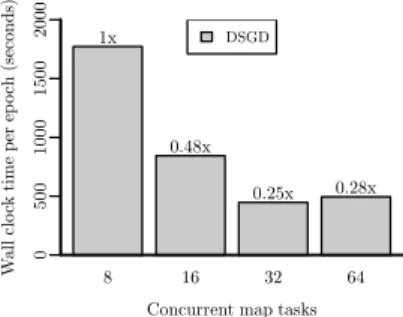
8 16 32 64 Concurrent map tasks
W all clo ck time per ep och (seconds) 0 500 1000 1500 2000 1x 0.48x 0.25x 0.28x DSGD
Figure 3: Speed-up experiment (Hadoop cluster, 143GB data)
Here, SGD required slightly fewer epochs than DSGD to converge. This discrepancy is a consequence of different randomizations of the training sequence: SGD shuffles the entire dataset, whereas DSGD shuffles only strata and blocks. The situation was reversed with respect to wall-clock time, and DSGD converged slightly faster than SGD. Most of DSGD’s processing time was spent on communica-tion of intermediate results over the (slow) centralized file system. Recent distributed processing platforms have the potential to reduce this latency and improve performance for moderately-sized data; we are currently experimenting with such platforms.
7.3
Scalability of DSGD
We next studied the scalability of DSGD in our Hadoop envi-ronment, which allowed us to process much larger matrices than on the in-memory R cluster. In general, we found that DSGD has good scalability properties on Hadoop, provided that the amount of data processed per map task does not become so small that system overheads start to dominate.
Figure 2c shows the wall-clock time per DSGD epoch for different dataset sizes (measured in number of nonzero entries ofV) and appropriately scaled numbers of concurrent map tasks (after @-sign). The processing time initially remains constant as the dataset size and number of concurrent tasks are each scaled up by a factor of 4. As we scale to very large datasets (572GB) on large clusters (80 parallel tasks), the overall runtime increases by a modest30%. This latter overhead can potentially be ameliorated by improving Hadoop’s scheduling mechanism, which was a major bottleneck.
A similar observation is made in Figure 3, where we depict the speedup performance when the number of ratings (nonzero entries) is fixed at 6.4B (143GB) and the number of concurrent map tasks is repeatedly doubled. DSGD initially achieves roughly linear speed-up speed-up to 32 concurrent tasks. After this point, speed-speed-up performance starts to degrade. The reason for this behavior is that, when the number of map tasks becomes large, the amount of data processed per task becomes small—e.g., 64-way DSGD uses642blocks so that the amount of data per block is only≈35MB. The actual time to execute DSGD on the data is swamped by Hadoop overheads, especially the time required to spawn tasks.
8.
CONCLUSION
We have developed a stratified version of the classic SGD al-gorithm and then refined this SSGD alal-gorithm to obtain DSGD, a distributed matrix-factorization algorithm that can efficiently handle web-scale matrices. Experiments indicate its superior performance. In future work, we plan to investigate alternative loss functions, such as GKL, as well as alternative regularizations. We also plan to investigate both alternative stratification schemes and emerging distributed-processing platforms. We will also extend our techniques to other applications, such as computing Kohonen maps.
9.
REFERENCES
[1] Apache Hadoop.https://hadoop.apache.org. [2] S. Asmussen.Applied Probability and Queues. Springer, 2nd
edition, 2003.
[3] J. Bennett and S. Lanning. The Netflix prize. InKDD Cup and Workshop, 2007.
[4] C. M. Bishop.Pattern Recognition and Machine Learning. Information Science and Statistics. Springer, 2007. [5] L. Bottou and O. Bousquet. The tradeoffs of large scale
learning. InNIPS, volume 20, pages 161–168. 2008. [6] R. H. Byrd, P. Lu, J. Nocedal, and C. Zhu. A limited memory
algorithm for bound constrained optimization.SIAM J. Sci. Comput., 16(5):1190–1208, 1995.
[7] Y. S. Chow and H. Teicher.Probability Theory: Independence, Interchangeability, Martingales. Springer, 2nd edition, 1988. [8] A. S. Das, M. Datar, A. Garg, and S. Rajaram. Google news
personalization: scalable online collaborative filtering. In WWW, pages 271–280, 2007.
[9] S. Das, Y. Sismanis, K. S. Beyer, R. Gemulla, P. J. Haas, and J. McPherson. Ricardo: Integrating R and Hadoop. In SIGMOD, pages 987–998, 2010.
[10] R. Gemulla, P. J. Haas, E. Nijkamp, and Y. Sismanis. Large-scale matrix factorization with distributed stochastic gradient descent. Technical Report RJ10481, IBM Almaden Research Center, San Jose, CA, 2011. Available at
www.almaden.ibm.com/cs/people/peterh/dsgdTechRep.pdf. [11] K. B. Hall, S. Gilpin, and G. Mann. MapReduce/Bigtable for
distributed optimization. InNIPS LCCC Workshop, 2010. [12] T. Hofmann. Probabilistic latent semantic indexing. InSIGIR,
pages 50–57, 1999.
[13] Y. Koren, R. Bell, and C. Volinsky. Matrix factorization techniques for recommender systems.IEEE Computer, 42(8):30–37, 2009.
[14] H. J. Kushner and G. Yin.Stochastic Approximation and Recursive Algorithms and Applications. Springer, 2nd edition, 2003.
[15] D. D. Lee and H. S. Seung. Learning the parts of objects by non-negative matrix factorization.Nature,
401(6755):788–791, 1999.
[16] C. Liu, H.-c. Yang, J. Fan, L.-W. He, and Y.-M. Wang. Distributed nonnegative matrix factorization for web-scale dyadic data analysis on mapreduce. InWWW, pages 681–690, 2010.
[17] G. Mann, R. McDonald, M. Mohri, N. Silberman, and D. Walker. Efficient large-scale distributed training of conditional maximum entropy models. InNIPC, pages 1231–1239. 2009.
[18] R. McDonald, K. Hall, and G. Mann. Distributed training strategies for the structured perceptron. InHLT, pages 456–464, 2010.
[19] A. P. Singh and G. J. Gordon. A unified view of matrix factorization models. InECML PKDD, pages 358–373, 2008. [20] Y. Zhou, D. Wilkinson, R. Schreiber, and R. Pan. Large-scale parallel collaborative filtering for the Netflix Prize. InAAIM, pages 337–348, 2008.
[21] M. A. Zinkevich, M. Weimer, A. J. Smola, and L. Li. Parallelized stochastic gradient descent. InNIPS, pages 2595–2603, 2010.