The European Company Survey 2009 on flexibility practices and social
dialogue is the second European-wide establishment survey to be undertaken
by Eurofound. The survey documents flexibility strategies in firms and is a
unique source of comparative information on social dialogue at the workplace.
According to management and employee representatives in 27,000 public
and private establishments across Europe, working time flexibility is the most
common type of flexibility available in European companies. More than half
of all establishments with 10 or more employees in the EU27 use some type of
flexi-time arrangement. This reflects a substantial increase on the situation four
years ago as measured in the first European Company Survey, which covered 21
countries.
The European Company Survey also looked at views and experiences regarding
workplace social dialogue. The survey found that six out of ten employees in
Europe are covered by some form of recognised employee representation. The
findings paint a picture of robust practices of workplace social dialogue in Europe,
while also pointing to limitations and important differences across Europe.
Overview
ISBN 978-92-897-0863-09 7 8 9 2 8 9 7 0 8 6 3 0 The European Foundation for the Improvement of Living and Working Conditions (Eurofound) is a tripartite EU body, whose role is to provide key actors in social policymaking with findings, knowledge and advice drawn from comparative research. Eurofound was established in 1975 by Council Regulation EEC No 1365/75 of 26 May 1975.
European Company Survey 2009
Sozialforschung, Munich, Germany: Chapter 2
Research institute: European Foundation for the Improvement of Living and Working Conditions
Research managers: Greet Vermeylen, David Foden, Agnès Parent-Thirion, Stavroula Demetriades, Branislav
Mikulić, Radoslaw Owczarzak, Felix Wolf, Eszter Sandor
Luxembourg: Office for Official Publications of the European Communities, 2010
ISBN 978-92-897-0863-0
© European Foundation for the Improvement of Living and Working Conditions, 2010
For rights of translation or reproduction, applications should be made to the Director, European Foundation for the Improvement of Living and Working Conditions, Wyattville Road, Loughlinstown, Dublin 18, Ireland.
The European Foundation for the Improvement of Living and Working Conditions is an autonomous body of the European Union, created to assist in the formulation of future policy on social and work-related matters. Further information can be found on the Eurofound website at www.eurofound.europa.eu.
European Foundation for the Improvement of Living and Working Conditions Wyattville Road Loughlinstown Dublin 18 Ireland Telephone: (+353 1) 204 31 00 Fax: (+353 1) 282 42 09 / 282 64 56 Email: [email protected] www.eurofound.europa.eu Printed in Denmark
The paper used in this book is chlorine-free and comes from managed forests in northern Europe. For every tree felled, at least one new tree is planted.
Improving labour market flexibility is one of the key elements of the Lisbon Strategy to make Europe more dynamic and competitive. Eurofound’s second European Company Survey (ECS) examines flexibility practices and social dialogue in 27,000 establishments throughout Europe. The survey finds that working time flexibility is the most common type of flexibility in European companies, showing a substantial increase compared with four years ago.
About two thirds of surveyed establishments use some form of contractual flexibility such as temporary agency work, fixed-term employment or freelance work. The majority of establishments regularly check the need for further training, which is a crucial aspect of functional flexibility and innovation. In addition, the survey considers wage flexibility through variable pay elements such as performance-related pay and financial participation, and attitudes to these; the global economic crisis is likely to cast such schemes in a new light.
The ECS also explores management and employee views and experiences regarding workplace social dialogue. Six out of 10 employees in Europe are represented by a trade union or works council. The survey findings paint a picture of robust practices of workplace social dialogue in Europe, but also point to limitations and to important country differences.
In a time of economic challenge, it is useful to investigate aspects of company performance. We trust that this overview report will contribute towards assessing and improving flexibility practices and social dialogue in Europe.
Jorma Karppinen Erika Mezger
NMS12 12 New Member States, 10 of which joined the EU in 2004 (Cyprus, the Czech Republic, Estonia,
Hungary, Latvia, Lithuania, Malta, Poland, Slovakia and Slovenia) – and are sometimes referred to as
the NMS10 – and the remaining two in 2007 (Bulgaria and Romania)
EU27
27 EU Member States
CC3
3 candidate countries (Croatia, the Former Yugoslav Republic of Macedonia and Turkey)
EU27
AT
Austria
LV
Latvia
BE
Belgium
LT
Lithuania
BG
Bulgaria
LU
Luxembourg
CY
Cyprus
MT
Malta
CZ
Czech Republic
NL
Netherlands
DK
Denmark
PL
Poland
EE
Estonia
PT
Portugal
FI
Finland
RO
Romania
FR
France
SK
Slovakia
DE
Germany
SI
Slovenia
EL
Greece
ES
Spain
HU
Hungary
SE
Sweden
IE
Ireland
UK
United Kingdom
IT
Italy
Candidate countries
HR
Croatia
MK
1The Former Yugoslav Republic of Macedonia
TR
Turkey
1 International Organization for Standardization (ISO) code 3166. Provisional code that does not prejudge in any way the definitive nomenclature for this country,
which will be agreed following the conclusion of negotiations currently taking place under the auspices of the United Nations (http://www.iso.org/iso/country_ codes/iso_3166_code_lists.htm).
Foreword
v
Executive summary
1
Introduction
3
Chapter 1: Working time flexibility
5
Flexitime arrangements
5
Overtime work
10
Part-time work
14
Non-standard working hours
20
Conclusion
21
Chapter 2: Human resources practices
23
Autonomous teamwork
23
Contractual flexibility
24
Further training
31
Chapter 3: Variable pay and financial participation schemes
33
Pay elements related to individual or group performance
33
Financial participation
36
Attitudes of employee representatives towards performance-related pay schemes
43
Chapter 4: Workplace social dialogue
45
Methodology
45
Profile of employee representation
46
Resources of employee representation
51
Processes of social dialogue
55
Impact and support
64
Chapter 5: Company performance
71
Performance indicators
71
Performance findings
73
Performance and training
80
Performance and pay
83
Conclusion
84
Bibliography
87
Annex 1: Survey methodology
89
Universe and sample
89
Fieldwork
89
Net sample – number of interviews per country
89
Establishment and employee proportional weighting of data
91
Annex 2: Management and employee representative questionnaires
93
Management questionnaire
93
Introduction
The second large-scale European-wide establishment survey launched by the European Foundation for the Improvement of Living and Working Conditions (Eurofound) – known as the European Company Survey 2009 (ECS 2009) – focuses on two topics in the field of company policies that are widely debated in the EU: flexibility practices and employee participation at the workplace.
Following on from the first Eurofound establishment survey in 2004–2005, the ECS 2009 was carried out across the 27 EU Member States and in the candidate countries of Croatia, the Former Yugoslav Republic of Macedonia and Turkey. In more than 27,000 establishments with 10 or more employees of both the private and the public sectors, human resources managers and employee representatives – where available – were interviewed about flexibility measures applied at the establishment and the involvement of employee representatives in their set-up. The survey covers different forms of working time flexibility (flexitime and working time account systems, part-time work, overtime work and work at unusual hours), the application of non-permanent employment contracts (external flexibility), aspects of wage flexibility as well as modes of enhancing the employability of staff for different tasks (functional flexibility).
Moreover, the survey investigates the general structures and practices of company-level employee representation in Europe, shedding light on the different channels of representation, on available resources and on the impact of social dialogue on company decisions in different areas. The findings provide a unique insight into the flexibility strategies of companies as well as into workplace social dialogue structures and practices.
Policy context
In the Lisbon Strategy, the EU set ambitious aims of making the European economy the most competitive and dynamic knowledge-based economy in the world, and of creating more and better jobs for the people in Europe. The enhancement of labour market flexibility and other forms of flexible work organisation are considered as key policy elements in this context. However, although generally favouring these practices, recent EU policies have also shown concern about the potential negative aspects of flexibility measures on the inclusiveness of labour markets and on the working conditions of employees. This is reflected in a series of EU framework legislation and recommendations, for example, on the quality of part-time work, on temporary agency work and on financial participation. Such concern is also apparent in the emphasis put on the importance of employee participation in decision-making at workplace level. Employee participation,
whether directly by employees or through institutionalised representation structures, is considered to play a crucial role in shaping flexibility measures and working conditions more generally at the level of the establishment.
Key findings
The ECS 2009 shows that companies in Europe apply a broad range of flexibility measures. Generally, these are not applied in isolation, but are combined with each other. Although none of the measures is exclusive to specific geographic regions or sectors of economic activity, some pronounced regional and sectoral differences emerge regarding their application. Working time flexibility is the most widely used form of flexibility investigated in the ECS and its use has further increased in recent years. It is most prevalent in the Nordic and Continental countries. Southern European establishments make much less use of instruments such as part-time work, flexitime arrangements and overtime work. While part-time work clearly prevails in the services sector and is often found among largely female workforces, other forms of working time flexibility are less concentrated in specific sectors. In a considerable proportion of establishments all over Europe, employees work in non-permanent contractual arrangements – temporary agency workers, freelancers or employees on fixed-term contracts – with large regional variations regarding the use of the different forms. The proportion of the workforce affected by non-permanent contractual arrangements is however relatively small in all countries.
The flexibility potential of companies can also be increased by enhancing the employability of staff for different tasks, for example by task rotation, autonomous teamwork or further training. The survey shows that a majority of European establishments recognise the importance of further training. This pays off: enterprises regularly monitoring the training needs of employees rated better than others in terms of economic performance, labour productivity and staff motivation. However, training is not equally distributed among all workers.
Variable performance or profit-related elements of pay is another option for companies in flexibly adapting to changing market conditions. While the EU has encouraged some of these schemes, only a minority of European establishments make use of them. Findings show that the incidence tends to increase with company size. Where such schemes are used, staff motivation and productivity increases are the dominant motives, while wage flexibility plays only a minor role. Performance or profit-related pay schemes proved to
be positively correlated with the reported economic situation and labour productivity.
Social dialogue structures and practices in European establishments are the other main topics of the survey. Overall, the results show an encouraging picture of workplace employee representation, with a majority of employees in the EU being covered by a statutory form of employee representation and by a collective wage agreement at either the establishment or a higher level. A total of 86% of these representational structures have a trade union link, while 63% of them have a union majority. Furthermore, the majority of employee representatives have access to vital resources such as training measures, information on the economic and employment situation of the establishment, and enough time off from their normal work to fulfil their representative duties. A majority of employee representatives and managers are generally positive about the effects and climate of social dialogue at the workplace.
However, the survey also identifies some limitations of social dialogue structures and practices at the workplace. For example, a significant minority of workplace representatives do not receive sufficient information and are not granted time off to properly fulfil their representative duties. Moreover, in a range of establishments, employee representation is limited to health and safety matters. A less developed implementation of social dialogue structures and different, more confrontational processes of statutory employee participation can be distinguished in southern European countries.
The influence of workplace employee representation on the diverse flexibility practices varies. While a majority of representatives are involved in the establishment of rules and procedures related to working time issues, the influence
on contractual arrangements and other human resources measures is much more limited. For example, many of the applied profit-sharing schemes are not co-determined by the employee representatives.
Commentary
The findings reveal a remarkable variety in the application of flexibility measures across Europe. These originate not only in different national company cultures and frameworks, but also in the channels and quality of social dialogue at workplace level. Although the survey findings point to a generally positive picture of social dialogue structures and practices, it also becomes apparent that employee representation at workplace level differs widely between countries and also between large and small organisations. Directive 2002/14/ EC establishing a general framework for informing and consulting employees in the European Community has been a landmark development in establishing common guidelines for employee participation in the workplace. Nevertheless, in view of the importance of decisions made at company level in shaping flexibility measures and working conditions, the topic of employee participation is likely to remain on the policy agenda.
The current economic crisis had already begun when fieldwork for the survey was conducted in the spring of 2009. This is likely to have had an impact on some of the indicators, such as the extent of flexible contractual arrangements. Among other effects, the economic crisis may cast new light on financial participation schemes based on share ownership, which might now appear more attractive for employers seeking capital but might also appear to be of greater risk to employees.
In the spring of 2009, the European Foundation for the Improvement of Living and Working Conditions (Eurofound) launched a large-scale representative survey addressed to managers and employee representatives. The European Company Survey 2009 – Flexibility practices and social dialogue (ECS) is the second cross-country establishment survey carried out by Eurofound in recent years. The ECS is focused on documenting the flexibility strategies of companies and it is a unique source of comparative information on social dialogue at the workplace.
The European Union considers the enhancement of labour market flexibility as one of the key elements required to achieve the aims of the Lisbon Strategy, namely to become the most competitive and dynamic knowledge-based economy in the world, and to create more and better jobs for European citizens. At the same time, the EU is concerned that flexibility measures do not become too one-sided at the expense of employees. Therefore, in recent years, a series of framework laws and recommendations were enacted which set rules for major flexibility instruments as well as for the consultation and participation of employees in matters related to work organisation.
Previous research at Eurofound has shown that companies use different flexibility practices not in isolation but in combination. The survey studies different measures of internal and external quantitative and qualitative flexibility. A total of four different categories of flexibility can be distinguished (see Chung et al, 2007, p. 5):
• external numerical flexibility – referring to the number of workers employed from the external labour market. A crucial aspect of this flexibility type is the employment of workers on a temporary basis, be it through the employment of temporary personnel or relaxed hiring and firing practices. Some of these jobs might be a stepping stone into permanent employment or suit the needs of the employee;
• internal numerical flexibility – referring to flexibility in relation to the workers already employed in the organisation. This is achieved by adjusting working hours to match the quantity of labour without hiring new or dismissing existing staff. It might also stem from a demand from employees to adjust their working hours to suit their private needs;
• functional flexibility – referring to the extent to which enterprises adapt their work organisation to changes and
new challenges by transferring employees to different activities and tasks within the company. The way that work is organised, for instance by using autonomous teamwork, might have a positive impact on learning at the workplace and enhancing the employability of the worker;
• wage flexibility – defined as the degree of responsiveness of wage costs to economic conditions. It might also be used as an incentive to motivate workers, to reward them for good work or to share the profits of a company with the employees.
Social dialogue is vital to managing business and employment change in the European social model. In order to address these challenges, the ECS interviewed managers as well as employee representatives, where possible, to gain insights into the structure and role of social dialogue at company level. The survey also maps flexibility measures and strategies, and the role of social dialogue in establishing them.1
Against this background, Eurofound launched the ECS in 2008–2009 in all 27 EU Member States (EU27) as well as in the three candidate countries (CC3): Croatia, the Former Yugoslav Republic of Macedonia and Turkey. It covers establishments with 10 or more employees in both the private and the public sector from all relevant economic sectors except agriculture and forestry.2 As part of the survey, personnel managers in 27,160 establishments were interviewed about a set of flexibility practices applied at company level, including different working time practices, variable pay schemes and contractual employment agreements. The managers were also questioned about social dialogue structures, and some information on company performance was collected. At the same time, in those establishments where a formal employee representation existed and was available for interview – amounting to a total of 6,569 units – the chair of this body was asked for the position of the employee representation on the various flexibility forms considered in the management interview. In addition, the survey posed some general questions on the resources of the employee representation and its degree of involvement in different work-related matters in this context.3
Fieldwork for the survey was carried out in the spring of 2009 – mostly March to April. At that time, the current global economic crisis had already begun, although some countries and sectors were more affected than others. When
2 Also not included are sectors NACE Rev.1.1 P (private households with employed persons) and NACE Q (extra-territorial organisations and bodies), according to
the General industrial classification of economic activities within the European Communities (Nomenclature générale des activités économiques dans les Communautés européennes, NACE). These are both sectors of negligible size in relation to the company sample size of 10 or more employees.
interpreting the results, it should be noted that the crisis and its timing has an impact on some of the indicators. This is especially apparent in the questions on flexible forms of contractual agreements or in indicators related to the current economic situation. In these areas, the crisis might distort some results, by showing for example smaller proportions of workers in atypical employment contracts than in the months and years before.
Where not explicitly stated otherwise, results shown in this report are proportionally weighted according to establishment. They represent the real distribution of establishments with 10 or more employees in the countries surveyed. It should be noted that averages tend to reflect the situation in small enterprises (with 10 to 49 employees) more than that in the larger companies since the broad majority of establishments are small in size. Furthermore, EU averages tend to reflect the situation in the large countries more than that in the smaller ones.
This overview report first provides a descriptive analysis of the flexibility indicators covered in the survey. Chapter 1 focuses on the indicators collected for working time flexibility:
flexible working time arrangements, overtime work, part-time work and work at unusual hours. Chapter 2 considers human resources (HR) practices, such as autonomous teamwork, contractual flexibility and training.
The third chapter examines variable pay and financial participation. It looks at profit-sharing schemes as well as share-ownership schemes. It also explores attitudes towards performance-related pay.
Social dialogue and employee participation are introduced in the fourth chapter, which outlines general aspects related to the structure and resources of establishment-level employee representation. It then examines the degree of influence of the employee representation on company decisions related to working conditions and on the application and shape of flexibility measures in particular.
Finally, Chapter 5 considers company performance indicators and assesses them in the context of the economic crisis. It also explores the link between performance and training, as well as between performance and pay practices.
1
The ECS 2009 considers a range of flexibility practices atestablishment level, starting with different forms of working time flexibility. In the survey, data were collected for the following flexible or atypical working time arrangements:
• flexitime arrangements, including working time accounts;
• overtime work;
• part-time work;
• non-standard working hours and shift work.
The survey tackled each of these forms of working time flexibility, focusing on an approximate quantification of their usage and further aspects regarding their application.
Flexitime arrangements
Flexitime arrangements can generally be divided into two groups. On the one hand, there are basic flexitime arrangements which allow employees to vary the start and end time of work on a day-to-day basis, but do not allow for variations in the length of the daily work schedule. On the other hand, there are more advanced schemes in which flexitime regulations are combined with a so-called (working) time account. These allow for a much broader variability of working times, including variations in the length of the working day or week. Hours worked above the contractually or collectively agreed amount are banked as ‘credit hours’, while working hours falling below that amount are considered as ‘debit hours’. Differences between the agreed and the factual working time usually have to be balanced out within a certain reference period, the length of which varies considerably from company to company. Some systems require a monthly balancing while others have to be settled on an annual basis only. There are also systems where no reference period has been specified or where the working time accounts explicitly have a ‘lifelong’ horizon, enabling employees to bank time for the purpose of early or phased retirement or for sabbaticals.
Flexitime schemes with the possibility to bank hours are frequently considered as a type of flexibility that can meet the interests of both employers and employees. For employers, the instrument opens up a broad range of flexibility in the management of all types of workload variations, enabling them to react flexibly to changing market conditions. The broader the leeway for the accumulation of working hours, the larger the flexibility gains for the employer tend to be. For employees, the benefits consist mainly of an increase in their time sovereignty and the possibility to improve their work–life balance.
Whether a flexitime scheme is more beneficial for the employer or for the employee, or whether both benefit equally from it, depends to a large degree on the rules set for the handling of the system and the extent to which these are put into practice in the day-to-day business. If there is a sound balance between the interests of the employer and those of the employees, allowing employees to take time off from the account when they need it and allowing the employer to count on the additional performance of the employee in times of high work pressure, then these systems can be considered as a ‘win-win situation’ for both parties. The previous wave of the establishment survey conducted by Eurofound in 2004–2005 – the Establishment Survey on Working Time and Work–life Balance (ESWT)4 – showed that both managers and employee representatives of companies practising flexitime schemes considered this as a positive form of work. About two thirds of both managers and employee representatives perceived a higher job satisfaction and a better adaptation of working times to the workload as a major outcome of the introduction of flexitime schemes in their organisation. The greater the leeway of the system applied in an establishment, the higher the level of satisfaction tended to be on both sides. Negative aspects, in turn, were rarely cited (Riedmann et al, 2006, p. 9).
Incidence and take-up of flexitime
The flexitime questions in the ECS 2009 were asked in incremental steps, starting with the existence of flexitime in a broad sense as the possibility to adapt, within certain limits, the time when they begin or finish their daily work according to their personal needs and wishes. Establishments offering such flexibility were then asked whether the applied system allows them to accumulate hours by working longer on some days and compensating for this later by working less on other days and, if so, whether the accumulated credit hours can be taken in the form of entire days off from work. Finally, the existence of long-term working time accounts was investigated, defined as accounts with a settlement period of more than one year.
On average, more than half (56%) of all establishments with 10 or more employees in the EU27 offer employees flexitime arrangements in the broad sense, including highly formalised working time account systems as well as more informal flexitime arrangements without the possibility to bank time. These flexible time arrangements are however not necessarily open to the entire workforce, but are sometimes restricted to specific groups of employees, such as clerical staff, employees in management positions or employees not working any shift scheme. In the establishments offering these schemes, 4 http://www.eurofound.europa.eu/surveys/companysurvey/2004/index.htm.
on average about two thirds of the workforce are entitled to make use of them. Thus, the flexibility schemes are an instrument open to the majority of workers. In almost half (45%) of all establishments practising such schemes, they are available to the entire workforce.
As Figure 1 shows, the average proportion of employees entitled to use the flexitime scheme on offer varies between about 45% and 75%, indicating that in all countries on average a substantial share of employees is included in the scheme. In countries where flexitime schemes are widespread at establishment level, the proportion of employees entitled to use the existing scheme tends to be higher than in countries where only few establishments are practising them. However, there are a few exceptions to this rule; for example, the Former Yugoslav Republic of Macedonia and Greece have a low incidence of establishments with flexitime schemes, but a high proportion of persons entitled to use them within these companies. No country has a take-up rate close to 100%. This finding points to the existence of some ‘natural’ limits in the application of flexitime schemes: for certain types of workplaces, the instrument is obviously considered as not adequate. A closer look at the data reveals that companies with atypical operating hours – those practising shift work, night work or weekend work – for example, more often limit the application of the flexitime scheme to subgroups of the establishment than enterprises which do not have such atypical operating hours. Furthermore, the schemes applied in the services sector are generally open to a broader part of the workforce than those in industry.
Incidence of flexitime schemes with time
accounts
Two thirds of the applied flexitime schemes are not restricted to flexibility regarding the start of the working day but also include the possibility to bank time in a working time account or a similar system. Taking all establishments with 10 or more employees as a base, this means that almost four out of 10 (38%) establishments have working time accounts. The flexitime schemes in just over three quarters of the establishments with a time account allow the workers to take off whole days from the accumulated time credits, thus indicating that the majority of time account schemes in operation are designed for broader flexibility. In relation to all establishments – that is, not only those with time banking – this means that 29% of all companies with 10 or more employees offer flexitime schemes with enough flexibility to allow for whole days to be taken off work.
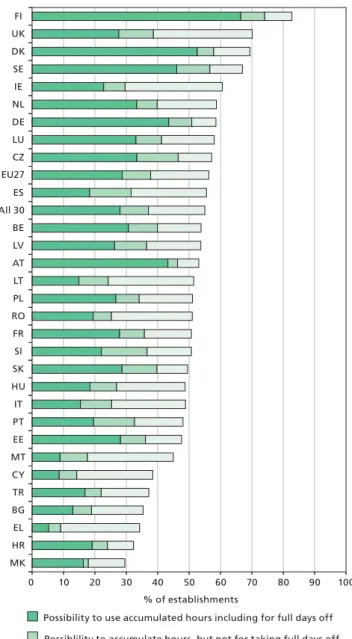
As Figure 2 shows, pronounced country differences emerge in both the general implementation of flexitime schemes and in the flexibility leeway that they allow to employees.
• Flexitime is most widespread in Finland, with more than eight out of 10 establishments practising a flexitime scheme. High shares of more than two thirds of establishments applying flexitime arrangements are also found in the United Kingdom (UK) (70%), Denmark (69%) and Sweden (67%).
Figure 1: Incidence and take-up rates of flexitime schemes, by country (%)
30 40 50 60 70 80 10 20 30 40 50 60 70 80 90
% of establishments practising flexitime
% o f e m p lo ye es e n ti tl ed t o u se s ch em e i n es ta b lis h m en ts o ff er in g t h em TR UK SE FI SK SI RO PT PL AT NL MT HU LU LT LV CY IT FR ES IE EE DE DK CZ BG BE HR EL MK All30 EU27
Notes: Base for x-axis = all establishments with 10 or more employees. Base for y-axis = establishments with 10 or more employees offering any flexitime scheme. See p. vi for list of country codes and groupings.
• In Bulgaria, Greece and the candidate countries (CC3), flexitime schemes are least widespread, with only about a third of establishments offering them.
Figure 2: Flexible working time arrangements, by country and flexibility scope (%)
0 10 20 30 40 50 60 70 80 90 100 FI UK DK SE IE NL DE LU CZ ES BE LV AT LT PL RO FR SI SK HU IT PT EE MT CY TR BG EL HR MK % of establishments
Possibility to use accumulated hours including for full days off Possiblility to accumulate hours, but not for taking full days off Possibility to vary start and end of daily work, but no accumulation of hours
EU27 All 30
Notes: Base = all establishments with 10 or more employees. The top end of the data bars shows the proportion of establishments using any type of flexitime scheme. The different legend keys show the scope of the applied schemes. In the EU27, for example, 56% of establishments use some form of flexitime scheme. This total comprises 28.7% using working time accounts with the possibility of taking whole days off (bottom of the column), plus 9% using accounts allowing just some hours to be taken off (middle of the column) and another 18.5% using basic flexitime schemes not allowing for time banking (top of the column).
Source: ECS 2009
• The schemes applied in the Nordic countries, in Germany and in Austria generally allow for very high flexibility, mostly including the possibility to bank hours and even take full days off from the accumulated time credits. In contrast, the schemes in Hungary, Ireland, Lithuania, the UK and most southern countries do not often allow for any time accumulation. Flexitime in those countries is more often limited to options regarding the start and end of daily work.
Long-term working time accounts
Long-term working time accounts offer the widest flexibility leeway. The ECS defined them as accounts allowing employees to accumulate hours for periods of more than one year on a so-called long-term time account. Within the EU27, only 6% of establishments with 10 or more employees offer such long-term time accounts (Figure 3). The highest incidence by far is measured in Denmark, where close to a third (30%) of all establishments with 10 or more employees offer such an account to at least some of the workers. Other countries with a significant proportion of establishments practising long-term accounts are Sweden (18%), Finland (13%), Germany (12%) and Austria (11%). In southern Europe and in most of the new Member States (NMS) that joined the EU in 2004 and 2007, on the other hand, long-term time accounts are seldom available.
These rates reflect only the proportion of establishments offering such schemes. They do not allow any conclusions on the share of employees entitled to use them. Even if the general flexitime model practised in the company is open to a majority or all employees, this does not automatically mean that long-term accounts are also open to everybody. Moreover, case studies carried out in the context of a German research project on the usage of long-term accounts have shown that even in establishments where these schemes are offered to all or most employees, only a minority of workers used them for long-term banking. Among these employees, there was an over-proportionally high share of older workers who used the accumulated hours for early retirement plans (Wotschack et al, 2008).
In the current economic crisis, many companies are using the accumulated hours in the working time accounts as a buffer for coping with – often substantially – reduced order volumes. Companies that were successful in the boom period preceding the economic crisis and have been practising long-term time accounts for several years may have accumulated a considerable amount of hours in these accounts. The clearance of working time accounts may help to avoid or at least postpone dismissals or the introduction of other far-reaching measures such as short-time work. Long-term working time accounts can thus have a certain
employment-securing effect and help the employer to avoid the loss of skilled workers.
The current economic crisis, however, also highlights some of the potential dangers related to the use of long-term working time accounts from the perspective of employees. Not all working time accounts are sufficiently secured against the risk of business failure. For the employees concerned, this means that, in case of company collapse, they not only lose their job but also the time credits accumulated in the account through long periods of overtime hours, without any compensation in the form of time off or money. Recent
research has shown that even in countries that have drawn up laws and rules for securing time accounts, these are often not implemented.5
Long-term time accounts – especially those with a lifelong perspective – are partly targeted at specific purposes. This could be plans for longer periods of further training, for sabbaticals dedicated to the care of dependent persons or – particularly in the case of older workers – for early retirement. In economically difficult times, employees may be urged to use up the accumulated time credits, thereby rendering long-term life plans void.
Trend developments in use of flexible working
time arrangements
The ECS 2009 repeated several of the questions on flexible working time arrangements that had been asked in the ESWT 2004–2005, thus allowing for the first time the observation of pan-European trends in the development of this flexibility arrangement at company level (Figure 4).
Figure 4: Incidence of flexibility schemes, 2004–2005 and 2009 (%)
0 10 20 30 40 50 60
Full days off Accumulation of hours Any flexibility
% of establishments in 21 countries ESWT 2004–2005 ECS 2009
Notes: Base = all establishments with 10 or more employees from the 21 countries covered by the ESWT. The 21 countries included in this comparison are the 15 Member States before EU
enlargement (EU15) and six of the NMS: CY, CZ, HU, LV, PL and SI.
Sources: ESWT 2004–2005 and ECS 2009
The comparison shows that on all levels measured by the trend questions, the proportion of companies making use of flexitime schemes has notably increased in the past four years.
5 For example, according to the German IAB Establishment Panel, conducted by the Institute for Employment Research (Institut für Arbeitsmarkt- und Berufsforschung,
IAB), in 2006 only a third of the German establishments – with at least one dependent employee liable to social security contributions – offering separate long-term working time accounts had secured these accounts against business failure or were planning to do so (Fischer et al, 2007, p. 83). Smaller companies in particular had often not (yet) made provisions. In Germany, protection against bankruptcy is obligatory only for certain types of long-term accounts – those managed in monetary terms and targeted at specific purposes. Nonetheless, the high proportion of unprotected accounts calls for attention to this matter.
Figure 3: Establishments offering long-term time accounts, by country (%) DK SE FI DE AT NL LU SI EU27 All 30 BE FR LT TR RO HR ES LV UK MK BG CZ EE IT PL PT SK CY EL IE HU MT 0 5 10 15 20 25 30 35
Note: Base = all establishments with 10 or more employees.
• According to the ESWT, almost every second establishment (48%) with 10 or more employees across the 21 EU Member States surveyed offered employees some type of flexibility regarding the beginning and end of daily working time. This proportion has increased to 57% in the ECS 2009 in the same set of 21 countries.
• In the ESWT, almost one third (32%) of the establishments offered schemes with the possibility of accumulating hours in some type of working time account. The ECS 2009 finds a significant increase of seven percentage points in this regard, with 39% of establishments now offering working time arrangements of this kind.
• The ESWT identified that every fourth establishment (25%) provided working time accounts allowing for an even greater degree of flexibility, measured by the possibility to take full days off from the account as compensation for credit hours. In the ECS 2009, the proportion of establishments in these 21 countries offering this broader flexibility has risen to 29%. These trend results show that in the 21 Member States where trends can be observed, there has been substantial progress in the further spread of this form of internal flexibility over the past four years. Figure 5 shows an increase in the use of arrangements allowing for an accumulation of working hours in all countries except for Greece, Ireland, Latvia and Poland, where the level has remained about the same over the past four years.6 Particularly high increases were reported in Portugal, Finland, Denmark and Belgium. Considerable increments were also found in the Netherlands, Spain and the UK. In Finland and Denmark, a high proportion of establishments were already using working time systems allowing for the accumulation of hours in 2004. By way of contrast, Portugal measured a very low level in 2004 but is now in the medium range. The Netherlands and Belgium also had comparatively low levels in 2004 and are now among the countries where time banking systems are widespread, with 40% of establishments using them.
Regarding the proportion of employees entitled to use the flexible schemes, there is little difference between the ESWT and the ECS. According to both surveys, on average about two thirds of the workforce are entitled to make use of the flexitime scheme in the establishment where it is offered.
Figure 5: Flexible working time arrangements with possibility to accumulate hours, by country 2004–2005 and 2009 (%) % of establishments in 21 countries ESWT 2004–2005 ECS 2009 0 10 20 30 40 50 60 70 80 BE CZ DK DE IE EL ES FR IT CY LV LU HU NL AT PL PT SI FI SE UK All 21
Note: Base = all establishments with 10 or more employees from the 21 countries covered by the ESWT.
Sources: ESWT 2004–2005 and ECS 2009
6 The slight decreases in Poland, Latvia and Greece visible in the graph do not necessarily indicate a real decline in the use of these schemes. In samples of 500 or
Characteristics of establishments offering
flexitime schemes
The use of flexitime schemes – both with and without working time accounts – is not restricted to particular sectors of economic activity. Even sectors such as wholesale and retail trade and repair of goods, or hotels and restaurants – where availability for clients at specified times is an important requirement – have introduced flexitime schemes to a significant extent (Table 1). There are nevertheless some differences in the application of this instrument, with the largest concentration of flexible working time arrangements in real estate and business activities, in financial intermediation, and in other community, social and personal services. Flexitime schemes were found to be least common in the construction and education sectors.
Larger establishments are more likely to practise flexitime schemes than smaller enterprises, regardless of the degree of flexibility that the system offers. However, a notable proportion of smaller establishments also practise flexitime schemes – even the more complex arrangements allowing for time banking. In view of the considerable investment required for the set-up and administration of a time account system, this is remarkable and is a sign that, even in small enterprises where the investment of running a time banking system is comparatively high per employee, employers consider the advantages of these schemes to clearly outweigh the costs. Long-term time accounts, however, are only rarely applied in smaller units: while 12% of the establishments with 500
or more employees practise long-term accounts, only 5% of those in the smallest size class of 10 to 19 employees do so (Figure 6).
All investigated types of flexitime schemes are applied more often by establishments for which major variations of the workload within the day, within a working week or within the year are part of the normal business than by enterprises normally not having to cope with any such variations. Differences are however relatively small, of about five percentage points. For the application of long-term working time accounts, the existence of regular variations in the workload plays an even smaller role.
Overtime work
The most traditional company strategy to cope with temporary workload peaks is the use of overtime hours. This normally means that the contractually or collectively agreed number of daily or weekly working hours – and thus the overall volume of working hours – is temporarily extended, enabling the establishment to cope with workload peaks without having to recruit and train additional staff.
In the ECS, managers were asked about the occurrence of overtime in the past 12 months as well as about the type of compensation granted for it. For staff with flexible working time arrangements allowing for time banking, only the time credits remaining in the working time accounts at the end
Table 1: Establishments with flexitime schemes, by sector, EU27 (%)
Economic sector Basic flexibility Possibility to
accumulate hours
Possibility to take
whole days off Long-term accounts
Manufacturing and energy 52 35 27 5
Construction 43 27 20 4
All industry sectors 50 33 25 5
Wholesale and retail trade, repair of goods 54 34 26 5
Hotels and restaurants 63 37 28 8
Transport and communication 52 31 24 5
Financial intermediation 69 50 40 6
Real estate and business activities 70 48 35 8
Public administration 63 50 38 5
Education 46 31 22 3
Health and social work 55 40 29 6
Other community, social and personal services 69 51 43 6
All services sectors 59 41 30 6
All sectors 56 38 29 6
Note: Base = all establishments with 10 or more employees in the EU27.
of the agreed adjustment period were to be considered as overtime hours.
Incidence of overtime work
In just over two thirds (68%) of establishments in the EU, overtime hours according to this definition were worked in the reference period (Figure 7). Within the establishments that had worked any kind of overtime, on average almost half of all employees were involved in overtime work. However, this average value conceals large differences between enterprises. While 29% of the establishments had less than 20% of their workforce doing overtime hours, in a similar proportion of companies (26%) all or almost all of the employees were involved (80% or more). The ECS did not collect data on the overall volume of overtime in terms of number of hours since many establishments would not be able to give a precise figure on this, especially not ad hoc in a telephone interview. At national level, establishments in particularly Germany, the Netherlands, the Nordic countries, Ireland, France and the UK resorted to overtime more than establishments in southern Europe and in the central and eastern European NMS. The Czech Republic, Malta and Italy, however, are exceptions to this rule, with greater proportions of overtime than the EU average of 68%.7 Data from the ESWT 2004– 2005 showed similar country patterns, with Germany and Ireland having the highest proportion of establishments
7 Country differences in the measurement of overtime incidence in the ECS
do not necessarily always reflect general differences regarding the attitude towards overtime. Its occurrence is also influenced by variations in the economic cycle. In countries booming at the time of the survey, overtime is more likely to occur than in countries with a less favourable economic situation. Nonetheless, the national results for overtime work measured four years ago in the ESWT are very similar, indicating that the country patterns in the use of overtime do not just result from differences in the economic situation.
Figure 6: Flexitime schemes, by company size, EU27 (%)
0 10 20 30 40 50 60 70 80
10–19 employees 20–49 employees 50–249 employees 250–499 employees 500 or more
employees All size classes
% o f e st ab lis h m en ts
Basic flexitime Flexitime scheme with
accumulation of hours Flexitime scheme with accumulation of hours including for full days off Long-term time accounts (time banking for periods > 1 year) Note: Base = all establishments with 10 or more employees in the EU27.
Source: ECS 2009
Figure 7: Establishments with overtime work in the 12 months to spring 2009 (%) 0 10 20 30 40 50 60 70 80 90 100 DE NL FI DK SE IE FR UK CZ MT IT AT LU BE EU27 All 30 CY SI SK PL HR TR RO HU EE ES EL PT LV MK LT BG % of establishments
Note: Base = all establishments with 10 or more employees.
doing overtime work and most southern European Member States practising this work form to a lesser extent.
Overtime work is relatively evenly spread across the different sectors of economic activity. In practically all sectors, about two thirds (between 61% and 74%) of establishments had practised this work form in the past 12 months. Larger enterprises were slightly more likely to avail of overtime than smaller companies. On the other hand, overtime in the larger establishments on average affected a smaller part of the workforce within the establishment.
Compensation of overtime hours
The traditional way of compensating overtime is payment in monetary terms, by an extra hourly wage for each additional hour paid on top of the monthly salary – be it with or without any additional overtime bonus payments. The ECS 2009 results show that payment for overtime hours is still the prevailing form of compensation: just over one third (35%) of establishments in the EU generally compensate overtime work in monetary terms. Almost a quarter (23%) of establishments offer compensation by time off as a general rule. In addition to these two exclusive alternatives, organisations more commonly offer both types of compensation: 37% of establishments indicated that they compensate overtime hours by time off or by pay. This does not necessarily mean that employees can freely choose between both forms – it is also possible that some groups of employees generally receive monetary compensation while others are compensated by time off, or that overtime hours up to a certain threshold are compensated by time off while hours beyond that threshold are compensated by payments. In a small minority of 4% of all establishments with overtime hours in the reference period, overtime work is generally not compensated at all. This practice is almost non-existent in the manufacturing sector (2%), but is somewhat more common in services (5%) and especially in the sectors of real estate and business activities (8%) and education (7%). This form of ‘compensation’ is evidently the least favourable one from the perspective of the employees. With regard to well-earning employees in higher positions, however, a certain amount of overtime is often expected and included in the salary. Indeed, most of the establishments indicating that they do not compensate overtime hours in the ECS have a high proportion of employees working in highly skilled positions. Among establishments with fewer than 20% of workers in highly skilled positions, only 2% of the enterprises generally do not compensate overtime hours; however, this proportion increases in line with the share of skilled workers,
reaching 9% in establishments where 80% or more of the positions were classified as high-skilled.8
In the services sector, compensation with time off as a general rule is much more frequent than in industry (27% compared with 14%), whereas in industry, payment of overtime hours is more prevalent (46% compared with 30%).
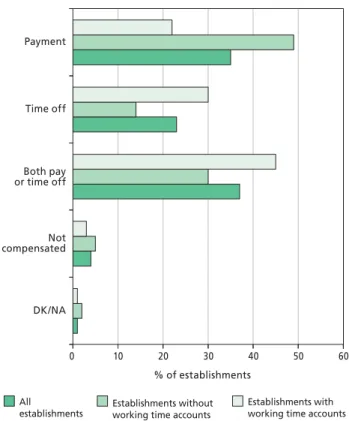
A comparison of the forms of overtime compensation between establishments offering working time accounts and those not using them shows pronounced differences between the two groups. While almost half (49%) of all establishments without time banking options generally compensate overtime hours with pay, less than a quarter (22%) of enterprises with time accounts do so (Figure 8). Accordingly, time off is the sole form of compensation in only 14% of establishments without time banking but this is the case in almost a third (30%) of companies practising such a system. Nonetheless, the most frequent mode of compensation in establishments practising time banking is the application of both pay and time off.
Figure 8: Forms of compensation for overtime hours in establishments with and without working time accounts, EU27 (%)
0 10 20 30 40 50 60 DK/NA Not compensated Both pay or time off Time off Payment % of establishments All
establishments Establishments without working time accounts
Establishments with working time accounts
Notes: Base = all establishments with 10 employees or more availing of overtime work in the past 12 months in the EU27. DK/ NA = Don’t know/No answer.
Source: ECS 2009
8 This pattern is however not uniform throughout all of the countries. In Hungary and Lithuania, for example, there is no clear correlation between the proportion
Significant differences exist between countries with regard to the compensation of overtime hours.9 In German establishments, the compensation of overtime hours by time off is most widespread at company level, with almost half of the establishments (46%) compensating overtime solely in this manner (Figure 9). Other countries with high proportions of establishments offering this form of compensation as a general rule are Belgium, Luxembourg, Denmark and Romania. In most Mediterranean countries, with the notable exception of Spain, this form of compensating overtime is least common, with only 3% of establishments in Malta, 4% in Italy and 7% in Greece and Cyprus practising it as a general rule. In these countries, both forms of compensation are rarely applied. Instead, compensation in the form of payment prevails. Generally, payment as the sole form of compensation for overtime is also widespread in most central and eastern European Member States as well as in the UK. Establishments not compensating overtime hours were most frequently reported in the Netherlands (14%) and Lithuania (11%). Belgium (8%), Hungary and Germany (6% each) also have above average shares of establishments that do not compensate overtime work at all.
From both a flexibility and work–life balance perspective, overtime hours compensated with time off differ substantially from overtime hours compensated in a monetary form. In establishments not practising any working time account system, overtime hours compensated by time off can be regarded as a kind of interim measure between classical overtime work – compensated in monetary terms – and time account systems. Employees compensated by time off do not in the long run work more hours. For the employer, the practice of compensating overtime hours with time off has clear advantages: if the time off is taken in periods of low workloads during which otherwise ‘idle’ hours would have to be paid, the overtime hours do not lead to any additional costs. In terms of work–life balance, furthermore, this form of overtime tends to be more favourable than paid overtime. However, the possibilities for employees to decide on when to work overtime and when to take time off are likely to be much more limited than in working time account systems with established rules. In addition, for some groups of workers – especially those whose basic salaries are very low – overtime payments might be an essential part of their income and thus be their preferred form of compensation.
Figure 9: Forms of overtime compensation, by country (%)
0 10 20 30 40 50 60 70 80 90 100 DE BE NL DK AT SE LU RO FI SI EU 27 All30 CZ ES FR SK IE BG PT PL LT EE HU UK HR LV MK TR IT CY EL MT % of establishments
Time off DK/NA Not compensated Both pay or time off Payment
Note: Base = all establishments with 10 employees or more availing of overtime work in the past 12 months. DK/NA = Don’t know/No answer.
Source: ECS 2009
9 The observed country patterns in the practice of overtime compensation largely remain the same if the analysis is limited to establishments not practising any
Part-time work
Part-time work is one of the most widely known forms of non-standard working time arrangements in Europe. It allows establishments to adapt the workforce to variations in the workload within a day or week and is also often considered as being favourable for employees since it tends to facilitate the combination of work with family or household obligations.
EU Council Directive 97/81/EC10 concerning the Framework Agreement on part-time work concluded by the European social partners made provisions for eliminating the discrimination of part-time workers and improving the quality of part-time work. Nevertheless, the framework conditions set for part-time work vary between countries. The quality of part-time employment from a work–life balance perspective depends to a large degree on the specific conditions under which part-time jobs are offered and the way that such work is practised in the establishments.
The main focus of the ECS with regard to part-time work is not to provide statistical data on its incidence – these figures are already available from the Labour Force Survey. Instead, the ECS tries to explore the nature of the part-time work offered within an establishment by investigating selected aspects of the organisation of part-time work and by gauging the quality of the part-time employment on offer. In addition, the survey considers the significance of part-time work within the set of flexibility strategies that establishments implement to adapt to changing market situations.
Establishments using part-time work
In the ECS 2009, the incidence of part-time work was measured from the establishment perspective by asking for an approximate indication of the proportion of part-time workers among the workforce. This question makes it possible to distinguish between three groups of establishments:
• establishments with no part-time workers;
• establishments with a low proportion of part-time workers only – less than 20% of the workforce;
• establishments employing a substantial proportion of part-time workers, amounting to 20% or more of the workforce.
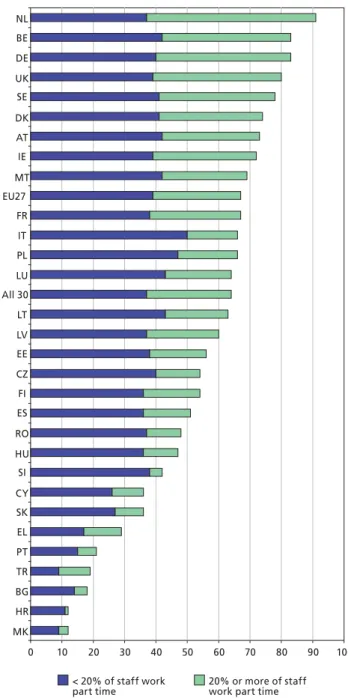
Overall, two thirds (67%) of all establishments with 10 or more employees in the EU currently employ at least one employee on a part-time basis (Figure 10). However, the proportion of establishments using part-time work varies enormously between countries. The Netherlands has the most widespread use of part-time work, with 91% of establishments with 10
or more employees currently employing some people on a part-time basis. Other countries with a very high proportion of more than three quarters of establishments applying part-time work are Belgium, Germany, the UK and Sweden. Part-time work is least common in establishments in the CC3, as well as in Bulgaria, Slovakia and the smaller of the southern European Member States (Portugal, Greece and Cyprus).
Figure 10: Establishments practising part-time work, by country and proportion of part-time staff (%)
0 10 20 30 40 50 60 70 80 90 100 NL BE DE UK SE DK AT IE MT EU27 FR IT PL LU All 30 LT LV EE CZ FI ES RO HU SI CY SK EL PT TR BG HR MK < 20% of staff work
part time 20% or more of staff work part time Note: Base = all establishments with 10 or more employees.
Source: ECS 2009
When limiting the ECS sample to the 21 countries that were part of the ESWT 2004–2005 and comparing both surveys, a slight increase can be observed in the proportion of establishments using this work form, from 64% in 2004–2005 to 69% in 2009. This trend is found in almost all of the 21 Member States under study, but it is strongest in the southern European countries and in Slovenia and Luxembourg. In Poland, on the other hand, the proportion of establishments using this work form has slightly decreased.
The sectors of economic activity where part-time work is most widespread at company level are all within the services sector. Moreover, establishments in which a substantial proportion of personnel work part time – defined for this study as 20% or more – are heavily concentrated in the services sector, especially in hotels and restaurants, education, health and social work, and other community, social and personal services (Figure 11). These are also the sectors with the highest proportion of female employees in the workforce. As the analysis of the ESWT 2004–2005 showed, in a large number of companies, part-time work occurs exclusively among women, with as many as 55% of establishments with this form of work not having a single man among their part-time workforce (see Anxo et al, 2007, p. 26).
Patterns of part-time work
Part-time work can be organised in different ways. The manner in which it is organised is an important determinant for qualitatively evaluating part-time work practices. The most common method of organising part-time work in European establishments is still the traditional approach, with some fixed hours being worked every day. In four out of five establishments (78%) where part-time work is practised, it is at least partly organised in this way (Table 2).
Close to half (45%) of all establishments with part-time workers, however, also offer other fixed cycles, for example full-time hours on some days and full days off on other days. Both forms of organisation can be considered as being rather employee-friendly, with fixed schedules and thus a certain predictability. For the establishment, however, the flexibility gain – as compared to standard full-time employment – is limited in these forms of part-time organisation. It mainly consists of the possibility to reinforce the work teams with additional personnel during regularly occurring and largely foreseeable workload peak times. In addition, part-time work allows for the employment of adequately skilled personnel for tasks where there is not enough work to employ somebody on a full-time basis.
Figure 11: Part-time work, by sector, EU27 (%)
0 10 20 30 40 50 60 70 80 90
Construction Manufacturing and energy Transport and communication Wholesale and retail trade, repair of goods Public administration All sectors Real estate and business activities Hotels and restaurants Financial intermediation Other community, social and personal services Health and social work Education
% of establishments
< 20% of staff work part time 20% or more of staff work part time Note: Base = all establishments with 10 or more employees in the EU27.
Table 2: Organisation of part-time work, by country (%) Some fixed daily working hours Other fixed cycles Flexible working hours on demand Other forms AT 83 36 33 10 BE 65 73 29 18 BG 72 29 34 23 CY 78 42 41 15 CZ 78 25 31 18 DE 80 47 47 17 DK 81 57 35 15 EE 49 38 26 24 EL 75 38 25 2 ES 87 20 34 9 FI 45 54 45 36 FR 76 52 25 13 HU 79 29 23 9 IE 73 69 53 18 IT 88 23 17 3 LT 79 35 26 6 LU 72 57 38 10 LV 64 49 48 10 MT 61 30 56 7 NL 67 87 30 14 PL 81 32 21 9 PT 74 15 26 5 RO 84 18 28 3 SE 72 60 34 18 SI 80 12 16 7 SK 82 13 20 6 UK 76 56 48 16 HR 45 12 16 32 MK 81 32 40 13 TR 75 53 57 27 EU27 78 45 35 13 All 30 countries 78 45 36 13
Note: Base = establishments with 10 employees or more with part-time staff.
Source: ECS 2009
Slightly more than a third (35%) of enterprises, however, organise at least some of the part-time jobs as flexible working hours which are fixed only a few days or hours in advance according to the establishments’ needs. Some groups of part-time workers – for example, students – may have more flexibility leeway than others and might even prefer a certain spontaneity regarding their work schedule. However, this form of part-time work is normally the least favourable for employees since it requires them to organise their private duties flexibly on an ad hoc basis around the work schedules. Moreover, this part-time work form makes it very difficult to combine different part-time work arrangements with each other, an aspect which is especially important if a person works part time involuntarily due to not
finding a full-time job and seeks to combine different part-time jobs in order to have a sufficient income. From the point of view of the employer, nonetheless, this form of part-time work offers the widest range of flexibility since it allows the establishment to adapt the workforce at very short notice to the actual workload.
Other forms of part-time organisation than those mentioned here are practised by 13% of establishments. These other forms can be, for example, full-time work for several months with part-time payment – for instance, in the context of a partial retirement scheme – alternating with time off, or flexible part-time work schedules where it is mostly the employee and not the employer who determines the schedules according to his or her own needs.
When comparing the organisation of part-time work at national level, some differences emerge in regional patterns. While the traditional form of part-time work for some hours each day is overall by far the most widespread form, in the Netherlands, Finland and Belgium other fixed cycles slightly prevail (Table 2). Flexible part-time work on demand is most frequently found in Turkey (in 57% of establishments with part-time workers), Malta (56%), Ireland (53%), Latvia and the UK (both 48%) and Germany (47%).
Table 3: Organisation of part-time work, by sector (%)
Economic sector fixed daily Some
working hours Other fixed cycles Flexible working hours on demand Other forms Manufacturing and energy 83 35 28 9 Construction 78 31 29 9
Wholesale and retail
trade, repair of goods 80 41 33 8
Hotels and restaurants 74 50 63 20
Transport and
communication 77 36 40 18
Financial intermediation 79 51 36 14
Real estate and business
activities 75 51 34 13
Public administration 81 51 33 20
Education 78 45 30 13
Health and social work 76 57 43 17
Other community, social
and personal services 76 50 43 18
EU27 78 45 35 13
All 30 countries 78 45 36 13
Note: Base = establishments with 10 employees or more with part-time staff.
Source: ECS 2009
Regarding sector of economic activity, it is notable that flexible hours on demand are most prevalent in hotels and restaurants – a sector in which the workload is often strongly dependent on unforeseeable factors such as the weather or