V T T P U B L I C A T I O N S
Jouni Kivistö-Rahnasto
Machine safety design
An approach fulfilling European safety
requirements
4 1 1
VTT PUBLICATIONS 411
Machine safety design An approach fulfilling European safety requirements
Jouni Kivistö-Rahnasto
Tätä julkaisua myy Denna publikation säljs av This publication is available from VTT TIETOPALVELU VTT INFORMATIONSTJÄNST VTT INFORMATION SERVICE
PL 2000 PB 2000 P.O.Box 2000 02044 VTT 02044 VTT FIN–02044 VTT, Finland Puh. (09) 456 4404 Tel. (09) 456 4404 Phone internat. + 358 9 456 4404 Faksi (09) 456 4374 Fax (09) 456 4374 Fax + 358 9 456 4374
V T T P u b l i c a t i o n s
V T T P u b l i c a t i o n s
V T T P u b l i c a t i o n s
V T T P u b l i c a t i o n s
V T T P u b l i c a t i o n s
V T T P u b l i c a t i o n s
V T T P u b l i c a t i o n s
V T T P u b l i c a t i o n s
V T T P u b l i c a t i o n s
P
In the European Union legislators have moved away from the application of
detailed safety requirements towards requirements for application of risk
analysis by companies themselves. Manufacturers or their representatives
must carry out risk assessment and take results into account in machine
design (Directive 98/37/EC). Today, when the revision of the directive is
being considered, it is essential to integrate current safety design procedures
into systematic machine design processes in order to ensure both an
acceptable level of safety in machines and feasible design efforts. This work
integrates European safety requirements into the systematic machine design
process. The main benefit of the approach fulfilling the European safety
requirements is the clarification of the safety design requirements and
simultaneous safety design integrated with other design tasks.
VTT PUBLICATIONS 411
TECHNICAL RESEARCH CENTRE OF FINLAND ESPOO 2000
Machine safety design
An approach fulfilling European safety
requirements
Jouni Kivistö-Rahnasto
VTT Automation
Thesis for the degree of Doctor of Technology to be presented with due permission for public examination and criticism in Auditorium Festia pieni sali at Tampere University of
ISBN 951–38–5561–9 (soft back ed.) ISSN 1235–0621 (soft back ed.)
ISBN 951–38–5562–7 (URL: http://www.inf.vtt.fi/pdf/) ISSN 1455–0849 (URL: http://www.inf.vtt.fi/pdf/)
Copyright © Valtion teknillinen tutkimuskeskus (VTT) 2000
JULKAISIJA – UTGIVARE – PUBLISHER
Valtion teknillinen tutkimuskeskus (VTT), Vuorimiehentie 5, PL 2000, 02044 VTT puh. vaihde (09) 4561, faksi (09) 456 4374
Statens tekniska forskningscentral (VTT), Bergsmansvägen 5, PB 2000, 02044 VTT tel. växel (09) 4561, fax (09) 456 4374
Technical Research Centre of Finland (VTT), Vuorimiehentie 5, P.O.Box 2000, FIN–02044 VTT, Finland phone internat. + 358 9 4561, fax + 358 9 456 4374
VTT Automaatio, Riskienhallinta, Tekniikankatu 1, PL 1306, 33101 TAMPERE puh. vaihde (03) 316 3111, faksi (03) 316 3499
VTT Automation, Riskhantering, Tekniikankatu 1, PB 1306, 33101 TAMMERFORS tel. växel (03) 316 3111, fax (03) 316 3499
VTT Automation, Risk Management, Tekniikankatu 1, P.O.Box 1306, FIN-33101 TAMPERE, Finland Phone internat. +358 3 316 3111, fax +358 3 316 3499
Kivistö-Rahnasto, Jouni. Machine safety design. An approach fulfilling European safety requirements. Espoo 2000, Technical Research Centre of Finland, VTT Publications. 99 p. + app. 9 p.
Keywords machine safety, safety design, risk assessment, safety requirements, hazards, risks, machine design
Abstract
Deficiencies in ergonomics and safety cause negative consequences for companies, national economy and individuals and therefore safer and more healthy products and work environments are required. Improvements in ergonomics and the safety of existing workplaces increase job satisfaction, decrease absenteeism and accidents in companies and may also have positive effects on the quality of the products of companies.
Hazard analysis and risk assessment are widely accepted in product and process design. In the European Union legislators have shifted away from the application of detailed safety requirements towards requirements for application of risk analysis by companies themselves. Manufacturers or their representatives must carry out risk assessment and take results into account in machine design (Directive 98/37/EC). The new regulations are harmonised machine safety requirements within the EU member states and make it possible to market machines throughout the EU.
Today, when the revision of the directive is being considered, it is essential to integrate current safety design procedures into systematic machine design processes in order to ensure both an acceptable level of safety in machines and feasible design efforts. This work was carried out in order to integrate European safety requirements into the systematic machine design process. At the beginning of the work, the theoretical framework was described and the first version of the approach was developed. The preliminary approach was tested and further developed in case studies. The case studies cover the redesign of two existing single machines, the design of a large materials handling system and the safety design of a new single machine.
The main benefit of the approach fulfilling the European safety requirements was the clarification of the safety design requirements and simultaneous safety design together with other design tasks. The results also indicated that the harmonised C-level standards do not necessarily cover all the essential safety problems related to the machine to be designed and therefore risk assessment is recommended even if the C-level standard is available. In addition, the risk estimation according to EN 954-1 (1997) was unreliable. Individual judgements regarding the severity of consequences and the possibility of a user to avoid accident varied drastically. Finally, the machinery safety directive (Directive 98/37/EC) mixes hazards, technical requirements and safety goals in a confusing manner. Therefore, the proposal for a new draft of the directive on machinery (Proposal for... 1998) should be changed in a such way that it clearly separates the hazards, the technical requirements and the safety goals.
Preface
This thesis was researched at Tampere University of Technology and the Technical Research Centre of Finland. The thesis suggests an approach fulfilling European machine safety requirements during systematic machine design.
I wish to express my thanks to my thesis advisor, Professor Markku Mattila, and the advisory group, Professor Veikko Rouhiainen and Dr. Markku Reunanen. I am grateful for the efforts of Professor Arto Verho, Dr. Risto Kuivanen and Professor John Stoop, who have read the manuscript, and I thank them warmly for their valuable comments and constructive criticism concerning my work. I am also endebted to my colleagues and the engineers in the case companies for their pleasant cooperation and valuable discussions.
For the financial support received for this study I would like to express my gratitude to the Finnish Work Environment Fund, Tampere University of Technology and the Technical Research Centre of Finland.
Finally, my warmest thanks are due to my wife Heli and to my daughter Katariina.
Tampere, January 2000 Jouni Kivistö-Rahnasto
Contents
Abstract... 3
Preface ... 5
Definitions ... 9
1. Introduction... 10
2. Scope and objectives of the study... 14
3. Theoretical framework... 16
3.1 Hazards and risks... 16
3.2 Safety ... 17
3.3 Safety in design ... 18
3.3.1 Approaches to design ... 18
3.3.2 Safety in general problem solving... 19
3.3.3 Integration of safety into the design process ... 23
4. The approach to machine safety design... 27
4.1 The process to achieve safety ... 27
4.1.1 Phases of the process... 27
4.1.2 Risk assessment ... 29
4.1.3 System synthesis and risk reduction... 31
4.2 Application of the approach in the different design stages ... 33
4.2.1 Task clarification... 33
4.2.2 Determination of functions and function structure ... 35
4.2.3 Search for solution principles... 37
4.2.4 Division into realisable modules ... 39
4.2.5 Development of the layouts of key modules ... 40
4.2.6 Completing overall layouts... 42
4.2.7 Detail design... 43
5. Development of an approach fulfilling the European safety requirements in machine design ... 45
6. Case 1: Safety design of a food mixing machine... 49
6.1 Introduction ... 49
6.2 The food mixing machine... 49
6.3 Method... 50
6.4 Hazards of the food mixing machine... 51
6.5 Risk reduction... 53
6.6 Discussion... 54
7. Case 2: Safety design of a colour tinting machine ... 56
7.1 Introduction ... 56
7.2 The colour tinting machine... 56
7.3 Method... 57
7.4 Hazards of the colour tinting machine... 59
7.5 Risk-reduction measures... 60
7.6 Discussion... 62
8. Case 3: Safety design of a materials handling system ... 64
8.1 Introduction ... 64
8.2 The materials handling system ... 64
8.3 Method... 65
8.3.1 Safety design ... 65
8.3.2 Risk estimation ... 68
8.4 Hazards of the materials handling system ... 70
8.5 Risk estimation ... 71
8.6 Discussion... 73
9. Case 4: Safety design of a trim cutting machine ... 75
9.1 Introduction ... 75
9.2 The trim cutting machine... 75
9.3 Method... 76
9.4 Hazards of the trim cutting machine... 78
9.5 Reliability of the hazard identification ... 80
10. Discussion... 83
10.1 Improvements in safety... 83
10.2 Weaknesses of the machinery safety directive ... 83
10.3 Risk assessment ... 84
10.4 Integrating safety into the general design process... 85
10.5 Need for further studies ... 87
11. Conclusions... 88
References... 90 APPENDICES
Appendix 1: Content of the determination document Appendix 2: Risk assessment form
Appendix 3: Safety design specification form
Appendix 4: Hazards of the proposal for a new draft of the directive on machinery
Definitions
Accident. Unplanned event giving rise to death, ill-health, injury, damage or other loss (BS 8800 1996).
Hazard. A source of possible injury or damage to health (EN 292-1 1992). Hazardous situation. Any situation in which a person is exposed to hazard or to hazards (EN 292-1 1992).
Incident. Unplanned event which has the potential to lead to accident (BS 8800 1996).
Machine. An assembly of linked parts or components, at least one of which moves, with the appropriate actuators, control and power circuits, etc., joined together for a specific application, in particular for the processing, treatment, moving or packaging of material (Directive 98/37/EC).
Risk. A combination of the probability and the degree of possible injury or damage to health in a hazardous situation (EN 292-1 1992).
Safety of a machine. The ability of a machine to perform its function, to be transported, installed, adjusted, maintained, dismantled and disposed of under conditions of intended use specified in the instruction handbook without causing injury or damage to health (EN 292-1 1992).
1. Introduction
Deficiencies in ergonomics and the safety of workplaces cause costs and other negative consequences for companies, national economy and individuals (Aaltonen et al. 1996). Workers in companies require safer and more healthy work environments and the customers of the companies require safer and environmentally sustainable products and services (Rahimi 1995). In many cases efforts to prevent occupational accidents are made at existing workplaces (Harms-Ringdahl 1987). However, the technical possibilities to improve the safety of the existing systems are rather limited and the cost of the changes may become high (Suokas 1993). Therefore, methods to integrate safety into product design have been developed (Østerås 1998, p. 25, Kuivanen 1995, p. 63, Reunanen 1993, p. 43, Stoop 1990, p. 23).
Customers primarily expect value, not innovations (Heinonen 1994, p. 69), and ergonomics is one property which increases product value (Cross 1989, p. 128). Improvements in ergonomics and the safety of existing workplaces increase job satisfaction, decrease absenteeism and accidents in companies and may also have positive effects on the quality of the products of companies (Kuusela 1998, p. 90, Drury 1997). Ergonomic problems and deficiencies in the quality of products often have the same causes (Eklund 1997). Hence, good ergonomics and the safety of a machine are strong selling arguments for a machine manufacturing company.
Safety and ergonomics are also a matter of ethics. An engineer has the general obligation, but also the right to protect clients and the public from dangers caused by the work of engineers (Martin & Schinzinger 1996, p. 239). This right arises from moral and ethic obligations associated with the role of engineers. Hubka & Eder (1988, p. 155) state that a designer should permanently aspire to provide the best possible ergonomic properties, including protection against hazards. When the consequences of an action can be foreseen, the designer should apply the ethics of responsibility. When the precise consequences are impossible to foresee, the designer should apply the ethics of consciousness. Therefore, the best possible knowledge and consciousness are prerequisites of responsible and ethically founded actions in ergonomics (Luczak 1998).
Basic design rules, principles and guidelines, such as clarity, simplicity and safety, are important aspects of quality engineering (Beitz 1997). However, ergonomical considerations are not necessarily integrated into design processes (Broberg 1997) and the knowledge of designers concerning safety and ergonomics is not necessarily always sufficient (Main & Ward 1992). Insufficient and unfocused training is one of the major reasons for unsuccessful quality initiatives (Brown 1995). In addition, feedback to designers is often unreliable, delayed, negative and sometimes missing altogether and designers fail to learn from the feedback (Busby 1997, Smyth 1997). An experienced designer may also assume that he knows all the requirements from experience and therefore reduces his efforts to analyse the design goals (Badke-Schaub & Frankenberger 1999, Holts 1989). On the other hand, ergonomics considerations in the early stages of design has helped design teams to focus on the perspective of the user (Montreuil 1996, Haslegrave & Holmes 1994). Therefore, safety and health considerations should be integrated into the design process on the basis of concurrent engineering (Gauthier & Charron 1995).
The planning of a design process at the beginning is characterised by uncertainty (Höhne 1997) and design decisions are made under uncertainty of possible unintended consequences (Behesti 1993). The uncertainty involves risks and project risk management together with the management of safety and health risks of products are an inherent part of a company’s business risk management (Sadgrove 1996, p. 4, Ulrich & Eppinger 1995, p. 271, Wideman 1992).
The control of the risks associated with production and products should not be heavily dependent on the people at risk (Culvenor & Dennis 1997). However, inadequate attention to safety and related requirements has been one of the major reasons for project failures (Constable 1992). Deficiencies in design have caused unacceptable failures and disasters of which many could have been avoided by using systematic approaches for managing engineering design (Hales 1995). Simultaneously the requirements concerning project timescales and costs are increasing and the achievement of reduction in the timescales and costs of product design is coming to depend on improvements in the quality of the design process (Cooke et al. 1997).
Hazard analysis and risk assessment are widely accepted in product and process design (Van Aken 1997). Safety analysis has mainly been based voluntarily on benefits for the company (Rouhiainen 1993) and many manufacturing system design processes have shown very few signs of systematic safety analysis (Mattila et al. 1995). However, the application of safety analysis will continue to increase (Rouhiainen 1993). In the European Union legislators have moved away from detailed safety requirements towards requirements for application of risk analysis by companies themselves (Hale et al. 1990). Today manufacturers or their representatives must carry out a risk assessment and take the results into account in machine design (Directive 98/37/EC).
The machinery safety directive (Directive 89/392/EEC) and its amendments came to force in 1995. The directive and the amendments were joined in 1998 by a new directive (Directive 98/37/EC). In the European Union the essential health and safety requirements of the machinery safety directive (Directive 98/37/EC) has become an important project management task in machine design and manufacturing. The new regulations are harmonised machine safety requirements within the EU member states and make it possible to market machines throughout the EU. In practice the manufacturer designs and manufactures machinery according to the essential health and safety requirements of the directive, prepares the technical documentation and has a type examination carried out, if necessary. On the basis of the design and documentation, the manufacturer signs the declaration of conformity and fastens the CE mark on the machinery.
According to the New Approach, the directive sets out the central requirements (Ekelenburg et al. 1995, The New Approach… 1994). Detailed instructions are given in harmonised European standards which are broken down to three levels. A-level standards are general standards useful in designing all kinds of machinery. B-level standards deal with special safety problems, such as noise, safety distances and guards. C-level standards are related to specific machinery or groups of machinery. The standards are not mandatory and the manufacturer can apply different solutions which ensure the same or a higher safety level than the solutions presented in the standards. However, designing a machine in accordance with the harmonised safety standards ensures automatically
The essential health and safety requirements of the machinery safety directive (Directive 98/37/EC) forced many companies to compare the existing designs with the new requirements. In many cases, the existing design of a machine and related documentation were modified (Kivistö-Rahnasto 1997, Kivistö-Rahnasto & Mattila 1995). Today, when the revision of the directive is being considered, it is essential to integrate current safety design procedures into systematic machine design processes in order to ensure both an acceptable level of safety in machines and feasible design efforts.
2. Scope and objectives of the study
The scope of the study is machine safety design and the integration of the essential health and safety requirements of the machinery safety directive (Directive 98/37/EC) into systematic machine design. The objectives of this study are
− to develop an approach to machine safety design that can be used to fulfil the essential safety and health requirements of the machinery safety directive − to integrate the approach into the systematic machine design process.
On the basis of the objectives, the empirical studies concentrate on the following questions:
Question 1: Does the application of the machinery safety directive (Directive 98/37/EC) improve the safety of machines?
Question 2: Does the current structure of the machinery safety directive support systematic safety design?
Question 3: If the answer to the Question 2 is negative, how should the structure of the essential health and safety requirements of the machinery safety directive be changed in order to support systematic machine design?
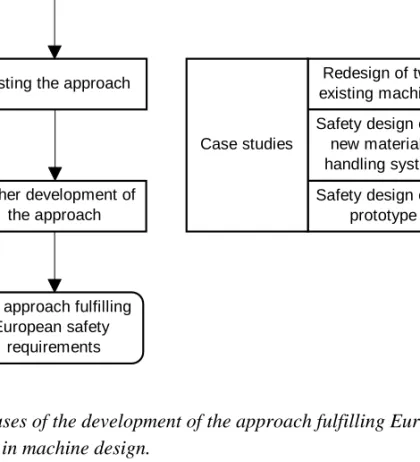
At the beginning of the work the theoretical framework is described and the first version of the approach is developed on the basis of the theoretical framework. The preliminary approach is tested and further developed in case studies. The case studies cover the redesign of two existing single machines, the design of a materials handling system and the safety design of a new single machine (Figure 1).
Redesign of two existing machines Theoretical framework
Development of the first version of the approach
Testing the approach
Further development of the approach
The approach fulfilling European safety requirements Safety design of a new materials handling system Safety design of a prototype Case studies
Figure 1. Phases of the development of the approach fulfilling European safety requirements in machine design.
The case studies are selected to facilitate the development of the approach fulfilling the essential health and safety requirements of the machinery safety directive (Directive 98/37/EC). The case studies also demonstrate the safety design of different kinds of machines in different kinds of design situations. However, all case studies are carried out in a business-to-business environment and no consumer products are involved. The case studies do not cover the whole spectrum of machines and design situations and this must be carefully borne in mind when generalizing the results.
3. Theoretical framework
3.1 Hazards and risks
Machine hazards are sources of potential harm or a situation of potential harm (IEC 300-3-9 1995). The hazards can cause human injuries or ill-health as well as damage to property or the environment (BS 8800 1996). The concept of hazard can also be divided into hazards and hazardous situations (EN 292-1 1992). Hazards are sources of possible injuries or damage to health and hazardous situations are any situations in which a person is exposed to hazards. Hazards create potential conditions waiting to become loss (Roland & Moriarty 1983, p. 6). Unplanned events that cause losses are called accidents (BS 8800 1996). An accident is a dynamic mechanism that begins with the activation of a hazard, flows through the system as a series of events in logical sequences and finally produces a loss (Roland & Moriarty 1983, p. 8). If the unplanned event has a potential to lead to accident, it is incident (BS 8800 1996).
Hazards are unable to cause losses to human health, property and the environment if the chains of unplanned events are cut before the losses occur. Appropriate defences prevent the losses whereas insufficient defences enable accidents to pass through the defences and cause losses (Reason 1997, p. 11) (Figure 2).
Hazards Losses
Defences
Incident
The concept of risk is essential in estimating and evaluating the significance of the losses. The risk describes the potential for realisation of unwanted and negative consequences of events (Rowe 1977, p. 24). The risk is a combination of the likelihood and the consequences of the harmful effects of a specified hazardous event (BS 8800 1996, IEC 300-3-9 1995, Vleck & Stallen 1981, Lowrance 1980). In machine design the risk is described as a combination of the probability and the degree of the possible injury or damage to health in a hazardous situation (EN 292-1 1992).
Machines must be designed according to the essential safety and health requirements on the basis of the state of the art (Directive 98/37/EC) and a manufacturer must continuously follow the technological possibilities that can be applied to improve machine safety. In addition, risks change over time (Patwardhan et al. 1990, Lowrance 1976, p. 3) and knowledge about customers’ experiences of a product through its entire life cycle is essential for product quality (Johnson 1990).
3.2 Safety
Safety is a machine's ability to perform its function without causing injury or damage to health (EN 292-1 1992). A machine is safe if the risks of the machine are judged to be acceptable (Lowrance 1976, p. 75). All products involve risks and absolute safety is impossible to achieve (Jardine & Hrudey 1997, Ballard 1993, Abbot 1987, p. 43, Thomson 1987, p. 1).
The scale of risk is divided between safety and danger (Schön 1993). Things having low risk are safe and things having high risk are dangerous. Rowe (1980) suggests that when the risk increases from zero level, it may still be acceptable. When the risk continues to increase, the risk level exceeds the non-action level and risk reduction becomes desirable. At a certain point risk is unacceptable and risk reduction measures are required.
The machinery safety directive (Directive 98/37/EC) sets out the essential health and safety requirements. The machinery safety directive obliges machine manufacturers to assess the hazards of the machine to be designed and to design the necessary safety measures on the basis of this assessment. The directive and
the related standards handle machine safety and machine risks qualitatively; they provide no quantitative approach and no acceptability standard. The principle harmonised European standards for risk assessment EN 1050 (1997) and EN 954-1 (1997) provide aid in prioritizing hazards and accident scenarios, but they do not provide instructions for evaluating the acceptability of risks.
3.3 Safety in design
3.3.1 Approaches to designDesign is a purposeful human activity in which cognitive processes transform human needs and intentions into embodied objects (Roseman & Gero 1998). Design processes are not all alike. Much of designing is actually variant design (28%) and adaptive design (36%), while original design accounts for 36% of all design activities (Culley et al. 1999). Hence, most design work is a short design process under great pressure of time aiming to create a fairly good, but not optimal, design solution with minimum documentation (Günther & Ehrlenspiel 1999). On the other hand an optimal solution which is innovative, safe and low-cost, requires a longer design process and more systematic methods. Investigations have shown that various approaches to problem solving result in good solutions (Pahl & Badke-Schaub 1999). Each individual procedure has its own advantages and disadvantages and the successful use of different design strategies and methods depends strongly on the type of experience that the designer has (Weth 1999).
Dym & Levitt (1991, p. 39) describe three strategies for problem solving. The first strategy is called generate and test, in which all the possible states are systematically generated and tested to see if they satisfy the goal and constraints. The second strategy is decomposition or problem reduction. In this strategy the problem is divided into subproblems which are easier to solve than the initial problem. The third strategy is called match, in which a current state is compared with the goal and the difference between these states is defined. Different kinds of approaches and methods in designing have been described.
Ulrich & Eppinger 1995, Roozenburg & Eekels 1995). On the other hand, Quality Function Deployment (Akao 1988) and axiomatic design (Suh 1990) more closely match a strategy which aims to identify the factors and the design parameters that must be adjusted in order to attain customer satisfaction and design goals.
Systems engineering can be applied in the creation of new machine functions whereas Quality Function Deployment is frequently limited to improving existing functions. On the other hand, axiomatic design seems appropriate for optimisation and improving the robustness of design solutions. Therefore, systems engineering is selected as a basis for the development of an approach which aims to fulfil the European safety requirements. In this study VDI 2221 (1993) is used as a framework for the design process.
3.3.2 Safety in general problem solving
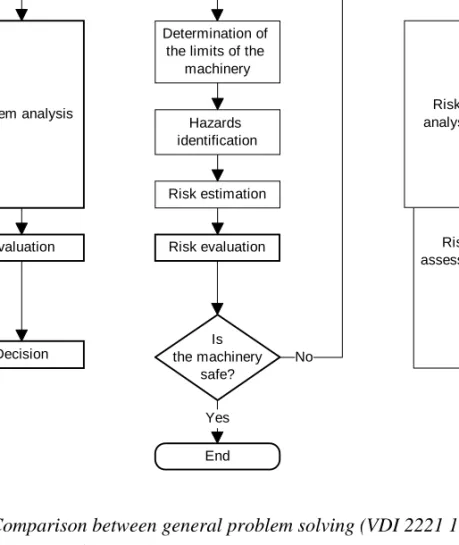
The design of a machine consists of multiple problems which must be solved in order to achieve the design goals (VDI 2221 1993). The problem-solving strategies are general and they can be applied to machine design problems as well as to safety. The identical phases of the problem solving in design (VDI 2221 1993) and the iterative process to achieve safety (EN 1050 1997) create a natural link integrating safety into machine design (Figure 3).
Problem analysis aims to gather necessary information concerning design problems (VDI 2221 1993). Ideas on how to develop a new machine and the causes behind development problems are formed in the analysis phase, together with the criteria that the new machine should meet (Roozenburg & Eekels 1995, p. 131). The losses to human health, environment or property cause design problems. Safety management can be seen as a set of problem-solving activities at different levels of abstraction (Hale et al. 1997). Safety problems are aspects of the design problem and they set new demands that are not imposed by other design criteria (Stoop 1990, p. 86).
Risk assessment Problem analysis Problem definition System synthesis System analysis Evaluation Decision Risk reduction (Safety design) Determination of the limits of the
machinery Hazards identification Risk estimation Risk evaluation Is the machinery safe? No VDI 2221 EN 1050 End Yes Risk analysis
Figure 3. Comparison between general problem solving (VDI 2221 1993, p. 4) and the process to achieve safety (EN 1050 1997, p. 11).
The accident scenarios formed from use scenarios and hazards should be used as a basis of safety design (Stoop 1990, p. 56). Safety problems are typically related to existing machines and problem solving actually starts with the system analysis phase, or with risk analysis as this is called in safety design (Figure 3).
health should be gathered in order to identify the hazards of the machine and possible accident scenarios (EN 1050 1997). Especially accident analysis can provide important information about the actual accident sequences, making it possible to design appropriate safety measures to prevent hazards and losses. The design problem must be clearly defined from a fuzzy array of facts and myths into coherent statements or questions (Suh 1990, p. 6). The problem is defined and formulated in greater detail in the problem definition phase (VDI 2221 1993). The design problem includes goals that are required to be achieved. The goals can be further elaborated into more specific objectives (Roozenburg & Eekels 1995, p. 136). Initial statements about the objectives may be vague and they need to be expanded and clarified (Cross 1989, p. 45). The list of objectives is called the design specification (Roozenburg & Eekels 1995, p. 131). In addition to hazards of the machine and the possible accident scenarios, the safety design specification should also include information concerning the people exposed to the hazards, the environment, standards and codes of practice and legal requirements (Abbot 1987, p. 77). Documentation of the constraints is one of the major objectives of the process of product specification. An underconstrained solution is not necessarily in an acceptable solution space at all (Gause & Weinberg 1989). In his example, Willem (1988) states that required attributes, like safety, describe the product properties that the design must have if it is a solution to the problem.
The requirements of the machinery safety directive (Directive 98/37/EC) concerning safety objectives, safety measures and instructions, together with the safety analysis of existing machines, creates the basis for a safety-related design specification. The essential health and safety requirements of the machinery safety directive (Directive 98/37/EC) are mandatory and therefore they must be handled primarily as requirements that must be fulfilled under all circumstances. However, all the safety objectives may not be completely satisfied by the current state of the art. Therefore laws also attempt to describe the procedures for deciding the highest possible level of safety (Hale & Swuste 1998). In those cases the machine must be designed to meet the safety objective as far as possible.
Means for satisfying the design criteria are created in the system synthesis phase (VDI 2221 1993) (Figure 3). Provisional solutions for the design problems as
well as for known safety problems are created. Solutions that cause no hazards should be applied as far as possible in fulfilling the functional requirements (EN 292-1 1992, Barnett & Brickman 1986). The risks connected with solution should be lowered to an acceptable level if total elimination is impossible. Safety devices are applied if an unacceptable risk exists despite risk reduction measures. In addition to safety devices, additional warnings, instructions and user training may be necessary.
The behaviour and properties of the provisional design solutions are studied in the system analysis phase (VDI 2221 1993). Roozenburg & Eekels (1995, p. 235) call this phase simulation. System analysis aims to determine the properties of the provisional design solutions. The safety of the suggested solutions should be analysed in order to identify and model possible dangerous behaviour and properties of the solutions. If hazards exist, valid predictions of the side effects of the design solutions should be made (Behesti 1993, Stoop 1990, p. 53, Hubka & Eder 1988, p. 48).
In the evaluation phase (VDI 2221 1993) the solutions are assessed against the initial design requirements (Roozenburg & Eekels 1995, p. 293, Nijhuis & Roozenburg 1997). The essential safety and health requirements are set in the problem analysis and problem definition phases and the provisional solutions should fulfil the requirements. The results of risk analysis can be applied to (Kjellén & Sklet 1995)
− verify the acceptability of a concept − compare and select between concepts − further reduce risks of a chosen concept.
It is also possible that the system analysis phase reveals new safety problems that are not covered by the initial design specification. In that case risk evaluation can be used to judge the significance of the problem. If the problem is considered significant, new design requirements have to be set.
Decisions about the acceptability of the solution or the need for better solutions are made in the decision phase. If the provisional designs are not acceptable, the
are further developed. In both cases it is important to use the new safety information from the system analysis and evaluation phases in setting the new safety requirements.
3.3.3 Integration of safety into the design process
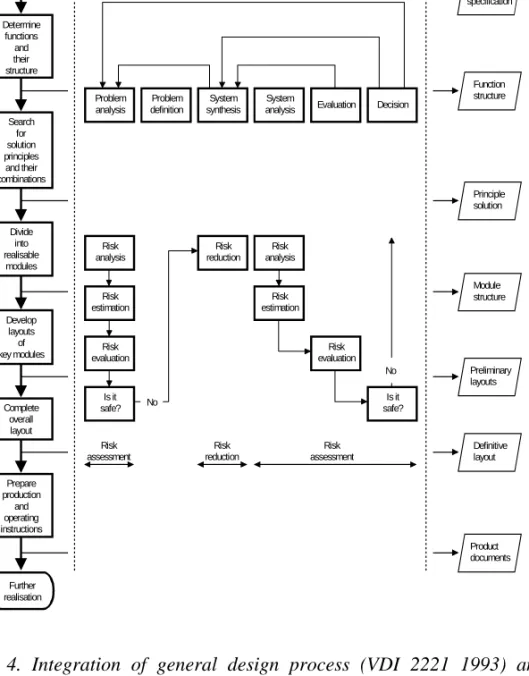
VDI 2221 (1993) divides the design process into seven stages (Figure 4). During the task clarification stage the design problem is clarified and the design specification is formed. On the basis of the design specification the inputs and outputs of the system and the functions between them are created in the determination of the functions and the function-structure stage. Function structure describes the overall relationships between different functions and subfunctions. Alternative solution principles for the functions are created in the stage “search for solutions principles and their combinations”. The optimal solution principle or several alternative concepts are selected for further development. In the next design stage the solution principles are divided into realisable modules. The design of the modules is started in the layout design of the key modules. After the layouts of the key modules have been defined, the overall layout of all the modules is completed. In the last design stage the layouts and modules are detailed and the drawings, instructions and other documents are prepared.
The design process flows from the task clarification to the detailed drawings and instructions for the manufacturing and the use of the machine. Each design stage starts with clarification and formulation of the problem and continues with the synthesis phase aiming to identify alternative solutions to the problem. The possible solutions are then analysed and evaluated against different kinds of design criteria. On the basis of the evaluation decisions about the acceptability of alternative solutions are made and the design process proceeds to the next design stage. This conforms with the iterative process for achieving safety (Figure 3). The design consists of the vertical design stages and the horizontal analysis, evaluation and decision making process concerning the proposed solutions in each design stage. Thus, the risk assessment and safety design is carried out horizontally in each design stage simultaneously with other design tasks (Figure 4).
Design task Clarify and define the task Determine functions and their structure Divide into realisable modules Develop layouts of key modules Complete overall layout Prepare production and operating instructions Search for solution principles and their combinations Iter at iv e pr oc ess fo r t he pr ev ious or fo llo w ing desi gn st ag es Risk evaluation Problem analysis Problem definition System
synthesis Evaluation Decision
Risk analysis Risk estimation Is it safe? Risk reduction Risk analysis Risk estimation Risk evaluation System analysis Is it safe? No No Risk assessment Risk assessment Risk reduction Product documents Definitive layout Preliminary layouts Module structure Principle solution Function structure Design specification Further realisation Design stages (VDI 2221)
General problem solving (VDI 2221) and the approach for achieving safety (EN 1050)
Results (VDI 2221) C lar ifi cat ion of the t as k C onc ept ua l de si gn Em bodi m ent d es ign De ta il d es ig n
Figure 4. Integration of general design process (VDI 2221 1993) and the process to achieve safety (EN 1050 1997).
safety problems as design problems. Interdisciplinary work is needed in order to utilise the knowledge from different disciplines and problem orientation is important to prevent overemphasising certain factors at the expense of other factors are not considered.
The safety-related decisions are made at five decision points of the design process (Stoop 1990, p. 88). The first decision point deals with the scenarios of the use of the product and requirements for the product. The requirements should be set in a general manner in order to leave sufficient solution space to enable safety improvements to be made. The second safety-related decision point is the selection of a solution principle. The solutions can be constrained by existing design and innovation, the state of technology and user acceptance, while certain technologies and energy sources involve inherent hazards that should be avoided. At the third decision point, allocation of functions between man and machine is made. This allocation should rely on expertise regarding use, user interfaces and cognition of the users. The fourth decision point is comprised of selection of the risk that will be interfered and the selection of the risk control strategy between risk elimination and risk reduction. The final decision point deals with the evaluation of the safety of the design in the long term. The residual risks and new use scenarios should be assessed on the basis of the whole lifecycle of the product. In addition, attention should be paid to changing characteristics of the user due to ageing and loss of capabilities. Reunanen (1993, p. 43) integrated safety into a design process by applying different kinds of safety analysis in different stages of the design process (VDI 2221 1993) (Figure 4). Safety analysis was applied to yield requirements of the product or determine the safe use of the product. Product design could directly benefit from the new identified safety requirements and information concerning the safe use of the product could be used in detailed design when user instructions are composed. Similarly Østerås (1998, p. 25) applied design for X approach to assess reliability, maintainability and safety in conceptual design. The identification of the event chains causing accidents in the conceptual design phase was found to be important in identifying appropriate risk-reduction measures.
Kuivanen (1995, p. 63) applied a simultaneous and interdisciplinary design approach to the design of safety in robot systems. In the early design stages the
allocation of functions between user and automation was an essential safety-related decision. In the next design stage safety factors were considered in more detail. Built-in safety factors such as stopping procedures and ergonomics were defined and designed. Layouts, work tasks and workplaces were designed simultaneously together with the user. Applicability of safety standards and legislation was studied and obvious safety devices and functions were defined and designed on the basis of the standards. The basic solutions of the system were designed during the specifying design stage. In addition, safety and ergonomics experts compared and analysed different kinds of safety solutions on the basis of 3D animation.
4. The approach to machine safety design
4.1 The process to achieve safety
4.1.1 Phases of the process
The approach fulfilling European safety requirements consists of the design process (Figure 4) and the iterative problem-solving process to achieve safety (Figure 5). The design process is based on VDI 2221 (1993) and the safety is designed simultaneously with other properties of the machine. Each design stage (Figure 4) includes an iterative process to achieve safety (Figure 5)
− analysis of safety problem
− definition of safety problems and requirements and preparation of safety design specification
− systems synthesis and risk reduction
− analysis of risks of alternative solutions and satisfaction of requirements of the safety design specification
− evaluation of risks of alternative solutions and satisfaction of the requirements
− decision making.
The procedure is based on EN 1050 (1997) and conforms with the general problem-solving cycle described in VDI 2221 (1993). The process is repeated in each design stage until acceptable safety is achieved. The risk assessments are located in the problem analysis before the system synthesis and in the system analysis after the system synthesis. The problem analysis clarifies the safety design problem and the system analysis is carried out to evaluate the results of the system synthesis. The safety design process is controlled by the safety design specification (Appendix 3). In the system synthesis and risk reduction phase it directs the design activities and in the evaluation phase it builds up an evaluation criterion among others.
D eter m in ati on of l im its an d fun ct ions of t he m ac hi ne, the us er s a nd th e e nv iro nm en t An al ys is o f t he l ega l hea lth an d sa fe ty re qu irem en ts , s tan dar ds an d s afe ty g oal s An al ys is o f ha za rd s of sim ila r m ach in es An al ys is of h az ard s re la te d to th e de si gn pr ob le m Pr epa ra tion of the s af ety de si gn sp ec ifica tio n Fu lfi lme nt of th e l eg al s af ety requ iremen ts , s tan dar ds a nd sa fe ty go al s H az ar ds el im inati on R is k re du ct io n ( by d es ig n) D es ig ni ng of s afe ty dev ic es D es igni ng of w arn in gs D es igni ng of ma rk ings Pr epa ring o f i ns tru ct ions C om par is on b et w ee n the m ac hi ne or the al ter na tiv e so lu tion s a nd th e l eg al requ irem en ts , s ta nda rd s an d s afe ty g oal s Id en tifi ca tion o f h az ar ds , ha za rd ous s ituati on s, po ss ib le ac ci de nt s an d lo sse s R is k e stim atio n R is k e val ua tio n Is the m ac h ine or the a lte rn at iv e so lu tio ns sa fe ? D eter m in ati on do cu me nt (A ppe ndi x 1 ) Ri sk a ss essm en t f or m (A ppe ndi x 2 ) Sa fety d esi gn sp ec ifica tio n f or m (A ppe ndi x 3 ) D raw in gs C al cul ati on s Tes ts Li st o f s ta nda rd s Sp ec ifi ca tions In st ru ct io ns Et c. VD I 22 21 SF S EN 1 05 0 Pr obl em a nal ys is Ri sk a ss essm en t Pr obl em d ef ini tion Sy st em s yn thes is Ri sk re du ct io n Sy st em an al ys is Ri sk a na lys is Ev al ua tion R is k ev al ua tion Is it s af e? Ri sk a ss essm en t De ci si on R is k e stim atio n R is k ev al ua tion Is it s af e? Fi g ure 5 . T he p rocess to achieve sa fet y.
The risk assessment related to the problem analysis covers the determination of the limits and functions of the machine, the users and the environment (Figure 5). In addition, the existing legal safety requirements, standards and codes of practice are analysed and the relevant requirements are selected. The risk assessment is applied to identify the inherent risks associated with the design problem and the common risks of existing similar machines and the machine to be designed. The result of the problem analysis and the problem-definition phases is the safety design specification for the next design stage.
The system synthesis phase creates alternative solutions for the design problem. The alternative solutions for the safety problems of the machine are created and the legal safety requirements, standards and safety goals are fulfilled (Figure 5). The alternative solutions for the design problem are analysed and evaluated in a multidisciplinary fashion in order to identify the optimal solution. The risks of the solutions are one aspect involved. The assessment of the risks covers the risks of the solutions and the comparison between the solution and the legal requirements, standards and safety goals. In many cases an iterative process is needed to create acceptable solutions.
4.1.2 Risk assessment
The aim of risk assessment is to produce information about the hazards of the machine in order to create and update the safety design specification. Risk assessment requires information about the intended and unintended use of the machine, the structure and functions of the machine, the environment and users of the machine. Systematic determination of the limits and functions of the machine, its users and environment (Appendix 1) helps design teams to identify the hazards and accident scenarios to be avoided and to evaluate existing safety measures.
The machinery safety directive (Directive 98/37/EC) sets out specific requirements for safety measures. Some of the requirements consider safety measures related to specific hazards, like requirements for the fixed guards applied to prevent hazard of a moving part. These requirements enable the design team to select and design appropriate safety measures for the hazards and possible accidents that are identified. Some of the requirements are related to certain functions of the machine or to user tasks, like starting and stopping the
machine or maintenance. These requirements are relevant if the machine has the specific function or the user task. Some of the requirements, like markings, are more general and are not necessarily associated with any specific hazard or machine function or user task. Hence, all the essential health and safety requirements of the machinery safety directive (Directive 98/37/EC) cannot be fulfilled on the basis of hazard identification. Therefore, the safety analysis team must go through all the essential safety and health requirements and identify the requirements that are relevant for the machine. In addition, the requirements of the A-, B- and C-level standards should be considered. The relevant requirements are part of the safety design specification (Appendix 3).
The analysis of the legal requirements is followed by the identification of hazard and the possible accident scenarios of existing similar machines. Methods for hazard identification in early design phases are, for example, investigation of accidents and incidents that have occurred, Preliminary Hazard Analysis (PHA) and Potential Problem Analysis (PPA) (Reunanen 1993). Failure Mode and Effect Analysis (FMEA) and Fault Tree Analysis (FTA) as well as methods for checking control systems (Tiusanen et al. 1994) are typically applied to gather more detailed information about the functions, modules and components. Hazard and Operability Analysis (HAZOP) is applied in the process industry, but it can also be applied to the design of robustness of machines. Work Safety Analysis (WSA) and Human Error Analysis (HEA) as well as different kinds of usability evaluation methods and ergonomics considerations are applied to gather information about user performance.
In this approach the hazard identification is based on the general list of machine hazards (EN 1050 1997) and the results of the determination of the limits and functions of the machine. Once a hazard and the accident scenarios are identified, they are documented using the risk assessment form (Appendix 2). When necessary, the design team clarify the severity of losses caused by the hazards, frequency of the hazardous events and the possibilities of users to avoid the accident (EN 1050 1997, EN 954-1 1997). The results of risk estimation and evaluation of the acceptability of the risks are documented using the risk assessment form (Appendix 2). The safety design specification (Appendix 3) is created on the basis of the risk assessment and the comparison
After the system synthesis the risk assessment is used to evaluate the results of the design and the safety of the proposed solutions. Hence the objectives of the risk assessment differ from the risk assessments that are carried out to clarify the safety design problem. The focus is on the analysis of the new risks that are typical of the design solution and also on the evaluation of the alternative solutions. In practice the process is iterative and the risk assessment is carried out very much in the system synthesis phase.
4.1.3 System synthesis and risk reduction
The risks that are identified, evaluated and considered so important that further action is needed are removed or reduced in the system synthesis phase. The safety design is based on the safety design specification (Appendix 3) and covers the structure, functions and the use of the machine as well as warnings, markings and user instructions. The safety design specification lists the hazards and hazardous situations to be avoided and the basic requirements for the safety measures. Detailed instructions for safety measures are given in harmonised A-, B- and C-level European standards when necessary. The design team selects and designs appropriate safety measures and describes the selected safety measures in the safety design specification (Appendix 3).
The iterative safety design process for selecting appropriate preventive safety measures for the possible accidents is presented in standard EN 292-1 (1992) (Figure 6). The first safety design step is to map different kinds of possibilities for removing the source of hazard. However, all hazards are not removable. In such a case the design team should find design solutions, like reduction of electrical voltage, that reduce the risks of the possible accidents to the acceptable level. Even the risk-reduction measures may be inadequate or it may be impossible to lower the risks sufficiently, forcing the design team to design additional safety devices. If the design of safety devices is impossible, the basic concept that causes the hazard must be changed. Informing the user about the remaining risk by warnings, markings and instructions is the last safety measure. Merely informing the user, without any other kinds of actions to improve safety, is an insufficient safety measure (Figure 6).
Risk assessment Is hazards avoidable? Is risk reducible? Is safequarding possible? Are other hazards generated? Is safety adequate? Is safety adequate? Risk reduction by design Risk reduction by design Safeguarding
Information for use
Is safety adequate? Goal reached Goal reached Goal reached Goal reached No No No No Yes Yes Yes Yes Yes Yes No No No Yes
4.2 Application of the approach in the different design
stages
4.2.1 Task clarification
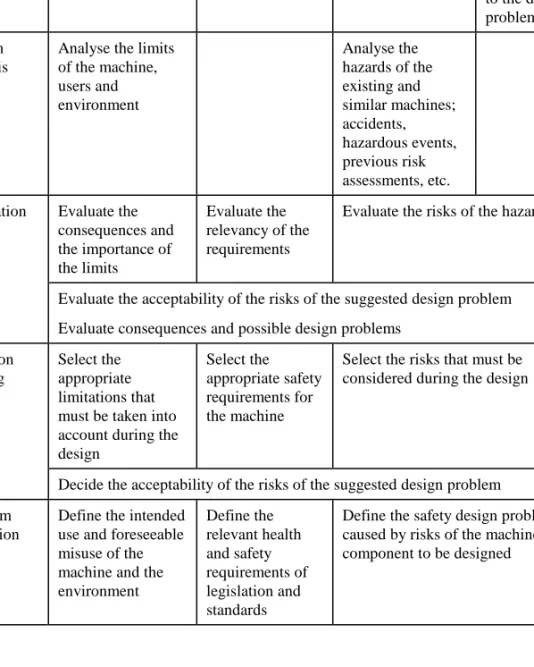
The task clarification stage aims to identify all available information about the hazards of the machine, about the legal and standard requirements for the safety measures and design principles and about the limits of the machine, user and environment (Table 1). In the early stages of a design project it is also necessary to evaluate the design in order to determine its feasibility and where to concentrate further work (Crossland et al. 1995). The result of the task clarification is the safety design specification.
The problem analysis and the system analysis phases are followed by risk evaluation and decision making about the acceptability of the risks of the machine (Table 1). The unacceptable risks create safety design problems and are added to the safety design specification. The functions and limits of the machine, user and environment are also evaluated and the most important limitations and requirements are added to the safety design specification. Finally, the relevancy of the legal requirements and standards are evaluated and the relevant requirements are added to the safety design specification.
The information concerning the design problem, the requirements and limitations is gathered by different methods and approaches and can overlap. For example, the legal safety requirements can cover a hazard that is identified in the analysis of existing similar machines. Therefore, the safety design specification must be gone through and simplified.
Table 1. Safety in the task clarification stage. Process
phase
Safety design task
Problem analysis Analyse the requirements of legislation and standards Analyse the design problem Analyse the hazards related to the design problem System analysis
Analyse the limits of the machine, users and environment Analyse the hazards of the existing and similar machines; accidents, hazardous events, previous risk assessments, etc. Evaluation Evaluate the
consequences and the importance of the limits Evaluate the relevancy of the requirements
Evaluate the risks of the hazards
Evaluate the acceptability of the risks of the suggested design problem Evaluate consequences and possible design problems
Decision making
Select the appropriate limitations that must be taken into account during the design
Select the appropriate safety requirements for the machine
Select the risks that must be considered during the design
Decide the acceptability of the risks of the suggested design problem Problem
definition
Define the intended use and foreseeable misuse of the machine and the environment Define the relevant health and safety requirements of legislation and standards
Define the safety design problems caused by risks of the machine or component to be designed
4.2.2 Determination of functions and function structure
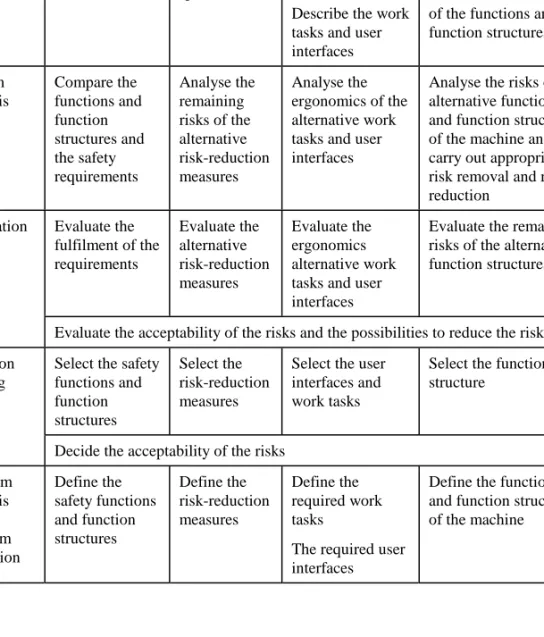
The safety design specification is the basis for the safety design in the determination-of-functions-and-function-structure stage. The hazards, the legal requirements as well as the standards and limits of the machine, the users and the environment can be taken into account during the determination of the functions and function structure of the machine. This is important because the elimination of the remaining risks is more difficult during the following design phases (Table 2).
The machine must have the mandatory safety functions described in the machinery safety directive (Directive 98/37/EC) and in the related standards. The risks that are not covered by the mandatory safety functions must be removed or reduced as far as possible and the appropriate safety functions must be determined. In addition, the determination of functions and function structures may create new hazards and ergonomic problems that are not considered in the task clarification stages. These risks must also be analysed and taken into account during the determination of safety functions.
The remaining risks of the machine are evaluated and safety functions to protect against the risks are selected. The iterative process must be continued until the appropriate safety functions for the unacceptable risks are created and added to the safety design specification. During the risk evaluation it is also recommended to evaluate the difficulties that the design of the safety functions will cause during the following design phases.
The allocation of functions between machine and users is made during the determination phase. The allocation of functions can be applied during the following design stages in designing the ergonomics of the work tasks and the user interfaces between user and machine (Table 2).
Table 2. Safety in the determination-of-functions-and-function-structure stage. Process
phase
Safety design task
System synthesis Select the safety-related functions that are required by legislation and standards Remove or reduce the risks that are listed in the safety design specification
Allocate
functions between the machine and the user
Describe the work tasks and user interfaces
Create the functions and function structures of the machine
Remove or reduce risks of the functions and function structures System analysis Compare the functions and function structures and the safety requirements Analyse the remaining risks of the alternative risk-reduction measures Analyse the ergonomics of the alternative work tasks and user interfaces
Analyse the risks of the alternative functions and function structures of the machine and carry out appropriate risk removal and risk reduction
Evaluation Evaluate the fulfilment of the requirements Evaluate the alternative risk-reduction measures Evaluate the ergonomics alternative work tasks and user interfaces
Evaluate the remaining risks of the alternative function structures
Evaluate the acceptability of the risks and the possibilities to reduce the risks Decision
making
Select the safety functions and function structures Select the risk-reduction measures
Select the user interfaces and work tasks
Select the function structure
Decide the acceptability of the risks Problem analysis and problem definition Define the safety functions and function structures Define the risk-reduction measures Define the required work tasks
The required user interfaces
Define the functions and function structures of the machine
4.2.3 Search for solution principles
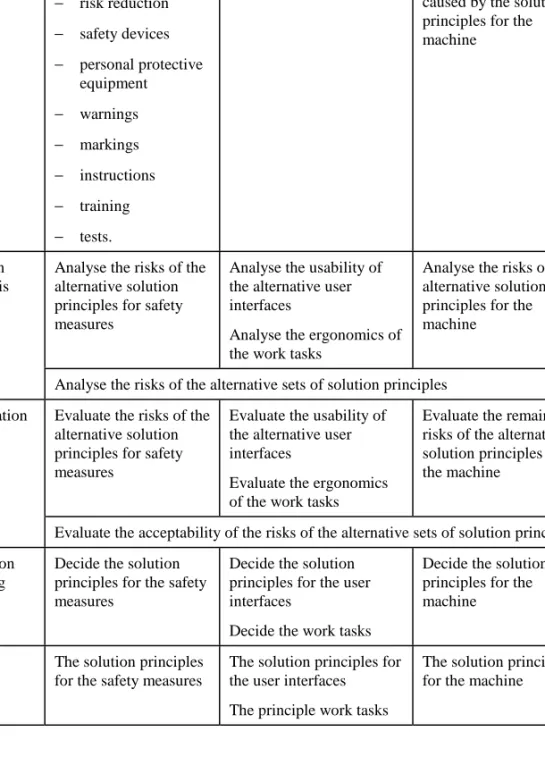
The previous design stages describe the safety and ergonomics design problems, legal and standard requirements and the functions and function structures of the machine. In this design stage the solution principles for the safety design problems and the principles of safety measures for carrying out the safety functions are sought simultaneously with the other functions and function structures of the machine.
The solution principles for the functions and function structures may have inherent hazards that are typical of them (Table 3). The inherently safe solution principles are the most preferable. If the remaining risk after the risk reduction is unacceptable, protection measures against the risk must be taken. In addition, the user must be informed about the residual risks and necessary safety measures, about appropriate training and about personal protection equipment (Directive 98/37/EC, Ullman 1997, p. 167).
Good ergonomic design principles and the limitations of the users and the environment must be taken into account when seeking the solution principles for the work tasks and user interfaces. The basic requirements for the design of work tasks are given in legislation and standards (Shaub & Landau 1998, Dickinson 1995, Stewart 1995) and different books provide additional information about the design of work (Kroemer & Grandjean 1997, Sanders & McCormick 1993).
Table 3. Safety in the search-for-solution-principles stage. Process
phase
Safety design task
System synthesis
Create solution principles for the safety measures to carry out the safety functions and the safety measures − risk reduction − safety devices − personal protective equipment − warnings − markings − instructions − training − tests.
Create solution principles for user interfaces and work tasks
Create alternative solution principles for the machine’s functions and function structures Remove or reduce risks caused by the solution principles for the machine
System analysis
Analyse the risks of the alternative solution principles for safety measures
Analyse the usability of the alternative user interfaces
Analyse the ergonomics of the work tasks
Analyse the risks of the alternative solution principles for the machine
Analyse the risks of the alternative sets of solution principles Evaluation Evaluate the risks of the
alternative solution principles for safety measures
Evaluate the usability of the alternative user interfaces
Evaluate the ergonomics of the work tasks
Evaluate the remaining risks of the alternative solution principles for the machine
Evaluate the acceptability of the risks of the alternative sets of solution principles Decision
making
Decide the solution principles for the safety measures
Decide the solution principles for the user interfaces
Decide the work tasks
Decide the solution principles for the machine
Result The solution principles for the safety measures
The solution principles for the user interfaces
The solution principles for the machine
4.2.4 Division into realisable modules
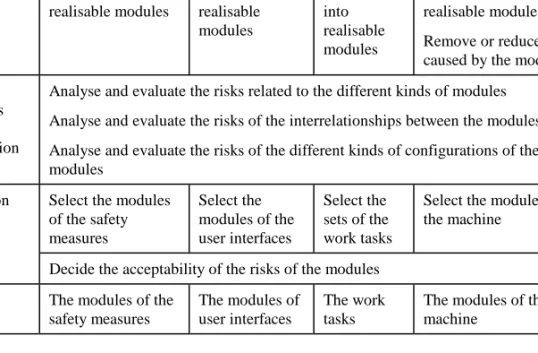
Practical design can be carried out by dividing the solution principles into realisable modules (Table 4). In addition, modular product systematics (Pahl & Beitz 1996, p. 434) can be applied to divide machine modules into function modules and production modules. Function modules are applied to implement technical functions and production modules are designed on the basis of production considerations.
The systematic hazard-based approach to safety supports the design of function modules. A safety measure against a hazards, like an emergency stop, is a basic module and it is applied in all machines. A safety measure can also be a special module, like additional lighting, and it is applied only in the case of a special environment. Adaptive modules are applied to adapt a system to other systems. For example, the adaptive module can integrate the emergency stop of a machine with the control system of a production line. Customer-specific functions, like safety fences and walkways, are carried out by non-modules and they are designed case by case.
Table 4. Safety in the division-to-realisable-modules stage. Process
phase
Safety design task
System synthesis
Divide the safety measures into realisable modules
Divide the user interfaces into realisable modules Divide the work tasks into realisable modules
Divide the structure of the machine into realisable modules Remove or reduce risks caused by the modules System
analysis and evaluation
Analyse and evaluate the risks related to the different kinds of modules Analyse and evaluate the risks of the interrelationships between the modules Analyse and evaluate the risks of the different kinds of configurations of the modules
Decision making
Select the modules of the safety measures Select the modules of the user interfaces Select the sets of the work tasks
Select the modules of the machine
Decide the acceptability of the risks of the modules Result The modules of the
safety measures
The modules of user interfaces
The work tasks
The modules of the machine
The ergonomic design of work can be divided on the basis of the different work tasks that are needed to operate a machine (Table 4). Different kinds of materials handling tasks, control task, and maintenance as well as disturbance-control tasks constitute specific design problems that must be solved to ensure good ergonomics. In addition to the individual work tasks, the organisational factors related to the operation of a machine must be considered.
The user interfaces can also be divided into realisable modules (Table 4). The controls, displays and other elements of user interfaces must be designed according to good ergonomic principles. In addition, the design of the user instructions is an essential part of the design of the work tasks and user interfaces. It must be noted, however, that even if the work tasks and user interfaces are divided into smaller modules, the overall ergonomics and usability must be treated on the basis of the overall system.
4.2.5 Development of the layouts of key modules
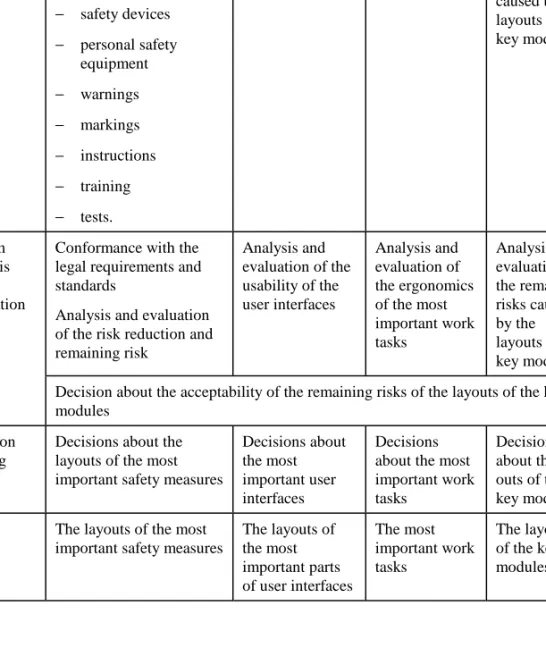
The preliminary design of the safety measures to protect against the most important hazards is carried out during the development stage of the layouts of key modules (Table 5). The design teams determine the dimensions, materials, locations etc. of the modules of the machine only as far as is practical to get an idea of the alternative layouts. The information in the relevant standards and other specifications concerning the safety measures are applied as far as is practicable.
The risks related to the alternative layouts are analysed and evaluated and necessary risk-reduction measures are designed (Table 5). The risk analysis and the ergonomics analysis and evaluation together with the evaluation regarding the other design criteria help design teams to compare the alternative solutions and select the optimal layout.
Table 5. Safety in the development-of-the-layouts-of-key-modules stage. Process
phase
Safety design task
System synthesis
Design of layouts and most critical dimensions etc. of the most important safety measures − risk reduction − safety devices − personal safety equipment − warnings − markings − instructions − training − tests. Usability design of the most important user interfaces Ergonomic design of the most important work tasks Design of the layouts of the key modules Safety design for the risks caused by the layouts of the key modules System analysis and evaluation
Conformance with the legal requirements and standards
Analysis and evaluation of the risk reduction and remaining risk Analysis and evaluation of the usability of the user interfaces Analysis and evaluation of the ergonomics of the most important work tasks Analysis and evaluation of the remaining risks caused by the layouts of the key modules Decision about the acceptability of the remaining risks of the layouts of the key modules
Decision making
Decisions about the layouts of the most important safety measures
Decisions about the most important user interfaces
Decisions about the most important work tasks
Decisions about the lay outs of the key modules Result The layouts of the most
important safety measures
The layouts of the most important parts of user interfaces The most important work tasks The layouts of the key modules
4.2.6 Completing overall layouts
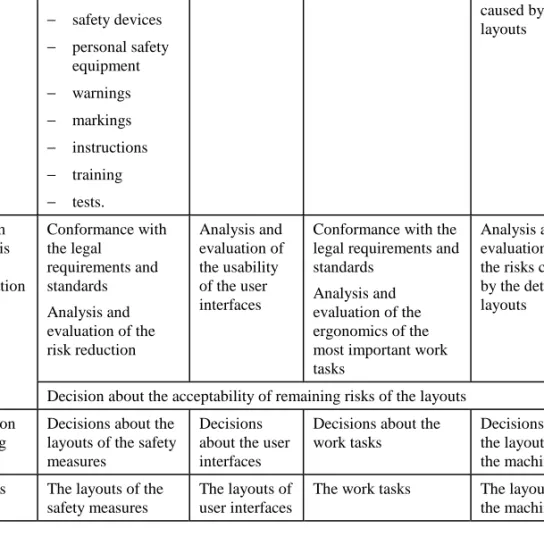
The preliminary layout is completed by adding more detailed information about the modules and components (Table 6). The safety measures and the user interfaces are further designed and commercial components and equipment are selected. The work tasks and related instructions are also designed in more detail. The legal requirements and standards together with handbooks are applied to give more detailed information about safety and ergonomics for the design.
Table 6. Safety in the completing-overall-layouts stage. Process
phase
Safety design task
System synthesis
Design of detailed layouts of the safety measures − risk reduction − safety devices − personal safety equipment − warnings − markings − instructions − training − tests. Design of the user interfaces Ergonomic design of the work tasks
Design of the layouts Safety design for the risks caused by the layouts System analysis and evaluation Conformance with the legal requirements and standards Analysis and evaluation of the risk reduction Analysis and evaluation of the usability of the user interfaces
Conformance with the legal requirements and standards
Analysis and evaluation of the ergonomics of the most important work tasks
Analysis and evaluation of the risks caused by the details of layouts
Decision about the acceptability of remaining risks of the layouts Decision
making
Decisions about the layouts of the safety measures
Decisions about the user interfaces
Decisions about the work tasks
Decisions about the layouts of the machine Results The layouts of the The layouts of The work tasks The layouts of
The system analysis and evaluation phase consists of the risks assessment of the details of the alternative components and the ergonomic evaluations of the work tasks and the user interfaces (Table 6). The evaluation is followed by decision making in which the detailed layout is confirmed.
4.2.7 Detail design
The final production instructions, user instructions and the technical construction file are finished in the detail design stage (Table 7). The technical documentation is prepared according to the requirements of the machinery safety directive Annex 5 (Directive 98/37/EC), including the necessary drawings, calculations and tests as well as the information concerning the risk assessment and risk-reduction measures. For serial products the quality measures for maintaining acceptable safety during manufacturing are also described.
The design of the user information covers the work tasks, the user interfaces and necessary warnings and instructions for the safe operating of the machine. Therefore, the instructions and other user information are designed together with the other properties of the machine and the design and production of instructions for the use are started in the tasks clarification stage.
Table 7. Safety in the detailed design stage. Process
phase
Safety design task
System synthesis Detailed design of safety measures − risk reduction − safety devices − personal safety equipment − warnings − markings − instructions − training − tests. Preparation of the technical construction file Detailed design of user interfaces Detailed design of the work tasks Detailed design of the machine Safety design for the risks caused by details System analysis and evaluation Conformance with the legal requirements and standards Analysis and evaluation of the overall risk reduction Analysis and evaluation of the usability of the user interfaces Analysis and evaluation of the user instructions Analysis and evaluation of the ergonomics of the most important work tasks Analysis and evaluation of the risks caused by the details
Decision about the acceptability of remaining risks, ergonomics and usability of the machine
Decision making
Decisions about the detailed design of the safety measures
Decisions about the detailed design of user interfaces Decisions about the detailed design of the work tasks Decisions about the detailed design of the machine Results Detailed design of the machine and its safety measures, user interfaces and work