MINISTRY OF LABOUR, FAMILY AND
EQUAL OPPORTUNITIES
SECTORAL OPERATIONAL PROGRAMME
HUMAN RESOURCES DEVELOPMENT
2007 2013
October 2007
CONTENTS
ABBREVIATIONS ... 1 INTRODUCTION ... 3 SOP HRD EXANTE EVALUATION ... 5 1. CURRENT SITUATION ANALYSIS ... 7 1.1 Education... 7 1.2 Employment...18 1.3 Social Inclusion...33 1.4 Health ...42 1.5 Previous experiences in preaccession assistance ...44 2. SWOT ANALYSIS...47 3. STRATEGY ...50 3.1 Objectives ...58 3.2 List of Priority Axes ...61 3.2.1 Priority Axis 1: Education and training in support for growth and development of knowledge based society...64 3.2.2 Priority Axis 2: Linking life long learning and labour market...79 3.2.3 Priority Axis 3: Increasing adaptability of workers and enterprises...86 3.2.4 Priority Axis 4: Modernisation of Public Employment Service...92 3.2.5 Priority Axis 5: Promoting active employment measures...97 3.2.6 Priority Axis 6: Promoting social inclusion...102 3.2.7 Priority Axis 7: Technical Assistance...109 3.3 Coherence and compliance with Community and national policies ...112 3.4 Complementarity of the SOPHRD with other Operational Programmes and with operations financed under the EAFRD and EFF...118 4. FINANCIAL PLAN...122 5. IMPLEMENTATION ...126 5.1 Management ...126 5.2 Monitoring and Evaluation ...131 5.3 Financial management and control...137 5.4 Information and Publicity...146 5.5 Management Information System ...147 6. PARTNERSHIP ...149 ANNEXES ...152
Abbreviations ACD Administrative Capacity Development AEM Active Employment Measures AMIGO Labour Force Survey in Households ACIS Authority for the Coordination of Structural Instruments CASPIS Anti Poverty Commission and Promotion Social Inclusion CF Cohesion Fund CSG Community Strategic Guidelines CVT Continuous Vocational Training EAFRD European Agricultural Fund for Rural Development EC European Commission EDIS Extended Decentralised Implementation System EES European Employment Strategy EFF European Fisheries Fund EQFHE European Qualification Framework in Higher Education ERDF European Regional Development Fund ESF European Social Fund ETF European Training Foundation EU European Union GD Government Decision GEO Government Emergency Ordinance HR Human Resources HRD Human Resources Development IB Intermediate Body ICT Information and Communication Technology ILO International Labour Organisation ISCED International Standard Classification of Education ISCO International Standard Classification of Occupations IT Information Technology JAP Joint Assessment Paper on Employment Priorities JIM Joint Inclusion Memorandum KAI Key area of intervention LEAP Local Educational Action Plan LFS Labour Force Survey LLL Life Long Learning MA Managing Authority MoERY Ministry of Education, Research and Youth MoLFEO Ministry of Labour, Family and Equal Opportunities MoEF Ministry of Economy and Finance
MSMETTLP Ministry for Small and Medium Sized Enterprises, Trade, Tourism and Liberal Professions
NAPCR National Authority for Protection of Children Rights NAPD National Authority for Persons with Disabilities NAPE National Action Plan for Employment NAPPRM National Authority for Public Procurement Regulation and Monitoring NCAVT National Council for Adult Vocational Training NCTVED National Centre for Technical and Vocational Education Development NDP National Development Plan NGO Non Governmental Organisation NIRFLSP National Institute for Research in the Field of Labour and Social Protection NIS National Institute for Statistics NMS New Member States NRDP National Rural Development Programme NSRF National Strategic Reference Framework ODL Open Distance Learning OECD Organisation for Economic Cooperation and Development OP Operational Programme OPTA Operational Programme Technical Assistance PA Priority Axis PES Public Employment Service PhD Doctorate PIA Public Internal Audit REAP Regional Education Action Plan R&D Research and Development RDI Research, Development and Innovation RO Romania ROP Regional Operational Programme SAP School Actions Plans SEN Special Educational Needs SMEs Small and Medium sized Enterprises SOP Sectoral Operational Programme SOP IEC Sectoral Operational Programme Increasing of Economic Competitiveness SWOT Strengths, Weaknesses, Opportunities, Threats TVET Technical Vocational Education and Training
VET Vocational Education and Training
WB World Bank
Introduction
The Sectoral Operational Programme Human Resources Development (SOP HRD) sets the priority axes and the major intervention areas of Romania in the human resources field in order to implement the EU financial assistance through the European Social Fund, within the frame of ,,Convergence” objective, for the programming period 20072013.
Elaborated in the context of National Development Plan 20072013 and in line with the Priorities of the National Strategic Reference Framework, SOP HRD is an important instrument in supporting the economic development and structural changes. Moreover, the investments in human capital will complement and will confer sustainability to the increase of productivity on a longterm. A highly qualified labour force, with a high level of education, having the capacity to respond to the new technologies and to the changing needs of markets, is essential for a competitive and dynamic economy. Romania will promote active labour market policies to increase the adaptability and flexicurity of labour force. It is envisaged to be reached a higher level of participation on the labour market, as a base for a competitive knowledge based economy.
SOP HRD was elaborated under the coordination of Ministry of Labour, Family and Equal Opportunities. During the consultations there were involved the Ministry of Economy and Finance, National Agency of Employment, Ministry of Education, Research and Youth, Ministry of Internal Affaires and Administrative Reform, Ministry of Development, Public Works and Housing, Ministry of Agriculture and Rural Development, Ministry of Public Health, National Institute for Statistics, National Institute for Scientific Research in the field of Labour and Social Protection, AntiPoverty Commission and Promotion of Social Inclusion, National Adults Training Board, National Agency for Equal Opportunities, Ministry for Small and Medium Sized Enterprises, Trade, Tourism and Liberal Professions, other line ministries and agencies. There also took place large consultations with social partners, civil society organisations, public administration and other relevant stakeholders. The close consultations between the MoLFEO and the representatives of the Directorate General for Employment, Social Affairs and Equal Opportunities within the European Commission had an important role in finalising the structure and content of the SOP HRD. The objectives and the aim of SOP activities were established on the basis of the analysis of the human resources development in Romania and were defined in concordance with the following documents: − Joint Assessment Paper on Evaluation of Employment Policies (JAP 2006); − National Action Plan for Employment 20042005; − Joint Inclusion Memorandum on Social Inclusion (JIM 2006); − National Strategy on Employment 20052010; − Preaccession Economic Programme 2005; − Strategy for Continuous Vocational Training on short and medium term 2005 – 2010; − National Strategy for developing social services 2005;
− National Strategy concerning the prevention and fight against domestic violence phenomena 2005;
− National Strategy on social inclusion of young over 18 leaving the State Child Protection System 20062008;
− National Strategy for developing the social assistance system for elderly persons 2005 – 2008;
− National Strategy for protection, integration and social inclusion of disabled persons in 20062013 period “Equal opportunities for disabled persons – towards a society without discrimination“;
− National Strategy for Equal Opportunities between Women and Men; − Strategy for Preuniversity Education Development 20012010; − Strategy for decentralisation of education 2005;
− Strategic Guidelines for Education and Research 20062008.
The general objective of SOP HRD is the development of human capital and increasing competitiveness, by linking education and lifelong learning with the labour market and ensuring increased opportunities for future participation on a modern, flexible and inclusive labour market for 1,650,000 people.
The specific objectives can be summarised as follows:
− Promoting quality initial and continuous education and training, including higher education and research;
− Promoting entrepreneurial culture and improving quality and productivity at work; − Facilitating the young people and long term unemployed insertion in the labour
market;
− Developing a modern, flexible, inclusive labour market;
− Promoting (re)insertion in the labour market of inactive people, including in rural areas 1 ;
− Improving public employment services;
− Facilitating access to education and to the labour market of the vulnerable groups. The ESF intervention in Romania shall support the achievement of the general objective and the specific objectives in the field of human resources development, making a real contribution to the implementation of European Employment Strategy and to the overall objective of growth and jobs.
1 Rural area refers to rural localities as defined under the Romanian Law No 350 / 2001 on spatial planning and urbanism
and Law No 351/2001 for approving the National Spatial Plan – Section IV – Localities network, namely the localities where either the majority of population is occupied in agriculture, forestry or fisheries, or in terms of endowment with public utilities, do not fulfill the legal obligations to be declared as urban localities, even if the majority of population is occupied in other sectors than those mentioned before. Thus, from an administrative point of view, the Romanian territory is organized, at NUTS5 level, in 319 towns making up the urban area and 2,851 communes, making up the rural area (data for 31 December 2005). In their turn, communes are mostly made up of more than one village (12,946 villages in total) without any administrative responsibilities.
SOP HRD exante evaluation
In accordance with Article 47, par. 2 of the Council Regulation (EC) 1083/2006, this Programme has been subject to an exante evaluation in order to provide a basis for the assistance. The ex ante evaluation was carried out externally by a Consortium lead by Panteia (NL) under a PHARE contract. The exante evaluation exercise was an interactive process. Seminars, workshops, debriefing meetings and bilateral discussions brought together the planners, evaluators and other stakeholders to improve the quality of programming. The outcome of the exante evaluation is incorporated into the programme document and is designed to contribute to the successful and efficient implementation.
The exante evaluation addressed the following main questions:
· Relevance: to what extent are the programme's objectives relevant in relation to the evolving needs and priorities at national and EU level?
· Effectiveness: how realistic is the programme in achieving its specific and global objectives by 2013 or earlier?
· Efficiency: how well are the resources (inputs) allocated with respect to outputs or results? · Consistence and Coherence: are the proposed objectives and measures logically linked to the socioeconomic analysis, are they mutually consistent (consistence) and are they well embedded in the regional, national and Community (e.g. Lisbon Objectives) policy objectives and interventions (Coherence) · Utility: are the expected and unexpected effects realistic and globally satisfactory in the context of wider social, environmental and economic needs? · Sustainability: will the effects obtained in the proposed programmes remain, even after the end of the programme without further public funding?
· Management and monitoring arrangements: how they may affect the achievement of programme objectives & contribute the chosen processes to positive results? The exante evaluation contains the following five main components: A. Appraisal of the socioeconomic analysis and the relevance of the strategy to the needs identified; B. Evaluation of the rationale of the strategy and its consistency; C. Appraisal of the coherence of the strategy with regional and national policies and the Community Strategic Guidelines; D. Evaluation of the expected Results and Impact; E. Appraisal of the proposed implementation systems. The main findings and recommendations of the exante evaluation concluded that, in general, the Sectoral Operational Programme for Human Resource Development 20072013 may be qualified as a document that meets the EU standards:
· It contains an extensive quantitative analysis on the Romanian labour market, on its educational system and on the position of vulnerable groups.
· The analysis directs itself at the important strengths and many weaknesses, of which low participation on the labour market, including the backwards situation of rural areas, and the low participation in CVT seems the most important elements.
· The strategy includes the interventions needed to address the EU policy objectives (CSG, Lisbon Agenda and Integrated Guidelines) in the field of labour market, educational and social inclusion policies.
· The strategy is translated into a proposed set of Priority Axes and Key Areas of Intervention, which will tackle the weaknesses of the Romanian human resources development.
· The strategy and interventions are coherent with EU and national policies, including complementarity with the other Operational Programmes and EAFRD and EFF financed operations. As far as the regions, the Programme will link itself with regional initiatives in the field of HRD.
· The document also contains the main outlines of SOP HRD implementation.
The exante evaluator presented his preliminary conclusions and recommendations within two draft reports, for which two debriefing meetings were organized in October, discussing the overall analysis part and the SOP HRD objectives as they were formulated at that moment, as well as in December, discussing the Strategy and the Priority Axes proposed.
All of the debatable points were clarified during these two meetings and other bilateral meetings that took place between the evaluator and the representatives of the SOP Managing Authority. Most of the exante recommendations have been taken into account in the process of finalising the OP and only a few have been retained by the evaluator in the final exante evaluation report, based on the clarifications and underpinned explanations provided by the SOP MA.
The main recommendations made by the exante evaluators related to updating of statistics and bringing further information (labour productivity, migration a/o), adding new elements in the SWOT analysis, lessons learned on Phare experience, improvement of the rationale of the strategy and reflect the complementarities and synergies with the other OPs (especially the ROP and the SOP IEC), better quantification of the main programme objective (the amount of persons covered by the programme), improved explanations of the results for the main key areas of intervention, as well as more information on the implementation of operations (ageing, partnership etc). All recommendations have been included in the SOP HRD.
Strategic Environmental Assessment
Given the nature of the European Social Fund, focussing on immaterial operations related to Human Resource Development, this Operational Programme does not set the framework for operations likely to have significant environmental effects, such as infrastructure projects, especially the ones listed, Annexes I and II to Directive 85/337/EEC as amended by Directive 97/11/EC and 2003/35/EC.
Consequently, the Managing Authority considered and the Environmental Authority agreed that there was no need for a Strategic Environmental Assessment of this OP under the Directive 2001/42/EC.
1.
CURRENT SITUATION ANALYSIS
1.1 Education
· Structure of the education system
The benchmarks for the education and training systems set up by the European Commission in 2002, at the European Council held in Barcelona, as well as the decisions made at the European level in the “Bologna process” triggered the reform of the education system in Romania.
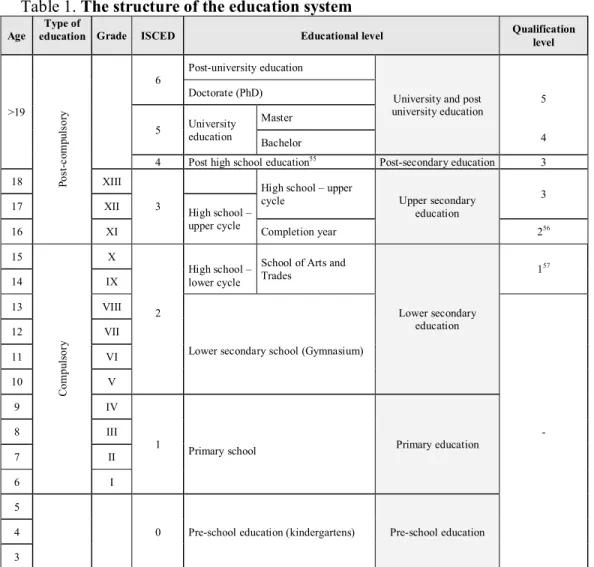
The current structure of education and initial training system aims at ensuring flexibility and openness of individual educational routes (see Table 1, Annex 1). The current educational model provides for students the opportunity to either attend higher levels of education or to enter in the labour market (after 10 th grade). Within the education system, the initial VET provides both academic and professional opportunities as presented in the Box 1, Annex 1. The recognition and validation of prior learning are not operational at the system level. Validation of prior learning operates in initial VET. Also, according to the existing methodology, validation of prior learning is taken into account in the development of the second chance education, contributing thus to higher flexibility and increased access to such programs.
· Participation in education
Data available for the school year 2005/2006 indicate a decrease of enrolments (ISCED 05) by 4.46% as compared to the school year 2000/2001. The most severe decrease is recorded in primary schools and gymnasium enrolments, respectively by 13.88% and 27.28% in the reference period (2000/2001 – 2005/2006); by residence, in both cases the decrease is higher in urban areas. Low enrolment is also recorded in post highschool education, due to the financing system based on the contribution of interested companies or individuals. In the reference period, the highest increase is recorded in the vocational education (School of Arts and Trades and the Completion year) by 18.73% due to the restructuring 2 of the initial VET, operational since 2003/2004; by residence, the situation is favourable to rural areas. The demographic descending trends in urban areas and the increased schooling capacity in vocational education in rural areas are the main factors underpinning this different pattern of enrolment figures. In case of university education, the enrolments increased, in the reference period, by 35.48% (Table 2, Annex 1).
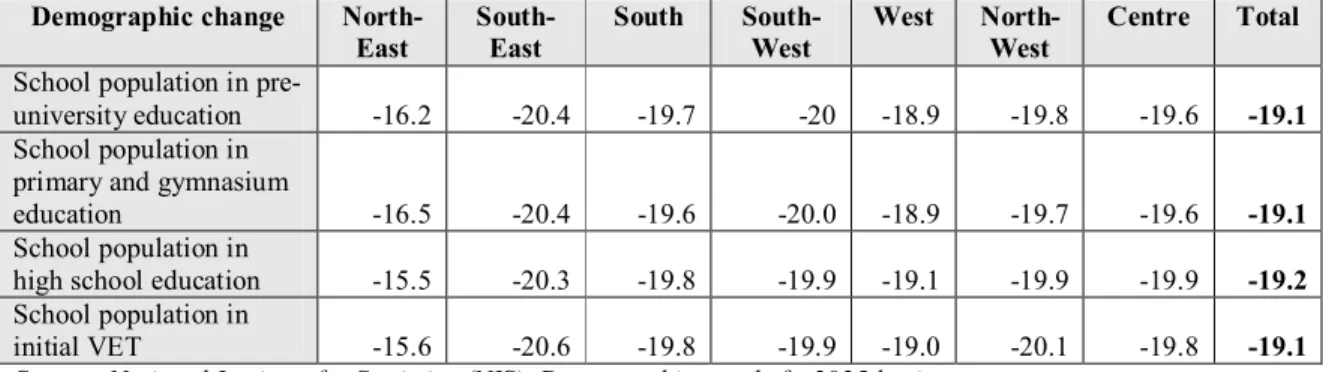
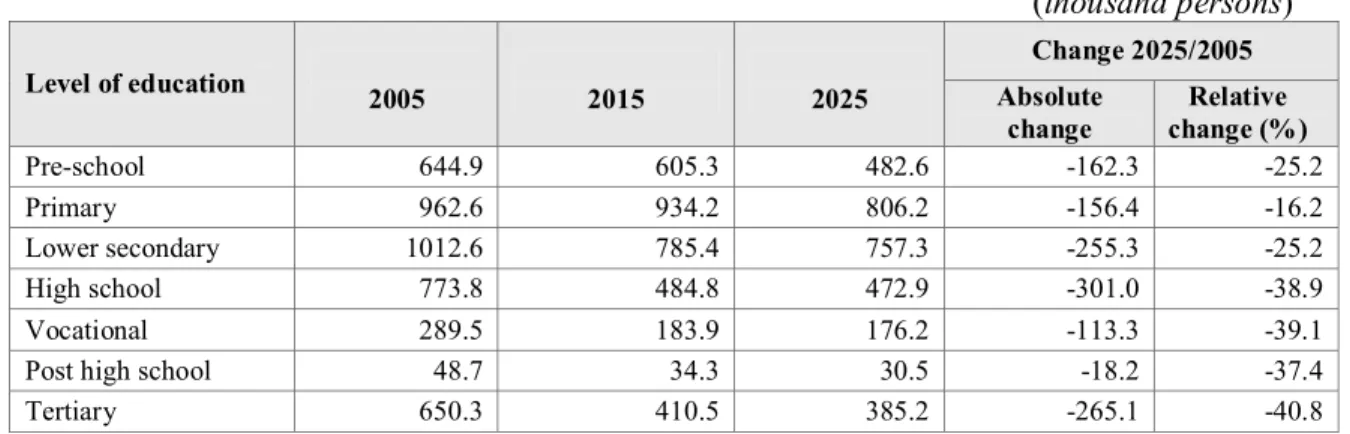
According to the available demographic estimates, the school age population will record a severe decrease by about 20% during 20052013 (Tables 3.1 and 3.2, Annex 1). This forecasted trend will raise the issue of restructuring the school network and redesigning the HR management in education and initial VET.
The gross enrolment rate at all levels of education (ISCED 16) recorded a continuously positive trend from 66.5% in 2000/2001 up to 72.9% in 2005/2006 (Table 4, Annex 1). Participation at different education levels and by residence recorded various trends during the reference period as illustrated in Table 5, Annex 1. These developments lead to the need for school networks restructuring and social support programs dedicated to the access and participation to education in rural areas, in particular at ISCED 3 level.
2 School of Arts and Trades and the Completion year are part of the progressive professional route which is offering a double qualification, with academic purposes and with professional goal
The difference of about 27 percent points in the gross enrolment rate in high schools and vocational education by residence (86.6% in urban areas as compared to 59.9% in rural areas in 2005/2006, as presented in Chart 1, Annex 1 affects the educational attainment of the population in rural areas. The existing gap indicates that a large proportion of the pupils from rural areas become early school leavers.
In case of rural areas, problems of access to education are due to poor access possibilities and learning conditions, poverty, and the relatively high costs of education (including basic education) that this community cannot afford. The relatively lower share of qualified teaching personnel in rural areas as compared to urban areas remains among the factors with negative influence for ensuringaccess to quality education in rural areas.
In case of the Roma community, almost 12% of the population in the 716 year age group dropped out school before graduating compulsory education and about 18% are not enrolled and are not attending any form of education. As a whole, about 80% of the persons not attending education are Roma population 3 and 38.6% of the Roma are functional illiterate 4 . Data available on Roma educational attainment are limited, since the official statistics do not provide breakdowns of various indicators by Roma, but by gender and area of residence. The above mentioned studies indicate that, additionally to the economic situation of Roma community, the educational attainment/background of older Roma generations and traditions seriously influence the low participation in education of Roma children. Also, the absence of preschool education and poor Romanian language speaking abilities of most Roma children negatively affect their performance in school. Discrimination and segregation are sensitive issues in case of equal access and participation in education of Roma. Generally, Roma population lives at outskirts, ill famed neighbourhoods. The schools located in these areas, in which Roma children are learning, provide poor learning conditions and education; the average rate of repeating is about 11.3% (MoERY Statistics), far above the national average indicator (3.52% in 2005/2006). Mentality of the majority population towards Roma represents another issue that may nourish discrimination/segregation (for detailed presentation see Box 2, Annex 1).
Low participation in education is recorded, also, in case of children with special educational needs (SEN). The limited stock of knowledge of teaching personnel in mainstream schools in working with students with disabilities, improper educational infrastructure and existing communication shortcomings between school and community contribute to the increase of the number of children with disabilities not attending to formal education and to the absence of monitoring of their integration in mainstream education. An important cause generating poor social inclusion rate is the traditional educational segregation of persons with disabilities. The practice of isolating children with slight disabilities into special schools has stopped beginning with 2001, following implementation of a program which, although successful in integrating a number of 18,158 children with disabilities into the mainstream education, has failed to simultaneously adapt school curricula, train teachers in acquiring special skills to work with children with disabilities and adopt a supportive attitude. In 2002, 4,400 children 3 Ministry of Education and Research, Institute for Educational Sciences, Research Institute for the Quality of Life, UNICEF,
"Participation in education of Roma children", Bucharest, 2002, p.47;
4 In the school year 2002/2003, Roma pupils represented about 4.23% of the total enrolments in compulsory education, at national level. The participation in education of Roma pupils is lower in case of preschool education as compared to primary education. Similarly, after primary education, the participation in education of Roma pupils continuously decreases. At the moment, there are very few studies and qualitative analysis on Roma participation to education and educational attainment. Source: „Roma people in Romania”, CASPIS;
with special needs were enrolled in the mass education system. The educational policy pursued by MoERY aims at modernising and restructuring the “special education” (education for children with special educational needs/disabilities) so as to create the premises for the beginning of school life in the nearest public school and for quality and diversified educational support services for the target groups (see Box 3, Annex 1). During the last years specific projects aiming at development of “inclusive schools” were developed in Romania. Despite these efforts, Romanian society preserved its traditional segregation mentality, and the best practices derived from these projects could not be extended at national level.
With regards to the increasing of access to education, in the period 20022006, most of the actions have been targeted to the curriculum development, expanding and increasing flexibility of second chance education, training of the teachers, training of school mediators and school mentors. Starting with 2006, these actions were significantly complemented by measures for increasing accessibility of the educational infrastructure and improving learning conditions: investments in the modernisation of the educational infrastructure and provision of school transportation facilities. Efforts in this respect need to be continued after 2007. Charts 2 and 3 in Annex 1 show that, the dropout rate in primary school and gymnasium increased by 2.8 times in 2004/2005 as compared to 2000/2001. In case of gymnasium, the drop out increased by 3 times in the reference period. Available findings indicate that, in case of children living in poor families, the chances of school dropout is 3 times higher as compared to the children living in families which are not poor and 3.5 times higher in case of children living in families affected by severe poverty.
Early school leaving is a phenomenon negatively affecting the quality and competitiveness of the human capital. The early school leaving rate increased from 22.4% in 1999 up to 23.4% in 2004 and slightly decreased in 2005 to 20.8% (Table 6 below). A significant gap between Romanian and European indicators can be noticed; the early school leaving exceeds by far the 10% EU benchmark set for 2010. Table 6. Early school leavers (1824 year age group) (%) 1999 2000 2001 2002 2003 2004 2005
RO RO EU25 EU15
Early school leavers (1824
years age group), by gender 22.4 23.1 21.8 22.9 22.7 23.4 20.8 15.2 17.2
Male 24.2 24.1 22.2 23.7 23.9 24.9 21.6 17.3 19.5
Female 20.4 22.0 21.4 22.1 21.5 21.8 19.9 13.1 14.9
Sources for RO: NIS, LFS annual average data; data for 2002÷2005 were weighted based on the results of the March 2002 Population and Housing Census;
Source for EU25 and EU15: EUROSTAT, New Cronos, annual average data 2005.
As shown in Table 6, there is a gender gap: the early school leaving rate is higher in case of male population, since many of them are leaving schools to enter on the labour market to ensure financial support for their families. Poverty, low educational attainment of parents and the risk of social exclusion are the most important factors leading to the increase of early school leaving rate 5 . Also, the surveys 6 available identify the low attractiveness of education among the motivations for early school leaving (only 33% of the pupils surveyed consider the education provided in schools as useful for their social and professional life).
5 European Commission, Study on Access to Education and Training, Basic Skills and Early School Leavers (Ref. DG EAC
38/04), Final Report European Commission DG EAC, September 2005
By categories, Roma population is the group the most exposed to early school leaving 7 , and the situation is more severe in case of Roma women due to the poor living conditions and traditions. Low achieving pupils are also one of the categories exposed to early school leaving since their poor performance in school seriously affects their self esteem and motivation for learning.
Prior to 2005, at the system and policy making level, only few measures with limited impact were undertaken for reintegrating the early school leavers in formal education, either immediately, or through later education and training programs, during their active life. The high early school leaving correlated with the low number of early school leavers who reenter in formal education are factors with strong negative effects on the quality of human capital in Romania.
Preschool education
For tackling disadvantages affecting participation and educational attainments, European countries identified the preschool education (early education) as a tool/solution 8 . The existing evidences show that if the disadvantage is tackled at the earliest age, through pre school education, there are longlasting benefits in terms of better achievements during individuals’ further school and work careers because it is essential for the development of individuals as learners, it contributes to the prevention of early school leaving and to the increase of educational attainment and facilitates later learning. The preschool education (ISCED 0) is part of the education and training system and it pursues the goal of the socialisation and mental, emotional and cognitive development of the children, through specific activities and tools. The enrolment rate in preschool education increased from 66.1% in 2000/2001 to 74.7% in 2005/2006, with differences by residence in favour of urban areas (Table 7, Annex 1). The gap is explained by the higher employment rate in urban areas (which limits parents’ possibilities of taking care of their children, unlike the rural areas); higher poverty in rural areas (making the relative costs of preschool education higher at the level which the rural community cannot afford); availability of preschool education infrastructure. A study issued by MoERY mentions the poor quality of preschool education infrastructure (over 20% of the kindergartens has a high level of usage, insufficient sanitary facilities especially in rural areas, insufficient space for educational activities etc.) and insufficient qualified personnel 9 .
Initial VET
One of the objectives of the restructured education system, in force since the school year 2003/2004, has been to enhance the access to initial VET. The MoERY undertook measures aiming at improving access to initial education and training, as well as improving the attractiveness of VET and providing equal opportunities to VET access in disadvantaged areas (such as rural areas). The positive achievements in this respect are reflected by the fact that the number of students enrolled in vocational education route, 9 th grade, increased by 3.1% in 2004/2005 as compared to 2003/2004, but it decreased by 1.5% in 2005/2006 as compared to 2004/2005) (Table 8, Annex 1).
7 Idem 5
8 European Commission, Communication from the Commission to the Council and to the European Parliament “Efficiency
and Equity in European Education and Training Systems”, Brussels, 8.9.2006, COM(2006) 481 9 Institute for Educational Sciences, “Study on preschool education”, 2003
The schooling capacity of the initial VET system increased substantially beginning with school year 2002/2003: from 844 school units in 2002/2003 to 1,474 school units in 2004/2005 and 1,495 in 2005/2006. Most of the increase was in rural areas: from 518 school units in 2003/2004 to 713 school units in 2005/2006. The increased number of schools is mainly a result of the reclassification of education. In some of these schools (those included in the Phare TVET projects) the learning environment has been improved by new equipment. The results achieved in 2005/2006 have been followed by a restructuring of the VET schools network having as result in 2006/2007 a total of 1,367 VET schools units, out of which 611 in rural areas. The reorganisation of the network included also transportation facilities for students in rural areas, improving thus the access conditions. These schools offer first chance education to the graduates of grade VIII in their locality, preventing additional costs that the parents have to afford for transport or accommodation in case the students should go for learning in other localities.
Since mid ‘90s, initial VET has been under a continuous process of reforming, aiming at modernising and better adjustment it to the demands of a society which has known major changes at economic and social level. An important component of this reform is the learning content of the initial VET based on the “life long learning” concept: it starts with development of qualifications, then, based on the vocational training standards, the curriculum is developed and finally, within the certification process, the competences (performance descriptors within the training standards) are under assessment during the final examination. In VET, the development of qualifications is organised with the direct involvement of relevant social partners. Since qualifications are not anymore linked to the type of provider (schools or private providers) or to the type of training (initial or continuing VET), their validation is the responsibility of Sectoral Committees 10 that are gradually established by the National Adult Training Board acting as National Authority for Qualifications. This is meant to increase coherency between initial and continuous VET. So far, vocational training standards for qualifications levels I, II and III which can be obtained through the initial VET system have been updated and are implemented at national level. The methodological developments and expertise as regards qualifications development and validation reached within the initial VET have been transferred to the whole VET etc.
In order to increase the quality of provision and based on progress made in regional and local planning of initial VET (REAP, LEAP), since 2006/2007 measures for optimising the school network in initial VET will be pursued. The activities implemented, apart from increasing the schooling capacity in rural areas, consisted of improving the initial and continuous training offer in rural areas, developing institutional capacities for VET schools in view of assuring inclusive education and training for students with special education needs.
Quality assurance is in a more advanced phase in initial VET than in the other components of the education system. It started earlier under a PHARE project and a system of quality assurance based on the common quality assurance framework (CQAF) agreed at European level has already been implemented. The experience acquired allowed the starting of implementing of the quality assurance instruments for initial VET at the level of the whole VET system.
Expected outcomes of the above decisions envisage quality assurance improvement of the VET provision. The effects of all these will be measured in June 2008 when first graduates may enter labour market or continue their studies.
10 The Sectoral Committees are structures for social dialogue organized at the level of sectors of activity and are set up by the National Adult Training Board, through the common agreement of the representative social partners at sector level. The Sectoral Committees contribute to the development and upgrading of the qualifications by sectors of activity.
In case of post high school education, the current financing system does not allow a proper development/pace in relation with labour market needs and current EU experiences in the field. At present, as already mentioned, the companies cofinance the post highschools, in relation with their specific needs. This raises the issue of addressing in a coherent manner the labour market needs which requires intermediate qualification levels between high school and higher education. The lack of staff development strategies in companies, in particular in SMEs, affects also the development of this level of education.
University education
Unlike the secondary and postsecondary education, in case of university education, the ascending trend of participation in education specific to early ‘90s continued also between 2000/2001 and 2005/2006. Thus, the gross enrolment rate in university education increased from 27.7% in 2000/2001 up to 44.8% in 2005/2006 (Table 9, Annex 1). The increasing participation in university education is explained by the development of private university education, development of the universities’ networks, by setting up new universities or by developing subsidiary universities in non traditional locations, increasing enrolments, increasing interest for university education due to a larger labour market absorption of highly educated people and lower unemployment risk for university graduates. For rural population, Roma community and other vulnerable groups, the access and participation to university education remains low due to the relatively high costs of university education and the incidence of early school leaving affecting them. By Bologna cycles, the enrolments in university education are dominated by undergraduate students. The number of enrolments in Master programs increased during the last two years due to higher chances of master graduates to insert in the labour market. The number of doctoral graduates decreased, due to the changed access condition to this level of education, with negative effects on the R&D human potential (Table 10, Annex 1).
The restructuring of the university education started in university year 2005/2006 following the Bologna process. As part of the restructuring and modernisation of university education, recently, progress was made in terms of institutional framework and methodology supporting the development of National Qualifications Framework in Higher Education. In 2005, the National Agency for the Qualifications in Higher Education and Partnership with Social and Economic Environment has been set up and progress towards developing the National Register of Qualifications for Higher Education is currently being made.
· Life Long Learning
Life long learning is not approached in a coherent and comprehensive manner at system and policy making levels. This fact limits the coherence and the flexibility of individual learning routes throughout lifelong. Despite the progress made in regulating the validation of prior learning, the insufficient use of the existing legal framework (except for initial VET) remains one of the limits of introducing life cycle approach in education and training. The insufficient development of the transfer mechanisms of the learning outcomes between various learning environments limits the possibilities of the population, especially for the adult population, to obtain the formal validation of the competences acquired in the labour market and to reenter into the formal education. Also, at the policy making level, more coherence between education and initial training policy and CVT policy is needed.
The validation of learning outcomes achieved, a better articulation between education and initial VET and CVT, improved definition and transparency of qualifications are issues to be addressed through the development and implementation of a National Qualifications
Framework (NQF). Progress in this respect was made in terms of institutional development (the National Adult Training Board was appointed as National Authority for Qualifications and a National Agency for Qualifications in Higher Education was set up), development and activities of Sectoral Committees (progress is still insufficient and the financing of Sectoral Committees limits their effectiveness and development; thus only 16 Sectoral Committees were operational in 2006) and development and validation of qualifications. NQF supports the development of life long learning for individuals and will create a transparent system of qualifications in vocational training that will allow a coherent development of the current initial and continuous vocational training system, having regard on the perspective of life long learning and having the support of the stakeholders.
Quality of the human capital in Romania
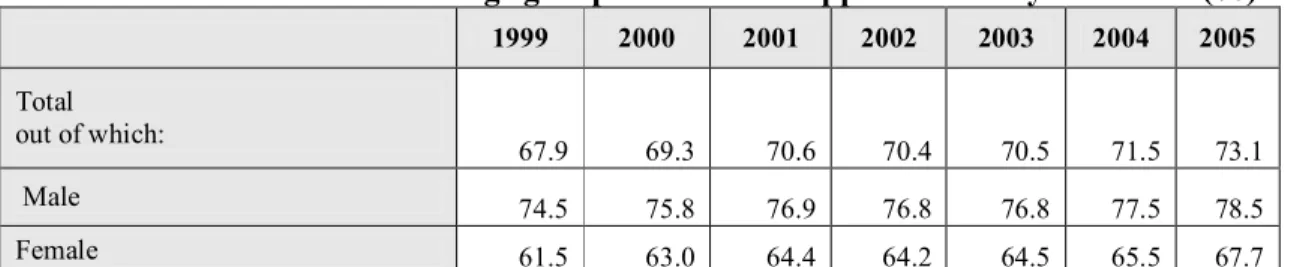
The competitiveness of the human capital is directly influenced by the educational attainment. For the population in the 2564 years age group, data show that the share of the population with at least upper secondary education is close to the EU average, but below the average level of the 10 new Member States and the 85% EU benchmark for 2010. Data show that the share of the population aged 2564 years old with at least upper secondary education increased during 19992005 from 67.9% to 73.1%. By gender, higher values (above 75%) were recorded during the reference period in case of male population, and lower values in case of female population, for which the indicator has been about 67.7% in 2005. The gender gap reduced to 10.8 percent points in 2005 as compared to 13 percent points in 1999. (see Table 11, Annex 1).
In the same age group, the share of the population with university education, although on a ascending trend (from 8.7% in 1999 up to 11.1% in 2005), remains below the level recorded in the most developed countries (figures for 1999: USA – 27.7%, France 16.4%, Germany – 15%, UK – 15.4%) (White Paper on Labour Force, DTI/UK – 2003) (Table 12, Annex 1). The evolution by gender reflects a slight decrease of the existing gap between female and male population with university education. The educational attainment of the population within 1529 age group is presented in Table 13, Annex 1. Data obtained from Population and Housing Census 2002 and NIS 2005 indicate an increase in the number of graduates of university education, within the 1529 years age group, both in absolute and relative terms, during 19922005. Also the share of the graduates of post high school education and the share of graduates of primary schools increased in the same age group in the same period. A decrease is recorded in case of the share of graduates of lower secondary schools within 1529 years age group (from 43.1% in 1992 to 38.4% in 2002). On the whole, in 2002, within the 1529 age group, about 6% graduated university education, 84% graduated secondary education (including postsecondary and foreman education), about 8% graduated primary education and 3% had no education.
Increased competitiveness of the human capital could be achieved through life long acquisition of knowledge and competences and through the continuous up date of individual stock of knowledge and competences, continuous education and training. The supply of continuous vocational training remains fragmented, since it is addressing especially the needs of individuals and not the enterprises’ needs. Most of the training providers avoid modular training programs due to legal vagueness and due to the fact that the completion of one or several modules of a training program does not provide a “profession” and does not give the right to the trainee to an occupation on the labour market. The complete qualification cycles/programs, finalised with a nationally recognised certificate of qualification, are more
valued/praised since they provide the right to practice one or more occupations on the labour market.
· Human resources in education
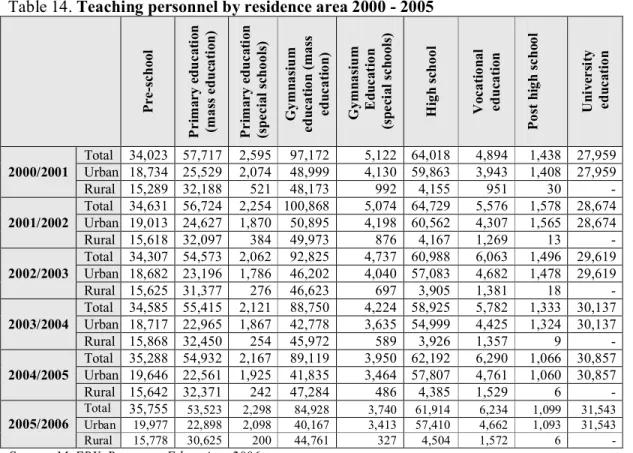
Figures available show, in 2004/2005, that human resource employed in education system represented 4.32% of the employed population in Romania. The analysis of the dynamics of the teaching personnel during the period 20002005 indicates that the personnel in the education and training decreased except for vocational and preschool education (Table 14, Annex 1).
The share of qualified personnel continuously increased during 20002006, at all levels of education. A slightly reversed evolution is recorded in 2005/2006 as compared to previous school year in case of preschool education (0.7 percent points) and vocational education (0.6 percent points). By residence, at all educational level, during the entire period analysed, the share of qualified teaching personnel is lower in case of rural areas as compared to urban areas. In university education, the issue of unqualified teaching personnel does not exist (Table 15, Annex 1).
The forecasted decrease of the school population by 20% in 2013 (as compared to 2005) will trigger serious effects in case of school network and recruitment of teaching personnel. This demographic trend is expected to trigger a decrease of the personnel in education and initial training by about 10%. Despite this forecasted surplus at system level, there are increasing deficits of qualified teaching personnel in particular for domains highly demanded and better paid by employers in the labour market (e.g. ICT, foreign languages). Deficits of qualified teaching personnel are specific to the fields/curricular areas related to new occupations demanded by the labour market, as well as to the new professions in education (e.g. qualified school educational assistant for SEN children) for which initial and continuous training programs for teachers and trainers are not available yet.
The ageing trend of the population is visible in case of teaching staff and will contribute to the overall diminishment of the teaching personnel. The low attractiveness of a teaching career, the relative persisting rigidity in the professional routes and rewarding of the teachers, limit the possibilities of the education and initial VET providers to recruit and maintain the quality young graduates in a teaching career. Combined with the ageing trend of the personnel, it is expected for the existing deficits to accrue and to coexist with an overall surplus of teaching personnel. All these will negatively affect the quality and responsiveness of the education and initial VET to the labour market demands, particularly in case of new occupations. These developments and the demographic trends underline the importance of the qualification and quality of the human resources employed in education. · Human resources in research and development In 2004 in Romania the number of R&D employees per 100 employees was 0.46. This ratio is 3 times lower than in the EU15 (1.41 R&D employees/100 employees). The number of R&D employees, especially highly qualified specialists, recorded a constant increase trend (Chart 4, Annex 1).
Low wages, poor or improper endowments, as well as opportunities provided by research programmes from other countries gradually led to an increase in the average age of the R&D highlyqualified staff, so that, in 2004, around 63% of the total number of researchers is over
40 years old. In 2005 the total number of researchers has increased, but the structure by age groups has been changed, data being no more comparable with the previous years (see Table 16, Annex 1).
The dominant weight is of the technical and engineering researchers (approx. 60%), which is also a field with a high capacity to adapt to the economic changes. In 2004 the specialised staff in R&D units obtained a total number of 1,282 patents, out of which 435 issued for Romanian inventors, 170 for foreigner inventors and 677 patents have been certified in Europe.
The evolution of doctoral graduates and their structure by field of research are relevant for the development of human potential in R&D (Table 17, Annex 1). Most of doctoral graduates are in the fields of science, mathematics and humanities. A significant increase of doctoral graduates in 2004 as compared to the entire period 20012003 occurred (the number of doctoral graduates increased 3 times) followed by a severe decrease in 2005, due to the high cost of doctoral programs and limited support provided to doctoral candidates. MoERY, through the executive body of the National University Research Council granted, on competitive basis, support for research activities and, to a limited extent, support to young researchers. Within the support for young researchers, support for doctoral candidates and their research activities was also provided, on competitive basis.
· Quality assurance and management
The official statements made during the last 15 years referred to the education as national priority and to the fact that developments in terms of quality assurance should be pursued in reforming initial education and training. In case of formal education, prior to 2005, quality assurance in education was based almost exclusively on external evaluation like school inspection and accreditation, while the internal mechanisms and procedures for quality assurance and management were not fully operational at system level. Prior to 2005, significant progress in developing quality standards and mechanisms for quality assurance and management was made in case of initial VET under Phare funded project.
At the system level, during 2005 and 2006, progress was made in defining the institutional framework for quality assurance in education. The two Agencies for Quality Assurance in Preuniversity Education and in University Education were created. For the next period, new standards, quality assurance mechanisms (based on internal and external standards stipulated by the new legal framework adopted in 20052006) will be developed and implemented by the above mentioned agencies and by the education and initial VET providers. Once the guidelines and methodologies for quality assurance, evaluation and management are adopted/validated at system levels, the education and initial VET providers will have to adopt specific actions for the implementation of these new tools: transposition of the new standards, training for school/university staff development (over 45,000 persons school/university staff and other stakeholders staff) and training for external quality evaluators and assessors (about 4,000 persons).
There is no available study of quality assessment of education and training. The good quality or the poor quality can be assessed, at present, mostly by the school/university graduates’ performances in the labour market, in terms of employment and unemployment rates, although the relevance of employment and unemployment rates in evaluating the quality of initial education and training may be diffused by other economic and social causes that may produce effects in employment and unemployment rates and structures.
In terms of systemic restructuring, the decentralisation of preuniversity education is a key challenge for the years to come. The process has been initiated since the end of 2005 and is currently piloted in 50 schools. Based on the result of this pilot phase, the decentralization will be extended in preuniversity education. The decentralization in education addresses the issues of financing, HR management at local level, improved relevance of curriculum for local development needs and competence demands (by increasing the relative weight of local curriculum) etc. A crucial factor for the success of decentralization will be the training of all the stakeholders in the process (school management and decision makers, inspectors, public administration etc.). It will support the development of a system providing flexible, accessible and better education to individuals.
· Education and training in support for provision of managerial skills and
entrepreneurship
Great consideration was given to the reinforcement of the initial education and training contribution in providing employability competences to their future graduates. The initial VET restructuring, seen as a continuing and coherent process, is a good example for the importance given to the need to improve the cooperation with employers and to address the individual education and training needs. The VET curriculum is developed based on validated training standards by Sectoral Committees. Methodologies and mechanisms for updating training standards and VET curricula have been developed and applied during the Phare TVET projects and will be updated by the institutional development of the NAQ, supported by Phare projects. The new VET curriculum introduced some innovations focused on developing learnerbased teaching methodologies and the individual tailored educational offers. The new curriculum, based on competences and the transferable credits system adopted create the premises for flexible and better adapted educational and initial VET offers to the labour market needs and for promoting entrepreneurship. Entrepreneurial education is part of the key competences and is reflected in all curriculum development activities. Entrepreneurial education is also part of the compulsory curriculum in gymnasium education (module within the technical education curricular area) and in 10th grade and high school lower cycle. Initial VET offer contains entrepreneurial education as part of curriculum in upper secondary education. The specific training of teachers who are instilling entrepreneurial spirit is still insufficient and remains a priority of the system. Schoolenterprises cooperation as predictor for entrepreneurship skills development is still insufficiently exploited, especially in rural areas.
In case of university education, entrepreneurial education is less coherent and systematic compared to preuniversity education, as well as compared to the experiences and practices of other Member States, which created chairs for entrepreneurship (Belgium), master programs in entrepreneurship (Denmark), centres for entrepreneurship development (UK) etc.
Tertiary education, university and nonuniversity (namely posthigh school education) is fostering the achievement of managerial skills. The first reference level ensuring managerial skills is the high school. Still labour market is requiring managerial skills within a competences package, including occupational related knowledge, to be delivered by post high school education.
· Correlating education and initial VET offers and labour market demand
The increase of the education and initial VET relevance to the labour market needs still remain a major goal in the policy making and activities of the education providers. The rate of youth unemployment (see also the references in the below section onYouth Unemployment) is
raising the problem of education relevance to the labour market. There have been taken several measures aiming at improving initial VET supply responsiveness to the labour market needs: improving the strategic planning of the initial VET offer and provision of career guidance and key competences.
Among the factors limiting the correlation between education and initial VET to the labour market, the following could be considered:
Still insufficient involvement of relevant stakeholders in the participatory planning of educational activities/offers;
Insufficient training provided to stakeholders in education and VET planning;
Insufficient updated information and studies on long term labour market needs affecting the initial VET planning and responsiveness;
Insufficient development and valorisation of partnership in education and training, limited cooperation in developing continuing learning programs, work based learning programs etc.;
Absence of mechanisms for monitoring the insertion and professional development of graduates (e.g. “tracer studies”).
At system level, some of these issues (e.g. involvement of social partners, local authorities, and other stakeholders) will be addressed through the implementing of NQF and of the new instruments for quality assurance in education.
The available studies (developed in 2005 within Phare TVET 2002) indicate that for graduates, regardless their educational/training attainment, a longer period of time is necessary to adapt them to job requirements, unlike in the case of persons with longer working experience. This situation is directly influenced by the insufficient correlation between education and initial VET offers and labour market needs. The lowest correlations are specific to intermediate qualification levels. One of the explaining factors is that the initial VET system was designed for career development. Qualifications achievement allow to initial VET graduates to practice several occupations. Thus, for being able to practice and to adapt to requirements of a specific occupation/job, graduates need to be integrated in programs for transition from school to work. Current programmes do not support the graduates’ effective insertion on the labour market and the work based learning and career counselling are not yet responding to the requirements of the study programmes. In this respect, specific actions for increasing relevance of qualifications provided by initial education and training were undertaken and some progress was made. Another issue that also remains to be addressed by the initial VET is the contribution to the middle management development trough post high school education.
1.2 Employment
Structural analysis of the labour market
The Romanian labour market faced significant changes in the economic transition process, emphasised by the reduction of the active and employed population, by maintaining the unemployment rate at relatively constant values, and by the increase of the youth and long term unemployment, being mainly affected by the limited job creation capacity. Important changes occurred alongside a severe decrease in the employed population regarding the structure of employment by sectors, fields of activity, regions, and types of ownership, age, and professional status.
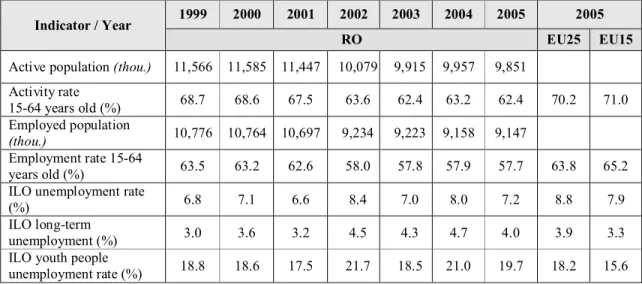
Table 18.Main indicators of employment, 19992005* )
Indicator / Year 1999 2000 2001 2002 2003 2004 2005 2005
RO EU25 EU15
Active population (thou.) 11,566 11,585 11,447 10,079 9,915 9,957 9,851 Activity rate 1564 years old (%) 68.7 68.6 67.5 63.6 62.4 63.2 62.4 70.2 71.0 Employed population (thou.) 10,776 10,764 10,697 9,234 9,223 9,158 9,147 Employment rate 1564 years old (%) 63.5 63.2 62.6 58.0 57.8 57.9 57.7 63.8 65.2 ILO unemployment rate (%) 6.8 7.1 6.6 8.4 7.0 8.0 7.2 8.8 7.9 ILO longterm unemployment (%) 3.0 3.6 3.2 4.5 4.3 4.7 4.0 3.9 3.3 ILO youth people unemployment rate (%) 18.8 18.6 17.5 21.7 18.5 21.0 19.7 18.2 15.6 Source for EU25 and EU15: EUROSTAT, New Cronos, 2005 Source for RO: NIS, Labour Force Survey (AMIGO), annual averages; data for 20022005 have been weighted based on the results of the Population and Housing Census, March 2002
* ) Data referring to 19992001 are not fully comparable with data series 20022005 due to the revision of definitions related to the main categories of population (active, inactive, employed, unemployed).
The human resources evolution has been for the past decade under the influence of several demographic and social phenomena such as: the speeding up of the fertility decreasing process and maintaining mortality at high rates, the increase of the emigration, and the decrease of the medical and social assistance services’ quality. These facts contributed to the increase of the share of 60 years old and over population and also to the maintaining of the demographic dependency rate at high level, especially in the rural areas.
a) Employment structure
· Employment rate
In 2005, the employed reached the level of 9.85 million persons. Compared to 2002, the employment rate dropped in 2005 by 0.3 percent points, reaching 57.7% (Table 19, Annex 1). The employment rate of the working aged population in 2005 situates Romania at a 12.3 percent points distance as compared to the Lisbon objective established to be achieved in 2010 – general employment rate of 70%. On the other hand, women employment rate reached in 2005 51.5%, by 8.5 percent points lower than the Lisbon objective (60% in 2010). In 2005,