Dictionary Design for Distributed
Compressive Sensing
Wei Chen
, Member, IEEE
, Ian J. Wassell, and Miguel R. D. Rodrigues
, Member, IEEE
Abstract—Conventional dictionary learning frameworks at-tempt tofind a set of atoms that promote both signal representation and signal sparsity fora class of signals. In distributed compressive sensing (DCS), in addition to intra-signal correlation, inter-signal correlation is also exploited in the joint signal reconstruction, which goes beyond the aim of the conventional dictionary learning framework. In this letter, we propose a new dictionary learning framework in order to improve signal reconstruction performance in DCS applications. By capitalizing on the sparse common com-ponent and innovations (SCCI) model [1], which captures both intra- and inter-signal correlation, the proposed method iteratively finds a dictionary design that promotes various goals: i) signal representation; ii) intra-signal correlation; and iii) inter-signal correlation. Simulation results showthat our dictionary design leads to an improved DCS reconstruction performance in com-parison to other designs.
Index Terms— Compressive sensing, dictionary learning, dis-tributed compressive sensing.
I. INTRODUCTION
C
OMPRESSIVE SENSING (CS) is a framework that aims to reconstruct an unknown signal with a reduced number of random projections. Therefore, CS represents a convenient universal compression method that has been attracting growing interest in various applications such as wireless sensor networks (WSNs) [2] and electrocardiogram (ECG) [3], [4] acquisition. The success of CS is due to the fact that many natural signals of interest lie approximately in a union of low-dimensional sub-spaces in the higher-dimensional ambient space [5]. This union of subspaces can itself be described by a sparse combination ofManuscript received May 23, 2014; revised July 31, 2014; accepted August 11, 2014. Date of publication August 20, 2014; date of current version August 27, 2014. This work was supported by EPSRC Research Grants EP/K033700/1 and EP/K033166/1, the Fundamental Research Funds for the Central Universi-ties under Grant 2014JBM149, the State Key Laboratory of Rail Traffic Control and Safety under Grant RCS2012ZT014 of Beijing Jiaotong University; the Nat-ural Science Foundation of China under Grants 61401018 and U1334202, and by the Key Grant Project of Chinese Ministry of Education under Grant 313006. The associate editor coordinating the review of this manuscript and approving it for publication was Prof. Chandra Sekhar Seelamantula.
W. Chen is with the State Key Laboratory of Rail Traffic Control and Safety, Beijing Jiaotong University, Beijing 100044, China, and also with the Com-puter Laboratory, University of Cambridge, Cambridge CB3 0FD, U.K. (e-mail: [email protected]).
I. J. Wassell is with the Computer Laboratory, University of Cambridge, Cam-bridge CB3 0FD, U.K. (e-mail: [email protected]).
M. R. D. Rodrigues is with the Department of Electronic and Electrical En-gineering, University College London, London WC1E 7JE, U.K. (e-mail: [email protected]).
Color versions of one or more of thefigures in this paper are available online at http://ieeexplore.ieee.org.
Digital Object Identifier 10.1109/LSP.2014.2350024
columns of a dictionary, e.g., a wavelet transform-based dictio-nary.
Rather than using a predefined dictionary, it is also possible to construct customized dictionaries for specific classes of signals, which result in improved CS performance [6]. With a given set
of training signals ( ), the
dictionary ( ) can be learnt by solving the following optimization problem [7]:
(1)
where is composed of the set of
sparse signal approximations corresponding to the training
sig-nals , and denotes the Frobenius
norm and the norm, respectively, and is a parameter that balances signal representation and signal sparsity induced by the dictionary. This classical dictionary learning framework only exploits the sparsity structure of signals, but additional struc-ture can also be incorporated into the design framework. For example, Zelnik-Manoret al.propose a dictionary learning ap-proach for signals with a block-sparse structure [8] and Szaboet al.develop a dictionary learning method that takes into consid-eration the overlapping group structure of a signal [9].
As a generalization of CS, distributed compressive sensing (DCS) [1], [10] exploits both correlation within a signal (often capture by sparsity in some basis) as well as correlation across signals, in order to sense and reconstruct more efficiently a collection of signals. Intra- and inter-signal correlation arise in many applications. For example, temperature signals measured by various sensors in the field are not only sparse (in some appropriate basis) but also highly correlated across sensors; and likewise ECG signals of adjacent heartbeats are also sparse (in some appropriate basis) and significantly correlated. Recent work [1], [10] has demonstrated that joint reconstruction of several correlated signals via DCS outperforms recovering each signal one by one via CS. Therefore, and in the same way that conventional dictionary learning such as the method of optimal directions (MOD) [11] and KSVD [12] can substantially im-prove the performance of CS, we are also motivated to study how a dictionary learning framework customized for a set of signals that exhibit both intra- and inter-signal correlation can improve the performance of DCS applications.
In this letter we propose a new dictionary learning design for correlated signals to improve DCS reconstruction performance. The proposed design captures both the intra-signal structure and inter-signal correlation, and according to our experiments out-performs dictionaries learned via conventional methods for both synthetic data and for actual ECG data.
II. MEASUREMENT ANDRECONSTRUCTION INDCS
In the DCS setting [1], [10], a set of signals ( ) are expressed in terms of the sparse representations
1070-9908 © 2014 IEEE. Personal use is permitted, but republication/redistribution requires IEEE permission. See http://www.ieee.org/publications_standards/publications/rights/index.html for more information.
( , ) under a dictionary , as follows:
(2) These representations ( ) are also taken to obey the sparse common component and innovations (SCCI) model which captures both intra- and inter-signal correlation. In partic-ular,
(3)
where with denotes the common
com-ponent of the sparse representation , which captures the inter-signal correlation and is common to all the correlated
sig-nals, and ( ) with denotes
the innovations component of the sparse representation , which captures the intra-signal correlation and is specific to the signal . The joint sparsity level of signals following the SCCI model, which is exploited by the reconstruction algorithms in [1], is determined by .
The DCS signal measurement process is based on the compu-tation of low-dimensional projections of each high-dimensional signal independently, as follows:
(4) where is the projections vector associated with signal , is the projections matrix associated with signal where , and denotes the noise term for the mea-suring process. The signal reconstruction process in DCS in-volves solving the following optimization problem to jointly re-cover the original signal representations1
(5)
where , is the extended
signal representation vector, is the ex-tended measurements vector and is the ex-tended sensing matrix given by:
..
. ... ...
The superiority of DCS for recovering a set of correlated sig-nals is not only demonstrated by the milder sufficient and nec-essary conditions for DCS reconstruction in comparison to the conditions for CS [10], but is also shown in comprehensive ex-periments [1].
Inspired by the fact that DCS can outperform standard CS, we next put forth a dictionary design framework that promotes the SCCI signal model for a set of correlated signals in order to improve further the performance of DCS.
III. DICTIONARYLEARNING FORDCS Given a set of training matrices
, where each training matrix
( ) is composed of correlated signals, the
1Note that generally the norm can be replaced by the norm to relax the
problem as a convex problem.
dictionary learning problem for DCS can be formulated as follows2
(6)
where and ( ; )
denote the common component and the innovation component of the sparse representation associated with the signal respectively, and denotes the weight for the joint sparsity level in the optimization problem. The traditional dictionary learning framework [11]–[13] aims to find a set of atoms that lead both to an accurate and parsimonious repre-sentation of each individual signal, assuming implicitly that the signals are drawn independently according to the model [12]. However, the proposed formulation in (6) attempts to determine a dictionary that yields an accurate and parsimonious representation of the overall set of signals. The conventional dictionary learning canfind some atoms relating to common components, while the proposed learning process enforces the SCCI model so as to reduce the joint sparsity level. In particular, by aiming to promote low joint signal sparsity, i.e., , then one expects DCS tailored reconstruction algorithms, such as (5) or the proposed joint orthogonal matching pursuit (JOMP), to achieve better performance in comparison to standard CS reconstruction algorithms.
Note that the design framework represents a generalization of the standard dictionary learning framework (this can be readily appreciated by removing the effect of the common components). Therefore, and akin to many efficient heuristic dictionary learning algorithms such as the MOD [11] and K-SVD [12] that rely on the use of iterative approaches to solve the non-convex dictionary design problem, our proposed approach to DCS dictionary design also involves two stages: joint sparse approximation and dictionary update.
A. Joint Sparse Approximation
In the joint sparse approximation stage, the dictionary is assumed to befixed, and the common components and the innovation components ( ) for each set of corre-lated signals ( ) can be obtained by solving the following problem:
(7) In principle, we could adopt a convex optimization approach, whereby the norm is replaced by the norm, to approximate the solution to this optimization problem. However, the resulting
2The traditional dictionary learning problem is formulated by using only one
subscript to represent distinct signals in the training dataset. On the other hand, our learning framework involves using two subscripts: subscript differentiates signals within the same subset and subscript differentiates signals of different subsets. This means it is only required that each subset with signals in the training data share the same common component.
optimization problem is not entirely suitable for the sparse ap-proximation step in the dictionary learning process in view of its computational complexity3. Instead, we adopt a greedy algo-rithm that represents a generalization of the standard orthogonal matching pursuit (OMP) from the setting associated with the re-construction of a single sparse signal to the setting associated with the reconstruction of multiple sparse signals that obey the SCCI model. The pseudo-code of this algorithm, which we refer to as JOMP, is described in Algorithm 1.
Algorithm 1Joint Orthogonal Matching Pursuit
Input: A set of signals , a dictionary
and a positive value .
Output: The common component and the innovation
components ( ). Process: Do 1) Initialize ( ), ( ), , ( ) and ; 2) Calculate , and ( ); 3) If , then and ; Otherwise and ; 4) Compute , where .. . ... ... 5) Compute ;
6) If halting condition is true, return and ( ); otherwise go to step 2;
(Note that a matrix subscript with respect to a set denotes a selection of the columns of the matrix indexed by the set.)
In each iteration of the JOMP, the largest correlation between the residue ( ) of any innovation component and columns of is compared with the largest correlation between the total residue and columns of , and then the index of the larger element corresponding to either common component or one of the innovation components is selected. The common component and the innovation components are updated via least square estimation after the update of their support, and a new residue for each signal is calculated at the end of each iteration. The algorithm stops when a certain criterion is satisfied, for ex-ample such as reaching the maximal joint signal sparsity level or a threshold value of the residue. Note that JOMP is similar to OMP except that it involves the correlation between the total residue and the columns of . This key innovation en-ables the JOMP tofit the SCCI model and tofind the common component and the innovation components with a low joint spar-sity level. We adopt the JOMP to solve the correlated signal rep-resentations not only because of its simplicity but also because it is a natural generalization of the OMP which is widely used in standard dictionary learning designs [12].
3For a signal with elements whose sparse approximation has elements
with non-zero elements ( ), the complexity of the OMP is , which is much smaller than , i.e., the complexity of solving an optimization problem [14].
Fig. 1. Success recovery rate of the ground truth dictionary. (a) High inter-signal correlation with and ( ); (b) Low inter-signal correlation with and ( ).
B. Dictionary Update
The dictionary update approaches of either MOD or KSVD are appropriate for the proposed framework. For MOD, the common components and the innovation components ( ) for the correlated signals ( ) are assumed to befixed, and then the dictionary can be obtained by solving the following problem:
(8)
where . By
using least square estimation, the solution is immediately given by
(9) For KSVD, only one column of the dictionary and the non-zero entries in the associated row of are updated each time.
In summary, our approach to solve the dictionary learning problem alternates between two steps:
• We firstfind the common component and the innovation components of the sparse representations with afixed dic-tionary by using joint-sparsity-enforcing algorithms, i.e., the JOMP;
• Then we find an estimate for the dictionary by using either least square estimation as in MOD or using the ap-proach of KSVD.
The proposed dictionary design not only exploits the intra-signal structure as does a conventional dictionary design, but also capitalizes on the inter-signal structure. It provides a means for DCS to efficiently reconstruct correlated signals of a certain class under a customized dictionary. In contrast, conventional dictio-nary designs do not promote the joint sparsity and predefined dictionaries are not specialized for a certain class of signals.
IV. PERFORMANCERESULTS
We now compare the performance of the proposed dictionary learning approach with other dictionary learning approaches, such as MOD or KSVD, for DCS reconstructions.
A. Experiments with Synthetic Data
Wefirst evaluate the efficacy of the algorithm in recovering an underlying pre-specified dictionary. In particular, a
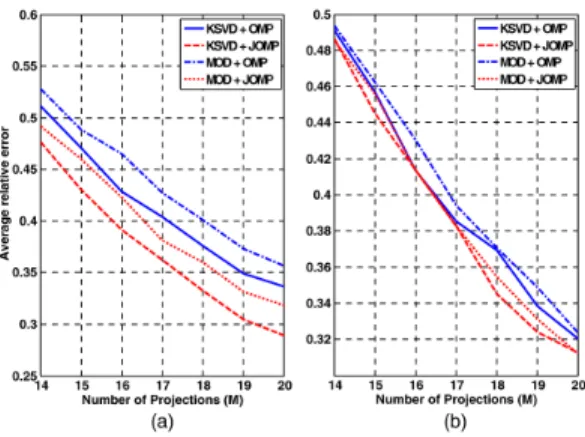
Fig. 2. DCS reconstruction performance with the usage of different dictio-naries. (a) High inter-signal correlation with and ; (b) Low inter-signal correlation with and .
Fig. 3. A segment of ECG signal and reconstructed results ( ). (a) Orig-inal ECG signal; (b) CS reconstruction with the wavelet dictionary, and aver-aged relative error is 1.1304; (c) CS reconstruction with a dictionary based on intra-signal correlation, and averaged relative error is 0.1445; (d) DCS recon-struction with a dictionary based on intra-signal correlation, and averaged rela-tive error is 0.0902; (e) DCS reconstruction with the proposed dictionary based on the SCCI model, and averaged relative error is 0.0609.
distributed (i.i.d.) Gaussian entries, followed by a column nor-malization. The set of training data consists of 1500 ( ) signals, which are divided into 250 subsets, each of which is composed of 6 signals satisfying the SCCI model. The common component of signals within the same subset is created by a linear combination of different dictionary atoms, with uni-formly i.i.d. coefficients in random and independent locations. Similarly, innovation components of each signal within the same subset is created by a linear combination of different dictio-nary atoms. White Gaussian noise to yield a signal-to-noise ratio (SNR) of 20 dB is added to these signals.
The convergence behaviour of different algorithms, i.e., suc-cess recovery rate of the ground truth dictionary (averaged over 10 trials) versus the number of iterations is shown in Fig. 1. It can be seen that the proposed approach always outperforms conventional approaches and is particularly effective for signals with high inter-signal correlation as shown in Fig. 1(a) than sig-nals with low inter-signal correlation as shown in Fig. 1(b). In the experiment, conventional KSVD and MOD both using OMP take 0.46 and 0.34 seconds on average for each iteration, respec-tively, while 0.36 and 0.23 seconds are taken by the proposed
KSVD and MOD both with JOMP, respectively4The reduction of running time can be explained by noting that the JOMP uses
iterations tofind the sparse approximations for signals, while about iterations are required by OMP5.
We now evaluate the quality of dictionary designs for DCS ap-plications. We use the previous setting for training purposes and we use 1200 ( ) signals for testing. projections are taken for each test signal by applying projection matrices with i.i.d. Gaussian entries and column normalization. The test data is reconstructed via DCS with the use of various dictionary designs and compared with the original data. The performance is eval-uated by using the average relative error, i.e., , where and ( ) denote the th original signal and the th reconstructed signal in the test data set respectively. Fig. 2 shows the benefit of the proposed dictionary designs for DCS applications.
B. Experiments with ECG Data
We now evaluate the efficacy of our approach with real ECG data. We conduct preprocessing as in [4] for some ECG records taken from the MIT-BIH Arrhythmia Database set [15], which involves beat detection and period normalization. The set of training data consists of 1, 061 ( ) segments randomly extracted from 48 ECG records, where each segment is com-posed of 6 adjacent heartbeats with dimension 288. A dictionary of size that only takes into account intra-signal correlation is learned by using MOD with OMP (choosing the halting sparsity level to be 10), while the proposed dictionary design that leverages the SCCI model is learned by using MOD with JOMP (choosing the halting joint sparsity level to be 30)6. The learning process terminates after 50 iterations. The performance of the learned dictionaries are evaluated by using the other 1,089( ) segments that are not in the training set. Reduced numbers of measurements are taken from the test heartbeat signals by using random matrices whose entries are drawn i.i.d. from a Gaussian distribution and followed by column normalization. The test data is reconstructed via DCS or CS with the use of various dictionary designs and compared with the original data. We use OMP for CS reconstructions, and JOMP for DCS reconstructions. Fig. 3 demonstrates the higher reconstruction quality of the proposed dictionary design in comparison to the other designs, where the reconstructed ECG segment is one of the test segments in the MIT-BIH Arrhythmia Database set.
V. CONCLUSION
In this letter, we propose a novel dictionary learning approach, which captures both intra- and inter-signal correlation, for DCS applications. We have shown via experiments with both syn-thetic data and actual ECG data that the proposed design, pro-vides a significant improvement to the DCS reconstruction per-formance.
4Our simulations are performed in MATLAB R2012b environment on a
system with a quad-core 3.4 GHz CPU and 32 GB RAM, running under the Microsoft Windows 7 operating system.
5Note that the computation of one iteration of the JOMP is in general more
demanding than that for OMP. For learning a dictionary with very large di-mensions, the growth of computational complexity within one iteration of the JOMP becomes the dominant factor and consequently the JOMP can consume more running time in total.
6The JOMP considers signals, and thus we choose a higher halting joint
REFERENCES
[1] D. Baron, M. Wakin, M. Duarte, S. Sarvotham, and R. Baraniuk, Dis-tributed compressed sensing Electrical and Computer Engineering De-partment, Rice Univ., Houston, TX, USA, Tech. Rep. ECE-0612, Dec. 2006.
[2] T. Xue, X. Dong, and Y. Shi, “Multiple access and data reconstruc-tion in wireless sensor networks based on compressed sensing,”IEEE Trans. Wireless Commun., vol. 12, no. 7, pp. 3399–3411, 2013. [3] H. Mamaghanian, N. Khaled, D. Atienza, and P. Vandergheynst,
“Compressed sensing for real-time energy-efficient ecg compression on wireless body sensor nodes,”IEEE Trans. Biomed. Eng., vol. 58, no. 9, pp. 2456–2466, 2011.
[4] L. Polania, R. Carrillo, M. Blanco-Velasco, and K. Barner, “Com-pressed sensing based method for ecg compression,” inIEEE Int. Conf., Acoustics, Speech and Signal Processing (ICASSP), 2011, pp. 761–764.
[5] Y. Lu and M. Do, “A theory for sampling signals from a union of sub-spaces,”IEEE Trans. Signal Process., vol. 56, no. 6, pp. 2334–2345, 2008.
[6] W. Chen and M. Rodrigues, “Dictionary learning with optimized projection design for compressive sensing applications,”IEEE Signal Process. Lett., vol. 20, no. 10, pp. 992–995, 2013.
[7] I. Tosic and P. Frossard, “Dictionary learning,”IEEE Signal Process. Mag., vol. 28, no. 2, pp. 27–38, Mar. 2011.
[8] L. Zelnik-Manor, K. Rosenblum, and Y. Eldar, “Dictionary optimiza-tion for block-sparse representaoptimiza-tions,”IEEE Trans. Signal Process., vol. 60, no. 5, pp. 2386–2395, 2012.
[9] Z. Szabo, B. Poczos, and A. Lorincz, “Online group-structured dictio-nary learning,” inIEEE Conf. Computer Vision and Pattern Recogni-tion (CVPR) 2011, 2011, pp. 2865–2872.
[10] M. Duarte, M. Wakin, D. Baron, S. Sarvotham, and R. Baraniuk, “Mea-surement bounds for sparse signal ensembles via graphical models,”
IEEE Trans. Inf. Theory, vol. 59, no. 7, pp. 4280–4289, 2013. [11] K. Engan, S. Aase, and J. Hakon Husoy, “Method of optimal
direc-tions for frame design,” in1999 IEEE Int. Conf. Acoustics, Speech, and Signal Processing, 1999 Proc.,, 1999, vol. 5, pp. 2443–2446. [12] M. Aharon, M. Elad, and A. Bruckstein, “K-svd: An algorithm for
designing overcomplete dictionaries for sparse representation,”IEEE Trans. Signal Process., vol. 54, no. 11, pp. 4311–4322, Nov. 2006. [13] M. Sadeghi, M. Babaie-Zadeh, and C. Jutten, “Dictionary learning for
sparse representation: A novel approach,”IEEE Signal Process. Lett., vol. 20, no. 12, pp. 1195–1198, Dec. 2013.
[14] D. Needell and J. Tropp, “Cosamp: Iterative signal recovery from in-complete and inaccurate samples,”Appl. Comput. Harmon. Anal., vol. 26, no. 3, pp. 301–321, 2009.
[15] A. L. Goldberger, L. A. Amaral, L. Glass, J. M. Hausdorff, P. C. Ivanov, R. G. Mark, J. E. Mietus, G. B. Moody, C.-K. Peng, and H. E. Stanley, “Physiobank, physiotoolkit, and physionet components of a new research resource for complex physiologic signals,”Circulation, vol. 101, no. 23, pp. e215–e220, 2000.