73
ELECTRONICS AND ELECTRICAL ENGINEERING
ISSN 1392 – 1215 2011. No. 9(115)
ELEKTRONIKA IR ELEKTROTECHNIKA
SYSTEM ENGINEERING, COMPUTER TECHNOLOGY
T 120
SISTEMŲ INŽINERIJA, KOMPIUTERINĖS TECHNOLOGIJOS
Case Study of a Cost-Effective on-line Learning Environment
Development for Laboratory Class Enhancement
P. Stanic Molcer
Subotica Tech - College of Applied Sciences,
Marka Oreskovica 16, Subotica, Serbia, phone: +381 24 655 201, e-mail: [email protected]
V. Delic
Faculty of Technical Sciences, University of Novi Sad,
Trg Dositeja Obradovica 6, Novi Sad, Serbia, phone: +381 21 485 2533, e-mail: [email protected]
Introduction
Computer aided distance learning becomes reality without any pretension to replace a good teacher. Distance learning is always in a handicapped position when possibility of direct interaction is in question because of the lack of the permanent presence of a teacher. An e-learning course should be attractive, interesting and it has to compensate the absence of the teacher with an appropriate structure, regardless of whether distance learning or supplemental learning material in traditional studying are being considered. Beyond the simple information delivery through the Internet, the creators of the learning material described in this paper used all the possibilities available to make their products active in contrast to written text, which is inert. A web-based learning system with a set of interactive on-line exercises is developed to students of engineering in which emphasis was put on meeting the style of learning of today’s young generation oriented towards inductive discovery and exploring, and the interactivity needed in learning materials. One of our goals in creating a virtual lab with on-line exercises was to make learning more enjoyable and to increase the student’s motivation for signal processing subjects. Information technology is considered the boys’ world, which contributes to the fact that very few girls want to have a career in technology. One way to try to make technology more appealing to girls is to create web learning materials [1]. The goal of the E-Girls – Towards Technology project in Tampere University of Technology was to increase the number of female students in technology by making it easier for them to find their way, in particular, to the fields of electrical engineering and electronics. The subjects of interest of young women were taken into account in purpose to make the learning material more attractive and motivating to them, but according to the received feedback from the course, both boys and girls found the topics interesting and the content useful [2]. Experimentation is a pervasive need
within engineering education, and one that is the hardest to address in a learning-effective and a cost-effective manner [3]. In [4] the development of a multimedia educational package incorporating novel interactive visualization activities and quizzes to help students in the study of engineering measurements is reported and providing appropriate facilities to engage students in the exploration and discovery of knowledge is emphasized. In [5] a series of speech coding simulation tools developed using the J-DSP simulation environment is described [6] and there it was pointed out that despite the fact that certain topics in speech coding could be covered only by static web content, some important aspects of speech processing are best com-municated through the use of computer simulation tools. The work described in [7] was carried out within the EU-funded Invocom project (Internet-based vocational training of communication students, engineers, and technicians), which involved partners from several technical universities and companies around the Europe. According to their experiences, the web server concept is really useful and beneficial from both the material developers’ and users’ points of view.
In modern engineering education it seems rational not to develop extensive and expensive solutions, but rather to build flexible systems that allow smooth adaptation to a new situation [8]. Measurements are often connected with application of special and expensive equipment, hence a virtual laboratory can offer a cost-effective solution [9]. In this paper the results of research and intentions to create a simple, cost-effective and practical system adjusted to the needs of users are given. The focus was on enabling the visualization of the signals, and especially the possibility to hear the audio signals as they are created during the exercises. The on-line interactive exercises have shown to be useful, easy-to-use, and attractive in the study of signal processing as they enriched the learning material in the way which increased the students’ activity in the learning process according to the European Credits Transfers System [10].
74 An evaluation of an interactive website in the field of electromagnetics is reported in [11]. Most of the students indicated that they would like to use a similar system in other courses. In addition, the students indicated that they would like to see the exercises solved in a more detailed and structured way within dynamic and interactive web course provided by teachers and would like to investigate phenomena themselves by changing the parameters in on-line calculations. The interactive exercises described in this paper allow users to investigate the topics by changing the parameters of the simulations. Students can concentrate on the topics that interests them the most, or they can explore deeper some of the topics which they find more difficult to understand. There is no need to download any extra soft-ware or plug-ins nor to learn any programming techniques to complete the exercises, thus students can spend more time exploring the studied topic.
The following section briefly describes the architecture of the realized virtual lab. The third section gives a short course description. The fourth section presents the details of the formative evaluation, the fifth section discusses the evaluation results and describes the created extensions of the learning course.
Architecture of the learning system
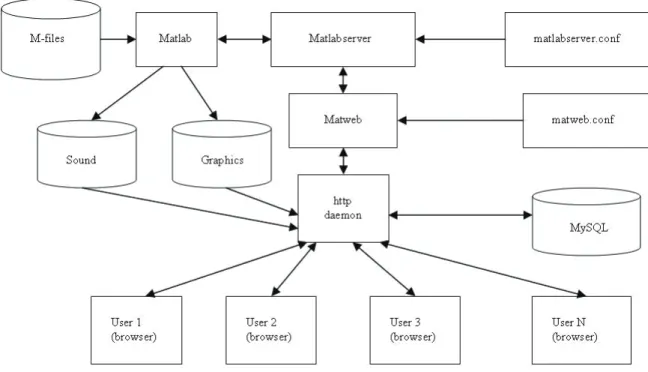
The architecture of the realized virtual lab for signal processing e-learning is cost effective because students only need an Internet browser. The server on which the exercises run has Matlab7 for Windows or Linux, and an Apache Web Server.Matlab has its own web server which communicates with Apache. Apache transmits the input parameters from the web page to the Matlab application. The input parameters include the parameters of the experiments chosen by the users and the name of the Matlab application which has to be executed and which is previously incorporated into the web page. The results are generated inside the Matlab application and graphically presented in JPEG format. The application also generates sound files, which can be accessed through the link generated by Matlab (Fig. 1). For the graphic files, the built-in file name server was used. For the sound files, random file names are generated in the applications. Every execution of an application deletes the JPEG and WAV files created by them which are older than one hour, avoiding this way the uncontrolled increase of the number of files on the server.
Fig. 1. Architecture of the virtual lab for signal processing e-learning based on Matlab
PHP scripting language is used in creating the on-line tasks and the on-line questionnaire. It processes the page requests and fetches the data from a MySQL database. PHP dynamically outputs data in HTML form queried in a special web page accessed by the professor with his user name and password. Students can change specific parameters in every simulation in order to explore the behavior of the model set up by the exercise. By modifying the input parameters, students can understand their impact on the resulting output more easily, as well as on the behavior of the explored system. Students are given several tasks, including on-line experiments with suggested parameters which are leading them step by step through the topic in question. After
the results have been obtained, the students are able to analyze the output of the simulations depending on various input parameters, and they are supposed to make deductive conclusions on the topic. Answering the questions in the questionnaire about the topic is the final step of the task. Course description
The first set of exercises was made as an experiment in the field of speech signal processing. It was intended to be used as a supplement to the existing theoretical course. The goal was to create a tool which could be used independently by the students. The topic of applying linear
75 prediction in speech coding is explored in nine exercises. The on-line exercises provide visualization of speech signals in the time domain and the amplitude spectrum of the LPC (Linear Predictive Coding) filter which models the vocal tract [12, 13], as well as the amplitude spectrum of the speech signal varying in time. Reproduction of the sound produced by estimation is also available. Students can analyze the characteristics of the filter with various input signals and filter parameters by changing these inputs and observing the results given by Matlab. It has to be mentioned that the tests accompanying the exercises has been made in purpose to illustrate better the specific topic in question and must not be generalized. At first, the contribution of the filter order to the quality of the prediction, (signal-to-noise ratio) is investigated. Increasing the filter order, which is the input parameter of the exercise, results in an increase of the signal-to-noise ratio. The resulting figure shows the signal-to-noise ratio as a function of the filter order. In the resulting figure students can see that the rate of increase of this function is not linear and that saturation occurs at certain values of the filter order. A greater value of the filter order implies that there are more parameters to transmit. The goal of coding is to reduce the amount of the data while keeping the amount of information acceptable, increasing the data transfer rate in this way. Students can see on the diagram what filter order is the best choice in terms of speed and quality of the estimated signal.
The second topic contains four exercises about the stationarity and the windowing of the speech signal. The speech signal is a slowly time-varying one and can be considered as quasi-stationary during 20-35 ms [12]. It is possible to model the vocal tract by a filter with its transfer function (1) determined by the filter order P and parameters
a
k
1 . 1 1
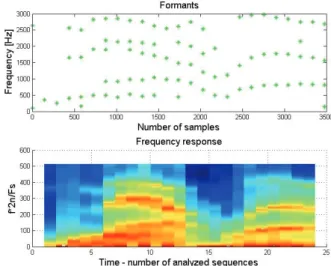
P k k kz a z H (1)The parameters of the prediction filter have to be estimated every 20-35 ms. Before the estimation, the Hamming window function is applied to the analyzed sequence. Students can change the window length and the amount of the overlapping between successive windows. There is also a possibility to change the filter order and the entire length of the analyzed sequence. As the result of the exercise, frequency response of the LPC filter is available. Fig. 2 shows the results that the students obtain after processing a sequence of 8000 samples at a sampling rate of 8000 Hz. The amplitude spectrum of the signal as a function of time shows how fast the speech signal changes, thus it also shows how often the signal has to be estimated.
The third topic contains four exercises related to the quantization [14] of the filter parameters and about the PARCOR coefficients. Students can select the number of bits available for representation of the filter parameters. As the result of the exercise they can observe the degradation of the filter frequency response due to truncation of the filter coefficients and to the quantization noise. The filter described with such parameters can become unstable. On
the z-plane diagram the stability or the instability of the filter can be observed.
Fig. 2. Results of the exercise about speech signal stationarity
The estimated speech signals with various numbers of bits can also be reproduced, heard and compared to each other. The PARCOR coefficients are presented and experiments with them are available in this group of exercises. The stability and the frequency response of the LPC filter after quantization can be explored when PARCOR coefficients are used and they can also be compared with the frequency response and the stability of the same filter when PARCOR coefficients are not used. The results of the exercise shown in Fig. 3 clearly demonstrate that the PARCOR coefficients are less vulnerable and less sensitive to quantization than the direct filter coefficients.
Fig. 3. Results of the exercise about the quantization of PARCOR coefficients
Methods of evaluation
An end of the project of creating a learning material cannot be considered in a classical sense because development of such material is a continuous process. The environment, its technical capabilities and the contents of the learning subject are all changing. Instead of making an evaluation after the project is completed, a continuous formative evaluation was conducted during the development of the learning material described here. The formative evaluation will improve a project during the development and implementation phases [15]. It provides feedback during the program development and implementation. An on-line questionnaire is assessed to ensure feedback information. The course material was
76 improved according to the results of the analysis of the questionnaire, meeting this way the needs of the users. The first version of the set of on-line exercises was tested with students from the Faculty of Technical Sciences in Novi Sad, Serbia, who had chosen the field of telecommunication and signal processing as their principal field of study. During the 8th term within the subject of Digital Speech Processing, on-line exercises were offered as a supplement to the theoretical learning and laboratory exercises. The other group involved in the formative evaluation of the learning material consisted of students of multimedia from the Technical University in Budapest, Hungary. The students were asked to fill in a questionnaire containing two types of questions. The first type of the questions were actually the task of the specific experiment. The second type of the questions were related to the students’ opinion about the usefulness of the exercise on a scale from 1 (the least) to 5 (the most) (see Appendix). Results and discussion
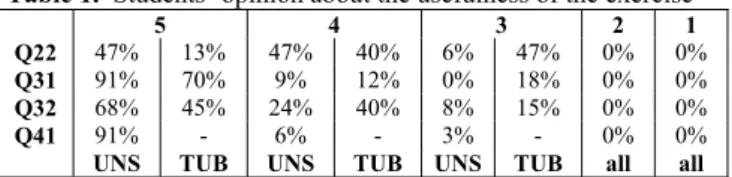
The first assessment was made at the Technical University in Budapest. After some modifications of the system were made, the assessment was repeated at the University of Novi Sad. Several representative answer statistics for the posed questions are given in Table 1. The answers to the questions related to the task of the first exercise indicated that the students did not understand the exercise well enough, hence the answers to questions Q11 and Q21 were not considered. All the other answers related to the opinion of the students were considered because the students were successful in giving correct answers about the tasks. The first exercise within the third topic got the best marks as it can be seen in the second row of Table 1. Most of the students liked the idea of on-line exercises as can be seen in the 4th row in Table 1. Most of the students welcomed the opportunity to do laboratory exercises at home. Still, some students noted that computers and Internet are available in the laboratories at the University but not at their homes, and that they had difficulties with doing the exercises. Another problem reported by the students was the slow response time of the system. The web statistic clearly showed the breaking point in using the learning material. This was the slowest exercise which had the longest response time. This fact could also be seen from the results of the questionnaire collected from the stu-dents in Hungary. As the exercises were not compulsory, students just quitted the experiment when the waiting time for the results became too long. The rapid development of the Internet and the increase in web usability and accessibility in Serbia in the last years promise that this problem which existed at the beginning of the development of the learning material will soon be overcome.
It has to be noted that the drawback of the described system is that there is no opportunity for the teachers to follow up the students during there work on the exercises, and to give them immediate help if necessary.
Textual notes of the students about the on-line exercises were very useful and helpful in specifying the further direction of the development, and in the light of this fact, further possibilities for giving comments were added to the survey.
Table 1. Students’ opinion about the usefulness of the exercise
5 4 3 2 1
Q22 47% 13% 47% 40% 6% 47% 0% 0% Q31 91% 70% 9% 12% 0% 18% 0% 0% Q32 68% 45% 24% 40% 8% 15% 0% 0% Q41 91% - 6% - 3% - 0% 0%
UNS TUB UNS TUB UNS TUB all all Note: The opinion scale is from 1 (the least) to 5 (the most).
The questions (Q) are given in the Appendix.
The results are given in percents of students from:UNS – University of Novi Sad; TUB - Technical University in Budapest
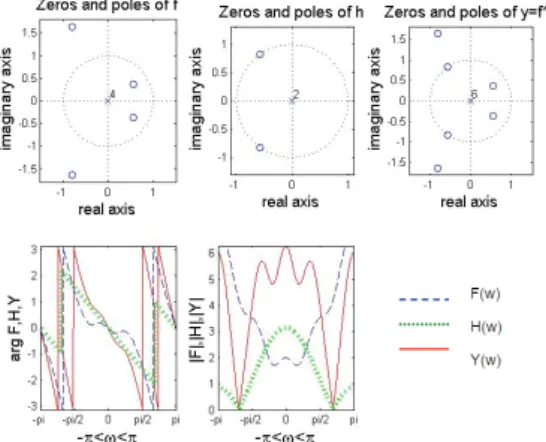
An evaluation of the created exercises was accomplishedwith the purpose of gainingknowledge as to whether to continue the program, extend it to other sites, or to modify it. The information obtained from the evaluation results aided the extension and the enhancement of the e-learning project. The further development of the on-line material led to its expansion on other topics in digital audio signal processing, digital signal processing [16] as well as fuzzy logic [17]. The design of the web site and the redesign of the data base were also necessary. In the experimental phase of the development no user name or password from the users was required. The new version is intended to be in use as a homework part of the laboratory, thus the collection of additional information about the students such as their index number became essential. Homework projects give the opportunity to apply the acquired knowledge and be rewarded with results that can be seen and heard [18]. The number of exercises in the field of audio signal processing has been extended to 15, including the former exercises about speech signal processing. A new set of 9 exercises about the fundamentals of digital signal processing have also been made. The new set of exercises in the field of digital signal processing is related to convolution, autocorrelation, z-transformation of signals and analysis of poles and zeros in the z-plane. The technique of windowing is also included in the tasks. Results of an exercise as delivered by Matlab web server are shown in Fig. 4. This exercise is intended to illustrate the connection of the signal in time domain and in frequency domain as regards convolution. The users submit the samples of any two finite input signals, and as the result they receive the convolution of those two signals shown in the frequency domain and the z-plane together with the input signals. The input signals in this example were as given by (2) and (3):
n n 0.5
n12
n2
3
n3
1.5
n4
f ,(2)
n n 1.1412
n1
n2
h . (3)
The additional exercises in the topic of audio signal processing were related to the amplitude spectrum of the speech signal, the differences between various (male and female) speakers, the amplitude spectrum of various (classical, rock) music samples, the filtering of the speech signal, as well as the reverberation of the audio signal [12, 19]. All of these exercises include the possibility of listening to the audio signal before and after its processing. Fig. 5 shows the results of the exercise related to the filtering of the speech signal.
Users have to submit the of the preemphasis coefficient α. This filter is commonly used to emphasize the higher frequencies in speech signal, because the
77 greatest amount of energy is contained in the lower frequency components. In this way lower frequencies have more impact on the LPC coefficients, but higher frequencies also play a significant role in the intelligibility of the speech signal. By changing the parameter of the filter, the users can see the changes in the amplitude spectrum and hear them after filtering.
Fig. 4. Results of the exercise related to the convolution
Fig. 5. Results of the exercise of filtering of the speech signal
Beside being used at the Faculty of Technical Sci-ences in Novi Sad, the interactive online exercises have been introduced in the 2009/2010 academic year also at the College of Applied Sciences in Subotica, Serbia. The e-learning system runs on a single server, wherefrom it can be used by multiple institutions.
Conclusions
On-line exercises are useful to distance learning students but our study has shown that “traditional” students also like the idea of learning that way and are particularly interested in using more interactive e-learning material. It is often hard to achieve synchronization of the theoretical lectures and laboratory exercises in signal processing because of the lack of room and computers in the college. That is why proper timing can not be always achieved. An on-line set of exercises is not limited in time and space, hence it can bridge the gap between lectures and laboratory exercises. Importance of
continuous formative on-line evaluation during the development has been discussed and the results have been presented. The development of the learning material for engineers as proposed in this paper is time-effective – hence cost-effective too – because once the system is established, it can be easily extended to other fields, and the number of exercises can be increased easily.
Appendix
The questions about the students’ opinions were as follows:
Q11 Does the exercise contribute to the understanding of the LPC filter’s function in speech signal modeling? Q21 Does the exercise contribute to the appreciation of the
impact of the window length and the sequence length to the accuracy of the prediction?
Q22 Does the exercise contribute to the appreciation of the impact of the window length and the sequence length to the accuracy of the prediction?
Q23 Does the exercise contribute to the understanding of the LPC filter’s function in speech signal modeling and the understanding of the formants?
Q241 Were you able to see how the frequency response of the LPC filter depends on the window length?
Q242 Does the exercise contribute to the understanding of the dependence of the prediction on the window length?
Q31 Were you able to see in the exercise the degradation of the LPC filter because of the parameters quantization of the parameters?
Q32 Does the exercise contribute to the understanding of the fact that the quantization of filter coefficients affects its stability?
Q33 Does the exercise contribute to the understanding of the meaning of line spectral frequencies?
Q34 Does the exercise contribute to the understanding of the advantage of the PARCOR coefficients as compared with the direct filter coefficients?
Q41 Do you like the idea of the on-line exercises?
Q42 How much do you find these exercises useful in acquiring theoretical knowledge?
Acknowledgements
The work described in this paper was supported in part by the Ministry for Science and Technological Development of the Republic of Serbia, within the project TR11001.
References
1. Korpinen L., Koskiranta M., Lehtelä R. The Designing and Implementation of WWW–course “Electricity, Electronics and Environment” // Electronics and Electrical Engineering. – Kaunas: Technologija, 2010. – No. 6(102). – P. 75–78. 2. Vesapusito M., Vekara T., Korpinen L., Koskiranta M.,
Lehtelä R. The students’ Feedback on WWW–course “Electricity, Electronics and Environment” // Electronics and Electrical Engineering. – Kaunas: Technologija, 2010. – No. 6(102). – P. 99–102.
3. Gurkan D., Mickelson A., Benhaddou D. Remote Laboratories for Optical Circuits // IEEE Transactions on
78
Education, 2008. – Vol. 51. – No. 1. – P.53–60.
4. Tan F. L., Fok S. C. Development of a Computer–Aided Educational Tool Incorporating MATLAB for Engineering Measurements // Computer Applications in Engineering Education, 2009. – Vol. 17. – No. 2. – P. 206–213.
5. Spanias A., et al. Development and Evaluation of a Web– Based Signal and Speech Processing Laboratory for Distance Learning // Proceedings of IEEE ICASSP–2000. – Istanbul, 2000. – Vol. 6. – P. 3534–3537.
6. Atti V., Spanias A. On–line Simulation Modules for Teaching Speech and Audio Compression Techniques // Proceedings of 33rd Annual Frontiers in Education (FIE'03), 2003. – Vol. 1. – P. T4E–22.
7. Yan P., Valkama M., Renfors M. Distance Learning in Communications Signal Processing using MATLAB Web Server // Proceedings of the 6th Nordic Signal Processing
Symposium – NORSIG 2004. – Espoo, Finland, 2004. 8. Hrad J., Zeman T. Increasing the Attractiveness of
Engineering Education in the Area of Electronic Communications // Electronics and Electrical Engineering. – Kaunas: Technologija, 2010. – No. 6(102). – P. 79–82. 9. Rankis I., Lebedev A., Bunina I. Elaboration of Program
Package Virtuallab for Power Electronics Laboratories // Electronics and Electrical Engineering. – Kaunas: Technologija, 2009. – No. 6(94). – P. 61–64.
10.European Commission Realizing the European Higher Education Area, Communiqué Conf. Ministers Responsible for Higher Education, Berlin, Germany, 2003.
11.Humar I., Sinigoj A. R., Bešter J., Hagler M. O. Integrated Component Web–Based Interactive Learning Systems for Engineering // IEEE Transactions on Education, 2005. – Vol. 48. – No. 4. – P. 664–675.
12.Gold B., Morgan N. Speech and Audio Signal Processing. – J. Wiley & Sons, 2000.
13.Salkintzis A. K., Passas N. Emerging Wireles Multimedia Services and Technologies. – J. Wiley & Sons, 2005.
14.Dincic M., Peric Z. Design of Quantizers with Huffman Coding for Laplacian Source // Electronics and Electrical Engineering. – Kaunas: Technologija, 2010. – No. 10(106). – P. 129–132.
15.Mester Gy., Stanić Molcer P., Delić V.. Educational Games. In: Cruz–Cunha M. M., Carvalho V. H. and Tavares P. Business, Technological and Social Dimensions of Computer Games: Multidisciplinary Developments. IGI Global, Pennsylvania, in press.
16.Stanić Molcer P., Delić V. Učenje na daljinu sa onlajn vežbama iz digitalne obrade signala // Procedings of the 7th
IEEE Conference DOGS’08. – Kelebija, Serbia, 2008. – P. 217–220
17.Stanić Molcer P., Delić V. Web–Based Exercises for Teaching Basis of Fuzzy Logic // Proceedingsof the 7th
International Symposium on Intelligent Systems and Informatics. – Subotica, Serbia, 2009. – P. 103–107.
18.Marozas V., Dumbrava V. Motivating the Students to Study the Basics of Digital Signal Processing by using Virtual Learning Environment // Electronics and Electrical Engineering. – Kaunas: Technologija, 2010. – No. 6(102). – P. 87–90.
19.Gardner W. G., Kahrs M. Applications of Digital Signal Procesing to Audio and Acoustics. – Kluwer Academic Publishers, 2002.
Received 2010 11 09 Accepted after revision 2011 02 18 P. Stanic Molcer, V. Delic. Case Study of a Cost-Effective on-line Learning Environment Development for Laboratory Class Enhancement // Electronics and Electrical Engineering. – Kaunas: Technologija, 2011. – No. 9(115). – P. 73–78.
This paper reports the parallel development and formative evaluation of a web-based interactive learning course based on Matlab in the field of digital signal processing and digital audio signal processing. The challenge of creating an interactive course is discussed, and the advantages, time and cost-effectiveness are described. The architecture of system is briefly described and it can be easily extended to other fields to give students additional opportunity to an active learning. Illustrative examples of the exercises with speech signal are given in a short course description. Results of the evaluation provided a feedback for further development of the system, which lead to its enhancement and its extension. Ill. 5, bibl. 19, tabl. 1 (in English; abstracts in English and Lithuanian).
P. Stanic Molcer, V. Delic. Rentabilios laboratorijai skirtos realaus laiko mokymosi aplinkos kūrimo galimybių studija // Elektronika ir elektrotechnika. – Kaunas: Technologija, 2011. – Nr. 9(115). – P. 73–78.
Pristatomas dabar tobulinamas virtualus mokymosi kursas taikant programų paketą „Matlab“, skirtą skaitmeniniams signalams apdoroti ir skaitmeniniam garso signalų apdorojimui. Aptariamas interaktyvaus kurso kūrimo uždavinys, jo pranašumai ir rentabilumo klausimai. Trumpai aprašyta sistemos architektūra gali būti pritaikyta aktyviam mokymuisi. Pateikta iliustruotų uždavinių sprendimo pavyzdžių su kalbiniais elementais. Apibendrinti vertinimo rezultatai, suformuluotos tobulinimo gairės. Il. 5, bibl. 19, lent. 1 (anglų