Student Tutors for Problem-Based Learning
in Dental Hygiene: A Study of Tutor Actions
Tricia Moore, Ed.D.; Daniel L. Kain, Ph.D.
Abstract: This case study illuminates contextual factors related to the tutor experience when senior students served as tutors for sophomore students in a problem-based learning (PBL) course in a baccalaureate dental hygiene program. Data were collected using various sources and methods. Tutors and administrators were interviewed, those tutored completed an anonymous ques-tionnaire, the tutorial process and tutor training sessions were observed, and related documents were examined. Data analysis included open and axial coding, creation of tutor profiles, and identification of patterns. Tutor training included experiencing the PBL student role, attending class, and weekly seminar sessions facilitated by a tutor supervisor. Analysis revealed that tutor behaviors could be distinguished by the nature of intended actions (e.g., telling, asking, clarifying, acknowledging), emphasis of comments (process, content, social), and facilitation style (directive, suggestive, empowering). Patterns in tutor behavior and attitudes emerged related to comfort or growth and persistence or lenience. Differences in tutor understanding and perception of their role and the purpose of PBL appeared to influence the role the tutor assumed. Other factors that influenced tutor behavior included tutor intentions, tutor training, and environmental factors (e.g., time). The study, incorporating Fishbein’s integrative model, suggests points of influence on tutor behaviors.
Dr. Moore is Professor, Dental Hygiene Program, Northern Arizona University; and Dr. Kain is Vice Provost, Northern Arizona University. Direct correspondence and requests for reprints to Dr. Tricia Moore, Dental Hygiene Program, Northern Arizona University, Box 15065, Flagstaff, AZ 86011; 928-523-4012 phone; 928-523-6195 fax; [email protected].
Keywords: dental hygiene education, team-based learning, problem-based learning, faculty development, peer mentoring, pedagogy
Submitted for publication 10/5/10; accepted 1/6/11
H
ealth care providers today are faced with an explosion of information, new products, complex medical conditions, and disparities in health and access to care.1-3 Medical and dentalschools have introduced problem-based learning (PBL) to develop professionals who can work in teams to solve complex problems in a changing world. In contrast to traditional lecture-based in-struction, PBL structures learning through students’ first encountering realistic problems from their area of practice. Students then identify learning issues as what they need to know to understand causes of phenomena embedded in a problem, which they pursue in self-directed inquiry. Components of PBL include authentic ill-structured problems (ones that may have multiple “correct answers” vs. those that suggest only one solution path), self-directed learn-ing, and small-group collaboration with tutors who serve as facilitators rather than content experts.4 In
PBL, students solve problems similar to the real world problems they will encounter as professionals. The PBL process is designed to help students develop learning and problem-solving skills: they learn how to think about thinking, create hypoth-eses, gather evidence, make decisions, ask probing questions, resolve ambiguities, and determine what actions to take. Students come together in small
groups, under the guidance of tutors, to share their understanding, discuss inconsistencies, and negotiate differences. Alternative views enable learners to test their understanding and build new ideas or solutions that are compatible.5 A move from traditional
educa-tional methods to PBL has the potential to shift the emphasis from lecture and the passive transfer of information to active collaborative and self-directed learning, critical thinking, problem-solving, and teamwork—all skills that serve the graduates of dental hygiene programs in their future practice.
This article highlights one aspect of a case study regarding PBL in dental hygiene education in an attempt to illuminate contextual factors when senior students served as tutors for sophomore stu-dents. The study was guided by four questions: 1) How does the student come to participate as a tutor? 2) How does the tutor prepare for the tutor role? 3) What does the tutor do during tutorials? and 4) What does the tutor learn from the tutoring experience? The focus of this article is question 3.
The PBL Tutor
The PBL tutor role differs dramatically from a traditional faculty role. The PBL tutor is a
facilita-tor of the collaborative learning process rather than a content expert or dispenser of knowledge. Stud-ies have identified tutor tasks including directing the learning process, encouraging elaboration and integration of knowledge, balancing student direc-tion with assistance, contributing knowledge and experience, creating a pleasant learning environment, stimulating critical evaluation of ideas, modeling self-evaluation, and stimulating individual account-ability.6 Schmidt and Moust identified desirable tutor
behaviors as challenging students to clarify their own ideas and encouraging them to elaborate on subject matter, question their ideas, look for inconsistencies, and consider alternatives.7
The PBL tutor role includes helping students with necessary structure, practice, and feedback to encourage movement from novice learner behavior to what psychologists refer to as expert reasoning.8-10
One important skill required of tutors is scaffolding,10
which involves simplifying the learner’s role through gradually diminishing interventions of the tutor.8
Scaffolding also involves obtaining the students’ in-terest in the task, breaking the task into manageable steps, maintaining motivation for pursuit of the goal, pointing out discrepancies when students’ solutions or processes are not ideal, controlling frustration, and modeling ideal behavior.10 Tutors provide support by
asking appropriate questions, cuing, and providing metacognitive support or structure needed to reach higher levels of thinking, thus the term “scaffolding.” Because receiving too little, or too much, guidance can adversely affect learning, assistance is provided only when needed and takes the form of modeling, feedback, instructing, questioning, and cognitive structuring.
Effective tutoring is a challenge to implement. Studies have found that tutors sometimes resort to traditional information dissemination when they experience difficulties in the group, listing learning issues for the students, providing resources, and even lecturing.11 Studies also show that facilitators are
more apt to provide explanations, simplify concepts, and make connections for students than to empower students to do these things themselves.12,13 For many
tutors it is easier to give answers than to ask questions and direct students to information sources. These tutor behaviors go against intended PBL theory and deprive the group of situations that result in elabora-tion, activation of prior knowledge, and development of self-directed learning skills.
Few studies have looked at actual tutor behaviors and processes. Most studies of PBL tutors focus on
what facilitators ought to do rather than on what they actually do or why they do it.6 One exception is a study
by Hmelo-Silver and Barrows14 of an expert PBL
tu-tor in a medical program. That study revealed tutu-tor goals of helping students construct causal explanation, reason effectively, and become self-directed learners. Effective tutor strategies included use of open-ended and metacognitive questioning, pushing for explana-tion, reiterating, summarizing, generating and evalu-ating hypotheses, mapping symptoms to hypotheses, checking for consensus, creating learning issues, and encouraging construction of visual representations.
Study Context
The baccalaureate dental hygiene program at Northern Arizona University (NAU DH) introduced PBL to develop students’ ability to work in teams, im-prove thinking, and develop lifelong learning skills. This program awards a baccalaureate degree in dental hygiene after one year of prerequisite courses (e.g., biology, anatomy, physiology, chemistry, microbiol-ogy, nutrition, patholmicrobiol-ogy, statistics, psycholmicrobiol-ogy, soci-ology, and English) and three years of liberal studies and dental hygiene didactic and clinical coursework (e.g., dental anatomy, oral histology, head and neck anatomy, oral radiology, pharmacology, periodontics, pain management, research, public health, oral medi-cine, dental materials, career management, oral health outcomes, professional seminar, and clinical dental hygiene). Within the three years of dental hygiene coursework are two one-credit hour professional seminar courses, which utilize PBL. One occurs early (sophomore year); the other occurs late (senior year). At the time of this case study, the senior PBL seminar met face-to-face once a week for two hours with an additional hour allocated for work outside of class. The sophomore PBL course consisted of a six-week orientation to problem-solving, self-directed learn-ing, and working in groups. During this orientation period, students learned a problem-solving model, practiced solving problems, used visual tools (such as concept maps and fishbone diagrams) to clarify relationships between ideas, made decisions using consensus, set goals, conducted self-assessment, provided and received peer feedback, and learned guidelines for performing roles in groups. After the orientation, the sophomores solved problems in groups using these processes.
The NAU DH PBL model was fashioned after, and is well aligned in many ways with the Barrows
model,4 also described in Barrows and Neo.15 The
steps in the NAU problem-solving model coordinate well with that recommended process. Problems uti-lized in both models are authentic, ill-structured prob-lems that do not have single correct answers; that is, reasonable persons could draw varying conclusions. Self-directed learning is emphasized in both models with students identifying their learning goals and completing necessary research to learn the material and develop and analyze solutions.4,15
There are also differences between the NAU DH model and the Barrows model, including the emphasis of the curriculum, specific nature of the problems, schedule, scope of practice, type of student, and nature of tutor. The Barrows model concentrates on problems related to diagnosis and treatment of specific medical conditions; the NAU DH model uses a variety of problems including some related to diagnosis and treatment of oral conditions and others related to political decisions or ethical dilemmas. The Barrows model recommends that PBL groups have the freedom to schedule meet-ing time accordmeet-ing to their needs; the NAU DH model provides for a set and limited tutorial time. The Barrows model recommends that PBL extend throughout the curriculum; the NAU DH model is two single courses within a curriculum that primar-ily uses more traditional approaches to education. The Barrows model uses PBL with graduate level medical students; the NAU DH program uses PBL with undergraduate dental hygiene students. One final important difference involves the tutor. In both models the tutor serves as a facilitator rather than content expert; however, Barrows uses faculty tutors and NAU DH uses student tutors.
Student Tutors
Although most dental and dental hygiene pro-grams are accustomed to the low faculty-to-student ratio required to learn clinical skills, they often perceive the very low ratio required by PBL (one tutor to six students) as an expendable extravagance. Programs acknowledge faculty recruitment issues16-18
and often use groups larger than the ideal size for PBL. Some programs have experimented with tutor-less groups19-20 or the use of student peer tutors.21-23
The NAU DH program obtained grant resourc-es that initially provided financing for faculty tutors for PBL. Subsequent scarcity of funding and limited faculty resources, combined with the potential for
improving the student experience, led the department to examine the possibility of using students as tutors. Several studies have compared the use of student and faculty PBL tutors, with mixed results depending on the criteria for evaluation. De Grave et al.24 found no difference in test achievement scores
for groups tutored by students and faculty; however, students found faculty-led tutorials more pleasant. Although there is not much evidence supporting the use of peer tutors compared to faculty tutors in PBL groups, neither is there much evidence against their use. A study by Solomon and Crowe23 found
that peer tutors struggled with facilitation skills and had difficulty separating the student and tutor roles. The students enjoyed the tutor role even though they struggled with skills such as asking relevant questions and judging when to be directive and intervene. Steele et al. found no difference between faculty and peer tutors with respect to student perceptions of group process and student performance on knowledge-based examinations.25 The focus groups in that study
revealed that students in peer-facilitated groups took shortcuts in the process that may have undermined the goals of PBL. For example, some peer tutors distributed learning objectives before the case rather than at the end as a check of self-directed learning skill. Peer-led groups divided learning issues among members and limited discussion and elaboration. These deviations from intended PBL theory were seen by some students as positive in that they made the tutorials more efficient.
A theoretical model of tutor behaviors and their relationship with other elements of PBL17,26 suggests
that PBL tutoring requires the use of expertise (pos-session of a suitable knowledge base); cognitive congruence (skill to express oneself in a language understood by students); and social congruence (willingness to become involved with students in an authentic way). De Grave et al.24 suggested that
faculty and students might experience cognitive incongruence whereas students and student tutors might experience cognitive congruence. Because novices (i.e., students and student tutors) have dif-ferent cognitive structures than experts (i.e., faculty tutors), student tutors might be better able to un-derstand student problems, assess prior knowledge, and explain concepts using language and examples students understand better than those faculty tutors might use.
There has been ongoing debate about the rela-tive importance of content and facilitation expertise for PBL tutors.27-35 Barrows and Tamblyn suggested
that as long as one is a good tutor, he or she can suc-cessfully tutor in any area.36 Schmidt et al.34 found
that process facilitation skills affected achievement and that non-expert tutors were less likely to em-phasize detail and more likely to see things from the viewpoint of the students (cognitive congruence). Others suggest that expert tutors detract from stu-dents’ self-directed learning by teaching or lecturing about their areas of expertise and dominating the group rather than facilitating self-direction and col-laborative learning.37
Vygotsky and Piaget both recognized the im-portance of social interaction in learning but differed with respect to the basic nature and ideal situation for social learning. Piaget, according to Rogoff, emphasized the importance of collaboration with an “equal” partner because unequal power relations prevent discussion and cooperation necessary for the “true socialization of the intelligence” (p. 147).38
Vy-gotsky, on the other hand, also according to Rogoff, believed in the importance of a “more capable” part-ner, someone with more skill and understandingwho could stretch the other partner within his or her zone of proximal development, the zone width indicating the potential for new learning.38 Vygotsky and Cole
defined the zone of proximal development (ZPD) as “the distance between the actual developmental level as determined by independent problem-solving and the level of potential development as determined through problem-solving under adult guidance or in collaboration with more capable peers” (p. 86).9
Senior students may be in a good situation to serve as tutors for sophomore students—able to serve as both the more expert peer Vygotsky proposed as essential and the equal peer Piaget proposed as necessary for true collaboration. Topping has argued that peer tutoring can allow both the conflict and challenge necessary, according to Piaget, to loosen blockages from old myths and false beliefs, as well as the support and scaffolding from a more competent peer necessary, according to Vygotsky, for movement within the ZPD.39
Senior students are likely to have more content knowledge and skill as well as a broader vision of the important features of the learning situation than sophomore students. Yet senior students may also be in a better position than faculty members to serve in the capacity of a peer, allowing freer discussion than might occur with a faculty tutor. Senior students may be better able to adjust their communication for understanding and may be more likely to share com-mon values, experience, and frame of reference with
sophomore students, factors that allow for discussion less restricted by power differentials. Student tutors may also have an easier time than faculty tutors finding effective ways to achieve “shared thinking” to stretch less skilled sophomores (p. 39).38 The
pur-pose of our study was to examine the student tutor experience and explain how students function in the tutor role when senior dental hygiene students served as tutors for beginning students in a one-semester, two-hour PBL course.
Methods
The research methods of our study included interviews, written questionnaires, observations, and document review. The study was informed by interviews of all students serving as tutors (n=6) during a one-semester PBL course. Tutor interviews concentrated primarily on the tutoring experience including details such as how they decided to become a tutor, how they prepared, what they did in tutorials, and details of their experience. The study was also informed by interviews of three administrators: the NAU DH program chair, the PBL course designer, and the student tutor supervisor. Administrators were asked about tutor selection, tutor preparation, and their perception of the tutor role in general. Sopho-more students provided their perspectives on the tutor role on an anonymous (coded only by tutorial group) written questionnaire with primarily open-ended questions. Tutees were asked things such as what their tutors did during tutorials, what they wished their tutors would do more of and less of, how feedback was provided in the group, and what feedback their tutor provided to them. Normal course products such as journal entries, training materials, and evaluation forms also contributed data. Documents from both tu-tors and students were examined. Another important data source was observation of student-tutored PBL sessions using videotape and audiotape. Analyzed segments of tutorials amounted to about five hours of observation for each tutor. Analyzed segments of tutor training sessions totaled about ten hours. The primary researcher completed all transcription, checked transcriptions for accuracy, and conducted the analysis.
Transcripts of interviews, tutor meetings, and tutorial sessions were analyzed using a combina-tion of open and axial coding accomplished with the assistance of Provalis Research’s QDA Miner Qualitative Data Analysis Software (version 3.0.1).
Initially, categories, properties, and dimensions were generated through open coding40 to categorize
pat-terns that emerged from the tutor experience rather than forcing data into preconceived categories. The use of QDA Miner software facilitated the search for patterns. For example, with this software it was pos-sible to count the number of times a particular code occurred by tutor and/or by tutorial week and to ac-cess all instances of a particular code. A search could be conducted for codes by data source; for example, it was easy to see what tutees, the tutor supervisor, or tutorial observation revealed for a particular code. The software allowed for an examination of relation-ships between categories and subcategories40 working
back and forth between the data and the classification system in an attempt to verify internal and external homogeneity (i.e., sameness within categories; differ-ence between categories), emergdiffer-ence of regularities and examination of deviant cases, and meaningful-ness of categories.41
As patterns emerged, the researcher returned to the data to further elucidate findings. Review of tutorials, tutor interviews, and journals resulted in the construction of tutor profiles. Individual case and cross-case analysis of all six tutors helped connect threads within and between various tutor experiences, identify patterns, consistencies, and differences, and provide meaning.41
The primary researcher was experienced in research methods, including ethnographic research methods and qualitative interviewing. Bias inevita-bly, though not intentionally, was introduced into the study related to the researcher’s familiarity with the literature on PBL and tutoring, her experience as a dental hygienist, her involvement in design of the PBL curriculum, and her hopes as a passionate be-liever in PBL. Her insider position facilitated access and also influenced the questions asked and answers received. Her position and experience also enabled understanding of the tutor role as it related to PBL theory, processes and strategies taught in the PBL course, and demands of the dental hygiene profes-sion. Although some might consider this knowledge of PBL and tutoring to be a plus for this study, others may see it as a weakness. For this reason, tactics were used to ensure validity, including the use of external reviewers and interviewers.
Techniques used to improve validity included collection of data using a variety of methods and multiple sources, use of an interview protocol, pilot and field testing of instruments, interviewers repre-senting internal and external perspectives, review
of preliminary findings by the participants (focused group interview), and examination of data by external reviewers. The use of an external interviewer helped ensure results were not simply due to researcher bias or to tutor perceptions of the primary researcher’s position being one of power (as instructor in the NAU DH program). The primary researcher conducted four of the tutor interviews. Two of the tutor interviews and all of the administrator interviews were conduct-ed by an experiencconduct-ed interviewer who had no vestconduct-ed interest in the PBL program. The value of using an external interviewer became clear as participants explained more of the concepts that were assumed understood when the primary researcher asked the same questions. The external interviewer could also ask innocently for more explanation. The use of an outside interviewer helped improve the trustworthi-ness of the information collected.
Secondary analyses and interpretations were also solicited to help ensure that results were not simply due to researcher bias. Three external review-ers, without knowledge or a vested interest in the NAU DH PBL program, were enlisted to provide an outsiderperspective. The external reviewers had completed coursework in qualitative data analysis and were familiar with methods and purposes of coding procedures.
Another method used to improve trustworthi-ness and credibility was to check with participants to see if they affirmed the validity of the report and if they recognized their contribution.42 After initial
data analysis but prior to final analysis and report writing, tutors were given a chance to respond to preliminary patterns that had emerged at a focused group interview. Following a presentation, tutors were invited to react to the findings. The tutors were asked to contrast researcher findings with their perception of the tutor role and experience and to identify any discrepancies between the preliminary analysis and their perception. Discrepancies identified enabled the researcher to return to the data applying new insight to a final analysis.
Results
Tutor Selection and Training
Six senior students were interested and all were selected for the tutor role. Tutor ages ranged from twenty-one to twenty-eight. All were female; two were Hispanic and four were Caucasian. Tutor
preparation began when students experienced PBL as a student during their sophomore year. They re-ceived limited coaching in expected behaviors and then learned on the job, facilitating tutorials as they simultaneously learned about the tutor role. During training, tutors were encouraged to wait before inter-vening, to ask questions rather than give answers, to ask deep rather than surface questions, to emphasize learning of process over content, to facilitate and provide positive and constructive feedback, and to empower the group rather than be directive. Tutors met with a supervisor for an hour each week after conducting tutorial sessions.
Each tutor worked with a group of five or six sophomore students throughout the semester. Tutors appeared to have enough knowledge on most top-ics and a sufficient amount of process knowledge (e.g., problem-solving, self-directed learning, group facilitation) to facilitate tutorials. Homework assign-ments (e.g., writing questions, extracting pros and cons from articles) helped tutors prepare for their role. Primarily, tutor training provided a forum for communication and mutual support among tutors as they shared problems and ideas.
Tutorial Sessions
The tutor role is complex and varied. Papinczak et al.43 likened it to that of a symphony conductor.
Just as each conductor would direct an orchestra dif-ferently, each tutor in this study introduced her own style and expectations into the way she conducted tutorial sessions. Tutors were given some guidance but allowed much freedom to accomplish course goals as they wished. This was illustrated in a small way the week after spring break (week 8) when each tutor commenced in a different fashion. Connie (all names are pseudonyms) provided a summary for her group; Amy asked for a volunteer to summarize; and Sharon let her group decide which tool they could use to summarize (they chose the fishbone chart to diagram the main concepts and connections within the problem). Another tutor was asked by the group to review but successfully deflected the request to the quietest girl, who provided a summary for the group. Another tutor waited for the student who was assigned the role of chair to start the group.
Findings from this study have been helpful in describing what tutors do, including variation in tutor actions, which can be understood according to three levels of variation: type of intervention (i.e., tutor
utterance), emphasis, and facilitation style. During the observed tutorial sessions, tutor interventions averaged approximately one per minute (1.06; with 1,677 interventions observed during 1,582 minutes). Most tutor interventions (47 percent) were statements intended to provide information (e.g., “a hypothesis is your best educated guess”), offer feedback (e.g., “you bring up good points”), or give directions (e.g., “you might want to find more”). Thirty-three percent of tutor interventions were questions. Most ques-tions were surfacein nature(72 percent), requiring thinking at the level of Bloom’s44 “knowledge” or
“recall” or Guilford’s45 “cognition” or “memory”
(e.g., “how many times do you take Zyban a day?”). Fewer questions were deep (28 percent; e.g., “what do you think the real problem is?”). Tutors also intervened by acknowledging (14 percent; e.g., “uh huh”) and confirming or clarifying (4 percent; e.g. “is that what you mean?”). A few interventions (<2 percent) were inaudible or mere fillers (e.g., “um”) and were not coded.
In addition to type, tutor interventions that were statements or questions were also classified by emphasis, considering whether the interventions fo-cused on process, content, or social interaction. Most interventions emphasized processes(62 percent), in-cluding problem-solving, feedback, roles, tools, and groups in general (e.g., “Do you guys know where to go from here?”; “Does anyone want to summarize?”; “If I was the recorder I would write the learning issues on the board”; “Do we have a consensus?”; “How do you guys want to do feedback?”).
A considerable number of interventions em-phasized content (35 percent). Content emphasis included interventions related to subject matter (e.g., “your primary physician is to your general health as your general dentist is to your general oral health”). When questions about what students knew appeared to be more about identification of learning issues, they were classified as process (e.g., “what would you want to know about describing lesions?”); when they appeared to be about specific content, they were classified as content (e.g., “do you know what ipsilateral means?”).
Very few interventions were social (3 percent) in nature. Interventions classified as having a social emphasis included those unrelated to the PBL course such as comments about other courses (e.g., “anesthe-sia was the hardest class” or “you’ll learn about that in pathology”), program requirements or examinations (e.g., “I’ve been studying for boards this week and it
just seems like, ‘I learned all that?’”), snacks (e.g., “it’s spicy”), and miscellaneous topics (e.g., “guys that are kinda like arm candy”).
The concept of style was also employed to understand tutor interventions. When requesting or encouraging students to act, tutor facilitation style was classified as directive (31 percent), suggestive (52 percent), or empowering (17 percent). In a di-rective intervention, tutors told students what to do (e.g., “look up this”), controlled the process without giving options (e.g., “let’s just do the questions”), and managed things students might have managed (e.g., “that’s another issue to look into”). A sugges-tive intervention proposed a single direction but used softer language or left the decision somewhat open (e.g., “we could do it this way”) or suggested poten-tial resources or learning issues (e.g., “do you think that should be a learning issue?”). An intervention was seen as empowering when a tutor encouraged students to make decisions (e.g., “do you know what to do next?”), asked open-ended questions (e.g., “how do you want to do it?”), offered more than one option (e.g., “you can tackle this by doing the steps first or by answering the questions first”), or let students themselves manage their learning (e.g., “do you have any other learning issues?”).
Tutors used content knowledge to direct, guide, and encourage student learning of content (e.g., types of screening tools for oral cancer) by giving informa-tion, sharing opinions and personal experience, ask-ing questions, answerask-ing questions, determinask-ing how tutorial time should be spent, and providing feedback. Tutors also used their knowledge to help focus learn-ing issues, lead discussion on the quality of sources, and make connections in formulating hypotheses. Tutors used their knowledge of process to direct, guide, and encourage procedures and to help students develop skill in problem-solving, group function, and self-directed learning. Tutors used their knowledge of learning processes: the PBL process (e.g., problem-solving or thinking tools such as concept maps), self-directed learning (e.g., learning issues), and group facilitation (e.g., roles or consensus decision making). Tutors also used knowledge to facilitate social interaction and relationship building as well as orientation to the program and the profession. Tu-tors helped change some students’ tendency to race to a solution by asking questions and slowing the problem-solving process, encouraging exploration and learning along the way. Most tutors facilitated the processes that are theoretically important for PBL to improve learning.
Patterns: Tutor Behavior and
Perceptions of Role and Purpose
Patterns emerged during data analysis related to comfort or growth and persistence or lenience. Some tutors reported they wished to work in comfort-able and familiar ways; others supported stretching the boundaries. For example, Connie remarked that comfort was needed for growth; other tutors felt discomfort, or stretching the comfort zone, would lead to growth. The tutors who were most vocal about valuing comfort were also most lenient, or least persistent, about students learning the problem-solving process, using scaffolding tools, roles, and giving constructive feedback. In her interview, Con-nie said it was typical of her to “let [it] slide” after asking questions of quiet students failed to get them involved. She admitted that she did not enjoy having others seem uneasy, and for that reason she often left the uncomfortable unspoken.
The tutors who felt stretching the students’ comfort zone led to growth were more likely to focus on process and to be firm, or persistent, about things such as roles, using the problem-solving process, scaffolding tools, and constructive feedback. When Amy’s group failed to make a decision, she was persistent, asking repeatedly, “But what will you do today?” In one problem scenario, Amy actually prompted the group five times to make a decision about what they would do (type of screening tool),
which finally resulted in productive discussion. When Amy’s group was initially not ready for feedback, she persisted by suggesting an alternative method and emphasized that they should be prepared to give feedback the following week.
Feedback caused the most discomfort among both students and tutors. All groups participated in feedback sessions; however, for most groups this consisted primarily of positive feedback. All tutors acknowledged the importance of feedback but few persisted enough to overcome the resistance, fear, or discomfort that initially surrounded the sessions. When asked for an example of individual feedback they received from their tutor, 36 percent of tutees indicated they had not received any. All tutors pro-vided general, positive feedback to their groups. Only one tutor regularly provided specific, positive, and
constructive feedback to individual students. Most feedback provided by tutors was directed towards the group as a whole and was general and positive in nature (e.g., “awesome” or “good job today”). Some tutors gave more specific feedback
(e.g., “that is a good chart”) and/or feedback di-rected to individuals (e.g., “I like how you brought up [this issue]” or “you’re really great at saying if you disagree with the group or, when you don’t understand something, at stopping and making the group think about it”). Based on comments in tutor meetings and written in journals, all tutors seemed to think feedback was important. Those who felt it was uncomfortable were least likely to persistently expect students to provide constructive feedback and were least likely to provide feedback as a tutor. On an anonymous questionnaire, tutees reported that they wished their tutor had provided more feedback.
How did tutors’ perceptions of the purpose of PBL relate to their desire to preserve the status quo and/or desire to stretch the comfort zone for growth? In this case there were patterns related to tutor per-ceptions of the purpose of PBL and their emphasis, tutoring style, and level of persistence. Tutors were asked about their perspective of the purpose of PBL and the PBL tutor. Their responses indicated wide variation in these purposes.
For example, Connie said: “I’m a very content-focused tutor. I want to make sure they understand what credible information and resources are.” Connie had a directive, content-focused, lenient style that supported dependence on the tutor and maintenance of the status quo. She saw the purpose of PBL as primarily to learn content. Connie felt the most im-portant thing she did, as a tutor, was direct student focus on appropriate content so they did not go off on unimportant or unrelated tangents. She helped the group identify and prioritize learning issues. When she described what her group did during a typical day, she focused on learning issues and “teaches.”
Amy, and other tutors with more empowering, process-focused, persistent styles, had different ideas about the purpose of PBL. They saw the purpose as individual growth and development of skills needed for the future such as self-directed learning. Amy said sometimes she had to explain her tutor role to students, saying, “I’m not there to be your reference guide. I’m there to help you guys if you get stuck. I’m there to help you learn the process. I’m there to be a model.”
Sharon acknowledged that she was hoping to create an environment in which students “feel they can talk openly, speak their mind, and contribute and discuss new ideas and thoughts. I also would like them to learn and value the different steps in the PBL process, see their importance and how you can utilize them in everyday life and in work. I also would like
to get to the point where they can function as a group within the PBL process without needing my help at all.” She described her role as initially guiding the students and then fading. Guiding consisted of asking probing questions to “provoke deeper thought like if someone said ‘oh we need to get rid of the plaque because it’s bad’ then I might ask ‘why is it bad? what does it do that makes it bad?’ and that would make them go into microbiology and what that does to your tissue instead of just saying it’s bad.” Sharon said it was important for tutors to give students “that pause,” that time to think and decide on their own what to do next instead of guiding them.
Influences on Tutor Behavior
Findings from this study help increase un-derstanding of contextual factors that contribute to differences in how tutors manage their role and help illuminate why students function as they do in the tutor role and how differences in tutor understanding and conceptualization of the purposes of PBL impact what tutors do.
One way to interpret the data in this case study is that tutor behavior might be greatly influenced by the tutor’s personal philosophy and beliefs about the purpose and value of their role and PBL. Even though the purpose of PBL was discussed in early tutor training sessions, when asked directly what the purpose of PBL was, only two of six tutors indicated a purpose that was in line with the program’s intended purpose. One said the purpose of PBL was “to help students with their problem-solving skills . . . [to] be able to analyze the situation or problem on their own and come to conclusions and decisions that are based on facts and evidence that are sound”; another said, “It gives them a chance to regulate their own learn-ing, facilitate how they learn, how fast they learn.” Others responded that it was to learn content or how to work in groups.
The data suggest that tutors’ behaviors are influenced more by their beliefs than by tutor train-ing and environmental factors. A tutor’s underlytrain-ing beliefs and values influence their conception of the goals of PBL and consequently influence their behav-iors. For example, Connie, the tutor who was most directive and content-focused, also did not clearly embrace the purpose of the PBL. She was lenient and protected students from participating in processes designed to encourage their growth (e.g., feedback, roles, and problem-solving process). The tutors who understood the purpose of PBL, such as Amy, tended
to exercise an empowering style, be persistent, and encourage processes that would move students from their comfort with the status quo.
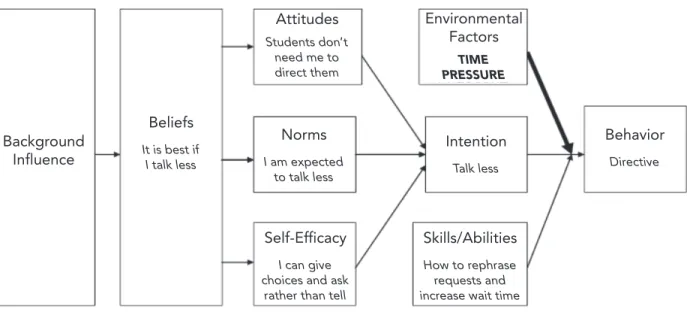
The Fishbein46 integrative model (IM) of
be-havior prediction became a theoretical framework to explain influences on tutor behaviors in this case. Though designed to explain health-related behaviors and target effective communication in encouraging positive behaviors, the elements of the model illumi-nate tutor behavior. According to Fishbein’s model, individuals are more likely to perform a behavior when they intend to, they have the necessary skills and abilities, and no environmental constraints pre-vent it. If a tutor believes performing the behavior will lead to positive outcomes, she will have a more favorable opinion towards it (i.e., attitude). If a tutor believes that other tutors are performing the behavior or that others think she should perform the behaviors (i.e., norms) and that she has the necessary skills and abilities to perform the behavior (i.e., self-efficacy), there is a greater chance she will perform the behav-ior. This model explains some of the variance in tutor behaviors observed in our study.
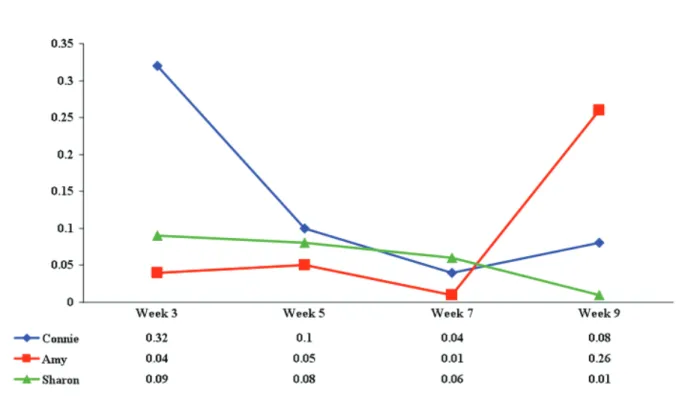
This model helps explain how it was possible for tutors to learn skills and improve their abilities without necessarily demonstrating the behaviors. For example, it can help explain why Amy’s behavior be-came more directive during weeks 7 and 9 (see Figure 1). Amy indicated in interviews that she intended to be less directive or more empowering, believed it was best if she talked less, and understood she was expected by others to intervene less; however, environmental factors (time pressures) prevented her from performing the intended behavior (see Figure 2 for the model applied to a change in tutor behavior).
In addition to helping understand tutor behav-iors, Fishbein’s model46 also has implications for
tu-tor training. It can help educatu-tors understand where to focus their attention in order to achieve desired tutor behaviors. The model reinforces many of the things that occurred in the tutor training in this case. The model suggests that a tutor’s intentions may be influenced by hearing other tutors talk in the tutor meetings or by expectations of the tutor supervisor or tutees. For example, Connie mentioned that hear-ing other tutors talk about high-functionhear-ing groups
made her reconsider her expectations for her group. The model also suggests that a tutor’s intentions may be influenced by the perception of his or her abil-ity to perform particular behaviors. This reinforces the importance of feedback and time spent in tutor meetings practicing behaviors such as converting statements from directive to empowering, emphasis from content to process, and questions from surface to deep. Practice can help improve self-efficacy and skills and abilities, which the model suggests should improve the chance of the desired behaviors occur-ring. The model also suggests changes that should occur in the program, such as removal of external time pressures.
The IM modelcan also inform tutor selection. According to Fishbein’s model,46 tutors who
under-stand and value the underlying theory and purpose of PBL and believe that PBL outcomes are valuable will be more likely to exhibit desired tutor behaviors. Tu-tors are faced with many decisions: talk or be silent, ask or tell, content or process, direct or empower, lenience or persistence, comfort or growth, depen-dence or independepen-dence, and intervene or fade. They must decide to focus on individual voices and roles or on group function as a whole; to invite conflict of ideas, diversity, and individuality or emphasize unity and consensus; to dissuade dominant members
or persuade reticent ones; to model roles or prompt roles; and to let students go off track or bring them back on track.
The intended purpose of PBL in the NAU DH program can perhaps be best achieved through a combination of tutor selection (attitude, beliefs) and tutor training (skills, norms). For example, if the tutor understands that the goal is to encourage learning of process and thinking rather than to learn content and race to the answer, she may place more emphasis on asking than telling and may determine what is on or off track differently.
This study revealed that tutors who saw the purpose of PBL as growth and learning process had different outcomes than those who saw the purpose as learning content. The case study demonstrates the importance of selection of tutors who understand the purpose of PBL and points of leverage in training tutors.
REFERENCES
1. Haden NK, Andrieu SC, Chadwick DG, Chmar JE, Cole JR, George MC, et al. The dental education environment. J Dent Educ 2006;70(12):1265–70.
2. Iacopino AM. The influence of “new science” on dental education: current concepts, trends, and models for the future. J Dent Educ 2007;71(4):450–62.
Figure 2. Fishbein’s integrated model applied to a change in tutor behavior
Self-Efficacy
I can give choices and ask
rather than tell
Attitudes Students don’t need me to direct them Environmental Factors TIME PRESSURE Norms I am expected to talk less Intention Talk less Skills/Abilities How to rephrase requests and increase wait time
Behavior Directive Beliefs It is best if I talk less Background Influence
3. Stevenson RG. The educational system’s integration of evidenced-based principles: what are the obstacles in the dental school environment? J Evid-Based Dent Pract 2006;6(1):59–61.
4. Barrows HS. The essentials of problem-based learning. J Dent Educ 1998;62(9):630–3.
5. Savery JR, Duffy TM. Problem-based learning: an in-structional model and its constructivist framework. Educ Technol 1995;35(5):31–8.
6. Savin-Baden M, Wilkie K, eds. Challenging research in problem-based learning. Maidenhead, UK: Society for Research into Higher Education and Open University Press, 2004.
7. Schmidt HG, Moust JH. Factors affecting small-group tutorial learning: a review of the research. In: Evensen DH, Hmelo CE, eds. Problem-based learning: a research perspective on learning interaction. Mahwah, NJ: JL Erlbaum Associates, 2000:19–52.
8. Bliss J. Effective teaching and learning: scaffolding revis-ited. Oxford Rev Educ 1996;22(1):37–61.
9. Vygotsky LS, Cole M. Mind in society: the development of higher psychological processes. Cambridge: Harvard University Press, 1978.
10. Wood D, Bruner JS, Ross G. The role of tutoring in problem solving. J Child Psychol Psychiatry 1976;17(2): 89–100.
11. Dolmans DH, Wolfhagen IH, van der Vleuten CP, Wijnen WH. Solving problems with group work in problem-based learning: hold on to the philosophy. Med Educ 2001;35(9):884–9.
12. Hockings C. Practising what we preach? Contradictions between pedagogy and practice in the move to problem-based learning. In: Savin-Baden M, Wilkie W, eds. Chal-lenging research in problem-based learning. Maidenhead, UK: McGraw-Hill, 2004:69–80.
13. Wilkie K. Becoming facilitative: shifts in lecturers’ approaches to facilitating problem-based learning. In: Savin-Baden M, Wilkie W, eds. Challenging research in problem-based learning. Maidenhead, UK: McGraw-Hill, 2004:81–92.
14. Hmelo-Silver C, Barrows HS. Goals and strategies of a problem-based learning facilitator. Interdisc J Problem-Based Learning 2006;1(1):21–39.
15. Barrows HS, Neo LWK. Principles and practice of a PBL. New York: Prentice Hall, 2007.
16. Distlehorst LH, Dawson E, Robbs RS, Barrows HS. Problem-based learning outcomes: the glass half-full. Acad Med 2005;80(3):294–9.
17. Schmidt HG, Moust JH. Processes that shape small-group tutorial learning: a review of research. Paper presented at Annual Meeting, American Educational Research Asso-ciation, San Diego, 1998. At: www.eric.ed.gov/80/PDFS/ ED419792.pdf. Accessed: October 5, 2010.
18. Hendricson WD, Cohen PA. Oral health care in the 21st century: implications for dental and medical education. Acad Med 2001;76(12):1181–206.
19. Duek JE, Wilkerson LA. Learning issues identified by students in tutorless problem-based tutorials. At: www. eric.ed.gov/PDFS/ED394986.pdf. Accessed: October 5, 2010.
20. Woods DR, Hall FL, Eyles CE, Hrymak AN. Tutored versus tutorless groups in problem-based learning. Am J Pharm Educ 1996;60(3):231–8.
21. Kassab S, Abu-Hijleh MF, Al-Shboul Q, Hamdy H. Student-led tutorials in problem-based learning: educa-tional outcomes and students’ perceptions. Med Teacher 2005;27(6):521–6.
22. Moust JH, Schmidt HG. Effects of staff and student tutors on student achievement. Higher Educ 1994;28(4):471–82. 23. Solomon P, Crowe J. Perceptions of student peer tutors in a problem-based learning program. Med Teacher 2001;23(2):181–6.
24. De Grave WS, De Volder MS, Gijselaers WH, Damoi-seaux V. Peer teaching and problem-based learning: tutor characteristics, tutor functioning, group functioning, and student-achievement. In: Nooman ZM, Schmidt HG, eds. Innovation in medical education: an evaluation of its pres-ent status. New York: Springer, 1990:123–35.
25. Steele DJ, Medder JD, Turner P. A comparison of learn-ing outcomes and attitudes in student- versus faculty-led problem-based learning: an experimental study. Med Educ 2000;34(1):23–9.
26. Schmidt HG, Moust JH. What makes a tutor effective? A structural-equations modeling approach to learning in problem-based curricula. Acad Med 1995;70(8):708–14. 27. Albanese MA. Treading tactfully on tutor turf: does PBL tutor content expertise make a difference? Med Educ 2004;38(9):918–20.
28 Azer SA. Challenges facing PBL tutors: twelve tips for successful group facilitation. Med Teacher 2005;27(8):676–81.
29. Curet MJ, Mennin SP. The effect of long-term vs. short-term tutors on the quality of the tutorial process and student performance. Adv Health Sci Educ 2003;8(2):117–26. 30. Dalrymple KR, Wuenschell C, Shuler CF.
Develop-ment and impleDevelop-mentation of a comprehensive faculty development program in PBL core skills. J Dent Educ 2006;70(9):948–55.
31. Davis WK, Oh MS, Anderson RM, Gruppen LD, Nairn R. Influence of a highly focused case on the effect of small-group facilitators’ content expertise on students’ learning and satisfaction. Acad Med 1994;69(8):663–9.
32. Kaufman DM, Holmes DB. The relationship of tutors’ content expertise to interventions and perceptions in a PBL medical curriculum. Med Educ 1998;32(3):255–61. 33. McLean M. What can we learn from facilitator and student perceptions of facilitation skills and roles in the first year of a problem-based learning curriculum? BMC Med Educ 2003;3(9).
34. Schmidt HG, van der Arend A, Moust JH, Kokx I, Boon L. Influence of tutors’ subject-matter expertise on student effort and achievement in problem-based learning. Acad Med 1993;68(10):784–91.
35. Schmidt HG. Resolving inconsistencies in tutor expertise research: does lack of structure cause students to seek tutor guidance? Acad Med 1994;69(8):656–62.
36. Barrows HS, Tamblyn RM. Problem-based learning: an approach to medical education. New York: Springer, 1980. 37. Silver M, Wilkerson LA. Effects of tutors with subject
expertise on the problem-based tutorial process. Acad Med 1991;66(5):298–300.
38. Rogoff B. Apprenticeship in thinking: cognitive develop-ment in social context. New York: Oxford University Press, 1990.
39. Topping KJ. Trends in peer learning. Educ Psychol 2005;25(6):631–45.
40. Strauss AL, Corbin JM. Basics of qualitative research: techniques and procedures for developing grounded theory. 2nd ed. Thousand Oaks, CA: Sage, 1998. 41. Patton MQ. Qualitative research and evaluation methods.
3rd ed. Thousand Oaks, CA: Sage, 2002.
42. Lincoln YS, Guba EG. Naturalistic inquiry. Beverly Hills, CA: Sage, 1985.
43. Papinczak T, Tunny T, Young L. Conducting the symphony: a qualitative study of facilitation in problem-based learn-ing tutorials. Med Educ 2009;43(4):377–83.
44. Bloom BS. Taxonomy of educational objectives: the classification of educational goals. New York: Longmans, 1956.
45. Guilford JP. Higher-order structure-of-intellect abilities. Multivariate Behav Res 1982;16(4):411.
46. Fishbein M. A reasoned action approach to health promo-tion. Med Decis Making 2008;28(6):834–44.