Education Dissertations and Projects School of Education
2017
First-Year Teachers’ Perceptions of their Readiness
for the Classroom
Kathryn Elizabeth Pritchard
Follow this and additional works at:https://digitalcommons.gardner-webb.edu/education_etd Part of theCurriculum and Instruction Commons,Educational Assessment, Evaluation, and Research Commons, and theTeacher Education and Professional Development Commons
This Dissertation is brought to you for free and open access by the School of Education at Digital Commons @ Gardner-Webb University. It has been accepted for inclusion in Education Dissertations and Projects by an authorized administrator of Digital Commons @ Gardner-Webb University. For more information, please seeCopyright and Publishing Info.
Recommended Citation
Pritchard, Kathryn Elizabeth, "First-Year Teachers’ Perceptions of their Readiness for the Classroom" (2017).Education Dissertations and Projects. 240.
By
Kathryn Pritchard
A Dissertation Submitted to the
Gardner-Webb University School of Education in Partial Fulfillment of the Requirements
for the Degree of Doctor of Education
Gardner-Webb University 2017
ii
Approval Page
This dissertation was submitted by Kathryn Pritchard under the direction of the persons listed below. It was submitted to the Gardner-Webb University School of Education and approved in partial fulfillment of the requirements for the degree of Doctor of Education at Gardner-Webb University.
__________________________________ ________________________
Jennifer Putnam, Ed.D. Date
Committee Chair
_________________________________ ________________________
Sydney Brown, Ph.D. Date
Committee Member
_________________________________ ________________________
Kelsey Greer, Ed.D. Date
Committee Member
_________________________________ ________________________
Jeffrey Rogers, Ph.D. Date
Dean of the Gayle Bolt Price School of Graduate Studies
iii
Acknowledgements
Work that takes time cannot be achieved without great effort, sacrifice, and support. Accomplishing this goal would not have been possible without the love and support of my family: my husband Craig who has been there with advice, critique, and support; my sons Iain, Graham, Cailean, Neil, and Stewart who give me great joy and helped me understand many of the statistical tests in this study; and my parents Margaret and Patrick who have always believed that I could achieve a goal if I set my mind to it!
As it is for many people, this work has become a lifetime achievement. In my early college years, while I thought I might complete a Doctoral program, life intervened and provided me with a wonderful husband and five terrific sons! While I was not able to continue my education initially, I also felt that the school had not challenged me and I did not want to continue on in education, to not be challenged. Through the work at Gardner-Webb, the rigorous program of study, and the highly qualified professors, I can finally say, “I have been challenged!”
iv Abstract
First-Year Teachers’ Perceptions of their Readiness for the Classroom. Pritchard, Kathryn 2017: Dissertation, Gardner-Webb University, Preservice Teachers/Novice Teachers/ Teacher Preparation/Teacher Readiness/Teacher Efficacy/Lateral Entry Teachers
This study addresses the impact of teacher preparation programs on novice teachers’ perceived readiness for the classroom. An explanatory sequential mixed-method, three-phase design was used involving two collections of quantitative data and a focus group convened to explore themes that emerged from quantitative data. Data collected suggest whether the type of teacher preparation program completed by a preservice teacher impacts a novice teacher’s perceived sense of readiness for teaching.
Butin (2010) discussed “translating research into effective practice has been the weak link” (p. 4) in research studies. Studying a potential connection between teacher sense of readiness for the classroom and the needs they identify that will support them in their first year may reduce teacher attrition by providing North Carolina teacher mentor programs access to the types of support teachers feel they need in order to remain in teaching and provide teacher preparation programs with suggestions for focused instruction to meet teacher perceived needs.
This study found traditionally certified teachers’ perceptions of readiness to teach
declined during their first year, whereas lateral entry teachers’ perceptions of readiness to teach increased during their first year. Strategies to address the needs identified by teachers in the study including the needs related to teacher knowledge of learners, knowledge of subject matter, and knowledge of teaching are discussed in relation to the study’s findings.
v Table of Contents Page Chapter 1: Introduction ...1 Introduction ...1 Overview of Chapter 1 ...3 Background ...4
Possible Reasons for Attrition ...5
Purpose of the Study ...9
Audience ...10
Nature of the Study ...11
Research Questions and Hypothesis ...11
Methodology ...12
Conceptual and Theoretical Frameworks ...14
Scope and Limitations of the Study ...18
Chapter 1 Summary ...19
Chapter 2: Literature Review ...20
Overview of Chapter 2 ...20
History of Teacher Preparation in the United States ...20
Teacher Effectiveness and Perception of Readiness ...28
Teacher Perception of Readiness ...32
Preservice Teacher Preparation ...33
Conceptual and Theoretical Frameworks ...37
Transition from Preservice Teacher to Novice Teacher ...42
Teacher Attrition ...43
Novice Teacher Needs ...45
Lateral Entry Teachers ...48
Novice Teacher Support Programs ...49
Pathways to Teacher Licensure in North Carolina ...52
Chapter 2 Summary ...53
Chapter 3: Methodology ...54
Introduction ...54
Research Questions and Hypothesis ...56
Overview of Chapter 3 ...57
Setting and Background ...57
Role of the Researcher ...58
Methodology ...59 Threats to Validity ...72 Issues of Trustworthiness ...72 Chapter 3 Summary ...73 Chapter 4: Results ...74 Introduction ...74 Overview of Chapter 4 ...74 Research Questions ...74 Data Collection ...75
Collective Response: Fall/Spring Surveys ...79
Research Question 1 ...91
vi Research Question 1b ...94 Research Question 1c ...100 Research Question 1d ...108 Research Question 2 ...115 Chapter 4 Summary ...129 Chapter 5: Discussion ...130 Introduction ...130 Overview of Chapter 5 ...130
Summary of the Study ...131
Research Questions ...131
Data Analysis ...132
Theoretical Framework ...143
Recommendations ...145
Implications for Future Research ...152
Assumptions, Limitations, and Threats to Validity and Reliability ...152
Chapter 5 Summary ...154
References ...155
Appendices A New Teacher Survey – Fall...175
B New Teacher Survey – Spring ...180
C Pilot Survey Feedback ...189
D Email Message Inviting Survey Participants ...192
E Focus Group Questions ...194
Tables 1 Alignment of Research Methods with Research Questions ...67
2 School Survey Respondents - Fall ...77
3 Highest Degree Obtained - Fall ...77
4 School Survey Respondents - Spring ...78
5 Path to Certification Fall/Spring ...79
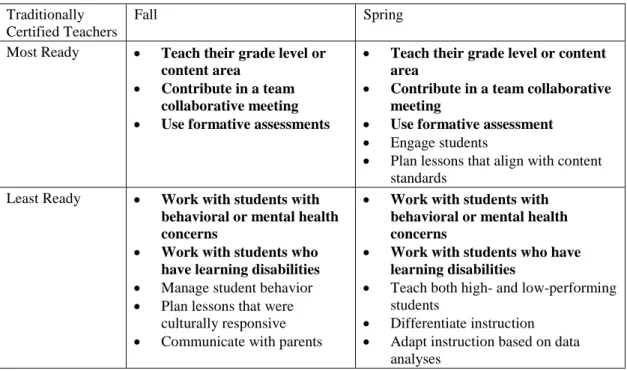
6 Fall Survey: Traditionally Certified Teachers’ Perceptions of Readiness to Perform Teacher Tasks ...82
7 Spring Survey: Traditional Teachers’ Perceptions of Readiness to Perform Teacher Tasks ...84
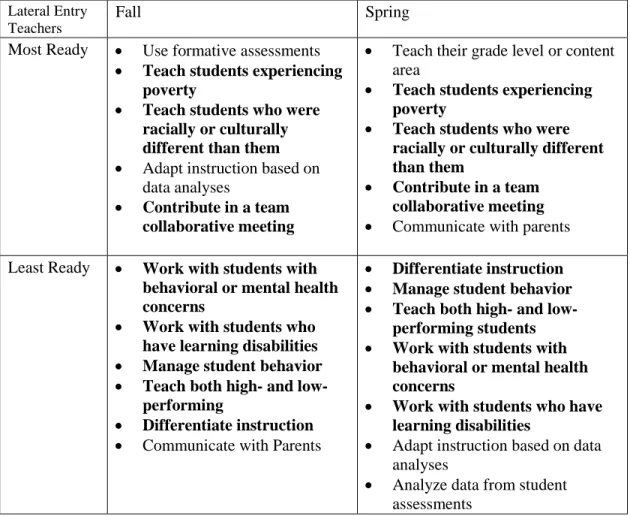
8 Fall Survey: Lateral Entry Teachers’ Perceptions of Readiness to Perform Teacher Tasks ...87
9 Spring Survey: Lateral Entry Teachers’ Perceptions of Readiness to Perform Teacher Tasks ...89
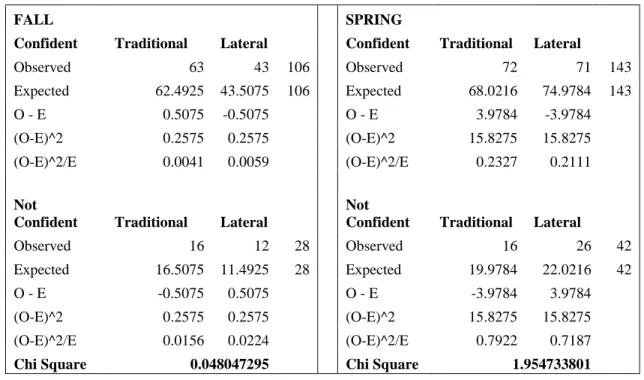
10 Fall/Spring: Perception of Readiness to Teach ...92
11 Two-Sample t Test: Overall Perception of Readiness to Teach ...94
12 Fall Survey: Traditionally Certified Teachers’ Perceptions of Readiness in Knowledge of Learners ...95
13 Spring Survey: Traditionally Certified Teachers’ Perceptions of Readiness in Knowledge of Learners ...96
14 Fall Survey: Lateral Entry Teachers’ Perceptions of Readiness in Knowledge of Learners ...97
15 Spring Survey: Lateral Entry Teachers’ Perceptions of Readiness in Knowledge of Learners ...98
vii
16 Two-Sample t Test: Knowledge of Learners ...100
17 Fall Survey: Traditionally Certified Teachers’ Perceptions of Readiness in Knowledge of Subject Matter and Curriculum Goals ...102
18 Spring Survey: Traditionally Certified Teachers’ Perceptions of Readiness in Knowledge of Subject Matter and Curriculum Goals ...103
19 Fall Survey: Lateral Entry Teachers’ Perceptions of Readiness in Knowledge of Subject Matter and Curriculum Goals ...104
20 Spring Survey: Lateral Entry Teachers’ Perceptions of Readiness in Knowledge of Subject Matter and Curriculum Goals ...105
21 Two-Sample t Test: Knowledge of Subject Matter ...104
22 Fall Survey: Traditionally Certified Teachers’ Perceptions of Readiness in Knowledge of Teaching ...109
23 Spring Survey: Traditionally Certified Teachers’ Perceptions of Readiness in Knowledge of Teaching ...110
24 Fall Survey: Lateral Entry Teachers’ Teachers’ Perceptions of Readiness in Knowledge of Teaching ...111
25 Spring Survey: Lateral Entry Teachers’ Teachers’ Perceptions of Readiness Knowledge of Teaching ...112
26 Two-Sample t Test: Knowledge of Teaching ...115
27 Focus Group Demographic ...122
Figures 1 Tipping Point: The Impact of Marginalization and Constructivism on Learning ....15
2 A Framework for Understanding Teaching and Learning ...16
3 Teacher’s Roles and Related Actions ...30
4 Traditional Learning versus Constructivist Learning ...39
5 A Framework for Understanding Teaching and Learning ...42
6 Exploratory Sequential Mixed-Methods Design Process ...55
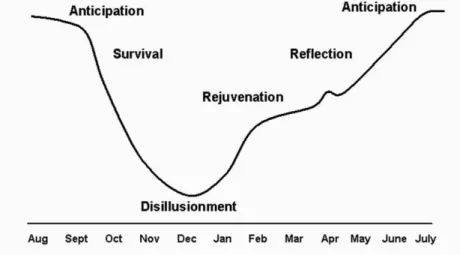
7 Phases of First-Year Teacher Development ...58
8 Comparison of Traditionally Certified Teachers’ Fall and Spring Ratings of Highest and Lowest Readiness to Perform Teaching Tasks...85
9 Comparison of Lateral Entry Teachers’ Fall and Spring Ratings of Highest and Lowest Readiness to Perform Teaching Tasks ...90
10 Chi-Square Analysis Fall/Spring Overall Perception of Readiness to Teach ...93
11 Chi-Square Analysis Fall/Spring Knowledge of Learners ...99
12 Chi-Square Analysis Fall/Spring Knowledge of Subject Matter ...106
13 Chi-Square Analysis Fall/Spring Knowledge of Teaching ...114
14 Support Desired from Administrative Staff ...116
15 Continued Support Desired by Teachers ...119
16 Ongoing Support Desired by Principals ...120
17 Focus Group Question Development ...122
18 Focus Group Initial Themes...124
19 Phases of First-Year Teacher Development ...125
20 Comparison of Traditionally Certified and Lateral Entry Teachers' Ratings of Highest and Lowest Confidence ...132
21 A Framework for Understanding Teaching and Learning ...143
Chapter 1: Introduction Introduction
Gladwell (2008) noted that it took 10,000 hours of practice to achieve mastery in a field. A novice teacher in his or her first year teaches approximately 1,080 hours (180 days x 6 hours per day), indicating that it would take between 9-10 years of full-time teaching to become a master teacher. When novice teachers consider leaving teaching soon after starting their careers, it is costly to both students and school systems (BEST NC, 2015; Boyer & Gillespie, n.d.; Corcoran, 2007; Hammond, 2009; Darling-Hammond & Ducommun, 2011; Gray & Taie, 2015; Shockley, Guglielmino, &
Watlington, 2006). “Large numbers of teachers leaving our schools are sapping the ability of our educational institutions to provide quality educational opportunities for students” (Shockley et al., 2006, p. 113). Barnes, Crowe, and Schaefer (2008) reported that in one North Carolina school district, the cost when teachers left was as much as $10,000 per teacher. Their report suggested that by providing high quality resources to novice teachers, the price associated with teacher attrition could be reduced by half (Barnes et al., 2008).
Additionally, Goe (2010) reported that teacher effectiveness increased over the first 5 years of service. Therefore, helping to understand the needs of novice teachers so they are prepared to handle the expectations of daily classroom life can not only reduce the cost to schools by reducing teacher attrition but can also facilitate the growth of student achievement (Barnes et al., 2008; Goe, 2010).
In 2015, enrollment in North Carolina teacher education programs was down 20% (Westervelt, 2015). In addition, teacher turnover has increased annually since 2010 (North Carolina Department of Public Instruction [NCDPI] Communication and
Information Division, 2015; North Carolina Teacher Turnover Report, 2015). Of the educators leaving the profession, 20% were beginning teachers, 32% were Teach for America Teachers, and 24% were lateral entry teachers; yet only 13% were career status teachers, indicating that novice teachers are leaving at an alarming rate (North Carolina Teacher Turnover Report, 2015, p. 6).
Nationally, the statistics are less dire (Education Reimagined, 2015; Hanna & Pennington, 2015). In a 5-year study completed by the National Center for Educational Statistics, between 10% and 17% of teachers did not return to teaching in the first 5 years (Gray & Taie, 2015, p. 3). Of these teachers, between 9% and 14% were traditionally certified teachers and between 10% and 20% were teachers who were certified by other means (Gray & Taie, 2015, p. 8). Ravitch (2016) summed up the call to action in North Carolina well: “Wake up, people of North Carolina! The legislators in your state are pummeling your public schools with a sledge hammer” (para. 1).
Research on teacher retention is not a new subject; however, through the
recession in 2008, the implementation of Common Core in 2012, and in 2015 and 2016, the political maneuvers that have taken significant funds away from schools and teachers in North Carolina, finding ways to retain new and experienced teachers is at the forefront of many principals’ minds, taking time away from instructional improvements that could increase achievement (Bottoms & Schmidt-Davis, 2010; Darling-Hammond &
Ducommun, 2011).
Ascertaining the reason some teachers leave and identifying methods to retain novice teachers, “especially the good ones!” (Induction Coach, personal communication, November 2015), was a daily conversation for the Induction and Success Department of an urban school district in North Carolina. The Induction and Success Department serves
novice teachers through their third year of teaching. The department provides an orientation for all new teachers and provides ongoing, required, and supportive professional development. In addition, through the work of the department’s five Induction and Support Coaches, new teachers are supported and monitored, mentors are trained, and collaboration with Lead Mentors at each school occurs.
Learning the reasons teachers chose to leave the profession they spent years training for, or stopped a different career for, is one component that may help to reduce the percentages of teachers who leave within the first few years of teaching. This
research analyzed perceptions of novice teachers entering teaching through the traditional teacher preparation route and entering teaching through the lateral entry teaching route with regard to their level of preparation prior to beginning an education career as well as after teaching for several months. In addition, it identified support structures teachers perceived they needed prior to, and during, the first year in the profession. Finally, the results of this research identified areas of support and improvement that may be
beneficial to both teacher preparation programs and new teacher support programs. Overview of Chapter 1
The subsequent pages in this chapter will briefly review the literature related to the study of teacher attrition and teacher preparation and the impact that attrition of new teachers has in the field of education. The chapter will then move on to discuss the problem statement and purposes of this study and the research questions and hypotheses that will be examined. The chapter will further explore the theoretical and conceptual frameworks from which the research will be viewed and the potential impact of the research being conducted. Next, a summary of the research design and methodology will be discussed along with concise definitions that relate to key constructs in the
dissertation. Finally, prior to the overall chapter summary, assumptions, the research scope and delimitations, limitations, and significance will be discussed.
Background
Losing teachers, losing public funding to charter schools, losing equitable pay for teachers, and losing respect have been reported as critical aspects of the educational situation in North Carolina (M. Brown, 2015; Corcoran, 2007; Darling-Hammond, 2009; Darling-Hammond & Sykes, 1999; Graziano, 2005; Kopkowski, 2016; NEA Research, 2008; Ravitch, 2016). While each of these critical aspects of the educational situation in North Carolina in 2016 merit considerable research, the focus of this work was on finding potential links between teacher preparation programs, teachers’ perceptions of being prepared for the realities of the work in a public-school setting, and the supports teachers need so that despite the negativity surrounding education in this state, novice teachers, no matter their training, will stay in teaching.
Overall, local and private universities account for 51% of teachers who teach in North Carolina. Twenty-nine percent of teachers herald from out of state, and 15% use alternative entry methods. In North Carolina, less than 1% of teachers are from the Teach for America Program (BEST NC, 2015). In the county where this research took place, 61% of first-year teachers come from North Carolina public and private
universities, 24% from out of state, 10% use alternative entry pathways, and 3% join through the Teach for America program (BEST NC, 2015). Studying the relationship between teachers’ perceived levels of readiness and their preparation for the profession has a limited research base. The literature review, Chapter 2, details the research to date on teachers’ perceptions of readiness for work in the public classroom.
Possible Reasons for Attrition
Marginalization. “Marginalization is related to, but different from, inequality. While academic definitions vary . . . [marginalization] describe[s] situations of acute and persistent disadvantage in education” (UNESCO, 2009, p. 5). Novice teachers have many influences that can impact their success or failure in their first year of teaching. Furthermore, their perceptions of job satisfaction or dissatisfaction can be impacted by their sense of readiness for teaching (Darling-Hammond, 2006). Unfortunately, novice teachers enter a teaching world where teachers and teacher educators are experiencing greater and greater marginalization (Cody, 2013; George, 2009; Jones, 2009; Kagan et al. 2001; Maher & Tetrealut, 1999; Murrow, 2006; Schmertzing, 2007). Kagan et al. (2001) discussed marginalization as a possible “shifting phenomenon” (p. 2), characterized by time periods in a person’s life when the person may be included in the traditional social structure but also time periods where a person is marginalized. As people mature, they may be more at risk of being in a marginalized culture, or the work they chose might be a precursor for marginalization. Kagan et al. discussed two specific types of
marginalization: people who are voluntarily marginalized and people who are
involuntarily marginalized (p. 3). Marginalization of teachers can have a large impact on a teacher’s job satisfaction and overall desire to remain in the position. Kagan et al. stated,
People who are marginalized have relatively little control over their lives and the resources available to them; they may become stigmatized and are often at the receiving end of negative public attitudes. Their opportunities to make social contributions may be limited and they may develop low confidence and self-esteem. (pp. 3-4)
Concurring, Schmertzing (2007) discussed the history of education and the
marginalization of the teacher’s voice over the past century. In his opinion, teachers were isolated from the teaching reform movements that occurred during the 21st century, as they lacked training and knowledge of the research-based strategies they were required to use in their classrooms. Efforts to strengthen teachers’ voices and overall levels of respect were diminished by the media’s focus on negative issues, rather than the huge successes that teachers achieved annually (Hartney, 2015). Schmertzing suggested that teachers conduct action research in their classrooms to develop a deeper understanding of what works in education (Marzano, 2007; Marzano, Pickering & Pollock, 2005). He ascertained that by conducting action research, teachers would understand the ways large-scale research recommendations might work, or not work, in their school, in their town, and in their state. Schmertzing summarized his points by concluding, “for schools to be more effective and for teachers to be more satisfied in their work, teachers need to take more control over their workspace” (p. 20), thereby strengthening their voice and increasing their level of respect in the public’s eye. Cody (2013) summed up the call to action asserted by Ravitch (2016):
We have, in our nation, two parallel conversations going on about education. One is the conversation sponsored and controlled by the billionaires driving corporate reform. The other is that of teachers, parents, and students who are the subjects of these reforms. (Cody, 2013, p. 1)
Cody (2013) explained this phenomenon at an Education Nation event in 2013, where the featured speakers had very little experience working with children or expertise in education. He asked, “Can you imagine a summit on healthcare that included not a single prominent doctor?” (Cody, 2013, p. 1), and continued on to assert, “in the biggest
public arena where education is discussed, teachers have been silenced, their expertise ignored . . . [and] teachers have something akin to minority group status” (Cody, 2013, p. 1).
Work environment. Wages, teacher evaluation, teacher expectations, and teacher preparation are other aspects of teacher working conditions that contributed to teacher attrition (Graziano, 2005; Kopkowski, 2016; Sawchuk, 2015). “Workplace conditions are sometimes so surreal they make leaving the profession seem like [teachers’] best or only option” (Kopkowski, 2016, para. 3).
Wages. BEST NC (2015) reported 52% of teachers in North Carolina held a second job on top of their full-time teaching load. Smith (2015) concurred and also indicated North Carolina ranked third in the number of teachers who felt the need to take on second jobs to provide for their families. While the extra work put teachers on a fast path to burnout, this phenomenon has plagued teachers for decades (Dworkin, 1987; Graziano, 2005). However, rather than increasing teachers’ salaries to reduce the need for extra income, in 2014, North Carolina legislators eliminated the pay scale for teachers who completed a master’s degree (Sawchuk, 2015); and while teachers with only a few years of experience were given a pay increase, more experienced teachers received little or no pay raise (Sawchuk, 2015). “The bottom line for many educators, especially new ones, is that their income doesn’t pay the rent and bills” (Kopkowski, 2016, para. 29).
Teacher evaluation. Educator Value-Added Assessment System (EVAAS), a statistical measure of student growth, is the tool used to evaluate North Carolina public school teachers’ effectiveness in the teacher evaluation process (NCDPI, 2015). The EVAAS score a teacher receives at the end of an evaluation year became the data point in the sixth standard of the teacher evaluation process (NCDPI, 2015). In 2012, when the
evaluation standards were implemented, teachers were given 3 years to “make growth” or risk losing their jobs. At that time, the sixth standard alone could determine a teacher’s future in teaching if the teacher was unable to make growth for 3 consecutive years (NCDPI, 2015). In a study conducted by Oakes and Robertson (2014), 58% of teachers reported feeling “a lot of stress” (p. 8) with this teacher evaluation system, and only 29% of participants in the study reported that they received enough training on the new evaluation system to prepare them to teach in an effective manner (Oakes & Robertson, 2014, p. 10).
Teacher expectations. Swift (2012) noted,
The role of the teacher in any classroom is very important and is an essential part of the learning process. The classroom teacher is not only an instructor, but a researcher as well, and the teachers should be constantly examining and reviewing the quality of instruction and making improvements as needed by including the latest research in the classroom setting. (p. 76)
However, “it doesn’t make sense to hold people accountable for things over which they have no control” (Kopkowski, 2016, para. 15). When implemented in 2001, No Child Left Behind (NCLB) imposed mandates with little or no training for teachers (Kopkowski, 2016). For instance, once the law was passed, schools had to immediately send home letters to parents labeling teachers who were, upon implementation of the law, deemed not highly qualified, demoralizing some teachers (Kopkowski, 2016). Often, new teachers were sent to low-performing schools with high turnover rates and low staff morale (Kopkowski, 2016). In these schools, teachers were held accountable for the implementation of multiple initiatives without sufficient training or support (New Teacher Center, 2016). High stakes testing, where test results determine a teacher’s
career path, was another factor found to impact teacher attrition (Kopkowski, 2016). Finally, changing standards and added job duties have been attributed to teacher turnover (Reuter, 2016).
Teacher preparation. Teacher preparation programs experienced declines in enrollment between 2004 and 2012 (E. Brown, 2015; Sawchuk, 2015). The literature attributed the declines to the political climate at the time, a weak economy, and the lack of respect teachers received (E. Brown, 2015; Sawchuk, 2015); however, a decline in enrollment in teacher education programs did not explain the increase in teacher attrition after teachers secured a full-time position in teaching. While additional literature
discussed components of teacher preparation programs and novice teachers’ efficacy, a lack of research existed on preservice teachers’ perceptions of their readiness levels for the daily expectations that are inherent in teaching and the supports novice teachers identify as necessary to minimize attrition (Barry, 2010; Boyd, Grossman, Lankford, Loeb, & Wyckoff, 2009a; Brabeck et al., 2014; Brenneman, 2015; Clark, Barnes, & Sudweeks, 2015; Darling-Hammond, 2012a; Darling-Hammond, Chung, & Frelow, 2002; Ferlazzo, 2012; Fisman, 2012; Pomerance, Greenberg, & Walsh, 2016; Newville, 2011; VonHoene, 2016).
Purpose of the Study
The role of the teacher can be ambiguous. “Many hardworking teachers actually harbor misunderstanding about what their job requires” (Wiggins & McTighe, 2007, p. 1). Some teachers believe their job is only to cover the content, engage students with interesting activities, or teach to the test (Wiggins & McTighe, 2007). In the classroom, teaching involves direct instruction, facilitation, and coaching. Outside the classroom, teaching involves analysis of data to guide daily preparation.
While accurate measures of teacher attrition are important if school systems, administrators, and potential teachers are to effectively plan for the coming years, the need to identify factors which cause teachers to remain in the profession is perhaps of greater importance. (Inman & Marlow, 2004, p. 605).
In fact, keeping qualified teachers in schools is essential for student success (Darling-Hammond & Ducommun, 2011).
Through the analysis of first-year teachers’ self-reported sense of being prepared for the classroom, their confidence in their knowledge of different types of learners, their knowledge of the subject matter they teach, and their knowledge of teaching (Darling-Hammond, 2006), this study examined three elements of teaching that may have contributed to the factors that impact the decision novice teachers make when deciding whether or not to remain in teaching after their first year. In addition, it analyzed the differences, if any, between teachers who entered the profession as traditionally trained teachers or as lateral entry teachers.
Audience
Butin (2010) noted that “translating research into effective practice has been the weak link” (p. 4) in research studies. Determining the needs of teachers during their first year may provide teacher preparation programs and support programs for lateral entry teachers in school districts strategies to enrich their programs and, in turn, increase enrollment. As the teacher shortage in North Carolina continues, it may be that more educators will enter the profession through nontraditional means. For this reason, the research may be of particular interest to districts trying to support lateral entry teachers. It may also provide North Carolina teacher mentor programs access to the types of support novice teachers, despite their prior preparation, feel they need in order to remain
in the profession. Nature of the Study
This study addressed novice teachers’ perceived readiness for the classroom as well as the types of support teachers perceived they needed during their first year of teaching.
Research Questions and Hypothesis
This study focused on the following research questions with regard to novice teachers in an urban North Carolina school district.
1. How does novice teacher perceived readiness for teaching change during the first year? (Quantitative)
a. How does traditional teacher certification versus lateral entry affect teacher overall perceived readiness to teach?
b. How does traditional teacher certification versus lateral entry affect teacher overall perceived readiness in knowledge of learners and their development in social contexts?
c. How does traditional teacher certification versus lateral entry affect teacher overall perceived readiness in knowledge of subject matter and curriculum goals?
d. How does traditional teacher certification versus lateral entry affect teacher overall perceived readiness in knowledge of teaching? 2. What support structures contribute to novice teachers’ perceptions of job
readiness? (Qualitative)
The hypothesis for this work was, “Teachers withtraditional teacher certification will report an increase in the perception of readiness to teach over lateral entry teachers.”
The null hypothesis is that there is not a significant difference between teacher reports of readiness to teach and the type of teacher preparation program.
The independent variable in the quantitative component of the study was teacher perception of readiness for teaching. The dependent variables in this study were
teachers’ perceptions of readiness in the areas of their “knowledge of learners and their development in social contexts; knowledge of subject matter and curriculum goals, and knowledge of teaching” (Darling-Hammond, 2006, p. 203).
Methodology
The study was a mixed-methods study (QUAN qual) determining if there were relationships between new teachers’ self-reported perceived readiness to teach at the beginning of their career and their self-reported perceived readiness to teach at the midpoint of their first year. In addition, the study identified support structures that new teachers perceived as beneficial during their first year and identified some relationships between teachers entering teaching from a traditional teacher preparation program or from a lateral entry route. As “some stakeholders may find certain types of measures or evidence more credible than others” (Fitzpatrick, Sanders, & Worthen, 2011, p. 386), a mixed-methods design delivers a comprehensive review of a concept, thus providing a “complete understanding of research problems/questions” (Creswell, 2014, p. 218).
An explanatory sequential mixed-methods, three-phase design (Creswell, 2014) was used involving two collections of quantitative data where the raw, quantitative survey data were presented and analyzed and then a focus group was convened to gather in-depth qualitative data.
In the first, quantitative phase, of the study, data archived from a school district in North Carolina were analyzed and coded. This survey was developed by district leaders
to understand the needs of new teachers and to identify if there were any predetermining factors that contribute to teacher attrition in the district. The survey, while planned by the district, had not been implemented until this researcher approached the Executive
Director of Accountability and Research in June 2016 (EDRA, personal communication, June 2, 2016). At that time, a New Teacher Survey group was convened, including the Executive Director of Accountability and Research, the Executive Director of Human Resources, the Executive Director of Induction and Success, and this researcher. The group met during the summer of 2016 to develop the survey that would be distributed to new teachers in the fall of 2016 (New Teacher Study Team, personal communication, July 7, 2016, July 20, 2016, August 16, 2016, August 31, 2016). The survey sample population comprised teachers identified as Beginning Teacher 1 in one of the four largest school districts in North Carolina. Survey participants responded to the first survey during the required district orientation program prior to the beginning of their teaching career or as close as possible to their first day of teaching. After approval of this proposal, this researcher analyzed the archived, raw survey data using the tools available in the SAS software program.
Through the quantitative data gathered in the survey, aspects of teacher
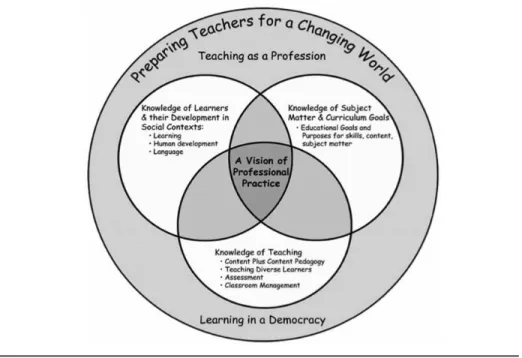
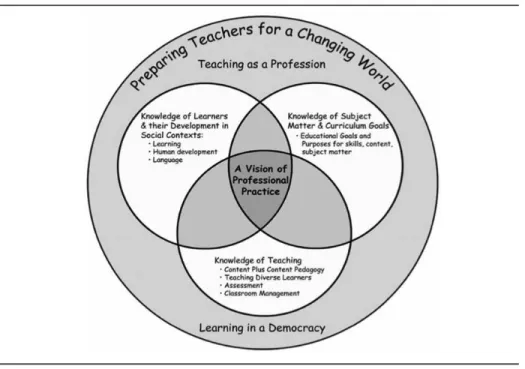
preparation were compiled to yield an overall “readiness” score using the components from Darling-Hammond’s (2006) “Framework for Understanding Teaching and Learning” (p. 304) which included the subcategories knowledge of learners and their development in social contexts, knowledge of subject matter and curriculum goals, and knowledge of teaching.
A second component of this study was longitudinal in nature. Teachers who agreed to complete the district survey at the beginning of the 2016 school year were
asked to respond to a second survey after 6-8 months of teaching, each using the school system’s email exchange system. Upon receipt of the survey responses, the data were analyzed to find relationships between expectations prior to beginning teaching and the needs of teachers midway through their first year.
Finally, an exploratory follow-up was implemented. A small focus group was convened, chosen from the survey participants, that explored teachers’ perceptions of the support structures they felt were needed during their first year. The focus group was held at the Induction and Success Professional Development Center in the county where the study was conducted. More information on the study’s methodology is presented in Chapter 3.
Conceptual and Theoretical Frameworks
Constructivism. “Constructivism seeks to change existing cognitive structures by allowing students to explore new alternatives” (Yost, Sentner, & Forlenza-Bailey, 2000, p. 42). Fighting against the social and political forces, teacher education and induction programs in school systems focus on training and supporting preservice and novice teachers to develop the skills necessary to be ready for teaching in a public-school classroom. Teacher education and induction programs that employ constructivist
practices which “focus closely on what beginning teachers already know and believe about teaching” (Wideen, Mayer-Smith, & Moon, 1998, p. 167) and facilitate a
thoughtful process in which teachers utilize reflective practices that create “tension and uncertainty so that preservice teachers will focus on the multiple dimensions of a
dilemma and subsequently choose from a wider assortment of options” (Yost et al., 2000, p. 43) are considered optimum programs for developing 21st century educators (Darling-Hammond, 2006). As teachers form new realities of teaching based on their daily
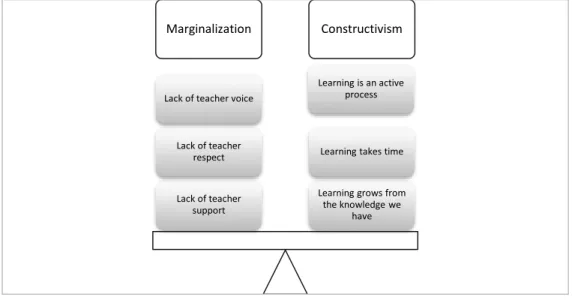
experiences (Ayaz & Şekerci, 2005; Bushman, 1996; Culatta, 2015; Harrington & Enochs, 2009; Miller, 2011; Trochim, 2006), positive experiences with supportive staff and administrators yield happier teachers (Zakrzewski, 2012). Conversely, negative experiences with staff and administrators yield frustrated teachers who are more likely to leave education within a few years of beginning their career (Jasper, 2014; Long, 2012; Zakrzewski, 2012). Figure 1 depicts the delicate balance between the marginalization of teachers and the constructivist lens of teacher preparation.
Figure 1. Tipping Point: The Impact of Marginalization Constructivism on Learning
(Brooks & Brooks, 1999; Cody, 2013; George, 2009; Jones, 2009; Kagan et al., 2001; Trochim, 2006).
As teachers utilize an active process in their classrooms, their knowledge grows (Lew, 2010; Plourde & Alawiye, 2003) and teachers then begin to use their voice to discuss issues that impact their work (Oshrat-Fink, 2014); however, if collaboration is not present and new teachers are ostracized (George, 2009; Schmertzing, 2007), the teachers
Marginalization Constructivism
Learning grows from the knowledge we
have Learning takes time Learning is an active process Lack of teacher support Lack of teacher respect Lack of teacher voice
“lack the opportunities to make social contributions . . . and they may develop low self-confidence and self-esteem (Kagan et al., 2001, p. 4).
Framework for teaching and learning. Darling-Hammond (2006) found that teacher education and induction programs supported preservice and novice teachers and increased the likelihood that teachers will remain in the profession. Through her
research, Darling-Hammond (2006) developed a Framework for Teaching and Learning (Figure 2). This Framework (Darling-Hammond, 2006) provided a foundation for teacher preparation programs to evaluate their programming and implement course work that could meet the need of both 21st century learners: teachers and students.
Figure 2. A Framework for Understanding Teaching and Learning. Reprinted from
Constructing 21st century Teacher Education by Darling-Hammond (2006).
Darling-Hammond (2012a) further explained how the Framework was connected with teacher quality and teaching quality:
understandings an individual brings to teaching, including dispositions to behave in certain ways. Teaching quality refers to strong instruction that enables a wide range of students to learn. Teaching quality is in part a function of teacher quality— teachers’ knowledge, skills, and dispositions—but it is also strongly influenced by the context of instruction: the curriculum and assessment system; the “fit” between teachers’ qualifications and what they are asked to teach; and teaching conditions, such as time, class size, facilities, and materials. (p. i) Definitions
The terms defined in this section are provided to ensure a common understanding of the terms that are used throughout the study. Most terms are accompanied by a citation; however, in situations where a definitive definition is necessary for
understanding but a specific definition is not available, the researcher has clarified the term and provided synonyms used throughout the research.
Alternative licensure programs. Alternative licensure programs provide students who have completed a bachelor’s degree or higher in a specific subject area a pathway to teacher licensure. Participants in alternative licensure programs may include individuals who have retired from other fields or who are transitioning mid-career. Alternative licensure programs require teachers to attend a supervised program while they teach, providing the teachers with core teaching pedagogy (U.S. Department of Education, 2015).
Confidence. “A judgement of capabilities for accomplishment of some goal” (Druckman & Bjork, 1994, p. 173).
Constructivism. “People construct their own understanding and knowledge of the world, through experiencing things and reflecting on those experiences” (EBC, 2004,
para. 1).
First-year teacher. A teacher working in their first full-time teaching role in which the teacher has full responsibility for a class of students. Other terms include “novice teacher,” “mentee,” and “beginning teacher.”
Practicum. A 3- to 4-week observation and, sometimes, hands-on experience for preservice teachers in which they visit multiple settings so they have exposure to
different types of classroom settings (University of Hartford, n.d.).
Preservice teacher. A student in a teacher preparation program who is
completing an observation, practicum, or student teaching experience (Kennedy, 1999). Readiness. The perception that a person employed as a teacher has the
knowledge, skills, and dispositions necessary to meet the demands of working in a public school setting (Abbatte-Vaughn, 2006).
Student teaching. A semester of teaching with a supervising teacher in which the supervising teacher gradually releases responsibility to the student teacher for planning, instruction, assessment, and discipline; supports guidance for the student teacher; and then resumes responsibility for the class, gradually, at the end of the semester (Gardner-Webb University School of Education, 2012).
Teacher preparation program. The training program a preservice teacher completes prior to full-time employment as a classroom teacher (Cochran, King, & DeRuiter, 1991).
Scope and Limitations of the Study
Scope. The study addressed teachers’ perceptions of readiness to teach in a public school classroom. The study developed an overall readiness score by combining teachers’ survey responses to consider how ready a teacher feels after his or her student
teaching experience(s) through his or her responses to survey items (Appendices A and B) related to Darling-Hammond’s (2006) “Framework for Understanding Teaching and Learning” (p. 304).
Limitations of the study. As learning is an ongoing process, the study could not address all aspects of learning that occur while teachers are in the classroom nor the influence the staff and students have on the teacher during the time period of the study. In addition, the study was limited to new teachers in one school district in North
Carolina. Therefore, results are specific to that district and may not be generalizable in other districts or across the state.
Chapter 1 Summary
This chapter provided an introduction to the problem of teacher preparation and teacher attrition. Facts and figures are discussed which relate to teacher attrition in North Carolina. The research questions, theoretical and conceptual framework from which the study will be viewed, as well as the focus, scope, and limitations of the study were also discussed in this chapter. In Chapter 2, a thorough review of the literature on teacher preparation will be discussed.
Chapter 2: Literature Review Overview of Chapter 2
Since the early 1800s, preservice teacher development programs have existed in the United States to provide some form of preparation for teachers of young children (Newville, 2011; Ross, 2014). Over time, these programs have evolved from providing a high school education for preservice teachers to developing the pedagogical and content knowledge preservice teachers can apply in 21st century classrooms. Programs also moved from apprenticeship models to models that included a field experience component in their teacher education graduation requirements such that preservice teachers were required to spend a specific number of hours in practical, classroom experience with a supervising teacher (Darling-Hammond, 2006).
This chapter will review the history of teacher preparation in the United States, teacher effectiveness and perceptions of readiness, preservice teacher preparation, the conceptual and theoretical frameworks for this study, teacher attrition, novice teacher needs, lateral entry teachers, novice teacher support programs, and the pathways to teacher licensure in North Carolina in 2016.
History of Teacher Preparation in the United States
Significant political, theoretical, social, and economic issues over the past 200 years shaped the focus of teacher preparation programs (Darling-Hammond, 2006; Friedman & Mandelbaum, 2011; Newville, 2011). Normal schools were the first teacher preparation programs in the United States. While sources differ on where and when the first normal school opened in the United States (Harper, 1939; Hilton, 2011; Newville, 2011), the focus of normal schools was to train teachers “in educating all the children of all the people” (Harper, 1939, p. 14). Normal schools were not begun without
controversy, and thus began the onset of a national debate on how teachers should be prepared, on the content and pedagogical knowledge teachers should receive in their training, and on the standards to which teachers must be held accountable. In 1862, The Morrill Act established land grant colleges to provide education for students in fields that were necessary for the development of the country (Friedman & Mandelbaum, 2011). Additional legislation was added to the land grant college program in 1917 at which time the Smith-Hughes Vocational Education Act provided specific funds for teacher training (National Research Council, 1995). These acts of legislation broadened the reach of teacher training programs across the United States. As programs opened, debate continued on the scope of the curriculum and overall preparation standards teachers should master during their preservice years. In 1918, an educational supervision
association, the Progressive Education Association, was opened (Progressive Education Network, n.d.). Leaders in this network of educators included John Dewey, a foremost educator in the early 20th century. Prawat (2009) reported that Dewey had
three key ideas . . . that continue to resonate with progressive or, in current usage, constructivist U.S. educators. . . . In fact, all three of the great reform movements in U.S. education, in the 1930s, 1960s, and 1990s, highlighted variations on these three themes: Individualism, the notion that it is up to the individual child, with guidance from the teacher, to make sense of his or her own experience; readiness, the notion that the child will learn when he or she is ready to learn; and
pragmatism, the notion that the worth of learning lies in its instrumental value. (para. 3)
Constructivism. Constructivists hold to the belief that a teacher adds to his or her prior knowledge based on his or her life experiences (Brooks, 1987; Brooks &
Brooks, 1999; Clark et al., 2015). Knowledge cannot be forced upon the learner nor can learning be stopped (Brooks, 1987; Brooks & Brooks, 1999). Connell, Stein, and Gardner (2012) used the term “mental models” to describe the choices teachers make daily. Mental models, they asserted, support the “understanding, reasoning, and decision making” (Connell et al., 2012, p. 273) teachers make from their “observations about student behavior and performance, to predict what will happen in response to possible actions they might take” (Connell et al., 2012, p. 274). They went on to remind the researcher “that even though the objective classroom situation is identical . . . there are a myriad ways teachers might interpret [the] situation, and for each interpretation, there are a myriad ways teachers might respond to it” (Connell et al., 2012, p. 274). In a more recent publication, Stein (2015) further supported this view: “The mind is best understood as a complex and dynamic system, always in process, always changing, growing and becoming more diverse and differentiated” (para. 7).
Constructivist ideas have influenced many educator, politician, and parent views of education since (Friedman & Mandelbaum, 2011); however, the Great Depression (1929-1940) and World War II impacted teacher preparation programs’ implementation of these themes. During the Great Depression, teacher education programs were limited in funds; therefore, teacher preparation programs focused on developing only the
practical skills teachers needed (Newville, 2011), and teacher shortages during World War II saw the implementation of emergency teacher certification programs as workers took on jobs that paid more than teaching positions (Friedman & Mandelbaum, 2011; Newville, 2011).
Ruff, Snyder, and Petrich (2010) provided examples of constructivism in a 21st century classroom. Teachers who employ “[d]iscovery learning, [i]nquiry learning,
[p]roblem based learning, [d]iscussion, and [c]ooperative learning groups” (Ruff et al., 2010, p. 4) and who design lessons that are relevant to student needs, value and challenge students’ points of view, and formatively assess students such that lessons are changed based on the outcome of the formative assessment are reported to be teaching from a constructivist perspective (Ruff et al., 2010).
Teacher preparation programs. The launch of Sputnik in 1957 refreshed a national debate about where the focus of teacher preparation programs should be: content knowledge, pedagogy, or standards (Newville, 2011). At that time, the National Council for Accreditation of Teacher Education (NCATE) was begun “to help establish high quality teacher preparation. Through the process of professional accreditation . . . NCATE works to make a difference in the quality of teaching and teacher preparation today, tomorrow, and for the next century” (NCATE, 2014a, para. 2). In 2016, this organization became known as the Council for the Accreditation of Educator Preparation (CAEP). CAEP oversees the accreditation of teacher preparation programs and focuses on five standards: (a) content and pedagogical knowledge; (b) clinical partnerships and practices; (c) candidate quality, recruitment, and selectivity; (d) program impact; and (e) provider quality continuous improvement and capacity (CAEP, 2015).
Following Sputnik, the Civil Rights Era saw
profound changes in American education and improved the educational opportunities of millions of students. Many barriers that once prevented minorities, women, individuals with disabilities, and older persons from freely choosing the educational opportunities and careers they would like to pursue [were] eliminated. (U.S. Department of Education, 2015, para. 3)
Warren (1985) asserted that the cyclical nature of the design of teacher
preparation programs should be a cause for concern. Warren noted that rather than being driven by the economic forces of the time period, teacher preparation programs should rely on “professional judgment about teacher education” (p. 11) and on the “difficult responsibilities [of teaching], which are to conceptualize, innovate, and analyze disparate educational and policy phenomena” (p. 11). What once started as an apprenticeship, the movement of teacher preparation into university programs, “spelled the beginning of the end of independent professional preparation” (Cochran-Smith, Feiman-Nemser, & McIntyre, 2008, p. 296). In the early 2000s, Labaree, as cited in Cochran-Smith et al. (2008), found that schools of education were stronger academically than they were professionally relevant, as the schools were competing with other departments in the university for overall recognition. Consequences of this movement yielded programs that lacked rigorous, relevant training due to the marginalization of education departments in some institutions (Cochran-Smith et al., 2008).
Twenty-first century ideas for “innovative” teacher preparation programs reverted back to ideas that originated in the apprenticeship-type model (Boyd et al., 2009a;
Brownell, Ross, Colon, & McCallum, 2005; Cydis, 2014; Darling-Hammond, 2006; Malone, 2008; Samuel, 2010; Yost et al., 2000). For instance, Yost et al. (2000) asserted, “teacher education programs that maintain a consistent focus or mission and engage in constructivist practices have demonstrated promising results” (p. 41).
In addition, researchers suggested implementing critical reflection into teacher preparation programs. Reflection was previously suggested and defined by Dewey (as cited in Yost et al., 2000) as “an active persistent and careful consideration of any belief or supposed form of knowledge in light of the grounds supporting it and future
conclusions to which it tends” (p. 39). A teacher who employs critical reflection “is one who makes teaching decisions on the basis of a conscious awareness and careful
consideration of the assumptions on which the decisions are based, and the technical, educational, and ethical consequences of those decisions” (Yost et al., 2000, p. 41).
Brownell et al. (2005) reported that exemplar teacher education programs “stressed the importance of extensive, well-planned, and well-supervised field
experiences” (p. 247). Field experiences in these programs emphasized reflection and collaboration with supervisors and program personnel. Malone (2008) and Cydis (2014) studied programs that implemented a personal learning plan or a competency-based methodology. They suggested that teacher preparation programs implement training methods that engage the learner in developing his or her own standards-based goals and evaluate his or her progress toward those goals. Similar to the apprentice model, teacher candidates in preparation programs that implemented this model would work with model teachers to implement and refine their work toward the achievement of the identified goals. Samuel (2010) discussed four models of teacher education programs: the master apprenticeship, the applied science model, the reflective practitioner model, and the critical-reflective practice model (pp. 5-6). These models also reflected prior models of instruction. Samuel asserted that the applied-science model was the predominant model of teacher training programs at the time; however, Boyd et al. (2009a) and Darling-Hammond (2006) documented research that supported the use of the other three models discussed by Samuel. Darling-Hammond (2006) noted the importance of diverging from the applied-science model of teacher education and instead implementing teacher
education programs that have “extensive and intensely supervised clinical work-tightly integrated with course work-that allows candidates to learn from expert practice in
schools that serve diverse students” (p. 307). In addition, Darling-Hammond (2006) recommended teacher training programs immerse students in the extensive analysis of student work, thorough examination and analysis of lesson plans and teacher resources, and applying a critical lens to videos of teaching in action (p. 307).
Boyd et al. (2009a) indicated,
teacher preparation that focuses more on the work of the classroom and provides opportunities for teachers to study what they will be doing as 1st-year teachers seems to produce teachers who, on average, are more effective during their first year of teaching. (p. 434)
They continued, “programs that provide more oversight of student-teaching experiences or require a capstone project supply significantly more effective 1st-year teachers” (Boyd et al., 2009a, p. 434) and “teachers who have had the opportunity in their preparation to engage in the actual practices involved in teaching . . . also show greater student gains during their 1st year of teaching” (Boyd et al., 2009a, p. 434).
As the needs of the learner became a greater focus in the most recent decade, Education Reimagined, a conglomeration of school superintendents, business leaders, researchers, and teachers’ union representatives, suggested in 2015 that teaching become learner-centered and move away from the current paradigm in which teaching was designed for efficiency rather than based on the needs of the learner (A Transformational Vision of Education in the U.S., 2015). The authors suggested, “for the next generation to succeed, and thrive, their learning experiences must facilitate their development” (A Transformational Vision of Education in the U.S., 2015, p. 8) and
be based on the mastery of skills; be personalized, relevant and contextualized; be focused on the learner as a participant; be embedded in meaningful relationships;
and rooted in opportunities such that the learner is aware that leaning happens anywhere, anytime. (A Transformational Vision of Education in the U.S., 2015, pp. 7-8)
Pomerance et al. (2016) declared, “teacher candidates [should be required] to practice instructional strategies to the point of mastery” (p. 28) and referred to research that backed the revision of licensing exams to include six specific research-based instructional strategies rather than strategies that research has not proven their
effectiveness (Pomerance et al., 2016). The six teaching strategies recommended by the report included paring graphics with words, linking abstract concepts with concrete representations, posing probing questions, repeatedly alternating problems with their solutions and problems that students must solve, distributing practice, and assessing to boost retention (Pomerance et al., 2016, pp. vi, 2, 19-25). The authors stated, “like any skill, repeated practice and considerable feedback is necessary for teacher candidates to gain proficiency in applying the fundamental instructional strategies in an actual class” (Pomerance et al., 2016, p. 16).
In his vision for the future teacher, Berry (2010) stated,
The once-vexing struggle to secure qualified and effective teachers for all of America’s 60 million students has been resolved. No longer is the “teacher quality” debate focused solely on measuring the effectiveness of individual teachers in isolated classrooms. Instead, most policymakers are more interested in how teachers grow professionally and spread their knowledge to others. In 2030, education accountability systems place a premium on how teachers learn as teams, both in their brick and mortar buildings and in virtual settings where they work with peers, mentors, and coaches. In 2030, curriculum and instruction
drives accountability and results, not the other way around as it has for much of education’s convoluted past. (p. 15)
Teacher Effectiveness and Perception of Readiness
Characteristics of effective teachers. In a meta study of what makes an
effective teacher, Wilson and Floden (2003) found conclusively that there are large gaps in the research of what makes a teacher effective, how teacher preparation programs can prepare effective teachers, and how teacher effectiveness impacts teacher attrition. Notable from the research was the overall lack of a consistent definition of an effective teacher (Wilson & Floden, 2003). The research calls for much larger, multidisciplinary, mixed-methods studies to be completed that explore, among other things, “the effects of variations in field experiences, the ramifications for teacher supply of 4- versus 5-year programs, the retention of alternatively prepared teachers, [and] the links between certification and teaching performance” (Wilson & Floden, 2003, p. 28). Seven years later, the National Research Council (2010) similarly concluded that despite the vast amount of research, “there is little firm empirical evidence to support conclusions about the effectiveness of specific approaches to teacher preparation” (p. 4) and what makes an effective teacher.
Wayne and Youngs (2003) reviewed research on teacher characteristics and student achievement. In their analysis, they set parameters for the research that they reviewed, including but not limited to student socioeconomic status, prior achievement, and teacher characteristics. Their review supported the position that “high school students clearly learn more from teachers with certification in mathematics, degrees related to mathematics, and coursework related to mathematics” (Wayne & Youngs, 2003, p. 107) and that while “teachers differ greatly in their effectiveness . . . teachers
with and without different qualifications differ only a little” (Wayne & Youngs, 2003, p. 108). Their research conclusion supported flexible hiring practices by principals rather than adhering to specific qualifications; however, Corcoran (2007) suggested the hiring trends 4 years later had instead moved toward developing national accreditation standards and procedures for teacher education programs. Specifically, Corcoran recommended further study of the impact that content area knowledge, pedagogy, and student teaching experiences have on teacher overall preparation and effectiveness.
Wiggins and McTighe (2007) stated,
The teacher's role, behavior, and strategies must stem deliberately from established mission and goals, the curriculum, and agreed-upon learning principles. In other words, the particular approaches, methods, and resources employed are not primarily subjective “choices” or mere matters of style. They logically derive from the desired student accomplishments and our professions understanding of the learning process. We teach to cause a result. Teaching is successful only if we cause learning related to purpose. (para. 7)
Given this assertion, the authors stated there was not one teaching approach better than another. Rather, they noted, a teacher must be skilled in identifying the needs of each student and then must decide which approach or approaches could be implemented and how for long the approach should be implemented (Figure 3). Wiggins and McTighe (2007) also reported that the role of the teacher as a facilitator and the role of the teacher as a coach had much larger yields and benefits for students than the role of a teacher delivering direct instruction.
Teacher Role (Method the Teacher Uses)
Learner Actions (What Students Need to Do) Didactic/Direct Instruction • Demonstration, modeling • Lecture • Questions (convergent) Facilitation of Understanding • Concept attainment • Cooperative learning • Discussion • Experimental inquiry • Graphic representation • Guided inquiry • Problem-based learning • Questions (open-ended) • Reciprocal teaching
• Simulation (e.g., mock trial)
• Socratic seminar
• Writing process
Coaching
• Feedback/conferencing
• Guided practice
Receive, Take In, Respond
• Observe, attempt, practice, refine
• Listen, watch, take notes, question
• Answer, give responses
Construct, Examine, Extend Meaning
• Compare, induce, define, generalize
• Collaborate, support others, teach
• Listen, question, consider, explain
• Hypothesize, gather data, analyze
• Visualize, connect, map relationships
• Question, research, conclude, support
• Pose/define problems, solve, evaluate
• Answer and explain, reflect, rethink
• Clarify, question, predict, teach
• Examine, consider, challenge, debate
• Consider, explain, challenge, justify
• Brainstorm, organize, draft, revise
Refine Skills, Deepen Understanding
• Listen, consider, practice, retry, refine
• Revise, reflect, refine, recycle through
Figure 3. Teacher’s Roles and Related Actions. Adapted from “Schooling by Design”
by Wiggins and McTighe (2007).
Marzano (2007) explained that effective classroom pedagogy includes the use of effective instructional strategies, the use of effective management strategies, and the use of effective classroom curriculum design strategies (p. 6). He furthered his assertion by responding to 10 instructional design questions that help a preservice or novice teacher
consider actions in response to the 10 design questions a preservice or novice teacher might ask to further develop their instructional tool bag to increase their effectiveness:
What will I [the preservice or novice teacher] do to. . . :
. . . establish and communicate learning goals, track student progress, and celebrate success?
. . . help students effectively interact with new knowledge?
. . . help students generate and test hypotheses about new knowledge? . . . engage students?
. . . establish or maintain classroom rules and procedures?
. . . recognize and acknowledge adherence and lack of adherence to classroom rules and procedures?
. . . establish and maintain effective relationships with students? . . . communicate high expectations for all students?
. . . develop effective lessons organized into a cohesive unit? (Marzano, 2007, p. 7)
NCATE (2014b) indicated that the qualities of an effective teacher include “knowledge of teaching and learning, subject matter knowledge, experience, and the combined set of qualifications measured by teacher licensure are all leading factors in teacher effectiveness” (p. 3). The Council’s research concluded that “high quality pre-service teacher preparation provides beginning teachers . . . the knowledge and skills needed for effective teaching” (NCATE, 2014b, p. 16).
Measuring teacher effectiveness. Efforts to measure teacher effectiveness in recent years have utilized classroom observations, student surveys, and student
Kane (2013) found,
heavily weighting a single measure may incentivize teachers to focus too narrowly on a single aspect of effective teaching and neglect its other important aspects . . . [I]f the goal is for students to meet a broader set of learning objectives than are measured by state’s tests, then too-heavily weighting that could make it harder to identify teachers who are producing other valuable outcomes. (pp. 10- 11)
The research also yielded important conclusions about the use of multiple measures to determine teacher effectiveness. Cantrell and Kane (2013) recommended implementing a balanced system in which the criteria that is used to measure
effectiveness is weighted the same across all dimensions:
rigorous training for all principals, administrators, mentors, peer evaluators, or others who observe teachers to increase interrater reliability; measures that specifically add value to the evaluation; including student perception surveys and observations to help prioritize improvement initiatives; video that provides quality feedback for teachers; and training and assessment for learning and teaching. (p. 20)
Boyer (2003) found a strong effect size between teachers who implemented collaborative problem solving and student outcomes, and she recommended teacher preparation programs include this value-added program in the course work preservice teachers complete.
Teacher Perception of Readiness
Limited research exists on teacher perceptions of overall readiness (Clark et al., 2015). Recent research on teacher perceptions has focused on teachers’ perceptions of
their abilities to teach specific subject matter such as math and reading or on the type of student teaching experience a teacher completed rather than the components of this study: readiness to manage a classroom, prepare lessons aligned with content standards, engage students, personalize instruction, analyze and respond to data, or prepare to teach all content components in a given role (Clark et al., 2015).
Clark et al. (2015) considered teacher perceptions of readiness as the perceptions related to the teachers’ student teaching or internship experiences. They used cross-institutional data from preservice teachers who completed either a student teaching experience (teaching in a classroom with a supervising teacher for 15 weeks in 1 semester) or an internship (teaching in a classroom with a supervising teacher for 1 academic year) and followed up with the teachers after 1 year of teaching. The researcher’s own literature review reported inconsistent results when comparing the length of student teaching experiences and teachers’ perceptions of their ability to teach. In addition, “not a single study [was located] that examined teacher perceptions at both the preservice and inservice stages based on the type of student teaching experience teachers were assigned” (Clark et al., 2015, p. 173).
Preservice Teacher Preparation
The impact of teacher preparation is long lasting (Dickstein, 2013); and, as Bolster (1983) reported,
Teachers’ knowledge of teaching, once achieved, tends to be highly resistant to change. Principles of practice, honed in the demanding arena of the classroom, are not easily discarded or revised, even in the face of conflicting evidence from the most careful experimental studies. Teachers, in fact, appear to have a high degree of mistrust of knowledge about education. (p. 299)