The Islamic University of Gaza Deanery of Graduate Studies Faculty of Engineering
Computer Engineering Department
Modern Approach for WEB
Applications Vulnerability Analysis
Rami M. F. Jnena
120090823
Supervisor
Prof. Mohammad A. Mikki
A thesis proposal to partial fulfillment of the requirements for the
degree of Master of Science in Computer Engineering
ii
ACKNOWLEDGMENT
It is a pleasure to thank the many people who made this thesis possible.
This work would not have been possible without the support from my supervisor Prof. Dr. Mohammad Mikki under whose guidance, I chose this topic. And I would like to gratefully acknowledge his supervision that has been abundantly helpful and has assisted me in numerous ways. I specially thank him for his infinite patience. The discussions I had with him were invaluable.
My thankfulness also goes to my mother and my father.
I would also like to thank my wife who encouraged me strongly to complete this thesis and study in spite of the great burdens that I went through.
I want to thank my brothers for their support and patience during my studies and thesis. I also want to thank my sisters for their support during my studies and thesis. Their appreciation towards the education has pushed me forward in my studies.
iii
Table of Contents
LIST OF FIGURES ... v
LIST OF TABLES ... vi
ABSTRACT ... vii
ABSTRACT ARABIC ... viii
Chapter1 INTRODUCTION ... 1
1.1. Motivation ... 2
1.2. Attack analysis ... 3
1.3. Penetration Testing ... 4
1.4. Layers of Penetration Testing ... 5
1.5. Methodology at Each Layer in Penetration Testing Methodology ... 6
1.6. Flaw Hypothesis Methodology ... 7
1.7. Vulnerability Classification ... 7
1.8. Aim of this Thesis ... 8
1.9. Methods Used ... 8
1.10. Our approach ... 9
1.11. Organization of this Thesis ... 9
Chapter 2 VULNERABILITY ANALYSIS... 10
2.1 Introduction ... 11
2.2 How Vulnerability Assessment Tools Work ... 12
2.3 Web Vulnerability attack Threats ... 14
2.3.1 SQL Injection ... 18
2.3.2 Cross Site Scripting ... 21
2.4 Web Application Vulnerability Scanners ... 24
2.4.1 Web Application Scanners in Academia ... 24
2.4.2 Free/Open-Source Web Application Scanners ... 26
2.4.3 Commercial Web Application Scanners ... 27
Chapter 3 RELATED WORK ... 32
Chapter 4 ... 43
THE PROPOSED APPROACH METHODOLOGY AND DESIGN ... 43
iv
4.2 Tools used ... 44
4.3 Development Description ... 47
4.3.1 Web application crawling ... 48
4.3.2 Web pages requests with parameters filtering ... 50
4.3.3 SQL Injection ... 52
4.3.4 Cross Site Scripting (XSS) ... 61
Chapter 5 EXPERIMENTAL RESULTS... 64
5.1 Introduction ... 65
5.2 Test Beds Description ... 66
5.3 Results of our scanner with test beds... 68
5.4 Other Web applications vulnerability scanners ... 71
5.5 Performance evaluation of our scanner with other vulnerability scanners ... 73
Chapter 6 CONCLUSION AND FUTURE WORK ... 77
v
LIST OF FIGURES
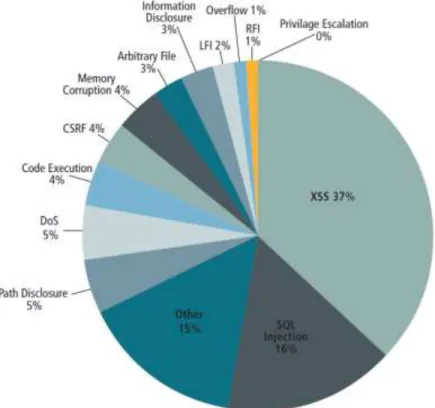
Figure 2.1: Top 10 Threads. 25
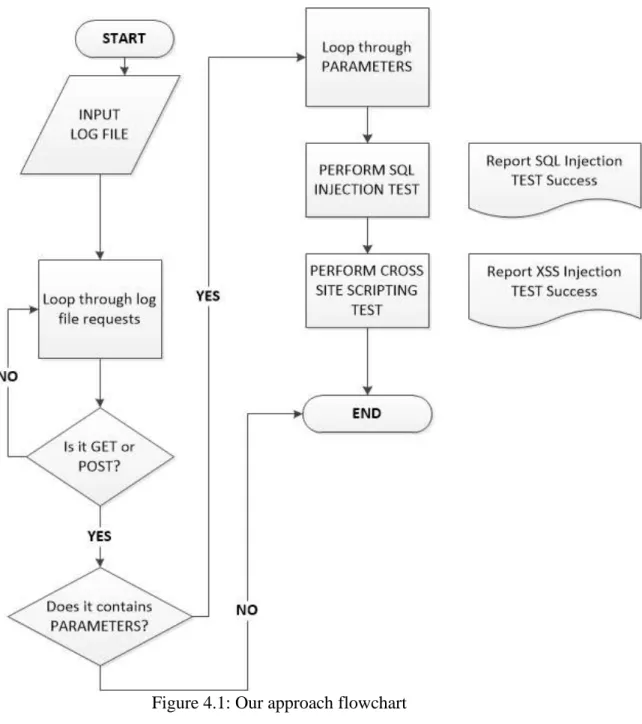
Figure 4.1: Our Approach Flowchart. 57
Figure 4.2: RAW HTTP request 58
Figure 4.3: GET method 59
Figure 4.4: POST method 59
Figure 4.5: HTTP requests parse result list 60
Figure 4.6: Block Diagram 61
Figure 4.7: Database server error response 62
Figure 4.8: XSS methodology Block Diagram 71
Figure 5.1: Dam vulnerable web application 75
Figure 5.2: Mutillidae vulnerable web application 75
Figure 5.3: SQL injection Results Graph 77
Figure 5.4: Cross Site Scripting (XSS) Results Graph 78
Figure 5.5: Performance test of vulnerability scanners 83 Figure 5.6: false positive rate comparison of vulnerability scanners 84
vi
LIST OF TABLES
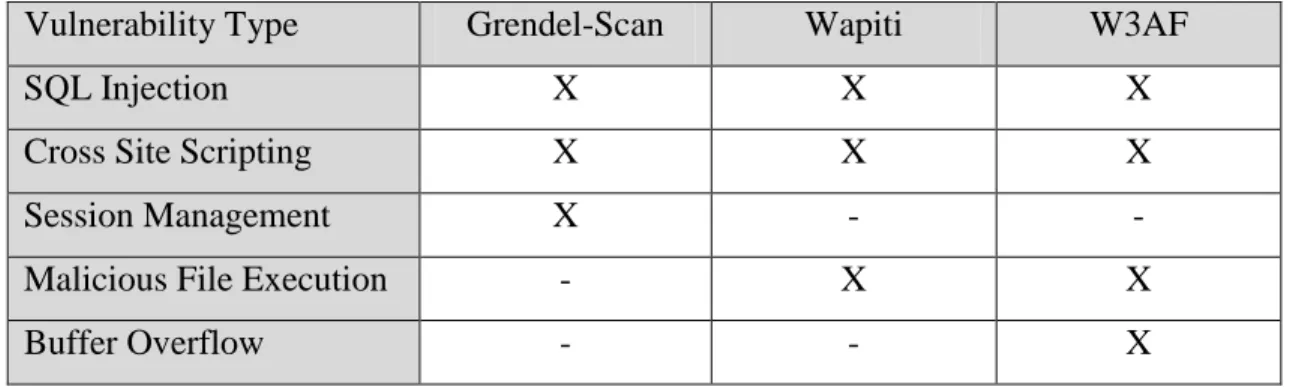
Table 2.1: A comparison of the relevant vulnerabilities detected by free/open-source web
application scanners 35
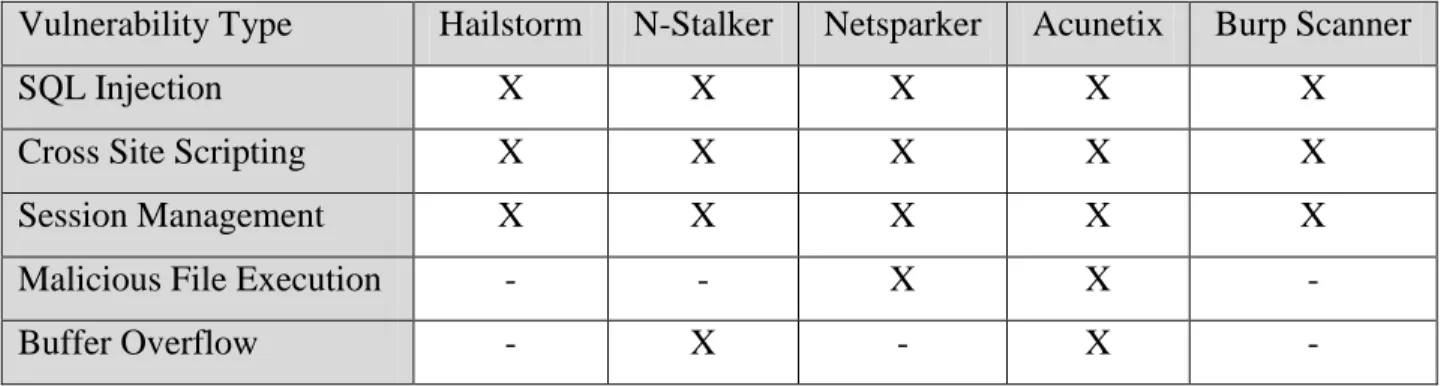
Table 2.2: A comparison of the relevant vulnerabilities detected by evaluation versions
of commercial web application scanners 39
Table 4.1: Common database servers’ errors 64
Table 4.2: Generic errors criteria 64
Table 4.3: MySQL, Microsoft SQL Server, and Oracle error messages 68
Table 5.1: SQL injection Results 77
Table 5.2: Cross Site Scripting (XSS) Results 78
Table 5.3: Features comparison between vulnerability scanners 82
Table 5.4: Performance test of vulnerability scanners 83
vii
ABSTRACT
The numbers of security vulnerabilities that are being found today are much higher in applications than in operating systems. This means that the attacks aimed at web applications are exploiting vulnerabilities at the application level and not at the transport or network level like common attacks from the past. At the same time, quantity and impact of security vulnerabilities in such applications has grown as well. Many transactions are performed online with various kinds of web applications. Almost in all of them user is authenticated before providing access to backend database for storing all the information. A well-designed injection can provide access to malicious or unauthorized users and mostly achieved through SQL injection and Cross-site scripting (XSS).
In this thesis we are providing a vulnerability scanning and analyzing tool of various kinds of SQL injection and Cross Site Scripting (XSS) attacks. Our approach can be used with any web application not only the known ones. As well as it supports the most famous Database management servers, namely MS SQL Server, Oracle, and MySQL. We validate the proposed vulnerability scanner by developing experiments to measure its performance. We used some performance metrics to measure the performance of the scanner which include accuracy, false positive rate, and false negative rate. We also compare the performance results of it with performance of similar tools in the literature.
viii
ABSTRACT ARABIC
اذى .ليغشتلا مظن تاقيبطت يف ويمع تناك امم ريثكب ىمعأ يى مويلا اييمع روثعلا متي يتلا ةينملأا تارغثلا ددع تساو بيولا تاقيبطت فديتست يتلا تامجيلا نأ ينعي ىوتسم ىمع سيلو قيبطتلا ىوتسم ىمع فعضلا طاقن للاغ وأ لقنلا كبش بوساحلا تا ةكرتشملا تامجيلا لثم تحبصأ .يضاملا نم و ريثأتو ةيمك تمن ،وسفن تقولا يف يف ةينملأا تارغثلا لا هذى تاقيبطت ريبك لكشب . ونا ثيحو عاونأ عم تنرتنلإا ربع تلاماعملا نم ديدعلا ذيفنت متي .بيولا تاقيبطت نم ةفمتخم متي ونأب اممع تانايبلا ةدعاق ىلإ لوصولا ةيناكمإ ريفوت لبق مدختسملا ةقداصم نم وناف تارغث نقح ماظن للاخ ممصم اديج اميمصت ةيممع نا ،ةميم تامومعم ىمع لوصحلا ةمظنلاا هذيل جولولا رفويس يتينقت للاخ نم متت ةيساسلاا نقحلا SQL Injection و Cross Site Scripting .ماظنلا عيطتسي ،بيولا ةمظناب ةصاخلا ةينملاا تارغثمل فشكو حسم ماظن ريوطتو ميمصتب انمق ،ثحبلا اذى يف يعون نم تارغثلا فاشتكا SQL Injection
و Cross Site Scripting طت عونب ديقم ريغ وناو امك . بيولا قيب تانايبلا دعاوق ةمظنا ريشلا لماكلا معدلا عم .بيولا ةمظنا ةفاكل ومادختسا نكمي امناو MS SQL Server و Oracle و MySQL . واذختسا ىت .ءادلاا سايقن تهياش بساجت للاخ ني تحوشطًنا ةشكفهن ىييقتو صحف مًػ ىت ازهن تيساسلاا ءادلاا سيياقي تنساقي ىتو اًك .تبراكنا تيبهسنا لذؼي سايقي و ،تبراكنا تيباجيلاا لذؼي سايقي ،تقذنا سايقي ،يهو تًظنلاا ني عىننا .تهثاًي تًظناو ثاودا غي ءادلاا جئاتن
1
Chapter1
2
1.1. Motivation
A "computer system" is more than hardware and software; it includes the policies, procedures, and organization under which that hardware and software is used. Security holes can arise from many areas or combination of these them. This leads no sense to restrict the study of vulnerabilities to hardware and software problems [67]. When attacker breaks into a computing system, he takes advantage of lapses in procedures, technology, or management (or some combination of those factors), permitting unauthorized access or actions. The precise failure of the controls is termed a vulnerability or security flaw; mistreatment that failure to violate the security policy is termed exploiting the vulnerability. One who attempts to exploit the vulnerability is called an attacker [67].
Another more general definition from [68] defines Vulnerability analysis as ―the act of determining which security holes and vulnerabilities may be applicable to the target network‖.
Vulnerability analysis, also known as vulnerability assessment [69], ―is a process that defines, identifies, and classifies the security holes (vulnerabilities) in a computer, network, or communications infrastructure‖. In addition, vulnerability analysis can forecast the effectiveness of proposed countermeasures and evaluate their actual effectiveness after they are put into use.
Vulnerability analysis consists of several steps:
Define and classify target system.
Assign relative levels of importance to the target system resources.
Identify potential threats to each resource.
Develop or setup a method to deal with the most serious potential problems.
Define and implement procedures to minimize the consequences if the attack for the target system resource.
In order to develop reliable and robust web applications, we have to use vulnerability metrics that let us monitor, analyze, and quantify application behavior under a range of faults and attacks. In this research we will present a scanning tool for analyzing
3
web applications vulnerability in real time. This scanner lets us quantify how attacks and faults impact network performance and services, discover attack points, and examine how critical the web application components behave during an attack or system fault.
1.2. Attack analysis
Most network attackers overcome the target system with a brute forced traffic to consume all system resources (such as CPU cycles, memory, network bandwidth, and packet buffers). These attacks degrade service and can eventually lead to a complete shutdown.
There are two common types of attacks [72]:
Server attacks: these attacks include TCP SYN, Smurf IP, ICMP flood, and Ping of Death attacks. For example, the attacker may make brute force requests to a victim server with spoofed source IP addresses. Due to TCP/IP protocol stack vulnerabilities, the victim server cannot complete the connection requests and wastes all of its system resources. This will result denial of service on the target attacked system.
Routing attacks: the main strategy in routing attacks is distributed denial-of-service (DDoS) attacks which focuses on routers devices. When a router is compromised, it will forward traffic according to the attackers’ intent. Similar to server attacks, the attackers aim to consume all router resources, forcing the router to drop all incoming packets, thus negatively affecting network performance and behavior.
Vulnerability Analysis researches in networks and internet still in its beginning; this gives researchers much room for improvements. Several tools, which are based on modeling network specifications, fault trees, graph models, and performance models, works on vulnerability analysis by checking logs of systems and monitor performance metrics [70, and 71].
4
There are three common types of vulnerability analysis techniques [72]:
Network specifications survivability analysis. This approach injects fault and intrusion events into a given network specification, and then visualizes the effects in scenario graphs. This is done by using model checking, Bayesian analysis, and probabilistic analysis, which provides a multifaceted network view of a desired service.
Attack trees. This approach determines which attacks are most feasible and therefore most likely in a given environment, and quantifies vulnerability by mapping known attack scenarios into trees. Attack trees assume that all vulnerability paths are known and can be defined as possible or impossible. This can change as new attacks are discovered, however, to sudden render a previously impossible node possible.
Graph-based network-vulnerability analysis. This approach analyzes risks to specific network assets and examines the possible consequences of a successful attack. As input, the analysis system requires a database of common attacks (broken into atomic steps), specific network configuration and topology information, and an attacker profile. Nodes identify an attack stage, such as the machine class the attacker has accessed and the user privilege level he or she was compromised. Using graph methods lets you identify the attack paths with the highest probability of success.
1.3. Penetration Testing
A penetration test is ―an authorized attempt to violate specific constraints stated in the form of a security or integrity policy‖. This method implies a metric for determining whether the study has succeeded. In addition, it provides a framework in which to examine those aspects of procedural, operational, and technological security mechanisms relevant to protecting the particular aspect of system security in question.
Another study does not have a specific target; instead, the goal is to find some number of vulnerabilities or to find vulnerabilities within a set period of time. The
5
strength of such a test depends on the proper interpretation of results. Briefly, if the vulnerabilities are categorized and studied, and if conclusions are drawn as to the nature of the flaws, then the analysts can draw conclusions about the care taken in the design and implementation. But a simple list of vulnerabilities, although helpful in closing those specific holes, contributes far less to the security of a system.
In practice, penetration testing study is affected by many constraints; resources and time are the most constraints that affect it. If these constraints arise as aspects of policy, they improve the test because they make it more realistic.
1.4. Layers of Penetration Testing
Penetration testing is designed to characterize the effectiveness of security mechanisms and controls to attackers. Attacker’s point of view conducts penetration test studies, and the environment in which the tests are conducted is that in which a putative attacker would function. Different attackers, however, have different environments; for example, insiders have access to the system, whereas outsiders need to acquire that access. There are two layers for a penetration testing study, external attacker with access to the system and internal attacker with access to the system.
1. External attacker with access to the system: in this layer, in order to launch the attack the testers/attacker have access to the system and can proceed to log in or to invoke network services available to all hosts on the network. This layer requires an access account from which the testers can achieve their goal or using a network service that can give them access to the system. Common forms of attack at this stage are guessing passwords, looking for unprotected accounts, and attacking network servers. To provide the desired access an implementation of flaws in servers are required.
2. Internal attacker with access to the system: in this layer, the testers have an account on the system and can act as authorized users of the system. The test typically involves gaining unauthorized privileges or information and, from that, reaching the goal. At this stage, the testers acquire (or have) a good knowledge of
6
the target system, its design, and its operation. Attacks are developed on the basis of this knowledge and access.
In some cases, information about specific layers is irrelevant and that layer can be skipped. For example, penetration tests during design and development skip layer 1 because that layer analyzes site security. A penetration test of a system with a guest account will usually skip layer 2 because users already have access to the system. Ultimately, the testers must decide which layers are appropriate.
1.5. Methodology at Each Layer in Penetration Testing Methodology
The penetration testing methodology springs from the Flaw Hypothesis Methodology. The usefulness of a penetration study comes from the documentation and conclusions drawn from the study and not from the success or failure of the attempted penetration. Such a conclusion can only be drawn once the study is complete and when the study shows poor design, poor implementation, or poor procedural and management controls. Also important is the degree of penetration. If an attack obtains information about one user's data, it may be deemed less successful than one that obtains system privileges because the latter attack can compromise many user accounts and damage the integrity of the system.
1.6. Flaw Hypothesis Methodology
The Flaw Hypothesis Methodology was developed at System Development Corporation and provides a framework for penetration studies [67]. It consists of five steps, information gathering, flaw hypothesis, flaw testing, flaw generalization, and flaw elimination.
1. Information gathering. In this step, the testers become familiar with the system's functioning. They examine the system's design, its implementation, its operating procedures, and its use. The testers become as familiar with the system as possible.
7
2. Flaw hypothesis. Drawing on the knowledge gained in the first step and on knowledge of vulnerabilities in other systems, the testers hypothesize flaws of the system under study.
3. Flaw testing. The testers test their hypothesized flaws. If a flaw does not exist (or cannot be exploited), the testers go back to step 2. If the flaw is exploited, they proceed to the next step.
4. Flaw generalization. Once a flaw has been successfully exploited, the testers attempt to generalize the vulnerability and find others similar to it. They feed their new understanding (or new hypothesis) back into step 2 and iterate until the test is concluded.
5. Flaw elimination. The testers suggest ways to eliminate the flaw or to use procedural controls to ameliorate it.
1.7. Vulnerability Classification
Security flaws from various perspectives are described by vulnerability classification frameworks. Some frameworks describe vulnerabilities by classifying the techniques used to exploit them. Other frameworks characterize vulnerabilities in terms of the software and hardware components and interfaces that make up the vulnerability. And others classify vulnerabilities by their nature; this is done by discovering techniques for finding previously unknown vulnerabilities.
Vulnerability analysis goal is to develop methodologies that provide the following abilities:
1. Specify, Design, and implement a computer system without vulnerabilities. 2. Analyze a computer system to detect vulnerabilities.
3. Address any vulnerability introduced during the operation of the computer system.
8
1.8. Aim of this Thesis
The main goal of this master thesis is to present a new analyzing tool for main two web applications vulnerabilities, which are mainly SQL Injection and Cross Site Scripting (XSS). To achieve this goal, a dynamically generate test requests that are applied specifically to a given web application will be applied by the analysis tool. By doing this analysis, our scanning will be apple to detect vulnerabilities of any web application regardless if it’s for known web application or custom web application. The analysis tool will conduct two tests; these t101ests will identify the common web applications vulnerabilities that are SQL Injections and Cross Site Scripting (XSS). These tests will be applied on web applications input parameters so the tests will be parameter-based tests.
1.9. Methods Used
To accomplish the proposed solution, the following methods have been used in sequence:
Study the basic principles of web applications vulnerability analysis.
Study and learn the main scripting languages used for implementation of code.
Review the existing techniques of vulnerability analysis.
Identify the major and common vulnerabilities on web applications and study their mechanisms.
Design a set of related analysis mechanisms and algorithms.
Demonstrate the validity of the proposed solution to detect vulnerabilities on different types of web applications.
1.10. Our approach
The new scanning tool has been implemented in Perl scripting language under Linux environment. The evaluation method used is an automatic exploiting for the detected vulnerabilities which will verify the existence of vulnerability and minimize the false positives that may exist by the scanning tool.
9
1.11. Organization of this Thesis
The rest of the thesis is organized as follows; Chapter 2 presents a complete review of vulnerability analysis with statistics about known vulnerabilities of web applications and their impact in web developments. A brief review of well-known scanning and analyzing tools of vulnerabilities with detailed description of most modern tools, as well as, categories of lately proposed solutions are discussed in chapter 3. Chapter 4 presents a formal description of our design of analysis tool with required parameters, assumptions, and all prerequisite mechanisms needed to make this comprehensive work. Validation and evaluation results are provided in chapter 5. The report ends with conclusion in chapter 6 which summarizes this thesis and gives some hints for future work on this research subject.
10
Chapter 2
VULNERABILITY
ANALYSIS
11
2.1 Introduction
In computer security, vulnerability is a weakness which allows an attacker to reduce a system's information assurance.
Vulnerability is the intersection of three elements: a system susceptibility or flaw, attacker access to the flaw, and attacker capability to exploit the flaw [46]. In order to exploit vulnerabilities, the attacker must have at least one applicable tool or technique that can connect to a system weakness security hole.
According to NIST SP 800-37, ―vulnerability analysis and assessment is an important element of each required activity in the NIST Risk Management Framework (RMF)‖. This RMF comprises six steps, into each of which vulnerability analysis and assessment is to be integrated [45]:
Information System Categorization.
Security Controls Selection.
Security Controls Implementation.
Security Controls Assessments.
Information Systems Authorization.
Security Controls Monitoring.
Integration is done by the vulnerability assessment tools, by automating the detection, identification, measurement, and understanding of vulnerabilities found in ICT components at various levels of a target ICT system or infrastructure. Vulnerability is an attribute or characteristic of a component that can be exploited by either an external or internal agent (hacker or malicious insider) to violate a security policy of (narrow definition) or cause a deleterious result in (broad definition) either the component itself, and/or the system or infrastructure of which it is apart. Such ―deleterious results‖ include unauthorized privilege escalations or data/resource accesses, sensitive data disclosures or privacy violations, malicious code insertions, denials of service, etc [45].
12
Such tools are often referred to as vulnerability scanners, because their means of vulnerability detection is to scan targets (usually network services and nodes, and the operating systems, databases, and/or Web applications residing on those nodes) in an attempt to detect known, and in some cases also unknown, vulnerabilities [45].
Improving the scanning techniques of Web Application scanners will allow them to achieve better performance and, therefore, increase their credibility. However, in order to understand and improve web application scanners, the common vulnerabilities that they aim to detect must be understood first. This chapter is organized as follows: how are vulnerability assessments tools work will be discussed in Section 2.1, some of the specific vulnerabilities that web application scanners attempt to probe for will be discussed in Section 2.2, several of the most popular and researched web application scanners will be discussed in Section 2.3. 2.2 How Vulnerability Assessment Tools Work
Vulnerability assessment tools generally work by attempting to automate the steps often employed to exploit vulnerabilities: they begin by performing a ―footprint‖ analysis to determine what network services and/or software programs (including versions and patch levels) run on the target. The tools then attempt to find indicators (patterns, attributes) of, or to exploit vulnerabilities known to exist, in the detected services / software versions, and to report the findings that result. Caution must be taken when running exploit code against ―live‖ (operational) targets, because damaging results may occur. For example, targeting a live Web application with a ―drop tables‖ Standard Query Language (SQL) injection probe could result in actual data loss. For this reason, some vulnerability assessment tools are (or are claimed to be) entirely passive. Passive scans, in which no data is injected by the tool into the target, do nothing but read and collect data. In some cases, such tools use vulnerability signatures, i.e., patterns or attributes associated with the likely presence of a known vulnerability, such as lack of a certain patch for mitigating that vulnerability in a given target. Wholly passive tools are limited
13
in usefulness (compared with tools that are not wholly passive) because they can only surmise the presence of vulnerabilities based on circumstantial evidence, rather than testing directly for those vulnerabilities.
Most vulnerability assessment tools implement at least some intrusive ―scanning‖ techniques that involve locating a likely vulnerability (often through passive scanning), then injecting either random data or simulated attack data into the ―interface‖ created or exposed by that vulnerability, as described above, then observing what results. Active scanning is a technique traditionally associated with penetration testing, and like passive scanning, is of limited utility when performed on its own, as all the injected exploits would be ―blind‖, i.e., they would be launched at the target without knowing its specific details or susceptibility to the exploits. For this reason, the majority of vulnerability assessment tools combine both passive and active scanning; the passive scanning is used to discover the vulnerabilities that the target is most likely to contain, and the active scanning is used to verify that those vulnerabilities are, in fact, both present and exposed as well as exploitable. Determining that vulnerabilities are exploitable increases the accuracy of the assessment tool by eliminating the false positives, i.e., the instances in which the scanner detects a pattern or attribute indicative of a likely vulnerability that which, upon analysis, proves to be either (1) not present, (2) not exposed, or (3) not exploitable. It is the combination of passive and active scanning, together with increased automation, which has rendered automated penetration testing suites more widely useful in vulnerability assessment.
Most vulnerability assessment tools are capable of scanning a number of network nodes, including networking and networked devices (switches, routers, firewalls, printers, etc.), as well as server, desktop, and portable computers. The vulnerabilities that are identified by these tools may be the result of programming flaws (e.g., vulnerabilities to buffer overflows, SQL injections, cross site scripting [XSS], etc.), or implementation flaws and misconfigurations. A smaller subset of
14
tools also provides enough information to enable the user to discover design and even architecture flaws.
The reason for ―specialization‖ of vulnerability assessment tools, e.g., network scanners, host scanners, database scanners, Web application scanners, is that to be effective, the tool needs to have a detailed knowledge of the targets it will scan. Web application and database vulnerability scanners look for vulnerabilities that are traditionally ignored by network- or host-level vulnerability scanners [45]. Even custom-developed Web application and/or database application often use common middleware (e.g., a specific supplier’s Web server, such as Microsoft® Internet Information Server [IIS] or Apache®), backends (e.g., Oracle® or PostgreSQL), and technologies (e.g., JavaScript®, SQL) that are known or considered likely to harbor certain types of vulnerabilities that cannot be identified via signature based methods used by network- and host-based vulnerability analysis tools. Instead, Web Application scanners and database scanners directly analyze the target Web application or database, and attempt to perform common attacks against it, such as SQL injections, XSS, least privilege violations, etc [45].
2.3 Web Vulnerability attack Threats
The numbers of security vulnerabilities that are being found today are much higher in applications than in operating systems. This means that the attacks aimed at web applications are exploiting vulnerabilities at the application level and not at the transport or network level like common attacks from the past[48]. The Open Web Application Security Project (OWASP) has put together what is considered the definitive standard list of top threats to Web applications. It is called ―The OWASP Top 10 Project‖ and it represents a general consensus on the major areas of threat by category. The Top 10 threats [Figure 2.1] as they exist currently are as follows:
15
1. Injection:
Injection flaws, such as SQL, OS, and LDAP injection, occur when untrusted data is sent to an interpreter as part of a command or query. The attacker’s hostile data can trick the interpreter into executing unintended commands or accessing unauthorized data.
2. Cross Site Scripting (XSS):
XSS flaws occur whenever an application takes untrusted data and sends it to a web browser without proper validation and escaping. XSS allows attackers to execute scripts in the victim’s browser which can hijack user sessions, deface web sites, or redirect the user to malicious sites.
3. Broken Authentication and Session Management:
Application functions related to authentication and session management are often not implemented correctly, allowing attackers to compromise passwords, keys, session tokens, or exploit other implementation flaws to assume other users’ identities.
4. Insecure Direct Object References:
A direct object reference occurs when a developer exposes a reference to an internal implementation object, such as a file, directory, or database key. Without an access control check or other protection, attackers can manipulate these references to access unauthorized data.
5. Cross-Site Request Forgery (CSRF):
A CSRF attack forces a logged-on victim’s browser to send a forged HTTP request, including the victim’s session cookie and any other automatically included authentication information, to a vulnerable web application. This allows the attacker to force the victim’s browser to
16
generate requests the vulnerable application thinks are legitimate requests from the victim.
6. Security Misconfiguration:
Good security requires having a secure configuration defined and deployed for the application, frameworks, application server, web server, database server, and platform. All these settings should be defined, implemented, and maintained as many are not shipped with secure defaults. This includes keeping all software up to date, including all code libraries used by the application.
7. Insecure Cryptographic Storage:
Many web applications do not properly protect sensitive data, such as credit cards, SSNs, and authentication credentials, with appropriate encryption or hashing. Attackers may steal or modify such weakly protected data to conduct identity theft, credit card fraud, or other crimes.
8. Failure to Restrict URL Access:
Many web applications check URL access rights before rendering protected links and buttons. However, applications need to perform similar access control checks each time these pages are accessed, or attackers will be able to forge URLs to access these hidden pages anyway.
9. Insufficient Transport Layer Protection:
Applications frequently fail to authenticate, encrypt, and protect the confidentiality and integrity of sensitive network traffic. When they do, they sometimes support weak algorithms, use expired or invalid certificates, or do not use them correctly.
17
10. Invalidated Redirects and Forwards:
Web applications frequently redirect and forward users to other pages and websites, and use untrusted data to determine the destination pages. Without proper validation, attackers can redirect victims to phishing or malware sites, or use forwards to access unauthorized pages.
Figure 2.1: Top 10 Threats
This list only includes the ten most critical web application risks that exist today, but other important vulnerabilities exist, including buffer overflow exploits and malicious file execution (included on the previous version of the OWASP Top 10 for 2007 [47]). Because the total number of web application vulnerabilities that exist is extremely large, only the most relevant vulnerabilities are implemented and analyzed in this research. The web application vulnerabilities that are most relevant to this research include SQL injection, and cross-site scripting (XSS). Information about these vulnerabilities has been taken from [48].
18
2.3.1 SQL Injection
This section will discuss a brief overview of different kinds of SQL injection attacks and their defenses. [48] Describes the basic definition and fundamental information regarding SQL injection techniques.
Attacks
SQL injection occurs when malicious input is passed into a database interpreter without being properly validated or encoded. In this type of attack the client is attacking the web server database. The input that the attacker passes into the interpreter is crafted to be a legitimate SQL statement, but instead of returning the data that the application’s developer intended, the interpreter now returns the data requested by the attacker. This type of attack is severe because not only can it expose all sensitive user and business related data, but it could even go as far as executing operating system commands or giving an attacker complete control of a web application. An example of a valid SQL query which displays information for the user ―Rami‖ is:
SELECT info FROM users WHERE username = 'Rami';
An attacker could use the malicious user name ―' OR 1=1 –‖ to cause the interpreter to display all of the user information data in the database. The corresponding SQL query would be:
SELECT info FROM users WHERE username = '' OR 1=1 –
This is one of the simplest types of SQL injection, but works because the leading single quote causes the query to break out of the single quote delimited data. Therefore the always true ―OR 1=1‖ is appended to the query, and thus displays all of the user information data in the database. The double dashes ―–‖ at the end of the query cause all of the text that would follow it to be commented out, because ―–‖ is the comment symbol in this SQL language.
19
Adding the comment symbol is necessary in this attack because it nullifies the rest of the syntax that the web application would normally append to the end of database query to complete the operation. Therefore, the only query that is being executed is the attacker’s injected sequence, and not the web applications expected query.
Even more dangerous attacks are possible against certain SQL versions and databases as well. An example of this would be if an attacker took advantage of a web application that implements both regular and administrator users, and therefore normally logs in users with default roles, but could also log in a user with administrator roles. If the administrator user has advanced functionality and has the ability to access all of the web application’s data, then the web application can be completely compromised if an attacker takes control of the administrator account. An SQL injection attack could accomplish this if a web application uses email addresses as user names and associates each user name in the database as either a regular or an administrator user. In this example the attacker will exploit a generic ―Change Mailing Address‖ field on a web page and associate an email address of their choosing to the administrator account. The attacker would enter the following in the ―Change Mailing Address‖ field on the web page:
'; UPDATE users SET username = '[email protected]' WHERE username LIKE '%admin%'; –
The semi-colon ―;‖ will end the first query and allow for the attacker’s query to be executed. This query will cause the email address that the attacker entered to replace the email address that matches the pattern most like ―admin‖. All that is necessary to perform this attack is for the attacker to ―guess and check‖ until they know that the table holding the accounts is in fact ―users‖, and that the field holding the user names is in fact ―username‖. After this, the user name most closely matching ―admin‖ will be replaced with the attacker’s email address, but will continue to have administrative capabilities. Now that the attacker has replaced the administrator’s email address with his own, he can click the ―Forgot
20
Password‖ button that most user-based web applications provide, and have the administrator’s password sent to him in the convenient ―Password Reminder‖ email.
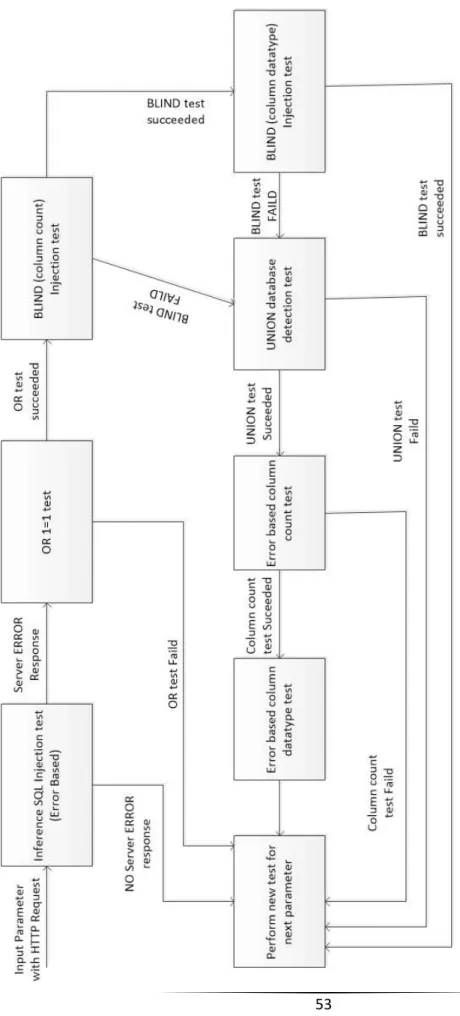
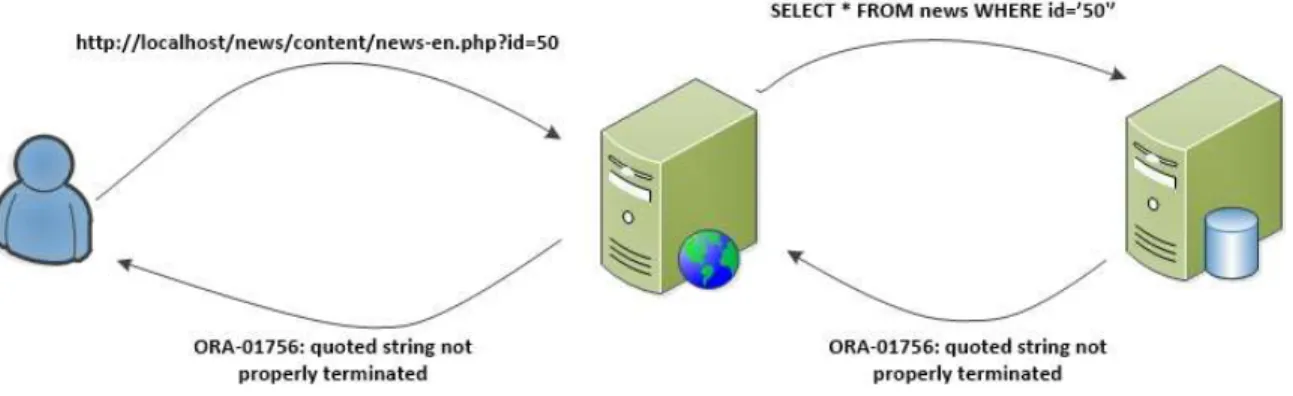
The previously mentioned attack is not always easy to execute because it is not trivial to find out the name of the table and column being used in the SQL database. This challenge is overcome by using two other types of SQL injection: blind SQL injection and error-based SQL injection. Blind SQL injection uses a series of true and false questions to take advantage of the predictability of the WHERE condition in SQL, since 1=1 will always return true. Therefore, if a record is returned when using blind SQL injection, the attacker’s injected condition must have been true. Error-based SQL injection is a specific type of SQL injection that uses SQL error messages to determine the structure of the database. SQL injection statements are crafted by the attacker in a way such that the attacker can use the error responses to systematically unveil table names, column names, column data types, and even specific data entries [48].
Defenses
The best way to prevent SQL injection is to have all interpreters separate untrusted data from database queries and to only accept expected input [41, 50]. In order to achieve this, all data originating from a client should have special characters escaped or sanitized into a valid format, should use an API which avoids the use of an interpreter entirely, or should use prepared statements and parameterized interfaces. The ―mysqli->prepare‖ mechanism will create prepared statements for MySQL in PHP, and the following code sequence will escape all special characters:
if ( !get_magic_quotes_gpc() ) {
$safe_string = mysql_real_escape_string( $original_string ); }
21
Also, to protect against blind SQL injection and error message based SQL injection, SQL error reporting should be disabled in conjunction with the other safety measures mentioned above. In order to disable error reporting for MySQL the ―@‖ character should precede commands to suppress on-screen error reporting. These defensive measures should be implemented to mitigate SQL injection attacks.
2.3.2 Cross Site Scripting
Three of the main types of cross-site scripting (XSS) attacks, as well as some defensive techniques to protect against them, will be reviewed in this section.
Attacks
XSS occurs when a web application includes malicious code in a web page that is sent to a client’s browser without proper content validation. In this type of attack the web page server is attacking the client machine. When the web page is viewed by the client it will execute the malicious script that the attacker embedded into the web page. XSS is the most prevalent web application security flaw [47] due in a large part to its simplicity and resulting severity. Some of the attacks that this type of vulnerability can result in are the hijacking of a user’s session, the defacement of websites, the insertion of hostile content, and the redirection of users’ requests.
Reflective XSS is a type of XSS attack that can occur when a victim follows a URL which contains malicious scripting that is executed when the web page is rendered. This is commonly done by sending victims legitimate looking e-mail messages that contain malicious script in the message’s URL. Once the HTTP request from the URL is processed, the HTML content is received and displayed in the victim’s browser, thus executing the malicious script. An example of a URL containing a reflective XSS attack that would execute some type of malicious script included the function ―malicious()‖ would be:
22
Stored XSS is another type of XSS attack. This type of attack occurs when the malicious script is uploaded into the database back end of a server without input validation, and is later retrieved by the web application to be embedded into a web page. This causes every user who visits the infected web page to execute the malicious script in his or her browser. An example of where this vulnerability can be found is a web application that uses a comment section to allow users to view and leave feedback about a product. If an attacker were to leave a comment which included malicious script, the script would be stored as a comment for that product in the database, and then executed every time a user clicks to view the page holding the comments for that product. An example of this type of attack is a script crafted to steal a user’s cookie and save it in a remote site for exploitation at a later time so that they can perform actions as if they were the victim (such as bank transactions, e-mail correspondence, etc...). The following script would execute such an attack if stored in a web application’s database and then executed in a client’s web browser:
<script>document.write('<img src=―http://www.attackersite.com' +document.cookie+'―) </script>
A third type of XSS attack is Document Object Model, or DOM-based, XSS. This is a different kind of XSS attack because it occurs on the client side when the user is processing the content, instead of on the server side when the web application is retrieving information to put in a web page. The Document Object Model is the standard model that represents HTML and XML content of a web page. The DOM can be modified in this type of attack to execute a malicious script in the victim’s browser. An example of this type of attack would be to exploit a web page that uses some embedded JavaScript in to set the default language for the client using a variable in the URL. An example of this would be:
23
The malicious script that would exploit this would simply need to replace the variable ―English‖ in the URL. A URL that shows this type of DOM-based XSS attack would be:
http://www.mysite.com/index.html#default=<script>malicious()</script>
Because everything after the # in a URL is not sent to the server by the browser, the malicious script would not be detected by the server even if the server was performing input validation. Therefore the script would be echoed into the page (DOM) when the browser renders it, and would result in the attacker’s script being executed [49].
Defenses
The same rules described above that apply to protecting against SQL injection, apply to protecting against XSS as well. All user supplied input should be validated and properly escaped before being included in the output web page [50]. This requires the same escaping technique as before, which in PHP is:
if ( !get_magic_quotes_gpc() ) {
$safe_string = mysql_real_escape_string( $original_string ); }
Also, proper output encoding will ensure that the browser treats the possibly dangerous content as text, and not as active content that could be executed. The ―htmlentities()‖ and ―htmlspecialchars()‖ functions in PHP will check output to make sure that it is HTML encoded.
The best way to avoid DOM-based XSS vulnerabilities is to have all client-side input passed to the server for proper validation. However, if using variables in the DOM cannot be avoided, then input validation should occur in the script itself. A check to confirm that the string being written to the HTML page consists of only alphanumeric characters should be completed so that no scripting characters are allowed. A downside of this defensive technique is that the security check is
24
viewable in the HTML code to the attackers, and therefore is easily understandable and attackable [49]. An example of a script which checks that only alphanumeric characters exist in a string is:
if (original_string.match(/^[a-zA-Z0-9]+$/)) { document.write(original_string);
}
These defensive techniques, although not infallible due to the mentioned limitations, will add a level of protection against attacks that aim to exploit XSS vulnerabilities.
2.4
Web Application Vulnerability Scanners
There are several web application vulnerability scanners that test for popular vulnerabilities in web servers and web applications. These tools can either be academic research projects, free/open-source applications, or commercial software products. Tools are developed in academia by members of universities who are interested in improving and studying web application vulnerability scanners, but are generally not available for purchase or commercial use. The open-source/free tools are available to the public, but are generally not as up-to date and accurate as the commercial tools. These tools do however, give users the ability to customize their tool and gain a greater understanding of the security of their web applications. Commercial tools usually give more comprehensive results than open-source/free tools, but can cost anywhere from just under $100.00 to over $6000.00 [8, 50]. Specific web vulnerability scanners from these three categories that automatically scan for and detect the most common web application vulnerabilities will be reviewed in this section.
2.4.1 Web Application Scanners in Academia
25
that are developed in academia. These scanners are different from free/open-source and commercial scanners because the researchers who work on them are continuously evaluating them and also discuss not only where their design succeeds, but where their design is limited and requires future work. These scanners are not available for public use, so they cannot be used in this analysis of web vulnerability scanner limitations, but reviewing the techniques and methods used by these scanners will help in understanding how other web application scanners work [48].
Huang et al. developed a web application scanner called WAVES that attempts to reduce the number of potential side effects of black-box testing [51, 52]. The auditing process of web application scanners can cause permanent modifications, or even damage, to the state of the application it is targeting. This is a drawback that both commercial and open-source/free web application scanners share, and is why the authors introduced a testing methodology that would allow for harmless auditing. Their experimental results found that WAVES was unable to detect any new vulnerability that were not already detected by a static source code analyzer they had developed. Also, WAVES was unable to discover all of the vulnerabilities that the static source code analyzer had found (detected only 80% of the vulnerabilities found by the static analyzer). The authors believe their tool failed in part because it did not have complex procedures able to detect all data entry points, and because it was unable to observe HTML output.
Another academic black-box approach was developed by Antunes and Viera as described in [53]. Their web vulnerability scanner was used to identify SQL injection vulnerabilities in 262 publicly available web services. The first step in their approach was to prepare for the tests by obtaining information regarding the web service in order to generate the workload (valid web service calls). The second step was to execute the tests. This was accomplished by using a workload emulator that acted as a web service consumer, and by using an attack load generator that automatically generated attacks by injecting them
26
into the workload test calls. The final step in their approach was to analyze the responses by using a set of well-defined rules which would identify vulnerabilities and exclude potential false-positives. Their results showed that they achieved a detection coverage rate of 81% in the scenario where they had access to the known number of vulnerabilities, and maintained a false-positive rate of 18% in their optimistic interpretation. These results are better than those of the commercial tools that the authors analyzed, and suggest that it is possible to improve the effectiveness of vulnerability scanners [48].
2.4.2 Free/Open-Source Web Application Scanners
Many open-source and free web application scanners are available for black-box testing and analysis. Some of these applications provide extensive functionality with the ability to be customized and expanded to meet the needs of users. Others however do not provide a great deal of usability and have a limited amount of functionality, and therefore can only test for a few web application vulnerabilities. Three of the more thorough and robust free/open-source scanners, Grendel-Scan [54], Wapiti [55], and W3AF [56], will be reviewed.
Grendel-Scan [54] is an open-source web application security testing tool which has an automated testing module for detecting common web application vulnerabilities. It has the ability to find simple web application vulnerabilities, but its designers state that no automated tool can identify complicated vulnerabilities, such as logic and design flaws. Grendel-Scan tests for SQL injection, XSS attacks, and session management vulnerabilities, as well as other vulnerabilities.
Wapiti [55] is a free web application vulnerability scanner and security auditor. It performs black-box analysis by scanning the web pages of a web application in search of scripts and forms where data can be injected. After the list of scripts and forms is gathered, Wapiti injects payloads to test if the
27
scripts are vulnerable. Wapiti scans for remote file inclusion errors, SQL and database injections, XSS injections, and other vulnerabilities.
W3AF [56] is exactly what it stands for, a Web Application Attack and Audit Framework. The goal of the project is to create a framework which can find and exploit web application vulnerabilities easily. The project’s long term objectives are for it to become the best open source web application scanner, and the best open source web application exploitation framework. Also, the designers want the project to create the biggest community of web application hackers, combine static code analysis and black box testing into one framework, and become the NMAP [57] of the web. W3AF incorporates a great deal of plug-ins into its framework, and is capable of testing for SQL injection, XSS attacks, buffer overflow, malicious file execution, and session management vulnerabilities. Table 2.1 provides a comparison of the vulnerabilities that the free and open source web application scanners search for.
Vulnerability Type Grendel-Scan Wapiti W3AF
SQL Injection X X X
Cross Site Scripting X X X
Session Management X - -
Malicious File Execution - X X
Buffer Overflow - - X
Table 2.1: A comparison of the relevant vulnerabilities detected by free/open-source web application scanners.
2.4.3 Commercial Web Application Scanners
Commercial web application scanners are generally licensed to companies or organizations that wish to test their web applications for vulnerabilities so that they can fix security holes before they are maliciously exploited. Since a data breach can result in the loss of personal information of thousands of
28
customers, and the loss of millions of dollars, companies are willing to pay large sums of money for these applications. These commercial applications compete against each other for market share, and therefore do not want to disclose their scanner’s limitations or restrictions. However, an approach to analyze these limitations and restrictions is proposed in this thesis. Some of the features of popular commercial web application scanners will be discussed below [48].
Cenzic [58] sells a web application scanner tool called Hailstorm which utilizes stateful testing. Stateful testing tools are designed to behave like human testers by taking what seem to be an application’s insignificant or disparate weaknesses, and combining them together into serious exploits. The key benefits that Hailstorm claims are the ability to identify major security flaws in target applications, to help with internal compliance policies, to avoid vulnerabilities that lead to downtime, and to assess applications for commonly known vulnerabilities. Cenzic provides a 7-day free trial of Hailstorm Core which can detect vulnerabilities including SQL injection, XSS , and session management.
Acunetix Web Vulnerability Scanner [8] is another black-box tool which claims in-depth checking for SQL injection, XSS, and other vulnerabilities with its innovative AcuSensor Technology. This technology is supposed to quickly find vulnerabilities with a low number of false-positives, pinpoint where each vulnerability exists in the code, and report the debug information as well. Acunetix also includes advanced tools to allow penetration testers to fine tune web application security tests, and has many more features to scan websites with different scan options and identities. The only vulnerability that the free edition of the software detects is XSS, but a 30-day trial version of the product is available that also can detect SQL injection, file execution, session management, and manual buffer overflow attacks.
29
N-Stalker [59] provides a suite of web security assessment checks to enhance the overall security of web applications. It is founded on the technology of Component-oriented Web Application Security Scanning, and allows users to create their own assessment policies and requirements, enabling them to check for more than 39,000 signatures and infrastructure security checks. Vulnerabilities checked for include SQL injection, XSS attacks, buffer overflows, and session management attacks, but the evaluation edition only lasts for a 7-day period.
Netsparker [60] is a web application vulnerability scanner developed by Mavituna Security Ltd. Netsparker is focused on eliminating false-positives, and uses confirmation and exploitation engines to ensure that false-positives are not reported. The engines also allow the users to see the actual impact of the attacks instead of text explanations of what the attack could do. Because of the techniques Netsparker uses, Mavituna Security claims that it developed the first false-positive free web application scanner. Netsparker scans for all types of XSS injection, SQL injection, malicious file execution, and session management vulnerabilities.
Burp Scanner [61] is a web application vulnerability scanner that is part of Burp Suite Professional. Burp Suite Professional is the commercial version of Burp Suite, which is an integrated platform for attacking and testing web applications. Burp Suite provides a number of tools, including an interception web proxy, web spider, application intruder, session key analyzer, and data comparer. The professional version includes Burp Scanner which can operate in either passive or active mode, or either manual scan or live scan mode. The vulnerabilities it searches for include SQL injection, XSS injection, and session management vulnerabilities.
Rational AppScan [62] is licensed by IBM for advanced web application security scanning. The AppScan tool automates vulnerability assessments and tests for SQL injection, XSS attacks, buffer overflows, and other common
30
web application vulnerabilities. AppScan can generate advanced remediation capabilities in order to ease vulnerability remediation, simplify results with the Results Expert wizard, and test for emerging web technologies. Rational AppScan provides an unlimited evaluation period for its standard edition; however, with the evaluation license the software is only capable of testing a test web site provided by AppScan.
BuyServers Ltd. [63] sells a web vulnerability scanner called Falcove which is a 2-in-1 scanning and penetration tool, meaning that it not only tries to detect vulnerabilities, but is capable of exploiting them as well. Falcove utilizes a crawler feature that checks for web vulnerabilities, audits dynamic content (password fields, shopping carts), and generates penetration reports that explain the security level of the tested web site. However, BuyServers Ltd. no longer supports the trial version of the product that detects SQL injection, XSS, and file execution attacks.
HP’s WebInspect [64] software provides web application security testing and assessment for complex web applications. WebInspect claims fast scanning capabilities, broad security assessment coverage, and accurate web application security scanning results. HP also believes WebInspect identifies security vulnerabilities that are undetectable by traditional scanners by using innovative assessment technologies such as simultaneous crawl and audit, and on current application scanning. HP WebInspect scans for data detection and manipulation attacks, session and authentication vulnerabilities, and server and general HTTP vulnerabilities, but does not currently provide a working evaluation version of the product.
NT OBJECTives’ NTOSpider [65] is a web application security scanner that claims to provide automated vulnerability assessment with unprecedented accuracy and comprehensiveness. NTOSpider identifies application vulnerabilities and ranks threat priorities, as well as produces graphical HTML reports. NT OBJECTives’ proprietary S3 Methodology and Data
31
Sleuth intelligence engine are employed for automation and accuracy, and checks vulnerabilities on a case-by-case basis, which provides context-sensitive vulnerability checking. NTOSpider checks for SQL injection, XSS attacks, and session management vulnerabilities, but does not provide a trial version for evaluation.
Table 2.2 provides a summary of the relevant vulnerabilities that each of the evaluationversions of the commercial web application scanners detect.
Vulnerability Type Hailstorm N-Stalker Netsparker Acunetix Burp Scanner
SQL Injection X X X X X
Cross Site Scripting X X X X X
Session Management X X X X X
Malicious File Execution - - X X -
Buffer Overflow - X - X -
Table 2.2: A comparison of the relevant vulnerabilities detected by evaluation versions of commercial web application scanners.
32
Chapter 3
33
According to Curphey and Araujo [1], there are eight categories of web application security Assessment tools: source code analyzers, web application (black box) scanners, database scanners, binary analysis tools, runtime analysis tools, configuration management tools, HTTP proxies, and miscellaneous tools. The most common of these web application assessment tools are source code analyzers and web application scanners. Source code analyzers generally achieve good vulnerability detection rates, but are only useful if the web application’s source code is available. On the other hand, web application vulnerability scanners are the tools which most closely mimic web application attacks, but have been known to perform rather poorly [3, 17, 44, 52].
There are two main approaches to test web applications for vulnerabilities [5]:
White box testing: consists of the analysis of the source code of the web application. This can be done manually or by using code analysis tools like Ounce [6] or Pixy [7]. The problem is that exhaustive source code analysis may be difficult and cannot find all security flaws because of the complexity of the code.
Black box testing: consists in the analyses of the execution of the application in search for vulnerabilities. In this approach, also known as penetration testing, the scanner does not know the internals of the web application and it uses fuzzing techniques over the web HTTP requests.
In practice, black-box vulnerability scanners are used to discover security problems in web applications. These tools operate by launching attacks against an application and observing its response to these attacks. To this end, web server vulnerability scanners such as Nikto [10] or Nessus [11] dispose of large repositories of known software flaws. While these tools are valuable components when auditing the security of a web site, they largely lack the ability to identify a priori unknown instances of vulnerabilities. As a consequence, there is the need for a scanner that covers a broad range of general classes of vulnerabilities, without specific knowledge of bugs in particular versions of web applications [9].
Security testing a Web application or Web site requires careful thought and planning due to both tool and industry immaturity. Finding the right tools involves several steps,
34
including analyzing the development environment and process, business needs, and the Web application's complexity. M. Curphey and R. Arawo [1] Describes the different technology types for analyzing Web applications and Web services for security vulnerabilities, along with each type's advantages and disadvantages. Their analysis is based on collective experiences and the lessons we've learned along the way.
Fonseca, J. CISUC proposed a method to evaluate and benchmark automatic web vulnerability scanners using software fault injection techniques. The most common types of software faults are injected in the web application code which is then checked by the scanners. The results are compared by analyzing coverage of vulnerability detection and false positives. Three leading commercial scanning tools are evaluated and the results show that in general the coverage is low and the percentage of false positives is very high [42].
Fonseca, J. CISUC [4] proposed a methodology to inject realistic attacks in Web applications. The methodology is based on the idea that by injecting realistic vulnerabilities in a Web application and attacking them automatically we can assess existing security mechanisms. To provide true to life results, this methodology relies on field studies of a large number of vulnerabilities in Web applications. The paper also describes a set of tools implementing the proposed methodology. They allow the automation of the entire process, including gathering results and analysis. We used these tools to conduct a set of experiments to demonstrate the feasibility and effectiveness of the proposed methodology. The experiments include the evaluation of coverage and false positives of an intrusion detection system for SQL injection and the assessment of the effectiveness of two Web application vulnerability scanners. Results show that the injection of vulnerabilities and attacks is an effective way to evaluate security mechanisms and tools.
Stefan Kals, Engin Kirda, Christopher Kruegel, and Nenad Jovanovic [9] developed SecuBat, a generic and modular web vulnerability scanner that, similar to a port scanner, automatically analyzes web sites with the aim of finding exploitable SQL injection and XSS vulnerabilities. Using SecuBat, they were able to find many potentially vulnerable
35
web sites. To verify the accuracy of SecuBat, they picked one hundred interesting web sites from the potential victim list for further analysis and confirmed exploitable flaws in the identified web pages. Among thier victims were well-known global companies and a finance ministry. More than fifty responded to request additional information or to report that the security hole was closed.
SecuBat vulnerability scanner [9] consists of three main components: First, the crawling component gathers a set of target web sites. Then, the attack component launches the configured attacks against these targets. Finally, the analysis component examines the results returned by the web applications to determine whether an attack was successful. Scott and Sharp [41] discuss web vulnerabilities such as XSS. They propose to deploy application-level firewalls that use manual policies to secure web applications. Their approach would certainly protect applications against a vulnerability scanner such as SecuBat. However, the problem of their approach is that it is a tedious and error-prone task to create suitable policies.
Huang et al. [13] present a vulnerability detection tool that automatically executes SQL injection attacks. As far as SQL injection is concerned, our work is similar to theirs. However, their scanner is not as comprehensive as our tool because it lacks any detection mechanisms for XSS vulnerabilities where script code is injected into applications. The focus of their work, rather, is the detection of application level vulnerabilities that may allow the attacker to invoke operating-level system calls (e.g., such as opening a file) for malicious purposes.
There are many commercial web application vulnerability scanners available on the market that claim to provide functionality similar to our scanner (e.g., Acunetix Web Vulnerability Scanner [8]). Unfortunately, due to the closed-source nature of these systems, many of the claims cannot be verified, and an in-depth comparison with our scanner is difficult. For example, it appears that the cross-site scripting analysis performed by Acunetix is much simpler than the complete attack scenario presented in our approach. Also, no working proof-of-concept exploits are generated.