Multi- and Many-Core
Technologies:
Architecture,
Programming, Algorithms,
& Application
Chapter 1
Scheduling DAG Structured
Computations
Yinglong Xia
IBM T.J. Watson Research Center, Yorktown Heights, NY 10598
Viktor K. Prasanna
Ming Hsieh Department of Electrical Engineering, University of Southern Cal-ifornia, Los Angeles, CA 90007
1.1 Introduction . . . . 2
1.2 Background . . . . 3
1.3 Related Work . . . 4
1.4 Lock-free Collaborative Scheduling . . . 5
1.4.1 Components . . . 6
1.4.2 An Implementation of Collaborative Scheduler . . . 8
1.4.3 Lock-free Data Structures . . . 8
1.4.4 Correctness . . . 10
1.4.5 Experiments . . . 12
1.4.5.1 Baseline Schedulers . . . 12
1.4.5.2 Datasets and Task Types . . . 14
1.4.5.3 Experimental Results . . . 15
1.5 Hierarchical Scheduling with Dynamic Thread Grouping . . . 19
1.5.1 Organization . . . 19
1.5.2 Dynamic Thread Grouping . . . 20
1.5.3 Hierarchical Scheduling . . . 21
1.5.4 Scheduling Algorithm and Analysis . . . 23
1.5.5 Experiments . . . . 25
1.5.5.1 Baseline Schedulers . . . 26
1.5.5.2 Datasets and Data Layout . . . 27
1.5.5.3 Experimental Results . . . . 28
1.6 Conclusion . . . 33
Many computational solutions can be expressed as directed acyclic graphs (DAGs) with weighted nodes. In parallel computing, scheduling such DAGs onto multi/many-core processors remains a fundamental challenge. In this chapter, we first introduce a modularized scheduling method for DAG struc-tured computations on multicore processors, where various heuristics can be utilized for each module within the scheduling framework. This modular de-sign enables the scheduler to be adaptive to various underlying architectures. In particular, we develop lock-free data structures for reducing the overhead due to coordination. Second, we extend the scheduling method to many-core 1
processors. Considering the architectural characteristics of many-core proces-sors, we propose a hierarchical scheduler with dynamic thread grouping. Such a scheduler dynamically adjusts the number of threads used for scheduling and task execution. Therefore, it can adapt to the input task graph to improve per-formance. We evaluate the proposed method using various datasets. We also use exact inference in junction trees, a real-life problem in machine learning, to evaluate the performance of the proposed schedulers on multi/many-core processors.
1.1
Introduction
Given a program, we can represent the program as adirected acyclic graph (DAG) with weighted nodes, in which the nodes represent code segments, and there is an edge from node v to node ˜v if the output from the code segment performed atv is an input to the code segment at ˜v. The weight of a node represents the (estimated) execution time of the corresponding code segment. Such a DAG is called a task dependency graph. The computations that can be represented as task dependency graphs are calledDAG structured computations [2, 15].
The objective of scheduling for DAG structured computations on multi-core/manycore processors is to minimize the overall execution time by allo-cating the tasks to the cores, while preserving the precedence constraints [15]. Prior work has shown that system performance is sensitive to schedul-ing [8, 11, 21]. Efficient schedulschedul-ing on typical multicore processors such as the AMD Opteron and Intel Xeon require balanced workload allocation and minimum scheduling overhead [3]. The collaborative scheduling is a type of work sharing based distributed scheduling methods, where we distribute the scheduling activities across the cores and let the schedulers dynamically col-laborate with each other to balance the workload. Collaboration requires locks to prevent concurrent write to shared variables. However, locks can result in significant synchronization overhead. The traditional lock-free data structures are based on hardware specific atomic primitives, such as CAS2, which are not available in some modern systems [10]. Thus, we utilize a software lock-free data structure to improve the performance of the collaborative scheduler. Unlike general-purpose multicore processors, manycore processors are more interested in how many tasks from a DAG can be completed efficiently over a period of time rather than how quickly an individual task can be completed. Examples of existing manycore processors include the Sun UltraSPARC T1 (Niagara) and T2 (Niagara 2), which support up to 32 and 64 concurrent threads, respectively [19]. The Nvidia Tesla and Tilera TILE64 are also avail-able. Scheduling DAG structured computations on manycore processors re-mains a fundamental challenge in parallel computing.
Our contributions in this paper include: (a) We propose a lightweight col-laborative scheduling method and a hierarchical scheduling method for DAG structured computations on multicore and manycore processors, respectively. (b) We develop lock-free local task lists to reduce coordination overhead dur-ing scheduldur-ing. (c) We propose a dynamic thread groupdur-ing technique to merge or partition the thread groups at run time. (d) We experimentally show the efficiency of the proposed methods compared with various baseline methods.
The rest of this chapter is organized as follows: In Section 1.2, we pro-vide the background of task scheduling for DAG structured computations. Section 1.3 introduces related work on task scheduling and lock-free data structures. Sections 1.4 and 1.5 discuss collaborative scheduling method and hierarchical scheduling method, respectively. We summarize the scheduling methods for DAG structured computations on multicore and manycore pro-cessors in Section 1.6.
1.2
Background
In our context, the input to task scheduling is a directed acyclic graph (DAG), where each node represents a task and the edges correspond to prece-dence constraints among the tasks. Each task in the DAG is associated with a weight, which is the estimated execution time of the task. A task can be-gin execution only if all its predecessors have completed execution [1]. The task scheduling problem is to map the tasks in a given DAG onto the cores so as to minimize the overall execution time on a parallel computing sys-tem. Scheduling DAG structured computation is in general an NP-complete problem [12, 18].
Scheduling DAG structured computations can be static or dynamic. Un-like static scheduling which requires complete and accurate information on the DAG and platform to determine the schedule of tasks before execution begins, dynamic scheduling decides the mapping and scheduling of tasks on-the-fly. In addition, dynamic scheduling can tolerate error in estimated task weights [15]. We focus on dynamic scheduling in this paper. Dynamic schedul-ing methods can becentralizedordistributed. Centralized scheduling dedicates a thread to execute a scheduler, and uses the remaining threads to execute the tasks allocated by the scheduler. Distributed scheduling, however, integrates a scheduler into each thread. These schedulers cooperate with each other to achieve load balance across the threads. We consider distributed scheduling on homogeneous multicore/manycore processors.
Work sharing [20] and work stealing [6] are two generic approaches for task scheduling. In work sharing, when a task becomes ready, it is allocated to a thread to satisfying some objective function, for example, balance the workload across the threads. By workload of a thread, we mean the total
weight of the tasks allocated to the thread but not yet been executed. In work stealing, however, every thread allocates new tasks to itself and the underuti-lized threads attempt to steal tasks from others [20]. Randomization is used for work stealing. This also reduces coordination overhead. When the task weights are not available and the input DAG has sufficient parallelism, work stealing shows encouraging performance [6]. When the task weights are known and the input DAGs are not limited to nested parallelism, work sharing can lead to improved load balance across the threads [20]. The main downside of work sharing approach is that a thread must know others’ workload when allocating new tasks. This can increase coordination overhead in lock based implementations. Our proposed method is a type of work sharing scheduler. We use software lock-free data structures to reduce the overhead due to syn-chronization.
To design an efficient scheduler we must take into account the architectural characteristics of processors. General-purpose multicore processors consist of several homogeneous cores with separate or shared caches, which play a cru-cial role in synchronization across the cores. Therefore, efficient schedulers on such processors must evenly distribute the workload and reduce overheads due to synchronization. In contrast, almost all the existing manycore processors have relatively simple cores, compared with general-purpose multicore pro-cessors, e.g., AMD Opteron and Intel Xeon. For example, the pipeline of the UltraSPARC T2 does not support out of order (OoO) execution and therefore results in a longer delay. However, the fast context switch of such processors overlaps such delays with the execution of another thread. For this reason, the UltraSPARC generally shows higher throughput when enough parallel tasks are available [19].
Directly utilizing traditional scheduling methods such as centralized or distributed scheduling can degrade the performance of DAG structured com-putations on multicore/manycore processors. For example, many centralized scheduling methods dedicate a thread to allocate tasks, which brings chal-lenges in term of load balance across the threads. In addition, the single thread in charge of scheduling may not be able to serve the rest of the threads in time on manycore processors, especially when the tasks are completed quickly. On the other hand, distributed scheduling requires multiple threads to schedule tasks. This limits the resources for task execution. Many schedulers accessing shared variables can also result in costly synchronization overhead. There-fore, an efficient scheduling method must be able to adapt itself to input task dependency graphs.
1.3
Related Work
The scheduling problem has been extensively studied for several decades. Early algorithms optimized scheduling with respect to specific task depen-dency graphs, such as the fork-join graph [9], albeit general programs come in a variety of structures. Beaumountet al.compared a centralized scheduler to a distributed scheduler [5]. The comparison is based on multiple bag-of-task applications, which are different from DAG structured computations. Squillante and Nelson studied work sharing and stealing approaches in task scheduling, and pointed out that task migration in shared memory multipro-cessor increased contention for the bus and the shared memory itself [20]. This implies the importance of lock-free data structure for schedulers. Don-garraet. al. explored dynamic data-driven execution of tasks in dependency graphs with compute-intensive tasks interconnected with a dense and com-plex dependencies, such as the tiled Cholesky, the tiled QR and the tiled LU factorizations, where the workload is divisible. In [24], Zhao discussed schedul-ing techniques for heterogeneous resources, unlike the platforms considered in this paper. Scheduling techniques have been utilized by several programming systems such as Cilk [6], Intel Threading Building Blocks (TBB) [13] and OpenMP [17]. All these systems rely on a set of extensions to common im-perative programming languages, and involve a compilation stage and various runtime systems. TBB and Cilk employ work stealing for scheduling; they do not consider task weights. In contrast with these systems, we focus on schedul-ing methods for DAGs on general purpose multicore processors. Almost all the existing lock-free data structures are based on atomic primitives. However, some atomic primitives used in these structures require special hardware sup-port, e.g. Double-Word Compare-And-Swap (CAS2), which is not available in modern computer systems [4]. Unlike [16], we propose a software lock-free data structure without using atomic primitives. In our approach, we dupli-cate/partition shared data to ensure exclusive access to shared variables on general-purpose multicore processors. In addition, to the best of our knowl-edge, the above systems are not optimized for manycore processors.
1.4
Lock-free Collaborative Scheduling
We propose a lightweight scheduling framework for DAG structured com-putations on general-purpose multicore processors. We distribute the schedul-ing activities across the cores and let the schedulers collaborate with each other to balance the workload. The scheduling framework consists of multiple modules, where various heuristics can be employed for each module to
im-prove the performance. In addition, we develop a lock-free local task list for the scheduler to reduce the scheduling overhead on multicore processors.
1.4.1
Components
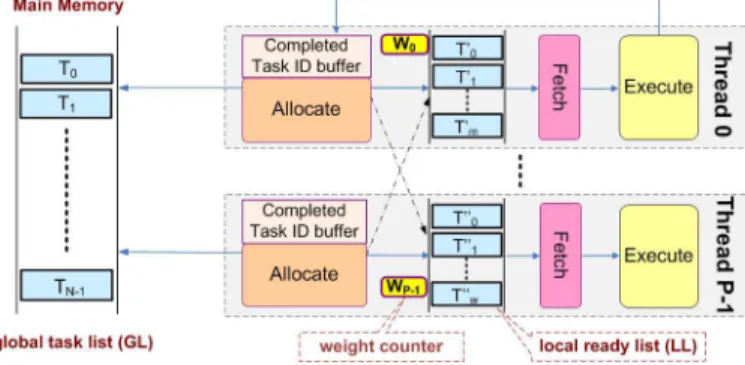
We modularize the collaborative scheduling method and show the compo-nents in Figure 1.1, where each thread host a scheduler consisting of several modules. The input task dependency graph is shared to all threads. The task dependency graph is represented by a list called theglobal task list (GL) on the left-hand side of Figure 1.1, which is accessed by all the threads shown on the right-hand side. Unlike the global task list, the other modules are hosted by each thread.
FIGURE 1.1: Components of the collaborative scheduler.
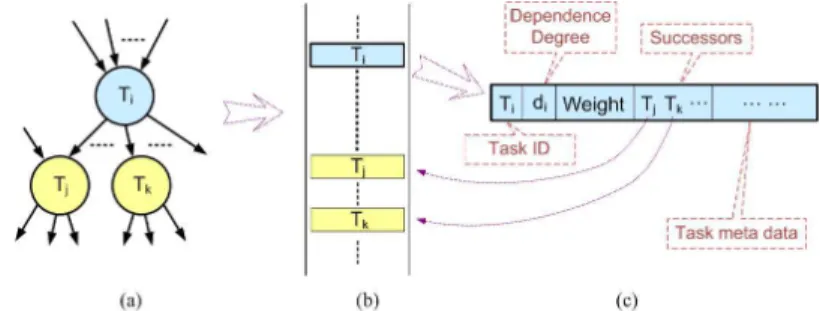
Theglobal task list (GL) represents the given task dependency graph. Fig-ure 1.2(a) shows a portion of the task dependency graph. FigFig-ure 1.2(b) shows the corresponding part of the GL. As shown in Figure 1.2(c), each element in the GL consists of task ID, dependency degree, task weight, successors and the task meta data (e.g. application specific parameters). Thetask ID is the unique identity of a task. Thedependency degree of a task is initially set as the number of incoming edges of the task. During the scheduling process, we decrease the dependency degree of a task once a predecessor of the task is pro-cessed. Thetask weight is the estimated execution time of the task. We keep the task IDs of thesuccessors along with each task to preserve the precedence constraints of the task dependency graph. When we process a taskTi, we can locate its successors directly using the successor IDs, instead of transversing the global task list. In each element, there istask meta data, such as the task type and pointers to the data buffer of the task, etc. The GL is shared by all the threads and we use locks to protect dependency degreedi, 0≤i < N.
Every thread has a Completed Task ID buffer and an Allocate module (Figure 1.1). The Completed Task ID buffer in each thread stores the IDs of tasks that are processed by the thread. Initially, all the Completed Task ID buffers are empty. During scheduling, when a thread completes the execution
of an assigned task, the ID of the task is inserted into the Completed Task ID buffer in that thread. For each task in the Completed Task ID buffer, the Allocate module decrements the task dependency degree of the successors of the task. For example, if the ID ofTi in Figure 1.2 was fetched by Threadl from the Completed Task ID buffer, then Threadllocates the successors ofTi and decreases their task dependency degrees. If the task dependency degree of a successor Tj, becomes 0, the Allocate module allocatesTj to a thread. Heuristics can be used in task allocation to balance the workload across the threads. Our framework permits plug-and-play insertion of such modules. In this section, we allocate a task to the thread with the smallest workload at the time of completion of the task execution.
The local task list (LL) in each thread stores the tasks allocated to the thread. For load balance, the Allocate module of a thread can allocate tasks to any thread. Thus, the LLs are actuallyshared by all threads. Each LL has a weight counter associated with it to record the total workload of the tasks currently in the LL. Once a task is inserted into (or fetched from) the LL, the weight counter is updated.
The Fetch module takes a task from the LL and sends it to the Execute module in the same thread for execution. Heuristics can be used by the Fetch module to select tasks from the LL. For example, tasks with more children can have higher priority for execution [15]. In this paper, we use a straightforward method, where the task at the head of the LL is selected by the Fetch module. Once the execution of the task is completed, the Execute module sends the ID of the task to the Completed Task ID buffer, so that the Allocate module can accordingly decrease the dependency degree of the successors of the task. We emphasize that Figures 1.1 shows the framework of collaborative scheduling, where various heuristics can be used for the components. For ex-ample, genetic algorithms or randomization techniques can be used for the Allocate and Fetch modules [15]. In this paper, we focus on the reduction of overhead of collaborative scheduling with respect to straightforward imple-mentations of the components.
FIGURE 1.2: (a) A portion of a task dependency graph. (b) The corre-sponding representation of the global task list (GL). (c) The data of element
1.4.2
An Implementation of Collaborative Scheduler
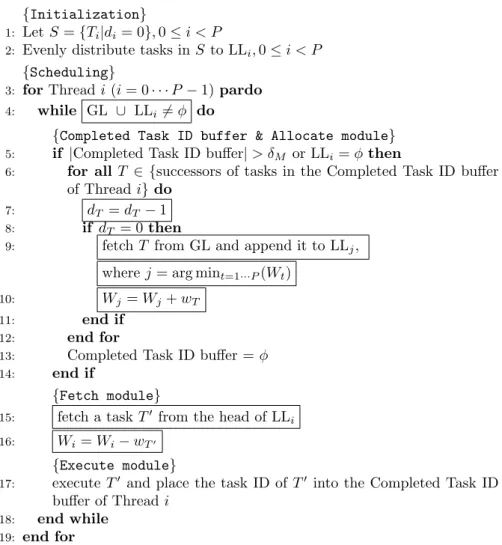
Based on the framework of collaborative scheduling in Section 1.4.1, we present a sample implementation of collaborative scheduling in Algorithm 1.3. We use the following notations in the algorithm: GL denotes the global task list. LLi denotes the local task list in Threadi, 0≤i < P.dT andwT denote the dependency degree and the weight of taskT, respectively.Wiis the weight counter of Thread i, i.e. the total weight (estimated execution time) of the tasks currently in LLi.δM is a given threshold. The statements in boxes involve shared variable accesses.
Lines 1 and 2 in Algorithm 1.3 initialize the local task lists. In Lines 3-19, the algorithm performs task scheduling iteratively until all the tasks are processed. Lines 5-14 correspond to the Allocate module, where the algorithm decreases the dependency degree of the successors of tasks in the Completed Task ID buffer (Line 7), then allocates the successors with dependency degree equal to 0 into a target thread (Line 9). Line 5 determines when the Allocate module should work. When the number of tasks in the Completed Task ID buffer is greater than the threshold δM, the Allocate module fetches tasks from the GL. The motivation is that accessing the shared GL less frequently can reduce the lock overhead. We choose the target thread as the one with the smallest workload (Line 9), although alternative heuristics can be used. Line 15 corresponds to the Fetch module, where we fetch a task from the head of the local task list. Line 16 updatesWi according to the fetched task. Finally, in Line 17,T′ is executed in the Execute module, and its ID is placed
into the Completed Task ID buffer.
Due to the collaboration among threads (Line 9), all local task lists and weight counters are sharedby all threads. Thus, in addition to the GL, we must avoid concurrent write to LLi and Wi, 0 ≤i < P, in Lines 9, 10, 15, and 16.
1.4.3
Lock-free Data Structures
In Algorithm 1.3, collaboration among the threads requires locks for the weight counters and local task lists to avoid concurrent writes. For example, without locks, multiple threads can concurrently insert tasks into local task list LLj, for somej, 0≤j < P (Line 9, Algorithm 1.3). In such a scenario, the tasks inserted by a thread can be overwritten by those inserted by another thread. Similarly, without locks, data race can occur to weight counter Wj (Line 10, Algorithm 1.3). Therefore, locks must be used for weight counters and local task lists. Locks serialize the execution and incur increasing over-heads asP increases. Thus, we focus on eliminating the locks for local task lists and weight counters.
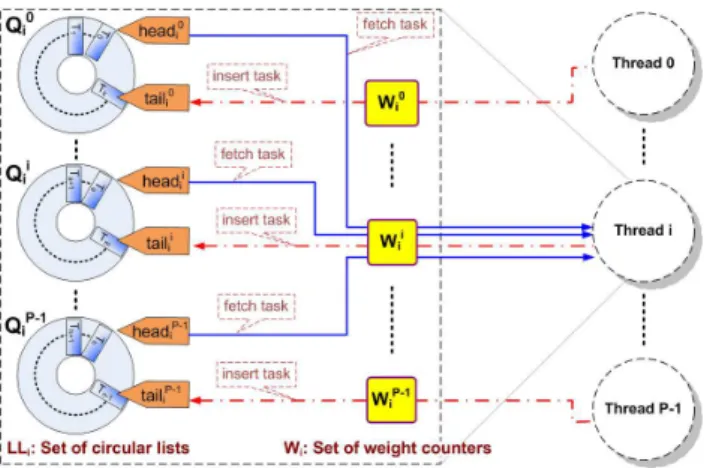
We propose a lock-free organization for the local task lists and weight counters. We substitute P weight counters for each original weight counter and P circular lists for each local task list, so that each weight counter or
{Initialization}
1: LetS={Ti|di= 0},0≤i < P
2: Evenly distribute tasks inS to LLi,0≤i < P
{Scheduling}
3: forThreadi (i= 0· · ·P−1) pardo 4: while GL ∪ LLi6=φ do
{Completed Task ID buffer & Allocate module}
5: if |Completed Task ID buffer|> δM or LLi=φthen
6: for all T ∈ {successors of tasks in the Completed Task ID buffer of Threadi}do
7: dT =dT −1
8: if dT = 0then
9: fetchT from GL and append it to LLj, wherej= arg mint=1···P(Wt)
10: Wj =Wj+wT
11: end if
12: end for
13: Completed Task ID buffer =φ
14: end if
{Fetch module}
15: fetch a taskT′ from the head of LLi
16: Wi=Wi−wT′
{Execute module}
17: executeT′ and place the task ID ofT′ into the Completed Task ID
buffer of Threadi 18: end while
19: end for
circular list is updatedexclusivelyduring scheduling. Thus, there areP2
lock-free weight counters andP2lock-free circular lists. The lock-free organization
is shown in Figure 1.4, where the dashed box on the left-hand side shows the organization of local task list LLi and weight counterWi in Threadifor some i, 0 ≤i < P; the dashed circles on the right-hand side represent the
P threads. Although there are more queues and counters than the shown in Figure 1.1, this organization does not stress the memory. Each queue can be maintained by three variables only: head, tail and counter. If each variable is an integer, then the total size of these variables is less than 1 KB, which is negligible compared with the cache size of almost all multicore platforms.
The lock-free local task list in Thread i, 0 ≤ i < P, denoted by LLi, consists ofP circular listsQ0
i, Q1i,· · ·, Q P−1
i . Thej-th circular list Q j i, 0 ≤
j < P, corresponds to thej-th portion of LLi. Each circular list Qji has two pointers, headji and tailij, pointing to the first and last task, respectively. Tasks are fetched from (inserted into)Qji at the location pointed to byhead
j i (tailji).
The solid arrows in Figure 1.4 connect the heads of the circular lists in LLi to Threadi, which shows that Thread i can fetch tasks from the head ofany circular list in LLi. Corresponding to Line 15 of Algorithm 1.3, we let Thread i fetch tasks from the circular lists in LLi in a round robin fashion. The dash-dotted arrows connecting Threadj, 0 ≤ j < P, to the tail of Qji imply that Threadj allocates tasks to LLi by inserting the tasks at the tail of circular listQji. IfQji is full, Threadjinserts tasks intoQjk, 0≤k < P and
k6=i, in a round robin fashion. According to Figure 1.4, each head or tail is updated by one thread only.
We use P weight counters in Threadi to trackWi, the workload of LLi. TheP weight counters are denotedWi0, Wi1, · · ·, W
P−1
i in Figure 1.4, and
Wi is given by Wi =PPj=0−1Wij. Note that all the solid arrows pass through weight counterWi
i in Figure 1.4, which means that Threadimust updateWii when it fetches a task fromany circular list. The dash-dotted arrow passing through Wij for some j, 0 ≤ j < P, indicates that Thread j must update
Wij when it inserts a task intoQ j
i. Note that the value ofW j
i isnot the total weight of tasks inQji. Therefore, each weight counter is updated by one thread only during scheduling.
1.4.4
Correctness
When a thread is writing data to shared variables, e.g., the weight counters, the head and tail of the circular lists, another thread may read stale values of these shared variables if we eliminate locks. However, such a stale value does not impact thecorrectness. By correctness, we mean that all the precedence constraints are satisfied and each of the tasks in the DAG is scheduled onto some thread.
FIGURE 1.4: Lock-free organization of local task list (LLi) and a set of weight counters in Threadiand their interaction with respect to each thread. satisfied because of the locks for the global task list (GL). For each task T
in the GL, the task dependency degree dT is protected by a lock to avoid concurrent write. Thus, according to Lines 7 and 8 in Algorithm 1.3, T can be allocated only if all the precedence tasks ofT are processed. Therefore, the precedence constraints are satisfied regardless of potentially stale values.
When a stale value of a weight counterWij is read by a thread, an error is introduced into the workload estimate for LLi, i.e.Wi=PPj=0−1Wij. Due to the inaccurate workload estimate, the thread may allocate a new task to a different thread, compared with the case for which the exact workload is known. This does not affect the correctness, but may lead to an unbalanced load. However, since the weight counters are checked in every iteration of scheduling (Lines 4-18, Algorithm 1.3), the updated value is taken into consideration in the next iteration of some thread. Therefore, except for temporal influence on load balance, the stale values of the weight counters have no impact on correctness.
We analyze the impact of the stale value ofheadi
j, 0≤i, j < P, by consid-ering Line 9 in Algorithm 1.3, where Threadiallocates taskT to Threadjby appendingT to LLj. To appendT to the lock-free local task list LLj, Threadi
first checks if Qij is full. If not,T is appended at tailij in Qij. A circular list
Qi
j is full if and only if headij = tailij+ 1. Consider the following scenario: Assume Qi
j is full and Threadj fetches a task fromQij. Then, Thread j up-dates headi
j and Thread i allocates task T to Thread j. In such a scenario,
T can be appended toQi
j, since Thread jhas taken a task away. However, if Threadireads the stale value ofheadi
j, thenQijstill appears to be full. Thus, Thread i finds another circular listQi
k, k 6=j, in a round robin fashion, for task allocation, whereQi
k is not full. Therefore, the stale value ofheadij does not affect the correctness, but may lead to an unbalanced load.
by considering Line 15 in Algorithm 1.3, where Threadifetches taskT′ from
LLi. To fetch a task from a lock-free local task list LLi, Thread ifirst checks ifQji is empty, wherej is chosen in a round robin fashion. If not empty, the task at headji in Q
j
i is fetched. Otherwise, Thread i fetches a task from the next nonempty circular list in LLi. Consider the following scenario: Assume
Qji is empty and Thread j appends task T′ to Qj
i. Then, Thread j updates
tailji and Thread ifetches a task from Qji. In such a scenario, Thread ican fetch a task from Qji, since Thread j has inserted T′ into Q
j
i. However, if Thread i reads the stale value of tailji, then Q
j
i still appears to be empty. Thus, Threadj fetches a task from another circular list. The updated value of tailji can be read in the next iteration of scheduling. Then Thread j can fetchT′ for execution. Therefore, the stale value oftailj
i does not affect the correctness.
1.4.5
Experiments
We conducted experiments on three state-of-the-art homogeneous multi-core systems: (1) The dual Intel Xeon 5335 (Clovertown) quadmulti-core platform contained two Intel Xeon x86 64 E5335 processors, each having four cores. The processors ran at 2.00 GHz with 4 MB L2 cache each and 16 GB DDR2 shared memory. The operating system was Red Hat Enterprise Linux WS Release 4 (Nahant Update 7). We installed GCC version 4.1.2 compiler with streaming SIMD extensions 3 (SSE 3), also known as Prescott New Instructions. (2) The dual AMD Opteron 2335 (Barcelona) quadcore platform had dual AMD Opteron x86 64 2350 quadcore processors, running at 2.0 GHz. The system had 16 GB DDR2 memory, shared by all the cores, and the operating sys-tem was CentOS version 5 Linux. We also used the GCC 4.1.2 compiler on this platform. (3) The quad AMD Opteron 8358 (Barcelona) quadcore plat-form had four AMD Opteron x86 64 8358 quadcore processors, running at 1.2 GHz. The system had 64 GB shared memory and the operating system was Red Hat Enterprise Linux Server Release 5.3 (Tikanga). We also used GCC 4.1.2 compiler on this platform.
1.4.5.1 Baseline Schedulers
To evaluate the proposed method, we implemented six baseline methods and compared them along with the proposed one using the same input task dependency graphs on various multicore platforms.
(1) Centralized scheduling with shared core (Cent shared): This schedul-ing method consisted of ascheduler thread and severalexecution threads. Each execution thread was bound to a core, while the scheduler thread can be ex-ecuted on any of these cores. In this scheduling method, the input DAG was local to the scheduler thread. Each execution thread has a ready task list shared with the scheduler thread. In addition, there was a Completed Task ID buffer shared by all the threads. The scheduler thread was in charge of
all the activities related to scheduling, including updating task dependency degrees, fetching ready-to-execute tasks and evenly distributing tasks to the ready task lists. Each execution thread fetched tasks from its ready task list for execution. The IDs of completed tasks were inserted into the Completed Task ID buffer, so that the scheduler thread can fetch new ready-to-execute tasks from the successors of tasks in the Completed Task ID buffer. After a given number (i.e.δM in Algorithm 1.3) of tasks in the ready task list were processed, the execution thread invoked the scheduler thread and then went to sleep. When a task was allocated to the ready task list of a sleeping thread, the scheduler invoked the corresponding execution thread. Spinlocks were used for the ready task lists and Completed Task ID buffer.
(2) Centralized scheduling with dedicated core (Cent ded): This schedul-ing method was adapted from the centralized schedulschedul-ing with shared core. The only difference is that a core was dedicated to the scheduler thread, i.e., each thread was bound to a separate core. Similar toCent shared, the input DAG waslocal to the scheduler. Each execution thread had a ready task listshared with the scheduler thread. There was a Completed Task ID buffershared by all the threads. The scheduler thread was also in charge of all the activities related to scheduling and the execution threads executed assigned tasks only. Spinlocks were used for the ready task lists and Completed Task ID buffer.
(3) Distributed scheduling with shared ready task list (Dist shared): In this method, we distributed the scheduling activities across the threads. This method had ashared global task list and asharedready task list. Each thread had a local Completed Task ID buffer. The schedulers integrated into each thread fetched ready-to-execute tasks from the global task list, and inserted the tasks into the shared ready task list. If the ready task list was not empty, each thread fetched tasks from the ready task list for execution. Each thread inserted the IDs of completed tasks into its Completed Task ID buffer. Then, the scheduler in each thread updated the dependency degree of the successors of tasks in the Completed Task ID buffer, and fetched the tasks with depen-dency degree equal to 0 for allocation. Pthreads spinlocks were used for the global task list and the ready task list.
(4) Collaborative scheduling withlock-based local task list (ColSch lock): This was the collaborative scheduling (Section 1.4.1) without any optimization discussed in Section 1.4.3. Rather than using the lock-free data structures, we used mutex locks to avoid concurrent write to the local task lists and weight counters. Spinlocks were used to protect task dependency degrees in the shared global task list.
(5) Collaborative scheduling with lock-free local task list (ColSch lockfree): This wasnot a baseline, but the proposed method (Section 1.4.3) with lock-free weight counters and local task lists (Section 1.4.3). We used spinlocks to protect task dependency degrees in the shared global task list.
(6) DAG Scheduling using the Cilk (Cilk): This baseline scheduler per-formed work stealing based scheduling using the Cilk runtime system. Unlike the above scheduling methods where we bound a thread to a core of a
mul-ticore processor and allocated tasks to the threads, we dynamically created a thread for each ready-to-execute task and then let the Cilk runtime system to schedule the threads onto cores. Although Cilk can generate a DAG dynami-cally, we used a given task dependency graph stored in ashared global list for the sake of fair comparison. Once a task completed, the corresponding thread reduced the dependency degree of the successors of the task and created new threads for the successors with resulting dependency degree equal to 0. We used spinlocks for the dependency degrees to prevent concurrent write.
(7) Our implementation ofwork stealing based scheduler (Stealing): Al-though the above baselineCilk is also a work stealing scheduler, it used the Cilk runtime system to schedule the threads, each corresponding to a task. On the one hand, the Cilk runtime system has various additional optimiza-tions; on the other hand, scheduling the threads onto cores incurs overhead due to context switching. Therefore, for the sake of fair comparison, we imple-mented theStealingbaseline; we distributed the scheduling activities across the threads, each having a shared ready task list. The global task list was sharedby all the threads. If the ready task list of a thread was not empty, the thread fetched a task from it at the top for execution and upon completion updated the dependency degree of the successors of the task. Tasks with de-pendency degree equal to 0 were placed into the top of its ready task list by the thread. When a thread ran out of tasks to execute, it randomly chose a ready list to steal a task from its bottom, unless all tasks were completed. The data for randomization were generated offline to reduce possible overhead due to a random number generator. Pthreads spinlocks were used for the ready task lists and global task list.
1.4.5.2 Datasets and Task Types
We used both synthetic and real datasets to evaluate the proposed schedul-ing methods. We built a task dependency graph for exact inference in a Bayesian network used by a real application called QuickMedical Reference decision theoretic version (QMR-DT), a microcomputer-based decision sup-port tool for diagnosis in internal medicine [14]. There were 1000 nodes in this network of two layers, one representing diseases and the other symptoms. Each disease has one or more edges pointing to the corresponding symptoms. All random variables (nodes) were binary. The resulting task dependency graph for exact inference had 228 tasks, each corresponding to a series of computa-tions called node level primitives. These primitives consist of addition, mul-tiplication and division operations among single precision floating point data in one or two tables [23]. Given the number of random variables involved in each task and the number of states of the random variables, denoted byWc andr, respectively, the table size is 4rWc bytes. Each table entry was a 4-byte
single precision floating point data. In this dataset,r was 2 and the average value for Wc was 10. The average number of successors d for each task was also 2. The task weights were estimated usingWc,r andd(see [23]).
We used extensive synthetic datasets to investigate the impact of various parameters of task dependency graphs on the scheduling performance. Our graph generator synthesized DAGs to simulate the structure of programs: Each node represented a code segment. The edges showed the data dependency between the code segments. We assumed that the loops in a program must either be inside a code segment or unrolled. LetN denote the number of nodes in the DAG anddthe average node degree. Letα0, α1,· · · , αN−1 denote the
nodes. We started with an empty set of edges. When nodeαi was visited, the generator spawnedmax(0, (d−din+δ)) outgoing edges forαi, wheredinis the number of incoming edges andδ∈(⌊−d/2⌋,⌈d/2⌉) is a random integer. The outgoing edges were connected to nodes selected randomly fromαi+1toαN−1:
The probability thatαj , i < j < N,was selected isP(αi→αj) =e−1/(j−i). That is, for a given nodeαi, the nodes close to αi had higher probability of selection. Finally, all the nodes with no parent, except forα0, were connected
toα0. We generated DAGs with 10000 nodes. The average degree of the nodes
was 8. The threshold for the Task ID bufferδM was 5.
We experimented with three types of tasks foreach node of the generated DAGs in our experiments: (1)Dummy task: Dummy task was actually a timer, which allowed us to assign the execution time of a task. Dummy tasks also helped us analyze the scheduling overhead, since we could easily calculate the task execution time. (2)Computation intensive task: This simulated a number of real tasks. We performed matrix multiplicationY =XTX, whereX was a 256×256 matrix. (3)Memory access intensive task: This simulated another common type of real task, which performed irregular memory access. In our experiments, we updated each element x[i] of an array with 128k entries by performingx[i] =x[y[i]], wherey was an index array forx.
1.4.5.3 Experimental Results
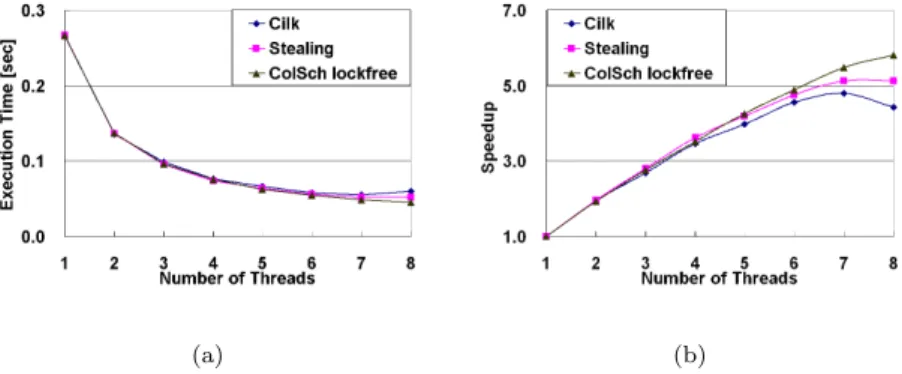
We first compared the proposed scheduling method (i.e. ColSch lockfree) with the two work stealing based methodsStealingandCilk us-ing the task dependency graph for exact inference in the QMR-DT Bayesian network on the platform with dual AMD Opteron 2335 quadcore processors. In each comparison, the input task dependency graphs were identical for all the methods. In Figure 1.5(a), we show the execution time for scheduling ex-act inference using the task dependency graph. The corresponding speedup is shown in Figure 1.5(b). According to Figure 1.5(a), when the number of threads is less than four, almost no difference in execution time can be ob-served. However, as the number of threads increases, we can observe that the proposed method led to less execution time than the two baseline methods. The difference is clear in Figure 1.5(b), where we converted the execution time into speedup. A reason for the difference in the speedups is that the proposed scheduling method balanced the workload across the threads according to the task weights. However, both the baseline methods did not consider the task weights. Instead, they stole tasks from other threads to feed the underutilized
threads. Since the DAG had 228 nodes and the number of threads was 8, the number of tasks per thread was 28.5 on the average. Thus, the number of available tasks for stealing at a particular time was even less. In this scenario, there is no guarantee for work stealing to achieve load balance across the threads. Note that, although the results of Stealing andCilk were similar in Figure 1.5(b), the performance ofStealingwas slightly better thanCilk. One reason for the performance difference was the overhead due to thread creation and the context switch. For Cilk, we dynamically created threads for the tasks. This incurs thread creation overheads. In addition, we let the runtime system to swap the threads in the cores, which resulted in context switch overhead. However, for the other methods, we bound the threads to separate cores and allocated tasks to the threads in user space, where no thread creation or swap in/out occurred.
(a) (b)
FIGURE 1.5: Comparison of the proposed scheduler with work stealing based schedulers.
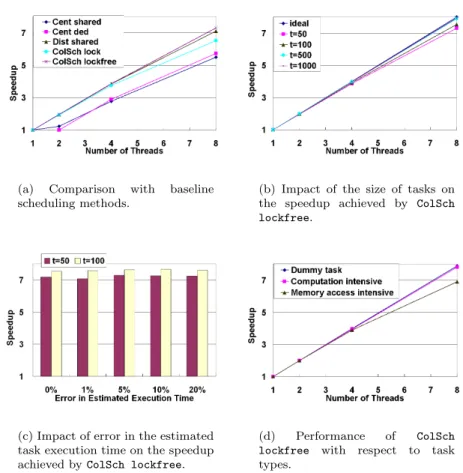
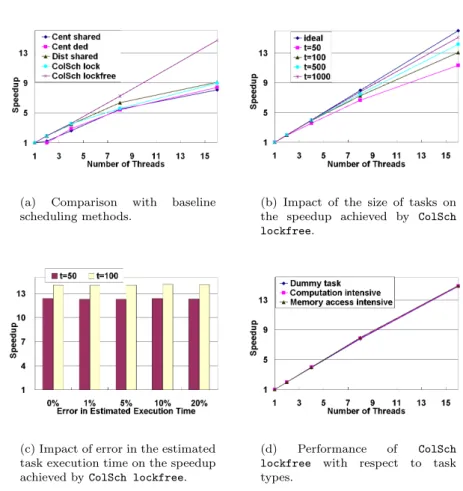
We conducted the followingfour experiments using synthetic datasets on multicore platforms to investigate the impact of various parameters of in-put task dependency graphs on scheduling performance. The first experiment compared the proposed scheduling method and various baseline methods. We used our graph generator to construct a DAG with 10000 nodes, where each node was assigned a dummy task taking 50 microseconds. We executed the DAG using the five task sharing scheduling methods on a dual Intel Xeon 5335 (Clovertown) quadcore platform and a quad AMD Opteron 8358 (Barcelona) quadcore platform, where up to 8 and 16 concurrent threads were supported, respectively. Given various available threads, we measured the overall execu-tion time on both platforms and converted it into speedups in Figures 1.6(a) and 1.7(a), where the speedup is defined as the serial execution time over parallel execution time.
The second experiment investigated the overhead due to the proposed lock-free collaborative scheduling method with respect to the number of threads
(a) Comparison with baseline scheduling methods.
(b) Impact of the size of tasks on the speedup achieved by ColSch lockfree.
(c) Impact of error in the estimated task execution time on the speedup achieved byColSch lockfree.
(d) Performance of ColSch lockfree with respect to task types.
FIGURE 1.6: Experimental results on dual Intel Xeon 5335 (Clovertown) quadcore platform.
and task size on various platforms. As in the above experiment, we used a DAG with 10000 nodes and dummy tasks. However, we varied the time delay for each dummy task. We show the ideal speedup and the experimental results with dummy tasks taking 50, 100, 500 and 1000 microseconds in Figures 1.6(b) and 1.7(b).
The third experiment showed the impact of the error in the estimated task execution time. We again used a DAG with 10000 dummy task nodes. However, instead of using the real execution time as the task weight, we used estimated execution time with errors. Let t denote the real task execution time andt′ the estimated execution time. The real task execution time twas
randomly selected from range ((1−r/100)t′, (1 +r/100)t′), where r is the absolute percentage error in estimated task execution time. We conducted ex-periments withr= 0,1,5,10,20 and show the results Figures 1.6(c) and 1.7(c).
(a) Comparison with baseline scheduling methods.
(b) Impact of the size of tasks on the speedup achieved by ColSch lockfree.
(c) Impact of error in the estimated task execution time on the speedup achieved byColSch lockfree.
(d) Performance of ColSch lockfree with respect to task types.
FIGURE 1.7: Experimental results on quad AMD Opteron 8358 (Barcelona) quadcore platform.
Note that the definition of speedup in the above two figures is the serial exe-cution time over 8-thread parallel exeexe-cution time.
The last experiment examined the impact of task types. We used the lock-free collaborative scheduler to schedule a DAG with 10000 tasks. In the ex-periments, we used dummy tasks, computation intensive tasks and memory access intensive tasks, discussed in Section 1.4.5.2. The results are shown in Figures 1.6(d) and 1.7(d).
According to Figures 1.6 and 1.7, the proposed method showed superior performance compared with baseline methods on various platforms as number of cores increased. For example, in Figure 1.7(a), when 16 cores were used, the speedup achieved by our method (15.12×) was significantly higher than others methods (up to 8.77×). This was because more cores lead to higher conflict in accessing the task lists. The proposed method allowed such
con-current access, but the baseline methods serialized the accesses. The baseline
Cent shared showed relatively low performance due to the overhead of fre-quent context switch between the scheduler thread and the execution thread.
Cent dedalso showed limited speedup, since the computing capability of the core dedicated to the scheduler thread was not used efficiently. The proposed method exhibited good scalability for various task weights. The speedups were close to the ideal speedup for large task weights. The results showed that our technique was tolerant to the error in estimation of task weights. This was because the errors in estimation of task weights can counteract each other. In addition, we observed that the scheduling overhead was less than 1% for the proposed method in all the experiments. Finally, the proposed method achieved almost linear speedup for tasks of various types, including compu-tation intensive tasks and memory access intensive tasks, which implied that the proposed scheduler can work well in real life scenarios.
1.5
Hierarchical
Scheduling
with
Dynamic
Thread
Grouping
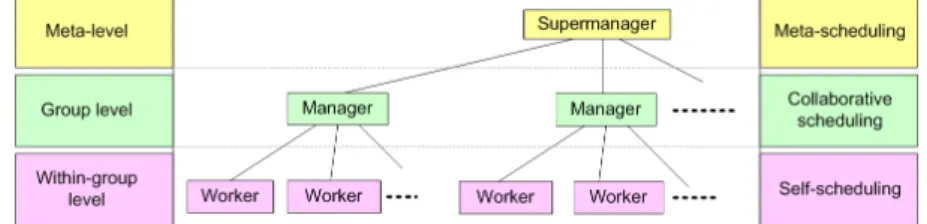
In order to improve scheduling performance on manycore processors, we propose a hierarchical scheduling method with dynamic thread grouping, which schedules DAG structured computations at three different levels. At the top level, a supermanager separates threads into groups, each consisting of a manager thread and several worker threads. The supermanager dynami-cally merges and partitions the groups to adapt the scheduler to the input task dependency graphs. Through group merging and partitioning, the proposed scheduler can dynamically adjust to become a centralized scheduler, a dis-tributed scheduler or somewhere in between, depending on the input graph. At the group level, managers collaboratively schedule tasks for their work-ers. At the within-group level, workers perform self-scheduling within their respective groups and execute tasks.
1.5.1
Organization
We illustrate the components of the hierarchical scheduler in Figure 1.8. The boxes with rounded corners represent thread groups. Each group consists of amanager thread and several worker threads. The manager in Group0 is
also the supermanager. The components inside of a box are private to the group; while the components out of the boxes are shared by all groups.
The representation of theglobal list (GL) is discussed in Chapter 1.4.1 (see Figure 1.1). Theglobal ready list (GRL) in Figure 1.8 stores the IDs of tasks with dependency degree equal to 0. These tasks are ready to be executed.
During the scheduling process, a task is put into this list by a manager thread once the dependency degree of the task becomes to 0.
FIGURE 1.8: Components of the hierarchical scheduler.
Thelocal ready list(LRL) in each group stores the IDs of tasks allocated to the group by the manager of the group. The workers in the group fetch tasks from LRL for execution. Each LRL is associated with a workload indicator (WI) to record the overall workload of the tasks currently in the LRL. Once a task is inserted into (or fetched from) the LRL, the indicator is updated.
Thelocal completed task list (LCL) in each group stores the IDs of tasks completed by a worker thread in the group. The list is read by the manager thread in the group for decreasing the dependency degree of the successors of the tasks in the list.
The arrows in Figure 1.8 illustrate how each thread accesses a component (read or write). As we can see, GL and GRL are shared by all the managers for both read and write. For each group, the LRL is write-only for the manager and read-only for the workers; while LCL is write-only for the workers and read-only for the manager. WI is local to the manager in the respective group only.
1.5.2
Dynamic Thread Grouping
The scheduler organization shown in Figure 1.8 supports dynamic thread grouping, which means that the number of threads in a group can be adjusted at runtime. We adjust groups by either merging two groups or partitioning a group. The proposed organization ensures efficient group merging and parti-tioning.
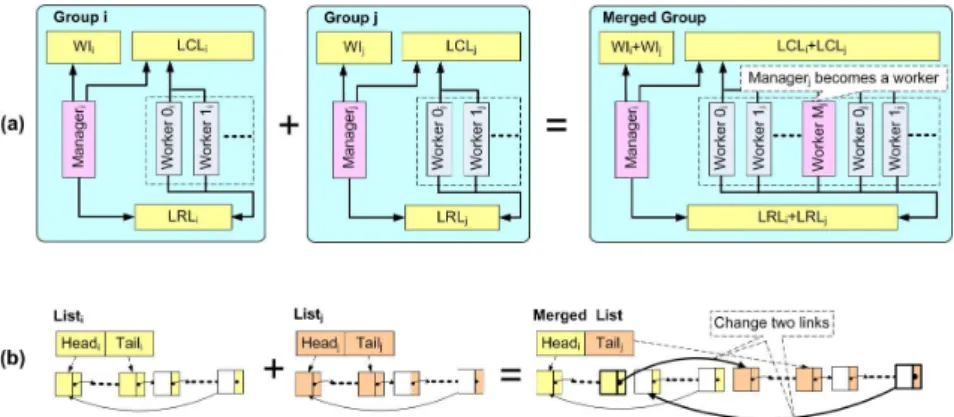
Figure 1.9(a) illustrates the merging of Groupi and Groupj, i < j. The two groups are merged by converting all threads of Groupj into the workers of Groupiand merging WIs, LCLs and LRLs accordingly. Converting threads
of Groupj into the workers of Groupi is straightforward: M anagerj stops allocating tasks to Groupj, but performs self-scheduling as a worker thread. Then, all the threads in Groupj access tasks from the merged LRL and LCL. To combineW Ii and W Ij, we add the value ofW Ij to W Ii. AlthoughW Ij is not used after merging, we still keep it updated for the sake of possible future group partitioning. Merging the lists i.e. LCLs and LRLs is efficient. Note that both LCL and LRL are circular lists, each having a head and a tail pointer to indicate the first and last tasks stored in the list, respectively. Figure 1.9(b) illustrates the approach to merge two circular lists. We need to update two links only, i.e. the bold arrows shown in Figure 1.9(b). None of the tasks stored in the lists are moved or duplicated. The head and tail of the merged list areHeadi and T ailj, respectively. Note that two merged groups can be further merged into a larger group.
We summarize the procedure in Algorithm 1.10. Since the queues and weight indicators are shared by several threads, locks must be used to avoid concurrent write. For example, we lockLRLi and LRLj immediately before Line 1 and unlock them after Line 3. Algorithm 1.12 does not explicitly assign the threads in Groupiand Groupjto Groupk, since this algorithm is executed only by the supermanager. Each thread dynamically updates its group infor-mation and decides if it should be a manager or worker (see Algorithm 1.12).
FIGURE 1.9: (a) Merge Groupi and Groupj. (b) Merge circular lists Listi and Listj. The head (tail) points to the first (last) tasks stored in the list. The blank elements have no task stored yet.
Groupiand Groupjcan be restored from the merged group by partitioning. As a reverse process of group merging, group partitioning is also straightfor-ward and efficient. Due to space limitations, we do not elaborate it here. Group merging and partitioning can be used for groups with an arbitrary number of threads. We assume the number of threads per group is a power of two hereinafter for the sake of simplicity.
Input: Groupi and Groupj.
Output: Groupk = Groupi + Groupj
{Merge LRLi and LRLj}
1: LetLRLj.Head.P redecessor points toLRLi.T ail.Successor
2: LetLRLi.T ail.Successor points toLRLj.Head
3: LRLk.Head=LRLi.Head,LRLk.T ail=LRLj.T ail
{Merge LCLi and LCLj}
4: LetLCLj.Head.P redecessor points to LCLi.T ail.Successor
5: LetLCLi.T ail.Successor points toLCLj.Head
6: LCLk.Head=LCLi.Head,LCLk.T ail=LCLj.T ail
{Merge W Ii and W Ij}
7: W Ik=W Ii+W Ij
FIGURE 1.10: Group merge
1.5.3
Hierarchical Scheduling
Using the proposed data organization, we schedule a given DAG structured computation at three levels. The top level is called themeta-level, where we have a supermanager to control group merging/partitioning. At this level, we are not scheduling tasks directly, but reconfiguring the scheduler according to the characteristics of the input tasks. Such a process is calledmeta-scheduling. The supermanager is hosted along with the manager of Group0 by Thread0.
Note thatM anager0can never become a worker as discussed in Section 1.5.2.
The mediate level is called the group level, where the manager in each group collaborates with each other and allocates tasks for the workers in the group. The purpose of collaborating between managers is to improve the load balance across the groups. Specifically, the managers ensure that the workload in the local ready lists is roughly equal for all groups. A manager is hosted by the first thread in a group.
The bottom level is called the within-group level, where the workers in each group perform self-scheduling. That is, once a worker finishes a task execution and updates LCL in its group, it fetches a new task, if any, from LRL immediately. Self-scheduling keeps all workers busy, unless the LRL is empty. Each worker is hosted by a separate thread.
FIGURE 1.11: The hierarchical relationship between the supermanager, managers and workers, and the corresponding scheduling schemes.
The hierarchical scheduler behaves between centralized and distributed schedulers, so that it can adapt to the input task graph. Note that each group consists of a manager thread and several worker threads. When all the groups are merged into a single group, the proposed method becomes a centralized scheduler; when multiple groups exist, the proposed method behaves as a distributed scheduler.
1.5.4
Scheduling Algorithm and Analysis
We propose a sample implementation of the hierarchical scheduler pre-sented in Section 1.5.3. Based on the organization shown in Section 1.5.1, we use the following notations to describe the implementation: Assume there are P threads, each bound to a core. The threads are divided into groups consisting of a manager and several workers.GLandGRLdenote the global task list and global ready list, respectively.LRLi andLCLi denote the local ready list and local completed task list of Groupi, 0 ≤ i < P. dT and wT represent the dependency degree and the weight of taskT, respectively.W Ii is the workload indicator of Threadi. Parameters δM, δ+ and δ− are given
thresholds. The boxes show the statements that access variables shared by all groups.
Algorithm 1.12 illustrates the framework of the hierarchical scheduler. In Lines 1-3, thread groups are initialized, each with a manager and a worker, along with a set of ready-to-execute tasks stored inLRLj, where the overall task weight is recorded in W Ij. A boolean flag fexit in Line 3 notifies if the threads can exit the scheduling iteration (Lines 5-15).rank controls the size of groups: Increasingrankleads to merging of two adjacent groups; while decreasingrankleads to partitioning of current groups.rank= 1 corresponds to the minimum group size i.e. two threads per group. Thus, we have 1 ≤
rank≤logP. The group sizeQis therefore given by:
Q= P
2logP−rank = 2
rank (1.1)
Line 4 in Algorithm 1.12 starts all the threads in parallel. The threads perform various scheduling schemes according to their thread IDs. The first thread in each group is a manager (Line 8). In addition, the first thread in Group0 i.e.
Thread 0 performs as the supermanager (Line 10). The rest of the threads are workers (Line 13). Given thread IDi, the corresponding group is⌊i/Q⌋.
Algorithm 1.13 shows the meta-scheduling method for the superman-ager. The algorithm consists of two parts: updating rank (Lines 1-2) and re-grouping (Lines 3-11). We use a heuristic to updaterank: Note that W Ij is the computational workload for Groupj. A large W Ij requires more work-ers for task execution.|LCLj| is the number of completed tasks anddis the average number of successive tasks. For each completed task, the manager reduces the dependency degree of the successive tasks and moves ready-to-execute tasks to LRLj. Thus, (|LCLj| ·d) represents the workload for the
Input: P threads; Task dependency graph stored inGL; ThresholdsδM,δ+
andδ−.
Output: Assign each task to a worker thread
{Initialization}
1: Groupj={Manager: Thread2j,Worker: Thread2j+1},j = 0,1,· · ·, P/2−1
2: Evenly distribute tasks {Ti|Ti ∈ GLanddi = 0} across LRLj, W Ij = P
T∈LRLjwT,∀j= 0,1,· · ·, P/2−1
3: fexit=false,rank= 1
{Scheduling}
4: forThreadi= 0,1,· · ·, P −1pardo 5: while fexit=false do
6: Q= 2rank
7: if i%Q= 0 then
{Manager thread}
8: Group level scheduling at Group⌊i/Q⌋ (Algorithm 1.14)
9: if i= 0then
{Supermanager thread}
10: Meta-level scheduling (Algorithm 1.13)
11: end if
12: else
{Worker thread}
13: Within-group level scheduling at Group⌊i/Q⌋ (Algorithm 1.15)
14: end if
15: end while 16: end for
17: if GL=∅thenfexit=true
FIGURE 1.12: A Sample Implementation of Hierarchical Scheduler
scheduler. A larger (|LCLj| ·d) requires more managers for task scheduling. In Line 1, the ratior tells us if we need more managers or more workers. If more workers are needed, we increase rank in Line 2. In this case, groups are merged to provide more workers per manager. Otherwise,rankdecreases. Line 2 also ensures thatrankis valid by checking the boundary values.d,δ+
and δ− are given as inputs. The re-grouping depends on the value ofrank.
Ifrank increases, two groups merge (Line 5); if rank decreases, the merged group is partitioned (Line 9). The two operators Merge(·) and Partition(·) are discussed in Section 1.5.2. Line 12 flipsfexit if no task remains in GL. This notifies all of the threads to terminate (Line 5 in Algorithm 1.13).
Algorithm 1.14 shows an iteration of the group level scheduling for man-agers. Each iteration consists of three parts: updatingW Ii(Lines 1-2 and 15), maintaining precedence relationship (Lines 3-8) and allocating tasks (Lines 9-14). Lines 3-8 check the successors of all tasks in LCLi in batch mode to
reduce synchronization overhead. Let m = 2rank−1 denote the number of workers per group. In the batch task allocation part (Lines 9-14), we first fetchmtasks fromGRL. Line 12 is an adaptive step of this algorithm. If the overall workload of themtasks is too light (P
T∈S′wT <∆W) or the current
tasks in LRLi is not enough to keep the workers busy (W Ii < δM), more tasks are fetched for the next iteration. This dynamically adjusts the work-load distribution and prevents possible starvation for any groups. In Line 10, the manager inspects a set of tasks and selectsm tasks with relatively more successors. This is a widely used heuristic for scheduling [15]. Several state-ments in Algorithm 1.14 are put into boxes, where the managers access shared components across the groups. Synchronization cost of these statements varies as the number of groups changes.
{Update rank}
1: r=PP/Qj=0(W Ij/(|LCLj| ·d)),rankold=rank
2: rank=
min(rank+ 1,logP), r > δ+
max(rank−1,1), r < δ−
{regrouping}
3: if rankold< rankthen
{Combine Groups}
4: forj= 0 toP/(2·Q)−1do
5: Groupj = Merge(Group2j, Group2j+1)
6: end for
7: else if rankold> rankthen
{Partition Group}
8: forj=P/Q−1 downto 0 do
9: (Group2j, Group2j+1) = Partition(Groupj)
10: end for 11: end if
FIGURE 1.13: Meta-Level Scheduling for Supermanager
The workers schedule tasks assigned by their manager (Algorithm 1.15). This algorithm is a straightforward self-scheduling scheme, where each idle worker fetches a task from LRLi and then puts the tasks into LCLi after execution. AlthoughLRLi andLCLi are shared by the manager and worker threads in the same group, no worker accesses any variables shared between groups.
1.5.5
Experiments
The Sun UltraSPARC T2 (Niagara 2) platform was a Sunfire T2000 server with a Sun UltraSPARC T2 multithreading processor [19]. UltraSPARC T2 has 8 hardware multithreading cores, each running at 1.4 GHz. In addition,
{Update workload indicator}
1: ∆W =PT˜∈LCLiwT˜
2: W Ii=W Ii−∆W
{Update precedence relations}
3: for allT ∈ {successors of ˜T , ∀T˜∈LCLi} do
4: dT =dT −1
5: if dT = 0then
6: GRL=GRL∪ {T};GL=GL\{T}
7: end if 8: end for
{Batch task allocation}
9: if LRLi is not fullthen
10: S′ ⇐fetchmtasks fromGRL, if any
11: if P
T∈S′wT <∆W orW Ii< δM then
12: Fetch more tasks fromGRL toS′, so thatP
T∈S′wT ≈∆W +δM 13: end if
14: LRLi=LRLi∪ {S′}
15: W Ii=W Ii+PT∈S′wT 16: end if
FIGURE 1.14: Group Level Scheduling for the Manager of Groupi
each core supports up to 8 hardware threads with 2 shared pipelines. Thus, there are 64 hardware threads. Each core has its own L1 cache shared by the threads within a core. The L2 cache size is 4 MB, shared by all hardware threads. The platform had 32 GB DDR2 memory shared by all the cores. The operating system was Sun Solaris 11 and we used Sun Studio CC with Level 4 optimization (-xO4) to compile the code.
1.5.5.1 Baseline Schedulers
To compare the performance of the proposed method, we performed DAG structured computations using Charm++ [7] Cilk [6] and OpenMP [17]. In ad-dition, we implementedthreetypical schedulers calledCent ded,Dist shared
and Steal, respectively. We evaluated the baseline methods along with the proposed scheduler using the same input task dependency graphs.
(a) Scheduling DAG structured computations using Charm++ (Charm++): Charm++ runtime system employs a phase-based dynamic load balancing scheme facilitated by virtualization, where the computation is monitored for load imbalance and computation objects (tasks) are migrated between phases by message passing to restore balance. Given a task dependency graph, each task is packaged as an object called chore. Initially, all tasks with a depen-dency degree equal to 0 are submitted to the runtime system. When a task
{Perform task execution} 1: Fetch T fromLRLi 2: if T 6=∅then 3: Execute taskT 4: LCLi=LCLi∪ {T} 5: end if
FIGURE 1.15: Within-Group Level Scheduling for a Worker of Groupi
completes, it reduces the dependency degree of the successors. Any succes-sors with reduced dependency degree equal to 0 are submitted to the runtime system for scheduling.
(b) Scheduling DAG structured computations using Cilk (Cilk): This base-line scheduler performed work stealing based scheduling using the Cilk runtime system. Unlike the proposed scheduling methods where we bound a thread to a core of a multicore processor and allocated tasks to the threads, we dynam-ically created a thread for each ready-to-execute task and then let the Cilk runtime system schedule the threads onto cores. Although Cilk can generate a DAG dynamically, we used a given task dependency graph stored in ashared global list for the sake of fair comparison. Once a task completed, the corre-sponding thread reduced the dependency degree of the successors of the task and created new threads for the successors with dependency degree equal to 0. We used spinlocks for the dependency degrees to prevent concurrent write. (c) Scheduling DAG structured computation using OpenMP (OpenMP): This baseline initially inserted all tasks with dependency degree equal to 0 into a ready queue. Then, using the OpenMP pragma directives, we created threads to execute these tasks in parallel. While executing the tasks in the ready queue, we inserted new ready-to-execute tasks into another ready queue for parallel execution in the next iteration. Note that the number of tasks in the ready queue can be much greater than the number of cores. We let the OpenMP runtime system to dynamically schedule tasks to underutilized cores. (d) Centralized scheduling with dedicated core (Cent ded), (e) Distributed scheduling with shared ready task list (Dist shared) and (f) Task stealing based scheduling with distributed ready task list (Steal) are discussed in Items (2), (3) and (7) in Chapter 1.4.5.1, respectively.
1.5.5.2 Datasets and Data Layout
We experimented with both synthetic and real datasets to evaluate the per-formance of the proposed scheduler. For the synthetic datasets, we varied the task dependency graphs so that we can evaluate our scheduling method using task dependency graphs with various graph topologies, sizes, task workload, task types and accuracies in estimating task weights. For the real datasets, we used task dependency graphs for blocked matrix multiplication (BMM), LU and Cholesky decomposition. In addition, we also used the task dependency
graph for exact inference, a classic problem in artificial intelligence, where each task consists of data intensive computations between a set of probabilis-tic distribution tables (also known aspotential tables) involving both regular and irregular data accesses [22].
We used the following data layout in the experiments: The task dependency graph was stored as an array in the memory, where each element represents a task with a task ID, weight, number of successors, a pointer to the successor array and a pointer to the task meta data. Thus, each element took 32 Bytes, regardless of what the task consisted of. The task meta data was the data used for task execution. For LU decomposition, the task meta data is a matrix block; for exact inference, it is a set of potential tables. The lists used by the scheduler, such as GRL, LRLs and LCLs, were circular lists, each having a head and a tail pointer. In case any list was full during scheduling, new elements were inserted on-the-fly.
1.5.5.3 Experimental Results
We compared the performance of the proposed scheduling method with two state-of-the-art parallel programming systems i.e. Charm++[7], Cilk [6] and OpenMP [17]. We used a task dependency graph for which the structure was a random DAG with 10,000 tasks and there was an average of 8 suc-cessors for each task. Each task was a dense operation, e.g., multiplication of two 30×30 matrices. For each scheduling method, we varied the num-ber of available threads, so that we could observe the achieved scalability. The results are shown in Figure 1.16. Similar results were observed for other tasks. Given the number of available threads, we repeated the experiments five times. The results were consistent; the standard deviation of the results were almost within 5% of the execution time. In Figure 1.16(a), all the methods exhibited scalability, thoughCharm++ showed a relatively large overhead. A reason for the significant overhead of Charm++compared with other methods is that Charm++ runtime system employs a message passing based mecha-nism to migrate tasks for load balancing (see Section 1.5.5.1). This increased the amount of data transferring on the system bus. Note that the proposed method required at least two threads to form a group. In Figure 1.16(b) where more threads were used, our proposed method still showed good scalability; while the performance of theOpenMPandCharm++degraded significantly. As the number of threads increased, theCharm+required frequent message pass-ing based task migration to balance the workload. This stessed the system bus and caused the performance degradation. The performance ofOpenMP de-graded as the number of threads increase, because it can only schedule the tasks in the ready queue (see Section 1.5.5.1), which limits the parallelism.
Cilkshowed scalability close to the proposed method, but the execution time was higher.
We compared the proposed scheduling method with three typical sched-ulers, a centralized scheduler, a distributed scheduler and a task-stealing based
(a) Scalability with respect to 1-8 threads
(b) Scalability with respect to 8-64 threads
FIGURE 1.16: Comparison of average execution time with existing parallel programming systems.
scheduler addressed in Section 1.5.5.1. We used the same dataset as in the pre-vious experiment, but the matrix sizes were 50×50 (large) and 10×10 (small) for Figures 1.17(a) and (b), respectively. We normalized the throughput of each experiment for comparison. We divided the throughput of each experi-ment by the throughput of the proposed method using 8 threads. The results exhibited inconsistencies for the two baseline methods: Cent ded achieved much better performance thanDist shared with respect to large tasks, but significantly poorer performance with respect to small tasks. Such inconsisten-cies implied that the impact of the input task dependency graphs on schedul-ing performance can be significant. An explanation to this observation is that the large tasks required more resources for task execution, butDist shared
dedicated many threads to scheduling, which limits the resources for task ex-ecution. In addition, many schedulers frequently accessing shared data led to significant overheads due to coordination. Thus, the throughput decreased forDist sharedas the number of threads increased. When scheduling small tasks, the workers completed the assigned tasks quickly, but the single sched-uler ofCent dedcould not process the completed tasks and allocate new tasks to all the workers in time. Therefore,Dist sharedachieved higher throughput thanCent dedin this case. When scheduling large tasks, the proposed method dynamically merged all the groups and therefore became the same as Cent ded (Figure 1.17(a)). When scheduling small tasks, the proposed scheduler became a distributed scheduler by keeping each core (8 threads) as a group. Compared withDist shared, 8 threads per group led to the best throughput (Figure 1.17(b)). Stealexhibited increasing throughput with respect to the number of threads for large tasks. However, the performance tapered off when more than 48 threads were used. One reason for this observation is that, as the number of thread increases, the chance of stealing tasks also increases. Since a thread must access shared variables when stealing tasks, the coordi-nation overhead increased accordingly. For small tasks,Stealshowed limited
performance compared with the proposed method. As the number of threads increases, the throughput was adversely affected. The proposed method dy-namically changed the group size and merged all the groups for the large tasks. Thus, the proposed method becomesCent dedexcept for the overhead of grouping. The proposed scheduler kept each core (8 threads) as a group when scheduling the small tasks. Thus, the proposed method achieved almost the same performance asCent dedin Figure 1.17(a) and the best performance in Figure 1.17(b).
(a) Performance with respect to large tasks (50×50 matrix
multi-plication for each task)
(b) Performance with respect to small tasks (10×10 matrix
multi-plication for each task)
FIGURE 1.17: Comparison with baseline scheduling methods using task graphs of various task sizes.
We experimentally show the importance of adapting the group size to the task dependency graphs in Figure 1.18. In this experiment, we modified the proposed scheduler by fixing the group size. For each fixed group size, we used the same dataset in the previous experiment and measured the performance as the number of threads increases. According to Figure 1.18, larger group size led to better performance for large tasks; while for the small tasks, the best performance was achieved when the group size was 4 or 8. Since the optimized group size varied according to the input task dependency graphs, it is necessary to adapt the group size to the input task dependency graph.
In Figure 1.19, we illustrated the impact of various properties of task de-pendency graphs on the performance of the proposed scheduler. We studied the impact of the topology of the graph structure, the number of tasks in the graph, the number of successors and the size of the tasks. We modified these parameters of the dataset used in the previous experiments. The topologies used in Figure 1.19(a) included a random graph (Rand), a 8-dimensional grid graph (8D-grid) and the task graph of blocked matrix multiplication (BMM). Note that we only used the topology of the task dependency graph for BMM in this experiment. Each task in the graph was replaced by a matrix multi-plication. According to the results, for most of the scenarios, the proposed scheduler achieved almost linear speedup. Note that the speedup for a 10×10 task size was relatively lower than others. This was because synchronization