Paper to be presented at the Summer Conference 2009 on
CBS - Copenhagen Business School Solbjerg Plads 3
DK2000 Frederiksberg DENMARK, June 17 - 19, 2009
THE VALUE OF CROWDSOURCING: CAN USERS REALLY COMPETE WITH
PROFESSIONALS IN GENERATING NEW PRODUCT IDEAS?
Marion Kristin Poetz
Department of Innovation and Organizational Economics, Copen [email protected]
Martin Schreier
Marketing Institute, Department of Management, Bocconi Unive [email protected]
Abstract:
Generating ideas for new products used to be the exclusive domain of marketers, engineers, and/or designers. Users have only recently been recognized as an alternative source of product ideas. Whereas some have attributed great potential to outsourcing idea generation to the crowd of users ( crowdsourcing ), others have been more skeptical. We join this debate by presenting the first real-world comparison of ideas actually generated by a firm s professionals with those generated by users in the course of an idea generation contest. Executives from the underlying company evaluated all ideas (blind to their source) in terms of key quality dimensions, including novelty, customer benefit, and feasibility. We find that on average user ideas score higher in novelty and customer benefit, but lower in feasibility. Even more interestingly, we find that user ideas are placed more frequently than expected among the very best in terms of novelty and customer benefit. Finally, we discuss the generalizability of our findings and identify avenues for future research.
The value of crowdsourcing:
Abstract:
Generating ideas for new products used to be the exclusive domain of marketers, engineers, and/or designers. Users have only recently been recognized as an alternative source of product ideas. Whereas some have attributed great potential to outsourcing idea generation to the “crowd” of users (“crowdsourcing”), others have been more skeptical. We join this debate by presenting the first real-world comparison of ideas actually generated by a firm’s
professionals with those generated by users in the course of an idea generation contest.
Executives from the underlying company evaluated all ideas (blind to their source) in terms of key quality dimensions, including novelty, customer benefit, and feasibility. We find that on average user ideas score higher in novelty and customer benefit, but lower in feasibility. Even more interestingly, we find that user ideas are placed more frequently than expected among the very best in terms of novelty and customer benefit. Finally, we discuss the generalizability of our findings and identify avenues for future research.
Introduction
Consider the following experiment in idea generation: A company wishes to develop
promising ideas for new products. Who would you suggest should be asked to generate ideas: the professional engineers, marketers and/or designers who work for the company, or its potential customers or users in general? Moreover, who would be able to come up with better ideas?
Despite its obvious importance to the ultimate success of a firm, the idea generation process is an area where scholars generally still have limited insights with regard to the “ideal” process. Schulze and Hoegl (2008, p. 1742), for example, note that “how new product ideas are effectively generated still remains an issue of high relevance to both management scholars and practitioners.” Usually, however, it is a firm’s marketers, engineers, and/or designers who take on the creative tasks in generating new product ideas. Based on extensive marketing research (or not) and using some theoretical approach to creativity in new product
development (NPD) (e.g., Amabile et al. 2005, Goldenberg, Lehmann, and Mazursky 2001, Majchrzak, Cooper, and Neece 2004, Schulze and Hoegl 2008), those professionals try to identify (or create) and solve a relevant consumer problem by inventing a creative solution. The key assumption behind that intuitive approach is that a firm’s professionals, unlike users, have the experience and expertise required to come up with truly novel and promising ideas which might be appealing to broader parts of the market and might therefore lead to
successful new products (Ulrich and Eppinger 2004, Ulrich 2007). In a similar vein, Bennett and Cooper (1981, p. 54), for example, argued that a truly creative idea for a new product "is very often out of the scope of the normal experience of the consumer.“ Such opinions have been substantiated by the idea that users might be too accustomed to current consumption conditions (i.e., the present), thus preventing them from predicting and shaping the future (Leonard and Rayport 1997). Consequently, the logical conclusion from that literature might be the following: “relying on the method of asking buyers to describe potential future
products, big leaps to novel product ideas are generally not likely” (Schulze and Hoegl 2008, p. 1744). In the experiment described above, the answer would clearly be that the company should ask its professionals to generate new product ideas.
On the other hand, however, it appears plausible that at least some users might have
reasonably good new product ideas (Jeppesen and Frederiksen 2006). This idea is supported by a growing body of studies which – contrary to conventional wisdom – show that users often innovate for themselves and that many of those user innovations are characterized by high commercial attractiveness (cf. von Hippel 1988/2005). Probably one of the most extreme and most frequently cited examples of user innovation is open source software (such as Apache or Linux), which is developed exclusively by a community of users rather than
professional software developers employed by firms (e.g., Bagozzi and Dholakia 2006, Lerner and Tirole 2002/2005, Pitt et al. 2006) 1. The great success of open source software – Apache, for example, is outperforming Microsoft in terms of market share in the web server security software market (see Netcraft.com) – has dramatically changed the potential role of users in corporate NPD efforts. In particular, a number of leading companies have already begun to
1 It should be noted, however, that professional software developers have also recently made
major contributions to improving open source software such as Apache or Linux on behalf of their employers (e.g., IBM). Because of the rapid diffusion of open source software, firms have an interest in improving it even further, for example in order to improve sales in complementary equipment (e.g., server hardware or websphere software).
experiment with the idea of harnessing the creative potential among users in order to fuel their own NPD pipelines.
Analogous to open source software, the underlying idea is to outsource the phase of idea generation to a potentially large and unknown population, referred to as the “crowd,“ in the form of an open call. Such idea generation contests have consequently become known as “crowdsourcing” (Agerfalk and Fitzgerald 2008, Howe 2006, Pisano and Verganti 2008, Surowiecki 2004). Dell, for example, has launched an initiative called Idea Storm where users from around the globe have been invited to suggest product improvements and new product ideas online. This initiative has resulted in more than 10,000 idea submissions (see
Ideastorm.com). Another frequently cited example is the US fashion startup Threadless (Ogawa and Piller 2006), which specializes in hip T-shirts designed by users. Its highly active user community submits new design proposals on an ongoing basis, and every week the company chooses the most attractive user-designed T-shirts to be included in its product line. Similar initiatives have been reported for companies across various industries, including Adidas, BBC, BMW, Boeing, Ducati, and Muji (Berthon et al. 2007, Ogawa and Piller 2006, Piller and Walcher 2006, Sawhney and Prandelli 2000, Sawhney, Verona, and Prandelli 2005). Compared to an active company-initiated search for specific types of users with the most promising ideas (e.g., based on the lead user method; Lilien et al. 2002, von Hippel 1986), crowdsourcing relies on a self-selection process among users willing and able to respond to widely broadcast idea generation competitions (Lakhani et al. 2007, Piller and Walcher 2006).
One of the key questions increasingly discussed by academics and practitioners is whether users are actually willing and able to come up with new product ideas that might be appealing not only to the individual user but also to broader parts of the market. In other words, how attractive are new product ideas generated by users by means of a crowdsourcing process
compared to new product ideas generated by a firm’s professionals? This is an important
question, since in the long run it will guide a firm’s decision whether or not to launch crowdsourcing initiatives (such as idea generation contests) for specific problem areas in which the firm wishes to innovate. Although a few studies indicate that it is at least plausible that some user ideas might be equally attractive or even more attractive than ideas generated within companies, most of the current literature would suggest the opposite. More
importantly, a real-world comparison has not been carried out to date. We therefore join this debate by presenting a highly realistic study that compares the quality of new product ideas generated for an actual and relevant problem within the confines of a consumer goods company (i.e., created by professionals) and ideas created by users in the course of an idea generation contest.
Background: Some arguments why users might be able to compete with professionals
As noted above, most academics and practitioners would consider users to be of little value to idea generation because it is assumed that they are not able to provide promising new product ideas which would be appealing to broader parts of the market. Christensen (1997), for example, even argues that user input might have a negative effect on a firm’s innovation efforts. At the same time, there is a growing body of literature which challenges this
commonly held assumption. A number of empirical studies on the sources of innovation in the fields of industrial as well as consumer goods have revealed that users rather than
manufacturers were often the initial developers of products which later gained commercial significance (for an overview, see von Hippel 1988/2005). For example, the majority of all major innovations in snowboarding, windsurfing and skateboarding equipment were
innovations by users range from computer innovations to petroleum processing and scientific instruments (von Hippel 2005). Moreover, empirical studies have demonstrated that user innovation is not a rare occurrence: Up to 30% of the user populations surveyed to date reported that they had already developed new or modified products themselves, and those products are often characterized by high levels of commercial attractiveness (Franke and Shah 2003, Franke, von Hippel, and Schreier 2006, Morrison, Roberts, and von Hippel 2000). Baldwin, Hienerth and von Hippel (2006) even argue that user innovators can, under certain conditions, serve as the starting point for industry development by bridging periods of uncertainty in early phases of industry life cycles because of different cost/benefit structures. Based on these findings, it has been argued that companies might be better off according users a far more active role in NPD. In particular, it has been suggested that users might contribute needs-based as well as solution-based information to the design of new products (von Hippel 1978). Interestingly, in the course of a lab experiment Kristensson, Gustafsson and Archer (2004) found that users of mobile phone services were able to generate new product ideas with higher levels of novelty compared to a set of ideas developed by professional service developers. A number of successful practical applications in industrial markets have also pointed to the idea that, at least in some instances, users might provide a very promising complement to a company’s professionals at the “fuzzy front end” of NPD. Lilien et al. (2002), for example, find that new product concepts jointly developed by selected lead users collaborating with in-house personnel at 3M showed a sales potential which was an average of eight times higher than traditionally developed 3M concepts. Similarly, Urban and von Hippel (1988) find that a new personal computer CAD system that included lead user innovations was significantly preferred over the best commercially available system.
Ogawa and Piller (2006) provide the first insights indicating that user ideas generated in the course of a crowdsourcing process (via self-selection) might also hold commercial potential. They report that at Muji, a Japanese manufacturer of consumer goods, some new products have been developed on the basis of ideas submitted by users (e.g., a beanbag sofa, a portable lamp and an innovative bookshelf). They also indicate that some of those products outperform traditionally developed products in terms of sales – despite the fact that Muji has become famous for its internal design capabilities. With reference to the lead user method, recent research indicates that self-selection approaches (e.g., via broadcast searches; Lakhani et al. 2007) also contribute to identifying promising lead users and subsequently to the development of commercially attractive new product concepts (Hienerth, Pötz and von Hippel 2007). Overall, these findings suggest that it appears at least plausible that some new product ideas generated by users in idea generation contests might seriously compete with new product ideas generated by company professionals.
On the other hand, it is widely argued that expertise – as possessed by engineers, marketers and/or designers – is a key driver for generating successful new product ideas. Amabile (1998), for example, points out that besides creative thinking skills and motivation, the expertise of R&D and marketing personnel in terms of technical, procedural and intellectual knowledge is a central driver for generating novel and useful ideas. Furthermore, Ulrich and Eppinger (2004) and Ulrich (2007) argue that in the development of new products there is no way to circumvent the need for a certain level of design knowledge with respect to how existing solutions work and how they can be modified. By increasing their level of expertise, engineers develop a better understanding of the product components and thus invent with greater reliability because they can avoid elements that failed in the past (Vincenti 1990). More generally, the more competence and experience inventors possess, the higher the expected quality of their solutions will be (e.g., Larkin et al. 1980, Weisberg 1993, Magee 2005). Many companies therefore rely on their internal expertise and knowledge bases when
generating new products. This “local search behavior" is still the predominant approach used to generate innovations (e.g., Nelson and Winter 1982, Stuart and Podolny 1996).
Nevertheless, there is also a downside to local searches: Firms that rely too heavily on their internal expertise might be blocked from finding alternative, potentially more successful solutions (Helfat 1994, Stuart und Podolny 1996, March 1991, Martin und Mitchell 1998, von Hippel 1994). Audia and Sorenson (2001), for example, report on computer workstation manufacturers which tend to launch new products that are very similar to their existing offerings and might therefore face problems in future sales growth.
So what is the best strategy for the successful generation of new products? Katila and Ahuja (2002) join this discussion by analyzing the effects of exploiting company-internal expertise versus exploring external knowledge on new product performance in the global robotics industry. They find that using and re-using existing internal knowledge indeed fosters the generation of new products, but the relation is curvilinear, indicating that beyond a certain point the additional exploitation of internal expertise will lead to a drop in new product
output. Nevertheless, the authors recognize that the local search strategy has an important role in NPD, namely as a means of combining existing solutions in order to generate new
combinations. Contrary to their expectations, Katila and Ahuja (2002) also find that how widely a firm explores external knowledge has a linear effect on new product innovation. In a similar vein, Kristensson, Gustafsson and Archer (2004, p. 11) provide the first laboratory-based insights that “professional developers elaborated with informational elements that were not as cognitively remote,“ whereas users seemed to have “access to informational elements that were further apart“ – and were thus able to come up with more novel solutions. As presented by those authors, the reason for this might again be the fact that prior knowledge and experience concerning what has technically worked (or not) in the past blocked the divergent thinking skills necessary for developing truly novel solutions. As users were not hampered by knowledge of how current technologies operate, they were able to come up with mobile phone services that were more original but less feasible.In contrast, professional developers seemed to focus more on how a potential idea could be translated into an actual mobile phone service for the market (feasibility). Kristensson, Gustafsson and Archer (2004) thus argue that professionals are more driven by a convergent thinking style which results in less novel ideas.
Based on the potential of user-generated ideas and the ambivalent role of prior knowledge and its exploitation by professionals in NPD, a real-world study exploring the topic in more detail certainly appears necessary. Analyzing whether users can indeed compete with professionals in generating new product ideas might provide scholars as well as practitioners with more detailed insights into how new product ideas can be generated effectively.
Study method
Overview. As the main aim of this study is to compare the quality of new product ideas
generated by users in the course of an idea generation contest with that of ideas generated by a firm’s professionals, we searched for a firm that met the following criteria for collaboration: 1) It had to have the need and intention to innovate in a certain product area; 2) by default, it had to use its internal professionals to generate new product ideas; and 3) it had to be willing to launch a simultaneous idea generation contest in order to collect user ideas. Finally, the company had to be willing and able to evaluate all ideas regardless of their source
(professionals vs. users) along all key dimensions in order to fully assess the quality of available ideas.
We identified the Bamed / MAM Group (www.mambaby.com), a leading company in the baby products market, as a firm which fulfilled our criteria and was willing to collaborate in
this project. The Bamed / MAM Group is based in Austria and has eight sister companies located in Germany, the UK, Sweden, Hungary, Spain, Brazil, Thailand and the US. The group employs 400 people worldwide, and its products are sold in over 30 countries on all five continents, with more than 40 million baby products sold each year. Bamed / MAM is the market leader in many countries, and it is positioned as a firm which is highly capable of designing leading-edge baby products (as demonstrated by several international design prizes).
Traditionally, the Bamed / MAM Group has applied a typical stage-gate model in their NPD projects (e.g., Cooper 1990). Using various market research techniques, they attempt to identify unmet consumer needs or related consumer problems, which marketers, R&D professionals, and designers then try to address by generating new product ideas. Only the best ideas make it to later stages, where the group might also cooperate with internationally renowned scientists, health experts, midwives and child development educators in order to arrive at the final products to be introduced on the market. The Bamed / MAM Group currently holds 63 patents for technology and designs.
Idea generation. This study relates to an innovation project within the company’s feeding
product line. Market research conducted by the company within that field has shown that consumers experience a strong need for solutions that make the additive feeding of babies with mash and solid food more convenient for both parents and babies. Based on this market need, the Bamed / MAM Group started their regular internal idea generation process and – in parallel – launched an idea generation contest to collect ideas created by users.
Company-internal idea generation (i.e., ideas generated by professionals) led to a total of 51 ideas that were ready to be presented to upper management. The users, in contrast, were invited to submit their new product ideas via the company’s website, where the idea
generation contest was announced. In addition, a link to the competition website was posted in several internet forums and advertised in a number of newsletters. The website contained an introductory text explaining the contest, a description of the underlying problem for which ideas should be generated, and an online form with which users could submit ideas. After submitting their ideas, users were also asked to complete a short questionnaire in order to provide insights on the sample characteristics. The incentives for participation were a cash prize of €500 for the winning idea and 50 non-cash prizes (i.e., personalized pacifier boxes with a retail price of approximately €16 each) to be raffled off among participants. Overall, 70 users participated in this idea generation contest (i.e., submitted an idea via the website).
Evaluation of ideas. The quality of the ideas was assessed by two executives from the
company (the CEO and the head of R&D) who are also generally responsible for deciding which ideas should finally pass the gate to the next NPD stage. Both experts have extensive market and technical knowledge. They were blind to the source of the ideas (professionals vs. users). Similar ideas – regardless of their source – were grouped by the researchers prior to the start of the evaluation process in order to facilitate better comparisons. The groups of ideas as well as the ideas within each group were presented to the experts for evaluation in random order, with each idea described on a separate sheet.
As a first step, the experts were asked to look at all of the ideas and to assess 1) whether the submissions constitute true ideas (and not just comments on the topic, such as “teach your babies how to eat”) and 2) whether the ideas could be evaluated properly (i.e., they were described in a way that allows serious evaluation). Overall, 18 user submissions (and none of the professional ideas) had to be excluded from further analysis on the basis of those two criteria. Before the experts assessed the final quality of ideas in more detail, they were given training with regard to the evaluation criteria as well as their definition and proper application (Krippendorf 2004, Hayes and Krippendorf 2007). After the individual evaluation, the
company experts had the opportunity to discuss differences in their assessments and change their individual ratings based on their joint discussion if desired.
Following previous research (e.g., Amabile et al. 2005, Franke, von Hippel, and Schreier 2006, Kristensson, Gustafsson, and Archer 2004, Moreau and Dahl 2005), the quality of the ideas was measured using three key variables: 1) the novelty of the idea compared to existing target market products, 2) the value of the idea in terms of its ability to solve the underlying problem (in our case making the additional feeding of babies with mash and solid food more convenient for both parents and babies) and thus to create customer benefit, and 3) the
feasibility of an idea in terms of how easy it could be translated into a commercial product
(the evaluators considered both technical and economic aspects when assessing an idea’s feasibility). Despite being slightly more detailed, these evaluation procedures realistically reproduce the decision-making process usually applied by this company at this NPD stage. All three variables were measured using five-point rating scales (where 1 = low
novelty/customer benefit/feasibility and 5 = high novelty/customer benefit/feasibility). We assessed interrater reliability by calculating Krippendorf’s alpha for each quality dimension. Krippendorf’s alpha is a conservative index that measures agreement among multiple raters and is considered to be a highly rigorous measure for assessing interrater reliability for rating scales such as those employed in this study (values of .67 and greater are generally considered to be satisfactory; Krippendorf 2004). The agreement coefficients for novelty, customer benefit, and feasibility are .65, .61, and .81, respectively. Given the
difficulty of the specific task (predicting the attractiveness of potential new products based on ideas), those results seem to be satisfactory (Amabile et al. 1996, Franke, von Hippel, and Schreier 2006, Krippendorf 2004, Kristensson, Gustafsson, and Archer 2004). For further analysis, we averaged the two experts’ scores for each of the three dimensions. In addition, we also created a three-way interaction term (novelty x customer benefit x feasibility) in order to allow a comparison of the overall quality of ideas between the two samples. However, we note that, consistent with previous research (e.g., Kristenssen, Gustafsson, and Archer 2004, Urban et al. 1997), we find that novelty is positively correlated with customer benefit (r = .36) but negatively correlated with feasibility (-.36). In addition, customer benefit is also
negatively related with feasibility (-.24; all p’s < .01). This implies that the well-known trade-off between maximizing output (pursuing very promising ideas in terms of high novelty and high customer benefit) and minimizing input (pursuing ideas that are the easiest to realize in terms of costs and effort) is also a factor in our case.
From a practical perspective, comparing mean differences between professional and user-generated ideas in terms of novelty, customer benefit, and feasibility (and the interaction of those dimensions) is only one way to look at the data. Another approach which may be even more relevant is to compare the very best ideas to all of the other ideas in terms of the three quality dimensions. In other words, it would be especially important to know who came up with the very best ideas, since it is those few ideas which a company might wish to realize. For example, what if the variance (but not the means) of professional and user ideas was very different (e.g., included a few very attractive professional ideas and many which are around or below average, versus many average user ideas but hardly any excellent ideas)? In such a situation, looking at means versus the “best versus the rest” would naturally raise fairly different practical and theoretical implications. As suggested by the company, we thus also created three dummy variables where ideas assigned a value greater than three (or less than or equal to three) in each dimension are defined as top (or other) ideas.
Description of the user-sample. What are the main characteristics of the participants in the
underlying idea generation contest? Consistent with the underlying domain of baby products, we find that participating users were predominantly female (90.4 percent) and on average
31.46 years old (SD = 6.54). Next, we captured several user characteristics that have been identified as positively related to user innovativeness (Franke and Shah 2003, Franke, von Hippel, and Schreier 2006, Jeppesen and Frederiksen 2006, Lüthje 2004, Lüthje, Herstatt, and von Hippel 2005, Schreier and Prügl 2008). All items (adapted from those sources) are
measured on five-point scales (where 1 = strongly disagree and 5 = strongly agree). First, we find that participants tend to have vast experience with the underlying problem, that is, feeding babies (mean = 3.85; SD = 1.26; measured by the single item “I have a lot of experience in the additional feeding of babies with mash and solid food”). Second, we also find that participants report having high technical knowledge of the related products (mean = 3.34; SD = 1.17; measured by the two items “I am particularly interested in the technical aspects of feeding products” and “With regard to feeding products, I consider myself a ‘tinkerer’”; Cronbach’s alpha = .66). Third, we find that participants tend to be lead users: Both components of this construct – high expected benefits from innovations (M = 3.54; SD = 1.02) and being ahead of a trend (M = 2.89; SD = 1.01) – show relatively high levels of agreement (high expected benefit is measured using the three items “I have already had problems in feeding babies which could not be solved by commercially available products,“ “In my opinion, there are many unresolved problems with products for the additional feeding of babies with mash and solid food” and “I have baby-feeding needs that cannot be satisfied by existing products”; alpha = .73; being ahead of a trend is measured using the four items “In general, I find new solutions or products for feeding babies earlier than others”, “In the past, I have benefited highly from adopting new feeding products”, “With regard to buying and using new feeding products, I am often asked for advice”, and “I have already tried to modify existing products in order to improve the process of feeding babies”; alpha = .78). Finally we find that participants regard themselves as highly creative persons in general (M = 3.62; SD = .84), as measured by a short form of the established Kirton Adaption Innovation Inventory (alpha = .93; for items, see Im, Bayus, and Mason 2003, Kirton 1976). We note that none of these measures are significantly correlated with the quality of the submitted ideas. While to some extent this problem might be attributed to the small size of the sample (n = 52), we interpret it as an indication that the participants in the study tended to be highly qualified, probably far above-average users (as reflected in the high mean statistics reported on the relevant user characteristics). As observed in the course of other documented idea generation contests (Piller and Walcher 2006), this suggests that an effective self-selection process was at work (Füller, Matzler, and Hoppe 2008, Jeppesen and Frederiksen 2006). We address this and related aspects in more detail in our general discussion.
Findings
We first present our findings with regard to the mean comparisons of the quality of ideas generated by professionals and that of ideas generated by users, and then proceed to analyze the best ideas in our samples.
First, we find that ideas created by professionals score significantly lower in terms of novelty (mean = 2.12) than ideas created by users (mean = 2.60; p = .05). Second, we also find that professional ideas are attributed significantly lower customer benefit (mean = 1.86) compared to user ideas (mean = 2.44; p < .01). Third, we find that ideas created by professionals tend to be significantly easier to realize (mean = 4.33 vs. mean = 3.91; p < .10). However, the
relatively high mean statistics indicate that feasibility does not seem to constitute a bottleneck for the underlying ideas. Interestingly, we find that professional ideas also score significantly lower (mean = 16.75) than user ideas (mean = 24.93; p < .05) on the overall quality index (the three-way interaction term novelty x customer benefit x feasibility; see Table 1). In addition, for all quality dimensions, the variances for professional and user ideas are not equal
relatively low mean values for novelty and customer benefit, this supports our conjecture that it might not be sufficient to look at mean differences alone.
Professional ideas
(n = 51) User ideas (n = 52)
Idea quality Mean (SD) Mean (SD) Mann-Whitney-U test
Z-value (p-value)*
Novelty 2.12 (1.14) 2.60 (1.27) -1.956 (.050)
Customer benefit 1.86 (.66) 2.44 (1.01) -3.010 (.003)
Feasibility 4.33 (.91) 3.91 (1.21) -1.856 (.063)
3-way interaction 16.75 (12.15) 24.93 (19.24) -1.973 (.048) * We use Mann-Whitney-U tests instead of simple t-tests because the dependent variables are not normally distributed.
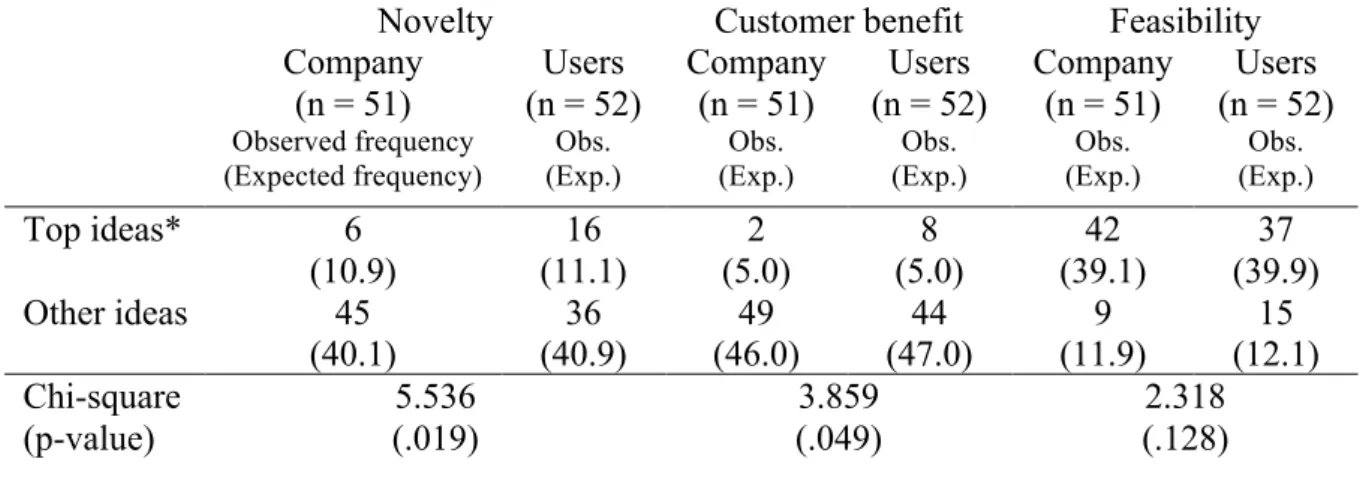
Table 1: Average novelty, customer benefit, and feasibility of professional versus user ideas We then turn to the “best versus the rest” ideas in our samples (see Table 2). As noted above, we define top ideas as those which score higher than three on the five-point scale in each of the three quality dimensions. First, we find that 24 of the 103 total ideas are considered very new (i.e., top ideas in terms of novelty). More interestingly, we find that this relatively small percentage (23%) mostly comprises user ideas, as only six professional ideas (compared to 16 user ideas) belong to this group. Thus, significantly more user ideas (and fewer professional ideas) than expected can be assigned to the group of top ideas in terms of novelty (p < .05). Second, we find that only 12 of the 103 ideas qualify as top ideas in terms of customer benefit (12%). As in the case of novelty, we find that only two professional ideas (compared to eight user ideas) belong to this group. Again, we find this pattern to be statistically significant: More user ideas (and fewer professional ideas) than expected can be placed in the group of top ideas in terms of customer benefit (p < .05). Third, we find that 79 of the 103 ideas are considered easy to realize (top ideas in terms of feasibility). This very large share (77%) comprises 42 professional ideas and 37 user ideas. In contrast to the mean findings reported above, however, we do not find a significant difference in observed and expected frequencies for professional versus user ideas in this quality dimension (p > .10).
Novelty Customer benefit Feasibility
Company
(n = 51) (n = 52) Users Company (n = 51) (n = 52) Users Company (n = 51) (n = 52) Users Observed frequency (Expected frequency) Obs. (Exp.) Obs. (Exp.) Obs. (Exp.) Obs. (Exp.) Obs. (Exp.) Top ideas* 6 (10.9) 16 (11.1) 2 (5.0) 8 (5.0) 42 (39.1) 37 (39.9) Other ideas 45 (40.1) (40.9) 36 (46.0) 49 (47.0) 44 (11.9) 9 (12.1) 15 Chi-square (p-value) (.019) 5.536 (.049) 3.859 (.128) 2.318
* Top ideas are defined as those which score higher than 3 in the respective quality dimension.
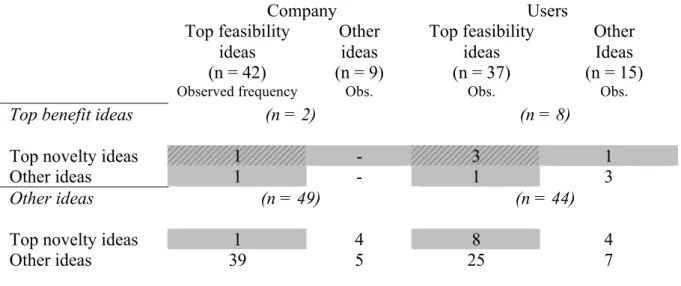
From a company’s perspective, it might be also interesting to see whether some ideas which are among the top ideas in one dimension are rated similarly in the other dimensions (because ideas that are very novel, deliver high customer benefit and are easy to realize at the same time clearly constitute the most promising opportunities). In the final step, we therefore aim to explore those interactions on a descriptive basis. Due to the small observed frequencies
(mostly ≤ 3), however, we do not report significance tests. Overall, we find that user ideas are at least on par with professional ideas in this analysis (see Table 3). In particular, we find that only one professional idea and three user ideas qualify as top ideas in all three dimensions. Second, we find that only three professional ideas (vs. 13 user ideas) belong to the group of top ideas at least in two dimensions. For example, only one professional idea which received a top rating in terms of novelty is also found to be very easy to realize (top feasibility). In contrast, eight user ideas that belong to the top group in terms of novelty also qualify for the top feasibility group. In terms of customer benefit x feasibility, the findings are tied: One professional idea and one user idea are attributed high customer benefit and high feasibility at the same time. Finally, none of the professional ideas (compared to one user idea) are placed at the top in terms of novelty as well as customer benefit.
Company Users Top feasibility ideas (n = 42) Other ideas (n = 9) Top feasibility ideas (n = 37) Other Ideas (n = 15)
Observed frequency Obs. Obs. Obs.
Top benefit ideas (n = 2) (n = 8)
Top novelty ideas 1 - 3 1
Other ideas 1 - 1 3
Other ideas (n = 49) (n = 44)
Top novelty ideas 1 4 8 4
Other ideas 39 5 25 7
Top ideas are defined as ideas with a score higher than 3. Top in all three
dimensions
Top in two dimensions
Table 3: Top ideas in interactions between novelty, customer benefit and feasibility
Discussion
Can users really compete with professionals in generating promising new product ideas? This question has fueled broad discussions among practitioners and academics alike since famous success stories of user innovation such as open source software began to challenge the status quo of NPD, in which a firm’s marketers, engineers, and/or designers used to be exclusively responsible for coming up with new product ideas. More specifically, crowdsourcing
processes – that is, attempts to outsource the phase of idea generation to a potentially large and unknown population of users (the “crowd”) – have attracted increased attention in recent years. We join this debate by presenting a real-world comparison of the quality of ideas
actually generated by a firm’s professionals compared to those submitted by users in the course of an idea generation contest. Both users and professionals created ideas for an
effective and relevant problem in the consumer goods market for baby products. We find that user ideas clearly score higher on average in terms of novelty and customer benefit, and somewhat lower in terms of feasibility, indicating that professionals are more capable of coming up with ideas that can be developed more easily into a product for the market. However, the average values for feasibility – in contrast to novelty and customer benefit – tended to be relatively high. As a result, this dimension did not constitute a narrow bottleneck in our study (i.e., given that they were assessed as promising in terms of novelty and customer benefit, most ideas would have had a fair chance of being developed for the market with a reasonable level of effort). Even more interestingly, we also find that the best ideas overall tend to be more heavily concentrated among users compared to a firm’s professionals. In fact, some of the top user ideas were finally selected by the company to pass the gate for the next NPD stage. This underscores the validity of our findings, which provide evidence that users might indeed be able to complement a firm’s professionals in the idea generation stage of NPD. We conclude by discussing the generalizability of our results and by pointing out promising avenues for future research.
In what situations can we expect similar results so that firms might derive commercially attractive new product ideas from users? We argue that it will mostly depend on the users’ capabilities and motivation as well as the design of the search/attraction process.
First, the ability of users to come up with promising ideas for new products might depend most heavily on the underlying industry or the respective product category, as well as the nature of the specific problem for which the firm wishes to innovate. If the knowledge necessary to generate new product ideas in a given industry/product category is complex and/or difficult and costly to acquire – thus constituting a high entry barrier – users might be less likely to engage and/or succeed in developing their own ideas. If knowledge-based entry barriers are low and/or the knowledge needed to come up with successful ideas is closely linked to aspects of use experience – as in our case of feeding babies – users might be more successful (Baldwin, Hienerth, and von Hippel 2006, Lettl, Herstatt, and Gemünden 2006, Lüthje, Herstatt, and von Hippel 2005). Industries also vary in terms of the amount of knowledge necessary to understand how existing products work and how they can be
modified. As a certain minimum knowledge of existing solutions tends to be a prerequisite for coming up with new ideas, the ability of users to generate successful ideas might also depend on the minimum level of knowledge necessary to understand how existing products function and can be modified in a given industry. This argumentation is in line with Klevorik et al. (1995), who find that the importance of different external sources (such as suppliers, users, or universities) varies in different industries. The authors asked senior R&D managers from 130 industries to rate the importance of several external sources of innovation. They found that user input was valued highly in industries such as machinery, electrical equipment and surgical/medical instruments, whereas suppliers and/or university researchers were more dominant in fields such as food and forest products, drugs, soaps/detergents or metalworking. It seems plausible that the latter industries will require a higher level of complex knowledge which is costly to acquire (e.g., chemistry or biology related knowledge) and thus constitutes an entry barrier for users to innovate. As a result, there may be a significant relationship between knowledge-based entry barriers and the users’ ability and likelihood of coming up with promising new product ideas. Future research might therefore analyze different
industries/product categories which systematically vary in terms of the complexity of relevant knowledge in order to shed more light on factors that influence the value of users as a
As for the type of problem for which a firm wishes to innovate, we argue that users might generally be better at solving needs-based problems (e.g., novel functionality) and worse at technology-based problems (i.e., dimensions of merit). This is because users have direct access to information on unmet needs and may thus be better equipped to come up with promising ideas for new products with novel functional capabilities (e.g., the first scientific instrument of a new type). In contrast, companies might be more able to come up with promising "dimensions of merit" innovations (e.g., performance improvements in an existing type of scientific instrument) because they are more familiar with the underlying technology (Riggs and von Hippel 1994, von Hippel 2005). The ability of users to come up with
promising ideas might not only depend on the type of problem itself, but also on the way it is broken down and communicated to a group of users. Lakhani et al. (2007), for example, find that a firm’s experience in articulating problems influences whether or not the problem is solved successfully by a group of external problem-solvers. Future research on how different problem types and their articulation influence the types of participating users and the quality of their ideas could therefore be useful in developing a more effective means of designing crowdsourcing processes.
Second, the users’ motivation might be closely tied to their willingness to invest in generating new product ideas and/or to share them with firms. Research on open source software
development has shown that users freely share ideas with their peers in communities (e.g., Lakhani and Wolf 2005). Franke and Shah (2003) report similar findings for various sports communities. They find that 67 percent of the users surveyed stated that they had already shared their inventions free of charge within the community. The main reason behind the free revelation of ideas among users is that users benefit from using an innovation and not from selling it (von Hippel 2005). Other documented motives for revealing ideas free of charge are expected reciprocity, social norms, recognition, and improvements by others (c.f. Harhoff, Henkel, and von Hippel 2003). But what about revealing ideas to firms (vs. other users) in the course of an idea generation contest? Up to now, we have seen only sparse evidence
suggesting that certain users do share their ideas with certain firms – mostly because of firm recognition as a motivational factor (Jeppesen and Frederiksen 2006; either without any monetary reward as reported in Hienerth, Pötz, and von Hippel 2007, motivated by cash prizes in Lakhani et al. 2007 or non-cash prizes in Piller and Walcher 2006, or a combination of the latter two, as in our case; for additional potential motives, cf. Füller, Jawecki, and Mühlbacher 2007).Future research should therefore analyze the conditions (i.e., the incentive system of the crowdsourcing process) under which users might be willing to share ideas with firms. In addition, it might be valuable to investigate which type of user is most likely to reveal ideas to firms free of charge (and what motivates them to do so), and whether such behavior depends on certain characteristics of the underlying industry and/or the underlying firm(Füller, Matzler, and Hoppe 2008). Depending on the type of industry and the likelihood of free revealing versus other types of appropriability strategies such as patenting and
licensing (e.g., because the resources available for securing innovation returns might differ for B2B vs. B2C users), further research on how IP rights systems influence the exchange of ideas between users and firms might also contribute to the development of systems that support fair exchanges more effectively.
Third, in our case many of the top ideas came from users, and the average quality of user-generated ideas was fairly high overall, indicating that our process seems to have attracted highly qualified users. But does it necessarily always work out this way? We argue that it does not: If, for example, qualified users cannot be attracted, many of the ideas collected in a crowdsourcing process might not be valuable at all. In their study on the Adidas idea
generation contest, Piller and Walcher (2006, p. 314) report that 90% of the contributions submitted were either only marginally creative (mostly comments) or built on existing
products, but did not “radically expand the company’s solution space”. On the other hand, as in the case of Dell or Lego, for example, firms might simply be confronted with “too many” ideas from their user community and face the problem of not being able to filter and select the most promising ones (or only being able to do so with tremendous effort; e.g., Toubia and Florès 2007).
More generally, firms also need to possess the ability to absorb external knowledge (Cohen and Levinthal 1990). The extent to which this process of absorbing ideas generated through crowdsourcing is constrained by limited resources as well as prior experience constitutes a promising avenue for further research. As already argued in the background chapter of this paper, prior knowledge and expertise may result in local search behavior and might therefore negatively influence a firm’s ability and activities in exploring external knowledge (e.g., Katila and Ahuja 2002). This raises the question of whether firms that are very much path-dependent in their generation of internal ideas are also constrained by prior experience in filtering and selecting the most promising external ideas. In our study, the two executives who rated the ideas were blind to their source (users vs. professionals) and – as they valued ideas from users highly – may have been blocked by prior experience to a comparatively low extent. However, further investigation of this topic would provide scholars and practitioners with more detailed insights on the appropriate filtering mechanisms for ideas arising from crowdsourcing processes.
Although crowdsourcing – such as the idea generation contest applied in our study – might attract the most capable users in a self-selection process, there is some evidence that active search processes for user ideas (e.g., the pyramiding search method; von Hippel, Franke and Prügl 2008) might also hold the potential for identifying the most promising user ideas. Whereas active searches can be limited by prior knowledge (e.g., Lakhani et al. 2007), self-selection processes might be confined to that group which is able to access a problem
broadcast by a firm. In our case, for example, we broadcast the idea competition via the firm’s website and advertised it in various online forums related to the target market. Nonetheless, only 70 ideas were submitted. Although we could not calculate a response rate, this figure generally appears to be fairly low. The issue of accessibility is therefore another factor that might influence the users attracted and subsequently the number and quality of ideas
submitted in an idea competition. Future research might analyze the conditions under which different search processes (active search vs. self-selection) and their specific design are most efficient and effective in finding the most innovative ideas.
In sum, we argue that factors related to the users’ capabilities and motivation as well as the design of the search/attraction process might moderate the outcome of a crowdsourcing approach (and thus determine when and why our findings could be replicated). However, our study provides an important initial indication that users can actually outperform professionals in the generation of new product ideas, at least under certain conditions. The underlying company, for its part, was surprised at and very enthusiastic about this outcome, finally selecting several of the best user ideas to pass the gate to the next NPD stage and subsequently sponsoring further user initiatives (i.e., conducting a lead user study).
References
Agerfalk, P.J., B. Fitzgerald. 2008. Outsourcing to an unknown workforce: Exploring opensourcing as a global sourcing strategy. MIS Quart.32(2) 385-409.
Amabile, T.M., S.G. Barsade, J.S. Mueller, B.M. Staw. 2005. Affect and creativity at work.
Admin. Sci. Quart.50 367-403.
Amabile, T.M., R. Conti, H. Coon, J. Lazenby, M. Herron. 1996. Assessing the work environment for creativity. Acad. Management J.39(5) 1154-1184.
Audia, P.G., O. Sorenson. 2001. Aspirations, performance and organizational change: A multi-level analysis. Working Paper, London Business School.
Bagozzi, R.P., U.M. Dholakia. 2006. Open source software user communities: A study of participation in Linux user groups. Management Sci.52(7) 1099-1115.
Baldwin, C., C. Hienerth, E. von Hippel. 2006. How user innovations become commercial products: A theoretical investigation and case study. Res. Policy35(9) 1291-1313.
Bennett, R.C., R.G. Cooper. 1981. The misuse of marketing. McKinsey Quart.3 52-69. Berthon, P.R., L.F. Pitt, I. McCarthy, S.M. Kates. 2007. When customers get clever: Managerial approaches to dealing with creative consumers. Bus. Horizons50(1) 39-47. Christensen, C.M. 1997. The Innovators Dilemma: When New Technologies Cause Great
Firms to Fail. Harvard Business School Press, Boston, MA.
Cohen, W.M., D.A. Levinthal. 1990. Absorptive capacity: A new perspective on learning and innovation. Admin. Sci. Quart.35 128-152.
Cooper, R.G. 1990. Stage-Gate systems: A new tool for managing new products. Bus.
Horizons33(3) 44-53.
Franke, N., S. Shah. 2003. How communities support innovative activities. An exploration of assistance and sharing among end-users. Res. Policy32(1) 157-178.
Franke, N., E. von Hippel, M. Schreier. 2006. Finding commercially attractive user
innovations: A test of lead user theory. J. Product Innovation Management23(4) 301-315. Füller, J., G. Jawecki, H. Mühlbacher. 2007. Innovation creation by online basketball communities. J. Bus. Res. 60(1) 60-71.
Füller, J., K. Matzler, M. Hoppe. 2008. Brand community members as a source of innovation.
J. Product Innovation Management25(6) 608-619.
Goldenberg, J., D.R. Lehmann, D. Mazursky. 2001. The idea itself and the circumstances of ist emergence as predictors of new product success. Management Sci.47(1) 69-84.
Harhoff, D., J. Henkel, E. von Hippel. 2003. Profiting from voluntary information spillovers: How users benefit by freely revealing their innovations. Res. Policy32(10) 1753-1769. Hayes, A.F., K. Krippendorf. 2007. Answering the call for a standard reliability measure for coding data. Comm. Methods and Measures1 77-89.
Hienerth, C., M.K. Pötz, E. von Hippel. 2007. Exploring key characteristics of lead user workshop participants: Who contributes best to the generation of truly novel solution?
DRUID Summer Conf., Copenhagen, 1-31.
Howe, J. 2006. The rise of crowdsourcing. Wired14(06), accessed online at: http://www.wired.com/wired/archive/14.06/crowds.html (February, 16, 2009). Im, S., B.L. Bayus, C.H. Mason. 2003. An empirical study of innate consumer
innovativeness, personal characteristics, and new-product adoption behavior. J. Acad. Market. Sci.31(1) 61-73.
Jeppesen, L.B., L. Frederiksen. 2006. Why do users contribute to firm-hosted user
communities? The case of computer-controlled music instruments. Organ. Sci.17(1) 45-64. Katila, R., G. Ahuja. 2002. Something old, something new: A longitudinal study of search behavior and new product introduction. Acad. Management J.45(6) 1183-1194.
Kirton, M. 1976. Adaptors and innovators: A desription and measure. J. Appl. Psychol.61(5) 622-29.
Klevorick, A.K., R.C. Levin, R.R. Nelson, S.G. Winter. 1995. On the sources and significance of interindustry differences in technological opportunities. Res. Policy24 185-205.
Krippendorf, K. 2004. Content Analysis: An Introduction to its Methodology, 2nd edition ed. Sage Publications Thousand Oaks, CA.
Kristensson, P., A. Gustafsson, T. Archer. 2004. Harnessing the creative potential among users. J. Product Innovation Management21(1) 4-14.
Lakhani, K.R., L.B. Jeppesen, P.A. Lohse, J.A. Panetta. 2007. The value of openness in scientific problem solving. Working Paper No. 07-050, Harvard Business School, Boston, MA, 1-57.
Lakhani, K.R., R.G. Wolf. 2005. Why hackers do what they do: Understanding motivation and effort in free/open source software projects. J. Feller, B. Fitzgerald, S. Hissam, K.R. Lakhani, eds. Perspectives on Free and Open Source Software. MIT Press, Cambridge, MA, 3-21.
Larkin, J., J. McDermott, D.P. Simon, H.A. Simon. 1980. Expert and novice performance in solving physics problems. Sci.208(4450) 1335-1342.
Leonard, D., J.F. Rayport. 1997. Spark innovation through empathic design. Harvard Bus. Rev.75(6) 102-113.
Lerner, J., J. Tirole. 2002. Some simple economics of Open Source. J. Ind. Econ.50(2) 197-234.
Lerner, J., J. Tirole. 2005. The economics of technology sharing: Open Source and beyond. J.
Econ. Perspect. 19(Spring) 99-120.
Lettl, C., C. Herstatt, H.G. Gemünden. 2006. Learning from users for radical innovation.
Lilien, G.L., P.D. Morrison, K. Searls, M. Sonnack, E. von Hippel. 2002. Performance assessment of the lead user idea-generation process for new product development.
Management Sci.48(8) 1042-1059.
Lüthje, C., C. Herstatt, E. von Hippel. 2005. User-innovators and "local" information: The case of mountain biking. Res. Policy34(6) 951-965.
Magee, G.B. 2005. Rethinking invention: Cognition and the economics of technological creativity. J. Econom. Behaviour & Organ.57 29-48.
Majchrzak, A., L.P. Cooper, O.E. Neece. 2004. Knowledge reuse for innovation.
Management Sci.50(2) 174-188.
March, J.G. 1991. Exploration and exploitation in organizational learning. Organ. Sci.2(1) 71-87.
Martin, X., W. Mitchell. 1998. The influence of local search and performance heuristics on new design introduction in a new product market. Res. Policy26 753-771.
Moreau, P.C., D.W. Dahl. 2005. Designing the solution: The impact of constraints on consumers' creativity. J. Consumer Res.32 13-22.
Morrison, P.D., J.H. Roberts, E. von Hippel. 2000. Determinants of user innovation and innovation sharing in a local market. Management Sci.46(12) 1513-1527.
Nelson, R.R., S.G. Winter. 1982. An Evolutionary Theory of Economic Change. Belknap Press, Cambridge, MA.
Ogawa, S., F.T. Piller. 2006. Collective customer commitment: Reducing the risks of new product development. MIT Sloan Management Rev.47(2) 65-72.
Piller, F.T., D. Walcher. 2006. Toolkits for idea competitions: A novel method to integrate users in new product development. R&D Management36(3) 307-318.
Pisano, G.P., R. Verganti. 2008. Which kind of collaboration is right for you? Harvard Bus. Rev.86(12) 78-86.
Pitt, L.F., R.T. Watson, P. Berthon, D. Wynn, G. Zinkhan. 2006. The penguin's window: Corporate brands from an open-source perspective. J. Acad. Marketing Sci.34(2) 115-127. Riggs, W., E. von Hippel. 1994. The impact of scientific and commercial values on the sources of scientific instrument innovation. Res. Policy23(4) 459-469.
Sawhney, M., E. Prandelli. 2000. Communities of creation: Managing distributed innovation in turbulent markets. California Management Rev.42(4) 24-54.
Sawhney, M., G. Verona, E. Prandelli. 2005. Collaborating to create: The Internet as a
platform for customer engagement in product innovation. J. Interactive Marketing19(4) 4-17. Schulze, A., M. Hoegl. 2008. Organizational knowledge creation and the generation of new product ideas: A behavioral approach. Res. Policy37(10) 1742-1750.
Schreier, M., R. Prügl. 2008. Extending lead-user theory: Antecedents and consequences of consumers' lead userness. J. Product Innovation Management25(4) 331-346.
Shah, S. 2000. Sources and patterns of innovation in a consumer products field: Innovations in sporting equipment. Working Paper No. 4105, MIT Sloan School of Management, Cambridge, MA.
Stuart, T.E., J. Podolny. 1996. Local search and the evolution of technological capabilities.
Strategic Management J.17(1) 21-38.
Surowiecki, J. 2004. The Wisdom of Crowds. Random House Large Print and Doubleday, New York.
Toubia, O., L. Florès. 2007. Adaptive idea screening using consumers. Marketing Sci. 26(3) 342-360.
Ulrich, K.T., S.D. Eppinger. 2004. Product Design and Development. 3rd edition. McGraw-Hill, New Jersey.
Ulrich, K.T. 2007. Design: Creation of Artefacts in Society. Pontifica Press.
Urban, G.L., J.R. Hauser, W.J. Qualls, B.D. Weinberg, J.D. Bohlmann, R.A. Chicos. 1997. Information acceleration: Validation and lessons from the field. J. Marketing Res.34(1) 143-153.
Urban, G.L., E. von Hippel. 1988. Lead user analyses for the development of new industrial products. Management Sci.34(5) 569-582.
Vincenti, W.G. 1990. What Engineers Know and How They Know It. Johns Hopkins University Press, Baltimore, MD.
von Hippel, E. 1978. Successful industrial products from customer ideas. J. Marketing42(1) 39-49.
von Hippel, E. 1986. Lead users: A source of novel product concepts. Management Sci.32(7) 791-805.
von Hippel, E. 1988. The Sources of Innovation. Oxford University Press, New York.
von Hippel, E. 1994. "Sticky information" and the locus of problem solving: implications for innovation. Management Sci.40(4) 429-439.
von Hippel, E. 2005. Democratizing Innovation. MIT Press, Cambridge.
von Hippel, E., N. Franke, R. Prügl. 2008. "Pyramiding": Efficient identification of rare subjects. Working Paper No. 4720-08, MIT Sloan School of Management, Cambridge, MA. Weisberg, R.W. 1993. Creativity: Beyond the Myth of Genius. Freeman, New York.