Jurnal Pendidikan IPA Indonesia
http://journal.unnes.ac.id/index.php/jpii
VIRTUAL LABORATORY TO IMPROVE STUDENTS’
PROBLEM-SOLVING SKILLS ON ELECTRICITY CONCEPT
Gunawan*1, A. Harjono1, H. Sahidu1, L. Herayanti2 1Department of Physics Education, Universitas Mataram, Indonesia
2Department of Physics Education, IKIP Mataram, Indonesia
DOI: 10.15294/jpii.v6i1.8750
Accepted: April 17th, 2017. Approved: August 30th, 2017. Published: October 17th, 2017.
ABSTRACT
The purpose of this study is to examine the effect of the use of virtual labs on problem-solving ability of students to the concept of electricity. The subjects were students of physics education at Mataram University. Students were divided into two groups: experimental and control group. The research instrument used was in the form of problem-solving ability tests on electricity concept. The tests employed the form of essay that represent concepts about electricity being studied. The results showed the effect of the use of virtual labs on problem-solving ability of students to the concept of electricity. It can be seen from the different improvement of problem-solving ability in both groups. Problem-solving ability of experimental group is higher than the control group. From the analysis of these problem-solving steps, it can be seen that general students in both classes have the same ability to identify problems and define goals. In the next step, the different improvement in problem-solving skills in the two classes is significant. Experimental class’ students have a higher ability to plan and implement problem-solving solutions than those of control class.
© 2017 Science Education Study Program FMIPA UNNES Semarang
Keywords: virtual laboratory; problem-solving skills; electricity concepts
INTRODUCTION
The laboratory has a very important role in Physics learning. The laboratory activities, students can be trained and equipped with some skills such as observing, classifying, measuring, communicating, interpreting data, and making conclusions. Laboratory activities make physics learning more interesting and fun. Most educa-tors agree that laboratory activity is an important component of science learning. The research fin-dings show that there is a relationship between experience in the laboratory and the development of metacognitive skills, and can inform the deve-lopment of curriculum based on research (Sandi-Urena et al., 2012). Through student laboratory activities can develop academic and social skills. From a social point of view, students will be
ac-customed to appreciate the opinions of others, learn to communicate ideas, and working toget-her in teams.
Some subjects can be learned in the labora-tory are: First, students learn about the functions to the management of the laboratory. Second, the students learn to measure and compare the results with other similar quantities used as stan-dard units. Third, the students learn to observe the objects they encounter. Fourth, students can also learn to do experiments in accordance with the instructions that are prepared or developed independently to achieve the goals set.
The limited equipment for physics experi-ments in Institute of Teachers’ Education is still one of the problems. The equipment available is generally not comparable with the number of stu-dents. Laboratories and their support equipment require cost support for management, storage, la-boratory maintenance, equipment and materials,
*Address Correspondence:
and availability of trained staff. This results in some experiments not being optimal, and some others are unworkable. In conventional labora-tory models, students usually do not have much freedom to practice. This condition has implica-tions for the low mastery of concepts and skills in solving physical problems, including electrical concepts.
The concept of electricity is one of the major concepts in physics. The concept of elect-ricity in basic physics lectures include discussing Coulomb’s law through Kirchoff ’s law. The lear-ning of this electrical concept requires sufficient supporting experiments to be well explained to the students. As with other experimental devices, the electrical concept experiments were inadequa-te. This can be known from the results of physics laboratory observations on several Institutes of Teachers’ Education in NTB. Most of the electri-cal concept is an abstract concept. This creates difficulties for students, because it is difficult to visualize the process directly through activities in the laboratory. This condition contributes to the low understanding and ability to solve student physics problems.
One of the innovations and alternative solutions that can be done is the utilization of computer technology for physics experiments. Computer technology can be adapted in learning to make it more interesting. In addition, it can be used offline or online, including combining face-to-face with online learning. Computer techno-logy can be called a virtual lab. Harms (2000) defines virtual labs as computer simulations that allow experimental functions in a laboratory to be performed on a computer. Chen et al., (2010) defines virtual labs as software used for simula-ting the laboratory environment. Virtual labs can
be used when the tools needed for real experi-ments are too expensive, unsafe, and unavailable. Virtual labs allow learners to experiment and re-peat over and over again, and provide an oppor-tunity to observe how changes in parameters and effects are generated. A very important feature of a virtual lab for learners is to provide a learning experience of failure without causing any real da-mage. While Noor & Wasfy (2008) defines virtu-al labs as modeling, simulation, and information technology to create an interactive learning envi-ronment that suits both researchers and learners. According to Ciepiela et al. (2010) the keyword of virtual labs is experiment.
The main things to consider in learning with virtual labs include the applied approaches, strategies, techniques, and support facilities. Ac-cording to Ahmed & Hasegawa (2014), virtual labs make it easy for learners to connect bet-ween theoretical and practical aspects without paper and pen. Finkelstein et al., (2005) argues, the implementation of physical practice can be done with computers, for example to collect and process data. Modifying a physics experiment to display a complete experiment is easier to do vir-tually inside a computer. The concept of physics to be experimented can be made in computer pro-grams that are easy to use and learn. Gunawan & Liliasari (2012) suggests that computers can be used to practice problems, games, to learn problem-solving. It is important to understand that experiments are virtually not intended to replace the role of real laboratory activity. The virtual laboratory is intended to be a supporter or an alternative to the unavailability of adequate laboratory equipment. Its use is expected to inc-rease motivation and develop the ability to solve problems realistically.
Researchers have found that the problem solving ability of learners can be trained and fa-cilitated through the integration of problem-sol-ving strategies and computer technology (Kim & Hannafin, 2011). The problem-solving ability has been recognized as an important skill to adapt to the environment in the 21st century (Kuo et al., 2012). The role of education in the 21st century should prepare learners to meet the challenges of a dynamic and interconnected world (Wüsten-berg et al., 2014).
Training and equipping problem-solving skills has long been recognized as an important issue in education. Problem solving skills are not only important for work, but also to adapt to the environment (Hwang et al., 2012). Problem solv-ing ability is the ability to use logic to solve real-life problems and make decisions, (Butterwroth & Thwaitess, 2013). There are five steps in sol-ving physical problems, namely (1) Identify and define problem; (2) Define goals and objectives); (3) Generate solution; (4) Make a plan for action; (5) Follow-up of the action plan. This stage is cal-led the implementation phase of the solution
Hämäläinen et al., (2015) describes several important things to be able to solve the problem include: required support and resources for pro-fessional development related to problem solving in the work settings of various technologies, rese-arch-based knowledge needs to be fully applied to respond to changes, and work environments with the flexibility, authenticity and equipment used to support problem solving.
This article describes the effect of virtual labs on the ability to solve problems in electrical concepts. In addition to general discussion, this article also explains the level of acquisition and improvement of problem solving skills in both classes of each troubleshooting step.
METHODS
The development of research has success-fully developed a virtual laboratory model of the electric concept. Empirical model testing uses quasi-experimental research. The research samp-le is a physics teacher candidate at Mataram Uni-versity which is divided into two classes namely experiment and control. Class experiments were studied using an electric virtual laboratory, while the control class was studied conventionally. The research instrument is a physics problem solving test through a description test. Data were ana-lyzed using the appropriate statistical test using SPSS version 20. Data analysis included test: ho-mogeneity, normality, and research hypothesis.
Improved student problem-solving skills can be determined through N-gain scores (Cheng et al., 2004):
Note:
N-gain > 70% (High); 30% ≤ N-gain ≤ 70% (Me-dium); and N-gain < 30% (Low).
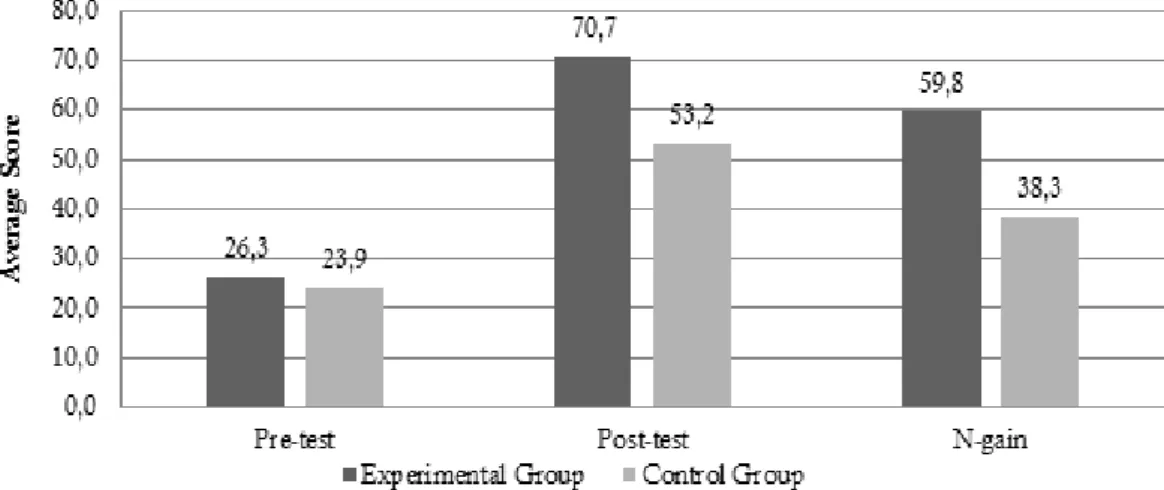
RESULTS AND DISCUSSION The lessons learned in this study use a de-veloped virtual laboratory. Previously, students were given pretest to know their initial ability. While posttest is given at the end of learning to know the problem solving ability. The compari-son of the test results and the increase values in the two classes is shown in Figure 1.
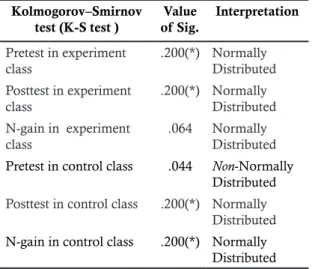
Figure 1 shows, initial ability in both clas-ses is almost the same. In addition, it can be kno-wn from the homogeneity test results. Homoge-neity test results show that the pretest data comes from a homogeneous group. Both are in the ‘low’ category. This indicates that both groups do not have enough knowledge to answer a problem. Through a treatment, the students’ ability in both classes becomes increasing. However, problem-solving skills have differences in both classes. The average scores on the experiment class are higher than the control class. Comparison of the increase in the average score can be seen in the N-gain data of both classes. The increase in the experimental class is 59.8%, while the control class is 38.3%. Both classes are in the medium category. In addition to the homogeneity test, normality data is required to determine the data distribution pattern. Normality test results can be seen in Table 1.
Table 1. Normality Test of Problem Solving Ability in Both Classes
Kolmogorov–Smirnov test (K-S test ) Value of Sig. Interpretation Pretest in experiment class .200(*) Normally Distributed Posttest in experiment class .200(*) Normally Distributed N-gain in experiment class .064 Normally Distributed
Pretest in control class .044 Non-Normally Distributed
Posttest in control class .200(*) Normally Distributed
N-gain in control class .200(*) Normally Distributed 100% x S S S S gain -N pre max pre post − − =
Experiments using virtual labs give stu-dents the opportunity to hypothesize and prove it in problem-solving. The virtual lab’s system helps students to trigger their ’self-motivation’ to learn actively. Student feedback shows that they work in an innovative environment and feel this mo-del is more effective. The virtual lab is developed through design, testing and evaluation, and some necessary modifications. The results of the Serin, (2011) also found a statistically significant inc-rease. The findings are related to the achievement and problem-solving skills of learners who study science and technology through computer-based learning. Mettas & Constantinou (2007) conclu-ded that good technology could improve the de-velopment of problem-solving skills. The results analysis shows that technology contributes to the development of positive values and attitudes in educational technology. Also, technology has a significant effect on improving the understan-ding and implementation of problem-solving strategies in the technology domain. Technology brings enthusiasm and motivation in education. Technology began to be considered an important educational activity that can help in their future careers.
According to Oidov et al., (2012) virtual laboratories in the learning process are useful to provide learners with the opportunity to learn by doing, exciting, motivating activities to discover, ensuring classroom interaction through discussi-on and debate, develop thinking skills and prob-lem-solving skills, and open up possibilities by using different types of resources for self-study.
In virtual labs learning, most student acti-vities are performed on a computer. Students are given problems, some information, and software that they can use to test ideas. The next step is left entirely to the students. Each student should be able to identify the needs and develop the ap-propriate design, test the experimental design, and analyze the suitability of the original plan with the results already obtained, then revise and re-experiment if necessary. The results of Gunawan & Liliasari (2012), show that virtual labs are used to improve students’ critical thinking disposition. Learning with virtual labs helps students to make correct inferences. Virtual labs are also helpful to increase user interest and motivation, strengthen their skills and provide full-time security (Gorg-hiu et al., 2009). Virtual labs increase the interest of learners, they feel much more relaxed than real laboratories, improve the quality of learning, and they are not tired while working with virtual labs (Limniou et al., 2007).
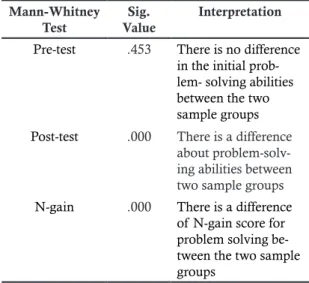
Table 1 shows the existence of non-distri-buted data that is in the pretest data of the control class. This implies the type of statistical tests to be performed for hypothesis testing. The solution of the non-normally distributed data in this case is using the Mann-Whitney test. This hypothesis test is based on the results of the student’s prob-lem-solving test which includes: test data and N-gain score. The results of hypothesis testing are shown in Table 2.
Table 2. Hypothesis Test Results
Mann-Whitney Test
Sig. Value
Interpretation
Pre-test .453 There is no difference in the initial prob-lem- solving abilities between the two sample groups Post-test .000 There is a difference
about problem-solv-ing abilities between two sample groups
N-gain .000 There is a difference of N-gain score for problem solving be-tween the two sample groups
Table 2 shows that the initial problem-sol-ving abilities in both classes are not significantly different. This result explains the previous case in Figure 1. The impact of treatment on both classes has increased problem-solving abilities. However, Pretest results and N-gain scores for problem-sol-ving abilities in both classes were significantly dif-ferent. This data suggests that ‘learning technolo-gy’ using virtual labs is proven to help students improve their problem-solving skills. The results of this study are in accordance with several other studies.
Serin et al., (2009) found that ‘learning technology’ has a positive effect on the prob-lem-solving ability of learners. Harskamp & Suhre (2007) argue, that the designed compu-ter program allows learners to choose problems and use the instructions in different time from troubleshooting. Students who learn by using computer programs show there is an increased problem-solving ability than traditional learning. The use of instruction can help to explain the important parts in order to improve the problem solving skills of the learner. In addition, Ismail et al., (2016) explains that the implementation of virtual lab can be used to improve scientific lite-racy skills.
Yusuf & Subaer (2013) have also shown that learning based on virtual lab media is able to activate learners. Most students strongly agree with the use of virtual labs in physics learning. Nance et al., (2009), argues that in addition to supporting educational activities, virtual labs can be used to support research activities. The
ad-vantages of virtual labs are to assist researchers in terms of: First, being able to remotely access experiments, analyze data, or generate reports; Secondly, accelerate the dissemination of product results; Third, record the complete documenta-tion during the study; Fourth, doing experiments repeated over different parameters.
Figure 2. Comparison of Capabilities According to Problem Solving Stages in Both Classes
in computer-based learning. Views on virtual labs programs and spreadsheet instruments are prepa-red as a solution to solve the problem.
The increase in problem solving skills in the experimental class is the influence of the tre-atment given. Based on the observation of the researcher during the learning, it can be seen the effect of treatment at each stage of learning. Each stage is to train students’ skills to solve problems. The scores of problem solving skills are measured based on the analysis of each step of the problem solving during pretest and posttest. The result of problem solving analysis for each step is shown in Figure 2. The steps of the problem solving in-clude: (1) Identify and define problem; (2) Define goals and objectives; (3) Generate solution, (4) Make a plan of action; and (5) Follow through.
Based on Figure 2, it can be seen the inc-reasing score of each step problem solving abili-ties. The ability of both classes is identical in step 1 (Identify and define problem) and step 2 (Defi-ne goals and objectives). In this step, the ability of both classes has a high score. This indicates that most of the students are able to recognize and understand the problem on electrical concept very well. Identifying the problem is an important component to solve the problem in the next step. The ability of problem identification and goal set-ting helps the student in recognizing the problem, categorizing, and defining the solution plan.
Lin & Singh, (2009) describes his rese-arch that, categorizing problems by students for An additional advantage of using virtual
labs that can be accessed remotely is: the research team can split the test location without having to be present in the same location. Users can also access laboratory resources, collect experimental results, even share ideas from anywhere.
Cruz-benito et al., (2014) states that ‘vir-tual models’ open up new opportunities for lear-ning and learlear-ning resources. This model allows learners to interact with their virtual resources to make measurements and assessments. Further-more, the ability of this platform gives the lear-ners the power to know how they learn, opens up new ways to learn progress in learning and can help to motivate, ultimately not only to view the virtual world like video games, but also as a virtu-al environment for learning purposes.
During the research, virtual laboratories and supporting devices were adapted to improve student problem solving skills. This is important because of the variety of student learning styles. The instrument used is a combination of con-ceptual-procedural problems and mathematical calculations. This learning style should be consi-dered because in previous research conducted by Gunawan et al. (2016) have found that the impli-cations of the ‘problem concept’ used have diffe-red in the mastery of students’ physics concepts based on two sample groups. Likewise for the ‘learning style’, learners are visual and auditory style is very helpful to learn by using the com-puter, while kinestetik style needs other support
further physics lectures. In addition, it can be a useful tool for understanding student patterns in identifying problems and reflecting on how to solve them. There are differences in identifying problems at different levels of the course. In ba-sic phyba-sics courses, identification is applied to the basic principles but relevant to the problem. Me-anwhile, in advanced courses such as quantum mechanics, identification is focused on concepts and procedures to ’solve problems’. According to Lin & Singh (2013), identification of relevant physics principles is one of the important compo-nents to solving physics problems. In some cases, the same student problems have different solu-tions in applying the concept of physics. Students need help to apply their knowledge in different situations.
In the next step (steps 3, 4, and 5), the ability of the experimental class is higher than the control class. This means that, learning the concept of electricity through a virtual lab provi-des opportunities for students to solve problems systematically. Students are able to experiment as much as possible without destroying the tool and make it easier to connect a concept with others. In addition, students are more flexible in proving ideas to improve problem-solving skills. This con-dition as a motivation for students to feel com-fortable to work in front of the computer screen. Klegeris & Hurren (2011) found that the ability of learners to solve problems increased significantly. The satisfaction and motivation of learners has been proven to help the next stage become easier. The reason is, learners enjoy the process, benefits, and progress in themselves.
The practice of applying the concept that has been found is one of the factors of problem solving ability that can be improved. Providing more opportunities makes students more expe-rienced in solving physics problems. Nirmalak-handan (2013) argues that learning achievements and problem-solving skills of learners can be imp-roved through practice, and computer-based as-sessment. In addition, Harskamp & Suhre (2007) found that the program was able to improve stu-dents’ analytical skills, using tools, and a soluti-on approach. The experiment group is superior to all the steps in solving the problem, but some instructions are used incompletely.
For example, virtual labs will make it easier for students to transfer what they learn from one context to another. It is a useful tool to help students understand the application of physics principles in different situations and de-velop a coherent structure of physical knowledge. According to Perels et al., (2005) problem-solving
ability can be enhanced by continuous practice to solve problems and self-regulatory.
Utilization of virtual labs in electrical con-cept learning is a blend of theory and practice. It is proven that the students are able to improve their problem solving skills. The interactive display of images and silmulations in the program is to help students recall the material discussed earlier. Car-son (2007) explains that his knowledge and appli-cation are the main principles of theory and prac-tice to solve problems. This means that educators are easy to connect students’ lessons through dai-ly problems. Learners are given the knowledge to solve the problem.
Virtual labs that are used contain problems to practice, recognize the problem, and solve the problem. Visual forms in the virtual lab help stu-dents to build concepts and summarize them. This is supported by several research results. Ac-cording to Shih et al. (2016) the visual form helps students to answer the questions given. Additio-nal knowledge resources help students to answer difficult questions Gunawan et al. (2013) has proven that physics learning through virtual labs helps students to improve their abilities by logic inference and construct physics concepts.
In addition Lin & Singh (2013) find that learners will be easy to solve analog problem-solving processes and transfer their learning in different situations. An interesting experience for students if always given practice and feedback during a learning session. Çevik (2015) also re-sulted that feedback in online learning activities is to improve students’ ability in problem solving. Subali et al. (2017) also supports that experiments using computer programs help students to impro-ve students’ literacy skills, particularly in desig-ning graphs and predicting.
This research assumes that the application of problem solving to each student is the ability of the class. This effect is similar to (Hämäläinen et al., 2015) which also assumes that the problem-solving ability is personal. However, in the future, to solve complex problems at work. The ability to network and share problem solving is more necessary than individual skills (Hämäläinen & Vähäsantanen, 2011). This becomes interesting for further research.
The lowest increase in step 5 occurs in both classes. Some literature considers this step is the implementation of solutions in problem solving. This step is a follow-up to the problem. Students are expected to solve the problem thoroughly and appropriately. In the control class, there was an increase in this stage averaging 16.8% (Low ca-tegory), while the experimental class was 41.2%
(Medium category). These results indicate that, the average score increase in the experimental class is higher than the control class. Analysis of student answers indicates that some students have difficulty in solving problems appropriately. This becomes the future finding to continuously improve the quality of learning so that problem solving ability at each stage is better.
Although virtual labs provide positive re-sults to improve problem solving skills, there are limitations. The limitation is that experiment class activities are not all recorded, so there are patterns of interaction, discussion, and other in-teresting events in the problem solving stage can not be fully analyzed. There are several difficul-ties to use virtual laboratories: (a) recommended computer standards; (b) required staff; (c) instruc-tors who are expert in the learning model; and (d) other technical constraints during the research.
CONCLUSION
The conclusion in this research is the app-lication of virtual laboratory in electrical concept has a positive effect on student problem solving ability. The increase in problem solving skills of the two classes is different. However, the experi-mental class problem-solving capability is higher than the control class. Students have similar ca-pabilities in steps 1 and 2 which are identify and define problems; define goals and objectives. Me-anwhile, in the next step, the ability of experiment class is higher than control class. This shows that the application of virtual labs in electrical con-cept learning helps students to improve their abi-lity to solve physics problems.
Students should be familiar with the virtu-al lab features so they can learn regularly. This will make it easier to achieve goals. Time ma-nagement must be precisely configured to make it easier to achieve the goal. Further research is suggested to focus on other skills that can be de-veloped for virtual lab learning. Student response patterns, different problem-solving abilities, and gender-evaluated outcomes, are interesting to in-vestigate.
ACKNOWLEDGEMENT
Special thanks to the Directorate of Rese-arch and Community Service (DRPM) Kemen-ristekdikti who has funded this research from 2015 to 2017. Thanks also to the researchers of the Center for Research on Physics Education and Technology at Mataram University for his contributions and suggestions.
REFERENCES
Ahmed, M. E., & Hasegawa, S. (2014). An Instruc-tional Design Model and Criteria for Designing and Developing Online Virtual Labs. Interna-tional Journal of Digital Information and Wireless Communications (IJDIWC), 4(3), 355-371. Carson, J. (2007). A Problem with Problem Solving:
Teaching Thinking without Teaching Knowl-edge. The Mathematics Educator, 17(2), 7–14. Chen, X., Song, G., & Zhang, Y. (2010). Virtual and
Remote Laboratory Development : A Review. Earth and Space 2010: Engineering; Science; and Operations in Challenging Environments, 3843– 3852.
Cheng, K. K., Thacker, B. A., Cardenas, R. L., Crouch, C., Cheng, K. K., Thacker, A., & Cardenas, R. L. (2004). Using An Online Homework Sys-tem Enhances Students’ Learning of Physics Concepts in An Introductory Physics Course. American Journal of Physics, 72(11), 1447- 1455. Ciepiela, E., Harezlak, D., Kocot, J., Bartynski, T.,
Kasztelnik, M., Nowakowski, P., & Bubak, M. (2010). Exploratory Programming in The Vir-tual Laboratory. Proceedings of the International Multiconference on Computer Science and Informa-tion Technology, IMCSIT, 5, 621–628.
Cruz-Benito, J., Therón, R., García-Peñalvo, F. J., Maderuelo, C., Pérez-Blanco, J. S., Zazo, H., & Martín-Suárez, A. (2014). Monitoring and Feedback of Learning Processes in Virtual Worlds through Analytics Architectures: A Real Case. In Information Systems and Technolo-gies (CISTI), 2014 9th Iberian Conference on (pp. 1-6). IEEE.
Demiraslan Çevik, Y., Haslaman, T., & Çelik, S. (2015). The Effect of Peer Assessment on Prob-lem Solving Skills of Prospective Teachers Sup-ported by Online Learning Activities. Studies in Educational Evaluation, 44(1), 23–35.
Finkelstein, N. D., Adams, W. K., Keller, C. J., Kohl, P. B., Perkins, K. K., Podolefsky, N. S., Lemas-ter, R. (2005). When Learning About The Real World is Better Done Virtually: A Study of Substituting Computer Simulations for Labora-tory Equipment. Physical Review Special Topics - Physics Education Research, 1(1), 1–8.
Gorghiu, L. M., Gorghiu, G., Alexandrescu, T., & Borcea, L. (2009). Exploring Chemistry Using Virtual Instrumentation-Challenges and Suc-cesses. Research, Reflections and Innovations in Integrating ICT in Education, 1(1), 371–375. Gunawan, G., Setiawan, A., Widyantoro, D.H. (2013).
Model Virtual Laboratory Fisika Modern un-tuk Meningkatkan Keterampilan Generik Sains Calon Guru. Jurnal Pendidikan dan Pembelaja-ran, 20(1), 25–32.
Gunawan, G., Harjono, A., & Imran, I. (2016). Pen-garuh Multimedia Interaktif dan Gaya Belajar terhadap Penguasaan Konsep Kalor Siswa. Ju-rnal Pendidikan Fisika Indonesia, 12(1), 118–125.
Gunawan, G., & Liliasari, L. (2012). Model Virtual Laboratory Fisika Modern untuk Meningkat-kan Disposisi Berpikir Kritis Calon Guru. Jur-nal Cakrawala Pendidikan, 31(2), 185–199. Hämäläinen, R., De Wever, B., Malin, A., &
Cincinna-to, S. (2015). Education and Working Life: Vet Adults’ Problem-Solving Skills in Technology-Rich Environments. Computers and Education, 88(1), 38–47.
Harms, U. (2000). Introduction, Virtual and Remote Labs , Demonstration of Examples. 2nd Euro-pean Conference on Physics Teaching in Engineering Education.
Harskamp, E., & Suhre, C. (2007). Schoenfeld’s Prob-lem Solving Theory in A Student Controlled Learning Environment. Computers and Educa-tion, 49(3), 822–839.
Hwang, G.-J., Wu, P.-H., & Chen, C.-C. (2012). An Online Game Approach for Improving Stu-dents’ Learning Performance in Web-Based Problem-Solving Activities. Computers & Educa-tion, 59(4), 1246–1256.
Ismail, Permanasari, A., & Setiawan, W. (2016). STEM Virtual Labs: An Alternative Practical Media to Enhance Student’s Scientific Literacy. Jurnal Pendidikan IPA Indonesia, 5(2), 239–246. Kim, M. C., & Hannafin, M. J. (2011). Scaffolding
Problem Solving in Technology-Enhanced Learning Environments (TELES): Bridging Research and Theory with Practice. Computers and Education, 56(2), 403–417.
Klegeris, A., & Hurren, H. (2011). Impact of Problem-Based Learning in A Large Classroom Setting: Student Perception and Problem-Solving Skills. Advances in Physiology Education, 35(4), 408-415. Kuo, F. R., Hwang, G. J., & Lee, C. C. (2012). A Hy-brid Approach to Promoting Students’ Web-Based Problem-Solving Competence and Learning Attitude. Computers and Education, 58(1), 351–364.
Limniou, M., Papadopoulos, N., Giannakoudakis, A., Roberts, D., & Otto, O. (2007). The Integration of A Viscosity Simulator in A Chemistry Labo-ratory. Chemistry Education Research and Practice, 8(2), 220–231.
Lin, S.-Y., & Singh, C. (2009). Categorization of Quantum Mechanics Problems by Professors and Students. European Journal of Physics, 31(1), 57–68.
Lin, S. Y., & Singh, C. (2013). Using An Isomorphic Problem Pair to Learn Introductory Physics: Transferring from A Two-Step Problem to A Three-Step Problem. Physical Review Special Topics - Physics Education Research, 9(2), 11–19. Mettas, A. C., & Constantinou, C. C. (2008). The
Technology Fair: A Project-Based Learning Approach for Enhancing Problem Solving Skills and Interest in Design and Technology Education. International Journal of Technology and Design Education, 18(1), 79–100.
Nance, K., Nance, K., Hay, B., Dodge, R., Seazzu, A., & Burd, S. (2009). Virtual Laboratory Environ-ments: Methodologies for Educating Cyberse-curity Researchers. Methodological Innovations Online, 4(3), 3–14.
Nirmalakhandan, N. (2013). Improving Problem-Solv-ing Skills of Undergraduates through Comput-erized Dynamic Assessment. Procedia-Social and Behavioral Sciences, 83, 615–621.
Noor, A. K., & Wasfy, T. M. (2008). Simulation of Physical Experiments in Immersive Virtual Environments. Engineering Computations, 18(4), 515–538.
Oidov, L., Tortogtokh, U., & Purevdagva, E. (2012). Virtual Laboratory for Physics Teaching. Inter-national Conference on Management and Education Innovation, 37, 319–323.
Perels, F., Gürtler, T., & Schmitz, B. (2005). Training of Self-Regulatory and Problem-Solving Com-petence. Learning and Instruction, 15(2), 123-139. Hämäläinen, R., & Vähäsantanen, K. (2011). Theo-retical and Pedagogical Perspectives on Orches-trating Creativity and Collaborative Learning. Educational Research Review, 6(3), 169–184. Sandi-Urena, S., Cooper, M., & Stevens, R. (2012).
Effect of Cooperative Problem-Based Lab In-struction on Metacognition and Problem-Solv-ing Skills. Journal of Chemical Education, 89(6), 700–706.
Serin, O. (2011). The Effects of The Computer-Based Instruction on The Achievement and Problem Solving Skills of The Science and Technology Students. Turkish Online Journal of Educational Technology, 10(1), 183–201.
Serin, O., Serin, N. B., & Saygılı, G. (2009). The Ef -fect of Educational Technologies and Material Supported Science and Technology Teaching on The Problem Solving Skills of 5th Grade Primary School Student. Procedia - Social and Behavioral Sciences, 1(1), 665–670.
Shih, K. J., Singh, S., & Hoiem, D. (2016). Where to Look: Focus Regions for Visual Question An-swering. Computers Vision and Pattern Recogni-tion, 1(1), 4613–4621.
Subali, B., Rusdiana, D., Firman, H., Kaniawati, I., & Ellianawati, E. (2017). Computer-Based Exper-iment of Free Fall Movement to Improve the Graphical Literacy. Jurnal Pendidikan IPA Indo-nesia, 6(1), 41–48.
Wüstenberg, S., Stadler, M., Hautamäki, J., & Greiff, S. (2014). The Role of Strategy Knowledge for The Application of Strategies in Complex Problem Solving Tasks. Technology, Knowledge and Learning, 19(1), 127–146.
Yusuf & Subaer. (2013). Pengembangan Perangkat Pembelajaran Fisika Berbasis Media Labo-ratorium Virtual pada Materi Dualisme Gel-ombang Partikel di SMA Tutwuri Handayani Makassar. Jurnal Pendidikan IPA Indonesia, 2(2), 189–194.