Parameter No./Name(refers to parameter number on Tables IA,B,
C, D,E, F, G & H as noted) Container1 Preservation2,3 Maximum holding time4
Table IA—Bacterial Tests:
1–5. Coliform, total, fecal, and E. coli PA, G Cool, <10 °C, 0.0008% Na2S2O35 8 hours 22 , 23
6. Fecal streptococci PA, G Cool, <10 °C, 0.0008% Na2S2O35 8 hours 22
7. Enterococci PA, G Cool, <10 °C, 0.0008% Na2S2O35 8 hours 22
8. Salmonella PA, G Cool, <10 °C, 0.0008% Na2S2O35 8 hours 22
Table IA— Aquatic Toxicity Tests:
9–12. Toxicity, acute and chronic P, FP, G Cool, ≤6 °C 16 36 hours
Table lB—Inorganic Tests:
1. Acidity P, FP, G Cool, ≤6 °C18 14 days
2. Alkalinity P, FP, G Cool, ≤6 °C18 14 days
4. Ammonia P, FP, G Cool, ≤6 °C18, H2SO4 to pH<2 28 days
9. Biochemical oxygen demand P, FP, G Cool, ≤6 °C18 48 hours
10. Boron P, FP, or Quartz HNO3 to pH<2 6 months
11. Bromide P, FP, G None required 28 days
14. Biochemical oxygen demand, carbonaceous P, FP G Cool, ≤6 °C18 48 hours
15. Chemical oxygen demand P, FP, G Cool, ≤6 °C18, H2SO4 to pH<2 28 days
16. Chloride P, FP, G None required 28 days
17. Chlorine, total residual P, G None required Analyze within 15 minutes
21. Color P, FP, G Cool, ≤6 °C18 48 hours
23–24. Cyanide, total or available (or CATC)and free P, FP, G Cool, ≤6 °Creducing agent if oxidizer is present18, NaOH to pH>10 , 5, 6 14 days
25. Fluoride P None required 28 days
27. Hardness P, FP, G HNO3 to pH<2 6 months
28. Hydrogen ion (pH) P, FP, G None required Analyze within 15 minutes
31, 43. Kjeldahl and organic N P, FP, G Cool, ≤6 °C18, H2SO4 to pH<2 28 days
Table IB—Metals7:
Table FS1000-4
40 CFR Part 136 TABLE II: Required Containers, Preservation Techniques, and Holding Times*
Applicable to all Non-Potable Water Samples (includes wastewater, surface water, and groundwater) Parameter No./Name(refers to parameter number on Tables IA,B,
C, D,E, F, G & H as noted) Container1 Preservation2,3 Maximum holding time4
35. Mercury (CVAA) P, FP, G HNO3 to pH<2 28 days
35. Mercury (CVAFS) FP, G; and FP-lined cap 5 mL/L 12N HCl or 5 mL/L BrCl17 90 days 17
3, 5–8, 12, 13, 19, 20, 22, 26, 29, 30, 32–34, 36, 37, 45, 47, 51, 52, 58–60, 62, 63, 70– 72, 74, 75. Metals,
except boron, chromium VI, and mercury. P, FP, G
HNO3 to pH<2, or at least 24 hours
prior to analysis19 6 months
Table lB—Inorganic Tests (continued):
38. Nitrate P, FP, G Cool, ≤6 °C18 48 hours
39. Nitrate-nitrite P, FP, G Cool, ≤6 °C18, H2SO4 to pH<2 28 days
40. Nitrite P, FP, G Cool, ≤6 °C18 48 hours
41. Oil and grease G Cool, ≤6 °C18
,
H2SO4 to pH<2 28 days42. Organic Carbon P, FP, G Cool, ≤6 °CpH<2. 18 H2SO4, or H3PO4 to 28 days
44. Orthophosphate P, FP, G Cool, ≤6 °C18, 24 Filter within 15 minutes;
Analyze within 48 hours
46. Oxygen, Dissolved Probe G, Bottle and top None required. Analyze within 15 minutes
47. Winkler G, Bottle and top Fix on site and store in dark 8 hours
48. Phenols G Cool, ≤6 °C18, H2SO4 to pH<2 28 days
49. Phosphorous (elemental) G Cool, ≤6 °C18 48 hours
50. Phosphorous, total P, FP, G Cool, ≤6 °C18, H2SO4 to pH<2 28 days
53. Residue, total P, FP, G Cool, ≤6 °C18 7 days
54. Residue, Filterable P, FP, G Cool, ≤6 °C18 7 days
55. Residue, Nonfilterable (TSS) P, FP, G Cool, ≤6 °C18 7 days
56. Residue, Settleable P, FP, G Cool, ≤6 °C18 48 hours
57. Residue, Volatile P, FP, G Cool, ≤6 °C18 7 days
61. Silica P or Quartz Cool, ≤6 °C18 28 days
64. Specific conductance P, FP, G Cool, ≤6 °C18 28 days
65. Sulfate P, FP, G Cool, ≤6 °C18 28 days
67. Sulfite P, FP, G None required Analyze within 15 minutes
68. Surfactants P, FP, G Cool, ≤6 °C18 48 hours
69. Temperature P, FP, G None required Analyze
73. Turbidity P, FP, G Cool, ≤6 °C18 48 hours
Table lC—Organic Tests8
13, 18–20, 22, 24–28, 34–37, 39–43, 45–47, 56, 76,
104, 105, 108–111, 113. Purgeable Halocarbons G, FP-lined septum Cool, ≤6 °C18, 0.008% Na2S2O35 14 days
6, 57, 106. Purgeable aromatic hydrocarbons G, FP-lined septum Cool, ≤6 °CpH 2 18, 0.008% Na2S2O35, HCl to 14 days9
3, 4. Acrolein and acrylonitrile G, FP-lined septum Cool, ≤6 °C18, 0.008% Na2S2O3 , pH to
4–5 14 days10
23, 30, 44, 49, 53, 77, 80, 81, 98, 100, 112. Phenols11 G, FP-lined cap Cool, ≤6 °C18, 0.008% Na
2S2O3 7 days until extraction, 40 days after extraction
7, 38. Benzidines11 , 12 G, FP-lined cap Cool, ≤6 °C18, 0.008% Na
2S2O35 7 days until extraction 13
14, 17, 48, 50–52. Phthalate esters 11 G, FP-lined cap Cool, ≤6 °C18 7 days until extraction, 40 days
after extraction
82–84. Nitrosamines11 , 14 G, FP-lined cap Cool, ≤6 °C18, store in dark, 0.008%
Na2S2O35
7 days until extraction, 40 days after extraction
88–94. PCBs11 G, FP-lined cap Cool, ≤6 °C18 1 year until extraction, 1 year
after extraction
54, 55, 75, 79. Nitroaromatics and isophorone 11 G, FP-lined cap Cool, ≤6 °C18, store in dark, 0.008%
Na2S2O35
7 days until extraction, 40 days after extraction
1, 2, 5, 8–12, 32, 33, 58, 59, 74, 78, 99, 101.
Polynuclear aromatic hydrocarbons11 G, FP-lined cap
Cool, ≤6 °C18store in dark, 0.008% Na2S2O35
7 days until extraction, 40 days after extraction
15, 16, 21, 31, 87. Haloethers11 G, FP-lined cap Cool, ≤6 °C18, 0.008% Na2S2O35 7 days until extraction, 40 days
after extraction
29, 35–37, 63–65, 107. Chlorinated hydrocarbons 11 G, FP-lined cap Cool, ≤6 °C18 7 days until extraction, 40 days
Table FS1000-4
40 CFR Part 136 TABLE II: Required Containers, Preservation Techniques, and Holding Times*
Applicable to all Non-Potable Water Samples (includes wastewater, surface water, and groundwater) Parameter No./Name(refers to parameter number on Tables IA,B,
C, D,E, F, G & H as noted) Container1 Preservation2,3 Maximum holding time4
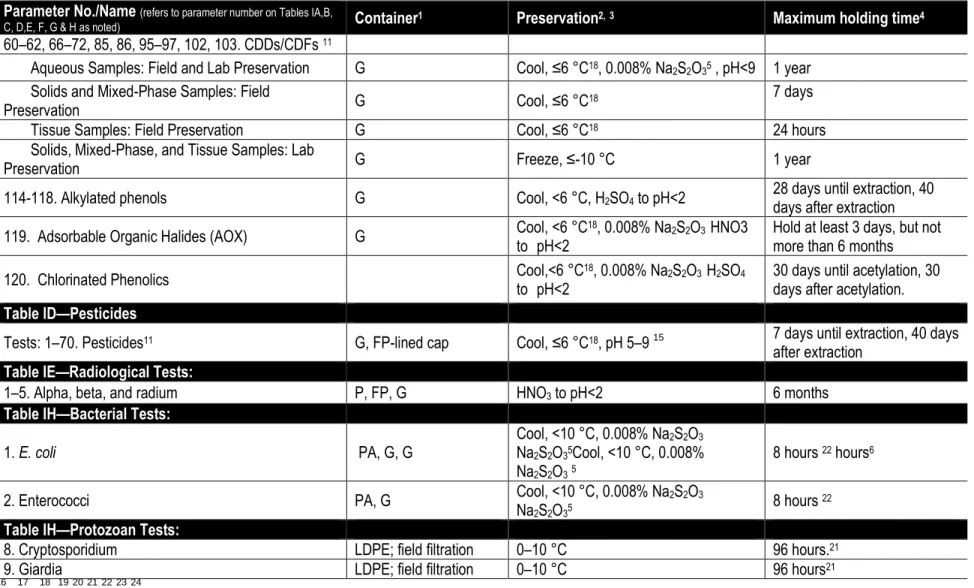
60–62, 66–72, 85, 86, 95–97, 102, 103. CDDs/CDFs 11
Aqueous Samples: Field and Lab Preservation G Cool, ≤6 °C18, 0.008% Na2S2O35 , pH<9 1 year
Solids and Mixed-Phase Samples: Field
Preservation G Cool, ≤6 °C18 7 days
Tissue Samples: Field Preservation G Cool, ≤6 °C18 24 hours
Solids, Mixed-Phase, and Tissue Samples: Lab
Preservation G Freeze, ≤-10 °C 1 year
114-118. Alkylated phenols G Cool, <6 °C, H2SO4 to pH<2 28 days until extraction, 40 days after extraction
119. Adsorbable Organic Halides (AOX) G Cool, <6 °C18, 0.008% Na2S2O3 HNO3
to pH<2 Hold at least 3 days, but not more than 6 months
120. Chlorinated Phenolics Cool,<6 °C18, 0.008% Na2S2O3 H2SO4
to pH<2 30 days until acetylation, 30 days after acetylation. Table lD—Pesticides
Tests: 1–70. Pesticides11 G, FP-lined cap Cool, ≤6 °C18, pH 5–9 15 7 days until extraction, 40 days
after extraction Table IE—Radiological Tests:
1–5. Alpha, beta, and radium P, FP, G HNO3 to pH<2 6 months
Table IH—Bacterial Tests:
1. E. coli PA, G, G Cool, <10 °C, 0.008% NaNa2S2O35Cool, <10 °C, 0.008% 2S2O3
Na2S2O35
8 hours 22 hours6
2. Enterococci PA, G Cool, <10 °C, 0.008% NaNa 2S2O3
2S2O35 8 hours
22 Table IH—Protozoan Tests:
8. Cryptosporidium LDPE; field filtration 0–10 °C 96 hours.21
9. Giardia LDPE; field filtration 0–10 °C 96 hours21
16
, 17 , 18 192021222324
1 ‘‘P’’ is polyethylene; ‘‘FP’’ is fluoropolymer (polytetrafluoroethylene (PTFE; Teflon®), or other fluoropolymer, unless stated otherwise
in this Table II; ‘‘G’’ is glass; ‘‘PA’’ is any plastic that is made of a sterlizable material (polypropylene or other autoclavable plastic); ‘‘LDPE’’ is low density polyethylene.
2
Except where noted in this Table II and the method for the parameter, preserve each grab sample within 15 minutes of collection. For a composite sample collected with an automated sampler (e.g., using a 24-hour composite sampler; see 40 CFR 122.21(g)(7)(i) or 40 CFR Part 403, Appendix E), refrigerate the sample at ≤6 °C during collection unless specified otherwise in this Table II or in the method(s). For a composite sample to be split into separate aliquots for preservation and/or analysis, maintain the sample at ≤6 °C, unless specified otherwise in this Table II or in the method(s), until collection, splitting, and preservation is completed. Add the preservative to the sample container prior to sample collection when the preservative will not compromise the integrity of a grab sample, a composite sample, or an aliquot split from a composite sample; otherwise, preserve the grab sample, composite sample, or aliquot split from a composite sample within 15 minutes of collection. If a composite measurement is required but a composite sample would compromise sample integrity, individual grab samples must be collected at prescribed time intervals (e.g., 4 samples over the course of a day, at 6-hour intervals). Grab samples must be analyzed separately and the concentrations averaged.
Alternatively, grab samples may be collected in the field and composited in the laboratory if the compositing procedure produces results equivalent to results produced by arithmetic averaging of the results of analysis of individual grab samples. For examples of laboratory compositing procedures, see EPA Method 1664A (oil and grease) and the procedures at 40 CFR 141.34(f)(14)(iv) and (v) (volatile organics).
3
When any sample is to be shipped by common carrier or sent via the U.S. Postal Service, it must comply with the Department of Transportation Hazardous Materials Regulations (49 CFR Part 172). The person offering such material for transportation is
responsible for ensuring such compliance. For the preservation requirements of Table II, the Office of Hazardous Materials, Materials Transportation Bureau, Department of Transportation has determined that the Hazardous Materials Regulations do not apply to the following materials: Hydrochloric acid (HCl) in water solutions at concentrations of 0.04% by weight or less (pH about 1.96 or greater); Nitric acid (HNO3) in water solutions at concentrations of 0.15% by weight or less (pH about 1.62 or greater); Sulfuric acid (H2SO4) in water solutions at concentrations of 0.35% by weight or less (pH about 1.15 or greater); and Sodium hydroxide (NaOH) in water solutions at concentrations of 0.080% by weight or less (pH about 12.30 or less).
4
Samples should be analyzed as soon as possible after collection. The times listed are the maximum times that samples may be held before the start of analysis and still be considered valid. Samples may be held for longer periods only if the permittee or monitoring laboratory has data on file to show that, for the specific types of samples under study, the analytes are stable for the longer time, and has received a variance from the Regional Administrator under Sec. 136.3(e). For a grab sample, the holding
Table FS1000-4
40 CFR Part 136 TABLE II: Required Containers, Preservation Techniques, and Holding Times*
Applicable to all Non-Potable Water Samples (includes wastewater, surface water, and groundwater)
time begins at the time of collection. For a composite sample collected with an automated sampler (e.g., using a 24-hour composite sampler; see 40 CFR 22.21(g)(7)(i) or 40 CFR part 403, Appendix E), the holding time begins at the time of the end of collection of the composite sample. For a set of grab samples composited in the field or laboratory, the holding time begins at the time of collection of the last grab sample in the set. Some samples may not be stable for the maximum time period given in the table. A permittee or monitoring laboratory is obligated to hold the sample for a shorter time if it knows that a shorter time is necessary to maintain sample stability. See 136.3(e) for details. The date and time of collection of an individual grab sample is the date and time at which the sample is collected. For a set of grab samples to be composited, and that are all collected on the same calendar date, the date of collection is the date on which the samples are collected. For a set of grab samples to be composited, and that are collected across two calendar dates, the date of collection is the dates of the two days; e.g., November 14 – 15. For a composite sample collected automatically on a given date, the date of collection is the date on which the sample is collected. For a composite sample collected automatically, and that is collected across two calendar dates, the date of collection is the dates of the two days; e.g., November 14 - 15. For static-renewal toxicity tests, each grab or composite sample may also be used to prepare test solutions for renewal at 24 h, 48 h, and/or 72 h after first use, if stored at 0 –6 °C, with minimum headspace.
5 ASTM D7365-09a specifies treatment options for samples containing oxidants (e.g., chlorine). Also, Section 9060A of Standard
Methods for the Examination of Water and Wastewater (20th and 21st editions) addresses dechlorination procedures.
6 Sampling, preservation and mitigating interferences in water samples for analysis of cyanide are described in ASTM D7365-09a.
There may be interferences that are not mitigated by the analytical test methods or D7365-09a. Any technique for removal or suppression of interference may be employed, provided the laboratory demonstrates that it more accurately measures cyanide through quality control measures described in the analytical test method. Any removal or suppression technique not described in D7365-09a or the analytical test method must be documented along with supporting data.
7 For dissolved metals, filter grab samples within 15 minutes of collection and before adding preservatives. For a composite sample
collected with an automated sampler (e.g., using a 24-hour composite sampler; see 40 CFR 122.21(g)(7)(i) or 40 CFR Part 403, Appendix E), filter the sample within 15 minutes after completion of collection and before adding preservatives. If it is known or suspected that dissolved sample integrity will be compromised during collection of a composite sample collected automatically over time (e.g., by interchange of a metal between dissolved and suspended forms), collect and filter grab samples to be composited (footnote 2) in place of a composite sample collected automatically.
8
9
If the sample is not adjusted to pH 2, then the sample must be analyzed within seven days of sampling.
10
The pH adjustment is not required if acrolein will not be measured. Samples for acrolein receiving no pH adjustment must be analyzed within 3 days of sampling.
11 When the extractable analytes of concern fall within a single chemical category, the specified preservative and maximum holding
times should be observed for optimum safeguard of sample integrity (i.e., use all necessary preservatives and hold for the shortest time listed). When the analytes of concern fall within two or more chemical categories, the sample may be preserved by cooling to ≤6 °C, reducing residual chlorine with 0.008% sodium thiosulfate, storing in the dark, and adjusting the pH to 6–9; samples preserved in this manner may be held for seven days before extraction and for forty days after extraction. Exceptions to this optional preservation and holding time procedure are noted in footnote 5 (regarding the requirement for thiosulfate reduction), and footnotes 19, 20
(regarding the analysis of benzidine).
12 If 1, 2-diphenylhydrazine is likely to be present, adjust the pH of the sample to 4.0 ± 0.2 to prevent rearrangement to benzidine. 13 Extracts may be stored up to 30 days at <0
⁰ C.
14 For the analysis of diphenylnitrosamine, add 0.008% Na
2S2O3 and adjust pH to 7–10 with NaOH within 24 hours of sampling
15 The pH adjustment may be performed upon receipt at the laboratory and may be omitted if the samples are extracted within 72
hours of collection. For the analysis of aldrin, add 0.008% Na2S2O3.
16 Place sufficient ice with the samples in the shipping container to ensure that ice is still present when the samples arrive at the
laboratory. However, even if ice is present when the samples arrive, immediately measure the temperature of the samples and confirm that the preservation temperature maximum has not been exceeded. In the isolated cases where it can be documented that this holding temperature cannot be met, the permittee can be given the option of on-site testing or can request a variance. The request for a variance should include supportive data which show that the toxicity of the effluent samples is not reduced because of
Table FS1000-4
40 CFR Part 136 TABLE II: Required Containers, Preservation Techniques, and Holding Times*
Applicable to all Non-Potable Water Samples (includes wastewater, surface water, and groundwater)
the increased holding temperature. Aqueous samples must not be frozen. Hand-delivered samples used on the day of collection do not need to be cooled to 0 to 6⁰C prior to test initiation.
17
Samples collected for the determination of trace level mercury (<100 ng/L) using EPA Method 1631 must be collected in tightly-capped fluoropolymer or glass bottles and preserved with BrCl or HCl solution within 48 hours of sample collection. The time to preservation may be extended to 28 days if a sample is oxidized in the sample bottle. A sample collected for dissolved trace level mercury should be filtered in the laboratory within 24 hours of the time of collection. However, if circumstances preclude overnight shipment, the sample should be filtered in a designated clean area in the field in accordance with procedures given in Method 1669. If sample integrity will not be maintained by shipment to and filtration in the laboratory, the sample must be filtered in a designated clean area in the field within the time period necessary to maintain sample integrity. A sample that has been collected for
determination of total or dissolved trace level mercury must be analyzed within 90 days of sample collection.
18 Aqueous samples must be preserved at ≤6 °C, and should not be frozen unless data demonstrating that sample freezing does not
adversely impact sample integrity is maintained on file and accepted as valid by the regulatory authority. Also, for purposes of NPDES monitoring, the specification of ‘‘≤°C’’ is used in place of the ‘‘4 °C’’ and ‘‘< 4 °C’’ sample temperature requirements listed in some methods. It is not necessary to measure the sample temperature to three significant figures (1/100th of 1 degree); rather, three significant figures are specified so that rounding down to 6 °C may not be used to meet the ≤6 °C requirement. The preservation temperature does not apply to samples that are analyzed immediately (less than 15 minutes).
19 An aqueous sample may be collected and shipped without acid preservation. However, acid must be added at least 24 hours
before analysis to dissolve any metals that adsorb to the container walls. If the sample must be analyzed within 24 hours of collection, add the acid immediately (see footnote 2). Soil and sediment samples do not need to be preserved with acid. The allowances in this footnote supersede the preservation and holding time requirements in the approved metals methods.
20 To achieve the 28-day holding time, use the ammonium sulfate buffer solution specified in EPA Method 218.6. The allowance in
this footnote supersedes preservation and holding time requirements in the approved hexavalent chromium methods, unless this supersession would compromise the measurement, in which case requirements in the method must be followed.
21 Holding time is calculated from time of sample collection to elution for samples shipped to the laboratory in bulk and calculated
22
Sample analysis should begin as soon as possible after receipt; sample incubation must be started no later than 8 hours from time of collection.
23 For fecal coliform samples for sewage sludge (biosolids) only, the holding time is extended to 24 hours for the following sample
types using either EPA Method 1680 (LTB-EC) or 1681 (A-1): Class A composted, Class B aerobically digested, and Class B anaerobically digested.
24 The immediate filtration requirement in orthophosphate measurement is to assess the dissolved or bio-available form of
orthophosphorus (i.e., that which passes through a 0.45-micron filter), hence the requirement to filter the sample immediately upon collection (i.e., within 15 minutes of collection).
Table FS 1000-5
Approved Water and Wastewater Procedures, Containers, Preservation and Holding Times
For Analytes not Found in 40 CFR 136*
Analyte Methods Reference 1 Container2 Preservation3 Maximum Holding Time4
Bromine DPD Colorimetric5 SM 4500-Cl-G P, G None required Analyze immediately
Bromates Ion Chromatography EPA 300.0 6 P, G Cool 4°C 30 days
Chlorophylls Spectrophotometric SM 10200 H P, G7
Dark 4°C
Filtered, dark, -20°C
48 hours chilled until filtration8, and analyze immediately or
48 hours chilled until filtration8,and 28 days (frozen)after filtration
Corrosivity Calculated (CaCO3 Stability, Langelier Index) SM 2330 ASTM D513-92 P, G Cool 4°C 9 7 days9
Cyanotoxin ELISA and LC/MSMS FP, G Cool 6°C16 7 days until extraction, 40 days after extraction
FL-PRO Gas Chromatography DEP (11/1/95)18 G, PTFE lined cap
only
Cool 4°C, H2SO4 or HCl
to pH<2
7 days until extraction, 40 days after extraction
Odor Human Panel SM 2150 G only Cool 4°C 6 hours
Salinity Electrometric 10 Hydrometric10 SM 2520 B SM 2520 C G, wax seal Analyze immediately
or use wax seal 30 days
10
Taste Human Panel SM 2160 B, C, D
ASTM E679-91 G only Cool 4°C 24 hours
Total Dissolved Gases Direct-sensing
Membrane-diffusion SM 2810 __________ ___________ Analyze in-situ
Total Petroleum
Hydrocarbons Gravimetry EPA 1664
17
G only Cool 4°C, Hto pH<2 2SO4 or HCl 28 days
Transparency Irradiometric11 62-302.200(6), FAC __________ ___________ Analyze in-situ
Un-ionized Ammonia Calculated12 DEP-SOP13 P, G Cool 4°C
Na2S2O312
8 hours unpreserved 28 days preserved 12
Organic Pesticides14 GC and HPLC EPA (600-series) 14 15 15 15 16
1
SM XXXX = procedures from "Standard Methods for the Examination of Water and Wastewater"; see Standard Methods Online (http://www.standardmethods.org/store/). Reference methods are listed for informational purposes only.
ASTM XXXX-YY = procedure from "Annual Book of ASTM Standards", Water and Environmental Technology, Volumes 11.01 and 11.02 (Water I and II). See American Society for Testing and Materials (ASTM International), http://www.astm.org/Standard/index.shtml. Reference methods are listed for informational purposes only.
2
P = plastic, G = glass.
3
When specified, sample preservation should be performed immediately upon sample collection.
4
The times listed are the maximum times that samples may be held before analysis and still be considered valid.
5
The approved procedure is for residual chlorine. However, in the absence of chlorine, the DPD colorimetric procedure can be adapted to measure bromine content of the sample. In such case, the validity of this assumption must be verified by using another procedure for chlorine which is not affected by the presence of bromine (i.e., negligible interference).
6 “
The Determination of Inorganic Anions in Water by Ion Chromatography", EPA Method 300.0, Revision 2.1,, Revised August 1993, by John D. Pfaff, U. S. EPA Cincinnati, Ohio 45268. Reference methods are listed for informational purposes only.
7
Collect samples in opaque bottles and process under reduced light. A secondary device, such as a Van Dorn/Niskin or bucket, may be used to collect the sample and then expeditiously transfer into an opaque bottle.
8
Samples must be filtered within 48 hours of collection. Add magnesium carbonate to the filter while the last of the sample passes through the filter.
9
Temperature and pH must be measured on site at the time of sample collection. 7 days is the maximum time for laboratory analysis of total alkalinity, calcium ion and total solids.
10
The electrometric and hydrometric analytical methods are suited for field use. The argentometric method is suited for laboratory use. Samples collected for laboratory analysis, when properly sealed with paraffin waxed stopper, may be held indefinitely. The maximum holding time of 30 days is recommended as a practical regulatory limit.
11
Transparency in surface waters is defined as a compensation point for photosynthetic activity, i.e., the depth at which one percent of the light intensity entering at the water surface remains unabsorbed. The DEP Chapter 62-302, FAC requires that the light intensities at the surface and subsurface be measured simultaneously by irradiance meters such as the Kahlsico Underwater Irradiometer, Model No. 268 WA 310, or an equivalent device having a comparable spectral response.
12
The results of the measurements of pH, temperature, salinity (if applicable) and the ammonium ion concentration in the sample are used to calculate the concentration of ammonia in the unionized state. Temperature, pH and salinity must be measured on-site at the time of sample collection. Laboratory analysis of the ammonium ion concentration should be conducted within eight hours of sample collection. If prompt analysis of ammonia is impossible, preserve samples with H2SO4 to pH between 1.5 and 2. Acid-preserved samples, stored at 4°C, may be held up to 28 days for ammonia determination.
Sodium thiosulfate should only be used if fresh samples contain residual chlorine.
13
Calculation ofUn-ionized Ammonia in Fresh Water, Chemistry Laboratory Methods Manual, Florida Department of Environmental Protection, Revision 2, 2/12/2001. The document is available from the DEP Standards & Assessment Section. Reference method listed for informational purposes only.
14
Other pesticides listed in approved EPA methods (608.1, 608.2, 614, 614.1, 615, 617, 618, 619, 622, 622.1, 627, 629, 631, 632, 632.1, 633, 642, 643, 644 and 645) that are not included in Table ID of 40 CFR Part 136.3 (7-1-13 Edition). Reference methods and CFR citation listed for informational purposes only.
Table FS 1000-5
Approved Water and Wastewater Procedures, Containers, Preservation and Holding Times
For Analytes not Found in 40 CFR 136*
15
Container, preservation and holding time as specified in each individual method must be followed.
16
Sample preservation procedures, container material and maximum allowable holding times for analytes not specified in DEP-SOP-001/01 (March 1, 2014) shall follow the preservation, container and holding time requirements specified in the selected analytical method. If no method-specified requirements exist, the best available scientific knowledge shall be used as guidance for determining the appropriate procedures for use, per 62-160.400(2), F.A.C.
17
Method 1664, n-Hexane Extractable Material (HEM; Oil and Grease) and Silica Gel Treated n-Hexane Extractable Material (SGT-HEM; Non-polar Material) by Extraction and Gravimetry. Revision A, February 1999. EPA-821-R-98-002, and, Revision B, February 2010. EPA-821-R-10-001. Reference methods listed for informational purposes only.
18
Volatile Organics Purge-and-Trap GC and
GC-MS 8015, 8260, 8021, 5035
See Table 1000-7
Semivolatile Organics GC, HPLC, and GC-MS
8041, 8061, 8070, 8081, 8082, 8091, 8111, 8121, 8131, 8141, 8151, 8270, 8275, 8280, 8290, 8310, 8315, 8316, 8318, 8321, 8325, 8330, 8331, 8332, 8410, 8430, 8440, FL-PRO, MADEP, TPHWG
Glass, 8 oz widemouth with
Teflon® -Lined lid Cool ≤6°C
1 14 days until extraction,
40 days after extraction
Dioxins 8290 Amber Glass, 8 oz widemouth
with Teflon® -Lined lid
Cool ≤6°C1
in dark
30 days until extraction, 45 days after extraction Total Metals-except
mercury and chromium VI methods
Flame AA, Furnace AA, Hydride and ICP
All 7000-series (except 7195, 7196, 7197, 7198, 7470 and 7471), 6010 (ICP) and 6020 (ICP)
Glass or plastic 8 oz widemouth (200 grams sample) None 6 months Chromium VI Colorimetric, Chelation with Flame AA (200 gram sample) 7196 and 7197 (prep 3060) Glass or plastic, 8 oz
widemouth (200 gram sample) Cool 4°± 2°C
1
1 month until extraction, 4 days after extraction 2
Mercury Manual Cold Vapor AA 7471
Glass or plastic 8 oz widemouth (200 grams sample)
Cool 4°± 2°C1 28 days
Microbiology (MPN) MPN Sterile glass or plastic Cool ≤6°C1 24 hours
Aggregate Properties Glass or plastic Cool ≤6°C1
14 days Inorganic nonmetallics
all except: Cyanide
Sulfite, Nitrate, Nitrite & ο-phosphate Elemental Phosphorus Glass or plastic Cool ≤6°C1 28 days 14 days --- 48 hours 48 hours Glass or plastic Glass or plastic Glass
Table FS 1000-6
Recommended Sample Containers, Sample Volumes, Preservation Techniques and Holding Times for Residuals, Soil and Sediment Samples
The term “residuals” include: (1) sludges of domestic origin having no specific requirements in Tables FS-1000-4 or FS-1000-9; (2) sludges of industrial origin; and (3) concentrated waste samples.
1Keep soils, sediments and sludges cool at ≤6°C from collection time until analysis. No preservation is required for concentrated waste samples. 2
Storage Temperature is 4°C, ±2°C
* Reference method numbers are listed for informational purposes only and are found in SW-846, Test Methods for Evaluating Solid Waste, Physical/Chemical Methods (http://www.epa.gov/epawaste/hazard/testmethods/sw846/online/index.htm), except for the additional informational method sources listed below: FL-PRO - Method for Determination of Petroleum Range Organics, Revision 1, November 1, 1995, Florida Department of Environmental Protection
MADEP – Method for the Determination of Extractable Petroleum Hydrocarbons (EPH), Revision 1.1, May 2004, Massachusetts Department of Environmental Protection
MPN – Microbiological test methods utilizing Most Probable Number procedures TPHWG - TPH Working Group Series
Conc.
Level Sampling Device
Collection
Procedure* Type Vial Preparation* Preservation Sample Preparation*
Max HT Determinative Procedure^ ≤200
ug/kg
Coring Device 5035 - Section 6.2.1 Glass Vial w/ PTFE-silicone Septum 5035 - 6.1.1 NaHSO4 / 4ºC (see 5035 – 6.4.3)
5035 - Section 7.2.3 14 D Any recognized VOC Method (see 5035 – 7.2) ≤200
ug/kg
Coring Device 5035 - Section 6.2.1
Glass Vial w/ PTFE-silicone Septum
5035 - 6.1.1 4ºC 5035 - Section 7.2.3 48 H Any recognized VOC Method (see 5035 – 7.2) ≤200
ug/kg
Coring Device 5035 - Section 6.2.1
Glass Vial w/ PTFE-silicone Septum
5035 - 6.1.1 4ºC / -10ºC, 5035 - Section 7.2.3 48 H / 14 D
Any recognized VOC
Method (see 5035 – 7.2) ≤200
ug/kg
EnCore or equivalent 5035 - Section 6.2.1
EnCore or
equivalent 5035 - 6.1.1
,,
4ºC 5035 - Section 7.2.3 48 H Any recognized VOC Method (see 5035 – 7.2) ≤200
ug/kg
EnCore or equivalent 5035 - Section 6.2.1 EnCore or equivalent 5035 - 6.1.1 , NaHSO4 / 4ºC (see 5035 – 6.4.3) 5035 - Section 7.2.3
48 H / 14 D Any recognized VOC Method (see 5035 – 7.2)
≤200 ug/kg
EnCore or equivalent 5035 - Section 6.2.1
EnCore or
equivalent 5035-6.1.1 4ºC / -10ºC, 5035 - Section 7.2
48 H / 14 D Any recognized VOC Method (see 5035 – 7.2) >200
ug/kg
EnCore or equivalent 5035 - Section 6.2.2.3
EnCore or
equivalent 5035 - 6.1.3
, 4ºC 5035 - Sections 7.3.2 & 7.3.3
48 H / 14 D Any recognized VOC Method (see 5035 – 7.3) >200
ug/kg
Coring Device 5035 - Section 6.2.2.3 Glass Vial w/ PTFE-silicone Septum 5035 - 6.1.3 Methanol/PEG + 4ºC
5035 - Section 7.3.4 14 D Any recognized VOC Method (see 5035 – 7.3) >200
ug/kg8
Conventional Devices DEP SOP - Section 5.
Glass w/ PTFE-silicone Septum
5035 - 6.1.2 4ºC 5035 - Sections 7.3.1 - 7.3.3
14 D Any recognized VOC Method (see 5035 – 7.3) Oily
Waste
Conventional Devices 5035 - Section 6.2.4.2
Glass w/ PTFE-silicone Septum
5035 - 6.1.4 4ºC 5035 - Sections 7.4.1 - 7.4.2
14 D Any recognized VOC Method (see 5035 – 7.4) Oily
Waste
Conventional Devices 5035 - Section 6.2.4.1
Glass w/ PTFE-silicone Septum
5035 - 6.1.4 Methanol/PEG + 4ºC
5035 - Sections 7.4.3 14 D Any recognized VOC Method (see 5035 – 7.4) Dry Wt. Conventional Devices 5035 - Sections
6.2.1.6, 6.2.2.7,
Table FS 1000-7
Sample Handling, Preservation and Holding Time Table for SW 846 Method 5035*
6.2.3 liner
Soil Screen
Conventional Devices 5035 - Sections 6.2.1.6, 6.2.3
Glass w/ PTFE-silicone Septum
5035 – 4.4.1 4ºC 5035 - Section 7.1 14 D Any recognized VOC Method (see 5035 – 7.1)
1
Maximum time allowable from time/date of collection to sample analysis.
2
Eliminate 6.1.1.2; use only organic-free water.
3
Contents of sampling device must be transported to the laboratory at 4ºC and stored at -10ºC.
4
In order to ensure that vials do not break during freezing, they should be stored on their side or at a slanted angle to maximize surface area.
5
Maximum allowable time at 4ºC is 48 hours; maximum allowable time to sample analysis is 14 days (from time of sample collection).
6
Conducted in the laboratory.
7
Entire contents of sampling device are extruded into the sample analysis vial containing the appropriate solvent.
8
Procedures are limited only to those situations or programs in which the maximum contamination level does not exceed 200 ug/kg.
9
Methanolic preservation in the field is not recommended, but may be used if approved by DEP for a project.
*See method 5035 in SW-846, Test Methods for Evaluating Solid Waste, Physical/Chemical Methods (http://www.epa.gov/epawaste/hazard/testmethods/sw846/online/index.htm) and DEP SOP FS 3000, Soil, in DEP-SOP-001/01, 9/19/12.
MICROBIOLOGICAL-BACTERIA Cool < 10°C, Na2S2O3 P or G
Total Coliforms, fecal coliforms & E. coli in drinking water Cool < 10°C6, Na
2S2O35 30 Hours7 P or G
Total coliforms and fecal coliforms in source water
Heterotrophic bacteria in drinking water Cool < 10°C, Na2S2O35 8 hours P or G Gross Alpha Conc. HCl or HNO<2 8,9 3 to pH 6 mo P or G
Gross beta Conc. HCl or HNO to pH <28,9 6 mo P or G Strontium-89 Conc. HCl or HNO to pH <28,9 6 mo P or G Strontium-90 Conc. HCl or HNO to pH <28,9 6 mo P or G Radium-226 Conc. HCl or HNO to pH <28,9 6 mo P or G Radium-228 Conc. HCl or HNO to pH <28,9 6 mo P or G Cesium-134 Concentrated HCl to pH <<28,9 6 mo P or G
Iodine-131 None 8 days P or G
Tritium None 6 months G
Uranium Conc. HCl or HNO<28,9 3 to pH 6 mo P or G Photon emitters Conc. HCl or HNO<28,9 3 to pH 6 mo P or G
Asbestos Cool 4°C 48 hours P or G
Bromate Ethylenediamine (50mg/L) 28 days P or G Cyanide Cool, 4C, Ascorbic acid (if chlorinated), NaOH pH>12 14 days P or G
Nitrate Cool, 4°C 48 hours P or G
Nitrate (chlorinated source) Cool, 4°C 14 days P or G
Odor Cool 4°C 24 hours G
502.2
Sodium Thiosulfate or Ascorbic Acid, 4°C HCl pH<2 if Ascorbic Acid is used
FS 1000-8
Preservation Methods and Holding Times for Drinking Water Samples that Differ from 40 CFR Part 136, Table II Analyte or EPA Method Number* Preservation1 Holding Time2 Holding Time for
Extract3 Container
4
504.1 Sodium Thiosulfate Cool, 4°C, 14 days 4°C, 24 hours Glass with PFTE-Lined Septum 505 Sodium Thiosulfate Cool, 4°C 14 days (7 days for Heptachlor) 4°C, 24 hours Glass with PFTE-Lined Septum 506 Sodium Thiosulfate Cool, 4°C, Dark 14 days 4°C, dark, 14 days Amber Glass with PFTE-lined Cap 507 Sodium Thiosulfate Cool, 4°C, Dark 14 days (see method for
exceptions)
4°C, dark, 14 days Amber Glass with PFTE-lined Cap 508 Sodium Thiosulfate Cool, 4°C, Dark 7 days (see method for
exceptions) 4°C, dark, 14 days Glass with PFTE-lined Cap 508A Cool, 4°C 14 days 30 days Glass with PFTE-lined Cap 508.1 Sodium Sulfite, HCl pH<2, Cool, 4°C 14 days (see method for
exceptions) 30 days Glass with PFTE-lined Cap 515.1 Sodium Thiosulfate Cool, 4°C, Dark 14 days 4°C, dark, 28 days Amber Glass with PFTE-lined Cap 515.2 Sodium Thiosulfate HCl pH<2, Cool, 4°C, Dark 14 days ≤ 4°C, dark, 14 days Amber Glass with PFTE-lined Cap 515.3 Sodium Thiosulfate HCl pH<2, Cool, 4°C, Dark 14 days ≤ 4°C, dark, 14 days Amber Glass with PFTE-lined Cap 515.4
Sodium Sulfite, HCl pH<2, Cool, ≤10°C for first 48 hours ≤6°C thereafter, Dark
14 days ≤0°C, 21 days
524.2 Ascorbic Acid, HCl pH<2, Cool 4°C 14 days Glass with PFTE-lined Septum 525.2 Sodium Sulfite, Dark, Cool, 4°C, HCl pH<2 14 days (see method for
exceptions)
≤ 4°C, 30 days from
collection Amber Glass with PFTE-lined Cap 531.1, 6610 Sodium Thiosulfate Monochloroacetic acid,
pH<3, Cool, 4°C
Cool 4°C, 28
days Glass with PFTE-lined Septum 531.2 Sodium Thiosulfate, Potassium Dihydrogen
547 Sodium Thiosulfate Cool, 4°C 14 days (18 mo. frozen) Glass with PFTE-lined Septum 548.1 Sodium Thiosulfate (HCl pH 1.5-2 if high biological
activity), Cool, 4°C, Dark 7 days ≤4°C 14 days
Amber Glass with PFTE-lined Septum
549.2
Sodium Thiosulfate (H2SO4 pH<2 if
biologically active), Cool, 4°C, Dark
7 days 21 days High Density Amber Plastic or Silanized Amber Glass
550, 550.1 Sodium Thiosulfate Cool, 4°C, HCl pH<2 7 days 550, 30 days 550.1, 40 days
Dark, 4°C Amber Glass with PFTE-lined Cap 551.1 Sodium Thiosulfate, Sodium Sulfite, Ammonium Chloride, pH 4.5-5.0 with phosphate buffer, Cool, 4°C
14 days Glass with PFTE-lined Septum
552.1 Ammonium chloride, Cool, 4°C, Dark 14 days ≤4°C, dark 48 hours Amber Glass with PFTE-lined cap 552.2 Ammonium chloride, Cool, 4°C, Dark 14 days ≤4°C, dark 7 days ≤-10°C 14 days Amber Glass with PFTE-lined cap 555 Sodium Sulfite, HCl, pH ≤ 2, Dark, Cool 4°C 14 days Glass with PFTE-lined cap 1613B Sodium Thiosulfate, Cool, 0-4°C, Dark Recommend 40 days Amber Glass with PFTE-lined Cap
1 Preservation, when required, must be done immediately upon sample collection. 2
Stated values are the maximum regulatory holding times. Sample processing must begin by the stated time.
3
Stated time is the maximum time a prepared sample extract may be held before analysis.
4
(P) polyethylene or (G) or glass. For microbiology, plastic sample containers must be made of sterilizable materials (poly-propylene or other autoclavable plastic).
5
Addition of sodium thiosulfate is only required if the sample has a detectable amount of residual chlorine, as indicated by a field test using EPA Method 330.4 or 330.2 or equivalent.
FS 1000-8
Preservation Methods and Holding Times for Drinking Water Samples that Differ from 40 CFR Part 136, Table II
6
Temperature requirement applies only to source water samples, however once received by the laboratory, if sample processing does not begin on the same working day, samples must be refrigerated.
7
If samples are analyzed after 30 hours, but within 48 hours of collection, the laboratory is to indicate in the analytical report that the data may be invalid because of excessive delay in sample processing. No samples received after 48 hours are to be accepted or analyzed for compliance with the regulations of the Department of Environmental Protection or the Department of Health.
8
It is recommended that the preservative be added at the time of collection unless suspended solids activity is to be measured. It is also recommended that samples be filtered, if suspended or settleable solids are present, prior to adding preservative, at the time of collection. However, if the sample has to be shipped to a laboratory or storage area, acidification of the sample (in its original container) may be delayed for a period not to exceed 5 days. A minimum of 16 hours must elapse between acidification and analysis.
9
If HCl is used to acidify samples, which are to be analyzed for gross alpha or gross beta activities, the acid salts must be converted to nitrate salts before transfer of the samples to planchets.
*Dechlorinate bulk samples when applicable
ANALYTE NAME CONTAINER PRESERVATION MAX HOLDING TIME
Fecal Coliform Plastic or Glass Cool 4°C 24 hours Salmonella Plastic or Glass < 10°C 24 hours Enteric Viruses Plastic or Glass Up to 25°C 2 hours Enteric Viruses Plastic or Glass 2 to 10°C 48 hours
Specific Oxygen Uptake
Rate Plastic or Glass None As Soon As Possible
Helminth OVA Plastic or Glass < 4°C (Do not Freeze) 24 hours Cryptosporidium/Giardia Plastic or Glass 0 - 10°C (Do not Freeze)* 96 Hours Total Solids Plastic or Glass ≤6°C (Do not Freeze) 7 days
Metallics Plastic or Glass See Tables FS 1000-4, FS 1000-5 and FS 1000-6 Other Inorganic Pollutants Plastic or Glass See Tables FS 1000-4, FS 1000-5 and FS 1000-6
Table FS 1000-10
Container Materials, Preservation, and Holding Times for Fish and Shellfish
Analyte Matrix Sample Container Field (Transport to Lab) Laboratory
Preservation Maximum Shipping Time Storage Holding Time Whole Organism (Fish, shellfish, etc.
Foil-wrap each organism (or composite for shellfish) and transport in waterproof plastic bag
Cool in wet ice or: _ _ _ _ _ _ _ _ _ _ _ Freeze on dry ice
24 hours
_ _ _ _ _ _ _ _ _ _ _ 48 hours
Mercury Tissue (fillets and edible portions, homogenates) Plastic, borosilicate glass, quartz, PTFE Freeze at <-20°C 1 year Other metals Tissue (fillets and edible portions, homogenates) Plastic, borosilicate glass, quartz, PTFE Freeze at <-20°C 6 months Organics Tissue (fillets and edible portions, homogenates) Borosilicate glass, PTFE, quartz, aluminum foil Freeze at <-20°C 1 year Dioxin Tissue (fillets and edible portions, homogenates) Amber containers: Borosilicate glass, PTFE, quartz, aluminum foil Freeze at <-20°C extraction, 15 days 30 days until
after extraction Lipids Tissue (fillets and edible portions, homogenates) Plastic, borosilicate glass, quartz, PTFE Freeze at <-20°C 1 year
Holding Time (Days)
From: Field Collection To: SPLP or TCLP Extraction From: SPLP or TCLP Extraction To: Preparative Extraction From: Preparative Extraction To: Determinative AnalysisTotal Elapsed Time
Volatiles Semi-Volatiles Mercury
Metals, except Mercury 14 14 28 180 NA 7 NA NA 14 40 28 180 28 61 56 360 NA – Not Applicable