Development of A Real-Time Business Intelligence (BI) Framework based on Hex-Elementization of Data Points for Accurate Business Decision-Making.
Girish Nair
Doctor of Philosophy, 2019
PRIMARY SUPERVISOR: Professor Yi-Chen Lan, Western Sydney University, Sydney, Australia SECONDARY SUPERVISOR: Professor Bhuvan Unhelkar, University of South Florida, Sarasota-Manatee, Florida, USA.
Western Sydney University School of Business
Enhancing Business Decision-making using Hex-Elementization - Nair
Dedication
I dedicate this thesis to my father, who passed away 25 years ago, while doing his Ph.D. This is for you papa.
Acknowledgment
I would like to first acknowledge my teachers (supervisors). Thank you Prof Yi-Chen your guidance, support and encouragement during my candidature. Thank you in believing in me and taking me under your umbrella. A special thanks to Prof Bhuvan. He said this is going to be a character-building exercise, and what an exercise this has been. Thank you for providing the appropriate nudge at appropriate times. Thank you for all your guidance to ease this journey.
Secondly, I thank my mentor and manager Nigel. Thank you for being patient with me and letting me off work on those innumerable Fridays. Thank you for believing in me. I thank him and my colleagues at work for not asking any tough questions regarding my thesis.
I personally thank James Harris and Colleen Berish for kindly reviewing and painfully reading this thesis. Thank you for making this research read well!
I am grateful to my mother for providing me with the upbringing, which was the source of inspiration, resilience and hard-work needed to complete this journey. Finally, I thank my loving wife, Anju. Her strong belief in me, unconditional love and support has sustained me throughout this journey. I am sorry to my son Ralph and daughter Norah for staying away from them to work on this thesis.
Enhancing Business Decision-making using Hex-Elementization - Nair
Statement of Authenticity
I, Girish Nair, declare that this thesis is submitted in accordance with the requirements of the award of Doctor of Philosophy, in the School of Business, Western Sydney University, and the work presented in this thesis is, to the best of my knowledge and belief, original except as acknowledged in the text.
I hereby declare that I have not submitted this material, either in full or in part, for a degree at this or any other institution.
Girish Nair Candidate --- Signature 15-June-2019 --- Date
Abstract
The desire to use business intelligence (BI) to enhance efficiency and effectiveness of business decisions is neither new nor revolutionary. The promise of BI is to provide the ability to capture interrelationship from data and information to guide action towards a business goal. Although BI has been around since the 1960s, businesses still cannot get competitive information in the form they want, when they want and how they want. Business decisions are already full of challenges. The challenges in business decision-making include the use of a vast amount of data, adopting new technologies, and making decisions on a real-time basis. To address these challenges, businesses spend valuable time and resources on data, technologies and business processes. Integration of data in decision-making is crucial for modern businesses. This research aims to propose and validate a framework for organic integration of data into business decision-making. This proposed framework enables efficient business decisions in real-time. The core of this research is to understand and modularise the pre-established set of data points into intelligent and granular “hex-elements” (stated simply,
hex-element is a data point with six properties). These intelligent hex-elements build semi-automatic relationships using their six properties between the large volume and high-velocity data points in a dynamic, automated and integrated manner. The proposed business intelligence framework is called “Hex-Elementization” (or “Hex-E” for short).
Evolution of technology presents ongoing challenges to BI. These challenges emanate from the challenging nature of the underlying new-age data characterised by large volume, high velocity and wide variety. Efficient and effective analysis of such data depends on the business context and the corresponding technical capabilities of the organisation. Technologies like Big
Enhancing Business Decision-making using Hex-Elementization - Nair
Data, Internet of Things (IoT), Artificial Intelligence (AI) and Machine Learning (ML), play a key role in capitalising on the variety, volume and veracity of data. Extricating the “value” from
data in its various forms, depth and scale require synchronizing technologies with analytics and business processes.
Transforming data into useful and actionable intelligence is the discipline of data scientists. Data scientists and data analysts use sophisticated tools to crunch data into information which, in turn, are converted into intelligence. The transformation of data into information and its final consumption as actionable business intelligence is an end-to-end journey. This end-to-end transformation of data to intelligence is complex, time-consuming and resource-intensive.
This research explores approaches to ease the challenges the of end-to-end transformation of data into intelligence. This research presents Hex-E as a simplified and semi-automated framework to integrate, unify, correlate and coalesce data (from diverse sources and disparate formats) into intelligence. Furthermore, this framework aims to unify data from diverse sources and disparate formats to help businesses make accurate and timely decisions.
Keywords: Business Intelligence, Data Integration, Hex-Elementization, Hex-E, Organic
Business Intelligence, Automated Business Intelligence, Business Intelligence Framework, Big Data, Artificial Intelligence, Business Decision-making
Table of Contents
ABSTRACT ...I TABLE OF CONTENTS ... III TABLE OF FIGURES ... VII TABLE OF TABLES ...IX ABBREVIATIONS ...X
CHAPTER 1: INTRODUCTION ... 1
RESEARCH CASE ...1
RESEARCH PROBLEM STATEMENT ...4
RESEARCH OBJECTIVES ...6
PHILOSOPHICAL BACKGROUND OF HEX-ELEMENTIZATION ...7
RESEARCH QUESTIONS ... 11
RESEARCH OUTLINE ... 13
THE JOURNEY FROM DATA TO KNOWLEDGE TO INTELLIGENCE ... 17
THE 7TH DIMENSION AND BIG DATA... 20
THEORETICAL CONTRIBUTION AND PRACTICAL CONTRIBUTION ... 23
Theoretical Contribution ... 24
Practical Contribution ... 25
CHAPTER 2: LITERATURE REVIEW ... 26
INTRODUCTION TO THE LITERATURE REVIEW ... 26
DECISION-MAKING IN THE BIG DATA ERA ... 31
DATA-DRIVEN DECISION-MAKING ... 33
SIX DEGREES OF SEPARATION (INFORMATION THEORY) ... 37
QUANTUM INFORMATION THEORY – GREG JAEGER ... 40
THE ZACHMAN ISAFRAMEWORK (1987 AND 1992) ... 42
Enhancing Business Decision-making using Hex-Elementization - Nair
EA3CUBE FRAMEWORK -SCOTT BERNARD ... 46
BUSINESS INTELLIGENCE... 50
Unstructured Data ... 52
DECISION-MAKING IN THE AGE OF ARTIFICIAL INTELLIGENCE ... 59
Artificial Intelligence as a disruption or enabler for decision-making ... 65
THE ROLE OF DATA AND CONTEXT IN DECISION-MAKING ... 74
The journey of a Context-Based Data Point ... 81
The Granularity of Data, Analytics, and Processes ... 82
SUMMARY ... 87
CHAPTER 3: RESEARCH METHODOLOGY ... 91
THE RELEVANCE OF RESEARCH METHOD TO THIS RESEARCH ... 91
AMIXED-METHOD APPROACH... 92
EXPLORATORY SEQUENTIAL DESIGN – THE MIXED METHOD APPROACH ... 93
Phase 1: Exploratory ... 97
Phase 2: Model building ... 100
Phase 3: Validation ... 100
AMETHOD TO CONVERT SUBJECTIVE SURVEY RESPONSES TO QUANTITATIVE MEASURE... 101
Standardisation of data ... 102
Normalisation of data... 103
A METHOD OF FINDING OBJECTIVE PATTERNS USING QUALITATIVE ANALYSIS... 106
Semi-structure Interviews ... 107
Rigorous data analysis using software (NVivo) ... 108
Inductive coding interview responses and structuring themes ... 109
Objectivity, accuracy, transparency, dependability ... 112
Ethical Considerations In This Research ... 114
CHAPTER 4: DATA COLLECTION AND ANALYSIS3 ... 116
INTRODUCTION ... 116
Quantitative Method ... 116
Qualitative Method of data collection ... 120
DATA ANALYSIS ... 129
Part 1: Quantitative Analysis of survey data ... 129
Part 2: Qualitative Data Analysis of the semi-structured interview ... 178
VALIDATION OF RESEARCH QUESTIONS ... 240
Validation of Participants ... 241
Validation of Research Questions and Findings ... 242
CHAPTER 5: CONCLUSIONS AND FUTURE DIRECTION ... 261
THEORETICAL CONTRIBUTION AND PRACTICAL CONTRIBUTION ... 261
Theoretical Contribution ... 261
Practical Contribution ... 262
CONCLUSIONS... 263
LIMITATIONS &CHALLENGES OF HEX-ELEMENTIZATION ... 267
New Form of Unstructured data ... 267
IoT Node Interface, Communication Protocols and Channels, and Hex-E ... 267
Heterogeneity of IoT ... 268
Pull or Push Architecture?... 269
FUTURE DIRECTION... 270
3-Dimensional Hex-E ... 270
IoT and Hex-E ... 272
IoT, Big Data and Hex-E ... 274
Artificial Intelligence and Hex-E ... 279
Managing Risks in Decision-Making ... 285
Blockchain and Hex-E ... 299
Implementation of Hex-E ... 302
APPENDICES ... 309
Enhancing Business Decision-making using Hex-Elementization - Nair
Appendix 2: Ethics Approval ... 310
Appendix 3: Participant Information Sheet ... 312
Appendix 4: Participant Consent form ... 316
Appendix 5: Interview Questions ... 318
Table of Figures
FIGURE 1: THE CONCEPT OF HEX-ELEMENTIZATION ...3
FIGURE 2: HEX-ELEMENT WITH SIX ATTRIBUTES AND SIX SIDES ... 10
FIGURE 3: TWO HEX-ELEMENTS CONNECTING USING COMMON PROPERTY... 10
FIGURE 4: KNOWLEDGE FLOW IN HEX-ELEMENTIZATION ... 19
FIGURE 5: CORRELATION PROCESS BETWEEN HEX-ELEMENTS AND THE 7TH PROPERTY OUT OF COMMONALITY ... 20
FIGURE 6: HEX-ELEMENTS WHEN CONNECTED FORMS A TIGHT AND EFFICIENT STRUCTURE ... 21
FIGURE 7: CRITICAL THINKING PROCESS OF LITERATURE REVIEW (MACHI &MCEVOY,2016) ... 28
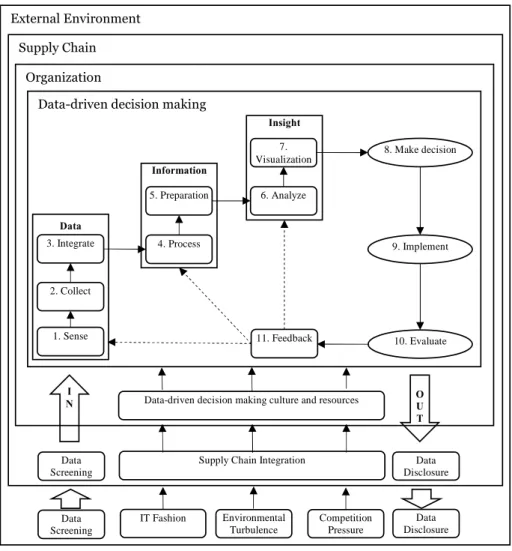
FIGURE 8: DATA-DRIVEN DECISION-MAKING FRAMEWORK (JIA,SONG,HALL,2015) ... 36
FIGURE 9: ILLUSTRATION OF 2 OUT OF THE 6 DEGREES OF INFORMATION-FLOW ... 37
FIGURE 10: ZACHMAN’S FRAMEWORK OF ENTERPRISE ARCHITECTURE (ZACHMAN,1992) ... 42
FIGURE 11: SPEWAK'S ARCHITECTURE OF ENTERPRISE ARCHITECTURE (ZACHMAN,SPEWAK,&HILL,1992) ... 44
FIGURE 12: EA3 MODEL (BERNARD,2012) ... 46
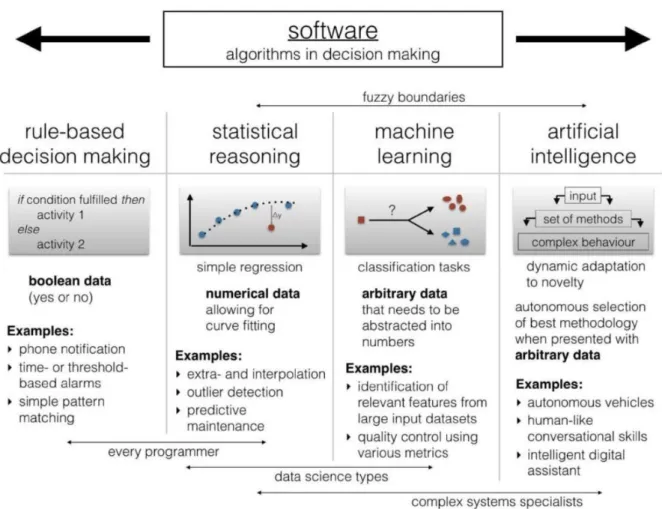
FIGURE 13: EVOLUTION OF SOFTWARE AND ITS APPLICATIONS (FULCHER,2008) ... 60
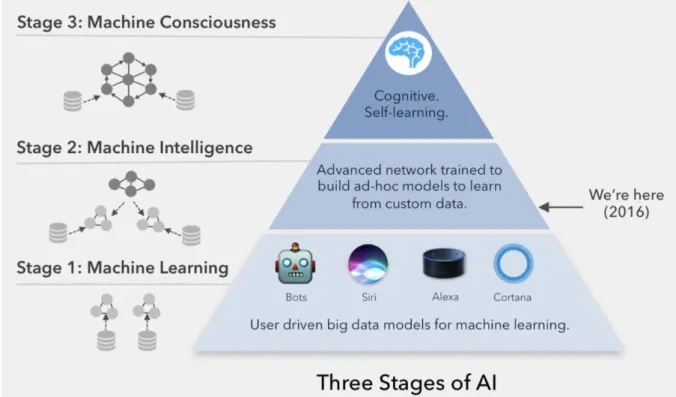
FIGURE 14: THREE STAGES OF AI (PAKA,2016) ... 69
FIGURE 15: HOW BUSINESSES ARE ADOPTING AI - MCKINSEY SURVEY (BUGHIN, ET AL.,2017) ... 71
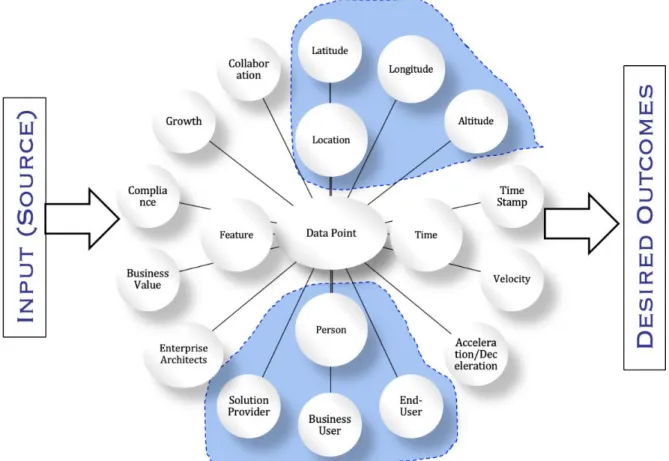
FIGURE 16: DATA POINT AND THE CONTEXT (UNHELKAR,2017) ... 75
FIGURE 17: CONTEXTUAL WRAPPING AROUND HEX-ELEMENTIZATION ... 80
FIGURE 18:JOURNEY OF DATA-POINT VIA CONTEXT ENGINE &ANALYTIC ENGINE THE FEEDBACK LOOP (UNHELKAR,2017) ... 82
FIGURE 19: DATA ANALYTIC PROCESSES BASED ON GRANULARITY (ADAPTED FROM UNHELKAR,2017) ... 83
FIGURE 20: THE EXPLORATORY SEQUENTIAL DESIGN ... 95
FIGURE 21: RESEARCH PROCESS FLOW ... 96
FIGURE 22: COMPONENTS OF DATA ANALYSIS: AN INTERACTIVE MODEL (MILES,HUBERMAN,&SALDANA,2014) ... 121
FIGURE 23: GEOGRAPHICAL DIVERSITY OF THE SURVEY RESPONDENTS (COURTESY GOOGLE MAPS)... 131
FIGURE 24: BREAKDOWN OF SURVEY PARTICIPANTS BY EXPERIENCE ... 135
FIGURE 25: BREAKDOWN OF PARTICIPANTS BY MANAGEMENT LEVEL ... 137
FIGURE 26: PARTICIPANT RESPONSES ON “HOW IMPORTANT IS DATA IN DECISION-MAKING.” ... 140
Enhancing Business Decision-making using Hex-Elementization - Nair
FIGURE 28: PARTICIPANTS RESPONSE TO THE LAG IN THE DATA AND ITS IMPACT ON DECISION-MAKING ... 145
FIGURE 29: SURVEY RESPONSES ON THE QUALITY OF DATA THEY RECEIVE ... 147
FIGURE 30: RESPONSES ON WHETHER CONTEXT GETS LOST AMIDST A HUGE QUANTITY OF DATA ... 149
FIGURE 31: SURVEY RESPONSE ON THE LOSS OF CONTEXT BY MANAGEMENT LEVEL ... 150
FIGURE 32: VARIOUS CHALLENGES FACED BY SURVEY PARTICIPANTS WITH EXISTING DATA ... 151
FIGURE 33: SURVEY RESPONSE ON WHETHER UNSTRUCTURED DATA CAN ASSIST IN DECISION-MAKING ... 154
FIGURE 34: SURVEY RESPONSE ON THE PERCEIVED BENEFIT OF HEX-E FRAMEWORK ... 157
FIGURE 35: PRINCIPAL COMPONENT ANALYSIS PROCESS ... 162
FIGURE 36: LINEAR PROJECTION OF PRINCIPAL COMPONENTS ... 165
FIGURE 37: REGRESSION ANALYSIS OF COMPOSITE SURVEY RESPONSE SET 1 ... 172
FIGURE 38: REGRESSION ANALYSIS OF COMPOSITE SURVEY RESPONSE SET 2 ... 175
FIGURE 39: WORD FREQUENCY CHART USING ALL RESPONSES ... 191
FIGURE 40: MIND MAP OF DECISION-MAKING AS A NODE ... 194
FIGURE 41: THE ITERATIVE PROCESS OF CREATING METADATA BASED ON CONTEXT ... 202
FIGURE 42: WORD TREE FOR THE NODE "TIME" ... 221
FIGURE 43: 3D RENDERING OF "HEX-ELEMENTS" IN THE FORM OF A HEXAGONAL PRISM ... 270
FIGURE 44: TRUNCATED OCTAHEDRON ... 271
FIGURE 45: HEX-ELEMENTIZATION AS A MECHANISM FOR CONTEXT OF A DATA POINT IN AN IOT ENVIRONMENT ... 274
FIGURE 46: CONCEPTUAL FRAMEWORK OF HEX-E + A.I. LAYER ... 281
FIGURE 47: RENDERING OF HEX-E WITH NEURAL NETWORKS ... 282
FIGURE 48: IMPLEMENTATION OPTIONS OF HEX-E BOTH AS A SET OF PROTOCOLS OR "AS-A-SERVICE" ... 304
FIGURE 49: AN EXAMPLE HEX-ELEMENT FROM A SMARTWATCH AND HOW IT FINDS A COMMON THREAD WITH A HEALTH MONITOR ... 307
Table of Tables
TABLE 1: EXAMPLE PROPERTIES OF HEX-ELEMENTS FROM THREE DEVICES ... 21
TABLE 2: DECISION MATRIX - AN EXAMPLE ... 61
TABLE 3: CONTEXT PARAMETERS A DATA-POINT (CASH AMOUNT) VIS-A-VIE BUSINESS OUTCOMES ... 77
TABLE 4: SAMPLE RESPONSE FOR A GIVEN QUESTION A FROM RESPONDENT AA ... 105
TABLE 5: SAMPLE RESPONSE FOR A GIVEN QUESTION B FROM RESPONDENT AA ... 105
TABLE 6: SAMPLE AGGREGATION OF THE TWO QUESTIONS FROM RESPONDENT AA ... 105
TABLE 7: TABLE SHOWING PARTICIPANT INFORMATION – INCLUDING THE DURATION OF EACH INTERVIEW ... 122
TABLE 8: BREAKDOWN OF SURVEY PARTICIPANTS BY INDUSTRY AND EXPERIENCE LEVEL ... 133
TABLE 9: CORRELATION MATRIX OF STANDARDISED RESPONSES... 163
TABLE 10: SAMPLE TRANSFORMATION AND STANDARDISATION OF RESPONSES ... 169
TABLE 11: PHASES AND ASSOCIATED STAGES OF THEMES FROM QUALITATIVE CONTENT AND THEMATIC ANALYSIS ... 181
TABLE 12: EXAMPLES OF CODING (POLIT &BECK 2010) ... 182
TABLE 13: TABLE OF WORDS MOST FREQUENTLY USED IN THE INTERVIEWS ... 186
TABLE 14: DISTRIBUTION OF COST IN TRADITIONAL BI (ANALYTICS,2007) ... 205
Enhancing Business Decision-making using Hex-Elementization - Nair
Abbreviations
No. Abbreviation Definition
1 AI Artificial Intelligence
2 BA Business Analysis
3 BI Business Intelligence
4 CAQDAS Computer-Assisted Qualitative Data Analysis Software
5 CEO Chief Executive Officer
6 CIO Chief Investment Officer
7 COO Chief Operating Officer
8 CRM Customer Relationship Management
9 DA Decomposition Analysis
10 DSS Decision Support System
11 EA Enterprise Architecture
12 EAP Enterprise Architecture Planning
13 EIS Executive Information System
14 ERP Enterprise Resource Planning
15 EU European Union
16 GDPR General Data Protection Regulation
17 HaaS Hex-E as a Service
18 Hex-E Hex-Elementization
19 HPC High Performance Computing
20 HR Human Resources
21 IDC International Data Corporations
22 IoT Internet of Things
23 IPA interpretative phenomenological analysis (IPA)
24 KPI Key Performance Indicators
25 MIS Management Information System
26 ML Machine Learning
27 NLP Natural Language Processing
28 OLAP Online Analytical Processing
29 PCA Principal Component Analysis
30 ROE Return on Effort
31 ROI Return on Investment
32 RTBI Real-Time Business Intelligence
33 SMM Social Media Marketing
Chapter 1:
INTRODUCTION
Research Case
Business decision-making is full of challenges. These challenges emanate from the nature of the underlying data - primarily its sheer volume, velocity, and variety. Analysis of such data depends on the outcomes desired by the business and the technical capabilities of the organisation to process that data. The challenge is further complicated with the rapid evolution of technologies such as Big Data, Internet of Things (IoT) and Artificial Intelligence (AI). For example, when business organisations examined the social media giant Facebook, it was not immediately clear how the platform would help generate sales and revenue (Vieira, Costa, de Almeida, Costa, & Coelho, 2018). The value of Facebook, as later realised, is in the value of the information gathered about its users. In other words, the business value is a lot more than the overt data collection by an organisation. Extricating value from the data in its various forms, depth, and scale requires multiple disciplines of technologies, analytics and business processes to work together (Unhelkar, 2017). Transforming this data into useful and actionable intelligence is the capability of data scientists and data analysts. These data professionals make use of sophisticated analytical tools to transform data into information and intelligence. This end-to-end transformation of data to intelligence is complex, time-consuming and resource-intensive.
This research explores approaches to ease this end-to-end data to intelligence transformation. The research suggests a simplified and semi-automated framework, called Hex-Elementization, to help integrate, correlate and coalesce data into intelligence in real-time to help accurate decision-making. The research proposes a framework which helps
Enhancing Business Decision-making using Hex-Elementization - Nair
integrate data into intelligence. The vision of this framework enables efficient business decisions in real-time, and with limited resources and time. Furthermore, the framework aims to unify data from diverse sources and disparate formats.
The core of this research is to modularise the pre-established set of data points into intelligent
and granular “hex-elements”. These hex-elements enable integrated and semi-automatic relationship-building between the large volume and high-velocity data points. The purpose of this relationship-building in data is to help businesses extract context-based insights which directly helps in decision-making. The proposed business intelligence framework is called
“Hex-Elementization” also abbreviated as “Hex-E”.
Integrated relationship-building requires that each data point is well-defined, modularised and open to connecting with other data points. Finding, correlating, connecting, and coalescing relationships between disparate data and information sets lead to real-time business intelligence. To achieve this objective, this research illustrates the inherent limitations of the existing way of connecting data points from diverse forms (e.g., text, multimedia and mixed format) in a business environment. The data challenges for businesses today include large volumes (Petabytes), high velocity (giga-bytes per second) and wide varieties (text, machine sensors, audio, graphics, videos and mixed). Data, disparate in content and medium, needs to be correlated in a meaningful manner to enhance decision-making. This data integration not only facilitates accurate decision-making but also enables agility in decision-making (Unhelkar, 2013). Enabling these data points to coalesce semantically is not possible with human capacity due to the sheer size and quantity of data.
Machine-to-machine interaction (Semantic Web) and automated-relationship forming are essential in creating actionable insights within a short time.
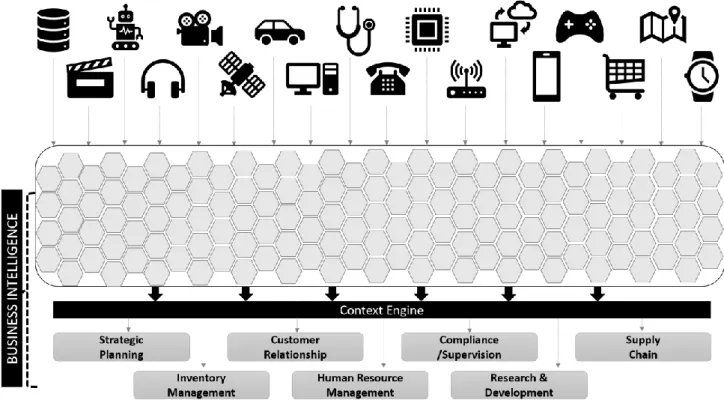
Figure 1 shows how datasets from disparate sources of data pass through the Hex-Elementization process to create generic hex-elements. These hex-elements are further used to connect, coalesce and correlate data to form meaningful information. The Context Engine translates the goals from the different entities the organisation deals with to the data available post the Hex-Elementization process.
Figure 1: The concept of Hex-Elementization
Thus, the research addresses challenges that include breaking down data complexity from various sources to form atomic level basic data points, automatically connecting data based on context and enabling real-time decision-making by businesses. The research objectives are explained in the next section.
Enhancing Business Decision-making using Hex-Elementization - Nair
Research Problem Statement
The problem statement in the context of the proposed research is briefly explained below. The problem covers on what do we already know, what do we need to know, why do we know it, and what will the research do to find out.
Data is taking a centre stage in decision-making. Organisations are turning towards a more data-driven approach when it comes to decision making. However, data is constantly evolving as the variety, velocity, volume and veracity changes. Most of the organisations are not aware of the fact that they already capture a lot of data. Extracting intelligence from this data will help them make timely and accurate decisions.
This research addresses the current difficulty in extracting intelligence in real-time due to the complexity inherent in data. This research proposes a methodology called Hex-Elementization which aims to break down data into the most granular form with six unique characteristics. The process of Hex-Elementization aims to break down the data to a common denominator to help correlate, coalesce and connect disparate data sets to enable extracting business intelligence. This extraction of business intelligence is proposed to be contextual driven in this business-intelligence framework.
Organisations make decisions all the time. These organisations need a mechanism to extract business intelligence on a real-time basis. Currently, the business intelligence frameworks are pull-based in which organisational stakeholders define their business goals and aims. Then an army of business analysts, programmers, database administrators along with sophisticated analytical tools, work together to translate business goals into identifiable
technical actions to be applied to the data they have. This entire end-to-end journey, from defining business goals to getting insights, takes time and resources. This research proposed a methodology which aims to ease this journey of data into intelligence.
The research will first aim to understand the challenges business stakeholders in varied industries face in trying to extract intelligence to make optimal business decisions. Then the research will aim to propose a model which can be applied in various organisations along with other technologies to help extract business intelligence on a real-time basis.
Enhancing Business Decision-making using Hex-Elementization - Nair
Research Objectives
Based on the previous discussion, the main objectives of this research are summarised as follows.
1. Examine the relationship between data and the challenges of real-time business
decision-making.
This objective examines various types of data used in a corporate environment and how the data is used in decision-making. The aim is to understand if enough granularity is embedded in the data for business to make optimal business decisions. The challenges in decision-making include the need for accuracy, time available to make the decisions and the level of granularity required. The impact of delay in making decisions due to the lack of data or uncorrelated information is studied in this research. Also, the benefit of a real-time solution for business insights is investigated in detail in this research.
2. Develop a framework that enables data sets to connect, correlate and coalesce without
intermediary processes or human intervention.
This objective is explored by understanding how the data, and the information emanating from it, flows through the organisation, processes and people. The aim of this research objective is to understand, through existing frameworks (i.e., in Literature Review), how disparate information connects to help generate insights. The impact of data on processes and people is also explored here.
3. Develop a conceptual Hex-Elementization platform in which data correlation occurs
symbiotically in processes based on the inherent nature of things.
This objective explores a set of protocols, in Enterprise Architecture platforms, to find an optimal way of organically relating data sets. The conceptual Hex-E platform is based on
the premise that each data point is defined in the most optimal way through its six parameters.
4. Explore the impact of Hex-Elementization on various business competencies, and
contextual-based decision.
This objective is examined by understanding how businesses pull data and information. When businesses explicitly demand (pull) data and information, they first need to know what they are looking for. While a push-based system (such as Hex-Elementization) provides data, information and intelligence to the business based on pre-defined rules or context. Whether contextual-based information, pushed through a framework, is viable through Hex-Elementization framework, is the main explorative aim of this research. This research also investigates the practicality and impact of information flow on business structure and enterprise architecture.
5. Develop Hex-Elementization based on business context and desired outcomes rather
than entirely on data-analytics.
This objective is examined by understanding how businesses can benefit from a decision-making approach based on context, as compared to decisions based entirely on pre-defined business rules.
Philosophical Background of Hex-Elementization
Business intelligence is not a new concept. The desire to use BI to enhance efficiency, effectiveness and tactical business decisions has been around since the advent of computers. With the introduction of Big Data and IoT (Nair & Lan, 2016), there is a need to re-think the way BI is applied. The organisational challenges in real-time decision-making include resources needed to analyse the data in ever-shortening time periods.
Enhancing Business Decision-making using Hex-Elementization - Nair
Hex-Elementization proposes a platform enabling disparate datasets to communicate with each other in real-time based on the context in which businesses make decisions. The Hex-Elementization model aims to help businesses configure the platform to suit the context in which decisions are made. The Hex-Elementization model aims to find a way to make data, and information from this data, connect organically relative to the business context. Businesses only need to provide the context required for decision-making, and Hex-E responds with the information derived from various datasets seamlessly to businesses, relative to this context. Hex-Elementization begins with the premise that the optimal way to describe each data point is through six attributes or characteristics. Therefore, an essential
question in developing this platform is “Why Hex or six sides? “. According to Schneider, every natural pattern of growth or movement inevitably conforms to one or more simple geometric types (Schneider, 2003). Schneider further articulates numbers, shapes and their patterns symbolise omnipresent principles, including wholeness, polarity, structure, balance, cycles, rhythm and harmony, from the most basic building blocks and growth patterns. Furthermore, in surprising ways, multiples of six, particularly twelve, thirty-six, and sixty emerge as a natural framework in mathematics, nature, the symbolic arts and everyday affairs (Schneider, 2003).
The hexagon, as a shape, is found in many basic structures. For example, honeycombs and ice crystals have six sides; and even the recently discovered strong element, graphene, (Ball, 2016) has six sides. The hexagonal shape is trusted by nature. Nature finds this structure helpful, effective and efficient. For example, hexagonal cells of beehives package the maximum space using the least materials, energy and time (Schneider, 2003).
One reason for this harmony is that hex structures lend themselves to the tight knitting of a variety of configurations with the most distinct attributes (Ball, 2016). Other shapes (e.g., octagonal) also lend themselves to configurations, but they quickly start becoming less efficient. This lack of efficiency could be the result of the effort required to select and connect the right properties, or attributes, from the shapes or data points. Conversely, less complicated shapes like squares or triangles limit the number of attributes that can be used to describe a data point resulting in limited effectiveness in connecting. Thus, the hexagon seems to be ideal for integration. Laplace, the famous French astronomer and mathematician said, “All the effects of nature are only the mathematical consequences of a small number of
immutable laws” (Laplace, 1921).
The hexagon is a geometrical shape that promises to integrate easily with other hexagonal shapes. By defining data points with six properties, the Hex-Elementization platform can help configure or unify multiple elements more easily than other ways of defining data. The first step is to break the complex and disparate set of data available to businesses into an atomic piece of data. Each data is then described with six distinct attributes or properties. These attributes are used to connect, coalesce and correlate a data point with another data point in real-time under the Hex-E umbrella.
Hex-element is the most basic part of the overall process of Hex-Elementization. Conceptually, a hex-element is a data element defined by six unique properties or attributes. A hex-element is not a byte or bit, data record or an address in the computer’s registry. Hex-element is an outcome of a group of characteristics, in this case, six. Hex-Hex-element is an embodiment of six attributes which uniquely identify an intelligible part of data which enables
Enhancing Business Decision-making using Hex-Elementization - Nair
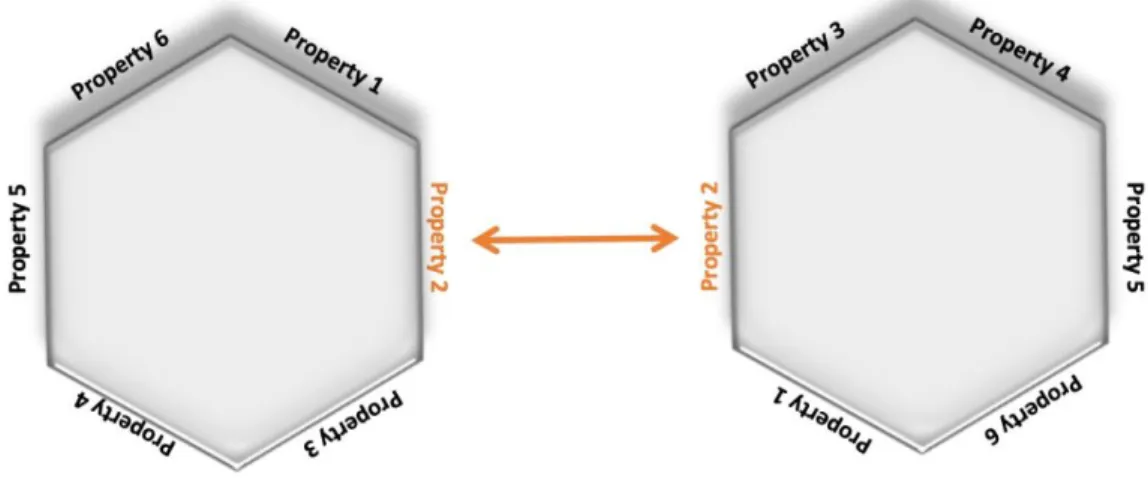
coalescence when combined with other hex-elements. Figure 2 shows how a hex-element renders itself with six properties or characteristics.
Two hex-elements can connect based on matching properties (see Figure 3). This matching is the essence of the Hex-Elementization process in which disparate atomic data, as denoted by hex-elements, form relationships based on common and shared properties.
Figure 3: Two hex-elements connecting using common property
The discussion until now presents the concept of Hex-Elementization. The next section presents the research questions.
Research Questions
1. Businesses have access to the vast amount of data that is continuously growing. Businesses extract some information snippets from this data based on available tools and processes. There is a need for businesses to transform this data into information and subsequently into intelligence. How do businesses prepare themselves to utilise data? This will help in answering the first Research Objective 1 – as highlighted below.
Examine the relationship between data and the challenges of real-time business
decision-making.
2. What are the challenges in creating and utilising business intelligence in understanding the current state of the business and how can this business intelligence be used to undertake business transformation? How do businesses enable intelligent decision-making in real-time by streamlining their data ecosystem and creating rapid correlations between otherwise unrelated data sets? This research question is aimed to help achieve the research outcome described below.
Develop a conceptual Hex-Elementization platform in which data correlation occurs
symbiotically in processes based on the inherent nature of things.
3. How does the increased use of unstructured data impact decision-making? How will developments in data science augment decision-making?
4. Is the battle of Quality vs Quantity of data more prominent in an environment in which data science is being incorporated in every known industry? How does the Quality vs. Context continuum survive in such a changing environment?
Develop Hex-Elementization based on business context and desired outcomes rather than entirely on data-analytics.
Enhancing Business Decision-making using Hex-Elementization - Nair
5. What are the various business risks associated with the effort to connect, coalesce and correlate datasets that produce intelligence for business to help with real-time decisions? This research question is aimed to help answer the research objectives below.
- Explore the impact of Hex-Elementization on various business competencies, and contextual-based decision.
- Develop Hex-Elementization based on business context and desired outcomes rather than entirely on data-analytics
Research Outline
Improving decision-making within a corporate environment is a result of considering as many factors as possible (Kakkar & Gordon, 2018). A key factor in decision-making is the value provided by data. Literature indicates that defining an entity with six elements provides maximum value in integration (Schneider, 2003). This research explores a hexagonal mapping for data and its impact on decision-making.
The six sides of a hexagon make it possible to create rich extendible structures. The richness of hexagonal structures is also extremely malleable (Ball, 2016), resulting in the potential to apply these hexagonal structures to a wide-ranging set of problems and challenges. For example, hexagonal structures can be valuable in robotics, supply chains, financial markets and health care. When nano-robots are tasked to merge and form bigger, unified structures, then the most granular part of this structure must be in the shape of hexagons
The concepts of economics are applicable to data utilisation as well. Economics within technology deals with demand and supply of data and intelligence. For example, there is a continuous wave of data (i.e., supply), however the consumption of data (i.e., demand) is lagging. This lag is attributed to the limited ability of businesses to extract information and insights as fast as the data arrives. Business need to consume data surpasses the need to consume everyday goods and services. This need continues to rise as technology advances. The only difference is there will not be any supply constraints when it comes to data and information (Lan & Unhelkar, 2005). When it comes to data, the traditional concepts of economics will eventually fail because supply exceeds demand. Despite this, data is becoming increasingly expensive (Brynjolfsson & McAfee, 2014). Hex-Elementization is envisaged to fill
Enhancing Business Decision-making using Hex-Elementization - Nair
in this gap between the supply and demand of the data. Hex-Elementization lays the foundation for a framework which can help escalate the connection between different data sets on a real-time basis. This concept reduces the time it takes to relate data and extract information.
The problem of integration becomes evident, even if the data consumption is accelerated. This is because integration is not just confined to one kind of data. Instead, there is a need to integrate data in various forms, including music, e-books, and business strategy (Lan & Unhelkar, 2005). Integration is important in the digital age. Economist Shapiro states that in the next phase of the human-technical evolution, long-held economic principles and economic law will be challenged. Abundance will become the norm rather than scarcity (Guerriero, 2019). Every industry is experiencing this exponential increase of data in different formats. This exponential growth in size and type of data makes it hard to analyse it mainly because the new data does not fit in relational databases. Silo-based integration is the assimilation of data within the same silo – or type of medium (for example, integrating Microsoft Office files or merging two MP3 files). Businesses need a generic framework which can read from different formats of data and work around their volume.
One of the reasons for the Global Financial Crisis (2007-2008) was the mountain of complex financial instruments, so disparate in structure and format that no central system could simplify them to an understandable format. Lack of understanding, and the associated lack of transparency can create complex systems which are hard to manage without adequate controls. Hex-Elementization aims to create a platform which is data-format agnostic. Consider for example, an investment banking organisation that needs to understand the
information flow and knowledge control (Lan & Unhelkar, 2005). There are risks associated with this investment banking business, including credit risk, compliance oversight, and liquidity risks. A platform like Hex-Elementization can help this investment bank correlate non-linear data trends in various formats, frequency and volume, and make it easy to understand and incorporate data in various forms. As James Rickards succinctly puts forth;
“the next financial collapse will resemble nothing in history” (Rickards, 2014).
Processes capture data and information about the persons, places, things and events discovered while conducting business (Unhelkar, 2012). This needs to be current and of value. For example, one can tap into resources (mostly from the Internet) on what kind of food is healthy for humans relative to age, gender, and any medical condition. However, what is needed are more current properties (information) that make this data and information relevant to the person rather than another quality rating (of good or bad). “We do not need data on what is good, but information on what is better and relevant for us” (Nair & Lan, 2016). For that to happen, it is crucial to combine the existing information – which already exists in a different form – with new and fresh information providing the context. The array of permutations and combinations for customers using services takes the process of globalisation and data integration to an altogether different level (Lan & Unhelkar, 2005). To enable access to this rich dimension of data and relate it to the context of the user, Hex-Elementization proposes the use of Artificial Intelligence (AI), Machine Learning (ML) and Neural Networks (NN). The use of ML and NN can help find automated relationships and predict various dimensions of information from the same set of data for businesses to gain a 360-degree view of their operating landscape.
Enhancing Business Decision-making using Hex-Elementization - Nair
The volume, variety, and velocity of the data currently managed are unprecedented. By some estimates, the amount of data stored globally, since the year 2000, is ten times larger than any in human history (Brynjolfsson & McAfee, 2014). Every two minutes, the number of photographs uploaded to Instagram, Facebook, Flickr, and Google is more than the combined photographs taken in the entire 19th century (Benzell & Brynjolfsson, 2019). According to economist Brian Arthur, innovation is just combining earlier inventions to put them to practical use (Arthur, 2010).
The nature of information flow has changed. In the past, people received information using visual and tactile cues in brick and mortar shops while buying something. However, technology and the amount of information at hand has changed that behaviour pattern. Majority of consumers, especially Gen-Y type and beyond are tech savvy and subscribe to one or more social media platforms. These consumers start their research on products or services well before they visit a shop. As described by Unhelkar, in a report on the user experience, the understanding of human-business relationships is vital in a densely connected world where the consumers are increasingly Gen-Y type and beyond (Unhelkar, 2016). Unhelkar correctly identifies the fact that the process of decision-making starts way before consumers face the actual system or interface presented by the business (Unhelkar, 2013). In other words, investigating and assimilating data (e.g., prices and model) and information (e.g., quality, shop deals/specials) occurs even before a consumer visits the shops. How do these bits of pre-purchase information, which are not organised or systematically captured, reach the vendors (the businesses, the shop-owners)? How can the vendors gain insights into consumer thinking and shopping patterns while shopping decisions are made? This vendor need is best served through an on-going learning platform. Learning and managing that
learning, is an ongoing activity that should find a place even in the routine, business-as-usual operations of a business (Unhelkar, 2012). Every additional or incremental piece of data and information increases knowledge about customers of any business. More time is increasingly spent finding ways to link and relate data than in making decisions. The proposed model of
“Hex-Elementization” creates a framework to help real integration, linking data and insights, and saves valuable time during the pre-integration phase of decision-making.
The Journey from Data to Knowledge to Intelligence
In practice, the journey from data to intelligence in Hex-Elementization entails creating knowledge-sets through the interaction between various internal business processes such as Enterprise Resource Planning (ERP), Customer Relationship Management (CRM), or Supply Chain Management (SCM), and when these processes interact with external data (e.g., Macro or Third-Party data).
Information within a business organisation can flow from three different sources – 1. An Internal Data Source (ERP, SCM. CRM).
2. Business Inherent Knowledge (Insight, Experience) and
3. External Data Sources (Macro Data, Competition, Third-party Data Sources).
Businesses have previously extracted the information from internal sources (i.e., business processes and departments) to help make tactical decisions. It is only a recent phenomenon that businesses (TDWI, 2018) are getting data and information through third-parties, especially in the form of Big Data. Even if the data always existed, the process of integrating
Enhancing Business Decision-making using Hex-Elementization - Nair
internal data to external data is a resource-intensive process, requiring extra people, time and money.
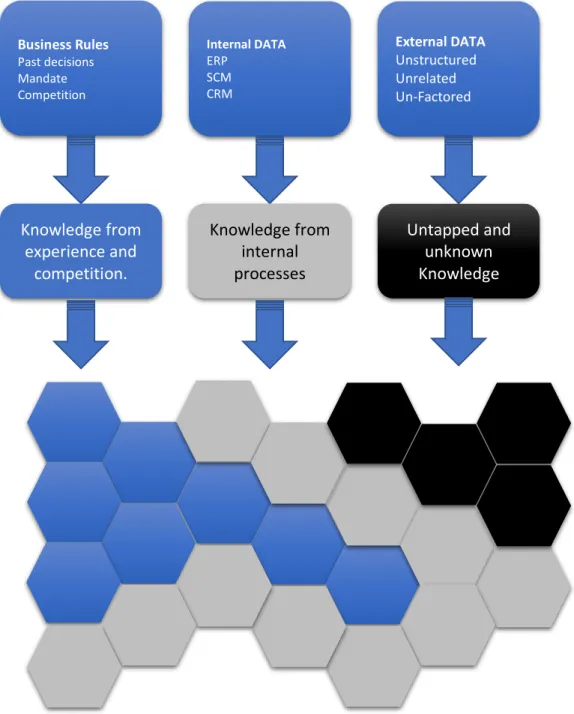
As shown in Figure 4, the flow of internal data through various business processes provides intelligence which could be used to make tactical decisions. The figure shows how the data from internal sources and external sources along with the business rules are introduced to the Hex-E platform to help process it further for decision-making.
Big Data presents businesses with an enormous trove of data previously untapped. Hex-Elementization eases the extraction and integration of internal or external data, unstructured or structured data, and small or big data, to help organisations make timely and accurate business decisions.
Business Rules Past decisions Mandate Competition Internal DATA ERP SCM CRM External DATA Unstructured Unrelated Un-Factored Knowledge from experience and competition. Knowledge from internal processes Untapped and unknown Knowledge
Enhancing Business Decision-making using Hex-Elementization - Nair
The 7th Dimension and Big Data
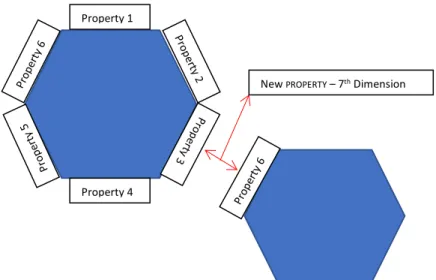
Hex-Elementization also results in an extra property of data as data is connected. The number of hex-element properties exponentially increases upon integration. A hex-element with six properties, when combined with another hex-element with the same number of properties, does not end up having 12 properties, as would be expected by adding two, six-sided figures, but has 13 properties – as shown in Figure 5. So as more hex-elements are combined, the total properties grow exponentially. Similarly, a group of 7 hex-elements, as shown in Figure 6, has a combined property repository of 56 properties rather than the expected value of 42
– a 33% increase in the number of properties. In other words, more information is created when a piece of data integrates with another piece.
The new dimension is the result of the fusion of one of the six hex-dimensions where the properties have something in common. The common thread of these two properties creates a new dimension or a new property. This is referred to as the 7th dimension. The exponential growth in the number of properties when new elements encounter pre-built hex-structures is the main benefit of this structure. The structure also provides tight-knit data elements, as shown in Figure 6.
Property 1
Property 4
New PROPERTY– 7th Dimension
Property (#) Smartphone Smartwatch Heart Sensor
Property 1 GPS Co-ordinate GPS Co-ordinate Pulse
Property 2 Heart rate Heart rate Heart rate
Property 3 Location Time-zone Rhythm
Property 4 Time and Date Routine Variability
Property 5 Health Glucose level Respiration rate
Property 6 Tracking Tracking Temperature
Table 1: Example properties of hex-elements from three devices
Table 1 provides an example set of properties from a hex-element derived from three devices, namely a smartphone, smartwatch and a heart sensor. Each of these properties is one of the six sides of a element. When trying to connect, the common properties across two hex-elements are matched to form a union. For example, the GPS coordinate from both Smartphone and Smartwatch (property 1) is used to create a connection. Property 2, heart rate, is a common property across all the hex-elements. Data from smartphone, smartwatch and heart rate monitor help create a push-based intelligence. For example, when the heart rate of a person rises dramatically, the heart sensor can send a signal to the smartwatch (through Property 2), which in turn can trigger the smartphone to call the emergency services
Enhancing Business Decision-making using Hex-Elementization - Nair
based on its connection with the smartphone using property 2.Thus, hex-elements emerging from various devices coalesce and integrate using common properties between the elements.
Big Data brings in the ability to decode untapped information in a variety of medium of data, which is both a structured and unstructured format. Within these two formats of data, there are innovations made regularly. In the era of the ever-evolving world of Big Data, the greater the quantity of data (Mayer-Schönberger & Cukier, 2014), the bigger the opportunity to gain meaningful information. As data becomes the new factor of production apart from labour, land, and capital, its use in diverse faculties and situations are boundless (Brynjolfsson, 1994). Traditional database concepts and data storing concepts will become obsolete as the volume of the stored data increases.
The web is the default source of information for a lot of basic consumer needs. From school children trying to get help with science projects, to people who are at the highest echelon of their professional career, everyone uses the web in a small or big scale. Content on the web is 95% unstructured (Tanwar, Duggal, & Khatri, 2015). The flow of unstructured data will multiply as innovations and new devices, and the way they communicate, keeps changing. Keeping pace with the ever-growing types of files, music, photos and many other digital formats, is a question that must be answered. Moreover, how can current research make it easier for future generations to integrate and find insights among this ever-increasing disparity between data and its formats?
Hex-Elementization is a potential solution to help form the building blocks of a framework through which disparate, structured and unstructured data, in any volume, can be passed to
help the data integrate, communicate, and extract meaningful information beyond the realms of the original use (Nair & Lan, 2016). For example, when data from a GPS, traffic information, and the meteorological department are easily combined, a car driver not only receives information on the optimal path to reach a destination but also whether any current weather pattern that might make it uncomfortable to drive. The system helps the driver find the best path in terms of proximity to the destination and with less traffic, but also chooses an economical path. It also formulates a route which is best for the car given the wear and tear
forecasted by the weather data. Thus, the car’s Electronic Control Unit (ECU) data integrates
with the GPS coordinates, traffic information, transport department, and the meteorological department.
Big data is not only about the volume of data, but it is also about the complexity of data. In other words, the delay in extracting information from data is in part, because of significant volumes, and the physical or digital incompatibility which exists in current systems. Computers do not need to be bigger or smarter, with powerful chips and larger hard-drives; instead require a framework to better break and integrate the data.
Theoretical Contribution and Practical Contribution
This research contributes to both the academic and business worlds, creating a considerable overlap between the two. The theoretical contribution will help further the research by adding to the knowledge base this model creates at the end of the study. The practical objective deals with the applicability of this work in practice by businesses. The contribution of this research to both academic (theoretical) and practical world are listed below:
Enhancing Business Decision-making using Hex-Elementization - Nair Theoretical Contribution
1. This research provides a business intelligence framework to enable real-time, resource-saving, accurate decision-making in workplaces. The underpinning theory will add to the decision-making theories explained in the Literature Review section.
2. The contextual underpinning of large undertakings in new-age technologies, like Big Data, is just the beginning. This research provides the basis of a contextual driven business intelligence framework in a push environment. Decision-making in the era of big-data is detailed in the Literature Review. The theories in this subject will be further augmented by the introduction of Hex-Elementization. 3. This research adds a new concept of integration to the area of data and
information gathering, especially in the world of Artificial Intelligence, Machine Learning, Internet of Things and Big Data. The current theories around integration of data are not designed with AIML in mind. The integration need to be more automated in the era of big-data + AIML. The underpinning concept of Hex-E with respect to integration of data is further discussed from the lenses of theoretical literatures.
4. The research provides a theory at the atomic level of data to enable automated integration. Apart from the information theory which was conceived in late 19th century, no major attempt in literature has been made to granulise data, which is discussed in detail in the Literature Review. This research will help create a new branch in the body of knowledge which deals with breaking data further into smaller self-contained unit of measurement.
Practical Contribution
1. This research helps save resources, in terms of people, time and systems, by providing a generic framework in which a diverse set of data correlates and connects. This automated connection provides meaningful and timely insight for real-time and accurate decisions.
2. The framework provides the organic growth of intelligence encompassing both internal business data (i.e., from HR, Finance, Marketing, Supply Chain) and external data (i.e., Third-party data vendors, high-frequency consumer data).
3. Resource consumption in enterprise architecture planning is extensive and can be optimised with the flow of information and the ensuing business intelligence. The model proposed by this research provides a solution that works in various situations and architecture.
4. Big Data, and its variety, volume, and velocity, is expected to increase exponentially in various forms. The framework proposed by this research enables easier integration of any new type of data entering the organisation.
5. The proposed Hex-Elementization framework, powered by Artificial Intelligence, including Machine Learning and Neutral Networks, automates the integration of data from disparate sources. Hex-E has the potential to be implemented a-service or as-a-protocol within any data-driven organisation.
6. The framework proposed by Hex-E automates triggers and red flags to help detect regulatory violations in real-time. The framework supports the need for information to be collated and correlated from diverse market players to comply with regulatory requirements. Compliance departments and regulators alike, need to process this information on a real-time basis to maintain a credible oversight on business activities.
Enhancing Business Decision-making using Hex-Elementization - Nair
Chapter 2:
LITERATURE REVIEW
Introduction to the Literature Review
The literature reviewed in this chapter covers data, information, AI, ML, IoT and analytics. Furthermore, decision-making across numerous disciplines is also discussed. The purpose of this focused literature review is to lay a solid foundation for the research in Hex-E and decision-making. This literature study includes the capability of humans in making decisions (Zeleny & Cochrane, 1973) and in challenging circumstances, as highlighted in the field of psychology and economics. Inherent bias such as framing, anchoring and representativeness (Kahneman & Tversky, 1996) can unduly influence decisions. This influence steers people away from making objective, data-based decisions and leads to more subjective decisions based on intuition (Morewedge & Kahneman, 2010). The field of economics, on the other hand, highlights the issues in making objective decisions when understanding the economic activity of humans are unsettled (Fine & Milonakis, 2009). Many economic studies have demonstrated how conventional wisdom is often wrong (Levitt & Dubner, 2005), especially when it comes to making. Technology advances challenge the art of decision-making, and the theories of decision-making are faced with reality, which tends to be involved as humans find boundaries in cognition and judgement (Bandura, 1986). Decision-making at times entails balancing the costs and benefits of all necessary or available alternatives (Saaty, 2005). For typical decision-makers in an organisation, experience and knowledge are challenged by the changing environment (Prelec & Loewenstein, 1991). The influx of new tools, new data and the complexity of using these new tools to crunch unconventional datasets are all challenges in extracting value from data. The emerging data and technologies
limit the rationality of decision-making. Hence, in this bounded rationality (Gigerenzer & Selten, 2002), decision-makers are faced with the prospect of using optimal resources, while making optimal choices to make optimal decisions. This process then becomes complex, especially when faced with a deluge of data being presented (Unhelkar, 2016).
The process to reach a decision should be an evolutionary one, rather than a revolutionary one (Lindblom, 1959). In the era of big data, the “incrementalist view” of decision-making (Carayannis & Stokes, 2000) is optimal for businesses that are incrementally facing new datasets. Learning from each dataset and the impact of decisions on organisational efficiency should be at the centre of business goals. To be tactical and nimble is tough in the age of Big Data, when billions if not trillions of “things” are connected to the Internet (Nokia, 2019), that are streaming data on every minuscule movement, made anywhere in the organisation. The
“organisational, procedural view” of decision-making concentrates on the steps and rules of getting the insights which are necessary to make optimal decisions (March, 1994).
The entire suite of literature surrounding decision-making revolves around organisational structures, examined in detail in this section, organisational procedures and organisational hierarchy. The subsequent literature review tries to synthesise the existing body of knowledge (Mays, Roberts, & Popay, 2001) and literature in the field of business intelligence, decision-making in the context of organisational structures, processes, and implementations. The literature review is a complex process of reviewing existing literature in the context of the current state of business intelligence and decision-making and, at the same time, examines how this pre-established set of knowledge embedded in existing literature leads to problems or further inquiry (Ford & Richardson, 1994).
Enhancing Business Decision-making using Hex-Elementization - Nair
There are many ways to achieve a well-formed literature review. In order to address concerns, conflicts, issues, challenges or beliefs associated with the existing body of knowledge, a variety of literature and theories are critiqued (Machi & McEvoy, 2016) in developing this literature review.
Figure 7: Critical thinking process of Literature Review (Machi & McEvoy, 2016)
As shown in Figure 7, the literature review conducted in this thesis follows a logical process of identifying and searching for existing literature on the topics of decision-making and business intelligence, followed by an assessment of the suitability of the literature to the identified research questions. The review process includes analysing existing literature using the inductive argument in order to help explain and discuss the research questions in light of the literature review (Webster & Watson, 2002). This process is also known as the argument of discovery (Mayer, 2004; Machi & McEvoy, 2016). Using constructive critique, each piece of
Recognise and define a problem Create a process for solving the problem Collect and compile information Discover the evidence and build argument Critique the literature Draw conclusions
literature is reviewed and analysed to help define the contribution or potential gaps of this research to the existing body of knowledge. The review process is also known as the argument of advocacy as it analyses and critiques the knowledge gained from the argument of the discovery (previous phase) to help support the questions raised in this thesis.
The concept of a framework designed to generate business intelligence organically is not discussed in contemporary literature or theories. The concept of such a framework transcends a single field, like information technology, and encompasses multiple fields including business processes, data analytics and enterprise architecture. In the absence of an optimal enterprise architecture, corporations are not able to create a holistic environment where data and intelligence are shared in a coordinated way. Various enterprise architecture theories, including that of Zachman and Spewak, are discussed in detail in this literature review.
The literature review also discusses the theories and literature surrounding the fourth factor of production, that of data, (land, labour and capital being the other three) and especially Big Data. Businesses are now capturing more data than ever. According to one research, 80% of this newly captured, high-frequency data lies dormant (Paul, Manguerra, & Slawecki, 2018). Businesses either do not have the resources or an environment to transform the data to insights. Hex-E proposes an automated method of crunching and analysing the data in order to generate business intelligence despite the different formats and quality of the data.
The literature review also highlights the concepts of Information Theory, which makes it possible to view data at its most atomic level. Drawing inference from the differences in
Enhancing Business Decision-making using Hex-Elementization - Nair
Quantum Theory versus General Theory of Relativity, atomic-level behaviour is often
“spooky” (Einstein, 1971) and rarely makes sense in real-life situations; the same concept applies to bits and bytes. It is the transformation of data into information and, eventually intelligence, that plays a crucial and useful role in business decision-making and provides relevant insights. Integration, coalescence and correlation are concepts that are considered very early in an organisation’s effort at setting up an information technology framework. Without such upfront planning, it is difficult for an operating business to bring about technical agility unless the business was to start from scratch. Hex-E proposes to address the issue of the integration of data and information and its evolution into intelligence in a unified manner. This integration and evolution help businesses achieve agility in decision-making based on a holistic business intelligence framework.
Decision-Making in the Big Data Era
Making accurate and timely decisions is a continuous challenge for most businesses. This challenge has become complicated with the advent of Big Data. While traditional decision-making also uses data, there is a significant reliance on intuition and instinct in those decisions. The high volume, velocity, and variety of Big Data make it almost impossible to undertake decisions based on intuition. Businesses can handle the challenge mentioned above by understanding and applying the power of data and the ensuing information within. Data-based decisions drive the daily activities of an organisation. Data is now considered the fourth factor of production after land, people and capital (Brynjolfsson & McAfee, 2014). Similar to how the deployment of capital, land or people affects overall productivity, and the bottom-line, the importance of the intangible asset of data on productivity and profitability is immutable.
Information technology has been highlighted in the past as an enabler of productivity in the workplace (Brynjolfsson, 1994). Although giant leaps in information technology have been made since the 90s, the use of resources including time, money and people has increased. Despite the giant strides in the fourth industrial revolution, it is not easy for organisations to extract meaning from data (Schwab, 2017). This is due to the changing nature of data in terms of volume and variety. Decision-making is further complicated as the internal data generated by CRM, ERP and SCM systems is difficult to be effectively consumed. This is because these systems have proprietary formats which take time to coalesce and produce meaningful information. Time lags with internal data make it difficult to incorporate that data into the decision-making process. Different departments in a typical organisation often use siloed applications based only on the specific department needs. The needs of these departments
Enhancing Business Decision-making using Hex-Elementization - Nair
are also silo-based as the application is used for a narrowly defined purpose. Data sharing and integration is often an afterthought. When management sees the need to generate insights internally, it needs to create a new process to integrate data. For good decision-making, it is crucial that businesses integrate across their boundaries. The external and internal data needs to be properly integrated to be of value in decisions.
Integrating data in decision-making has inherent issues because data is now multi-structured, multi-formed and non-relational (Kościelniak & Puto, 2015). Businesses can tap into unique
datasets (e.g., satellite imagery) to gauge the impact of extraneous factors on their operations. Such data, however, is not at rest. This means it cannot be approached in a store and analyse method. The analysis of data that is in motion and complex in a real-time manner is crucial.
Hex-Elementization proposes a model which tries to extract information from this multi-structural, disparate data set by finding context-based business intelligence. Hex-elements (as explained in Chapter 1) from disparate data sets organically try to find relationships based on the common properties. Hex-E explores relationships and intelligence in multiple data sets. Business needs help in simplifying this data-to-decision process, especially when data is growing exponentially. Doing so helps organisations harness the enormous potential of exploiting data to provide a competitive advantage (Unhelkar, 2017).
Data-driven Decision-Making
Corporations are currently facing a data-rich environment, in which data is streamed from every conceivable source, including internal departments, multiple devices and external parties. The world wide web (Internet) has brought the world closer. However, the collaborative intelligence (Luo, Lan, & Tang, 2012) it promised remains to be realised. The difficulty for decision-makers resides not just in differentiating between good and bad data, but also in extracting information from this data. It is only natural that technologies delivering faster, cheaper, and more accurate information create opportunities to re-invent the decision-making process.
As McElheren and Brynolfsson aptly said, the inertia in adopting new tools means that large corporations are not always nimble creatures (Mcelheran & Brynjolfsson, 2016). Instead of jumping on the latest technological bandwagon, managers need to re-think how to leverage decision-making practices using data objectively.For example, many businesses are keen to apply machine learning (ML) to their data without having a plan to integrate insights with existing business processes. Generating business intelligence, which can provide a competitive edge, becomes increasingly challenging when new age analytical tools and Big Data are used in a general way (or become General Purpose Technology (GPT)). Converting data into information and then into business intelligence provides the edge to businesses to remain competitive and make decisions at a faster rate. Intuition and the experience of the managers are no longer enough to make decisions in fast-changing, high stakes, business-critical, shifting conditions, and time-pressured circumstances (Klein, 2004).