AIS Electronic Library (AISeL)
AIS Electronic Library (AISeL)
ICIS 2019 Proceedings Crowds, Social Media and Digital Collaborations
Patterns of Data-Driven Decision-Making: How Decision-Makers
Patterns of Data-Driven Decision-Making: How Decision-Makers
Leverage Crowdsourced Data
Leverage Crowdsourced Data
Marcel RhynUniversity of St. Gallen, [email protected] Ivo Blohm
University of St. Gallen, [email protected]
Follow this and additional works at: https://aisel.aisnet.org/icis2019
Rhyn, Marcel and Blohm, Ivo, "Patterns of Data-Driven Decision-Making: How Decision-Makers Leverage Crowdsourced Data" (2019). ICIS 2019 Proceedings. 31.
https://aisel.aisnet.org/icis2019/crowds_social/crowds_social/31
This material is brought to you by the International Conference on Information Systems (ICIS) at AIS Electronic Library (AISeL). It has been accepted for inclusion in ICIS 2019 Proceedings by an authorized administrator of AIS Electronic Library (AISeL). For more information, please contact [email protected].
Patterns of Data-Driven Decision-Making:
How Decision-Makers Leverage
Crowdsourced Data
Completed Research Paper
Marcel Rhyn
University of St. Gallen
Institute of Information Management
Müller-Friedberg-Strasse 8
9000 St. Gallen, Switzerland
[email protected]
Ivo Blohm
University of St. Gallen
Institute of Information Management
Müller-Friedberg-Strasse 8
9000 St. Gallen, Switzerland
[email protected]
Abstract
Crowdsourcing represents a powerful approach for organizations to collect data from large networks of people. While research already made great strides to develop the tech-nological foundations for processing crowdsourced data, little is known about decision-making patterns that emerge when decision-makers have access to such large amounts of data on people’s behavior, opinions, or ideas. In this study, we analyze the character-istics of decision-making in crowdsourcing based on interviews with decision-makers across 10 multinational corporations. For research, we identify four common patterns of decision-making that range from structured and goal-oriented to highly dynamic and data-driven. In this way, we systematize how decision-makers typically source, process, and use crowdsourced data to inform decisions. We also provide an integrated perspec-tive on how different types of decision problems and modes of acquiring information in-duce such patterns. For practice, we discuss how information systems should be designed to provide adequate support for these patterns.
Keywords: Crowdsourcing, Crowdsourced Data, Decision Making
Introduction
Over the past years, much attention has been paid in both research and practice to the value that organiza-tions could create through crowdsourced data (Abbasi et al. 2016; Barbier et al. 2012; Chen et al. 2012; Sharma et al. 2014). So far, decision-makers in organizations mostly worked with enterprise-specific data collected through standardized and purposeful processes that address specific information needs (Constantiou and Kallinikos 2015). Recently, with increased capabilities to collect large-scale, crowd-sourced data, they have gained access to much more diverse and extensive data sources that allow them to uncover new behavioral trends (e.g., Brynjolfsson et al. 2015), derive insights about latent user preferences (e.g., Blohm et al. 2016), or design innovative products (e.g., Poetz and Schreier 2012). Literature suggests that these developments enable a shift towards more open, “data-driven” decision-making in organizations that draws upon actual information about people’s elicited or observable behavior, opinions, and choices (Abbasi et al. 2016; Sharma et al. 2014). Bonabeau (2009), in particular, predicts that the use of crowd-sourced data will mark “a paradigm shift in the way companies make decisions” (p. 46). Indeed, large com-panies are already beginning to embrace this shift. Microsoft, for example, used crowdsourced data from more than 48,000 Skype users in combination with an analysis dashboard, EI Analytics, to support deci-sions about investments in network and server infrastructure, emphasizing that such data and tools have “a positive impact on the development process and decision making” (Musson et al. 2013, p. 43).
While research already made great strides in recent years to develop the technical foundations for pro-cessing large-scale data from crowds (Chen et al. 2012), decision-making in organizations that builds upon these novel capabilities to source and analyze data on people’s actual behavior, opinions, or choices is not well understood (Sharma et al. 2014). Decision-making describes the sequences of data-processing activi-ties and evaluation patterns, by which focal actors analyze data and choose courses of actions to solve an organizational problem (e.g., develop a new product based on ideas or behavioral data from a crowd). Marchand and Pepper (2013) note that scholars and practitioners have focused too much on technical facets of user-generated data and related analytics technologies and not enough on the people who work with them. They emphasize that it is crucial to understand “how people perceive problems, use information, and analyze data in developing solutions, ideas, and knowledge” (p. 109). Especially for analytics technologies, the logic behind many investments in them is that “giving managers more high-quality information more rapidly will improve their decisions and help them solve problems and gain valuable insights” (Marchand and Peppard 2013, p. 106). However, much research suggests that investments in new technologies and approaches, such as crowdsourcing, provide little value per se if they are not well integrated with decision-making processes in organizations (Brynjolfsson and Hitt 1998; Willcocks and Lester 1999). When it comes to understanding and managing decision-making processes, no “process should be considered universally applicable” (Boonstra 2003, p. 207). Instead, it is important to examine patterns of decision-making that depend on the specific circumstances of the decision environment (Boonstra 2003). Thus, in line with Ab-basi et al. (2016) , we argue that is crucial to gain a better understanding of the structure of decision-making processes that emerge when decision-makers have access to large amounts of crowdsourced data. This would make it possible to better understand what patterns may occur in different types of decision situa-tions and how information systems can be designed to provide adequate decision support.
To address this gap, the objective of our study is to analyze and systematize decision-making patterns in crowdsourcing. We answer the following research question: What decision-making patterns emerge when decision-makers have access to large-scale, crowdsourced data? Taking a process perspective (cf. Boonstra 2003; Mintzberg et al. 1976; Simon 1960), we examine decision-making in crowdsourcing as a sequence of data-processing activities and evaluation patterns, by which focal actors process crowdsourced data and choose courses of actions to solve an organizational problem. To study the characteristics of such decision-making processes and identify patterns, we conducted interviews with decision-makers from 10 multina-tional corporations that regularly work with crowdsourced data. We use a multi-staged coding approach based on Gioia et al. (2013) in combination with a temporal bracketing strategy (Langley 1999) to concep-tualize their decision-making processes and identify decision-making patterns.
With this study, we contribute to both research on crowdsourcing and research on decision-making. For research on crowdsourcing, we outline the structure of decision-making processes that emerge when deci-sion-makers have access to large amounts of crowdsourced data. We extend existing literature in this field, which has already focused on the technical foundations for processing and analyzing crowdsourced data (e.g., Barbier et al. 2012; Chen et al. 2012), by providing a better understanding on how decision-makers leverage such data and derive decisions based on newly gained insights. More importantly, however, we show that decision-making processes in crowdsourcing do not always represent a predetermined sequence of phases but that they rather follow four distinct patterns. For research on decision-making, we answer the calls from various scholars to examine how decision-making processes may change in data-driven environ-ments (e.g., Abbasi et al. 2016; Sharma et al. 2014). Our findings from crowdsourcing show potential limi-tations of the traditional phase theorem of decision-making in data-driven environments. We provide an integrated perspective on how the structure of the decision problems (Shim et al. 2002; Simon 1960) and the mode of acquiring information (Aguilar 1967; Huber 1991; Vandenbosch and Huff 1997) evoke and af-fect patterns instead of a uniform, sequential process. Finally, for practice, the patterns identified in this study may help to better design information systems that provide decision support around crowdsourced data. We show that there is no “one-size-fits-all”-solution to information systems design and discuss how decision support mechanisms need to be adapted to different patterns in decision-making.
The remainder of this paper is structured as follows. First, we present the theoretical background of our work and review existing literature on crowdsourcing and decision-making. Second, we describe the paper’s underlying methodology and provide a detailed description of our data collection and analysis. Third, we reveal the results and discuss their implications for both theory and practice. Finally, we conclude our study by acknowledging its limitations and offering an outlook for future research.
Theoretical Background
Crowdsourcing
In this paper, we follow a large stream of related IS literature that views crowdsourcing as a sourcing ap-proach for information (i.e., an “information market”; Bonabeau 2009), which allows decision-makers in organizations to improve their decision-making through a form of collective intelligence (e.g. Bonabeau 2009; Chiu et al. 2014; Geiger and Schader 2014). Traditional sourcing approaches intend to generate or acquire information based on specialized actors, such as dedicated employees (e.g., Rosenkopf and Nerkar 2001), intraorganizational units (e.g., Ahuja and Lampert 2001), or interorganizational partners (e.g., Stuart and Podolny 1996), to address very specific information needs (cf. Piezunka and Dahlander 2015). Information is typically delivered and retrieved through standardized and systematic processes in order to reduce the complexity of decision-making (Constantiou and Kallinikos 2015). By opening the generation of information to large networks of people, crowdsourcing fundamentally differs from these approaches. Crowdsourcing seeks to deliberately increase the volume and diversity of the acquired information by gath-ering and processing data from large networks of individuals (Blohm et al. 2013). Such data may take the form of user-generated content (e.g., ideas, feedback) or automatically tracked data (e.g., click paths, ses-sion lengths). Information gained through crowdsourced data can either unfold its value for organizations in a non-emergent or an emergent way (Geiger and Schader 2014). Value is non-emergent when it can be retrieved directly from individual contributions provided by the crowd. This is the case, for example, for ideas generated during innovation contests (e.g., Leimeister et al. 2009) or feedback in crowdsourced soft-ware testing (e.g., Leicht et al. 2017). Value is emergent, on the other hand, when it can be derived only indirectly from a collection of contributions that first need to be transformed or aggregated. This is the case, for example, for crowdsourced votes (e.g., Blohm et al. 2016) or behavioral data required to model user preferences (e.g., Brynjolfsson et al. 2015).
Given the decentralized nature of crowdsourcing, contributions and data are often collected through IT platforms (Blohm et al. 2018). These information systems act as an interface between the crowd and the organization and facilitate the sourcing and aggregation of data at a focal point (Geiger and Schader 2014). Individuals working at this interface (e.g., project managers) take an important boundary-spanning role for the organizations (Tushman and Katz 1980). They are responsible for processing and interpreting the data to extract relevant information for the organization (Geiger and Schader 2014; Schenk and Guittard 2011). However, as emphasized by Sharma et al. (2014), information and insights for organizations do not emerge automatically out of raw data. They rather emerge out of active decision-making processes by individuals working with crowdsourced data. Thus, much research in recent years has started to examine how such new opportunities to source or prospect data may affect or improve decision-making processes (e.g. Bonabeau 2009; Chiu et al. 2014). According to related research (e.g., Bonabeau 2009; Chiu et al. 2014), crowdsourced contributions can potentially support all phases of decision-making, ranging from an initial gathering of data for the identification of new opportunities or problems (e.g., mining behavioral data to uncover trends; Brynjolfsson et al. 2015), to the ideation and conceptualization of innovative products (e.g., designing a new product; Poetz and Schreier 2012), to the final evaluation of alternatives (e.g., voting for the realization of a product design; Blohm et al. 2016). Bonabeau (2009) notes that, with crowdsourcing, “we now have access to more data — sometimes much more data — about customers, employees and other stakeholders so that, in principle, we can gain a more accurate and intimate understanding of our environment. But that’s not enough; decisions still need to be made” (p. 45).
Decision Making
Literature on decision-making has an extensive background that can be broadly classified into three major streams: research on individual decision-making (e.g., Todd and Benbasat 1999), research on group deci-sion-making (e.g., De Dreu and West 2001), and research on organizational decideci-sion-making (e.g., Maitlis and Ozcelik 2004). In this paper, we are interested in decision-making patterns that emerge when individ-uals (i.e., decision-makers) have access to crowdsourced data and thus follow the first stream of research. On an individual level, the most widely used conceptualization of decision-making is the phase theorem of decision-making (Arnott and Pervan 2014). It describes decision-making as a process that comprises three distinct phases: (1) a processing of informational cues, (2) an assessment of possible courses of actions, and
(3) a commitment to action (March 1994; Mintzberg et al. 1976; e.g., Simon 1960). Simon (1960) refers to these phases as the “intelligence”, the “design”, and the “choice” phase. Mintzberg et al. (1976) termed them the “identification”, the “development”, and the “selection” phase. While early literature suggested a se-quential relationship between these phases, recent studies provide a more fine-grained perspective on de-cision-making and show that dede-cision-making processes often comprise multiple data-processing and eval-uation sequences that can occur iteratively and recursively (e.g., Boonstra 2003; Frisk et al. 2014; Mintzberg et al. 1976). Boonstra (2003), in particular, provides evidence that decision-making is not always predeter-mined, linear, and explicit but rather exhibits different path configurations or “patterns” that can be ex-plored. While many factors may influence such decision-making patterns, literature generally discusses two major antecedents for them on an individual level: the structure of the decision problem and the decision-maker’s mode of acquiring information to address the problem (e.g., Payne et al. 1993; Simon 1990). The first important determinant for differences in decision-making processes is the structure of the under-lying decision problem. Decision problems are argued to exist on a continuum from structured to unstruc-tured (Gorry and Scott Morton 1971; Shim et al. 2002; Simon 1960). Decision problems are structured to the extent that they are repetitive and routine so that a definite procedure has been worked out for handling them. Decision problems are unstructured to the extent that they are non-trivial and novel so that no spe-cific or predefined procedure has been worked out for handling them (Simon 1960). Gorry and Scott Morton (1971) note that, in structured cases, much of the decision-making process can be automated, whereas un-structured cases require adaptive judgement and problem-oriented action by the decision-maker. However, studies show that even for unstructured problems, it is possible to observe patterns in decision-making. Mintzberg et al. (1976) emphasize that “although the processes used are not predetermined and explicit, there is strong evidence that a basic logic or structure underlies what the decision maker does and that this structure can be described by systematic study of his behavior” (p. 247).
The second important determinant for differences in decision-making is the mode of acquiring information. Information helps decision-makers “establish options and select adequate courses of actions” (Vandenbosch and Huff 1997, p. 82). The modes of acquiring information cover a broad spectrum, ranging from general and unintentional to specific and goal-oriented (Aguilar 1967; Huber 1991). The former de-scribes “the behavior people exhibit when they browse through information without a particular problem to solve or question to answer”, whereas the latter describes behavior people exhibit when they “are looking for something specific” and search particular information (Vandenbosch and Huff 1997, p. 83). However, there are different perspectives with regard to how access to information and the mode of acquiring it affect decision outcomes. Some scholars (e.g., Anderson 1983) follow a rational model of choice and argue that decision-makers enter decision situations with known objectives that allow them to make optimal choices with appropriate information. Others see decision-makers constrained by cognitive limitations (Todd and Benbasat 1999) and bounded rationalities (Simon 1979) that impede optimal choices. To overcome such constraints, it has become the objectives of information systems to support decision-makers in acquiring information and increasing the efficiency and effectiveness of decision-making (Shim et al. 2002).
The Impact of Crowdsourced Data on Decision Making
In recent years, scholars have begun to question how the phase theorem of decision-making translates to data-driven environments, such as crowdsourcing, and what patterns might emerge this context (e.g., Abbasi et al. 2016; Constantiou and Kallinikos 2015; Sharma et al. 2014). On the one hand, decision prob-lems have drastically changed with regard to their structuredness, as both problem and solution spaces for decision-makers have risen in quantity and complexity. Barbier et al. (2012), for example, underline that crowdsourcing “can generate a massive amount of data, making it difficult to understand and prioritize all of the data” (p. 259). Similarly, Bonabeau (2009) emphasize that crowdsourced data must be explored ap-propriately to discover opportunities, evaluate them, and proceed accordingly. Yet, “limitations as individ-ual decision-makers have left us ill equipped” to do so (Bonabeau 2009, p. 45). This may lead to less sys-tematic and more exploratory decision-making patterns (Lycett 2013). On the other hand, crowdsourcing has also paved the way for much more diverse and thorough modes of acquiring information. Decisions can now be informed much more thoroughly by actual data and insights rather than subjective judgement or intuition (Abbasi et al. 2016). Li et al. (2017), for example, argue that crowdsourced data “opens up new ways for more informed decisions” (p. 34). By aggregating data from large crowds, decision-makers can now build more reliable models and design processes for more efficient and effective decision-making (Li et al. 2017). Decision-makers may follow clearly defined “information value chains” (Abbasi et al. 2016) that
afford very efficient, data-driven making processes. In this way, it is also possible that decision-making patterns become more systematic and less based on intuition (cf. Abbasi et al. 2016).
Thus, these developments and the complex interaction between the changing structure of decision prob-lems and new potential modes of acquiring information have left research unable to explain the types of decision-making patterns that may emerge. In line with many other authors (e.g., Abbasi et al. 2016; Constantiou and Kallinikos 2015; Sharma et al. 2014), we argue that, despite the long tradition of research in this field, there is a need to better understand such decision-making patterns. Crowdsourcing is a partic-ularly interesting case to study the characteristics of such processes because it deliberately seeks to increase the volume and diversity of the acquired data for decision-making and allows us to examine what type of information decision-makers seek, how they process the underlying data, and how they derive decisions based on the data (Chiu et al. 2014). This makes it possible to better understand what decision-making patterns are likely to occur in different decision situations, how these patterns relate to the efficiency and effectiveness of decision-making, and how information systems may provide support.
Methodology
The objective of our study is to analyze and systematize decision-making patterns in crowdsourcing. We view decision-making patterns as processes consisting of data-processing and evaluation phases, by which focal actors choose adequate courses of actions to solve an organizational problem. We aim to examine how the structure of the decision problem and the mode of acquiring and processing information evoke different patterns of decision-making. To achieve this objective, we use a qualitative research approach with semi-structured interviews for our study. We follow Mintzberg et al. (1976) and aim at “eliciting the verbalizations of decision makers' thought processes”, which can then be “analyzed to develop simulations of their decision processes” (p. 247). A qualitative research approach allows data to be collected in natural settings and ulti-mately offers rich and holistic insights through local groundedness (Miles et al. 2014). It is especially well-suited to capture events, processes, or structures experienced by decision-makers and thus represents an adequate way of analyzing the characteristics and patterns of their decision-making (Miles et al. 2014). We conducted semi-structured interviews with 16 decision-makers across 10 organizations that regularly en-gage in crowdsourcing. For the analysis of the interviews, we employed a multi-staged, inductive coding approach based on Gioia et al. (2013) and a temporal bracketing strategy proposed by Langley (1999).
Data Collection
For the purpose of this study, we use semi-structured interviews as our primary source of data (Myers and Newman 2007). With this type of interview, it is possible to gain insights from a sample of decision-makers who frequently engage in crowdsourcing and study their decision-making processes in detail. The semi-structured format of the interviews ensures that we collect comparable information from all decision-mak-ers but still allows us to engage in further enquiries as the discussion unfolds.
For the selection of the interview partners, we followed a purposive sampling strategy, which is the most commonly used form of non-probabilistic sampling (Guest et al. 2006). “Purposive sampling strategies are non-random ways of ensuring that particular categories of cases within a sampling universe are represented in the final sample of a project” (Robinson 2014, p. 32). For our study, we specifically searched and inter-viewed decision-makers that work with crowdsourced data. However, we aimed to ensure that both struc-tured and unstrucstruc-tured decision problems in crowdsourcing are represented (cf. Simon 1960). As outlined previously, decision problems are structured to the extent that they have clear objectives and follow definite rules. Decision problems are unstructured to the extent that they are non-trivial and novel without prede-fined rules (Simon 1960). Thus, to cover structured decision problems, we interviewed decisions-makers that use crowdsourced data in technical contexts with well-defined evaluation criteria and decisions (e.g., verifying and accepting defects in software testing). To cover unstructured decision problems, we inter-viewed decision-makers that use crowdsourcing in creative contexts that typically have no clear solution but require adaptive judgement and choice for the final decision (e.g., identifying promising ideas for prod-uct development). This is consistent with Schenk and Guittard (2011), who note that, in “a context of new product development and innovation projects, problem solving can be regarded as a complex process”, whereas more small-scale and repetitive verification tasks can be regarded as simple problems (p. 99).
Given that crowdsourcing is mostly organized in campaigns or projects, the responsible decision-makers are often product owners or project managers in the organizations. They are in charge of defining the prob-lem, specifying an appropriate crowd, and collecting the data. They are also the primary decision-makers when it comes to retrieving the data, processing them, and making a decision to incorporate changes in the software or start a project based on an ideation campaign. To avoid biases, we interviewed decision-makers from different industries (8), different organizations (10) and departments (15). We also made sure to in-terview decision-makers with varying degrees of experience, ranging from one to more than 100 projects. The organizations are based in Europe.
Regarding the sample size, Guest et al. (2006) found that basic elements for meta-themes typically become present within the first six interviews of a study while saturation usually occurs within twelve interviews. Similarly, Bertaux (1981) recommends a minimum sample size of fifteen while Kuzel (1992) suggests six to
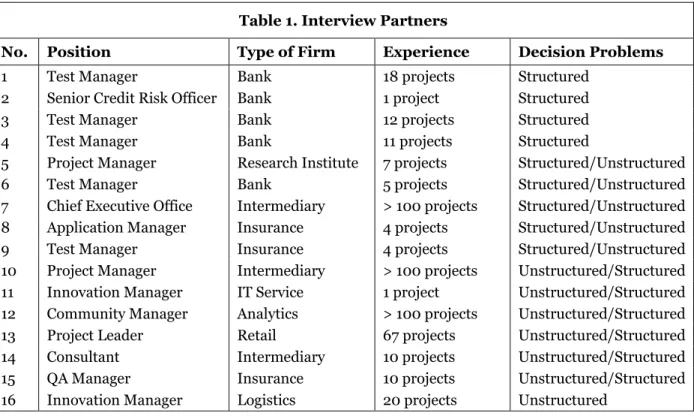
twenty interviews. We follow Guest et al. (2006) and refer to saturation “as the point in data collection and analysis when new information produces little or no change to the codebook” (p. 65). This means that the interviews cease to reveal fundamentally new insights for the development of properties of a given category (e.g., phases in decision-making), so that we become “empirically confident that a category is saturated” (Glaser and Strauss 1967, p. 65). Miles et al. (2014) emphasize that sampling often has an “iterative or ‘rolling’ quality, working in progressive waves as the study progresses” (p. 33). Thus, we followed Miles et al. (2014) and conducted the interviews iteratively from September 2016 to March 2018 until information provided by the decision-makers became repetitive and started to indicate an onset of saturation. We con-cluded the interview phase by 16 interviews. Table 1 lists the interview partners, their experience, and the types of decision problems they typically face. Given that some interview partners have conducted multiple projects, they may have encountered both structured and unstructured decision problems and described respective decision-making processes.
Table 1. Interview Partners
No. Position Type of Firm Experience Decision Problems
1 Test Manager Bank 18 projects Structured 2 Senior Credit Risk Officer Bank 1 project Structured 3 Test Manager Bank 12 projects Structured 4 Test Manager Bank 11 projects Structured
5 Project Manager Research Institute 7 projects Structured/Unstructured 6 Test Manager Bank 5 projects Structured/Unstructured 7 Chief Executive Office Intermediary > 100 projects Structured/Unstructured 8 Application Manager Insurance 4 projects Structured/Unstructured 9 Test Manager Insurance 4 projects Structured/Unstructured 10 Project Manager Intermediary > 100 projects Unstructured/Structured 11 Innovation Manager IT Service 1 project Unstructured/Structured 12 Community Manager Analytics > 100 projects Unstructured/Structured 13 Project Leader Retail 67 projects Unstructured/Structured 14 Consultant Intermediary 10 projects Unstructured/Structured 15 QA Manager Insurance 10 projects Unstructured/Structured 16 Innovation Manager Logistics 20 projects Unstructured
Table 1. Interview Partners
The questions in our interview guideline aimed to uncover patterns of decision-making that individuals exhibit when working with crowdsourced data. The structure of the interviews followed three parts: In the first part, we asked the decision-makers to introduce themselves, explain their function and experience in the organization, outline typical decision problems that they face in their organizations, and describe the crowdsourced data that they use. This part aimed at gaining an overview of the crowdsourced data and the types of decision problems and their structuredness. In the second part, we asked the decision-makers to
outline the sequences of data-processing activities and evaluation steps, by which they source, analyze, and use crowdsourced data to address decision problems. As outlined by Mintzberg et al. (1976), this part aimed at “eliciting the verbalizations of decision makers' thought processes”, which can then be “analyzed to de-velop simulations of their decision processes” (p. 247). In the third part of the interviews, we were interested in the type information systems used during this process and their assessment of the efficiency and effec-tiveness of decision-making based on crowdsourced data. In the end, we also gave our interview partners the possibility to further explain or discuss aspects that they deem important for their decision-making but were not explicitly asked by us. The duration of the interviews ranged from 30-90 minutes. We recorded the interviews and took notes during the sessions.
Data Analysis
To systematically extract patterns of decision-making and analyze how they relate to the structure of the underlying decision problems and the mode of acquiring and processing information, we coded the inter-views. Codes “are labels that assign symbolic meaning to the descriptive or inferential information compiled during a study” (Miles et al. 2014, p. 71). They can be used to retrieve and categorize chunks of information in interview transcripts to cluster segments that relate to a particular construct or theme (Miles et al. 2014). In our case, the codes serve to structure the verbalizations of the decision-making processes from the inter-views. That is, we use the codes to derive distinct phases of decision-making in crowdsourcing as described by decision-makers and analyze different patterns based on how these phases are aligned.
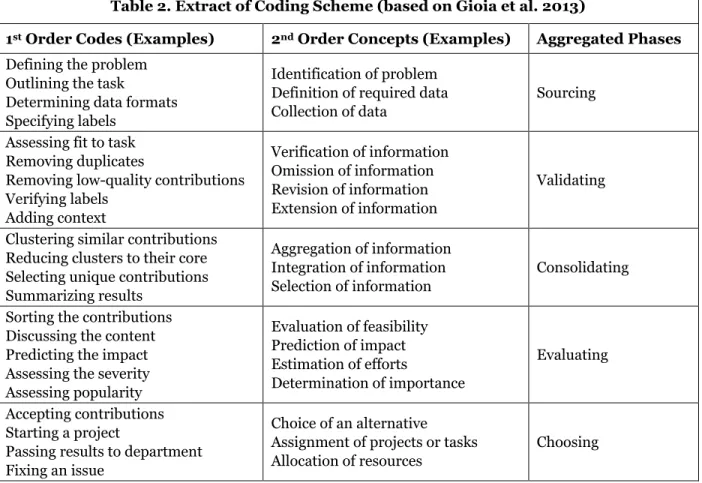
Table 2. Extract of Coding Scheme (based on Gioia et al. 2013)
1st Order Codes (Examples) 2nd Order Concepts (Examples) Aggregated Phases
Defining the problem Outlining the task
Determining data formats Specifying labels
Identification of problem Definition of required data
Collection of data Sourcing Assessing fit to task
Removing duplicates
Removing low-quality contributions Verifying labels Adding context Verification of information Omission of information Revision of information Extension of information Validating
Clustering similar contributions Reducing clusters to their core Selecting unique contributions Summarizing results
Aggregation of information Integration of information
Selection of information Consolidating Sorting the contributions
Discussing the content Predicting the impact Assessing the severity Assessing popularity Evaluation of feasibility Prediction of impact Estimation of efforts Determination of importance Evaluating Accepting contributions Starting a project
Passing results to department Fixing an issue
Choice of an alternative Assignment of projects or tasks
Allocation of resources Choosing
Table 2. Extract of Coding Scheme (based on Gioia et al. 2013)
We followed the inductive data analysis and coding approach proposed by Gioia et al. (2013), which is well-established in related literature on decision-making and process research (e.g., Langley et al. 2013; Smith 2014). This approach is based on a multi-staged coding scheme with first-order codes, second-order con-cepts, and aggregated dimensions (Gioia et al. 2013). First-order codes represent informant-centric terms that emerge during the interviews. For these codes, we adhered to words that were used by the
decision-makers during the interviews to describe the processes and activities when engaging in crowdsourcing. Based on similarities and differences in these codes, it is possible to derive second-order concepts that rep-resent germane themes and categories described during the interviews (Gioia et al. 2013). These second-order concept “help us to describe and explain the phenomena we are observing” (Gioia et al. 2013, p. 20). Finally, it is possible to aggregate these second-order concepts to distinct phases of decision-making in crowdsourcing. Table 2 provides an extract of the coding scheme.
To increase confidence in the analysis, three researchers were involved in the coding process. We followed Saldaña (2016), who notes that coding “can and should be a collaborative effort” (p. 27) to develop more objective perspective on the codes and their interpretation. For this purpose, literature suggests an iterative process of “constant comparison” (Corbin and Strauss 1990). In line with Saldaña (2016) and Harry et al. (2005), we did not attempt to develop a numerical reliability rating, but to reach a consensus on the appro-priate usage of the set of codes. We developed potential concepts and dismissed, changed, or retained them based on comparisons across the interviews to achieve a coherent synthesis. We discussed preliminary re-sults and variations and gave our raw data to independent students for analysis (cf. Lehrig et al. 2017). We adapted the concepts whenever suitable or necessary. In this way, we embarked on “a process of testing the codes for clarity and reliability” (Harry et al. 2005, p. 6). We repeated the process until we reached consen-sus with regard to the aggregated phases of decision-making in crowdsourcing.
As outlined earlier, distinct phases can occur iteratively and recursively during a decision-making process and form “patterns” (Boonstra 2003; Frisk et al. 2014; Mintzberg et al. 1976). To examine such patterns based on the codes, we followed a temporal bracketing strategy proposed by Langley (1999). It represents a standard approach for analyzing process data and is especially well-suited for an “open-ended inductive approach that most researchers use in process research” (Langley et al. 2013, p. 693). At its core, temporal bracketing refers to the “decomposition of data into successive adjacent periods [which] enables the explicit examination of how actions of one period lead to changes in the context that will affect action in the subse-quent periods” (Langley 1999, p. 703). That is, based on the codes (aggregated phases), we reconstructed the decision-making processes, by which decision-makers typically source and process crowdsourced data to derive decisions for the underlying projects. These processes can then be grouped based on the number of transitions between phases and similarities in their alignment to describe the processes as “evolving pat-terns”(Langley 1999). Exemplary results of the temporal bracketing of the codes are depicted in Figure 1.
Findings
The interviews provide interesting insights into decision-making in crowdsourcing. It became apparent that the characteristics of the data and the way in which they are generated in crowdsourcing greatly affect how the data-processing activities and evaluation patterns are aligned during decision-making. The interviews revealed five distinct phases that typically occur during decision-making in crowdsourcing. These five phases represent germane episodes of acquiring and processing newly gained data through crowdsourcing to derive decisions for the underlying projects. They provide a data-centric perspective on decision-making. The sourcing phase comprises the acquisition of data to either identify new or address existing problems and opportunities. In crowdsourcing, decision-makers may source new data at potentially all stages of de-cision-making. In the validation phase, decision-makers assess the appropriateness of the data to address the underlying decision problem. This phase is essential for decision-makers working with crowdsourced data, as they can no longer rely on the trustworthiness of the sources nor the quality of their input. The
consolidation phase describes the extraction of meaningful information from crowdsourced data. It re-volves around aggregating data, integrating data, and selecting data provided by the crowd to derive valua-ble insights. In the evaluation phase, decision-makers determine the value of the insights extracted from the crowdsourced data. That is, they have to estimate the required efforts for implementation (e.g., in terms of costs and time), assess the feasibility, and predict the impact for their organizations. The choice phase
describes the commitment of resources to realize a project or implement changes in the organization. However, we find that decision-making processes do not always adhere to a predetermined sequence of these phases. They rather follow different patterns that range from sequential and goal-oriented to dynamic and data-driven. The patterns depend upon the structure of the decision problem and the mode of acquiring and processing information. In the following sections, we first describe the decision-making patterns that emerged during the interviews based on how the previously outlined phases are aligned and how they
typ-ically (re-)occur. Second, we explain how the patterns relate to the problem structure and the mode of ac-quiring information described by our interview partners. Finally, we consider the efficiency and effective-ness of the patterns based on the interviews.
Patterns of Decision-Making
Figure 1 below depicts the results of the temporal bracketing of the codes and illustrates exemplary se-quences for each decision-making pattern. Each step represents a phase of sourcing, validating, consolidat-ing, or evaluating data, and choosing adequate courses of actions for the underlying project as described by the decision-makers during the interviews. The patterns reveal great differences with regard to how many times these phases occur and how they are aligned during decision-making.
Figure 1. Overview of Decision-Making Patterns with Exemplary Sequences
Informing: The first pattern of decision-making reconstructed from the interviews takes the form of a sequential process that is characterized by only few transitions between phases of gathering data and mak-ing a choice. That is, data are sourced once and then processed in a standardized and goal-oriented way to address specific information needs of the decision-maker. We termed this pattern “informing”. Interview partner 12, a manager for an analytics provider, described an exemplary case for such a pattern in retail audits for monitoring stores. She explained that she uses crowdsourcing to collect clearly specified data on mobile devices of customers for point of sales benchmarks (e.g., geo data). Crowdsourced geo data are col-lected, validated, and then displayed on analytics dashboards for managers to decide, for example, whether the positioning of certain products on shelves need to be changed. As both the problem and the required data are known, the process is standardized and aims for high efficiency in decision-making. A similar pro-cess was described by interview partner 4, a test manager for a retail bank. He uses crowdsourcing for standardized regression testing in software development and explained: “The most important aspect for me at the moment is to have the test cases that were executed by the crowd at the status ‘okay’. The data are validated and forwarded during the actual crowdtesting session. Our test managers just synchronize the defect by the crowd from TFS [Microsoft Team Foundation Server] to HP QC [HP Quality Center].”
Solving: The second decision-making pattern also takes the form of a sequential process but progresses stepwise. In this case, data are sourced and evaluated in a more gradual and analytical manner to address problems that are less structured and require thorough examination. We termed this pattern “solving”. In-terview partner 6, a test manager for a retail bank, provided an example for such a pattern. He explained that he uses crowdsourced data to identify and fix defects in a large-scale banking software. He notes that “understanding such defects from a technical point of view is very difficult.” For this purpose, he system-atically sources, validates, consolidates, and evaluates defect reports and decides whether and how to fix
1 2 3 4 5 Interview 12 1 2 3 4 5 Interview 6 1 2 3 4 5 Interview 13 1 2 3 4 5 Interview 16 1 2 3 4 5 Interview 4 1 2 3 4 5 Interview 9 1 2 3 4 5 Interview 14 1 2 3 4 5 Interview 11
Pattern I. “Informing” Pattern III. “Understanding”
Pattern IV. “Exploring”
Pattern II. “Solving”
Note: 1 = Sourcing, 2 = Validating, 3 = Consolidating, 4 = Evaluating, 5 = Choosing
t t t
t t t t
them. He describes the process as a “thorough analysis” that is very “tedious and time-consuming”. How-ever, he also emphasizes that this allows him to get “an extremely good picture of how well the application works.” Interview partner 9 referred to such decision-making processes as a “multi-step analysis”.
Understanding: The third decision-making pattern is the first to deviate from the sequential structure. Early stages of the decision-making process aim at incrementally developing potential options to address a problem. At later stages, however, we see decision-makers iteratively source and compare new data to get a better understanding of these options and make adequate decisions. We termed this pattern “understand-ing”. Interview partner 13 offered an exemplary description for such a pattern. As a project leader for a large retail company, he is responsible for developing new products. At early stages, he uses crowdsourcing to gather ideas on different types of products that could be included. At later stages, he typically has to source new data to better estimate market impacts and customer preferences of ideas (e.g., through votes) that he did not previously know. He compares the decision-making process to a “stage-gate process”. These phases are repeated until the available options and final decisions are backed by enough data.
Exploring: The fourth pattern of decision-making takes the form of a highly dynamic process of sourcing and scanning data. It exhibits a rather undirected structure that revolves around iteratively probing data to uncover new solution spaces that were not hitherto known. We termed this pattern “exploring”. Interview partner 16, an innovation manager in a large logistics group, offered an exemplary description for such a pattern. He explained: “We use crowdsourcing as part of our search strategy. It represents a trend mon-itor in which we identify trends”. Data are sourced in an open and unrestricted manner to find potential “search streams” that are then further investigated and enriched with novel data as promising “business cases” unfold. In this pattern, crowdsourced data act as guidance in exploratory decision-making process.
Table 3. Summary of Decision-Making Patterns
Pattern Description
I. Informing “Informing” describes a pattern of focused and directed search for specific infor-mation through crowdsourced data. The goal is to efficiently process crowd-sourced data and quickly inform a decision that has clear requirements.
II. Solving “Solving” describes a pattern of stepwise analysis of information in crowdsourced data. The focus lies on gradually accumulating required information and system-atically approaching a decision.
III. Understanding “Understanding” describes a pattern of iterative comparison of information gained through crowdsourced data. The focus lies on recursively sourcing data to evaluate different options for a decision.
IV. Exploring “Exploring” describes a pattern of open and dynamic scanning of information in crowdsourced data. The focus lies on probing data to uncover new and hitherto unknown solution spaces for decisions.
Table 3. Summary of Decision-Making Patterns
The Role of the Problem Structure and the Mode of Acquiring Information
The interviews not only reveal different patterns of decision-making but also offer insights with regard to why and in which contexts these patterns occur. We find the four decision-making patterns to be a conse-quence of how the structure of the decision problem and the decision-maker’s mode of acquiring infor-mation interact. Interview partner 14, a consultant for a crowdsourcing intermediary, explained: “Decision problems are very diverse. Some organizations have a clear problem, such as choosing a name for a new product, and ask the crowd for their preference. Others face much more complex problems and need to understand, for example, media consumption of their customers.” However, not all decision-makers ad-dress these different types of problems in the same way. Some decision-makers use crowdsourced data for a goal-oriented search of specific information that addresses their problem. Others scan crowdsourced data
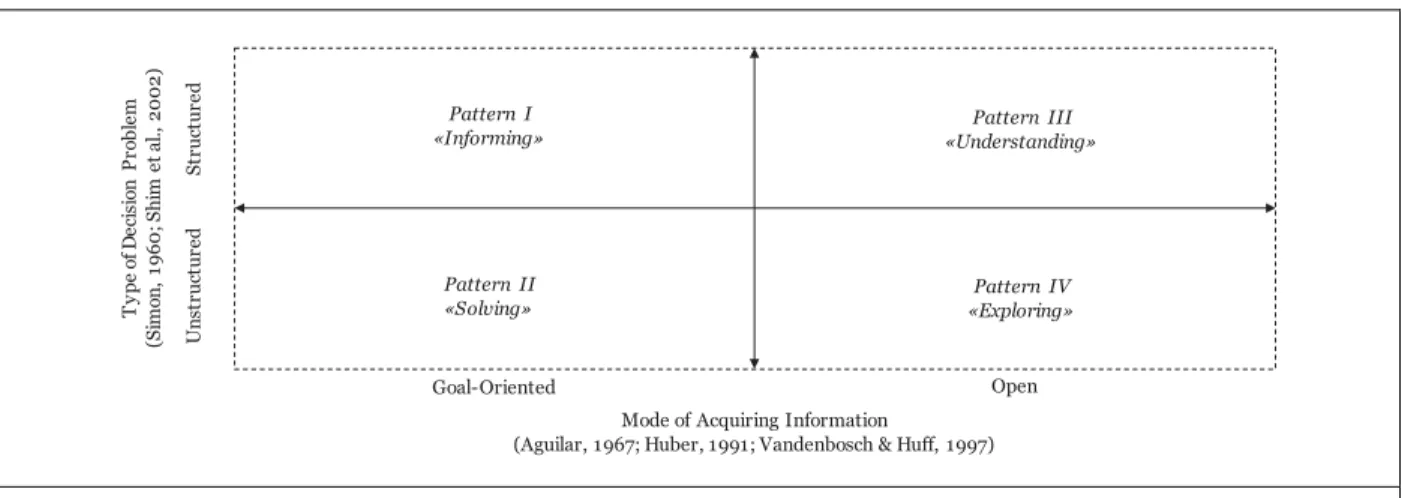
more openly to develop and select potential options. This explains differences in how the phases of decision-making are aligned and how often they (re-)occur (see Figure 2 for an overview).
Decision-making patterns in crowdsourcing that follow a rather sequential order (Pattern I and II) are typ-ically driven by a decision-maker’s goal-orientedsearch for information. We find them to occur when de-cision-makers put strong emphasis on their own expertise and experience and argue to have a good under-standing on how to source, process, and analyze adequate data. Interview partner 11, for example, de-scribed: “I examined the data myself. […] I know the business pretty well by now and can decide by myself whether an option is promising or not.” Thus, he looks for specific information that addresses predefined requirements. In such cases, crowdsourced data is primarily used to efficiently “inform” decisions or “solve” problems. “Informing” decisions (Pattern I) through a goal-oriented search usually occurs when decision-makers face structured decision problems (e.g., in technical contexts). In these cases, decision-makers have often worked out very efficient routines to process and evaluate crowd-sourced data. For example, interview partner 12, a manager for an analytics provider, explained: “Some projects start in the morning and can be finished by noon. In these cases, the validation of the data is actually the most time-consuming part, be-cause they are all collected and retrieved at once.” Similarly, interview partner 11, notes that he often uses crowdsourced data in a standardized way to reassure his decision whether to invest in the development of a product or not. When a goal-oriented search is applied to a more complex, unstructured decision problem, the decision-making pattern represents much of a “solving” process (Pattern II). In these cases, our inter-view partners reported to fragment the decision problems. That is, they analyze the crowdsourced data stepwise, accumulate information, and develop decisions progressively.
Decision-making patterns in crowdsourcing that are rather recursive and iterative in nature (Pattern III and IV) are typically related to decision-makers employing a more dynamic and open scanning for infor-mation. Such patterns often occur when decision-makers put less emphasis on their own expertise and ex-perience. In these cases, it is more likely that data – not predefined objectives – drive the decision-making process and guide decision-makers. That is, decision-makers rely more thoroughly on data to openly “ex-plore” new options or better “understand” them. “Exploring” new options through an open and dynamic scanning for information (Pattern IV) occurs when decision-makers face highly unstructured decision problems. Interview partner 12, a manager for an analytics provider, explained: “There are projects that are extremely complex and progress very slow. Even the definition of project is time-consuming.” Simi-larly, interview partner 6, argued: “The most time-consuming part here is understanding the problem.” In these cases, decision-makers face novel and non-trivial problems for which they have not yet found an effi-cient routine. Decisions develop iteratively and require decision-makers to source new data multiple times to address novel information needs at particular stages of their decision-making. If an open scanning for information is applied to a more structured decision problem, the process typically aims to better “under-stand” options by recursively sourcing and comparing crowdsourcing data (Pattern III).
Figure 2. Theoretical Framework for Decision-Making Patterns in Crowdsourcing Goal-Oriented T ype of D ec is io n Pr ob le m (S im on , 1 96 0; S hi m e t a l., 2 00 2) St ruc tur ed Pattern I
«Informing» «Understanding»Pattern III
Pattern II
«Solving» «Exploring»Pattern IV
Mode of Acquiring Information
(Aguilar, 1967; Huber, 1991; Vandenbosch & Huff, 1997) Open U ns tr uc tur ed
Efficiency and Effectiveness of Decision-Making Patterns
In crowdsourcing, the efficiency of decision-making is contingent upon the amount of time and effort re-quired to process data and implement, for example, ideas or bug fixes. The effectiveness of decision-making relates to quality of the decision and whether the implemented ideas or bug fixes achieved the targeted objectives (Todd and Benbasat 1999). Given that there are distinct patterns of decision-making that depend upon the structure of the decision problem and the mode of acquiring information, the interviews also re-veal differences with regard to how the phases during these patterns relate to the efficiency and effective-ness of decision-making and how information systems may provide adequate support for the decision-mak-ers. Some patterns have been shown to be more focused on the efficiency of decision-making while others are more concerned with the effectiveness of decision-making. Furthermore, different phases during deci-sion-making have different implications for the efficiency and effectiveness of decideci-sion-making.
Decision-makers in crowdsourcing that employ a goal-oriented search to “inform” their decisions or “solve” a problem typically view the “validation” and “consolidation” phase as critical for their decision-making. The decision-makers reported that they often validate and consolidate data manually, requiring substantial amounts of time and effort. Project leader 13 emphasized: “There is a lot of manual effort involved because most crowdsourced data are highly unstructured.” Test manager 6 underlined that this requires “way too much time”. Thus, across the interviews, multiple decision-makers suggested that there is vast potential for automated data-processing mechanisms to support decision-making patterns I (“informing”) and II (“solv-ing”), as both are goal-oriented and primarily target a high efficiency in decision-making. Surprisingly, however, we found that decision-makers are still hesitant rely on such technologies. Test manager 9 ex-plained: “Currently, I would not blindly trust automated reports. I always want to know what is going on. I want to have enough control to be able to intervene.” Similarly, innovation manager 11 stated: “At a certain point, it is not possible to manually process and evaluate all data. However, when it comes to automation, I’m always concerned about missing high-potential ideas.” This also resonates with earlier findings that pattern I and II often occur when decision-makers put strong emphasis on their own expertise and believe to have a good understanding on how to source, process, and analyze data.
Decision-makers that employ a more open and dynamic scanning of crowdsourced data to “explore” new options or better “understand” them are often primarily concerned with the effectiveness of their decision-making. Project leader 13, for example, explained: “In retail, there is a ‘one-in-one-out’ rule. It is only pos-sible to introduce a new product in a store if another product is removed at the same time.“ He explains that crowdsourced data are used to make the “right” decisions with regard to their product assortment in stores. The most important aspect for him is the outcome: “We have conducted 67 crowdsourcing cam-paigns so far where we developed products – from the initial problem definition to the final product launch. These products yielded a gross revenue of 100 Mio. Euros”. Hence, our interviews suggest that in pattern III (“understanding”) and IV (“exploring”), the “sourcing” and “evaluation” phase are critical, as decision-makers rely more on data and their decisions become more data-driven. The most important threats to such data-driven patterns revealed during the interviews are subjective judgement and biases by the decision-makers (i.e., how data are interpreted). Sometimes, decision-makers even reported to deliber-ately dismiss data. Innovation manager 11 said: “We received a lot of votes from the crowd but did not really take these preferences into account for our final decision. […] We were able to do this based on our experience.” Project leader 13 admitted: “We try to be as neutral and objective as possible, but there is definitely a lot of subjectivity involved in the process”. Multiple decision-makers argued that there is high potential for information systems to support decision-making patterns III and IV by offering pattern recog-nition and visualization capabilities that allow for an easier analysis of crowdsourced data during the “eval-uation” phase. Project leader 13 said: “It would be very interesting to have a pattern recognition system of some sort, to extract patterns that are otherwise not easily detectable. This would surely help to identify trends in data or classify customer segments. Artificial intelligence or machine learning are promising in this regard – especially when crowdsourced data are combined with internal data, such as sales data.”
Discussion
Taken together, the results from our interviews offer a number of interesting insights into the characteris-tics of decision-making in crowdsourcing. Existing literature on decision-making is mostly grounded on the
traditional phase theorem (Mintzberg et al. 1976; Simon 1960) and builds upon the basic tenet that deci-sions are made by systematically gathering new information, assessing potential courses of actions based on this information, and then committing to one or more alternatives. In crowdsourcing, with new oppor-tunities to source and analyze data, we found the characteristics of decision-making processes to change. Based on the interviews, we identified five distinct phases that occur when decision-makers work with crowdsourced data. These five phases represent germane episodes of acquiring and processing data in order to make adequate decisions for the underlying projects. More importantly, however, it became clear during our analysis that decision-making processes in crowdsourcing do not always represent a predetermined sequence of these phases. In related studies, Mintzberg et al. (1976) already noted that while it is possible to delineate distinct phases in decision-making processes, such phases do not necessarily follow “a simple sequential relationship“ (p. 250). Similarly, Boonstra (2003) argued that decision-making processes “are not always predetermined, linear and explicit” and that it is instead possible to “identify general patterns” of decision-making (p. 197). Our findings extend this perspective. In crowdsourcing, where decision-makers have the opportunity to freely source and examine user-generated data, we find four different patterns of decision-making to emerge that range from sequential and goal-oriented to dynamic and data-driven. Decision-makers that exhibit sequential patterns typically use crowdsourced data to efficiently “inform” decisions or gradually “solve” decision problems. These patterns resonate strongly with the traditional per-spective on decision-making, where decisions are based on data collected through systematic and purpose-ful processes that address specific information needs of the decision-makers (Constantiou and Kallinikos 2015). We find these patterns to still occur in crowdsourcing when decision-makers employ a goal-oriented search and have a good understanding on how to source and analyze data. This allows them to develop and follow predefined routines. When facing structured decision problems, these routines are characterized by only few transitions between phases of sourcing data and making a choice, since the problem and required data are clear. As the decision problems become more unstructured, we found decision-makers to fragment the decision problems and develop solutions stepwise by systematically sourcing, validating, consolidating, and evaluating data before making a choice. Mintzberg et al. (1976) describe similar behavior and note that, to reduce complexity, decision-makers deal with unstructured problems by factoring them into “familiar, structurable elements” and following “interchangeable sets of procedures or routines” (i.e., phases). Decision-makers that exhibit more recursive and iterative patterns use crowdsourcing to “explore” new op-tions for decision problems or better “understand” them. These patterns resonate strongly with a more recent perception of making and reflect Abbasi et al.’s (2016) notion of a “data-driven decision-making process”. In these patterns, data act as principal drivers or guidance for the decision-decision-making pro-cess and not clearly defined objectives by the decision-maker. That is, decision-makers rely more thor-oughly on data to make a decision and employ a dynamic and open scanning for information. For structured decision problems, our interview partners described such data-driven decision-making processes as “stage-gate processes”, in which decisions are iteratively developed and backed by data. For unstructured decision problems, decision-making processes become more explorative and increasingly revolve around probing data to uncover new, hitherto unknown solution spaces. Lycett (2013) describe such processes as “infor-mation technology driven sense-making processes”, which revolve around organizing data to identify and regularize patterns into plausible explanations and actionable decisions.
Finally, the four distinct patterns show that it is imperative to account for differences in decision-making when using crowdsourced data and designing decision support mechanisms. Our findings emphasize that, depending on the decision-making pattern, there is different potential for information systems to support phases in such processes. For structured problems, we see great potential to increase the efficiency of deci-sion-making by automating highly repetitive or standardized data-processing tasks. For unstructured prob-lems, we see great potential to increase the effectiveness of decision-making by leveraging pattern recogni-tion and visualizarecogni-tion techniques to support managers in making sense of crowdsourced data.
Theoretical Implications
From a theoretical perspective, we contribute novel insights to both research on crowdsourcing and re-search on decision-making. In rere-search on crowdsourcing, scholars have been increasingly interested in the value that organizations could create through crowdsourced data (e.g., Barbier et al. 2012; Bonabeau 2009; Chiu et al. 2014). While related studies already made great strides to develop the technical foundations for
processing large-scale data from crowds (e.g., Barbier et al. 2012; Chen et al. 2012), the structure and pat-terns of decision-making that emerge when decision-makers have access to crowdsourced data were mostly unclear (Abbasi et al. 2016). The findings of our study address this gap in two ways. First, we reveal five distinct phases that form decision-making processes in crowdsourcing. With this data-centric perspective on decision-making, it possible to better understand how decision-makers in crowdsourcing source, vali-date, consolivali-date, and evaluate data from a crowd to choose adequate courses of actions for solving an or-ganizational problem. Second, and more importantly, we show that decision-making processes in crowdsourcing do not always represent a predetermined sequence of these phases as assumed by traditional decision-making models used in crowdsourcing literature (e.g., Chiu et al. 2014). Instead, we identify four common patterns of decision-making in crowdsourcing that range from very structured and goal-oriented to highly dynamic and data-driven. They systematize how the decision-making phases are typically aligned. Second, for research on decision-making, we answer the calls from various scholars to examine how deci-sion-making processes may change in data-driven environments (e.g., Abbasi et al. 2016; Sharma et al. 2014). Existing literature in this field mostly grounded on the traditional phase theorem (Mintzberg et al. 1976; Simon 1960) and builds upon the basic tenet that decisions are made by systematically gathering new information, assessing potential courses of actions based on this information, and then committing to one or more alternatives (see Arnott and Pervan 2014). However, in data-driven environments, such as crowdsourcing, decision problems have drastically changed with regard to their structure. Furthermore, decision-makers now have access to much more diverse sources and more thorough means to acquire in-formation. Thus, studies have emphasized that “we need to understand if and how we should revise existing decision making models” (Abbasi et al. 2016, p. 11). Our findings from crowdsourcing show the limitations of the traditional phase theorem for studying decision-making in more data-driven environments. They indicate that, when given the opportunity to freely source and prospect data, decision-makers tend to adopt different patterns of gathering and analyzing data. We find sequential patterns to still occur when decision-makers employ a goal-oriented search and have a good understanding on how to source and analyze data. However, when decision-makers rely more thoroughly on data to make a decision and employ a dynamic and open scanning for information, patterns become increasingly recursive and iterative in nature and re-flect “sense-making processes” (Lycett 2013). In this way, the patterns contrast early models of decision-making, which assumed that decision-making is mostly linear (Simon 1960). They extend more recent stud-ies presented by Mintzberg et al. (1976) and Boonstra (2003) and show that the traditional phase theorem of decision-making can be extended to data-driven contexts by describing different path configurations of decision-making phases rather than a uniform process. We provide an integrated perspective on how the structure of the decision problems (Shim et al. 2002; Simon 1960) and the mode of acquiring information (Aguilar 1967; Huber 1991; Vandenbosch and Huff 1997) may evoke and affect such patterns.
Practical Implications
From our findings, we are also able to derive a number of practical implications for organizations that are aiming to leverage crowdsourced data. The four distinct patterns identified in our study show that it is im-perative to account for differences in decision-making when using crowdsourced data and designing deci-sion support mechanisms. They underline that there is no “one-size-fits-all”-solution for decideci-sion support. Instead, we urge organizations to pay close attention to the structure of the decision problems and the modes by which decision-makers acquire information and adjust the mechanisms for decision support to fit different decision-making patterns. In cases where decision-making patterns resemble a goal-oriented search for information (e.g., when analyzing and verifying defect reports), we find it imperative to provide data in a manner that lets decision-makers efficiently “inform” decisions or gradually “solve” decision prob-lems. Data should be automatically pre-preprocessed in the “validation” phase to reduce manual efforts and increase the efficiency of decision-making. In cases where decision-making patterns reflect a more dynamic exploration of data (e.g., when deciding on new products during innovation campaigns), our findings sug-gest that decision support systems should offer more options to experiment with data and visualize the results, e.g., to support the “consolidation” and “evaluation” phase.
Finally, in a broader sense, we recommend organizations to take advantage of crowdsourcing to source and analyze data for improved decision-making. In crowdsourcing, decision-makers have the opportunity to freely specify the type of data as well as the amount of data that should be generated at potentially all stages during their decision-making. Especially for unstructured problems, our findings show that decision-mak-ers often repeatedly return to data “sourcing” phases to back their decisions with insights from crowds. This
underlines the importance of access to adequate data during decision-making. Decision-making in such settings often revolves around the exploration of data in order to discover new options and incrementally develop better decisions. We believe that crowdsourcing represents a very powerful approach to provide access to such data and foster data-driven decision-making processes in organizations.
Limitations and Future Research
As with all research, the findings presented in this paper should be regarded in light its limitations. First, we analyzed decision-making in the domain of crowdsourcing. We cannot claim that our findings apply to all other contexts that use large-scale, user-generated data to the same extent. Thus, we urge future research to investigate decision-making patterns in other contexts and examine similarities or differences between them. It would be interesting to see what patterns remain stable across different contexts or how they change over time. Second, we used semi-structured interviews with decision-makers from organizations based in Europe as our source of data, which may limit the generalizability of the results. While we made sure select a broad sample of decision-makers across 10 different organizations and departments with var-ying degrees of expertise, our results are still bound to the participants and the discussions with them. By conducting interviews, we aimed to gain in-depth insights into making as experienced by decision-makers. We see great potential in future research to also consider quantitative data and triangulate our findings with insights from crowdsourcing platforms or other information systems that are used by deci-sion-makers. This would help to provide a more comprehensive picture of decision-making with behavioral data. Third, although we studied decision-making in an organizational context, we focused on individual decision-making processes by managers responsible for engaging in crowdsourcing and evaluating the re-sults. Another interesting avenue for future research is to further study the role of organizational structures, hierarchies, or teams for decision-making and analyze how these aspects may change in contexts facing large amounts of user-generated data. We agree with Sharma et al. (2014) that individual decision-making is only the first step in understanding how organizations may benefit from large-scale data and novel infor-mation systems, as individual decision-making processes are typically embedded in organizational settings.
Conclusion
Crowdsourcing represents a powerful approach for organizations to span their boundaries and systemati-cally collect data from large and diverse networks of people. So far, however, literature gave little insights into the structure and patterns of decision-making processes that emerge when decision-makers have ac-cess to such large amounts of user-generated data. In this study, we addressed this gap and analyzed the characteristics of decision-making in crowdsourcing based on interviews with decision-makers from 10 cor-porations. Depending on the type of decision problem and the mode of acquiring information, we saw four patterns emerge with regard to how different phases in decision-making are aligned and (re-)occur. Thus, for research, we showed that the traditional phase theorem of decision-making can be extended to more data-driven contexts, such as crowdsourcing, by looking at different path configurations of such phases. For practitioners, we discussed how information systems can be adapted to support these patterns. In this way, our study may contribute to a better understanding of decision-making in crowdsourcing.
References
Abbasi, A., Sarker, S., and Chiang, R. H. L. 2016. “Big Data Research in Information Systems: Toward an Inclusive Research Agenda,” Journal of the Association of Information Systems (17:2), pp. 1–32. Aguilar, F. 1967. Scanning the Business Environment, New York: MacMillan.
Ahuja, G., and Lampert, C. M. 2001. “Entrepreneurship in the Large Corporation: A Longitudinal Study of How Established Firms Create Breakthrough Inventions,” Strategic Management Journal (22:6–7), pp. 521–543.
Anderson, P. A. 1983. “Decision Making by Objection and the Cuban Missile Crisis,” Administrative Science Quarterly (28:2), pp. 201–222.
Arnott, D., and Pervan, G. 2014. “A Critical Analysis of Decision Support Systems Research Revisited: The Rise of Design Science,” Journal of Information Technology (29:4), pp. 269–293.
Barbier, G., Zafarani, R., Gao, H., Fung, G., and Liu, H. 2012. “Maximizing Benefits from Crowdsourced Data,” Computational and Mathematical Organization Theory (18:3), pp. 257–279.