WestminsterResearch
http://www.westminster.ac.uk/westminsterresearch
A Sustainable Approach for the Downstream Processing of
Bacterial Polyhydroxyalkanoates: State-of-the-art and latest
developments
Perez Rivero, C., López-Gómez, J.P. and Roy, I.
NOTICE: this is the authors’ version of a work that was accepted for publication in the
Biochemical Engineering Journal. Changes resulting from the publishing process, such
as peer review, editing, corrections, structural formatting, and other quality control
mechanisms may not be reflected in this document. Changes may have been made to
this work since it was submitted for publication. A definitive version was subsequently
published in Biochemical Engineering Journal, DOI: 10.1016/j.bej.2019.107283, 2019.
The final definitive version in Biochemical Engineering Journal is available online at:
https://dx.doi.org/10.1016/j.bej.2019.107283
© 2019. This manuscript version is made available under the CC-BY-NC-ND 4.0 license
https://creativecommons.org/licenses/by-nc-nd/4.0/
The WestminsterResearch online digital archive at the University of Westminster aims to make the research output of the University available to a wider audience. Copyright and Moral Rights remain with the authors and/or copyright owners.
Whilst further distribution of specific materials from within this archive is forbidden, you may freely distribute the URL of WestminsterResearch: ((http://westminsterresearch.wmin.ac.uk/).
Accepted Manuscript
Title: A Sustainable Approach for the Downstream Processing of Bacterial Polyhydroxyalkanoates: State-of-the-art and latest developments
Authors: Cristina P´erez-Rivero, J. Pablo L´opez-G´omez, Ipsita Roy
PII: S1369-703X(19)30217-7
DOI: https://doi.org/10.1016/j.bej.2019.107283 Article Number: 107283
Reference: BEJ 107283
To appear in: Biochemical Engineering Journal
Received date: 27 February 2019 Revised date: 3 June 2019 Accepted date: 19 June 2019
Please cite this article as: P´erez-Rivero C, L´opez-G´omez JP, Roy I, A Sustainable Approach for the Downstream Processing of Bacterial Polyhydroxyalkanoates: State-of-the-art and latest developments, Biochemical Engineering Journal (2019), https://doi.org/10.1016/j.bej.2019.107283
This is a PDF file of an unedited manuscript that has been accepted for publication. As a service to our customers we are providing this early version of the manuscript. The manuscript will undergo copyediting, typesetting, and review of the resulting proof before it is published in its final form. Please note that during the production process errors may be discovered which could affect the content, and all legal disclaimers that apply to the journal pertain.
1
A Sustainable Approach for the Downstream Processing of Bacterial
Polyhydroxyalkanoates: State-of-the-art and latest developments
Cristina Pérez-Rivero1*, J. Pablo López-Gómez2, Ipsita Roy1
1 Applied Biotechnology Research Group, School of Life Sciences, College of Liberal Arts and Sciences, University of Westminster, London UK
2 Bioengineering Department, Leibniz Institute for Agricultural Engineering and Bioeconomy, Max-Eyth-Allee 100, Potsdam, Germany
*corresponding author: [email protected]
Graphical abstract
LCA
2 Highlights
DSP remains a bottleneck in the sustainable and economic production of PHAs.
The selection of DSP should be based on final product specification.
Green solvents have been found to dissolve scl and mcl-PHAs.
Chemical-free methods have great potential in large scale recovery of PHAs.
Abstract:
Bioplastics have emerged as a platform to reduce our dependence on fossil fuels. Polyhydroxyalkanoates (PHAs) are a family of biodegradable polyesters with large potential in consumer goods and medical applications. These polymers accumulate in prokaryotic microbes and their recovery is a challenging, often under explored, operation. In the past, oil-derived solvents and chemicals have been widely used as extracting agents, compromising the “environmentally-friendly” claim of bioplastics. Furthermore, the large amount of chemicals and solvents required at the industrial level would negatively impact the economics of the process. The present review presents the latest advances in the field of downstream operations for PHA recovery emphasizing those green technologies with scaling-up feasibility. As for the upstream and fermentation stages, the extraction process needs to be carefully optimized to accomplish a competitive production of PHAs.
Keywords: bioplastics, PHAs, downstream operations, green solvents, digestion, recovery, sustainability
List of symbols:
ATPE Aqueous two-phase extraction MIBK Methyl isobutyl ketone CAGR Compound annual growth rate MMC Mixed microbial cultures
CP Cloud point MTBE Methyl tert-butyl ether
DMC Dimethyl carbonate Mw Molecular weight
DSP Downstream processing NPCM Non-polymer cellular matter
3 EDTA Ethylenediaminetetraacetic acid PEG Polyethylene glycol
EOPO Ethylene oxide propylene oxide PHA Polyhydroxyalkanoate HPH High pressure homogenization P(3HB) Poly(3-hydroxybutyrate) ICI Imperial Chemical Industries P(3HHx) Poly(3-hydroxyhexanoate) LAS Linear alkylbenzene sulphonate P(3HO) Poly(3-hydroxyoctanoate) LCA Life cycle assessment P(3HV) Poly(3-hydroxyvalerate) LDPE Low density polyethylene PP Polypropylene
LPS Lipopolysaccharides scl Short-chain length
mcl Medium-chain length sCO2 Supercritical carbon dioxide MEK Methyl ethyl ketone SDS Sodium dodecyl sulphate
1
INTRODUCTION
Oil-derived plastics have grown at a faster rate than any other bulk material for several decades. Biobased polymers could serve to offset, to a certain extent, the non-renewable feedstock used in the plastic industry. Moreover, biodegradability is seen as a solution to the major plastic disposal problem. However, the process development of biobased biodegradable polymers is certainly at a very early stage compared to the petrol-based plastic manufacturing industry. Over the last years, intensive research has targeted the optimization of bioplastic production. The primary objective is that large-scale operation can compete with that of traditional plastics while reducing the environmental impact [1].
Microbially produced plastics are promising candidates for a biobased generation of biopolymers. Great efforts have focused in upstream operations for example, in the selection and engineering of prokaryotic and eukaryotic strains, as well as in the utilisation of cheap substrates for their production [2,3]. Nevertheless, developments in the purification and recovery of bioplastics has been rather slow. Moving towards industrialization, it is clear that the production of biopolymers needs to go hand in hand with eco-friendly downstream operations [4].
4 The global polyhydroxyalkanoates (PHAs) market size is projected to reach 23,734.65 metric tons by 2021, at a compound annual growth rate (CAGR) of 6.27 %, between 2016 and 2021 [5]. These biopolymers exhibit a wide range of properties derived from the structural variation of their backbone/side chains and have demonstrated an outstanding biocompatibility [6]. PHAs can be classified, depending on the number of carbon atoms in the monomer unit, into short-chain length (scl) PHAs (3 to 5 carbon atoms) and medium short-chain length (mcl) PHAs (from 6 to 14). Scl-PHAs can be used to produce rigid plastics with properties comparable to those of polypropylene (PP) whereas mcl-PHAs imitate more flexible materials like low density polyethylene (LDPE). PHA degradation has been reported to occur in soil, fresh and salt water and in the human body, although the degradation time needs to be carefully evaluated before selecting a disposal route [7].
Polyhydroxyalkanoates (PHAs) are energy and carbon reservoirs [8] polymerized and stored within the host cells. This condition makes their recovery more challenging than the separation of some other (extracellular) fermentation products. In the past, chlorinated and other oil-derived solvents, harsh chemicals and energy intensive practices have been used to demonstrate the feasibility of producing PHAs from a microbial culture [9]. We have now reached a point where downstream processing (DSP) for the recovery of bioplastics cannot jeopardize the environmental impact of a well-established bioprocesses.
The focus of this review is to provide the reader with an overview of the more relevant options for scl and mcl-PHA recovery, from pure and mixed cultures, and stress the environmental impact associated with each one of them. Although numerous reviews on PHAs are available, the emphasis of this work is to critically discuss the most recent DSP methods and highlight those with scalability potential and low ecological burden.
1.1
Production of PHAs
PHAs are synthesized by different organisms, including archaea, bacteria, yeast, algae, plants and their recombinant forms. Bacterial cultivation can be carried out in pure or mixed culture. PHA generation can be coupled or decoupled to cellular growth, and frequently the limitation
ACCEPTED MANUSCRIPT
5 of an essential nutrient (nitrogen, phosphorus, oxygen, etc.) and an excess of carbon is exploited to trigger polymer accumulation. PHA is water insoluble and accumulates as chains surrounded by diverse proteins in cytoplasmatic granules. In some highly optimised microbial producers, PHAs can account for more than 90% of the bacterial dry cell weight in the form of multiple granules [10].
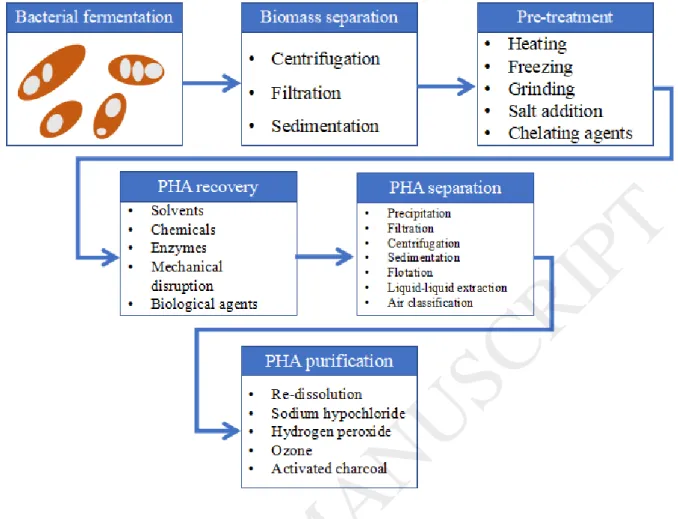
The process of producing PHAs includes a series of steps, within which downstream operations can account for half of the production costs [11]. The first stage after fermentation is to separate the biomass (cells containing PHAs) from the broth. Centrifugation, filtration, sedimentation are the most common methods to achieve this. Biomass can be pre-treated to increase the permeability of the bacterial cells by heating, freezing, adding salts, grinding in liquid nitrogen and using hot compressed water. Biomass, pre-treated or not, is then subjected to an extraction process in which there is either a solubilization of cellular material surrounding the PHA, or solubilization of the polymer itself. PHA is subsequently separated from the disrupted cellular matter and purified according to the final requirements of the final product as shown in Figure 1.
6
Figure 1: Conventional stages involved in the recovery of PHA from bacterial fermentation and most common methods for each stage.
2
RECOVERY METHODS
2.1
Solvents
Solvent extraction is to date the most widely spread practice for the recovery of PHAs. There are certain solvents that can alter the permeability of the cell membrane and selectively dissolve the polymer stored inside. In some cases, a pre-treatment step is used to increase the solvent accessibility to the polymer. After being dissolved, PHA is recovered with a precipitating agent e.g. ethanol or methanol, at low temperatures.
2.1.1 Halogenated solvents
Halogenated solvents such as chloroform, methylene chloride, 1,2-dichloroethane, 1,1,2-trichloroethane and 1,1,2,2-tetrachloroethane have been tested to recover PHAs [12,13]. Lemoigne, who first discovered P(3HB) in 1926, was also the first to use chloroform for extraction and it is still the reference technique for comparison purposes. The Soxhlet set-up
ACCEPTED MANUSCRIPT
7 allows the recirculation of hot solvents, to maximize solubility and reduce the large volumes of solvents used for the extraction. It provides good recovery yields and high purity of the extracted polymer [14]. The chloroform method allows the extraction of polymer with low endotoxin content, an important requirement when the polymer is targeted for medical applications.
The natural morphology of the PHA granules can be affected by the use of halogenated solvents, which prevents the use of PHA for certain applications, for example in the production of strong fibres [15]. Additionally, the large amounts of solvents (20 parts of solvent per one part of polymer) make this approach an expensive option for application at industrial scale. Furthermore, chlorinated solvents are harmful compounds, suspected to induce cancer, that cause long-term adverse effects in aquatic environments and believed to contribute to ozone layer depletion. Their use is banned in consumer products in several countries, and thus, they should be replaced with safer alternatives.
2.1.2 Halogen-free solvents
In view of the negative effects of halogenated solvents, a series of patents from companies such as Agroferm, Procter & Gamble, Monsanto, Metabolix and Kaneka describe the use of alternatives to chlorinated solvents [16–21]. Table 1 lists the main halogen-free solvents used in the last decade.
Kurdikar and co-workers [18] investigated mixtures of non-halogenated PHA-solvents: alcohols, esters, amides, cyclic and acyclic ketones, which can be used for PHA recovery and Narasimhan et al. [22] studied the influence of high temperature when using these types of solvents. Acetone extraction at high temperarute and pressure was studied by Koller and co-workers to recover scl-PHA. As advantages, the method enabled the reutilization of the solvent and reduced the extraction time from 12 h to 20 minutes. Performance compared to that of cholorofom recovery [23].
8 One of the advantages of the chloroform-based method was the ability to reduce the endotoxin content in the final polymer; Furrer et al. achieved an endotoxin level between 10 and 15 U/g P(3HO) by using n-hexane followed by 2-propanol [24].
According to Chemat, “Green Extraction is based on the discovery and design of extraction processes which will reduce energy consumption, will allow the use of alternative solvents and renewable natural products, and ensure a safe and high quality extract/product” [25]. Halogen-free solvents are in general less harmful than chlorinated solvents but are not completely sustainable. Many of them are oil derived and require special treatment for disposal. To assess the risk of a solvent, GSK have created a solvent selection guide that considers health, reactivity and stability, environmental impact, life cycle score, legislation flag, environmental health and safety flag, boiling and melting points and waste disposal [26].
To date dimethyl carbonate (DMC) and biobased solvents are seen as the most eco-friendly alternatives for extraction [27]. DMC is completely biodegradable, whereas ethyl acetate, ethyl lactate, butyl lactate and isopropanol can be produced through biochemical conversion of biomass. Similarly, ethanol produced through biomass fermentation would have a lower impact on the overall non-renewable carbon footprint of the process. A good example of an integrated biorefinery in Brazil uses waste streams from ethanol distillation as solvents to recover PHAs [28].
Fei et al. proposed an ‘environmentally friendly’ process for P(3HB) recovery, from C. necator
cells using a solvent mixture of acetone, ethanol and propylene carbonate in the same volume proportions, starting with non-defatted wet biomass. When hexane was selected for polymer precipitation, improved polymer yield and purity were obtained (92 and 93% respectively). Physical properties did not differ from chloroform-extracted P(3HB) [29].
Table 1: Studies on halogen-free solvents for PHA recovery.
Functional group Solvent PHA dissolved Reference
Hydrocarbon Hexane P(3HO), P(3HB) [30–32]
Alcohol Methanol P(3HB) [31,33] Ethanol PHA [33,34] Propanol PHA [31,33] C1 to C6 alcohol PHA [35] Ketone
Acetone scl-PHA, P(3HO) [23,36,37]
Methyl isobutyl ketone (MIBK) P(3HB-co-3HHx) [20,38]
Methyl ethyl ketone (MEK) P(3HB-co-3HHx), P(3HO-co-3HV) [38,39]
9
Cyclo-hexanone P(3HB) [20,40,41]
Lactone γ-butyrolactone P(3HB) [41]
Acid Acetic acid P(3HB), PHA [33,42]
Acetic acid anhydride PHA [43]
Carbonate ester
Dimethyl carbonate (DMC) PHA [44]
Ethylene carbonate P(3HB) [16,33]
1,2-propylene carbonate P(3HB), PHA block copolymers [16,45,46]
Ester
Methyl lactate PHA [47]
Ethyl lactate P(3HB-co-3HHx), PHA [31,38,47]
Ethyl acetate P(3HB-co-3HHx) [48]
Butyl acetate P(3HB-co-3HHx) [20,31,38]
Organosulfur Dimethyl sulfoxide P(3HB) [33]
Amide Dimethyl formamide P(3HB) [33]
Cyclic ether Tetrahydrofuran P(3HB) [17,49,50]
Lactam n-methyl-pyrrolidone P(3HB) [51]
Ether
Diethylether mcl-PHA [52]
Methyl tert-buthyl ether
(MTBE) mcl-PHA [53]
Anisole P(3HB) [40]
Phenitole P(3HB) [40]
In the search for “green solvents”, ionic liquids have also been investigated to substitute the large amount of volatile solvents and undesirable chemicals used in extraction processes. These compounds have low vapour pressure, therefore, produce no hazardous gases. Ionic liquids are salts with a melting temperature of 100°C or less which can dissolve substances that are insoluble in water [54]. The patent, owned by Procter & Gamble [54], describes how PHAs can be extracted in a batch or continuous system (stripping) by simple contact with an ionic liquid in the absence of water. Polymer is then isolated from the ionic liquid with a recovery solvent, such as an alcohol, followed by conventional separation methods (sedimentation, crystallization, centrifugation, decantation, filtration or combination of those). A particular case was reported by Kobayashiet al. who investigated the power of ionic liquids to dissolve NPCM from cyanobacteria. They reported that 1-ethyl-3-methylimidazolium methylphosphonate was able to dissolve cyanobacteria components but not P(3HB) [55].
2.2
Digestion methods
In ideal conditions the NPCM content should be less than the polymer, therefore, dissolving the former should be, in principle, relatively less challenging.
2.2.1 Chemicals
Sodium hypochlorite
10 Sodium hypochlorite is a strong oxidizing chemical able to dissolve proteins, lipids, carbohydrates and nucleic acids that constitute the non-PHA matter. Although a very pure polymer (over 95%) can be recovered using sodium hypochlorite, the reduction of the molecular weight of the polymer after treatment with this harsh chemical has led to serious concerns [56].
The relationship between polymer degradation, volume of sodium hypochlorite and temperature was studied in Cupriavidus taiwanensis 184. Increasing the volume of sodium hypochlorite up to 30 mL per g of dry cells, at constant temperature (50°C), resulted in 80% reduction in molecular weight. The effect of temperature, at constant volume of the oxidizing agent (2 mL) was less deleterious but still significant: almost a 30% decrease in molecular weight was observed when temperature was increased from 40 to 100°C [57].
In order to tackle the Mw decrease, the combined effect of chloroform and sodium hypochlorite was implemented by Hahn et al. [58]. In the so-called dispersion method, lyophilised biomass was incubated with sodium hypochlorite and chloroform for 2 hours at 30℃ in an orbital shaker at 140 rpm (5 mL of 80% sodium hypochlorite solution in distilled water and 22.5 mL of chloroform were added per 0.3 g biomass). The hydrophobic P(3HB) dissolved into chloroform as soon as cells lysed, avoiding polymer destruction by hypochlorite. After incubation, the slurry was centrifuged which resulted in phase separation and three layers were formed. The top two layers were sodium hypochlorite and cell debris. The bottom layer, containing chloroform and dissolved polymer was collected, filtered and concentrated. Polymer was precipitated using ice-cold methanol in a 1:10 ratio under continuous stirring.
Successful studies have been carried out using just sodium hypochlorite on a high-rate continuous process and at a large scale extraction process [59,60]. In the first case, yield of polymer recovery (around 100% w/w) and purity (more than 90% of PHA content in the residual solids, on a weight basis) was achieved even though it was a mixed culture system. Also in MMC, Samorì et al. [44] employed a combination of a green solvent, DMC, and the use of sodium hypochlorite in a pretreatment step.
Sodium and potassium hydroxide
11 The saponification reaction between sodium hydroxide and the lipid layer in the bacterial cell wall destabilises the membrane and increases its permeability [61]. Sodium hydroxide or potassium hydroxide are mild digestion agents which can overcome some of the environmental concerns related to the use of harsh chemicals for PHA recovery.
Mohammadi et al. investigated the digestion conditions with a Gram-negative PHA-accumulating bacteria, Comamonas sp. EB173. They found that a sodium hydroxide concentration of 0.05 M and a digestion time of 1 h at 4°C gave the best results and achieved an 88.6% purity and a 96.8% recovery yield. Purification of the polymer was simply performed with ethanol and water. The same parameters were evaluated with recombinant C. necator cells. Although the length of the treatment was extended to 4 h in order to optimize the results, PHA was effectively recovered even from cells with low PHA content [62,63].
A simple procedure was adopted by Anis et al. [64] to recover P(3HB-co-3HHx) from recombinant C. necator cells. Best results were found when freeze dried biomass, in concentration ranging from 10 to 30 g/L, were incubated in 0.1 M sodium hydroxide from 1 to 3 h at 30°C and the polymer polished using 20% (v/v) of ethanol. Under such conditions, the recovered copolymer P(3HB-co-3HHx) could reach 80 to 90% (w/w) of purity and recovery yield.
Two digestive solutions, sodium hydroxide (1 M) and sodium hypochlorite (5% chlorine) were evaluated in an extraction reactor fed with biomass with a high PHA content. The fermentation system consisted of a high-rate continuous process with an enrichment step of the MMC. Sodium hydroxide was less effective than the sodium hypochlorite in the overall PHA recovery both in the 3 h and 24 h treatment. The action of sodium hypochlorite (5% chlorine) resulted in a total recovery of the polymer with more than 90% (w/w) of PHA content in the residual solids.The relatively lower performance of sodium hydroxide can be attributed to the additional difficulty of cell disruption in mixed cultures [59].
Recently, Irdahayu et al. [65] proposed a recovery strategy based on the synergistic effect of sodium hydroxide and Lysol, a commercial detergent, for non pre-treated biomass. The methodology was applied to batches with varying 4HB monomer content. Beside the good
ACCEPTED MANUSCRIPT
12 recovery, 90% at the largest extraction volume (100 L), the polymer exhibited high purity, retained its original properties and could be suitable for biomedical applications.
Acids
Acids can also be used to disrupt the non-PHA cellular material (NPCM) and liberate the intracellular PHA. With the view to identifying a cost-effective recovery system and assess the environmental impact of the downstream operations, López-Abelairas et al. [66] compared sulphuric acid with three other alkaline solutions (sodium hydroxide, sodium hypochlorite and sodium hypochlorite combined with dichloromethane). The lowest costs were those associated with the use of sodium hydroxide and sulphuric acid (1.02 and 1.11 €/kg respectively). In addition, the CO2 emissions of these two chemicals were only 18% of the emissions produced by sodium hypochlorite. Sulphuric acid was able to extract the purest polymer without polymer degradation thus, it was selected as the most appropriate choice.
Yu and Chen [67] developed a promising method based on the selective dissolution of NPCM in aqueous acidic solution and crystallization of biopolymers. P(3HB) from Ralstonia eutropha
cells was extracted with a 97.9% (w/w) purity and 98.7% (w/w) recovery. Even a copolymer, P(3HB-co-3HV) and terpolymer, P(3HB-co-3HV-co-4HV) were successfully recovered with very high values of purity and yield: 98.5% (w/w), 95.4% (w/w) respectively for the former and 96.4% and 94.8% (w/w) for the latter. Average molecular weight was described as a function of processing conditions. The processing parameters need to be carefully controlled in order to avoid a major reduction in the original value.
2.2.2 Surfactants
Surfactants enter the lipid membrane increasing the volume of the cell envelop until it bursts. Micelles of surfactants and membrane phospholipids are then formed and PHA granules released. Surfactants can also solubilize proteins and other molecules from the NPCM. Anionic sodium dodecyl sulphate (SDS) is the most widely used surfactant in PHA recovery. This detergent is known for its ability to recover genetic material. SDS can be directly added in high cell density cultures of R. eutropha cells and it has demonstrated a good recovery
ACCEPTED MANUSCRIPT
13 regardless of the inclusion or not of a pretreatment option [68]. Other surfactants, such as the synthetic palmitoyl carnitine, naturally synthesized in mammalian cells as part of the fatty acid metabolism, were used with R. eutropha and Alcaligenes latus cells and exhibited a stronger lytic activity in the latter case [69].
Very high purities cannot be achieved with surfactants only. Therefore, a combination with some other chemical or enzymatic treatment is the most usual practice. The influence of sodium hydroxide, sodium hypochlorite and chelating agents, together with SDS, have been demonstrated and purities up to 99% have been reached [70]. Surfactant concentration, in aqueous solution, needs to be kept below 5% (w/w) in order to avoid a disposal problem or increased cost. SDS concentrations in the range of 0.025 to 0.2% (w/w) have been found to be sufficient for the process [71]. Biobased surfactants or biodegradable detergents, such as linear alkylbenzene sulfonic acid (LAS-99), could be sustainable alternatives to reduce the disposal efforts related to traditional surfactants [72].
2.2.3 Enzymes
An enzymatic process can also be used to lyse and digest major parts of NPCM. Cocktails of proteases, nucleases, phospholipases, lysozymes and other enzymes, in combination with surfactants and chelating agents (and heat treatment to accelerate degradation), have been known for a long time as mechanisms to recover PHAs [73–75]. For example, the added effects of alcalase (digest denatured proteins), SDS (solubilization) and EDTA (assist solubilization by complexing the divalent cations and thus destabilizing the membrane fragments) were selected by de Koning and Witholt [76] to extract mcl-PHAs.
The Zeneca process developed by Imperial Chemical Industries (ICI) started with an intense heat treatment of the PHA-rich biomass. Enzymatic hydrolysis with pepsin, trypsin and papain was followed by a surfactant dissolution of the residual cellular matter. Finally, a decolorization step with hydrogen peroxide of the isolated polymer was performed [74]. Enzymes from
Cytophaga species demonstrated their potential in lysing R. eutropha cells completely at 37.5°C, a pH of 7.3, in 60 minutes of incubation, with no mechanical treatment involved [77].
ACCEPTED MANUSCRIPT
14 Kapritchkoff et al. [78] screened different enzymes to recover P(3HB) from R. eutropha cells, discovering that trypsin, bromelain and lysozyme were found to be the most promising. A concentration of 2% (w/w) bromelain, at 50°C and pH 9 gave a polymer with 88.8 % purity. Using pancreatin instead, the purity was increased to 90%, the costs associated with enzymes were reduced three times and the polymer did not undergo any apparent degradation.
Yasotha et al. [79] investigated the recovery of mcl-PHA from P. putida cells. They found that the contribution of alcalase was the most important from a mixture of alcalase, lysozyme, EDTA and SDS. Cross-ultrafiltration was used to separate the granules and purification of the polymer was carried out by continuous defiltration.
Neves and Müller [80], evaluated several commercial enzymes among proteases and glycosides for their ability to recover P(3HB) and the co-polymer P(3HB-co-3HV) from C. necator cells. After optimization, 93.2% recovery and 94% purity were obtained with an enzyme solution at 0.02% (w/w) of Celumax®, a glycosidase, after 1 hour incubation at pH 4 and 60°C.
Lakshman and Shamala [81] cultivated Microbispora species on the thermally inactivated fermented broth of Sinorhizobium meliloti for 24, 48 and 72 h. PHA was isolated using chloroform or a mixture of a non-ionic surfactant (Triton X-100) and EDTA with a polymer recovery of 98, 82 and 14% respectively for the different incubation times. Alternatively, they simply used the supernatant of Microbispora fermentation broth at 72h for hydrolysing S. meliloti cells and obtained 94% yield and 92% purity.
Divyashree and colleagues [82] also used Microbispora culture filtrate, containing a protease activity of 3 U/mL, on a Bacillus flexus culture. The enzymatic hydrolysis proved to be better than sonication in lysing the cells but less efficient than a sodium hypochlorite digestion. Recently, Israni et al. [83]used the lytic activity of Streptomycesalbus on B. megaterium cells. As in the case described above, two approaches were followed: co-inoculation of S. albus with PHA- producer cells and utilization of the lytic culture filtrate for polymer extraction. The enzyme-based extraction led to a 1.74-fold increase in the PHA yield as compared to co-inoculation, attributable to the utilization of the released polymer by the growing S. albus. The
ACCEPTED MANUSCRIPT
15 lytic activity of S. albus was demonstrated in a wide spectrum of Gram positive and negative bacteria, including B. subtilis and P. aeruginosa P6.
Kachrimanidou and co-workers [84]used the crude enzymes produced by Aspergillus oryzae
in solid state fermentation to recover P(3HB-co-3HV) from C. necator. Almost 90% of cells were lysed under optimized temperature and pH conditions. Enzymatic lysis of bacterial cells was also carried out at the optimum temperature and uncontrolled pH value leading to a recovery yield and purity of 98% and 96.7%, respectively. Besides, the author evaluated the recycle of cell lysate for further P(3HB) production.
2.2.4 Biological agents
An innovative approach was introduced when entire organisms were used in the process of recovering intracellular products. These organisms digested the cellular matter from PHA accumulating bacteria while leaving PHA intact [85]. The biopolymer was then recovered from the faecal pellets and simply washed. The nutritional value of C. necator cells had been previously reported when this type of bacteria was used as single cell protein for rats [86]. The drawback of a long recovery time can be overcome if the method is integrated into other processes such as insect farming.
2.3
Supercritical fluids
Substances above their critical pressure and critical temperature exhibit an intriguing intermediate behaviour. They have the diffusivity properties of a gas and the solvation power of a liquid. For this reason, supercritical fluids can diffuse through solids and dissolve materials [87].
Supercritical carbon dioxide or sCO2 is the most common type of supercritical fluid used in biotechnology. It is chemically inert, non-toxic, non- flammable and is readily available at high purity and low cost. Additionally, its temperature and pressure values (31°C and 74 bar) allow working in mild conditions and the residual solvent can be simply vaporized by reducing the pressure, leaving no harmful products for disposal. Based on all these features, it is considered a green solvent [88].
16 Supercritical fluid extraction (SFE) has been applied in industry for the recovery of high-value products such as essential oils and flavours and in the production of decaffeinated coffee and cholesterol-free butter [89]. Since it is a batch process, it rarely applies to inexpensive commodity products but is considered a promising tool for pharmaceuticals and biomedical materials intended for tissue engineering and drug delivery [90].
Hampson and Ashby [91] tried to implement SFE to recover mcl-PHAs synthesized by
Pseudomonas resinovorans. They used lyophilized cells and a fluid flow of 1.5 L/min. Extraction conditions ranged from 40 to 100°C and 2000 to 9000 psi. sCO2 was used for the extraction of the lipid materials which accounted from 2 to 11% of the non-PHA cellular matter. The increase in the flow rate shortened the extraction time to less than 3 h. A chloroform extraction was still required to recover the polymer, although the SFE step reduced the amount of solvent needed significantly.
Confirming the aforementioned results, Williams et al. [92,93] demonstrated that pure supercritical CO2 is able to extract lipids and other hydrophobic contaminants whereas mixtures with modifiers (conventional solvents) can be later used to extract pure PHA with a good recovery yield. They found that PHA can be soluble at 9% in those mixtures. In this context, Metabolix developed a single step process to recover 100% pure P(3HO) with 25 to 150 times less endotoxin than the one obtained by solvent extraction and recrystallization [94].
A few years later, Khosravi-Darani and colleagues [95,96] studied the solubility of P(3HB) in sCO2 and tested the combination of this technique in a pre-treatment. Interestingly this work found that the cell stage influenced the disruption process. Also, both wet and freeze-dried cells were used but higher purity was found with the latter. Sodium hydroxide was found to be more effective than sodium chloride and resulted in the achievement of a complete disruption after two pressure release events. Hejazi et al. [97] used the Taguchiapo’s statistical approach to find the optimum conditions for disruption of R. eutropha and P(3HB) recovery using SFE only. An 89% recovery was attained using sCO2 and methanol as modifier for 100 min at 200 atm and 40°C.
17 In a more recent review, Koller et al.[4] supported the claim that sCO2 is good for degreasing PHA rich biomass based on the outcomes of the 5th framework program European project WHEYPOL. These results are in contradiction with the claim that supercritical fluids can be, on its own, a suitable method for PHA recovery. A comparison of the main features of supercritical fluids compared to other solvent and digestion methods is shown in Table 2:
Table 2: Advantages and disadvantages of the extraction and digestion methods for PHA recovery.
METHOD STRENGTHS WEAKNESSES
Solvent extraction
High yield (>90%) High purity (>99%)
Toxicity for human health and environment Some of them are derived from oil
Green solvents Biobase and/or biodegradable
Good performance
Relatively low toxicity Costs in large scale
Chemical digestion
Lower toxicity for human health Low capital investement
Can affect polymer quality
Costly waste water treatment/difficult to reuse
Supercritical fluids Non toxic for human health
Environmentally friendly
Not widely availale
Recovery mechanism under research
Biological recovery No chemicals involved
Valorization of NPCM
Slow process Low purity
2.4
Mechanical disruption
2.4.1 Bead mill
Cell disruption by bead milling for the recovery of intracellular products is a common practice in the isolation of DNA, enzymes and recombinant proteins. Complete destruction of the cellular wall, in a non-specific way, is achieved using solid-shear forces generated by the disruption agents, such as glass beads, rotating along with the cell suspension in a chamber [98]. The heat generated in the process needs to be dissipated with a cooling liquid flowing around the grinding chamber.
Tamer et al. [99] were the first to study the disruption of A. latus. The intracellular release of protein served as an indicator of P(3HB) release. They used heat shock at 80°C to achieve a complete disruption of the cell on 8 passes through the mill. Bead milling was found to be effective independently of biomass concentration and could be used even at low biomass
ACCEPTED MANUSCRIPT
18 concentrations. The diameter of the beads did not affect the outcome but the beads loading had a strong effect on the results.
Disruption processes generally follow first order kinetics and the results that can easily be predicted and scaled up [99]. This fact, together with the relatively low energy consumption and readily available equipment, greatly favours bead milling over other DSP methods. Gutt et al. [100] compared different DSP methods with the same amount of starting C. necator
biomass and used design of experiments and ANOVA analysis to improve the performance of the better methods found. Mechanical disruption by bead milling coupled with SDS treatment was found to be the best technique and allowed a 100% recovery with 94% polymer purity within two hours.
2.4.2 High pressure homogenization
A high pressure homogenizer satisfies most of the criteria to be applied at large-scale in DSP [101]. In this piece of equipment, the fermented broth flows at high pressure through a narrow gap where is subjected to very high shear forces that cause cell disruption. Increasing the number of passes in the homogeniser enhances product purity as more of the cellular material is solubilized.
When using used high pressure homogenization (HPH) to dirupt A. latus cells, Tamer et al. [99] found that the performance of the equipment depended on the biomass concentration. A low efficiency was achieved with low cell density broths. Homogenization of cell concentrations exceeding 66 g/L was neither effective due to process interruption caused by frequent blockages. Furthermore, micronization of P(3HB) to levels where it could not be precipitated was more frequent in the high pressure homogenizer than in the bead mill, resulting in higher losses of the polymer with an increase in the number of passes.
Ghatnekar et al. [102] used HPH in combination with 5% (w/v) volume of SDS to attain a 98% yield and 95% P(3HB) purity after two cycles with Methylobacterium cells. A cell disintegration of more than 99.99% after a pre-treatment with a strong alkaline solution and 1% SDS solutions followed by HPH has also been reported [4]. Even mechanical digestion with
ACCEPTED MANUSCRIPT
19 no prior treatment has yielded more than 90% disintegration which highlighted the promising performance of these methods for large scale operation.
The amount of the DNA released when cell lysis can represent a challenge for the recovery steps that follow biomass homogenization. Heat treatment, addition of hypochlorite or commercial nucleases are the most common ways of reducing the viscosity and, thereby, easing DSP. To cut down costs, nucleases encoding genes from Staphylococcus aureus were inserted in PHA producing strains such as P. putida and C. necator. In both cases, the lysate viscosity was successfully was reduced without compromising the PHA production [103,104].
2.4.3
Ultrasonication
This method uses the power of acoustic waves to break down the cells. High frequency sounds, produced by ultrasonic vibrators, are converted into mechanical oscillation by a transducer through a titanium probe immersed into the cell suspension. Bacterial and fungal cells can be disrupted by ultrasonic means.
Ultrasonication has been frequently used as pre-treatment in PHA recovery for different types of cells including C. taiwanensis and Buskholderia in small scale, although certain species might be more susceptible than others[4]. Penloglou [105] used ultrasonication in combination with a chemical method for the production of a P(3HB) with tailor-made molecular properties. Ishak et al. [106] developed an ultrasound assisted process in which a frequency of 37 kHz facilitated the extraction in a solvent mixture of (acetone)/marginal non-solvent (heptane). Samorì et al. [44] chose glass beads of 0.5 mm diameter and ultrasonication as pre-treatment methods for the non-halogenated solvent extraction process.
A process for PHA recovery based on mechanical disruption was patented by Tianan Biological Material Co. Bead milling and ultrasonic processes were used for breaking the cells in the fermentation broth. The pH was adjusted to be alkaline before or after surfactant and coagulant agents were added. The final product was separated after one hour by centrifuge, filter press or vacuum suction filtration. It is claimed by the author that the invention process has low cost,
ACCEPTED MANUSCRIPT
20 high extraction yield and no pollution. These attributes make it an easily scalable method (Chen 2003).
A different mechanical process, gamma irradiation, has been explored as cell lysis treatment on B. flexus byDivyashree & Shamala [108]. Gamma irradiation of 5 to 40 kGy on wet biomass, obtained after centrifugation of the fermentation broth, resulted in cell damage and favoured the PHA extractability. Irradiated biomass was then subject to chloroform extraction. Although little researched, this method seems to be effective for cell disruption and improvement of polymer properties such as molecular weight and tensile strength increase. A comparison among the mechanical methods presented can be found in Table 3.
Table 3: Advantages and disadvantages of the mechanical methods for PHA recovery.
METHOD STRENGTHS WEAKNESSES
Bed mill Efficient at low cell concentrations
Easily scalable
Several number of passes required Pre-treatment stage involved
HPH Scale-up potential
High yield without pre-treatmetnt
Depends on biomass concentration Micronization of PHA
Ultrasonication Low cost
No pollution Used in combination with other methods
Gamma irradiation Can improve polymer properties Little researched
Used in combination with solvents
2.5
Cell fragility
Pre-treatment methods (thermal, pH, osmotic pressure) and the action of solvents, chemicals and/or enzymes are normally applied to increase the vulnerability of the cell wall and liberate the PHA granules. Nonetheless, there are other factors that can indirectly influence the cell wall fragility. For example, Schumann & Müller [51] reported that microorganisms with high PHA content (60 to 80% of dried cell matter) are more fragile and can be easily broken in a few steps. Besides, less chemicals agents, enzymes or chelates are required and there is less risk of polymer damage.
Page and Cornish [109] found that the supplement of fish peptone to Azotobacter vinelandii
cells not only enhanced P(3HB) formation but lead to pleomorphic and osmotically sensitive
ACCEPTED MANUSCRIPT
21 cells, for which fragility was exploited in a simple alkaline treatment. It is believed that the addition of fish peptone stimulated P(3HB) formation at a much higher rate than cell protein formation, impairing growth and causing partial cell lysis. Immersion of the biomass in 1 N NH3, at 45°C, for 10 min, was enough to yield a final product consisting of 94% P(3HB), 2% protein, 4% non-protein residual biomass.
Divyashree and Shamala [110] also investigated the effect of the cultivation media on the robustness of the cellular wall. They demonstrated that B. flexus cells grown on inorganic nutrients lacked diaminopimelic acid in the cell wall and had a lower amino acid concentration than cells cultivated on organic sources (yeast extract or peptone) and therefore could be lysed more easily.
The exposure of halobacterial cells to low salt concentrations as a procedure for extracting P(3HB) was patented by Escalona et al. [111]. Rathi et al. [112] used osmotic lysis in the presence of an alkali or detergent as a simple mechanism for P(3HB) recovery from halophilic bacteria. From 90% to full recovery and high purity (90%) was obtained regardless of using wet or dry biomass. P(3HB-co-3HV) produced by the extremely halophilic archaeon Haloferax mediterranei has been also extracted by osmotic pressure combined with a reduced amount of chemicals (SDS and sodium hypochlorite) and little solvent (chloroform) [113,114]. A similar treatment has been employed by Choi and Lee taking advantage of the specially fragile walls of recombinant E. coli cells [61].
2.6
Genetically induced cell lysis
In an attempt to reduce the costs associated with DSP operations for the case of intracellular metabolites, bacterial and yeast strains have been designed and constructed to secrete certain fermentation products that naturally accumulate in the cytoplasm [115].
Lysis genes from bacteriophages have been introduced in bacteria producing scl and mcl-PHAs [116–119]. Most bacteriophages have a holin-endolysin lysis mechanism, in which small proteins (holins) oligomerize in the membrane creating holes that allow the endolysins to reach the bacterial wall and degrade it. The time at which the holins cause the permeabilization of
ACCEPTED MANUSCRIPT
22 the membrane can be ‘programmed’ based on culture conditions. Resch et al. [120] provoked cell lysis by a switch in temperature once the fermentation was over and Zhang et al. [121] forced the cell wall to collapse by transferring the cells from a solution rich in magnesium to a buffer with a lower magnesium concentration. A two-carbon source system was used to induce cell disruption in B. megaterium fermentation; in this case, the regulatory system was induced by xylose but inhibited by glucose. Once the latter carbon source was depleted, cells spontaneously liberated the accumulated PHA [122].
Sabirova et al. [123] presented an invention for extracellular production of PHAs through genetic modifications. Alcanivorax borkumensis SK2 was found to overproduce PHA when growing on alkanes, which resulted in extracellular deposition of the polymer. The inactivation of a particular enzyme rechannelled the intermediate metabolites of the alkane degradation towards PHA synthesis.
3
ADVANCED SEPARATION TECHNIQUES
3.1
Aqueous two-phase systems
Aqueous two-phase extraction (ATPE) systems are based on the transfer of a solute from one aqueous phase to another phase. They can be of a polymer-polymer type or polymer-salt type. ATPE have been used for antibiotic, enzyme, nucleic acid and protein recovery and show unique features: they involve relatively safe and eco-friendly phase forming components (with a large aqueous base), they provide a rapid separation without energy input and can handle large capacities, which result in an ease of scalability [124].
Divyashree et al. [125] used an ATPS, containing polyethylene glycol (PEG) and phosphate, to separate PHA produced by B. flexus cells. Three pretreatment options to lyse the cells were explored and the ATPS performance, on the hydrolysed cells was compared with that of chloroform. The mixture of PEG (12%, w/v), potassium phosphate (9.7%, pH=8.0) and cell hydrolysate was left to separate at 28°C for 30 minutes. In the partition system, the PEG phase containing PHA was the upper phase while the residual cellular material was at the bottom. In the case of the enzymatic hydrolysis at 37°C and for 2 hours prior to the phase separation, the
ACCEPTED MANUSCRIPT
23 protease, secreted by the Microbispora used, could be recovered in the PEG phase together with PHA. Furthermore, the enzymatic pre-treatment yielded a higher molecular weight polymer than the sodium hypochlorite method.
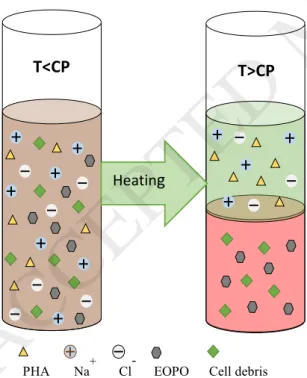
PEG was replaced by thermoseparating polymers, which can be more easily recyclable. They consist of random, diblock, and triblock copolymers of hydrophilic ethylene oxide (EO) and hydrophobic propylene oxide (PO), thus named as EOPO copolymers. Thermoseparating polymers are soluble in water up to the lower critical solution temperature or cloud point (CP). By raising the temperature, two phases are formed, i.e. the polymer and the waste phase. Leong et al. [126,127] studied the influence of the molecular weight of the thermoseparating polymers, their concentration, and the type of salt added to promote the partition of biomolecules to the targeted phase, (NH4)2SO4, K2HPO4 or NaCl. The authors acknowledged that the ATPS system was not a total solution but could be a primary step for purification, which would benefit from a volume reduction. The mechanism of separation of ATPS with thermoseparating polymers is shown in Figure 2.
Figure 2: Schematic representation of a thermoseparating polymer based two-phase system for the recovery of PHA.
Heatin
g
T>CP
T<CP
PHA Na+ Cl- EOPO Cell debris
24
3.2
Air classification
This technique consists of the separation of finely ground solid particles based on size or weight. The resulting finer fraction, with a high concentration of the product of interest, is later recovered with 85-95 % yield and 85-90 % purity, using physical methods such as filtration or centrifugation[128]. The first process patented by Procter & Gamble using air classification involved fine grinding of the biomass originating particles smaller than 100 μm. These particles were subjected to air classification and the fine fraction washed with an alcohol solution and the solid pellet of PHA separated from the residual supernatant [129].
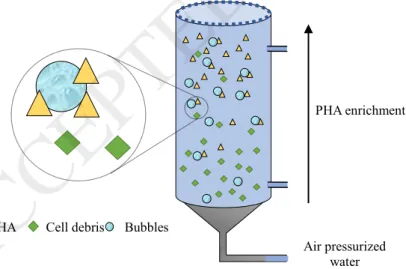
Van Hee and colleagues [130] carried out an in-depth study on the mechanism of flotation as a separating mechanism of mcl-PHA granules from the cell debris of P. putida. They used a flotation device with an enzyme treated broth, near the iso-electric point of bacterial debris and inclusion bodies, and water injection. The samples recovered at the bottom and the top were freeze dried. PHA content was determined by GC-FID. An 86 % purity was achieved, and the authors pointed out that there was room to improve this value with continuous flotation, when non-selective transport of particles in water is reduced. A schematic representation of the dissolved air mechanism to separate PHA is presented in Figure 3.
Figure 3: Representation of the separation of PHA from bacterial broth by selective air-dissolved flotation.
Air pressurized water PHA enrichment
PHA Cell debris Bubbles
25
4
PURIFICATION
The type of contaminants remaining in the recovered polymer depends on the extraction method used. Lipids and colouring substances are often co-extracted when using non-polar solvents while proteins are usually found when biomass has been chemically digested in an aqueous solution. Some of the techniques presented above can be applied, repeated or combined rendering a polymer suitable for a certain application [131].
The technology of PHA purification must satisfy strict requirements if the polymer is to be used in the medical field. Biologically active contaminants that can trigger immunological reactions need to be reduced to values that comply with United States Pharmacopeia policies. Lipopolysaccharides (LPS), present in the outer membrane of Gram negative bacteria, act as endotoxins and induce adverse effects when they are in contact with blood. Thereby, they represent a serious concern and medical-grade PHA needs to be meticulously purified to get rid of them. Repeated dissolution and precipitation of the polymer is common practice when purifying this grade of polymer [132].
To further reduce the endotoxin content, hypochlorite and inorganic and organic peroxides (hydrogen peroxide and benzoyl peroxide mainly) have been successfully used by Williams et al. [94]. Horowitz and Brennan [133] patented a purification strategy based on ozone. In addition to solubilisation of impurities, ozone has a bleaching and deodorizing effect on the polymer and eliminates the hazards of operating with hydrogen peroxide and the polymer degradation caused by sodium hypochlorite treatment. Zhang et al. [134] studied the endotoxin removal capacity of an adsorbent of crystalline calcium silicate hydrate.
Wampfler et al. [135] improved the simultaneous extraction and adsorption-based purification strategy developed previously in which a large loss of product was incurred. Mcl-PHA was extracted from freeze-dried biomass, in the presence of activated charcoal and ethyl acetate for 1 h (solvent to biomass ratio of 15:1v/w). An activated charcoal to solvent ratio of 0.25 or 0.5 (v/v) was used depending on the type of polymer being extracted. Solids were eliminated by pressure-assisted filtration after extraction. The filtrate was next passed through a filter cake
ACCEPTED MANUSCRIPT
26 and then through a membrane to remove the finest coal particles. A 55 to 75% yield was achieved using this optimized protocol.
5
FACTORS AFFECTING THE RECOVERY OF PHAs
As previously discussed, the recovery of PHAs is a complicated process that normally requires more than a single unit operation. The selection of a suitable combination of methods depends upon different factors [136]. It is crucial to specify the polymer quality requirements before considering any DSP method. Mechanical and physical properties, such as molecular weight, will be severely affected by the type of extraction method. Also the PHA natural form (amorphous or crystalline) might change with certain treatments [137]. Depending on the target purity and endotoxin level allowance, an additional purification step might be required. The properties of the PHA produced will determine the compatibility with certain DSP methods. For example, mcl-PHAs have a wider spectrum of solvents than P(3HB). Besides the type of polymer, its content affects the integrity of the membrane. Based on the percentage of PHA accumulated in the cell, the decision of solubilizing the PHA or the non-PHA cellular matter (NPCM) should be made [4]. The density of the polymer and average size of the granules finally limits the number of separation systems that can be used.
Lastly, the type of microorganism and culture conditions can also influence the DSP. Usually PHA-accumulating wild type bacteria have stronger cell walls than recombinant strains [138]. Mixed microbial cultures (MMC) are claimed to be more resistant to cell hydrolysis than pure cultures [44]. The cellular density of the culture affects the efficiency of the recovery process too. Compared to heterotrophic bacteria, the DSP of algae and cyanobacterial cultures is particularly difficult due to the lower biomass concentrations achieved in the fermentation [139]. Remaining oily substrates can be an obstacle for PHA isolation and a degreasing step, with an organic solvent or supercritical fluids, might be needed [140].
6
ENVIRONMENTAL CONSIDERATIONS
Bioplastics are presumed to present an ecological advantage with respect to conventional plastics since they are derived from renewable sources. This needs to be thoroughly evaluated
ACCEPTED MANUSCRIPT
27 by considering the environmental impact along the whole life cycle [141]. Results of the life cycle assessment of PHA production are however controversial. Different indicators such as global warming potential, carbon footprint, etc. and benchmarking against diverse products have led to contradictory results, especially when fermentation substrates and energy systems differ widely from one study to another. Furthermore, most studies are based on pilot-scale data, which do not represent a real industrial production system [142]. However, it is important to highlight the usefulness of LCA to pinpoint ‘ecological hotspots’[143].
Fernández-Dacosta et al. [144] performed a LCA on three downstream strategies for PHA recovery from MMC, namely alkali treatment (I), surfactant-hypochlorite (II) and solvent based extraction (III), results are summarised in Table 4. The former was found to be the most favourable from both, environmental and economic point of view. The surfactant-hypochlorite method required an additional step and had a higher ecological footprint due to the usage of chemicals (SDS). The distillation to recover and recycle DCM and ethanol in the solvent-based approach incurred in the highest costs and environmental impact because of the high duties in reboiler and condenser. Nonetheless, the polymer extracted by this route was the only one with enough quality to be applied as a thermoplastic.
Table 4: Comparison of different strategies for PHA recovery, adapted from Fernández-Dacosta et al. [144].
Strategy Yield (%) Cost (€/kg) GWP
(kg CO2-eq/kg P(3HB)) Non-renewable energy (MJ/kg P(3HB)) DSP contribution to total cost (%) I 73.5 1.40 2.4 106 70 II 75.8 1.56 2.1 109 73 III 82.8 1.95 4.3 156 79
On another study, Righi et al. conducted a LCA of polyhydroxybutyrate extraction using simulated industrial scale data using DMC and compared the results with those obtained with 1,2-dichloroethane. In all categories assessed (climate change, photochemical ozone formation and ecotoxicity), DMC showed better environmental performance than the halogenated hydrocarbon solvent. It was also found that the extraction applied to dry biomass resulted more favourable than the one from slurry biomass [145].
28
7
REMARKS
Solvents have been the most explored alternative for PHA recovery and good results, in terms of yield, purity and polymer quality, have been achieved with this method. Nevertheless, in order to adopt the principle of producing a sustainable replacement for an oil-derived product, green solvents and recycle loops need to be implemented. sCO2 can be an interesting alternative if the cost of production can be reduced; a biorefinery approach where the sCO2 is produced in the same facility could contribute towards this goal. Other promising solvents are DMC or ethyl lactate derived from microbially produced lactic acid [146].
To overcome the limitation of the most commonly used chemical, i.e. sodium hypochlorite, low concentrations of surfactant solutions, acids and bases can be employed which could result in less environmental burden. Enzymatic hydrolysis could only compete with the chemical approach if crude enzyme hydrolysates are produced. Mechanical systems, specially bead milling, have many attractive advantages over solvents and chemicals, provided a clean energy system is available.
Within the advanced separation techniques, ATPE appears as a cost-effective and scalable method to be used as a first step in the purification process. The combination of operations must be carefully evaluated based on the final product specifications but ultimately Life Cycle Assessments should determine whether the selected route is a sustainable solution.
As already mentioned, DSP can contribute to a high share of the total costs. Developing less expensive DSP operations is especially important if using MMC or starting with low value carbon sources. Furthermore, the anaerobic digestion of NPCM in biogas plants or the chemical/enzymic hydrolysis to a rich carbon and nitrogen source for subsequent microbial cultivations can enhance the overall feasibility of the process [147].
As presented in this review, the suitability of an extraction technique is intimately linked to the system characteristics and final use of the polymer, but it can never neglect the ultimate purpose of the process: the production of green plastics.
29
8
REFERENCES
[1] O. Wolf, J. Schleich, F. Marscheider-Weidemann, M. Patel, M. Crank, G. Angerer, B. Hüsing, European Commission. Joint Research Centre. Institute for Prospective Technological Studies., Techno-economic feasibility of large-scale production of bio-based polymers in Europe, Publications Office, 2005.
[2] G.-Q. Chen, X.-R. Jiang, Engineering microorganisms for improving polyhydroxyalkanoate biosynthesis, Curr. Opin. Biotechnol. 53 (2018) 20–25. doi:10.1016/J.COPBIO.2017.10.008.
[3] L. Favaro, M. Basaglia, S. Casella, Improving polyhydroxyalkanoate production from inexpensive carbon sources by genetic approaches: a review, Biofuels, Bioprod. Biorefining. 13 (2019) 208–227. doi:10.1002/bbb.1944.
[4] M. Koller, H. Niebelschütz, G. Braunegg, Strategies for recovery and purification of poly[(R)‐ 3‐ hydroxyalkanoates] (PHA) biopolyesters from surrounding biomass, Eng. Life Sci. 13 (2013) 549–562. doi:10.1002/ELSC.201300021.
[5] L. Narayanan, A.P. Joshi, Polyhydroxyalkanoate (PHA) market Global forecast 2021, 2017.
[6] P. Basnett, E. Marcello, B. Lukasiewicz, B. Panchal, R. Nigmatullin, J.C. Knowles, I. Roy, Biosynthesis and characterization of a novel, biocompatible medium chain length polyhydroxyalkanoate by Pseudomonas mendocina CH50 using coconut oil as the carbon source, J. Mater. Sci. Mater. Med. 29 (2018) 179. doi:10.1007/s10856-018-6183-9.
[7] T. Narancic, S. Verstichel, S. Reddy Chaganti, L. Morales-Gamez, S.T. Kenny, B. De Wilde, R. Babu Padamati, K.E. O’Connor, Biodegradable Plastic Blends Create New Possibilities for End-of-Life Management of Plastics but They Are Not a Panacea for Plastic Pollution, Environ. Sci. Technol. 52 (2018) 10441–10452. doi:10.1021/acs.est.8b02963.
30 [8] S. Obruca, P. Sedlacek, M. Koller, D. Kucera, I. Pernicova, Involvement of polyhydroxyalkanoates in stress resistance of microbial cells: Biotechnological consequences and applications, Biotechnol. Adv. 36 (2018) 856–870. doi:10.1016/j.biotechadv.2017.12.006.
[9] N. Jacquel, C.-W. Lo, Y.-H. Wei, H.-S. Wu, S.S. Wang, Isolation and purification of bacterial poly(3-hydroxyalkanoates), Biochem. Eng. J. 39 (2008) 15–27. doi:10.1016/j.bej.2007.11.029.
[10] P. Passanha, S.R. Esteves, G. Kedia, R.M. Dinsdale, A.J. Guwy, Increasing polyhydroxyalkanoate (PHA) yields from Cupriavidus necator by using filtered digestate liquors, Bioresour. Technol. 147 (2013) 345–352. doi:10.1016/j.biortech.2013.08.050.
[11] M. Koller, Biodegradable and Biocompatible Polyhydroxy-alkanoates (PHA): Auspicious Microbial Macromolecules for Pharmaceutical and Therapeutic Applications, Molecules. 23 (2018) 362. doi:10.3390/molecules23020362.
[12] J.N. Baptist, Process for preparing poly-beta-hydroxybutyric acid, 3044942, 1960. https://patents.google.com/patent/US3044942A/en (accessed February 18, 2019). [13] P.A. Holmes, L.F. Wright, B. Alderson, P.J. Senior, A process for the extraction of
poly-3-hydroxy-butyric acid from microbial cells, 0015123, 1980.
[14] J.A. Ramsay, E. Berger, R. Voyer, C. Chavarie, B.A. Ramsay, Extraction of poly-3-hydroxybutyrate using chlorinated solvents, Biotechnol. Tech. 8 (1994) 589–594. doi:10.1007/BF00152152.
[15] P.J. Barham, Physical Properties of Poly(Hydroxybutyrate) and Poly(Hydroxybutyrate-Co-Hydroxyvalerate), in: Nov. Biodegrad. Microb. Polym., Springer Netherlands, Dordrecht, 1990: pp. 81–96. doi:10.1007/978-94-009-2129-0_8.
[16] R.M. Lafferty, E. Heinzle, Cyclic carbonic acid esters as solvents for poly-(β-hydroxybutyric acid, 4101533, 1977. https://patents.google.com/patent/US4101533 (accessed February 6, 2019).
[17] I. Noda, L.A. Schechtman, Solvent extraction of polyhydroxyalkanoates from biomass,
ACCEPTED MANUSCRIPT
31 5,942,597, 1996. https://patents.google.com/patent/US5942597A/en (accessed February 18, 2019).
[18] D.L. Kurdikar, F.E. Strauser, A.J. Solodar, M.D. Paster, J. Asrar, Methods of PHA extraction and recovery using non-halogenated solvents, 6,043,063, 1998. https://patents.google.com/patent/US6043063A/en (accessed February 18, 2019). [19] D.M. Horowitz, Methods for purifying polyhydroxyalkanoates, US 2002/0058316A1,
2002.
https://patents.google.com/patent/US20020058316A1/en?q=Methods&q=purifying&q =polyhydroxyalkanoates&q=Horowitz&oq=Methods+for+purifying+polyhydroxyalka noates+Horowitz (accessed February 18, 2019).
[20] J. Van Walsem, L. Zhong, S.S. Shih, Polymer extraction methods, 7,252,980, 2003. https://patents.google.com/patent/US7252980B2/en?q=Polymer&q=extraction&q=met hods&inventor=Walsem&oq=Polymer+extraction+methods+Walsem (accessed February 18, 2019).
[21] K. Kinoshita, F. Osakada, Y. Ueda, K. Narasimhan, A.C. Cearley, K. Yee, I. Noda, Method for producing polyhydroxyalkanoate crystal, US 7,153,928 B2, 2004. https://patents.google.com/patent/US7153928 (accessed February 18, 2019).
[22] K. Narasimhan, I. Noda, M. Matthew, A.C. Cearley, M.S. Gibson, S.J. Welling, Process for the extraction of polyhydroxyalkanoates from biomass, 0057692 A1, 2005. https://patents.google.com/patent/US20060057692A1/en?q=Process&q=solvent-
based&q=extraction&q=poly- &q=hydroxyalkanoates&q=biomass&q=Narasimhan&oq=Process+for+the+solvent-based+extraction+of+poly-+hydroxyalkanoates+from+biomass+Narasimhan (accessed February 18, 2019).
[23] M. Koller, R. Bona, E. Chiellini, G. Braunegg, Extraction of short-chain-length poly-[(R)-hydroxyalkanoates] (scl-PHA) by the “anti-solvent” acetone under elevated temperature and pressure, Biotechnol. Lett. 35 (2013) 1023–1028. doi:10.1007/s10529-013-1185-7.
32 [24] P. Furrer, S. Panke, M. Zinn, Efficient recovery of low endotoxin medium-chain-length poly([R]-3-hydroxyalkanoate) from bacterial biomass, J. Microbiol. Methods. 69 (2007) 206–213. doi:10.1016/J.MIMET.2007.01.002.
[25] F. Chemat, M.A. Vian, G. Cravotto, Green Extraction of Natural Products: Concept and Principles, Int. J. Mol. Sci. 13 (2012) 8615–8627. doi:10.3390/ijms13078615.
[26] A.D. Curzons, D.C. Constable, V.L. Cunningham, Solvent selection guide: a guide to the integration of environmental, health and safety criteria into the selection of solvents, Clean Technol. Environ. Policy. 1 (1999) 82–90. doi:10.1007/s100980050014.
[27] C. Samorì, M. Basaglia, S. Casella, L. Favaro, P. Galletti, L. Giorgini, D. Marchi, L. Mazzocchetti, C. Torri, E. Tagliavini, Dimethyl carbonate and switchable anionic surfactants: two effective tools for the extraction of polyhydroxyalkanoates from microbial biomass, Green Chem. 17 (2015) 1047–1056. doi:10.1039/C4GC01821D. [28] R. Nonato, P. Mantelatto, C. Rossell, Integrated production of biodegradable plastic,
sugar and ethanol, Appl. Microbiol. Biotechnol. 57 (2001) 1–5. doi:10.1007/s002530100732.
[29] T. Fei, S. Cazeneuve, Z. Wen, L. Wu, T. Wang, Effective recovery of poly-β-hydroxybutyrate (PHB) biopolymer from Cupriavidus necator using a novel and environmentally friendly solvent system, Biotechnol. Prog. 32 (2016) 678–685. doi:10.1002/btpr.2247.
[30] T. Manangan, S. Shawaphun, Quantitative extraction and determination of polyhydroxyalkanoate accumulated in Alcaligenes latus dry cells, ScienceAsia. 36 (2010) 199–203. doi:10.2306/scienceasia1513-1874.2010.36.199.
[31] A. Aramvash, N. Gholami-Banadkuki, F. Moazzeni-Zavareh, S. Hajizadeh-Turchi, An Environmentally Friendly and Efficient Method for Extraction of PHB Biopolymer with Non-Halogenated Solvents, J. Microbiol. Biotechnol. J. Microbiol. Biotechnol. (2015) 1936–1943. doi:10.4014/jmb.1505.05053.
[32] P. Furrer, S. Panke, M. Zinn, Efficient recovery of low endotoxin medium-chain-length poly([R]-3-hydroxyalkanoate) from bacterial biomass, J. Microbiol. Methods. 69 (2007)