Fauna & Flora International acts to conserve
threatened species and ecosystems worldwide,
choosing solutions that are sustainable, based on
sound science and compatible with human needs.
Mobile Phones:
An Appropriate Tool
For Conservation And
Development?
Ken Banks and Richard Burge
F
auna & F
lora I
n
ternational • K
en B
anks and Richar
d B
urge • M
obile P
hones: An A
ppr
opr
iate
T
ool F
or Conser
vation And D
ev
elop
ment?
UNA & FL
ORA INTERNA
TIONAL CONSER
V
A
TION REPOR
T
S
VodafoneCover_04.qxp 20/10/2004 09:05 Page 1Mobile phone technology is developing at an extraordinarily rapid pace and is being applied to an increasingly wide range of human activities and the environment in which we live. It brings both benefits and challenges. This report looks at the implications and applications of mobile phone technology on conservation and development initiatives in the develop-ing world. It takes into account the integration between mobile phones and other Information and Communication Technologies (ICTs), identifying ways in which mobile phones play a role in the digital divide debate. Having considered government, donor, business and NGO policies towards mobile phones and other ICTs, the report details a number of case studies where they are being applied to development and conservation work.
Fauna & Flora International
Corporate Affairs Department Great Eastern House Tenison Road Cambridge CB1 2TT United Kingdom Tel: +44 (0)1223 571000 Fax: +44 (0)1223 461481 [email protected] www.fauna-flora.org
The Vodafone Group Foundationis driven by a Passion for the World Around Us. The Foundation makes social investments that help the people of the world to have fuller lives by:
• Sharing the benefits of developments in mobile communications technology as widely as possible
• Protecting the natural environment
• Supporting the local communities in which Vodafone’s customers, employees, investors and suppliers live
The Vodafone Group Foundation
Vodafone House The Connection Newbury
Berkshire RG14 2FN
Fauna & Flora International – Communications Fauna & Flora International Conservation Reportscontain information relating to the worldwide conservation activities of Fauna & Flora International (FFI). This ongoing series of publications examines thematic conservation issues and provides details of FFI research into, and management of , key species and habitats. These reports form an integral part of a portfolio of publications about biodiversity conservation and the work of FFI.
Fauna & Flora, the magazine of Fauna & Flora International, provides twice-yearly updates on FFI activities, supported by FFI’s website at www.fauna-flora.org
Oryx – The International Journal of Conservation aims to provide a comprehensive view of the conservation of wild species. It features original succinct and up-to-date papers on all aspects of species conservation, particularly material that has the potential to improve conservation efforts and enhance understanding of conservation needs.
Sample copies of some FFI publications can be requested or downloaded Ken Bankshas over 15 years experience working in the
Information Technology industry. He also has experience on development and conservation projects in various parts of Africa. He is currently contracted to Fauna & Flora International.
Richard Burgehas over 12 years experience working in international development, particularly in Africa. He is an independent consultant, working in the Corporate Affairs Department of Fauna & Flora International.
Since 2003 the authors have also worked on a research and development project called ‘Technologies for conservation and development in southern Africa’.
Mobile Phones: An Appropriate
Tool For Conservation And
Development?
The designation of geographical entities in this document and the presentation of the material do not imply any expression on the part of the author of Fauna & Flora International concerning the legal status of any country, territory or area, or its authorities, or concerning the delineation of its frontiers and boundaries.
The opinion of the individual authors does not necessarily reflect the opinion of either the editors or Fauna & Flora International.
The authors and Fauna & Flora International take no responsibility for any misrepresentation of material from the translation of this document into any other language.
Published by Fauna & Flora International, Cambridge, UK Copyright 2004 Fauna & Flora International
Reproduction of any part of this publication for educational, conservation and other non-profit purposes is authorized without prior permission from the copyright holder, provided that the source is fully acknowledged. Reproduction for resale or other commercial purposes is prohibited without prior written permission from the copyright holder.
Citation: Banks, K and Burge, R. (2004) Mobile Phones: An Appropriate Tool For Conservation And Development?Fauna & Flora International, Cambridge, UK ISBN: 1-903703-15-8
Produced by: Fauna & Flora International, Cambridge, UK
Layout by: Page Bros., Norwich
Cover photo: Credit: Jeremy Holden/FFI.
Printed by: Page Bros., Norwich
Available from: Fauna & Flora International Great Eastern House Tenison Road
Cambridge CB1 2TT, UK Tel: + 44 (0)1223 571000 Fax: +44 (0)1224 461481 [email protected]
Acknowledgements . . . .4
1. Executive summary . . . .5
2. Setting the scene . . . .9
2.1. Mobile phones: the global picture . . . 9
2.2. A view from the developed world . . . 10
2.3. A view from the developing world . . . 12
3. The digital divide . . . .17
3.1. Why should we be concerned with the digital divide? . . . 17
3.2. Can mobile phones help to close the digital divide? . . . 17
3.3. Widening the scope: integration with other ICTs . . . 19
4. ICT strategies and applications for, and in, the developing world . . . .21
4.1. Government and donor policies . . . 21
4.2. The role of NGOs . . . 22
4.3. Corporate Environmental and Social Responsibility (CESR): the business benefits of good practice . . . 22
4.4. How the telecommunications industry can address its CESR responsibilities . . . 24
4.5. Connecting CESR and market opportunity to extend coverage to poor, rural areas . . . 26
4.6. Socio-economic spin-offs: mobile telephony as a catalyst . . . 26
4.7. A southern African perspective . . . 27
5. Mobile telephony and development: case studies from around the world . . . .31
5.1 Rural phones . . . 31
5.2 Telemedicine . . . 32
5.3 Small business development . . . 33
5.4 Market trading and farming . . . 33
5.5 Humanitarian and community services . . . . 35
5.6 Issues raised . . . 35
6. Mobile telephony and microfinance . . . .37
6.1. Case studies . . . 37
6.2. Issues raised . . . 37
7. Mobile telephony, ICTs and conservation .41 7.1. The use of ICTs in conservation . . . 41
7.2. ICT use at a practical, hands-on level . . . 43
7.3. ICT use for basic data collection . . . 44
7.4. ICT use for information, education and research . . . 44
7.5. ICT use in community-led conservation initiatives . . . 45
7.6. ICT use for conservation project management . . . 45
7.7. ICT use in tracking and monitoring . . . 46
7.8. Issues raised . . . 51
8. Identifying appropriate ICTs for conservation and development: southern Africa as a case study . . . .53
9. Bibliography . . . .63
Acknowledgements
The authors would like to express thanks to the following people who have contributed to the research and to this report.
John Logan and Szilvia Lidstone, Vodafone Group Foundation
Nick Hughes, Vodafone Group
Kule Chitepo, Ridwana Yusuf-Jooma and Rest Kanju, ResourceAfrica
Tatenda Chiweshe, Blufone Michele Scanlon, EMC
Jenine Firpo, Hewlett Packard (USA)
Dave Beamont, Jon Hutton, Tim Knight, Bill Parker and Matt Rice, Fauna & Flora International
Becky Coles, Fauna & Flora International (for research and input into Chapter 7)
Leonie Vlachos, Bridges.org
Dr Amani Ngusaru, Nichola Starkey, Georgina Stevens and Mark Wright, WWF
Ed O’Keefe, Synergy, UK
Karen Hayes, Fauna & Flora International, who has provided valuable input into the overall report and, in particular, the CESR sections of Chapter 4.
Mobile phone technology is developing at an extraordinarily rapid pace and is being applied to an increasingly wide range of human activities and the environment in which we live. It brings both benefits and challenges. This report looks at the implications and applications of mobile phone technology on conservation and development initiatives in the developing world. It takes into account the integration between mobile phones and other Information and Communication Technologies (ICTs), identifying ways in which mobile phones play a role in the digital divide debate. Having considered the policies of governments, donors, businesses and non-governmental organizations (NGOs) towards mobile phones and other ICTs, the report details a number of case studies where they are being applied to development and conservation work.
The research for the report was mainly desk-based, although complemented by field research coming from an existing Fauna & Flora International (FFI) project in southern Africa.1 It does not attempt to examine the whole range of ICT applications and initiatives being used in development. Nor is the report a definitive account of the use of mobile phone technology for conservation and development projects. Nevertheless, we hope the report can contribute to the understanding and debate of the use of mobile phone technology in these areas, and perhaps for the first time, bring together a whole range of projects and practices.
The following conclusions are drawn and recommendations are made:
1. Mobile phones have fundamentally changed how we communicate in society. They have become a dominant technology in the developed world. With innovation racing ahead in the West, there is the danger of developing countries once again being left behind, this time technologically (what is called ‘the digital divide’).
2. However, the impact of mobile phones has possibly been more profound in developing countries that have had poor telecommunications infrastructure. To an extent, mobiles are ‘leapfrogging’ the technological gap between the developed and developing world.
3. Historically, there has been a slow uptake of many ICTs in developing countries, due to equipment costs, lack of infrastructure, logistical problems, lack of finance or political/commercial commitment. On the other hand, mobile phone growth in the developing world has been staggering, due to ease of network expansion, cheaper relative costs, high demand, and willingness of companies to invest. Rates of mobile phone uptake have differed markedly between and within countries in the developing world.
4. On their own, however, mobile phones will not, and cannot, bridge the digital divide. They must also be considered alongside other ICTs in an
Executive Summary
1
1The project, ‘t4cd’ (technologies for conservation and development in southern Africa)
integrated approach. Mobile phones may not always be the most appropriate form of technology, even where there is good Global System for Mobile Communications (GSM) coverage.
5. It is important to emphasise that mobile phones and other ICTs are only tools, and nota solution in themselves to the problems encountered in the conservation and development arenas. In this respect, ICTs should be seen as tools of wider strategies and programmes, which aim to deal with threats to wildlife and the environment, as well as poverty.
6. Conservation and development projects applying ICTs at the community level should consider access criteria for bridging the digital divide. Issues of access, appropriate technology, affordability, capacity, content, socio-cultural factors, trust, legal and regulatory frameworks, local economic environment, macro-economic environment, political will, relevance and using existing infrastructure, are all highly relevant. If not properly considered, there is a danger of failure. 7. Governments, business and civil society are all
engaged in developing strategies and applications for ICTs in development, and sometimes, conservation work. The challenge for governments, business and civil society alike is to consider the above-mentioned criteria in their policies, programmes or business plans. For an international conservation agency, such as FFI, there is an equally complex challenge of incorporating such criteria into the piloting and development of ICT applications in support of its conservation programmes in order to demonstrate that there is the potential for biodiversity gain.
8. It is important to realise that mobile phone applications in the developed world can be adapted to the developing world, and visa-versa, providing there is commitment, resources, and involvement of local partners. In Europe, there are projects underway, or being piloted, that use mobile phone technology to support
socio-economic development and environmental activities.
9. It is an encouraging sign that some, but not all, of the major mobile phone operators in Europe have published Corporate Environmental and Social Responsibility (CESR) policies. This is undoubtedly good business practice, as well as opening up the opportunity for conservation agencies to pilot and develop applications for conservation projects.
10. As for any sector, there are clear business drivers, as well as CESR expectations, for mobile telecommunications companies to engage in conservation and development. And there are many, generic, environmental management issues, which companies should monitor, including energy efficiency, transport and water consumption. But there are also a variety of industry-specific issues that need to be considered: environmental impact of network rollout, waste management/end-of-life product control, and supply chain management.
11. Mobile phone companies should consider measuring how they perform against internationally agreed environmental goals, and the Millennium Development Goals (MDGs). This is a challenge to the corporate sector but it could be incorporated into future CESR reports. 12. Any ICT project for conservation and development should consider working in partnership with private business, government, civil society and academia. A wealth of experience and knowledge resides in the various sectors. The wheel should not be re-invented in different places, but replicated. A forum between the different parties could be established to share learning and experiences, both positive and negative. For example, the World Summit on the Information Society (in December 2003) was a good opportunity for different stakeholders to come together and share experiences.
13. If introduced appropriately, mobile phones can be a useful tool for development. There are a
number of examples from around the world which demonstrate the use of mobile phones in support of development work. Mobile technology is being used in rural phone networks, telemedicine, small business development, market trading and farming, humanitarian aid and community services. There are definite benefits of the use of mobile phones in supporting development, although certain criteria are necessary for their application to be successful.
14. In one particular area of development – microfinance – mobile telephony is being introduced and piloted extensively. Besides microfinance institutions (such as the Grameen Bank), the corporate sector has seen the potential value of using mobile phone technology for commercial applications in the microfinance sector. There are potential benefits, as well as concerns, about the technology being adapted to meet the needs of the poor.
15. Due to the isolation of many conservation areas, mobile phone use is often restricted. Where they are used, it tends to be on a practical level only, providing simple but crucial voice
communications. Hence, an even greater reason to consider other technologies.
16. ICTs can be used to benefit biodiversity and conservation in a number of ways. There are case studies from around the world that demonstrate potential biodiversity gains of ICT use in the following areas: at a practical, hands-on level; basic data collection, information, education and research; community-led conservation initiatives; conservation project management; tracking and monitoring.
17. A whole range of other ICTs are being applied to conservation work based on a pure scientific need, such as with the tracking of species or the implementation of GIS to digitally map the natural environment. At another level, the simple introduction of mobile phone coverage into an area can present huge benefits to both conservation organizations working in the area, and the local communities, without the need for any direct conservation NGO intervention. Indeed, NGOs encouraging mobile phone operators to extend coverage into national parks and reserves by presenting a strong business and biodiversity case is already happening.
2.1. Mobile phones: The global picture
Phones are now the dominant technology with which young people, and urban youth in particular, now define themselves. What sort of phone you carry and how you customise it says a great deal about you, just as the choice of car did for a previous generation.
The Economist (2004a) The good news for Iraq is that the use of mobile phones has increased several hundred-fold since before the war . . . The bad news is that the supply of electricity, of vastly more concern to millions of sweltering Iraqis, is still below the pre-war level and at that only for a limited time each day.
The Guardian (2004a) The mobile phone dominates our lives. It is more than just a ‘must have’ item in developed, western countries. To many young people, it has become a fashion item. Uptake in more established markets has now reached saturation point; there are currently more than 51 million users in the UK (BBC News Online, 2003b). While the demand for mobile phones seems to be insatiable, it is after all only a technology. There are always going to be more pressing needs. Nevertheless, it is a technology that has the potential to have a positive impact in society.
The mobile phone industry is unique in its rate of innovation – both in terms of the handsets themselves and the range of services on offer. Over the past couple of years in particular, the mobile phone has become a
key information communication device, spurred on by the earlier introduction of text messaging (Short Message Service, SMS) and the more recent mobile internet (Wireless Application Protocol, WAP) services. In its early days, WAP was over-hyped and badly promoted to a sceptical public, resulting in disappointing uptake. For many, expectations of the ‘mobile internet’ were just that, and handsets at that time simply were not able to deliver.
More recently, however, the introduction on some phones of colour screens, polyphonic sound2, built-in cameras and innovative operating systems such as Symbian3has enabled WAP-related services to come of age, and services such as Vodafone live!4are a testament to how far things have come. The rollout of 3G5 networks will significantly enhance the services on offer, and the continuing trend to provide mobile access to websites, albeit still limited at present, is a classic example of how the two technologies are beginning to converge. As a result, competition amongst mobile phone companies has boomed, with new firms trying to get a piece of the action in a market estimated to be worth over US$70 billion worldwide (The Economist, 2004b).
With innovation racing ahead in the West, there is the danger of developing countries once again being left behind, this time technologically. The aptly
Setting the Scene
2
2Polyphonic – the ability to play two or more independent sounds at the same time. 3Symbian – an advanced, open operating system used in many new data-enabled mobile
phones.
4Vodafone live! – the mobile internet platform of Vodafone.
53G – third generation (mobile phones), which provide enhanced speed and richer
titled ‘digital divide’ was already an issue, with emphasis on access to telephones, computers and the internet. For reasons discussed in section 3.2, mobile telephones have been able to ‘leapfrog’ some of the barriers, and as a result have found themselves at the forefront of the digital divide debate. The impact of mobile phones has been considerable.
People in some of the poorest parts of the world now have access to mobile technology. Addressing their specific needs, and supporting and encouraging the use of mobile technology as a force for positive social and environmental change presents the industry with unique challenges and opportunities.
2.2. A view from the developed world
The mobile phone has rapidly become an integral part of our lives. In many countries more than half the population uses a mobile phone and, in some developing economies, mobiles are often people’s only means of telecommunication.
Sir Christopher Gent, cited in Vodafone CSR Report (2003)
Aside from yet-unanswered questions relating to health, the positive use of mobile technologies lies largely in our hands – in the hands of government, when it comes to environmental issues and safety regulations; in the hands of operators, who can do much to ensure the smooth integration of the technology into our society, both in terms of equipment design and aesthetics, and through initiatives which help train people in mobile phone etiquette; in the hands of employers, who can take pains to ensure staff with corporate mobiles are not abused; and ultimately, in the hands of users, who need to cultivate a greater level of awareness and work to ensure that their phone use does not negatively impact the lives of those around them.
International Telecommunications Union (2004)
It is important to recognize that mobile phone innovations in the UK in support of developmental, environmental and conservation needs could easily be adapted in the rest of the world.
Setting the Scene
Box 1: The digital impact: mobile phones • By May 2004 there were an estimated 1.325
billion mobile phone subscribers globally; • Between 1995 and 2005, the number of mobile
phone subscribers across Africa is forecast to leap one hundredfold from 652,000 to over 67 million; • During the first quarter of 2004, over 153 million
mobiles phones were sold globally;
• Global revenue from mobile services leaped from US$19 billion in 1991 to an estimated US$414 billion in 2003;
• By 2003, there were an estimated 80 million browser-enabled mobile phones (with Internet access), up from 1.1 million in 1999. The number of mobile internet users is forecast to hit 600 million by 2008;
• In 1991 the number of fixed lines in use around the world totalled 546 million, compared with just 16 million mobiles. By 2002, the number of fixed lines doubled, whilst mobile lines have increased over seventy times;
• In Bangladesh, an investment of $80 million by Grameen Phone provided cellular phone service to rural areas, covering 100,000 subscribers in 250 villages.
Sources: Gartner Group, NUA Internet surveys and News, Africanews, Inktomi, asia.internet, e-commercetimes, Financial Times, Jupiter Communications, Cnet, Forrester Communications, PC Magazine, Far Eastern Economic Review, Hindustan Times, IDC, Forbes, MobileChoice, International Telecommunications Union (ITU)
Setting the Scene
Box 2: How mobile phones have changed everyday life in the Democratic Republic of Congo – a western perspective
My first visit to the Congo was in 1994, to a town called Goma in the eastern part of what was then Zaire, during the Rwandan genocide and refugee crisis. Like most international aid agencies, we were equipped with some of the most recent ICT equipment, including high-frequency (HF) radios and a satellite telephone. However, for the majority of the Congolese, there was no access to phones, the internet, or radios, let alone mobile phones. They relied upon traditional forms of communication, sometimes travelling hours to send a message, or crossing the border into Rwanda (which, in 1994, was not the safest thing to do). A few had fixed lines, but these were unreliable. Very few could afford to pay for email or voice calls on a satellite phone. By 2003, however, one of the most dramatic changes in everyday life was the proliferation of the mobile phone. When I returned to Goma in this year, the mobile appeared to be an everyday item for some people, such as entrepreneurs, NGO staff, church leaders, government officials, cooperatives, and military officers. Instead of driving for a couple of hours, you
could just make a call or text message, to arrange a meeting, buy and sell produce, pass on information, and so on. And this was taking place in a town where there are high levels of poverty, compounded by two protracted civil wars, a volcanic eruption, riots and looting, and the occupation by a foreign army, all in the last ten years. The majority, however, continue to have no access to mobile phones.
But the mobile has a ‘reputation’ in the Congo. At the turn of the century, a sudden boom in the price of coltan (a tantalum-bearing ore, used in the manufacture of capacitors for mobile phones and other hi-tech equipment), led to a short-lived ‘gold rush’. While some benefited, the vast majority saw little reward. The exploitation of natural resources in the Congo has resulted in human suffering on an unprecedented scale, together with the destruction of wildlife and the environment, because it happened in a chaotic and unregulated fashion, largely controlled by military or political factions. The solution is to press for the regulation of coltan mining, for the benefit of the Congolese, private business and wildlife.
Richard Burge (2004)
See also Hayes & Burge (2003)
In Europe, projects are under way, or being piloted, which use mobile phone technology to support socio-economic development and environmental activities. These include sending data to doctors to facilitate remote diagnosis and provide patient support, mobiles being provided to flood victims in areas where land lines have come down, and farmers being able to update livestock databases via General Packet Radio Service (GPRS) on a mobile handset. By learning from these initiatives, knowledge and skills can be transferred to the developing world and adapted according to the particular context and need.
This learning and innovation requires commitment and resources. The Vodafone Group Foundation has given both, providing a grant to FFI to carry out research project development into how mobile phone technology can support international conservation and
sustainable development efforts. This report is one product of the research. Its conclusions and recommendations are, however, made entirely independently of the company.
It is an encouraging sign that some, but not all, of the major mobile phone operators in Europe have published Corporate Environmental and Social Responsibility (CESR) policies. This is undoubtedly good business practice, as well as opening up the opportunity for organizations such as FFI to pilot and develop applications for conservation projects. At the same time, the CESR statements and activities of corporations should be continuously monitored, their impact evaluated, and their effectiveness improved. The challenge will be to put newly developed policies into practice. Chapter 4 looks into CESR issues in more detail.
Setting the Scene
A main focus of this report is to examine the benefits, or otherwise, of mobile telephony for conservation and development. While most of the case studies included are projects in the developing world, it is important to highlight a few examples in the developed world, which are promoting international conservation and development issues: SMS texting to campaign on fair trade (e.g., The Catholic Agency for Overseas Development’s Jubilee Campaign), SMS donating for good causes (e.g., Comic Relief ), and the use of the mobile internet to raise awareness and funds (e.g., FFI’s wildlive!, see Box 3 below).
2.3. A view from the developing world
Africans’ insatiable appetite for cell [mobile] phones has made the continent a profitable market for the high-tech gadgets, which were
introduced only a decade ago. But in the intervening ten years, the sales figures have masked a larger social story: how the proliferation of cell phones is changing Africans’ relationships with one another.
Hall (2003) The growth of the cell phone industry in Cameroon is being choked by expensive cell phone handsets, with a motorbike being cheaper than a cellular telephone . . . Cameroonians are keen to be part of the world by using cellular telephones . . . Cellphone manufacturers and network operators themselves are best placed to change this dire situation, but they seem unaware or uninterested in solving the problem.
Balancing Act (2004)
Box 3: wildlive! – a case study
Combined web/WAP approaches are nothing new to news service providers such as the BBC who have had a simple text-based, mobile news service available for some time.
There are unique opportunities for the conservation movement to harness mobile technology as a tool in promoting their work. December 2003 saw the launch of wildlive! – a joint venture between the Vodafone Group Foundation, Vodafone UK and Fauna & Flora International. A fully-featured website providing a wide variety of conservation news stories, discussion boards, field diaries, competitions, downloadable resources and image galleries was developed using a shared database which also feeds directly into a micro-site on Vodafone’s live! platform. Vodafone live! users can access a wide range of these services, in addition to downloadable animal-sound ringtones, wildlife images and themed Java games. This is the first time that conservation-based materials have been made available to mobile subscribers, giving them the opportunity to engage in conservation in a completely new way. As wildlive! proved highly successful in the first six months after its launch in the UK, the Vodafone Group is expanding the service to engage live! users across the world in conservation.
Plans have also been put in place to create a ‘low bandwidth’ version of wildlive! This will feed conservation information through to earlier (legacy) models of handsets and, for example, allow tourists to receive location-specific information relating to the conservation areas they are visiting, or provide them details of local markets or cultural events taking place. These will be provided via simple WAP access, or via SMS, or a combination of both.
Setting the Scene
Unlike countless other high-tech products, mobiles are finding a readily accessible market within developing countries. Demand is high and, although it is a relatively new industry, mobile phone service providers tend to be highly profitable, operationally at least. With some operators able to turn a profit within a few months of operation, in recent years there has been a ‘scramble’ for licences and partners. With global growth forecast to hit over 30% in 2004, the rush is easily justified as Africa alone is set to grow at twice that rate (CellularOnline, 2003). A key reason for the historically low uptake of many ICTs in developing countries lies in equipment costs and a lack of supporting infrastructure. Logistical problems, such as the vast distances involved, and a lack of finance or political/commercial will, have meant that the expansion of fixed-line networks has been slow and, in some cases, non-existent. Mobile technology, on the other hand, can be implemented without the need to run cables over vast distances, and solar energy is often available as an alternative or backup power source. Such factors, coupled with huge consumer demand, the opening up of telecommunications markets, the willingness of
network operators to expand into emerging markets and the relative ease of network implementation have made mobile phones the communication method of choice in many developing countries. Indeed, uptake in some cases has been staggering – the number of mobile users in Swaziland, for example, overtook the number of fixed-line subscribers in just two years (Hall, 2003).
As mentioned, mobile phone uptake has been dramatic in the developing world. Mobile phone services, such as text messaging, have proved incredibly popular in places like the Philippines, while in Bangladesh they have connected some villages to a modern communications network for the first time. This has surprised some development practitioners, who thought that mobile telephones were a luxury item of the developed world and therefore inappropriate for many in the developing world. In Africa, the demand for connectivity has been phenomenal. The boom in mobile phone usage has largely been facilitated by the availability of cheap pay-as-you-go SIM cards and recycled handsets, which has allowed even the poorest members of society to make Box 4: The digital impact: other ICTs
• The cost of going online ranges considerably from US$18/month in Sweden to US$78/month in Argentina. On other hand, internet access in Chad costs US$10.50 for just one hour, where the average annual GDP per person is US$187; • An estimated one in three internet users in 2003
accessed the web from North America. Five years earlier the figure was nearer one in two;
• E-business will account for 10% of the world’s GDP by the year 2005;
• In industrialised economies, about 25% of consumer spending and 70% of business-to-business spending will be influenced by the internet;
• In 2000, 94% of all online transactions took place in the developed world, a 19:1 ratio against Africa, Asia and Latin America;
• India’s software exports are expected to grow from US$4 billion at present to about US$100 billion by 2005;
• By 2005, global demand for specialized IT skills will outstrip supply by 20%;
• The Asia-Pacific PC market, excluding Japan, grew 35% in 1999 to 14.1 million units, while the number of internet users jumped from 12.9 million to 21.8 million. Within five years, the total is expected to reach 95 million.
Sources: Gartner Group, NUA Internet surveys and News, Africanews, Inktomi, asia.internet, e-commercetimes, Financial Times, Jupiter Communications, Cnet, Forrester Communications, PC Magazine, Far Eastern Economic Review, Hindustan Times, IDC, Forbes, MobileChoice, International Telecommunications Union (ITU)
Setting the Scene
and receive calls. Some observers highlight the many countries across the African continent that are now ‘leapfrogging’ older technologies. Mobile phones and other wireless technologies are often the preferred options (AllAfrica.com, Oct 2003). Their impact has been felt across the board, no less so in rural areas:
Farmers are using mobile phones to ensure the best prices for their crops, small-scale entrepreneurs are contacting potential clients, and grandparents are talking to their children and grandchildren hundreds of kilometres away.
IDRC (2003a) Their positive impact – as a communications tool – can be seen when comparing past and current practice: What happens now is this. People have buyers for their maize, their coffee, their produce in town. So they call a buyer and say ‘Hello, we have 10 bags of maize. Do you need them? And what’s your price?’ They get the answer and then they call another buyer to ask ‘What’s your price?’ They get the best price. They ask: ‘How do you want it delivered, when do you want it delivered.’ In the past, they would just put it on a lorry and deliver even when the buyer is not interested, even when the market is down. Now, they actually find out.
IDRC (2003a) There has clearly been a great deal of enthusiasm for mobile phones in many developing countries as in the
West, albeit for different reasons. In the case of Africa, this is partly attributed to traditional African culture, with its emphasis on palaver and oral story telling. In Nigeria, for example, the average mobile phone is used for 200 minutes per week, compared with just 120 in the UK (Hall, 2003). However, the higher usage may also be due to other factors such as the lack of landlines and email facilities, larger families and social networks. While oral communication may be popular, high levels of illiteracy in some countries may negate the ability of people to use phones for other purposes, such as reading text messages.
Despite all of this, mobile networks may not always be as flexible or cheap as other technologies. In some cases, such as in Cameroon, new handset costs can actually prove to be a barrier.6 Fixed line technology, where it exists, allows for internet access and in many cases cheaper phone calls. Mobile coverage can prove rather sketchy in some areas (see Map 1), with competing network operators tending to concentrate initially on the larger towns and cities. As markets mature, however, coverage tends to spread gradually to more rural areas.
In reality, though, literally millions of Africans are making regular mobile calls. Mobile coverage is widening and increasing numbers of handsets are becoming available to developing world markets. What role can, and should, mobile phones be playing in helping to close the ‘digital divide’?
6However, there are schemes in the developed world such as Fonebak in the UK and the
PhoneFund and CollectiveGood in the US, which have provided cheaper mobile phones in the developing world. These recycling schemes ensure that reconditioned handsets are sold to approved retailers in Asia, Africa and Eastern Europe.
Setting the Scene
Map 1: In large parts of Africa mobile phone coverage remains limited
3.1. Why should we be concerned with
the digital divide?
Whether taken from the view of the developed or the developing world, the mobile phone is undoubtedly transforming society. Together with other types of ICT, the mobile phone is bringing about opportunities as well as challenges for all. On the one hand, it brings people closer together (sometimes called ‘the global village’), enables electronic commerce and business, connects people to social services, and allows for a certain ‘digital democratization’. On the other hand, the lack of coverage, infrastructure, access and knowledge, especially in many rural areas, has left many people even further behind in an age of ‘digital development’. In varying ways, governments, civil society and businesses have attempted to harness the opportunities while addressing the challenges of the so-called the digital divide.
So, what is the digital divide? The standard definition is provided by the Organisation for Economic Co-operation and Development (OECD):
The gap between individuals, households, business and geographic areas at different socio-economic levels with regard both to their opportunities to access information and communication technologies (ICTs) and to their use of the Internet for a wide variety of activities. OECD (2001) While it is recognized that there is a digital divide within countries as much as between countries and
continents, one of the concerns of this report is whether mobile phones can assist in closing the divide between the developed and developing world, or if they actually accentuate the gap.
3.2. Can mobile phones help to close
the digital divide?
The value of the mobile phone to everyday life in the developing world is not disputed. However, despite the explosion of mobile phones in these countries, mass poverty remains the key constraint to the expansion of mobile phone access and use. The traditional view has been that people living on less than US$1 a day simply cannot afford to make a phone call, let alone buy a handset. So, how could mobile phones have any impact on their lives at all, except ensure that they are even further disadvantaged in the new digital revolution?
This is even more pertinent when considering the new applications being offered by the mobile phone, such as the mobile-internet, video-streaming and photo-messaging (services commonly known in the UK as 2.5G or 3G). At present, 3G phones are emerging on the African sub-continent, but the potential for uptake will be severely limited (News.com, 2003). However, the traditional view is challenged when the reality is considered. As already seen, mobile phone use has boomed in many, but not all, developing countries. One of the advantages of mobile phones over other forms of technology is that they are more accessible in areas that lack ICT infrastructure. They are also more reliable in areas even where there are
The Digital Divide
fixed lines. In terms of affordability, the adoption of pre-paid phone cards has contributed hugely to the uptake of mobile phones in the developing world. It is arguable, therefore, that mobile phones are able to reach a larger number of people in the developing world than any other new technology. As one report notes about its ICT projects:
Most target groups . . . cannot afford to buy or even access the technology used in the projects, with the exception of phones. The poor are, moreover, increasingly benefiting from the strategic use of telephone communication . . . (some projects) clearly demonstrate that telephone technology (landline and mobile) can be used effectively to answer the communication, information, and business needs of poor people in developing nations
InfoDev (2003a) One of the dangers, though, is to see the introduction of mobile phone technology and other ICTs as the solution for poverty reduction, sustainable development and, even, conservation. Some view mobile phones as the catalyst for socio-economic development. However, this is debatable, as there are very few reports that have measured the impact of mobile phones on communities, except perhaps for anecdotal evidence in the trade press or development journals. Furthermore, developing over-dependence on a technology, such as the mobile phone, carries its own dangers. For example, farmers relying upon a mobile-based payment and information system may find themselves unable to trade in the event of a technological breakdown.
A stronger argument is that mobile phones and other ICTs “should be seen as a means to help meet existing development objectives, in particular the international development goals for poverty reduction, education, health and environment, not as a separate sector or end in themselves” (OECD, 2003a). Hence, many regard ICTs as a tool, albeit a very important one, in the business of poverty alleviation.
This is a real challenge for the private business sector. As previously identified, some mobile telecommunications companies in Europe have
developed CESR guidelines over the last few years. They have also supported social development projects in the UK and developing world. But how many of them have addressed wider developmental goals in connection with their business activities in the developing world? If companies started to address these as part of their commercial operations, it would add real value to CESR policies.
Crucial to this debate is whether or not mobile phone technology is able to play a role in bridging the digital divide. It is not just about expanding coverage into areas where previously there has been weak or non-existent telecommunications infrastructure. A number of criteria have to be met in order to help close the digital divide. The criteria outlined in Box 5 demonstrate what needs to be considered when looking at how modern technology (including mobile phones) could help close the divide. The piloting and introduction of mobile phone technology, in aid of conservation and development, should be measured against each of these criteria.
The challenge for governments, business and civil society alike is to consider these criteria in their policies, programmes or business plans. For an international conservation agency like FFI, there is an equally complex challenge of incorporating such criteria into the piloting and development of ICT applications in support of its conservation programmes in order to demonstrate that there is the potential for biodiversity gain.
In line with this thinking is a recent study conducted by the Overseas Development Institute (ODI), called ‘Livelihoods Approaches to Information and Communication in Support of Rural Poverty Elimination and Food Security’ (ODI, 2003). The key conclusions were that information and communications systems are most likely to improve livelihoods in rural areas if they: share costs appropriately; ensure equitable access to all; contain a high proportion of local or appropriately localized content; build on existing systems; build capacity; use realistic technologies; and build knowledge partnerships. These conclusions are wholly appropriate to FFI’s conservation programme, whenever ICTs are being applied, as FFI considers
The Digital Divide
human livelihoods as a fundamental part of any conservation strategy.
3.3. Widening the scope: integration
with other ICTs
Any analysis of the impact of mobile phones on conservation and development has to consider the wider ICT environment. Mobile phones are just one component of the range of telecommunications equipment on offer. Chapter 8 demonstrates a range of ICT tools available to those working in the conservation and development arenas.
At the same time, it is difficult to evaluate the impact of ICTs, including mobile phones, in the developing world, as contributors to the World Summit on the Information Society, in December 2003, have recognized:
. . . despite the proliferation of reports, initiatives, and pilot projects in the past several years, we still have little rigorous knowledge about ‘what works’. There are abundant ‘success stories’, but few of these have yet been subjected to detailed evaluation. There is a growing amount of data about the spread of ICTs in developing countries and the differential rates of that spread, but little hard evidence about the sustained impact of these ICTs on poverty reduction and economic growth in those countries . . . it is even difficult to put together systematic and reliable information on the size and scope of ICT initiatives in developing countries.
McNamara (2003) Finally, it is important to re-emphasize that mobile phones and other ICTs are only tools, and not the Box 5: Real Access criteria (to close the
digital divide)
1.Physical access: is technology available and physically accessible?
2.Appropriate technology: what is appropriate technology according to local conditions, and how do people use the technology to suit their own needs and wants?
3.Affordability: is technology access affordable for people to use?
4.Capacity: do people understand technology and its potential uses?
5.Relevant content: is there locally relevant content, especially in terms of language?
6.Integration: does the technology further burden people’s lives or does it integrate into daily routines?
7.Socio-cultural factors: are people limited in their use of technology, based on gender, race or other socio-cultural factors?
8.Trust: do people have confidence in and understand the implications of the technology they use, for instance in terms of privacy, security or cybercrime?
9. Legal and regulatory framework: how do laws and regulations affect technology use and what changes are needed to create an environment that fosters its use?
10.Local economic environment: is there a local economy that can and will sustain technology use?
11.Macro-economic environment: is national economic policy conducive to widespread technology use, for example, in terms of transparency, deregulation, investment, and labour issues?
12.Political will: is there political will in government to do what is needed to enable the integration of technology throughout society? 13.Relevance: any project interventions should
have clear objectives that are relevant to people’s needs.
14.Using existing structures: where appropriate, interventions should use what is available, but also adapt to changing environments.
The Digital Divide
solution to the problems encountered in the conservation and development arenas. In this respect, ICTs should be seen as tools of wider strategies and programmes, which aim to deal with threats to wildlife and the environment, as well as poverty. McNamara’s paper outlined general principles to act as guideposts for ICTs to be used in the promotion of development and poverty reduction (McNamara, 2003). These can be adapted to be applicable, also, to biodiversity and conservation. The case studies that follow in Chapters 5–7 demonstrate how ICTs are used practically in development and conservation programmes.
The internet can be regarded as a powerful tool for change and as a result has become a core element of numerous ICT strategies. However, it is important to
be aware of its negative impacts. These include propagating western ideologies and lifestyles; neglecting other cultures; delivering culturally-inappropriate content (e.g., pornography); being heavily biased towards the English language (approximately 65% of the internet is in English); issues over security and personal data (including viruses, worms and spyware); almost total lack of regulation; distorting the truth and the lack of accountability; propagating racial hatred and other extremist views; information overload; and exposing unsuspecting individuals to internet fraud. As the mobile phone becomes a more sophisticated and complex technology, it will face similar dangers. It is necessary for governments and business to develop appropriate policies that can curtail the negative use of mobile phones and other ICTs.
4.1. Government and donor policies
Governments and donors have been considering the role of ICTs in development for a number of years. While some have been slow or cautious on the uptake of ICTs, others have fully embraced new technologies in their policies and programmes. For example, the New Partnership for Africa’s Development (NEPAD) sees ICTs as crucial for social and economic development in the sub-continent. It has nominated organizations like Africa Connection to develop rural ICT markets, in order ‘to create a positive business environment for attracting expanded private investment and new operators into telecommunication infrastructure and information technology, as key planks in a broader effort to foster socio-economic development and growth’ (Africa Connection, 2003).
However, as with other multilateral ICT initiatives, NEPAD requires support from donors, civil society and the private sector. None of its twenty high-profile infrastructure projects (which includes tele-communications) has attracted a major private sector company in three years (NEPAD, 2004).
Most bilateral and multilateral donors have developed ICT strategies, recognizing the potential of ICTs as a catalyst for socio-economic development. They do not see ICT proliferation as the goal, but as a means to achieve their broader objectives, particularly in poverty reduction. Most donors have built their ICT strategy on partnerships with other bilateral and multilateral agencies, civil society, the private sector and academic institutions. A recent survey of OECD members concluded that:
• Sustainable ICT projects need to be locally owned and accompanied by human capacity development; • Capacity in effectively using ICTs for development is often the main constraint, not equipment itself; • The private sector is instrumental in expanding
ICTs for development access and applications; • Governments play a key role in establishing a
well-regulated, competitive enabling environment for ICTs to flourish;
• For ICTs to have a positive development impact, the various social groups must have equal access to them, particularly disadvantaged groups such as the poor, [women], children and indigenous people; • Many important aspects of information and
communication infrastructure are cross-border in nature, and therefore require international/regional cooperation.
(OECD, 2003b) These conclusions largely mirror the earlier arguments on the role that mobile phones and other ICTs can play in development and conservation work. The third point, referring to the crucial role of the private sector, is extremely important. In designing and implementing any ICT project, it is essential that governments and civil society work in partnership with the private sector, if they are to have real success. The World Bank has developed an Information and Communication Technology Strategy with the vision “to be a catalyst in improving access to ICT and promoting its use for stimulating economic growth, increasing equity, and reducing poverty” (World Bank,
ICT Strategies and Applications
ICT Strategies and Applications for, and in, the Developing World
2002). In this regard, the World Bank and other donors have agreed Millennium Development Goals (MDGs), which commit the international community to an expanded vision of development, one that vigorously promotes human development as the key to sustaining social and economic progress in all countries, and recognizes the importance of creating a global partnership for development. Its ICT strategy is geared towards meeting these MDGs.
The World Bank’s vision leads to four strategic directions: (1) broadening and deepening sector and institutional reform, (2) improving access to information infrastructure, (3) supporting ICT human capacity, (4) supporting ICT applications. InfoDev, which is a part of the World Bank, funds ICT projects that feed into the work of the World Bank’s Global ICT Department. InfoDev itself acknowledges the need to review the support it has provided to ICT projects. As a result, in 2004–05, it is launching “an intensive programme of support, research, analysis, and evaluation, impact monitoring, and toolkit development focused on distilling the lessons and experiences from the past 10 years on the impact of ICTs on poverty . . . .” (InfoDev, 2004). As with the World Bank, the United Nations supports a number of initiatives, including the UN’s ICT Task Force (which involves NGOs, government and the private sector), the UNDP ICT for Development programme, of which the Digital Opportunity Initiative is a key component (a public private partnership), and Digital Diaspora Networks (for Africa and the Caribbean, up to mid-2004).
Of particular interest to this report is the policy of the Department for International Development (DFID) in the UK. A study in 2002 set out the fundamental principles for DFID’s approach to ICTs and development. DFID supports a number of ICT-related programmes, including Building Digital Opportunities, Catalysing Access to ICTs in Africa, Imfundo (a programme to use ICTs for primary education and gender in Africa), Knowledge and Research, Louder Voices, and Open Knowledge Network. It also supports a number of multi-donor programmes, as well as companies like Vodafone, through its Business Challenge Fund.
It is important that the development and conservation community is informed of these wider developments. Equally, NGOs need to inform donors and governments of viable and appropriate ICT applications at the grassroots level. It is essential for any ICT project to understand the context in which it is working, and ensure integration with multilateral and bilateral programmes.
4.2. The role of non-governmental
organizations (NGOs)
As with governments and donors, NGOs are beginning to see the benefits of ICTs to development and conservation work. Some NGOs have embraced ICTs in their programmes, while others remain somewhat sceptical. The case studies in the subsequent chapters demonstrate the former. One NGO that has led the way in terms of its support to ICTs in development is the International Development Research Centre (IDRC), based in Canada, which has, amongst other programmes, created the Acacia Initiative to support ICT projects in Africa. Trusts and foundations are also recognizing the importance of supporting ICT projects that can help to close the digital divide, such as the Open Society Initiative. Other NGOs such as Bridges.org have been involved in developing policy and lobbying governments to improve access to modern technologies.
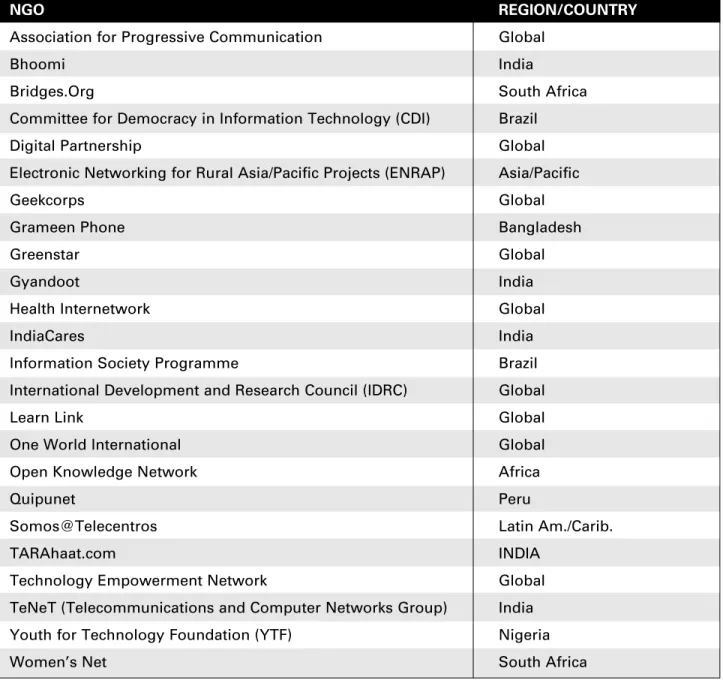
There are various NGO consortia working with ICTs, as well as organizations set up specifically to deal with issues of the digital divide. One such organization is the Digital Divide Network, which involves a number of partners from the private and not-for-profit sector. The NGOs in Table 1 are just some of those involved in ICT for development and conservation.
4.3. Corporate Environmental and
Social Responsibility (CESR): the
business benefits of good practice
There are a myriad of reasons why companies adopt CESR policies and practices. These drivers cover a spectrum that ranges from damage limitation to market opportunism. While corporate responsibility reporting is increasingly a feature of annual accounting processes, there are marked differences between the policies and practices of different companies. CESR policies tend to be voluntary in
ICT Strategies and Applications for, and in, the Developing World
nature, so the amount of emphasis on CESR depends largely upon the CEO, executive board, key staff or shareholders. In general, the private business sector argue that this voluntary approach is bringing about results in practice, while others (e.g., the corporate social responsibility coalition7) believe that there
should be mandatory requirements that make regulation the key driver.
Whether by choice or compliance, good corporate behaviour makes good business sense because: • Detrimental environmental practices can cost time
and money, and pose serious financial and regulatory compliance risks for companies. Anticipating and managing these risks delivers clear corporate benefit;
NGO REGION/COUNTRY
Association for Progressive Communication Global
Bhoomi India
Bridges.Org South Africa Committee for Democracy in Information Technology (CDI) Brazil Digital Partnership Global Electronic Networking for Rural Asia/Pacific Projects (ENRAP) Asia/Pacific
Geekcorps Global
Grameen Phone Bangladesh
Greenstar Global
Gyandoot India
Health Internetwork Global
IndiaCares India
Information Society Programme Brazil International Development and Research Council (IDRC) Global Learn Link Global One World International Global Open Knowledge Network Africa
Quipunet Peru
Somos@Telecentros Latin Am./Carib. TARAhaat.com INDIA
Technology Empowerment Network Global TeNeT (Telecommunications and Computer Networks Group) India Youth for Technology Foundation (YTF) Nigeria Women’s Net South Africa
Table 1: Some NGOs active in ICT policy and practice
7This is a UK coalition, of whose members include NGOs, academic institutions, unions,
business, and MPs. FFI is not a member of the coalition. It calls on the Government to ensure that companies to meet their environmental, social and business duties in three key areas: (a) mandatory reporting, (b) directors’ duties, and (c) foreign direct liability.
ICT Strategies and Applications for, and in, the Developing World
• Poor environmental practices pose health and safety risks for employees, host communities and customers with resulting legal and financial implications for the company;
• Poor community relations can jeopardize a company’s ‘licence to operate’;
• Public campaigns that can have significant negative impacts on reputation and brands are less likely if a company adopts good practices and open communications;
• A good social and environmental track record can improve a company’s performance on corporate indices, as well as its access to capital, as financial institutions and investors will feel more confident about the security of their investment;
• Companies with stated and demonstrated values, as well as active social and environmental outreach programmes, find it easier to recruit and retain quality staff;
• Products and services that answer environmental and social needs may be good indicators of innovative applications and potential new markets.
4.4. How the telecommunications
industry can address its CESR
responsibilities
As for any sector, these broad drivers of good practice can be applied to mobile telecommunications companies. There are many generic environmental management issues that companies should monitor, including energy efficiency, transport and water consumption. But a variety of industry-specific issues also need to be considered.
4.4.1. Environmental impact of network
rollout
The siting of base stations is a major consideration for mobile telecommunications companies as the aesthetic and potential health impacts of masts are highly contentious issues. Some companies are working with local planning authorities to find ways to balance the demands of service delivery with local concerns and restrictions. It is good practice for companies and local authorities to engage fully with the community, including local environmental bodies. This is especially true of mast locations, particularly in relation to health and more specifically when they are located above public buildings and schools. Despite a
series of health studies that have been carried out by government, academia and the mobile phone industry, results are inconclusive.
4.4.2. Waste management/end-of-life
product control
An estimated 15 million mobile phones are replaced each year in the UK alone. Many end up in the waste stream where, along with chargers and particularly batteries, they create a potentially lethal pollution hazard. International legislation is driving companies to build appropriate waste management policies and practices into their business operations with the result that recycling programmes are even starting in emerging markets such as Nigeria. These recycling programmes are a lucrative industry in their own right, providing the twin benefits of waste management and introduction of cheaper products to emerging markets.
4.4.3. Supply chain management
A company’s efforts to improve its own performance may be seriously undermined if it is found to be trading with, and profiting from, other companies whose socio-environmental actions are unacceptable. Managing the supply chain has become a major area of concern for many sectors including telecommunications. Addressing the complexities of the supply chain can often be most effectively achieved as a group rather than on an individual company basis. In order to share responsibility, learning and costs, the telecoms sector has created several industry policy development forums, including the Global e-Sustainability Initiative (GeSI). However, there is still much to be done on supply chain management. The industry should engage more with governments and civil society to ensure that ethical practices are carried out and monitored right down the supply chain. An increasing number of companies within the sector now produce annual CESR reports. Orange has been developing its CESR policies, publishing its first report in 2003, stating that: “corporate social responsibility is a natural extension of our business philosophy, brand and values” (Orange, 2003). Orange has eight business principles, including a commitment to managing its environmental impacts responsibly. As with mmo2, which is supporting the
ICT Strategies and Applications for, and in, the Developing World
planting of new forests in Europe, it supports charities through its Community Futures programme. These are worthwhile initiatives, but could be expanded. Orange encourages each of its companies to work with charities and support educational initiatives including how mobile phones can help in education, e.g., providing Thai language text messaging to deaf people in Thailand.
Partnerships are being formed between companies and the NGO sector. NGOs are able to add value to an organization by drawing on external resources, opinions and perspectives not available internally, and in return companies can provide specific skills, staff and expertise not available to NGOs. In some cases, these relationships are sponsorships or cause-related marketing campaigns. In others, the partners share resources and skills in order to address social and environmental issues within the sphere of the businesses’ activities. An example of the latter is the relationship between FFI and the Vodafone family of operating companies and corporate foundations. The parties are working together on a range of these issues in order to see how mobile telecommunications affect
communities and environments and how this can bring about biodiversity gains.
A partnership between the NGO and business sector needs to recognize that each party has different goals and objectives. A technology business may be most interested in how to gain access to emerging markets and sell more products, while an NGO’s prime concern may be to determine how a technology could be applied to poverty reduction programmes. It is important for both parties that the NGOs avoid being compromised as this will impact negatively on both their credibility with their supporters and on the impartial value they deliver to the company. They must be prepared to monitor and challenge their business partners. Key lessons on how companies and NGOs build effective partnerships can be found in the publication ‘Getting Real’ (IBLF, 2002).
Companies are accountable not only to their shareholders, but to customers and communities in which they have an impact. Likewise, NGOs should be accountable to both donors and the communities in which they work. It is good CESR practice for a Box 6: Fonebak
Through the ‘Fonebak’ scheme, Shields Environmental collect mobile phones for reuse or recycling. Viable phones are tested, refurbished, rebranded and sold. Older phones are recycled and the metals – including gold, palladium, copper, silver and platinum from the handsets, and cadmium, lithium and nickel from the batteries – are reclaimed. Plastics are recovered and reused, or cleanly incinerated for energy generation.
Typically, Fonebak recycles phones that are 1-2 years old, and which are then used for a further 3-5 years in a developing market. So by moving between markets, these phones actually fulfil the 7-year lifespan committed by the manufacturer rather than being obsolete after a mere 18 months use in the developed world.
Box 7: The coltan issue
In 2000, the telecommunications industry was accused of profiting from the war in Central Africa through the purchase of cheap ‘coltan’ – an ore containing the metal tantalum used in electronic products including mobile phones.
In an effort to understand the issues and address the problems, GeSI worked with FFI to propose an ethical trading response.
ICT Strategies and Applications for, and in, the Developing World
company to respond positively to challenges and concerns as this process will strengthen and validate CESR policies.
4.5. Connecting CESR and market
opportunity to extend coverage to
poor, rural areas
Senior managers who commit their companies to strategies for the bottom of the pyramid are creating sustainable development…
Prahalad and Hart (2002) With telecommunications markets reaching saturation point at the ‘top of the pyramid’ in developed countries, companies are turning their attention to the potential at the ‘base’. An estimated four billion people worldwide occupy this space – defined as having a purchasing power of less than US$1,500 a year. Whether as a component of CESR policy or identified as ‘emerging markets development’, many companies are beginning to see the benefits of this “counterintuitive new opportunity in the new millennium” (Prahalad and Hart, 2002).
In terms of economies of scale, servicing the base of the pyramid clearly makes sense. As previously documented, mobile phone uptake has proved strong in many developing countries, despite the preconception that the cost would be prohibitive for the majority. This large and willing market creates an incredibly high rate of demand and potentially very attractive profit margins within a relatively short period of time.
As the limiting factor is coverage, investment in infrastructure is substantial. However, outside well-populated urban areas, developing countries may present vast landscapes with scattered, small centres of habitation that pose significant physical and technical challenges in terms of coverage as well as marginal financial return, if any.
Anxious to try to extend coverage into these rural areas, some governments, when granting operating rights, require companies to include investment in areas of marginal return. Thus some network operators are committed to extending mobile coverage to isolated and unprofitable populations. In such
situations, the companies are, in effect, providing subsidized telecommunications services to some of the poorest communities.
But this does not necessarily constitute CESR as much as enlightened business interest. Such ‘subsidies’ are, in fact, a precondition, and therefore a cost, of their licence. And there is a significant market at stake. Cumulatively, the revenue potential in Africa’s rural telecom and ICT markets is estimated to be US$3 billion (Africa Connection, 2003).8There is, therefore, great financial potential in this dispersed market if companies can find creative solutions to make investment in infrastructure commercially viable. This may require partnerships with governments and co-operation between mobile phone companies in order to share costs.
In some instances, the government further requires the company to make social investment commitments to poor urban and rural communities, and to environmental causes. This is most notable in South Africa, where the three main cell operators (Vodacom, MTN and Cell C) are required not only to build networks in rural locations but also to include the provision of public phone booths. But, again, there is potential for commercial return. In Tanzania, the government has required Vodacom Tanzania to set up 50 telekiosks through a franchising system. The same company is now setting up its 200th centre, “not least because high demand has made telekiosks a profitable business idea” (Dialog Online, 2003).
Africa Connection has produced a Rural ICT Toolkit aimed at those looking to accelerate rural ICT development in Africa. It recommends four main activities to be promoted: (1) rural public phones (including the [mobile] ‘Virtual Network Operator’), (2) regional ‘next level’ internet points of presence (POPs), (3) networks for rural ‘intermediate’ agencies, and (4) small-scale telecentres.
4.6. Socio-economic spin-offs: mobile
telephony as a catalyst
In the often highly entrepreneurial environments found in many developing countries, the arrival of
8The World Bank financed a study, with the Africa Connection Centre for Strategic
Planning, in 2003 showing the market potential for ICT development in rural areas, in 10 African countries.