Civil Society Division (DSO/MO) Social Development Department Ministry of Foreign Affairs The Hague, the Netherlands
EVALUATION
Trade Union Cofinancing Programme 2009-2012
Final report
15 February 2012
CDP
Consultants for Development Programmes Utrecht, the Netherlands
Preface
The Dutch government’s Trade Union Cofinancing Programme ( Vakbondsmede-financieringsprogramma, VMP) is currently being implemented through grants to the Federation of Christian Trade Unions (CNV) and the Trade Union Confederation (FNV), covering the period 2009 to 2011. The three parties agreed to conduct a mid-term evaluation. In October 2011 the Ministry of Foreign Affairs commissioned the Utrecht-based firm Consultants for Development Projects (CDP) to carry out the evaluation.
A reference group comprising representatives of the ministry departments concerned, the Policy and Operations Evaluation Department (IOB) and FNV and CNV drafted the terms of reference (ToR). The evaluation mapped various new measures and conditions contained in the VMP and reviewed the progress made in applying them in CNV and FNV programmes and boosting effectiveness.
Following preliminary orientation and a draft proposal, CDP submitted two Inception Reports proposing an approach for the evaluation activities. The reports were discussed and approved by the reference group, and the approach was duly adopted.
The evaluation results were presented to the reference group in January 2012. A joint reflection on the conclusions and recommendations did not take place as planned. The report was finalised, taking account of comments and suggestions received. Responsibility for the report rests entirely with CDP.
Abbreviations
ACILS American Center for International Labour Solidarity
ALRN African Labour Research Network
BCPA Bureau for Technical Assistance to Unions in African Countries
BWI Building and Woodworkers’ International
CNV/CNV Internationaal Federation of Christian Trade Unions. CNVI is responsible for most of the international projects
CLC Cambodian Labour Confederation
DC countries Developing countries in the context of VMP: partner countries of the Dutch government, and OECD/DAC Least Developed Countries (LDCs)
DW themes Decent Work Agenda themes
FES Friedrich Ebert Foundation (Friedrich Ebert Stiftung)
FNV/FNV Mondiaal Dutch Trade Union Confederation. FNV Mondiaal (FNVM) is responsible for most of the international projects
FSPMI Federation of Indonesian Metalworkers Union (Federasi Serikat Pekerja Metal Indonesia)
GAWU General Agricultural Workers’ Union, Ghana
GFL Ghana Federation of Labour
GTUC Ghana Trades Union Congress
GUF Global Union Federations
ICEM International Federation of Chemical, Energy, Mines and General Workers’ Union
IDH Sustainable Trade Initiative (Initiatief Duurzame Handel) ILO International Labour Organisation (Geneva, Switzerland)
IMF International Monetary Fund
IOB Policy and Operations Evaluation Department (IOB) of the Dutch Ministry of Foreign Affairs
ITUC International Trade Union Confederation
IUF International Union of Food, Agricultural, Hotel, Restaurant, Catering, Tobacco and Allied Workers’ Associations
(I)NGO (International) Non-Governmental Organisation
(K)SBSI Confederation of Prosperous Indonesian Labor Unions (Konfederasi Serikat Buruh Sejahtera Indonesia)
LDC Least Developed Countries (OECD/DAC)
LRPI Labour Research and Policy Institute, Ghana
MDG Millennium Development Goal
MfDR/LFA Management for Development Results/Logframe Approach PME systems Planning, Monitoring and Evaluation systems
PSI Public Services International
VMP Trade Union Cofinancing Programme of the Dutch Ministry of Foreign Affairs (Vakbondsmedefinancieringsprogramma) TEGLU Textile, Garments, and Leather Workers Union
ToR Terms of Reference
TURC Trade Union Research Centre
TWUG Timber and Woodworkers’ Union, Ghana
WSM World Solidarity Movement, Belgium
Executive summary
Through the Trade Union Cofinancing Programme (VMP), the Dutch Ministry of Foreign Affairs, which is responsible for development cooperation, grants funding to the trade union federations FNV and CNV to promote labour and union rights in developing countries and so contribute to sustainable poverty reduction. The implementation and realisation of ILO’s Decent Work Agenda is central to the VMP. Funding for the current period of four years (2009/2012) has totalled around €57 million, with roughly two-thirds going to FNV Mondiaal and one-third to CNV Internationaal.
In 2008, the Ministry’s Policy and Operations Evaluation Department (IOB) published its evaluation report on the VMP for 2001-2006. A number of its recommendations were incorporated in the present VMP.
Firstly, the report mapped the choices made by FNV and CNV in relation to certain new conditions set out in the VMP policy framework. Secondly, it analysed the progress achieved by integrating and applying these conditions, from the start of the current VMP in 2009 until just over halfway through the implementation period, and also assessed the likelihood that these conditions would be fulfilled by the end of 2012. Thirdly, the report assessed the likelihood of increased effectiveness, where possible.
Three study questions were posed in the ToR:
1. To what extent has the number of countries fallen compared to the previous VMP? 2. In assessing partner organisations’ applications, has sensitivity to context on the part of
CNV Internationaal and FNV Mondiaal led to effective partner choices?
3. To what extent are the organisations’ PME systems capable of establishing their effectiveness?
The evaluation took place between November 2011 and January 2012. It consisted of (i) document study, (ii) interviews with FNV, CNV and partners, and (iii) field research in Ghana and Indonesia. The report was conceived as a basis for the new VMP framework, due to be published in February 2012.
Main findings and conclusions
Choice of countries (question 1)
Both CNV and FNV have introduced a greater focus into their overall programmes by reducing the number of countries where they work and focusing investments in the developing countries (DCs)1 identified in the Dutch government’s policy letter on development cooperation. By 2012, FNV will have reduced its range from 99 to 46 countries, 80% of which are official ‘partner countries’ of the Netherlands. The volume of investments there will also have risen to around 67%. CNV had already cut back significantly at the start of the VMP. By 2012, the number of countries where it works will have dropped from 36 to 28 (current at the time of going to press) or fewer. About half are DC countries, and by 2012 CNV’s total investments there will have risen to around 75%.
However, reducing the number of countries does not necessarily guarantee greater effectiveness, either at country or implementation level, since the picture is much more complex. Fragmentation may still occur due to factors and mechanisms that drive decision-making about projects, activities and partnering. In consequence of internal strategy reviews and partly in response to the conditions proposed in the VMP, FNV and CNV have both opted for a more strategic focus. They have introduced categories for intervention, and multiannual and strategic planning at country or partner organisation level. CNV adopted this approach early on, whereas FNV’s methods have already been piloted and are ready for organisation-wide application.
Choice of partners (question 2)
Whereas CNV follows a one-partner/country approach, FNV generally works with more than one, including multilateral partners and labour-related NGOs. The two different approaches derive from the strategic analyses and internal policies of the respective organisations, as do the types of interventions and ways of working that they favour. FNV seeks to streamline partnerships as a function of strategic planning and to narrow the focus by limiting the types of partnerships and projects it finances. This includes organising and facilitating collaborative processes between actors clustered around strategic objectives or issues. In terms of effectiveness, it has produced some promising results. Meanwhile, CNV has consistently deployed technical assistance to build organisational capacity by improving its partner’s internal and external organisation at confederation and affiliate level, while at the same time financing a portion of the partner’s organisational and project costs. The two distinctive approaches have achieved tangible success at rank-and-file and organisational level.
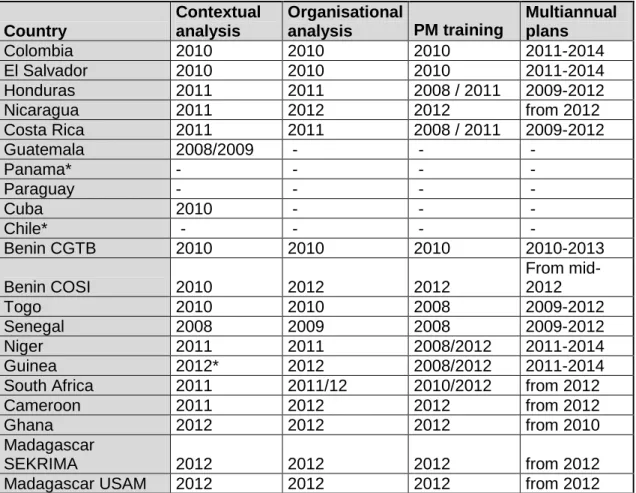
FNV and CNV confirm the added value of contextual and organisational analyses in both approaches besides the function of providing baseline data.
FNV has so far piloted contextual analyses as a potential starting point for its multiannual Country Programming process; the data obtained have been used as input into that process and serve as baseline data. This function will be extended progressively as and when new Country programmes are formulated. These formal contextual analyses did not influence country selection or categorisation, or the trajectories to be followed, nor did they determine the choice of partners or interventions. The choices were based on the usual analyses by the portfolio managers, using various data collection methods. CNV has already undertaken a range of contextual analyses. Moreover, since CNV had already chosen which countries to work in, these analyses did not influence its choice of countries or partners, or the initial choice of interventions. However, as contextual analyses constitute an input into the multiannual partner programmes currently being formulated, the outcomes are used to confirm the partner’s role and to identify additional domains for intervention as well as other potential partner organisations.
In both cases, organisational analyses have been used primarily to reassess the partners’ suitability. FNV has developed new tools that are mainly geared to identifying the needs for capacity development and the functioning of the partners in relation to project implementation or collaboration. In such cases, capacity development usually falls under project costs. CNV’s organisational analyses have also been developed during the present VMP period and have been integrated in its PME system. The analyses identify a wide range of options for improving the organisation’s performance. Recently there has been a general shift towards greater organisational sustainability.
It has been assumed that these two instruments will boost project implementation and effectiveness. If changes occur in the countries and/or partnerships, their role could become increasingly important. They should also add major value in combination with multiannual planning and strategy reviews.
PME systems and outcomes (question 3)
Given the work already involved, the need for changes to be completed at CNV and FNV, and the fact that it will inevitably take time to achieve greater focus and effectiveness, the next VMP should consolidate rather than introduce new conditions.
As it stands, the list of DC countries is helpful and the same modality could be applied during the next VMP. Further reducing the number of partner/DC countries would not be advisable since this would be harder to combine with CNV and FNV policies. Extending the list could only be achieved through other government financing instruments and/or financing from FNV and CNV’s own or alternative institutions.
Provision could be made through a limited financial facility to harmonise efforts with other financing instruments, open up international opportunities for achieving country-specific strategies and facilitating collaboration between CNV, FNV, employers’ organisations or the RDA on practical issues at country level, and consolidating and sharing information.
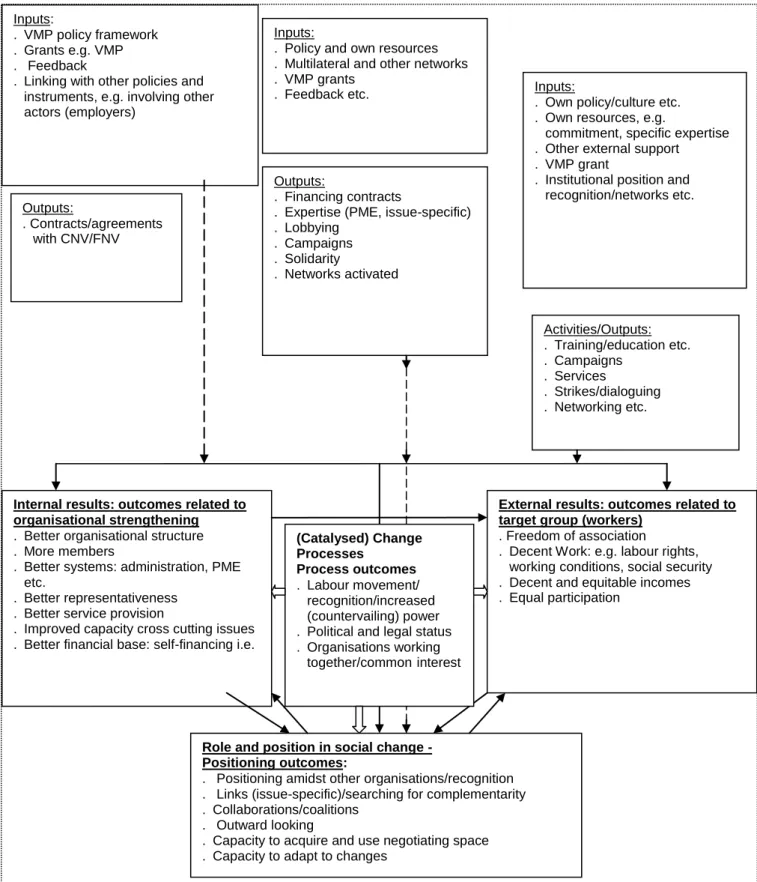
The theory of change underlying the VMP should be made more explicit. It should not only identify the part played by labour organisations in societal change in the partner countries but also indicate how the programme could help to achieve this change. The VMP should include policy indicators that will help the Ministry measure progress towards policy objectives and as a function of that, specify the information needed from CNV and FNV on progress at various points in time: annual, midterm, at the end or after the implementation period.
FNV’s choices still favour a more concentrated effort per country, but they also allow for emphasis on the multi-actor/facilitative approach to change processes regarding strategic objectives and/or issues.
CNV’s revised approach entails greater collaboration with the partner in each country on positioning and working with other actors to bring about overall societal change. A good example of this is the general dialogue on democratisation.
CONTENTS
Preface i
Abbreviations ii
Executive summary iii
1. Introduction 1
1.1 Policy context 1
1.2 Trade Union Cofinancing Programme (VMP) 1
1.3 This evaluation 2
1.3.1 Key questions and ToR 2
1.3.2 Comments on the ToR and process 3
1.3.3 This report 4
2. Reduction in number of countries and concentration of investment 5
2.1 Policy framework 5
2.2 FNV 5
2.2.1 Reduction and conformity 5
2.2.2 Conclusions on reduction and conformity by FNV 6
2.2.3 Concentrating investments inDC countries 7
2.2.4 Conclusions on concentration of investment in DC countries by FNV 8
2.2.5 Multilateral financing 8
2.2.6 Conclusions on multilateral financing by FNV 9
2.2.7 More focus/less fragmentation 9
2.2.8 Conclusions on more focus/less fragmentation by FNV 10
2.3 CNV 11
2.3.1 Reduction and conformity 11
2.3.2 Conclusions on reduction and conformity by CNV 11
2.3.3 Concentrating investments in DC countries 12
2.3.4 Conclusions on concentration of investment in DC countries by CNV 12
2.3.5 Multilateral financing 12
2.3.6 More focus/less fragmentation in specific countries 13
2.3.7 Conclusions on focus at implementation level by CNV in specific countries 13
2.4 General conclusions on reduction of number of countries and concentration of
investment 14
3. Choice of partners and interventions 15
3.1 Policy framework 15
3.2 FNV 15
3.2.1 Approach and options taken by FNV 15
3.2.1.1 Preparations 15
3.2.1.2 Contextual analyses 16
3.2.1.3 Organisational analyses 16
3.2.1.4 Conclusions on the approach and options taken by FNV 17 3.2.2 Contextual analyses and follow-up in Colombia, Ghana and Indonesia 18
3.2.2.1 Project contextual analyses 18
3.2.2.2 Contextual analysis: Colombia 18
3.2.2.3 Contextual analysis: Ghana 19
3.2.2.4 Contextual analysis: Indonesia 20
3.2.2.5 Conclusions and recommendations on FNV contextual analyses 20 3.2.3 Organisational analyses and follow-up in Colombia, Ghana and Indonesia 21
3.2.3.1 Approaches to partnering 21
3.2.3.2 Choices and effectiveness 21
3.3 CNV 24
3.3.1 Approach and options taken by CNV 24
3.3.1.1 Preparations 24
3.3.1.2 Place and function of contextual and organisational analyses 24 3.3.1.3 Conclusions on approach and options taken by CNV 25 3.3.2 Contextual analyses and follow-up in Cambodia and Indonesia 26
3.3.2.1 Contextual analysis: Indonesia 26
3.3.2.2 Contextual analysis: Cambodia 27
3.3.2.3 Conclusions on CNV contextual analyses 28 3.3.3 Organisational analysis and follow-up in Cambodia and Indonesia 28
3.4 General conclusions and recommendations on choice of partners and
interventions (question 2) 29
4. PME systems and outcomes 31
4.1 Introduction 31
4.2 Policy framework 32
4.2.1 VMP 32
4.2.2 Underlying theories of change 32
4.2.3 FNV and CNV response 34
4.2.4 Conclusions and recommendations concerning the policy framework 35
4.3 PME by FNV and partners 35
4.3.1 Planning 35
4.3.2 Conclusions and recommendations on planning by FNV 38
4.3.3 Monitoring and evaluation 38
4.3.4 Conclusions and recommendations on monitoring and evaluation by FNV 41
4.4 PME by CNV and partners 42
4.4.1 Planning 42
4.4.2 Conclusions and recommendations on planning by CNV 44
4.4.3 Monitoring and evaluation 44
4.4.4 Conclusions and recommendations on monitoring and evaluation by CNV 48
4.5 General conclusions and recommendations on PME systems and outcomes
(question 3) 49
5. Summary of conclusions and recommendations 52
5.1 Conclusions concerning question 1:
To what extent has the number of countries fallen compared to the previous
VMP period? 52
5.2 Conclusions concerning question 2:
In assessing partner organisations’ applications, has sensitivity to context on the part of CNV Internationaal and FNV Mondiaal led to effective
partner choices? 52
5.3 Conclusions concerning question 3:
To what extent are the organisations’ PME systems capable of establishing
their effectiveness? 53
5.4 Recommendations/suggestions 54
Annexes A. ToR
B. Overview of activities
C. List of Dutch government partner countries and LDCs applicable to VMP
D. Overview of countries included in the FNV programme in 2009 and projected for 2012 E. FNV VMP programme: Financial flows over the last five years through bilateral and
multilateral partners per category and per country
F. Case studies: FNV programmes in Ghana and Indonesia G. CNV VMP countries and partners in 2009 and 2011
H. Expenditure by CNV per year and per country in focus and non-focus countries I. Case studies: CNV programmes in Ghana and Indonesia
J. FNV Decent Work themes and union strengthening per country in Programme and Attention Countries
1.
Introduction
1.1 Policy contextPoverty reduction
At a time when many poor countries seem to have found their way towards economic growth, it is important to consider how far that economic growth can be pro-poor. After all, poverty reduction should be the outcome of all growth. Many poor people work but do not earn a decent living. A key factor is the extent to which economic growth produces more and better jobs. Most jobs in developing countries are in the informal sectors and include the self-employed. In the poorest countries, at least three quarters of all work is self-employment with contributing family workers, although there are country-specific differences and differences in the ‘scale of informality’ (ILO).
Economic growth urgently needs to become more labour-intensive, more productive and more lucrative. To this end it will probably also have to become more formal. A complicating factor here is contradictory evidence about the extent to which pro-labour regulations actually benefit sustainable employment, rather than encourage entrepreneurs to substitute labour for technology (capital).2
Increased private and public investments are needed. Investment in education and skills gives the poor better prospects of getting decent work. Governments should prioritise employment in their overall development strategy,3 improve the legal framework for employment, ensure compliance with labour laws, guarantee workers’ right to organise, promote collective bargaining, make room for trade unionism and protect its representatives, create basic social security, devote special attention to employment and unemployment, and take account of specific sub-groups.
Labour movement
The labour movement itself has enormous potential to change society and create better conditions for workers, but there are a number of problems. There is limited coverage, especially in many poor countries, partly because the vast majority of workers in the informal sector are not reached by this type of organisation. In the countries where labour market institutions do exist, there is a trend towards decreasing coverage, poor enforcement of labour laws due to poor governance, weak institutional capacity, or lack of adequate inspection. This means that even the minority of organised workers do not always benefit. Moreover, the operations of trade unions and other civil organisations are often frustrated by reluctant governments or employers, and dismissal, harassment, arrest or even murder of labour representatives is still not uncommon in many poor countries.4
At international level, the ILO Declaration on Fundamental Principles and Rights at Work (1998) set the tone for much of its recent work. The Decent Work Agenda that came out of this declaration has become a benchmark for action to improve the conditions of workers in poor countries. The World Bank works on improving social protection in general and builds social protection programmes into its long-term country strategies.5 The labour movement (and the unions in particular) have taken a decision to unite in the ITUC in order to influence policies and support members more effectively and in a more coordinated way.
1.2 Trade Union Cofinancing Programme (VMP)
Through the VMP the Ministry of Foreign Affairs (‘the Ministry’) funds FNV and CNV – and their international departments FNV Mondiaal (FNVM) and CNV Internationaal (CNVI) respectively. The funding for the present period of four years (2009-2012) has been around €57 million, with roughly two-thirds going to FNVM and one-third to CNVI.
The overall aim of the VMP is to promote labour and union rights in developing countries, and to contribute to sustainable poverty reduction. The implementation and realisation of ILO’s Decent Work Agenda is a central part of the VMP:
1. Progress has been made on achieving the Agenda’s four strategic objectives, especially for children, young people, women and workers in the informal sector.
2. There is an ongoing social dialogue.
3. Trade unions demonstrably contribute to the outcomes identified in 1 and 2.
4. Where necessary, trade union capacity has been strengthened in order to help implement the Decent Work Agenda.
In 2008, the Policy and Operations Evaluation Department (IOB) of the Ministry published its evaluation report on the VMP period 2001-2006. A number of its recommendations were incorporated in the present VMP.
1.3 This evaluation
1.3.1 Key questions and ToR
Firstly, this evaluation maps the choices made by FNV and CNV in relation to certain new conditions set out in the VMP policy framework. Secondly, the midterm progress made in the integration and application of those conditions is analysed, as is the likelihood of these conditions being fulfilled by the end of the VMP period. Thirdly, and subject to feasibility, the impact of the new conditions on effectiveness are estimated.6,7
Key questions
a. To boost the VMP’s focus and effectiveness, a reduction in the number of countries where FNV and CNV are active was made conditional. FNV and CNV also had to concentrate their VMP activities in the government’s partner countries and OECD/DAC Least Developed Countries (LDCs). In this document, the term used for both groups is Developing Countries (DC countries, see Annexe C). By 2012, 60% of the VMP financing should go to DC countries, with 40% going elsewhere.8 This evaluation therefore verifies to what extent a reduction has taken place, and to what extent the chosen countries match the DC countries of the VMP. It also considers what impact this has had in terms of greater effectiveness.
b. Another condition was to make the choice of interventions and partners9 more explicit. This was to be done by assessing or reassessing the relevance of interventions and the need for strengthening partner organisations. Two instruments were to be used:
- contextual analyses, in order to determine:
the most appropriate forms of intervention, given the context and possible strategies for change;
with whom best to work on aspects of the improvement of the Decent Work Agenda, also taking into account what others do and possible linkages, synergy or complementarity.10 Note:11 in this evaluation it is assumed that an institutional analysis is an integral part of a contextual analysis, especially in determining the second major element;
how these interventions relate to the objectives of FNV and CNV and their partners, and thus to the objectives of the VMP;
- organisational analyses for assessing internal and external organisation aspects: the potential and chosen partners’ degree of organisation, income diversification, participation, representation/support base, accountability, professional capacity, strategic potential and gender.12
This evaluation verifies to what extent13 and for what reason such contextual analyses have taken place, and considers their quality and effects on partner and activity choice, as well as elements included in plans.
c. The improvement of the PME systems of FNVM and CNVI and those of the partners, especially the extent to which these systems allow for measurement and reporting of the
outcomes of the VMP. This evaluation verifies whether any of the planned improvements of the systems are of sufficient quality and in line with acceptable standards for planning, monitoring and evaluation. Both CNV and FNV have agreed on a Monitoring Protocol with the Ministry, which serves as the starting point for the analysis.
Details of the terms of reference (ToR) for this evaluation can be found in Annexe A. The evaluation questions are repeated at the beginning of the three chapters, each of which deals with one of the three main questions. The agreed evaluation approach was described in the Inception Report. The evaluation activities have been summarised in Annexe B.
1.3.2 Comments on the ToR and process
The methodological limitations of this evaluation inherent in the ToR and also indicated in the Inception Reports were that:
- the choice of countries as a whole would be reviewed;
- the partner choice and PME systems would mainly be dealt with at the level of the two countries selected by the reference group – Indonesia and Ghana – and explicitly serve an illustrative purpose, not a representative one for the whole VMP. This poses a methodological problem: how to know whether certain aspects are ‘illustrative’ if the broader approach is not evaluated. And conversely, if any conclusions were drawn on the basis of the case studies, this might not necessarily reflect the overall situation in the countries concerned;
- the effect of implementing the conditions would be assessed in terms of gradually working towards set goals, since the use of the instruments has started only recently. The likelihood of improvements would be indicated because only a few country dossiers would be included and also only a few examples of contextual and organisational analyses: Ghana (FNV) and Indonesia (CNV). There was no change when the dossiers on Colombia (FNV) and Cambodia (CNV) were added. The latter were pilots and included as good examples illustrating the potential of the instruments;
- although the evaluation would take account of contextual factors,14 no full contextual analyses of these two countries would be done;
- the evaluation would not analyse the multilateral partnerships and interventions; for that reason, question 3d – the degree to which the reduction in the number of countries has influenced the volume of multilateral projects/programmes – could not be answered. A partial response is given by looking at the volume of investments.
Regarding arrangements agreed in the Inception Report it has already been indicated that: - In the VMP, increased focus is assumed to be synonymous with increased effectiveness.
This would be difficult to measure, given the narrow scope of the evaluation. Methodologically it would seem to be difficult to attribute such changes; even if the likelihood of increased effectiveness were established, the assumption as such might have to be discussed;
- This applies to the PME systems: it is assumed in the VMP that the more organisations work with well-designed PME systems, the higher the effectiveness of projects will be. A check of outcomes at final beneficiary levels would not be possible. This also applied to the two countries visited, in view of time constraints. This evaluation would therefore have to be based on the nature of the reported outcomes;
- It would be difficult to answer the majority of the questions in the ToR on the extent to which the PME systems are used for learning and internal steering at various levels, especially at the level of partners. The fieldwork only made it possible to study a few cases, and these are not representative per se.15 An in-depth study at the level of partners was not possible either, given the time-frame and the variety of partners.
For FNV, in particular, multilateral funding is strategic in that it complements activities undertaken through bilateral partnerships and collaboration. Multilateral collaboration was not
included in the ToR and was therefore not analysed. Through the reference group, FNV indicated that this would be an omission. It was therefore agreed that the options taken by FNV in this regard would be briefly described and account would be taken of the projects run through some of the multilateral channels in Indonesia and Ghana to nevertheless get a more complete picture of the respective country programmes, projects and approaches. The consultants’ proposed approach was designed to stimulate mutual learning through a series of self-evaluative workshops and sessions that invited reflection on ways of working. Given the setting, it was not entirely relevant. Owing to the questions asked in the ToR, the evaluation was a rather formalistic checking of a number of conditions included in the VMP and the ensuing negotiations. If these are implemented, there will presumably be a greater degree of focus – and therefore also of effectiveness – at outcome level. The consequences of not fulfilling the conditions were unknown. Many respondents also assumed that the evaluation was intended to downsize the programme. Not surprisingly, the evaluation met with some reserve and put certain people on the defensive, particularly at first. The latter has to a large degree been overcome by explaining in detail what the evaluation was about and (for the benefit of the partners in Indonesia and Ghana) that the aim was not to evaluate the partners as such, but rather general ways of working and collaboration modalities with CNV and FNV.
The evaluation would also have to produce recommendations that would be relevant to the next VMP. Given the limited scope of the evaluation, such recommendations are few. However, suggestions for further reflection have been included, and for the same reason some of the assumptions about the present VMP are also discussed, as indicated, in the Inception Report.
FNV and CNV and their partners have done their utmost to facilitate the evaluation by providing documents and additional information, being available for discussions, and organising field visits. At Ministry level, all dossiers about the VMP period were made accessible to us; the proposal made in the Inception Report for a joint ‘lessons learned’ reflection with Ministry staff did not materialise.
1.3.3 This report
This report systematically answers the three main questions of the ToR in the following three chapters. Each paragraph or sub-heading clearly indicates which question is being covered:
Chapter 2: question 1 about the extent to which the number of countries has fallen compared to the previous VMP;
Chapter 3: question 2 about whether sensitivity to context on the part of CNVI and FNVM led to effective partner choices;
Chapter 4: question 3 about the extent to which the organisations’ PME systems are capable of establishing their effectiveness.
The questions are answered separately with regard to CNV and FNV and care has been taken not to compare the two organisations. Brief conclusions and recommendations or suggestions are given at the end of each chapter. The final chapter gives a more general evaluation of the development of the programmes to date.
2.
Reduction in number of countries and concentration of investment
2.1 Policy frameworkThe list of DC countries for the VMP consists of the partner countries identified in the Dutch government’s policy letter on development cooperation at the time of the start of the VMP, and LDC countries (see Annexe C). Both are mentioned in the VMP without differentiation. At the overall VMP level, the list includes 65 countries and there is an option to invest up to 40% in other countries.
The increased focus of FNV and CNV programmes also depends on how many countries the organisations worked in previously, the degree of reduction, the degree of harmonisation with the DC country list, the categories of countries where FNV or CNV are active, the investments to date in the DC countries, and the projected investments for 2012 (the deadline for the 60% investment). In this section, these variables were researched with regard to both FNV and CNV in order to answer the first study question and sub-questions posed in the ToR:
Question 1: To what extent has the number of countries fallen compared to the previous VMP?
a. What choices did FNV and CNV make which resulted in the current list of countries?
b. To what extent has limiting the number of countries resulted in more effective project implementation/more effective use of activities?
c. To what extent has limiting the number of countries improved the implementation of projects in relation to the specific country context?
d. What effect has reducing the number of countries had with regard to the scale of multilateral projects/programmes?
e. To what extent has the reduced country list resulted in more focused project implementation, or to what extent has it reduced fragmentation of activities and themes?
The extent to which fewer countries and more concentrated investment has resulted in more effective project implementation is assumed (see chapter 1). The validity of the VMP assumption that fewer countries would automatically mean more focus, less fragmentation and therefore greater effectiveness at project level is questionable, particularly in the light of the Indonesia and Ghana programme analyses.
2.2 FNV
2.2.1 Reduction and conformity
Choices made (1a)
The IOB evaluation16 found that the implementation of the VMP programme was too fragmented. FNV invested in 59 countries through bilateral assistance. An additional 40 countries were reached through GUFs and other international bodies(which were also active in part in bilateral countries), bringing the total to almost 100 countries. FNV also evaluated the situation and concluded that the large number of countries required too much input from a limited number of staff and that too little attention was being paid to contextual changes and follow-up.
In its VMP proposal, FNV indicated five categories of countries where it wished to work. The individual choice of country and category (with budgetary consequences) depended on FNV’s position in the country to date, and on whether the Ministry had listed the country as a development cooperation partner. The country’s potentially strategic location in a continent or
sub-continent (e.g. South Africa in Southern Africa, and Indonesia in Southeast Asia) were also considered. For each category a trajectory was designed in response to the Ministry’s conditions. In the final proposal to the Ministry17 the following categories were thus distinguished (see overview, Annexe D):
- Programme Countries, where a concentrated effort would be made to develop integrated programmes in the medium and long term with strategic partners. Three out of the eight are DC countries;
- Attention Countries, in which the project approach is maintained and the financing is mainly done through bilateral financing of one major partner. An Attention Country may become a Programme Country, providing it is already a DC country. Out of 10 countries identified, five were DC countries.
- Exploratory Countries may have the potential for more intensive and substantial collaboration especially through bilateral financing, although GUF and ITUC financing is not excluded. Such countries could become Attention or Programme Countries depending on developments and partner performance. In 2008, the 11 countries identified were all DC countries;
- Other DC Countries (30) are all included in the DC country list; in these countries the investment would especially continue through the GUFs or ITUC (if the country is not also included in the DC countries with which the Dutch government ended its development relationship by 2011);
- Phase-Out Countries (40). These are countries where more intensive collaboration has taken place in the past (‘concentration countries’ in the preceding VMP period) or where FNV saw few possibilities for collaboration because the potential partners were problematic or not strong enough. In quite a few countries in this category the existing collaboration was insignificant and could therefore be ended without too much trouble.
Reduction and conformity (1)
FNV started with 99 countries in 2009, but wanted to reduce this to at least 54 in 2012, of which 49 would be DC countries.18 The situation as at the end of 2011 is as follows (see Annexe D):
- seven Programme Countries remain: 4 non-DCs, 1 Broad Relations, 1 MDG and 1 Fragile State. Belarus now falls under the Matra grant system;
- the number of Attention Countries has risen to 11: 4 non-DCs, 1 MDG, 2 LDCs, 3 Fragile States and 1 Broad Relations. Nigeria will be phased out in 2012. Bangladesh and Nepal used to be Exploratory Countries;
- the number of Exploratory Countries has dropped to 0. FNV says that contextual analyses have been done for all of them. They will now be classified as Attention Countries (2) or Other DC Countries (8). One country will be phased out;
- the Other DCs category has substantially changed. Seven have been transferred from Exploratory Countries and 10 are to be phased out by 2012. A total of 27 (all DC countries) remain: 8 LDCs, 12 MDGs, 3 Fragile States and 4 Broad Relations;
- the number of Phase-Out Countries rose to 54 due to transfers from other categories. Investments there will be discontinued, so all these countries will have been phased out by 2012, bringing the total to 0.
Assuming no other changes occur before the end of 2012, the total number of countries by the end of that year will be 46. Of this number, 8 are non-DC and 3819 are DC countries: 7 Broad Relations (including Moldova), 14 MDGs, 7 Fragile states and 10 LDCs.
2.2.2 Conclusions on reduction and conformity by FNV
- The decision to include a country in a particular category depended on FNV’s position there to date, whether the country had been listed by the Ministry as a development cooperation partner, and on the country’s potentially strategic location in a continent or sub-continent.
- The numbers were reduced in response to the IOB evaluation findings, the conditions imposed by the VMP in this regard and FNV’s internal conclusion that such a large number of countries could not be adequately managed.
- Almost 80% of the countries where FNV is active have been harmonised with the DC country list.
- The reduction in the number of countries is substantial and exceeds the VMP’s initial proposal.
- Since the main indicator is a reduced number of countries, it follows that the expected increase in focus and therefore also in effectiveness will exceed initial estimates.
2.2.3 Concentrating investments in DC countries
Volume of investments (1, 1e)
It is assumed in the VMP that reducing the number of countries will result in more concentrated investment and that increasing the focus will automatically mean greater effectiveness. The previous IOB evaluation found that investments were skewed. Investments in many Bilateral Countries were low or very low: of the 59 countries receiving bilateral assistance, 29 received less than €25,000. Of these 29 countries, 18 received less than €5,000 in 2005. Between 35% and 50% of the annual investment per continent went to three single countries: Brazil, India and South Africa.
The volume of investments20 over the VMP period shows the following pattern (Annexe E): - Programme Countries got the lion’s share of the total investment, with an average of
around €4million per year for all the countries, and an average of €550,000-€600,000 per country per year. Total investments remained more or less constant, while individual country investments varied considerably throughout the timeframe.
- Attention Countries received slightly less over the past two years, but the level of investment remained substantial – between €1.5 million and €2.2 million per year for all the countries and an average investment of €150,000-€220,000 per country per year. There was considerable variation per country and per year.
- Other DC Countries (27) remained more or less constant. Investments totalled around €1.5 million per year with an average of €46,000-€58,000 per country per year.
- The Phase-Out Countries still received substantial investments in 2008 (almost €2.8 million), but this fell to almost €1.5 million in 2010. Many countries were phased out in that year, followed by even more in 2011. The remaining 7 countries will be phased out in 2012 after the final grant has been paid.
60/40% investments (1,1a,1e)
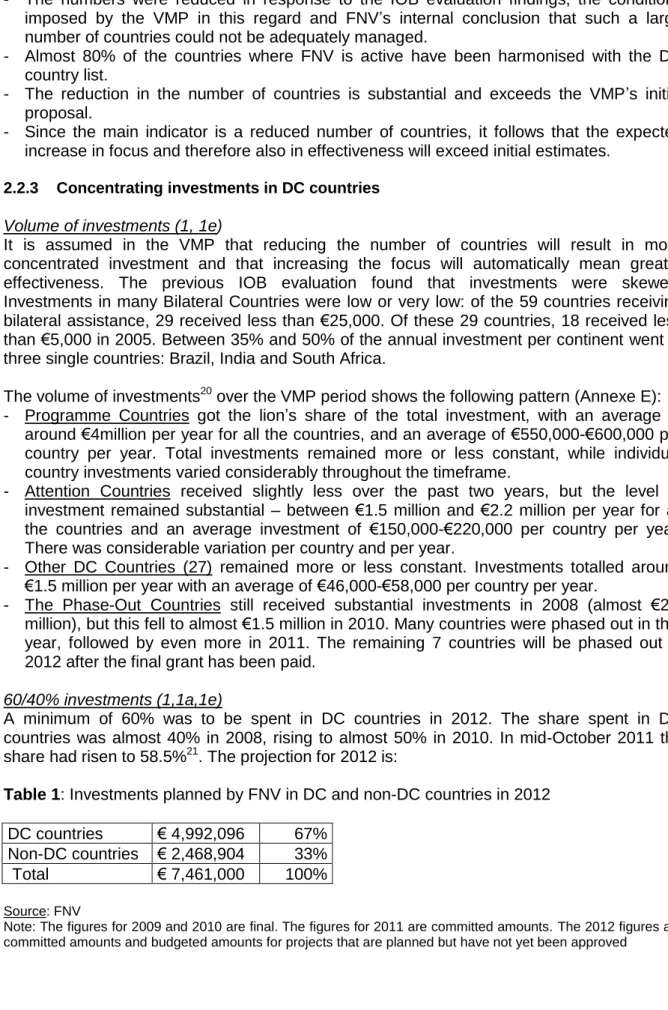
A minimum of 60% was to be spent in DC countries in 2012. The share spent in DC countries was almost 40% in 2008, rising to almost 50% in 2010. In mid-October 2011 the share had risen to 58.5%21. The projection for 2012 is:
Table 1: Investments planned by FNV in DC and non-DC countries in 2012 DC countries € 4,992,096 67%
Non-DC countries € 2,468,904 33%
Total € 7,461,000 100%
Source: FNV
Note: The figures for 2009 and 2010 are final. The figures for 2011 are committed amounts. The 2012 figures are committed amounts and budgeted amounts for projects that are planned but have not yet been approved
2.2.4 Conclusions on concentration of investment in DC countries by FNV
- Overall, the volume of investment has been fairly constant over the years for the first three country categories. This was made possible by an effective phasing out in a number of countries by the end of 2011.
- Investments have focused on Programme and Attention Countries. Here the level or volume of investment has been maintained over the years. In other country categories, extremely low investment is now non-existent, apart from a few exceptions due to country-specific circumstances.
- If 67% of the investments go according to plan in DC countries, FNV will have met the 60/40 criterion.
- The investment concentration in DC countries will have risen substantially to 67% by 2012.
All these figures take into account bilateral and multilateral investments. The allocation of expenditure for bilateral organisations is straightforward, while the allocation of multilateral generic projects (in 17 countries) is proportionate. Multilateral projects specific to an individual country are included in the total expenditure in that country.
2.2.5 Multilateral financing
Effect of reducing the volume of multilateral projects and programmes (1d)
FNV strongly believes that strengthening local unions and improving working conditions is achieved most effectively through a combination of bilateral and multilateral channels. FNV therefore works directly and bilaterally with global union federations (GUFs) and confederations and with research institutes or national NGOs. GUFs and the ITUC are the best-known multilateral channels, but the category includes international NGOs like Streetnet or Homenet South Asia, which have network members in the countries concerned. It also includes research institutes active in various countries, e.g. ALRN works in 13 African countries. These channels can be used simultaneously in the same country.
Whether the volume of projects has been reduced is measured in terms of whether and to what extent multilateral funding has decreased, due either to a reduced number of countries and/or an increase in bilateral funding. Here ‘multilateral’ is understood to refer especially to GUF/ITUC, since the IOB evaluation points to inefficiency in this area and would like to see the share reduced.22
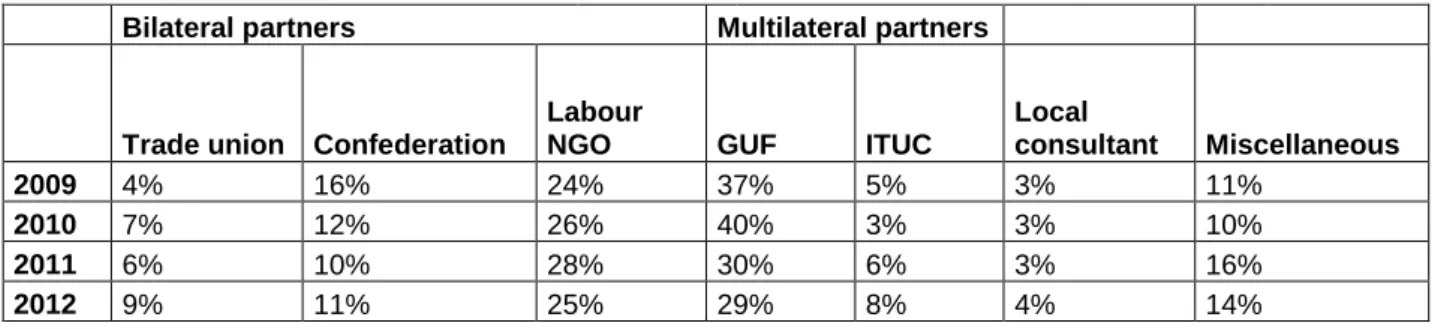
Table 2 below indicates the shares for the various categories:
- Bilateral funding is channelled especially through trade unions, confederations and national labour NGOs. Confederations get an average of 12% per year, but the trend is downward. Individual trade unions get an average of almost 7% per year, and the trend is upward (from 4% in 2009 to 9% in 2012). Labour NGOs get a significant average share of 26% per year. So bilateral financing has remained fairly stable over the four-year period at around 45% of the annual total.
- Multilaterally, the GUFs get the lion’s share – an average of 34% per year. Their share shows a downward trend, unlike the ITUC share, which is slightly upward. Together, these organisations will receive a smaller share by the end of the implementation period: from 43% in 2010 to 37% in 2012. This share is now smaller than that of the bilateral partners.
Table 2: Channelling of funds through bilateral and multilateral channels Bilateral partners Multilateral partners
Trade union Confederation
Labour
NGO GUF ITUC
Local consultant Miscellaneous 2009 4% 16% 24% 37% 5% 3% 11% 2010 7% 12% 26% 40% 3% 3% 10% 2011 6% 10% 28% 30% 6% 3% 16% 2012 9% 11% 25% 29% 8% 4% 14% Source: FNV
Note 1: The figures for 2009 and 2010 are final. The figures for 2011 are committed amounts. The 2012 figures are committed amounts and budgeted amounts for projects that are planned but not yet approved.
Note 2: The figures above for bilateral and multilateral partners require special comment. The investments in a particular country may also be from GUF funding, which explains the increase in total country-specific investments to the levels shown in 2.2.3. This also applies to local consultants, who often operate on a country-specific basis.
2.2.6 Conclusions on multilateral financing by FNV
- Multilateral funding through GUFs and ITUC accounts for a significant share of the total investments, although it has dropped by 14% compared to 2009. Whether this is due to a reduced number of countries cannot be determined without further analysing the multilateral financing and types of projects there.23
- Relative funding through bilateral channels has remained more or less constant. 2.2.7 More focus/less fragmentation (1e)
Here, ‘more focus/less fragmentation’ is interpreted in terms of project activity content and the degree to which project objectives converge at implementation level. The Ghana and Indonesia programmes have been used as case studies. It is assumed that the emerging picture illustrates24 essential features of the FNV programme and approach.
FNV-Ghana programme and projects
Ghana is a Programme Country, so the interventions and partnering would be reassessed through a context study, a programming exercise for a multiannual and strategic plan. This would have to result in a focused and strategic country programme and a relatively long-term association with partners. The country programming is starting to take effect.
The case study shows that in practice, decision-making to date has taken place through other mechanisms, as follows:
- the habit of working with GTUC, which has long been a natural partner and also one of the chief actors in this field;
- the choice to work with the Confederation and a selection of affiliates (5/17);
- the Confederation and affiliates then propose projects based on their needs, which means that there are various activities supporting each of these organisations and the arrangement of such needs under one of the chosen DW themes(4);
- DW themes are accommodating rather than selective, since projects have multiple objectives;
- working through several GUFs and international NGOs or research organisations;
- the decision to also work through a value chain approach and to accommodate the preferences of one of the FNV affiliates;
- the choice to also encourage local unions to cater for workers in the informal sectors, which means not only new target groups but also many activities other than the usual core ones;
This leads to a large array of interventions that are fairly well in line with the VMP content-wise objectives and can be justified on the basis of context. The combined mechanisms result in a broad programme that is not focused on content.25 Interventions appear to exist in parallel, and objectives do not converge towards strategic objectives, a vision or a common approach. As a result, the focus is lost. Multiannual and strategic programming, which would be one way to remedy such a situation, has not yet26 been effective, largely because of the same mechanisms.
FNV-Indonesia programme
Indonesia is not a Programme Country but an Attention Country. The sequence of contextual analysis, organisational analysis and multiannual programming for the country as a whole has therefore not yet been initiated. The projects contribute to five Decent Work Agenda themes (1,2,3,6,8) such as negotiating, freedom of association, and strengthening unions/federations27. There are a number of long-standing relationships (e.g. Kahutindo) and over 15 ongoing projects (bilaterally and multilaterally funded), which does not initially imply a content-wise focus. To some extent the same portfolio-broadening mechanisms deployed in Ghana operate here.
A closer look reveals a relative focus resulting from certain choices:
- Projects concentrate on unions/federations in a relatively limited number of sectors, with a large formal workers’ component.
- The focus is on 4-5 organisations that show initiative. These are considered ‘frontline organisations’ by FNV, since they have a relatively sound financial and membership base and also a relatively strong position vis-à-vis other unions and in social dialogue forums. It is therefore possible to facilitate their activities for the benefit of workers rather than invest in the organisations themselves. It also means that the relationship with many of these unions is dynamic and collaboration is strongly based on linking with contextual developments and emerging opportunities.
- Activities are more consistently aimed at positioning organisations and middle management, which provides for strategic focus.
- It is concentrating on the issue that provides focus, even though in such cases institutional coverage is broadened by linking organisations functionally to the issue.
- Focus also occurs because issues, including crosscutting issues like gender, consistently recur in different and consecutive projects.
2.2.8 Conclusions on more focus/less fragmentation by FNV
- As regards the assumption that reducing the number of countries (and ensuing advised steps) would lead to greater focus at implementation level, the two cases show that other determining mechanisms are at work.
- Because of these mechanisms, focus is not necessarily achieved and fragmentation still occurs. Although the Ghana programme generally reflects the recommended planning sequence that supports the assumption, the result does not reflect much content-wise focus. The Indonesia programme, which does not follow the recommended sequence, shows that the choice of working method may improve focus, particularly if there is a combination of bilateral and multilateral funding.
- Although programmatic working may not produce more focus per se (as in Ghana), a multifaceted list of projects (as in Indonesia) shows that a relative focus is achieved by zooming in on crosscutting themes and other issues around which partnerships are grouped and collaboration is organised. Facilitating change processes also increases focus.
- These principles and ways of working, and the accompanying dynamic portfolio management, offer good prospects for much more focus, provided they are applied consistently and other ‘add-on’ mechanisms are curtailed.
2.3 CNV
2.3.1 Reduction and conformity
Choices made (1a)
Already before the start of the present VMP period, CNV had committed to reducing the number of countries and partners in order to improve focus, step up collaboration with partners and improve management.28 In most countries where it is active, CNV works with one partner confederation, and in some countries with two or three other organisations such as a research institute, an NGO or a trade union. So the choice is actually about selecting a particular partner in the first place. Because of quality requirements and intensified cooperation, a number of partners and/or countries were to be phased out. Later on, the decision to further reduce the list was based on the DC country list but also on other criteria relating to the partner organisation. Overall, harmonisation with the Ministry’s DC country list played no part in this; it was primarily an internal strategic decision already taken in 2008.29 The schedule subsequently included in CNV’s VMP proposal30 shows the situation at the start of the period (2009). The current list of countries and partners has been established on the basis of the various annual reports and list of commitments (see Annexe G).
CNV proposed to concentrate its efforts in the so-called focus countries, with ‘focus partners’. The intensity of the collaboration is tailored to the partner’s actual or potential strength. There are opportunities for working in an integrated manner (including linking up with CNV programmes such as Lobbying and Campaigning) or complementarily, and a more voluminous investment would be justified.31 The relationship with focus countries tends to be longer-term, in principle.
For non-focus countries, the efforts would be more specific, closely related to achieving concrete results for workers, but also taking account of the partner in the country in question. Overall, collaboration with partners in these countries is less intensive but may also be fairly long-term, unless contextual analyses and other developments dictate otherwise.
Reduction and conformity (1)
CNV started out with 36 countries (including Nepal but not Burma) and 40 partners in 2009: 6 LDC countries, 4 MDGs, 3 Broad Relations, 3 Fragile states, 2 countries exiting from the Ministry list in 2011 and 18 non-DCs. Thus, not more than 18 countries (50%) matched the DC list.
The present situation shows a total of 28 countries (excluding Nepal, since no partner was found), of which 15 (just over 50%) are DC countries and 13 are not (2 countries that exited in 2011 and 11 non-DC countries).
The intended reduction in non-focus countries has been achieved. Investments now continue in only 18 countries. Of the remainder, the reduced investment in Cuba and the token sum for India have now both been terminated. In Venezuela the partner was found not to meet the criteria after all, so investments there have been stopped. Further reduction will take place in 2012 and 2013. Evidently, continued monitoring of context and partners is vital.
2.3.2 Conclusions on reduction and conformity by CNV
- CNV has achieved more focus at the overall VMP programme level by concentrating its efforts in fewer countries. Because there is generally only one partner per country, there are also fewer partners.
- The reduction is the result of internal strategy reformulation, not initially in response to the conditions put forward in the VMP.
- The choice of countries depends on the choice of partners, the quality of existing collaboration, the functioning and capacity of the partner, the opportunities for following an integrated approach and the absorption capacity of the partner.
- Only around 50% of the countries in the list are DC countries. This has hardly changed since the start of the present VMP. On its own, the list of countries does not suggest much of a match with the DC list.
2.3.3 Concentrating investments in DC countries
Volume of investments (1,1e)
The second indicator for increased focus at CNV overall programme level is the volume of investments per country and partner (see Annexe H):
- Total investment has increased over the three years for focus countries and non-focus countries. More has been invested in non-focus than in focus countries.
- In focus countries the investments range from €144,000 in 2009 to almost €200,000 on average per country/partner in 2011 (for 8 countries). The investments per country vary considerably, with Cambodia (€339,726) and Indonesia (€611,000 in 2011) significantly above the average.
- The average investment in the remaining non-focus countries has also increased: from around €90,000 per country in 2009 to €131,000 per country/partner in 2011 for 18 countries/partners. There is less variation between countries and no exceptional cases in which investments are far above the average.
So in terms of increased volume of investments, more focus has been achieved at country level as well. Given the continued high investments over the three years in the organisation, operational capacity and activities of the two partners in Indonesia and Cambodia, one might question whether this is a case of ‘too much focus’, in view of absorption capacity and sustainability.32
60/40% investments (1,1a,1e)
Annexe H also shows that investment in DC countries was almost 73% in 2009 at the start of the VMP and rose slightly in 2011, when non-DC countries were phased out. CNV therefore meets the VMP criterion of investing 60% or more in DC countries.
2.3.4 Conclusions on concentration of investment in DC countries by CNV
- On average, there is more investment in partners in focus countries than in non-focus countries. This may be seen as a degree of focus.
- Since the start of the VMP period, partners in DC countries have received a share significantly above the required 60% and the percentage is still rising (75%). The trend has also been upwards in absolute terms. So CNV meets the VMP criterion of investing 60% or more in DC countries. This also suggests increased focus.
- Since there are few countries in the focus countries group, one would expect the investment limit per country/partner to be reached earlier than for non-focus countries, in view of absorption capacity and need. This is not necessarily the case for the non-focus countries, but certain partners in this group receive high amounts every year, which prompts the same question.
2.3.5 Multilateral financing (1d)33
CNV’s investment of VMP funding through multilateral financing is minimal: €30,000 in the conditional cash transfer (CCT) programme for Central America, and partnerships with the INGOs Wage Indicator, Fairfood and the regional consultant BCPA. The reduction in the number of countries has not affected these partnerships.
2.3.6 More focus/less fragmentation in specific countries (1e)
Here, ‘more focus/less fragmentation’ is interpreted in terms of34 project activity content and
the degree to which project objectives converge at implementation level. The Ghana and Indonesia programmes have been used as case studies. It is assumed that the emerging picture illustrates35 essential features of the FNV programme and approach.
General approach
CNV’s PME approach, which was introduced before the present VMP, is intended to strengthen the organisation as a whole. It extends to confederation level and all federations and affiliates and focuses on how they are organised at central, regional and plant level. System improvement is a high priority. The CNV analysis indicates the need for financing the functions related to the introduction and operation of such systems, technical (PME) support by CNV itself and, in the case of Ghana, decentralised intensive support by the regional consultant BCPA. In addition, the federations and the confederation are asked to identify activities that lead to concrete, short-term results in line with their priorities and the characteristics of the sector(s) they are active in. Priorities must fit in with the overall themes of CNV.
The underlying assumption is that if efforts are concentrated on a particular partner and concrete success achieved, the partner will be better equipped to improve the situation of workers in due course and thus play a significant role in labour-related issues in the country jointly with other organisations working towards the same goals. Eventually, this will be done without external support, but in general there is no set timeframe for this.36
Other mechanisms
The concentration of effort, the one-partner approach and the decision to work on the four major themes create considerable focus at the outset. The requirement that the confederation and affiliates must all benefit from the support leads to some broadening of focus at implementation level, as the case studies illustrate (see Annexe I). Addressing each affiliate’s needs results in activities being identified in many sectors and at various levels. A second mechanism is that affiliates also enter into the informal sector, which implies approaching other target groups and undertaking previously non-core activities. Crosscutting issues are dealt with by the organisations themselves and are integrated in the activities for the benefit of workers. Efforts at complementarity (such as Fairfood initiatives) broaden the range of activities and collaboration to a certain extent.
2.3.7 Conclusions on focus at implementation level by CNV in specific countries
- The two case studies carried out – Indonesia (focus country) and Ghana (non-focus country) – show above all that the programme follows its own logic, based on the general approach chosen by CNV. Focus at implementation level does not stem from reducing the number of countries as such. Country choice is linked to partner choice, followed by screening of the relevance of the proposed activities to the four themes. This approach has been consistently applied in both Ghana (Ghana Federation of Labour-GFL) and Indonesia (KSBSI) in recent years and promotes a content-wise focus.
- The fact that the organisations’ planning process is required to benefit all the affiliates has the effect of broadening interventions, as does searching for complementarity, and linking and learning. However, this does not imply fragmentation, since the activities are all in line with the four themes and/or organisational strengthening.
2.4 General conclusions on reduction of number of countries and concentration of investments (question 1)
- Both FNV and CNV have reduced the number of countries they work in. They also comply with the VMP condition that at least 60% of their investments must be in DC countries by 2012. Most countries where FNV works are in this category, as compared with about 50% in the case of CNV.
- CNV’s choices and the two case studies suggest that CNV’s project is indeed focused. Efforts are generally limited to the activities of one partner, and provide support in systems development and operations, thus ensuring effectiveness.
- FNV’s project implementation does not necessarily possess or lack focus: it all depends on the choices made in the trajectory leading to implementation, and above all on ways of working. FNV’s multi-actor approach can be made focused and effective by concentrating on major issues and organising actors around them, as well as through linking and consistent follow-through at process level. Facilitating this through a combination of bilateral and multilateral channels seems to be working.
- A more content-wise focus is not necessarily guaranteed by limiting the number of countries nor is it negated by using additional channels in a particular country. Much depends on ways of working. This challenges the linear assumption that reducing the number of countries and concentrating investments will result in more focus; in practice things work differently.
- Per country, the sum total of efforts by both FNV and CNV caters for a great variety of projects, collaborative partnerships, levels of intervention and approaches; in that sense the separate interventions of the two organisations probably cause more fragmentation than necessary. There are virtually no links between the programmes and crosscutting issues are basically the same in most cases.37 So there may be scope for more collaboration at the practical level, which would ultimately boost effectiveness – and probably also efficiency.
3.
Choice of partners and Interventions
3.1 Policy frameworkThe VMP assumes that every country is almost unique,38 given the history of the labour movement, the context, the issues at stake and the opportunities for collaboration with other stakeholders. An interpretation of the VMP requirements on conducting contextual and organisational analyses, determining which unions in the countries should be strengthened (and how), and deciding on appropriate intervention, should be seen in regard to this background. The VMP also seeks to promote a re-thinking of partnerships and interventions and hence asks for proof of relevance and justification of partner and intervention choices. Both CNV and FNV point out that labour-related work does not only have country-specific dimensions. Both organisations work through lobbying and campaigning in order to influence international policies and trends, e.g. in international corporations (unionism as a countervailing power – FNV) or international institutions like the ILO, WTO or IMF. Both work on crosscutting themes like corporate responsibility or domestic (migrant) workers as a means of implementing the relevant ILO conventions. FNV is more pronounced in this regard. In its analysis, FNV points out that many of these issues can best be approached through multilateral channels like the GUFs and ITUC, which may complement or reinforce bilateral input.
In the next section, we describe the approach and options taken by the two organisations as regards partner choice, implementation and use of contextual analyses. We also draw conclusions based on answers to the questions posed in the ToR:39
Question 2: In assessing partner organisations’ applications,40 has sensitivity to context on the part of CNV Internationaal and FNV Mondiaal led to effective partner choices?
a. To what extent have contextual and organisational analyses helped CNV and FNV make well-founded decisions concerning support to partner organisations?
b. To what extent have contextual and organisational analyses led to improved project proposals by partner organisations?
c. To what extent do CNV and FNV consider substantive policy issues in partner funding decisions?
3.2 FNV
3.2.1 Approach and options taken by FNV 3.2.1.1 Preparations (2a, 2c)
In preparation for the present VMP, FNV began consultations with six partners in 2007 and 2008. A list was drawn up of the existing partners’ expectations and of the challenges underlying their wish to work with FNV. The main points were categorised under ‘Decent Work’ and ‘Strengthening the union movement by making it more representative’.
The choice of countries was based on existing context knowledge and experience, and estimates of opportunities and constraints. The new Programme and Attention categories proposed in the VMP were intended as a means to continue working in these countries,41 in principle with existing partners, but also with other, recently identified potential partners.