Memory-Enhanced Univariate Marginal Distribution Algorithms for Dynamic
Optimization Problems
Shengxiang Yang
Department of Computer Science, University of Leicester University Road, Leicester LE1 7RH, United Kingdom
Abstract- Several approaches have been developed into evolutionary algorithms to deal with dynamic optimiza-tion problems, of which memory and random immi-grants are two major schemes. This paper investigates the application of a direct memory scheme for univari-ate marginal distribution algorithms (UMDAs), a class of evolutionary algorithms, for dynamic optimization problems. The interaction between memory and ran-dom immigrants for UMDAs in dynamic environments is also investigated. Experimental study shows that the memory scheme is efficient for UMDAs in dynamic envi-ronments and that the interactive effect between mem-ory and random immigrants for UMDAs in dynamic en-vironments depends on the dynamic enen-vironments.
1 Introduction
Evolutionary algorithms (EAs) have been widely applied to solve stationary optimization problems. In recent years, there has been a growing interest in investigating EAs for dynamic optimization problems. This trend reflects the fact that many real world optimization problems are actually dy-namic [1]. For dydy-namic optimization problems (DOPs), the fitness function, design variables, and/or environmen-tal conditions may change over time due to many reasons, e.g., machine breakdown and financial factors. For dynamic problems, the aim of an algorithm is no longer to locate an optimal solution but to track the moving optima with time. This challenges traditional EAs seriously since they cannot adapt well to the changing environment once converged.
In recent years, several approaches have been developed into EAs to address dynamic problems [5], of which mem-ory and random immigrants are two major approaches. The random immigrants approach [7] aims to maintain the popu-lation diversity by immigrating random individuals into the population to adapt EAs to dynamic environments.
The basic principle of memory schemes is to store useful information from the current environment and reuse it later in new environments. As reviewed in [4], the information may be stored in two mechanisms: by implicit memory or by explicit memory. For implicit memory schemes, EAs use genotype representations that contain redundant informa-tion to store good (partial) soluinforma-tions to be reused later. Typ-ical examples of implicit memory schemes are genetic algo-rithms (GAs) based on multiploidy representations [6, 9, 15] or dualism mechanisms [18, 19]. Explicit memory schemes use precise representations but split an extra memory space to explicitly store useful information, e.g., good solutions, from current generation for reuse in later generations or en-vironments [3, 10, 12, 17].
In this paper, the memory scheme is investigated for the Univariate Marginal Distribution Algorithm (UMDA), which was first introduced by M¨uhlenbein [14] as a class of EAs, for dynamic optimization problems. An explicit memory scheme is used to improve UMDA’s adaptability in dynamic environments. Within this memory scheme, the best samples created by the probability vector are stored in the memory in certain time and space pattern. When the environmental change is detected, the memory points are merged with the current population members in UMDA for further iterations. This paper also investigates the relation-ship between memory and random immigrants schemes for UMDAs in dynamic environments.
Using the dynamic problem generator proposed in [18, 19, 20], a series of dynamic test problems are constructed from three stationary functions and experiments are carried out to compare the performance of investigated UMDAs and a peer memory-enhanced GA. The experimental results val-idates the efficiency of the memory scheme for UMDAs in dynamic environments. The experimental results also indi-cates that the random immigrants scheme has different in-teractions on the memory scheme for UMDAs in different dynamic environments.
The outline of this paper is given as follows. The next section describes the UMDAs with and without memory schemes and the memory-enhanced GA investigated in this paper. Section 3 presents the dynamic test environment for this study. The experimental results and relevant analysis are presented in Section 4. Section 5 concludes this paper with discussions on relevant future work.
2 Description of Investigated Algorithms
2.1 The Standard UMDA
M¨uhlenbein [14] introduced the UMDA as the simplest ver-sion of Estimation of Distribution Algorithms (EDAs) [13]. Thereafter, there have been several modifications and math-ematical analysis of UMDAs [11, 21] and UMDAs have been applied for many optimization problems [8]. In the binary search space, UMDA evolves a probability vector
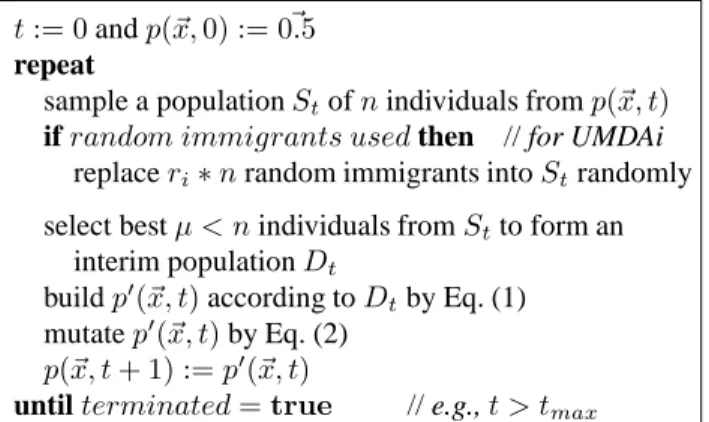
p(~x, t) = (p(x1, t), . . . , p(xl, t)) (~x = (x1, . . . , xl) ∈ {0,1}l) where all the variables are assumed to be indepen-dent of each other. The pseudo-code for the UMDA with mutation investigated in this paper, denoted UMDAm, is shown in Figure 1.
UMDAm starts from the central probability vector that has a value of 0.5 for each locus and falls in the central point of the search space. Sampling this probability vector creates random solutions because the probability of creating a 1 or
t:= 0andp(~x,0) :=0~.5
repeat
sample a populationStofnindividuals fromp(~x, t)
ifrandom immigrants usedthen // for UMDAi replaceri∗nrandom immigrants intoStrandomly select bestµ < nindividuals fromStto form an
interim populationDt buildp0(~x, t)according toD
tby Eq. (1) mutatep0(~x, t)by Eq. (2)
p(~x, t+ 1) :=p0(~x, t)
untilterminated=true // e.g.,t > tmax
Figure 1: Pseudo-code of the UMDA with mutation (UM-DAm) and the UMDA with mutation and random immi-grants (UMDAi).
0 on each locus is equal1. At iterationt, a populationS
tofn individuals are sampled from the probability vectorp(~x, t). The samples are evaluated and an interim populationDt is formed by selectingµ (µ < n) best individuals, denoted
~x1
t,· · ·, ~x µ
t, fromSt. Then, the probability vector is updated by extracting statistics information fromDtas follows:
p0(~x, t) := 1 µ k=µ X k=1 ~xkt (1)
After the probability vector is updated according toDt, in order to keep the diversity of sampling in dynamic en-vironments, a bitwise mutation is applied in this paper. The mutation operation always changes the probability vec-tor toward the central probability vecvec-tor as follows. For each locus i = {1, . . . , l}, if a random number r =
rand(0.0,1.0)< pm(pmis the mutation probability), then mutatep(xi)using the following formula:
p(xi) = p(xi)∗(1.0−δm), p(xi)>0.5 p(xi), p(xi) = 0.5 p(xi)∗(1.0−δm) +δm, p(xi)<0.5, (2)
whereδm is the mutation shift that controls the amount a mutation operation alters the value in each bit position. Af-ter the mutation operation, a new set of samples is generated by the new probability vector and this cycle is repeated.
As the search progresses, the elements in the probabil-ity vector move away from their initial settings of 0.5 to-wards either 0.0 or 1.0, representing high evaluation solu-tions. The search stops when some termination condition becomes true, e.g., the maximum allowable number of iter-ationstmaxis reached.
In this paper, we also investigate the effect of random immigrants on the performance of UMDAs in dynamic en-vironments. The pseudo-code for the investigated UMDA with mutation and random immigrants, denoted UMDAi, is also shown in Figure 1, whereriis the ratio of random im-migrants to the total population size. Within UMDAi, for
1When sampling the probability vector for a solution, for each locusi
if a randomly created numberr=rand(0.0,1.0)< p(xi, t), it is set to
1; otherwise, it is set to 0.
each iteration after the probability vector is sampled, a set of individuals are randomly selected and replaced with ran-domly created individuals (immigrants).
2.2 Memory-Enhanced UMDAs
The memory scheme has proved to be able to enhance EA’s performance in dynamic environments. As mentioned in Section 1, the memory scheme works by storing and reusing useful information either implicitly or explicitly. In this pa-per we focus on explicit memory schemes.
For explicit memory schemes, there are several techni-cal considerations, regarding the content, management and retrieval strategies of the memory. For the first aspect, usu-ally good solutions are stored and reused directly when the environment changes [10]. It is also an interesting policy to store environmental information together with good so-lutions. When the environment changes, the stored environ-mental information is used, for example, as the similarity measure [16], to associate the new environment with stored solutions in the memory to be re-activated. For the memory management, usually it has fixed size and when it is full, one memory point is selected to be removed to make room for new ones, i.e., the best individuals from the population. As to selecting which memory point to be updated, there are several memory replacement strategies, e.g., replacing the most similar one if the new individual is better [4]. For memory retrieval, a natural strategy is to use the best indi-vidual(s) in the memory to replace the worst indiindi-vidual(s) in the population. This can be done periodically (e.g., every generation), or only when the environment changes.
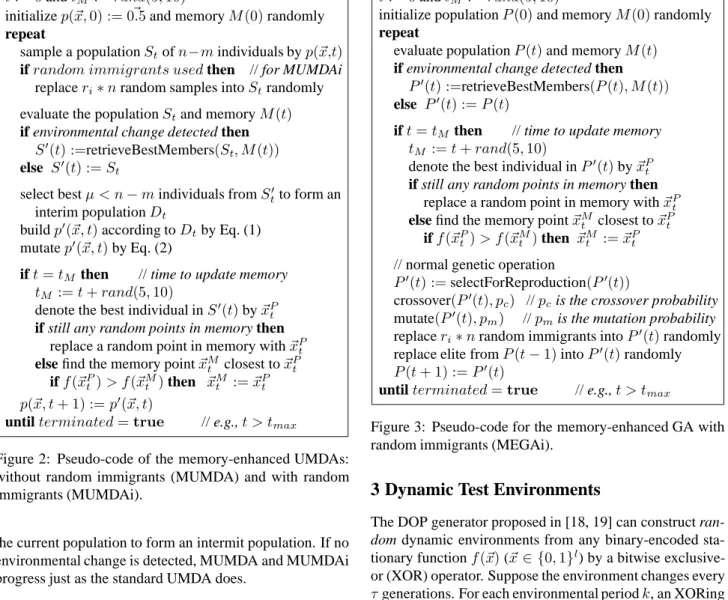
In this paper we investigate an explicit memory scheme for UMDAs in dynamic environments. The pseudo-code for the investigated memory-enhanced UMDAs without and with random immigrants, denoted MUMDA and MUMDAi respectively, is shown in Figure 2. In Figure 2, n is the number of evaluations per iteration including the memory samples andf(~x)denotes the fitness of individual~x.
In MUMDA and MUMDAi, a memory of size m = 0.1∗nis used to store best samples from the population. The most similar measure, as discussed in [4], is used as the memory replacement strategy. That is, when the memory is due to update, we first find the memory point closest to the best population sample in terms of Hamming distance. If the best population sample has higher fitness than this memory sample, it is replaced by the best population sam-ple; otherwise, the memory stays unchanged.
The memory in MUMDA and MUMDAi is updated us-ing a dynamic time pattern as follows. After each mem-ory updating, a random integer R ∈ [5,10] is generated to determine the next memory updating timetM. For ex-ample, suppose a memory updating happens at generation
t, then the next memory updating time istM = t+R =
t+rand(5,10). This way, the potential effect that the en-vironmental change period coincides with the memory up-dating period can be smoothed away.
The memory is re-evaluated every iteration. If any mem-ory sample has its fitness changed, the environment is de-tected to be changed. Then the memory will be merged with
t:= 0andtM :=rand(5,10)
initializep(~x,0) :=0~.5and memoryM(0)randomly
repeat
sample a populationStofn−mindividuals byp(~x,t)
ifrandom immigrants usedthen // for MUMDAi replaceri∗nrandom samples intoStrandomly evaluate the populationStand memoryM(t)
if environmental change detected then S0(t) :=retrieveBestMembers(S
t, M(t))
else S0(t) :=S
t
select bestµ < n−mindividuals fromS0
tto form an interim populationDt
buildp0(~x, t)according toD
tby Eq. (1) mutatep0(~x, t)by Eq. (2)
ift=tM then // time to update memory
tM :=t+rand(5,10)
denote the best individual inS0(t)by~xP t
if still any random points in memory then
replace a random point in memory with~xP t
else find the memory point~xM
t closest to~xPt
iff(~xP
t )> f(~xMt )then ~xMt :=~xPt
p(~x, t+ 1) :=p0(~x, t)
untilterminated=true // e.g.,t > tmax
Figure 2: Pseudo-code of the memory-enhanced UMDAs: without random immigrants (MUMDA) and with random immigrants (MUMDAi).
the current population to form an intermit population. If no environmental change is detected, MUMDA and MUMDAi progress just as the standard UMDA does.
2.3 Memory-Enhanced Genetic Algorithm
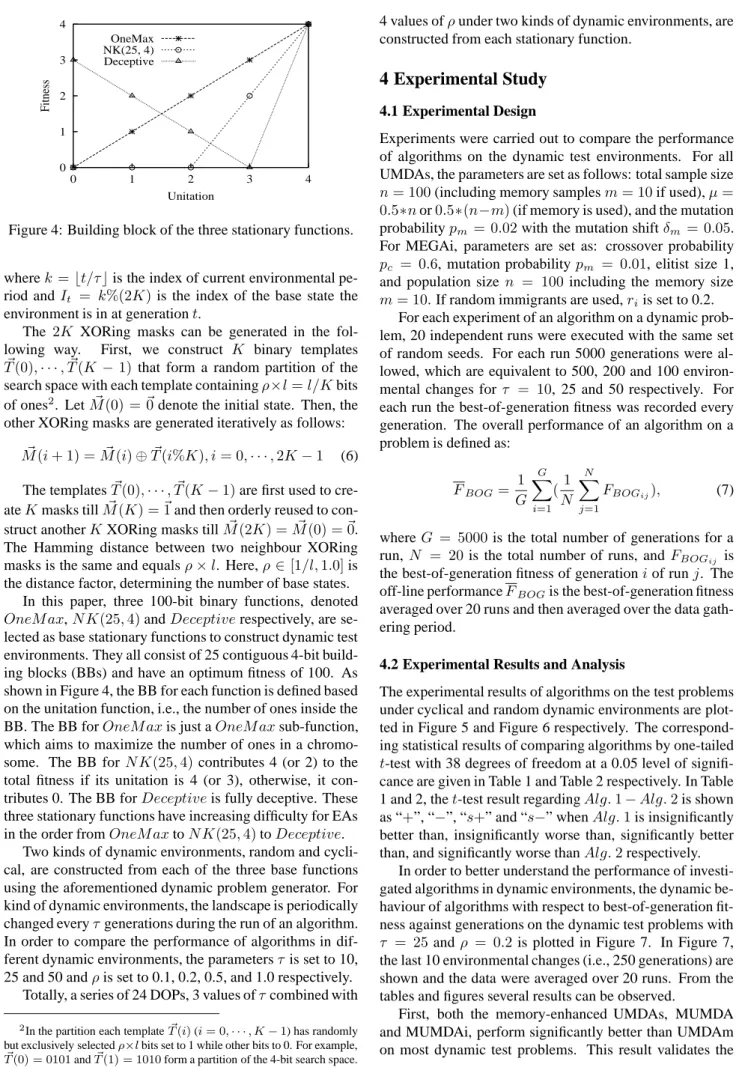
As for stationary problems, GAs are the most studied EAs for dynamic environments. In this study a memory-enhanced GA with random immigrants, denoted MEGAi, is taken as a peer EA to compare the performance of UMDAs for dynamic problems. Figure 3 shows the pseudo-code of MEGAi. MEGAi has typical configuration of standard GAs as follows: generational, uniform crossover, bit flip muta-tion, fitness proportionate selection with the elitist scheme.
MEGAi uses a memory of sizem= 0.1∗n, wherenis the total number of individuals evaluated in each generation. The memory is randomly initialized and, as in MUMDA and MUMDAi, is updated in a dynamic time pattern with the most similar memory updating strategy [4]. When the memory is due to update, if any randomly initialized points still exists in the memory, the best individual of the popula-tion will replace one of them randomly; otherwise, it will re-place the closest memory point if it is better. The memory is re-evaluated every generation. If an environmental change is detected, the memory is merged with the old population and the bestn−m individuals are selected as an interim population to undergo normal genetic operations for a new population while the memory remains unchanged.
t:= 0andtM :=rand(5,10)
initialize populationP(0)and memoryM(0)randomly
repeat
evaluate populationP(t)and memoryM(t)
if environmental change detected then P0(t) :=retrieveBestMembers(P(t), M(t))
else P0(t) :=P(t)
ift=tM then // time to update memory
tM :=t+rand(5,10)
denote the best individual inP0(t)by~xP t
if still any random points in memory then
replace a random point in memory with~xP t
else find the memory point~xM
t closest to~xPt
iff(~xP
t )> f(~xMt )then ~xMt :=~xPt // normal genetic operation
P0(t) :=selectForReproduction(P0(t))
crossover(P0(t), pc) //p
cis the crossover probability mutate(P0(t), pm) //p
mis the mutation probability replaceri∗nrandom immigrants intoP0(t)randomly replace elite fromP(t−1)intoP0(t)randomly
P(t+ 1) :=P0(t)
untilterminated=true // e.g.,t > tmax
Figure 3: Pseudo-code for the memory-enhanced GA with random immigrants (MEGAi).
3 Dynamic Test Environments
The DOP generator proposed in [18, 19] can construct
ran-dom dynamic environments from any binary-encoded
sta-tionary functionf(~x)(~x∈ {0,1}l) by a bitwise exclusive-or (XOR) operatexclusive-or. Suppose the environment changes every
τgenerations. For each environmental periodk, an XORing maskM~(k)is incrementally generated as follows:
~
M(k) =M~(k−1)⊕T~(k), (3) where “⊕” is the XOR operator (i.e.,1⊕1 = 0,1⊕0 = 1, 0⊕0 = 0) and T~(k)is an intermediate binary template randomly created withρ×lones for environmental period
k. For the first periodk= 1,M~(1)is set to a zero vector. Then, the population at generationtis evaluated as below:
f(~x, t) =f(~x⊕M~(k)), (4) wherek = dt/τeis the environmental period index. With this generator, the parameter τ controls the change speed whileρ∈(0.0,1.0)controls the severity of environmental changes. Biggerρmeans severer environmental change.
The above generator can be extended to construct
cycli-cal dynamic environments as follows (see [20] for a
for-mal description). First, we can generate2KXORing masks
~
M(0), ~M(1),· · ·, ~M(2K − 1) as the base states in the search space randomly. Then, the environment can cycle among these base states in a fixed logical ring. Suppose the environment changes everyτ generations, then the individ-uals at generationtis evaluated as follows:
4 3 2 1 0 4 3 2 1 0 Fitness Unitation OneMax NK(25, 4) Deceptive
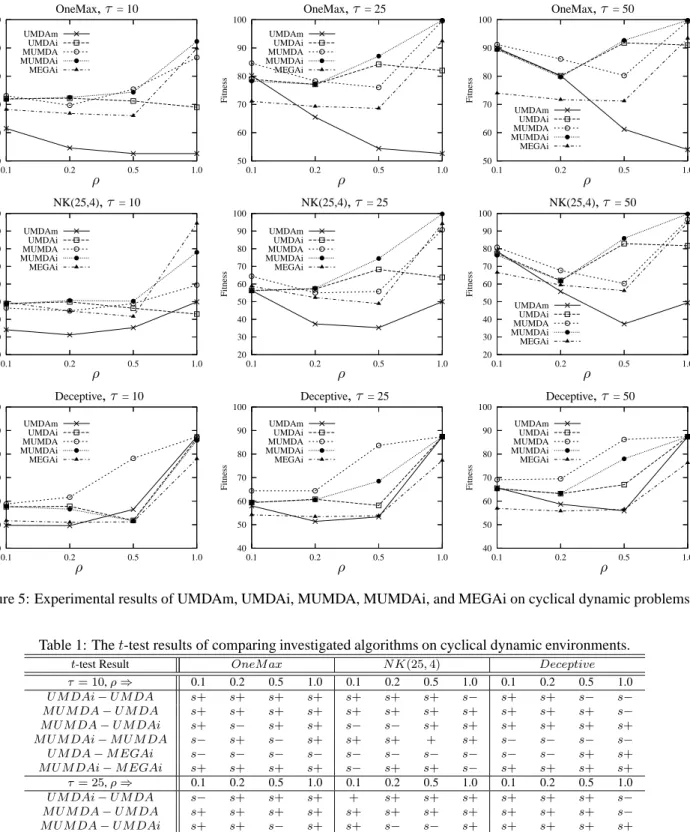
Figure 4: Building block of the three stationary functions.
wherek =bt/τcis the index of current environmental pe-riod andIt = k%(2K)is the index of the base state the environment is in at generationt.
The 2K XORing masks can be generated in the fol-lowing way. First, we construct K binary templates
~
T(0),· · ·, ~T(K−1) that form a random partition of the search space with each template containingρ×l=l/Kbits of ones2. LetM~(0) =~0denote the initial state. Then, the other XORing masks are generated iteratively as follows:
~
M(i+ 1) =M~(i)⊕T~(i%K), i= 0,· · ·,2K−1 (6) The templatesT~(0),· · ·, ~T(K−1)are first used to cre-ateKmasks tillM~(K) =~1and then orderly reused to con-struct anotherKXORing masks tillM~(2K) =M~(0) =~0. The Hamming distance between two neighbour XORing masks is the same and equalsρ×l. Here,ρ∈[1/l,1.0]is the distance factor, determining the number of base states.
In this paper, three 100-bit binary functions, denoted
OneM ax,N K(25,4)andDeceptiverespectively, are se-lected as base stationary functions to construct dynamic test environments. They all consist of 25 contiguous 4-bit build-ing blocks (BBs) and have an optimum fitness of 100. As shown in Figure 4, the BB for each function is defined based on the unitation function, i.e., the number of ones inside the BB. The BB forOneM axis just aOneM axsub-function, which aims to maximize the number of ones in a chromo-some. The BB forN K(25,4) contributes 4 (or 2) to the total fitness if its unitation is 4 (or 3), otherwise, it con-tributes 0. The BB forDeceptiveis fully deceptive. These three stationary functions have increasing difficulty for EAs in the order fromOneM axtoN K(25,4)toDeceptive.
Two kinds of dynamic environments, random and cycli-cal, are constructed from each of the three base functions using the aforementioned dynamic problem generator. For kind of dynamic environments, the landscape is periodically changed everyτgenerations during the run of an algorithm. In order to compare the performance of algorithms in dif-ferent dynamic environments, the parametersτ is set to 10, 25 and 50 andρis set to 0.1, 0.2, 0.5, and 1.0 respectively.
Totally, a series of 24 DOPs, 3 values ofτcombined with
2In the partition each templateT~(i)(i= 0,· · ·, K−1) has randomly
but exclusively selectedρ×lbits set to 1 while other bits to 0. For example,
~
T(0) = 0101andT~(1) = 1010form a partition of the 4-bit search space.
4 values ofρunder two kinds of dynamic environments, are constructed from each stationary function.
4 Experimental Study
4.1 Experimental Design
Experiments were carried out to compare the performance of algorithms on the dynamic test environments. For all UMDAs, the parameters are set as follows: total sample size
n= 100(including memory samplesm= 10if used),µ= 0.5∗nor0.5∗(n−m)(if memory is used), and the mutation probabilitypm= 0.02with the mutation shiftδm = 0.05. For MEGAi, parameters are set as: crossover probability
pc = 0.6, mutation probabilitypm = 0.01, elitist size 1, and population size n = 100including the memory size
m= 10. If random immigrants are used,riis set to 0.2. For each experiment of an algorithm on a dynamic prob-lem, 20 independent runs were executed with the same set of random seeds. For each run 5000 generations were al-lowed, which are equivalent to 500, 200 and 100 environ-mental changes for τ = 10, 25 and 50 respectively. For each run the best-of-generation fitness was recorded every generation. The overall performance of an algorithm on a problem is defined as:
FBOG= 1 G G X i=1 (1 N N X j=1 FBOGij), (7) whereG = 5000is the total number of generations for a run, N = 20is the total number of runs, andFBOGij is the best-of-generation fitness of generationiof runj. The off-line performanceFBOGis the best-of-generation fitness averaged over 20 runs and then averaged over the data gath-ering period.
4.2 Experimental Results and Analysis
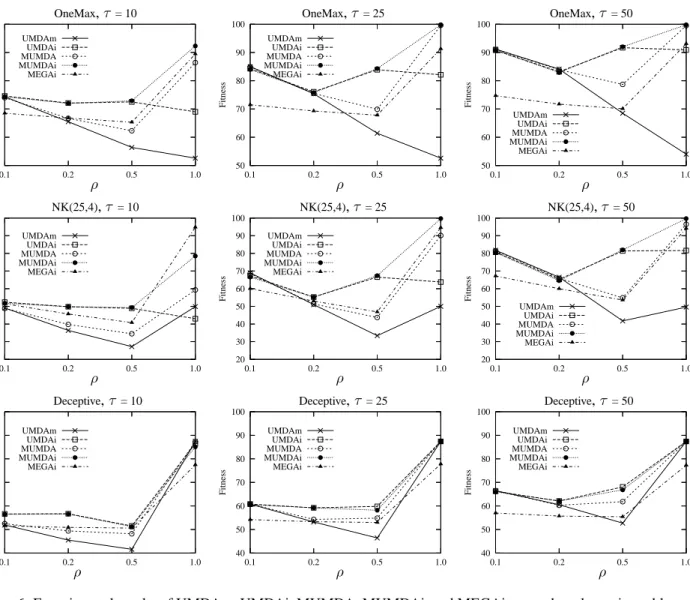
The experimental results of algorithms on the test problems under cyclical and random dynamic environments are plot-ted in Figure 5 and Figure 6 respectively. The correspond-ing statistical results of comparcorrespond-ing algorithms by one-tailed
t-test with 38 degrees of freedom at a 0.05 level of signifi-cance are given in Table 1 and Table 2 respectively. In Table 1 and 2, thet-test result regardingAlg.1−Alg.2is shown as “+”, “−”, “s+” and “s−” whenAlg.1is insignificantly better than, insignificantly worse than, significantly better than, and significantly worse thanAlg.2respectively.
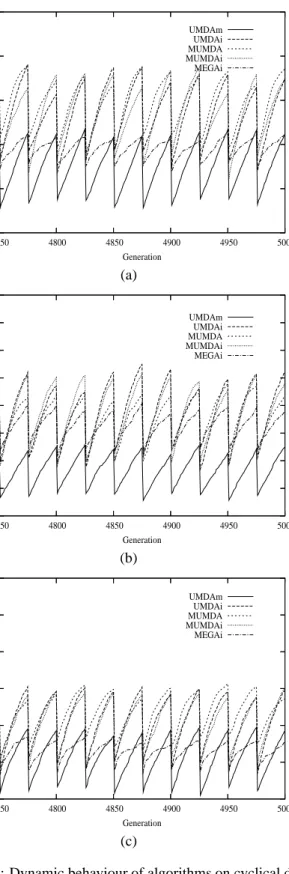
In order to better understand the performance of investi-gated algorithms in dynamic environments, the dynamic be-haviour of algorithms with respect to best-of-generation fit-ness against generations on the dynamic test problems with
τ = 25andρ = 0.2is plotted in Figure 7. In Figure 7, the last 10 environmental changes (i.e., 250 generations) are shown and the data were averaged over 20 runs. From the tables and figures several results can be observed.
First, both the memory-enhanced UMDAs, MUMDA and MUMDAi, perform significantly better than UMDAm on most dynamic test problems. This result validates the
OneMax,τ = 10 OneMax,τ= 25 OneMax,τ = 50 50 60 70 80 90 100 1.0 0.5 0.2 0.1 Fitness UMDAm UMDAi MUMDA MUMDAi MEGAi 50 60 70 80 90 100 1.0 0.5 0.2 0.1 Fitness UMDAm UMDAi MUMDA MUMDAi MEGAi 50 60 70 80 90 100 1.0 0.5 0.2 0.1 Fitness UMDAm UMDAi MUMDA MUMDAi MEGAi ρ ρ ρ NK(25,4),τ = 10 NK(25,4),τ = 25 NK(25,4),τ = 50 20 30 40 50 60 70 80 90 100 1.0 0.5 0.2 0.1 Fitness UMDAm UMDAi MUMDA MUMDAi MEGAi 20 30 40 50 60 70 80 90 100 1.0 0.5 0.2 0.1 Fitness UMDAm UMDAi MUMDA MUMDAi MEGAi 20 30 40 50 60 70 80 90 100 1.0 0.5 0.2 0.1 Fitness UMDAm UMDAi MUMDA MUMDAi MEGAi ρ ρ ρ
Deceptive,τ = 10 Deceptive,τ = 25 Deceptive,τ = 50
40 50 60 70 80 90 100 1.0 0.5 0.2 0.1 Fitness UMDAm UMDAi MUMDA MUMDAi MEGAi 40 50 60 70 80 90 100 1.0 0.5 0.2 0.1 Fitness UMDAm UMDAi MUMDA MUMDAi MEGAi 40 50 60 70 80 90 100 1.0 0.5 0.2 0.1 Fitness UMDAm UMDAi MUMDA MUMDAi MEGAi ρ ρ ρ
Figure 5: Experimental results of UMDAm, UMDAi, MUMDA, MUMDAi, and MEGAi on cyclical dynamic problems.
Table 1: Thet-test results of comparing investigated algorithms on cyclical dynamic environments.
t-test Result OneM ax N K(25,4) Deceptive
τ= 10,ρ⇒ 0.1 0.2 0.5 1.0 0.1 0.2 0.5 1.0 0.1 0.2 0.5 1.0 U M DAi−U M DA s+ s+ s+ s+ s+ s+ s+ s− s+ s+ s− s− M U M DA−U M DA s+ s+ s+ s+ s+ s+ s+ s+ s+ s+ s+ s− M U M DA−U M DAi s+ s− s+ s+ s− s− s+ s+ s+ s+ s+ s+ M U M DAi−M U M DA s− s+ s− s+ s+ s+ + s+ s− s− s− s− U M DA−M EGAi s− s− s− s− s− s− s− s− s− s− s+ s+ M U M DAi−M EGAi s+ s+ s+ s+ s− s+ s+ s− s+ s+ s+ s+ τ= 25,ρ⇒ 0.1 0.2 0.5 1.0 0.1 0.2 0.5 1.0 0.1 0.2 0.5 1.0 U M DAi−U M DA s− s+ s+ s+ + s+ s+ s+ s+ s+ s+ s− M U M DA−U M DA s+ s+ s+ s+ s+ s+ s+ s+ s+ s+ s+ s− M U M DA−U M DAi s+ s+ s− s+ s+ s− s− s+ s+ s+ s+ s+ M U M DAi−M U M DA s− s− s+ s+ s− s+ s+ s+ s− s− s− s− U M DA−M EGAi s+ s− s− s− s− s− s− s− s+ s− − s+ M U M DAi−M EGAi s+ s+ s+ s+ s− s+ s+ s+ s+ s+ s+ s+ τ= 50,ρ⇒ 0.1 0.2 0.5 1.0 0.1 0.2 0.5 1.0 0.1 0.2 0.5 1.0 U M DAi−U M DA s− − s+ s+ s− s+ s+ s+ s− s+ s+ s− M U M DA−U M DA s+ s+ s+ s+ s+ s+ s+ s+ s+ s+ s+ + M U M DA−U M DAi s+ s+ s− s+ s+ s+ s− s+ s+ s+ s+ s+ M U M DAi−M U M DA s− s− s+ s+ s− s− s+ s+ s− s− s− s− U M DA−M EGAi s+ s+ s− s− s+ s− s− s− s+ s+ − s+ M U M DAi−M EGAi s+ s+ s+ s+ s+ s+ s+ s+ s+ s+ s+ s+
efficiency of introducing the memory scheme into UMDA. From Figure 7, it can be seen that the performance of
MUMDA and MUMDAi stays at a much higher fitness level than UMDAm. And both MUMDA and MUMDAi achieve
OneMax,τ = 10 OneMax,τ= 25 OneMax,τ = 50 50 60 70 80 90 100 1.0 0.5 0.2 0.1 Fitness UMDAm UMDAi MUMDA MUMDAi MEGAi 50 60 70 80 90 100 1.0 0.5 0.2 0.1 Fitness UMDAm UMDAi MUMDA MUMDAi MEGAi 50 60 70 80 90 100 1.0 0.5 0.2 0.1 Fitness UMDAm UMDAi MUMDA MUMDAi MEGAi ρ ρ ρ NK(25,4),τ = 10 NK(25,4),τ = 25 NK(25,4),τ = 50 20 30 40 50 60 70 80 90 100 1.0 0.5 0.2 0.1 Fitness UMDAm UMDAi MUMDA MUMDAi MEGAi 20 30 40 50 60 70 80 90 100 1.0 0.5 0.2 0.1 Fitness UMDAm UMDAi MUMDA MUMDAi MEGAi 20 30 40 50 60 70 80 90 100 1.0 0.5 0.2 0.1 Fitness UMDAm UMDAi MUMDA MUMDAi MEGAi ρ ρ ρ
Deceptive,τ = 10 Deceptive,τ = 25 Deceptive,τ = 50
40 50 60 70 80 90 100 1.0 0.5 0.2 0.1 Fitness UMDAm UMDAi MUMDA MUMDAi MEGAi 40 50 60 70 80 90 100 1.0 0.5 0.2 0.1 Fitness UMDAm UMDAi MUMDA MUMDAi MEGAi 40 50 60 70 80 90 100 1.0 0.5 0.2 0.1 Fitness UMDAm UMDAi MUMDA MUMDAi MEGAi ρ ρ ρ
Figure 6: Experimental results of UMDAm, UMDAi, MUMDA, MUMDAi, and MEGAi on random dynamic problems.
Table 2: Thet-test results of comparing investigated algorithms on random dynamic environments.
t-test Result OneM ax N K(25,4) Deceptive
τ= 10,ρ⇒ 0.1 0.2 0.5 1.0 0.1 0.2 0.5 1.0 0.1 0.2 0.5 1.0 U M DAi−U M DA s+ s+ s+ s+ s+ s+ s+ s− s+ s+ s+ s− M U M DA−U M DA s− s+ s+ s+ − s+ s+ s+ s+ s+ s+ + M U M DA−U M DAi s− s− s− s+ s− s− s− s+ s− s− s− s+ M U M DAi−M U M DA s+ s+ s+ s+ s+ s+ s+ s+ s+ s+ s+ s− U M DA−M EGAi s+ s− s− s− s− s− s− s− s+ s− s− s+ M U M DAi−M EGAi s+ s+ s+ s+ s+ s+ s+ s− s+ s+ s+ s+ τ= 25,ρ⇒ 0.1 0.2 0.5 1.0 0.1 0.2 0.5 1.0 0.1 0.2 0.5 1.0 U M DAi−U M DA s− s+ s+ s+ s− s+ s+ s+ + s+ s+ s− M U M DA−U M DA − + s+ s+ − + s+ s+ + s+ s+ + M U M DA−U M DAi s+ s− s− s+ s+ s− s− s+ + s− s− s+ M U M DAi−M U M DA s− s+ s+ s+ s− s+ s+ s+ s− s+ s+ s− U M DA−M EGAi s+ s+ s− s− s+ s− s− s− s+ − s− s+ M U M DAi−M EGAi s+ s+ s+ s+ s+ s+ s+ s+ s+ s+ s+ s+ τ= 50,ρ⇒ 0.1 0.2 0.5 1.0 0.1 0.2 0.5 1.0 0.1 0.2 0.5 1.0 U M DAi−U M DA s− s− s+ s+ s− s− s+ s+ s− s+ s+ s− M U M DA−U M DA − s− s+ s+ − s− s+ s+ − s− s+ + M U M DA−U M DAi s+ s+ s− s+ s+ s+ s− s+ s+ s− s− s+ M U M DAi−M U M DA s− s− s+ s+ s− s− s+ s+ s− s+ s+ s− U M DA−M EGAi s+ s+ s− s− s+ s+ s− s− s+ s+ s− s+ M U M DAi−M EGAi s+ s+ s+ s+ s+ s+ s+ s+ s+ s+ s+ s+
better performance improvement over UMDAm on cyclical environments than on random dynamic environments. This
result means that the effect of the memory scheme depends on whether the environment changes cyclically or not.
50 60 70 80 90 100 4750 4800 4850 4900 4950 5000 Best-Of-Generation Fitness Generation UMDAm UMDAi MUMDA MUMDAi MEGAi (a) 20 30 40 50 60 70 80 90 100 4750 4800 4850 4900 4950 5000 Best-Of-Generation Fitness Generation UMDAm UMDAi MUMDA MUMDAi MEGAi (b) 40 50 60 70 80 90 100 4750 4800 4850 4900 4950 5000 Best-Of-Generation Fitness Generation UMDAm UMDAi MUMDA MUMDAi MEGAi (c)
Figure 7: Dynamic behaviour of algorithms on cyclical dy-namic (a) OneM ax, (b) N K(25,4) and (c) Deceptive
functions withτ = 25andρ= 0.2.
Second, the addition of the random immigrants scheme improves the performance of UMDA on most dynamic problems, see the t-test results regarding UMDAi – UM-DAm. This also validates the benefit of maintaining the diversity for UMDA in dynamic environments. However, whenρis small, e.g., 0.1, for several cases the random
im-migrants scheme has negative effect on the performance of UMDAm. This happens because when the severity of en-vironmental changes is low, the random immigrants added slow down the continuous search progress of original UM-DAs when change occurs.
Third, when comparing the memory scheme and the ran-dom immigrants scheme, it can be seen that the effect of the memory scheme is significantly greater (better) than the random immigrants scheme on most cyclical dynamic prob-lems, see thet-test results regarding MUMDA – UMDAi in Table 1. However, for random dynamic problems, the ran-dom immigrants scheme outperforms the memory scheme on most cases. This happens because for random DOPs, random immigrants may track the new environment more efficient than memory samples.
Fourth, when examining the interactive effect between the memory scheme and the random immigrants scheme, it can be seen that MUMDAi outperforms UMDAi on most cyclical and random dynamic problems. This means when the random immigrants scheme is used, the addition of the memory scheme always has positive effect on UMDA’s per-formance. However, MUMDAi is beaten by MUMDA for many cyclical problems. That is, when the memory scheme is used, the addition of the random immigrants may have negative effect in cyclical dynamic environments.
Finally, comparing the performance of MEGAi with UMDAs, it can be seen that MEGAi outperforms UMDAm under many dynamic environments, see thet-test results re-garding UMDAm – MEGAi. However, MEGAi is signif-icantly beaten by both MUMDA and MUMDAi on most dynamic test problems, see the relevantt-test results. This happens due to two factors. The first factor lies in that UMDAs have better search capacity than MEGAi and this factor contributes to the fact that even UMDA outperforms MEGAi on several dynamic test problems. This point can be seen from Figure 7. On almost all dynamic problems UMDAs achieve a much higher fitness improvement than MEGAi does during each environmental period.
The second factor is because that the memory scheme in MUMDA and MUMDAi has a stronger effect than the memory scheme in MEGAi. This can be clearly seen in the dynamic behaviour of algorithms in Figure 7. On cycli-cal dynamic problems MUMDA and MUMDAi are able to maintain a higher fitness level than MEGAi does.
5 Conclusions and Future Work
This paper investigates the application of the memory scheme for UMDAs in dynamic environments. Within this memory scheme, the best samples are stored in the memory by replacing the most similar memory point. When the en-vironmental change is detected, the memory is merged with the population to build new probability vectors. This paper also investigates the relationship between memory and ran-dom immigrants for UMDAs in dynamic environments. An experimental study was carried out based on a series of sys-tematically constructed dynamic test environments. From the experimental results, several conclusions can be drawn on the dynamic test environments.
First, the memory scheme is efficient to improve the per-formance of UMDAs in dynamic environments. Second, the experimental results indicate that different interaction exists between the random immigrants scheme and the memory scheme. In general, when random immigrants is used for UMDA, the addition of the memory scheme has a positive effect on UMDA’s performance in dynamic environments. Random immigrants improves the performance of UMDA when no memory is used. However, when memory is used for UMDA, random immigrants have a negative effect on UMDA’s performance in the cyclical dynamic test environ-ments. Third, the memory-enhanced UMDAs seem a better choice than the memory-enhanced GA for the dynamic test problems.
The work studied in this paper can be extended in sev-eral ways. Developing other memory management and re-trieval mechanisms would be an interesting future work for memory-based UMDAs and other estimation of distribution algorithms [2, 13] in dynamic environments. Comparing the memory scheme investigated in this paper with the as-sociative memory scheme studied in [20] is another future work. And it is also an interesting work to further investi-gate the interactions between the memory scheme and other approaches, such as multi-population and adaptive opera-tors, for UMDAs in dynamic environments.
Bibliography
[1] T. B¨ack. On the behaviour of evolutionary algorithms in dynamic fitness landscape. Proc. of the 1998 IEEE
Int. Conf. on Evol. Comput., pp. 446-451, 1998.
[2] S. Baluja. Population-based incremental learning: A method for integrating genetic search based function optimization and competitive learning. Technical
Re-port CMU-CS-94-163, Carnegie Mellon University,
USA, 1994.
[3] C. N. Bendtsen and T. Krink. Dynamic memory model for non-stationary optimization. Proc. of the 2002 Congress on Evol. Comput., pp. 145-150, 2002.
[4] J. Branke. Memory enhanced evolutionary algorithms for changing optimization problems. Proc. of the 1999
Congress on Evol. Comput., vol. 3, pp. 1875-1882,
1999.
[5] J. Branke. Evolutionary Optimization in Dynamic
En-vironments. Kluwer Academic Publishers, 2002.
[6] D. E. Goldberg and R. E. Smith. Nonstationary func-tion optimizafunc-tion using genetic algorithms with dom-inance and diploidy. Proc. of the 2nd Int. Conf. on
Genetic Algorithms, pp. 59-68, 1987.
[7] J. J. Grefenstette. Genetic algorithms for changing en-vironments. Proc. of the 2nd Int. Conf. on Parallel
Problem Solving from Nature, pp. 137-144, 1992.
[8] P. Larra˜naga and J. A. Lozano. Estimation of
Distri-bution Algorithms: A New Tool for Evolutionary Com-putation. Kluwer Academic Publishers, 2002.
[9] E. H. J. Lewis and G. Ritchie. A comparison of dominance mechanisms and simple mutation on non-stationary problems. Proc. of the 5th Int. Conf. on
Par-allel Problem Solving from Nature, pp. 139-148, 1998.
[10] S. J. Louis and Z. Xu. Genetic algorithms for open shop scheduling and re-scheduling. Proc. of the 11th
ISCA Int. Conf. on Computers and their Applications,
pp. 99-102, 1996.
[11] T. Mahnig and H. M¨uhlenbein. Mathematical analy-sis of optimization methods using search distributions.
Proc. of the 2000 Genetic and Evol. Comput. Confer-ence Workshop Program, pp. 205-208, 2000.
[12] N. Mori, H. Kita and Y. Nishikawa. Adaptation to changing environments by means of the memory based thermodynamical genetic algorithm. Proc. of
the 7th Int. Conf. on Genetic Algorithms, pp. 299-306,
1997.
[13] H. M¨uhlenbein and G. Paaß. From recombination of genes to the estimation of distributions I. Binary pa-rameters. Proc. of the 4th Int. Conf. on Parallel
Prob-lem Solving from Nature, pp. 178-187, 1996.
[14] H. M¨uhlenbein. The equation for response to selection and its use for prediction. Evolutionary Computation, vol. 5, pp. 303-346, 1998.
[15] K. P. Ng and K. C. Wong. A new diploid scheme and dominance change mechanism for non-stationary function optimisation. Proc. of the 6th Int. Conf. on
Genetic Algorithms, 1997.
[16] C. L. Ramsey and J. J. Greffenstette. Case-based ini-tializtion of genetic algorithms. Proc. of the 5th Int.
Conf. on Genetic Algorithms, 1993.
[17] K. Trojanowski and Z. Michalewicz. Searching for op-tima in non-stationary environments. Proc. of the 1999
Congress on Evol. Comput., pp. 1843-1850, 1999.
[18] S. Yang. Non-stationary problem optimization using the primal-dual genetic algorithm. Proc. of the 2003
Congress on Evol. Comput., vol. 3, pp. 2246-2253,
2003.
[19] S. Yang and X. Yao. Experimental study on population-based incremental learning algorithms for dynamic optimization problems. Soft Computing, pub-lished online first on 22 April 2005.
[20] S. Yang and X. Yao. Population-based incremental learning with associative memory for dynamic envi-ronments. Submitted to IEEE Trans. on Evol.
Com-put., 2005.
[21] Q. Zhang. On stability of fixed points of limit models of univariate marginal distribution algorithm and fac-torized distribution algorithm. IEEE Trans. on Evol.