A Generate-Test-Aggregate Parallel Programming Library
Systematic Parallel Programming for MapReduce
Yu Liu
The Graduate University for Advanced Studies Tokyo, Japan
[email protected]
Kento Emoto
University of Tokyo Tokyo, Japan[email protected]
Zhenjiang Hu
National Institute of Informatics Tokyo, Japan[email protected]
ABSTRACT
Generate-Test-Aggregate(GTA for short) is a novel programming model for MapReduce, dramatically simplifying the development of efficient parallel algorithms. Under the GTA model, a parallel computation is encoded into a simple pattern: generateall candi-dates,testthem to filter out invalid ones, andaggregatevalid ones to make the result. Once users specify their parallel computations in the GTA style, they get efficient MapReduce programs for free owing to an automatic optimization given by the GTA theory.
In this paper, we report our implementation of a GTA library to support programming in the GTA model. In this library, we pro-vide a compact programming interface for hiding the complexity of GTA’s internal transformation, so that many problems can be encoded in the GTA style easily and straightforwardly. The GTA transformation and optimization mechanism implemented inside is a black-box to the end users, while users can extend the library by modifying existing (or implementing new) generators, testers or aggregators through standard programming interfaces of the GTA library. This GTA programming library supports both sequential or parallel execution on single computer and on-cluster execution with MapReduce computing engines. We evaluate our library by giving the results of our experiments on large data to show the efficiency, scalability and usefulness of this GTA library.
Categories and Subject Descriptors
D.1.3 [Concurrent Programming]: Parallel programmingGeneral Terms
Algorithms, Design
Keywords
High-level Parallel Programming, Generate Test Aggregate Pro-gramming Model, MapReduce, Optimization, Functional Program-ming, Scala
1.
INTRODUCTION
Permission to make digital or hard copies of all or part of this work for personal or classroom use is granted without fee provided that copies are not made or distributed for profit or commercial advantage and that copies bear this notice and the full citation on the first page. To copy otherwise, to republish, to post on servers or to redistribute to lists, requires prior specific permission and/or a fee.
PMAM’2013,February 23, 2013, ShenZhen [Guangdong, China] Copyright 2013 ACM 978-1-4503-1908-9/13/02 ...$15.00.
Google’s MapReduce is the de facto standard for large scale data-intensive applications. Despite the popularity of MapReduce, developing efficient MapReduce programs for some optimization problems is usually difficult in practice.
As an example, consider the well-known 0-1 Knapsack problem: fill a knapsack with items, each of certain valueviand weightwi, such that the total value of packed items is maximal while adhering to a weight restrictionW of the knapsack. This problem can be formulated as:
maximize∑ni=1vixi
subject to∑ni=1wixi≤W,xi∈ {0,1}
However, designing an efficient MapReduce algorithm for the Knap-sack problem is difficult for many programmers because the above formular does not match MapReduce model directly. Moreover, designing one for the problem with additional conditions is more difficult.
The Generate-Test-Aggregate (GTA for short) theory has been proposed in the previous work [10, 11] to remedy this situation. It synthesizes efficient MapReduce programs (i.e., parallel and scal-able programs) for a general class of problems that can bespecified in terms ofgenerate, testand aggregatein a naive way of first generating all possible solution candidates, then keeping those candidates that pass a test of certain conditions, and finally select-ing the best solution or makselect-ing a summary of valid solutions with an aggregating computation. For instance, the Knapsack problem could be specified by a GTA program like this: generating all pos-sible selections of items, keeping those that satisfy the constraint of total weight, and then selecting the one which has the maximum sum of value. Note that directly implementing such an algorithm by MapReduce is possible but not practical. Givennitems, this naive program will generateO(2n) possible selections. Suppose there are 100 items and each item just takes 1 byte space, then the generated data will be about 1018TB that is beyond any storage system’s capability.
The GTA theory [10, 11] introduces a way to synthesize from such a naive program an work efficiencyO(n)and fully parallelized MapReduce program of which run-time efficiency is guaranteed by elimination of exponential blow-up, which is so-called the GTA optimization.
Although the previous work [10, 11] theoretically gave the method-ology, it has not mentioned the implementation: It is non-trivial to implement the GTA theory with both the powerful optimization and a nice programming interface because of the gap between mathe-matical concepts and a practical programming language. Moreover, more work on practical programming with GTA is necessary in or-der to extract and indicate the real capability of the GTA theory, which will guide new users to this new world.
In this paper we present our implementation of a lightweight GTA library which is a functional programming platform allowing users to write GTA programs and execute them on local machines or large computer-clusters. Our main technical contributions are two folds. First, we design a generic program interface for users who don’t know details of the GTA theorem and parallel program-ming, to let them use GTA in a black-box. Our library also shows how the theoretical GTA fusion can be implemented and executed on practical MapReduce engines. Second, we demonstrate the use-fulness of our GTA library with some interesting examples, show-ing that lots of application problems can be easily and efficiently resolved by using our library.
The rest of the paper is organized as follows. After explaining the background knowledge in Section 2, we show the design and implementation of our library in Section 3. In Section 4 we intro-duce more details of the implementation. Then, we demonstrate the usefulness of our library using the Knapsack problem and other examples, and report our experimental results in Section 5. The re-lated work is discussed in Section 6. Finally, we conclude the paper and highlight some future work in Section 7. The source code used for our experiments is available online1.
2.
BACKGROUND
In this section we briefly review the concepts of Generate-Test-Aggregate (GTA for short) theory [10, 11], as well as its back-ground knowledge, list homomorphism [4, 8, 16] and MapReduce [9].
The notation we use to formally describe algorithms is based on the functional programming language Haskell [4]. Function appli-cation can be written without parentheses, i.e., f aequals f(a). Functions are curried and application associates to the left, thus, f a bequals(f a)b. Function application has higher precedence than operators, so f a⊕b=(f a)⊕b. We use the operator◦over functions: by definition,(f◦g)x= f(g x). The identity element of a binary operatoris represented byı.
2.1
List Homomorphism
A list homomorphism is a special, useful recursive function on lists. Naturally, it is a simple divide-and-conquer parallel compu-tation [8, 16]. List homomorphisms have a close relationship with parallel computing that have been studied intensively [8, 16, 18], and
DEFINITION1 (LISTHOMOMORPHISM). Function h is said to be a list homomorphism, if and only if there is a function f , an associative operatorand the identity element ıofsuch that
the following equations hold.
h[ ] = ı
h[a] = f a
h(x++y) = h xh y
Since h is uniquely determined by f and, we write h= ([f,]). For instance, summation functionsumon a list of integers can be defined in this format as a list homomorphism, in which,ıand
fare replaced with+, 0 and the identity functionλx.x:
sum[ ] = 0
sum[a] = a
sum(x++y) = sum x+sum y.
Another example is function subliststhat given a list as input
1https://bitbucket.org/inii/gtalib
produces a bag (multi-set) of all sublists of the list: sublists[ ] =*[ ]+
sublists[x] =*[ ]+]*[x]+
sublists(xs++ys) =sublists xs×++ sublists ys. Here,*a1, . . . ,ak+denotes a bag of elementsa1, . . . ,ak, so*[x]+
is a singleton bag of singleton list[x], the operator]denotes bag union, and×++denotes the cross concatenation of lists in two bags. For example, *[]+]*[1]+ =*[ ],[1]+ *[ ],[1]+×++*[ ],[1]+ =*[ ],[1],[1],[1,1]+ sublists[1,1,2,3] =*[ ],[1],[1,2],[1,2,3],[1,3],[2],[2,3],[3], [1],[1,1],[1,1,2],[1,1,2,3],[1,1,3],[1,2], [1,2,3],[1,3]+.
Note that we may have duplications in a bag, and the order of elements are ignored in a bag. We write*A+to denote the type of bags whose elements
have typeA.
Given a setMand an associative binary operatoronMwith its identityı, the pair(M,)is called a Monoid. For example, the set of integers with the usual plus operator forms a monoid
(Z,+). Given a monoid(M,)and a function f ::A→M, we
have a unique list homomorphism([f,])::[A]→M.
2.2
List Homomorphisms on MapReduce
Google’s MapReduce [9] is a popular programming model for processing large data sets in a massively parallel manner. Nowa-days, several free, realistic implementations of MapReduce are avail-able. Hadoop [2] is a famous open-source implementations of MapRe-duce using Java as its primitive language. Spark [31] is a fast in-memory MapReduce cluster implementation on Scala [24].
List homomorphisms fit well with MapReduce, because their input can be freely divided to sub-lists which can be distributed among machines. Then on each machine the programs are com-puted independently, and the final result can be got by a merging procedure. In fact, it has been shown that list homomorphisms can be efficiently implemented using MapReduce [20]. Therefore, if we can derive an efficient list homomorphism to solve a problem, we can solve the problem efficiently with MapReduce, enjoying its advantages such as automatic load-balancing, fault-tolerance, and scalability.
2.3
Generate, Test, and Aggregate
The GTA programming style and powerful fusion optimization [10, 11] have been proposed to synthesize MapReduce programs from naive specifications (GTA programs) in the following form.
aggregate◦test◦generate
A GTA program consists of ageneratethat generates a bag of intermediate lists, a testthat filters out invalid intermediate lists, and anaggregatethat computes a summary of valid intermediate lists. A GTA program in this form can be transformed into a single list homomorphism , if these components meet the condition of GTA fusion optimization. To understand the meaning, we review several important concepts.
DEFINITION2 (SEMIRING). Given a set S and two binary operations⊕and⊗, the triple(S,⊕,⊗)is called a semiring if and only if
• ⊕is an associative and commutative operator with identity element ı⊕,
• ⊗is associative with identity element ı⊗and distributes over
• ı⊕is a zero of⊗.
For example, a set of bags of lists forms a semiring (*[A]+,],×++) with the bag union and the cross concatenation for any element type A. The distributivity plays an important role in the optimization in the GTA theory.
Similar to the connection between a monoid and a list homo-morphism, a semiring is naturally connected to a special recursive function on bags of lists.
DEFINITION3 (SEMIRING HOMOMORPHISM). Given arbitrary semiring(S,⊕,⊗)and function f::A→S, function shom::*[A]+→ S is a semiring homomorphism from(*[A]+,],×++)to(S,⊕,⊗), iff
the following hold.
shom(x]y) =shom x⊕ shom y shom(x×++y) =shom x⊗ shom y
shom*[a]+ =f a
shom*+ =ı⊕
shom*[ ]+ =ı⊗
Since shom is uniquely determined by f ,⊕and⊗, we write shom= (
{f,⊕,⊗}).
Since a semiring homomorphism consumes a bag of lists, it can be used as an aggregator in the GTA program. Actually, semir-ing homomorphisms in combination with generators and testers of specific kinds have very powerful fusions.
An example of semiring homomorphisms is aggregatormaxsum f using semiring the max-plus semiring(Z,↑,+)to find the
maxi-mum amongf-weighted sums of lists in a given bag: maxsum f (x]y) =maxsum x↑maxsum y maxsum f (x×++y) =maxsum x+maxsum y
maxsum f *[a]+ = f a
maxsum f *+ =−∞
maxsum f *[ ]+ =0
Here,↑is an operator to take the maximum of two operands. Read-ers can check whethermaxsum f actually computes the maximum f-weighted sum of a given bag of lists, using the facts that every bag can be decomposed into union of singleton bags, and that every singleton bag of a list can be decomposed into cross-concatenation of singleton bags of singleton lists. For example,*[1,2,3],[2,3]+=
*[1,2,3]+]*[2,3]+= (*[1]+×++*[2]+×++*[3]+)](*[2]+×++*[3]+).
Now, we introduce a class of generators that have good fusability with semiring homomorphisms.
DEFINITION4 (SEMIRINGPOLYMORPHICGENERATOR). A function polymorphic over semirings(S,⊕,⊗)
generator⊕,⊗::(A→S)→[A]→S is called asemiring polymorphic generator.
Parameterised with semirings, a semiring polymorphic genera-tor does different computation with different semirings. Particu-larly, using the semiring(*[A]+,],×++)of bags of lists, function
generator],×++ (λa.*[a]+)::[A]→*[A]+is a generator that can be
used in the GTA program. For example, abstracting the semiring in generatorsublists, we havesublists=sublists0],×++ (λa.*[a]+) where
sublists0⊕,⊗ f[ ] =ı⊗
sublists0⊕,⊗ f[x] =ı⊗⊕f x
sublists0⊕,⊗ f(xs++ys) =sublists0⊕,⊗ f xs⊗sublists0⊕,⊗ f ys.
Moreover, we have the following powerful result to fuse such a generator with an aggregator of semiring homomorphisms.
THEOREM1 (SEMIRINGFUSION[10]). Given a semiring poly-morphic generator generator⊕,⊗::(A→S)→[A]→S and a semir-ing homomorphism({f,⊕,⊗})to(S,⊕,⊗), the following holds.
({f,⊕,⊗})◦generator],×++ (λa.*[a]+) =generator⊕,⊗ f
The left-hand-side of the equation is a GTA program without testers, in whichgenerator],×++ (λa.*[a]+)is the generator and({f,⊕,⊗})
is the aggregator. In this program, possibly an exponential num-ber of intermediate lists are generated by the generator and then consumed by the aggregator, so that the total cost would be ex-ponential in the length of the input list. On the other hand, the right-hand-side is usually an efficient program without such an ex-ponential blow-up, because it does not use the heavy operator×++ but uses (possibly) lightweight operator⊗. For example, the the-orem says that programmaxsum(λa.a)◦sublists, which given a list computes the maximum of sums of its all sublists, is equivalent to programsublists0↑,+(λa.a). This is easily verified because the
program computes a sum of all positive numbers and it is clearly the maximum sum of all sublists.
Another important concept in GTA isfilter embedding, which fuses an aggregator of semiring homomorphisms and a tester of a specific filter form:
DEFINITION5 (HOMOMORPHICTESTER). If a tester test is a filter with a predicate defined with a function ok and list homo-morphism([f,]), namely, test=filter(ok◦([f,])), we call it a homomorphic tester.
For example, in a GTA program for the knapsack problem, the tester to filter out item selections with too heavy total weights is a homomorphic tester as follows.
removeInvalidSelection=filter((≤w)◦([getWeight,+])) Here, the homomorphism([getWeight,+])computes the total weight of the given list, and the judgment (≤w) compares it with the weight limit to find invalid ones.
Now, we are ready to introduce the filter embedding:
THEOREM2 (FILTEREMBEDDING). Given a homomorphic tester filter (ok◦([f,]))in which the list homomorphism is to (M,)and a semiring homomorphism({f,⊕,⊗})to(S,⊕,⊗), there exists a lifted semiring (SM,⊕M,⊗M), a lifted function fM and function postprocessoksuch that the following holds.
(
{f,⊕,⊗})◦filter(ok◦([f,])) =postprocessok◦({fM,⊕M,⊗M}) This filter embedding is useful because we can remove a tester be-tween a generator and an aggregator so that we can fuse them by the semiring fusion. Readers who are interested with these can reader the paper [10, 11] for details.
Reasoned by the theory of GTA, i.e., the combination of the filter embedding and the semiring fusion, a GTA program consisting of those components is eventually transferred to an efficient program postprocess◦generator⊕M,⊗M fM. For example, thenaivesolution of Knapsack problem will generateO(2n)intermediate candidates and thus costsO(n2n), but the efficient final program only costs O(n).
Note that, currently the GTA theory is an approach to construct-ing list homomorphisms, so the input ofgenerate(alsoaggregate, andfilter) is limited tolistsbut nottreesor other data structures. GTA for trees/graphs is on our schedule as a future work.
3.
ARCHITECTURE AND PROGRAMMING
t r a i t M a p R e d u c e a b l e [ A , M ,+ R ] e x t e n d s L i s t H o m o [ A , M ]{ o v e r r i d e def f ( a : A ): M
o v e r r i d e def c o m b i n e ( l : M , r : M ): M def p o s t P r o c e s s ( a : M ): R
}
Listing 1: Almost List Homomorphism
In this section we introduce our GTA programming environment. The GTA theory provides an approach to systematic derivation of list homomorphisms, so that we can get efficient MapReduce com-putation automatically once problems are specified GTA programs. Our library provides GTA programming interface to form a GTA program which produces an instance of so-calledMapReduceable. The instance ofMapReduceableadapts the list homomorphism to the MapReduce; its definition is shown in Listing 1. TheMapReduceable has three methods,fcorresponding to the functionfof the list ho-momorphism, combinecorresponding to the binary operator , and a newly introduced methodpostProcesswhich is applied on the out put of theREDUCEprocessing as a final processing of whole computation2.MapReduceablecan be used in any MapRe-duce engine or parallel frameworks which provides MapReMapRe-duce style APIs. By passing GTA objects (instances ofMapReduceable) to such MapReduce engines’ programming interface we can con-struct fully scalable MapReduce computation quite easily.
3.1
Target Environment
Our GTA library is targeted big scale distributed/parallel com-putations on clusters which may have lots of computing nodes, but it also works well on single machine in either sequential or multi-threads model. Our implementation of GTA fusion is modular and easy to be extends.
Currently, our library officially supports three execution models: native, Spark and Hadoop. In native model, GTA works with Scala collection framework, and in Spark or Hadoop model GTA works with Spark or Hadoop, respectively.
3.2
GTA Programming Interface
There is a top level class named GTA for wrapping the GTA programming environment. The user should extend this top class to write his GTA program.
Usually a GTA expression (in Scala) is written like: val gta=generate(...)filter(...)aggregate(...).
val gtais a GTA object (MapReducable) which can be executed in parallel. For "(...)"s, the user should choose proper parameters respectively to the generator, tester and aggregator.
Given proper parameters, the GTA expression produces an in-stance of MapReducable corresponding to the efficient program synthesized by the GTA optimization. Then, the instance can be used in the supported execution models. To grasp an image of the GTA programming, concrete example for computing the maxi-mum sum of all segments (contiguous sublists) of an integer listis shown in Listing 2. We will explain the details of the components allSegmentsandmaxSumused in the program later in Section 3.4.
To make the programming easier, the GTA library predefined common generators, testers and aggregators. Users can choose them to compose various of programs. We list some useful genera-tors, testers, and aggregators in Table 1. There are four generagenera-tors, which, given a list, can generate all sublists (sublists), all prefix
2Such an extended list homomorphism is called analmost list
ho-momorphism[6, 17]
p a c k a g e E x a m p l e s i m p o r t G T A S . _
o b j e c t u s e r A p p e x t e n d s GTA [ Int ] w i t h App {
/* S p a r k job c o n f i g u r a t i o n */ def ctx ( c o n t e x : S p a r k C o n t e x t , i n p u t : s p a r k . RDD [ Int ]) = { /* GTA e x p r e s s i o n */ val gta = g e n e r a t e ( a l l S e g m e n t s ) a g g r e g a t e ( m a x S u m ) /* c o m p u t e r e s u l t . a l i s t is the i n p u t l i s t */
val rst = a l i s t . map ( gta . f ). r e d u c e ( gta . c o m b i n e ( _ , _ )) p r i n t l n ( " rst " )
} }
Listing 2: GTA Example: Maximum Segments Sum (Spark)
c l a s s A l l S e g m e n t s [ I ] e x t e n d s G e n e r a t o r C r e a t e r [ I , I , T4 ] { def m a k e G e n e r a t o r [ S ]( s : A g g r e g a t o r [ I , S ]) = new M a p R e d u c e a b l e [ I , T4 [ S ] , S ] { o v e r r i d e def f ( i : I ) = new T4 ( s . f ( i ) , s . p l u s ( s . id , s . f ( i )) , s . p l u s ( s . id , s . f ( i )) , s . p l u s ( s . zero , s . f ( i ))) o v e r r i d e def c o m b i n e ( l : T4 [ S ] , r : T4 [ S ]): T4 [ S ] = { val ss = s . p l u s ( s . p l u s ( l . _1 , r . _1 ) , s . t i m e s ( l . _2 , r . _3 )) val t a i l s = s . p l u s ( r . _2 , s . t i m e s ( l . _2 , r . _4 )) val i n i t s = s . p l u s ( l . _3 , s . t i m e s ( l . _4 , r . _3 )) val all = s . t i m e s ( l . _4 , r . _4 ) /* T4 is a t y p e of four - t u p l e : ( T , T , T , T ) */
new T4 ( ss , tails , inits , all ) }
o v e r r i d e val id : T4 [ S ] =
new T4 ( s . zero , s . zero , s . zero , s . id )
/* The 1 st e l e m e n t of the four - t u p l e is s e g m e n t s */
o v e r r i d e def p o s t P r o c e s s ( a : T4 [ S ]): S = a . _1 }
}
Listing 3: Generator of "All Segments"
lists (prefixes), all continuous segments (segments), and paint col-ors (attaching some informations) to each element (coloring), re-spectively. Each tester in the table tests whether the sum (length, or its mod of somek) of a list is equal to (or less / more than) a constant valuec. The aggregaters are for aggregating the generated lists to compute the maximum summation (maxSum), minimum summation (minSum) , maximum probability or the list which is the solution of above aggregations (select), respectively.. Here we just list the generic names for them, and the details will be ex-plained by concrete examples (using more appropriate names of them, according to the context) in the following sections.
Defining aggregators, testers, and generators.
For advanced users, we provide Scala trait/classes as program-ming interface to implement their own generators, testers and
ag-Table 1: Some Predefined Generators, Testers, and Aggrega-tors
G T A
sublists sum =,≥,≤c maxSum prefixes length =,≥,≤c minSum segments sum % k = c maxProbablity coloring length % k =c select
t r a i t A g g r e g a t o r [ A , S ] { def p l u s ( l : S , r : S ) def t i m e s ( l : S , r : S ) def f ( a : A ): S val id : S val z e r o : S } Listing 4: SemiringHomomorphism a b s t r a c t c l a s s M a x S u m [ T ] e x t e n d s A g g r e g a t o r [ T , Int ] { def p l u s ( l : Int , r : Int ) = l max r
def t i m e s ( l : Int , r : Int ) = l + r def f ( a : T ): Int
val id : Int = 0
// z e r o is - i n f t y
val z e r o : Int = Int . M i n V a l u e }
Listing 5: MaxSum
gregators.
In our library, an aggregator is a semiring homomorphism, and its base classAggregator[A,S]is provided to implement user-defined aggregators by extending it. Here, the type parameterAis a type of elements in lists of the input bag, andSis a type of the carrier set of the semiring. Its methodsplusandtimescorrespond to the op-erators of a semiring, andzeroandidare their identity elements, respectively. Listing 4 shows Scala code of the base class. For ex-ample, abstract classMaxSum(Listing 5) is an aggregator that finds the maximum among weighted3sums of lists in the given bag.
The library accepts homomorphic testers, which can be speci-fied by the list homomorphism([f,⊕])and the judgment function ok. Thus, a tester is represented by a specializedMapReduceable namedPredicateof whichpostProcessmethod always returns Boolean value as shown in Listing 64. For example,WeightLimit shown in Listing 7 is an implementation of a tester to check whether a given list of items has total weight less than or equal to the weight limitw. We can check this condition by computing the sum of weights by a list homomorphism with the usual plus operator+ and then comparing the result with the limitw. Since we do not need an exact value of total weight greater thanw, the implemen-tation uses the cut-off bymin(w+1). The reason why we use the cut-off will be explained later in Section 4.1.
In our library, a generator has to be a list homomorphism param-eterized by a semiring as shown in Definition 4. How to implement it in the context of object-oriented language is a very interesting problem. We define a generic class namedGeneratorCreater (shown in Listing 8) which has a generic (polymorphic) function to produce an instance ofMapReducable:
gen[S](s:Aggregator[A,S]):MapReduceable[I,S,P[S]].
It takes an aggregator as its parameter, to produce a concrete in-stance ofMapReduceable.
There are four type parameters in thisgenfunction. The type pa-rameterIis the type of elements of the input list,AandSare type parameters of aggregator, which we have explained. In addition to these input/output types, the function has the third type parameterP for its intermediate result, i.e., the result of its homomorphism part. This type can be parameterized byS, e.g, it can beId[S]
(equiva-3The weights are determined by methodf.
4In Listing 6 there are some other traits for extending the
Predicateand they will be explained in Section 4.1
/* * P r e d i c a t e is an almost - l i s t h o m o m o r p h i s m * w h o s e p o s t P r o c e s s r e t u r n s B o o l e a n */ t r a i t P r e d i c a t e [ M , T ] e x t e n d s M a p R e d u c e a b l e [ M , T , B o o l e a n ] t r a i t C o u n t a b l e [ T ] e x t e n d s { def c o u n t : Int } t r a i t F i n i t e [ T ] e x t e n d s I t e r a b l e [ T ] w i t h C o u n t a b l e [ T ] /* F i n i t e P r e d i c a t e is P r e d i c a t e on f i n i t e m o n o i d */ t r a i t F i n i t e P r e d i c a t e [ M , T ] e x t e n d s P r e d i c a t e [ M , T ] w i t h F i n i t e [ T ]
Listing 6: Predicate and FinitePredicate
/* * t e s t s if the t o t a l w e i g h t is <= the l i m i t w */ o b j e c t W e i g h t L i m i t ( w : Int ) e x t e n d s P r e d i c a t e [ K n a p s a c k I t e m , Int ]{ def p o s t P r o c e s s ( t : Int ) = t <= w
def c o m b i n e ( l : Int , r : Int ) = ( l + r ) min ( w +1) def f ( i : K n a p s a c k I t e m ) = ( i . w e i g h t ) min ( w +1) val id = 0
}
Listing 7: Example of Predicate (WeightLimit)
lent toS),Pair[S](equivalent to (S,S)),Triple[S](equivalent to (S,S,S)), etc.
Extending theGeneratorCreater, one can define a semiring polymorphic generator of the almost list homomorphism form by implementing the function gen. Notice that the functiongenis a generic function such that the instance ofMapReduceablecan only be produced by methods ofswhose type isAggregator[A,S]. Therefore, this class is functionally equal to the class of functions generator⊕,⊗::(A→S)→[A]→S. The Scala codes are showed in Listing 8. The generatorsublists(actually,sublists0) can be implemented as the scala objectallSelectsshown in Listing 9, which simply implements the definition.
The function gen has slightly different type compared to the definition in Definition 45, because we are focusing on
genera-tors whose computation patterns are suitable for the MapReduce model, while the original definition has no assumption on compu-tation patterns. The generic functiongenreturns an instance of MapReduceable[I,P[S],S]of which computation consists of a list homomorphism from[I]toP[S]and apostProcessfromP[S]toS. We design such interface so that users can feel more comfortable to write generators likePrefixesshown in Listing 10, in which the homomorphism part computes pairs of type(S,S)while its final result is of typeS.
GeneratorSurfixesto produce all suffixes can be implemented similarly. Combined with various of testers and aggregators, these generators can express a lot of problems. More examples can be found in the source code of our library.
3.3
GTA Expression
As we described, GTA programming is to choose or define gen-erators, testers and aggregators to write GTA expressions. Here, we give the formal definition of GTA expression in the EBNF for better understanding.
5The equivalent of thisgenis actuallygenerator0
⊕,⊗::(A→S)→ [A]→P[S]
t r a i t G e n e r a t o r C r e a t e r [ I , A , P [ _ ]] e x t e n d s B a s e T y p e { def gen [ S ]( s : A g g r e g a t o r [ A , S ]): M a p R e d u c e a b l e [ I , P [ S ] , Any ] }
Listing 8: Polymorphic Generator
o b j e c t a l l S e l e c t s e x t e n d s G e n e r a t o r C r e a t e r [ Int , Int , Id ]{ def m a k e G e n e r a t o r [ S ]( s : A g g r e g a t o r [ Int , S ]) = new M a p R e d u c e a b l e [ Int , Id [ S ] , S ] { o v e r r i d e def f ( i : Int ): Id [ S ] = Id ( s . p l u s ( s . f ( i ) , s . id )) o v e r r i d e def c o m b i n e ( l : Id [ S ] , r : Id [ S ]): Id [ S ] = Id ( s . t i m e s ( l , r )) o v e r r i d e def p o s t P r o c e s s ( a : Id [ S ]): S = a o v e r r i d e val id : Id [ S ] = s . id } }
Listing 9: Generator of "All Selects"
expr ::= GenTerm FiltTerms AggTerm
GenTerm ::= generate0(0GeneratorCreater0)0 FiltTerms ::= ε | filter0(0Predicate0)0FiltTerms AggTerm ::= aggregate0(0Aggregator0)0.
Where thegenerate,filterandaggregateare the three key-words (actually, functions). Each of them has an argument which is an instance ofGeneratorCreater,PredicateorAggregator, appropriately. Note that one GTA expression may have multiple testers in this library. (Because we do implementation in Scala, ans Scala allows a single-line GTA expression being written in multiple lines that each line is one or more terms and with a ’.’ between any two terms.)
3.4
Solving Problems with GTA
We use three examples to show how to use the GTA library.
Knapsack problem and its variants.
First, recall the 0-1 Knapsack problem in the introduction. Simi-larly, we can firstly generate all possible candidates, then filter them using the predicate of weight limitation, finally, compute the total value on every remained candidate and choose the one which has the maximum total value. This problem can be programmed by us-ing theallSelects,maxTotalValueextending themaxSumand theWeightLimit, as shown in Listing 11. If we want get the solu-tion of knapsack items but not the maximum summasolu-tion, aselect aggregator can be performed here instead ofmaxSum(the details of selectaggregator can be found in the library).
At a glance, the cost of the algorithms is exponential in the num-ber of items. However, the GTA library optimizes it by using the GTA Fusion Theorem [10, 11] so that we can get an efficient al-gorithm whose cost is linear in the number of items (and quadratic with respect to the capacity of the knapsack).
A more complex example ofmulti-constraints Knapsack prob-lemis shown in Listing 15. A new constraint onthe maximum number of items in a knapsackis given in this case: the predicate LengthLimitchecks the length of the given list in a similar way toWeightLimit. Not only check the exact length but also we can check whether the length (or summation) is less/more than a con-stant valuec, or the length modkis equal/less/more thanc. Con-ceptually, arbitrary numbers of testers can be used. For example, we can add another constraint onthe minimum number of items in a knapsackto extend the problem more. In these examples, we only
c l a s s P r e f i x e s [ K ] e x t e n d s G e n e r a t o r C r e a t e r [ K , K , P a i r ] { def m a k e G e n e r a t o r [ S ]( s : A g g r e g a t o r [ K , S ]) = new M a p R e d u c e a b l e [ K , P a i r [ S ] , S ] { def f ( i : K ) = P a i r [ S ]( s . p l u s ( s . id , s . f ( i )) , s . p l u s ( s . zero , s . f ( i ))) def c o m b i n e ( l : P a i r [ S ] , r : P a i r [ S ]): P a i r [ S ]= P a i r [ S ]( s . p l u s ( l . l , s . t i m e s ( l . r , r . l )) , s . t i m e s ( l . r , r . r )) val id : P a i r [ S ] = P a i r [ S ]( s . zero , s . id ) def p o s t P r o c e s s ( a : P a i r [ S ]): S = a . l } }
Listing 10: Generator of "All Prefixes"
... val a l l S e l e c t s = new A l l S e l e c t s [ K n a p s a c k I t e m ] val w i t h L i m i t _ 1 0 0 = new W e i g h t L i m i t ( 1 0 0 ) o b j e c t m a x T o t a l V a l e x t e n d s M a x S u m [ K n a p s a c k I t e m ] { def f ( a : K n a p s a c k I t e m ): Int = a . v a l u e } /* d e f i n e a GTA */ val gta = g e n e r a t e ( a l l S e l e c t s ) . f i l t e r ( w i t h L i m i t _ 1 0 0 ) . a g g r e g a t e ( m a x T o t a l V a l u e ) p r i n t l n ( /* x is the i n p u t l i s t */
gta . p o s t P r o c e s s ( x . map ( gta . f ). r e d u c e ( gta . c o m b i n e )) )
Listing 11: 0-1 Knapsack Problem
find the best solutions (the maximum/minimum one), but also we can extend them tokth−bestsolutions.
Maximum segments sum problem.
Next, let us consider the famous Maximum segments sum (mss for short) problem [3, 7, 17, 21, 23, 26]: Given a list of integers, find the maximum of sums of its all segments (contiguous sublists). This is a simplified problem of finding an optimal period in a his-tory of changing values.
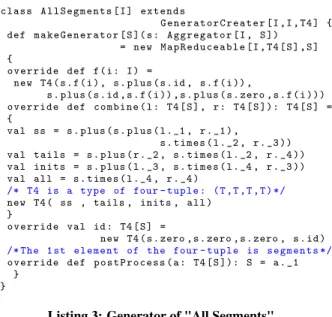
Under GTA programming model, the approach is simple: First, choose theallSegmentsgenerator that generates all the segments [17] of input list. Then choose themaxSumas the aggregator, that means to compute the maximum sum among all sums of segments. Listing 2 shows the GTA solution. This problem only need to write a few lines of Scala code. More additional predicates can be added to extending themss, e.g., the segment should only contain at most one negative number, or maximum sum has to be divisible by 3. TheallSegmentsas shown in Listing 3 is similar toallSelects andallPrefixesbut more complex on data structures. We need a four-tupletype T4[T] = (T,T,T,T)as the type of intermediate data structure. The details of how to construct such a list homomor-phism can be found in [17].
Viterbi algorithm.
More complex problems can also be encoded by GTA. Hidden markov model (HMM) is known for its applications in temporal pattern recognition. The Viterbi algorithm [30]] is to find the most likely sequence of hidden states, i.e.,the Viterbi path , from the given sequence of observed events. In detail, given a sequence of observed events(x1,x2, ...,xn), a set of states in a HMM model S= (z1,z2, ...,zk), probabilitiesPyield(xi|zj) of events xi being caused by statesz,, and probabilitiesPtrans(zi|zj)of stateszi ap-pearing immediately after stateszj, to compute the most likely se-quence of(z1,z2, ...,zn)is formalized as:
c l a s s M a r k i n g G e n [ EV , ST ]( val s t a t e s : Set [ ST ]) e x t e n d s G e n e r a t o r C r e a t e r [ E , T u p l e 2 [ EV ,( ST , ST )] , Id ]{ val m a r k s = for ( x < - s t a t e s ; y < - s t a t e s ) y i e l d ( x , y ) t y p e M a r k e d = T u p l e 2 [ EV , ( ST , ST )] def m a k e G e n e r a t o r [ S ]( s : A g g r e g a t o r [ Marked , S ])= new M a p R e d u c e a b l e [ E , Id [ S ] , S ] { def f ( i : E ): Id [ S ]=( s . z e r o /: m a r k s ) {( z : S , mk : M a r k )= > s . p l u s ( z , s . f (( i , mk ) ) ) } def c o m b i n e ( l : Id [ S ] , r : Id [ S ]): Id [ S ]= s . t i m e s ( l , r ) val id : Id [ S ]= s . id def p o s t P r o c e s s ( a : Id [ S ]): S = a } } Listing 12: MarkingGenerator arg max Z∈Sn+1 ( n
∏
i=1 Pyield(xi|zi)Ptrans(zi|zi−1))In [11], the approach of using GTA to compute above specifica-tion is introduced as: Firstly, we need to remove the indexi−1in the specification. To this end, we let the expression range over pairs of hidden states inS×Sand introduce a predicatetransto restrict the considered lists of state pairs. Intuitively,trans(p)is true if and only if the given sequencepof state pairs describes consecutive transitions
((z0,z1),(z1,z2), . . . ,(zn−2,zn−1),(zn−1,zn))
and false otherwise. Introducing the function prob(x,(s,t)) =Pyield(x|t)Ptrans(t|s)
the expression above can be transformed into the following equiv-alent expression. arg max p∈(S×S)n trans(p)=True n ∏ i=1 prob(xi,pi)
Now, we are ready for building a Generate-Test-Aggregate algo-rithm. Given a set of marks, the generatorMarkingGeneratorin Listing 12 associates all possible mark to each element of the given list. For the Viterbi algorithm, the mark is the product setS×S. For example, givenS={s1,s2}andx= [x1,x2], it can generate
* [(x1,(s1,s1)),(x2,(s1,s1))], [(x1,(s2,s1)),(x2,(s1,s1))], [(x1,(s1,s2)),(x2,(s1,s1))], .. . [(x1,(s2,s2)),(x2,(s2,s2))] +.
The implementation of MarkingGeneratoris almost the same as theSublistGenerator. The difference is that the methodf sums up all possible associations of the marks, in which the type Marked[Elem,Mark]is the pair of the list element and the mark (Like painting colors on the input, so that theMarkingGenerator can be seen as acoloringgenerator.).
Among those associations of pairs of states to the input, we want to take only ones with valid transitions. To this end,transis im-plemented asViterbiTestshown in Listing 13. The methodf extracts the mark, i.e., the associated pair of states, in which the pair has the typeTrans[State](a pair of states corresponds to a transition between states). The methodcombineappends two valid transitions(s,t)and(u,v)to make a new valid transition(s,v) ift=u. It returns a special value for invalid transitions otherwise.
a b s t r a c t c l a s s V i t e r b i T e s t [ E , M a r k ] e x t e n d s P r e d i c a t e [( E , M a r k ) , M a r k ] { t y p e M a r k e d T s = ( E , M a r k ) def i s T r a n s ( a : M a r k ): B o o l e a n def p o s t P r o c e s s ( a : M a r k ) = i s T r a n s ( a ) def c o m b i n e ( l : Mark , r : M a r k ): M a r k def f ( a : M a r k e d T s ): O p t i o n [ M a r k ] = S o m e ( a . _2 ) val id : M a r k ...// o m i t o t h e r s } Listing 13: MarkingGenerator a b s t r a c t c l a s s M a x P r o d A g g r e g a t o r [ T ] e x t e n d s A g g r e g a t o r [ T , D o u b l e ] { def p l u s ( l : Double , r : D o u b l e ) = l max r def t i m e s ( l : Double , r : D o u b l e ) = l * r def f ( a : T ): D o u b l e val id : D o u b l e = 1.0 val z e r o : D o u b l e = 0.0 } Listing 14: ViterbiMaxProdAggregator
The methodpostprocessfinally checks whether the input list had a valid transition or not.
The aggregatorViterbiMaxProdAggregatorshown in List-ing 14 implements the aggregator for computList-ing the maximum prob-ability, using the semiring([0,1],max,×)about the real numbers between 0 and 1. For simplicity, it computes not the Viterbi path but the Viterbi score (the maximum probability). The methodf ex-tracts the value from the marked element. Other parts are straight-forward implementation of the semiring.
Finally, the composition of above components gives a GTA al-gorithm as
val vbGta=generate(vbGen)f ilter(vbTest)aggregate(vbAgg),
wherevbGen,vbTestandvbAggare instances of MarkingGener-ator, ViterbiTest, and MaxProdAggregator respectively.
Similar to the knapsack problem, the program is optimized into a linear-cost parallel algorithm, although it looks an exponential algorithm at a glance. It is worth noting that we can compute the Viterbi path by replacing the aggregator with another aggregator based on a semiring to compute the path [14].
4.
IMPLEMENTING THE
GENERATE-TEST-AGGREGATE LIBRARY
We choose Scala to implement our library not only because it is a functional language with flexible syntax and strong type system, but also because of its performance and portability (Scala is JVM based so it is compatible with most of popular Java systems). We use Spark [31] and Hadoop [2] as MapReduce engines without any modification on them. To run a GTA program on a new MapReduce engine, the only thing we need to do is writing a Scala adapter for the engine, so that the MapReduce API can be invoked from the user’s GTA program.
Design philosophy.
On implementation, we mainly concern the following three key points. The first is how to make an expressive, easy-to-use pro-gramming interface. We want to hide the complexity of interme-diate computation and data structures, so that users only need to focus on how to convert their problems to the GTA style. Once
... val a l l S e l e c t s = new A l l S e l e c t s [ K n a p s a c k I t e m ] val w i t h L i m i t _ 1 0 0 = new W e i g h t L i m i t ( 1 0 0 ) val l e s s T h a n _ 1 0 _ i t e m s = L e n g t h L i m i t [ K n a p s a c k I t e m ] ( 9 ) o b j e c t m a x T o t a l V a l e x t e n d s M a x S u m [ K n a p s a c k I t e m ] { def f ( a : K n a p s a c k I t e m ): Int = a . v a l u e } /* d e f i n e a GTA */ val gta = g e n e r a t e ( a l l S e l e c t s ) . f i l t e r ( w i t h L i m i t _ 1 0 0 ) . /* add a new f i l t e r */ f i l t e r ( l e s s T h a n _ 1 0 _ i t e m s ) . a g g r e g a t e ( m a x T o t a l V a l u e ) p r i n t l n ( /* x is input , p o s t P r o c e s s r e t u r n s the r e s u l t */
gta . p o s t P r o c e s s ( x . map ( gta . f ). r e d u c e ( gta . c o m b i n e )) )
Listing 15: Extended 0-1 Knapsack Problem
users simply map their problems to navie GTA programs, they get scalable and efficient MapReduce programs.
The second is correctness and efficiency of the GTA fusion. As a practical problem, user’s input and output data may have com-plex structures, and also generators, filters and aggregators chosen by the user may have a variety of combinations. Our library has to consider about such situations, and set constraints in the program-ming interface to prevent as many errors as possible. In addition, we make the fusion mechanism being type-safe (at library level, thanks to the type system of Scala), so that users can find semantic errors at compile time. The details of how to implement the fusion will be discussed in Section 4.1
The last one is compatibility and portability. It is important to clarify how our GTA can work together with other libraries/frame-works. Conceptually, our GTA can be used together with any duce or other parallel frameworks which provide the standard MapRe-duce API , in Scala or Java. We also need to define a proper scope of our system so that adapters between GTA and execution engines can be easily made. Currently, we only provide unidirectional in-vocation: APIs of MapReduce engines can be used from GTA pro-grams, but not the converse. This lets GTA expressions be easily defined, although it also requires the user’s main MapReduce pro-gram being written in Scala. Since Scala is highly compatible with Java, this model works most of the time (most popular MapReduce engines provide Java or Scala API).
4.1
Semiring Fusion and Filter Embedding
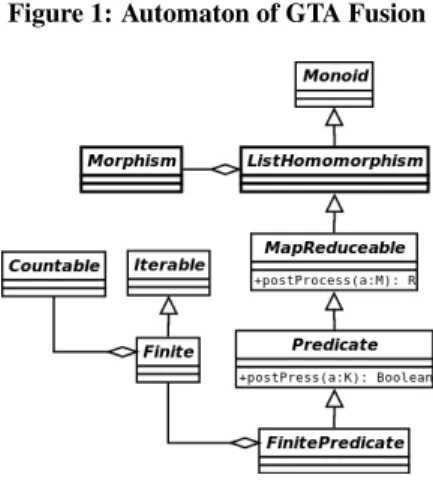
The GTA fusion process can be described as a deterministic au-tomaton shown in Figure 1. Whengeneratefunction is invoked (by given a polymorphic generator as the parameter), an instance of GENis created.GENhas two methods:filterandaggregateand keeps the polymorphic generator. Whenfilteris invoked, it just composes newPredicatewith previous one. Whenaggregate method is invoked, it embeds thePredicateintoAggregatorto form anotherAggregatorwith the lifted semiring, which is the filter embedding, and substitutes it to the polymorphic generator to produce a finalMapReduceableinstance, which is the semiring fusion.The semiring fusion is quite clearly introduced in the previous work [10, 11]: It is just to substitute an efficient semiring to the polymorphic generator. However, the filter embedding needs more work to do in practice. Here, we discuss how the filter embedding is implemented.
Filters tupling.
Figure 1: Automaton of GTA Fusion
Figure 2: Finite Predicate
Everyfilterclause in a GTA expression introduce aPredicate that is to be involved in the fusion. We can combine all the list ho-momorphisms together and create a new one that computes all at once.
Usually, tupling two list homomorphisms into one is simple. Let hh= ( ([f1,1]),([f2,2]) ). We have:
hh[ ] = (ı1,ı2)
hh[a] = (f1a, f2a)
hh(x++y) =hh xhh y
where(hx1,hx2)(hy1,hy2) = (hx11 hy1,hx22 hy2) .
By thetupling, multiplefilterclauses can be merged to one. We fuse this composed filter (aPredicate) together with genera-tor and aggregagenera-tor, to form the final GTAMapReduceableobject.
Lifted semiring.
In the filter embedding, the carrier setMof monoid(M,)should be finite, to guarantee the efficiency of the final program that uses the semiring lifted byM. The key point of implement the lifted semiring is to define a Scala class that can wrap the finite monoid and semiring. In order to define the operators⊕M,⊗M, the ele-ments of the set Mmust be enumerated in constant time. Thus, we definedFinitePredicateto resolve this problem. In order to guarantee that the final GTA program is efficiently computable, the composed filters must be a (or subtype of)FinitePredicate.
Finite monoid and finite predicate.
In our implementation, a finite monoid is a monoid whose do-main is a finite set. Using Scala to define such a set we can use theCountableandIterabletraits. An object that inherits from Countablemust implement a count method. AndIterable re-quires all its concrete subclasses to implement an iterator. We de-fined a Scala class namedFinitePredicate(Listing 6). It is a Predicatewith a finite domain. Figure 2 shows the class inheri-tance.
To guarantee the linear cost of the final program, filter clauses in a GTA expression have to be under the constraint: all thefilters
Figure 3: Execution Time of GTA Programs on Single CPU
Figure 4: Execution Time of GTA Programs on Spark Clusters
takeFinitePredicateas the parameters. Otherwise the compu-tational cost of the final program is not guaranteed.
The rest of implementing filter embedding, is to use the tupled testerand together with theaggregatorto construct the lifted semiring (Definition 2) which is introduced in the previous work [10, 11]. We use aMapdata structure to denote the domain of monoid (SM,M)where the keys (index) of theMapare elements in setM and thusMcan be defined. Readers who are interested with this could find details in our source code.
4.2
Serialization
For MapReduce frameworks like Spark and Hadoop, Java ob-jects used as output ofMAPandREDUCEneed to be serialized for saving in file system or being transfered through networks. The intermediate data produced by GTA also need to be serialized in some way. Currently, our GTA library uses different serializations for Spark and Hadoop. For Spark, the serialization is done by us-ing Java serialization, and for Hadoop we use the Hadoop Writable interface.
There are some universal data serialization frameworks, such as Avro [1] and Protocol Buffers [29], which provide common proto-cols and supporting multiple languages. We are considering apply such approaches in future.
5.
EXPERIMENTS
We evaluate our GTA library on both sequential and parallel (dis-tributed) ways and show the efficiency and scalability of it.
Figure 5: Speedup of GTA-Knapsack on Spark Clusters
Figure 6: Speedup of GTA Programs on Spark Clusters (size of input=108)
5.1
Algorithmic Efficiency and Scalability
Algorithmic efficiency.
We test the algorithmic efficiency of our GTA library by running a GTA-Knapsack program in local environment. In all the follow-ing test cases, the knapsack item’s weight is in range (0, 10] and the capacity of the knapsack is 100. The machine we used has a 2 GHz Intel Core Duo CPU (two cores) with 2 GB RAM and the Java VM heap size was set as: "JAVA_OPTS=-Xmx1024m -Xms256m". The Scala version is 2.9.2 final.
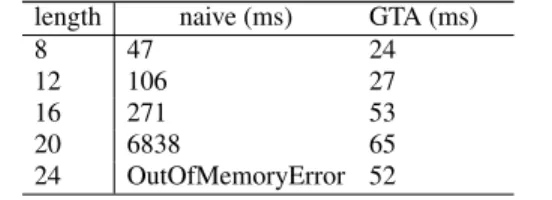
The first test case is comparing the GTA-Knapsack program to a Knapsack program in a naive algorithm (brute-force) which gen-erates all sublists, then filters them and make max-sum on the rest ones. Table 2 shows the comparison of running time. Obviously,
Table 2: Comparison of Naive and GTA Knapsack Programs
length naive (ms) GTA (ms)
8 47 24
12 106 27
16 271 53
20 6838 65
the GTA-Knapsack is much faster than the naive one. Optimized dynamic programming solution for 0-1 Knapsack problem can runs inO(nW)time, which is theoretically faster than our GTA-Knapsack (O(nW2)time). But without carefully optimizing the program, a dynamic programming solution could be even slower. An notable superior of our GTA library is that optimization is transparent to programmers.
The second experiment tests the GTA-Knapsack program with different size of input data. The running time of GTA-Knapsack is linear with the increasing of input data size (from 10×103 to 10×104). Figure 3 shows the linear algorithmic efficiency of our
GTA-Knapsack.
Evaluation on MapReduce clusters.
Our MapReduce clusters are built on the Edubase-Cloud (at Na-tional Institute of Informatics, Japan). It is a cloud computing en-vironment like Amazon EC2. We have authority to use up to 32 virtual-machine (VM) nodes. We configured Mapreduce (Spark and Hadoop) clusters with 4, 8, 12, 16, 20, 24, 28, and 32 nodes. Each VM has one single-core CPU, 3 GB RAM and 8-9 GB avail-able hard disk space. We prepared three sets of randomly generated items for theKnapsackprograms: 1×10⁶, 1×10⁷and 1×10⁸ items. Experiments on Vitirbi Algorithm and Maximum segments sum are evaluated in similar manner (we use programs randomly generated all input data). The results are given in Figure 4 , 5 and 6. When input data size is too small (in case of using data set of size 1×10⁶), the system overhead takes heavier ratio on the timing-results. For data with appropriate size, the results show that all the GTA programs gained near-liner speedup when increase the com-puting nodes. The evaluation of GTA programs on Hadoop clus-ters also shows the similar speedup though absolute performance is slower on same dataset, because of higher system overhead.
6.
RELATED WORK
The research on parallelization via derivation of list homomor-phisms has gained great interest since [8, 28, 32]. The main ap-proaches include the function composition based method [5, 12, 19], the third homomorphism theorem based method [15, 22], and the matrix multiplication based method [27]. It has been shown that homomorphism-based approaches can be used on systematic programming of MapReduce [20].
GTA [10, 11] is a new approach to systematic development of efficient parallel programs and/or list homomorphisms, in which feaures of semirings are maximally exploited to connect naive de-sign and efficient impementation, so that it dramatically simplifies the development of efficient parallel algorithms. However, there lacks of implementations which can support practical MapReduce programming. Our work is a continuation of previous research on GTA and making it work for common MapReduce frameworks.
There are also several high-level domain specific languages build upon MapReduce (Hadoop), such as Google’s Sawzall [25], Apache Pig Latin [13], and so on. They wrap MapReduce (Hadoop) and provide optimization functionalities to optimize users’ programs. Currently, they do not have optimizations similar to the GTA fu-sion. We believe that GTA can also be imported into the design of these languages as a primitive optimization choice.
7.
CONCLUSIONS
In this paper, we show that the Generate-Test-Aggregate the-ory for systematic derivation of efficient parallel programs can be implemented on MapReduce in a concise and effective way. Our framework on Scala provides a convenient GTA programming
in-terface for users to specify their problems in the GTA pattern easily, and to run them efficiently on multi-thread, Spark and Hadoop en-vironments. Our initial experimental results on several interesting examples indicate its usefulness in solving practical problems.
Currently, the GTA theory is based on the list homomorphisms, and our GTA library is concentrated on covering problems which are based on the list data structure. A very attractive future work is to apply the GTA style programming to problems based on trees/-graphs, which is not supported by our GTA library yet.
We are now investigating interesting applications in the GTA framework, and challenging to extend our library from lists to trees and graphs so that GTA style algorithms can be efficiently imple-mented for processing large trees/graphs such as data from social networks.
References
[1] Apache Software Foundation. Avro. http://avro.apache.org/.
[2] Apache Software Foundation. Hadoop.
http://hadoop.apache.org/.
[3] R. S. Bird. An introduction to the theory of lists. In M. Broy, editor,Logic of Programming and Calculi of Discrete Design, volume 36 ofNATO ASI Series F, pages 5–42. Springer, 1987. [4] R. S. Bird. Introduction to Functional Programming using
Haskell. Prentice Hall, 1998.
[5] W. N. Chin, S. C. Khoo, Z. Hu, and M. Takeichi. Deriving parallel codes via invariants. InInternational Static Analysis Symposium (SAS2000), volume Lecture Notes in Computer Science 1824, pages 75–94. Springer Verlag, 2000.
[6] M. Cole. List homomorphic parallel algorithms for bracket matching. Technical report, Department of Computer Sci-ence, University of Edinburgh, 1993.
[7] M. Cole. Parallel programming, list homomorphisms and the maximum segment sum problems. Report CSR-25-93, Department of Computing Science, The University of Edin-burgh, 1993.
[8] M. Cole. Parallel programming with list homomorphisms. Parallel Processing Letters, 5(2):191–203, 1995.
[9] J. Dean and S. Ghemawat. MapReduce: Simplified data pro-cessing on large clusters. In6th Symposium on Operating System Design and Implementation (OSDI2004), December 6–8, 2004, San Francisco, California, USA, pages 137–150, 2004.
[10] K. Emoto, S. Fischer, and Z. Hu. Filter-embedding semiring fusion for programming with mapreduce. Formal Aspects of Computing, 24:623–645, 2012.
[11] K. Emoto, S. Fischer, and Z. Hu. Generate, test, and aggregate - a calculation-based framework for systematic parallel pro-gramming with mapreduce. InProgramming Languages and Systems, 21st European Symposium on Programming (ESOP 2012), volume 7211 ofLecture Notes in Computer Science, pages 254–273. Springer, 2012.
[12] A. L. Fisher and A. M. Ghuloum. Parallelizing complex scans and reductions. InProceedings of the ACM SIGPLAN ’94 Conference on Programming Language Design and Imple-mentation (PLDI ’94), pages 135–146, 1994.
[13] A. F. Gates, O. Natkovich, S. Chopra, P. Kamath, S. M. Narayanamurthy, C. Olston, B. Reed, S. Srinivasan, and U. Srivastava. Building a high-level dataflow system on top of map-reduce: the pig experience. Proc. VLDB Endow., 2(2):1414–1425, Aug. 2009.
[14] J. Goodman. Semiring parsing. Computational Linguistics, 25:573–605, 1999.
[15] S. Gorlatch. Systematic efficient parallelization of scan and other list homomorphisms. In L. Bougé, P. Fraigniaud, A. Mignotte, and Y. Robert, editors, Euro-Par ’96 Paral-lel Processing, Second International Euro-Par Conference, Lyon, France, August 26-29, 1996, Proceedings, Volume II, volume 1124 ofLecture Notes in Computer Science, pages 401–408. Springer, 1996.
[16] S. Gorlatch. Systematic extraction and implementation of divide-and-conquer parallelism. In H. Kuchen and D. Swier-stra, editors,Programming languages: Implementation, Log-ics and Programs. PLILP’96, Lecture Notes in Computer Sci-ence 1140, pages 274–288. Springer-Verlag, 1996.
[17] Z. Hu, H. Iwasaki, and M. Takeichi. Formal derivation of parallel program for 2-dimensional maximum segment sum problem. InEuro-Par ’96 Parallel Processing, Second Inter-national Euro-Par Conference, Lyon, France, August 26-29, 1996, Proceedings, Volume I, volume 1123 ofLecture Notes in Computer Science, pages 553–562. Springer, 1996. [18] Z. Hu, H. Iwasaki, and M. Takeichi. Formal derivation of
efficient parallel programs by construction of list homomor-phisms. ACM Transactions on Programming Languages and Systems, 19(3):444–461, 1997.
[19] Z. Hu, M. Takeichi, and W.-N. Chin. Parallelization in cal-culational forms. In POPL ’98, Proceedings of the 25th ACM SIGPLAN-SIGACT Symposium on Principles of Pro-gramming Languages, January 19–21, 1998, San Diego, CA, USA, pages 316–328. ACM Press, 1998.
[20] Y. Liu, Z. Hu, and K. Matsuzaki. Towards systematic parallel programming over mapreduce. InProceedings of the 17th in-ternational Euro-Par conference on Parallel processing: Part II, Euro-Par’11, Berlin, Heidelberg, 2011. Springer-Verlag. [21] K. Morita, A. Morihata, K. Matsuzaki, Z. Hu, and M.
Take-ichi. Automatic inversion generates divide-and-conquer par-allel programs. In J. Ferrante and K. S. McKinley, editors, Proceedings of the ACM SIGPLAN 2007 Conference on Pro-gramming Language Design and Implementation, San Diego, California, USA, June 10-13, 2007, pages 146–155. ACM, 2007.
[22] K. Morita, A. Morihata, K. Matsuzaki, Z. Hu, and M. Take-ichi. Automatic inversion generates divide-and-conquer par-allel programs. In ACM SIGPLAN 2007 Conference on Programming Language Design and Implementation (PLDI 2007), pages 146–155. ACM Press, June 2007.
[23] S.-C. Mu. Maximum segment sum is back: deriving algo-rithms for two segment problems with bounded lengths. In Proceedings of the 2008 ACM SIGPLAN symposium on Par-tial evaluation and semantics-based program manipulation, PEPM ’08, pages 31–39, New York, NY, USA, 2008. ACM.
[24] M. Odersky and al. The scala language specification, version 2.9. Technical report, EPFL Lausanne, Switzerland, 2011. [25] R. Pike, S. Dorward, R. Griesemer, and S. Quinlan.
Interpret-ing the data: Parallel analysis with sawzall. Sci. Program., 13(4):277–298, Oct. 2005.
[26] I. Sasano, Z. Hu, M. Takeichi, and M. Ogawa. Make it prac-tical: A generic linear time algorithm for solving maximum-weightsum problems. InThe 2000 ACM SIGPLAN Interna-tional Conference on FuncInterna-tional Programming (ICFP 2000), pages 137–149. ACM Press, 2000.
[27] S. Sato and H. Iwasaki. Automatic parallelization via matrix multiplication. InProceedings of the 32nd ACM SIGPLAN conference on Programming language design and implemen-tation (PLDI ’11), pages 470–479. ACM, 2011.
[28] D. B. Skillicorn. The Bird-Meertens formalism as a parallel model. In J. S. Kowalik and L. Grandinetti, editors, NATO ASI Workshop on Software for Parallel Computation, NATO ARW “Software for Parallel Computation”, volume 106 ofF. Springer-Verlag NATO ASI, 1992.
[29] K. Varda. Protocol buffers: Google’s data interchange format. Technical report, Google, 6 2008.
[30] A. Viterbi. Error bounds for convolutional codes and an asymptotically optimum decoding algorithm. Information Theory, IEEE Transactions on, 13(2):260 – 269, apr 1967. [31] M. Zaharia, M. Chowdhury, T. Das, A. Dave, J. Ma, M.
Mc-Cauley, M. J. Franklin, S. Shenker, and I. Stoica. Re-silient distributed datasets: a fault-tolerant abstraction for in-memory cluster computing. In Proceedings of the 9th USENIX conference on Networked Systems Design and Im-plementation, NSDI’12, pages 2–2, Berkeley, CA, USA, 2012. USENIX Association.
[32] P. G. H. Zully N. Grant-Duff. Parallelism via homomorphism. Parallel Processing Letters, 6(2):279–295, 1996.