Working Paper No. 121
ECONOMIC REFORMS: POLICY AND INSTITUTIONS SOME LESSONS FROM INDIAN REFORMS
ARVIND VIRMANI
JANUARY 2004
INDIAN COUNCIL FOR RESEARCH ON INTERNATIONAL ECONOMIC RELATIONS Core-6A, 4th Floor, India Habitat Centre, Lodi Road, New Delhi-110 003
CONTENTS Page No. FOREWORD I ABSTRACT II 1 INTRODUCTION 1 2 CONCEPTUAL FRAMEWORK 3 2.1 Framework Overview 3 2.2 Policy 4 2.2.1 Categories 4 2.2.2 Dynamic Categorisation 5
2.2.3 Policy Inter linkage 7
2.3 Institutions 8
2.3.1 Rules and Players 8
2.3.2 Superstructure and Microstructure 8
2.3.3 Contract or Transaction Cost Approach 9
2.3.4 Institutional Categories 11
2.3.5 Institutional Dynamics 13
2.3.5.1 Institutional Interaction 13
2.3.6 Privatised Public Institutions 14
2.3.7 Institutional Externalities 16
2.4 Information and Knowledge 17
2.4.1 Policy Transition: Design & Innovation 18
2.4.2 Information Channels: Non Resident Professionals 19
2.5 Inter linkage of Policies and Institutions 20
2.5.1 Policy-Institution Complements 20
2.5.2 Institutional Innovations 20
2.5.3 Policy-Institution Substitution 21
2.5.4 Negative Complements 22
2.5.5 Institutional Externalities 23
2.6 Institutions and Growth 23
2.6.1 Democratic Hierarchies: Implimentation 25
2.6.2 Governance Paradox 25
3 INDIAN REFORMS: POLICIES AND INSTITUTIONS 26
3.1 Overview 26
3.2 Background 27
3.2.1 Economic Backdrop 27
3.2.2 Political Economy 27
3.2.3 Institutional Quality: Level vs. Trend 29
3.2.4 Bureaucratics 30
3.2.5 New Economic Policy (NEP) 33
3.3 Infrastructure 35
3.3.1 Monolith & Monopoly 35
3.3.3 Mixed Institutions, Ambiguous Policy: Telecom 36
3.3.3.1 Historical Problems & Strengths 37
3.3.3.2 Conceptual Boldness, Implementation Confusion 38
3.3.3.3 Goal Focus & Pragmatism 39
3.3.3.4 Technology & Domestic Competition 39
3.3.4 Institutional Innovation: Highways 40
3.3.5 Institutional Failure: Electricity 41
3.4 Financial Sector 42
3.4.1 Monolith or Oligolith 42
3.4.2 Skills and Knowledge 43
3.4.3 Institutional Inertia 43
3.4.4 Partial Success 44
3.5 Capital Markets 45
3.5.1 Institutions: Traditional vs. Modern 45
3.5.2 Institutional Evolution 46
3.5.3 Institutional Innovation 46
3.6 Tax Reform 47
3.6.1 Institutional Background 48
3.6.2 Income Tax 48
3.6.3 Indirect Taxes: Excise 49
3.7 External Sector 50
3.7.1 International Trade: Mental Models 51
3.7.2 Distorting Policy: Import Bans 52
3.7.2.1 De-control: Timing & Phasing 52
3.7.2.2 Bureaucratics 53
3.7.2.3 Negative Complement 55
3.7.3 Distorting Policy: Import Tariffs 55
3.7.3.1 Phasing and Timing 55
3.7.3.2 Information Gaps & Institutional Constraints 56 3.7.3.3 Directional Firmness, Implementation Flexibility 57
3.7.3.4 Institutional Inertia 59
3.7.3.5 Successful Trade Reform 59
3.7.4 Other Current Account 60
3.7.4.1 Institutional Knowledge 60
3.7.4.2 Trade-offs 61
3.7.4.3 Smuggling 62
3.7.4.4 Parallel Reform: Policy & Institutions 63
3.7.4.5 Another Success 63
3.7.5 Foreign Direct Investment 64
3.7.5.1 Policy Change 64
3.7.5.2 Institutional Change 64
3.7.5.3 Gradualism 65
3.7.5.4 FDI Growth 65
3.7.5.5 Political Constraints 66
3.7.6 Other Capital Account 66
3.7.6.1 Equity 66
3.7.6.2 Boldness & Caution 67
3.7.6.3 NRI Expertise 68
3.7.6.4 Stock Adjustment 68
3.7.6.5 Risk Aversion: External Debt 68
3.7.6.6 Institutional Evolution 69
3.7.7.1 With All Deliberate Speed 71
3.7.8 Modest Reform, Greatest Success 73
4 CONCLUSION 73
5 APPENDIX 74
5.1 Dual Exchange Rate 74
Foreword
This paper is the outcome of a confluence of two factors. The first is the experience and expertise that the professionals at ICRIER have in policy formulation in government and advice on Indian economic policy reforms. The second was ICRIER’s co-sponsorship of the GDN conference in Delhi.
The Global Development Network (GDN), is a global network of research and policy institutes working together to address the problems of national and regional development. GDN held its Fifth Annual Conference on “Understanding Reforms” in New Delhi during January 28-30, 2004. The conference provided a forum for researchers, policymakers and representatives of international organisations from around the world to meet and exchange ideas on pressing challenges of development. This was the first time that the Annual Conference was held in Delhi. ICRIER was a co-organiser for the Conference, and Director and CE of ICRIER, was a member of the Conference Steering Committee.
ICRIER also had special responsibility for organising two sessions. One was a session to review Indian Reforms from a multidisciplinary perspective. This working paper was presented at the first parallel session on Economic Reforms: Policy and Institutions. The session was chaired by Prof. Wahiduddin Mahmud, Professor of Economics, Dhaka University. The discussants were Prof. Ira Gang (Rutgers University) and Prof. Alvero Forteza (Universidad de la Republica Montivideo, Uruguay).
As co-ordinator of SANEI (South Asia Network of Economic research Institutes), the regional network partner of GDN in South Asia, ICRIER also organised a session on Economic Reforms in South and East Asia: A Comparative Perspective, also co-chaired by the Director ICRIER, where Prof. T. N. Srinivasan presented a paper on Economic Reforms in South Asia.
Dr. Arvind Virmani
Director & CE ICRIER
ECONOMIC REFORMS: POLICY AND INSTITUTIONS
Some Lessons from Indian Reforms
#Arvind Virmani*
Abstract
Economic policy and policy reform over the last few decades has been motivated by the need to accelerate growth or equivalently to reverse a decline in growth rate. The economic literature on the determinants of growth has burgeoned and disagreement has followed consensus on the policy prescriptions that need to be followed to achieve this purpose. Sometimes the disagreement is exaggerated by the titans of the profession, so as to distinguish themselves from those constituting the conventional wisdom. The present paper moves the focus from this “macro” debate to concrete issues of policy formulation and policy change and explores the links between policy and institutions in the context of economic reforms. Thus successful introduction of new policies may require new institutions and the degree of success in changing policies may depend on the degree to which existing institutions are modified.
The literature on Institutions and Development has dealt with questions of grand design such as the Constitution, the rule of law (personal safety), property rights and informal rules embodied in culture. These are matters that happen on a time scale of a quarter/half century or more and can be thought of as the “superstructure” of institutions. The quantitative work on institutions and growth has explored the linkage between these institutional issues and economic growth. In the current paper we focus on what may be called the “microstructure” of institutions, a smaller scale at which change can occur over a time frame of decades (or half decades). Among the issues that arise in this context are how changing institutions require changes in policies.
Keywords: Economic Reforms, India, Policy, Institutions JEL Classification: O1, P41
# Paper presented at the Global Development Network conference in New Delhi, January 28-30, 2004. * Director and CE, Indian Council for Research on International Economic Relations (ICRIER), Core 6A, India Habitat Centre, New Delhi 110003, India. I would like to thank Rajiv Ahuja, Alvaro Forteza, Ira Gang, Anwar Hoda, Vijay Kelkar, K. L. Krishna, Ajit Mathur, Sudhir Mulji and T. N. Srinivasan for thier comments on earlier versions of the paper, Gurnain Pasricha for research assistance and Manmeet Ahuja for his assistance.
1 Introduction
Economic development literature has over the past decade re-discovered the importance of institutions and progressively applied it to explaining the diversity of economic growth experiences across countries. Most economists working on a specific country or a group of countries take the institutions existing in that country as a given. During the last quarter of the 20th century and the 1st quarter of the 21st nearly all countries have created, at least in name, the same set of basic government institutions, give or take a few.1 The nature and quality of these institutions may however be quite different. This was revealed most dramatically during the Asian crises. At a superficial level all the fast growing countries of East and South East Asia had the entire set of market institutions (financial, corporate and governance) to be found in the developed/OECD countries. Most foreign investors (overwhelming majority of whom were from developed countries) assumed that these institutions were identical to those in their home countries and that economic players as well as economic institutions would therefore respond in the same way to shocks as they do in the highly developed economies. They were proved wrong, particularly in countries where the nature of these institutions was quite different (colloquially referred to as under developed). For instance the Nature of Credit markets in Developing Countries is quite different from that in Developed countries, because of the availability and cost of information and the consequent importance of collateral in lending decisions in the former.2 From the critical role of collateral followed the importance of asset markets and asset prices in the financial system. This linkage creates a feedback loop that can lead to a collapse of asset markets, lending/borrowing and company activity as a result of large adverse shocks.
Differences in the nature and quality of institutions across countries gives rise to the possibility that the same policy may have different effect in different countries. For instance differences in Liquidity preference, in the context of Keyenesian discussion of the liquidity trap, could be attributed to institutional differences in the sense of
1 Even communist dictatorships called themselves “Democratic Republics” and had national legislatures/ parliaments.
individual/group/community preferences being shaped by informal institutions.3 Even if on average the effect of given policies is similar there could be circumstance under which the effect is significantly different. The differential impact is generally more visible when there are major policy changes or large shocks. Thus the degree of success/failure of any specific policy reform or set of policy reform measures may differ across countries because of institutional differences. Further the success or failure of these policy reforms within a given country may itself depend on institutional developments and complementary institutional reforms. The purpose of the current paper is to review the economic reform experience keeping in mind this institutional perspective and to explore the linkages between policy and institutional reform.4
A subsidiary purpose of the paper is to open the door to multidisciplinary dialogue by bridging the gap between economic and other social sciences by eschewing economic “jargon.” This exploration draws heavily on the economic reform experience of India and the author’s practical experience of these reforms and can be viewed as an effort to conceptualise and generalise the lessons from Indian economic reforms. The next section 2 defines a conceptual framework for analysing policies and institutions in the context of economic reforms. Section 3 gives a selective review of the Indian reforms and attempts to relate the process of reform during the nineties to the concepts outlined in section 2. Those interested primarily in the Indian reforms may find it more interesting to read section 3 before section 2. Section 4 concludes the paper.
3 I understand from Sudhir Mulji that Keynes does so in his writings.
2 CONCEPTUAL FRAMEWORK
In this paper we pre-suppose that the economy under consideration is basically a market economy (however underdeveloped or imperfect). In other words we exclude Socialist/communist command economies of the kind that existed in the former USSR and much of Eastern Europe till the end of the eighties and in China till the end of the seventies. Such economies are now found only in a few countries such as N. Korea and Cuba.
2.1 Framework Overview
Section 2.2 looks at policies. We start by dividing policies into three categories and then analysing how the category to which any particular/specific policy belongs can change over time. In the context of economic reform different policies may also be inter-linked (section 2.2.3). Section 2.3 deals with institutions and starts by giving North’s (1994) technical definition of ‘institutions’ and posits this against the common usage of the term ‘institution’ to define what it will mean in this paper. Following this we narrow the focus by dividing institutions into two parts, the “superstructure” and the “microstructure” and focussing on the latter. Institutions are then divided into three exhaustive categories. There is also some sub-categorisation within the categories to aid understanding and analysis, but these are not exhaustive or mutually exclusive. The institutional categories mentioned by Rodrik (2003) are all sub-categories of one of three categories in our list. The subsequent section explores some inter linkages between different institutions that are important for the evolution of institutions and their quality. This is followed by a discussion of what we call, Privatised (public) institutions and institutional externalities that arise when institutions deteriorate below some threshold.
Section 2.4 explores the issues of information and knowledge that are so vital to the reform of economic policies and the change of institutions, what North calls ‘internal models’ and in different context have been referred to as ‘paradigm change’. Knowledge is essential for adapting and modifying policies in the face of unique political and institutional constraints (section 2.4.1). Similarly new channels of information have arisen and sources of knowledge and skills are now available that can aid reform efforts (section 2.4.2). Section 2.4 then goes on to define and explore the potential inter linkages
between policy and institutions and between policy reform and institutional reform. These include policy-institution complements (positive and negative) and substitutes, Institutional innovations in the process of reform and institutional (policy) externalities.
2.2 Policy
2.2.1 Categories
Economic policies can be broadly partitioned into three categories: Market distorting, market correcting and market creating. These categories correspond broadly to economists’ notion of policy interventions in perfect/competitive markets, markets with externalities and production/supply of public goods and services. As a practical matter we also have a category of ambiguous policies falling in between the market distorting and market creating policies. If we treat market creation as a form of market correction then we have three categories:
(a) Market Distorting Policies
Restrictions on investment (size, industry, products, ownership-public, private, foreign), imports and exports (bans, restrictions, canalisation, tariffs/duties), production and distribution (licensing or control) and price controls are examples of market distorting policies.
(b) Ambiguous Policies
This has several sub-categories depending on the source/nature of ambiguity: (i) Uncertain Effects: Their impact is genuinely uncertain (positive or
negative). Theory and empirical evidence is either not convincing or the latter is found to be different in different countries. These should however be distinguished from special exceptions that are blown up into grand intellectual principles that confuse non-specialists and decision-makers.
(ii) Trade-offs: There are both positive and negative effects of the policy and these have to be weighed against each other. The most interesting trade-offs are between the short term distorting effect of a policy and the uncertain long-term benefits. These trade-offs give room for sincere, honest, flexible and knowledge seeking decision-makers to accelerate
growth as well as to those with opposite characteristics to enrich themselves at the expense of the general public. Infant industry policies, justified by the new industrial economics, fall into this category.
(iii) Neutralising policies: These are policies that by themselves (i.e. in isolation) would be considered distorting policies, but counteract or partially neutralise the negative effect of another market distorting policies. Thus for instance the refund of import tariffs and supply of domestic inputs at international prices to exporters is a commonly used policy for correcting the distorting effect of import bans and high tariffs on exports.
(c) Market Correcting Policies
Examples are subsidies (implicit or explicit) for the production/supply of infrastructure services (e.g. water, roads, highways, electricity, telecom connectivity) in rural, remote and hilly areas, expenditures on communicable & environment related diseases (e.g. malaria), supply of clean water and sanitation & sewerage services to all (particularly the poor). Other examples of market correcting policies include taxes on polluting substances.
(i) Market creating policies are an important sub-category of market correcting policies. An example of this would be a subsidy on issue of and/or holding of debt of higher tenure that leads to the creation of a long-term debt market.
(ii) Market complementing: Another sub-category of market correcting policies is policies that correct inherent weakness in a market system. These market complementing policies such as those providing a social safety net for the poorest most vulnerable citizens (food subsidy, health insurance).
2.2.2 Dynamic Categorisation
A given policy may traverse the spectrum from market creating to market distorting over a period of time depending on the economic environment and the evolution of market institutions and the quality of governance. Thus for instance an interest or collateral subsidy to banks for a specific category of borrowers may be market creating
for a certain period of time after its introduction (as it helps corrects information asymmetries), but market distorting after the information problem is corrected through the new loan relationships.5 Another example is an infant industry protection policy based on the ‘new industrial economics’ and the practical experience of the USA and other developed countries in the initial stages of development. Moderate tariff protection to an ‘infant industry’ for 5 years or so may arguably be a market creating policy, but will with the passage of time become ambiguous and eventually a market distorting policy. In other words, the same or increasing levels of tariff protection cannot be justified on ‘infant’ industry grounds for the same industry through adolescence (6 to 12 years), teen age (13 to 19 years) and adulthood (20 to 55 years).6
A change in classification from market correcting to market distorting is frequently the case with policies (e.g. subsidies and taxes) designed to correct market distortions (externalities) and to support social objectives. Just as frequently the original objectives and justification becomes a “Mantra” to be chanted for decades even though the circumstances have changed and the environment is quite different from the original. Flexibility, adaptability and responsiveness of policy to changing circumstances and environment are therefore necessary elements of efficient, economic policy formulating and macro-management institutions.
Market distorting policies can over time also lead to the deterioration of market institutions because of non-use of certain market skills and the distortion of incentives to acquisition and use of non-market skills. For instance, controlled markets are often less risky at a micro level i.e. for the economic agents (in contrast to macro risk which may increase because of lack of micro flexibility). This there is a tendency for previously acquired skills for measuring, evaluating and dealing with market risk and uncertainty to deteriorate progressively (section 3.4).7 At the same time non-market skills such as judging and influencing the views of the ‘controller(s)’ are likely to grow and displace the former. These non-market skills can include various forms of ‘corruption,’ apart
5 See for instance, Virmani (1982) or Virmani(1989).
6 As has been done in India by respected economists and intellectuals.
7 This is what happened in the Nationalised Banking system and to a lesser extent in other parts of the financial system that saw the heavy hand of the State and its subsidiary control institutions (which included
from direct financial payments/ bribes.8 Though this legacy of skill deterioration can be reversed, it may take different amounts of time depending on the overall opportunity for using these or related skills. It is therefore necessary to be aware of the history of market distortions and their consequences, as these are an important input into the process of determining the timing and phasing of particular reforms.9
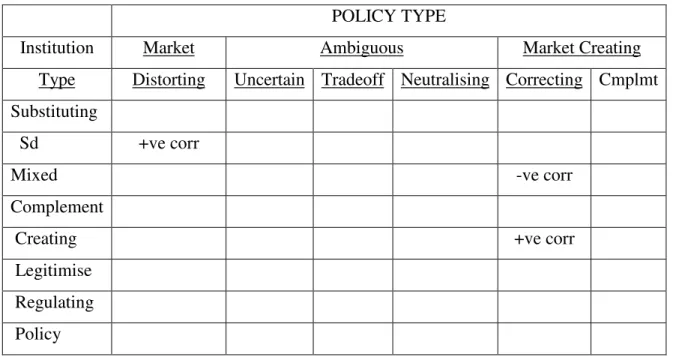
Table 1: Policy and Institution Categories
POLICY TYPE
Institution Market Ambiguous Market Creating
Type Distorting Uncertain Tradeoff Neutralising Correcting Cmplmt
Substituting
Sd +ve corr
Mixed -ve corr
Complement
Creating +ve corr
Legitimise Regulating Policy
2.2.3 Policy Inter linkage
As Rodriguez and Rodrik (1999) have pointed out, it is extremely difficult to rigorously identify the effect of trade liberalisation on economic growth as such liberalisation is frequently part of a set of policy reforms including better macro management. For instance it is often suggested that macro-stabilisation should precede structural reform. In this paper we will also explore the degree to which the success attained by a particular policy depends on other policies, for instance polices relating to different aspects of the external account such as trade, other current account, FDI, equity, debt, exchange rate. This is necessary for separating out the contribution of institutional change and that of these ‘other’ policy changes.
8 This characterized virtually the entire public sector and its supervisory institutions.
9 Access to Non-residents (migrants, expatriats), or skills through JVs can help fill small gaps fairly quickly.
2.3 Institutions
2.3.1 Rules and Players
North (1994) defines Institutions as the rules of the game- Both the formal (constitution, laws, rules) and informal (norms, conventions, codes of conduct) and Organisations and their entrepreneurs as ‘Players’. In the Indian context, Virmani (2002b) has emphasised that, “Laws particularly economic laws, do not merely define what a citizen/resident can or cannot do. They create a system of incentives and dis-incentives for economic agents and those charged with implementing the laws. Most economic laws have had consequences that their originators had no inkling of. The common result of the myriad such law is to create incentives for seeking, rent-creation, bribery and corruption.”
There are four types of organisations: (a) Government organisations that implement/enforce the formal laws and rules of the State (constitution, criminal procedure code, civil code). (b) State owned commercial organisation (Public sector). (c) Private non-profit organisations that implement or enforce informal laws and rules of society, or carry out social functions. (d) Commercial organisations like private joint stock companies. All organisations are subject to a framework of laws/rules that constitute their incentive structure. In addition the Organs of State (government non-commercial organisations) are also charged with implementing/ enforcing some specific set of laws and rules. The dictionary definition of “institution” includes both “laws, customs and practice,” and an “organisation or establishment constituted for specific purpose.” This paper therefore uses ‘institution (s)’ to indicate not just the laws & rules but also the organisation (s) charged with or responsible for implementing/enforcing them on others, as is done for instance in Davies and Treblicock (2001). Other organisations and entrepreneurs with no such function continue to be referred to as players a-la North (1994).
2.3.2 Superstructure and Microstructure
From the current perspective we can think of institutions at two levels. These could be termed the “Superstructure” and the “Micro-structure.” The superstructure consists of
the overarching10 institutions such as the constitution, the general laws (property rights, contract law) and informal rules of society and the organisations responsible for implementing these rules. The ‘super-structure’ is largely excluded from the ambit of the current paper. The ‘microstructure’ consists of specific economic laws (e.g. electricity act), rules, ministries/departments (e.g. finance, commerce), subsidiary institutions (e.g. regulatory authorities), agencies of governance (DGFT, CBDT, CBEC) charged with implementing these laws and rules. In this paper we focus on the microstructure of institutions and on the implementing organisations as these have a more direct bearing on the outcome of specific economic policies and economic policy changes.
The political economy literature has dealt extensively with the issue of political parties, voting behaviour, interest groups and the principal-agent problem between the voters and the ruling party/government and the role of the media. We do not focus on political economy questions (e.g. which policies are adopted and which not, will tariffs be high or low under what conditions of political economy) in the current paper. In addition to these higher level political issue (the equivalent of the Super-structure) there are internal political issues within the government (the micro-structure of political economy). These can be termed “Bureaucratic Politics” or “Bureaucratics” for short. 11 Besides
determining the pace and micro direction of reforms ‘Bureaucratics’ also affects the quality of the institutions. These fall within the ambit of the paper.
2.3.3 Contract or Transaction Cost Approach
Demsetz (1969) in discussing institutional efficiency proposes that an extant mode of organisation for which no superior feasible alternative can be described and implemented with expected net gains, is presumed to be efficient. Hennipman(1995) draws attention to the costs of overcoming resistance whether economic or political. He points out that total reform costs must take account of such costs and that (once this is done) implementation with net gains may not be possible. Williamson (2002) points out that this implies that policy reform must be, (a) Feasible (including meeting informational requirements), (b) Implementable (e.g. in describing compensatory or pay-out
10 Core, higher, deeper?
11 See Virmani(2001). Williamson(2002) talks of ‘Bureaucratic failure.’ This is ofcourse an essential component of the governance failure that we are analysing. It is not however clear whether the two are ‘seperable.’
mechanisms) in economic terms and (c) Recognise the legitimacy of political resistance and factor it into the evaluation. From our experience these are the basics (foundations) on which good policy advise and sustainable/sustained policy reform are based.
The analysis following from this perspective, however, sometimes assumes that institutional conditions are similar to those prevailing in developed countries (DCs) rather than those actually prevailing in developing countries (LDCs). For instance the presumption of ‘set-up cost advantage’ though it may be valid in DCs may have to be replaced by a presumption of set-up cost disadvantage for many government institutions in LDCs. What are these conditions? Transparency International and other organisations have constructed indices of the quality of governance and of corruption of governments. Perhaps 90% (70%) of low & lower-middle income countries have an index of governance quality in the bottom half (third) of the distribution, with the inverse holding for upper-middle and high income countries. In the former case there cannot be a presumption that these institutions are ‘efficient’ a-la Demsetz (1969).12 It follows that
the further presumption that political and economic interests arising from these must be treated as legitimate also needs refinement.
Those who have a vested interest in mal-governance and corruption must be viewed as illegitimate, but their arguments may be legitimate and these must be understood and addressed. Further those who actually loose under prevailing conditions of governance may be quite different from the losers as per idealised or theorised (DC like) conditions. Either careful, detailed empirical research or a profound understanding of local conditions (or both) are needed to identify the right distributional impact under these conditions. The conclusion of Hennipman(1995) about feasibility of reform may also be reversed once the benefits of reducing corruption/mal-governance counter balance the costs of overcoming resistance. The former may well improve the net gains from replacing old, existing institutions by newly created ones (de-novo), particularly if the gainers from governance reform are identified and provided information to counter the resistance of vested interests.13
12 Williamson (1996) treats the efficiency of the extant mode that passes the first two tests of remidiableness as a rebuttable proposition.
Arrow (2000) raises the critical role of expectations in current (investment) decisions and the importance of early actions infusing later confidence.
2.3.4 Institutional Categories
Most of the recent work on the link between institutions and economic growth/ development has focused on the rule of law and enforcement of property rights. Rodrik, Subramanian and Trebbi (2003) call the institutions relevant to this outcome as Market creating institutions: They also introduce three other categories of institutions relevant for sustained growth: Market regulating, market stabilising (macro management) and market legitimising (social safety nets). In considering the linkage between economic policies and market institutions we find it useful to divide institutions into three categories, Market Substituting, Market Complementing and Mixed. All four categories suggested by Rodrik and Subramanian would in this schema, be sub-categories of what we call Market Complementing institutions.
(a) Market Subtracting/Substituting (S type institution)
Such institutions displace/ drive out market agents/organisations or bar/keep out potential market agents & organisations from entering existing markets or creating new ones.
(i) One important sub-set is government institutions in charge of Public Sector Units producing a private good or service (e.g. cloth, bread, steel, hotel, restaurant) in a country that has private firms producing the same good or service. With rare exceptions they would be classified as a market substituting institution. By strict definition the PSUs are ‘players,’ but they can act as extensions of the S-type institution.
(ii) Another sub-category consists of institutions (agencies) charged with or set up (specifically) to implement market-distorting policies, which together have a negative effect on markets (Sd sub-type).
(b) Market Complementing (C type institution)
These could also be called market supporting. There are four sub-categories.14
14 We have adopted three of the names used by Rodrick et al(2002) though our definitions are somewhat different for two.
(i) Market Creating (Cc): Such institutions complement the market economy by supporting the creation of new markets. Traditionally examples are those supplying pure public goods like justice department/ministry, judiciary & courts, police.15 A non-traditional example is the National Dairy development board (NDDB) that some decades ago helped create a national milk market in India.
(ii) Market Policy (Cp): This sub-category includes government departments that make policy (macro and micro) and institutions engaged in macro-management (e.g. Central Bank).
(iii) Market Regulating (Cr): Examples are financial regulators (fiduciary intermediaries) and regulators for infrastructure services (‘natural’ monopolies). The market regulating and market creation role may be combined in a single institutions (it often is when markets are under-developed).
(iv) Market Legitimising (Cl): Institutions supplying public goods’ & services and social safety nets can be classed under this sub-category. Examples are urban municipalities that produce and supply civic infrastructure service (roads, drinking water, sewerage, and sanitation) and Public Delivery System for Food (PDS).
A government institution that has been set up to distribute private goods in remote areas with no retailers, may appear prima facie to be purely market creating. It could in reality be primarily market substituting if it survives on subsidies that are not available to private agents (and thus keeps out potential private retailers who would be willing to provide the same services at some fraction of the subsidy).
(c) Mixed Institutions (CS type)
Mixed institutions are those that have elements of complementarily and substitutability. They are complementary to the extent they fill a gap that private markets organisations would not supply. They are substituting to the extent that private organisations would be willing to provide the same service with a lower subsidy. In most developing economies a large number of M/CS type institutions are government production and supply organisations (set up), to undertake activities such as:
(i) Electricity transmission and distribution,
(ii) Telegraph/telephone communication,
(iii) Canal networks (from water surplus to water deficit areas), (iv) National and Provincial highway construction
(v) Education
(vi) Curative medicine
To the extent that these provide a non-tradable service in a geographical area with no private suppliers they would come under the C type category.
2.3.5 Institutional Dynamics
Many of these CS-type institutions (above) were primarily C types when they were set up. They have progressively become more S-type over time. Some of them are now indistinguishable from S-type organisations (even if they retain a small element of complementarily). Part of the explanation for this progression is that as the economy grows and develops, the scale of externalities is reduced and the number of potential suppliers of services increase.
Thus, as in the case of policies, institutions can move from one category to another as the environment changes. There is an additional factor however, in that institutions can change internally so that their nature changes even though the name is unchanged. Thus the category change could come about because the nature of the institution has changed.
2.3.5.1 Institutional Interaction
There is another dimension that is very important for the evolution of Market Complementing institutions and their effectiveness. This is in the number of roles that they combine in one institution or disperse across separate institutions. From this perspective we can divide institutions into three categories, Monolithic, Countervailing and Fragmented.16
(a) Monolithic institution (Monoliths) are those that combine the roles identified in the sub-categories of Creation, Policy, Regulation and Legitimisation (supply). Institutions connected with infrastructure have often had this
characteristic (section 3.3.1). The potential problem, is that, ‘Power corrupts and absolute power can corrupt absolutely.’17
(b) Multiple institutions: Functions are dispersed among a set of institutions charged with the same overall objective. Each institution has authority over specified aspects, so that they can in principle provide checks and balances between/across them (section 3.3.2).
(c) Fragmented institutions: Functions are widely dispersed across a large set of institution. Co-ordination (transaction costs) in meeting the overall objective becomes a more important goal for them than the basic objective.
In general, there is need for balancing the concerns of ‘Corrupting Power’ against that of ‘Co-ordination and transaction costs’ to come to an intermediate solution with a limited number of countervailing institution. This however assumes some basic level of institutional quality. Below some threshold of quality (above some level of corruption) the inter-relationships can be completely transformed. When the institutions are no longer driven primarily by the institutional objectives but by the personal objectives of their members they can be transformed from ‘countervailing’ to ‘competing’ institutions. The competition is in terms of appropriating rents for themselves. In such conditions the monolith (monopolist) institution may meet the institutional objective better than multiple (oligopoly/competing) institutions.
2.3.6 Privatised Public Institutions
We know from the Public choice and rent seeking literature that institutions of government are driven as much by the self interest of their members as by the professed public purpose [Buchanan & Tullock(1962), Downs (1967) and Niskanen (1973)]. In the economic theory of markets the norm is the private good or service that can be bought, sold and consumed by individuals. A public good is one, which does not meet the norm of excludability and rivalry in use i.e. a pure public good is non-excludable and non-rival in use. The opposite can be said of institutions. The normal institution is a public institution with a public purpose/objective.
17
It is convenient to define a Privatised (Public) Institution (by analogy with private-public goods) as an institution that is driven solely by the personal interests of its members/employees devoid of any public purpose that is the ostensible objective of the institution (section 3.3.5).18 This does not however mean that no public purpose is achieved by such a privatised institution. Some amount of public purpose may still be achieved as the joint product of the private objectives of its members. One reason is that the public purpose still acts as a constraint on and a justification for the role of the members of the institution. It provides the rationale for them to remain members of the institution dismissal) and legitimises the continuance of the institution (non-dissolution).
Given agency problems the actual objectives of the organisation are a mix of professed (ideal) objectives of the organisation and the personal objectives of the members. The gap between actual and ideal objectives is a measure of the quality of the institution. We define the quality of an institution as the gap between its professed public objective and the actual objectives as determined by the degree to which it is driven by the personal objectives of its members.19 This is dependent on the incentive structures
and enforcement systems within and outside the organisation, for the members of the institution to achieve the public objectives. An organisation driven solely by the personal interests of members would form the low-quality end. Low quality is also correlated with corruption.
The efficiency of the organisation is determined by its effectiveness in achieving its objectives. Flexibility, adaptability and responsiveness of policy to changing economic and institutional conditions are therefore necessary elements of efficient, high quality institutions. This is particularly so for complementing institutions dealing with policies for economic development and growth. In such institutions, good governance is closely associated with speed of response to external and internal shocks. This was (in our view) a notable characteristic of governments in most Asian Miracle economies till
18 The closest example of such a privatised State institution that the author has seen personally was the State Electricity Board (SEB) of Delhi prior to its conversion into a company and subsequent privatisation. 19 Several authors have referred to the ‘integrity’ of institutions without defining it precisely (see eg. Williamson (2002)). The popular meaning of this word is close to the definition of ‘quality’ given above.
the early nineties. In the case of institutions for implementing laws efficiency has the narrower ambit of ‘enforcement’.
We can define two measures of efficiency I-efficiency and P-efficiency. The former is a measure of the cost effectiveness in meeting the ideal goals of the organisation, while the latter is a measure of the effectiveness in meeting the actual (personalised) goals of the organisation given its quality. In an ideal organisation with no agency problems the quality of the organisation is 100% and these two measures of efficiency are identical. The obverse need not however be true. Even a poor quality, P-efficient organisation need not be highly I-inP-efficient.
In general I and P efficiency will be imperfectly co-related. This can be illustrated by comparing two hypothetical low quality organisations. One run by a well organised despot who collects all the rents and distributes a share to each member and another which is anarchic with each member trying to collect whatever rent he can for himself.20
The former is more likely to be characterised by a monopolistic solution that maximises long run rent collection for its members and thus accomplishes enough organisational objective to preserve its legitimacy. In contrast the latter is likely to be characterised by short-run personal maximisation and consequent collapse of the organisation and low long run rent collection for members. Thus the former organisation is likely to be both more I and P efficient than the latter organisation. Therefore I and P efficiency are likely to be positively co-related.
2.3.7 Institutional Externalities
Low quality institutions can have negative institutional externalities (and vice versa). This may be by, (a) Contagion (the rotten apple spoiling the entire basket) or example, that is by demonstrating the individual benefits and/or low probability of detection/punishment, or (b) By actively undermining other institutions in the pursuit of personal/selfish goals. These externalities could be horizontal (i.e. to other institutions) or vertical (to institutions hierarchically above or below it). For instance corruption inevitably progresses from the rent creating organisation (clients paying employees) to the vigilance organisation designated to check such corruption (detected members paying off investigators). It would also spread to the broader policing system (either or both
paying the police) and eventually the judiciary. This is clearly a dynamic process that unfolds over time and is subject to hysteresis i.e. it cannot be reversed completely by simply eliminating the original distortion or cause.
2.4 Information and Knowledge
Information and knowledge play a critical role in economic development. It is even more important in undertaking policy and institutional change and in the success or failure of these reforms. Any change requires the introduction of new information or knowledge as there would be no change otherwise. The institutional literature has emphasised the role of learning processes and the change in perceptual/mental models over time (North (1994)).
We can think of six stages to a successful process of transformation from an old to a new mental model (or paradigm). First is a general diffuse dissatisfaction with the existing mental models, policies and/or institutions.21 Over time (second stage) some
people begin to recognise the possibility of alternatives.22 These are alternatives from the
historical knowledge base of the country/society or increasingly in this globalised world, alternatives proposed by the global development community or prevalent in other countries. The third stage is an attempt by these pioneers to increase their personal knowledge about the new model (i.e. in the new direction) and to connect with those who have this different model.23 The fourth stage is the import and/or creation of people having the new model perspective.24
The fifth stage is the incorporation of higher level visionaries as well as those with deeper knowledge into the decision-making hierarchy so that the operational model held by the concerned decision making institution also begins to change. The final stage is the overcoming the “fears” of neutral opinion leaders (i.e. those with no personal vested interest in the old policy or institution) through incorporation of new information into their mental framework and gradual understanding. There is enormous inertia in old
20 See Shliefer and Vishney (1993) and Macintyre (2003)
21 India in the mid to late seventies. 22 India in the eighties.
23 Whenever I called on Dr. Manmohan Singh during home visits (while working in the research
department of the World Bank) he always asked me what India should do to increase growth/development. He must have done the same with every external visitor.
ideas represented by the belief that old policies must be correct (otherwise why were they instituted and existed for so long?).25 This is manifested as a strong bias against any change in policy (inertia). Successful transition from one policy paradigm (model) to another requires innovative policy design and/or institutional innovation to overcome this inertia.
2.4.1 Policy Transition: Design & Innovation
The economic theory of the market economy is focused on equilibrium states or paths, and gives little guidance on the transition from one equilibrium state/path to another. Once the new goal is clear the most critical role of the policy advisor is to design the transition from the old policy frame to the new. A successful transition requires the adjustment and adaptation of policies to the institutional and political constraints. Knowledge and understanding of economic theory and the empirical evidence as well as a “feel” for the institutional and political constraints is an asset in designing economic policies. Institutional and political opportunities also provide the backdrop for appropriate timing and phasing of multiple policies.
We distinguish innovative policy design from institutional innovation. In our view these are two separate though sometimes inter-linked innovations. In contrast, Rodrik (2003) appears to use the term ‘institutional innovation’ to denote both types, though most of his examples are what we would classify as policy innovations. For instance, the “dual pricing” system is a policy hybrid that was first used in India in 1966 (for the cement industry), but abandoned in 1968 and has since been repeatedly used as a method of price and distribution de-control. It is an intermediate or transitional step in moving from price control to a free-market pricing of an individual commodity.
The dual pricing system involves retaining a certain proportion (x) of the total production under price and distribution control and allowing the rest 1-x to be sold on the
24 Montek S. Ahluwalia was hired from the World Bank in 1979 to become Economic Advisor in the Finance Ministry.
25 In the authors experience those who are ideologically opposed to the new ideas at the start remain opposed to any further change from the new (current position). That is even when they grudgingly accept the reforms that have been successfully introduced over the past, they always oppose any further reforms as
free market. Transition is generally made by reducing x over time and making it zero at some point (free market). Variants of this system have included one which sets a different ratio y for new investment, where 0 < y < x. In this case the set of existing beneficiaries and the degree of benefits is unchanged at the time of introduction of the new system. In either case, the socio-political resistance is neutralised and bureaucratic (rentier) sabotage minimised through a gradual transition that generates information to dispel irrational fears. The dual pricing system was re-introduced in the cement industry in 1982 leading to successful decontrol in the eighties.26 The sugar industry in contrast is an example of unsuccessful transition as it still operates under a ‘dual pricing’ regime, with the transition regime becoming semi permanent because of strong vested interests. What Lau, Qian and Roland (2000) call the “Dual Track System” in China appears to be quite similar to India’s “Dual Pricing” system. 27 Rodrik (2003) cites this as an important institutional innovation by China.
The most dramatic and successful use of the dual pricing approach in India was that of exchange rate reform in the early 1990s (section 3.7.7).
2.4.2 Information Channels: Non Resident Professionals
One of the important new global information channels that has opened up over the last few decades is the result of migration of college students and professionals from the developing to the developed countries. These first generation skilled migrants who have attained success in the host country and have their foot in both countries are an important knowledge bank for the source country.28 This channel is much more important than the traditional linkages with multilateral development institutions such as the World Bank, IMF and ADB. The country’ nationals and former nationals (with equal qualification &
too risky/dangerous/unnecessary. After these have taken place and they have again been grudgingly accepted, the attitude to further/new reforms is again one of opposition/questioning.
26 At its introduction in 1982 the ratios were x=66.6 % and y=50 %. The cement industry was under price and distribution controls since 1966 (except 1967 & 1968).
27 Around 1989 as Advisor (International Economics) in the Planning Commission we hosted a team from China led by the chairman of their State Commission (equivalent of our PC). Among the issues that they wanted to learn about from us were, (1) The monetary system and the role of the central bank, (2) Our experience of de-controlling markets (we explained the “dual pricing” system), including the agriculture markets (e.g. for rice & wheat). (3) How to set up a market for a product (e.g. steel, coal) where no such market exists. “What is a market?”( very difficult to explain!)
28 Even some second generation migrants who have kept their links with the mother country may be in the same position.
experience) have greater credibility and public/political acceptability than the staff of these institutions with respect to economic reform issues.
They also provide a pool of potential recruits into the system who can act as change agents. For instance some far-sighted policy makers in the government of India recruited a number of economists from the World Bank during the eighties.29 These economists later acted as change agents within the government of India and were particularly valuable in transforming policy after the BOP crisis of 1990-91. The crises provided a window of opportunity for introducing the reforms that they had been individually thinking of and/or working towards in the previous decade.
2.5 Inter linkage of Policies and Institutions
With these definitions we can turn to the analysis of the inter-linkages between policy reform and institutional reform.
2.5.1 Policy-Institution Complements
Market creating policies and market creating institution are often intimately linked in that they compliment each other. One is seldom effective without the other. The time dimension is very important especially for specialised institutions; it is a rare market creating institution that is able to re-orient itself after the market has been created and its job is over. There is a tendency to deteriorate progressively into a market substituting institution complemented (in a negative direction) by market distorting policies.
2.5.2 Institutional Innovations
In the case of Market complementing institutions the main problem is the deterioration in quality and efficiency of such institutions, particularly government related ones. It is obviously necessary to try to halt and if possible reverse the deterioration by changing the institutional superstructure, the laws and rules under which the institution operates. But below some quality threshold it is necessary to explore institutional innovations and look for alternative institutional mechanisms for accomplishing the market complementing roles that the deteriorated institution is unable
to fulfil.30 In the case of government institutions the alternative institutions could be public-private partnerships, or non-government organisation such a non-profit organisation, co-operative societies or commercial organisations. Sections 3.3.4 and 3.5.3 present examples of successful institutional innovation. One implication of this analysis is that we may be forced by deteriorating quality of governance to outsource the production and supply of (pure) public goods if the quality of government institutions producing them, deteriorate below some level.31
2.5.3 Policy-Institution Substitution
In the case of Mixed (M or CS type) institutions a deterioration is generally accompanied by a reduction in the market complementing role of the institution and a relative increase in its market-substituting role. As its quality & efficiency deteriorates the benefit-cost32 ratio of supporting such an institution falls relative to the use of market
correcting policy interventions. Thus it becomes socially beneficial to substitute policy intervention for institutional intervention below some quality threshold.
The following example illustrates this point. In most countries of the world there exists a public education system to provide primary and secondary education to the poor. If the governance of these institutions deteriorates to the point that school teachers do not show up on most days to teach, then it may be socially more beneficial to try the following innovations:
(a) Provide a one-time subsidy to any non-government organisation to set up a school instead of opening more government schools in under served areas. This strategy has been successfully used in one Indian state (province) to provide a secondary school for girls in every district where there was no such school.
30 This is suspected to have happened to most governing institutions in Bihar state and to many institutions in the Eastern part of Uttar Pradesh (UP), so that development funds disappear down a black hole. An alternative would be to channel these funds to NGOs engaged in distric development programs such as water harvesting.
31 For instance the Extension systems set up in India to provide information on new crops and practices t farmers has deteriorated to the point of uselessness. Private companies such as ITC have set up limited alternatives (E-Chupal) that integrate information provisions with their procurement and marketing systems in some parts of the country.
(b) Hand over the government school to a non-government organisation to run and cut down the expenditure on government schools.33 This strategy was proposed in another Indian State, but was thwarted by vested interest (who send their own children to private schools).
2.5.4 Negative Complements
The efficiency and quality of an institution also determines its interaction with policy reform. For instance efficiency and quality can have quite different implications for S-type institutions than for C-type and CS type institutions. Deterioration in the quality of S type institutions may not be a ‘bad’ in the conventional sense, but a ‘good.’ A more efficient, high quality S-type institution may be more damaging (produces higher distortion) than its opposite, so that dissolution of higher quality S type institution has higher priority than lower quality ones (lower distortion but some deadweight loss).
Consider the market substituting (Sd type) institutions that implement distorting policy. Ideally a reversal of the distorting policy and the dissolution of the institution should be done simultaneously.34 Alternatively the policy correction can precede the dissolution, as dispersal of staff may take time. In cases in which dissolution is not feasible or may take a long time it is helpful to change the name and objectives of the organisation. A positive objective no matter how trivial can be helpful in re-orienting the staff and their supporters, giving them something to think about and work on and not undermine reform.35 This is helpful in ensuring that they do not work against the policy reform or obstruct subsequent reform.
More generally in an institution with multiple functions (only a few of which may be S-type), implementation of market distorting policies can undermine the quality of the entire institution. This also gives us an indicator of market distortion policy-those institutions whose quality deterioration is greater than average are likely to be engaged in distorting policies.
33 Some NPOs/NGOs have demonstrated that they can provide better quality primary-secondary education at 1/4th to 1/10th the current expenditure on government schools.
34 This happened in India for one institution, the DGTD which was abolished almost simultaneously with the policy decision not to ban the import of any item in future. The DGTD had to certify that the firm seeking the ban had the technological capability to produce the item under consideration.
2.5.5 Institutional Externalities
Next consider institutions running Public sector units (PSUs) producing ‘private’ goods and services with other private producers present in the market. The objective of such an organisations is seldom the maximisation of profits as this produces cognitive dissonance (Public sector has a higher social purpose than the profit obsessed private sector!). Though in earlier years PSUs were confused with multiple objectives (employment, low prices, development of backward region), it has increasingly become a single objective of “survival as a PSU.” Survival strategies can lead to policy capture and/or regulatory capture resulting in distorting policies (like high tariffs and distorting subsidies) and corruption of other institutions (e.g. those who have the power to obstruct privatisation). The personal objective of those departments/ministries which ‘own’ and manage it in the name of the ‘Public’ is patronage. Quality of such organisation is therefore inherently imperfect, though their efficiency falls across the range from high to low. Though in general privatisation or dissolution of less efficient, lower quality PSUs will have higher priority,36 the privatisation of a relatively efficient, higher quality PSU may sometimes acquire greater urgency because of negative institutional externalities. These externalities can involve the undermining of related institutions such as the supervisory department/ministry or the creation of policy distortions to benefit the PSU.37
2.6 Institutions and Growth
Hall and Jones (1999), Acemoglu et al. (2001), Rodrik et al.(2002) and Easterly and Levine(2002) have shown that high-quality institutions are essential for high per capita income. On the other hand Davis and Trebilcock (2001) after reviewing the evidence on property rights, contract law and political & civil rights found, “there is little conclusive evidence that reforms in these areas have been effective in furthering development,” yet the empirical evidence suggests that, “reforms that enhance the quality of institutions charged with the responsibility for enacting laws and regulations
36 Assuming a higher financial improvement from privatisation of loss making PSUs than from profitable ones. This assumption may also be questionable given the controls and restrictions on land & labour markets.
37 For instance, in India the quality and efficiency of nationalised oil companies is relatively high (though precise quantification is very difficult because they absorb different amounts of oil resource rents). Similarly, except for historical, politically motivated over-manning, the quality and efficiency of the government steel company is also relatively high. Ipso facto this creates negative externalities that argue for early privatisation of these companies.
and institutions charged with the subsequent administration and/or enforcement of these laws or regulations” is beneficial.
The literature has implicitly assumed a particular type of institution in coming to conclusions and has not defined the quality or I-efficiency of these institutions carefully enough to come to clear conclusions. Based on our analysis, we conclude that the effect of institutions on growth depends on the type of institutions under consideration and the quality and I-efficiency of each type of institution. We have the following generalisations/hypothesis about the relationship between institutional quality & I-efficiency and growth:
(a) Market Complementing Institutions: There will be a positive relationship between the quality and I-efficiency of market complementing institutions and economic growth.
(b) Market Substituting Institution: There will be a negative relationship between the quality and I-efficiency of market substituting institutions and economic growth, particularly those implementing market distorting policies. The relationship between the quality of S-type institutions running PSUs producing private goods could be asymmetric (and ambiguous in case of deterioaration) because of negative institutional and policy externalities associated with deteriorating quality.
(c) Mixed Institutions: The relationship between the quality and I-efficiency of mixed institutions and growth would tend to be non-negative. The impact would however vary with the nature of associated policy- namely whether and to what extent the policy supports or discourages competitive private supply and its history (i.e. how long it has been in operation). For instance if the policy is very good and has been in operation for a long time there may be almost no impact of changes in institutional quality. If the policy is and has been very bad the impact of institutional change could be significant.
(d) Macro effect: The effect of quality & I-efficiency of the macro institutions (e.g. property rights, contract law, political and civil rights) on economic growth will be ambiguous (positive or negative) and possibly varying over time with policy changes. The ambiguity arises because the quality of market
substituting institutions is also improving (co-relation between institutions) and this has a negative effect on growth.
2.6.1 Democratic Hierarchies: Implementation
An ambiguous result could be observed in (a), (c) or (d) if another part of the institutional chain (running from laws to rules to procedures) continues on a worsening trend (i.e. the quality or i-efficiency of another part of the system has deteriorated). Complex systems are hierarchical and composed of sub-systems which in turn have sub-systems (Simon(1962)). Reforming one sub-system (the property law for instance), does not automatically result in a change in the subsidiary sub-systems (the rules, regulations and procedures that are required to operationalise and implement the new/modified law). There may be no effect of reform of the top sub-system on growth if the ones below are not reformed. If at the same time they continue on a previous (but unaccounted) declining trend, a spurious negative effect could even be observed.
2.6.2 Governance Paradox
In many developing countries there are numerous market substituting institutions charged with implementing market distorting policies (Sd type) such as import control investment licensing/reservation, production/distribution control organisation. These inherently have more serious incentive and monitoring problems than mixed institutions and market complementing ones. Sd type institutions are therefore likely to be the earliest to deteriorate in quality. The immediate effect of worsening governance standards and quality of economic institutions may therefore be an improvement in the growth environment in the short/medium term. Thus small de-control steps that are clear and credible signals of liberalisation of the control regime may set of a deterioration in I-efficiency that results in a much larger effective (de facto) reduction in controls.38 The positive (but perhaps short term),
growth impact of such a deterioration in governance can be referred to as the “governance paradox.”
If the market distorting policies and the Sd type institutions remain in place, however, the quality of other S type institutions and mixed (S-C type) institutions will eventually deteriorate aided by negative institutional and policy externalities. The market complementing institutions may be the last to deteriorate, particularly in countries that had strong and high quality government institutions at the start (e.g. India). Therefore the negative effects of deterioration of governance institutions on growth may appear slowly and in the long term in such countries.
If, on the other hand, the market distorting policies are subsequently eliminated the “Inverse governance paradox” appears. As existing economic agents have been violating the controls and licensing conditions (at some cost) the effective or de-facto reduction in controls is less than the de-jure or formal change. Thus the immediate positive impact of the formal removal of such market distorting policies may therefore be less than expected.39 The positive effect would however, tend to
accumulate over time.
3 Indian Reforms: Policies and Institutions
3.1 Overview
Section 3 applies the framework developed in section 2 to the Indian reforms since 1991. We start by giving a background to the reforms of the nineties. Sub-section 3.2.1 provides a very brief introduction to the Indian economy. Section 3.2.2 discusses the political economy of reforms (superstructure). Many outsiders have wondered why significant reforms did not take place after the 1965-66, 1966-67 droughts and the 1979-80 drought and 2nd oil shock. This section identifies evolving political factors that started
changing during the eighties and came to fruition in the nineties, that underlie the extensive and sustained reforms. Section 3.2.3 outlines the deteriorating institutional environment, section 3.2.4 gives a snapshot of the Indian Central governments bureaucratic and section 3.2.5 indicates the policy distortions existing at the time.
The rest of Section 3 applies the conceptual framework outlined in section 2 to the Indian reforms in five different sectors of the Indian economy: Infrastructure, Finance (mainly Banking), Equity markets, Taxation and the External sector. The first four
39
sectors illustrate the institutional aspects of reform and present and analyse examples of successful, partially successful and failed reform. The last sub-section on external sector presents a comprehensive view of policy reform and its interaction with institutional factors. The reforms considered here come under the purview of the Central government, with the exception of the electricity sector. The latter is primarily the responsibility of the States, but the Centre has some joint responsibility.40
3.2 Background
3.2.1 Economic Backdrop
The Indian economy is characterised by a wide range of reasonably well developed market institutions and a diversity of non-market, non-governmental ones. Many of these market institutions and informal socio-cultural systems have existed for centuries, while many have developed over the last fifty years.41 At the same time the role of the government in the economy is pervasive. The extent and range of market distorting polices and market substituting institutions introduced between 1960 and 1980 was phenomenal for an economy that was in essence a market economy. The conventional wisdom (CW) in India is that the economy (GDP) grew at the ‘Hindu Rate of growth’ of 3.5% per annum during the three decades till 1979. Virmani (2004b) has shown that in reality, the outcome of the Indian version of ‘State Socialism,’ was a disastrous fall in the growth rate to 2.9% per annum during the fifteen years from 1965-6 to 1979-80. This abysmal performance, put India in the bottom quarter of developing economies. It however, prepared the grounds for a questioning of the Fabian socialist model of growth and stimulated the initial questioning of socialist policies in the late seventies. These resulted in the 1980s in the first stirrings of reform and a growth recovery that ended with the BOP crisis of 1990-1991. The pre-1980 and post-1980 periods could therefore be characterised as the lower and upper portions of an Indian growth cycle.
3.2.2 Political Economy
The political economy of reform in India is driven, in our view, by a generational divide between those brought up before independence and those born and brought up
40 Under the constitution agriculture and most of the social sector (health, primary & secondary education, water, sanitation & sewerage, urban development) is the responsibility of the States.
after independence. The most important cultural memory of the former was about being ruled by the British government for a century and (most galling) by the British East India Company for a century before that. This translated to varying degrees into what we term the “East India company syndrome,” an archetypal fear of foreign capitalists and a disdain for the domestic variety.42 In acute form it also encompassed a lack of confidence in ones abilities relative to white foreigners. The post-independence generation, which was largely free of such hang-ups, reached adulthood in 1965-66 and middle level positions by 1980-1 (age < 35 years). In the 1984 elections, this generation gave the Congress party led by 40 year old Rajiv Gandhi the largest majority ever attained in Parliament.43 There was a hope among the people (the young?) that this former airline pilot could modernise the economy and take the nation to greater heights.
Though political, governmental and bureaucratic power remains in the hands of the pre-independence generation till today, the proportion of post-independence voters has increased rapidly. Even though the latter were brought up on a diet of anti-colonial rhetoric and socialist economics, the political ground has shifted gradually in line with the increase in young voters. The freeing of TV for private entry in the late eighties/early nineties unleashed a media boom that opened an information window for Indian voters into the wider world. In addition by 1991 most senior bureaucrats and prominent politicians had younger extended family members (children, nephews or nieces) who had studied abroad and perhaps lived abroad.
The collapse of the USSR in 1990 undermined the intellectual monopoly of the old, socialist, academic elite. The 1991 BOP crisis provided an opportunity to the small minority of market economists to introduce policy reforms. With rare exceptions academic economists and intellectual elite criticised the open economy policies by condemning them as being driven by IMF-World bank dictates.44 Parts of the media were among the early supporters of market reform, because of the larger proportion of younger people in influential positions in the fast growing, intensely competitive media.
41 Particularly Non-government non-profit institutions and the Media.
42 The Brahmin-ical tradition also contributed to the latter.
43 Sympathy for his assasinated mother, former Prime Minister Indira Gandhi and fear of other lurking enemies who might de-stabilise also contributed to this victory.