Key words: legal indices, actual indices, central bank governance, central bank accountability, political independence.
JEL Classification: E50, E52, E58.
In the economic literature we can identify six widely used indices or measures for legal independence: Bade & Parkin (1988); Alesina (1988, 1989); Grilli, Masciandaro & Tabellini (1991); Eijffinger & Schaling (1993); Cukierman (1992) and Cukierman, Webb & Neyapti (1992). All these indices of legal central bank independence exhibit in-verse and significant relation with inflation in industrialized countries but not in devel-oping countries. In develdevel-oping countries, the actual practices and norms in central banking may not replicate the central banking law, contrary to the case of devel-oped countries. Cukierman (1992), Cukier-man et al. (1992) and CukierCukier-man and Webb (1995) developed three behaviourally ori-ented indices for measuring central bank independence in emerging countries. These three indices are: a questionnaire – based index form identifying deviations of the legal position from actual practice, the actual
turnover rate of central bank governors and the political vulnera-bility of central bank governor which are used as proxies for actual independence of central banks, particularly in developing coun-tries. The first section of the paper reveals the most important in-dices for measuring central bank independence in developed countries and in developing countries. In the second section of the paper I use the new index for central bank independence and in-flation targeting for measuring these important aspects in three groups of countries: developed countries, developing countries and less developed countries.
BANK INDEPENDENCE
AND INFLATION TARGETING
IN DEVELOPED
AND DEVELOPING
COUNTRIES
Florin Cornel DUMITER
**
teaching assistant, PhD candidate, Faculty of Economics ”Vasile Goldiș” West University of Arad, Romania
1. Theoretical Assessments Regarding Central
Bank Independence and Inflation Targeting
Central bank independence is designed to insulate the central bank for the short – term and often myopic political pressures associated with the electoral cycle. Elected officials have incentives to deliver benefits before the next election even if the associated costs might make them undesirable from a longer – term perspective. This phenomenon has been called the political business cycle in which pre-election stimulus leads to higher inflation followed by monetary restraint after the elections (Crispin, 2006; Pollard, 2003). In our opinion the logic of central bank independence can be noticed by looking at the different views of
elected politicians and of central bank decision makers. Democratic leaders run for office promising change and improvement rather than continuity and stability, whereas an incoming head of a central bank will almost certainly want to continue the policies of a successful predecessor and will emphasize his or her commitment to do so. Political independence and non-partisan monetary policy provide the promise of monetary policy stability over time, which in turn stabilizes expectations in asset market. Such stability and continuity are essential for a successful monetary policy.
Central bank independence requires that the head of the bank has a term of office long enough to prevent government revision of the monetary policy decisions.
However, such structural features of central bank’s institutional design are only the starting point for central bank independence. If the government publicly attacks the central bank’s policies, then the independence will certainly be incomplete.
Another very important aspect highlighted in the literature on central bank independence represents the legalistic
illusion debated by André Orléan (2008), which views the
enforcement of law as the main source of credibility. Its most visible manifestation can be found in the importance attached to the statute of central banks. Thus, for example, most of the indicators able to measure the independence of central banks are constructed by encoding legal data, and especially their statute. This
legalistic conception has already been the object of
criticisms (Cukierman, 1994; Forder, 1996; King, 2001). It had been pointed out that a wide discrepancy can exist between de jure independence, as measured by these indicators, and de facto independence, as revealed by actual behaviour. Two explanations might exist: either the incompleteness of the law, with grey areas in the definition of rights and obligations, or structural and significant differences between the provisions of the law and actual practices.
In addition, the government must be constrained to act according to law. The government, as trustee of sovereignty, possesses not only a whole arsenal of means of exerting pressure, but also considerable prerogatives in legislative matters. At the very least, it retains the capacity to pass new laws. Thus, the aptitude of laws to subjugate the sovereign government credibly appears to be highly questionable. There are a number of examples where governments have contravened constitutional clauses without any difficulty.
The inflation targeting regime recognizes the importance of the inflationary phenomenon in modern economies, and, implicitly, the fact that ensuring price stability represents the most efficient way for the monetary policy to sustain the overall objective of long-term economic growth. After being widely used in industrialized countries in the 1990s, the direct inflation targeting strategy has become, in the aftermath of the Latin American and Asia crisis, an attractive alternative for emerging countries as well.
King (2002) show that not only has inflation been lower since inflation targeting was introduced, but that, as measured by its standard deviation, it has also been more stable than in recent decades. Moreover, inflation has been less persistent – in the sense that shocks to inflation die away more quickly – under inflation targeting than for most of the past century.
For some performance measures, both inflation targeters and nontargeters improve over time, but the improve-ments are larger for targeters. For example, average infla-tion fell both groups between the pretargeting and
targeting periods, but the average for targeters went above that of nontargeters to roughly the same. These findings have led authors such as Neumann and von Ha-gen (2002) argue that inflation targeting promotes “con-vergence”: it helps poorly performing countries catch up with countries that are already doing well.
As the International Monetary Fund stresses to countries that are considering the adoption of inflation targeting, the keys to success are transparency and accountability. Carson, Enoch & Dziobek (2002) suggest that once a political decision has been taken to make the inflation target the primary objective of monetary policy, it is crucial for the monetary authorities to keep the public regularly informed about the actions they have taken to meet that objective and the basis for the adjustments that they make. Perhaps even more than other monetary regimes, inflation targeting obliges the central bank to safeguard its credibility in pursuing the inflation goal. For this reason, inflation targeters are almost invariably countries in which the central bank has a high degree of independence. But it is also important to avoid a deflationary bias, which would impose unnecessary costs on society and risk undermining the political basis for the inflation – targeting regime and the independence of the central bank.
The motivations for inflation – targeting approach have been varied. In a number of cases, such as those of the United Kingdom and Sweden, the collapse of an exchange rate peg led the monetary authorities to search for an alternative nominal anchor for monetary policy, a way of reassuring the public that monetary would remain disciplined. The demise of a fixed – exchange – rate regime similarly motivated the adoption of a money – focused approach by Germany in the mid-1970s. Some countries, such as Canada, came to inflation targeting after unsuccessful attempts to use a money-targeting approach. For example, in the case of Canada, by 1980 inflation was as high as it was in 1975 (10 percent per year) despite adherence to monetary targets that lead to lower money growth (Howitt, 1993). In other cases, countries with tight monetary policies were successful in reducing their core rate of inflation adopted inflation targeting regime as an institutional means of locking in their inflation gains.
2. Legal Indices of Central Bank Independence
The empirical findings suggest that countries with independent central banks can achieve a lower level of the inflation rate without economic costs in terms of economic growth or output volatility. Regarding this aspect, the most empirical studies sustain a negative relationship between central bank independence and inflation. This is the consequence of the different measure and indices of central bank independence. As a consequence, central bank independence is measured with legal indices in developed countries, while in developing countries central bank independence is measured with informal indices. It
seems to be hardly any correlation regarding central bank independence and economic growth or output volatility. Some studies reveal a relationship between central bank independence and disinflation; considering this fact it is questionable the soundness of these correlations between central bank independence, economic growth, and the costs of disinflation. Other studies have questioned the consistency of the central bank independence indices, the statistical associations and the causality relationships between them.
Bade & Parkin (1988) index was the first attempt in order to measure central bank independence; the model consists in two main parts: a political index and an economic index. This was the first empirical study in the economic literature regarding central bank independence and analyzing twelve industrial countries1 in the period
1972 – 1986. For measuring political central bank independence Bade & Parkin (1988) study the legal provisions of the twelve central bank laws, considering the following criteria:
the central bank is the final monetary authority;
there is a government member in the central bank’s board with voting right;
some members of the central bank council are appointed independent from the government. For measuring financial central bank independence Bade & Parkin (1988) adopt several important criteria regarding some aspects as:
the central bank is independent in establishing its own spending and revenue budget;
the central bank is capable to hold the authority in establishing the salaries and other financial payments to its own staff;
the central bank is autonomous in establishing the authority and exclusivity regarding the profit allocation of the central bank.
The political and economical central bank independence indices of Bade and Parkin (1988) take values between 1 – the minimum level of independence, and 4 – the maxi-mum level of independence, a higher value representing a higher degree of central bank independence.
Alesina (1988, 1989) expands the Bade & Parkin (1988) index taking into account 17 developed countries in the period 1973 – 1986, index which is followed by Alesina & Grilli (1992) index for measuring political and economical central bank independence. Eijffinger & Schalling (1993) revealed the importance of the political central bank independence, according to these authors both central bank and the government can partly maintain the authority.
1
The countries included in Bade & Parkin (1988) study are: Australia, Belgium, Canada, France, Germany, Italy, Japan, The Netherlands, Spain, Switzerland, Great Britain and USA.
In 1991 Grilli, Masciandaro & Tabellini have developed a new index for measuring central bank legal independence, index which is more complex than Bade & Parkin (1988) index; the Grilli, Masciandaro & Tabellini (1991) index measures 18 developed countries2 in the period 1950 –
1987 and is made up of two parts: an economic index and a political index.
The Grilli, Masciandaro & Tabellini (1991) economic index can be attacked if the central bank has an active role in the supervisory activities, if the central bank can directly or indirectly finance the government budgetary deficits, the lack of autonomy regarding the establishment of the discount rates, the lending limitations and the terms of government lending.
Grilli, Masciandaro & Tabellini define political central bank independence as the central bank ability in establishing the monetary policy objectives autonomous and without government intervention. The authors consider as very important, regarding central bank political independence, some aspects as: the Governor’s and the board members’ appointing and dismissal procedures, the tenure of the central bank Governor and the board members, the government right in deciding on it’s necessary members in the central bank board, the central bank authority in formulating the monetary policy and the importance of the statutory objective of price stability as the final objective of the monetary policy; a very important aspect regarding political independence is the prevalence of the central bank over the Government in case of policy conflicts. The most comprehensive indices for measuring central bank independence are those established by Cukierman (1992) and Cukierman, Webb & Neyapti (1992). The LVAU index is constructed as follow: in the first place takes into account a restrain and precise characteristics; second, for every central bank independence variable it is assign a numerical value; in this sense are taken into account only those relevant information which are stipulated in the statute of the central bank. The complementary information regarding the application of the law is voluntary excluded and later combined into a different index category. These principles which are characterized by a high degree of subjectivity make possible the analyses of the central banks through the degree of their independence. The LVAU variables can be divided into four groups:
variables regarding the appointment and dismissal procedures and the tenure of the central bank Governor;
variables regarding conflicts resolution between government and central bank as well as the central
2 The countries included into Grilli, Masciandaro & Tabellini (1991) study
are: Australia, Austria, Belgium, Canada, Denmark, France, Germany, Greece, Ireland, Italy, Japan, The Netherlands, New Zeeland, Portugal, Spain, Switzerland, Great Britain and USA.
bank degree of participating in monetary policy formulation and the budgetary process.
the final objectives of the central bank in compliance with it’s statue;
limitations on government’s lending; these restrictions regard limitation on non-securitized lending and on advances, the terms of lending and the maturity of loans.
Analyzing the Cukierman (1992) LVAU index we can observe the sixteen variables of the legal independence varying between 0 (the lowest level of independence) and 1 (the higher level of independence). The degree of the legal central bank independence varies because of the quality of the data regarding the similar characteristics of the variables.
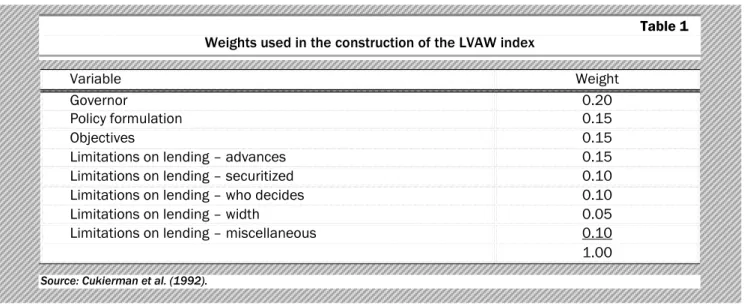
Together with the LVAU – the un-weighted coefficient of the legal central bank independence, Cukierman, Webb & Neyapti (1992) have developed LVAW – the weighted coefficient of the legal central bank independence presented in table 1.
3. Indicators Based on Actual Behaviour
Reviewing the economic literature we can sustain that the legal statute of a central bank is just one of the determinants of the actual central bank independence. Although central bank laws vary regarding their complexity, many of those are incomplete and give space to misinterpretation. As a consequence, factors like the personal characteristics of the central bank Governor and of other central bankers influence the level of actual central bank independence. In these cases, even if the law is very explicit, this law might be non-operational if it can be identified a tradition or an agreement with the government that those two aspects must be different. An explicit example is Argentina, where the tenure of central bank Governor stipulated in central bank’s charter is six years. In this case we can identify an informal tradition – the Governor of the central bank of Argentina it is supposed to resign if there are changes within the
Government or the Finance Ministry – the Governors of Argentina adhere to this tradition a long time ago. In this sense, the average tenure of the central bank Governor of Argentina was 10 months in the late 1980’s, while in the period 1996 – 2007 the tenure was 17 months. Obviously, it can be seen a lower level of central bank actual independence of Argentina in compliance with the medium term of Governor tenure stipulated in the central bank statue – six years. This way we have come to the conclusion that there exists a gap between the legal central bank independence indices and the actual central bank independence indices. The core argument for these hypotheses is the difficulty in identifying the systematic indices of the actual central bank independence in those situations in which legal independence is different from the actual independence. In this regard, for a more comprehensive analysis of the central bank actual independence we will present and identify the informal indicators of the actual central bank independence. In trying to identify the differences between central bank actual and legal independence Cukierman (1992) and Cukierman, Webb & Neyapti (1992) have determined the turnover rate of central bank governors for a period between 1950 and 1989. This indicator suggests that a higher degree of changes of the central bank governors imply a lower level of central bank independence. Long term tenure of the central bank Governor does not imply a higher degree of central bank independence, instead the tenures with a lower average than the political cycle implies personal independence. The turnover rate of the central bank governors represents the average of the changes in central bank governors over a period during a year, more exactly TOR = 1 / average tenure; this fact implies medium results between 0.2 and 0.25, higher levels meaning the compromising of the central bank independence.
Regarding the aspect mentioned above it can be observed that central bank independence is lower when the turnover rates of the central bank governors are very high.
Table 1 Weights used in the construction of the LVAW index
Variable Weight
Governor 0.20
Policy formulation 0.15
Objectives 0.15
Limitations on lending – advances 0.15
Limitations on lending – securitized 0.10
Limitations on lending – who decides 0.10
Limitations on lending – width 0.05
Limitations on lending – miscellaneous 0.10
1.00 Source: Cukierman et al. (1992).
One of the reasons for this fact is that in most of the countries with high turnover rates, the average tenure of the central bank Governor is lower than the average tenure of the Government. For this reason, we consider that there is a high possibility that the central bank Governor can be influenced by the executive branch, preventing the central bank Governor from implementing long term monetary policies. The medium values are between 0.2 and 0.25 because in most countries the political cycle varies between four and five years. Additionally, for three years or less average tenures of central bank Governor, it is very difficult for any political cycle to implement long term policies.
Cukierman & Webb (1995) developed the political vulnerability coefficient of the central bank which is defined as the political transaction report of a country which is followed (in six months or in a month) by a replacement of the central bank Governor.
The authors sustain that a political vulnerability is established when the frequency of the Governor changes reflects changes within the government, like an appointment of a new chief of the government.
The political vulnerability coefficient is similar with the turnover rate of central bank Governor in the political periods these two indices are equal when the unit of value have been equal to the entire political period, for example 7 months, and if neither one of the political parties of a country have not been truncate by the end of the analyzed period, or if there can be observed a very quick change of a political regime.
Cukierman & Webb (1995) have been taken into consideration 67 countries, 34 developed and 43 developing, for a period between 1950 and 1989 in which the turnover rate of the central bank Governor is more comprehensive than the political changes.
It can be observed some important differences between these two country groups, but also in country groups regarding the different forms of political changes.
In this context, the authors identify four types of political changes of the regime:
1.political regime changes – from democratic to authoritarian and vice versa;
2.government authority changes – from one authoritarian government to another;
3.changes of a political party – without a regime change;
4.changes in government structure – changes of the Prime Minister.
4. Measuring Central Bank Independence
and Inflation Targeting in Developed
and Developing Countries
The new index for central bank independence and inflation targeting that I built up is conceived as a sum of numerical values assigned to thirty eight institutional arrangements both in law and practice of central banks: nine attributes each for political and legal central bank independence, fifteen attributes for central bank governance and conduct of monetary policy and fourteen attributes for central bank transparency and accountability. These three groups, namely political an legal central bank independence, central bank governance and conduct of monetary policy and central
bank transparency and accountability take a maxim value
of 10 each, and gives a maximum aggregated of 10 for the new index of central bank independence and inflation targeting. This index can be called a weighted index of central bank independence and inflation targeting with a scale of 0 – 10, since attributes are weighted unequally. The score assigned to each criterion is aggregated to obtain the final value of the index. The higher the value assigned to each criterion, the higher will be the maximum score of the index. Appendix A presents the variables of the index and their coding.
This index is better considered as a de facto or actual
index rather than a de jure one because the aggregated value is based on the actual institutional practices or norms of central banks and not necessarily what is written in the central bank laws. However, the new index for central bank independence and inflation targeting is an interpretation based on these laws, which are put into actual practices and those practices that are not stipulated by law.
In order to observe the soundness of the index for measuring central bank independence and inflation targeting (ICBIIT) that I have constructed, it is very important to measure this index in developed countries and in developing countries. For a more comprehensive analyses and for viewing the reasons for the different level of central bank independence and inflation targeting I have built up three country groups: developed countries, developing countries and less developed countries.
Measuring central bank independence
and inflation targeting in developed countries
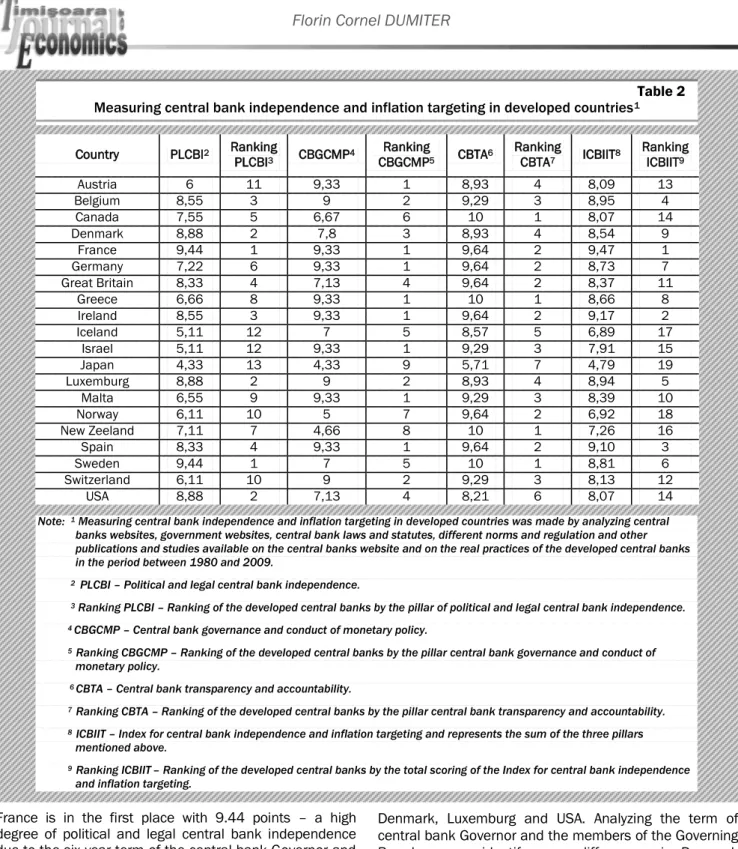
Table 2 presents the result of measuring central bank
independence and inflation targeting in developed countries3. Regarding the first pillar, political and legal
central bank independence, the results are as follows:
3 The developed country group consists in 20 countries: Austria, Belgium,
Canada, Denmark, France, Germany, Greece, Ireland, Iceland, Israel, Japan, Luxemburg, Malta, Great Britain, Norway, New Zeeland, Spain, Sweden, Switzerland and USA.
France is in the first place with 9.44 points – a high degree of political and legal central bank independence due to the six year term of the central bank Governor and the Governing Board, a lower level of the turn over rate of the central bank governor (0.13) and a non – political vulnerability. The central bank Governor cannot hold any other office in the Government and it can be dismissed only through the vote of the Governing Council. Regarding the Governing Board, their members are non – government persons, most of them being appointed by the President of the Republic and by the President of the National Assembly.
Regarding the first pillar of the ICBIIT we can identify on the second place with 8.88 points three countries:
Denmark, Luxemburg and USA. Analyzing the term of central bank Governor and the members of the Governing Board we can identify some differences: in Denmark central bank Governor has an unlimited tenure – limited by the age 70 – he it is obliged to send in the resignation before the expiration of the month in which he turns 70 years old; the tenure of the central bank Governor of Luxemburg is six years and the central bank Governor of the USA is 14 years.
A common feature of these countries is the non – political vulnerability and a lower turnover rate of the central bank Governors: Denmark (0.16), Luxemburg and USA (0.12), the fact that the central bank Governor cannot hold other
Table 2 Measuring central bank independence and inflation targeting in developed countries1 Country PLCBI2 Ranking
PLCBI3 CBGCMP4 Ranking CBGCMP5 CBTA6 Ranking CBTA7 ICBIIT8 Ranking ICBIIT9 Austria 6 11 9,33 1 8,93 4 8,09 13 Belgium 8,55 3 9 2 9,29 3 8,95 4 Canada 7,55 5 6,67 6 10 1 8,07 14 Denmark 8,88 2 7,8 3 8,93 4 8,54 9 France 9,44 1 9,33 1 9,64 2 9,47 1 Germany 7,22 6 9,33 1 9,64 2 8,73 7 Great Britain 8,33 4 7,13 4 9,64 2 8,37 11 Greece 6,66 8 9,33 1 10 1 8,66 8 Ireland 8,55 3 9,33 1 9,64 2 9,17 2 Iceland 5,11 12 7 5 8,57 5 6,89 17 Israel 5,11 12 9,33 1 9,29 3 7,91 15 Japan 4,33 13 4,33 9 5,71 7 4,79 19 Luxemburg 8,88 2 9 2 8,93 4 8,94 5 Malta 6,55 9 9,33 1 9,29 3 8,39 10 Norway 6,11 10 5 7 9,64 2 6,92 18 New Zeeland 7,11 7 4,66 8 10 1 7,26 16 Spain 8,33 4 9,33 1 9,64 2 9,10 3 Sweden 9,44 1 7 5 10 1 8,81 6 Switzerland 6,11 10 9 2 9,29 3 8,13 12 USA 8,88 2 7,13 4 8,21 6 8,07 14
Note: 1 Measuring central bank independence and inflation targeting in developed countries was made by analyzing central
banks websites, government websites, central bank laws and statutes, different norms and regulation and other publications and studies available on the central banks website and on the real practices of the developed central banks in the period between 1980 and 2009.
2 PLCBI – Political and legal central bank independence.
3 Ranking PLCBI – Ranking of the developed central banks by the pillar of political and legal central bank independence.
4 CBGCMP – Central bank governance and conduct of monetary policy.
5 Ranking CBGCMP – Ranking of the developed central banks by the pillar central bank governance and conduct of
monetary policy.
6 CBTA – Central bank transparency and accountability.
7 Ranking CBTA – Ranking of the developed central banks by the pillar central bank transparency and accountability.
8 ICBIIT – Index for central bank independence and inflation targeting and represents the sum of the three pillars
mentioned above.
9 Ranking ICBIIT– Ranking of the developed central banks by the total scoring of the Index for central bank independence
office in the Government and the non – government statute of the central bank board members.
Belgium and Ireland are in the third place in the top of the developed countries with 8.55 points, these countries most important elements have been the non – political vulnerability and a lower turnover rate of the central banks Governors: Belgium (0.10) and Ireland (0.13). The
common characteristics of these countries are: the non – government statute of the board members,
appointment of these members by the King in Belgium and by the Banking Association in Ireland, and the difference: the 5 years tenure of the Belgium Governor and the 7 years tenure of the Ireland Governor, the 6 years tenure of the Belgium Board Members and the 5 years term of the Ireland Board members.
In the fourth place are Great Britain and Spain with 8.33 points; the term of office of the central bank Governor of England is 5 years and of the Board members is 3 years, with the possibility of reappointment for another tenure; the Queen of England appoints the central bank Governor and the Bank of England has the authority to dismiss the Governor; the members of the Governing Board are non – government persons and appointed by the Queen of England and by the Governor. Regarding Spain, the tenure of the central bank Governor and the Governing board is six years, with possibility of reappointed just once; the King is responsible for the appointing of the Governor and Board for the dismissal and the Board members are non – government persons appointed by the Government. Both countries have lower turn over rates of the central bank Governor: Great Britain (0.10) and Spain (0.13) and non – political vulnerability.
At the middle of the hierarchy regarding the first pillar of the ICBIIT we can identify countries like: Canada - 7.55 points, Germany – 7.22 points, New Zeeland – 7.11 points, Greece – 6.66 points, Malta – 6.55 points, Norway – 6.11 points and Switzerland with 6.11 points.
At the end of the list of the developed countries regarding the first pillar are: Austria – 6 points, Israel and Iceland with 5.11 points and Japan with 4.33 points. The lower level of the political and legal central bank independence of these countries is due to the government intervention in appointing and dismissal procedures of the Governor and the central bank Board, as well as for the political vulnerability of the central bank Governor.
The second pillar of the ICBIIT, Central bank governance and conduct of the monetary policy, has the highest score in the following countries: Austria, France, Germany, Greece, Ireland, Israel, Malta and Spain with 9.33 points. The common feature of these countries is the membership of the European System of Central Banks (ESCB) and of the Euro Zone, countries characterized by an explicit prioritization of the price stability objective, as the first objective of the monetary policy, the high degree of goal independence, monetary policy targets and in
establishing and using the monetary policy instruments, the central bank authority in establishing and managing the interest rate and the exchange rate, the central bank prevalence over government in case of policy conflict, and the explicit interdiction of government lending.
The countries which can be identified in the middle of the developed group are: Belgium, Switzerland and Luxemburg - 9 points, Denmark – 7,8 points, Great Britain and USA with 4 points, Iceland and Sweden with 7 points. The countries with the lowest level of central bank governance and conduct of monetary policy are: Canada – 6.67 points, Norway – 5 points, New Zeeland – 4.66 points and Japan – 4.33 points due to the government participation in the formulation and implementation of the monetary policy and in regulating and implementing the exchange rate, the availability of government lending and the participation of the central bank in the primary market of government securities.
The countries with the best score regarding the third pillar of ICBIIT, central bank transparency and accountability, are: Canada, Greece, New Zeeland and Sweden with 10 points. In these countries, we can see a high degree of central bank accountability and transparency due to the explicit stipulation of the price stability objective, the quantification of the final objective of monetary policy, presentation and analyzing the monetary policy models, the availability of the time series for the most relevant macroeconomic variables but also the presentation an explanation of the monetary policy actions, the monetary policy decision and the adopted and the coming measures – all these action are possible due to the adoption and the practicing the inflation targeting strategy.
However, it can be identified countries with a high degree of central bank transparency and accountability: France, Germany, Ireland, Great Britain, Norway, Spain - 9.64 points, Belgium, Switzerland, Israel, Malta with 9.29 points and Austria, Denmark, Luxemburg with 8.93 points; these countries have a very transparent monetary policy, offering to the public the means and the tools for the perception and the understanding of the monetary policy transmission mechanism.
The developed countries with the lowest level of central bank transparency and accountability are: Island – 8.57 points, USA with 8.21 points and Japan with 5.71 points. It can be noticed that Japan has the lowest level of central bank transparency and accountability due to the eviction of public communication, lack of presenting and analyzing monetary policy decisions and actions, and missing time series for the macroeconomic variables public availability on the central bank website.
The final scoring of the ICBIIT is the following: first place France – 9.47 points followed closely by Ireland – 9.17 points and Spain – 9.10 points. In the middle position of the developed countries’ group are: Belgium – 8.95 points, Luxemburg – 8.94 points, Sweden – 8.81 points, Germany – 8.73 points, Greece – 8.66 points, Denmark –
8.54 points, Malta – 8.39 points, Great Britain – 8.37 points, Switzerland – 8.13 points, Austria – 8.09 points and Canada with 8.07 points. The developed countries with the lowest scoring of the ICBIIT are: Israel – 7.91 points, New Zeeland – 7.26 points, Iceland – 6.89 points, Norway – 6.92 points and Japan with 4.79 points.
Calculating the average of the three ICBIIT several results can be seen: 7.36 points of the political and legal central
bank independence for the developed country group, 7.92
points of the central bank governance and conduct of
monetary policy for the developed countries, 9.21 points
of the central bank transparency and conduct of
monetary policy for the developed countries and a total
scoring of 8.16 points for the ICBIIT. Taking into account
these results it can be shown that the developed countries have a high degree of central bank independence and inflation targeting, with a remarkably high degree of concentration at the top of the hierarchy.
Measuring Central Bank Independence
and Inflation Targeting in Developing Countries
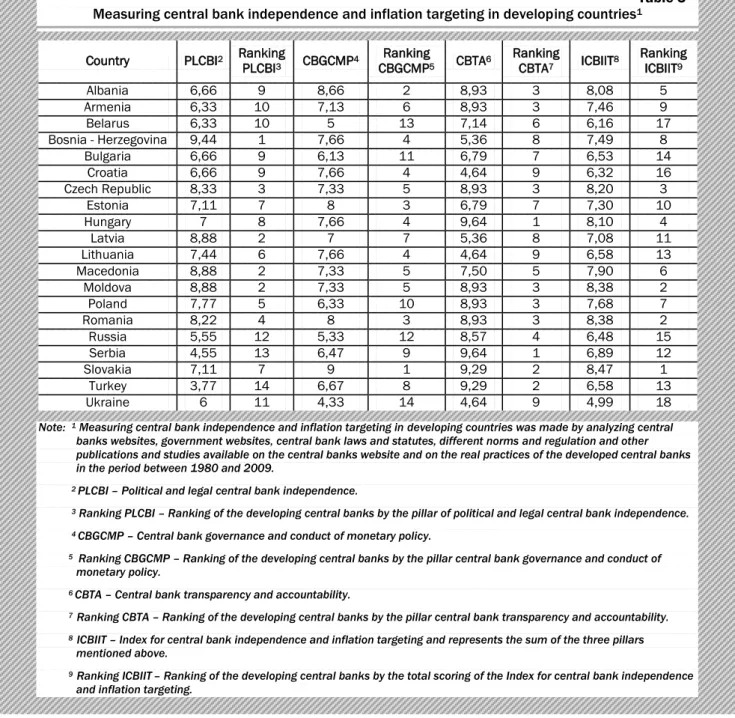
The results of measuring ICBIIT in developing countries4
are presented in the table 3; regarding the first pillar,
political and legal central bank independence, Bosnia –
Herzegovina has the highest score – 9.44 points due to the six years term of the tenure of central bank Governor and the Governing Board, appointment of the Governor by
4 The group of developing countries consists in 20 countries: Albania,
Armenia, Belarus, Bosnia – Herzegovina, Bulgaria, Croatia, Czech Republic, Estonia, Hungary, Latvia, Lithuania, Macedonia, Moldova, Poland, Romania, Russia, Serbia, Slovakia, Turkey, Ukraine.
Table 3 Measuring central bank independence and inflation targeting in developing countries1 Country PLCBI2 Ranking
PLCBI3 CBGCMP4 Ranking CBGCMP5 CBTA6 Ranking CBTA7 ICBIIT8 Ranking ICBIIT9 Albania 6,66 9 8,66 2 8,93 3 8,08 5 Armenia 6,33 10 7,13 6 8,93 3 7,46 9 Belarus 6,33 10 5 13 7,14 6 6,16 17 Bosnia - Herzegovina 9,44 1 7,66 4 5,36 8 7,49 8 Bulgaria 6,66 9 6,13 11 6,79 7 6,53 14 Croatia 6,66 9 7,66 4 4,64 9 6,32 16 Czech Republic 8,33 3 7,33 5 8,93 3 8,20 3 Estonia 7,11 7 8 3 6,79 7 7,30 10 Hungary 7 8 7,66 4 9,64 1 8,10 4 Latvia 8,88 2 7 7 5,36 8 7,08 11 Lithuania 7,44 6 7,66 4 4,64 9 6,58 13 Macedonia 8,88 2 7,33 5 7,50 5 7,90 6 Moldova 8,88 2 7,33 5 8,93 3 8,38 2 Poland 7,77 5 6,33 10 8,93 3 7,68 7 Romania 8,22 4 8 3 8,93 3 8,38 2 Russia 5,55 12 5,33 12 8,57 4 6,48 15 Serbia 4,55 13 6,47 9 9,64 1 6,89 12 Slovakia 7,11 7 9 1 9,29 2 8,47 1 Turkey 3,77 14 6,67 8 9,29 2 6,58 13 Ukraine 6 11 4,33 14 4,64 9 4,99 18
Note: 1 Measuring central bank independence and inflation targeting in developing countries was made by analyzing central
banks websites, government websites, central bank laws and statutes, different norms and regulation and other publications and studies available on the central banks website and on the real practices of the developed central banks in the period between 1980 and 2009.
2 PLCBI – Political and legal central bank independence.
3 Ranking PLCBI – Ranking of the developing central banks by the pillar of political and legal central bank independence.
4 CBGCMP – Central bank governance and conduct of monetary policy.
5 Ranking CBGCMP – Ranking of the developing central banks by the pillar central bank governance and conduct of
monetary policy.
6 CBTA – Central bank transparency and accountability.
7 Ranking CBTA – Ranking of the developing central banks by the pillar central bank transparency and accountability. 8 ICBIIT – Index for central bank independence and inflation targeting and represents the sum of the three pillars
mentioned above.
9 Ranking ICBIIT– Ranking of the developing central banks by the total scoring of the Index for central bank independence
the International Monetary Fund, an lower turn over rate of central bank Governor (0.14), non – political vulnerability and a non – politic statute of the Governing Board members. With a high degree of political and legal central bank independence are also countries like: Latvia, Macedonia, and Moldova with 8.88 points.
At the middle of the hierarchy of the first pillar of the ICBIIT for the developing countries observed can be countries like: Czech Republic – 8.33 points, Romania – 8.22 points, Poland – 7.77 points, Lithuania – 7.44 points, Slovakia and Estonia – 7.11 points and Hungary with 7 points. The common features of these countries are: the average tenure of five years of the central bank Governor and Governing Board members who are appointed and dismissed by Parliament or President, a non – political statute of the Governing Board members, a lower turn over rate of the central bank Governor and a non – political vulnerability.
Central banks with the lowest score are: Albania, Bulgaria, Croatia with 6.66 points, Armenia and Belarus – 6.33 points, Ukraine – 6 points, Russia – 5.55 points, Serbia – 4.55 points and Turkey with 3.77 points due to the following elements: terms of offices between 4 and 5 years of the central bank Governor and Governing Board members, Governor appointed by the Government, turnover rate of central bank Governor very high (over 0.33) and on average political – vulnerability of central bank Governors.
The second pillar of the ICBIIT, Central bank governance
and conduct of monetary policy, applied to the developing
countries has generated the following results: with 9 points, Slovakia has the highest score, country member of the ESCB and Euro Zone, country with the single monetary policy, a high goal independence and instrument independence, a high prevalence over the Government in case of policy conflicts and restriction of any type of government lending.
At the middle of the hierarchy regarding central bank
governance and conduct of monetary policy in developing
countries it can be seen countries like: Albania – 8.66 points, Estonia and Romania – 8 points, Bosnia – Herzegovina, Croatia, Lithuania, Hungary with 7.66 points, Macedonia, Moldova and Czech Republic with 7.33 points, Armenia – 7.13 points, Latvia – 7 points and Turkey – 6.67 points. These countries have price stability as the first monetary policy objective, most of them having adopted the inflation targeting strategy and gaining a high instrument independence and an autonomous exchange rate managing, in most countries direct and indirect government lending are strictly forbidden; regarding the regulations, decisions and intervention on the exchange market the decision are decided either by the central bank or jointly with the government.
Serbia with 6.47 points, Poland with 6.33 points, Bulgaria – 6.13 points, Russia – 5.33 points, Belarus – 5 points and Ukraine with 4.33 points are countries with the lowest
level of central bank governance and conduct of monetary
policy in the group of developing countries. This fact is due
to the adoption of other monetary policy strategies as: monetary targeting or exchange rate targeting, Govern-ment interference in establishing monetary policy objec-tives and targets, the government prevalence over the central bank in cases of policy conflicts, establishing the regulations, interventions in the exchange market by the central bank jointly with the government as well as grant-ing government lendgrant-ing in favourable terms for the government.
Regarding the third pillar of the ICBIIT in developing coun-tries, central bank transparency and accountability, Ser-bia and Hungary have the highest score – 9.64 points. This is due the fact of adopting inflation targeting strategy in both countries, a high degree of transparency in com-municating the monetary policy objectives and targets, a high availability of the macroeconomic variables time series and the macroeconomic models used for analyzing the monetary policy but due to the explanations and justi-fications of the monetary policy decisions and actions. Identified can be a high degree of central bank transparency and accountability in some developing countries as: Slovakia and Turkey – 9.33 points, Albania, Armenia, Moldova, Poland, Czech Republic and Romania with 8.93 points and Russia with 8.57 points. Most of these countries have adopted the inflation targeting strategy which has conducted to a more responsible monetary policy over the monetary policy objectives and targets, a better communication between the central bank and the public and press, publishing and presenting the projection, assumptions and forecasting over inflation and output and a public availability of the time series for the most comprehensive macroeconomic variables. However, it can be observed a weak point of these countries – the public availability absence of the main macroeconomic models used for the monetary policy analysis.
The developing countries with the lowest degree of central bank transparency and accountability are: Macedonia – 7.50 points, Belarus – 7.14 points, Bulgaria and Estonia – 7 points, Bosnia – Herzegovina and Latvia – 5.36 points, Croatia, Lithuania and Ukraine with 4.64 points. These countries are characterized through a monetary policy of those parameters are not available to the public, a lack o public availability of the main macroeconomic models used for the monetary policy analysis, a lower communication with the public and the missing explanations and justifications over the monetary policy actions and decisions.
The final hierarchy and score of the ICBIIT in developing countries is as follows: first place – Slovakia with 8.47 points, followed closely by Moldova and Romania with 8.38 points, Czech Republic with 8.20 points, Hungary with 8.10 points, Bosnia – Herzegovina – 7.49 points, Ar-menia – 7.46 points, Estonia – 7.30 points and Latvia – 7.08 points. The developing countries with the lowest
score of central bank transparency and accountability are: Serbia – 6.89 points, Lithuania and Turkey – 6.58 points, Bulgaria – 6.53 points, Russia – 6.48 points, Croatia – 6.32 points, Belarus – 6.16 points and Ukraine – 4.99 points.
Calculating the average of the three ICBIIT pillars several results can be observed: 7.08 points of the political and
legal central bank independence for the developing
coun-try group, 7.03 points of the central bank governance and
conduct of monetary policy for the developing countries’
group, 7.64 points of the central bank transparency and
accountability for the developing countries’ group and
7.25 points of the overall ICBIIT. Taking into account these
results it can be shown that the developing countries have middle – high level of central bank independence and in-flation targeting with a remarkable degree of concentra-tion in the middle of the hierarchy.
Measuring Central Bank Independence
and Inflation Targeting in Less Developed Countries
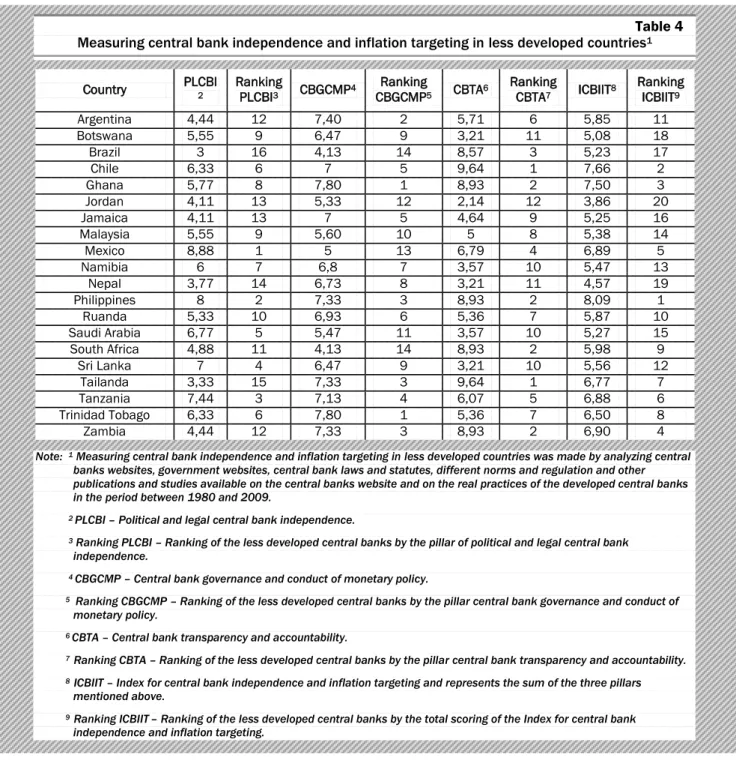
Table 4 presents the result of measuring central bank
independence and inflation targeting in the less developing country group. Regarding the first pillar,
political and legal central bank independence, the highest
score in the less developing countries group has Mexico - 8.88 points due to the 6 years tenure of central bank
Table 4 Measuring central bank independence and inflation targeting in less developed countries1
Country PLCBI2 Ranking PLCBI3 CBGCMP4 Ranking
CBGCMP5 CBTA6 Ranking CBTA7 ICBIIT8 Ranking ICBIIT9 Argentina 4,44 12 7,40 2 5,71 6 5,85 11 Botswana 5,55 9 6,47 9 3,21 11 5,08 18 Brazil 3 16 4,13 14 8,57 3 5,23 17 Chile 6,33 6 7 5 9,64 1 7,66 2 Ghana 5,77 8 7,80 1 8,93 2 7,50 3 Jordan 4,11 13 5,33 12 2,14 12 3,86 20 Jamaica 4,11 13 7 5 4,64 9 5,25 16 Malaysia 5,55 9 5,60 10 5 8 5,38 14 Mexico 8,88 1 5 13 6,79 4 6,89 5 Namibia 6 7 6,8 7 3,57 10 5,47 13 Nepal 3,77 14 6,73 8 3,21 11 4,57 19 Philippines 8 2 7,33 3 8,93 2 8,09 1 Ruanda 5,33 10 6,93 6 5,36 7 5,87 10 Saudi Arabia 6,77 5 5,47 11 3,57 10 5,27 15 South Africa 4,88 11 4,13 14 8,93 2 5,98 9 Sri Lanka 7 4 6,47 9 3,21 10 5,56 12 Tailanda 3,33 15 7,33 3 9,64 1 6,77 7 Tanzania 7,44 3 7,13 4 6,07 5 6,88 6 Trinidad Tobago 6,33 6 7,80 1 5,36 7 6,50 8 Zambia 4,44 12 7,33 3 8,93 2 6,90 4
Note: 1 Measuring central bank independence and inflation targeting in less developed countries was made by analyzing central
banks websites, government websites, central bank laws and statutes, different norms and regulation and other publications and studies available on the central banks website and on the real practices of the developed central banks in the period between 1980 and 2009.
2 PLCBI – Political and legal central bank independence.
3 Ranking PLCBI – Ranking of the less developed central banks by the pillar of political and legal central bank
independence.
4 CBGCMP – Central bank governance and conduct of monetary policy.
5 Ranking CBGCMP – Ranking of the less developed central banks by the pillar central bank governance and conduct of
monetary policy.
6 CBTA – Central bank transparency and accountability.
7 Ranking CBTA – Ranking of the less developed central banks by the pillar central bank transparency and accountability. 8 ICBIIT – Index for central bank independence and inflation targeting and represents the sum of the three pillars
mentioned above.
9 Ranking ICBIIT– Ranking of the less developed central banks by the total scoring of the Index for central bank
Governor and the 8 years tenure of the central bank Governing Board, a very low turn over rate of central bank Governor (0.08), a non - political vulnerability, the non – government statute of the Board members and the appointment of the members of the Board by the President of the Republic. Higher levels of political and legal central bank independence can be observed in other countries, namely: Philippines - 8 points, Tanzania - 7.44 points and Sri Lanka with 7 points.
At the middle of the hierarchy of the less developed countries regarding the first pillar of the ICBIIT are: Saudi Arabia with 6.77 points, Chile and Trinidad Tobago – 6.33 points, Namibia – 6 points, Ghana – 5.77 points and Botswana with 6.55 points. The lower level of political and legal central bank independence in these countries is due to the relatively low turn over rate of central bank Governor and a political vulnerability, more precisely, the tenure of the central bank Governor is lower than the one stipulated in the central banks charter and it appears after a change in the political regime or in an electoral cycle. The countries with the lowest degree of political and legal central bank independence are: Ruanda with 5.33 points, South Africa – 4.88 points, Argentina and Zambia – 4.44 points, Nepal – 3.77 points, Thailand – 3.33 points and Brazil – 3 points. The reasons behind these lower levels of political and legal central bank independence are: a lower tenure of central bank Governor and of the Governing Board members, Government interference in appointment and dismissal procedures of central bank Governor and the Governing Board members, higher turnover rates of central bank Governor (over 1) and political vulnerability of the central bank Governor.
The second pillar of the ICBIIT, central bank governance
and conduct of monetary policy, applied in the less
developed countries group had generated the following results - the countries with the highest score are : Ghana and Trinidad Tobago – 7.80 points, Argentina – 7.40 points, Philippines, Thailand and Zambia – 7.33 points, Tanzania – 7.13 points, Chile and Jamaica – 7 points. The satisfactory levels of central bank governance and conduct of monetary policy in these countries are due to the high central bank goal, target and instrument independence, the prevalence of the central bank in cases of policy conflicts and the central bank autonomy in managing the exchange rate policy.
At the middle of the hierarchy in the less developed country group of the second pillar of the ICBIIT are: Ruanda – 6.93 points, Namibia – 6.80 points, Nepal – 6.73 points, Botswana and Sri Lanka – 6.47, Malaysia – 5.60 points and Saudi Arabia – 5.47 points. These lower levels are due to the multiple monetary policy objectives without any prioritisation, the Government influence in establishing the monetary policy objectives and targets and granting direct and indirect Government lending.
The countries at the end of the hierarchy are: Jordan – 5.33 points, Mexico – 5 points, Brazil and South Africa – 4.13 points. These countries are tracking a lower level of central bank governance and conduct of monetary policy because of several facts: the governance authority in establishing the monetary policy objectives and targets, the absolute prevalence of the Government over the central bank in policy conflicts situations, the Government interference in regulation and application of the exchange rate and the lax conditions of the direct and indirect Government lending.
Referring to the third pillar of the ICBIIT, central bank
transparency and accountability in the developing
countries it can be seen that Chile and Thailand with 9.64 points are leaders, followed closely by: South Africa, Ghana and Zambia – 8.93 points and Brazil with 8.57 points. The higher level of central bank transparency and accountability, level which is similar to the developed and developing countries, is given by the adoption of the inflation targeting strategy which is preferred in most of the less developed countries. It can be noticed that countries which have adopted the inflation targeting strategy register a high degree of central bank transparency and accountability through the public availability of the information and of the time series macroeconomic variables, presenting its own macroeconomic forecasts for inflation and output and explaining and justifying the monetary policy present and future decisions.
The second group of countries is at the middle of the hierarchy regarding central bank transparency and accountability: Mexico – 6.79 points, Tanzania – 6.07 points, Argentina – 5.71 points, Trinidad Tobago and Ruanda – 5.36 points, Malaysia - 5 points. The lower level of these countries regarding central bank transparency and accountability is due to the lack of quantification of the primary monetary policy objective, the eviction of the main macroeconomic models use for monetary policy analyzes and the lack of the macroeconomic variables time series.
Countries with the lowest levels of central bank transparency and accountability in the less developed country group are: Jamaica – 4.64 points, Saudi Arabia – 3.57 points, Botswana and Nepal with 3.21 points and Jordan with 2.14 points. As we can see, these countries have lower levels of central bank transparency and accountability due to several factors like: the monetary policy strategy adopted by these countries have a lack of monetary policy transparency: the central bank does not communicate with the public and the press, monetary policy objectives and decisions are not clearly explained, justified and presented to the public, the lack of its own inflation and output forecasts and the missing auditing of the financial annual situations by the independent financial auditors.
Regarding the final hierarchy and scoring of the ICBIIT, the situation is as follows: on the first place is Phillipines with 8.09 points, followed closely by countries like: Chile – 7.66 points, Ghana – 7.50 points, Mexico – 6.89 points. At the middle of the hierarchy are: Tanzania – 6.88 points, Thailand – 6.77 points, Trinidad Tobago – 6.50 points, South Africa – 5.98 points, Ruanda – 5.87 points, Sri Lanka – 5.56 points, and at the end of the hierarchy we can observe countries like: Namibia – 5.47 points, Malaysia – 5.38 points, Saudi Arabia – 5.27 points, Jamaica – 5.25 points, Brazil – 5.23 points, Botswana – 5.08 points, Nepal – 4.57 points and Jordan – 3.86 points.
Calculating the average of the three ICBIIT pillars several results can be observed: 5.55 points of the political and
legal central bank independence for the group of less
developed countries, 6.46 points of the central bank
governance and conduct of monetary policy for the group
of less developed countries, 6.07 points of the central
bank transparency and accountability for the group of less
developed countries and 6.47 points of the overall ICBIIT. Taking into account these results it can be shown that the less developed countries have a lower level of central bank independence and inflation targeting with a remarkable concentration in the final section of the hierarchy.
4. Conclusions
The empirically observed trend towards a more independent central bank and an efficient inflation targeting regime is supported to a large extent by modern theory of monetary policy. The main idea of the different approaches is that central banks which are independent from government influence are able to reduce the inflation bias without having to implement completely inflexible rules. However, the monetary theory does not conclude that establishing an independent central bank alone leads to an improvement in social welfare. To achieve this, either the preferences of the independent central bank must differ from those of the government in an appropriate way, and / or the independently acting central bank must be provided with policy targets or incentive structures.
Analyzing the economic literature regarding central bank independence and inflation targeting, and presenting and identifying the indices for measuring central bank independence, conducted to the need of setting up a new index for both central bank independence and inflation targeting. In the economic literature there were indices for measuring only central bank independence de jure for developed countries and de facto for emerging countries. The index for central bank independence and inflation targeting wants in the first place to eliminate the differences of de jure and de facto independence for measuring independence both for developed countries and emerging countries based on some legal aspect and
of some actual practice and behaviour of the central banks. In the second place, we consider that inflation targeting and central bank independence are mutually reinforcing. By increasing central bank independence this fact will automatically lead to an increase transparency and accountability of the central bank, conducting to a higher credibility of the central bank and automatically to an efficient inflation targeting regime. Moreover, an efficient inflation targeting regime can increase central bank independence through an explicit target and a higher transparency of this monetary policy regime. The main purpose of this paper was to construct a new index for central bank independence and inflation targeting. In the economic literature there were indices for measuring only central bank independence de jure for developed countries and de facto for emerging countries. The index for central bank independence and inflation targeting wants in the first place to eliminate the differences of de jure and de facto independence for measuring independence both for developed countries and emerging countries based on some legal aspect and of some actual practice and behaviour of the central banks. In the second place, we consider that inflation targeting and central bank independence are mutually reinforcing. By increasing central bank independence this fact will automatically lead to an increase in transparency and accountability of the central bank, conducting to a higher credibility of the central bank and automatically to an efficient inflation targeting regime. Moreover, an efficient inflation targeting regime can increase central bank independence through an explicit target and a higher transparency of this monetary policy regime. The second purpose of this paper was measuring central bank independence and inflation targeting in three country groups establish by the author, namely: developed countries, developing countries and less developed countries conducted to the following results: in developed countries we can observe a high degree of central bank political and legal independence; is these countries the Governor and the members of the Governing Board have long tenures and overlap the political cycle, the Governor and the Board members are non – political persons, turnover rates of the central bank Governors are very low (beneath 0.16) and it is a remarkably non – political vulnerability. Regarding central bank governance and conduct of monetary policy in the developed countries we can see a high degree of goal, target and instrument independence, autonomous central bank in establishing and applying the interest rate and exchange rate policies and the strong interdiction of direct and indirect government lending. Developed countries have very transparent and accountable central banks due to the availability of time series of macroeconomic variables and the macroeconomic models used for analyzing monetary policy, the continued communication between central bank, public, press and enterprises, and the permanent explaining and justifying the monetary policy actions and decisions.
In developing countries we can observe a satisfactory level of political and legal central bank independence, characterized in average by lower turnover rates, a small government interference in the appointment and dismissal procedures of the Governor and the Governing Board, but it can be also identified a political vulnerability in some of the developing countries. Central banks have a relatively stable autonomy in establishing the monetary policies regarding the exchange rate and interest rate, in establishing the monetary policy targets in conjunction with the government, but also some weakness remarked by allowing government lending, by participating in the primary market for Government securities and performing the supervision function. Almost all of these countries have adopted an inflation targeting strategy, strategy which has facilitated a better relationship with the public, media, private agents – all of these conducted to a high level of central bank transparency and accountability in the developing country group.
In the less developing country group we can identify low levels of all the three pillar of the ICBIIT; the reason behind
this fact is the strong Government influence over the central bank in the appointment and the dismissal procedures of the Governor and of the Governing Board members, the prevalence of Government over the central bank in the conduct of monetary policy and establishing the exchange and interest rate and a low degree of transparency and accountability by promoting the banking secrecy and the lack of communicating with the public and the private agents regarding the monetary policy parameters, decisions and actions.
Finally, I consider that the new index for measuring central bank independence and inflation targeting means that a central bank holds the legal power in order to protect from external influence, gains a high degree of autonomy in establishing the monetary policy and implementing its objectives and targets without any government interference, can choose and use its optimal monetary policy instruments for controlling prices, inflation, exchange rate stability and restricting central bank accountability over the Parliament in order to keep more transparent its activities.
Bibliography
1. Alesina A., Politics and Business cycles in Industrial Democracies, Economic Policy 8, 1989.
2. Alesina A., Gatti R., Independent Central Banks: Low Inflation at No Cost? , American Economic Review 85, 1995.
3. Bade R., Parkin M., Central Bank Laws and Monetary Policy, Mimeo, University of western Ontario, 1988. 4. Bernanke B., Woodford M., The inflation targeting debate, National Bureau of Economic Research, The
University of Chicago Press, 2006.
5. Calvo G., On the time consistency of optimal policy in the monetary economy, Econometrica 46(6), 1978. 6. Carson C., Enoch C., Dziobek C., Statistical implications of Inflation Targeting – getting the right numbers and
getting the numbers right, International Monetary Fund, Washington D.C, 2002. 7. Crispin M., Politique monétaire crédible, Le potentiel, Supplément, Kinshasa, 2006.
8. Cukierman A., Central Bank Strategy, Credibility and Independence – Theory and Evidence, The MIT Press, 1992.
9. Cukierman A., Webb S.B., Neyapti B., Measuring the Independence of Central Banks and Its Effects on Policy Outcomes, The World Bank Economic Review 6, 1992.
10. Cukierman A., Central bank independnece and monetary control, The economic Journal 104, 1994.
11. Cukierman A., The Economics of Central Banking, Discussion Paper Center for Economic Research, No. 9631, 1996.
12. Debelle G., Fischer S., How independent should a central bank be? Federal Bank of Boston Conference Series no. 38, Boston: Federal Bank of Boston, 1994.
13. Eijffinger S., De Haan J., The Political Economy of Central Bank Independence, Special Papers in International Economics No. 19, Princeton, N.J., 1996.
14. Forder J., On the measurement and assesment of institutional remedies, Oxford Economic Papers 48, 1996. 15. Grilli V., Masciandaro D., Tabellini G., Political and Monetary Institutions and Public Financial Policies in
Industrialized Countries, Economic Policy, 13, 1991.
16. Healey N., Harrison B. (collected papers), Central Banking in Eastern Europe, Routledge, 2004.
17. Healey N., Wiśniewski Z. (collected papers), Central Banking in Transition Economies, Toruń Business School,
18. Howitt P., Money and growth, Monetary policy in developed economies: Handbook of Comparative economic policies, Vol. 3, Westport, Greenwood Press, 1993.
19. Issing O., Artus P., Blinder A., Buiter W., Solow R., Monetary policy in the new international environment – Central banks as economic institutions, The Cournot Center for Economic Studies Series, Edward Elgar Publishing, Cornwall, UK, 2008.
20. Kydland F., Prescott E., Rules Rather Than Discretion: The Inconsistency of Optimal Plans, Journal of Political Economy 85 (3,June), 1977.
21. King M., The politics of central bank independence, Central banking, XI (3), February 2001.
22. King M., The inflation target ten years on. Speech delivered to the London School of Economics, London, England, 2002.
23. Loungani K.P., Sheets N., Central Bank Independence, Inflation and Growth in Transition Economies, Journal of Money, Credit and Banking 29, 1997.
24. Lohman S., Optimal commitment in Monetary Policy: Credibility versus Flexibility, American Economic Review 82, 1992.
25. Mishkin F., Monetary policy strategy, The MIT Press, 2007.
26. Neuman M., von Hagen J., Does inflation targeting matter? Federal Reserve Bank of St. Louis Review 84 (4), 2002.
27. Orléan A., Monetary beliefs and the power of central banks, Central banks as economic institutions, The Cournot Centre for Economic Studies Series, Edward Elgar 2008.
28. Pollard P., A Look Inside Two Central Banks: the European Central Bank and the Federal Reserve, Federal Reserve Bank of St. Louis, 2003.
29. Radzyner O., Riesinger S., Central bank legislation and reality in Central and eastern Europe, Austria National Bank, Focus on Transition I, 1997.
30. Wagner H., Central Banking in Transition Countries, IMF Working Paper 98, Washington D.C., 1998.
Appendix A
Index of central bank independence and inflation targeting
1.Central bank political and legal independence (a) Term of office of Governor (CEO)
- 6 years or more 10 points
- 5 years 7 points
- 4 years 5 points
- 3 years or less 3 points
- Not mentioned 0 points
(b) Legal power to appoint the Governor (CEO)
- Board of the central bank 10 points
- Legislature / Parliament 5 points
- Executives / Government 0 points
(c) Legal power to dismiss Governor (CEO)
- Board of the central bank 10 points
- Legislature / Parliament 5 points
- Executives / Government 0 points
(d) Does Governor / CEO hold other office in the Government
- No – Governor / CEO does not 10 points
- Yes – He does 0 points
(e) Turnover rate of Governor / CEO
- TOR is 0.16 or smaller 10 points
- TOR is 0.2 or smaller 7 points
- TOR is 0.25 or smaller 5 points
- TOR is 0.33 or smaller 3 points