Experience driven software process
assessment and improvement
MARTIN IVARSSON
Department of Computer Science & Engineering
CHALMERS UNIVERSITY OF TECHNOLOGY
Experience driven software process assessment and improvement
MARTIN IVARSSON ISBN 978-91-7385-398-9
© Copyright Martin Ivarsson, 2010.
Doktorsavhandlingar vid Chalmers tekniska högskola Ny serie 3079
ISSN 0346-718X
Technical Report No. 68D
Department of Computer Science and Engineering Research group: Applied Software Engineering
Department of Computer Science and Engineering Chalmers University of Technology
SE-412 96 Göteborg, Sweden Telephone + 46 (0)31-772 1000
Contact information:
Department of Computer Science and Engineering Chalmers University of Technology
Hörsalsvägen 11
Telephone: +46 31 772 57 15 SE-412 96 Göteborg, Sweden [email protected]
Chalmers Reproservice Göteborg, Sweden 2010
Abstract
To maintain and increase competitive advantages, software organizations must continually strive to refine and improve their development processes. Software process assessment and improvement is the means by which development organizations assure and improve their processes, practices and tools to support their specific needs. Development practices are ultimately based on the knowledge and experiences of the organization’s staff. However, relying only on experiences inherent to the organization might, in the long run, mean becoming increasingly good at using obsolete practices. Thus, organizations also need to take advantage of industry best practice, innovations and, knowledge and experience inherent to the organization for improvements.
This thesis presents research aimed at supporting organizations to assess and improve their processes and practices with a focus on requirements engineering. First, the validation of a framework for assessment and improvement planning enables identification of improvement issues. The framework is characterized by relative accuracy and resource efficiency in using multiple data sources and involving practitioners in identifying what needs to be improved first. When challenges have been uncovered, the decision for how to improve involves: looking for innovation by introducing new practices, or improve practices currently used in the organization. To support process innovation, an investigation of the level and quality of evidence in requirements engineering research was made. Technology evaluations are classified according to the level of industrial relevance and rigor. To support learning from experiences inherent to the organization, a framework for diffusing and improving practices was developed and evaluated. Practices are used to transfer knowledge between different parts of the organization. Experiences from practice usage are then collected in postmortems offering iteratively improved decisions support. As the validity of experiences collected can be questioned, an example of how to strengthen the evidence is presented. The results can be stored in relation to the practice to improve the decision support related to it.
The main contribution of the thesis is the development and evaluation of methods for process assessment and improvement based on experience and knowledge inherent to an organization. Another contribution is the investigation into state-of-research in requirements engineering. It is important to leverage experiences both internal and external to an organization when making decisions on what practices to use. Future work should investigate how to balance process and practice innovation and refinement.
Keywords: Software Engineering, Software Process Assessment, Software Process
Table of Contents
ABSTRACT ... V TABLE OF CONTENTS ... VII ACKNOWLEDGMENTS ... IX LIST OF APPENDED PAPERS ... XI RELATED PUBLICATIONS... XII
CHAPTER I: INTRODUCTION ... 1
1.INTRODUCTION ... 1
1.1 GUIDE TO THE THESIS ... 2
2.BACKGROUNDANDRELATEDWORK ... 3
2.1 SOFTWARE PROCESS ASSESSMENT AND IMPROVEMENT ... 3
2.2 REQUIREMENTS ENGINEERING ... 11
2.3 KNOWLEDGE MANGEMENT IN SOFTWARE ENGINEERING ... 14
3.RESEARCHAPPROACH ... 17 3.1 RESEARCH CONTEXT ... 18 3.2 RESEARCH PROCESS ... 18 3.3 RESEARCH QUESTIONS ... 23 3.4 RESEARCH METHODOLOGY ... 24 4.RESEARCHRESULTS ... 27 4.1 CONTRIBUTIONS ... 28 4.2 FUTURE WORK ... 31 5.LISTOFPAPERS ... 31 5.1 INCLUDED PAPERS ... 31 5.2 STATEMENT OF CONTRIBUTION ... 34
5.3PAPERS NOT INCLUDED ... 34
REFERENCES ... 35
CHAPTER II: A PRACTITIONER’S GUIDE TO LIGHT WEIGHT SOFTWARE PROCESS ASSESSMENT AND IMPROVEMENT PLANNING ... 45
CHAPTER III: TECHNOLOGY TRANSFER DECISION SUPPORT IN REQUIREMENTS ENGINEERING RESEARCH: A SYSTEMATIC REVIEW OF REJ ... 89
CHAPTER IV: A METHOD FOR EVALUATING RIGOR AND INDUSTRIAL RELEVANCE OF TECHNOLOGY EVALUATIONS ... 123
CHAPTER V: PRACTICE SELECTION FRAMEWORK ... 157
CHAPTER VI: TOOL SUPPORT FOR DISSEMINATING AND IMPROVING DEVELOPMENT PRACTICES ... 197
CHAPTER VII: AN EMPIRICAL QUALITY ASSESSMENT OF AUTOMOTIVE USE CASES ... 227
Acknowledgements
This thesis and the included research have been achieved with the help and support of many people. I would like to take this opportunity to pay my gratitude.
I would like to thank my supervisor, Dr. Dr. (Master) Tony Gorschek, for having the absent mind to adopt me as a Padawan learner, and for the energy and stamina to see it through until the end. Most would have cut their losses and run.
“The force is kinda weak with you, my young Padawan”- Master Tony
My understanding of software engineering and research would have been very different if it was not for you (not worse – but different). On a more serious note, this thesis would not have been possible without your support. Thanks!
I would like to thank my examiner Prof. Johan Karlsson for his support and encouragement. I would also like to thank Dr. Peter Öhman for providing me with this opportunity, supervision and for approval of travel expenses. I would like to thank my co-authors, Fredrik Pettersson, Fredrik Törner for their contribution to the research presented in this thesis. The CEDES research project at Chalmers, and all the Ph.D. students who are or have been involved, for providing a enjoyable working environment and giving me a broader understanding of current research not only my own area but also in theirs.
I would also like to thank all persons that have been involved in the research studies. In particular, I would like to thank David Hellström, Fredrik Bernin, Lic. Ulrik Eklund, Johan Haraldsson, Anders Magnusson and Dr. Martin Hiller for providing me with the opportunity to perform research in industry and for your support.
Finally, I would like to thank my family for their continuous support. To all of you, and the ones I forgot – Thank you!
This research has been funded by the Swedish industry and government joint research program IVSS – Intelligent Vehicle Safety Systems through the CEDES project.
Introduction
Experience driven software process assessment
and improvement
1. Introduction
Software continues to become more important for a number of industries. Software is the predominant innovation driver in many domains, e.g. automotive and consumer electronics such as TVs, digital cameras and mobile phones [1]. However, the flexible and intangible nature of software has caused software projects to be overrepresented in project failures. In software product development the activity of eliciting, analyzing, specifying and validating requirements is called requirements engineering (RE). It is rather well understood that RE has a high impact on final product quality and constitutes a major determinant in software project failure [2-10].
To maintain and increase competitive advantages, software organizations must continually strive to refine and improve their development practices1. Process assessment and improvement is the means by which development organizations assure and improve their processes and tools to support their specific needs. Process assessment assures that development processes meet quality requirements, and identifies improvement potential. Assessment can be performed in different ways, for instance by benchmarking against a set of best practices or by using measurements. The goal is to identify an organization’s strengths and weaknesses to establish a plan for what to improve. One potential issue in starting an improvement effort is that extensive software process improvement (SPI) frameworks and measurement programs are viewed by many as too large to implement [11-14]. This makes it difficult for organizations to initiate and perform assessment and improvement efforts, as cost and time are crucial considerations [11, 12, 15].
When weaknesses have been identified, it is important to establish how to alleviate them to improve the performance of the organization. The decision for how to improve involves: looking for innovation by introducing new processes and practices, or improve ones currently used in the organization. Aiming at innovation by e.g. introducing new practices into the organization is high-risk, and the fit can be hard to gauge [16, 17]. Software organizations’ development practices are ultimately based on knowledge and competence of their staff [18]. Managing and sharing existing knowledge is thus a promising approach to improving the organization. Different parts of the organization have different knowledge and experiences, and might thus use different practices. Practices already used in the organization offer a low-risk alternative for improvement, as experiences from using them already exist in the organization [19]. However, focusing only on experiences inherent to the organization might, in the long run, mean becoming increasingly good at using obsolete practices [19]. Thus, organizations need to take advantage of industry best practice, innovations and, knowledge and experience inherent to the organization for improvements.
Development projects are concerned with fulfilling predetermined requirements on time, on budget and with quality, and consequently improvement often only happens as a reaction to a problem [20]. Even though knowledge of how to improve may exist in the organization, product development often takes precedence over improvements - i.e., short-term gains in terms of implementing new features outweigh long-term goals in terms of realized improvements [21].
1 In this thesis, the terms practice and technology are used interchangeably. The terms refers to any
In addition, focusing only on weaknesses might mean missing important opportunities for improvement [22, 23]. Managing strengths, weaknesses and means to improve development practices on the organizational level can help avoid missing important improvement opportunities. In addition, managing experiences outside of project contexts can help the organization to avoid localized optimizations that might deteriorate the organization’s performance [20]. For instance, excessively adding features to a product in one project can be successful in that project but might render the architecture difficult to use in subsequent projects.
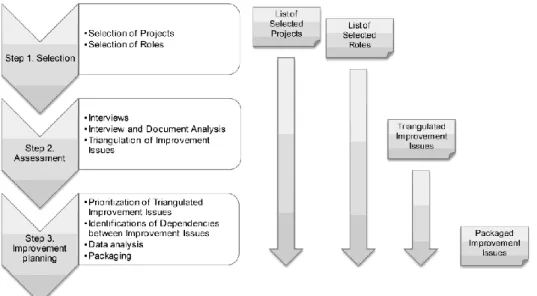
The main goal of the research presented in this thesis is to enable organizations to continuously improve to gain a competitive edge. By developing and applying lightweight methods for process assessment and improvement of the requirements engineering process, an organization’s performance is expected to improve. Four main contributions are made by the thesis. First, it provides a packaged framework for process assessment and improvement planning. Assessment is performed by eliciting improvement issues based on the organization’s experience and knowledge. The findings are validated through triangulation utilizing multiple data sources. In addition, practitioners are actively involved in prioritizing improvement issues and identifying dependences between them, in order to package improvements and thus establish an improvement plan that is realistic for the organization. Second, an evaluation and identification of evidence is given concerning the state-of-research on technology evaluations in requirements engineering. The evaluation considers both industrial relevance and rigor, and characterizes technology evaluations published in software engineering journals and how they have changed over time. The results can be used by practitioners to gauge the available evidence related to technologies, and by researchers as an empirical base on which to build on. Third, a framework is described for continuous process assessment and improvement through capturing experiences from development projects in postmortems. Experiences related to how practices have performed in the organization are captured and stored to make them available throughout the organization. Practices that have worked well are candidates for disseminating to other projects while practices that are estimated to be deficient can motivate closer investigation of the issues captured. Finally, as the validity of experiences collected in postmortems can be considered low, an example of how to strengthen the experiences is presented. Retrospective analysis is employed to evaluate a practice, Use case, used in industry. The results from the evaluation can be stored in relation to the practice in PSF to improve the available decision support for it.
1.1. Guide to the thesis
The thesis starts with an introduction to the research area and outlines how the research fit together. Following the introduction there are six thesis parts, each including one paper.
Chapter I provides a background to the research. Section 2 describes related work in
the areas of software process improvement, requirements engineering and knowledge management to put the work in context. Section 3 outlines the research process and the main research questions addressed in this thesis, together with the methodology used to answer the research questions. The research results and contributions are given in Section 4 as well as an outline of future work. Finally, Section 5 lists the papers which are part of the thesis.
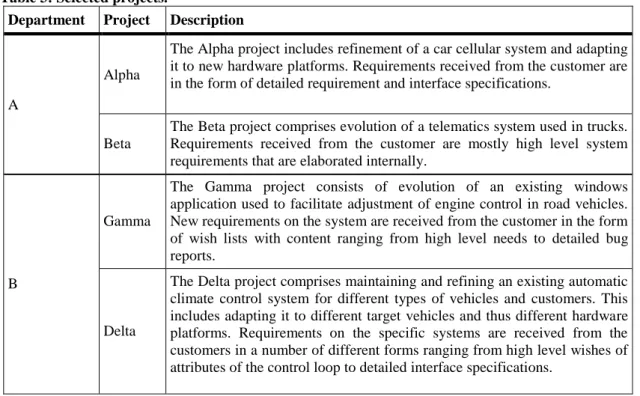
Chapter II presents a packaged framework for process assessment and improvement planning, iFLAP. The framework is applied at two departments at Volvo Technology to assess the requirements engineering process. The paper details these two cases of application and the lessons learned.
Chapter III describes an in-depth investigation into the available technology transfer
decision support in the Requirements Engineering journal (REj). The investigation is performed as a comprehensive systematic literature review of all papers published in REj containing any type of technology evaluation.
Chapter IV presents a model for evaluating the relevance and rigor of technology
evaluations in software engineering. The model is validated in a systematic literature review of requirements engineering technology evaluations published in software engineering journals.
Chapter V presents Practice Selection Framework (PSF), an Experience Factory
approach, enabling lightweight experience capture and use by utilizing postmortem reviews. In addition, an initial evaluation of PSF in industry is presented.
Chapter VI introduces tool support for PSF. The tool is used to further evaluate PSF
in both academia and industry.
Chapter VII presents a retrospective analysis of Use cases used in industry. The
results from the analysis can be stored in PSF to improve decision support related to Use cases.
2. Background and related work
Software development is often viewed as comprising requirements engineering, design, implementation, testing and maintenance activities [24] as seen in Figure 1. The work presented in this thesis focuses on the requirements engineering process, and especially on process assessment and improvement of this process. Assessment and improvement are illustrated as the feedback cycle in Figure 1. Assessment identifies weaknesses and strength in projects, and changes are made to improve on the weaknesses. To understand the contents of this thesis, a short introduction is given to software process assessment and improvement in Section 2.1 and requirements engineering in Section 2.2. In addition, the work presented capitalizes on knowledge and experiences inherent to the organization for identifying and selecting improvements thus an introduction to knowledge management is given in Section 2.3.
Requirements
engineering Design Implementation Test SPA, SPI, Learning
Maintenance
Figure 1: Overview of concepts used in this thesis.
2.1. Software process improvement and assessment
To maintain and increase competitive advantages, software organizations must continually strive to refine and improve their development processes. A process, and in
particular a software development process, is defined by the IEEE Standard Glossary of Software Engineering Terminology [25] as:
―process. (1) A sequence of steps performed for a given purpose; for example, the software development process.‖
―software development process. The process by which user needs are translated into a software product. The process involves translating user needs into software requirements, transforming the software requirements into design, implementing the design in code, testing the code, and sometimes, installing and checking out the software for operational use.‖
In this thesis, the definition of a process is assumed to include both the overall software development process and processes which are part of it, e.g. the requirement engineering process. Software process improvement and assessment are the means by which development organizations improve and assure their processes and tools to support their specific needs. Software process improvement (SPI) is often implicitly defined in the literature. Olson et al. [26] defines SPI as “the changes implemented to a software process that bring about improvements”. Other definitions often contain the stipulation that the changes should be improvements regarding process maturity or performance. Dybå [19] define two different improvement strategies that software organizations can adopt:
Exploitation
Exploitation entails learning from existing knowledge and experience and thereby improving existing technologies. This involves refining and elaborating on existing methods, processes and technologies, and is thus a low-risk approach to pursue improvements as no major changes are introduced into the organization.
Exploration
Exploration involves searching for new knowledge by either innovating new technologies or imitating existing ones. This involves experimentation with new methods, processes and technologies, and thus involves higher risks than exploitation as the results are more uncertain.
Process assessment, on the other hand, includes determining the current state of the organization and establishing what needs to be improved. Depending on what improvement strategy an organization has adopted, the assessment can take different forms. Several well-known SPI frameworks, presented below, used for process assessment and improvement have been defined. On the most fundamental level, all frameworks incorporate a continuous cycle consisting of two phases: analyze the process and change the process.
Analyze phase
The result of analyzing the process is an envisioned process that should be pursued. The process is then changed and the new, changed process becomes the current process. Analyzing the process consists of two steps: evaluation of the current situation and subsequent planning of what needs to be improved.
Change phase
Changing the process entails incorporating the needed changes that were identified in the earlier phase. This involves two steps: implementing the improvements identified and evaluating the effect of the improvements. If the effect is positive the new process becomes the current process and the cycle starts over.
The fundamental phases and the four steps presented can be visualized as in Figure 2, which was inspired by [27, 28].
1. Evaluation of the current situation
2. Plan for improvement
Analyze the process
4. Evaluate the effects of the
changes
3. Implement improvements
Change the process
Envisioned process Current process
Figure 2: Generic process for SPI.
SPI frameworks are either bottom-up, inductive, or top-down, prescriptive. The next two sections describe the most well-known frameworks of both kinds.
2.1.1. Inductive frameworks
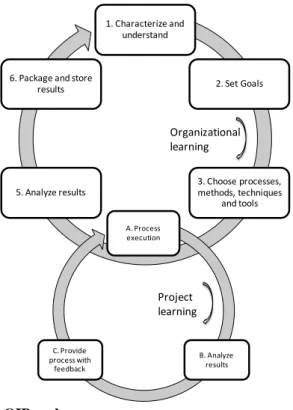
Inductive frameworks take their start in a bottom-up approach, basing the improvements on a thorough understanding of the current processes [29]. A well-known example of an inductive SPI framework is Basili’s Quality Improvement Paradigm (QIP) [30]. QIP proposes basing improvements on experiences from executing processes in projects rather than benchmarking against a pre-defined set of practices. QIP comprises two closed-loop cycles: a project cycle and an organizational cycle (see Figure 3). The project cycle provides feedback to the project executing the process, and the organizational cycle provides feedback to the organization when the project is completed. QIP begins with characterizing and understanding current processes. Based on this understanding, quantifiable goals for successful project performance are set, and changes to methods, techniques and tools are evaluated in pilot projects. The results of the pilot projects are then analyzed and if successful, are packaged and institutionalized in the organization.
1. Characterize and understand 2. Set Goals 3. Choose processes, methods, techniques and tools 5. Analyze results
6. Package and store results A. Process execution B. Analyze results C. Provide process with feedback Organizational learning Project learning
Figure 3: QIP cycle.
2.1.2. Prescriptive frameworks
In contrast to inductive frameworks, prescriptive frameworks base improvements on the adherence of processes to a collection of best practices describing how software should be developed. The prescriptive nature of such frameworks means that there is one set of practices, a reference model, that is advocated. The reference model provides a description of the process entities that are to be evaluated. No special consideration is given to the specific organization’s needs, business goals or strategy other than that the process should adhere to the one prescribed by the framework.
2.1.2.1. Capability Maturity Model Integration
Capability Maturity Model Integration (CMMI) was developed to combine three models: Systems Engineering Capability Model (SECM), Integrated Product Development Capability Maturity Model (IPD-CMM) v0.98, and the retired well-known Capability Maturity Model for Software (SW-CMM) [31]. CMMI replaced CMM when it was retired, and statements regarding CMM in the remainder of this introduction should also be considered valid for CMMI. CMM was originally developed to assist the US Department of Defense (DoD) in software acquisitions [32]. The rationale at the DoD was that it should be able to assess the development capability of contractors to minimize risks when acquiring software. As adherence to a specific maturity level became a business requirement for obtaining DoD contracts, contractors started using CMM as a guide to improve their development processes. The CMMI reference model comprises 22 process areas, and enables organizations to approach SPI and appraisals by using two basic representations: staged and continuous. The staged representation provides a way to assess and improve the organization’s overall maturity level. CMMI has five maturity levels: initial, managed, defined, quantitatively managed, and optimizing. The level that an organization achieves is governed by which process areas are implemented in accordance with
CMMI (see Figure 4); each maturity level has its set of process areas that needs to be implemented. Thus, the staged representation of CMMI guides the order in which the process areas shall be implemented. The continuous representation comprises six capability levels, and offers organizations the option to focus on each individual process area. This provides the possibility to select an order in which to implement process areas that do not conform to the staged representation. However, CMMI still guides the order in which practices should be implemented in each process area.
The appraisal method used when assessing an organization with CMMI is called Standard CMMI Appraisal Method for Process Improvement (SCAMPI). The efforts required to assess an organization range from 20 – 60 person hours, for the least rigorous Class C appraisal, to 800 – 1600 person hours for the full and comprehensive Class A appraisal [33, 34]. It is only the full assessment that results in a maturity rating. It should also be noted that estimates stated pertain only to the time spent by the assessment team and not time spent by the staff being assessed.
1. Initial 2. Managed 3. Defined 4. Quantitatively Managed 5. Optimizing Disciplined process Standard, consistent process Predictable process Continuously improving process CMMI v. 1.2 Configuration Management Measurement and Analysis Project Monitoring and Control Project Planning
Process and Product Quality Assurance Requirements Management Supplier Agreement Management
Decision Analysis and Resolution Integrated Project Management +IPPD Organizational Process Definition +IPPD Organizational Process Focus Organizational Training Product Integration Requirements Development Risk Management Technical Solution Validation Verification
Organizational Process Performance Quantitative Project Management Causal Analysis and Resolution Organizational Innovation and Deployment
Process areas
(Staged representation)
Figure 4: CMMI maturity levels and process areas.
2.1.2.2. ISO/IEC 15504
ISO/IEC 15504, Information technology – Process assessment [35], is an international standard for process assessment. During the development of the standard, the focus shifted from providing one reference model with which organizations are compared to including an effort to harmonize between different standards. Instead, ISO/IEC 15504 sets requirements on the reference models and process assessment models used. This has led to ISO/IEC 15504 relying on external sources for definitions of reference models. In particular, the life cycle models ISO 12207 [11], Software Life Cycle
Process, and ISO 15288 [36], Systems Life Cycle Process, formally constitute the
standards being harmonized with ISO/IEC 15504. In addition, this has led to different communities developing reference models tailored for particular domains, with the development of such frameworks as Automotive SPICE [37] and SPICE for SPACE [38].
In contrast to CMMI, ISO/IEC 15504 provides only continuous representation, and the measurement framework used for capability determination of a process consists of six capability levels. The measure of capability is based upon a set of process attributes (PA) that describe a number of characteristics that should be achieved to obtain a particular capability level (see Figure 5, based on [39]).
ISO/IEC 15504 assessments are very similar to SCAMPI (CMMI Class A). A fundamental difference is that, while CMMI can use both internal (if trained) or external assessment group members, SPICE demands that an external assessor head the assessment [35]. The cost of performing SPICE assessments ranges from 33 to 824 person-hours (median of 110) [40]. 1. Performed process 2. Managed process 3. Established process 4. Predictable process 5. Optimising process
PA 4.1 – Process measurement attribute PA 4.2 – Process control attribute PA 5.1 – Process innovation attribute PA 5.2 – Process opimisation attribute ISO/IEC 15 504
Measurement framework
0. Incomplete
process
PA 3.1 – Process definition attribute PA 3.2 – Process deployment attribute
PA 2.1 – Performance management attribute PA 2.2 – Work product management attribute
PA 1.1 Process performance attribute Process attributes
Figure 5: ISO/IEC 15504 capability levels and Process Attributes.
2.1.3. Concerns relating to SPI research
Even though there exist numerous examples of successful SPI in the literature, utilizing both inductive and prescriptive approaches, understanding how to implement SPI successfully is still one of the most challenging issues that the SPI field faces. Most of the case studies of SPI in the literature report on positive results, which is to be expected as organizations that have not shown any improvement or even regressed are unlikely to publish their results [40, 41]. A number of concerns relating to the application of current SPI practices have been identified in the literature, of which five related to this thesis are described and exemplified below together with their relation to
the frameworks presented in Sections 2.1.1 and 2.1.2 Most of the discussion will target prescriptive frameworks, as they are the most widely used in industry.
Challenge 1: Focus of SPI
The first challenge for software process improvement is the perspective taken in identifying, selecting and evaluating changes to the process. Process improvement often addresses the context of a development project. Process assessment is performed mostly on projects, and improvements are primarily assessed on projects [42]. Consequently, improvements often happen as a reaction to a problem and are confined to the project that is experiencing it. Addressing short-term goals and having a project perspective when implementing changes can raise problems. Especially for requirements engineering, project measures are only the first perspectives to consider [42]. Even if requirements contribute to a high-quality product and a project that is delivered on time and schedule, there is no guarantee that it will be successful on the market and generate revenue. Similarly for software architecture, an architecture might be successful within the project where it is developed but cause problems for subsequent projects using it. However, without fast feedback on improvements it can be hard to sustain commitment and discern whether the right direction has been taken, which means that measuring short-term is important but not enough. This means that some perspectives might need to be estimated by, for example, expert judgment to get early feedback on improvement success [43, 44]. When quantitative measures can be collected, these can be used to further the understanding of how improvements have performed.
Challenge 2: Commitment to SPI
One often cited problem is that SPI is expected to happen in addition to the regular workload without dedicating special resources [32, 45-48]. SPI initiatives need to obtain management support and commitment, since without dedicated resources the SPI effort will most likely be made in vain.
In addition to management support, the commitment of everyone involved in the SPI initiative must be ensured. It is a good idea to involve the people actively working with the process on a daily basis in the improvement work, as they are the ones who hold the knowledge of what needs to be improved [32, 45-50]. Börjesson and Mathiassen [51] present two driving forces regarding commitment and involvement that influence the success of SPI implementation. Process push depends on the competence, commitment and active participation of process engineers in developing and implementing new technologies, while practice pull depends on the competence, commitment and active participation of software practitioners in developing and adopting new technologies. The degree of process push and practitioner pull dictates the outcome of the SPI implementation effort. If the degree of both is low, the SPI effort will not happen. If only one of the pull or push forces is high the SPI may happen, and if both are high the SPI effort will most likely succeed.
Challenge 3: Initiation threshold to SPI
Extensive SPI frameworks, such as CMMI and SPICE, are viewed by many as too large to comprehend and implement [11, 12]. A typical CMM SPI cycle, for example, can take between 18 and 24 months to complete and demand large resources and long-term commitment [52]. This implies a long time to return on investment (ROI) and does not facilitate SPI success, as companies often require SPI efforts to show a
positive ROI within a year [48]. This makes it difficult for organizations, in particular small to medium sized enterprises (SMEs), to initiate and perform assessment and improvement efforts, as cost and time are crucial considerations [11, 12, 28]. This is a major concern for the SPI research field, as a vast majority of the current software industry is comprised of companies with fewer than 50 employees [53]. The problems faced by SMEs also pertain to small organizations within a larger company if it functions as a separate cost center [54]. This is confirmed by research initiatives to develop lightweight SPI frameworks such as IMPACT [55] and ADEPT [56] and to scope CMMI appraisals given organizations’ characteristics [57, 58].
The situation is not alleviated by the fact that many practices advocated by prescriptive frameworks do not comply with the needs of small organizations [54]. As prescriptive frameworks employ a one-size-fits-many policy, they might force practices on practitioners that they do not consider necessary, or miss issues important to the organizations [59, 60]. Inductive frameworks, on the other hand, address this by basing improvements on the organization’s situation. Finding possible improvement issues based on organizational needs, and not by following a prescribed framework, can help ensure support, from practitioners and management alike, for the assessment and subsequent improvements. This is a critical aspect in ensuring the success of process improvement efforts [32, 45-48, 50, 61, 62]. However, basing improvements on quantitative analysis, as proposed by QIP, produces useful results only if the process exhibits significant maturity [63].
Challenge 4: Visibility of SPI results
SPI initiatives need to show short-term benefits to keep the effort visible and maintain the commitment of staff and management [32, 48, 64-66]. To effectively provide short-term benefits, the improvements must be implemented in a continuous manner with small increments. Increments enable learning from experience, and thus the opportunity to correct failures and modify processes accordingly during the course of improvement [51]. Improving in increments implies giving priority to what needs to be improved and in which order things should be improved. When using prescriptive frameworks, these priorities are guided by the frameworks. Many organizations find that adopting processes in orders other than the prescribed one is more effective, e.g. early adoption of change control and code review [40]. Even though the continuous representation in CMMI and ISO/IEC 15504 improves visibility, in comparison to the staged representation, as practitioners can focus on one process at a time, the framework still guides priorities concerning the order of adoption of practices in each process area.
In order to adopt and institutionalize improvements on a broader scale, organizations need to ensure that their improvement initiatives provide the expected benefits. This is done through measurement, as it is the only way to demonstrate whether an improvement has actually occurred. However, measuring the success of SPI initiatives is not easy. Traditionally, SPI success has been measured in terms of gains in productivity, reductions of cost, improved ability to meet schedules, and improved quality and customer satisfaction [41, 67, 68]. While all these variables are important, different companies have different business goals and thus give different priority to these variables, or even emphasize others [68, 69]. Measurements should be aligned with business goals and the company’s strategy in order to be viable. Thus, there is a need to tailor measurement programs to align with the strategy and goals of the
company, to be able to evaluate the benefit of SPI initiatives for the company’s competitiveness.
Challenge 5: Tailorability of SPI methods
Enabling alignment of SPI initiatives with a company’s strategies and business goals requires a tailoring of SPI methods. A number of other contextual variables also need consideration, four of these being company size, development size, development mode and development speed [53]. Company size dictates how improvements may be pursued. For SMEs, resources and staff are always a consideration and there is a need for shorter time to return on investment compared to larger companies. Development size decides what practices are likely to be adopted. Software engineering methods are traditionally developed to fit large software projects. These methods are likely to be rejected in small and medium sized projects since they are perceived as ineffective [53, 70, 71]. This is because many methods for large scale software development found in the literature do not scale down well [71]. The process areas in which it is most difficult to achieve improvement by using CMM have been shown to be planning and tracking of software projects [32], which involve the methods that scale down poorly [71]. Development mode comprises the model under which development is performed. Much of the software engineering literature assumes the contract model for software development, where there is an external procurer that orders the software [53]. However, much of the software developed today includes pre-packaged software for mass markets or for internal use where there is no single customer but rather multiple, often contradictory, stakeholder views on what is to be developed. As time to market and coping with changing requirements become more important for companies to be competitive [48], many projects adopt agile methods to increase development speed. Agile methods are difficult to assess with traditional process assessment methods such as ISO/IEC 15504 and CMMI, even though some methods, such as Scrum and XP, map to ISO 9001 [72] and CMMI Levels 2 and 3 [73].
A concern for research is to understand how these contextual variables affect the success of SPI methods, not to embrace a one-size-fits-many approach, and to develop methods that facilitate SPI for a wider audience.
2.2. Requirements engineering
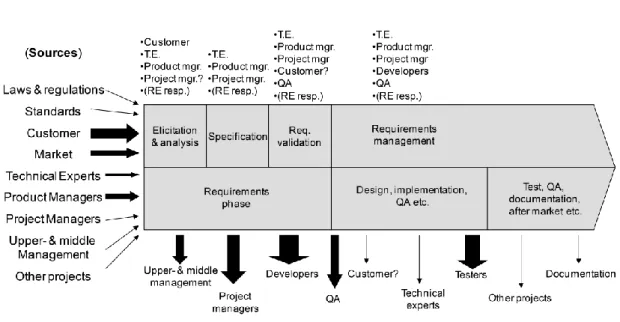
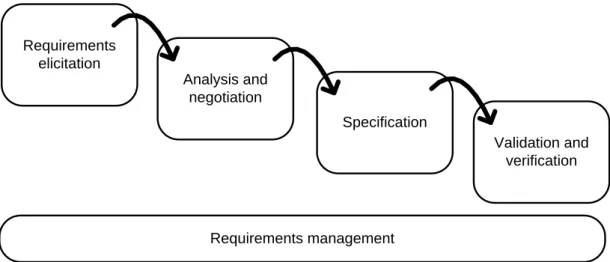
Requirements express the needs and constraints placed on a software product that contribute to the solution of some real-world problem [74]. Requirements engineering spans all activities related to creating and maintaining a set of requirements for a product. Traditionally, requirements engineering takes part in the beginning of a project and results in a specification that defines the product to be developed [24]. However, in practice, requirements engineering is an integral part of the development life cycle as new and changed requirements need to be managed. Requirements engineering is often divided into the processes of elicitation, analysis and negotiation, specification, validation, and requirements management [74, 75] which are illustrated in Figure 6.
Requirements elicitation Analysis and negotiation Specification Requirements management Validation and verification
Figure 6: Overview of requirements engineering process.
In reality the requirements engineering process is not as straightforward as depicted [76, 77]. It is an iterative and parallel process where requirements are continuously elicited, documented, analyzed and changed. The processes are briefly described below.
Requirements elicitation
Requirements elicitation concerns understanding, finding, learning and discovering the requirements for the product. Requirements can originate from several different sources. The usual sources of requirements are the stakeholders of the product including the users of the product, customers, stakeholders internal to the organization etc. Other sources include different types of documents such as laws and regulations, previous or related products, standards etc. Techniques traditionally used for eliciting requirements include requirements reuse, surveys, interviews etc. In addition, several different elicitation techniques have been proposed, including protocol analysis [78], repertory grid [79], creativity workshops [80] etc.
Requirements analysis and negotiation
Requirements analysis involves scrutinizing the elicited requirements for potential conflicts, ambiguities, dependences, overlaps, omissions and inconsistencies. In addition, the feasibility and risks of the requirements are assessed to gain an understanding of potential problems. Examples of techniques used for requirements analysis are modeling, interaction matrices, prototyping etc. At this point requirements can also be prioritized for importance. The goal is to reach the best trade-offs of what to include in the product by consolidating different stakeholders’ views. Examples of techniques for prioritizing requirements include the Planning Game, Analytical Hierarchy Process [81] and Cumulative voting [82].
Requirements specification
Requirements specification is an ongoing activity and involves documenting the elicited requirements in a specification or repository. Requirements are often specified using natural language, but other techniques such as Use cases [83] and formal specifications [84] are also used in practice. The specified requirements should ideally be correct, unambiguous, complete, consistent, verifiable, modifiable and traceable [85]. However, in practice, achieving these characteristics for large complex systems is impossible [86].
Validation and verification
Requirements verification concerns assessing the requirements to uncover deficiencies in consistency, accuracy and to ensure that they are adequate for development. Validation, on the other hand, involves showing that the requirements actually reflect the needs and wants of the customers. Validation and verification can be performed with different techniques such as reviews, prototypes or simulations.
Requirements management
Requirements management is an ongoing process spanning the entire development life cycle. As new requirements are introduced and old ones change, these changes need to be managed. This includes managing decisions regarding what changes to accept and dismiss, and how to communicate the changes to concerned stakeholders. To alleviate managing changes and keep track of how changes affect the development effort, different types of traceability can be used. In addition, version handling, i.e. documenting and keeping track of how requirements have changed, is part of requirements management.
2.2.1. Selecting requirements engineering practices
It is rather well understood that requirements have a big impact on final product quality, and that inadequate requirements are a major determinant of project failure. Thus, there are good reasons for practitioners to try to adopt successful RE practices. Improving the requirements engineering process often involves spending more time and resources on it. This includes, for instance, more time to elicit and document requirements to achieve good-enough input for development. The idea is that having better input to development will save time and resources, as catching and repairing defects during test or maintenance is costly [6].
Reasons for practitioners to select particular RE practices to use are the following [87]: It is the only practice that they know of
It is the practice of choice for any situation/project
The practice is prescribed by the used methodology used e.g. RUP [88] or SCRUM [89]
The practice is understood to be effective in the current situation/project
The first three reasons for selecting practices can in the long run limit the potential for improvement, as organizations might become increasingly good at using outdated or underperforming practices [19]. Several frameworks for requirements engineering practice selection have been proposed in literature, aimed at increasing the likelihood of practitioners using and understanding the fourth reason for practice selection [90-94]. By characterizing and describing RE practices in terms of strength, weaknesses and applicability, practitioner awareness is expected to increase. Tools have also been proposed to aid in the selection of practices guided by the situation in which they are to be applied [91, 92]. However, given that empirical evidence of RE practice performance is very limited (which is investigated in Chapters III and IV) the recommendations embedded in the frameworks are at least open for discussion [95]. Without guidance or evidence on return for investment on RE practices, uptake into industry might be hampered. This poses new challenges for RE researchers, as they need not only to develop new practices but also to provide convincing evidence of
their performance. This includes comparative studies between different RE practices and in different contexts to understand under what conditions certain practices are applicable. These comparisons also need to consider the best alternative investment. Comparisons between different practices that have only been applied in academia offer little advice on what works in practice.
2.3. Knowledge management in software engineering
Knowledge management is a large interdisciplinary research field. There are many definitions of what constitutes knowledge management. One commonly used is Davenport’s which defines knowledge management as “a method that simplifies the process of sharing, distributing, creating, capturing and understanding of a company’s knowledge” [96]. Knowledge management has gained much attention in software engineering, and a systematic review investigating the empirical evidence in the field has been published [97].
There are two main strategies for knowledge management: codification and personalization. Codification entails making the knowledge explicit by documenting it and making it available in the organization. Personalization involves capitalizing on tacit knowledge. Personalization supports the flow of information in the organization by providing an inventory of knowledge sources (people). In addition to these strategies, knowledge management approaches can be divided into different schools [98]. The schools are broadly categorized as “technocratic”, “economic” and “behavioral”. A successful knowledge management approach often integrates elements from several of these schools. The schools are briefly described below.
Technocratic schools
The technocratic schools support and condition employees in their everyday tasks. Three schools are categorized as technocratic: the systems, cartographic and engineering schools. The goal of the systems school is to capture knowledge in knowledge bases that other people can access. This school has been criticized for relying only on codification of knowledge. The risk is that this kind of effort will end up as an information junkyard [99]. However, there are examples of successful implementations of knowledge repositories in software companies [97].
The cartographic school is concerned with mapping organizational knowledge by establishing directories or “yellow pages” of who knows what in the organization. The idea is to make knowledgeable people in the organization accessible for others seeking advice or knowledge exchange. Examples of this school in software engineering are [100, 101].
The engineering school focuses on processes and knowledge flows in the organization. This school is the focus of the majority of empirical research carried out in software engineering on this topic [97].
Economic school
The economic or commercial school focuses on managing intellectual assets such as patents, trademarks, copyrights and intellectual property to increase revenue. This means that it is more concerned with maximizing the benefit of knowledge already owned instead of acquiring new knowledge. Little interest has been devoted to this school in software engineering research [97].
Behavioral school
The behavioral school aims to stimulate management and managers to be proactive in the creation, sharing and use of knowledge. Three schools are categorized as behavioral: the organizational, spatial and strategic schools. The organizational school uses organizational structures or networks to share or pool knowledge. These are often called “knowledge communities”, a group of people with a common problem, interest or experience. The spatial school focuses on how office space can be designed to facilitate knowledge exchange. The strategic school focuses on knowledge management as a part of competitive strategy. This includes, for example, strategies for how to use existing knowledge and how to foster innovation [102].
The main assets for software organizations are the employees, their expertise and experiences [103]. However, there are arguments pointing out software organizations’ inability to learn, and even that they have learned to fail [20], which makes knowledge management a promising concept in software engineering. The Experience Factory approach [104] has been central in software engineering for leveraging knowledge internal to software organizations, and for learning from past successes and failures in order to improve development processes. EF is an infrastructure for sharing and reusing experiences gathered in projects carried out in an organization. Section 2.3.1 provides a description of the Experience Factory approach and presents related work. One practical way of gathering experiences from development projects is to use project postmortems [105]. Postmortems are introduced in Section 2.3.2.
2.3.1. Experience factory
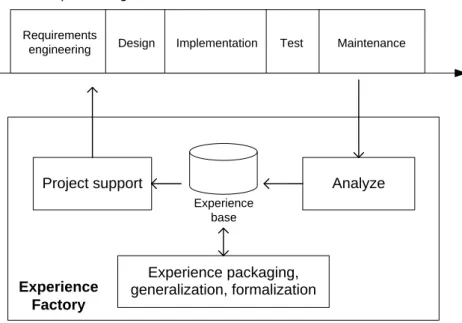
In software engineering, to reuse processes, product and life-cycle experience is often referred to as having an experience factory. The experience factory is a separate organization responsible for capturing and reusing knowledge in the organization. The infrastructure of the experience factory is illustrated in Figure 7.
Experience Factory
Experience base Requirements
engineering Design Implementation Test Maintenance
Project support Analyze
Experience packaging, generalization, formalization Development organization
The goal of the development organization is to develop and deliver products. The development organization also provides the experience factory with experiences and products from projects.
The experience factory organization processes the information from the development organization, and provides feedback and support to the development organization in the form of goals and models from previous development projects.
Experiences from development projects are collected, packaged and finally stored in the experience base to facilitate easy reuse. Packaging entails comparing, analyzing and combining experiences from several projects to generalize, tailor and formalize the experiences for reuse. Packaging for reuse is usually based on measurements as these allow for easy project consolidation [106]. However, packaging is still a difficult activity [107, 108]. The improvement methodology used in the experience factory is QIP presented in Section 2.1.1, accompanied by the Goal/Question/Metric paradigm [109] for setting and measuring operational goals.
The most well-known implementation of EF is the Software Engineering Lab at NASA [49]. However, even though the EF at NASA may have had a positive return on investment, few organizations have the resources to implement and run a similar effort. Other implementations can be found in [108, 110-112]. The main difference is in how experiences are captured and used. At Daimler-Benz (DB) [111], experience bases for describing processes and best practice have evolved for a long time. DB established an experience base/electronic process guide (EPG) to make experiences available to users, and used workshops and interviews to elicit experiences. Other efforts have focused on capturing common problems encountered during development and how these have been solved [110]. Tool support enables users to find solutions to common problems encountered during software development [113]. Other efforts have focused on making EF and QIP more concrete to enable easier use by practitioners [114, 115].
One important prerequisite for EF is closed-loop feedback, in the form of objective measurements of the development process [104]. This integrates experience capture into the normal engineering work. Subjective measures or expert judgment can also be used, but need to be managed, as simply relying on people’s willingness to share experiences is not enough [116]. Objective measurements have the advantage of not relying on the judgment of an expert. However, objective measurements are costly and might require a strict adherence to measurement procedure [13, 117-119]. Subjective measurement, on the other hand, requires no strict adherence to measurement procedure. This makes postmortems a good candidate for experience capture in an experience factory approach. Postmortems can be integrated into the normal development process, i.e., something you do after a development phase has ended or on project conclusion. Postmortems are described in the next section.
2.3.2. Postmortems
A practical approach to capture experiences and learn from development projects is the project postmortem [105]. A postmortem is a reflective activity carried out either at the end of a development phase or at project conclusion [105]. The goal of a postmortem is to learn from what happened in the project so as to improve future practice. The concrete result from a postmortem is often a postmortem report. Improvement can
happen on several levels: the individual, project and organizational levels [120]. Individuals can reflect on how they themselves have performed in the project and how they can improve until the next project, e.g., improve their skill or competence in relation to tools and techniques used. Project teams can reflect upon and discuss what they have learned during the project, and individuals share their experiences with the rest of the project team. On the organizational level, projects can reflect on organizational policies and processes and provide tacit insight into how they perform. Experiences from projects can also be communicated to other projects, to make them part of the learning experience [23].
Most research on postmortems in software engineering has focused on using the results for project learning. Several different approaches to postmortems for project learning and for capturing improvement potential in projects have been developed and tested in software engineering [121-124].
However, few have focused on approaches for increasing the impact of postmortems on the organizational level. Considering only the project level can raise problems as discussed in Challenge 1 in Section 2.1.3. The organization needs to consider what improvement is most important to pursue first, given the organization’s goals, not only the project’s goals. In addition, Challenge 2 emphasizes the need to gain management commitment to improvement efforts. Even though postmortems have uncovered issues needing improvement, the improvement effort might fail if management support (dedicated resources) is not assured.
Desouza et al. [120] have investigated the learning outcomes from using different ways of documenting postmortem outcomes, reports and stories. Stories are said to make more organizational impact, but the choice of documentation should depend on the project and learning outcome. Postmortem results can also be disseminated throughout the organization through, for example, workshops [23] or by connecting experience to an electronic process guide [125] to enable organizational learning. Analyzing a collection of postmortem reports can also unveil new insights into projects’ performance and provide useful guidance for process improvement initiatives [118, 119, 126]. However, analyzing postmortem reports to enable organizational learning comes at a high cost [126] and more efficient ways of analyzing postmortem data are needed. One potential way of increasing the efficiency of analyzing postmortem results for organizational learning is to discern what information is usable for organizational learning and document this in a way that is easy to analyze. This is the main idea behind PSF that is presented in Chapters V and VI. PSF is an approach for capturing experiences from postmortems and using these for organizational learning and improvement. PSF focuses on evaluating and sharing development practices. This means that the postmortem can be focused on eliciting and documenting information in a way that enables easy consolidation of experiences.
3. Research approach
The work presented in this thesis has evolved by using empirical studies to gather results. This section describes the research approach used in this thesis. First, the research context is presented in Section 3.1. In Section 3.2, the research model used is outlined as well as how it has been followed in this thesis. Then the research questions driving the research are presented in Section 3.3. Section 3.4 presents an overview of the research methodology used to find answers to the research questions.
3.1. Research context
Most of the studies part of the thesis has been performed in the automotive domain. The automotive domain is characterized by hard competition and the importance of software is increasing as a determinant in enabling innovations and cost savings [1, 127]. The amount of software in cars has been growing exponentially over the last 30 years [1]. Traditionally, automotive systems have been highly modular enabling quite independent development and production where individual sub-systems are sourced from suppliers. However, with the innovations enabled by software, the interactions between sub-systems have increased. The increase of software, increased interaction between sub-systems, and importance of non-functional requirements has increased both the product and process complexity. Most studies in this thesis have been performed at Volvo Car Corporation (VCC) and Volvo Technology (VTEC).
VCC
is a Swedish automotive manufacturer currently owned by Ford Motor Company. The company uses a top-down, prescribed development process with prescribed development practices. The development methodology used for software development is the MESC method [128]. VTEC is an automotive research and development organization in the Volvo Group. VTEC acts as a supplier to other companies, in or outside the Volvo Group. VTEC as an organization is ISO 9001 [129] certified and uses CMMI for process assessment. Projects carried out at the departments studied often involve 10-30 persons over 12-24 months. Projects carried out in the organization are free to choose what development methods, tools and techniques to use in projects in a bottom-up fashion. However, the development process used in projects is decided in a top-down manner.3.2. Research process
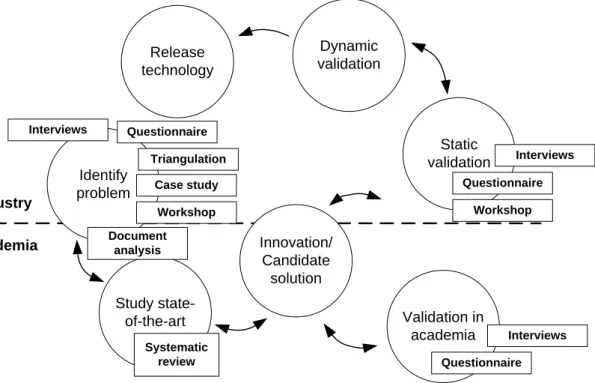
The work presented in this thesis can be seen as part of a research cycle aimed at transferring research results into industrial use, developed by Gorschek et al. [130, 131]. This section outlines the generic research cycle and then provides an overview of how it has been followed in this thesis. The overall research process is illustrated in Figure 8 as seven steps.
3. Innovation/ Candidate solution 5. Static validation 6. Dynamic validation Industry Academia 7. Release technology 1. Identify problem 2. Study
state-of-the-art 4. Validation in academia
Figure 8: Research model (adapted from [131]).
Step 1 is where the main research direction and research questions are outlined, based
on issues and problems identified in industry.
In Step 2, current knowledge and state-of-the-art in relation to problems identified in
the previous step are investigated. There is no use in inventing new solutions to problems that already have been solved. In the best case, solutions to the identified problems already have solutions that can be adopted to improve industry. In the worst case, no solutions are available but knowledge of state-of-the-art has been established. If no existing solutions are found in Step 2, Step 3 involves inventing a new solution based on the problems identified and state-of-the-art.
Steps 4 and 5 involve validating the solution in a limited scale to initially test whether
it addresses and solves the intended problems. Validation in academia offers a low-cost and risk alternative to understanding and testing the basic assumptions of the developed solution.
Step 6 involves using the solution in real projects to validate applicability in real
situations.
Step 7. When the solution is validated and deemed viable for industry use, it is
released and implemented into industry practice.
The motivation behind the research model is to start with a thorough understanding of real problems and to gradually validate and refine the solution to the point where it can be successfully used in industry. The overall goal of this thesis is to find practical means for organizations developing software-intensive products to improve their development processes and practices. Working close to industry and having the goal of
transferring research results into industry use has made the thesis mostly exploratory in nature. The use of the research cycle in this thesis is detailed below.
1. Identify problem
First, an assessment of current problems and challenges at two departments at Volvo Technology was performed to establish a research agenda. A framework for process assessment and improvement planning (iFLAP) is presented in Chapter II along with these two cases of application. Basing the research agenda on real issues is critical for successful research in software engineering [49, 131]. However, all problems found in industry are not suitable to be addressed with a research approach. Often there is a gap between what is used in industry and state-of-the-art. Suitable problems for research to address are ones that generate or confirm knowledge whilst being solved [132]. Other problems can be solved by considering current state-of-the-art or practice.
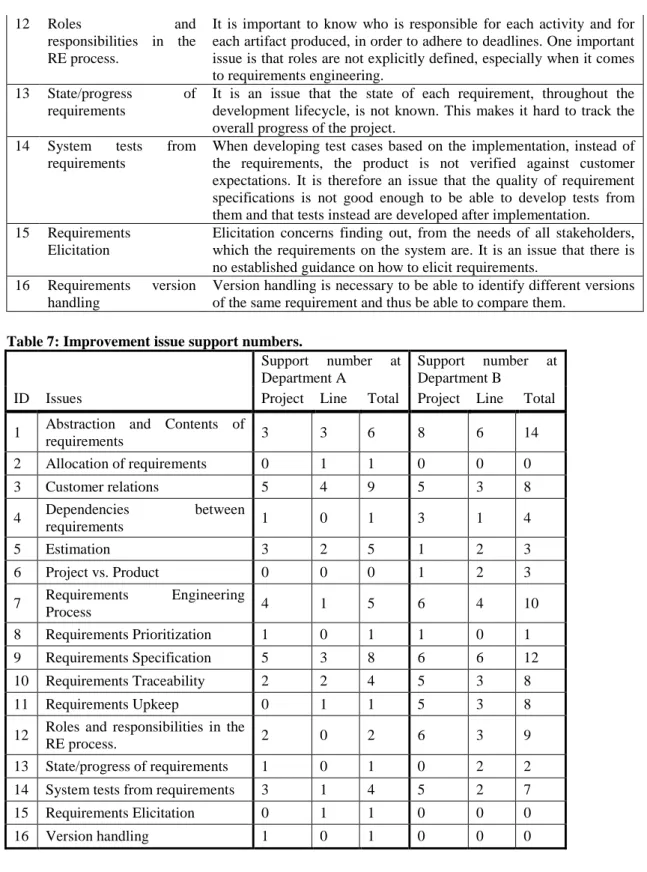
The improvement packages established during the process assessment and improvement planning are given in Figure 9 with descriptions in Table 1. The improvement issues are given in the rectangles in Figure 9, while the circles above them indicate the priority given to them in the improvement planning. The arrows between improvement issues in the case of Department B indicate the improvement order established. At Department B, the Requirements Engineering Process was seen as needing improvement before the issues of Abstraction and contents of requirements, and Requirements specification could be improved.
4 1 Requirements Engineering Process Abstraction and Contents of requirements Im p ro v e m e n t P a c k a g e Department A 1 2 3 Requirements Engineering Process Abstraction and contents of requirements Requirements specification Im p ro v e m e n t P a c k a g e Department B
Figure 9: Improvement packages at Departments A and B. Table 1: Description of improvement issues.
Improvement issue Description
Abstraction and contents of requirements
The main issue concerning the contents of requirements is the abstraction level at which they are specified. In most of these cases requirements are not detailed enough, giving room for different interpretations and resulting in changes late in the projects.
Requirements Engineering Process
There is a need for a usable requirements engineering process describing all activities, roles and responsibilities.
Requirements specification In many projects there is a need to either specify requirements internally or improve the customers’ requirements. This is not recognized by management or process, giving rise to unplanned costs
These improvement issues were used as input to the subsequent steps in the research cycle. Further, even though the improvement packages chosen at the departments are
similar, many priorities of other issues differed. Discussing these differences with representatives from the organization indicated that there was a potential for learning between the departments and between projects. Learning does take place within projects and between projects where experience are exchanged, e.g. between project managers. These projects can be seen as communities of practice [133] where knowledge and expertise are shared. However, the exchange to outside the community can be improved upon, to offer a cost-effective way of alleviating many of the other issues uncovered in the assessment. Thus, evolving learning between projects in the organization and between different organizational units was also seen as a potential research direction.
2. Study state-of-the-art
Having established two different research themes, state-of-the-art was studied. In software engineering, reusing life-cycle experience and processes for software development is often referred to as having an “Experience Factory” [104]. EF is a major undertaking and includes everything from reusing life-cycle experiences, i.e., processes, tools, methods etc., to products such as code, design and requirements. For this thesis, devising a lightweight, practically usable experience factory focusing on reusing experience concerning practices in the organization emerged as a possible solution to the learning issue. Practices are a candidate vessel for transferring knowledge, as it is a usual way of learning. Improvement often entails learning a new tool or method for a task.
Focusing only on exploiting experiences, i.e., learning from internal experience, in pursuing improvement limits the potential for process innovation [19]. To enable experience exploration, a study of state-of-the-art related to the issues uncovered in the process assessment was planned. However, focusing only on the immediate improvement issues offers a band-aid solution for the organization. In order to enable learning from others’ success, the scope of the state-of-the-art study was expanded upon to include not only research related to the issues identified in the previous step. Instead, the study focused on gauging the available evidence in requirements engineering, and the degree to which practitioners looking for methods/techniques/models/tools to adopt can use it as decision support. This was done by considering the industrial relevance of evaluations, i.e., the realism exhibited, and the rigor of the presentation. The state-of-art study of requirements engineering is presented in Chapters III and IV.
3. Candidate solution
The empirical evidence available in requirements engineering research was found to be rather limited. One of the few solutions which had been validated and tried in industry and which relates to the issues uncovered in the process assessment is the Requirements Abstraction Model (RAM) [134, 135]. The decision was to hold a workshop to tailor and try RAM. Testing RAM revealed that it was not the ideal fit for the organization. The organization where the trial was performed usually implements systems according to specification from an original equipment manufacturer (OEM). RAM could in this context be used to analyze and restructure the incoming specification. However, this meant that many of the advantages of using RAM were lost, e.g. requirements triage by comparison to company strategies. It also meant that the added overhead for using RAM in this context, as compared to organizations that
![Figure 8: Research model (adapted from [131]).](https://thumb-us.123doks.com/thumbv2/123dok_us/9886275.2879360/31.892.198.751.104.495/figure-research-model-adapted-from.webp)