ABSTRACT
Corruption represents a major leakage of public fund in many countries in the world. It has been highlighted that the involvement of unnecessary lobbying in the procurement contributes to the corruption. As a result, the Malaysian government has introduced the E-Procurement System to improve its services and to promote transparency in the procurement processes. This study aims to assess the effectiveness of the E-procurement system in reducing the lobbyist involvement in one of the largest statutory bodies in Malaysia. For this qualitative study, five procurement officers and three suppliers who had been using the system since it was implemented in the year 2011 were interviewed. Document review was also performed to access information on the processes in the system in support of the feedback from the respondents. The interview results showed that the E-procurement system was effectively implemented in largest statutory body (ACED) and reduced the involvement of lobbyist in the procurement processes. Both groups of informants agreed that the E-procurement system was an effective mechanism to curb procurement fraud because the processes were automated and transparent at every stage. Each process was conducted by a different person and it promoted integrity and transparency in the system. The E-Procurement System was found to be effective in preventing direct communication between the procurement officers and suppliers, therefore reducing the risk of lobbying. The E-procurement System was also bound by specific laws and regulations governing both parties, to which they must comply. The present study concludes that the system can reduce the unethical behaviour by lobbyist and that it should be implemented.
Keywords: e-procurement, lobbyist, public procurement, corruption
THE EFFECTIVENESS OF E-PROCUREMENT
SYSTEM IN REDUCING LOBBYIST
INVOLVEMENT IN PUBLIC PROCUREMENT
Jamaliah Said1, Marlina Wati Ishak2 Normah Omar1
1Accounting Research Institute, Universiti Teknologi MARA, Malaysia 2Malaysia Agricultural Research and Development Institute,
Serdang, Selangor, Malaysia
ARTICLE InFO Article History:
INTRODUCTION
Fraud has been the most challenging issue that is continuously occurring around the world, and Malaysia is of no exception. Fraud may jeopardize the entire country if it failed to be resolved (JPM, 2013). Audit General Report 2012 highlighted 121 cases related to fraud in the public sector as well as high profile cases like PKFZ, Sime Darby and other cases involving huge amount of public funds. Cases of false claim, bribery and mismanagement in buying instant trees at higher than the market prices, abuse of power linked to RM35 million spent on reviving abandoned projects to upgrade abundant of projects and other similar cases were found in all government agencies (AG, 2012). Hellman (2000) has identified several forms of corruption that exist, which consist of administrative corruption, legal methods of affecting policy that relate to lobbyist or involvement of lobbyist and public procurement kickback.
According to Kramer (2012), the improper selection of suppliers by approving higher price, accepting low quality goods and engaging unnecessary lobbyist will likely lead to corruption in public procurement. Pacific (2004) has noted that public procurement is one of the problematic areas that might be exposed to risks of being corrupted and thus needs serious attention from the government. It is an operational area that is exposed to high risk of corruption as public procurement deals with a large amount of funds and is also often high level of bureaucracy, creating opportunities and incentives for rent-seeking behaviour (Luijken & Martini, 2014). This has been supported by statistics in the report of OECD (2013) which stated that 20-25 percent of public funds had been estimated to have been lost through the corruption activities in public procurement.
the company to conduct tasks for financial and other compensation services (US, 2007). A certain third party deals and communicates with government officers in order to get the contracts for the government projects and is prone to bribe to fulfill personal interest (Andvig, 2012).
The leakages which occur in public procurement stem from corrupt lobbyists who quote higher prices for the purchase of products. Ratković (2013) has associated lobbying with corruption since lobbying exercises undue influence on public authorities. A typical scenario can be depicted with the lobbyist offering bribes to a certain procurement officer in order to get illegal information from the procuring agencies and selling it to the other parties for a certain amount of payment. Therefore, the involvement of lobbyists will result in corruption practices among the officers in the public sector and the suppliers themselves. Chief Commissioner of the Malaysian Anti-Corruption Commission (MACC) said in a national Management committee meeting Siries 12 Vol. 3, 21st October 2013):
“… the lobbyist issue, which has become quite a big issue in this country and the government must take this matter into serious consideration”
purchase goods and services (neupane et al., 2012). It has been recognised by most scholars that E-procurement plays a key role in reducing corruption in public procurement (neupane et al., 2012; OECD, 2008).
Every stage of the procurement cycle has been identified as being vulnerable to corruption activities. Levi and White (2008) found that corruption could happen at any stage in the procurement cycle. This is supported by the findings from another study by Othman et al. (2010) which revealed that each of the public procurement processes was vulnerably prone to corruption practice. There are six stages involved in public procurement cycle. It comprises: 1) need assessment; 2) preparation; 3) contractor or supplier selection; 4) contract implementation; 5) monitoring of the services; and, 6) the final stage of ensuring that goods received meet the standard of quality as stated in the contract.
This study aimed to determine the effectiveness of the E-Procurement System in reducing the involvement of lobbyist at all six stages of procurement cycle in public procurement that are vulnerable to corruption. It sought to establish how the E-procurement System was actually able to reduce the involvement of lobbyist in each stage of the public procurement processes.
E-PROCUREMENT OVERVIEW
The E-Procurement can be defined as the use of Information Technology (IT) to purchase the goods and services in business to business (B2B) activities (OECD, 2008; Panayiotou, Gayialis, & Tatsiopoulos, 2004). neupane et al. (2012) has found that the E-Procurement is an inter-organisational information system that automates the procurement process in order to enhance efficiency and effectiveness of the government procurement. It complements the traditional system used in the procurement process (Schapper, 2007). The traditional process will be modified to be more simplified and standardized for greater transparency.
Malaysia is one of the countries that have transformed the public procurement to the E-Procurement System. It is part of the Anti-Corruption Initiatives that has been developed by the government to reform the procurement process and at the same time curb the corruption that is frequently occurring in public procurement (neupane et al., 2012). The project started in the year 1999 when the government transformed the manual practice into an electronic and transparent process. The complexity of procurement gave a sign for the government to reform it into the E-Procurement System. It is to enhance the process so that it becomes more effective and efficient rather than to promote the transparency and accountability in the procurement activities.
it will also increase the transparency, accountability and also promote the integrity among procurement officers and suppliers. The cost of information and competition can be reduced while the officers and suppliers can also save their time in managing the procurement (Luijken & Martini, 2014; neupane et al., 2012; Schapper, 2007). Moreover, as asserted by Schapper (2007), the E-Procurement System is one of anti-corruption agenda developed by the government to curb corruption in the public procurement. E-Procurement reduces face-to-face communication and interaction between the procurement officers and the suppliers during the procurement processes which might expose them to corruption (Khanapuri, et al., 2011; Luijken & Martini, 2014; Pictet & Bollinger, 2008). Hanna (2010) also agrees that transactions through the E-Procurement are faster and easier compared to the traditional system.
Most of transactions conducted through the E-Procurement are direct purchase. Usually all ministries use the E-Procurement in managing the public procurement, statutory bodies, financial institutions and public organisations. Generally, the E-Procurement system was developed to increase transparency in the public services. It is quite similar to the E-Procurement that is used by all ministries; however there are some procedures and elements that differentiate one from the other. Meanwhile, the processes in the E-Procurement system are also web-based and they still follow the procedures as in the procurement cycle in the public procurement.
The Procurement Cycle
Generally, the procurement process will start with the process of identifying what type of goods and services that needs to be purchased and then end with the contract awarded to the suppliers with agreed payment terms (CPS, 2009; Othman et al., 2010). Hence, the procurement process should be more transparent, follow the rules and regulations enforced by the government, reflect accountability, fairness and equitable opportunities to all participants and the most important thing is the procurement should provide the value for money to the public since it involves the utilisation of public funds. However, public procurement is highly exposed to unethical behaviour especially corruption and the involvement of lobbyists. As Heggstad et al. (2010) pointed out, corruption might take place at any stages in the procurement cycle and it happens because of lack of transparency and lack of necessary professionalism among the procurement officers.
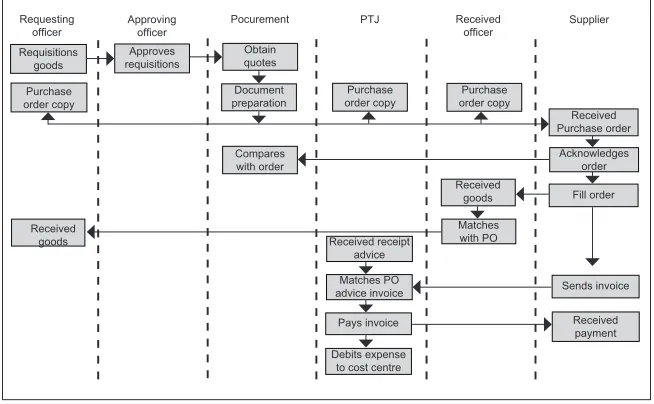
Obtain quotes Requisitions
goods Requesting
officer Approving officer Pocurement PTJ
Document preparation Compares with order Approves requisitions Purchase
order copy order copyPurchase order copyPurchase
Received goods Received officer Supplier Received goods Received receipt advice Received Purchase order Received payment Acknowledges order Fill order Sends invoice Matches with PO Matches PO advice invoice Pays invoice Debits expense to cost centre
Figure 1: The Procurement Process for the Public Procurement. Responsible Centre Refers To Responsibility Centre
(Source from Othman et al., 2010)
Corruption in Public Procurement
Selection stage and the Execution of Contract stage. However, the most risky and potentially vulnerable to corruption practice is at the preparatory stage where the procurement needs some amount of budgets and decisions should be made to fulfill all the requirements. Othman et al. (2010) have also supported the findings from the other researchers (Levi & White, 2008; Osei-Tutu, Badu, & Owusu-Manu, 2010) that reveal each of the public procurement processes is risky and exposed to the corruption practice. There are three stages identified from the findings of relevant studies that have been found to be highly vulnerable to corruption. These stages are: 1) the need of assessment; 2) during the selection of suppliers; and, 3) the monitoring of the services.
On the other hand, some studies have found that all levels or stages of procurement processes are actually vulnerable to the corruption practices (Osei-Tutu et al., 2010). These researchers have noted that any element of corruption practice can occur during the pre-qualification stage, tendering and contract, conceptual and design stage and contract execution stage. At the tendering and contractual stage, politicians might be involved in influencing the decision to choose the contractors or suppliers. In addition, there might also be a disruption from the lobbyists in the procurement at this stage. The identification of stages that are vulnerable to corruption can help the management to improve the weaknesses in the system and save the cost from the lobbyists. The lobbyists are associated with corruption because they exercise undue influence on the public authorities (Ratković, 2013). The leakages of public funds stem from the unnecessary and corrupt lobbyist. Thus, the involvement of lobbyists significantly contribute to corruption in the procurement process (Malaysia, 2012).
The Lobbyists in Public Procurement
The Lobbying Disclosure Act of 1995 (LD Act) defines a lobbyist as
any individual who is employed or retained by the client for financial or other compensation for services that include more lobbying contact (US, 2007). The lobbying activities should constitute 20 percent or more of lobbyist on behalf of their clients during a six-month period. Canada (2014)
in The Lobbying Act 1985 divided the lobbyists into consultant lobbyists
Other scholars have also viewed lobbyists as increasingly visible and influential people who are socially well-connected to politicians and are highly professional in their practice in a sophisticated manner (McGrath, 2006). They describe the lobbyist as an individual who is well educated, highly skilled and professional. Mack (2005) Mack’s (2005) definition of the lobbyists embraces people who are employed by the company or client to carry out lobbying on behalf of the company. In this case, the lobbying activities that are carried out by the lobbyist refer to making contact with the government official especially in the procurement, while Schepers (2010) describes the lobbyist as someone who carries out all forms of act on behalf of the clients but not with the purpose of developing partnership. Besides, the role of lobbyist is to promote unilateral business interest and act on behalf of the company. Lobbying can influence the decision made by politicians or the relevant parties, and can persuade them to accept their opinion in order to get the benefit from it (Jaatinen, 1998). In many situations, the cost increases because the cost of involving lobbyists will have to be borne by the consumers, resulting in products being sold at higher prices (Arshad, 2012).
More importantly, lobbyists are also involved in the public procurement. Lobbying will become a serious issue for the government in the future if it is not properly dealt with. According to Thai (2004) lobbyists have various interests, beliefs and objectives involved in the procurement system. They tend to be embroiled in unethical practices such as bribery and corruption linked to procurement officers in the tendering process with vested interests.
The involvement of lobbyists in the public procurement also contributes to the leakages of public funds since they offer higher prices for the purchasing of goods and services. They resort to bribery in order to get the information related to procurement from the officers and then they will sell the information to other interested suppliers at a high price. Thus, the transparency and credibility of the procurement officers in handling public procurement will be questioned by the people, leading towards a deterioration of public trust, which may arguably be difficult to be restored.
initiatives under national Key Results Areas (nKRA) (Malaysia, 2012). One of the initiatives highlighted in the nKRA is to develop guidelines for the lobbyists which started in 2014. However, the guidelines are still in the midst of preparation by the government and at present, there have yet to be standard guidelines which can be used to control the involvement of the lobbyists in the public procurement.
RESEARCH DESIGN
The study was conducted in a single case study via face-to-face interview with the procurement officers and suppliers in the largest statutory body that is involved in procurement system. According on Yin (2011), views and opinion from the perspectives of procurement officers and the suppliers are required in the study since these two groups are familiar with the electronic procurement system. Thus, the design of this study is based on a single design case study employing qualitative methodology.
There are multiple reasons on why this methodology was chosen in conducting the study. Firstly, the study sought to gain an in-depth understanding, explanation, verification and evaluation on the topic discussed. According to Leedy and Ormrod (2005), it is suitable to use the qualitative methodology when the information about the topic is rarely available and the variables are unknown. Moreover, Creswell (1998) has suggested that qualitative studies are more relevant to be used for something that lacks proven theories. Thus, the case study applied was in line with Creswell (1998) and Stake (1995). Case studies are strategy of inquiry where the researcher explores in depth the activity process, with one or more individuals. All the detailed information was collected using a variety of data collection procedures. Based on Stake (1995), case study was used in this study to get the interpretations and descriptions of others so that they will not be viewed the same by others.
Research Participants
in the study. Face-to-face interviews were conducted with these two groups. The suppliers were chosen based on the income for the year and also the quantity of contracts awarded to the suppliers through the system. The procurement officers were chosen based on the number of transactions conducted at the Responsibility Center via the system. In line with research ethics involving human participants, the identities of all research participants in reporting this case study are not disclosed. This is made possible by giving code names to the procurement officers (Officer 1, Officer 2, Officer 3, Officer 4, and Officer 5) and the suppliers (Supplier A, Supplier B, and Supplier C). The selection and number of participants for the interview in the study were influenced by the quality of information that could be obtained from these two groups. It is important to the points of view of these two groups on how they found the effectiveness of the procurement system in the public procurement, that is, whether it can reduce the intervention and involvement of lobbyists in the public procurement. The procedures of selecting participants are described further in the following section.
Study Protocols and Data Collection Methods
The respondents have to explain the procedures involved in the E-Procurement System in terms of how it is different from the traditional system. They need to answer questions related to the procedures used in the system and also their opinion on the transparency of the processes. The questions are designed to identify the possibility of the lobbyist involvement in the procurement processes.
From the five suppliers that were invited to participate in the study, only three of them agreed to be interviewed. The interviews were conducted at various places either at their office or at the other places where they preferred to be interviewed. The suppliers were identified as Supplier A, Supplier B and Supplier C.
There were also a set of questions designed for the suppliers in order to get their feedback on the topics discussed in the study. The questions were categorized in terms of the themes similar to the procurement officers’. The respondents need to answer questions related to their experience and their knowledge on the system. It is to ensure that they would be able to answer the next questions and that the responses are reliable. The respondents who were involved in the system less than 1 year were not included in the study. The respondents were required to explain the procedures involved in the E-Procurement System in terms of how it is different from the traditional system. Otherwise, they need to answer the questions related to the procedures used in the system and also their opinion on the transparency of the processes. The question was designed to identify the possibility of lobbyist involvement in the procurement processes.
CASE STUDY SITE: ACE RESEARCH INSTITUTE
However, most of the procurement activities in ACED are handled and managed by the Procurement & Purchasing Division led by the Finance Director and eleven staff members including the Assistant Director, five Officers and five clerical staff. Their levels of involvement are determined based on the value of procurement made by the department.
ACED reformed their procurement process in July 2011 where it started to use the electronic procurement in the direct purchase process. The system used in ACED is known as E-Procurement System. The E-Procurement system is a system that is developed by Ministry of Finance for the use of the statutory bodies, SME and other institutions in managing their procurement process. One of the main reasons for ACED to adapt E-Procurement System is to facilitate suppliers in the procurement process. This E-Procurement System is expected to benefit not only ACED but also suppliers via time and cost saving.
All the officers involved in the procurement activities are those who are highly experienced and knowledgable. These officers have three to four years of experience in managing the procurement activities including the electronic procurement. According to Officer 1 who was the procurement officer in the Procurement & Purchasing Division, at the early stages of implementation of the system, the staff members at every Responsible Centre made very minimal use of the system. This was because the system was still at the development stage and staff members were reluctant to switch and adapt to the new system since they had grown accustomed to and felt comfortable with the traditional system.
goal. Thus, ACED expanded the implementation of the online transaction procurement system to the other Responsible Centre.
The implementation of E-Procurement in the organisation is one of the Key Performance Indicators (KPI) for the Chief Director of every agency (Ministry of Finance, 2013b). Effective from 2014, most of the Responsible Centres at the headquarters in ACED started to use the system in the procurement process for the direct purchase. Records of total purchasing transaction via E-Procurement System was handled by the Purchasing Division at each Responsible Centre.
All the five procurement officers agreed that the system has given a lot of benefits to the organisation in conducting the procurement activities. They agreed that it was both cost and time saving in managing the procurement activities. The system also automated the procurement processes, thus reducing the usage of paper in preparing the documentation for purchasing of goods and services.
Meanwhile, all the officers also agreed that the E-Procurement System had given the opportunity for all suppliers to take part in the procurement activities if they registered with the agency. The prices that were offered by the suppliers through the system were also found to be more competitive, enabling the respective procurement officers to choose the best price, adding value for money to the agency concerned.
All the officers who were interviewed agreed that the processes through the E-Procurement System were faster and transparent compared with the traditional processes in the conventional system. Hanna (2010) in her study on the E-Procurement System has also commented on how easy and fast e-procurement system has been. In addition, the system could be classified as user friendly and also conveniently reliable since it operates online 24 hours a day and seven days a week (Kalakota & Robinson, 2001). However, most of the respondents also agreed that the procurement processes could be organized accordingly especially for the authorization of the approval. Thus, with the implementation of the E-Procurement System within the organisation, operational cost and time could be reduced. This was significant since ACED itself has to deal with budget constraints.
Meanwhile, research participants from the suppliers group also agreed that the E-Procurement System was useful for their business operation because the system was fast and easy to use, saves money and time. Two of the three suppliers who were interviewed agreed that the system had given their companies opportunities to be more involved in the procurement process at the selected agency. However, they also pointed out that despite the E-Procurement System being a good procurement system, suppliers sometimes experienced technical problems and there were occasions when the system became slow and that it was difficult for them to send the requirements needed by the agency.
All the three suppliers who participated in the study agreed that the charges on each transaction through the E-Procurement System were impractical since they already had to bear other costs. At the time the study was conducted, suppliers had to bear approximately 0.08% of the total value of the goods and services provided and also the 6% charges for goods and services tax. They explained that both charges had affected their businesses and the E-Procurement System charge was therefore an additional burden to them as their businesses were only small- and medium-sized. The cost associated with E-Procurement adoption was also raised by Kaliannan et al. (2009) and has been one of the issues that is affecting the suppliers especially for small- and medium-sized companies.
complicated criteria for the specification. It other words, the simple and straightforward purchase, for example, office equipment, was suitable to be conducted through the E-Procurement System.
Overall, the suppliers who were interviewed agreed that the E-Procurement System was quite good to be implemented in the government procurement as it allowed transparency in the procurement processes, and brought benefits to them especially when competition in business was becoming increasingly stiff. The suppliers also agreed that the E-Procurement System had reduced and eliminated the intervention of lobbyists in the procurement activities. This supported the findings in another study in which lobbyists insulated chances of the suppliers to get government contracts (Kalakota & Robinson, 2001).
The Procedures in E-Procurement Stages
During the interview session, all interviewees were asked to respond to a question about the procedures in the E-Procurement processes. They were also asked to explain the processes involved in the system in order to identify their understanding of the system itself. This was to identify at what level or stages was it possible for lobbyists to be involved in the public procurement.
ACED has provided a module on the E-Procurement System as a guideline to the users. The responses from the officers gave evidence that the module provided by the vendor was simple and the system’s process flow was easy to understand. Therefore, it was convenient for users to use the system. This was in line with the past literature where it has been claimed that the ease of use had made the users understand the procedures, therefore they were willing to use the electronic procurement system (Mose et al., 2013). Similarly, positive responses were also gathered from the suppliers about the system and this showed that they also understood the system very well.
next stage, which was the selection of suppliers in the system. Later, the procurement officer would choose the supplier based on the selected registered code in the system. All the selected suppliers would then be invited to enter the procurement processes. At this stage, suppliers would be given time to provide all the necessary documentation needed by the agency. Usually it would take three to seven days before the invitation period ended. The successful supplier would be chosen based on the goods or services provided in addition to the exact specifications requested by the users. Once the supplier was selected, the procurement officer would send the proposal to the authorised personnel for approval. The procurement officer would generate the purchase requisition through the system and send it to the successful supplier. At the time of delivery of the goods, the supplier concerned would also include an invoice and delivery notes to the agency. The store keeper would verify the goods received and generate the goods receive notes (GRn) in the system. The payment process would proceed after all the reconciliation processes with the order were completed.
In the traditional procurement system, the officer-in-charge has to manually search the catalogues for suppliers who provide the required products. The officer then needs to compare the prices offered by the suppliers and the delivery times that the suppliers can commit to. This is time-consuming and the process itself is very tedious. Past studies have found that the major problems that affect the selection of product concerned the price and delivery times (Egbu et al., 2003). Several responses that came from the interviewees concerning the procurement officials were in support of the findings in past studies.
was a stage that was prone to corruption (Othman et al., 2010), giving a chance for the lobbyist involvement where interference of human in the procurement process takes place.
Both groups of respondents which consisted of five procurement officers and three suppliers agreed that the processes were transparent because all the transactions were automated through the E-Procurement System. The procurement officer would directly negotiate with the respective suppliers through the system and this would remove the higher cost that might be charged by the lobbyist. This was also similar to the findings of other studies which argued that the electronic procurement system would reduce face-to-face communication between the officers and the suppliers where the risk of exposure to corruption exists (Khanapuri et al., 2011; Luijken & Martini, 2014; Pictet & Bollinger, 2008).
The system was also managed by officers from different ranks and levels. This showed that the decisions made were not influenced by any particular personal interest during the procurement activities compared with the traditional system. The OECD (2007) report has stated that, to prevent conflict of interest and corruption, the organisation needs to separate the duties and authorisation of their officers at the stages of procurement process. Thus, the possibility for the unethical practices can be avoided in the system. However, the following response was obtained from the officers on the possibility that the lobbyist might be involved in the system and the issue of personal interest:
“The possibility for the lobbyist to be involved in the procurement process is high if the officers cannot be accountable and does not have high level of integrity in performing their tasks even with latest inventions of high technology or system in the organisation. Lobbyist involvements at all stages are possible especially at the selection of suppliers and also at the approval stages”
who responded to the invitation might find a way to communicate with the officer outside the system. The request officers also tend to communicate with the supplier by getting the quotations from suppliers before the procurement process. Based on the responses from the officers, evidence indicated that the possibility of unethical behaviour was still very likely to happen at every stage in the procurement stages if the officers could not be accountable and lack integrity. This was similar to the findings by Heggstad et al. (2010) in which it was found that the unethical behaviour like corruption and lobbyist involvement at any stages in the procurement process will take place if there were lack of transparency in the system and integrity among officers.
Several responses were also noted from the interview with the suppliers:
“The E-Procurement System system is better than traditional system because it saves time, cost, is fair and encourages competition in the procurement activities. The processes involved are transparent and we know the officer involved in the process. However, the question arises when lately we have not invited in the procurement process even though at the early stages of implementation of the system we were usually invited to participate.”
CONCLUSION
This study was aimed to explore corruption opportunities by lobbyists in the E-Procurement cycle. It sought to answer the question of which stages of the E-Procurement System were exposed to such opportunities and in what ways. Results from the present study showed that there was no opportunity for direct lobbyist involvement in the E-Procurement System because all the processes in the system were fully automated and there were no human interventions during the procurement processes. Based on the procurement officers’ responses, the suppliers’ selection process was transparent. Suppliers were selected based on certain criteria and the decisions made were justified by the management. In addition, there were different officers involved in each stage indicating that the actions taken were transparent and that they had complied with the law and regulations. It was difficult for the lobbyists to be involved in the E-Procurement System unless there was some form of direct communication between the lobbyists and the officers involved as what had been practised in the traditional system.
However, it was discovered that the suppliers were suspicious of how suppliers’ selection process was done by the officers in the procurement process. This signified that suppliers needed to be convinced that the process of selection was transparent. However, both the procurement officers and the suppliers who were interviewed agreed that third party involvement was still possible at any stage of procurement cycle if the officers did not have the integrity and accountability in conducting their jobs. This was in agreement with the findings of Ratković (2013) in her study that lobbyists were associated to corruption, indicating that the possibility of lobbyist involvement in the procurement process was high if there was lack of integrity and accountability among officers in conducting their jobs. As noted by Heggstad et al. (2010), corruption may occur at any stage in the procurement cycle because of lack of transparency and lack of professionalism on the part of the officers themselves.
complete implementation of the system at the entire ACED will achieve the aim to fully embrace the system for direct purchase procedure and can be extended to the tender process later. Consequently, the system will reduce the possibility of lobbyists being involved in the procurement process and prevent corruption activities that might occur during the procurement process. As a result, the management will be able to improve the E-Procurement System based on the feedback gathered from the suppliers. The feedback from the suppliers should be taken into consideration by the management to ensure the successful implementation of the system in the future. Otherwise, if the management is reluctant to use the system, the aim and objective to implement the system will not be achieved and this will increase the opportunities for corruption practices. The implementation of 70% of procurement for goods and services through the E-Procurement System (Alilovic, 2007) can be achieved when ACED upgrades the system to incorporate all stations, including Sabah and Sarawak.
effect of the involvement of ministers or politicians in public procurement be conducted to determine whether the decisions made in relation to public procurement are biased and are influenced by the involvement of lobbyists. Therefore, there is indeed a myriad of possibilities for further research in the area.
REFERENCES
Alilovic, M. (2007). E-procurement impact on corruption: E-GP Scenario/
Model in Indonesia. Paper presented at the The 7th Regional Seminar
on Making International Anti-Corruption Standards Operational Bali, Indonesia. Retrieved from https://www.oecd.org/site/adboecdanti-corruptioninitiative/40838411.pdf.
Andvig, J. C. (2012). Public procurement and organized crime – illustrated with examples from Bulgaria, Italy and norway. nUPI working paper 813, Departmental of national Economic. Retrieved from https://www. files.ethz.ch/isn/156655/nUPI-WP--813-Andvig.pdf.
Arshad, F. M. (2012). The new Supply Chain: Implications to the Fresh Fruits and Vegetables Sector in Malaysia International Journal of
Business and Social Research, 2(4), 255-281.
Canada. (2014). Lobbying Act of 1985. Canada. Retrieved from http://laws-lois.justice.gc.ca/PDF/L-12.4.pdf.
Creswell, J. W. (1998). Qualitative Inquiry and Research Design: Choosing
Among Five Tradition. CA: Sage.
CPS (Crown Prosecution Service) (2009). Procurement Guide for Managers. Retrieved from http://www.cps.gov.uk/publications/finance/ procuremansguideapp2.html.
Egbu, C., P. Vines, P. M., & Tookey, J. (2003). The Role of Knowledge Management in E-Procurement Initiatives For Construction
Organizations. Paper presented at the 19th Annual ARCOM Conference,
Hanna, n. K. (2010). Transforming Government and Building the Information Society: Challenges and Opportunities for the Developing
World: Springer Verlag.
Heggstad, K., Froystad, M., & Isaksen, J. (2010). The Basic of Integrity in
Procurement. Chr. Michelsen Institute: DFID. Retrieved from https://
www.cmi.no/file/?971.
Hellman, J., Geraint, J. & Kaufmann, D. (2000). Are foreign investors and multinationals engaging in corrupt practices in transition economies?. A Stockholm Institute for Transition Economies, Stockholm. retrieved from http://siteresources.worldbank.org/InTWBIGOVAnTCOR/ Resources/fdi_trans_0800.pdf.
Jaatinen, M. (1998). Lobbying for conflict accommodation — A contingency model. Corporate Communications: An International Journal, 3(1), 23-42.
JPM (Jabatan Perdana Menteri) (2013). GTP annual report 2013. Retrieved from https://www.pmo.gov.my/dokumenattached/nTP-Report-2013/ GTP_2013_EnG_Report. pdf.
Kalakota, R., & Robinson, M. (2001). E-business 2.0: Roadmap for success. Harlow new Jersey: Addison-Wesley.
Kaliannan, M., Awang, H., & Raman, M. (2009). Electronic Procurement: A Case study of Malaysia’s E-Perolehan (E-Procurement) Initiatives.
International Journal Electronic Governance, 2(2/3), 101-115.
Khanapuri, V. B., nayak, S., Soni, P., Sharma, S., & Soni, M. (2011).
Framework to overcome challenges of implementation of e-Procurement
in India Contex. Paper presented at the International Conference on
Technology and Business Management, Dubai, UAE.
Leedy, P. D., & Ormrod, J. E. (2005). Practical Research Planning and
Design new Jersey: Pearson Merrill Prentice Hall.
Levi, M., nicholas D. & White, S. (2008). Do European procurement rules generate or prevent crime? Journal of Financial Crime, 15(3), 243-260.
Luijken, T., & Martini, M. (2014). The Role of Technology in Reducing Corruption in Public Procurement. Retrieved from https://www. transparency.org/files/content/corruptionqas/ The_role_of_technology_ in_reducing_corruption_in_public_procurement_2014.pdf.
MACC (Malaysian Anti Corruption Commission) (2013). Peranan ‘Orang Tengah’, Audit Fokus JKTU Siri 12. Retrieved from http://www.sprm. gov.my/jktu-org-tgh.html?&lang=bm.
Mack, R. (2005). Lobbying effectively in Brussels and Washington – Getting the right result. Journal of Communication Management, 9(4), 339-347.
Malaysia, Utusan. (2012, 22 August 2012). Orang Tengah Perlu Ada Kebenaran Khas, Dalam negeri, Utusan Malaysia.
McGrath, C. (2006). The ideal lobbyist: Personal characteristics of effective lobbyists. Journal of Communication Management, 10(1), 67-79.
Ministry of Finance, MoF. (2011). Economic Report 2012/2013. from http://www.treasury.gov.my/index.php?option=com_content&view=ar ticle&id=2281:laporan-ekonomi-20122013&catid=73:senarailaporan-ekonomi&Itemid=174&lang=en.
Ministry of Finance, MoF. (2013b). Punca Kuasa, Prinsip dan Dasar
Perolehan Kerajaan. Putrajaya: Treasury Malaysia. Retrieved from
file:///C:/Users/User_2/Downloads/PK1.pdf.
Mose, J. M., njihia, J. M., & Magutu, P. O. (2013). The Critical Success Factors And Challenges In E-Procurement Adoption Among Large Scale Manufacturing Firms In nairobi, Kenya. European Scientific Journal. 9(13), 375 - 401.
neupane, A., Soar, J., Vaidya, K., & Yong, J. (2012). Role of Public E-Procurement Technology To Reduce Corruption in Government
Procurement. Paper presented at the 2012 International Public
Procurement Conference, Seattle, Washington. Retrieved from: https:// eprints.usq.edu.au/21914/1/neupane_Soar_Vaidya_Yong_PV.pdf.
nKRA, nKRA Against Corruption (2014). Initiative 15: Guidelines for Middle-Men/Lobbyist. Retrieved 20 December 2014, 2014, from http:// www.nkracorruption.gov.my/ index.php/component/content/article/32-18-initiatives/212-initiative-15-guidelines-for-middle-men-lobbyist.
OECD (Organisation for Economic Co-operation and Development) (2007). Integrity in Public Procurement Good Practice From A To Z: OECD Public Governance and Territorial Development Directorate, Innovation and Integrity Division. Retrieved from http://www.oecd. org/development/effectiveness/38588964.pdf.
OECD (Organisation for Economic Co-operation and Development) (2008). Fighting Bribery in Public Procurement in Asia-Pacific. from http:// www.etransform.org/gti/sites/etransform.org/files/documents/bribery. pdf.
OECD (Organisation for Economic Co-operation and Development) (2013). Implementing The OECD Principles for Integrity in Public Procurement.
European Journal of Operational. 185(3), 1300 -1307.
Osei-Tutu, E., Badu, E., & Owusu-Manu, D. (2010). Exploring corruption practices in public procurement of infrastructural projects in Ghana.
International Journal of Managing Projects in Business, 3(2), 236-256.
Othman, R., Zakaria, H., nordin, n., Shahidan, Z., & Jusoff, K.. (2010). The Malaysian Public Procurement’s Prevalent System and its Weaknesses.
American Journal of Economics and Business Administration, 2 (1),
OECD (2004). Anti Coruption Policies in Asia and The Pacific: The legal and Institutional Frameworks for Fighting Corruption in Twenty-one Asian and Pacific Countries. Retrieved from https://www.oecd.org/site/ adboecdanti-corruptioninitiative/policyanalysis/35022355.pdf.
Panayiotou, n. A., Gayialis, S. P., & Tatsiopoulos, I. P. (2004). An e-procurement system for governmental purchasing. International
Journal of Production Economics, 90(1), 79-102.
Pictet, J., & Bollinger, D. (2008). Extended use of the cards procedure as a simple elicitation technique for MAVT. Application to public procurement in Switzerland. European Journal of Operational
Research, 185(3), 1300-1307.
Ratković, V. (2013). Anticorruption. Bulletin of the Directorate for
Anti-Corruption Initiative (DACI). Retrieved from http://www.aalep.eu/
sites/default/files/bulletin%20an ticorruption%20-%20no%2015.pdf.
Schapper, P. (2007). Corruption and Technology in Public Procurement. Retrievd from: http://documents.worldbank.org/curated/ en/946171468151791174/pdf/481060WP0Corru10Box338882B01P UBLIC1.pdf.
Schepers, S. (2010). Business-government relations: beyond lobbying.
Corporate Governance, 10(4), 475-483.
Stake, R. E. (1995). The Art of Case Study Research: SAGE Publications.
Tajuddin, A. J. A. (2015). Defining Professional Communication Skills for Malaysian Graduates: Evidence analysis using ATLAS.ti. International
Journal of Multidisciplinary Approach and Studies, 2(2), 1 - 21.
US, House of Representatives (2007). Lobbying Disclosure Act of 1995. Retrieved from: https://lobbyingdisclosure.house.gov/lda.html.
Yin, R. K. (2003). Case Study Research: Design and Methods. London: SAGE Publications.