A CRITICAL REALIST PERSPECTIVE OF ENTERPRISE ARCHITECTURE EVOLUTION: CONDITIONING AND OUTCOMES
Ayed Alwadain Computer Science Department
King Saud University Riyadh, Saudi Arabia [email protected]
Erwin Fielt
School of Information Systems Queensland University of Technology
Brisbane, Australia [email protected] Axel Korthaus
College of Business, Information Systems Discipline Victoria University
Melbourne, Australia [email protected]
Michael Rosemann School of Information Systems Queensland University of Technology
Brisbane, Australia [email protected]
ABSTRACT
This paper investigates how Enterprise Architecture (EA) evolves due to emerging trends. It specifically explores how EA integrates the Service-oriented Architecture (SOA). Archer’s Morphogenetic theory is used as an analytical approach to distinguish the architectural conditions under which SOA is introduced, to study the relationships between these conditions and SOA introduction, and to reflect on EA evolution (elaborations) that then take place. The paper focuses on reasons for why EA evolution could take place, or not and what architectural changes could happen due to SOA integration. The research builds on sound theoretical foundations to discuss EA evolution in a field that often lacks a solid theoretical groundwork. Specifically, it proposes that critical realism, using the morphogenetic theory, can provide a useful theoretical foundation to study enterprise architecture (EA) evolution. The initial results of a literature review (a-priori model) were extended using explorative interviews. The findings of this study are threefold. First, there are five different levels of EA-SOA integration outcomes. Second, a mature EA, flexible and well-defined EA framework and comprehensive objectives of EA improve the integration outcomes. Third, the analytical separation using Archer’s theory is helpful in order to understand how these different integration outcomes are generated.
INTRODUCTION
A widely adopted approach providing the required conceptual understanding of an enterprise as well as the way IS facilitates its business processes, is Enterprise Architecture (EA). EA is “a complete expression of the enterprise; a master plan which ‘acts as a collaboration force’ between aspects of business planning such as goals, visions, strategies and governance principles; aspects of business operations such as business terms, organisation structures, processes and data; aspects of automation such as information systems and databases; and the enabling technological infrastructure of the business such as computers, operating systems and networks” (Schekkerman 2005, p. 18). As a discipline, EA faces the challenge of responding to the emerging capabilities of both business and IT domains and integrating them within its frameworks in order to enable true representations of existing organisational elements and their relationships. EA needs to evolve on both representational and architectural descriptions levels. Architectural descriptions are the vehicle for building architectural representations (Martin et al. 2009). The representational level entails keeping EA models up-to-date with instances changes such as changes to business processes or applications data (Martin et al. 2009; Shah et al. 2011). The architectural descriptions level includes managing the concepts or properties of a system, their relationships and the principles of the system design and evolution (Martin et al. 2009).
EA needs to evolve and accommodate emerging trends (Jung 2009; McKendrick 2010; Postina et al. 2010; Sampaio 2010; Sousa et al. 2009) in order to accurately develop models capable of representing those emerging trends, concepts and relationships. Yet, EA’s literature lacks empirical studies that investigate EA evolution due to emerging trends. Further, EA evolution management is still a challenge (Buckl et al. 2009). In a recent Forrester Research survey, current business and IT trends such as pervasive business intelligence, Service-Orientated Architecture (SOA) and cloud are considered challenges for EA over the next three years (McKendrick 2010). This study focuses on EA architectural descriptions evolution, through the focus on one specific new development with substantial impact on EA, namely the emergence of SOA (Martin et al. 2009; Sousa et al. 2009).
Summarising, this paper will address the following research questions: (1) How does EA evolve, in particular in relation to the introduction of SOA? (2) What are the possible different outcomes of SOA integration within EA? and (3) Can critical realism, in particular Archer’s Morphogenetic theory, provide a theoretical foundation for EA evolution? The remainder of this paper is organised as follows. The next section presents the research methodology. Then, the theoretical foundations and the a-priori model are introduced. Subsequently, the revised research model and the findings are reported. Finally, the summarised findings, limitations and an outlook are presented.
RESEARCH METHODOLOGY
Interview Job Title Industry Sector EA framework
I-1 Chief Enterprise
Architect
Banking Proprietary EA framework
I-2 Chief Enterprise
Architect
Multi-business Modified TOGAF I-3 Strategic Architect Government ArchiMate I-4 (a) Chief Enterprise
Architect and (b) Senior Enterprise Architect
Health Modified TOGAF
I-5 Senior Enterprise
Architect
Banking Modified TOGAF
I-6 Senior Enterprise
Architect
Banking Modified TOGAF
I-7 EA consultant Consultancy TOGAF
I-8 Architecture Manager Health DoDAF
I-9 EA Consultant Consultancy TOGAF
I-10 EA Consultant Consultancy Modified TOGAF I-11 (a)EA Manager and
(b)Architecture Manager
Education In-house-developed EA based on TOGAF
I-12 EA Consultant Consultancy TOGAF, Zachman
I-13 Enterprise Architect Government Meta-Group methodology, now TOGAF I-14 Architecture Manager Banking Built-in Framework (Partial models) I-15 Enterprise Architect Banking Built-in Framework
I-16 EA Consultant Consultancy Gartner
I-17 EA Consultant Consultancy TOGAF
I-18 EA Consultant Consultancy Modified TOGAF
I-19 EA Consultant Consultancy TOGAF
I-20 EA Consultant Consultancy TOGAF, DoDAF
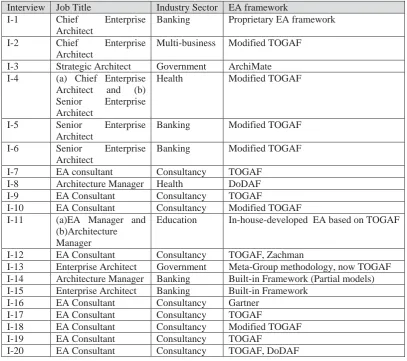
Table 1. Participants Information
Thematic analysis was conducted in this research to analyse the interview data (Fereday et al. 2006). Each interview was recorded and transcribed. After reading each interview and getting familiar with its content, it is imported to qualitative analysis tool NVivo v9 for analysis. A predefined codebook derived from the a-priori research model was used as a starting point for coding and was updated during the coding process. Both deductive and inductive coding techniques (Fereday et al. 2006) were used. At the completion of the interviews analysis, more than 70 codes were in the codebook including the ones derived from the a-priori research model. Then, newly identified codes were grouped and organised into possible themes (either generative mechanisms or outcomes). It was an iterative process back and forth in order to come to meaningful themes that describe the grouped codes.
THE A-PRIORI MODEL DEVELOPMENT
Archer (1995) proposed a morphogenetic theory for studying change. Interaction between structure and agency is complex to properly investigate in social situations and thus an “analytical” dualism whereby structure and agency are analytically separated is proposed in order to appropriately study their interaction (Archer 1995). Structure is defined as the “set of internally related objects or practices” (Sayer 1992, p. 92) that comprise the real entities we seek to examine in a particular contextual situation (Wynn et al. 2012). Archer (1995) states structures have properties (causal powers/generative mechanisms) which enable them to influence the world around them. The morphogenetic cycle has three analytical phases: structural conditioning, social interaction and structural elaboration. First, structural conditioning represents the existing structural properties prior to the intervention. They are consequences of past actions (Archer 1995). Second, social interaction is the second analytical level. During social interaction, agents engage with the pre-existing structures (Archer 1995). At this level, actions are enabled or constrained by the pre-existing structures. Finally, the third analytical level is the structural elaboration (either reproduction or transformation) of existing structures. Archer’s theory as presented earlier was adopted for three reasons. It provides an analytical approach that (1) distinguishes EA and SOA interaction into three phases and (2) facilitates the retroduction from the outcomes (phase three) to the causes (phase one and two). (3) SOA introduction also has different properties (dependent on related generative mechanisms such as different perception, different scopes and different perceived benefits) which need to be understood to comprehend the outcomes. Therefore, it was deployed as a means to better understand how the interaction between existing architectural settings and an SOA introduction can lead to different integration outcomes. It serves as an analytical tool to represent conditions, actions and outcomes during EA evolution. Such analysis is helpful when introducing SOA by considering the pre-existing conditions and SOA aspects in order to better integrate SOA within EA. The structural conditioning at T1 is called “architectural conditioning” to reflect the scope of this study comprising EA and its subsequent changes as a result of SOA introduction. The social interaction is called “architectural interaction (SOA introduction)”. SOA activities that are performed over the time period T2 to T3 are greatly influenced by both the pre-existing architectural conditions and SOA related generative mechanisms. Then, “architectural elaboration” at T4 is the result of the interplay between pre-existing architectural conditions and SOA introduction. We argue that SOA is introduced in different architectural conditions in different contexts. SOA introduction itself has multiple generative mechanisms such as different perspectives of SOA, scopes and perceived benefits which diversify SOA implementation in different contexts. When SOA is introduced, the interplay between theses architectural conditions and SOA introduction leads to the different evolution outcomes. The a-priori model is described using Archer’s (1995) morphogenetic analytical phases.
also conforms to the well-known maturity model SEI SMM (NASCIO 2003) and is widely used (Gosselt 2012).
THE EXTENDED THEORETICAL (A-PRIORI) MODEL
In this section we present the refined a-priori model (Figure 1) that explains SOA integration within EA outcomes underpinned by Archer morphogenetic theory (1995). It is developed based on the literature review (a-priori model) and extended based on the interview findings. The (*) sign on some elements of the model entails that they were inductively identified from the interview findings. The interview analysis was guided by the a-priori model. Particularly, the focus was on the architectural conditioning aspects, SOA introduction aspects and the integration outcomes. Following the analysis of the interviews, four new themes (two generative mechanisms related to the architectural conditioning phase and two integration outcomes) were identified. Other generative mechanisms related to SOA introduction emerged. However, they are not discussed in this paper due to space limitations and therefore we considered the second phase a black box as shown in Figure 1. The new emerged SOA integration within EA outcomes are “EA methods and tools” and “EA governance”. It means that SOA introduction interaction with the pre-existing architectural conditioning could lead to changes in “EA methods and tools” and/or “EA governance”. The interview findings are presented in the following sections and Figure 1 shows the theoretical (extended a-priori) model.
T1 Architectural Conditioning
T2 Architectural Interaction T3
Architectural Elaboration T4
x
Business Architecture
x
IS Architecture
x
Technical Architecture
x
EA Methods and Tools*
x
EA Governance*
SOA introduction
x
EA Maturity
x
EA Framework*
x
EA Objectives*
Figure 1. Enterprise Architecture Evolution (SOA integration) T1 Architectural Conditioning
based on how it is seen. They are classified into strategic, operational, IT and governance oriented EAs. The objectives of EA are seen to influence its use and SOA integration. For example EA consultant, I-16, commented that:
“there is a widely differing opinion on what enterprise architecture is and if you start with a different definition of EA you end up with a different relation to SOA”.
The interview findings also confirmed the relevance of EA maturity in this study as a generative mechanism. EA consultant, I-17, suggested there is a link between the architectural practice and the maturity of EA. He reported that TOGAF architecture development methodology (ADM) is used differently in alignment with the level of EA maturity. He stated:
“There’s very few people who use the whole ADM but typically people will align their architecture practice at their level of maturity with the relevant aspects of the ADM”.
EA consultant, I-12, reported based on many engagements with EA implementations that EA is still in its early maturity stages. He elaborated that a low level of maturity of EA impacts the involvement of EA within SOA and SOA introduction. He acknowledged that
“if you don’t have a mature EA capability in organisation, SOA is very unlikely to even get a look in…..If you don’t have a good EA function and have it engaged and accountable, in my opinion you cannot get SOA properly implemented”, I-12.
In summary, the interview findings suggest that there are two other important generative mechanisms besides EA maturity. They are EA framework and EA objectives. The participants reported different EA frameworks e.g. in-house-developed and modified well-known frameworks. Some of these frameworks have been changed in many morphogenetic cycles to match organisational changes. EA is also adopted for various objectives and there are different opinions about EA. The findings suggested that EA objectives have influence on SOA integration with EA. The findings also supported the proposed hypothesis that EA maturity (through its multiple dimensions) contingently affects the outcomes of SOA integration within EA.
T2 Architectural Interaction (SOA Introduction) T3
The interview findings supported the proposed generative mechanisms and additional generative mechanisms were inductively identified from the interview analysis. In this study, SOA introduction is hypothesised to be influenced by related generative mechanisms that lead to different integration outcomes within EA in different contexts. Due to space limitations they are not discussed in this paper, but this phase is mentioned here to emphasise that the action (SOA introduction) has generative mechanisms that interact with the architectural conditioning mechanisms to generate the different integration outcomes.
Architectural Elaboration T4 (Reproduction or Transformation)
Business Architecture
The interview findings showed some examples (seven cases) of this level of transformation where the SOA is integrated with the business architecture. All the cases that have reported SOA integration with the business architecture also integrated SOA with the IS and technology architectures. For example, participant, I-2, said
“we don’t differentiate between SOA architecture and EA, you know for us, SOA is very much part of the enterprise architecture... You know, until you start getting up into the information and business layers you start achieving true service orientation”,I-2.
Information System Architecture
SOA integration with the IS architecture is also supported in some of the interviews (three cases). All the cases that integrated SOA within the IS architectures have integrated it with the technology architectures as well. For example, participant, I-11, stated that SOA is integrated within the IS and the technical architectures. He noted
“the applications level has service and [service] components. At the operations level or the infrastructure level we talk about security and monitoring in terms of services”.
Chief enterprise architect, I-1, also stated that SOA is integrated within the integration architecture. He said
“Integration architecture is where we have these artefacts and everything you described right down to the service descriptions, the SLAs and the detail, all exist within it”.
Technical Architecture
The interview data supported this level of architectural elaboration. The abovementioned cases at the service-orientation of business and IS architectures level reported that SOA is integrated within EA at this level as well. In addition, participant, I-13, described their SOA integration at this architectural level. Enterprise architect, I-13, presented that SOA implementation started using a point-to-point integration using web services and a couple of years later, an enterprise service bus was introduced. He also reported that their documentation of EA and SOA was very limited. He said
“We’re not strong; we haven’t been strong in publishing a huge range of artefacts…. on a five point scale we’re somewhere between one, one and a half on SOA and probably enterprise architecture”. EA consultant, I-20, also described this limited integration aspect. He said
“People look at the service oriented architecture and then straight away they think of the technology adaptors, enterprise service buses and things like that and they forget about the business reason”, I-20.
EA methods and tools
Some participants argued that SOA introduction requires some changes to the architectural design and development methods and processes. For example, chief enterprise architect, I-1, argued that such changes need to be considered at a very early stage of SOA adoption in order to identify and build the right services. He claimed that:
“Not laying foundations first such as changes to SDLC, governance processes…” leads to “…building the wrong services”, I-1.
“So what we believe is that after the requirements, the business requirements, we need to have a service identification space. Which basically allows us to see what are the solutions that are needed and where can we actually get it... So we believe that there is a service identification and a service realisation phase that need to be a part of the life cycle of IT services in the future”.
However, participant, I-13, argued that SOA is not a new thing that needs changes to EA development methods and processes.
This observed integration outcome in some cases is convincing when existing EA methods are integrated with project and solution portfolios. This possible integration outcome is also argued for in the literature. For example, changes to EA methodology are needed to manage the service architecture (Postina et al. 2010). To do so, EA needs to be embedded in established IT management and processes. In particular, EA practices, roles and artefacts need to be integrated within the existing IT management processes and tasks (Löhe et al. 2013). EA and projects also need to be integrated to make sure that the project team develops a solution that aligns with the target architecture. This includes the definition of the architectural components, the specification of interfaces and activities needed to implement the solution (Ahlemann et al. 2012).
EA governance
The fifth possible level of architectural elaborations (integration outcomes) is SOA governance integration with EA governance. SOA governance is an important aspect to be considered when introducing SOA. However, the participants have different perspectives on SOA governance in relation to EA governance. Some participants emphasised SOA governance is part of EA governance. For example, participant, I-12, argued that
“SOA is just an architectural pattern, EA governance is the thing that is going to make this work, so SOA is part of your overall enterprise architecture governance”, I-12.
Enterprise consultant, I-18, declared that SOA is delivered as part of EA, and thus EA governance covers and influences SOA governance and practices. He said
“That [EA] governance should stem into anything that is delivered as part of the enterprise architecture which includes SOA”, I-18.
However, EA consultant, I-20, argued that SOA is a large initiative and requires its own governance practices that are aligned with architectural governance practices. It is also supported by another EA consultant, I-16. He stated that there is a relationship between EA and SOA governance on high level aspects, but EA should not get involved in low technical aspects of SOA.
“Enterprise architecture has set certain boundaries within those boundaries you can solve things in many different ways.…And especially when it gets to the lower layers of the SOA where you implement the technical services, the low level services I don’t think EA should necessarily have much to say about that”, I-16.
CONCLUSION AND OUTLOOK
As a result of the dynamic environment, the increasing pace of change and technological innovation, organisations are faced with huge challenges not only of assessing how their businesses could be affected but also how the emerging trends impact their EAs. EAs need to co-evolve with organisations in response to new technical and business paradigms. One of the more significant developments in recent years is the emergence of SOA. Several studies have attempted to provide approaches for how to integrate SOA within EA. Yet, there are different outcomes, different emphases and different representations of SOA elements. Moreover, there is a lack of empirical studies that examine EA evolution due to emergent trends. Thus, this paper aimed at better understanding the EA evolution through SOA by taking a closer look at both literature and practice based on a solid theoretical underpinning for understanding change. It employed Archer’s morphogenetic theory to understand the process of EA evolution when SOA is introduced. It built the foundations for subsequent empirical phases to further understand and explain EA evolution. Through the understanding of EA evolution, the viability of improvements arises. Such analysis is helpful to identify whether the architectural settings are needed to be enhanced prior to the dedication to SOA introduction.
REFERENCES
Ahlemann, F., Stettiner, E., Messerschmidt, M., Legner, C., and Lux, J. 2012. "Embedding Eam into the Project Life Cycle," in Strategic Enterprise Architecture Management, F. Ahlemann, E. Stettiner, M. Messerschmidt and C. Legner (eds.), Springer Berlin Heidelberg, pp. 141-168. Alwadain, A., Fielt, E., Korthaus, A., and Rosemann, M. 2011. "Where Do We Find Services in
Enterprise Architectures? A Comparative Approach. ," in The 22nd Australasian Conference on Information Systems (ACIS 2011). Sydney, Australia.
Alwadain, A., Fielt, E., Korthaus, A., and Rosemann, M. 2013a. "A Comparative Analysis of the Integration of Soa Elements in Widely-Used Enterprise Architecture Frameworks," International Journal of Intelligent Information Technologies (IJIIT) (9:2), pp 54-70.
Alwadain, A., Fielt, E., Korthaus, A., and Rosemann, M. 2013b. "Service-Oriented Architecture Integration within Enterprise Architecture: A-Priori Model," in The 24nd Australasian Conference on Information Systems (ACIS 2013). Melbourne, Australia.
Archer, M. S. 1995. Realist Social Theory: The Morphogenetic Approach, (Cambridge university press: Cambridge, UK.
Buckl, S., Ernst, A. M., Matthes, F., and Schweda, C. M. 2009. "Visual Roadmaps for Managed Enterprise Architecture Evolution," in Software Engineering, Artificial Intelligences, Networking and Parallel/Distributed Computing, 2009. SNPD '09. 10th ACIS International Conference on, pp. 352-357.
Bygstad, B., and Munkvold, B. E. 2011. "In Search of Mechanisms. Conducting a Critical Realist Data Analysis," in ICIS 2011 Proceedings.
Correia, A., and Silva, M. 2007. "Modeling Services in Information Systems Architectures.," in Digital Enterprise Technology Perspectives and Future Challenges P. F. Cunha and P. G. Maropoulos (eds.), Springer.: New York, USA, pp. 157-164.
Cuellar, M. J. 2010. "Using Realist Social Theory to Explain Project Outcomes.," International Journal of Information Technology Project Management (1:4), pp 38-52.
Fereday, J., and Muir-Cochrane, E. 2006. "Demonstrating Rigor Using Thematic Analysis: A Hybrid Approach of Inductive and Deductive Coding and Theme Development," International Journal of Qualitative Methods (5:1), pp 1-11.
Gosselt, R. 2012. "A Maturity Model Based Roadmap for Implementing Togaf," in 17th Twente Student Conference on IT: Enschede, The Netherlands.
Infosys. (2009). Enterprise Architecture Expands Its Role in Strategic Business Transformation, Infosys Enterprise Architecture Survey 2008/2009. Retrieved February, 05, 2010, from
http://www.infosys.com/offerings/IT-services/architecture-services/ea-survey/Pages/index.aspx
Joachim, N., Beimborn, D., Schlosser, F., and Weitzel, T. 2011. "Does Soa Create or Require It/Business Collaboration? Investigating Soa’s Potential to Reduce the Gap between It and Business," in The 2011 International Conference on Information Systems (ICIS).
Joachim, N., Beimborn, D., and Weitzel, T. 2013. "The Influence of Soa Governance Mechanisms on It Flexibility and Service Reuse," The Journal of Strategic Information Systems (22:1) 3//, pp 86-101.
Jung, C. 2009. "Actionable Enterprise Architecture.," in The 10th ACIS International Conference on Software Engineering, Artificial Intelligences, Networking and Parallel/Distributed Computing, pp. 294-299.
Kistasamy, C., van der Merwe, A., and De La Harpe, A. 2010. "The Relationship between Service Oriented Architecture and Enterprise Architecture," in 14th IEEE International Enterprise Distributed Object Computing Conference, pp. 129-137.
Kistasamy, C., Van der Merwe, A., and De La Harpe, A. 2012. "The Role of Service Oriented Architecture as an Enabler for Enterprise Architecture," in The 18th Americas Conference on Information Systems Seattle, Washington
Kokko, T., Antikainen, J., and Systa, T. 2009. "Adopting Soa- Experiences from Nine Finnish Organizations.," in 13th European Conference on Software Maintenance and Reengineering. Löhe, J., and Legner, C. 2013. "Overcoming Implementation Challenges in Enterprise Architecture
Management: A Design Theory for Architecture-Driven It Management (Adrima)," Information Systems and e-Business Management) 2013/02/01, pp 1-37.
Martin, R., Purao, S., and Robertson, E. 2009. "Evolving Enterprise Architecture," in Next Generation Enterprise Architecture ICEIMT Workshop: Bled, Slovenia.
McKendrick, J. (2010). Top 10 Enterprise Architecture Trends, Identified by Forrester. Retrieved March 02, 2011, from http://www.zdnet.com/blog/service-oriented/top-10-enterprise-architecture-trends-identified-by-forrester/5949
NASCIO. (2003). Nascio Enterprise Architecture Maturity Model. Retrieved 20 March, 2011 from http://www.nascio.org/publications/documents/NASCIO-EAMM.pdf
Patton, M. Q. 2001. Qualitative Research & Evaluation Methods, (Sage Publications: Thousand Oaks, CA.
Perko, J. 2008. It Governance and Enterprise Architecture as Prerequisites for Assimilation of Service-Oriented Architecture. Phd Thesis., Tampere University of Technology.
Postina, M., Trefke, J., and Steffens, U. 2010. "An Ea-Approach to Develop Soa Viewpoints," in 14th IEEE International Enterprise Distributed Object Computing Conference., pp. 37-46.
Sampaio, A. 2010. An Approach for Creating and Managing Enterprise Blueprints. Unpublished Thesis.
Sayer, R. A. 1992. Method in Social Science : A Realist Approach, (2nd ed.) Routledge: London. Schekkerman, J. 2005. The Economic Benefits of Enterprise Architecture., (Trafford: Victoria, BC,
Canada.
Schelp, J., and Aier, S. 2009. "Soa and Ea—Sustainable Contributions for Increasing Corporate Agility.," in The 42nd Hawaii International Conference on System Sciences., pp. 1-8.
Shah, H., and Golder, P. 2011. "Adappt: Enterprise Architecture Thinking for Information Systems Development," International Journal of Computer Science Issues (8:1).
Sousa, P., Lima, J., Sampaio, A., and Pereira, C. 2009. "An Approach for Creating and Managing Enterprise Blueprints: A Case for It Blueprints," A. Albani, J. Barjis and J. L. G. Dietz (eds.), Springer Berlin Heidelberg, pp. 70-84.
The Open Group 2009. The Open Group Architecture Framework Togaf, (Van Haren Publishing: LJ Zaltbommel, the Netherlands.
The Open Group. (2010). Definition of Soa Retrieved January, 20, 2010, from http://www.opengroup.org/projects/soa/doc.tpl?gdid=10632
Viering, G., Legner, C., and Ahlemann, F. 2009. "The (Lacking) Business Perspective on Soa–Critical Themes in Soa Research. ," in Wirtschaftsinformatik. , pp. 45-54.