Speedup of Shielding Current Analysis in High-Temperature
Superconducting Film: Implementation of
H
-Matrix Method
∗
)
Atsushi KAMITANI, Teruou TAKAYAMA, Ayumu SAITOH and Hiroaki NAKAMURA
1)Yamagata University, 4-3-16 Johnan, Yonezawa, Yamagata 992-8510, Japan
1)National Institute of Fusion Science, 322-6 Oroshi, Toki, Gifu 509-5292, Japan
(Received 28 November 2015/Accepted 3 March 2016)
Numerical techniques are proposed for accelerating a linear-system solver appearing in the virtual-voltage method. After the proposed techniques are implemented to a numerical code for analyzing the shielding current density in a high-temperature superconducting film, their performance is numerically evaluated. The results of computations show that, if GMRES is incorporated as a linear-system solver, the speed of the virtual-voltage method will be remarkably enhanced. Moreover, it is also found that the implementation of theH-matrix method to matrix-vector multiplications in GMRES will further improve the speed of the virtual voltage method.
c
2016 The Japan Society of Plasma Science and Nuclear Fusion Research
Keywords: high-temperature superconductor,H-matrix method, Newton method DOI: 10.1585/pfr.11.2405041
1. Introduction
Recently, a high-temperature superconducting (HTS) film has been used for numerous engineering applications: magnet, energy storage system, power cable and so on. Since evaluation of the shielding current density is indis-pensable for the design of such engineering applications, several numerical methods [1–3] have been so far devel-oped for analyzing the shielding current density. These methods are classified into two categories, according to the order of time- and space-discretizations.
After spatially discretized, an initial-boundary-value problem of the shielding current density is transformed to an initial-value problem of semi-explicit differential al-gebraic equations (DAEs) especially for the case where cracks are contained in an HTS film. The authors pro-posed a fast and stable algorithm [2] for solving the DAEs with the blockLUdecomposition. Throughout the present study, this method is called the DAE method.
On the other hand, time-discretization of the initial-boundary-value problem yields a problem in which a non-linear boundary-value problem is solved at each time step. However, the solution of the nonlinear problem by the Newton method is extremely time-consuming. This is mainly because a linear system with a dense matrix has to be solved at each iteration of the Newton method. This method is called the virtual-voltage method [3].
The purpose of the present study is to develop numer-ical techniques for speeding up the virtual-voltage method and to numerically investigate how they affect its perfor-mance.
author’s e-mail: [email protected]
∗)This article is based on the presentation at the 25th International Toki
Conference (ITC25).
2. Governing Equations
We first assume that an HTS film has the same cross sectionΩover the thickness and that it is exposed to the time-varying magnetic field B/μ0. By taking its
thick-ness direction as z-axis and choosing its centroid as the origin, we use the Cartesian coordinate system O : ex,ey,ez. Furthermore, the HTS film is assumed to con-tainmcracks whose cross sections are line segments in the
xy plane. Note that the boundary∂Ω of Ωis composed of not only the outer boundaryC0 but also crack surfaces
C1,C2,· · ·,Cm. In the following,xandxdenote position vectors of two points in thexyplane, whereas tandnare a unit tangent vector and a unit normal vector on∂Ω, re-spectively. In addition,bdenotes a film thickness.
In HTS films, the electric field E and the shielding current density jare closely related to each other through the J-E constitutive relation. As the relation, we assume the following power law [2–5]:
E=E(j) j
j, E(j)=EC
j jC
N
,
where j≡ |j|. Also, jCandECdenote the critical current
density and the critical electric field, respectively, andNis a positive constant.
Under the thin-plate approximation, there exists a scalar functionT(x,t) such that j=(2/b)∇ ×(Tez), and its time evolution is governed by the following equation [2,3]:
μ0∂∂
t( ˆWT)+(∇ ×E)·ez=− ∂
∂tB·ez. (1)
Here, denotes an average operator over the thickness and the operator ˆWis defined by
ˆ
WT ≡2T(x,t)
b +
ΩQ(|x−x
|)T(x,t)d2x,
c
whereQ(r)=−(πb2)−1[r−1−(r2+b2)−1/2].
The initial and boundary conditions to (1) are assumed as follows: T =0 att=0,T ∈ H( ¯Ω) andhi(E)≡
CiE·
tds = 0 (i = 1,2,· · ·,m). Here, sis an arclength along crack surfacesC1,C2,· · ·,CmandH( ¯Ω) is a function space defined by
H( ¯Ω)≡⎧⎪⎪⎨⎪⎪⎩w(x) :w=0 on C0, ∂
w ∂s=0 on
m
i=1
Ci⎫⎪⎪⎬⎪⎪⎭.
The boundary conditionT ∈H( ¯Ω) is derived fromj·n=0 on∂Ω, whereashi(E)=0 is the integral form of Faraday’s law around the crack surfaceCi. By solving (1) together with the initial and boundary conditions, we can investigate the time evolution of the shielding current density.
3. Virtual-Voltage Method
Throughout this section, a superscripts (l) denotes a value at timet = lΔt, whereΔt is a time-step size. For example, T(x,lΔt) is denoted by T(l)(x). Also, an inner
product is defined by (f,g)Ω≡
Ω
f(x)g(x)d2x.
If the initial-boundary-value problem of (1) is dis-cretized with respect to time, T(l)(x) becomes a solution
of the following nonlinear boundary-value problem:
G(T)≡μ0WTˆ + Δtez·(∇ ×E)−u=0 in Ω, (2) hi(E)=0 (i=1,2,· · · ,m), (3)
T ∈H( ¯Ω), (4)
whereu≡μ0WTˆ (l−1)− (B(l)−B(l−1))·ez.
Although the above boundary-value problem can be easily solved with the finite element method (FEM), the accuracy of its numerical solution will be degraded with a decrease in the film thicknessb. Especially, the numeri-cally calculated valueNi(E) ofhi(E) does not always be-come negligibly small. In order to resolve this difficulty, the authors proposed the virtual-voltage method [3]. In the method, virtual voltagesφ1, φ2,· · ·, φmare applied around C1,C2,· · ·,Cm, respectively, so as to have Ni(E) = 0 exactly satisfied. In other words, (3) is replaced with
hi(E)=φiandNi(E)=0 (i=1,2,· · ·,m). The resulting boundary-value problem is solved for (T,{φi}mi=1) by means
of the Newton method.
In each iteration of Newton method, the following lin-ear boundary-value problem is solved for (δT,{δφi}mi=1):
δG=−G(T), (5)
δhi−δφi=−[hi(E)−φi] (i=1,2,· · · ,m), (6)
δNi=0 (i=1,2,· · ·,m), (7)
δT ∈H( ¯Ω). (8)
Here,δT andδφiare corrections ofT andφi, respectively, whereas δG, δhi and δNi denote Fr´echet derivatives of
G(T),hi(E) and Ni(E), respectively. After a straightfor-ward calculation, we can prove that (5) and (6) are equiva-lent to the following weak form:
∀w∈H( ¯Ω) :
μ0(w,Wˆ(T+δT))Ω+ Δt(1,(∇w×ez)·(E+δE))Ω
+Δt m
i=1
w(Ci) (φi+δφi)=(w,u)Ω. (9)
Here,w(Ci) is a unknown constant1, whichw(x) takes on Ci, andδEis given by
δE= 2
b
d d j
E(j)
j
j⊗ j
j +
E(j)
j I
·(∇δT×ez),
whereIis an identity tensor of the 2nd order.
If (7), (8) and (9) are spatially discretized with the FEM, we get
⎡ ⎢⎢⎢⎢⎢
⎢⎢⎢⎢⎣ AC(T)T CO OF DT(T) O O
⎤ ⎥⎥⎥⎥⎥ ⎥⎥⎥⎥⎦ ⎡ ⎢⎢⎢⎢⎢ ⎢⎢⎢⎢⎣δλT
δφ
⎤ ⎥⎥⎥⎥⎥
⎥⎥⎥⎥⎦=G(T,φ), (10)
whereδTis a nodal vector correspondingδT andδφis de-fined byδφ ≡[δφ1, δφ2,· · ·, δφm]T. In addition, A(T),C andFare then×n,n×kandn×mmatrices, respectively, andDT(T)δT = 0is a discretized form of (7). Further-more, G(T,φ) ∈ Rn+k+mis a vector-valued function of T andφ. Also, n andk denote the total number of nodes and that of nodes only on crack surfaces, respectively, and they are assumed to satisfynk>m. Equation (10) has an asymmetric coefficient matrix and, hence, it has been so far solved with theLUdecomposition. In contrast, we propose that (10) be solved by GMRES. Since the opera-tion count required for GMRES is almost proporopera-tional to the square of the number of unknowns, the operation count required for the virtual-voltage method is expected to be reduced toO(n2). For this reason, GMRES is incorporated into the virtual-voltage method as a linear-system solver.
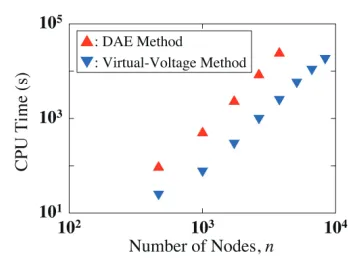
For the purpose of comparing the speed of virtual-voltage method with that of the DAE method, CPU times required for both methods are measured on FUJITSU PRIMEHPC FX100 of LHD Numerical Analysis Server in National Institute of Fusion Science. Dependences of CPU times on the numbernof nodes are depicted in Fig. 1. Al-though CPU times for both methods are in rough propor-tion ton2.5±0.1, the virtual-voltage method is about 10 times
faster than the DAE method.
4. Acceleration Techniques
4.1
Speedup strategy
As is apparent from Section 3, the numerical solu-tion of (10) becomes a rate-determining step at each time in the virtual-voltage method. On the other hand, GM-RES is an iterative linear-system solver and matrix-vector
1Since∂w/∂s=0 is satisfied onC
i,w(x) becomes constant on the
Fig. 1 CPU times as functions of the number of nodes. Here, the initial-boundary-value problem of (1) is solved from
t=0 tot=Aw/(4v) by means of either the DAE method or the virtual voltage method. Physical and geometrical parameters are assumed to be the same values as used in Section 4.3.
multiplications are the most time-consuming at each iter-ation of GMRES. Thus, in order to accelerate the virtual-voltage method, matrix-vector multiplications have to be performed with high speed.
Let W be an FEM matrix, corresponding to the op-erator ˆW, in which the boundary condition onC0 is also taken into account. Apparently,Wis a dense matrix. If the contribution ofW is subtracted from the coefficient ma-trix in (10), the remaining mama-trix becomes sparse. This means that the matrix-vector multiplicationWvis the most time-consuming at each iteration of GMRES. Therefore, the virtual-voltage method can be accelerated by using the high-speed matrix-vector multiplicationWv.
In order to realize the fast matrix-vector multiplication
Wv, the following two transformations are applied toW.
1. The matrixWis divided into a set of submatrices. 2. Only if a p×qsubmatrixW(σ,τ) satisfies a specified
condition, it is approximated by the ACA decomposi-tion [6, 7]: W(σ,τ) UVT. Here, UandV are p×r andq×rmatrices, respectively, andrdenotes an ap-proximate rank ofW(σ,τ).
In fact,O(pq) andO(r(p+q)) operations are required for matrix-vector multiplicationsW(σ,τ)vτandUVTvτ,
respec-tively. Hence, if the inequalityr< pq/(p+q) is satisfied for all approximated submatrices, the high-speed matrix-vector multiplicationWvis realized.
4.2
H
-matrix method
In the present study, the above two transformations are simultaneously performed by means of theH-matrix method [6, 7]. In theH-matrix method, a cluster tree is first generated on the basis of the information on node po-sitions. In other words, after a set of all nodes is assumed as a root clusterσR, a cluster tree is constructed by using
the following two steps:
1. A minimum axis-parallel rectangle is formed so as to
contain all nodes belonging to the cluster. Such a rect-angle is called a bounding box of the cluster.
2. The cluster is divided into two child clusters by means of a line segment linking middle points on two longer sides of the bounding box.
The above two steps are recursively repeated while the number of nodes contained in a cluster is greater than a certain threshold. In the following, each cluster is consid-ered to contain not a set of nodes but a set of node numbers. Next,W is transformed to anH-matrix by using the cluster tree. Specifically, for a cluster pair ofσandτon the same level in the tree, we check whether the admis-sibility condition, min[diag(σ),diag(τ)] ≤ ηdist(σ, τ), is satisfied or not. Here, diag(σ) denotes a diagonal length of the bounding box ofσ, whereas dist(σ, τ) is a distance between bounding boxes of σandτ. In addition, ηis a positive constant. The results of this check are classified into the following three cases:
A For the case where the admissibility condition is sat-isfied, the submatrixW(σ,τ), which corresponds toσ andτ, is approximated by the ACA decomposition. B For the case where the admissibility condition is not
fulfilled and eitherσorτis a leaf of the cluster tree,
W(σ,τ)is not approximated but stored as it is.
C Otherwise, the admissibility condition is checked for four pairs, each of which is composed of child clusters ofσandτ.
By starting the above check for a pair of two root clusters2,
σRandσR, we can obtain anH-matrix forW.
4.3
Speedup e
ff
ect of
H
-matrix method
The authors developed a numerical code for analyz-ing the time evolution of the shieldanalyz-ing current density in an HTS film with cracks. For the purpose of further speed-ing up the code, theH-matrix method is implemented to GMRES.
In order to investigate the effect of the H-matrix method on the speedup of the shielding current analysis, the scanning permanent-magnet method (SPM) [2, 8] is numerically simulated. In the SPM, a cylindrical perma-nent magnet of radiusRand heightHis moved along the surface of an HTS film and, simultaneously, an electro-magnetic force acting on the film is monitored. During the movement of the magnet, the distanceLbetween the mag-net bottom and the film surface is kept constant. In the following, an HTS film is assumed to have a rectangular cross sectionΩof widthwand length Aw, and cross sec-tions of cracks are assumed to be line segments of length
Lc. In addition, the longitudinal direction of Ω is taken
as x-axis. Also, the symmetry axis of the magnet is de-noted by (x,y) = (xA,yA), and its movement is assumed
2The matrixWcan be expressed as its submatrixW
(σR,σR)
correspond-ing to a pair of two root clusters,σRandσR. Hence, the admissibility
(a)
(b)
Fig. 2 Residual histories of GMRES att=Aw/(1200v). Here, (a) and (b) are obtained for the 1st and 13th iterations of the Newton method, respectively.
asxA =vt−Aw/2 andyA =const.Here,vis a scanning speed. Throughout the present study, the physical and ge-ometrical parameters are fixed as follows:R=0.8 mm,H
=2 mm,L =0.5 mm,v=10 cm/s,yA=0 mm, jC =1 MA/cm2,E
C =1 mV/m, N=20,b=1µm,A=11,w=
12 mm,Lc=4 mm andm=2.
Let us first investigate how theH-matrix method af-fects the residual history of GMRES. To this end, residual histories are determined for GMRES with/without the H-matrix method and they are depicted in Figs. 2 (a) and 2 (b). At the initial iteration of the Newton method, the residual history is hardly influenced by the implementation of the H-matrix method (see Fig. 2 (a)). On the other hand, at the almost final iteration of the Newton method, the resid-ual norm is slightly affected by theH-matrix method (see Fig. 2 (b)). However, if the number of iterations required for convergence of GMRES is denoted by Mc, the
H-matrix method scarcely changesMc. In order to investigate
these tendencies quantitatively, the sum ofMcis calculated
as a function of time and is depicted in Fig. 3. This fig-ure indicates that curves for GMRES with and without the H-matrix method are overlapping with each other. This result shows that, at each time step, theH-matrix method has little effect on the total number of GMRES iterations. Hence, it is the speed of the matrix-vector multiplication
Wv that essentially determines the speed of the virtual-voltage method.
Fig. 3 Total number of GMRES iterations as functions of time.
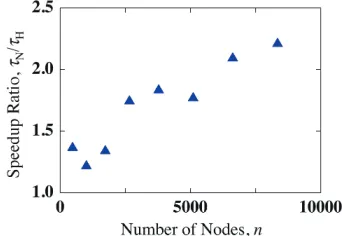
Fig. 4 Dependence of the speedup ratioτN/τHon the number of
nodes.
Finally, we investigate the influence of theH-matrix method on the speedup of the virtual-voltage method. To this end, the speedup ratioτN/τHis measured as functions
ofnand is depicted in Fig. 4. Here,τNandτHdenote CPU
times required for the execution of the code with and with-out theH-matrix method, respectively. The speedup ratio
τN/τHincreases roughly with increasing number of nodes
and it always exceeds unity. In other words, theH-matrix method can accelerate the numerical code for the shielding current analysis and its speedup effect will be enhanced with an increase in the number of nodes. From these re-sults, we can conclude that theH-matrix method is eff ec-tive for a large-sized shielding current analysis in an HTS film containing cracks.
5. Conclusion
We have proposed numerical techniques for acceler-ating a linear-system solver that appears in the virtual-voltage method. In addition, we have implemented them to a numerical code for analyzing the shielding current den-sity in an HTS film with cracks. By using the code, the per-formance of the proposed techniques has been evaluated numerically. Conclusions obtained in the present study are summarized as follow.
1. When GMRES is implemented as a linear-system solver, the virtual-voltage method is about 10 times faster than the DAE method.
GM-RES enables the virtual-voltage method to show an even higher speed.
Acknowledgment
This work was supported in part by Japan Society for the Promotion of Science under a Grant-in-Aid for Scien-tific Research (C) No. 26520204, No. 15K05926. A part of this work was also carried out with the support and un-der the auspices of the NIFS Collaboration Research pro-gram (NIFS15KNTS041, NIFS15KNXN297).
[1] Y. Yoshida, M. Uesaka and K. Miya, IEEE. Trans. Magn.30, 3503 (1994).
[2] A. Kamitani, T. Takayama, A. Saitoh and H. Nakamura,
Plasma Fusion Res.10, 3405023 (2015).
[3] A. Kamitani, T. Takayama and S. Ikuno, IEEE Trans. Magn.
49, 1877 (2013).
[4] R. Brambilla, F. Grilli and L. Martini, IEEE Trans. Appl. Supercond.22, 8401006 (2012).
[5] A. Kameni, M. Boubekeur, L. Alloui, F. Bouillault, J. Lam-bretchs and C. Geuzaine, IEEE Trans. Magn.50, 7009204 (2014).
[6] S. Kurz, O. Rain and S. Rjasanow, IEEE Trans. Magn.38, 421 (2002).
[7] V. Le-Van, B. Bannwarth, A. Carpentier, O. Chadebec, J.M. Guichon and G. Meunier, IEEE Trans. Magn. 50, 7010904 (2014).