Published online November 30, 2013 (http://www.sciencepublishinggroup.com/j/ajsea) doi: 10.11648/j.ajsea.20130206.13
Optimal performance model investigation in
component-based software engineering (CBSE)
Muhammad Osama Khan, Ahmed Mateen, Ahsan Raza Sattar
Department Of Computer Science, University of Agriculture Faisalabad, Pakistan
Email address:
[email protected] (M. O. Khan), [email protected] (A. Mateen)
To cite this article:
Muhammad Osama Khan, Ahmed Mateen, Ahsan Raza Sattar. Optimal Performance Model Investigation in Component-Based Software Engineering (CBSE). American Journal of Software Engineering and Applications. Vol. 2, No. 6, 2013, pp. 141-149.
doi: 10.11648/j.ajsea.20130206.13
Abstract:
Commercial off-the-shelf (COTS) technologies have emerged over the past decade. COTS technology gained significant popularity by developing the optimal, efficient, economically and quickly software system that mapping busi-ness requirement. As a consequence, the need for designing effective strategies for enabling large scale reuse, whilst over-coming the risks involved in the use of a particular technology, still remains. In this situation, the use of “COTS” technol-ogy introduces many problematic factors that still have not been fully solved; some of them are the lack of inclusive tools, efficient methods to manage and collect the required information for supporting COTS software selection. Keeping in view all these issues in this research report present an Optimal Performance Model (OPM) for gathering the information that is needed to define COTS market segments in a way that would make software components selection more effective and effi-cient. Mostly the information we collect possess huge diversity therefore suggest OPM’s that will certainly help to cover different aspects and fields of COTS software selection. This design model will base on several software quality standards. Commercial of the shelf software has gained considerable popularity as approach that quickly and economical creates software system that address business requirement. This research work will presents an approach for defining assessment principles for reusable software components.Keywords:
COTS, CBSE, ERP, DBMS, BPR1. Introduction
An efficient and effective software components selection method is necessary to deliver full Capable to the COTS technology. There are many COTS selection techniques, processes and methodologies that have been articulated. COTS-based systems development requires specific activi-ty like desire component selection, composition and last but not least the most important is component integration. After the successful working of this technique it became more popular as a result of this today a large number of software components are commercially available, components selec-tion a to fulfill the all system requirements which minimize the cost of the system software [21]. In COTS for large system are become common a days. Due to low budget, enhance the system requirement, accelerating rates of COTS improvement defined by software Engineering In-stitute (SEI). Building cost optimal components is very difficult job. Selecting the best components in cots selec-tion presented many challenges to software engineer to
devel-oping organizations are spending a large amount of time in COTS selection since the choice of the suitable components has a major effect on the project and final product [17]. We have developed OPM that addresses the selection process, Components software package. OPM has been introduced which supports the selection, search, and evolution of reusable software components and provides specific pro-cedures for defining the development quality standards. If OPM for selection component is not defined then each project finds its own procedure to complete it. This model compares the cost of individual components for cost opti-mization and analyses the benefits of alternative selection components [28]. Software development organization in-itiated process for definition of requirements for customer business process in COTS Enterprise Resource Planning (ERP). The software modules are available for commercial vendors that support business processes such as production planning, finance, human resource, accounting and pro-curement. COTS-ERP integrating the data required for these business processes in a logically single database [7]. COTS ERP systems are based on the principle that the software vendor can map the common business processes more effectively and efficiently than customer organiza-tions. Because ERP software is maintained by the vendor and developing of business processes defined by the vendor. Return on the investment (ROI) of customer and Total cost savings are based on the developing organization adopting the business process [8].Mostly ERP system the required limited customization through changes to configuration settings in the specific module .Configuration setting of the components up to standard then software required less maintenance costs ,if configuration settings is unsupported then software maintenance costs is increase, consequently reducing the overall return on the consumer’s investment [13].More and more organizations going toward standardi-zation regarding their process then resulting several organ-izations like public, state, local government and private are either implementing or planning to implement COTS-ERP systems. COTS -ERP system integrating the required data from these modules in a logically single database [28].
2. Objectives
OPM will satisfy the consistent and relevant system re-quirement with high quality and reliability for software development.OPM will select and test the candidate com-ponents. Component development will lead to the final components that satisfying the requirements with correct
and expected results. The OPM are to select and test the candidate components and check whether they satisfy the system requirement with high reliability and quality.
The system architecture design are to collect the users requirement, identify the system specification, select ap-propriate system architecture, and determine the imple-mentation details such as platform, programming languages, etc.
3. Materials and Methods
The increased commercial availability of embeddable software components, standardization of basic software environments (such as Microsoft Windows, UNIX), and the explosive popularity of the Internet has resulted in a new situation for reusable software consumers: there are many more accessible reuse candidates. Consequently, many or-ganizations are spending much time in reusable component selection since the choice of the appropriate components has a major impact on the project and resulting product. The component selection process is not defined so each project finds its own approach to it. Here a method has been introduce which supports the search, evolution and selection of reusable software and provides specific tech-niques for defining the evolution criteria, comparing the cost and benefits of alternatives and consolidating the evo-lution and selection and benefits of alternatives and conso-lidating the evolution results in decision making.
Component-Based Software Engineering (CBSE) is concerned with composing, selecting and designing com-ponents. As this approach become the more popular of and consequently several commercially available software components grows, selecting group of required components to full fill the requirements even though minimizing cost is becoming more hard. Optimal component systems selec-tion is not an easy task. It requires not only optimal com-ponents selection, although also to take their relationship into account. Selecting component problem described in this research paper. To accomplish this goal, we must to assign each component a set of requirements which satis-fies. Each component is assigned a unit cost which is the overall cost of acquirement and integration of that compo-nent. Several organizations have supported their reuse with E technologies. Component Based ERP systems have packages which offered by commercial vendors. These packages support main administrative processes such as accounting, procurement, budgeting and human resource management. These integrated System in a single database.
Table 1. Difference between Traditional software development and component based Software development
Traditional Software Development Custom Development Component based Software development
Requirements
Creation of system requirements to create a
Software system that meets these requirements (the engineers are producers).
Creation of a set of flexible requirements followed by the COTS marketplace exploration for selecting components that best fit these requirements. The engineers are consumers who then integrate the products.
Design Analyze requirements to produce a depiction of the
internal structure and integration of the system that
Traditional Software Development Custom Development Component based Software development
will serve the foundation for its construction. trade-off process of requirements analysis, architec-ture, COTS availability, prioritization and negotia-tion.
Construction Coding the detailed design to implement the system
requirements
Some requirement functionalities that were not ad-dressed by any COTS are usually developed in-house. In any case, usually glue code is used to mediate components interactions; as well as bridges or adaptors to smooth over incompatibilities in the component interfaces.
Testing Integration and evaluation of the product quality by
verifying its behavior by a finite set of test cases
Although COTS are tested by the component provid-er, they should be retested by the user to assure their suitability and their good system integration
Maintenance Modification to code and associated documentation
due to a problem or need for improvement
Due to maintenance effects, COTS-Based systems undergo a technology refresh and renewal cycle that has many implications.
Table 2. Advantages and disadvantages of using COTS software
Advantages Disadvantages
Immediately available; earlier payback Licensing, intellectual property procurement delays
Avoids expensive development Up-front licensing fees
Avoids expensive maintenance Recurring maintenance fees
Predictable, confirmable license fees and performance Reliability often unknown or inadequate; scale difficult to change.
Better functionality Too-better functionality compromises performance and usability.
Repeated upgrades often expect organization’s needs No control over maintenance and upgrades.
Broadly mature and use technologies Constraints on efficiency and functionality.
Devoted support organization Dependence on vendor
roadway technology needs Synchronizing multiple-software vendors.
Hardware /software independent. Integration not always trivial; incompatibilities among vendors.
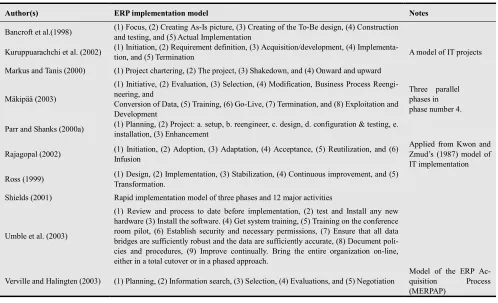
Table 3. ERP implementation models
Author(s) ERP implementation model Notes
Bancroft et al.(1998) (1) Focus, (2) Creating As-Is picture, (3) Creating of the To-Be design, (4) Construction and testing, and (5) Actual Implementation
Kuruppuarachchi et al. (2002) (1) Initiation, (2) Requirement definition, (3) Acquisition/development, (4)
Implementa-tion, and (5) Termination A model of IT projects
Markus and Tanis (2000) (1) Project chartering, (2) The project, (3) Shakedown, and (4) Onward and upward
Mäkipää (2003)
(1) Initiative, (2) Evaluation, (3) Selection, (4) Modification, Business Process Reengi-neering, and
Conversion of Data, (5) Training, (6) Go-Live, (7) Termination, and (8) Exploitation and Development
Three parallel phases in phase number 4.
Parr and Shanks (2000a) (1) Planning, (2) Project: a. setup, b. reengineer, c. design, d. configuration & testing, e. installation, (3) Enhancement
Rajagopal (2002) (1) Initiation, (2) Adoption, (3) Adaptation, (4) Acceptance, (5) Reutilization, and (6) Infusion
Applied from Kwon and Zmud’s (1987) model of IT implementation
Ross (1999) (1) Design, (2) Implementation, (3) Stabilization, (4) Continuous improvement, and (5) Transformation.
Shields (2001) Rapid implementation model of three phases and 12 major activities
Umble et al. (2003)
(1) Review and process to date before implementation, (2) test and Install any new hardware (3) Install the software. (4) Get system training, (5) Training on the conference room pilot, (6) Establish security and necessary permissions, (7) Ensure that all data bridges are sufficiently robust and the data are sufficiently accurate, (8) Document poli-cies and procedures, (9) Improve continually. Bring the entire organization on-line, either in a total cutover or in a phased approach.
Verville and Halingten (2003) (1) Planning, (2) Information search, (3) Selection, (4) Evaluations, and (5) Negotiation
Model of the ERP
Ac-quisition Process
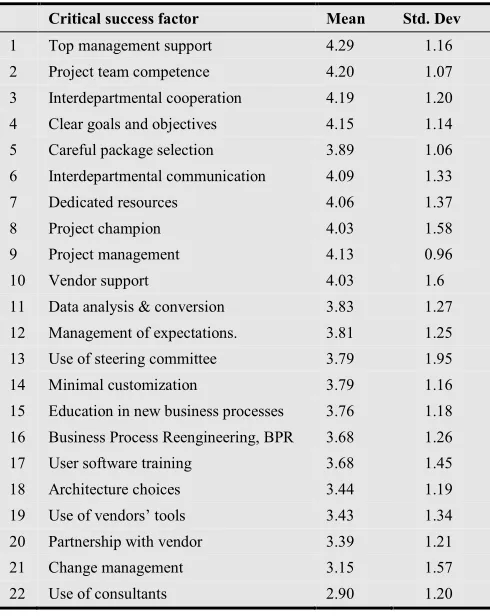
The Critical Success Factors in ERP implementation are described in addition to of the general literature on IT im-plementation, project management and Business Process Reengineering (BPR). This list was rated by IT managers. The consensus concerning ERP implementation is that multiple factors affect success. They have defined imple-mentation project success as a function of critical success factors (CSFs). ERP implementation research has widely tried to specify the CSFs of ERP implementation projects.
Table 4. Critical success factors of ERP implementation
Critical success factor Mean Std. Dev
1 Top management support 4.29 1.16
2 Project team competence 4.20 1.07
3 Interdepartmental cooperation 4.19 1.20
4 Clear goals and objectives 4.15 1.14
5 Careful package selection 3.89 1.06
6 Interdepartmental communication 4.09 1.33
7 Dedicated resources 4.06 1.37
8 Project champion 4.03 1.58
9 Project management 4.13 0.96
10 Vendor support 4.03 1.6
11 Data analysis & conversion 3.83 1.27
12 Management of expectations. 3.81 1.25
13 Use of steering committee 3.79 1.95
14 Minimal customization 3.79 1.16
15 Education in new business processes 3.76 1.18
16 Business Process Reengineering, BPR 3.68 1.26
17 User software training 3.68 1.45
18 Architecture choices 3.44 1.19
19 Use of vendors’ tools 3.43 1.34
20 Partnership with vendor 3.39 1.21
21 Change management 3.15 1.57
22 Use of consultants 2.90 1.20
3.1. Optimal Performance Model
We suppose that components are provided with interfaces that explicitly declare the component estimated performance properties. The estimate performance which better fulfills the non-functional and performance-related requirements could be used by the Software Architect. Items in the factor “Project Success” are divided into two groups “Progress” and “Quality” The new factor “Progress” includes questions about project completion on time and within budget, while “Quality” has questions related to system quality and the scope matched with the company’s needs. The other va-riables remained the same as they were in the pilot survey. “Function” is the most important factor for “Quality” of the ERP system. It indicates that selecting the right software and defining the necessary functions should be given the most consideration to enhance the overall quality of the ERP system. “Consultant Support” can also impact on “Quality, but there is no impact expected from “Internal Support”.
Figure 1. Optimal Performance Model
3.2. Survey Questionnaire
This questionnaire (which starts on the following page), gives you an opportunity to tell us your reactions to the SAP-ERP applications you used. The user responses help us to understand different aspects of the ERP system. The results have been used for research purpose only and we will not identify any Organization or individual in any pub-lication.
Please read each statement and indicate how strongly us-ers agree or disagree.
Table 5. Evaluating Oracle ERP Application
1
2
3
4
5
6
Name (Optional):
Current Position:
Work Experience with SAP-ERP Applications:
Work Experience with other ERP Applications:
No of ERP Implementation Project done & Roles:
Names of ERP Implementation Organization
QUESTIONNAIRE
1 It is easy to learn and understand several transactions involves for completing one business process?
2 It is easy to learn and understand the total number of transactions involves for completing whole Module level business process?
3 Overall, ERP application requires minimum number of transactions to complete business processes?
4 I am satisfied the way transactions and business processes are or-ganized in ERP application?
5 Business processes wise training or reference material for different module is easily available from ERP Vendor or Consultant?
6 It is easy to perform data cleansing & harmonization in ERP appli-cation?
7 It is easy to perform data transformation task in ERP application?
8 It is easy to perform testing and data loading in ERP application?
9 It is easy to perform data migration by using API method?
10 Overall, it is easy to learn the process of data migration in this ERP application?
11 Once learned, it is easy to remember data migration process after a period of non-use (at least one or few months)?
12 Service response time on error messages from ERP vendor is too slow?
13 Many peoples handling the same error for service request causes slow responses time?
14 I like using the User interface of ERP application?
15 ERP application has all the functionalities and capabilities that I expect it to have?
16 Overall, I am satisfied with this ERP application?
17 In ERP implementation projects the degree of top management team contributions in support, planning and training, with respect to re-spondents.
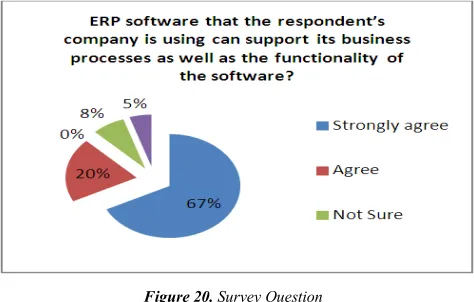
18 ERP software can support its business processes as well as the func-tionality of the respondent’s company.
4. Results and Discussion
In last four decades information systems have been de-veloped, There are so much research has been conducted to comprehend the develop systems customized to a specific organization. During the last 10 years it however became clear that a different practice had slowly emerged in the area of Enterprise Systems Software. Thus over the years it had become more and more common for software providers to reuse existing code (code developed for prior customer) whenever developing an Information System for a new customer. Thus most Enterprise Software had become pre-developed software targeted at specific lines of busi-nesses instead of tailor-made software for a specific cus-tomer. This phenomenon can be observed for different kinds of software e.g. Enterprise Resource Planning (ERP) software, Supply Chain Management (SCM) software, and Project Management (PM). In this thesis I will focus on ERP package software.
Figure 2. Survey Respondents’ Position in their Company
Figure 3. No of year SAP ERP Experience
Figure 4. No of year SAP ERP Implementation
The pilot survey was developed by using Google docs and was conducted as a web-based survey. The link to the survey was sent to the contacted individuals so that they can distribute it to other possible participants.
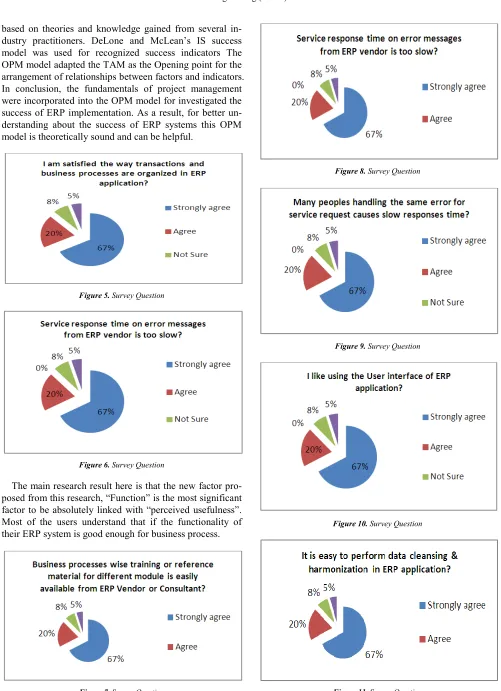
based on theories and knowledge gained from several in-dustry practitioners. DeLone and McLean’s IS success model was used for recognized success indicators The OPM model adapted the TAM as the Opening point for the arrangement of relationships between factors and indicators. In conclusion, the fundamentals of project management were incorporated into the OPM model for investigated the success of ERP implementation. As a result, for better un-derstanding about the success of ERP systems this OPM model is theoretically sound and can be helpful.
Figure 5. Survey Question
Figure 6. Survey Question
The main research result here is that the new factor pro-posed from this research, “Function” is the most significant factor to be absolutely linked with “perceived usefulness”. Most of the users understand that if the functionality of their ERP system is good enough for business process.
Figure 7. Survey Question
Figure 8. Survey Question
Figure 9. Survey Question
Figure 10. Survey Question
Figure 12. Survey Question
Figure 13. Survey Question
Figure 14. Survey Question
Figure 15. Survey Question Survey Question
Survey Question
Survey Question
Survey Question
Figure 16. Survey Question
Figure 17. Survey Question
Figure 18. Survey Question
Figure 19. Survey Question Survey Question
Survey Question
Survey Question
Figure 20. Survey Question
The Mostly Users think ERP system is useful. Moreover, how business requirements match the functions of the ERP system. Mainly make the ERP system is more useful. Dis-similar other information traditional systems, necessary functions across the departments in the ERP system needs to integrate within an organization to be fully valuable. This exact feature causes “Perceived Usefulness” have the major impact on “Function” to. It should be renowned that the ERP system must be considered part of business func-tions and processes sooner than an information system.
It is analyzed that results point to that more use and bet-ter quality of ERP systems can add to the benefits of ERP. The two project success indicators (i.e. “Quality and Progress”) have a positive impact on success indicator (i.e. “Intention to Use / Use”) and on the final dependent varia-ble, “ERP Benefits”.
5. Conclusion
In this research discusses relationships between success factors and indicators in more detail, describing the reason behind their relationships. Interpretations of the results about each dependent variable are presented along with its independent variables based on its analysis and other rele-vant data from the survey. The section discusses why a difference exists in a particular variable, and interprets its meaning with respect to ERP success. In conclusion, the research proposed several suggestions for the accomplish-ment of ERP systems based on the results of recognizing indicators and the relationships between indicators. These suggestions should allow software engineering have a bet-ter understanding of ERP success and help them to abstain failure considering critical factors recognized to successful ERP completion.
Most IT related research in the area of construction business management generally proposes research models without theories. Furthermore, since this kind of research is still comparatively new to construction related research, a lot surveys have been formed without sound theoretical background. They usually recognize the factors which compare the mean values of factors, and rank factors in with their importance showing the higher mean value as the more important factor. This research projects first time
point out the factors affecting ERP success with strong background theories in construction business related re-search. The OPM adapted three theoretically validated models including D&M IS Success Model and TAM, the fundamentals of project management in ERP implementa-tion. Therefore, the professional contribution of this re-search project can be found in a deliberate attempt to de-velop the ERP success model.
There have been few studies attempting to validate em-pirically the factors affecting both ERP implementation and user adoption. The factors identified in literature were mostly based on the experiences of IT professionals or se-nior managers involved in ERP implementation projects. For these reasons, this research focused on identifying the factors for the ERP success from both implementation project and user adoption perspectives. Then, identified factors were examined to verify their relationships with success indicators associated with the redefined ERP suc-cess, i.e. the success of the project and the success of use. Moreover, the research study proposed recommendations for the ERP success explaining how to approach ERP im-plementation to avoid failure and what to do more consi-dering the importance of each factor to a given dependent variable based on the findings of the study. These recom-mendations can give valuable information to engineering firms when they want implementing or upgrading their ERP systems.
References
[1] Aberdour, M. 2007. Achieving Quality in Open Source Software.IEEE Software, 24(1): 58–64.
[2] Balbo, G., and G. Serazzi. 1997. Asymptotic Analysis of Multiclass Closed Queueing Networks: Multiple Bottle-necks. Performance Evaluation, 30(3): 115-152.
[3] Brownsword, L., T. Oberndorfand C.A. Sledge. 2000. Developing New Processes for COTS-Based Systems. IEEE Software, 17(4): 48-55.
[4] Balsamo, S., A. D. Marco, P. Inverardi and M. Simeoni. 2006. Efficient Performance models in Component-Based Software Engineering. IEEE Computer Society,38(3): 64-71. [5] Balsamo, S., A.D. Marco, P. Inverardiand M. Simeoni. 2004.
Model-Based Performance Prediction in Software Devel-opment.IEEE Transactions on Software Engineering,30(5): 295-310.
[6] Becker, S., L. Grunske, R. Mirandola and S. Overhage. 2006. Architecting Systems with Trustworthy Components.
Lecture Notes in Computer Science, 3938(1): 169-248. [7] Bertolino, A. and R. Mirandola. 2004. CB-SPE Tool:
Putting Component-Based Performance Engineering into Practice. Component Based Software Engineering, 3054(1): 233-248.
[9] Chen, S., I. Gorton, A. Liu and Y. Liu. 2002. Performance Prediction of Component-based Applications. Journal of Systems and Software, 74(1): 35-43.
[10] Crnkovic, I., M. Chaudron and S. Lars-son.2005.Component-based Development Process and Component Lifecycle.Journal of Computing and Informa-tion Technology, 13(4): 321-327.
[11] Craig. D. C. (2007). Compatibility of Software Compo-nents-Modelling and Verification.Ph.D Thesis, Univ., Me-morial, Newfoundland.
[12] Denaro, G., A. Polini and W. Emmerich. 2004. Early Per-formance Testing of Distributed Software Applica-tions.ACM SIGSOFT Software Engineering Notes, 29(1):94-103.
[13] Fox, M. R., D. C. Brogan and F. Reynolds. 2004. Approx-imating component selection, Winter Simulation Conference, 25(5): 429-434.
[14] Glenn A., A. Thomas and S. Jajodia. 2004. Commercial- Off-The- Shelf Enterprise Resource Planning Software Im-plementations in the Public Sector: Practical Approaches for Improving Project Success, The Journal of Government Fi-nancial Management, 53 (2): 10-15.
[15] Grassi,V., R. Mirandola, and A. Sabetta. 2007. Filling the Gap between Design and Performance/Reliability Models of Component-Based Systems: SA Model-Driven Approach,J. Systems and Software, 80(4): 528–558.
[16] Grozev, N. 2011. A comparison of component-based soft-ware engineering and model-driven development from the ProCom perspective. M.S thesis.Univ.,Mälardalen,Sweden. [17] Hofmeister, C., P. Kruchten, R.L. Nord, H. Obbink, A. Ran
and P. America. 2007. Generalizing a Model of Software Architecture Design from Five Industrial Approaches,
Journal of Systems and Software, 80(1):106-126.
[18] Kim, I.Y. and O. Weck. 2005. Adaptive weighted-sum me-thod for bi-objective optimization: Pareto front generation.
Structural and Multidisciplinary Optimization, 29(2):149-158.
[19] Kontio, j. 1996.A Case Study in Applying a Systematic Method for COTS selection. IEEE Computer Society,
32(4):201-209.
[20] Kuz.I., Y. Liu, I.Gorton and GernotHeiser. 2007. CAmkES: A component model for secure microker-nel-based embedded systems, The Journal of Systems and Software, 80(1): 687-699.
[21] Kaur, A. and K. S. Mann. 2010. Component Selection for Component based Software Engineering. International Journal of Computer Applications, 2(1):12-18.
[22] Lau, K. and Z.Wang. 2007. Software Component Models.
IEEE Transaction on Software Engineering,33(10): 3-8 [23] Madanmohan, T.R. and R. De.2004. Open Source Reuse in
Commercial Firms. IEEE Software,21(6): 62-69.
[24] Mohamed, A.2007. Decision Support for Selecting COTS Software Products Based on Comprehensive Mismatch Handling. Ph.D. Thesis, univ., Calgary, Alberta.
[25] Mahmood, S. and A. Khan. 2011. An industrial study on the importance of software component documentation: A sys-tem integrators perspective. Information Processing Letters, 111(12): 583-590.
[26] Navas, J. and J.Babau. 2009. Efficient and Adapted Com-ponent-Based Strategies for Embedded Software Device Drivers Development. IEEE Computer Society, 2(1): 514-519.
[27] Peslak, A.L R., G.H. Subramanian and G.E. Clay-ton.2008.The Phases of ERP Software Implementation and Maintenance: A Model for Predicting Preferred ERP Use. Journal of Computer Information Systems, 48(2): 25–33 [28] Rawashdeh, A. and B. Matalkah.2006.A New Software
Quality Model for Evaluating COTS Components, 2 (4): 373-381.
[29] Runeson, P. and M. Höst. 2009. Guidelines for conducting and reporting case study research in software engineering.
Empirical Software Engineering, 14(2): 131-164.
[30] Torchiano, M. and M. Morisio. 2004. Overlooked Aspects of COTS-Based Development. IEEE Software, 21(2): 88-93. [31] Tekumalla,B. 2012. Status of Empirical Research in
Com-ponent Based Software engineering.M.S thesis, Univ. Go-thenburg, Sweden.
[32] Vilpola, I. 2008. Applying User-Centred Design in ERP Implementation Requirements Analysis.Ph.D The-sis,Univ.Technology,Tampere.
[33] Victor, S., C. Becerra andG.Valdes.2010.Empirical Valida-tion of Component-based Software Systems GeneraValida-tion and Evaluation Approaches.CeliElectronicJournal,13(1) : 2-9 [34] Wu.X.and M. Woodside. 2004. Performance Modeling from
Software Components, ACM/SIGSOFT Software Eng. Notes, 29(1): 290–301.
[35] Wanyama,T. and B.Far. 2008.An Empirical Study to Com-pare Three Methods for Selecting Cots.Software Compo-nents. International Journal of Computing and ICT Re-search, 2(1): 34-41.