The performance analysis of public key
cryptography-based authentication
Kaiqi Xiong
1,∗1University of South Florida, Tampa, Florida 33620, USA
Abstract
Several Kerberos-based authentication techniques using public-key cryptography have been proposed. Public-key cryptography can be used to eliminate a single point failure problem in the Key Distribution Center (KDC) and achieve better scalability. Public Key Cryptography for Cross-Realm Authentication in Kerberos (PKCROSS) and Public Key Utilizing Tickets for Application Servers (PKTAPP, a.k.a. KX.509/KCA) are considered two notable techniques. The latter was suggested to improve the former, but their actual computational and communication times have been poorly understood. This paper first presents a thorough performance evaluation of the two protocols based on analytical analysis and queueing network models. As shown, PKTAPP does not scale better than PKCROSS. Then, this paper gives a new public key cryptography-based group authentication technique. We show that the new technique can achieve better scalability than PKCORSS and PKTAPP and our performance methodology is effective.
Receivedon 12 January 2018;acceptedon 16 January 2018;publishedon 15 May 2018 Keywords: Security, Performance Evaluation, Complexity Analysis
Copyright © 2018 Kaiqi Xiong, licensed to EAI. This is an open access article distributed under the terms ofthe Creative Commons Attribution license (http://creativecommons.org/licenses/by/3.0/), which permits unlimited use,distributionandreproductioninanymediumsolongastheoriginalworkisproperlycited.
doi:10.4108/eai.15-5-2018.154770
1. Introduction
There are an explosive growth in a variety of collab-orative group services in academia and industry for the past ten years [18]. Example applications include video and audio conferencing, replicated servers and databases, and in particular Web services in that services components from several universe service providers can be flexibly integrated into a composite service regardless of their location, platform, and exe-cution speed [5]. To ensure quality of services, these ser-vice providers are required to work together. The rapid growth in collaborative applications has heightened the need for a reliable group communication system. With-out group authentication, the communication system will not be possible to be reliable.
A mature, reliable, secure network authentication protocol, Kerberos [29], allows a client to prove its identity to a server without sending confidential data across the network. Partitioning of the world into realms served by different application servers is a way to improve the scalability of Kerberos. In each realm,
∗
Corresponding author. Email:[email protected]
Kerberos consists of a client, application servers and a key distribution center (KDC). The client may represent a group of business users who request services from application servers. The KDC maintains a shared symmetric key with every client and the application servers in the realm. In case KDC is compromised (i.e., a single failure), all the symmetric keys will be divulged to the attacker and will have to be revoked. Recovering from such a compromise requires the re-establishment of new shared keys with the client and the application servers in the realm. In terms of time, effort and financial resources, it is very costly for such a recovery.
Kerberos has been extended based on public key cryptography since public key cryptography simplifies the distribution of keys in Kerberos. It eliminates a single point of failure. Integrating public key cryptog-raphy into Kerberos represents the enhancements of the current Kerberos standard. Several Kerberos-based authentication techniques using public-key cryptogra-phy have been proposed in the last decade. Among them include Public-Key Cross Realm Authentication in Kerberos (PKCROSS) [25] and Public-key Cryptog-raphy for Initial Authentication in Kerberos (PKINIT)
Research Article
[41]. Moreover, the scalability of network security infrastructures is becoming a serious concern as the explosive growth of collaborative applications such as Web services continues unabated. Public key based Kerberos for Distribution Authentication (PKDA) [37] and Public Key Utilizing Tickets for Application Servers (PKTAPP, a.k.a. KX.509/KCA) [30] and [31] have been proposed to enhance the security and scalability of Kerberos.
Among these Internet drafts, PKINIT is a core speci-fication. Both PKCROSS and PKTAPP use variations of PKINIT message types and data structures for integrat-ing public key cryptography with Kerberos in different authentication stages. PKTAPP was originally intro-duced as PKDA. It implemented PKDA using the mes-sage formats and exchanges of PKINIT. Microsoft has adopted the Internet draft specification of PKINIT for the support of public key cryptography in the Windows 2000 and 2003 implementations of Kerberos [17]. It has its own protocol that is the equivalent of KX509/KCA. There were preliminary discussions regarding an adop-tion of a common protocol between the Kerberos WG and Microsoft. The MIT Kerberos consortium will drive these discussions [4]. According to Altman [3], the standardization of PKCROSS and PKTAPP will be the next for Kerberos and PKI integration. The Kerberos Consortium at MIT was formed in September 2007 led by initial board members from Apple, Google, MIT, Microsoft and Sun and sponsored by 19 leading companies, universities and government agencies [7]. It is expected that Kerberos-based authentication and authorization will be as ubiquitous as TCP/IP-based networking itself. PKINIT and PKCROSS are listed as Projects 10 and 11 in the Kerberos Consortium’s proposal respectively [32]. As stated above, PKCROSS and PKTAPP use variations of PKINIT message types and data structures in the design of the authentication protocols. We believe that PKCROSS and PKTAPP will revive soon. Hence, this paper only considers these two notable techniques: PKCROSS and PKTAPP. The understanding of the variants of the two protocols can be achieved through the performance analysis of these two protocols.
Sirbu and Chuang [37] argued that PKCROSS would not scale well in a large network. PKTAPP was proposed to improve the scalability of PKCROSS. However, the actual costs associated with these techniques have been
poorly understoodso far. Although PKTAPP is shown to poorly perform when there are two or more application servers in one remote realm in Harbitter and Menasce [24], it remains unknown which technique performs better in a large network where application servers are within multipleKDC remote realms that are typical in many applications.
In the design of protocols, performance evalua-tion is a fundamental consideraevalua-tion. Two convenevalua-tional
approaches have been proposed to analyze the per-formance of a security protocol. The first one is to implement under study protocols and then take their measurements in real systems (for example, see Amir et al. [1]). This approach seems very good but it is time-consuming. Whenever the under-study proto-col is changed, the updated protoproto-col has to be re-implemented and the measurement data of the protocol implementation has been re-collected. This approach cannot be applied to our study of PKCROSS and PKTAPP. The implementation of original PKCROSS and PKTAPP is not available due to lack of resource and funding [4]. (Note: the implementation of PKTAPP’s variant KX.509) was just released last year [30].) The second one is to count the number of operations and then compute their corresponding costs within a under study protocol (for example, see Amir et al. [2] and Steiner et al. [38]). This approach is straightforward. It has widely used by researchers but it is not very easy to be used when the protocol becomes complicated such as the case of multiple KDC remote realms. Furthermore, in this case, an authentication request cannot often be processed fast enough, so it should wait in a queue. However, the second approach does not consider the waiting time of an authentication request in a queue. Hence, in order to efficiently and effectively analyze the performance of a protocol, we use a queueing network model as our protocol evaluation tool.
applied to understand other security protocols (see [26] and [36]).
The rest of this paper is organized as follows. In Section 2, we begin by giving an in-depth discussion of PKCROSS and PKTAPP and then presents their performance evaluation using queueing theory. Section
3gives a definition of the new public key cryptography-based group authentication technique along with the details of messages. We present performance analysis of the proposed technique compared to PKCROSS and PKTAPP in Section4. The related work is discussed in Section6. We finally conclude our discussion in Section
7.
2. PKCROSS and PKTAPP
Kerberos [29] is a network authentication protocol for providing a secure communication between a user workstation (or called a client) and application servers that was developed at the Massachusetts Institute of Technology in 1988. The latest version of Kerberos is Version 5. It divides the world into realms, each with user workstations, a single primary KDC, back-up KDCs, and application servers in which the KDC is a trusted intermediary.
In the Kerberos protocol, the client engages in a multiple-step authentication to obtain access to the application server whereby the client first obtains a relatively short lived credential: a Ticket-Granting Ticket (TGT) from the Authentication Service running on a (KDC), and then obtain a session ticket for a particular application server by presenting the TGT to a centralized Ticket-Granting Service (TGS) running on the KDC. The client presents the session ticket to the application server for authenticating herself/himself by showing knowledge of a secret session key. The secret session key was securely passed to the client by the KDC. Kerberos is stateless. It is extremely valuable from the scalability point of view. Cross-realm authentication is necessary when a client and an application server with different network domains fall into different Kerberos realms.
It is well-known that a public key security system is easier to administer, more secure, less trustful, and more scalable than a symmetric key security system. Public key security doesn’t use a trusted key management infrastructure since the burden of key management falls to public key clients [12]. In a public key infrastructure, public key clients need constantly and vigorously check the validity of the public keys that they use. Public key cryptography shifts the burden on key management from the KDC/TGS in Kerberos to its Certificate Authority (CA) who may be considered as a trusted intermediary. CA issues a public key certificate that is relatively long lived credential. The burden is determined by the number of times that clients want
Application Servers
Client Local KDC
Remote KDC
1, 1’
4, 4’
3
2
Local Realm
Remote Realm 1 5
6
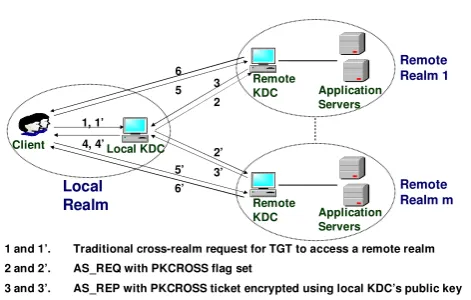
1 and 1’. Traditional cross-realm request for TGT to access a remote realm
2 and 2’. AS_REQ with PKCROSS flag set
3 and 3’. AS_REP with PKCROSS ticket encrypted using local KDC’s public key
4 and 4’. Traditional reply with cross-realm TGT using SKC
5 and 5’. Ticket-Granting Service Request (TGS-REQ)
6 and 6’. Ticket-Granting Service Reply (TGS-REP)
Application Servers Remote KDC
Remote Realm m 5’
6’ 2’
3’
Figure 1. The PKCROSS Message Flow
to authenticate to application servers in Kerberos. It might not be affordable in time-sensitive applications if one large-scale PKI deployment is needed for group authentication in a large network.
2.1. Protocol Analysis
PKCROSS [25] is one notable protocol of integrating public key cryptography with Kerberos to address the problem of network authentication among the client and the application servers in a large number of realms. Figure 1illustrates the authentication steps of PKCROSS. The cross realm KDC to KDC authentication is achieved by using public key cryptography.
First, just like Kerberos the KDC in PKCROSS is burdened by the need to constantly renew short-lived TGTs, and TGS must be involved whenever a client wants to request a service from an application server. Thus, if a large number of users in a single realm request services that may be a typical case in Web services, the KDC in the realm becomes a serious single point of failure due to a KDC compromise and possibly a performance bottleneck. Recovering such a compromise requires the re-establishment of secret keys for all users within this realm. When a number of users is large, such a recovery is very costly. PKINIT facilitates public-key based authentication between users and their local KDC. Hence, one possible solution to eliminating the single point of failure is to combine PKCROSS with PKINIT, and thus public-key based authentication is integrated with the entire Kerberos environment. However, it is easy to see that this solution is not feasible for time-sensitive applications, since the users might suffer from a long delay or even denial of services due to a high computational cost for the calculation of a public key used in the entire environment.
Application Server Client
1 2 3 4
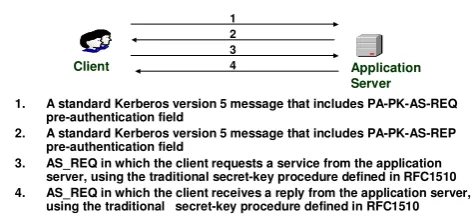
1. A standard Kerberos version 5 message that includes PA-PK-AS-REQ pre-authentication field
2. A standard Kerberos version 5 message that includes PA-PK-AS-REP pre-authentication field
3. AS_REQ in which the client requests a service from the application server, using the traditional secret-key procedure defined in RFC1510 4. AS_REQ in which the client receives a reply from the application server,
using the traditional secret-key procedure defined in RFC1510
Figure 2. The PKTAPP Message Flow
Table 1. The Operations of Encryption and Decryption Whenn Application Servers are inmRemote Realms
Protocols Entities # Secret Key # Private Key # Public Key
PKTAPP Client 2n+1 n+1 3n
Application server 3n+1 n 4n
Total 5n+2 2n+1 7n
PKCROSS
Client m+6 0 0
Local KDC 5 m+1 3m
Remote KDC 3m+n m 4m
Application server 3n 0 0
Total 4(n+m)+11 2m+1 7m
realm, and communicates with a remote KDC. Hence, it can easily become a performance bottleneck since all these authentication transactions have to transit the KDC. Thus, PKTAPP [31] has been proposed to address the issue. Figure 2 shows the message exchange of PKTAPP. The PKTAPP technique allows the client to communicate directly with the application servers so that the number of messages between them is reduced in an authentication process. But, as is seen in [24], even though PKTAPP requires fewer message exchanges than PKCROSS during client authentication with remote application servers, PKCROSS outperforms PKTAPP when two or more application servers are in a single remote realm. This is because PKTAPP requires more public-key message exchanges than PKCROSS that only requires one pair of public-key message exchanges. Below, we are going to study their performance in multiple remote realms.
We employ the first approach to analyzing the performance of the two techniques in which we are required to carefully compute the number of secret, private and public operations used in PKCROSS and PKTAPP in the case of a multiple remote realm. Table1
summarizes the encryption and decryption operations performed in these two techniques where m and n
are the number of remote realms and the number of applications servers within these realms respectively. Denote by cj the computational times per secret,
private, or public key operation respectively wherej= 1,2,3. Then, c1< c2< c3. Let fj(n, m), j= 1,2, be the
total computational times of encryption and decryption operations in PKTAPP and PKCROSS. Thus, from Table
1we have that
f1(n, m) = (5c1+ 2c2+ 7c3)n+ 2c1+c2
f2(n, m) = 4c1n+ (4c1+ 3c2+ 7c3)m+ 11c1+c2
Note thatf1(n, m) does not depend onm, which can be hence abbreviated asf1(n). Then, we have the following proposition.
Proposition 2.1.For each authentication, PKCROSS requires less computational time than PKTAPP if and only if the number of application serversnis more than
dm+ 3(m+3)c1
c1+2c2+7c3e, or the number of remote realms m is less thanbn− 3(n+3)c1
4c1+2c2+7c3c.
Proof. According to f1(n, m) and f2(n, m), their diff er-ence is given by f1(n, m)−f2(n, m) =−9c1+ (c1+ 2c2+
7c3)n−(4c1+ 2c2+ 7c3)m. Hence, f1(n, m)−f2(n, m)≥
0 if and only if −9c1+ (c1+ 2c2+ 7c3)n−(4c1+ 2c2+
7c3)m≥0, which implies Proposition2.1.
It is anticipated that the client is connected to the local KDC by a LAN, the client and the local KDC are connected to a remote KDC by a WAN, and a remote KDC and its application servers are connected by a WAN. Assume that all WANs have an identical communication time and a local area network (LAN) has a neglected communication time compared to a WAN. From Figures 1 and 2, we note that the number of WAN communications are 4n for PKTAPP and 4m+ 2n for PKCROSS. Let gj(n, m), j=
1,2, be the transaction times of PKTAPP and PKCROSS.
The transaction time is defined as the computational time of the total encryption and decryption operations plus the communication time per authentication in a technique. Also, denote byd the time spent in a WAN communication. Then, the following conclusion holds.
Proposition 2.2.For each authentication, PKCROSS uses less transaction time than PKTAPP if and only if the number of application servers n is more than m+
d(3c1+2d)m+9c1
c1+2c2+7c3+2d
e.
Proof. For j= 1,2, gj(n, m) can be computed by g1(n, m) =f1(n) + 4nandg2(n, m) =f2(n, m) + 4m+ 2n
and thus their difference is given by g1(n, m)−
g2(n, m) = (c1+ 2c2+ 7c3+ 2d)n−(4c1+ 2c2+ 7c3+ 4d)m−9c1which easily derives Proposition2.2.
Note that if n= 1 (so, m= 1), m+d(3c1+2d)m+9c1
c1+2c2+7c3+2d
e>
1 =n, and if m= 1, m+d(3c1+2d)m+9c1
c1+2c2+7c3+2d
e= 1 +
12c1+2d
c1+2c2+7c3+2d <2 since c1 is significantly smaller thanc3. This means that
Remote KDC 1
Remote KDC m WAN
Local KDC
LAN Exit
Application Servers Client
WAN WAN
Application Servers
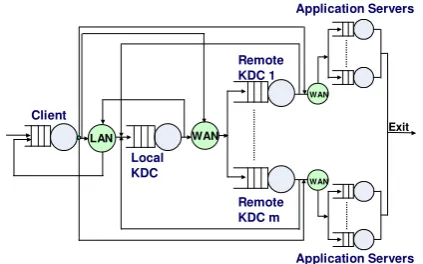
Figure 3. A Queueing Network with m Remote Realms for PKCROSS
In Proposition2.2we have shown that the number of application servers should bed(3c1+2d)m+9c1
c1+2c2+7c3+2d
emore than
the number of remote KDC realms so as to ensure that PKCROSS uses less transaction time than PKTAPP. But, the transaction time does not take into account the time required to wait in a queue for a service (i.e., waiting time) when multiple authentication requests present in any one of the authentication entities. Response time is used when such a case is considered. That is, the response time is the transaction time plus the waiting time per authentication request. A further discussion of the response time is given in next section.
2.2. The Calculation of Response Time via Queueing
Networks
In a distributed system, a queueing network is an efficient tool to analyze system scalability. To investigate the scalability of PKTAPP and PKCROSS, we first model the entities, the client, the local KDC, the remote KDCs, the application servers and communication networks, as a queueing network. The client may represent a single or multiple users that request group authentication at a given rate and the authentication request is processed in these entities according to these two techniques. Figures3and4give queueing networks to describe the message flows of PKCROSS and PKTAPP where each system resource is modeled as a queue associated with a queueing discipline.
Since a public key consumes a significantly higher computation cost than a private key, it is not reasonable to assume that all client requests are served at the same average service time. Instead, a class-switching in [6] and [33] is employed to model the class transaction with switching from low- to high-priority class, as different types of encryption/decryption operations are required with different service times. Preemption-resume is one good way to implement a service for satisfying multiple
Application Server n
Exit
Client
WAN
WAN
Application Server 1
Figure 4. A Queueing Network with nApplication Servers for PKTAPP
class client requests. In this paper, we use a preemptive-resume priority discipline, i.e., the service of a classr2 request can be interrupted if a higher-priority request of class r1 (r2> r1) arrives during its service. The interrupted request resumes its service from where it stopped after the higher-priority request, and any other request with priority higher than r2 that may arrive during its service, complete their service.
Our goal is to use the queueing networks to calculate the response time of an authentication request. The calculation is sketched below. Assume that the client requests group authentication at a rate λ. Based on the forced law, the throughput of an entity (the client station, the local KDC, the remote KDCs, or the application servers) isX(j)=λv(j)for classj job where
v(j)is the number of visits to the entity by classj jobs. Then, the total throughputXis a sum ofX(j)over all job classes at the entity. Thus, according to the utilization law, the utilization of the entity by classj jobs isρ(j)=
X(j)µ(j)=λv(j)µ(j)whereµ(j)is the service time per visit to the entity by classj jobs. Hence, the total utilization
ρis a sum ofρ(j)over all classes at the entity. Thereby, the response time of the entity isR= 1µ−ρ whereµis an
average service time of all classes at the entity, and the total response time per authentication request is a sum ofvRover all entities.
L
A
N
Local KDC
Remote Realm
Remote KDC
WAN
W
A
N
Client Application Servers
Figure 5. A Test Scenario With a Remote Realm
Table 2. The computational times of Encryption and Decryption Operations
Protocols and Operation Key Length Computational times (msec)
AES/ECB 128 0.000248
AES/ECB 256 0.000312
RSA encryption 1024 0.07
RSA decryption 1024 1.52
RSA encryption 2048 0.15
RSA decryption 2048 5.95
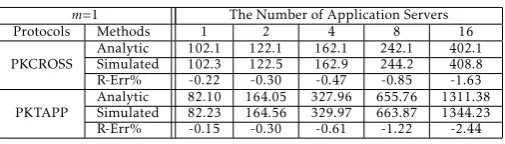
Table 3. The Comparison of Analytic and Simulated Response Times
m=1 The Number of Application Servers
Protocols Methods 1 2 4 8 16
PKCROSS
Analytic 102.1 122.1 162.1 242.1 402.1
Simulated 102.3 122.5 162.9 244.2 408.8
R-Err% -0.22 -0.30 -0.47 -0.85 -1.63
PKTAPP
Analytic 82.10 164.05 327.96 655.76 1311.38
Simulated 82.23 164.56 329.97 663.87 1344.23
R-Err% -0.15 -0.30 -0.61 -1.22 -2.44
evaluation based on an ECC key will be discussed in another paper.) Table3shows the accuracy of analytical response times obtained by the queueing methods compared to simulated results based on the scenario shown in Figure5, where R-Err% is the relative error used to measure the accuracy of the analytic results compared to model simulation results, and it is defined by (analytic result - simulated result)/simulated result
×100. As seen in the table, the analytic response times
match the simulated results very well.
To investigate performance with an increased number of application servers and remote realms, we further presented response times as a function of authen-tication request rates, i.e., throughput, when there are two remote realms, as shown in Figure 6. As is seen, PKCROSS has slightly less response time than PKTAPP whenn= 4, calleda crossover number. That is, PKCROSS is more efficient than PKTAPP if n≥4, but
less efficient than PKTAPP if n <4. Clearly, it follows from Table 3 that the crossover number is equal to 2 when m= 1. In general, Figure 7 shows crossover
m=2 and Crossover Number = 4
0 10 20 30 40
4 6 8
Throughput (authentication requests/sec)
R
e
s
p
o
n
s
e
T
im
e
(
s
e
c
)
PKTAPP n=5
PKCROSS n=5
PKTAPP
n=4 PKCROSS
n=4
PKCROSS n=3
PKTAPP n=3
Figure 6. Response Time vs. Authentication Request Rate
y = 1.8916x + 0.2879
R
2= 0.9976
0 10 20 30
0 2 4 6 8 10 12 14
The number of remote realms
C
ro
s
s
o
v
e
r
n
u
m
b
e
rs
Figure 7. Crossover Numbers vs. The Number of Remote Realms
numbers with varying number of remote realms. The crossover numbers can be 99.8% perfectly fitted by the straight line:n= 1.8916m+ 0.2879. This means that PKCROSS is more efficient than PKTAPP when n≥ d1.8916m+ 0.2879e. In other word, PKTAPP does not
scale better than PKCROSS. That is different from what PKTAPP’s designers expected. In next section we pro-pose a hybrid approach that has better scalability than PKCROSS.
3. A New Group Authentication Technique Using
Public-Key Cryptography
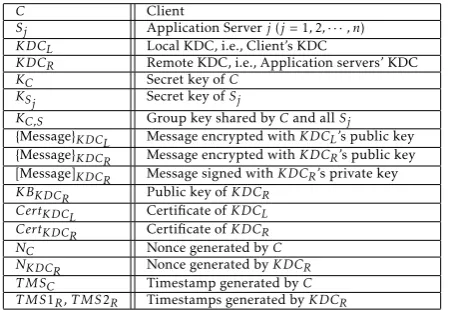
Table 4. The Notation Used In The Case of A Single Remote Realm
C Client
Sj Application Serverj(j= 1,2,· · ·, n)
KDCL Local KDC, i.e., Client’s KDC
KDCR Remote KDC, i.e., Application servers’ KDC
KC Secret key ofC
KSj Secret key ofSj
KC,S Group key shared byCand allSj
{Message}
KDCL Message encrypted withKDCL’s public key {Message}
KDCR Message encrypted withKDCR’s public key [Message]KDCR Message signed withKDCR’s private key
KBKDCR Public key ofKDCR
CertKDCL Certificate ofKDCL
CertKDCR Certificate ofKDCR
NC Nonce generated byC
NKDCR Nonce generated byKDCR
T MSC Timestamp generated byC
T MS1R,T MS2R Timestamps generated byKDCR
techniques. While it allows the client to deal directly with the application servers so that the number of messages is reduced in the authentication process like PKTAPP, the new technique still relies on the KDC for the authentication of the client and the application servers like PKCROSS.
3.1. A Single Remote Realm
In this section we define the group authentication technique among a client (denoted by C) and application servers (denoted by Sj) that are in a
single remote realm (denoted by KDCR), where j=
1,· · ·, n. The client C is a group key initiator, for
example, representing either a group member in a video conference or a service provider in Web services applications who wants to initiate secure communication among groups or service providers. (How C is chosen is beyond the scope of our study in this paper.) The application servers Sj are the rest
of either group members or service providers. Table 4
lists all notation used in this section. Figure 8 shows the message flow of the new group authentication technique whose message exchanges is given in detail as follows. (In order to emphasize our understanding of this new technique for its performance comparison with PKCROSS and PKTAPP, we briefly state the main goal of each exchange message.)
Message 1,C→KDCR:
NC, “C", “KDCR:S1, ...,Sn",KC{NC, KC,S,“KDCR: S1,
· · ·, Sn”, T MSC}
Main Goal: In this message, the clientCinitiates a group key request for a secure communication with the application serversSj.
For this purpose, it will encrypt the request message with a key, KC,S, that the client C invents. To make
sure that onlySjcan get the key (of course,KDCL and KDCR should be able to get it as well), the key will
Application Servers
Client Local KDC
Remote KDC
1 2
3 5
Local Realm Remote Realm
4
6
Figure 8. The Message Flow of A New Technique in a Single Remote Realm
be encrypted using the client C’s key along with the destination, “KDCR:S1, ...,Sn". ForSj to getKC,S, the KDCRwill first need to be authenticated by the KDC of
the clientC, and thenSj will need to be authenticated
by their KDC: KDCRand have KDCRgive Sj the key, KC,S.KDCRwill be responsible for making sure thatSj
are valid recipients and the client C is a valid sender validated by the client C’s KDC, KDCL. A common
nonce,NC, will also be invented to track the transaction
and give the recipient something to authenticate with to the remote KDC server,KDCR. A timestampT MSC
is included to prevent replay attacks or prevent the key,
KC,S, from being given out more than once.
Message 2,KDCR→KDCL:
NC, “C",KC{NC, KC,S,“KDCR:S1, ..., Sn”, T MSC},{NC,
NKDCR, T MS1R,AuthInfo}KDCL, where AuthInfo
consists of “KDCR", CertKDCR, [NC, NKDCR, T MS1R,“KDCL”,
KBMain Goal: The remote KDC,KDCR]KDCR. KDC
R, will authenticate the client C through KDCL who is the local KDC of the client.
After receiving the message from the client C,
KDCRinvents a nonce,NKDCR, and generates AuthInfo
necessary to authenticate KDCR. Then, it constructs
a message to send to the client C’s local KDC that containsNKDCR,NC,T MS1R, and AuthInfo, encrypted
with KDCL’s public key.KDCR will also forward the
part of the original message encrypted with C’s key. This is enough information for KDCL to authenticate
the client C and KDCR to make sure only if KDCL
can decrypt this message. Note that the message uses “KDCR" instead of “KDCR: S1, ..., Sn" for the sake
of a privacy consideration. This is because the client
C’s local KDC is unnecessary to know who will be part of the secure communication except the client C. Additionally, this message does not explicitly contain the identity KDCR since it is included in AuthInfo.
“KDCR" and its public key KBKDCR are uniquely
determined by CertKDCR in AuthInfo. Thus,CertKDCR
is used to prevent man-in-the-middle attacks.T MS1R
serves to avert replay attacks.
Message 3,KDCL→KDCR:
{“C”,“KDCR”, NKDC
Main Goal: After the client KDCL authenticates the clientC, it sends a reply toKDCR.
Using the key of the name given,KDCL will decrypt
the message encrypted with its public key and the original message encrypted byKC, and verify KDCR’s
signature. Then, it will check if the NC encrypted by
key KC matches the NC encrypted by its public key.
If they match, then the client C is really the client C
and its message is not altered. KDCL will then read
the destination, in this case, “KDCR." (Again, it does
not include “KDCR:S1,· · ·, Sn in the message for the
sake of a privacy consideration.) Furthermore, KDCL
will make sure if KDCR is a valid member. If so, it
continues the processing. Accordingly,KDCLwill make
sure that the timestamp is within the allowed clock-skew and that the key for this request has not already been given out.KDCL will then give out the key,KC,S. KDCLwill also encryptNKDCRwithKDCR’s public key
to authenticateKDCL toKDCR.KDCRwill verify that
theNKDCRreceived fromKDCLmatches theNKDCRsent
toKDCL, and it will distribute the returnedKC,StoSj.
Message 4,KDCL→C:
KC{KC,S,“KDCL”,“FromKDCR”, NC, T MSC, T MSL} Main Goal: The KDCL further informs the client C about its authentication and the share keyKC,S with the application servers.
The client decrypts the share keyKC,S, “FromKDCR”, NC, T MSC,andT MSL. The client needs to make sure
that the NC matches the nonce of a pending request,
the timestamp is within the allowed clock-skew, and
KC,Smatches the group key that was previously created.
The resources required for a brute force attack scale exponentially with increasing key size, not linearly. As a result, doubling the key size for an algorithm does not simply double the required number of operations, but rather squares them. Thus, using timestamps and nonce numbers makes the encrypted message random to some extent. Thus, this prevents a brute-force cryptographic attack and a plain-text attack on the secret key of the client.
Message 5,KDCR→Sj:
KSj{“C”, KC,S},KC,S{NC, T MSC, T MS2R}
Main Goal: KDCR informs its application servers Sj about their shared keyKC,S with the clientC.
The application servers Sj will decrypt the first
message to getKC,S, and then use the shared keyKC,S to
decrypt the second message to getT MSC andT MS2R. T MSCis included so thatSjknows when the group key
was inverted byC. To make sure that it is not a replay,Sj
should keep all timestamps that were recently received, say in the last five minutes that is a parameter set approximately for the maximum allowable time skew. Then, Sj should check that each received timestamp
from a given request initiator is different from any of the stored values. Any authentication request older than five minutes (or whenever the value of the maximum
allowable time skew) would be rejected anyway, soSj
would not remember values older than 5 minutes.
Messages 6,Sj→C:
KC,S{NC, T MSC}, wherej= 1,2,· · ·, n.
Main Goal: In the end, the application servers Sj communicate with C for making sure that KC,S is not altered.
The application servers send replies to the client. Then, by using pre-generatedKC,S, the client decrypts
the message to make sure that the group keyKC,S is not
altered. It also verifies nonce NC and makes sure the
received timestamp of the pending request is within the allowed clock-skew of the timestampT MSC.
In the new technique, note that KC,S can be
replaced by KC,Sj when C only wants to securely
communicate with any one of application servers Sj.
The aforementioned technique can be also modified so that a reply is issued to C by either KDCL or KDCR
whenever needed afterCis authenticated.
3.2. Multiple Remote Realms
In a large network, application servers are often within different network domains. For instance, in Web services service providers may be partitioned into many different realms due to their location flexibility. To work together, a service provider may wish to gain access to other service providers’ application servers in remote realms. To support “cross-realm" authentication, the service provider’s KDC needs to establish an either direct or indirect trust relationship with the other service providers’ KDCs. Here, we briefly describe how the proposed technique is extended in multiple remote realms.
Assume that the n application servers Sj are
distributed inmrealms, each with KDC servers denoted by KDCi (i= 1,· · ·, m). Let ni be the number of
application servers within KDCi, where 0≤ni ≤m
and Pm
i=1ni =n. Clearly, the case of a single remote
realm is associated withn1=nandni = 0 (i= 2,· · ·, m).
We further let Si,k be those application servers which
belong to the set{Sj|j = 1,· · ·, n}within realmi, where k= 1,· · · , ni. Then, the set ∪m
i=1{Si,k|k= 1,· · · , ni} is
identical to the set {Sj|j= 1,2,· · ·, n}. Table 5 lists
additional notation used in this section.
Figure 9 shows how the client authenticates to application servers. Authentication messages are given below.
Messages 1 and 1’,C→KDCi for each fixedi:
NC, “C", “KDCi: Si,1, ..., Si,ni", KC{NC, KC,S,“KDCi : Si,1,· · ·, Si,ni”, T MSC}
Messages 2 and 2’,KDCi→KDCL:
NC, “C", KC{NC, KC,S,“KDCi :Si,1,· · ·, Si,ni”, T MSC}, {NC, NKDC
i, T MS1i,
Table 5. The Additional Notation Needed In Multiple Remote Realms
Si,k Application Serverkin realmi
KDCi Remote KDC server in realmi
KSi,k Secret key ofSi,k
KBKDCi Public key ofKDCi
{Message}
KDCi Message encrypted withKDCi’s public key [Message]KDCi Message signed withKDCi’s private key
NKDCi Nonce generated byKDCi
CertKDCi Certificate ofKDCi
T MS1iandT MS2i Timestamps generated byKDCi
Application Servers
Client Local KDC
Remote KDC
1 2
3
5
Local Realm
Remote Realm 1
Application Servers Remote
KDC 5’
Remote Realm m 2’
3’
1’ 4, 4’
6
6’
Figure 9. The Message Flow of The New Technique in Multiple Remote Realms
CertKDCi, and [NC, NKDCi, T MS1i, “KDCL”,
KBKDCi]KDCi
Messages 3 and 3’,KDCL→KDCiwherei= 1,· · ·, n:
{“C”,“KDCi”, NKDC
i, KC,S, CertKDCL, T MSC,}KDCi
Messages 4 and 4’,KDCL→C:
KC{KC,S,“KDCL”,“FromKDCi”, NC, T MSC, T MSL}
Messages 5 and 5’,KDCi→Si,k:
KSi,k{“C”, KC,S}, KC,S{NC, T MSC, T MS2i}, where i= 1, · · ·,mandk= 1,· · ·, ni.
Messages 6 and 6’,Si,k→C:
KC,S{NC, T MSC}, wherei= 1,· · ·, mandk= 1, · · ·, ni.
In the first three messages, the clientC authenticates to her local KDC through remoteKDCi. Message 4 or
4’ checks if the group keyKC,S is valid, and Message 5
or 5’ distributes the group keyKC,S and authenticates
designated application servers within their individual KDC realms. An explanation of these messages are similar to the one in Section3.1.
4. The Performance Evaluation of The New
Proposed Technique
In this paper we focus on studying the efficiency of the proposed group authentication technique. Hence, we first compute its computational and communication
Table 6. The Operations of Encryption and Decryption Whenn Application Servers are inmRemote Realms
Entities # Secret Key # Private Key # Public Key
Client 3 0 0
Local KDC 2 1 4m
Remote KDC n+1 2m 3m
Application server 3n 0 0
Total 4n+6 2m+1 7m
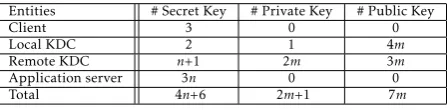
costs. Then, we give a thorough performance evaluation of the new technique using the queueing method proposed in Section 2. The security discussion of this new authentication will be given in Section5.
4.1. The Operations of Encryption and Decryption
The baseline transactions are constructed with one or more application servers in a remote realm as shown in Figure 8. Due to page limit, we directly consider the case of m remote realms, each withni application
servers where 0< ni ≤n and i= 1,2,· · ·, m. Table 6
summarizes the number of encryption and decryption operations performed in the proposed technique. As is shown in Tables 1 and 6, in our technique the computational burden on the client is mitigated to its local KDC compared to PKTAPP. Specifically, in term of the calculation of public key operations the burden on the client’s local KDC is O(m) in both the proposed technique and PKCROSS but the burden on the client isO(n) in PKTAPP. Let us recall thatmis the number of remote KDC servers andnis a total number of application servers where 1≤m≤n. Hence, their
computational burdens may be significantly different when mn. Note that the proposed technique uses
public key cryptography to authenticate the client’s KDC and the remote KDCs of application servers. So, it reduces the risk of a single failure on these KDCs.
Next, let us consider the operation costs of the proposed technique. Denote by f3(n, m) the total computational time of its encryption and decryption operations. Then, it follows from Table 6that f3(n, m) is computed by
f3(n, m) = 4c1n+ (2c2+ 7c3)m+ 6c1+c2
Thus, we have the following proposition.
Proposition 4.1.(a) The proposed technique requires less computational time than PKCROSS. (b) For n≥
4, the proposed technique requires less computational time than PKTAPP. But, when 1≤n <4, the proposed
technique requires less computational time PKTAPP if and only if the number of remote realmsmis less than
bn+ (n−4)c1 2c2+7c3
c.
Proof. The differences of computational times
f3(n, m) =−4c1+ (c1+ 2c2+ 7c3)n−(2c2+ 7c3)m
and f2(n, m)−f3(n, m) = 4c1m+ 5c1. Obviously, our
technique requires less computational time than PKCROSS due to f2(n, m)−f3(n, m)>0. Moreover, f1(n, m)−f3(n, m)≥0 if and only if m≤n+ (n
−4)c1
2c2+7c3, which implies (b) due ton≥m.
Similarly, we can easily get that
Proposition 4.2.For m≥4, the proposed technique
requires less computational time than PKTAPP. But, when 1≤m <4, the proposed technique requires less
computational time PKTAPP if and only if the number of application servers n should be more than dm−
(m−4)c1
c1+2c2+7c3
e.
Furthermore, let g3(n, m) be the transaction time of the proposed technique, i.e., the computational time of its encryption and decryption operations plus its communication time. Note that the number of WAN communications required in the technique is 3m+2n, and recall that d is the time spent in a WAN communication. Then, the following statements hold.
Proposition 4.3.(a) The proposed technique has less transaction time than PKCROSS. (b) The proposed technique uses less transaction time than PKTAPP if and only if the number of application serversnshould be more thandm+ (d−c1)m+4c1
c1+2c2+7c3+2d
e.
Proof. For j = 1,2,3, gj(n, m) are given by g1(n, m)−g3(n, m) = [f1(n, m)−f3(n, m)] + (2n−3m)d= (c1+ 2c2+ 7c3+ 2d)n−(2c2+ 7c3+ 3d)m−4c1, and
g2(n, m)−g3(n, m) = [f2(n, m)−f3(n, m)]. These easily derive (a)-(b) in this proposition.
Note that whenn= 1, we get thatm+ (d−c1)m+4c1
c1+2c2+7c3+2d > 1 =n due to usually d > c1, which imply
g1(n, m)−g3(n, m)<0. Also, when m= 1 and n≥2,
m+ (d−c1)m+4c1
c1+2c2+7c3+2d = 1 +
d+3c1
c1+2c2+7c3+2d <2
≤n due to
c1< c3, which imply g1(n, m)−g3(n, m)>0. Thus, we have that
Corollary 2.PKTAPP is more efficient than the proposed technique whenn= 1, but less efficient whenm= 1 and
n≥2, in term of transaction time.
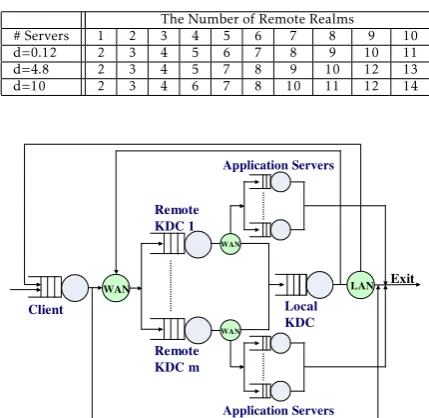
By using Proposition4.3 we calculated the minimal number of application servers so as to ensure that our technique requires less transaction time than PKTAPP with varied d= 0.12 msec, 4.8 msec and 10 msec when c1= 0.000248 msec, c2= 0.07 msec and c3= 1.52 msec in Table 7. We observed that the minimal number of application servers is sensitive to
drather thancj(j = 1,2,3). Table8further presents the
difference of transaction times between our technique and PKCROSS. We also noted that our proposed technique requires significantly less transaction time
Table 7. The Minimal Number of Application Servers
The Number of Remote Realms
# Servers 1 2 3 4 5 6 7 8 9 10
d=0.12 2 3 4 5 6 7 8 9 10 11
d=4.8 2 3 4 5 7 8 9 10 12 13
d=10 2 3 4 6 7 8 10 11 12 14
Remote KDC 1
Remote KDC m
WAN
Local KDC
LAN Exit
Application Servers Application Servers
Client
WAN
WAN
Figure 10. A Queueing Network withnRemote Realms for the New Technique
than PKCROSS, and the difference of transaction times between the two techniques are independent of the number of application servers. That is, the proposed technique is more efficient than PKCORSS.
4.2. The Calculation of Response Time via a
Queueing Network
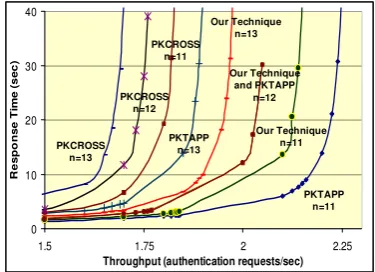
Similar to Section 2, we can use a queueing network to characterize the message flow of the proposed technique where each system resource is modeled as a queue associated with a queueing discipline shown in Figure 10. Figures 11, 12 and 13 show response times as a function of authentication request rates, i.e., throughput, in the case of one, two or eight remote realms with varying number of application servers. As is seen, our technique performs better than PKCROSS in all cases. It has also been demonstrated that our technique is more efficient than PKTAPP when n≥2
for one remote realm in Figure 11, when n≥4 for
two remote realms in Figure 12, and when n≥12
for eight remote realms in Figure 13 (roughly n≥
1.5m if m >1). These crossover numbers from m= 1
to 12 are further depicted in Figure 14 where the crossover numbers are 99.6% perfectly fitted by the straight line:n= 1.4406m+ 0.6364, which predicts the number of application servers required to ensure that our technique performs better than PKTAPP. Moreover, the line n= 1.4406m+ 0.6364 is below the straight line n= 1.8916m+ 0.2879 given in Section 2 due to 1.8916m+ 0.2879>1.4406m+ 0.6364 when m≥1.
Table 8. The Difference of Transaction Times Between Our Technique and PKCROSS (i.e.,g2(n, m)-g3(n, m))
The Number of Remote Realms
Difference (msec) 1 2 3 4 5 8 12 16 20 24
d=0.12 0.1222 0.2432 0.3642 0.4852 0.6062 0.9691 1.45314 1.93711 2.42108 2.90504
d=4.8 4.8022 9.6032 14.404 19.205 24.006 38.409 57.6131 76.8171 96.0210 115.225
d=10 10.002 20.003 30.004 40.005 50.006 80.009 120.013 160.017 200.021 240.025
0 10 20 30 40
2 7 12 17 22 27
Throughput (authentication requests/sec)
R e s p o n s e T im e ( s e c ) PKTAPP n=4 PKCROSS n=4 Our Technique n=4 PKTAPP n=2 PKCROSS n=2 Our Technique n=2 PKCROSS n=1 Our Technique n=1 PKTAPP n=1
Figure 11. Response Times vs. Authentication Request Rates whenm= 1
0 10 20 30 40
3 6 9 12
Throughput (authentication requests/sec)
R e s p o n s e T im e ( s e c )
Our Technique n=5 PKTAPP n=4 PKCROSS n=4 PKTAPP n=5 PKCROSS n=5 Our Technique n=4 PKCROSS n=3
Our Technique n=3 PKTAPP n=3 PKCROSS n=2 Our Technique n=2 PKTAPP n=2
Figure 12. Response Times vs. Authentication Request Rates whenm= 2
than PKCROSS. We also noted that the numbers n
in Table 7 are smaller than the crossover numbers in Figure 14. This means that it is not sufficient only if
transaction time is employed to analyze performance that researchers have often used.
5. Security Discussions
The proposed authentication technique allows for efficient message exchanges and the establishment of a group authentication among a client and multiple application servers. It is based on a security handshake. When presenting the message exchanges of the authentication technique in Sections 3.1 and 3.2, we
0 10 20 30 40
1.5 1.75 2 2.25
Throughput (authentication requests/sec)
R e s p o n s e T im e ( s e c ) PKCROSS n=13 PKCROSS n=12 Our Technique and PKTAPP n=12 Our Technique n=13 PKTAPP n=11 PKCROSS n=11 PKTAPP n=13 Our Technique n=11
Figure 13. Response Times vs. Authentication Request Rates whenm= 8
y = 1.4406x + 0.6364
R2 = 0.9958
0 5 10 15 20
0 2 4 6 8 10 12 14
The number of remote realms
C ro s s o v e r N u m b e rs
Figure 14. Crossover Numbers vs. Remote Realms
have discussed its security. We further give the security discussion of this technique below.
application server in this proposed technique remem-ber recent nonces within the allowed clock skew, then replay attacks are not possible. This means that in this technique, the clients and the KDCs runs must provide secure and reasonably synchronized clocks to prevent replay attacks. Subsequently, the proposed authentica-tion technique will not suffer from replay attacks.
Note that Messages 2 and 2’ do not leave clear except
NC and "C" in order that any clock synchronization
problem from client can be avoided to misuse by an attacker. Moreover, the identity of the client and the integrity of Messages 2 and 2’ can be authenticated through the information of "AuthInfo." The CertKDCR
used in the field of "AuthInfo" is prevent man-in-middle attacks.
As is known, the traditional Kerberos transmits the identity of the client in plaintext. But, this is not a case in the proposed technique except the first two messages. This change enhances the client’s privacy protection. It prevents an attacker from the tracking of the identities of the client’s and the KDCs’ who communicate each other for authentication. Additionally, an original version of Kerberos protocol [28] used the Needham-Schroder protocol as modified by Denning and Sacco (see [9] and [13]). However, there is a ticket invalidation issue in the Needham-Schroder protocol. A suggested fix was proposed in the extended Needham-Schroder protocol and in the Otway-Rees through a use of 7 and 5 messages respectively. The proposed authentication technique does not encounter a ticket invalidation issue.
Furthermore, the proposed technique is conceptually simple as it involves the client that generates a key and the KDCs that authenticate and distribute the key to group members via a pair-wise secure channel established with each group member. It works well in one-to-many multicast scenarios, for example, secure communications among service providers in Web services.
As is well-known,denial of service (DoS) attacksis one of the most common attacks these days [14]. DoS attacks cannot be prevented in PKCROSS and PKTAPP because authentication requests can be constantly sent to the KDC and the application server by an attacker [19]. While our proposed technique has several performance strengths as compared to PKCROSS and PKTAPP as shown in this paper, we have also realized that DoS attacks are out of our control. The client’s request message might be passed through by the remote KDC to the client’s local KDC with lack of any verification, which results in serious DoS attacks. To prevent them, we are required to securely migrate the client’s request and maintain an authentication state at every remote KDC that might not be an easy task. This is why a DoS attack is one of the most difficult attacks that we can prevent, as happened in PKCROSS and PKTAPP. But,
our technique is motivated by secure communications in Web services applications and it is mainly toward to e-business applications in which a trust-but-verify framework for Web services authorization has been proven an efficient method [39]. So, under the same framework we trust a client in a certain degree and allow the client to contact the KDC server of the application servers directly. Then, the authentication procedures proposed in this paper will follow. However, if the remote KDC server is badly under DOS attacks due to unauthenticated messages from the client, then we leave the option to switch back to the way in which a client needs to be first authenticated by its local KDC, e.g., using PKCROSS.
In the proposed technique, we also allow the client to create the group keyKC,S. This is particularly useful
when the client does not need to get a reply from its local KDC for a further verification. If the reply is required, then we can easily mitigate the creation of KC,S from the client to its local KDC by slightly
modifying the proposed technique accordingly.
6. Related Work
Kerberos (see RFC1510 [29]) has changed rapidly since 1999. Among them, there have been numerous proposals to integrate public key cryptography into Kerberos [8], [11], [16], [25], [19], [31], [34], [41], and [37]. These proposals address various concerns of Kerberos in distributed networks, for instance, security, scalability, and portability. Neuman, et al. [34] proposed PKINIT to enable use of public key cryptography for an initial authentication between the client and its local KDC. PKINIT is an extension of the Kerberos protocol. Its mechanism has been developed under the IETF Kerberos WG for eleven years [3] before PKINIT was approved as an IETF Proposed Standard (RFC4556, see Zhu and Tung [41]).
(see Altman [3]). Although the evolution of PKTAPP, its protocol structure has not been dramatically changed. We believe that PKCROSS and PKTAPP will revive soon. The Kerberos Consortium at MIT was just formed in September 2007 and listed PKCROSS as Project 10 in its proposal [32]. Kerberos on the web and Kerberos on mobile devices have been included in the strategic pillars of the MIT Kerberos Consortiym [21].
Performance evaluation is a fundamental considera-tion in the design of security protocols. However, per-formance associated with most of these protocols has been poorly understood. To analyze the performance of a protocol, we can first implement the protocol and then analyze measurement data taken from the implementa-tion. But, the implementation of a protocol is very time-consuming and constricted to development resources and funding. While the implementation of KX.509 was released in 2007 [30], up to today, PKCROSS has not been implemented yet due to a matter of lack of devel-opment resources and funding [4]. A group of scientists have recently started to discuss the implementation of PKCROSS [22] and [23]. Hence, performance mod-eling has become an attractive approach since it can quickly provide a performance guidance used for a protocol design. The simplest modeling approach for a study of security protocols is to coount the num-ber of secret, private, public key operations and then compute their corresponding costs (for example, see Amir et al. [2] and Steiner et al. [38]). This approach is straightforward. But, as shown in Sections2 and 4, it is not easy to compute the number of operations for PKCROSS, PKTAPP and our authentication techniques since their message exchanges become complicated in the case of multiple KDC remote realms. Furthermore, this approach does not consider the waiting time of an authentication request in a queue. Hence, in order to efficiently and effectively analyze the performance of a protocol, we use a queueing network model as our protocol evaluation tool.
Queueing theory has been used in an analysis of chanllge/response authentication protocols in Liang and Wang [20]. But, they studied the performance of these protocols by only using a single M/M/1 queue which is the simplest case in queueing theory. Existing studies in Harbitter and Menasce [24] employed the performance modeling approach for examining the impact of PKCROSS and PKTAPP on network throughput based on their skeleton implementations and construction of closed queueing networks for a relatively simple case: there is only a single remote realm. This present paper also employs a performance modeling approach for a study of PKCROSS and PKTAPP but extends Harbitter and Menasce [24] in several essential and important aspects.First, while the performance of PKCROSS and PKTAPP was studied in Harbitter and Menasce [24], it remains unknown
which technique performs better in multiple remote realms that are typical in an increasingly large network these days. It is very difficult to analyze the case of multiple remote realms due to the complexity of authentication message exchanges. The difficulty is in the complexity analysis of these protocols and the building and analysis of queueing network models that reflects the workload of authentication requests for these protocols in the case of multiple remote realms. Second, we explicit derive the formulas for calculating the computational and communication times of these protocols so as to easily determine which technique is better. Third, using a closed queueing network in Harbitter and Menasce [24] assumes there existconstantauthentication requests in the queueing network. This means that the number of the client’s authentication requests remains unchanged with time, which is obviously an unrealistic assumption in a real-world computer application such as Web services. Rather, we adopted anopenqueueing network where the client requests authentication at a given rate, i.e., the number of authentication requests in a computing system under study is not constant; it can be dynamically changed with time. Fourth, in order to better understand the performance of the authentication technique, we distinguish the processing ordering of multiple authentication requests by using the preemptive-resume priority discipline.Fifth, due to a performance trade off between these two protocols according to our scalability analysis, we propose a new hybrid technique. Our analysis has showed that the new technique has better scalability than these two protocols in most cases. Finally, we must point out that the approach of using queueing networks is relatively complicated in the case of multiple remote realms but it is necessary. As is seen, the numbers n given in Table8based on the approach of counting the number of operations are smaller than the crossover numbers presented in Figure14. The preliminary results of this research was published in [40].
7. Conclusions and future work
within either a single or multiple remote realms. Thus, we proposed a new public key cryptography-based group authentication technique. While giving the design and security of the new authentication technique in Section5, we mainly focus on the study of its performance compared to PKCROSS and PKTAPP in this paper. Our performance analysis has showed that the proposed technique outperforms PKCROSS in terms of computational and communication times in Propositions4.1and4.3, and response time in Figures
11, 12 and 13. This paper also gave the predicted minimal number of application servers so as to ensure that the proposed approach is more efficient than PKTAPP in multiple remote realms. Roughly speaking, the proposed technique performs better than PKTAPP when the number of application servers is about 50% more than the number of remote realms (i.e.,n≥1.5m)
in Section4.2.
As is shown, our performance methodology based on complexity analysis and queueing theory is an effective way to analyze the performance of security protocols. In the future, we plan to apply the methodology to other protocols, such as IKEv2 in Kaufman [27] and AAA in Patel et al. [35]. Particularly, it is of very interest to apply our method to those protocols which are used in either time-sensitive or resource-limited applications, e.g., the ones in wireless sensor networks.
References
[1] Y. Amir, Y. Kim, C. Nita-Rotaru, and G. Tsudik. On the performance of group key agreement protocols. ACM Transactions on Information and Systems Security (TISSEC), 7(3):1-32, August 2004.
[2] Y. Amir, Y. Kim, C. Nita-Rotaru, J. Schultz, J. Stanton and G. Tsudik. Secure group communication using robust contributory key agreement.IEEE Transactions on Parallel and Distributed Systems, 15(5):468–480, 2004.
[3] J. Altman. NIST PKI’06: Integrating PKI and
Kerberos. www.secure-endpoints.com/talks/
nist-pki-06-kerberos.pdf, 2007.
[4] J. Altman. Personal communication, 2007.
[5] D. Barry. Web Services and Service-Oriented Architecture: Your Road Map to Emerging IT. Morgan Kaufmann, 2003. [6] S. Bruell and G. Balbo. Computerational Algorithms for
Closed Queueing Netowrks. Editored by P. J. Denning, Science Library, Elsevier North Holland, Inc., New York, 1980.
[7] S. Buckley. MIT Kerberos Consortium Proposal to Sponsors. http://www.kerberos.org/join/overview. pdf, 2008.
[8] CITI. kx509 and KCA. http://www.citi.umich.edu/
projects/kerb_pki/, 2006.
[9] J. Clark and J. Jacob A Survey of authentication protocol literature. http://www.cs.york.ac.uk/~jac/papers/
drareviewps.ps, 1997.
[10] W. Dai. Crypto++ 3.1 benchmarks. http://www.
eskimo.com/~weidai/benchmark.html, 2007.
[11] D. Davis. Kerberos plus RSA for world wide web security. In Proceedings of the First USENIX UNIX Workshop on Electronic Commerce, New York City, New York, July 1995. [12] D. Davis. Compliance defects in public-key cryptogra-phy. InProceedings of the Sixth USENIX UNIX Security Symposium (USENIX Security’96), San Jose, California, July 1996.
[13] D. Denning and G. Sacco. Timestamps in key distribution protocols. Communications of the ACM, 24(8):533–536, August 1981.
[14] D. Dumitriu, E. Knightly, A. Kuzmanovic, I. Stoica, W. Zwaenepoel. Denial-of-service resilience in peer-to-peer file sharing systems. In Proceedings of the 2005 ACM SIGMETRICS international conference on Measurement and modeling of computer systems (SIGMETRICS 05), pages 38– 49 , 2005.
[15] P. Dongara and T. N. Vijaykumar. Accelerating private-key cryptography via multithreading on symmetric multiprocessors. In Proc. IEEE Int’l Symp. Performance Analysis of Systems and Software (ISPASS 03), pages 58–69, IEEE Press, 2003.
[16] W. Doster and M. Watts and D. Hyde. The KX.509 Protocol. http://www.citi.umich.edu/techreports/
reports/citi-tr-01-2.pdf, 2001.
[17] J. Garman.Kerberos: The Definitive Guide. O’Reilly, 2003. [18] 3GPP. Technical Specification Group Services and System Aspects; Study on the security aspects of the next generation system. In3rd Generation Partnership Project (3GPP), TR 33.899, 08 2017. [Online]. Available:http:// www.3gpp.org/ftp/specs/archive/33series/33.899/. [19] Y. Kirsal and O. Gemikonakli. Further Improvements
to the Kerberos Timed Authentication Protocol. In
Novel Algorithms and Techniques In Telecommunications, Automation and Industrial Electronics, eidted by T. Sobh, K. Elleithy, A. Mahmood, and M. Karim, Springer, 2008. [20] W. Liang and W. Wang. A Quantitative study of
authentication and QoS in Wireless IP Networks. In
Proceedings of the 24th IEEE Conference on Computer Communications (INFOCOM), 2005.
[21] T. Hardjono. Kerberos on the Web: Update.
http://www.kerberos.org/events/Board-3-30-09/
3-hardjono-kerbweb.pdf, MIT Kerberos Consortium,
December 2005.
[22] Heimdal. PKCROSS for Heimdal. http://www.taca.
jp/krb-cross-realm/pkcross-heimdal.html, April
2008.
[23] Heimdal. Initial version of PKCROSS
Implementation. http://www.stacken.kth.se/lists/
heimdal-discuss/2008-04/msg00004.html, Heimdal
Discussion Mailing List, April 2008.
[24] A. Harbitter and D. Menasce. Perofrmance of public-key-enabled Kerberos authentication in large networks. InProceedings of 2001 IEEE Symposium on Security and Privacy, Oakland, California, 2001.
[25] M. Hur, B. Tung, T. Ryutov, C. Neuman, A. Med-vinsky, G. Tsudik, and B. Sommerfeld. Public key cryptography for cross-realm authentication in Kerberos (PKCROSS). http://tools.ietf.org/html/
draft-ietf-cat-kerberos-pk-cross-07, May 2001.