CSUSB ScholarWorks
CSUSB ScholarWorks
Electronic Theses, Projects, and Dissertations Office of Graduate Studies
6-2019
Pascal's Triangle, Pascal's Pyramid, and the Trinomial Triangle
Pascal's Triangle, Pascal's Pyramid, and the Trinomial Triangle
Antonio Saucedo Jr.
Follow this and additional works at: https://scholarworks.lib.csusb.edu/etd
Part of the Discrete Mathematics and Combinatorics Commons, Other Applied Mathematics Commons, and the Other Mathematics Commons
Recommended Citation Recommended Citation
Saucedo, Antonio Jr., "Pascal's Triangle, Pascal's Pyramid, and the Trinomial Triangle" (2019). Electronic Theses, Projects, and Dissertations. 855.
https://scholarworks.lib.csusb.edu/etd/855
A Thesis
Presented to the
Faculty of
California State University,
San Bernardino
In Partial Fulfillment
of the Requirements for the Degree
Master of Arts
in
Mathematics
by
Antonio Saucedo Jr.
A Thesis
Presented to the
Faculty of
California State University,
San Bernardino
by
Antonio Saucedo Jr.
June 2019
Approved by:
Dr. Joseph Chavez, Committee Chair
Dr. Rolland Trapp, Committee Member
Dr. Belisario Ventura, Committee Member
Dr. Shawnee McMurran, Chair, Department of Mathematics
Abstract
Many properties have been found hidden in Pascal’s triangle. In this paper, we
will present several known properties in Pascal’s triangle as well as the properties that lift
to different extensions of the triangle, namely Pascal’s pyramid and the trinomial triangle.
We will tailor our interest towards Fermat numbers and the hockey stick property. We
will also show the importance of the hockey stick properties by using them to prove a
Acknowledgements
Foremost, I would like to thank Dr. Joseph Chavez for introducing me to the
material discussed on this paper, proofreading the material, and for his patience and
support throughout both my undergraduate and graduate career. When I first took a
class with Dr. Chavez, he quickly became one of my favorite professors due to his interest
in combinatorics. The techniques and skills I learned through his problem solving class not
only helped me through this paper, but also throughout my classes required to graduate.
I would also like to thank Dr. Rolland Trapp and Dr. Belisario Ventura for proofreading
Table of Contents
Abstract iii
Acknowledgements iv
List of Figures vi
1 Introduction 1
2 Pascal’s Triangle 4
2.1 Elementary Properties . . . 4
2.2 Fermat Numbers . . . 10
2.3 Hockey Stick . . . 13
3 Pascal’s Pyramid 17 3.1 Introduction . . . 17
3.2 Elementary Properties . . . 20
3.3 Fermat Numbers . . . 21
3.4 Hockey Stick . . . 23
4 Trinomial Triangle 26 4.1 Introduction . . . 26
4.2 Elementary Properties . . . 28
4.3 Hockey Stick . . . 31
5 Conclusion 38
List of Figures
1.1 Pascal’s Triangle . . . 1
1.2 Pascal’s Triangle in Combinatorial Notation . . . 3
2.1 Example of (2.2) forn= 4 . . . 5
2.2 Block Walking Example . . . 6
2.3 52 Example . . . 7
2.4 Star of David Centered at 52 . . . 8
2.5 Boscarol’s Identity Example . . . 9
2.6 Teardrop Example . . . 9
2.7 Pascal’s Triangle Modulo 2 . . . 10
2.8 Decimal Representation of Pascal’s Triangle Modulo 2 . . . 11
2.9 Decimal Representation of Rows 8-16 in Pascal’s Triangle Modulo 2 . . . 12
2.10 Hockey Stick in Pascal’s Triangle . . . 14
2.11 Little Hockey Stick and Puck Example . . . 14
2.12 The Big Hockey Stick and Puck Example . . . 15
2.13 Hokey Stick Example . . . 16
3.1 Pascal’s Pyramid . . . 17
3.2 Pascal’s Pyramid: Layers 1, 2, 3, and 4, Respectively . . . 18
3.3 Expansion of (a+b+c)nfor n= 1,2,3, Respectively . . . 18
3.4 Construction of Pascal’s Pyramid Layer 5 . . . 19
3.5 Fifth Layer of Pascal’s Pyramid . . . 19
3.6 Powers of 111 . . . 20
3.7 Powers of 12 . . . 20
3.8 3 Layers Used and Entries for Center i,j,kn . . . 21
3.9 Layers 1-4 Modulo 2 . . . 22
3.10 Layers 1-4 Translated to Decimal . . . 22
3.11 Left-hand Side of 3.2 . . . 24
3.12 Right-hand Side of 3.4 . . . 25
4.1 Trinomial Triangle . . . 26
4.2 Trinomial Triangle in Combinatorial Notation . . . 28
4.4 Sum Of Squares forn= 2 . . . 29
4.5 Teardrop Example for an Even Number of Rows . . . 31
4.6 Teardrop Example for an Odd Number of Rows . . . 31
4.7 Diagonal Hockey Stick and Multipuck Case 1 . . . 32
4.8 Diagonal Hockey Stick and Multipuck Case 2 . . . 33
4.9 Hockey Stick Example in the Trinomial Triangle . . . 34
4.10 Example of Teardrop . . . 35
4.11 Adding Hockey Sticks to Parallelogram with 3 Rows . . . 35
Chapter 1
Introduction
The main goal of this paper is to see which patterns in Pascal’s triangle apply
to extensions of Pascal’s triangle, such as Pascal’s pyramid and the trinomial triangle.
We will give an emphasis on where Fermat numbers appear in Pascal’s triangle and its
extensions as well as the existence of hockey sticks. Pascal’s triangle is an infinite array
of numbers which is constructed by beginning with the number 1. To obtain a new row,
we must sum the two adjacent values of the preceding row. Repeating this algorithm
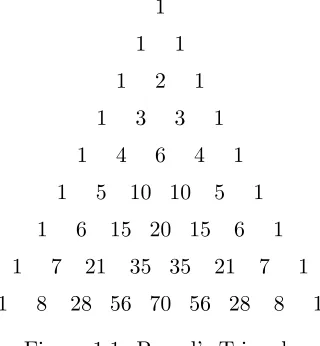
eight times, we can create the triangle in Figure 1.1 [Tuc12].
1 8 28 56 70 56 28 8 1
1 7 21 35 35 21 7 1
1 6 15 20 15 6 1
1 5 10 10 5 1
1 4 6 4 1
1 3 3 1
1 2 1
1 1
1
Figure 1.1: Pascal’s Triangle
The entries in Pascal’s triangle represent the coefficients of the binomial
the first few cases gives the following
(a+b)0= 1
(a+b)1=a+b
(a+b)2=a2+ 2ab+b2
(a+b)3=a3+ 3a2b+ 3ab2+b3
(a+b)4=a4+ 4a3b+ 6a2b2+ 4ab3+b4.
When n = 0, the coefficient of the binomial expansion is the initial row of Pascal’s
triangle, which we’ll call the 0th row. If n = 1,2,3,4, the coefficients of each binomial expansion yield the first, second, third, and fourth row, respectively. Furthermore, using
similar notation introduced in [Tuc12] , the entries in Pascal’s triangle can be expressed
by
n k
= n!
k!(n−k)!, n, k∈Z≥0. (1.1) n
k
is the entry in thenth row andkth column of Pasca’ls triangle.
Pascals Identity (1.2) was also introduced in [Tuc12] and states that any entry in Pascal’s triangle is the sum of the two adjacent values in the preceding row:
n k
=
n−1 k
+
n−1 k−1
, n, k∈Z≥0. (1.2)
Pascal’s identity plays a major roll in proving many properties in Pascal’s triangle. It is
a key factor to completing some induction proofs in the triangle. Also,
r 0
=
r r
= 1, r ∈Z≥0. (1.3)
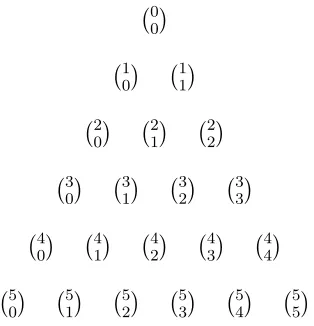
Using the notation in (1.1), Pascal’s triangle may be expressed in the following
0 0
1 0
1 1
2 0
2
1
2
2
3 0
3 1
3 2
3 3
4 0
4
1
4
2
4
3
4
4
5 0
5 1
5 2
5 3
5 4
5 5
Figure 1.2: Pascal’s Triangle in Combinatorial Notation
In Chapter 2, we will start by looking at elementary properties in Pascal’s
Tri-angle and and later introduce some which may not be well known to some readers. In
Chapters 3 and 4, we will look at which patterns in Pascal’s triangle extend to Pascal’s
Chapter 2
Pascal’s Triangle
2.1
Elementary Properties
We will begin by mentioning several well known patterns hidden in Figure 1.1.
Firstly, the triangle is symmetrical about the vertical axis. That is, the numbers on the
left side of the triangle have matching numbers on the right side. Also, the first diagonal
is just 1’s, the second diagonal is known as the natural numbers, the third diagonal is the
triangular numbers, the fourth diagonal is the tetrahedral numbers, and so on.
The existence of powers of 2 appear in each row of Pascal’s triangle [Pol09]. That is, the sum of row nis 2n. Consider the sum of the fourth row
1 + 4 + 6 + 4 + 1 = 16 = 24.
Given any row n,
n
X
k=0
n k
= 2n n, k≥0. (2.1)
Proof. Equation (2.1) can be easily proven by mathematical induction, and Pascal’s iden-tity (1.2) plays a major roll in completing the proof. The base case, whenn= 0, is obvious
since 20 = 1. Now assume the equation is true forn=l, that isPl
k=0 = 2l. Our goal is
to show the equation is true for n=l+ 1. Consider
l+ 1 0
+
l+ 1 1
+
l+ 1 2
+. . .+
l+ 1 l+ 1
.
expression as
l 0
+
l 0
+
l 1
+
l 1
+. . .+
l l−1
+
l l
+
l l
= 2
l 0
+
l 1
+. . .+
l l
.
Notice the sum is what we assumed to be true. Therefore, the expression is
2·2l = 2l+1.
This completes the induction proof and thus (2.1) holds.
Polya introduced the sum of the squares of each entry in rown is equal to the
middle entry of row 2nin [Pol09]. That is,
n
X
k=0
n k
2
=
2n n
n, k≥0. (2.2)
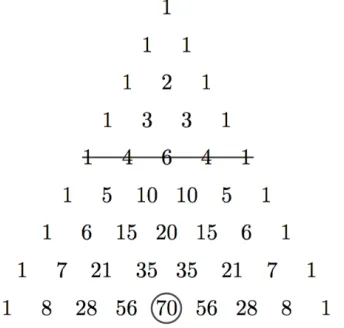
Consider the sum of the squares of the entries in row 4
4
X
k=0
4 k
2
= 12+ 42+ 62+ 42+ 12 = 70.
Also,
8 4
= 8!
4!·4! = 70.
An illustration of this example is shown in Figure 2.1.
We can show (2.2) is true by using the block walking technique, the idea of this proof
is shown by Polya in [Pol09] For simplicity, we will outline the proof by considering the
specific example of the sum of the squares of row 2. By (2.2) we know the sum is 42
= 6.
Using the block walking technique, suppose we start at the top of the triangle, meaning
the 0th row. Our goal is to end up at 6. Figure 2.2 (a) shows 3 ways of walking from the 0th row to 6. Since Pascal’s triangle is symmetrical about the vertical axis, we know there exists 3 more paths in the opposite direction which is shown in Figure 2.2 (b).
(a) (b)
Figure 2.2: Block Walking Example
Notice these paths combined create an outer path of a diamond with the middle row
being row 2. That is, to land on the entry 6 we must cross each entry in row 2. Observe,
there is only one way to get to the entry 1 in row 2, there are two ways to get to the
entry 2 in row 2, and there is only one way to get to the last entry 1 in row 2. Since the
diamond is symmetrical about the horizontal axis, there is only one way to get to the
entry 6 from entry 1 of row 2, there are two ways to get to entry 6 from entry 2 of row 2,
and there is only one way to get to entry 6 from the last entry 1 of row 2. In all, there
are 1·1 + 2·2 + 1·1 = 6 total ways of walking from the 0th row to entry 6. This can be generalized as follows: starting with the 0throw, there are n0
ways
to get to entry n0 of row n, n1 ways to get to entry n1 of row n, ..., and nn ways to get to entry nn of row n. Since the diamond shape is symmetrical about the nth row, there are n0 ways to get to entry 2nn from the entry n0 of row n, n1 ways to get to entry 2nn from entry n1 of rown, ..., and nn ways to get to entry 2nn from entry nn of row n. In all, there are n02
+ n12
+ n22
+. . .+ nn2
ways to get to entry 2nn
from
the 0th row.
being in its corresponding place value, that is, ones, tens, hundreds, and so on. Since
place values are just multiples of 10, we can easily calculate each row as follows:
row 0: 1·100 = 1 = 110
row 1: 1·101+ 1·100= 11 = 111
row 2: 1·102+ 2·101+ 1·100 = 121 = 112
row 3: 1·103+ 3·102+ 3·101+ 1·100= 1331 = 113.
This property applies to each row in Pascal’s triangle. Koshy introduces a formula in
[Kos11] which yields 11n for any rownby
n
X
k=0
n k
·10n−k= 11n, n≥0. (2.3)
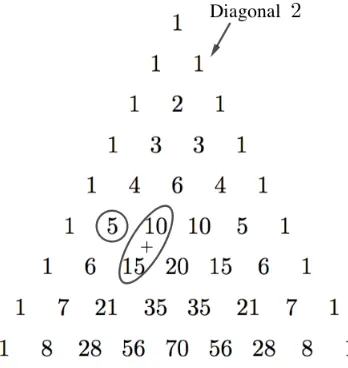
The square of any entry in diagonal 2 is equal to the sum of the two adjacent
entries on the right [Kos11]. That is,
n 1
2
=
n 2
+
n+ 1 2
, n≥1. (2.4)
As an example, say n= 5. From (2.4),
5 1
2
= 52 =
5 2
+
6 2
= 25.
Figure 2.3 shows which entries are being considered for n= 5.
The Star of David centered at nk is another fascinating patter introduced in [HP87], which states
n−1 k
n k−1
n+ 1 k+ 1
=
n−1 k−1
n k+ 1
n+ 1 k
. (2.5)
In Figure 2.4, we see the Star of David centered at 52
. Using (2.5),
4 2 5 1 6 3 = 4 1 5 3 6 2 .
Which simplifies to
6·5·20 = 4·10·15.
Notice both products equal 600. We can show this is always true by starting with the
left-hand side of (2.5) and rearranging the denominators of the products as follows:
n−1 k
n k−1
n+ 1 k+ 1
= (n−1)! k!(n−1−k)!·
n!
(k−1)!(n−k+ 1)!·
(n+ 1)! (k+ 1)!(n−k)!
= (n−1)! (k−1)!(n−k)!·
n!
(k+ 1)!(n−k−1)!·
(n+ 1)! k!(n−k+ 1)!
=
n−1 k−1
n k+ 1
n+ 1 k
.
Figure 2.4: Star of David Centered at 52
Boscarol’s identity, as stated in [Kos11], is given by i
X
k=0
n+k k
2n+k + n
X
l=0
n+i−l i
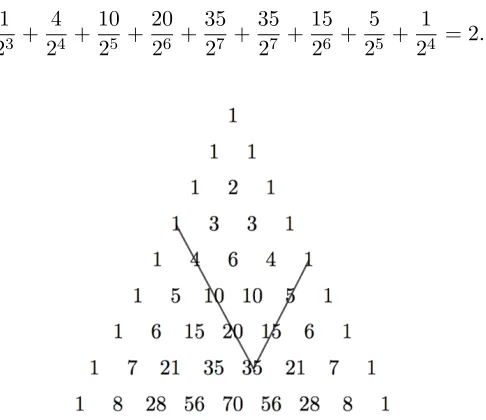
Beginning at any point of the form n0, (2.6) will hold. Consider the path in Figure 2.4, using Boscarol’s identity, we have:
1 23 +
4 24 +
10 25 +
20 26 +
35 27 +
35 27 +
15 26 +
5 25 +
1 24 = 2.
Figure 2.5: Boscarol’s Identity Example
The last property we’ll discuss is the teardrop property, which states the sum of all the entries in a parallelogram is equal to one less than the entry below it [Pol09].
Notice the sum of the entries in the parallelogram in Figure 2.6 is equal to 5, which is
one less than 6.
2.2
Fermat Numbers
Let us explore some patterns which may not be well known to some readers. We
will begin by looking at the existence of Fermat numbers [Hew77], which are of the form
F(m) = 22m+ 1, m∈Z≥0. (2.7)
Clearly, the first few Fermat numbers are
F(0) = 3
F(1) = 5
F(2) = 17
F(3) = 257.
We can find these numbers hidden in Pascal’s triangle, to do so we must consider each
entry in Pascal’s triangle modulo 2.
row 8 row 7 row 6 row 5 row 4 row 3 row 2 row 1 row 0
1 0 0 0 0 0 0 0 1
1 1 1 1 1 1 1 1
1 0 1 0 1 0 1
1 1 0 0 1 1
1 0 0 0 1
1 1 1 1
1 0 1
1 1
1
Figure 2.7: Pascal’s Triangle Modulo 2
As shown in [Hew77], if we consider each row a binary number, we are able to translate
to decimal notation. For simplicity, let
a(n) = n
X
k=0
n k
∗
·2n−k (2.8)
be the sequence of numbers constructed when rownis translated from binary to decimal.
For example, using (2.8) to translate row 5 yields the following:
a(5) =
5
X
k=0
5 k
∗
·25−k
=
5 0
∗
·25+
5 1
∗
·24+
5 2
∗
·23+. . .+
5 5
∗
·20
= 1·25+ 1·24+ 0·23+ 0·22+ 1·21+ 1·20
= 51.
The figure below shows rows 0−8 of Figure 2.8 translated to decimal using equation
(2.8).
Row Binary Decimal
0 1 1
1 11 3
2 101 5
3 1111 15
4 10001 17
5 110011 51
6 1010101 85
7 11111111 255
8 100000001 257
Figure 2.8: Decimal Representation of Pascal’s Triangle Modulo 2
The decimal representation of the binary numbers in rows 1, 2, 4, and 8 are
3 = F(0)
5 = F(1)
15 = 3·5 = F(0)·F(1)
17 = F(2)
51 = 3·17 = F(0)·F(2)
85 = 5·17 = F(1)·F(2)
255 = 15·17 = F(0)·F(1)·F(2)
257 = F(3).
Each value is either a Fermat number or a product of Fermat numbers. As we can
see, the gap between each Fermat number increases rapidly. Consider two consecutive
Fermat numbers F(m) and F(m+ 1), which appear in rows 2m and 2m+1, respectively. The gap between these two rows contains each product ofF(m) with each value of every
row before F(m), excluding row 0, in consecutive order. For example, F(3) = 257 and
F(4) = 65,537. Between the gap of these two numbers exists 3·F(3), 5·F(3), 15·F(3),
17·F(3), 51·F(3), 85·F(3), and 255·F(3), respectively. Figure 2.9 shows the binary
and decimal representation of rows 8−16 in Pascal’s triangle modulo 2.
Row Binary Decimal
8 100000001 257=F(3)
9 1100000011 771=3·257
10 10100000101 1285=5·257
11 111100001111 3855=15·257
12 1000100010001 4369=17·257
13 11001100110011 13107=51·257
14 101010101010101 21845= 85·257
15 1111111111111111 65535=255·257
16 10000000000000001 65537=F(4)
Figure 2.9: Decimal Representation of Rows 8-16 in Pascal’s Triangle Modulo 2
[Hew77] nicely tied the relationship between the rows in Pascal’s triangle modulo
numbers, we can let
b(n) =F(m)j0·F(m−1)j1·. . .·F(0)jm (2.9)
be the number found in row n, translated to decimal, wheren=j0j1. . . jm is in binary expansion. Using (2.9) we can find any decimal representation of rownin terms of Fermat
numbers. For example, the number in row n= 5, that is n= 101 can be found by
b(101) =F(2)1·F(1)0·F(0)1
= 171·50·31
= 51.
Notice n= 101 implies j0= 1, j1= 0, andj2 = 1 and thereforem= 2.
2.3
Hockey Stick
The hockey stick derived its name from the interesting path it creates in the
triangle. There are several hockey sticks that are found in Pascal’s triangle. The following
three theorems are shown in [CL18].
Theorem 2.1. Hockey Stick Theorem
k
X
i=0
n+i i
=
n+k+ 1 k
, n≥0.
As an example, consider the case when n= 2 andk= 3. Then,
3
X
i=0
2 +i i
=
2 0
+
3 1
+
4 2
+
5 3
.
Simplifying yields the following:
1 + 3 + 6 + 10 = 20 =
6 3
.
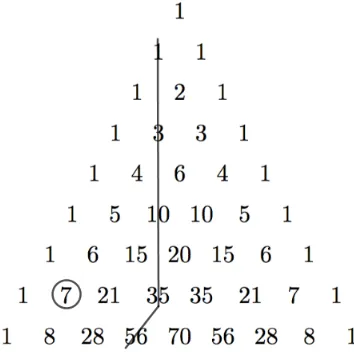
Figure 2.10: Hockey Stick in Pascal’s Triangle
Theorem 2.2. The Little Hockey Stick and Puck Theorem
n 0
+
n+ 2 1
+
n+ 4 2
=
n+ 5 2
−
n+ 5 0
, n≥0.
If n= 2, then
2 0
+
4 1
+
6 2
= 20.
Also,
7 2
−
7 0
= 20.
The path used in this example is shown in Figure 2.11.
Theorem 2.3. The Big Hockey Stick and Puck Theorem n 0 +
n+ 2 1
+
n+ 4 2
+
n+ 6 3
=
n+ 7 3
−
n+ 6 1
, n≥0.
If n= 1, we have
1 0 + 3 1 + 5 2 + 7 3
= 49.
Also, 8 3 − 7 1
= 49.
A path for the Big Hockey Stick and Puck Theorem, for n= 1, is shown in Figure 2.12.
Figure 2.12: The Big Hockey Stick and Puck Example
A general representation of Theorems 2.2 and 2.3 is shown in (2.10) [CL18]. For
any entry of the form n0 in Pascal’s triangle, the following holds k
X
i=0
n+ 2i i = bk 2c X j=0
(−1)j
n+ 2k−j+ 1 k−2j
. (2.10)
Suppose we begin the hockey stick at 10
and we limit k to 5. Using equation
(2.10), we have
5
X
i=0
1 + 2i i = 2 X j=0
(−1)j
12−j 5−2j
.
Expanding the summation yields
Simplifying,
1 + 3 + 10 + 35 + 126 + 462 = 792−165 + 10.
A path for this hockey stick and puck example is shown in Figure 2.11. A sketch for the
proof of (2.10) can be found in [CL18].
Chapter 3
Pascal’s Pyramid
3.1
Introduction
Pascal’s pyramid is a three dimensional extension of Pascal’s triangle which is
generated by starting with a 1 on the 0thlayer; a new layer is obtained by adding the three adjacent values in the previous layer. Repeating this algorithm four times will generate
the following pyramid [HP12].
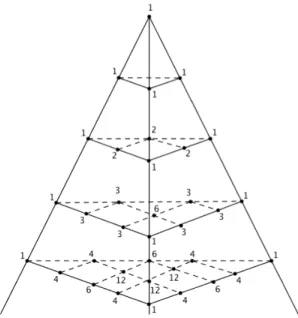
Figure 3.1: Pascal’s Pyramid
Figure 3.2: Pascal’s Pyramid: Layers 1, 2, 3, and 4, Respectively
The entries in layernrepresent the coefficients of the expansion (a+b+c)n, wherea,b, care real numbers and nis any non negative integer. Expanding the first few cases gives
the following
(a+b+c)0 = 1
(a+b+c)1 =a+b+c
(a+b+c)2 =a2+ 2ab+b2+ 2ac+ 2bc+c2
(a+b+c)3 =a3+ 3a2b+ 3ab2+b3+ 3a2c+ 6abc+ 3acb2+ 3ac2+ 3bc2+c3.
Notice the coefficients match the entries in each layer. They may be easily viewed below.
Figure 3.3: Expansion of (a+b+c)n forn= 1,2,3, Respectively
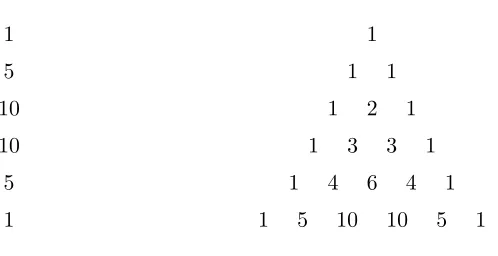
From [CO99], we can construct any layer in Pascal’s pyramid. To obtain layern,
we must first construct Pascal’s triangle up to row n. We then write rownas a column,
next to Pascal’s triangle and multiply each entry in the column to the corresponding row
in Pascal’s triangle. For example, to obtain layer 5 we first write down rows 0−5 of
1 5 10 10 5 1
1 5 10 10 5 1
1 4 6 4 1
1 3 3 1
1 2 1
1 1
1
Figure 3.4: Construction of Pascal’s Pyramid Layer 5
The product of the entries in the left column with the entries in the corresponding row
of Pascal’s triangle yields the fifth layer of Pascal’s pyramid.
1 5 10 10 5 1
5 20 30 20 5 10 30 30 10
10 20 10
5 5
1
Figure 3.5: Fifth Layer of Pascal’s Pyramid
Similar to the binomial coefficients, we can represent the coefficients in Pascal’s
pyramid by [Wal00]
n i, j, k
= n!
i!j!k!, i+j+k=n, n, i, j, k≥0. (3.1)
In addition,
n 0, n,0
=
n n,0,0
=
n 0,0, n
= 1, n≥0. (3.2)
Notice i,j,kn is the coefficient of aibjck in the expansion (a+b+c)n. Similar to Pascal’s identity, the following holds [HP12]
n i, j, k
=
n−1 i−1, j, k
+
n−1 i, j−1, k
+
n−1 i, j, k−1
3.2
Elementary Properties
We will now consider patterns in Pascal’s triangle that are also applicable in
Pascal’s pyramid. Notice the sum of each entry in layer n is 3n. In Figure 3.2, the sum of the entries in layer 3 should be 33. Observe
1 + 1 + 1 + 3 + 3 + 3 + 3 + 3 + 3 + 6 = 27 = 33,
as desired.
Powers of 111 are found hidden in each layer of the pyramid. Letn be a layer in Pascal’s pyramid. 111n can be found by translating the sum of each vertical column to decimal. In Figure 3.6, we have 1110 = 1, 1111 = 111, and 1112 = 12321, for layers 0, 1, and 2, respectively.
Figure 3.6: Powers of 111
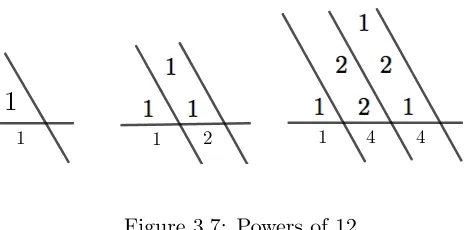
Similarly, the sum of each diagonal in layer n is 12n. Examples of powers of 12, for n= 0,1,2 can be found on Figure 3.7.
Figure 3.7: Powers of 12
center i,j,kn , the following products are equal:
n−1 i, j−1, k
n i−1, j, k+ 1
n i+ 1, j, k−1
n+ 1 i, j+ 1, k
=
n−1 i−1, j, k
n i, j−1, k+ 1
n i, j+ 1, k−1
n+ 1 i+ 1, j, k
(3.4)
=
n−1 i, j, k−1
n i−1, j+ 1, k
n i+ 1, j−1, k
n+ 1 i, j, k+ 1
.
In Figure 3.8, we see the layers in which the product takes into consideration, namely
layersn−1,n, and n+ 1, respectively.
n−1
i−1,j,k
n−1
i,j−1,k
n−1
i,j,k−1
n i−1,j,k+1
n
i,j−1,k+1
n i−1,j+1,k
n
i+1,j−1,k
n i,j+1,k−1
n i+1,j,k−1
n+1
i,j,k+1
n+1
i,j+1,k
n+1
i+1,jk
Figure 3.8: 3 Layers Used and Entries for Center i,j,kn
Using the center 1,31,1
, we have the following:
2 1,0,1
3 0,1,2
3 2,1,0
4 1,2,1
=
2 0,1,1
3 1,0,2
3 1,2,0
4 2,1,1
=
2 1,1,0
3 0,2,1
3 2,0,1
4 1,1,2
.
By (3.1), the products simplify to 216.
3.3
Fermat Numbers
Analogous to Chapter 2, Fermat numbers also exist in Pascal’s pyramid. We
Figure 3.9: Layers 1-4 Modulo 2
Examining each layer individually and translating each row from binary to decimal gives
us the following tables.
Layer 1
Row Binary Decimal
0 1 1
1 11 3
Layer 2
Row Binary Decimal
0 1 1
1 00 0
2 101 5
Layer 3
Row Binary Decimal
0 1 1
1 11 3
2 101 5
3 1111 15
Layer 4
Row Binary Decimal
0 1 1
1 00 0
2 000 0
3 0000 0
4 10001 17
Figure 3.10: Layers 1-4 Translated to Decimal
The last row of each layer is either a Fermat number or a product of Fermat numbers.
Notice row m of layer m has the same decimal value as row m in Pascal’s
triangle modulo 2 translated to decimal. For example, row 3 of layer 3 has a decimal
representation of 15. In Figure 2.7, we see the decimal representation of row 3 in Pascal’s
3.4
Hockey Stick
A 3-dimensional representation of the hockey stick, as stated in [Hew77], can be
found by
v
X
u=0
X
2i+j=2n+u
n+u i, j, i−n
= bv 2c X w=0 (−1)w
X
2i+j=2n+v+2w+2
n+v+ 1 i, j, i−n−2w−1
(3.5)
As an example, let us begin with layer n= 1 and limit v to 3. To help us visualize, we
will first consider the left hand side of (3.5). Using these parameters, (3.5) reads
3
X
u=0
X
2i+j=2·1+u
1 +u i, j, i−1
.
We can find our sum by lettingu vary from 0 to 3 and finding the corresponding
param-eters for the inner sum. Table 3.1 shows the corresponding sum and paramparam-eters, given u
is fixed.
u Summation Notation Inner Sum Parameters Sum
0 P
2i+j=2 1
i,j,i−1
i= 1,j= 0 1,10,0
1 P
2i+j=3 2
i,j,i−1
i= 1,j= 1 1,21,0
2 P
2i+j=4 3
i,j,i−1
i= 2,j= 0 2,30,1 i= 1,j= 2 + 1,32,0
3 P
2i+j=5 4
i,j,i−1
i= 2,j= 1 2,41,1
i= 1,j= 3 + 1,43,0
Table 3.1: Sum of Left-hand Side of (3.4)
Thus, the left-hand side of (3.5) simplifies to
1 1,0,0
+
2 1,1,0
+
3 2,0,1
+
3 1,2,0
+
4 2,1,1
+
4 1,3,0
= 1 + 2 + 3 + 3 + 4 + 12
Figure 3.11 shows the layers and values in which this left-hand side of (3.5) takes into
consideration, in this example.
Figure 3.11: Left-hand Side of 3.2
The right-hand side of (3.5) , with the parameters stated above, is
b3 2c
X
w=0
(−1)w
X
2i+j=2·1+3+2w+2
1 + 3 + 1 i, j, i−1−2w−1
=
1
X
w=0
(−1)w
X
2i+j=7+2w
5 i, j, i−2w−2
.
We can find our sum by lettingwvary from 0 to 1 and finding the corresponding
param-eters for the inner sum. Table 3.2 shows the corresponding sum and paramparam-eters, givenw
is fixed.
w Summation Notation Inner Sum Parameters Sum
0 P
2i+j=7 5
i,j,i−2
i= 3, j= 1 3,51,1
i= 2, j= 3 + 2,53,0
1 −P
2i+j=9 5
i,j,i−4
i= 4, j= 1 − 4,51,0
Table 3.2: Sum of Right-hand Side of 3.4
5 3,1,1
+
5 2,3,0
−
5 4,1,0
= 20 + 10−5
= 25
Figure 3.12 shows the layer and values in which this right-hand side of (3.5) takes into
consideration, in this example.
Figure 3.12: Right-hand Side of 3.4
Notice
1 + 2 + 3 + 3 + 4 + 12 = 10 + 20−5,
Chapter 4
Trinomial Triangle
4.1
Introduction
The trinomial triangle is another extension of Pascal’s triangle which is
con-structed by beginning with the constant term 1 in the 0th row. To obtain a new row, we sum the three adjacent values in the preceding row. Repeating this algorithm 4 times
yields the following triangle. Notice, entries in each row are symmetrical about the
ver-tical axis, know as the apex [Pol09].
1 4 10 16 19 16 10 4 1
1 3 6 7 6 3 1
1 2 3 2 1
1 1 1
1
Figure 4.1: Trinomial Triangle
The entries in row n represent the coefficients of the expansion (1 +x+x2)n. Expanding the first few cases yields:
(1 +x+x2)0= 1
(1 +x+x2)1= 1 +x+x2
(1 +x+x2)2= 1 + 2x+ 3x2+ 2x3+x4
Using similar notation as [Wei], the coefficients in this triangle may be expressed as n k 2 = n X i=0
(−1)i
n i
2n−2i n−k−i
, n≥0, −n≤k≤n. (4.1)
In addition, n −k 2 = n k 2 . (4.2) Also, 0 0 2
= 1. (4.3)
Calculating entries in the trinomial triangle is more tedious than calculating entries in
Pascal’s triangle. Using (4.1) we can calculate a few entries of the trinomial triangle.
Notice 2 0 2 = 2 X i=0
(−1)i
2 i
4−2i 2−i
.
Expanding the sum yields
2
X
i=0
(−1)i
2 i
4−2i 2−i
= 2 0 4 2 − 2 1 2 1 + 2 2 0 0 .
Simplifying using (1.1), the coefficient is
2 0
2
= 1·6−2·2 + 1·1 = 3.
Similarly, we can compute 41
2 as follows:
4 1 2 = 4 X i=0
(−1)i
4 i
8−2i 3−i
.
Expanding and simplifying
4
X
i=0
(−1)i
4 i
8−2i 3−i
= 4 0 8 3 − 4 1 6 2 + 4 2 4 1 − 4 3 2 0 + 4 4 0 −1
= 1·56−4·15 + 6·4−4·1 + 1·0 = 16.
Notice nk
2is the coefficient ofx
n+kin the expansion of (1+x+x2)n. Therefore,
0 0 2 1 −1 2 1 0 2 1 1 2 2 −2 2 2 −1 2 2 0 2 2 1 2 2 2 2 3 −3 2 3 −2 2 3 −1 2 3 0 2 3 1 2 3 2 2 3 3 2 4 −4 2 4 −3 2 4 −2 2 4 −1 2 4 0 2 4 1 2 4 2 2 4 3 2 4 4 2 5 −5 2 5 −4 2 5 −3 2 5 −2 2 5 −1 2 5 0 2 5 1 2 5 2 2 5 3 2 5 4 2 5 5 2
Figure 4.2: Trinomial Triangle in Combinatorial Notation
4.2
Elementary Properties
As mentioned in Section 4.1, the values of the triangle are symmetrical about
the apex. Notice each value in the apex is an odd number. Using (4.1), the middle entry
of the nth row can be found by:
n 0 2 = n X i=0
(−1)i
n i
2n−2i n−i
. (4.4)
Similar to Pascal’s identity, the trinomial coefficients satisfy the following [Wei]
n k 2 =
n−1 k−1
2
+
n−1 k
2
+
n−1 k+ 1
2
. (4.5)
Meaning each entry is the sum of the three adjacent entries in the previous row.
Triangular numbers are hidden on the third diagonal of the triangle.
Figure 4.3: Triangular Numbers in the Trinomial Triangle
of the entries in row 4:
1 + 4 + 10 + 16 + 19 + 16 + 10 + 4 + 1 = 81 = 34.
That is, for any row n
n
X
k=−n
n k
2
= 3n, n≥0. (4.6)
A similar pattern is the sum of the squares of the entries in row nis equal to the middle
entry of row 2n [Pol09]. That is,
n
X
k=−n
n k 2 2 = 2n 0 2
, n≥0. (4.7)
Consider the sum of the squares of the entries in row 2
2
X
k=−2
2 k 2 2 = 2 −2 2 2 + 2 −1 2 2 + 2 0 2 2 + 2 1 2 2 + 2 2 2 2
= 19.
Also, 4 0 2
= 19.
An illustration of this path is shown in Figure 4.4.
Figure 4.4: Sum Of Squares for n= 2
Similar to the powers of 11 introduced in Section 2.1, the powers of 111 are hidden in the trinomial triangle. Translating row n to decimal will result in 111n. That is,
n
X
k=−n
n k
2
Translating row 3, (4.8) reads:
3
X
k=−3
3 k
2
·103−k.
Expanding the sum yields
3 −3
2
·103+3+
3 −2
2
·103+2+
3 −1
2
·103+1+
3 0
2
·103−0
+ 3 1 2
·103−1+
3 2
2
·103−2+
3 3
2
·103−3.
Simplifying we have
1·106+ 3·105+ 6·104+ 7·103+ 6·102+ 3·101+ 1·100= 1367631 = 1113,
as desired.
The sum of the entries in row n with alternating signs is equal to 1 [Pol09].
That is,
n
X
k=−n
(−1)n−k
n k
2
= 1, n≥0. (4.9)
The sum of the entries in row 4, with alternating sings, yields
4
X
k=−4
(−1)4−k
4 k 2 .
Expanding the sum
(−1)4+4
4 −4
2
+ (−1)4+3
4 −3
2
+ (−1)4+2
4 −2
2
+ (−1)4+1
4 −1
2
+ (−1)4−0
4 0
2
+ (−1)4−1
4 1
2
+ (−1)4−2
4 2
2
+ (−1)4−3
4 3
2
+ (−1)4−4
4 4 2 , and simplifying
1−4 + 10−16 + 19−16 + 10−4 + 1 = 1.
Theteardrop property also applies to the trinomial triangle. The parallelogram can be created with even or odd number of rows. If the parallelogram consists of even
number of rows, the sum of the parallelogram is equal to one less than the entry below
the parallelogram. The sum of the parallelogram in Figure 4.5 is 18, which is one less
Figure 4.5: Teardrop Example for an Even Number of Rows
If the parallelogram consists of odd number of rows, the sum of the parallelogram
is equal to the entry below it. Notice the sum of the parallelogram in Figure 4.6 is 7,
which is also the entry right below it.
Figure 4.6: Teardrop Example for an Odd Number of Rows
4.3
Hockey Stick
Several hockey stick properties are shown in [CL18]. The Trinomial Diagonal
Hockey Stick and Multipuck has two different cases. For the first case, consider beginning
the diagonal hockey stick path at −nn
2, then
k
X
i=0
n+i −n+i
2
=
2k
X
j=0
(−1)j
n+k+ 1 −n+k−1−j
2
Beginning at −112 and setting k= 3, then
3
X
i=0
1 +i −1 +i
2 = 1 −1 2 + 2 0 2 + 3 1 2 + 4 2 2 . Also, 6 X j=0
(−1)j
5 1−j
2 = 5 1 2 − 5 0 2 + 5 −1 2 − 5 −2 2 + 5 −3 2 − 5 −4 2 + 5 −5 2 . Notice 1 −1 2 + 2 0 2 + 3 1 2 + 4 2 2
= 1 + 3 + 6 + 10 = 20
and 5 1 2 − 5 0 2 + 5 −1 2 − 5 −2 2 + 5 −3 2 − 5 −4 2 + 5 −5 2
= 45−51 + 45−30 + 15−5 + 1 = 20.
An illustration of this path is shown in Figure 4.7.
Figure 4.7: Diagonal Hockey Stick and Multipuck Case 1
For the second case of the diagonal hockey stick and multipuck property, consider
beginning at −nn+1, then k
X
i=0
n+i −n+ 1 +i
2
=
2k+1
X
j=0
(−1)j
n+k+ 1 −n+k−j
2
Beginning at 10 and setting k= 3,
3
X
i=0
1 +i i 2 = 1 0 2 + 2 1 2 + 3 2 2 + 4 3 2 . Furthermore, 7 X j=0
(−1)j
5 2−j
2 = 5 2 2 − 5 1 2 + 5 0 2 − 5 −1 2 + 5 −2 2 − 5 −3 2 + 5 −4 2 − 5 −5 2 .
In both equations,
1 0 2 + 2 1 2 + 3 2 2 + 4 3 2
= 1 + 2 + 3 + 4 = 10
and 5 2 2 − 5 1 2 + 5 0 2 − 5 −1 2 + 5 −2 2 − 5 −3 2 + 5 −4 2 − 5 −5 2
= 30−45 + 51−45 + 30−15 + 5−1 = 10.
An illustraton of this path can be found in Figure 4.8.
Figure 4.8: Diagonal Hockey Stick and Multipuck Case 2
A generalized hockey stick and multipuck formula, for the trinomial triangle,
was introduced in [Hew77]
k
X
i=0
n+i n 2 = bk 2c X j=0
(−1)j
n+k+ 1 n+ 2j+ 1
2
As an example, let n = 0 and k = 4. A path for this example is shown in Figure 4.9.
Using these parameters,
4 X i=0 i 0 2 = 0 0 2 + 1 0 2 + 2 0 2 + 3 0 2 + 4 0 2 . Also, 2 X j=0
(−1)j
5 2j+ 1
2 = 5 1 2 − 5 3 2 + 5 5 2 . Notice 0 0 2 + 1 0 2 + 2 0 2 + 3 0 2 + 4 0 2
= 1 + 1 + 3 + 7 + 19 = 31
and 5 1 2 − 5 3 2 + 5 5 2
= 45−15 + 1 = 31,
as desired.
Figure 4.9: Hockey Stick Example in the Trinomial Triangle
Not only are the hockey stick properties fascinating, but they may also be used
to prove other properties in the triangle. Let us revisit the teardrop property introduced
in Section 4.2. We will consider the parallelogram with odd number of rows, the sum of
the parallelogram is stated in the following theorem.
Theorem 4.1. If k is the number of rows in the parallelogram and if k is odd, then
k−1 2
X
j=0
k−1 2
X
i=0
i+j i−j
2
+ k−1
2 −1
X
j=0
k−1 2 −1
X
i=0
i+ 1 +j i−j
2 = k 0 2 .
We will show that the teardrop property exists for an odd number of rows in
parallelogram is 7 when k= 3 rows, as shown in Figure 4.10. Then we will show it also
holds for k= 5 rows by adding four hockey hockey sticks which we will call H1,H1,H3,
and H4.
Figure 4.10: Example of Teardrop
Observe the H1+H2 = 51 and H3 +H4 = 16. As shown in Figure 4.11 (a),
by adding H1 and H2 we are required to borrow 16. The 16 that we are over counting
by is replaced by the sum of H3 and H4, as shown in Figure 4.11 (b). Notice H1 and
H3 overlap at 7, but one of these 7s is replaced by the parallelogram which we stated in
our induction hypothesis. Therefore, by adding these four hockey sticks, we can create a
parallelogram with k= 5 rows. The sum of this parallelogram is the sum of the hockey
sticks which is 51, as shown in Figure.
(a) (b)
Figure 4.11: Adding Hockey Sticks to Parallelogram with 3 Rows
The proof of the general case will flow similar to the outlined proof above.
Proof. We will prove Theorem 4.1 by using induction on the number of rows in the parallelogram, for odd number of rows. The base case is obvious and can be seen in
Figure 4.12: Base Case
We will now assume the sum of the parallelogram is true forkrows, where kis
odd. Therefore, the sum of the parallelogram is k02. Our goal is to show the sum is true for the next number of odd rows, namely a parallelogram with k+ 2 rows.
Similar to Figure 4.11, we have to add four hockey sticks to create the next
parallelogram in the sequence. We start by addingH1 andH2 which are
H1:
k+1 2
X
i=0
k+1
2 +i
−k+12 + 1 +i
2
=
2k+12 +1
X
j=0
(−1)j·
k+1
2 +
k+1 2 + 1
−k+12 +k+12 −j
2
!
H2:
k+1 2
X
i=0
k+1
2 +i
−k+12 +i
2
=
2k+12
X
j=0
(−1)j·
k+1
2 +
k+1 2 + 1
−k+12 +k+12 −1−j
2
!
.
The sum of these two hockey sticks is 2k+12 +1
0 2 = k+2 0
2, since all other entries add to
0. H1+H2 provide most of the entries needed to create the next parallelogram, however
we borrowed the term k+11 2 which derived from H1.
The last two hockey sticks are given by
H3 :
k+1 2 −1
X
i=0
k+1
2 +i
k+1
2 −1−i
2
=
2(k+12 −1)+1
X
j=0
(−1)j·
k+1
2 + (
k+1
2 −1) + 1
k+1 2 −(
k+1
2 −1) +j
2
!
H4 :
k+1 2 −1
X
i=0
k+1
2 +i
k+1 2 −i
2
=
2(k+12 −1)
X
j=0
(−1)j·
k+1
2 + (
k+1
2 −1) + 1
k+1 2 −(
k+1
2 −1) + 1 +j
2
!
.
But the sum of these hockey sticks is k+11 2, since all other entries add to 0. Not only does H3+H4 sum to the value we borrowed in H1+H2, but it also provides the last
Observe, wheni= k+12 −1,H1 andH3 share the same term, namely k0
2. This
extra term is used to complete the parallelogram, since k02is the sum of the parallelogram in our induction hypothesis. Thus, by adding adding hockey sticks H1,H2,H3, andH4
to our parallelogram from our induction hypothesis we can create a new parallelogram
whose sum is k+20
Chapter 5
Conclusion
As seen in Chapters 2 through 4, many properties in Pascal’s triangle have
analogous representation in Pascal’s pyramid and the trinomial triangle. The hockey
stick property translates to both Pascal’s pyramid and the trinomial triangle. However,
we were not able to find if Fermat numbers exist in the trinomial triangle. That need
not mean that it does not, it may just be encrypted deep in the trinomial triangle that it
will require more time to find. Also, different types of hockey sticks exist in the trinomial
triangle, but we were only able to find one representation for Pascal’s pyramid. Is it
possible for other types of hockey sticks to exist in the pyramid? Furthermore, in the
trinomial triangle, we were able prove the sum of an odd number of rows of a parallelogram
is equal to the entry below it using hockey stick properties. It may be possible to prove
other properties of the triangles or pyramid using the hockey sticks introduced.
It may be convincing that each property found in Pascal’s triangle should be able
to translate to any extension, it may just be a matter of searching. For future research,
we will see if there are any properties that do not exist in Pascal’s triangle, but do in the
extensions of it. Something to consider is if we are able to generalize every property to
n-dimensional pyramids or triangles for multinomial expansions. Also, we may want to
consider how these properties translate to other triangles such as the harmonic triangle
Bibliography
[CL18] Joseph Chavez and Leonard Lamp. Hockey stick identities in the trinomial
triangle. Manuscript, October 2018.
[CO99] James Chappell and Thomas J. Osler. The trinomial triangle. The College Mathematics Journal, March 1999.
[Hew77] Denton Hewgill. A relationship between pascal’s triangle and fermat’s numbers.
Manuscript, 1977.
[HP87] Peter Hilton and Jean Pedersen. Looking into pascals triangle: Combinatorics,
arithmetic, and geometry. Mathematics Magazine, 60(5):305–316, 1987.
[HP12] Peter Hilton and Jean Pedersen. Mathematics, models, and magz, part i:
Pat-terns in pascal’s triangle and tetrahedron. Mathematics Magazine, April 2012.
[Kos11] Thomas Koshy. Triangular arrays with applications. New York, 2011.
[Pol09] George Polya. Mathematical Discovery: On Understanding, Learning, and Teaching Problem Solving. Ishi Press, 2009.
[Tuc12] Alan Tucker. Applied Combinatorics. John Wiley and Sons, 2012.
[Wal00] Hans Walser. The pascal pyramid.The College Mathematics Journal, November 2000.
[Wei] Eric W. Weisstein. Trinomial coefficient. MathWorld-A Wolfram Web Resource.