Algorithm of Web Page Similarity Comparison
Based on Visual Block
Xingchen Li1, Weizhe Zhang1,2, Desheng Wang1, Bin Zhang2, and Hui He1
1 School of Computer Science and Technology,
Harbin Institute of Technology, Harbin,China
[email protected], (wzzhang,wangdesheng0821,hehui)@hit.edu.cn
2
Cyberspace Security Research Center, Peng Cheng Laboratory, Shenzhen, China
Abstract. Phishing often deceives users due to the relative similarity to the true pages on a layout and leads to considerable losses for the society. Consequently, detecting phishing sites has been an urgent activity. By researching phishing web pages using web page screenshots, we discover that this kind of web pages use nu-merous web page screenshots to achieve the close similarity to the true page and avoid the text and structure similarity detection. This study introduces a new sim-ilarity matching algorithm based on visual blocks. First, the RenderLayer tree of the web page is obtained to extract the visual block. Second, an algorithm that will settle the jumbled visual blocks, including the deletion of the small visual blocks and the emergence of the overlapping visual blocks, is designed. Finally, the simi-larity between the two web pages is assessed. The proposed algorithm sets different thresholds to achieve the optimal missing and false alarm rates.
Keywords:phishing, similarity comparison, visual block, web rendering.
1.
Introduction
With the advent of the network information age, the Internet has significantly improved people’s works and lives [16] and has accelerated the spread of information. However, prohibited tools for illegal profit-making have emerged simultaneously. Phishing websites is one of the killers that threaten network development in China. These websites confuse users when a domain name similar to the real website is used [18], thereby seriously damaging the vital interests of regular enterprises and numerous netizens and seriously disrupting China’s network trading environment. At present, phishing websites mainly target financial and e-commerce websites [7] to defraud money. With the increase in the popularity of family digitalization and network broadband and the emergence of new consumption patterns (e.g., e-commerce, online bank payment, and online settlement), phishing attacks have become the most serious threat to the realistic safety of e-commerce [17].
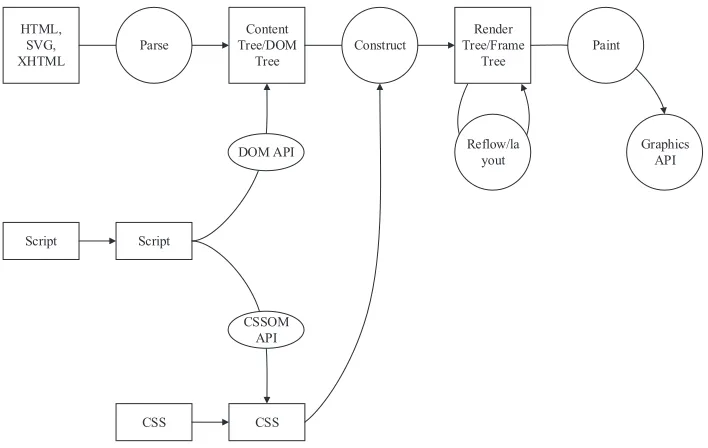
Web page similarity comparison relates to network rendering technology in addition to active detection technology. Network rendering technology involves the rendering prin-ciples of a browser and a kernel and the generation process of the rendering tree.
1) A document object model (DOM) tree is produced using HTML, XHTML, or SVG files..
2) The CSS files will generate a CSS rule tree.
3) JavaScript scripts, mainly through the DOM and CSSOM API, are used to operate the DOM and CSS rule trees.
After completing the parsing, the browser engine constructs the rendering tree through the DOM and CSS rule trees. The main steps are as follows:
1) The rendering tree is not equivalent to the DOM tree because of a header or a display; none is unnecessary in the rendering tree.
2) The CSS rule tree must complete the match and attach the CSS rule to each element (or frame) on the rendering Tree, which is the DOM node.
3) The position of each frame (i.e., each element) is calculated. This procedure is called the layout and reflow process.
Finally, the API of the operating system is drawn which is called native GUI.
HTML, SVG, XHTML
Content Tree/DOM
Tree
Render Tree/Frame
Tree
Script Script
Graphics API
CSS CSS
Parse Construct
DOM API
CSSOM API
Reflow/la yout
Paint
Fig. 1.Browser rendering principle
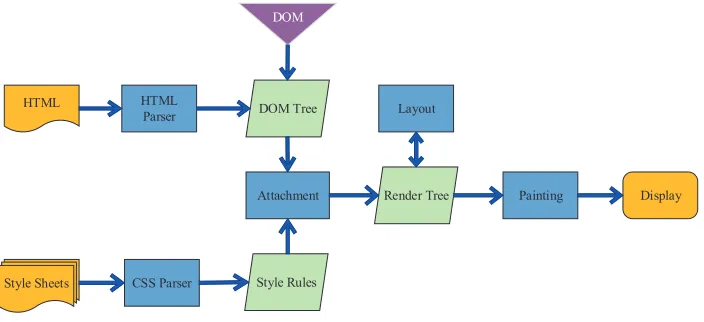
screen. The rendering tree, which contains only the nodes required to render the web pages, traverses the nodes in each DOM tree, thereby finding the style of the current node in the CSSOM rule tree to generate the rendering tree. In addition, the rendering tree cal-culates the exact location and size of each object in the layout of the web page. Every visible node is traversed from the root node of the DOM tree during the traversal process. The invisible nodes that are not reflected in the rendering output (e.g., script and meta tags) will be ignored. Similarly, some nodes that are hidden by CSS will also be ignored in the rendering tree. The suitable CSSOM rules for each node are then determined and applied. The matching begins from the right side of the selector to the left, thereby indi-cating that the matching begins from the child node of the CSSOM tree to the parent node. In addition, the time required to execute the rendering tree construction, layout, and draw-ing will depend on the size and application style of the document and on the device that runs the document. That is, a large document indicates additional work that the browser must complete. In addition, the drawing is time-consuming when the style is increasingly complex.
DOM
HTML DOM Tree
Style Sheets
HTML Parser
Attachment Render Tree Painting Display
CSS Parser Style Rules
Layout
Fig. 2.The construction process of render tree
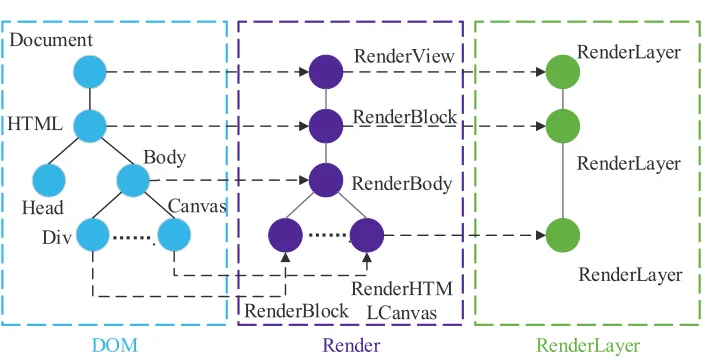
On the basis of some visual nodes of the DOM tree, the browser will build the cor-responding nodes in accordance with the node properties. These nodes will also form a rendering tree. The browser will create new nodes on the basis of this rendering tree to form a RenderLayer tree. The structural relationship between the three types of trees is demonstrated in Fig. 3.
DOM Document
HTML
Head
Body
Div
Canvas
Render
RenderView
RenderBody
RenderHTM LCanvas
RenderLayer RenderLayer
RenderLayer
RenderLayer RenderBlock
RenderBlock
ĊĊ. ĊĊ.
Fig. 3.The relationship between the three trees
On the other hand, the RenderLayer tree is a new tree that is built on the basis of the rendering tree. In addition, the nodes of this tree do not directly correspond to those of the rendering tree. Alternatively, a one-to-many relationship occurs among the nodes. In some cases, the tree must create new RenderLayer points. In the present study, the visual information of the web pages is obtained by analyzing the RenderLayer trees of the web pages and then extracting the information.
In this study, we devise a method to detect phishing sites based on visual blocks. The major contributions of this study are presented as follows:
1) Obtain the RenderLayer tree of the web page where the visual block will be extracted. 2) Design an algorithm that will settle jumbled visual blocks. This process involves
delet-ing the small visual blocks and mergdelet-ing the overlappdelet-ing visual blocks.
3) Define the similarity of the two web pages, and set different thresholds for the algo-rithm to achieve the optimal miss and error rates.
The remainder of this paper is organized as follows: Section 2 presents the related work. Section 3 discusses the similarity matching algorithm. Section 4 introduces the evaluation results. Section 5 provides the conclusions drawn from this study.
2.
Related Work
Phishing detection methods are mainly divided into two categories, namely, detecting URL and identifying the content of the web pages. The former identifies a phishing web-site in accordance with the URL through mathematical modeling and is suitable for de-tecting large quantities of web pages.
The text-based similarity detection extracts the text contents of the web page and com-pares them with the text template of the phishing web page to determine if the latter is a phishing website. The commonly used algorithms are Simhash and Imatch algorithms. Takama et al. [3] proposed a fast HTML web page detection approach, which provided direct access to node information by hashing the web page. The detection of the changes in the two versions of a page was accomplished by performing similarity computations after transforming the web page into an XML-like structure. It showed rapid improve-ments when compared to the results of a previous approach. Zhuang et al. [21] extracted 10 different types of features such as title, keyword and link text information to represent the website. Roopak et al. [14] proposed a novel method for detecting phishing pages by searching similar web pages through web mining and then comparing the web pages by matching the HTML source codes and computing the cosine similarity of the textual contents. The experiment results indicated that the detection rate is higher in the pro-posed mechanism than in other existing methods. Nichele et al. [12] presented a domain taxonomy-based clustering approach, which integrated page similarities to compute the session similarity. In the paper [15], authors used the Jaccard coefficient formula to de-termine the similarity among the web pages. This approach can be applied for usage and navigation clustering purposes. Huo et al. [13] proposed an N-gram algorithm to realize the comparison of web page similarities. Anari et al. [2] determined the similarity of web pages based on learning automata and probabilistic grammar.
DOMs are first used to express the internal structure of HTML files, thus contribut-ing significantly to HTML parscontribut-ing. Typical algorithms for structural similarity research are web page similarity measurement methods based on edit distance and statistical fea-tures. Edit distance, which is also known as Levenshtein distance, refers to the minimum number of edit operations required between two strings, from one to another. Licensed editing operations involve replacing one character with another, inserting one character, and deleting one character. In general, a small edit distance indicates a considerable sim-ilarity between two strings. Similar to the string, the number of edit operations is defined by inserting, deleting, and modifying the nodes of the tree. Similarly, a small edit distance of the two trees implies a huge similarity between the two trees. Therefore, the similar-ity of the web page can be calculated by comparing the edit distance of the web page’s DOM tree. Web page similarity measurement methods based on statistical features in-clude a method based on link and node features. The link feature focuses on the order of the nodes, while the node feature focuses on the content of the nodes. In the paper [9], authors constructed the links from the root node to the leaf node in the DOM tree of the independent web page and regarded the link frequency as a feature of the link to judge the similar web pages based on link frequency similarity. This algorithm is difficult but simple because it only considers tag information. Alpuente et al. [1] proposed a functional technique that transforms each web page into a compressed, normalized tree to represent a visual structure. An optimization of this technique, which was developed on the basis of memorization, achieved remarkable improvements in efficiency in time and space.
of web page typesetting. Liu et al. [10] detected phishing web pages in accordance with the similarity among the visual blocks after rendering the screening page, which involves two processes. The first process ran on local email servers and monitored emails for key-words and suspicious URLs, while the second process compared the potential phishing pages against actual pages and assessed the visual similarities among them in terms of key regions, page layouts, and overall styles. Fu et al. [6] proposed a phishing detection scheme that calculated the visual similarity of web pages based on Earth mover distance. In the paper [5], authors developed an automated process for crawling web pages. The Porter stemmer algorithm was used to convert the keywords into basic forms, and the term frequency–inverse document frequency method was utilized to obtain the importance of a keyword. In the paper [4], authors detected phishing using website components, such as source code, CSS, and logo. Furthermore, this method adopted the Jaccard coefficient formula to determine the similarity among web pages.
3.
Similarity Matching Algorithm
This section introduces a web page similarity matching algorithm based on visual blocks. The algorithm consists of three parts. The first part is the extraction of the web page’s vi-sual information. In this part, the RenderLayer tree of the web page must be analyzed, and the visual information, including the location and size information of the visual nodes, must be extracted. The second part is the merging of visual nodes. Given the scattered numerous visual nodes of the web, the small ones can be ignored directly, while the over-lapping ones require collision analysis and merge processing to maintain the consistency of the visual blocks with the original web page and improve the calculation efficiency. The last part is the web page similarity comparison, which utilizes the optimal free matching algorithm. For each visual block in the target web page, given that the visual blocks with coordinates, length, and width within a certain threshold range is found in the template web page, the blocks are considered similar. When the number of similar visual blocks is greater than a certain threshold, the two web pages are considered similar
3.1. Extracting Visual Blocks
Most web visual information are stored in the CSS file. Thus, obtaining the coordinates, lengths, and widths of the visual nodes directly from the HTML source code is difficult. The RenderLayer tree is more consistent with the visual structure of the original web page than the rendering tree. The non-visual nodes in the original web page (e.g., HEAD, META, and SCRIRT nodes) have been deleted.
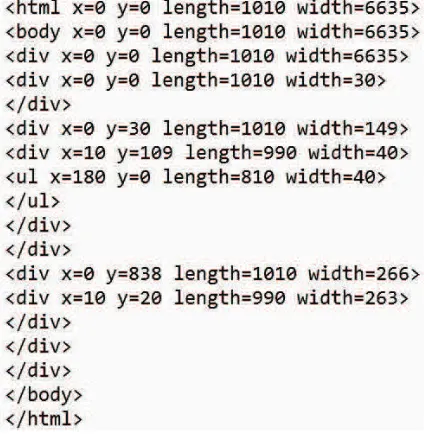
The structure of the RenderLayer tree is shown in Fig 4. The first line represents the total size of the layer point, and the remaining lines signify the visual nodes of the layer point. The coordinates of the visual nodes in the layer are all relative coordinates. Thus, each visual node must convert the coordinates into the absolute coordinates of the web page.
Fig. 4.Structure of the renderlayer tree
Algorithm 1Converting algorithm
Input: Dc: Depth of the current line,Dp: Depth of the previous line,Tc: Tag of the current line,
Ec: End tag of the current line Output: F: Format of HTML source code
1: functionCONVERTING 2: for line do 3: F.wirte(Tc) 4: ifDc> Dp then
5: S.push(Ec)
6: end if
7: ifDc< Dpand andDpis the last line of the layer nodethen 8: while! S.empty()do
9: F.write(S.pop())
10: end while 11: end if
12: ifDc< Dpand andDpis not the last line of the layer nodethen
13: depth =Dp−Dc
14: whiledepth != 0do
15: F.write(S.pop())
16: depth = depth - 1
17: end while 18: end if
19: ifDc==Dpthen
20: F.write(S.pop())
21: S.push(Ec)
22: end if 23: end for 24: end function
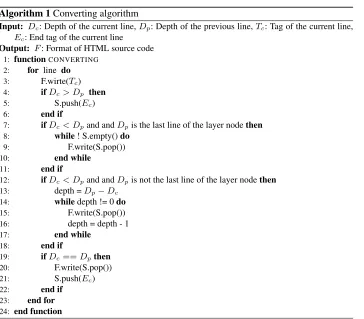
hand, if the depth is smaller in the current line than in the previous line and the previous line is the last line of the RenderLayer point, then the line is the starting line of the new layer point (i.e., the previous layer point has ended). The stack stores the tag order of the previous layer point. Thus, all elements in the stack must be discarded. The tail tags are then written in the output results. However, if the depth is smaller in the current line than in the previous line, but the previous line is not the last line of the layer point, the depth difference between the current and the previous lines must be determined to select the number of element output of the stack. If the depth of the current line is the same as that of the previous line, then the current node is the brother node of the last node. The top element output of the stack is written in the output results, and the current node tag is attached to the stack. The top end tag in the stack is popped and written in the output, and then the end tag of this node is attached to the stack. The whole algorithmic process is equivalent to restoring the visual attributes to the HTML source code, thereby unifying all tag formats in the code. The output results are shown in Fig. 5.
Fig. 5.The output of algorithm 1
3.2. Merging Visual Blocks
Each visual block is a rectangle. The merging process of the visual blocks may be horizontal and vertical. The coordinates represent the position of a visual block in a web page. The visual blocks with proximal abscissas can be merged after the abscissa ordering. Similarly, the visual blocks with proximal ordinates can be merged after the ordinate ordering.
The current study presents a merging algorithm for visual blocks. Assuming that a list stores the visual blocks after ordering, in Algorithm 2, Pointeripoints at the first element in the list of the visual blocks before merging, whereas Pointerj points at the second one. First, the visual blocks pointed by Pointersiandjmust be assessed for suitability in merging. If the points are unsuitable, then both pointers are moved backward for one bit. Otherwise, the merging of two visual blocks is considered. Second, multiple overlapping similar visual blocks must be merged. Therefore, Pointerjmust move backward for one bit until the visual blocks pointed by both pointers cannot be merged. At this time, the visual block pointed by Pointeriand the previous visual block pointed by Pointerjare merged. Pointeripoints at Pointerj, which will move backward for one bit. When Pointer jpoints at the end of the list, one merge process ends. Finally, when the length of the list of two attached merging results did not change, or if no visual blocks were merged, then the algorithm ends.
Algorithm 2merging algorithm
Input: Lbef ore: A list saving visual blocks before merging,i: Pointer i,j: Pointer j Output: Laf ter: A list saving visual blocks after merging
1: functionMERGING
2: whileLaf ter.size() not changedo 3: i←Lbef ore[0]
4: j←Lbef ore[0]
5: whilej !=Lbef ore.size()do
6: if!merge(i,j)theni←i + 1 j←j + 1
7: end if
8: ifmerge(i,j)then
9: whilemerge(i,j)doj←j + 1
10: end while
11: Laf ter.add(merge(i,j-1))
12: i←j
13: j←j + 1
14: end if 15: end while 16: end while 17: end function
Visual block merging mainly depends on the blocks’ coordinates. Two blocks can be merged if their coordinates are adjacent. However, the merging rules vary for different cases.
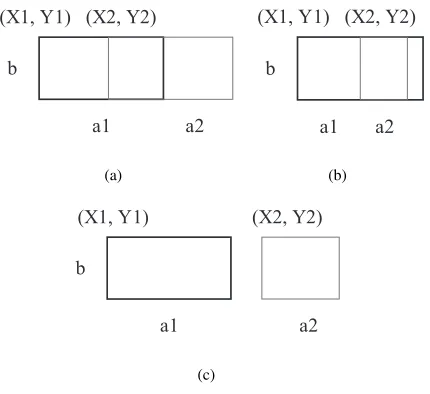
blocks are(X1, Y1),a1, andb1, and(X2, Y2),a2, andb2, correspondingly. The con-ditions for horizontal merging areY1 = Y2 andb1 = b2. If the abscissa is larger in the target block than in the reference block, then three cases are possible. The first case is where the reference and target blocks are overlapped, which is the most common case (Fig. 6(a)). The length after merging isX2−X1 +a2. Fig. 6(b) illustrates the second case, wherein the target block is within the reference block because the length of the former is small. This case is generally the search box on the web page, and the length after merging isa1. The third case is depicted in Fig. 6(c), wherein both blocks are not overlapped. The length after merging is the same as that in the first case. In summary, the coordinates, length, and width of the visual block after merging are(X1, Y1), max (a1, X2−X1 +a2), andb, respectively.
a1 a2
b
(X1, Y1) (X2, Y2)
(a)
a1 a2
b
(X1, Y1) (X2, Y2)
(b)
a1 a2
b
(X1, Y1) (X2, Y2)
(c)
Fig. 6.Visual block merging rules
3.3. Similarity Comparison
The traditional ordered matching principle possesses many limitations. For example, the similarity of the two web pages cannot be objectively measured, and the deviation of the visual block in the web page causes errors. In addition, the similarity matching princi-ple must have reflexivity and symmetry. Therefore, this study proposes an optimal free matching principle. For each visual block in the target web page, given a visual block with coordinates, length, and width within a certain threshold in the template web page, the blocks are considered similar.
The specific matching process is as follows:
1) Assume that(X, Y, L, W)represents the structure of each visual block, andXandY
respective length and width. The structure of the visual block of the target web page is(GX, GY, GL, GW), while that of the template web page is(T X, T Y, T L, T W). Considering that two nodes are similar in position and the lengths and widths are only slightly different, the nodes are considered similar. In particular, when|GX−T X|,
|GY −T Y|,|GL−T L|,|GW−T W|are within a certain threshold, the visual blocks are similar.
2) The nodes{GN1, GN2, GN3...}in the target web page are compared with the nodes
{T N1, T N2, T N3...}in the template web page. When one node in the template web page is similar to that in the target page, the similar nodes can be added, and the comparison of the nodes is continued. The final number of similar nodes is denoted as SIM.
3) Assume that the total nodes of the target and template web page areGandT, respec-tively. In most cases, the total nodes of the target page are different from that of the template page. Therefore, the maximum values ofGandT are taken. The similarity of the two web pages is denoted asSIM/M AX(G, T).
4.
Evaluation Result
The evaluation process consists of three parts. The first part is the evaluation of the extrac-tion effect, which assesses if the extracted and merged visual blocks are visually consis-tent with the original web page. The second part evaluates the threshold of similar visual blocks. The similarity of two similar web pages (i.e., experimental objects) is compared under different thresholds. The threshold of the highest similarity is selected as the thresh-old of similar visual blocks. The last part examines the threshthresh-old of similar web pages, in which several similar and dissimilar web pages are regarded as datasets. The threshold with the lowest missing report and false alarm rates is taken as the threshold of similar web pages.
4.1. Extraction Effect
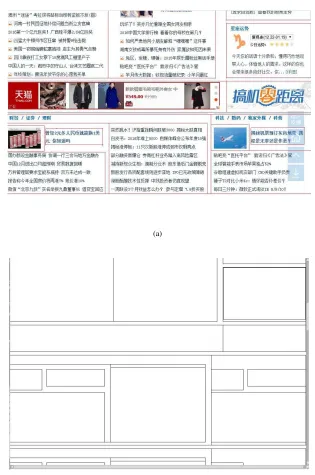
To verify if the extracted and merged visual blocks of the web page are visually consistent with the original web page, the drawing module TkInter is used to draw the visual block. This module is the interface of the standard Tk GUI toolkit and the built-in module of Python. The size of the web page is set as the size of the canvas. Then, the blocks in the visual block list are drawn on the canvas. The visual effect after drawing is compared with the original page, and the features of the web page determined by the algorithm are tested. Fig. 7(a) presents a screenshot of Tencent. The web page is divided into blocks from the visual angle. The red line divides the web page into various visual blocks. Fig. 7(b) illustrates the extracted visual blocks and the distribution diagram. In this figure, the block division results of the web page from the visual angle and the results obtained by the algorithm are nearly the same. Therefore, the algorithm is validated.
4.2. Threshold of Similar Node
(a)
(b)
Table 1.Visual block threshold testing table
Coordinate threshold Length-width threshold Similarity command
50 50 0.6216
50 60 0.6293
50 70 0.6293
... ... ...
190 180 0.9421
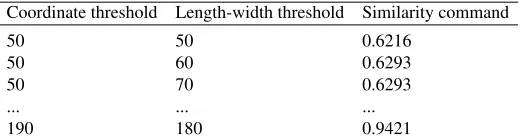
Table 1 shows a part of the data in the visual block similarity threshold test. When different coordinate and length/width thresholds are selected, the similarity degrees of the web pages vary. The similarity is low when the coordinate and length/width thresh-olds are small. The similarity degree also increases with the coordinate and the length-width thresholds. For example, when the coordinate threshold is 190 and the length/length-width threshold is 180, the web page similarity is the largest, that is, nearly reaching 95%. Therefore, 190 and 180 are taken as the corresponding coordinate and the length/width thresholds of the similar visual blocks.
4.3. Threshold of Similar Web Pages
The web page similarity threshold is determined as follows. Some similar and dissimilar web pages are selected as the target datasets. When the missing report and false alarm rates of similar web pages are at the minimum, the web page similarity threshold is considered the optimal value. The web pages of some post bars (e.g., Baidu post bar) are selected as the test object because of the similar typesetting. A total of 3000 URLs in the Baidu post bar are used as template web pages. These URLs are divided into 3 groups with 1000 URLs each. The final results are averaged to reduce the error. The test set includes some web pages of post bars and other web pages. If the web page is that of a post bar but is not considered similar to the template web page, then this web page is considered missing. If the web page is not a post bar web page but is regarded as similar to the template web page, then the web page is considered an error alarm.
During the comparison, the threshold of the similarity judgment starts from 0.35 and ends at 0.8, with an interval of 0.05, thereby yielding 10 similarity thresholds (Fig. 8). With the increase in the threshold, the false alarm and missing report rates decrease ini-tially and then increase. When the threshold is 0.45, the error and miss rates obtain mini-mal results. Thus, 0.45 is selected as the threshold of the web page similarity. The minimini-mal error and miss rates are 0.26 and 0.04, respectively.
828 Xingchen Li et al.
UDWH
Fig. 8.Web pages similarity threshold testing result
5.
Conclusion
This study investigates the visual block similarity of the web pages and proposes a new algorithm for visual block extraction and similarity comparison. The proposed algorithm analyzes the RenderLayer tree of the web page, extracts visual information by making the matching rules, determines the feature sets of the visual blocks corresponding to a web page by processing the visual nodes, and obtains similarity matching in accordance with the optimal free matching principle. After testing, the final number of the acquired visual nodes is approximately 5% of that of the original web page. In addition, to determine the threshold of the algorithm, numerous similar web pages are selected and tested under different threshold settings to achieve the optimal error and miss rates.
Acknowledgment This work was supported in part by the Key Research and Devel-opment Program for Guangdong Province (2019B010136001) and the National Key Re-search and Development Plan under Grant 2017YFB0801801, in part by the National Nat-ural Science Foundation of China (NSFC) under Grant 61672186 and Grant 61872110. Professor Zhang is the corresponding author.
References
1. Alpuente, M., Romero, D.: A tool for computing the visual similarity of web pages. In: Ap-plications and the Internet (SAINT), 2010 10th IEEE/IPSJ International Symposium on. pp. 45–51. IEEE (2010)
3. Artail, H., Fawaz, K.: A fast html web page change detection approach based on hashing and reducing the number of similarity computations. Data & Knowledge Engineering 66(2), 326– 337 (2008)
4. Chiew, K.L., Chang, E.H., Tiong, W.K., et al.: Utilisation of website logo for phishing detec-tion. Computers & Security 54, 16–26 (2015)
5. Cruz, I.F., Borisov, S., Marks, M.A., Webb, T.R.: Measuring structural similarity among web documents: preliminary results. In: Electronic Publishing, Artistic Imaging, and Digital Typog-raphy, pp. 513–524. Springer (1998)
6. Fu, A.Y., Wenyin, L., Deng, X.: Detecting phishing web pages with visual similarity assessment based on earth mover’s distance (emd). IEEE transactions on dependable and secure computing 3(4), 301–311 (2006)
7. Goel, D., Jain, A.K.: Mobile phishing attacks and defence mechanisms: State of art and open research challenges. Computers & Security 73, 519–544 (2018)
8. Jain, A.K., Gupta, B.B.: Phishing detection: analysis of visual similarity based approaches. Security and Communication Networks 2017 (2017)
9. Joshi, S., Agrawal, N., Krishnapuram, R., Negi, S.: A bag of paths model for measuring struc-tural similarity in web documents. In: Proceedings of the ninth ACM SIGKDD international conference on Knowledge discovery and data mining. pp. 577–582. ACM (2003)
10. Liu, W., Deng, X., Huang, G., Fu, A.Y.: An antiphishing strategy based on visual similarity assessment. IEEE Internet Computing 10(2), 58–65 (2006)
11. Marchal, S., Armano, G., Gr¨ondahl, T., Saari, K., Singh, N., Asokan, N.: Off-the-hook: an effi-cient and usable client-side phishing prevention application. IEEE Transactions on Computers 66(10), 1717–1733 (2017)
12. Nichele, C.M., Becker, K.: Clustering web sessions by levels of page similarity. In: Pacific-Asia Conference on Knowledge Discovery and Data Mining. pp. 346–350. Springer (2006) 13. Pengyu, L., Lijun, J., Bin, J.: The research of the maximum length n-grams priority
chi-nese word segmentation method based on corpus type frequency information. In: Proceedings Of The National Conference On Information Technology And Computer Science. pp. 71–74 (2012)
14. Roopak, S., Thomas, T.: A novel phishing page detection mechanism using html source code comparison and cosine similarity. In: Advances in Computing and Communications (ICACC), 2014 Fourth International Conference on. pp. 167–170. IEEE (2014)
15. Satiabudhi, G., Andjarwirawan, J., Setiadi, R.S.: Web Page Similarity Searching Based on Web Content. Ph.D. thesis, Petra Christian University (2012)
16. Sonowal, G., Kuppusamy, K.: Phidma–a phishing detection model with multi-filter approach. Journal of King Saud University-Computer and Information Sciences (2017)
17. Srinivasa Rao, R., Pais, A.R.: Detecting phishing websites using automation of human behav-ior. In: Proceedings of the 3rd ACM Workshop on Cyber-Physical System Security. pp. 33–42. ACM (2017)
18. Varshney, G., Misra, M., Atrey, P.K.: A phish detector using lightweight search features. Com-puters & Security 62, 213–228 (2016)
19. Varshney, G., Misra, M., Atrey, P.K.: A survey and classification of web phishing detection schemes. Security and Communication Networks 9(18), 6266–6284 (2016)
20. Wenyin, L., Huang, G., Xiaoyue, L., Min, Z., Deng, X.: Detection of phishing webpages based on visual similarity. In: Special interest tracks and posters of the 14th international conference on World Wide Web. pp. 1060–1061. ACM (2005)
Xingchen Li received the BS degree in information security from Harbin Institute of Technology, Weihai, China, in 2016 and received Master degree in Computer Science and Technology from Harbin Institute of Technology, China, in 2018. His research interests include virtualization techniques for cloud computing and information security, etc.
Weizhe Zhangis corresponding author of this paper. He is currently a professor in the School of Computer Science and Technology at Harbin Institute of Technology, China, and director in the Cyberspace Security Research Center, Peng Cheng Laboratory, Shen-zhen, China. His research interests are primarily in parallel computing, distributed com-puting, cloud and grid comcom-puting, and computer network. He has published more than 100 academic papers in journals, books, and conference proceedings. He is a senior member of the IEEE. Contact him at [email protected].
Desheng Wangreceived the BS degree in computer science and engineering from Harbin Engineering University, China, in 2015. He is currently working toward the PhD degree in the School of Computer Science and Technology, Harbin Institute of Technology. His re-search interests include virtualization techniques for cloud computing and machine learn-ing, etc.
Bin Zhangreceived his Ph.D. degree in Department of Computer Science and Technol-ogy, Tsinghua University, China in 2012. He worked as a post doctor in Nanjing Telecom-munication Technology Institute from 2014 to 2017. He is now a researcher in the Cy-berspace Security Research Center of Peng Cheng Laboratory. He has published more than 30 papers in refereed international conferences and journals. His current research interests focus on network anomaly detection, Internet architecture and its protocols, net-work traffic measurement, information privacy security, etc.
Hui Heis currently a full professor of network security center in the Department of Com-puter Science, China. She received the Ph.D. in department of comCom-puter science from the Harbin Institute of Technology, China. Her research interests are mainly focused on distributed computing, IoT and big data analysis. She is a member of the IEEE.