Information resource management in an
agent-based virtual organization—initial
implementation
Maria Ganzha1,2, Adam Omelczuk4, Marcin Paprzycki1,3, and Mateusz Wypysiak4
1 Systems Research Institute Polish Academy of Sciences, Warsaw, Poland
Maria.Ganzha, [email protected] 2 University of Gdansk, Gdansk, Poland 3 Warsaw Management Academy, Warsaw, Poland
4 Warsaw University of Technology, Poland omelczuka,[email protected]
Abstract. In this paper we describe an early stage prototype of a system for information resource management in an agent-based virtual organiza-tion. We focus our work on support for human resource adaptability (e.g. knowledge, skills) as a tool for assisting project managers. In the proposed approach, a virtual organization is functionalized in terms of roles played by agents, while organization structure and information flow are repre-sented in terms of agent-agent and agent-human interactions. Finally, all resources (e.g. workers, skills, training resources, etc.) are ontologically demarcated, and information is semantically processed. Discussion of or-ganizational needs is followed by the outline of the system. Finally, basic capabilities of the implemented prototype are illustrated.
Keywords:agent systems, ontologies, virtual organization, resource man-agement, Information Resources, e-learning, adaptability.
1.
Introduction
Development of new ICT technologies often influences provisioning of informa-tion needed to support workers in an organizainforma-tion. Among recent promising technologies, one can identify software agents [22], as well as ontologies and semantic data processing [13]. In this work, we consider how an organization can combine them to provide workers with the neededInformation Resources (IR)5. In the proposed approach a real-world organization is modeled in terms of identified roles played by various entities within it. These roles are then represented by software agents. Furthermore, the organizational hierarchy is mapped into (hierarchical) relationships between agents, while the information
flow within an organization is conceptualized in terms of agent-agent (and, pos-sibly, agent-human) message exchanges. In this way we follow, conceptually, the main tenets of the Gaia methodology for agent system development [36]. Furthermore, in the proposed approach, all resources are ontologically demar-cated (e.g. workers, articles, courses, books, projects, tasks, etc.), and informa-tion is semantically processed. Although in this paper, we focus only on issues involved in delivery of a class ofInformation Resources, presented results can be naturally extended to involve other resources, by modifying the ontology and the communication patterns. Note that, first, the proposed approach is in line with the vision for development of systems combining agents and semantic data processing, outlined in the seminal paper by J. Hendler [20]. Second, it follows the guidelines for agent system development proposed in [27]. There, a well presented argument supports the claim that to achieve progress in use of agent system in the real world, various approaches have to be tried and practically experimented with, to be able to gain the necessary experience.
Let us start with an overview of organizational adaptability that provides the use cases for the system prototype.
1.1. Adaptability in an organization—brief overview
Let us consider aVirtual Organization(VO; [5, 9, 10, 14, 19, 34]), where workers need to access variousInformation Resourcesto complete their tasks/projects. Obviously, access to resources should be (a) adaptive, matching the specific projects that the workers are involved in at a given moment, and changing with the project (as it evolves), and (b)personalized, different workers, depending on their knowledge, experience, and assigned task(s), require access to different resources (and their needs also change over time).
For instance, assume that two workers (W1 and W2) are a part of a team designing and implementing a knowledge management portal, combined with a dedicated mobile application. Here, worker W1 who is designing and imple-menting the back-end of the system (which is based on the Oracle database) needs different resources than her colleague (W2) preparing a dedicated front-end application geared for mobile operating systems (iOS, Android, and Win-dows Phone). However, because the new version of the WinWin-dows Phone sys-tem differs considerably from its previous versions, worker W2 needs additional resources to complete her job (e.g. she may need training modules related to working with the new Windows Phone API). Separately, if a graphics / Web in-terface specialist (worker W3) is added to the team, to create an application layout for the mobile devices (with much smaller screens), he may also need extraIRs to complete his task (e.g. he may need to extend his knowledge about most common screen resolution on mobile devices, including some technical details, like screen contrasts, or just an information about layout usability for the small screens).
– Decision, made by the management of the organization, about acceptance / rejection of a project is based on availability of workers with given skills, whose schedule is such that they can participate in the project.
– Some workers, who have been selected to participate in the project, need extra training (access toIR’s) to be ready when the project starts (worker W2).
– During the project, some workers need extra training (access toIR’s) to improve their skills (worker W3).
Note that, in this work, we use termstraining and Information Resources rather broadly (and somewhat informally). Specifically, bytrainingwe mean ac-cess to various types ofIR’s that can improve knowledge of the worker, while the termInformation Resourceincludes both e-learning modules and publica-tions.
The above listed situations represent cases of, broadly understood, adapt-ability taking place within a system (for more details, see [8, 18]). They can be divided into two orthogonal groups. First, we can observeinstitutional and in-dividual adaptability. Here, if workers with appropriate skills (and/or schedule) cannot be found, they have to be hired and/or trained, representing the gen-eral case ofinstitutional adaptability. Obviously, an organization may select to not to adapt, and reject a possible project. At the same time, worker who is being trained, or provided with an IR(e.g. a book) learns, and this represents the case ofindividual adaptability (i.e. her/his skills change). Second, we can distinguish reactive and proactive adaptability. Here, the reactive adaptability means that theIRprovisioning occurs in response to a specific situation (e.g. during a project a need for extra resource(s) is recognized; as in the case of worker W3, above). At the same time, if we assume that training of worker W2 takes place before the project starts (the organization recognizes the need to train its developers in the use of the new API of the operating system that they will work with), this would represent the case ofproactive adaptability.
Let us observe that, from the point of view of functionalities planned for the prototype, the proactive and the reactive adaptability resemble each other very closely. As soon as it is established that there exists a gap between theneeded and the existing skills, the system should proceed in exactly the same way. First, the gap has to be assessed, on a case-by-case basis. Second, appro-priate IRs (assumed to help closing this gap) should be found and delivered to the worker. Therefore, at this stage, we have concentrated our attention on the reactive scenario (leaving the proactive one for the future). Let us therefore describe, in some details, the two use cases that follow from the above gen-eral example, and provide foundation for the development (and testing) of the system prototype.
1.2. Use case scenarios
required by workers to complete these tasks, and (c) time constraints on each task. To be able to decide whether to accept the project, these requirements are matched against human resources available in the organization. Here, the following constraints are considered: (i) “schedule-availability” of workers within the organization, (ii) their individual skills, and (iii) possibility to hire extra work-ers (if needed).
After the initial analysis, project specification is send to the selectedProject Manager (PM) who will assess whether it is possible to complete it. For each task, thePM seeks Workers with appropriate skills and schedule. In our cur-rent approach, such assessment is based onPM↔Workerinteractions. Here, Workersassess their own skills and schedule against the proposed task(s) and send responses to thePM. In the case when theWorkerwould need additional knowledge to accomplish a given task, (s)he looks for suitableIR(s). Depend-ing on their availability and time needed to acquire knowledge, a positive or a negative response is send to thePM.
Upon receiving responses, thePM checks if all tasks can be covered by the availableWorkers. When some tasks cannot be assigned to theWorkers avail-able in the organization, thePM asks theHuman Resource Manager(HRM) to try to hire employees with needed skills and availability. If suchWorker(s)can be hired, the HRM “sends them” to thePM. When all tasks within the project have assigned Workers, the PM accepts the project. Next, she confirms as-signed tasks to the selectedWorkers. In the case when one or more tasks are left without assignedWorker, thePMis forced to reject the project.
Scenario 2: Employee Support. Let us now assume that a team is working on a project. At some moment during that time, one of Workers (e.g. W3 in the example above) faces a problem that she never encountered before. Obvi-ously, she starts to look for information to solve this problem. She can look for someone that was dealing with a similar problem (by asking fellowWorkers— W1 and W2, posting request on mailing list/forum, or search in the Internet). There, she may find solutions that are too complex for her, because they as-sumed that the person that will use them possessed higher level of knowledge. Other resources can, in turn, cover the issue on such an introductory level that they will be a waste of her time (they will cover topics that she is already famil-iar with). Thus, the need for personalized support for eachWorker arises. The system should be able to provideWorkers with neededIR(s) as a reaction to their needs.
Note that, the proactive scenario is very similar to the one described above. The only difference is in the fact that the decision to expand knowledge arises (proactively) on the basis of predicted future needs. Thus the differentiation between them belongs to a different (meta) level of the worker support system.
1.3. Related work
14, 17, 18, 31]), but most of them focus only on theoretical discussion how such systems can benefit from agent technology, and provide the initial design of such system (possibly including some suggestions concerning its implemen-tation). Specifically, they discuss how organization can be transformed to the form that actually can be used in agent systems, with ontologically demarcated Information Resources. They consider how to map the needed resources to the missing skills. For instance, in [30] authors’ discuss various methods of ontolog-ical matchmaking (understood as matching instances within a single ontology) an propose their own approach. However, this novel approach has not been tested in a realistic application.
In [25] authors present a platform that was designed during the EU project “Platform for Organizationally Mobile Public Employees” (projectPellucid). Main goal of this project was to create adaptable platform for assisting organization-ally mobile employees. Such platform was to improve organization effectiveness and efficiency by formalizing, recording, and storing information about experi-ence and knowledge, and allowing easy access to such data in a mobile envi-ronment. The proposed system was to combine software agents and semantic data processing. Unfortunately, as in case of so many other similar projects, after the end of EU-funding the promising research has stopped.
Another approach worthy mentioning was presented in [24]. In his thesis, author discuses use of ontology based knowledge representation in multi-agent systems. Author focuses on the issue how to create stronger connection be-tween those two with utilization of the semantic web. Again, the research does not seem to be continued after completion of the thesis.
In Poland, between 2005 and 2007, there existed (sponsored by the Polish government) project called WKUP (eng. Virtual Public Service Consultant; [6]). The goal of this project was to create interactive, personalized platform to sup-port citizens in finding assistance how to deal with tasks required by various administrative processes. The support was to be based on ontological repre-sentation of knowledge about the Polish legal system. Specifically, the WKUP system was to be able to understand questions in natural language, use ontolo-gies describing domain of public administration, and be able to cooperate with a semantic registry of public services based on the UDDI (Universal Description Discovery and Integration) specification. Even though the initial prototype has been developed around 2007, the project has been later abandoned [12].
Overall, while many publications consider the idea of combining software agents and semantic data processing to support workers in aVirtual Organiza-tion, in most cases only initial stages of system design have been completed, and promising prototypes have been abandoned (e.g. due to the lack of contin-ued funding).
2.
System overview
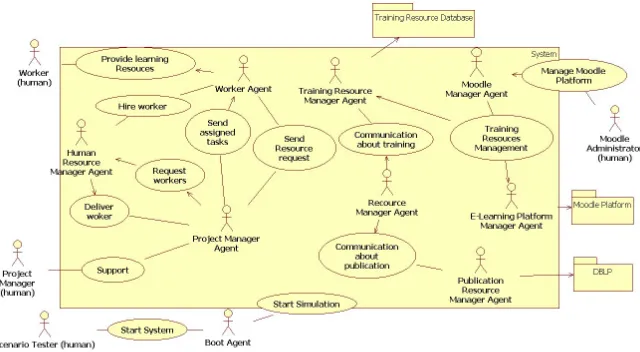
automatically detect Worker needs, and attempt at provisioning targeted IRs. One of key assumptions is that the system will be agent-based, and will use semantic data processing. Following the ideas discussed in [31, 17], we have decided that eachWorker in the organization will be supported by her/his per-sonalWorker Agent, which will represent her/his interests in the system. The Worker Agent is a form of aPersonal Agent, idea of which was proposed for the first time by P. Maes in [26]. Furthermore, a number of auxiliary, agents will be added to the system. These agents will facilitate roles that either can be ful-filled autonomously (without need for human intervention), or will emulate roles that, in an actual organization, are typically fulfilled by humans supported by theirWorker Agents. Based on these assumptions, in the context of the above presented example, and the two use case scenarios (that define the scope of our initial work), in Fig. 1 we present the AML use case of the system (for more details about AML, see [11]).
Fig. 1.AML Use case—functionality of the system
Let us now describe most important features of the proposed system in some detail.
2.1. Agents in the system
Let us start with a brief discussion of agents and their roles (see, Fig. 1). For the initial system prototype, supporting use cases described in section 1.2, we have designed and implemented the following agents:
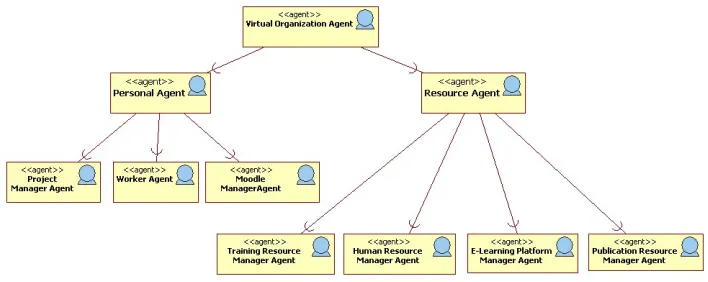
in the VO. The PA supports: Workers in a form of Worker Agent (WA); Project Managers, as theProject Manager Agents; andE-learning System Administratorsas theMoodle Administrator Agents.
– Resource Agent (RA); auxiliary autonomous agents that can play the fol-lowing roles in the system:
• Human Resource Manager Agent (HMRA), which emulates the situa-tion in which a humanHRMwould be supported by an extended version of theWA(prepared to support theHRM activities); in our system, due to its limited scope, this role is emulated (completed autonomously). • Publication Resources Manager Agent PRMA), which is interfacing with
the Digital Bibliography and Library Project (DBLP; [32]),
• Training Resource Manager Agent (TRMA), which is responsible for providing the system-side interface to the e-learning platform,
• E-learning Platform Manager Agent(EPMA), which provides the platform-side interface to the e-learning platform (here, it is assumed that mul-tiple e-learning platforms are located “somewhere within the Internet” and thus both sides—system and platform—have to be represented by separate agents – rather than having a single platform-side agent that would be contacted directly from the system).
Let us summarize agents and their roles in the form of the AML Role Dia-gram, in Fig. 2.
Fig. 2.Agent’s roles hierarchy
2.2. Information Resources
(ii)publication resources. Thetraining resourcescomprise online courses sup-plied for the Worker training. The publication resources are publications that provide the needed information.
As stated above, in addition to software agents, we will use semantic data processing. Therefore, both types ofIRs have been demarcated using a sim-plistic ontology, which was designed to support selected functionalities of the prototype. Let us now look in some detail into the use of ontology in our sys-tem.
2.3. Ontology in the system
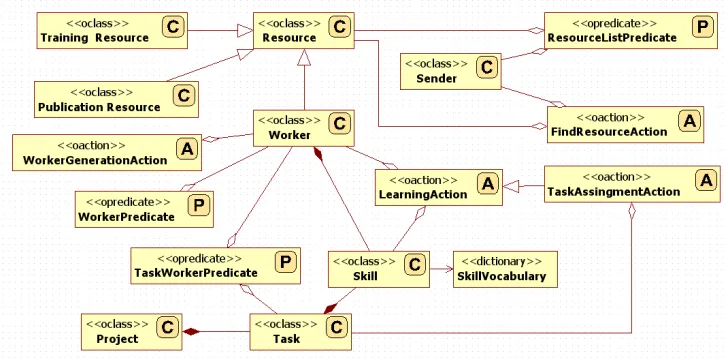
When designing our prototype we were faced with decisions concerning devel-opment and use of ontologies. For instance, we could have used the existing ontologies, e.g. the Dublin Core [1] for demarcation of publication resources, and adapt the VO ontology found in [33, 29, 23] to describe the organization. However, first, this would still leave us us with 0the need to develop an ontology of training resources. Second, combining the Dublin Core, the VO ontology and the training resource ontology is a research task in its own right, likely result-ing in a rather large and complex combined ontology. Third, we were not able to locate a mainstream e-learning platform that would be ontology enabled. Overall, focusing on ontologies, would postpone implementation of the system, which would contradict our main goal—development and experimentation with a working prototype (see, also [27]). Therefore, we have decided to develop our own simplistic ontology and use it in the prototype. In Fig. 3 we present the overall structure of this ontology.
Here, the central concept is theResource. For the prototype, we have de-cided to focus on the field of information technology, as conceptualized by the Association for Computing Machinery Computing Classification System [7]. The Skillconcept consists of two parts. The name of the discipline, and a value from the interval(0,100), which indicates the skill-level. Note that theSkill class is the only one used in both theResourceand theWorkermodules (see, section 3).
TheResourceconcept describes theInformation Resourcesas well as Hu-man Resource. It is used mostly in communication between theWorker Agents and theResource Module. It contains the mainResourceclass, the implemen-tation of theConceptinterface, and three child classes: theTraining Resource, thePublication Resourceand theWorker. TheWorkerclass stores the informa-tion aboutWorker’sskills (implemented as theSkill concept). TheSkill concept establishes connection between theWorker and theTaskconcepts, as well as between theWorkerconcept and theLearningAcionaction.
In case of conceptsTrainingInformationandPublicationResourcethese classes store specific information about thoseIRs, like author, title and publisher, for the publication resources, or names, localization and cost for participating in the course, for theTraining Resources. In this structure, thanks to the inheritance, subclasses could use theResourceclass in all messages for allIRs. Note that the only place where there is a need to distinguish between the differentIRs is when theWorker Agentdisplays found resources to theWorker. In other words, within the system both forms of Information Resourcesare processed exactly in the same way, only in the user interface they are distinguished.
e.g. creating a database, or designing application layout for a mobile device), available time (here, we have decided to use the standard man-hours), and the information if this project is to be considered to be within the scope of a proactive or a reactive scenario (i.e. if it is a project for the future, or if it is a project that the organization has committed to). TheWorker class stores basic information about the employee, like: first name, last name, list of skills of the represented person. This section contains also two implemented Predicates, called the WorkerPrediacte and the TaskWorkerPredicate. The first predicate is used in the transport of theWorker concept (for the same reasons as men-tioned earlier for theResourceListPredicate). TheTaskWorkerPredicate has a more complex job to do. It contains theTask and theWorker concepts, to be used in the communication process, and parameters defining how well skills of a given Worker match skills required for completing a specificTask. Here, we use simple metrics, based on the assessment of how many skills were on the exactly right level, how many above, and how many below the required skill level (for a given task). Additionally, the system stores the number of skill levels that are above the requirements, and number of those skills that did not fulfill the requirements.
To send requests, three implementations of theActioninterface are used. The WorkerGenerationAction is used by the Project Manager Agent, when it decides that a new employee has to be hired. It contains the Task concept, because such decision is made when some of the tasks, in the specific project, are not assigned (and cannot be assigned to the currently employed workers). Thus, a newWorker should be hired to complete this task. The remaining two actions are connected by the base-child class relation. The base class, called theLearningAction, stores the list ofSkillslevels of which the recipient (Worker Agent) must improve, and/or list of brand newSkill(s) to be acquired. The child class is calledTaskAssignmentAction, and stores theTask that is assigned to this Worker Agent. We decided to create such relation, because, sometimes, when theProject Manager Agent assigns aTaskto a particularWorker Agent, a given Worker must learn something new or increase knowledge in one of already possessed Skills, while at other times learning activities are required without assigning any task.
3.
Implementation details
As a result of the technical requirements analysis, completed in [28], we have selected the following technologies to implement the initial system prototype.
– All agents within the system are written in Java using the JADE frame-work [2], with addition of the log4j frameframe-work [3], used for the error logging purpose. During the actual implementation process, we used Java version 1.6.0 22. The runtime environment was provided by the standard Oracle Java Virtual Machine.
– As the e-learning platform we have selected the Moodle Platform [4]. It is an open source Learning Management System. While Moodle is written in PHP we decided not to connect with it through its web interface, but created a dedicated agent connected directly to the Moodle database. Note that this design decision follows the basic principles of agent system design, where software agents provide the basic abstraction for design modularity and component encapsulation (see, also [21]).
– The MySQL server and the Apache server, required to host the Moodle platform, were provided by the XAMPP version 1.7.3.
– Information retrieved from theTraining Resource Databaseand the DBLP, for further use by different agents, was described using ontology created using the Ontology Bean convention (see, section 2.3 for more details).
Lest us make a comment concerning the last decision. One of the weak-nesses of the JADE agent platform is its limited ability to deal with ontologies. As a matter of fact, at the time of working on our prototype the only reasonable way to combine JADE agents and ontologies was by representing ontologies as Java classes. Therefore, we have decided to implement our simplistic ontology directly into Java classes using the Ontology Beans (without the OWL demarca-tion). It is only now that we have developed a JADE add-on that allows agents communicate using OWL snippets (see, [35] for more details). This will allow us to actually use OWL ontologies directly, in the next release of the system.
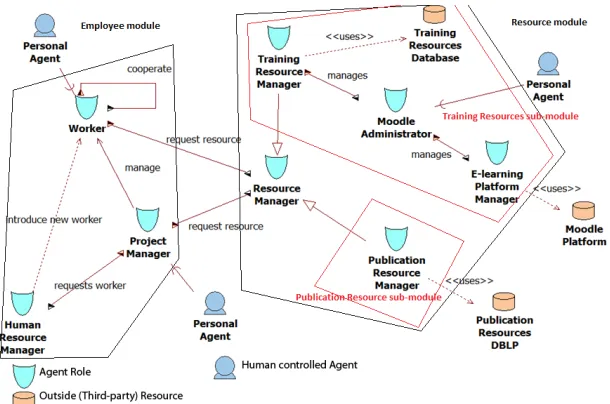
Let us now look in more details into the overall structure of the system and the implemented modules, which have been represented in Fig. 4.
3.1. Resource Module
Let us start with theResource Module. It deals with all aspects of searching and obtaining differentInformation Resources, including managing databases, and e-learning platforms. It was divided into the following sub-modules: the Publica-tion Resourcemodule, theTraining Resourcemodule, and theConnector.
Here, theConnector consists of theResource Manager Agent, which con-nects theResource Module and theEmployee Module. On the setup it starts two cyclic behaviors that are responsible for periodically refreshing the list of available Publication/Training Resource Manager Agents. This is achieved by asking the JADE Directory Facilitator (DF) for the list of such agents. All re-quests from the Worker Agent (to search for the IRs), received by the Re-source Manager Agent, are copied into identical messages send to theTraining Resource module and the Publication Resourcemodule. Each of these mes-sages contains added information about the original sender. Next, theResource Manager Agentawaits responses from all specializedResource Managersand merges answers received from them into a single ResourceList object. Here the inheritance relation between the Resource and the PublicationResource, as well as theTrainingResource, is used. The resulting list is forwarded to the properWorker Agent(identified through theSenderobject included in the mes-sage). In this way, theEmployee Moduleis not (and does not have to be) aware about possible sources ofInformation Resources(which, therefore, can be dy-namically added/removed, with only localized changes in the systems).
TheTraining Resourcemodule is responsible for managing content of the e-learning platform—in our case the Moodle Platform—and searching for courses matching the requested topics. It is composed of three agents: (i)E-learning Platform Manager Agent, (ii) Training Resource Manager Agent and, human controlled, (iii)Moodle Administrator Agent. The E-learning Platform Manager Agent is directly connected to the database of the Moodle Platform and is re-sponsible for translating requests received from theMoodle Administrator Agent to the SQL queries, and executing them. On the startup, in addition of the stan-dard setup, this agent establishes connection with the database (using data retrieved from a file). Such solution allows developers to create different config-uration for different Moodle Platforms by starting multiple instances of the same agent. Note that, during system development, we used the standard Java JDBC method to interface the database.
Moodle User Account, (4) deleting a Moodle User Account, (5) creating a new Moodle Course, (6) selecting a Moodle Course, (7) updating a Moodle Course, and (8) deleting a Moodle Course.
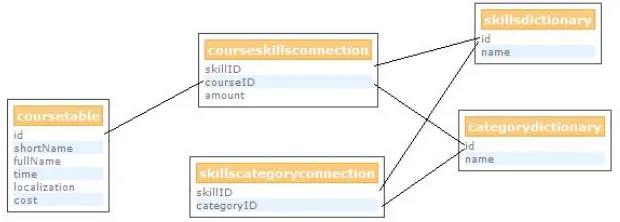
The last agent of theTraining Resource module is the Training Resource Manager Agent. On setup, it connects to an auxiliary course database, created to speed-up the searching process and to lower the cost of communication between the system and the Moodle Platform. This course database allows also for a singleTraining Resources Manager Agent to handle more than one e-learning platform and/or different types of them. It contains description sof available courses in a format corresponding to the ontology of training resources (see, Fig. 5, for more details).
Fig. 5.Training Resource Database
When searching for theTraining Resourcesconcerning a given subject (iden-tified by theSkillname) theTraining Resource Manager Agentlooks in the Skill-Dictionarytable for the ID of suchSkilland then creates a query that will return allIRthat cover the selected topic(s) and has theSkill level above the received requirement. This means that, after attending a specific e-course, worker should obtain the corresponding knowledge. All courses found as a result of the query, are send back to theResource Manager(without any knowledge to whom they will be forwarded to). Next, theResource Manager Agent forwards them to the requestingWorker Agent.
it is stored in theResourceList. If required, theResourceList may be trimmed to the requested length (note that the query to the DBLP—as well as to any other data source—may return hundreds of responses). Next, theResourceList is send back to the requestingWorker Agent.
3.2. Employee module
The second specialized module is the Employee Module, which is composed of three agents: (a)Project Manager Agent, (b)Worker Agent, and (c)Human Resource Manager Agent. The last agent is completely autonomous, while the first two require human interactions (at least in the current design of the system). TheHuman Resource Manager Agentemulates functions of a humanHRM, supported by an appropriateWorker Agent. Its only role is to fetch (from a file) a list of “not hired workers” and, when requested, search for a workers with needed skills. This is to emulate situation when thePMfinds out that she needs to hire extra workers to complete the project and requests help from theHRM.
TheWorker Agent supports theWorker and represents her/him in the sys-tem. It stores the Worker profile and, if appropriate, the Task objects repre-senting tasks currently assigned to its owner. This is the only agent (in this module) that communicates with theResource Manager Agent, to ask for Infor-mation Resources. This behavior can be triggered manually by theWorker, or autonomously during the project management process. It is facilitated by creat-ing a list of neededSkills. This list is send to one, or more,Resource Manager Agents. On demand, this agent can send the list ofSkillsof itsWorker(owner), to theProject Manager Agent, so that it can be used in the task-worker match-ing process (usmatch-ing data as actual as possible). Furthermore, theWAresponds to the queries from the Project Manager Agent, asking which tasks, stored in theProject predicate object, can be completed by the Worker. Second, it ac-cepts the information that itsWorker was assigned a task, and appropriately modifies her/his profile (availability schedule).
Note that, in the case when a “not hired” employee receives a message con-taining an information that a task was assigned to it, it changes its registration type, in the JADE Directory Facilitator, from “not hired” to “hired.”
3.3. Matchmaking in the system
While in [30] a complex method for ontological matchmaking was proposed, here we decided for a more simplistic approach. As stated above (sections 2.3, and 3), we have deliberately elected to apply a very simple, Java class-based ontology; rather than a full blown OWL-based one (similar to that discussed in [17]). This being the case, at current stage of system design, applying com-plex ontological matchmaking would make no sense.
The implemented matchmaking aims at minimizing the gap between the needed and the existing skills. It assignsWorkers to Tasksby picking an em-ployee with the skill-level at least as high as that required by the task. The assessment of the skill-level is done independently by eachWorker Agent, and is coordinated by theProject Manager Agent. TheWorkers that do not match the neededSkill set, can be (self)assigned to the training activities that should remove the gap and allow them to complete the task. In the process of estab-lishing if theWorkercan complete the task, the current schedule of theWorker, the time needed to accomplish the task, and (if necessary) the time of comple-tion of the needed training activities are jointly taken into account. Matchmaking is also used by theHuman Resource Manager Agent to find the bestWorkers to be hired, in the case that a project needs them. Agents that use the match-making engine include: theProject Manager Agent, theWorker Agent, and the Human Resource Manager Agent.
4.
Experimental evaluation
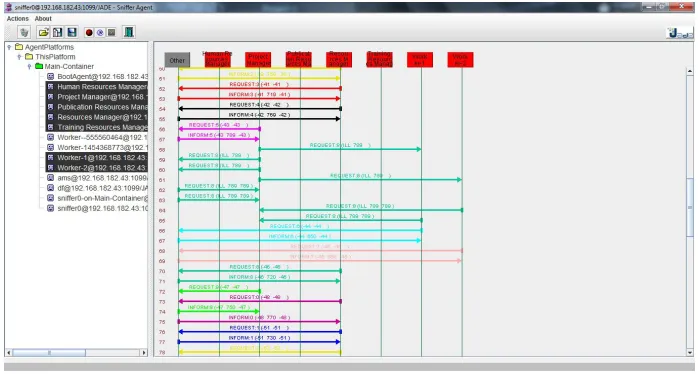
Let us now assume that the WA1 and the WA2 have skills connected with the task T1 (and that the WA1 is a better match—more skills satisfy task re-quirements); however, the WA2 also can be assigned to complete task T2. Fur-thermore, worker WA3 may execute either task T3 or task T4, but with a skills preference favoring execution of task T3. Finally, both workers WA4 and WA5 have skills corresponding to tasks T3 and T4 (however, WA5 is a better match for either one of them). The fact that a worker has skills connected to the task does not mean that all of the required skills are present. This can also mean that some of needed skills are not at the required level, or that some of them are missing (see, also Fig. 6). We will now discuss what is happening when the project is introduced to the system, from the “point of view” of each major agent / module.
Fig. 6.Skills connected to tasks—without skills levels
4.1. Project Manager Agent
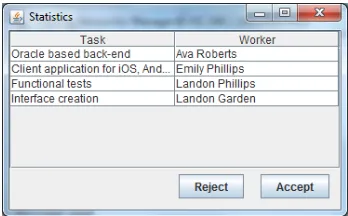
tasks—T1 to WA1, T2 to WA2, T3 to WA5 and T4 to WA3. In this moment this scenario is completed for theProject Manager Agent; see, also Fig. 4.1.
Fig. 7.Task-worker matching
4.2. Worker Agent
Now let’s consider theWorker Agentperspective (here, we will use the WA2 as the example). Since allWorker Agentsexecute the same behaviors, the specific case of W2 represents the generalWorker Agentbehavior. Here, our discussion will need a more detailed set of assumptions. Let us, therefore, assume that the WA2 has the following skills (calledWorker SkillsWS; see, Fig. 8): WS1, iOS skill at level 53, WS2, Android skill at level 61, WS3, Oracle skill at level 67. The WA2 can, of course, have also other skills, but in this example they will by irrelevant, so we omit them. The specification of the T1 states that the needed skills are (Task SkillsTS, where Sn in WSn and TmSn denote the same skill n): T1S3 at level 70; and T2: T2S1 at level 69, T2S2 at level 60 and T2S4, Windows Phone skill, at level 34.
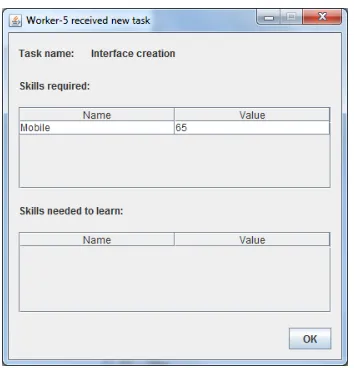
no task assigned to the worker (here, WA4), or with a reception of a message containing assigned task(s), and (if required) list of foundIRs (see, Fig. 11).
Fig. 8.Worker skills with levels
Fig. 9.Task assigned to worker with none learning activities to perform
4.3. Human Resource Manager Agent
Fig. 10.Task assigned to worker with learning activities
WA4 and WA5. Upon completing such comparison, it decides that WA5 is more suitable for this task. Therefore, theHuman Resource Manager Agentsends a message with the WA5 contact information and its skills to theProject Manager Agent.
4.4. Resource Module
Now let us see how this scenario looks from the perspective of theResource Module. First, the Resource Manager Agent is contacted by a Worker Agent (here, agent representing worker WA2) with a request to search for resources that can improve its skills S1, S3 and S4. It forwards this message to theTraining Resource Manager Agent and to the Publication Resources Manager Agent. Contact information for both agents is obtained from the JADE Directory Fa-cilitator. The dispatched message contains the list ofSkills and an added in-formation that it was the WA2 that originated the query. After obtaining both answers (again, we omit the case of non-responsive entities) theResource Man-ager Agent forwards the combinedResourceList back to the WA2.
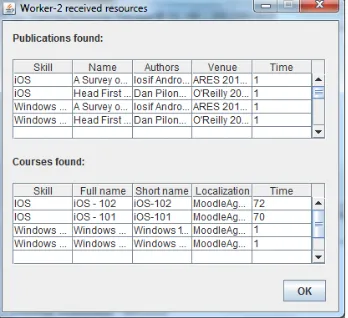
When processing the request, both theTraining Resource Manager Agent and thePublication Resources Manager Agentwork in a very similar way. Here, the Training Resource Manager Agent, after obtaining request to search for courses concerning S1, S3 and S4, will search the course database. Suppose that for skills S1 and S3 there was only a single course available for each of them, but for skill S4 there were 6. Now the the Training Resource Manager Agent will trim this number, and selects only a predefined number of courses, say two. Selection of those two courses is based on the skill level, duration, and cost of each one of them (see, Fig. 13). TheResponseList (consisting of courses applicable for each of the three skills) will be send back to theResource Manager Agent. At the same time, thePublication Resources Manager Agent will perform similar actions, but instead of searching the course database it will build a query that will be passed to the DBLP search engine. Next it will parse the obtained answer (see, Fig. 12). Finally, the resulting (possibly trimmed) list of publications will be send back to the WA2, as theResponseList.
Fig. 12.Searching in Digital Bibliography and Library Project—none resources found
Fig. 13.Searching in Training Resources Database—resources found
5.
Concluding remarks
The aim of the presented work was to describe a prototype of an agent-based Information Resources provisioning system, facilitating support for workers in a virtual organization. The implemented prototype consists of agents directly supporting workers and project managers (interacting with humans), as well as autonomous agents that facilitate services needed for functioning of the system. The implemented prototype has been interfaced with the DBLP library (as an example of publication resource provisioning), and with the Moodle platform (as an example of e-learning content provisioning).
While the system works with ontologically demarcated resources and se-mantic information processing, we have select a restricting ontological repre-sentation, based on Java classes. This decision was a deliberate one and was caused by factors outlined in sections 2.3 and 3.
In view of known shortcomings of the initial prototype, we plan to proceed as follows. First, we will evaluate lessons learned during system development and testing. Second, we will replace Java class-based ontology by an OWL-based one, and adapt all needed information processing and communication procedures. Here, we will use our JADE add-on that allows JADE agents to communicate by sending OWL snippets (without compiling ontologies into Java classes, see [35]. We will also introduce a newly designed front-end based on the Play framework (for more details, see [35]. Furthermore, we will expand the list of sources ofInformation Resources(both publication and training), to make the system truly heterogeneous. We will report on our progress in subsequent publications.
References
1. Dublin core webpage.http://dublincore.org/
2. Java Agent DEvelopment framework.http://jade.tilab.com/
3. Log4JADE Agent-based Logging Service. http://log4jade.sourceforge. net/
4. Moodle.http://moodle.org/
5. http://www.businessdictionary.com/definition/ virtual-organization.html(2008)
6. http://www.mwi.pl/badania-i-innowacje/projekty/wkup.html
(2011)
7. The acm computing classification system. http://www.acm.org/about/ class/ccs98-html
8. Badica, C., Popescu, E., Frackowiak, G., Ganzha, M., Paprzycki, M., Szymczak, M., Park, M.W.: On human resource adaptability in an agent-based virtual organization. In: N.T. Nguyen, R.K. (ed.) New Challenges in Applied Intelligence Technologies. Studies in Computational Intelligence, vol. 134, pp. 111–120. Springer, Heidelberg, Germany (2008)
9. Barnatt, C.: Office space, cyberspace and virtual organization. Journal of General Management 20(4), 78–92 (1995)
11. Cervenka, R., Trencansky, I.: The Agent Modeling Language - AML. Birkhuser Basel (2007)
12. Czerniejewski, B.: Personal Communication
13. Dieter, F.: Ontologies: A Silver Bullet for Knowledge Management and Electronic Commerce. Springer-Verlag, New York (2003)
14. Dunbar, R.: Virtual Organizing, pp. 6709–6717. Thomson Learning, London (2001) 15. Frackowiak, G., Ganzha, M., Gawinecki, M., Paprzycki, M., Szymczak, M., B ˘adic ˘a, C., Han, Y.S., Park, M.W.: Adaptability in an agent-based virtual organization. Inter-netional Journal Accounting, Auditing and Performance Evaluation (2008), in press 16. Frackowiak, G., Ganzha, M., Paprzycki, M., Szymczak, M., Han, Y.S., Park, M.W.: Adaptability in an agent-based virtual organization—towards implementation. In: WEBIST (Selected Papers). pp. 27–39 (2008)
17. Ganzha, M., Gawinecki, M., Szymczak, M., Frackowiak, G., Paprzycki, M., Park, M.W., Han, Y.S., Sohn, Y.: Generic framework for agent adaptability and utilization in a virtual organization—preliminary considerations. In: Cordeiro, J., et al. (eds.) Proceedings of the 2008 WEBIST conference. pp. IS–17–IS–25. INSTICC Press (2008)
18. Ganzha, M., Paprzycki, M., Gawinecki, M., Szymczak, M., Frackowiak, G., Badica, C., Popescu, E., Park, M.W.: Adaptive information provisioning in an agent-based virtual organization—preliminary considerations. In: Nguyen, N. (ed.) Proceedings of the SYNASC Conference. LNAI, vol. 4953, pp. 235–241. IEEE Press, Los Alami-tos, CA (2007)
19. Goldman, S., Nagel, R., Preiss, K.: Agile Competitors and Virtual Organizations. Van Nostrand Reinhold, New York (1995)
20. Hendler, J.: Agents and the semantic web. IEEE Intelligent Systems 16(2), 30–37 21. Jennings, N.: An agent-based approach for building complex software systems.
Commun. ACM 44(4), 35–41 (2001)
22. Jennings, N., Wooldridge, M.: Agent technology: foundations, applications, and mar-kets. Springer (1998)
23. Kim, H., Fox, M., Gruninger, M.: An ontology for quality management—enabling quality problem identification and tracing. BT Technology Journal 17(4), 131–140 (1999)
24. Laclavik, M.: Ontology and agent based approach for knowledge management 25. Laclavik, M., Balogh, Z., Hluchy, L., Nguyen, G., Budinska, I., Dang, T.: Pellucid
agent architecture for administration based processes
26. Maes, P.: Agents that reduce work and information overload. Commun. ACM 37(7), 30–40 (1994)
27. Nwana, H.S., Ndumu, D.T.: Software agents: an overview. In: Knowledge Engineer-ing Review, vol. 11, pp. 205–244. Cambridge University Press (1999)
28. Omelczuk, A., Wypysiak, M.: Managing human resource adaptability in an agent-based virtual organization (2011)
29. http://ontoweb.aifb.uni-karlsruhe.de/Ontology/index.html
30. Rhee, S.K., Lee, J., Park, M.W., Szymczak, M., Frackowiak, G., Ganzha, M., Pa-przycki, M.: Measuring semantic closeness of ontologically demarcated resources. Fundam. Inform. 96(4), 395–418 (2009)
31. Szymczak, M., Frckowiak, G., Ganzha, M., Gawinecki, M., Paprzycki, M., Park, M.W.: Resource management in an agent-based virtual organization—introducing a task into the system. In: Proceedings of the MaSeB Workshop. pp. 458–462. IEEE CS Press, Los Alamitos, CA (2007)
33. http://www.eil.utoronto.ca/enterprise-modelling/index.html
34. Warner, M., Witzel, M.: Zarzadzanie organizacja wirtualna. Oficyna Ekonomiczna (2005)
35. Wasielewska, K., Drozdowicz, M., Szmeja, P., Paprzycki, M., Ganzha, M., Lirkov, I., Petcu, D., Badica, C.: Agents in grid system—design and implementation. Springer (2011), to appear
36. Wooldridge, M., Jennings, N.R., Kinny, D.: The gaia methodology for agent-oriented analysis and design. Autonomous Agents and Multi-Agent Systems 3(3), 285–312 (2000)
Maria Ganzha obtained M.S. and her Ph.D. in Applied Mathematics from the Moscow State University, Moscow, Russia in 1987 and 1991 respectively. Her initial research interests were in the area of differential equations, solving mixed wave equations in space with disappearing obstacles in particular, currently she works in the areas of software engineering, distributed computing and agent systems in particular. She has published more than 100 research papers and is on editorial boards of 5 journals and a book series and was invited to Program Committees of over 100 conferences.
Adam Omelczuk is an MS student at the Warsaw University of Technology, where he is applying agent-oriented programming paradigm to the personalized information delivery process. His research interests focus on use of ontologies and semantic data processing.
Marcin Paprzycki (Senior Member of the IEEE, Senior Member of the ACM, Senior Fulbright Lecturer, IEEE CS Distinguished Visitor) has received his M.S. Degree in 1986 from Adam Mickiewicz University in Poznan, Poland, his Ph.D. in 1990 from Southern Methodist University in Dallas, Texas and his Doctor of Science Degree from Bulgarian Academy of Sciences in 2008. His initial research interests were in high performance computing and parallel computing, high performance linear algebra in particular. Over time they evolved toward distributed systems and Internet-based computing; in particular, agent systems. He has published more than 350 research papers and was invited to Program Committees of over 400 international conferences. He is on editorial boards of 14 journals and a book series.
Mateusz Wypysiakis an MS student at the Warsaw University of Technology, where he is applying agent-oriented programming paradigm to the information delivery process. His research interests focus on practical aspects of delivering of personalized information.