http://www.ijbs.com
I
I
n
n
t
t
e
e
r
r
n
n
a
a
t
t
i
i
o
o
n
n
a
a
l
l
J
J
o
o
u
u
r
r
n
n
a
a
l
l
o
o
f
f
B
B
i
i
o
o
l
l
o
o
g
g
i
i
c
c
a
a
l
l
S
S
c
c
i
i
e
e
n
n
c
c
e
e
s
s
2014; 10(8): 861-872. doi: 10.7150/ijbs.8521
Research Paper
Chondrocyte-specific Knockout of Cbf
β
Reveals the
Indispensable Function of Cbf
β
in Chondrocyte
Maturation, Growth Plate Development and Trabecular
Bone Formation in Mice
Mengrui Wu1,2, Yi-Ping Li1, 2, Guochun Zhu2, Yun Lu2, Yiping Wang1,2, Joel Jules2, Matthew McConnell2,
Rosa Serra3, Jian-Zhong Shao1, Wei Chen2
1. Institute of Genetics, Life Science College, Zhejiang University, Hangzhou, Zhejiang, 310058, People’s Republic of China. 2. Department of Pathology, University of Alabama at Birmingham, Birmingham, AL 35294, USA.
3. Department of Cell, Development, and Integrative Biology, University of Alabama at Birmingham, Birmingham, AL 35294, USA.
Corresponding author: Wei Chen, MD: Department of Pathology, University of Alabama at Birmingham, SHEL 815, 1825 University Blvd, Birmingham, AL 35294, USA, Tel: 205.975.2605, Fax: 205.975.4919, E-mail: [email protected] or Yi-Ping Li, PhD: Department of Pathology, University of Alabama at Birming-ham, SHEL 810, 1825 University Blvd, BirmingBirming-ham, AL 35294, USA, Tel: 205.975.2606, Fax: 205 975.4919, E-mail: [email protected].
© Ivyspring International Publisher. This is an open-access article distributed under the terms of the Creative Commons License (http://creativecommons.org/ licenses/by-nc-nd/3.0/). Reproduction is permitted for personal, noncommercial use, provided that the article is in whole, unmodified, and properly cited.
Received: 2014.01.07; Accepted: 2014.04.22; Published: 2014.07.29
Abstract
Despite years of research into bone formation, the mechanisms by which transcription factors specify growth plate development and trabecular bone formation remain unclear and the role of hypertrophic chondrocytes in trabeculae morphogenesis is controversial. To study the role of Core binding factor beta (Cbfβ) in postnatal cartilage development and endochondral bone for-mation, we generated chondrocyte-specific Cbfβ–deficient mice (Cbfβf/fCol2α1-Cre mice) using floxed alleles of Cbfβ (Cbfβf/f) and Cre driven by the Collagen 2α1 promoter (Col2α1-Cre). Cbfβf/fCol2α1-Cre mice evaded developmental and newborn lethality to survive to adulthood and displayed severe skeletal malformation. Cbfβf/fCol2α1-Cre mice had dwarfism, hypoplastic skel-etons, defective bone mineralization, shortened limbs, shortened sternum bodies, and un-calcified occipital bones and hyoid bones. In the long bone cartilage, the resting zone was elongated, and chondrocyte proliferation and hypertrophy were impaired in Cbfβf/fCol2α1-Cre mice, which led to deformation of the growth plates. Primary spongiosa formation was delayed, diaphysis was shortened and trabecular bone formation was almost absent in the mutant mice. In addition, la-mellar bone formation in the secondary spongiosa was also impaired. However, osteoclast for-mation in the trabecular bone was not affected. Cbfβ deficiency led to down-regulation of chondrocyte-regulating genes [i.e, patched (Ptc1), Cyclin D1 and Indian hedgehog (Ihh)] in the cartilage. Interestingly, the expression of Runx2 and Runx3 was not changed in the cartilage of the mutants. Collectively, the results revealed that Cbfβ is crucial for postnatal skeletal development and endochondral bone formation through its function in growth plate development and chon-drocyte proliferation and differentiation. This study also revealed that chonchon-drocyte maturation, mediated by Cbfβ, was critical to trabecular bone morphogenesis. Significantly, these findings provide insight into the role of Cbfβ in postnatal skeletogenesis, which may assist in the devel-opment of new therapies for osteoporosis.
Key words: Cbfβ, Runx, Indian hedgehog (Ihh), skeletal development, chondrocyte proliferation and hypertrophy, endochondral bone formation.
Ivyspring
Introduction
Core binding factors (Cbfs) are heterodimeric transcription factors comprised of the Cbf-alpha
(Cbfα) and Cbf-beta (Cbfβ) subunits. The Cbfα sub u-nits are encoded by the runt-related transcription factors
(Runxs), which contain three members: Runx1, Runx2, and Runx3 [1]. Unlike the Cbfα subunits, the Cbfβ
subunit is encoded by a single gene. The Cbfβ subunit
is a non-DNA-binding protein that associates with the Runx proteins to mediate their DNA-binding
affini-ties. Runx/Cbfβ heterodimeric transcription co m-plexes play crucial roles in various developmental processes [2], including the skeletal system by in part
mediating gene expression. Furthermore, Runx/Cbfβ
complexes are implicated in many diseases including cleidocranial dysplasia (CCD), an autoso-mal-dominant disease resulting predominantly from
Runx2 deficiency that is characterized by short stat-ure, patent fontanelles, defective clavicles, and defec-tive teeth [3].
Runx1 regulates development of certain parts of the skeleton (i.e, sternum morphogenesis, certain skull elements mineralization) [4, 5]. Runx1 has also been shown to promote chondrocyte proliferation and commitment of mesenchymal stem cells (MSCs) to the chondrocyte lineage [6]. Runx2 is a master regulator of osteoblast differentiation and hence plays an im-portant role in skeletal development [7-9].
Runx2-deficient (Runx2-/-) mice died soon after birth
and exhibited severe skeletal defects from blocked intramembranous and endochondral ossification [7-9]. The role of Runx2 in osteoblasts was buttressed by the finding that calvarial cells derived from
Runx2-/- embryos could differentiate into adipocytes
and chondrocytes but not into osteoblasts [10]. Final-ly, Runx3 cooperates with Runx2 to regulate chon-drocyte proliferation and hypertrophy [11].
The Cbfβ subunit is also vital for skeletal deve l-opment. Cbfβ-deficient (Cbfβ-/-) embryos died from an
absence of fetal liver hematopoiesis at mid-gestation [12, 13]. To circumvent embryonic lethality, CbfβGFP/GFP knock-in mice were generated and Cbfβ
-/-embryos were rescued by Tek-GFP/Cbfβ [Cbfβ-/-Tg(Tek-
GFP/Cbfβ)] or Gata1-Cbfβ [Cbfβ-/-Tg(Gata1-Cbfβ)]
transgene [14-16]. These mice died around birth and exhibited numerous skeletal defects, indicating that a
fully functional Cbfβ was essential for embryonic
skeletal development [14-16]. Cbfβ/Runx2 double
transgenic mice exhibited severe osteopenia and re-vealed that the Runx2/Cbfβ complex inhibits oste o-blastogenesis at a late stage of differentiation [17].
Indian hedgehog (Ihh) is a master regulator of both chondrocyte and osteoblast differentiation dur-ing endochondral bone formation [18, 19]. Studies
have shown that Runx2 binds to the Ihh promoter and
enhances its expression. Ihh, secreted by prehyper-trophic/hypertrophic chondrocytes, promotes chon-drocyte proliferation [18, 19]. In addition, Ihh inhibits chondrocyte hypertrophy and keeps chondrocytes in the proliferative pool by inducing expression of par-athyroid hormone-related protein (PTHrP), which in turn inhibits Ihh expression via the so-called “Ihh-PTHrP negative-feedback loop” [18, 19].
Nonetheless, the impact of Cbfβ deficiency in
chondrocytes during postnatal skeletal development is largely unknown. Thus, we generated chondro-cyte-specific Cbfβ–deficient mice (Cbfβf/fCol2α1-Cre
mice) by crossing Col2α1-Cre mice [20] with Cbfβf/f [21]
mice. Generally, the Cbfβf/fCol2α1-Cre mice survived to
adulthood and displayed severe skeletal malfor-mation (i.e. CCD-like features). Notably, the Cbfβ de-ficiency in chondrocytes impaired not only growth plate formation but also trabeculae morphogenesis by regulating chondrocyte-regulating genes including those involved in Ihh/PTHrP negative-feedback loop.
Results
Postnatal 7-day-old (P7) Cbfβf/fCol2α1-Cre
mice had dwarfism with shortened limbs and hypoplastic skeletons from defective bone mineralization
To investigate the role of Cbfβ in chondrocyte
development during postnatal skeletogenesis, we generated Cbfβf/fCol2α1-Cre mice, deleting the Cbfβ
gene specifically in the chondrocyte lineage. Unlike CbfβGFP/GFP knock-in mice, Cbfβ-/-Tg(Tek-GFP/Cbfβ)
mice and Cbfβ-/-Tg(Gata1-Cbfβ) mice, Cbfβf/fCol2α1-Cre
mice survived to adulthood. Postnatal seven-day-old (P7) Cbfβf/f Col2α1-Cre mice exhibited a dwarfed
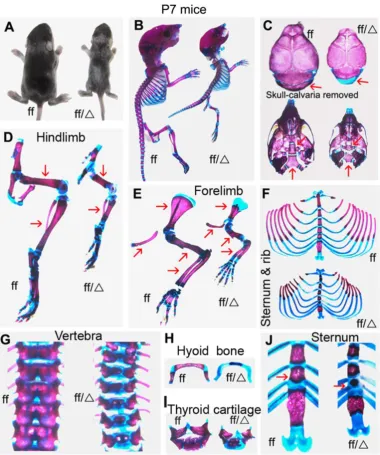
stat-ure with shortened limbs (Fig. 1A). Alizarin red & Alcian blue staining revealed decreased bone miner-alization and delayed ossification in several skeletal elements of the Cbfβf/f Col2α1-Cre mice (Fig. 1B). The
skulls of the mutant mice appeared basically normal compared to wild-type (WT) mice, except for the non-mineralized occipital bone (Fig. 1C). Several de-fects could be observed in the basicranium of the Cbfβf/f Col2α1-Cre mice. The basisphenoid bone and the
http://www.ijbs.com
Figure 1. P7 Cbfβf/fCol2α1-Cre mice exhibited dwarfism with hypoplastic skeletons and decreased mineralization. (A) Photographic image of postnatal
sev-en-day-old (P7) Cbfβf/fCol2α1-Cre (ff/Δ) and wild-type (WT, ff) mice. (B) Whole-mount Alizarin red S/Alcian blue staining of P7 Cbfβf/fCol2α1-Cre and WT mice to analyze
bone/cartilage development. (C) Alizarin red S/Alcian blue staining of skull bones (cranium and cranial base) of P7 Col2α1-Cre and WT mice. Arrowheads indicate the defective occipital bone, basisphenoid bone and basioccipital bone in the mutant mice. (D, E) Alizarin red S/Alcian blue staining of hindlimbs (D) and forelimbs (E) of P7 Cbfβf/fCol2α1-Cre
and WT mice. Arrowhead indicates the diaphysis was shortened in the mutantmice compared to WT. (F-J) Alizarin red S/Alcian blue staining of sternums/ribs (F), vertebrae (G), hyoid bones (H), thyroid cartilages (I) and sternum (J) of P7 Cbfβf/fCol2α1-Cre and WT mice. Arrowhead indicates the shortened sternum body in the mutant mice. Data are
representative for 6 mice per group.
P7 and Postnatal 18-day-old (P18)
Cbfβf/fCol2α1-Cre mice had dwarfism with
shortened limbs, lower bone density and malocclusion
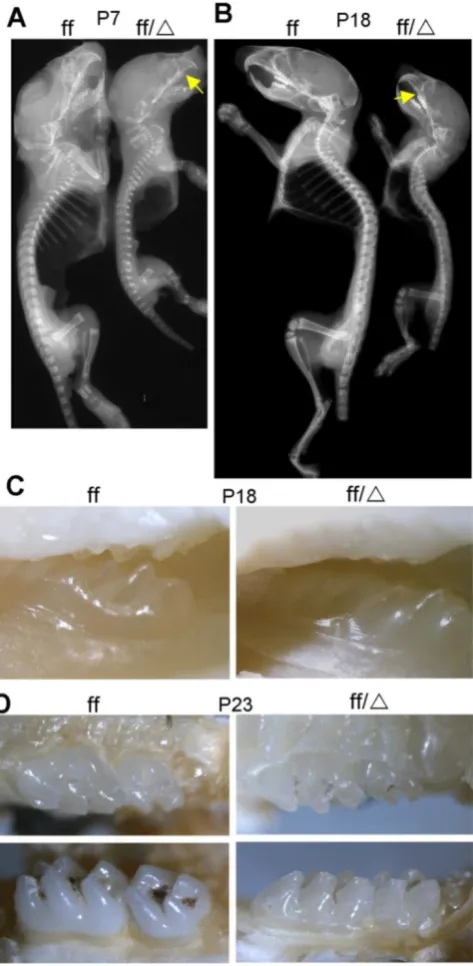
X-ray analysis was performed to assess bone density of WT and Cbfβf/f Col2α1-Cre mice (Fig. 2). The
mutant mice displayed dwarfism with shortened limbs at both P7 and P18. The whole-body bone den-sity was lower in P7 (Fig. 2A) and P18 (Fig. 2B) Cbfβf/fCol2α1-Cre mice compared to their WT cohorts.
The reduced bone density was most obvious as
ob-served in ribs, vetebrae, sternum, forelimbs and hindlimbs. Consistently, the ossification of ribs, ver-tebrae, sternum, forelimbs and hindlimbs was de-layed as shown by Alizarin red & Alcian blue staining (Fig. 1). Interestingly, the X-ray image also showed malocclusion in the Cbfβf/fCol2α1-Cre mouse teeth
(arrow, Fig. 2A, B). To confirm the tooth defect, pho-tographic images of the P18 (Fig. 2C) and P23 (Fig. 2D) WT and Cbfβf/fCol2α1-Cre mice were taken using a
Figure 2. P7 and P18 mice had reduced skeletal mineralization. (A) X-ray analysis of P7 Cbfβf/fCol2α1-Cre (ff/Δ) and WT (ff) mice shows decreased bone density
in the mutant mice. (B) X-ray analysis of P18 Cbfβf/fCol2α1-Cre and WT mice shows
decreased bone density in the mutant mice. Arrows indicated malocclusion in the mouse teeth. (C-D) Photographic images of (C) P18 and (D) P23 mice teeth, indi-cating eruption of the maxillary second molar was delayed in the Cbfβf/fCol2α1-Cre
mice. Data are representative for 5 mice per group.
Cbfβf/fCol2α1-Cre mice displayed elongated
but deformed growth plates
H&E staining was performed on 18.5 dpc WT
and Cbfβf/fCol2α1-Cre embryonic femoral frozen
sec-tions, as well as newborn, postnatal 14-day-old (P14)
and postnatal 30-day-old (P30) WT and
Cbfβf/fCol2α1-Cre mice femoral paraffin slides (Fig. 3).
Consistent with the short-limb deformity, the femurs,
and their diaphyses were shortened in the mutant mice compared to their WT cohorts (Fig. 3A, B, C, D). However, the epiphyseal growth plates were elon-gated in the mutant mice at all ages (Fig. 3A, B, C, D, double ended arrow). The ratio of femoral diaphysis to bone length was three-fold less in 18.5dpc and newborn mutant mice compared to the newborn WT mice (Fig. 3A, B). This ratio decreased to 1.5-fold lower in the P14 mutant mice compared to P14 WT mice (Fig. 3C). Nonetheless, the elongation and de-formity of the growth plates became more severe as the mice aged (Fig. 3A-D). Notably in the P30 mice, the growth plates protruded deep into the bone mar-row abnormally (Fig. 3D). In the WT mice, gmar-rowth plates were all organized into three layers, the resting zone, the proliferation zone and the hypertrophic zone at the 18.5dpc and newborn stages of develop-ment (Fig. 3E, F, left panels). The three-layer structure could hardly be observed in the mutant 18.5dpc em-bryo and newborn mouse growth plates (Fig. 3E, F, right panels). In the mutant 18.5dpc embryo and newborn mice, most chondrocytes appear like im-mature cells in the resting zone and the col-umn-shaped proliferative chondrocytes were absent (Fig. 3E, F, right panels). Quite a few hypertrophic chondrocytes could be found near the primary spon-giosa of the newborn mutant mice (Fig. 3F, right pan-el). The three-layer structure didn’t form in the mu-tant mouse growth plates until P14, with a drastically shortened hypertrophic zone and a slightly shortened proliferative zone (Fig. 3G). In the P30 mutant mouse growth plates, the arrangement of proliferative col-umns was not as neat as that in WT mice, and several hypertrophic chondrocyte-like cells were presented in the resting zone near the secondary spongiosa (Fig. 3H). Collectively, data showed that the mutant mice had severe defects in the growth plate development, which became more severe as the mice aged. The mutant growth plates were elongated and comprised of massive immature chondrocytes, the proliferative cells were disrupted, and hypertrophy was delayed.
Endochondral bone formation was delayed in the Cbfβf/fCol2α1-Cremice with unaffected
osteoclastogenesis
Trabecular bone formation could be observed in the primary spongiosa of newborn WT mice, but was absent in the newborn mutant mice (Fig. 4A). Trabec-ular bone (Fig. 4B, lower panel) and lamellar bone (Fig. 4B, upper panel) were well formed in the P30 WT mice, but were severely reduced in the P30 Cbfβf/fCol2α1-Cre mice. Additionally, growth plates
http://www.ijbs.com
mice. Since trabecular bone formation was impaired in the mutant mice, we performed TRAP staining to detect the formation of osteoclasts. Osteoclastogenesis was not affected at either the newborn stage or P30 in
the Cbfβf/fCol2α1-Cre mice compared to WT (Fig.
4C-E). To summarize, deletion of Cbfβ in chondrocytes impaired bone formation in both primary and sec-ondary spongiosa but didn’t affect osteoclast for-mation.
Figure 3. Cbfβf/fCol2α1-Cre mice had abnormal growth plates and delayed chondrocyte development. (A-D) H&Estaining of femoral sections from (A) 18.5dpc,
(B) newborn, (C) P14, and (D) P30 Cbfβf/fCol2α1-Cre (ff/Δ) and WT (ff) mice. Double ended arrow indicates the length of the epiphyseal growth plates. Arrow in (D) indicates
mutant growth plates protruded into the diaphysis. (E-H) H&Estaining showed growth plates from (E) 18.5dpc, (F) newborn, (G) P14, and (H) P30 Cbfβf/fCol2α1-Cre (ff/Δ) and
Figure 4. Cbfβf/fCol2α1-Cre mice had impaired endochondral bone formation. (A) H&E staining showed the femoral primary spongiosa in the newborn Cbfβf/fCol2α1-Cre (ff/Δ) and WT (ff) mice. (B) H&Estaining showed the femoral primary and secondary spongiosa in the P30 Cbfβf/fCol2α1-Cre and WT mice. (C) TRAP staining
of the femurs of newborn Cbfβf/fCol2-Cre and WT mice to analyze osteoclast formation. (D) TRAP staining of the femurs of P30. (E) Quantification of Osteoclast surface per bone
surface of WT and Cbfβf/fCol2-Cre newborn and P30 mice, and data were presented as mean±SEM (ns, not significant). Oc.S/BS, osteoclast surface per bone surface. Data are
representative for 6 mice per group.
Cbfβdeficiency impaired chondrocyte proliferation and patched (Ptc1) expression
Efficient ablation of Cbfβ in mutant mouse
growth plates was confirmed by immunochemistry (IHC) staining using the anti-Cbfβ antibody (Fig. 5A,
E). Consistently, Alcian blue staining of
prima-ry-cultured chondrocytes in a micro-mass culture
model showed a drastic decrease of chondrogenesis of Cbfβf/fCol2α1-Cre cells (Fig. 5B). Femoral PCNA
stain-ing also revealed that proliferative chondrocytes were decreased in the mutant growth plates (Fig. 5C, E). Indian hedgehog (Ihh), binding to membrane protein patched 1 (Ptc1), is a major regulator of bone devel-opment, coordinating chondrocyte proliferation, chondrocyte differentiation and osteoblast differenti-ation [18, 19, 22, 23]. Our IHC staining showed that Ptc1 was expressed in the proliferative and the pre-hypertrophic chondrocytes in postnatal 3-day-old (P3) WT mouse femurs (Fig. 5D, E). Ptc1 expression was also drastically decreased in the P3 mutant mice compared to WT cohorts (Fig 5D, E). We also per-formed TUNEL staining to detect apoptotic
chon-drocytes in the growth plate of P14 mice. The apop-totic cells appeared in the extremity of hypertrophic zone adjacent to the calcified trabecular bones. Loss of
Cbfβ increased hypertrophic chondrocyte apoptosis
(Fig. 5F, G), which may contribute to the shortening of the hypertrophic zone of the growth plates in post-natal Cbfβf/fCol2α1-Cre mice.
Cbfβ deficiency leads to downregulation of Ihh, Cyclin D1, and PTHrP-R in the chondrocytes
The cell cycle is regulated by a group of Cy-clin/CDK protein complexes, among which is Cyclin D1 that plays an important role in chondrocyte pro-liferation as a target of Ihh [24]. To address the
mechanism underlying the effects of Cbfβ on cho
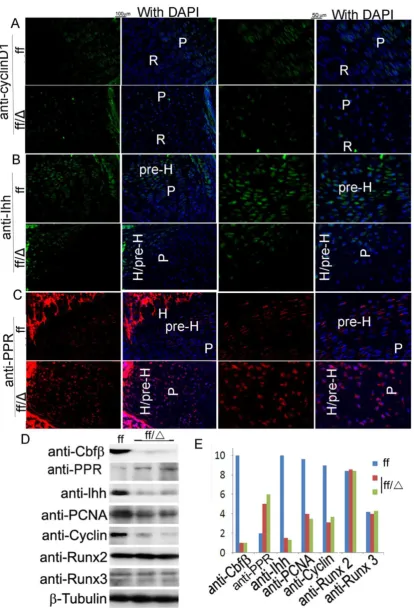
n-drocytes, we examined the expression levels of Cyclin D1, Ihh and PTHrP by immunofluorescent staining of tibial sections (Fig. 6A-C). Interestingly, Cyclin D1 was down-regulated in the mutant growth plates (Fig. 6A). This finding showed that Cbfβ might regulate, at
http://www.ijbs.com
through induction of parathyroid hormone-related peptide (PTHrP) which negatively regulates chon-drocyte maturation [18, 19]. Because Cbfβ functions in concert with Runx proteins, we reasoned that Cbfβ
might regulate chondrocyte development in the same way as the Runx proteins. Ihh expression was shown to be suppressed in Runx2-/- mice [11]. Consistently,
Ihh was also drastically downregulated in the growth plate of Cbfβ-deficient tibiae (Fig. 6B). Ihh has been shown to be regulated by a negative feedback loop mediated by PTHrP [18, 19]. Our results showed that the PTHrP receptor (PPR) was up-regulated in the mutant mice (Fig. 6C), indicating the Ihh-PTHrP neg-ative feedback loop was disrupted in the mutant mice.
Furthermore, Western blot analysis showed that the levels of Cyclin D1 and PCNA were reduced by three-fold in the mutant mice (Fig. 6D, E). Strikingly,
while the level of Ihh was reduced by ten-fold in the mutant mice, the level of PPR was increased by 2.5-fold, further confirming that the Ihh-PTHrP nega-tive feedback loop was disrupted in the mutant mice (Fig. 6D, E). Our Western blot analysis also confirmed
that the deletion of Cbfβ in the chondrocytes did not
affect the expression levels of Runx2 and Runx3 (Fig. 6D, E). Increased PPR expression in the mutant mice inhibited chondrocyte maturation which contributes to elongation of the bone epiphysis and thereby af-fects endochondral ossification. Collectively, these results indicate that the Col2α1-Cre-mediated Cbfβ deletion affects chondrocytes by impacting the ex-pression of Ihh and its targeted gene Cyclin D1 and disrupting the Ihh-PTHrP negative regulatory loop, which then affects chondrocyte maturation and en-dochondral ossification.
Figure 5. Cbfβf/fCol2α1-Cre deficiency resulted in reduced proliferation and decreased Ptc1 expression. (A) Immunohistochemistry (IHC) staining to detect
expression of Cbfβ in the growth plates of newborn Cbfβf/fCol2-Cre (ff/Δ) and WT (ff) mouse femurs. (B) Chondrocytes from newborn Cbfβf/fCol2α1-Cre (ff/Δ) and WT (ff) mice
were cultured and then stained with Alcian blue. (C) PCNA staining of the growth plates of tibial sections from P7 Cbfβf/fCol2α1-Cre (ff/Δ) and WT (ff) mice. (D) IHC to detect
Ptc1 expression in P3 Cbfβf/fCol2α1-Cre and WT mice growth plates. The left two panels show lower magnification of the femurs. The other four panels show higher magnification
of the femoral growth plates. H, hypertrophic zone (E) quantification of Cbfβ-positive cell ratio in hypertrophic zone, PCNA-positive cell ratio in proliferation zone and Ptc1-positive cell ratio in pre-hypertrophic zone, and data were presented as mean±SEM (**, p<0.01; ***, p<0.005). (F) TUNEL staining to detect apoptotic cells in P14
Cbfβf/fCol2α1-Cre and WT mice growth plates. (G) Quantification of TUNEL positive cell ratio in hypertrophic zone, and data were presented as mean±SEM (**, p<0.01; ***,
Figure 6. Analysis of gene expression in the cartilage of Cbfβf/f Col2α1-Cre mice by IF. (A-C) Immunofluorescence (IF) staining of the growth plates from tibial frozen sections of P7 Cbfβf/f Cbfβf/fCol2α1-Cre (ff/Δ) and WT (ff) mice with anti-CyclinD1 (A), anti-Ihh (B), and anti-PPR (C). (A-C) High-magnification figures were co-presented on the
right panels. (D) Western blot analysis of the expression of Cbfβ, PPR, Ihh, PCNA, Cyclin D1, Runx2, and Runx3 in the limb epiphyseal cartilages of newborn Cbfβf/fCol2α1-Cre
http://www.ijbs.com
Discussion
We excised Cbfβ specifically in the chondrocyte
lineage cells using the Col2α1-Cre mice (Fig. 1) to
generate a novel mice model to study the role of Cbfβ
in postnatal cartilage and endochondral bone devel-opment. Interestingly, the Cbfβf/fCol2α1-Cre mice
dis-played dwarfism, shortened limbs, delayed ossifica-tion, deformed growth plates and defective endo-chondral bone formation during postnatal develop-ment (Figs 1-3). The epiphyseal cartilages were un-expectedly elongated in the mutant mice, with a drastic decrease in proliferative and hypertrophic chondrocytes (Fig. 3E-H). Primary spongiosa for-mation was delayed in these mutant mice at birth, and P30 mutant mice exhibited reduced endochondral bone formation (Fig. 4A,B).
Cbfβ may control skeletal development by regulating the Ihh-PTHrP negative feedback loop.
Induction of Ihh by Runx2 through the
hetero-dimeric complexes with Cbfβ is significantly r e-pressed in the cartilage of the Cbfβf/fCol2α1-Cre mice
(Fig. 6B, D, E). Consistently, the expression of Cyclin D1 was also repressed in the mutant growth plates (Fig. 6A, D, E). PTHrP, induced by Ihh, in turn inhibits chondrocyte maturation and Ihh expression [18]. This Ihh-PTHrP negative regulatory loop maintains the chondrocyte proliferation pool and keeps pace of chondrocyte maturation [18]. Interestingly, the PTHrP receptor was upregulated in the mutant mice (Fig. 6C, D, E). While chondrocytes in Ihh-null mice display inhibited proliferation and pre-maturation [19], both were impeded in Cbfβf/f Col2α1-Cre mice (Fig. 3).
En-hanced chondrocyte hypertrophy, which was sup-posed to be observed with a low level of Ihh, may be compensated for by high expression of PTHrP recep-tor in the mutant mice. In addition, Ihh is also critical to endochondral osteoblastogenesis [23]. Consistently, decreased trabecular bone was observed in the mu-tant mice in endochondral bone.
Hedgehog signaling, including Ihh, in mature osteoblasts regulates bone resorption by controlling RANKL expression [25]. Interestingly, although Ihh
expression was down-regulated in the Cbfβf/f
Col2α1-Cre mice, osteoclast number was not changed.
Thus, it is possible that Cbfβ deficiency in the growth plates may influence the secretion of other cytokines and cell signaling molecules (e.g. Wnt, IL6, TNFa), aside from Ihh, which may play compensatory func-tions in osteoclast formation.
Cbfβ acted as a doorkeeper for cartilage and bone development in endochondral skeletal development
The hypertrophic zone not only serves as a scaf-fold for bone formation, but also produces osteoblas-togenesis-related signals (e.g. Ihh) [22, 23, 26, 27]. During the process of endochondral bone formation, hypertrophic chondrocytes undergo mineralization and apoptosis and are substituted gradually by oste-oblasts, which lay down bone matrix proteins and minerals and develop into osteocytes [27]. Runx2 has been reported to be essential for chondrocyte hyper-trophy [28, 29]. Deletion of Cbfβ resulted in retarded growth of trabecular bone and lamellar bone, and increased growth of epiphyseal cartilage, which pro-truded into both primary and secondary spongiosa (Fig. 4). The largely delayed chondrocyte hypertrophy keeps chondrocyte proliferation slow but constitutive, which contributes to the elongated growth plate. In addition, the signal to end cartilage growth and initi-ate bone formation was missing. This delayed ossifi-cation was not limited to long bones, but also occurs in vertebrae, ribs, and certain skull elements (Fig. 1).
Cbfβ deletion in the chondrocyte lineage causes some clinical features of CCD in mice
Cbfβf/fCol2α1-Cre mice show many clinical
fea-tures of CCD such as hypoplastic clavicles, shortened limbs, and dwarfism [3]. Whereas CCD is known to stem mostly from Runx2 deficiency, there are reports
of clinical features of CCD in some patients with Cbfβ
haploinsufficiency [30, 31], indicating that lack of
Cbfβ may also play a role in the pathogenesis of CCD. Our findings further support the idea that Cbfβ def i-ciency may be responsible for some cases of CCD which have not been linked with Runx2 deficiency [14]. Nevertheless, although Cbfβf/fCol2α1-Cre mice
displayed malocclusion, supernumerary teeth and/or tooth defect, another critical feature of CCD, was not observed in Cbfβf/fCol2α1-Cre mice. This observation
indicates that deletion of Cbfβ in the chondrocyte
lineage cells does not fully recapitulate the clinical features of CCD in mice. Most importantly, this find-ing suggests that CCD’s clinical features may result
from a lack of Cbfβ in chondrocytes during postnatal
development.
In summary, our study reveals the crucial role of
Cbfβ in chondrocyte development and postnatal bone
formation by regulating chondrocyte development for endochondral ossification. We show a working model by which Cbfβ may inhibit PPR and promote Ihh to
im-portant insights into the role of Cbfβ during postnatal
skeletal development and also supports a role for
Cbfβ in the pathogenesis of CCD. Further unde
r-standing of the role of Cbfβ in postnatal bone deve l-opment may provide a greater understanding of the
role of Cbfβ in skeletal development and many bone diseases stemming from defective bone development.
Materials and methods
Generation of Cbfβ CKO mice
The Col2α1-Cre mouse line was kindly provided
by Dr. Rosa Serra from The University of Alabama at
Birmingham (UAB) (Birmingham, AL, USA). Cbfβf/f
mice (Jackson Laboratory, B6.129P2-Cbfβtm1Itan/J)
were crossed with Col2α1-Cre mice to generate
Cbfβf/+Col2α1-Cre mice, which were intercrossed to
obtain homozygous CKO (Cbfβf/f Col2α1-Cre) mice.
The genotypes of the mice were determined by pol-ymerase chain reaction (PCR) using tail DNA and
following primers, Cbfβ deletion & flox,
5’-TGTCTGAAGACAACTACAGTGTAC-3’, 5’-CAACCCATTACCATTGGATTGGC-3’,
5’-CTCTCTGAACACTATATCAGTTCC-3’; cre, 5’-CCTGGAAAATGCTTCTGTCCGTTTGCC-3’,
5’-GGCGCGGCAACACCATTTTT-3’. All mice were maintained under a 12-hour light–dark cycle with ad libitum access to food and water at the UAB Animal Facility. The study was approved by the UAB Institu-tional Animal Care and Use Committee and con-formed to NIH guidelines.
Skeletal preparation
For skeletal preparations, mice were skinned, eviscerated, fixed in 95% ethanol, stained with Aliza-rin red and/or Alcian blue and sequentially cleared in 1% KOH. Cartilage and mineralized bone were char-acterized by different colors (blue and red, respec-tively) after the stain, according to standard proce-dures [32].
Histology and tissue preparation
Histology and tissue preparation were per-formed as described previously [33]. Generally, fe-murs and tibiae of mice were harvested, skinned, and fixed in 4% paraformaldehyde overnight. Samples were then dehydrated in ethanol solution and decal-cified in 10% EDTA for 1 to 4 weeks. For paraffin sec-tions, samples were dehydrated in ethanol, cleared in
xylene, embedded in paraffin, and sectioned at 6 μm
with Leica microtome and mounted on Superfrost Plus slides (Fisher). For frozen sections, samples were infiltrated in 30% sucrose, embedded in OCT media, sectioned at 8 µm with a freezing microtome and af-fixed to Superfrost Plus Gold slides (Fisher). H&E staining was performed as described previously [34].
Immunofluorescence analysis
Osteoblast and chondrocyte genes were ana-lyzed by immunofluorescence using the following primary antibodies: rabbit-anti-Ihh (Abcam, ab39634), rabbit-anti-Cyclin D1 (Santa Cruz, sc-753), mouse-anti-PTHrP-R (Santa Cruz, sc-12722); and the-se the-secondary antibodies: FITC-goat-anti-mouthe-se IgG(H+L) and TR-goat-anti-rabbit IgG (H+L). Imag-ing was taken by Leica Confocal Microscope and Zeiss fluorescent microscope.
Preparation of protein samples from growth plate cartilage of newborn mice
Under a stereo microscope, hindlimbs from new-born mice were dissected from the body and soft tissues were removed. White parts of the limbs be-tween the femora and tibiae were recognized as car-tilage and were dissected from the bone tissues. Re-maining soft tissues were carefully removed. The samples were then washed twice with 1X PBS, placed in a clean 2-ml EP tube and immersed with 100µl 2XSDS sample buffer (supplemented with DTT and protease inhibitors). Samples were lysed using an electronic homogenizer and boiled for 10 minutes.
Western blot analysis
Proteins were resolved on SDS-PAGE and elec-trotransferred onto nitrocellulose membranes. Im-munoblotting was performed according to
manufac-turer instructions. Cbfβ, Runx3, Runx2, CyclinD1, PPR and Ihh protein levels were analyzed using the following primary antibodies: rabbit-anti-Cbfβ (Santa Cruz, sc-56751), rabbit-anti-Runx3 (Sigma, AV37263); rabbit-anti-Runx2 (Abcam, ab23981), and Horseradish peroxidase-linked anti-rabbit IgG (7074) and Horse-radish peroxidase-linked anti-mouse IgG (7076) were from Cell Signaling. Other antibodies were the same as those used for immunofluorescence.
Proliferation assay
Proliferating cell nuclear antigen (PCNA) im-munostaining was performed using a commercial kit (93-1143; Zymed Laboratories, Inc.) with horseradish peroxidase reaction and subsequent detection by DAB (Vector Laboratories SK-4100) as per the manufactur-er's instructions.
Apoptosis assay
http://www.ijbs.com
Primary cell culture
Growth plate chondrocytes from newborn mice were derived as described [35] and micromass cul-tures were applied for 7 days [36]. Chondrocyte nod-ules were examined by Alcian blue staining [35].
Statistical analysis
Data were presented as mean ± SD (n=3 or more). Statistical significance was assessed using Student’s t-test. Values were considered statistically significant at P<0.05. Results were representative of at least four individual experiments.
Abbreviations
Cbfβ: Core binding factor beta; Col2α1-Cre:
Col-lagen 2α1 promoter driven Cre; Ptc1: patched; Ihh: In-dian hedgehog; Runxs: runt-related transcription factors; CCD: cleidocranial dysplasia; P7: postnatal sev-en-day-old; WT: wild-type; PTHrP: parathyroid hormone-related peptide; PPR: PTHrP receptor; IHC: immunohistochemistry; IF: immunofluorescence; TUNEL: Terminal deoxynucleotidyl transferase dUTP nick end labeling.
Acknowledgements
We thank Ms. Suzy Newton and Ms. Christie Paulson for their excellent assistance with the manu-script. We appreciate the assistance of the Center for Metabolic Bone Disease (P30 AR046031), Small Ani-mal Phenotyping Core, Metabolism Core, and Neu-roscience Molecular Detection Core Laboratory (P30 NS0474666) at UAB. This work was supported by the National Institutes of Health grants AR-44741 (Y.P.L.) and AR-055307 (Y.P.L.).
Competing Interests
The authors have declared that no competing interest exists.
References
1. Levanon D, Negreanu V, Bernstein Y, Bar-Am I, Avivi L, Groner Y. AML1, AML2, and AML3, the human members of the runt domain gene-family: cDNA structure, expression, and chromosomal localization. Genomics. 1994; 23: 425-32.
2. Westendorf JJ, Hiebert SW. Mammalian runt-domain proteins and their roles in hematopoiesis, osteogenesis, and leukemia. Journal of cellular biochemistry. 1999; (Suppl 32-33): 51-8.
3. Mundlos S. Cleidocranial dysplasia: clinical and molecular genetics. Journal of medical genetics. 1999; 36: 177-82.
4. Liakhovitskaia A, Lana-Elola E, Stamateris E, Rice DP, van 't Hof RJ, Medvinsky A. The essential requirement for Runx1 in the development of the sternum. Dev Biol. 2010; 340: 539-46. doi:10.1016/j.ydbio.2010.02.005. 5. Kimura A, Inose H, Yano F, Fujita K, Ikeda T, Sato S, et al. Runx1 and Runx2
cooperate during sternal morphogenesis. Development (Cambridge, Eng-land). 2010; 137: 1159-67.
6. Wang Y, Belflower RM, Dong YF, Schwarz EM, O'Keefe RJ, Drissi H. Runx1/AML1/Cbfa2 mediates onset of mesenchymal cell differentiation to-ward chondrogenesis. J Bone Miner Res. 2005; 20: 1624-36. doi:10.1359/JBMR.050516.
7. Ducy P, Zhang R, Geoffroy V, Ridall AL, Karsenty G. Osf2/Cbfa1: a tran-scriptional activator of osteoblast differentiation. Cell. 1997; 89: 747-54.
8. Komori T, Yagi H, Nomura S, Yamaguchi A, Sasaki K, Deguchi K, et al. Tar-geted disruption of Cbfa1 results in a complete lack of bone formation owing to maturational arrest of osteoblasts. Cell. 1997; 89: 755-64.
9. Otto F, Thornell AP, Crompton T, Denzel A, Gilmour KC, Rosewell IR, et al. Cbfa1, a candidate gene for cleidocranial dysplasia syndrome, is essential for osteoblast differentiation and bone development. Cell. 1997; 89: 765-71. 10. Kobayashi H, Gao Y, Ueta C, Yamaguchi A, Komori T. Multilineage
differen-tiation of Cbfa1-deficient calvarial cells in vitro. Biochem Biophys Res Com-mun. 2000; 273: 630-6. doi:10.1006/bbrc.2000.2981.
11. Yoshida CA, Yamamoto H, Fujita T, Furuichi T, Ito K, Inoue K, et al. Runx2 and Runx3 are essential for chondrocyte maturation, and Runx2 regulates limb growth through induction of Indian hedgehog. Genes Dev. 2004; 18: 952-63. doi:10.1101/gad.1174704
12. Sasaki K, Yagi H, Bronson RT, Tominaga K, Matsunashi T, Deguchi K, et al. Absence of fetal liver hematopoiesis in mice deficient in transcriptional coac-tivator core binding factor beta. Proceedings of the National Academy of Sci-ences of the United States of America. 1996; 93: 12359-63.
13. Wang Q, Stacy T, Miller JD, Lewis AF, Gu TL, Huang X, et al. The CBFbeta subunit is essential for CBFalpha2 (AML1) function in vivo. Cell. 1996; 87: 697-708.
14. Kundu M, Javed A, Jeon JP, Horner A, Shum L, Eckhaus M, et al. Cbfbeta interacts with Runx2 and has a critical role in bone development. Nat Genet. 2002; 32: 639-44. doi:10.1038/ng1050
15. Miller J, Horner A, Stacy T, Lowrey C, Lian JB, Stein G, et al. The core-binding factor beta subunit is required for bone formation and hematopoietic matura-tion. Nat Genet. 2002; 32: 645-9.
16. Yoshida CA, Furuichi T, Fujita T, Fukuyama R, Kanatani N, Kobayashi S, et al. Core-binding factor beta interacts with Runx2 and is required for skeletal de-velopment. Nat Genet. 2002; 32: 633-8. doi:10.1038/ng1015
17. Kanatani N, Fujita T, Fukuyama R, Liu W, Yoshida CA, Moriishi T, et al. Cbf beta regulates Runx2 function isoform-dependently in postnatal bone devel-opment. Dev Biol. 2006; 296: 48-61.
18. Kronenberg HM. Developmental regulation of the growth plate. Nature. 2003; 423: 332-6. doi:10.1038/nature01657
19. Karp SJ, Schipani E, St-Jacques B, Hunzelman J, Kronenberg H, McMahon AP. Indian hedgehog coordinates endochondral bone growth and morphogenesis via parathyroid hormone related-protein-dependent and -independent path-ways. Development (Cambridge, England). 2000; 127: 543-8.
20. Ovchinnikov DA, Deng JM, Ogunrinu G, Behringer RR. Col2a1-directed expression of Cre recombinase in differentiating chondrocytes in transgenic mice. Genesis. 2000; 26: 145-6.
21. Naoe Y, Setoguchi R, Akiyama K, Muroi S, Kuroda M, Hatam F, et al. Repres-sion of interleukin-4 in T helper type 1 cells by Runx/Cbf beta binding to the Il4 silencer. J Exp Med. 2007; 204: 1749-55. doi:10.1084/jem.20062456. 22. Maeda Y, Nakamura E, Nguyen MT, Suva LJ, Swain FL, Razzaque MS, et al.
Indian Hedgehog produced by postnatal chondrocytes is essential for main-taining a growth plate and trabecular bone. Proceedings of the National Academy of Sciences of the United States of America. 2007; 104: 6382-7. doi: 10.1073/pnas.0608449104.
23. Long F, Chung UI, Ohba S, McMahon J, Kronenberg HM, McMahon AP. Ihh signaling is directly required for the osteoblast lineage in the endochondral skeleton. Development (Cambridge, England). 2004; 131: 1309-18. doi:10.1242/dev.01006
24. Long F, Zhang XM, Karp S, Yang Y, McMahon AP. Genetic manipulation of hedgehog signaling in the endochondral skeleton reveals a direct role in the regulation of chondrocyte proliferation. Development (Cambridge, England). 2001; 128: 5099-108.
25. Mak KK, Bi Y, Wan C, Chuang PT, Clemens T, Young M, et al. Hedgehog signaling in mature osteoblasts regulates bone formation and resorption by controlling PTHrP and RANKL expression. Developmental cell. 2008; 14: 674-88. doi:10.1016/j.devcel.2008.02.003.
26. Karsenty G, Wagner EF. Reaching a genetic and molecular understanding of skeletal development. Developmental cell. 2002; 2: 389-406.
27. Mackie EJ, Ahmed YA, Tatarczuch L, Chen KS, Mirams M. Endochondral ossification: how cartilage is converted into bone in the developing skeleton. The international journal of biochemistry & cell biology. 2008; 40: 46-62. doi:10.1016/j.biocel.2007.06.009.
28. Enomoto H, Enomoto-Iwamoto M, Iwamoto M, Nomura S, Himeno M, Kitamura Y, et al. Cbfa1 is a positive regulatory factor in chondrocyte matura-tion. J Biol Chem. 2000; 275: 8695-702.
29. Drissi MH, Li X, Sheu TJ, Zuscik MJ, Schwarz EM, Puzas JE, et al. Runx2/Cbfa1 stimulation by retinoic acid is potentiated by BMP2 signaling through interaction with Smad1 on the collagen X promoter in chondrocytes. J Cell Biochem. 2003; 90: 1287-98. doi:10.1002/jcb.10677.
30. Khan A, Hyde RK, Dutra A, Mohide P, Liu P. Core binding factor beta (CBFβ)
haploinsufficiency due to an interstitial deletion at 16q21q22 resulting in de-layed cranial ossification, cleft palate, congenital heart anomalies, and feeding difficulties but favorable outcome. AmJMedGenetA. 2006; 140: 2349-54. 31. Mundlos S, Otto F, Mundlos C, Mulliken JB, Aylsworth AS, Albright S, et al.
Mutations involving the transcription factor CBFA1 cause cleidocranial dys-plasia. Cell. 1997; 89: 773-9.
33. Yang S, Hao L, McConnell M, Xuedong Z, Wang M, Zhang Y, et al. Inhibition of Rgs10 Expression Prevents Immune Cell Infiltration in Bacteria-induced Inflammatory Lesions and Osteoclast-mediated Bone Destruction. Bone Re-search. 2013; 1: 267-81.
34. Chen W, Wang Y, Abe Y, Cheney L, Udd B, Li YP. Haploinsuffciency for Znf9 in Znf9+/- mice is associated with multiorgan abnormalities resembling my-otonic dystrophy. Journal of molecular biology. 2007; 368: 8-17. doi:10.1016/j.jmb.2007.01.088.
35. Gosset M, Berenbaum F, Thirion S, Jacques C. Primary culture and pheno-typing of murine chondrocytes. Nature protocols. 2008; 3: 1253-60.