179
COMPARISON OF GRAVITY-RESISTED AND GYM-BASED
CORE TRAINING ON CORE ENDURANCE
Frans H. VAN DER MERWE, Stephen B. BURDEN, Peter S. MAULDER
Centre for Sport Science and Human Performance, Waikato Institute of Technology,Hamilton, New Zealand
ABSTRACT
Conditioning specialists have been incorporating concepts of gravity-resisted core training, both on stable and unstable surfaces, to enhance core endurance despite limited empirical evidence. The purpose of this study was to compare the effects of gravity-resisted and gym-based core training on core endurance. The experimental group (n=8) followed a gravity-resisted core training intervention while the control group (n=8) followed a gym-based core training intervention incorporating similar exercises over a 6-week period. Pre- and post-testing consisted of an isometric prone bridge endurance test, dominant and non-dominant isometric side flexor endurance tests, an isometric trunk flexor endurance test and an isometric trunk extensor endurance test. Relative to the control group, the experimental group showed a very likely improvement in isometric trunk flexor endurance (33.7±18.3%, 90% Confidence limits), likely improvements in isometric non-dominant side flexor endurance (26.1±18.7%), isometric prone bridge endurance (22.4±13.9%), and isometric dominant side flexor endurance (30.4±27.7%). Using a gravity-resisted core training intervention is likely to produce beneficial gains in core endurance for resistance trained males to a greater extent than a programme of similar exercises conducted conventionally in a gym.
Keywords: Gravity-resisted core training; Exercise; Rehabilitation; Core endurance.
INTRODUCTION
Strong and stable core musculature dynamically stabilises the lumbo-pelvic-hip region during functional activities. The core region consists of 29 pairs of muscles which act like a muscular corset when co-contracting to support the lumbo-pelvic-hip complex in order to stabilise both the spine and the pelvis in daily activity (Fredericson & Moore, 2005). The muscular co-contraction of the core musculature also increases the intra-abdominal pressure providing a stable platform to buffer and facilitate the transfer of forces between the upper and lower extremities (Bliven & Anderson, 2013). A weak or unstable core may lead to problems such as lower back pain and other lower extremity injuries (Leetun et al., 2004; Akuthota et al., 2008). Therefore, information pertaining to the effectiveness of training strategies for improving core function is of paramount importance to both general population and physical conditioning specialists.
literature of the most effective exercises to optimise core endurance. Studies have traditionally attempted to improve core function manifested as core strength, core stability or core endurance, using tools that produce unstable training surfaces, such as Swiss balls (Stanton et al., 2004), Bosu-balls (Willardson et al., 2009), Wobble boards (Vera-Garcia et al., 2000) or a combination of these tools (Gamble, 2007; Kahle & Gribble, 2009). Improvements in core function appear more prevalent with the use of an unstable strategy compared to a similar stable scenario (Cosio-Lima et al., 2003), but may be dependent on the exercise (Willardson et al., 2009), suggesting that it is pertinent to incorporate both stable and unstable strategies in core training. To the authors’ knowledge only one previous study has investigated the effects of a combined core training programme consisting of stable and unstable core exercises (Kahle & Gribble, 2009). However, in this study the control group was not involved in any concomitant core training intervention for the same period as the experimental group, which was also a common factor in many of the other core training investigations (Stanton et al., 2004; Tse et al., 2005; Carter et al., 2006).
For numerous years physical conditioning specialists have been incorporating concepts of gravity-resisted core training on both stable and unstable surfaces to enhance core function. The theoretical concept behind this mode of training is to increase the stress on the core muscles by altering the base of support (BOS) and raising the centre of gravity thus altering the line and effect of gravity on the body, as well as the muscle’s line of pull. The increased stress on the trunk is thought to increase the co-activation of the core musculature more than traditional gym-based core training. Empirical evidence is, however, required to validate the use of gravity-resisted core training. No research has been found substantiating the effect of a gravity-gravity-resisted core training intervention using both stable and unstable training surfaces. A greater understanding of this process would be advantageous to physical conditioning specialists programming for performance, rehabilitation and prehabilitation.
PURPOSE OF THE STUDY
The purpose of this study was to examine whether participation in a training intervention, incorporating stable and unstable gravity-resisted core exercises, would be more advantageous in improving core endurance than participation in a training programme of similar exercises using a gym-based approach.
METHODOLOGY
Research design
six-181
week training period. Participants were deemed non-compliant if they missed more than two intervention sessions over the six-week period.
Participants
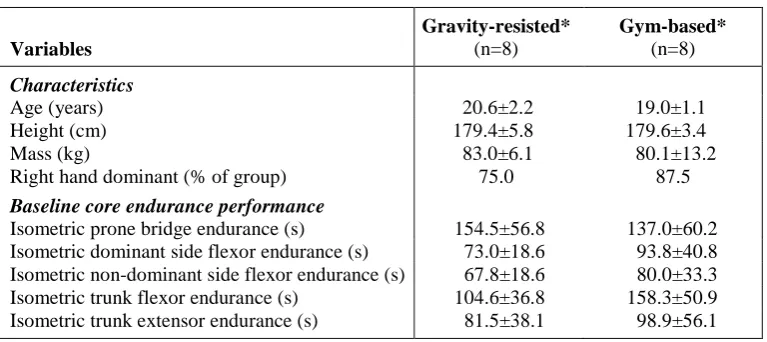
Sixteen resistance trained males completed the study, thus eight participants each made up the GRC training group (age=20.6±2.2 years; height=179.4±5.8cm; weight=83.0±6.1kg) and GBC training group (age=19.0±1.1 years; height=179.6±3.4cm; weight=80.1±13.2kg). The four participants, two from each initial group, who did not complete this study dropped out due to non-compliance and in one case due to personal reasons. Criteria for involvement in the study were resistance-trained males with a minimum of one-year core related training experience, and asymptomatic for lower back pain. Side dominance was determined based on writing hand preference with 75% of the experimental training group and 87.5% of the gym-based training control group being right side dominant. Written consent was obtained from each participant, and the study was approved by the Human Ethical Research Committee at the Waikato Institute of Technology. Participant characteristics and baseline data are presented in Table 1.
Table 1. BASELINE DATA OF PARTICIPANTS COMPLETING THE STUDY
Gravity-resisted* Gym-based*
Variables (n=8) (n=8)
Characteristics
Age (years) 20.6±2.2 19.0±1.1
Height (cm) 179.4±5.8 179.6±3.4
Mass (kg) 83.0±6.1 80.1±13.2
Right hand dominant (% of group) 75.0 87.5
Baseline core endurance performance
Isometric prone bridge endurance (s) 154.5±56.8 137.0±60.2 Isometric dominant side flexor endurance (s) 73.0±18.6 93.8±40.8 Isometric non-dominant side flexor endurance (s) 67.8±18.6 80.0±33.3 Isometric trunk flexor endurance (s) 104.6±36.8 158.3±50.9 Isometric trunk extensor endurance (s) 81.5±38.1 98.9±56.1
* Core training group
Data collection procedure
Training intervention
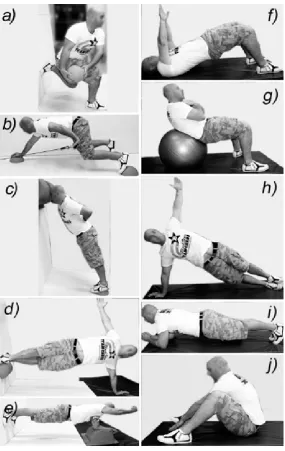
Both the GRC and GBC groups performed a 30- to 40-minute core training intervention, supervised by the same physical conditioning specialist (FvdM), twice a week for a 6-week period. The GRC group performed the training intervention on the BodywallTM Training System (Bodywall Ltd, Auckland, New Zealand), a Velcro-based training apparatus which allows the body to be positioned in non-traditional training positions. In addition to this the experimental group also utilised the various BodywallTM Training System accessories (gloves, shoes, wedges and pads) and a 5kg medicine ball. The GBC group performed the training intervention using a gym-based approach, which incorporated similar exercises to that in the experimental intervention utilising exercise balls and exercise mats. The 6-week training programmes for the experimental and control training groups are presented in Table 2 with exercises depicted in Figure 1 (to follow on next page). All participants were asked to refrain from any additional core training during the 6-week training period.
Table 2. SIX-WEEK EXPERIMENTAL CORE TRAINING PROGRAMME USING GRAVITY-RESISTED AND GYM-BASED CORE TRAINING
Exercises
Week 1 Sets/Reps
Week 2 & 3 Sets/Reps
Week 4 & 5 Sets/Reps
Week 6 Sets/Reps
Gravity-resisted training
Bulgarian medicine ball arcs* 3/10 3/12 3/15 3/18 3-Point bungy point* 3/08 3/10 3/12 3/15 Mod. unilateral chest press* 3/06 3/08 3/10 3/12 Bodywall side# bridge* (sec) 3/20 3/25 3/30 3/35 1-Arm prone bridge* (sec) 3/15 3/20 3/25 3/30
Gym-based training
Reverse bridging 3/12 3/15 3/18 3/20 Swiss ball Curl-ups 3/12 3/15 3/20 3/25 Side bridge on floor* (sec) 3/20 3/25 3/30 3/35 Prone bridge on floor (sec) 3/30 3/35 3/40 3/45 In-between legs curl-ups 3/12 3/15 3/18 3/20
* Per arm/side Training=Core training Mod= Modified Side=Assisted side
Statistical analysis
183
Figure 1. TRAINING EXERCISES PERFORMED BY GRAVITY-RESISTED (a-e) AND GYM-BASED (f-j) TRAINING GROUPS
a) Bulgarian medicine ball arcs b) 3-Point bungy point
c) Modified unilateral chest press d) Bodywall assisted side bridge e) 1-Arm Prone Bridge
Chances of benefit or impairment induced by the experimental training strategy were assessed as follows: <1%, almost certainly not; 1‒5%, very unlikely; 5‒25%, unlikely; 25‒75%, possible; 75‒95%, likely; 95‒99%, very likely; >99%, almost certain. Standard error of the mean and individual responses to the training interventions expressed as within-subject coefficients of variation (CV%) were estimated using the spreadsheet of Hopkins. An increase in CV when a test shows a change in the mean due to the experimental intervention was indicative of individual responses to the intervention.
RESULTS
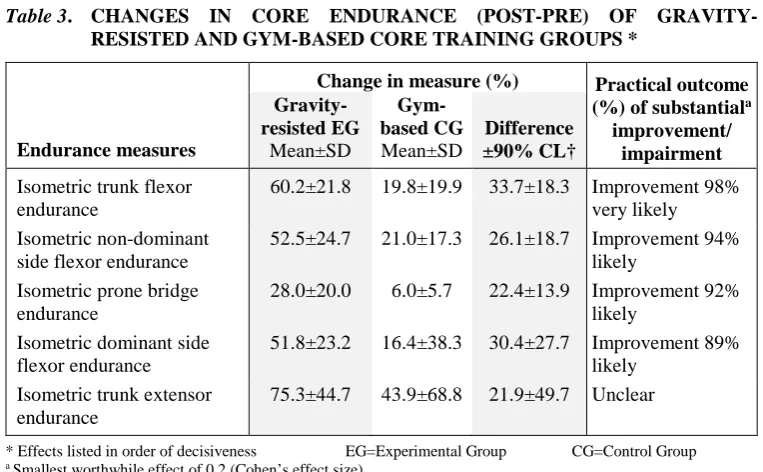
The effects of the experimental core endurance training intervention are presented in Table 3. There were substantially clear beneficial effects of training using the gravity-resisted core training intervention on all measures of core endurance except isometric trunk extensor endurance.
Table 3. CHANGES IN CORE ENDURANCE (POST-PRE) OF GRAVITY-RESISTED AND GYM-BASED CORE TRAINING GROUPS *
Endurance measures
Change in measure (%) Practical outcome (%) of substantiala
improvement/ impairment Gravity-resisted EG Mean±SD Gym-based CG Mean±SD Difference ±90% CL†
Isometric trunk flexor endurance
60.2±21.8 19.8±19.9 33.7±18.3 Improvement 98% very likely
Isometric non-dominant side flexor endurance
52.5±24.7 21.0±17.3 26.1±18.7 Improvement 94% likely
Isometric prone bridge endurance
28.0±20.0 6.0±5.7 22.4±13.9 Improvement 92% likely
Isometric dominant side flexor endurance
51.8±23.2 16.4±38.3 30.4±27.7 Improvement 89% likely
Isometric trunk extensor endurance
75.3±44.7 43.9±68.8 21.9±49.7 Unclear
* Effects listed in order of decisiveness EG=Experimental Group CG=Control Group
a Smallest worthwhile effect of 0.2 (Cohen’s effect size)
† 90% CL (Add and subtract this number to the mean effect to obtain the 90% confidence limits for the true difference)
185
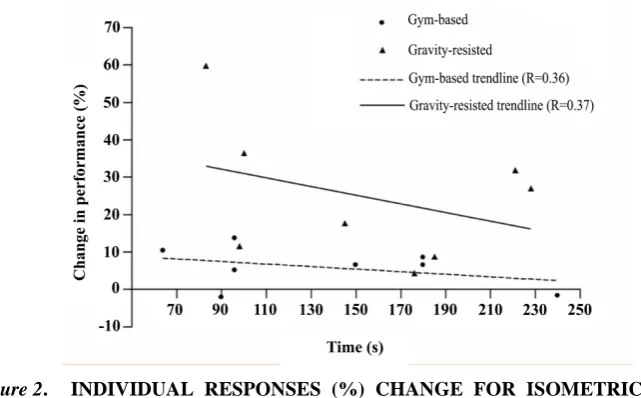
Figure 2. INDIVIDUAL RESPONSES (%) CHANGE FOR ISOMETRIC PRONE BRIDGE ENDURANCE TIME FOLLOWING 6-WEEK CORE TRAINING INTERVENTION
Standard errors of measurement for the core endurance tests expressed as coefficients of variation (CV%) for the control group between pre-test and post-test, in order of increasing error, were isometric prone bridge endurance, 4.0% (90% confidence limits, 2.8 to 7.2%); isometric non-dominant side flexor endurance, 12.0% (8.3 to 22.5%); isometric trunk flexor endurance, 13.7% (9.5 to 25.9%); isometric dominant side flexor endurance, 25.7% (17.5 to 50.9%); and isometric trunk extensor endurance, 44.8% (29.8 to 94.4%).
DISCUSSION
The 6-week gravity-resisted core training intervention produced a clear improvement in core endurance during an isometric trunk flexor endurance test, isometric non-dominant side flexor endurance test, isometric prone bridge endurance test, and isometric dominant side flexor endurance test but otherwise unclear improvements in isometric trunk extensor endurance.
The findings of improved core function following a period of core training are in accordance with previous studies (Cosio-Lima et al., 2003; Stanton et al., 2004; Tse et al., 2005; Carter et al., 2006). Specifically, these researchers observed improved core muscular activity, core endurance and balance performance in untrained women, male athletes, rowers and generally healthy individuals using Swiss ball dominant training programs conducted during 2 to 5 sessions a week for 5 to 10 weeks. Compared to these observed responses, the current findings are unique in the sense that the use of gravity-resisted core training on both stable and unstable surfaces were incorporated in the experimental training programme. Additionally, the control group was performing similar core training which allowed for a comparison in training effects between training interventions. The implications of the findings along with those of others (Cosio-Lima et al., 2003; Stanton et al., 2004; Tse et al., 2005; Carter et al., 2006) suggest 5 to 10 weeks of core training to be beneficial for improving core function and dynamic postural control during various balance tasks.
Compared to the control group, it was unclear if the experimental training group had greater improvements in isometric trunk endurance. Such an uncertainty of the training effect was likely due to two factors. Firstly, the training was aimed at activation of the core musculature, without a specific focus to target improvement in the trunk extensor muscles as evaluated by the isometric trunk extensor endurance test. Secondly, a large degree of variability (CV%; 44.8%) within-participants was found between pre- and post-testing for the isometric trunk extensor endurance test.
This study identified individual responses for improvement in isometric prone bridge endurance, isometric non-dominant side flexor endurance and isometric trunk flexor endurance. Specifically, in the GRC group the participants with the lowest ability to maintain these core endurance tests pre-training experienced much larger increases in core endurance post-training compared to the individuals with the greatest core endurance in the same training group and all participants of the gym-based training control group. Whilst the male participants in this study were trained they were not highly trained individuals. Thus the greater performance gains expedited by the poorer performers within the GRC group may have been due to neuromuscular adaptations, such as improved neural co-ordination and muscle recruitment (Hibbs et al., 2008), which are prevalent in studies lasting longer than 6-weeks (Gabriel et al., 2006; Kristensen et al., 2006).
CONCLUSION
Resistance trained males intending to use a gravity-resisted core training programme should expect larger improvements in core endurance compared to a gym-based training programme using similar core training strategies. Core training using a gravity-resisted training programme will more likely benefit trained males with poor core endurance compared to individuals with superior core endurance performance.
Acknowledgements
187
endorsement of the BodywallTM training system by the authors. No financial assistance was utilised in the present study.
REFERENCES
AKUTHOTA, V.; FERREIRO, A.; MOORE, T. & FREDERICSON, M. (2008). Core stability exercise principles. Current Sports Medicine Reports, 7(1): 39-44.
BATTERHAM, A.M. & HOPKINS, W.G. (2006). Making meaningful inferences about magnitudes. International Journal of Sports Physiology and Performance, 1(1): 50-57.
BLIVEN, K.C.H. & ANDERSON, B.E. (2013). Core stability training for injury prevention. Sports Health: A Multidisciplinary Approach, 5(6): 514-522.
CARTER, J.M.; BEAM, W.C.; MCMAHAN, S.G.; BARR, M.L. & BROWN, L.E. (2006). The effects of stability ball training on spinal stability in sedentary individuals. Journal of Strength and Conditioning Research, 20(2): 429-435.
COSIO-LIMA, L.M.; REYNOLDS, K.L.; WINTER, C.; PAOLONE, V. & JONES, M.T. (2003). Effects of physioball and conventional floor exercises on early phase adaptations in back and abdominal core stability and balance in women. Journal of Strength and Conditioning Research, 17(4): 721-725.
FREDERICSON, M. & MOORE, T. (2005). Core stabilization training for middle-and long-distance runners. New Studies in Athletics, 20(1): 25-37.
GABRIEL, D.A.; KAMEN, G. & FROST, G. (2006). Neural adaptations to resistive exercise. Sports Medicine, 36(2): 133-149.
GAMBLE, P. (2007). An integrated approach to training core stability. Strength and Conditioning Journal 29(1): 58-68.
HIBBS, A.E.; THOMPSON, K.G.; FRENCH, D.; WRIGLEY, A. & SPEARS, I. (2008). Optimizing performance by improving core stability and core strength. Sports Medicine, 38(12): 995-1008. HOPKINS, W.G. (2006). Spreadsheets for analysis of controlled trials, with adjustment for a subject
characteristic. Sportscience, 10(December): 46-50. (Also available on Hyperlink: [sportsci.org/ 2006/wghcontrial.htm]).
KAHLE, N.L. & GRIBBLE, P.A. (2009). Core stability training in dynamic balance testing among young, healthy adults. Athletic Training and Sports Health Care, 1(2): 65-73.
KRISTENSEN, G.O.; VAN DEN TILLAAR, R. & ETTEMA, G.J.C. (2006). Velocity specificity in early-phase sprint training. Journal of Strength and Conditioning Research, 20(4): 833-837. LEETUN, D.T.; IRELAND, M.L.; WILLSON, J.D.; BALLANTYNE, B.T. & MCCLAY DAVIS, I.
(2004). Core stability measures as risk factors for lower extremity injury in athletes. Medicine and Science in Sports and Exercise, 36(6): 926-934.
MCGILL, S.M.; CHILDS, A. & LIEBENSON, C. (1999). Endurance times for low back stabilization exercises: Clinical targets for testing and training from a normal database. Archives Physical Medicine and Rehabilitation, 80(8): 941-944.
REECE, J. (2009). Development of a prone bridge test as a measurement of abdominal stability in healthy adults. Unpublished master’s thesis. Provo, UT: Brigham Young University.
STANTON, R.; REABURN, P.R. & HUMPHRIES, B. (2004). The effect of short-term swiss ball training on core stability and running economy. Journal of Strength and Conditioning Research, 18(3): 522-528.
VERA-GARCIA, F.J.; GRENIER, S.G. & MCGILL, S.M. (2000). Abdominal muscle response during curl-ups on both stable and labile surfaces. Physical Therapy, 80(6): 564-569.
WILLARDSON, J.M.; FONTANA, F.E. & BRESSEL, E. (2009). Effect of surface stability on core muscle activity for dynamic resistance exercises. International Journal of Sports Physiology and Performance, 4(1): 97-109.