MOA BROWSING: EVIDENCE FROM THE
PYRAMID VALLEY MIRE
Summary: Large and medium-sized moa were trapped in soft calcareous sediments in Pyramid Valley mire at various times within the last 4 millennia. Before about 1800 yr B.P. any trapped birds must either have been wading in a shallow lake, or walking on its dry bed, just before being mired. Later, some birds were probably trapped while traversing a Carex secta-Phormium tenax swamp. Gizzard contents include large quantities of twigs of shrub and tree species which, characteristically, do not occur on mires and could not have been reached by trapped birds. The moa must have browsed within forest and along its margins before venturing onto the mire.
Keywords: Pyramid Valley, mire, Dinornis, Emeus, Euryapteryx, Pachyornis, gyttja, moa, browsing, gizzard contents, diet, forest.
Lake Sediments and Vegetation
The Pyramid Valley mire contains sediments indicating a complex history for the site and its vegetation (Duff, 1941; Eyles, 1955; Moar, 1970; Gregg, 1972) (Fig. 1). Most of the moa skeletons lie inThe Problem
Although some Galliformes customarily eat twigs and most living ratites eat them at times, twigs seem unlikely as a major item of diet for birds, even those as large as the Dinornis moa. Yet virtually all of the moa gizzard contents which have been examined (from Pyramid Valley and Scaifes Lagoon mires) contain large amounts of twigs and most contain relatively small quantities of leaf material (Burrows et al., 1981). Some twig fragments are up to 6 cm long and up to 6 mm in diameter, but most are shorter and thinner. Most of the information is for Dinornis and little is known of the diet of the other moa genera. The possibility that the twigs are merely a "lag" of coarse material left after softer leaf matter had disintegrated is not borne out by thorough investigation of this point for one complete Dinornis sample (Burrows et al., 1981. p. 318).
Batcheler (this volume) was unwilling to accept that twigs would have been eaten by choice, and suggested that the masses of twigs in the moa gizzards are really an artefact resulting from the desperate attempts of mired moa to satisfy their hunger by eating any plants within reach. This idea can be tested by examining:
1. The stratigraphic evidence from the Pyramid Valley mire (location and description in Burrows et al., 1981) in terms of::Ö
a. environmental and other conditions prevailing at the site.
b. the vegetation cover on and near the mire, deduced from fossil contents of the mire sediments and the gizzards.
c. the conditions under which the moa became trapped.
2. The modern habitats of the plant taxa in the gizzard contents.
New Zealand Journal of Ecology 12:©New Zealand Ecological Society
the calcareous ostracod gyttja (hereafter abbreviated to gyttja) which is about 1 m thick near the northern to western margins of the mire, thickening to about 3 m in the middle.
The stratigraphy and carbon dates are shown in Fig. 1. The age of the upper 10 cm of the lower peat is about 4280 yr B.P. (N.Z. 622); plant fragment-enriched layers at 116 to 123 cm, 81 to 86 cm and 68 to 73 cm are aged about 3720 yr B.P. (N.Z. 621), 2930 yr B.P. (N.Z. 620) and 2620 yr B.P. (N.Z. 619), respectively. The N.Z. 619 sample lay c. 46 to 51 cm below the top of the gyttja. Gregg (ibid.) showed that the mire strata are laterally continuous for at least 11m. All descriptions of the excavations done so far confirm that the stratigraphy is uniform (Duff, 1941; Eyles, 1955; Moar, 1970).
The sediments and their included fossils reveal that after an early period of shallow lake deposition, a Phormium tenax - Carex secta swamp was present in which the lower black peat accumulated until about 4280 yr B.P. (Eyles, 1955; Moar, 1970). Then, for at least 1660 radiocarbon years (and possibly at least 2500 years, as the date 2620 yr B.P. is for a layer 46 cm below the top of the gyttja, which accumulated at 0.45 mm per year (Gregg, 1972)), the basin contained a shallow lake. Potamogeton cheesemanii, Chara and
Nitella spp. grew in this lake. Near its margin grew Phormium, Carex secta and Baumea sp. (probably B. rubiginosa). The accumulated remains of the abundant aquatic animal life in the lake, especially ostracods (Percival, 1941) began a process of rapid biogenic infilling which led to the formation of the stratified gyttja.
There is no indication that woody vegetation occupied the lake but macrofossils in the gyttja include Podocarpus spicatus leaves and twigs, Leptospermum scoparium capsules, Myrsine divaricata leaves and the seeds, and other remains of Rubus sp., Muehlenbeckia sp. and Coprosma sp., derived from scrub and forest at the lake margin (Moar, 1970; Gregg, 1972). Although pieces of wood occur at intervals throughout the gyttja, the only concentrations of branches and woody stems
(including large Podocarpus spicatus trunks) are along the immediate mire margin (Fig. 2).
Some time after 2620 yr B.P. (most likely at least as late as about 1800 yr B.P.), Typha orientalis occupied part of the lake. Finally a Carex secta cover, with at least some Phormium, spread across the former lake surface. Beneath this swamp vegetation the upper peat accumulated. Peat-filled crevices and cracks in the top 50 to 70 cm of gyttja indicate severe
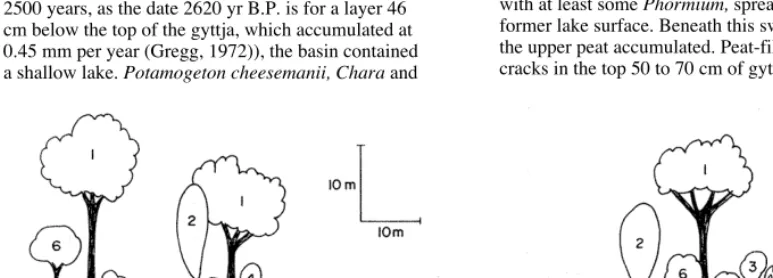
Figure 2: Reconstruction of Pyramid Valley lake and surroundings, about 3500 years ago, facing north, based on macrofossil and pollen information from the lake sediments, and plant taxa from moo gizzards.
Plant species: 1. Podocarpus spicatus 2. Plagianthus regius 3. Pennantia corymbosa, Carpodetus serratus, Hoheria sp. (probably angustifolia), Myoporum laetum. Pseudopanax ferox 4. Elaeocarpus hookerianus 5. Cordyline australis 6. Other small trees for which there are no definite records 7. Melicope simplex, Myrtus obcordata, Coprosma rotundifolia, C. spp. 8.
Muehlenbeckia australis, Rubus schmidelioides, R. squarrosus, Clematis sp. (probably foetida), Tetrapathaea tetrandra 9.
Leptospermum scoparium, Phyllocladus alpinus, Myrsine divaricata, Olearia virga/a, Coprosma spp. 10. Corokia cotoneaster, Teucridium parvifolium, Meuhlenbeckia australis, M. complexa, Rubus squarrosus, Carmichaelia sp. 11. Phormium tenax 12.
Table 1: Radiocarbon dates and stratigraphic position of moo specimens from Pyramid Valley.
Moa Laboratory Date (yr B.P.) Dated material Sample depth Reference No. below surface
(cm)
Emeus 121B N.Z. 610 3600 ±45 bone collagen 100 Gregg (1972)
Emeus 121B N.Z. 625 3740 ± 72 gizzard contents 100 Gregg (1972)
Dinornis 121D N.Z. 624 3640 ±72 gizzard contents 135 Gregg (1972)
Euryapteryx 121A N.Z. 623 3450 ± 71 gizzard contents 130 Gregg (1972)
Dinornis 122B N.Z. 3936 3480± 80 bone collagen 95 Burrows et a1., (1981)
Dinornis 122B N.Z. 3937 3590 ± 60 gizzard contents 95 Burrows et a1., (1981)
drying. Until the site was permanently flooded recently the peat and underlying gyttja tended to crack open during dry spells (Mrs B. McCulloch pers. comm.). It is not absolutely certain, however, whether all of the evident cracking is a recent phenomenon.
Miring of Moas
Most of the recovered moa skeletons for which good records exist were found within the gyttja. A few poorly-preserved skeletons projected up into the topmost peat layer but none have been collected from the bottom peat layer or lower. Within the gyttja, skeletons lay in a variety of positions relative to the top of the deposit. Attitude positions were also variable. Some Dinornis specimens had their feet in the lowermost, sticky gyttja and stood upright (Duff, 1941). The positions of other skeletons of each of the four moa genera (Dinornis, Emeus, Pachyornis, Euryapteryx) were more or less upright but the body had collapsed down onto the legs, which lay bent or diagonally extended. Still others were upside down, or the bones were scattered haphazardly. The upper neck vertebrae and cranium were separated from the rest of the neck in nearly all specimens, and were often some distance away or missing altogether. Eyles (1955) suggested, after testing the floating qualities of these bones, that neck and head had become separated from the body after death and floated away in the semi-liquid sediment. His explanation for the overturned skeletons is that they had drifted into those positions (presumably after separating from the legs). Eels and scavenging birds may also have influenced the separation of body parts.
The best-dated moa skeletons are those recorded by Gregg (1972) and Burrows et al., (1981). Radiocarbon dates (Table I) show that they were mired about 3500-3600 yr B.P. and their dates and position (95 cm to 135 cm below the surface) are consistent with the limiting dates for the deposits within which they are included (younger than 4280 yr
B.P., older than 2930 yr B.P.). Furthermore Gregg (1972) pointed out that the horizontal stratification in the gyttja passes uninterrupted over the skeletons. All of these moa, including Dinornis 121D and 122B (d. Burrows et al., 1981) were trapped during the lake phase and would have been unable to reach any woody plants, as they were too far (at least 7 m) from the lake shore. Other specimens with well-preserved, twig-filled gizzard contents, which were trapped even further from the shore, are Dinornis 76D, 76K and XA.
Many of the other moa skeletons at Pyramid Valley lie at about the mid-depth of the gyttja showing that the birds were trapped more than 3000 years ago, when the locality was a lake containing soft bottom sediments. Other skeletons, however, lie in the upper part of the gyttja and were probably mired later than 3000 years ago. Although some skeletons project a decimetre or so above the present top of the gyttja, there are only weak indications that any birds were trapped after the upper peat began to form, although some probably were. In the meantime it will be assumed that a shallow lake was present when most of the moa were trapped. They may have been
encouraged to walk out into the lake by the presence of a semi-firm bottom layer bound by Characeae, or onto a surface crust formed when the lake dried up during droughts. Some Dinornis skeletons (including XA) have been recovered from the middle of the mire (Duff, 1941). It seems most likely that the birds had walked there, rather than floated as carcasses.
Table 2: Habitats of plant taxa identified from the gizzard contents of moa from Pyramid Valley.
Taxa which occur in wet sites Dinornis Emeus (on open mire surface or at mire margin). No. of Kinds of No. of Kinds of
birds item birds item
Eurypteryx No. of Kinds of birds item Carex secta Cyperaceae Cordyline australis Elaeocarpus hookerianus Leptospermum scoparium Myrsine divaricata Olearia virgata Phormium tenax Phyllocladus alpinus Baumea sp.
Nertera sp.
Scirpus sp.
Taxa which occur in well-drained sites.
Chenopodium cf. allanii Clematis sp.
Coprosma cr. microcarpa
C. cf. rhamnoides
C. cf. robusta
C. rotundifolia Corokia cotoneaster Lophomyrtus obcordata Melicope simplex Muehlenbeckia australis M. cf. australis M. complexa Pennantia corymbosa Plagianthus regius Podocarpus spicatus Pseudopanax ferox P. cr. ferox
Rubus cf. schmidelioides R. cf. squarrosus Tetrapathaea tetrandra Teucridium parvifolium Myoporum laetum Carmichaelia sp.
s sO
sO
sO
cO, l
s, l t, h sO
cladode O
1 s* 1 SO
1 s* l*
s sO s s s s s sO s
s 1 s
tO
s sO
sO, t, b
s, l, tO 2 s, f, l 1 f, l
s so , l l l sO s 1 s 1 t
Taxa of indeterminate habitat
Coprosma spp. 10 s, f
Rubus sp. 11 s, t, I 1 s, thorn 1 s
Pittosporum sp. 1 cO
D can also occur on dry sites; O open, unforested sites; (M) at forest margin; (C) forest, under canopy; s seed or dry, indehiscent fruit; f fruit; c capsule; l leaf; t twig; h short shoot; b bark.
O numbers sparse; * relative numbers not known
Habitats of Plants From the Gizzard
Contents
Table 2 lists the taxa and kinds of plant fragments recovered from moa gizzard contents and the modern habitat conditions in which the plants grow (cf.
Burrows et al., 1981). Most of the trees, shrubs and vines live on well-drained sites and could have occurred at the margin of forest adjoining an open area such as a lake or mire. Most can grow in forest proper and some shrubs are usually found in shaded conditions under a forest canopy. Only very few of 8
3 D, O (M) 2 D (M, C) 1 D, O 3 D (M, C) 9 D, O 10
2 D (M, C) 1 D
O 2
the identified woody plants live in mires nowadays (on the open mire surface or on wet ground at its margin). Of the species represented by identified twigs in the moa gizzard contents only Olearia virgata falls into the mire-dwelling category. It is not restricted to mire sites, although in Canterbury wet ground is the most usual habitat. Some of the twigs tentatively identified as Coprosma might be C. propinqua which also occurs on mire surfaces and margins. Other unidentified twigs, of which there are large numbers, might be from mire-inhabiting species. Some of the twigs identified only as Rubus spp. might be R. australis which occurs in mires, but most are thought to be R. squarrosus or R. schmidelioides which do not.
Batcheler's view that the abundance of twigs in the gizzards does not reflect the normal moa diet is contradicted by the presence of Plagianthus regius
which grows on dry sites and does not even inhabit mire margins. Twigs of P. regius occur in 8 Dinornis
gizzard samples including specimen XA from the middle of the mire. The thickness of some of these twigs means that they were probably taken at heights of 2 m or more above the ground. Two other woody species, which do not grow on mires, Podocarpus spicatus and Muehlenbeckia cf. australis (both in
Dinornis 122B), are also represented by twigs in some samples.
Discussion
Several lines of evidence suggest very strongly that woody twigs were part of the normal diet of these moa. The large bills of Dinornis, have anatomical features indicating strong musculature and cutting edges which, together, could sever twigs (Burrows et al., 1981). The sheared ends of many twigs show that the bills were capable of cutting tough woody stems up to 6 mm diameter. The large volume of gizzard stones and their individual large size suggests that the gizzards were able to process a fibrous, woody diet. This is not to say that these moa ignored leaf material when it was available because one specimen (121D) contained more than 3000 Podocarpus spicatus leaves and five specimens (122B, 76D, BB, 89B and 121D) each contained substantial numbers of Rubus leaves, as well as (except 121D) large amounts of Rubus
stems. The Dinornis moa seem to have behaved like deer, cattle or goats, in taking a variety of food items, including browse. Presumably their digestive system was similarly specialised to cope with lignin and cellulose.
A curious feature of many Dinornis gizzard contents is the abundance of small fruit or seeds (e.g.
Corokia cotoneaster, Coprosma spp.). To obtain single fruit from the tangle of interlacing branches of shrubs such as these would have required considerable selectivity and a delicate touch. It is more likely that they were simply stripped from branches along with leaves and young twigs.
There is little evidence for the view that the larger moa may have fed on grassland plants although I have seen heaps of their gizzard stones in open
alpine/subalpine habitats in Nelson and near Dunedin. There were only limited areas of open unforested terrain in lowland to montane regions of the eastern South Island before the fires of the Polynesian era (Molloy et al., 1963; Molloy, 1969; Connor & Macrae, 1969). The exceptions were wetlands, some coastal margins and river floodplains. Grassland was probably unimportant, even on the Canterbury Plains and in Central Otago. Tall scrub (e.g. with Kunzea ericoides)
dominated in these dry localities.
We must conclude that the Dinornis moa were habitual forest-dwelling species. The forests of the dry eastern South Island are unlikely to have been uniformly tall, with dense undergrowth. Young, rejuvenating forests would fit this description, but old, mixed forest would have contained scattered podocarps and a few tall angiosperm trees, above an irregular and broken canopy of smaller trees hung with vines. Beneath them would be shrubs and a field layer of ferns. Openings of various sizes and forest margins abutting open areas such as river floodplains or wetlands, would also have been rich in vines and shrubs. There is no reason to doubt the ability of the largest moa to penetrate this kind of forest, just as cattle do today. Moa did not always hold their heads upright! They would, furthermore, have maintained trails and openings, by their trampling and feeding (Horn, this volume).
The evidence so far available prompts the conclusion that the Dinornis moa were principally browsers. Study of gizzard samples from other moa genera, from localities other than Pyramid Valley and, if possible, from habitats other than mires is highly desirable. Further study of the Pyramid Valley mire is also needed to resolve questions about the biology of moa and other extinct New Zealand birds.
Acknowledgements
References
Anderson, A.J. 1982. Habitat preferences of moa in central Otago, AD 1000-1500, according to palaeobotanical and archaelogical evidence.
Journal of the Royal Society of New Zealand 12: 321-36.
Batcheler, C.L. 1989. Moa browsing and vegetation formations, with particular reference to deciduous and poisonous plants. New Zealand Journal of Ecology 12: (Supplement) 57-65.
Burrows, C.J.; McCulloch, B.; Trotter, M.M. 1981. The diet of moas based on gizzard contents samples from Pyramid Valley, North Canterbury and Scaifes Lagoon, Lake Wanaka, Otago. Connor, H.E.; Macrae, A.H. 1969. Montane and
subalpine tussock grasslands in Canterbury. In:
Knox, G.A. (Editor). The Natural History of Canterbury. Reed, Wellington pp. 167-204. Duff, R. 1941. Notes on moa excavations at Pyramid
Valley. Waikari. Records of the Canterbury Museum 4: 330-8.
Eyles, J.R. 1955. Field notes on the excavations.
Records of the Canterbury Museum 6: 257-60. Gregg, D.R. 1972. Holocene statigraphy and moas at
Pyramid Valley, North Canterbury, New Zealand.
Records of the Canterbury Museum 9: 151-8. Horn, P.L. 1989. Moa tracks: an unrecognised legacy
from an extinct bird? New Zealand Journal of Ecology 12: (Supplement) 45-50.
Moar, N.T. 1970. A new pollen diagram from Pyramid Valley swamp. Records of the Canterbury Museum 8: 455-61.
Molloy, B.P.J. 1969. Recent history of the vegetation.
In: Knox, G.A. (Editor). The Natural History of Canterbury. Reed, Wellington pp. 340-60. Molloy, B.P.J.; Burrows, C.J.; Cox, J.E.; Johnston,
J.A.; Wardle, P. 1963. Distribution of subfossil forest remains, eastern South Island, New Zealand. New Zealand Journal of Botany 1: 68-77.