A Scalable Multiagent Platform for Large Systems
Juan M. Alberola, Jose M. Such, Vicent Botti, Agust´ın Espinosa and Ana Garc´ıa-Fornes
Departament de Sistemes Inform `atics i Computaci ´o
Universitat Polit `ecnica de Val `encia Cam´ı de Vera s/n. 46022, Val `encia (Spain) {jalberola,jsuch,vbotti,aespinos,agarcia}@dsic.upv.es
Abstract. A new generation of open and dynamic systems requires exe-cution frameworks that are capable of being efficient and scalable when large populations of agents are launched. These frameworks must pro-vide efficient support for systems of this kind, by means of an efficient messaging service, agent group management, security issues, etc. To cope with these requirements, in this paper, we present a novel Multi-agent Platform that has been developed at the Operating System level. This feature provides high efficiency rates and scalability compared to other high-performance middleware-based Multiagent Platforms.
Keywords:Multiagent Platforms, Multiagent Systems, Evaluation.
1.
Introduction
In the last decade, due to the rapid growth of the Internet, the speed of change, and an ever greater amount of easily accessible information, the next genera-tion of Multiagent Systems (MAS)s and informagenera-tion technology, will target open and large systems. In these dynamic and heterogeneous environments, it is essential that features such as security, high performance, scalability, and inter-operability are provided by application development frameworks.
Even though current Multiagent Platforms (MAP)s support the development and execution of MASs, very few real applications have been developed to focus on open and dynamic systems. These applications change quickly and require features such as reliability, scalability, and performance, which not many MAPs are designed to offer. According to [25], agent researchers should design and implement large software systems consisting of hundreds of agents and not only systems composed of a few agents. In order to develop these systems, researchers require efficient and scalable MAPs.
system (OS) services to develop this MAP instead of using middlewares be-tween the OS and the MAP. In [14] we proved that this can noticeably improve the performance and scalability of the system.
Functionality is another important issue when executing large systems. Works by other researchers such as [20] are helpful in determining the main require-ments for designing a MAP. By using theoretical proposals and methodologies [27], a MAP that supports agent organizations helps to simplify, structure, co-ordinate, and easily develop large applications, which are composed of thou-sands of agents. Standard language communication is another key requirement for allowing the interaction between heterogeneous entities. Support to coordi-nate communication is another requirement for these systems [42]. Definition of standard speech acts that agents can use, a common ontology to describe and access services, policies associated to agent conversations, and standard communication language are some features that should be provided. Finally, security concerns become important in large systems must be addressed if these systems are open in order to ensure the communications and the identi-ties of each entity. As stated by other authors in [45], these features should be provided by agent execution frameworks.
Towards these goals, in this paper, we present a MAP that is oriented to ful-filling the requirements for this new kind of systems. This MAP is mainly focused on scalability and efficiency for executing large MASs. It provides mechanisms to support agent organizations, security concerns (authentication, authoriza-tion, and integrity), a standard language of communication for information rep-resentation, conversation-oriented interactions, and so on.
The rest of the article is organized as follows. Section 2 presents the moti-vation and the previous work that allowed us to design and develop an efficient and scalable MAP. Section 3 gives an in-depth description of the MAP architec-ture. Section 4 details the services offered by the MAP. Section 5 describes how agents in this MAP are represented. Section 6 describes a tourism service ap-plication that is built on this MAP. Section 7 presents a performance evaluation of the MAP. And finally, in Section 8, we present some concluding remarks.
2.
Motivation and previous work
than Tryllian [11] and SAP [9] because it is built on Java RMI1, but they give no proofs confirm this claim. As these works state, Jade is more scalable than other MAPs and can be considered to be a stable MAP for large systems [40]. However, these conclusions do not provide any clue to MAP developers about how to improve MAP designs since these experiments only scale up to 100 pairs of agents and a few hosts. A more thorough study is required to be able to assess MAP performance and to determine to what extent design decisions influence MAP performance.
Some other works have tested the performance of other services but only for a single MAP. Most of these works test Jade, which seems to be the most widely used MAP. In [25], the authors tested Jade messaging, agent creation, and migration services. The tests that they performed related to the messaging service only scale up to eight agent pairs. In [17], an evaluation of a MAS for adapting application’s behaviour was carried out on Jade MAP. The work pre-sented in [26] tested the scalability and performance of the Jade messaging service. Similar to the works cited above, their conclusions do not provide any design decision. Even though these conclusions can allow MAS developers to check whether or not Jade fulfills their requirements when designing a MAS, they do not suggest any design decision for MAP developers.
There are also other works that focus on testing the performance of a spe-cific MAS that is running on top of a MAP. In [23] the performance of MAPs is measured when a MAS composed of several web agents is launched. This MAS provides documents requested by a user agent. The authors measured the number of documents requested per unit of time. Therefore, their conclu-sions are only valid for this MAS. Lee et al. [37] present a MAS in which agents coordinate with each other to carry out tasks. They evaluate how the topological relations between agents affect the number of CPU cycles needed to accom-plish these tasks. In [28], the authors compare the response time and the CPU cycles of SACI [13] and Jade.
Finally, other studies focus on detailing the functional properties of MAP. In [20], four MAPs are compared according to several criteria: implementa-tion languages, tools provided, agent deliberaimplementa-tion capabilities, etc. Shakshuki [46] presents a methodology to evaluate MAPs based on several criteria such as availability, environment, development, etc. Similar work is carried out by Nguyen [33], and Omicini [43] gives a brief evolution of MAPs. In other works such as [34, 44], different MAPs that are intended to be scalable are proposed; however, no empirical evaluation is carried out. These works provide ratings of properties provided by MAPs in order to help users choose the MAP according to their needs. Our work goes a step further since it is not only intended to be useful for MAP users but also for MAP developers.
A general conclusion of works that focus on MAP evaluation is that MAP performance decreases as the system grows. Furthermore, as we showed in a previous work [49], when large-scale MAS are taken into account, the perfor-mance of many MAPs is considerably degraded when the size of the system
executed increases, causing some MAPs to even fail. Therefore, current MAPs are not suitable for executing large population systems because their designs are not aimed at improving efficiency and scalability issues.
In order to develop a design in accordance with our goals, we detail other previous works that we carried out that focus on finding design decisions that influence MAP performance. In [41], we presented experiments to link perfor-mance with internal MAP designs, that is, to identify the key design decisions that lead to better performance. We extracted some conclusions from these ex-periments, such as the fact that centralizing services in a single host of the MAP degrades the performance causing this host to become a bottleneck in the case of very popular services. It is more suitable to design a distributed approach with efficient information replication mechanisms. In [16], we tested several issues of the MAPs, such as the performance of the directory service proposed by FIPA [2], the memory consumed by the agents and the MAP, the network occupancy rate, the CPU cycles, etc. According to these studies, the most influential point in the MAP performance that could become a bottleneck is the messaging ser-vice. This service is crucial in the performance of the MAP since agents need to exchange messages with other agents and access MAP services. Furthermore, some MAPs (such as Jade) base other MAP services (such as the Agent Direc-tory or Service DirecDirec-tory proposed by FIPA) on the messaging service. In [14], we specifically analyzed technologies for implementing the Message Transport System (MTS), which is the component of the MAP that manages the message exchanges among the agents running on the MAP. This work showed that in or-der to design a messaging service that can handle large agent populations, the design that performs better should be based on direct communication between each pair of agents so that the messaging service scales better and performs more efficiently, especially in these sorts of scenarios.
In the following sections, we present a MAP focused in being scalable and efficient in more detail. It has been developed using the services offered by the OS to support MAS efficiently. By bringing MAP design closer to the OS level we can define a long-term objective, i.e., to incorporate the agent concept into the OS itself in order to offer a greater abstraction level than current approaches.
3.
Magentix Multiagent Platform architecture
Magentix2 MAP aims to be scalable and efficient, mainly when it is executing large-scale MAS. To achieve a response time closer to the achievable time lower bound, this MAP has been developed using the services provided by the OS. Thus, one of the design decisions is that this MAP is written in C over the Linux OS. Current approaches for developing MAPs are based on interpreted lan-guages like Java or Python. These MAP designs are built over middlewares like the Java Virtual Machine (JVM) [21]. Although these middlewares offer some advantages like portability and easy development, MAPs developed over them
do not perform as well as one might expect, especially when they are running large systems. In [14] we presented a performance evaluation related to this issue. We proved in that using the Operating System (OS) services to develop a MAP instead of using middlewares between the OS and the MAP noticeably improves the performance and scalability of the MAP. Thus, we can see the MAP functionality as an extension of the functionality offered by the OS.
The Magentix communication service has been developed to offer high per-formance. This service is quite crucial to the performance of the MAP as we stated in Section 2 and some other services may be implemented using it. Magentix also provides advanced communication mechanisms such as agent groups, a manager to execute interaction protocols, and a security mechanism to provide authentication, integrity, confidentiality, and access control. This de-sign has been developed in order to provide the functionality required by MAS and perform efficiently.
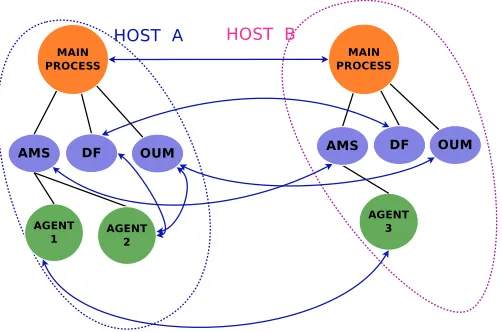
Magentix is a distributed MAP composed of a set of computers executing Linux OS (figure 1). Magentix uses replicated information on each MAP host to achieve better efficiency. Each one of these computers presents a process tree structure. The initial design of this structure is presented in [15]. The advantage of process tree management offered by Linux, and using some services like signals, shared memory, execution threads, sockets, etc. provides a suitable scenario for developing a robust, efficient, and scalable MAP.
The structure of each Magentix host is a three-level process tree. On the higher level we see themain process. This process is the first one launched on any host when this host is added to the MAP. Below this level we can see the services level. Magentix provides some services to support agent execu-tion: Agent Management System (AMS), Directory Facilitator (DF), and Orga-nizational Unit Manager (OUM). Services are represented by means of service agents replicated in every MAP host. Agents representing the same service manage replicated information and communicate with each other in order to keep this information updated. Finally, in the third level, user agents are placed. Using this process tree structure,mainprocess manages service agents com-pletely, i.e., it can kill any service agent to achieve a controlled shutdown of the MAP, and also detects at once whether any service agent dies. In the same way,amsagent has a broad control of the user agents of its own host.
Fig. 1.Platform structure: Agent Management System (AMS), Directory Facilitator (DF), Organizational Unit Manager (OUM)
improve the efficiency of the system. Current Magentix version offer support to different Linux distributions (such as Ubuntu, Fedora, CentOs or OpenSuse) as well as to Mac OS. Interoperability between heterogeneous agents is reached by means of standard communication language representation and ontologies for service interactions.
3.1. Communication and Message Transport System
Magentix provides a message-based communication mechanism in order to allow interactions between agents and services. This communication mecha-nism aims to obtain both good efficiency level and MAP scalability. As Magentix MAP is integrated into Linux, we have checked different alternatives available for communicating processes in an OS context [14]. In this study we have an-alyzed different communication services among processes provided by POSIX [10] compliant OS, in particular, the Linux OS, in order to select which of these services allows robust, efficient and scalable MAPs to be built. As a result of the evaluation, a lower bound of the time needed to communicate process cou-ples (located in the same or different hosts) was obtained. In these studies, we showed to what extent the performance of a Message Transport System (MTS) degrades when its services are based on middlewares between the OS and the MAP (like the JVM) rather than directly by the underlying OS. Thus, the Magentix MTS design was tested to be as close as possible to this time lower bound.
connec-tions based on TCP sockets, between a pair of processes. This mechanism enables high scalability in agent communication. Each Magentix agent has a server socket for receiving connections from other agents by means of client sockets. To carry out a new connection an agent creates a client socket that communicates with the remote agent server socket. Thus, Magentix agents are client/server at the same time.
At a lower level, Java-RMI technology (used for development communication in most of MAPs based on Java) uses TCP sockets. After evaluating different alternatives, we finally define the communication mechanism implemented in Magentix as point to point connections based on TCP sockets, between a pair of processes. The use of C language to develop the MAP, allows us to use this technology closer to the OS level, and avoid the overhead resulting from the use of Java-RMI, because the agent abstraction provided by a MAP is independent of the underlying communication mechanism implementation.
In our previous studies, we have also checked that opening a P2P tion between a pair of agents the first time they interact and leaving this connec-tion open for future interacconnec-tions is much more efficient than opening a new TCP connection each time they want to interact. Therefore two agents could have an indefinitely open connection for exchanging messages each time they require it. Nevertheless, the number of simultaneous open connections is limited by the OS. Therefore, each agent and service stores its open connections in a
con-nection table. The first time an agent contacts another one, a TCP connection
is established and remains open to exchange messages in the future. These connections are automatically closed when the conversation is not active, that is, some time has passed since the last message was sent, according to a LRU (Last Recently Used) policy (this mechanism is described in more depth in [50]).
Thisconnection tableimproves communication times since an agent does not
need to create a new TCP connection each time it wants to communicate with another agent.
4.
Services
In this section we describe the services that are implemented in Magentix ori-ented to agents, services, and group management:AMS service,DF service andOUMservice.
4.1. Agent Management System
As we stated in section 3, all of the agents launched in a specific host are represented by means of child processes of the amsagent. Just as the main process behaves, theamsagent has a broad control of the agents in its corre-sponding host. The management of starting and finalizing agents is automati-cally carried out by means of sending signals
TheAMS service stores the information regarding every agent running on the MAP. This service allows us to obtain the physical address (IP address and port), providing the agent name to communicate with. Due to the fact that the AMSservice is distributed among every MAP host, eachamsagent running on each host contains the information needed to contact every agent of the MAP. Hence, the operation of searching agent addresses is not a bottleneck as each agent looks this information up in its own host, without needing to make any re-quests to centralizing components. Every time an agent is started or finalized in a host, this update is replicated on each host of the MAP. Nevertheless, there is another information regarding agents that does not need to be replicated when it is updated. For this reason, theamsagents manage two tables of information: the Global Agent Table (GAT) and the Local Agent Table (LAT).
– GAT: Stored in this table is the name of each agent in the MAP and its physical address, that is, its IP address and its associated port.
– LAT: In this table additional information is stored such as the agent’s owner, the process PID which represents each agent and its life cycle state.
TheGAT is mapped on shared memory. Every agent has read only access to the information stored in theGAT of its own host. Each time an agent needs to obtain the address of another agent in order to communicate, it accesses the GAT without making any request to the ams agent. Thus, we avoid the bottleneck of requesting centralizing components each time one agent wants to communicate with another. The information contained in the GAT needs to be replicated in each host to achieve better performance. Although replication mechanisms imply an overhead in the system, this overhead is reduced as only the updated information is replicated, and these updates occur when agents are started or dead in the MAP, operations that generally occur in low frequency rates. Thus, the overhead resulting from replication is worthwhile in order to dis-tribute the information and make it available in each host of the MAP. Moreover, the spacial overhead (memory) for having the same information replicated in each host is also low, due to the fact that only the physical addresses of the agents are distributed (few bytes of memory).
has to make a request to theAMSservice using theAMSservice ontology. In a transparent way, these requests addressed to theAMS service are delivered to the specificamsrunning on the same host as the agent requested.
4.2. Directory Facilitator
The Directory Facilitator (DF) service offers the yellow pages functionality de-fined by FIPA. This service stores the information regarding the services offered by agents. TheDF service allows agents to register the services they provide, deregister these services, and look up a specifically required service. Much like theAMS service, theDF service is implemented in a distributed scenario by means of agents running on each MAP host, calleddf agents. Information regarding services is also replicated in every host of the MAP.
Information that needs to be replicated is stored in a unique table calledGST (Global Service Table). This table is a list of pairs: services offered by agents of the MAP and the agent that offers this service. In contrast to theGAT, the GSTis not implemented as shared memory, therefore only the df can acces this information directly.
Agents are able to register, deregister, and look up services offered by other agents. To do these tasks, agents need to communicate with the DF service using the DF service ontology. Current functionality of the DF service is the one proposed by FIPA. Nevertheless, we consider the possibility of improving this service in order to provide new functionalities such as the management of semantic information, service composition, services offered by agent organiza-tions, etc. and also extending the operations proposed by FIPA for registering, deregistering, and searching for services.
4.3. Organizational Unit Manager
The Organizational Units Manager (OUM) service provides support oriented to agent-group communication as a pre-support for agent organizations. Sev-eral research groups define theoretical proposals and methodologies to design MASs, oriented to organizational aspects of the agent society [27]. In order to develop applications which use these organization oriented methodologies, we require MAPs that support them. Among there are few MAPs which offer any kind of support related to agent organizations. Among these MAPs are Jack [3], MadKit [4], or Zeus.
more agents to receive the messages addressed to the unit: these agents are calledcontact agents. User can also specify the way in which these messages have to be delivered to the contact agents. This property is called therouting typeand messages addressed to the unit will be delivered to the contact agents defined according to one of theserouting types:
– Unicast: The messages addressed to the unit are delivered to a single agent which is responsible for receiving messages. This type is useful when we want a single message entrance to the group. It could be useful if the group has for example, a hierarchical structure, where the supervisor receives every message and distributes them to its subordinates.
– Multicast: Several agents can be appointed to receive messages. When a message is addressed to the unit, this message is delivered to any contact agent in the unit. This could be useful if we want to represent an anarchic scenario, where every message needs to be known by every agent without any kind of filter.
– Round Robin: There can be several agents appointed to receive messages. But each message addressed to the unit is delivered to a different contact agent, defined according to a circular policy. This type of routing messages is useful when several agents offer the same service but we want to dis-tribute the incoming requests to avoid the bottlenecks.
– Random: Several agents can be defined as contact agents. But the mes-sage is delivered to a single one, according to a random policy. As with the previous type, this is useful for distributing the incoming requests, but no kind of order for attending these requests is specified.
– Sourcehash: Several agents can be the contact agents. But any given mes-sage is delivered to one of the agents responsible for receiving mesmes-sages, according to the host where the message sender is situated. This is a load-balancing technique.
Units have a defined set of agents which make up the unit, calledmembers. These agents can interact and coordinate with each other and each one plays a certainrole. Finally, each unit has amanager associated to it. This agent is responsible for adding, deleting or modifying the members and contact agents. By default it is the agent which creates the unit and is the only one allowed to delete it.
All of this information regarding units in Magentix, is managed by theOUM service, which stores it in theGUT(Global Unit Table). Similar to the previous services, OUM is a distributed service composed byoum agents running on each MAP host. TheGUTtable is replicated and synchronized on each host of the MAP every time an update is made. Interaction between agents and OUMservice is carried out by the sending of messages using theOUMservice ontology.
4.4. RDF as framework for representing information
pro-poses some Agent Communication specifications regarding the language used for message exchanging in a MAP [30]. They standarize the structure of an Agent Communication Language (ACL) message to ensure interoperability and also Content Language (CL) specifications for representing the content of the ACL messages. The use of standard specifications is vital in order to allow in-teroperability between heterogeneous agents which could compose an open system, as well as to define standard ontologies for accessing the MAP ser-vices.
Resource Description Framework (RDF) is a language for representing infor-mation about resources on the World Wide Web. By generalizing the concept of a ”Web resource”, RDF can also be used to represent information about things even when they cannot be directly retrieved from the Web [6]. RDF is based on the idea of identifying things using Web identifiers (called Uniform Resource Identifiers, or URIs), and describing resources in terms of simple properties and property values. The underlying structure of any expression in RDF is a collection of triples, each consisting of a subject, a predicate and an object. The subject can be any resource, the predicate is a named property of the subject and the object denotes the value of this property. A set of such triples is called an RDF graph. RDF also provides an XML-based syntax (called RDF/XML [7]) for recording and exchanging these graphs. RDF is intended for situations in which this information needs to be processed by applications, rather than only being displayed to people. RDF provides a common framework for expressing this information so it can be exchanged between applications without loss of meaning.
Due to the features of RDF and its widespread use in MAS [18, 24, 35, 36], an RDF-based framework for managing information has been designed for Ma-gentix and has been integrated into it. It allows a MaMa-gentix agent to manage all of its information as RDF models (RDF graphs). Moreover, Magentix itself uses the framework for the messages exchanged, for representing the information that Magentix services manage, for interacting with the Magentix services and for storing MAP events.
The framework is based on offering an API to deal with RDF management. Of course, we did not implement an RDF support from scratch, the framework is designed as a wrapper for existing RDF management libraries and is aimed at simplifying the use of RDF inside a Magentix agent. There are some libraries that deal with RDF models. However, because of the Magentix features, i. e., the fact that it is implemented in C language and is focused on achieving high levels of efficiency, we have chosen the Redland libraries [8].
or Turtle Terse RDF Triple Language. Queries can be carried out with SPARQL or RDQL.
One of the functionalities of Magentix where the RDF has been used in it is to represent messages. Agents and services use message sending to commu-nicate with each other as we said in section 3.1. FIPA defines the structure of an Agent Communication Language (ACL) and also defines the use of RDF to represent the message content [31]. Message header and message content in Magentix are represented as RDF models serialized as XML. Some MAPs use this kind of serialization to represent the message content only (such as Jade), just as FIPA proposes. We provide Magentix with RDF to represent the whole message. Therefore, only one parser is needed and this simplifies the parsing and serializing process of a message.
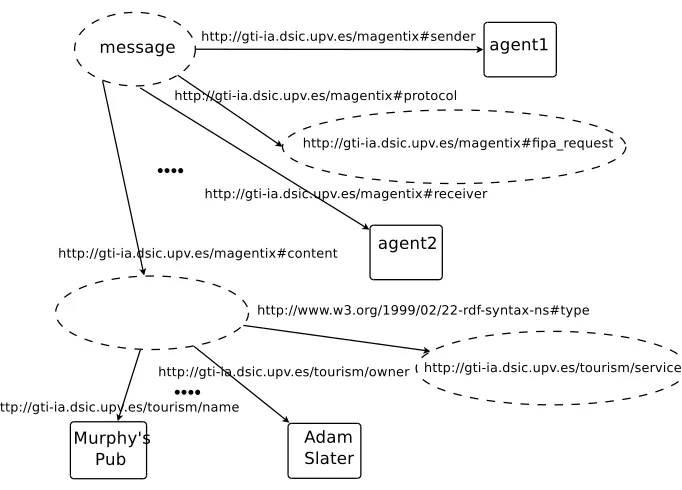
As far as we are concerned, representing the FIPA-ACL using RDF should be standard, but currently it is not, so interoperability with other FIPA-compliant MAPs is compromised. A simple gateway that directly translates both repre-sentations can be added to solve this problem. Figure 2 shows an example of a Magentix message. It is an RDF graph in which resources are drawn as ellipses and literals are drawn as squares. As can be observed, all of the FIPA-ACL fields are mapped as RDF properties describing a message resource. The content of the message can also be seen as an RDF sub-graph inside the main RDF graph representing the message. Therefore, any information that a Ma-gentix agent has as an RDF graph, can be added or retrieved directly from a message.
Regarding the representation of information about Magentix services, an ontology for interacting with them has been defined using Web Ontology Lan-guage (OWL) [5]. The ontology mainly focuses on describing the resources that the services manage (hosts, agents, services, organizational units, etc.). There-fore, all of the information is treated, without taking into account implementation concerns, so that a change in the implementation does not have any effect on the way the services treat the information. What is more, they can store all of its information in a direct and simper fashion on a database.
In order to achieve rich and flexible interactions between agents and Ma-gentix services, the ontology also includes actions that can be requested by a Magentix service (creation of a new agent to theAMS, registering a service to theDF, creation of a new organizational unit to theOUM, etc.). Therefore, any Magentix agent that knows the ontology can interact with Magentix services and also manage all of the related knowledge using the framework provided.
4.5. Security Model
The Magentix MAP has a security model [48, 47], which is based on both the Kerberos protocol and the Linux OS access control. This model provides Ma-gentix with authentication, integrity and confidentiality. By means of this model each agent has an identity which it can prove to the rest of the agents and services in a running Magentix MAP.
Fig. 2.Magentix Message represented in RDF
– Agentidentity. Its identity as an agent. This identity is created by the AMS when the agent is created.
– Useridentity. The identity of its owner, i.e, the identity of the user that cre-ated the agent.
– Unitidentity. The identity of each unit that the agent is in.
An agent always has at least itsAgentidentity and its owner’sUseridentity. Therefore, a Magentix agent is provided with more than one identity, so a way of letting the Magentix communication module know which Kerberos credentials it has to use when sending a message is needed. This is done with a new field in the message header. If this field is in the message header of a message to be sent, the communication module tries to use the identity chosen; otherwise the corresponding agent identity is used. If the Kerberos credentials associated to the identity that the agent is requesting are not available, and the agent is trying to use an identity that it does not own for instance, the sending of the message fails.
using Linux OS access control and can only be accessed by theroot user, so Magentix services have to run asrootprivileges.
When a service requires communication with another service, a security context is established as a client with the principal of the MAP administrator and as a server with theprincipalof the destination service. Using this security context the information sent is encrypted and a message integrity code is cal-culated. Therefore, the client is sure that the destination service is the service expected. Moreover, the destination service knows that it is being contacted by a service with the administrator’s identity, so the destination service will serve all of the requests it receives. Thus, only MAP services can exchange information with each other.
Securing agent communication is similar to securing service communica-tion, but agents use the identity that theamsagent has created for them when creating a security context to allow a secure interaction with each other.
In order to make efficient use of security contexts, a context cache has been added to each agent. This cache contains the corresponding security context associated with a destination agent. This cache is not related to the connec-tions cache, so that, when a connection with an agent is closed, the associated security context is not lost.
5.
User Agents
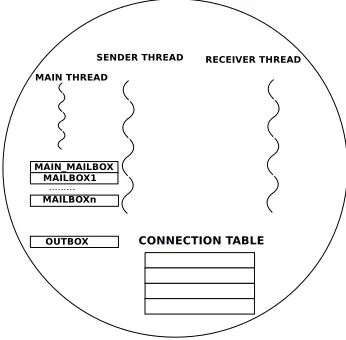
Agents in Magentix are represented as Linux processes. Internally, every agent is composed of Linux threads: a single thread for executing the agent tasks (main thread), a thread for sending messages (sender thread) and a thread for receiving messages (receiver thread). The ams agent manages the creation and deletion of the user agents launched on the same host. The GAT is shared between theamsagent and these user agents, so accessing the physical ad-dresses of any agent of the MAP is fast and does not become a bottleneck. Agents have free read access to the GAT, thus, searching for the address of any agent registered in the MAP is efficient.
5.1. Mailboxes
Mailboxes are used to improve the management of incoming messages from
any agent. An agent is able to interact simultaneously with several agents. In these scenarios the possibility of distributing the incoming messages in different message queues, depending on the conversation that belongs each message, becomes interesting. By default every agent has a unique Mailbox called
DE-FAULT MAILBOX, which receives every message addressed to the agent.
Magentix allows agent developer to create new Mailboxes and later, asso-ciate a conversation identifier to them. Then, when a message with this con-versation identifier (represented as theconversation idfield of the message) is received, this message is routed to the corresponding Mailbox. This functional-ity allows messages to be filtered and split according to this field, so that, agent developers can easily distribute the different conversations which an agent is in-volved in among different Mailboxes. A Mailbox is not restricted to receive only the messages of a specific conversation identifier since we consider the possi-bility of associating several identifiers to the same Mailbox. The basic function-ality an agent developer needs to bear in mind when working with Mailboxes is creating new Mailboxes and then, associating them to conversation identifiers. When an agent checks the message incoming queue, it specifies which Mailbox it wants to check. We can see in figure 3 an image of the internal structure of a Magentix agent.
5.2. Conversation Manager
Interactions between Magentix agents are focused on conversations. Thus, it is important for us not only to the searching and sending of messages to other agents but also to easily reproduce typical conversation patterns that can ap-pear in a big variety of scenarios. An agent is able to simultaneously communi-cate with several agents. Every interaction between a pair of agents very often requires the exchanging of more than one message. Moreover, message ex-change patterns are usually repeated in several interactions between agents, i.e. to access some service, to request information, to send proposals to differ-ent agdiffer-ents, etc. Thus, defining communication patterns to specify which mes-sages exchanges are allowed for a specific interaction proves to be an interest-ing and useful feature for agent developers.
FIPA defines standard interaction protocol specifications that agents can use in their conversation with other agents ([32]). These specifications deal with pre-agreed message exchange protocols for ACL messages. Magentix pro-vides support for executing these protocols defined by FIPA, therefore, agent developers can easily reproduce these interaction scenarios without needing to consider the sequence of exchanged messages, the possible failures in the execution of the protocol and so on. Agent developer only has to specify what to do when some of the deterministic events of the protocol take place and the protocol will automatically be checked and executed by Magentix.
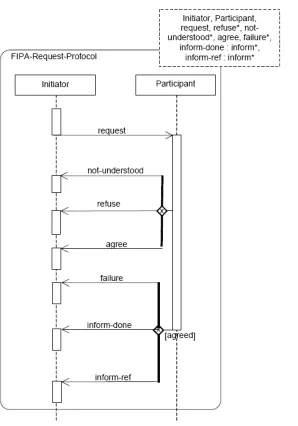
Interaction protocols are defined by FIPA using UML-diagrams. In figure 4 we can see the protocol FIPA-request as an example. In these protocols there are two roles, initiator and participant, which exchange some possible message sequences. We translate this representation to Magentix as finite state ma-chines. Each interaction protocol has a finite state machine associated to each possible role of the protocol. In figure 5 we can see the FIPA-request protocol for the initiator role. Each finite state machine has these properties:
– Anot createinitial state. This state is the first of every protocol.
– Transitions which allow the execution of the protocol depending on the mes-sages received (represented as performatives such as refuse or agree) or λ-transitions, which take the protocol execution forward to the next state. – Intermediate states for representing the intermediate steps of the protocol
execution.
– Adeletestate. This is the last one of every protocol.
Fig. 4.FIPA-request Interaction Protocol Fig. 5. Finite State Machine for FIPA-request in Magentix
stop them according to its needs. The conversation manager is an abstraction that hides the basic concepts of the conversations (makes sure the message is exchanged, mailbox management, etc.) from the agent developer, which only has to specify what to do in each step of the protocol, easily allowing the concur-rent execution and management of several conversations. We are now working to extend the conversation management funcionalities. We especially want to facilitate the specification of any protocol interaction that agent developer could require, apart from that predefined by FIPA.
6.
The Tourism Service Application
research group has been working with a partnership developing MAS-based recommender systems for tourists.
There are four different agent types in the application. A SightAgent man-ages all of the information related to the features and activities for a specific place of interest in the city. A UserAgent allows tourists to interact with the system by means of a GUI on their mobile devices. A BrokerAgent mediates between UserAgents and SightAgents. It also manages updated information about the SightAgents registered on it. Finally, a PlanAgent manages all of the planning processes in the system. The application offers search, reservation, planning, and registration services. The Search service is offered by the Bro-kerAgent and can be requested by a UserAgent. The result of the invocation of this service is a list of descriptions of places that match user preferences. The Reserve service is offered by a SightAgent and can be requested by a UserA-gent. The result of this service is the confirmation of a successful reservation or an error message. The ”Plan a Specific Day” service is provided by the PlanA-gent and can be requested by a UserAPlanA-gent. The result of this service is a plan consisting of a list of places or activities.
We have implemented this application using the Magentix MAP with RDF support. The implemented ontology is represented in RDF and gives detailed descriptions of tourist places, information about scheduling, etc; For example, information about restaurants, represent issues related to menus, cuisine, in-gredients, etc.
UserAgents can be implemented as Magentix agents in the MAP or by means of an interface that is implemented using the J2ME (Java 2 Micro Edi-tion) specification. In the latter case, UserAgents have to make HTTP requests to a GatewayAgent, which acts as a gateway between UserAgents and the rest of the system. This GatewayAgent is implemented as a Magentix agent, which includes a micro-http server. This mechanism allows the interaction between Magentix agents and external agents.
7.
Large Scale Evaluation of the Messaging Service
ser-vice. The experiments shown here are based on these benchmarks and are adapted to the Tourism Service Application presented in Section 6.
We compare Magentix against the performance of Jade, which is a well-known MAP and is more scalable than other MAPs as we stated in Section 2. Since the initial implementation of the Tourism Service Application was in Jade [38], we can determine the performance of the messaging service of both MAPs simulating different scenarios in this domain. We used 20 PCs Intel(R) Core(TM) 2 Duo CPU @ 2.60GHz, 2GB RAM, Ubuntu 10.10 and Linux Kernel 2.6.35. The computers were connected to each other via a 100Mb Ethernet hub.
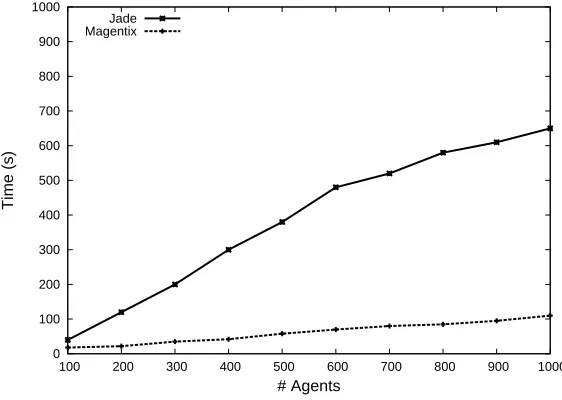
The first experiment is aimed at testing the MAPs performance when both the number of agents and the message traffic increase. This experiment mea-sures the capability of the MAP when messages are sent to different agents. As an example, this situation can occur when a BrokerAgent requests different SightAgents. We simulate this scenario by launching several groups of Broker-Agents and SightBroker-Agents. The objective of each BrokerAgent is to send a mes-sage to the first SightAgent on its list, which sends back the same mesmes-sage. After that, each BrokerAgent sends a message to its corresponding SightAgent placed in the next host and waits for the response. This experiment measures the time elapsed between when the first message is sent by the first BrokerA-gent and when the last message is received by the last BrokerABrokerA-gent. The exper-iment started with 100 agents in the system, increasing to 1000. The number of messages sent by each BrokerAgent was specified at 1000.
0 100 200 300 400 500 600 700 800 900 1000
100 200 300 400 500 600 700 800 900 1000
Time (s)
# Agents
Jade Magentix
Figure 6 shows the time required for the two MAPs. The figure shows that there is a performance degradation as the number of agents and the message traffic increase. However, Magentix performance degrades less than Jade per-formance. As an example, it can be observed that the elapsed time in Magentix when the system is composed of 1000 agents is less than the elapsed time in Jade when the system is composed of 200 agents.
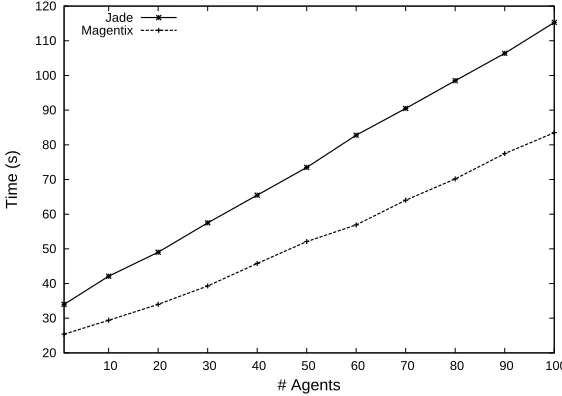
Another typical scenario is the massive amount of message-sending to a specific agent. The second experiment measures the ability of the MAPs when a lot of agents send messages to a single one. This specific agent could be-come a bottleneck in the system when multiple messages are addressed to it. This scenario appears, for example, when UserAgents are requesting the same BrokerAgent to retrieve information. The BrokerAgent has to serve every received request. As the number of incoming requests increases, the time for processing these requests may also increase. In order to simulate this, a single BrokerAgent agent and several UserAgents were launched. The goal of each UserAgent was to send messages to the BrokerAgent. The elapsed time be-tween when the BrokerAgent received the first message and when it answered all the messages is shown in Figure 7. In this experiment, we increased the number of UserAgents up to 100, distributed among all the hosts. Each UserA-gent sent 10000 messages.
20 30 40 50 60 70 80 90 100 110 120
10 20 30 40 50 60 70 80 90 100
Time (s)
# Agents
Jade Magentix
Fig. 7.Experiment 2: massive sending to an agent
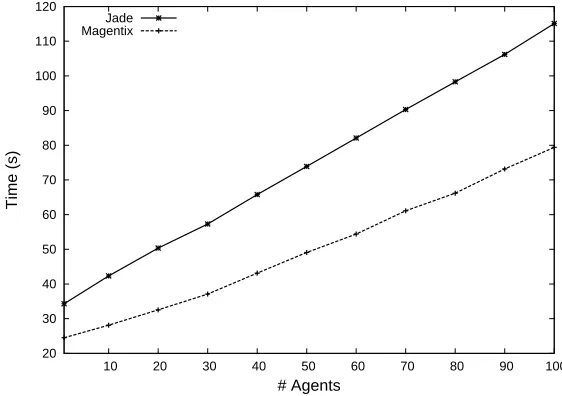
MAPs gradually increases as the number of agents increases. Therefore, Ma-gentix is also more scalable and efficient than Jade in this scenario. Note that in this scenario the receiver agent is not changed during the entire experiment. The third experiment complements the second one. The distribution of agents in this experiment was similar. However, there were the same number of Broker-Agents as UserBroker-Agents. In this experiment, several BrokerBroker-Agents were placed in the same host and each UserAgent communicated with its corresponding Bro-kerAgent. The results obtained are shown in Figure 8. It can be observed that the results for Jade are similar to the results for the second experiment. This is due to the way that Jade implements communication among all the MAP hosts. Therefore, the bottleneck is caused by the message transport system and not by the way the message queue is managed by the agent itself. In contrast, the performance in Magentix in the third experiment is slightly better than in the second one.
20 30 40 50 60 70 80 90 100 110 120
10 20 30 40 50 60 70 80 90 100
Time (s)
# Agents
Jade Magentix
Fig. 8.Experiment 3: host massive sending
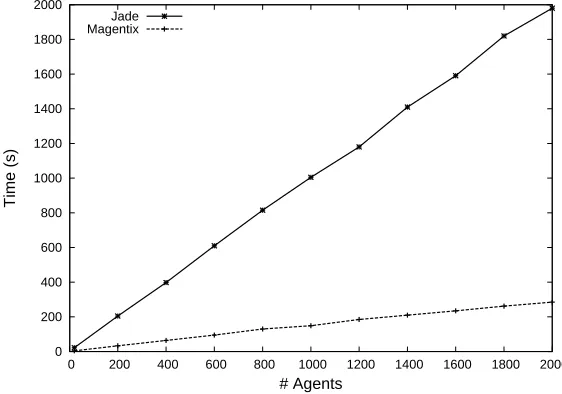
overloaded than others. Furthermore, in this experiment, the number of agents was increased to 2000, in order to overload the MAPs.
0 200 400 600 800 1000 1200 1400 1600 1800 2000
0 200 400 600 800 1000 1200 1400 1600 1800 2000
Time (s)
# Agents
Jade Magentix
Fig. 9.Experiment 4: random requests
It can be observed in Figure 9 that Magentix offers better performance than Jade, and the differences increase according to the increase in the traffic. The figure also shows that the two MAPs present higher response times with respect to the first experiment, in which the traffic was equally distributed among all the BrokerAgents. This is due to the fact that, in this forth experiment, message load is not spread over all of the receiver agents launched. Since the BrokerAgent in each message sending is selected randomly, there may be BrokerAgents that have to serve a lot of messages while others are idle. Therefore, as the second experiment indicates, Jade performs quite badly when there is an agent that is receiving a lot of messages. As a result, performance differences with respect to the first experiment are much higher in Jade than in Magentix.
8.
Conclusions
The next generation of technologies aims to provide features such as distri-bution, interoperability, scalability, organizations, service-oriented, open, geo-graphically dispersed, and so on. MASs can contribute to these environments by evolving new applications that will become more autonomous and social from the point of view of the MAS field.
MAPs have traditionally been used as a support framework to facilitate the development of these kinds of systems. A lot of MAPs have been developed in the last few years; however, unfortunately, very few real MAS-based appli-cations have appeared, probably due to the lack of suitability of the support frameworks which did not fulfill all of the requirements. In order to support the new generation of systems (in line with the latest trends in rapidly expanding technologies), new MAP designs should focus on being interoperable, scalable, and large-scale as just some of their key features.
In this paper, we have presented the Magentix MAP. Since its design is closer to the OS level, it ensures that the MAP is efficient, especially when running large systems. Basic services such as an agent directory service, a service directory service, and a messaging service are provided by Magentix. We have implemented and tested the performance of this MAP. Magentix also provides a group-oriented communication mechanism. This mechanism allows communication between individual agents as well as interaction among groups of agents. When considering large systems, security concerns become an im-portant issue and a necessary feature when these systems become open. Ma-gentix has a security model that is based on the Kerberos protocol and Linux OS access control which provides authentication, integrity, and confidentiality. In order to achieve interoperable systems, we represented the information us-ing RDF. This framework has been widely used in MAS for different purposes. Magentix represents messages to be exchanged in RDF so that agents can easily manage the information that is sent and received. Ontologies defined in OWL have also used to interact with services.
Using a tourism service application, we have shown how Magentix can be used as a support framework to develop MAS-based applications. The mes-saging service evaluation shown in this paper demonstrates that a MAP design that uses the OS services provides greater efficiency and scalability than other high-performance middleware-based MAPs such as Jade.
With the features provided by Magentix we can establish the next objective of the project: to provide Magentix with support for open MAS. We are working on the development of an http-based gateway at MAP level, in order to allow the interaction between Magentix agents and agents developed in other MAPs. Virtual organizations where agents dynamically enter and exit the system and form groups could also be created in Magentix.
TIN2008-04446. Juan M. Alberola has received a grant from Ministerio de Ciencia e Innovaci ´on de Espa ˜na (AP2007-00289).
References
1. Fipa-os. http://fipa-os.sourceforge.net
2. FIPA (The Foundation for Intelligent Physical Agents). http://www.fipa.org/ 3. Jack. http://www.agent-software.com
4. Madkit. http://www.madkit.org
5. OWL Web Ontology Language Overview. http://www.w3.org/TR/owl-features/ 6. RDF. http://www.w3.org/TR/rdf-primer/
7. RDF/XML Syntax Specification. http://www.w3.org/TR/rdf-syntax-grammar/ 8. Redland RDF Libraries. http://librdf.org
9. Safeguard. http://www.ist-safeguard.org/
10. Standard for information technology - portable operating system interface (POSIX) 11. Tryllian agent development kit (adk). http://www.tryllian.com
12. Zeus agent toolkit. http://labs.bt.com/projects/agents/zeus/
13. SACI - simple agent communication infrastructure. http://www.lti.pcs.usp.br/saci/ (2009)
14. Alberola, J.M., Mulet, L., Such, J.M., Garcia-Fornes, A., Espinosa, A., Botti, V.: Op-erating system aware multiagent platform design. In: Proceedings of the Fifth Euro-pean Workshop on Multi-Agent Systems (EUMAS-2007). pp. 658–667 (2007) 15. Alberola, J.M., Such, J.M., Espinosa, A., Botti, V., Garcia-Fornes, A.: Scalable and
efficient multiagent platform closer to the operating system. Artificial Intelligence Research and Development 184, 7–15 (2008)
16. Alberola, J.M., Such, J.M., Garcia-Fornes, A., Espinosa, A., Botti, V.: A performance evaluation of three multiagent platforms. In: Artificial Intelligence Review, Volume 34, Number 2. pp. 145–176 (2010)
17. Batouma, N., Sourrouille, J.L.: Dynamic adaption of resource aware distributed ap-plications. In: International journal of grid and distributed computing. vol. 4, pp. 25– 42 (2011)
18. Bauwens, B.: Xml-based agent communication: Vpn provisioning as a case study. In: XML Europe’99 (1999)
19. Bellifemine, F., Caire, G., Poggi, A., Rimassa, G.: Jade a white paper. EXP 3, 6–19 (2003)
20. Bitting, E., C.J.G.A.: Multiagent system development kit: An evaluation. In: Proceed-ings of Communication Networks and Services Research Conference, May 15-16, pp. 80-92, Moncton, New Brunswick, Canada, 2003
21. B ˘adic ˘a, C., Budimac, Z., Burkhard, H.D., Ivanovic, M.: Software Agents: Languages, Tools, Platforms. Computer Science and Information Systems 8(2), 255–298 (2011) 22. Burbeck, K., Garpe, D., Nadjm-Tehrani, S.: Scale-up and performance studies of
three agent platforms. In: IPCCC 2004 (2004)
23. Camacho, D., Aler, R., Castro, C., Molina, J.M.: Performance evaluation of zeus, jade, and skeletonagent frameworks. In: IEEE International Conference on Systems, Man and Cybernetics, 2002 (2002)
24. Cenk, R., Dikenelli, O., Seylan, I., G ¨urcan, ¨O.: An infrastructure for the semantic integration of fipa compliant agent platforms. In: AAMAS. pp. 1316–1317 (2004) 25. Chmiel, K., T.D.G.M.K.P.: Testing the efficency of jade agent platform. In:
26. Cortese, E., F.Quarta, Vitaglione, G.: Scalability and performance of jade message transport system. EXP 3, 52–65 (2003)
27. E. Argente, A. Gilet, S.V.V.J., Botti, V.: Survey of mas methods and platforms fo-cusing on organizational concepts. In: Recent advances in Artificial Intelligence Re-search and Development. vol. 113, pp. 309–316. IOS Press (2004)
28. Fern ´andez, V., Grimaldo, F., Lozano, M., Ordu ˜na, J.M.: Evaluating jason for dis-tributed crowd simulations. In: ICAART (2). pp. 206–211 (2010)
29. FIPA: FIPA Abstract Architecture Specification. FIPA (2001), http://www.fipa.org/specs/fipa00001/
30. FIPA: FIPA ACL Message Structure Specification. FIPA (2001), http://www.fipa.org/specs/fipa00061/
31. FIPA: FIPA RDF Content Language Specification. FIPA (2001), http://www.fipa.org/specs/fipa00011/
32. FIPA: FIPA Interaction Protocol Library Specification. FIPA (2003), http://www.fipa.org/specs/fipa00025/
33. Giang, N.T., Tung, D.T.: Agent platform evaluation and comparison (2002)
34. Hirsch, B., Konnerth, T., Heßler, A.: Merging agents and services — the JIAC agent platform. In: Multi-Agent Programming: Languages, Tools and Applications, pp. 159–185. Springer (2009)
35. Huynh, D., Karger, D.R., Quan, D.: Haystack: A platform for creating, organizing and visualizing information using rdf. In: Eleventh World Wide Web Conference Seman-tic Web Workshop (2002)
36. Laclavik, M., Balogh, Z., Gatial, E., Hluchy, L.: Agent architecture based on semantic knowledge model. In: 5th annual conference. VSB-Technick. pp. 288–291 (2006) 37. Lee, L.C., Ndumu, D.T., Wilde, P.D.: The stability, scalability and performance of
multi-agent systems. BT Technology Journal 16, 94–103 (1998)
38. Lopez, J.S., Bustos, F.A., Julian, V., Rebollo, M.: Developing a Multiagent Recom-mender System: A Case Study in Tourism Industry. International Transactions on Systems Science and Applications 4(3), 206–212 (2008)
39. Lopez, J.S., Bustos, F.A., Inglada, V.J.: Tourism services using agent technology: A multiagent approach. INFOCOMP - Journal of Computer Science - Special Edition pp. 51–57 (2007)
40. Lynch, S.: Using meta-agents to build mas platforms and middleware. In: Interna-tional Conference on Agents and Artificial Intelligence (ICAART) (2011)
41. Mulet, L., Such, J.M., Alberola, J.M.: Performance evaluation of open-source multi-agent platforms. In: Proceedings of the Fifth International Joint Conference on Au-tonomous Agents and Multiagent Systems (AAMAS06). pp. 1107–1109. Association for Computing Machinery, Inc. (ACM Press) (2006)
42. Nodine, M.H., Unruh, A.: Facilitating open communication in agent systems: the infosleuth infrastructure (1997)
43. Omicini, A., Rimassa, G.: Towards seamless agent middleware. In: TAPOC 2004 44. Park, A.H., et al.: A flexible and scalable agent platform for multi-agent systems. In:
Proceedings of WASET Bangkok (2007) (2007)
45. Pesovic, D., Vidakovic, M., Ivanovic, M., Budimac, Z., Vidakovic, J.: Usage of agents in document management. Computer Science and Information Systems 8(1), 193– 210 (2011)
47. Such, J.M., Alberola, J.M., Espinosa, A., Garca-Fornes, A.: A Group-oriented Se-cure Multiagent Platform. Software: Practice and Experience 41(11), 1289–1302 (2011)
48. Such, J.M., Alberola, J.M., Garca-Fornes, A., Espinosa, A., Botti, V.: Kerberos-based secure multiagent platform. In: Sixth International Workshop on Programming Multi-Agent Systems (ProMAS’08). pp. 173–186 (2008)
49. Such, J.M., Alberola, J.M., Mulet, L., Espinosa, A., Garcia-Fornes, A., Botti, V.: Large-scale multiagent platform benchmarks. In: LAnguages, methodologies and Development tools for multi-agent systemS (LADS 2007). Proceedings of the Multi-Agent Logics, Languages, and Organisations - Federated Workshops. pp. 192–204 (2007)
50. Such, J.M., Alberola, J.M., Mulet, L., Garcia-Fornes, A., Espinosa, A., Botti, V.: Hacia el diseo de plataformas multiagente cercanas al sistema operativo. In: International workwhop on practical applications on agents and multi-agent systems (2007) 51. Vrba, P.: Java-based agent platform evaluation. In: Proceedings of the HoloMAS
2003. pp. 47–58 (2003)
Juan M. Alberolais a PhD student at the Departament de Sistemes Inform `atics i Computaci ´o of the Universitat Polit `ecnica de Val `encia. His interest areas in-clude agent organizations, adaptation, multiagent platforms, case-based-reasoning and electronic markets.
Jose M. Such is Lecturer in the School of Computing and Communications at Lancaster University (UK). He was previously research fellow at Universi-tat Polit `ecnica de Val `encia (Spain), by which he was awarded a PhD in Com-puter Science in 2011. He is mostly interested in the following research topics: Privacy, Security, Trust, Reputation, Multi-agent Systems, and Artificial Intelli-gence.
Vicent Bottiis Full Professor at the Universitat Polit `ecnica de Val `encia (Spain) and head of the GTI-IA research group of the Departament de Sistemes In-form `atics i Computaci ´o. He received his Ph.D. in Computer Science from the same university in 1990. His research interests are multi-agent systems, agree-ment technologies, and articial intelligence, where he has more than 200 ref-ereed publications in international journals and conferences. Currently he is Vice-rector of the Universitat Polit `ecnica de Val `encia.
Ana Garc´ıa-Fornesis a Professor at the Departament de Sistemes Inform `atics i Computaci ´o of the Universitat Polit `ecnica de Val `encia. Her interest areas in-clude: real-time artificial intelligence, real-time systems, development of mul-tiagent infrastructures, tracing systems, operating systems based on agents, agent organizations, and negotiation strategies.