www.scienceworldjournal.org ISSN 1597-6343
Solution of a Deterministic Mathematical Model of Typhoid Fever By Variational Iteration Method
SOLUTION OF A DETERMINISTIC MATHEMATICAL MODEL OF
TYPHOID FEVER BY VARIATIONAL ITERATION METHOD
Peter O. J1* , Afolabi, O. A2, Oguntolu F. A3, Ishola C. Y4, Victor, A. A5
1, 2, 5 Department of Mathematics, University of Ilorin, Ilorin, Kwara State, Nigeria. 3Department of Mathematics, Federal University of Technology, Minna, Nigeria 4Department of Mathematics, National Open University of Nigeria Jabi, Abuja, Nigeria
1[email protected], 2[email protected], 3[email protected], 4[email protected], 5[email protected]
*Corresponding author: [email protected]. Phone: +2348033560280 ABSTRACT
The aim of this paper is to apply Variational Iteration Method (VIM) to solve typhoid fever model for a given constant population. This mathematical model is described by nonlinear first order ordinary differential equations. First, we find the solution of this model by using Variational Iteration Method (VIM). In order to show the efficiency of the method we compare the solutions obtained by VIM and RK4. The validity of the VIM in solving the model is established by using the computer in-built classical fourth-order Runge-Kutta method. We illustrated the profiles of the solutions of each of the compartments, from which we speculate that the VIM and RK4 solutions agreed well.
Keywords: Typhoid Fever, Variational Iteration Method, Runge-Kutta Method.
INTRODUCTION
Typhoid fever is one of the infectious disease which is endemic in most part of the world. It is systemic infection caused by Salmonella enterica serotype typhi (S typhi). It is spread through contaminated food, water or drink. Merrell andFalkow, 2004).
Typhoid fever infects 21 million people and kills 200,000 worldwide every year. Asymptomatic carriers are believed to play a major role in the evolution and global transmission dynamics of Typhoid fever, and their presence greatly hinders the eradication of Typhoid fever using treatment and vaccination. (Naresh et al., 2008).
“Typhoid fever has continue to be a health problem in developing countries where there is poor sanitation, poor standard of personal hygiene and prevalence of contaminated food. It is endemic in many parts of the developing world, illness do occur around the world in span of a day”. (Lifshitz, 1996).
Several mathematical models on the transmission dynamics of typhoid fever disease have been developed these includes (Adetunde, 2008), ( Date et al, 2015), (Cvjetanovic et al, 2014), (Kalajdzievska, 2011), (Lauria et al 2009), (Moatlhodl and Gosaamang, 2017),(Moffact, 2014),(Muhammad, et al
2015),(Mushayabasa, 2011), (Mushayabasa, 2017), (Nthiiri, 2016), (Virginia et al, 2014),(Watson and Edmunds, 2015), (Peter and Ibrahim, 2017), (Ibrahim et al, 2017) but none has incorporated both direct and indirect transmission dynamics in typhoid fever. We will like to complement and extend the existing works in the literature. We assume the existence of both direct transmission of typhoid from infected individuals to susceptible
and indirect transmission of bacteria from the environment to the susceptible individuals
The aim of this paper is to present the application of Variational Iteration Method to the proposed model and to verify the validity of Variational Iteration Method in solving the model using computer in-built Maple 18 classical fourth-order Runge-Kutta method as a base.
“The concept of variational iteration method was first proposed by (He, 1998). VIM which is a modified general Lagrange multiplier method (Abbasbandy and Shivanian, 2009), (Abdou and Soliman, 2005), (Momani and Abuasad, 2006) has been shown to solve effectively, easily and accurately, a large class of nonlinear problems with approximations which converge quickly to accurate solutions.
In this study, we employ the Variational Iteration Method (VIM) to the system of non-linear differential equations which describe our model and approximating the solutions in a sequence of time intervals. In other to illustrate the accuracy of the VIM, the obtained results are compared with classical fourth-order Runge-Kutta Method.
MATERIALS AND METHODS
The model subdivides the human population into four compartments: susceptible S(t), infected I(t), infected carrier Ic(t), and recovered R(t). The model assume direct transmission of typhoid from infected individuals to susceptible individuals. However, typhoid is largely contacted from environmental bacteria through contaminated water or food and drinks and transmission of typhoid through. To incorporate this real biological phenomenon, we consider an additional compartment, W(t), which represents bacteria in the environment. We assume that susceptible individuals get infected with typhoid fever at a rate proportional to the susceptible population, Individuals in the infected class, can recover from typhoid at the rate
. The Infected carrier and infected individuals both excrete bacteria into the environment. However, the rate of excretion by the infectious group
2 is higher than that of the carrier group
1 this is because infectious carrier do not show any signs of infection. The constant recruitment rate into the susceptible human is represented by
, while the natural death rate of human is represented by
.Model Equations
From the assumptions, descriptions of the model, we formulate
Fu
ll L
en
gt
h Rese
ar
ch
Ar
Solution of a Deterministic Mathematical Model of Typhoid Fever By Variational Iteration Method
the following system of differential equations
W I I dt dW R I dt dR I S dt dI I S dt dIc S S dt dS b c c
2 1 4 2 3 1 2 1 = = ) ( ) (1 = ) ( = = (1)W
I
I
c 2 3 1=
Substituting the value of force of infection
W I I dt dW R I dt dR I W I I S dt dI I W I I S dt dIc W I I S S dt dS b c c c c c 2 1 4 2 3 3 2 1 1 2 3 2 1 3 2 1 1 = = ) ( ) ( ) (1 = ) ( ) ( = ) ( = (2)
Table 1: Description of Variables and Parameters for Model
Variational Iteration Method
To illustrate the basic idea of variational iteration method, (Abbasbandy, and Shivanian 1999), (Abdou and Soliman 2005; Akinboro et al ,2014) gave the analysis of VIM as follows: Given the general differential equation of the form:
)
(
=
g
x
Ly
Ny
(3)Where N is a non-linear operator, L is a linear operator where
g(x) is a non-homogenous term of the differential equations. The construction of correctional function for the equation is given as:
ds
s
g
s
y
N
s
Ly
x
y
x
y
n(
)
=
n(
)
x{
n(
)
~
n(
)
(
)}
0
1
(4)Where
is a Lagragian multiplier which can be express as:1
)
(
1)!
(
1)
(
=
)
(
n nt
n
(5)where
n
is the highest order of the differential equation. Subject to the initial conditions S0=60, Ic0=40, I0=20, R0=10, W(0)=200.Solution of the Model Using Variational Iteration Method We present the analysis of the system of equations governing the model using variation iteration method. In this section. Following the same approach (Momani, and Abuasad, 2006), we obtain the correctional function as:
1 0 1 1
2 3
1 0 1
2 3 2 1
1 0
( )
( )
{
( )
( )
( )(
( )
( )
( )}
( )
( )
{
( )
( )(
( )
( )
( ) (
)
( )}
( )
( )
tn n n n n n
n n
t
n n n n n
n n n
t
n n
S
t
S t
S
x
S x
S x
Ic x
I x
W x dx
Ic
t
Ic t
Ic x
S x
Ic x
I x
W x
Ic x dx
I
t
I t
12 3 3 2
1 0 4
1 0 1 2
{ ( ) (1
)
( )(
( )
( )
( ) (
) ( )}
( )
( )
{
( )
( )
( )}
( )
( )
{
( )
( )
( )
( )}
n n n
n n n
t
n n n n n
t
n n n n n
b n
I
x
S x
Ic x
I x
W x
I x dx
R
t
R t
R x
I x
R x dx
W
t
W t
W x
Ic x
I x
W x dx
Subject to the initial conditions S0=60, Ic0=40, I0=20, R0=10, W(0)=200. Using the initial conditions and the parameter values in the table and with the help of Mapple 18, we obtain the iterated values for each compartment.
2
3 4
( ) = 60 9.9981148001 5
1.570768935 6
4.719980973 5
5.622348246 9
S t
E t
E t
E t
E t
5 6
7 8
1.165524202 10
1.405574263 13
4.748083674 13
3.003632145 13
E
t
E
t
E
t
E
t
2 3
4 5
( ) = 40 66
7.498713600 5
3.487984559 5
2.811218064 9
6.085091149 9
c
I t
t
E t
E t
E t
E t
6 7
8
7.028058272 12
2.374023676 12
1.501819281 13
E
t
E
t
E
t
Solution of a Deterministic Mathematical Model of Typhoid Fever By Variational Iteration Method
2 3
4 5
( ) = 20 61 7.498469350 5 5.612502025 5
2.811369197 9 6.562908640 9
I t t E t E t
E t E t
6 7
8
7.028405241 12
2.373989970 13
1.501825235 13
E
t
E t
E t
2 3
4 5
( ) = 10 13.58000000
21.91082000
1.874606966 5
1.118892677 5
4.216098798 8
R t
t
t
E t
E t
E t
6 7
8
3.061495037 8
2.973999923 8
5.253487415 7
E t
E t
E t
2 3
4 5
( ) = 200 24 28.33000000 2.249572427 5
1.055985140 5 5.059401508 8
W t t t E t
E t E t
6 7
8
3.673794045 8
3.568799909 8
6.304184899 7
E t
E t
E t
RESULTS
Numerical simulation which illustrate the analytical results for the proposed Model was demostrated. This is achieved by using some set of values given in the table (2) below and whose source are mainly from literature and well as assumptions . We considered different initial conditions for the human populations.
60
=
(0)
S
,I
c(0)
=
40
,I
(0)
=
20
,R
(0)
=
10
and that of bacterial populations
W
(
t
)
=
200
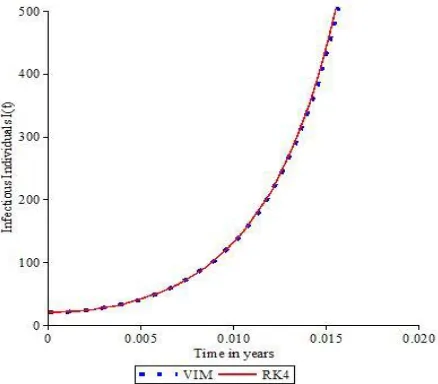
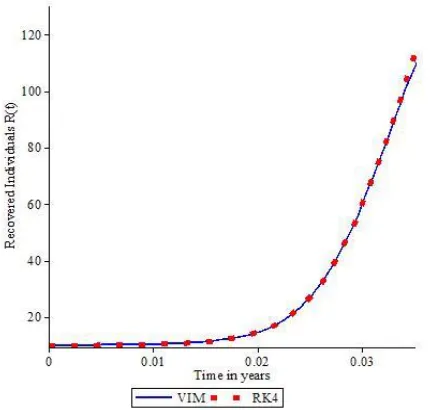
The VIM is demostrated against mapple buit-in fourth order Runge-Kutta Procedure for the solution of the model. Figure (1) to (5) shows the combined plots of the solutions ofS
(
t
)
,I
c(
t
)
,I
(
t
)
,)
(
t
R
andW
(
t
)
by VIM and RK4Table 2: Parameters values for model
Figure 1: Solution of Infected Population by VIM and RK4
Figure 2: Solution of Infected Population by VIM and RK4
Figure 3: Solution of Recovered Population by VIM and RK4
Solution of a Deterministic Mathematical Model of Typhoid Fever By Variational Iteration Method
Figure 4: Solution of Infected Population by VIM and RK4
Figure 5: Solution of Concentration Bacteria Population by VIM and RK4
DISCUSSION
The solutions obtained by using Variational Iteration Method with given initial conditions compared favourably with the solution obtained by using classical fouth-order Runge-Kuta method. The solutions of the two methods follows the same pattern and behaviour.This shows that Variational Iteration Method is suitable and efficient to conduct the analysis of typhoid models.
Conclusion
We present a deterministic model on the analysis of direct and indirect transition dynamics of typhoid fever model. Variational Iteration Method is employed to attempt the series solution of the model. Numerical simulations were carried out to compare the results obtained by VIM with the result of classical fourth-order Runge-Kutta method. The results of the simulations were displayed graphically. Based on the results obtained from this study, we may conclude that VIM is very effective in predicting the solution of modern epidemics.
REFERENCES
Abbasbandy, E & Shivanian, E. (2009). Application of the variational iteration method for systemof nonlinear Volterra’sintegro-differential equations, Mathematical and Comp. Applic., Vol 14, Issue2, Pg 147-158
Abdou, M . A & Soliman, A. A (2005), Variational iteration method for solving Burger’s and coupled Burger’s bequation,J.Comp.Appl.Math., Vol 181, Issue 2, 245-251 Adetunde, I. A. (2008). Mathematical models for the
dynamics of typhoid fever in kassena-nankana district of upper east region of Ghana. J. Modern Math Stat.,Vol 2, Pg 45-49
Akinboro, F. S., Alao, S., & Akinpelu, F. O. (2014). Numerical solution of SIR model using differential transformation method and variational iteration method. General Mathematics Notes, Vol 22, No. 2, Pg 82-92.
Anderson, R. M,, and May, R. M. (1991). Infectious diseases of humans: dynamics and control. Jama the Journal of the American Medical Association, 268(23), 33-81. Cvjetanovic, B., Grab, B & Uemura, K.(2014). Epidemiological
model of typhoid fever and its use in the planning and evaluation of antityphoid immunization and sanitation programmes, Bull. Org. Mond. Sante (45), 53-75. Date, K. A., Bentsi-Enchill, A., Marks, F., Fox, K. (2015). Typhoid
fever vaccination strategies, Vaccine 33, Pg 55-61. He, J. H (1999), Variational iteration method a kind of nonlinear
analytical technique: Some examples, Int. J. Nonlinear Mech., Vol.34, Pg 669-708.
Ibrahim, M. O Peter, O. J. OGWUMU O. D and Akinduko, O.B. (2017) On the Homotopy Analysis Method for PSTIR Typhoid Model. Transactions of the Nigerian Association of Mathematical Physics Vol.4, Pg 51-56
Kalajdzievska, D. (2011). “Modeling the Effects of Carriers on the Transmission Dynamics of Infectious Diseases”, Math Biosci Eng., Vol.8, Issue 3, Pg 711-722. Kariuki,C. (2004). Characterization of Multidrug-Resistant
Typhoid Outbreaks in Kenya, J. C. Micbol. Vol. 42 Issue 4, Pg 1477-1482.
Kariuki, S., Gilks, C Revathi, G and Hart, C. A. (2000). Genotypic analysis of multidrug-resistant Salmonella enterica Serovar Typhi, Kenya,Emerg. Infect.Vol 6, Pg 649-651. Lauria, D. T. Maskery, B. Poulos, C and Whittington, D. (2009).
“An optimization model for reducing typhoid cases in developing countries without increasing public spending,” Vaccine, 27(10), 1609-1621.
Lawi (2011). Mathematical Model for Malaria and Meningitis Co-infection among Children. Applied Mathematics Sciences, Vol.5 (47), Pg 2337-2359.
Lifshitz, E. I. (1996) Travel trouble: typhoid fever-A case presentation and review. J. Am Coll Health. 45(3), 99-105 Momani, S,Abuasad, S (2006), Application of He’s variational iteration method toHelmholtz equation, Chaos, Solitons& Fractals., 27: 1119- 1123strategies in microbial pathogenesis, Nature, 430, 250-256 Moatlhodl, K. and Gosaamang, R. (2017). Mathematical
Analysis of Typhoid Infection with Treatment. Journal of Mathematical Sciences: Advances and Applications. 40(1), 75-91
Moffact,N. (2014). Mathematical Model and Simulation of the Effects of Carriers on the Transmission Dynamics of Typhoid Fever. Transactions on Computer Science Engineering and its Applications (CSEA), Vol2, Issue3,
Solution of a Deterministic Mathematical Model of Typhoid Fever By Variational Iteration Method
Pg 14-20.
Muhammad, A. K., Muhammad, P.Saeed I., Ilyas, K., Sharidan S and Taza, G., (2015). Mathematical Analysis of Typhoid Model with Saturated Incidence Rate Advanced Studies in Biology, Vol 7 Issue 2,Pg 65 - 78. Mushayabasa, S. (2011). Impact of vaccines on controlling
typhoid Journal of modern mathematics and Statistics 5(2), 54-59.
Mushayabasa, S. (2017). Typhoid with saturated incidence rate and treatmenteffect”, World Academy of Science, Engineering and Technology, International Journal of Sciences: Basic and Applied Research (IJSBAR). 32(1), 151-168
Naresh, R. Pandey, S. and Misra, A. K. (2008), “Analysis of a Vaccination Model for Carrier Dependent Infectious Diseases with Environmental Effects”, Nonlinear Analysis: Modelling and Control, 13, 331-350 Nthiiri, J. K (2016). Mathematica modelling of typhoid fever
disease incorporating protection against infection British Journal of mathematics and computer science 14(1), 1-10.
Peter, O. J, Ibrahim, M. O.,Akinduko O. B. and Rabiu, M.(2017)Mathematical Model for the Control of Typhoid Fever IOSR Journal of Mathematics Vol.13Issue 4, Pg 60-66
Peter, O. J & Ibrahim, M. O. (2017). Application of Differential Transform Method in Solving a Typhoid Fever Model. International Journal of Mathematical analysis and Optimization. Vol 1, Issue 1, Pg 250-260
Roumagnac, P., Weill F. X., Dolecek C., Baker, S., Brises S., Chinh, N. T., Le TA, Acosta,C. J., Farrar, J., Dougan G., Achtman M., (2006). Evolutionary history of Salmonella typhi, Science, 314, Pg 1301-1304.
Van den Driessche, P and Watmough, J. (2002). “Reproduction numbers and sub-threshold endemic equilibria for compartmental models of disease transmission”, Mathematical Biosciences, Vol 180 (1-2), Pg29-48, Watson, C. H., and Edmunds, W. J. (2015) Review of typhoid
fever transmission dynamic models and economic evaluations of vaccination.Vaccine 33, 42-54. http://dx.doi.org/10.1016/j. vaccine.2015.04.013