RESEARCH ARTICLE
EFFECT OF ENZYME, DRIED POULTRY EXCRETA, PROBIOTICS AND THEIR INTERACTION
ON THE PERFORMANCE OF COMMERCIAL BROILER CHICKS
Bansal, G. R.,
*Singh, V. P. and Sachan, N.
RajMata Vijyaraje Scindia Krishi Vishwa Vidyalaya, Gwalior, India and U. P. Pt. Deen Dayal Upadhyay Pashu Chikitsa Vigyan Vishwavidyala Evam Go Anusandhan Sansthan, Mathura-281001(U.P.), India
Received 15h
October, 2013; Received in Revised from; 14h
November, 2013; Accepted 17th
December, 2013; Published online 2nd
January, 2013
ABSTRACT
To assess the effect of enzyme, dried poultry excreta, probiotics and their interaction on performance of commercial broiler chicks, two enzyme and probitics levels (without and with enzyme supplementation) and three levels of dried poultry excreta (0, 5 and 10% DPE) were considered for study. A group of twenty broilers both male and female distributed in 12 treatments replicated twice were taken for study. The chicks were reared in electric battery brooders under same environmental conditions. Data pertaining to performance traits such as growth and feed efficiency were recorded by weighing individual chicks at weekly interval up to 6 weeks of age. Chicks were fed experimental ration ad-libitum. Difference in initial and final body weight represented the weight gain by chicks over the corresponding period. Data were analyzed on survivor and equal number of bird’s per subclass basis. Analysis of variance revealed no significant difference in body weight during inclusion of all combinations among the male, female and in pooled sexes. Inclusion of 5 per cent DPE along with probiotic and enzyme in diet indicated highest body weight for males, females and on combined sexes followed by 10 per cent DPE along with probiotic and enzyme in diet. However, feed efficiency showed significant difference (P<0.05) on inclusion of DPE, enzyme and probiotics on second and fifth week while other week days had non significant effect on inclusion. The better feed efficiency was also observed on addition of enzyme and probiotics while it reduced on enhancement of DPE level in the diet.
Key words: chicks, traits, feed conversion ratio, probiotics, enzyme, poultry feed excreta.
INTRODUCTION
In spite of huge number of broiler production we are not able to fulfill the future need of human beings. That is due to fast increase in human population. Future growth in broiler production is estimated at 5 per cent for the consequent five year followed by 12 per cent for the next five years, thereafter a realistic 10 per cent per annum. The population of broiler estimated to be around 400 million (Upton, 2006). The production of grain is limited so future growth of the poultry industry which necessitate for the search of alternative feed resources such as crop and industrial byproducts, organic wastes, aquatic wastes, marine wastes etc (Khan, 1993). Massive application of modern technology on intensive system of housing and management, availability of genetically superior germplasm, nutritionally balanced feed, better disease control and health care measures have brought a spectacular improvement of broiler stocks during the last two decades (Jain, 2001). Commercialization of poultry farming activities in last few decades, has led to production and accommodation of huge amount of poultry waste. The numbers of studies have
clearly shown that a flock of 105 layers kept in cage produce
more than 12 tone fresh droppings daily. This huge amount of waste may be recycled in order to provide nutrients
*Corresponding author: [email protected]
for growing of crops and keeping the pollution free environments. More over these wastes are managed and processed appropriately in relation to the economic viable potency of poultry operation which may be enhanced (Mishra, 2000). These days, poultry is being raised under intensive system with high density for high economic return. As a result chickens are stressed by various factors such as transportation, over crowding, vaccination and heat/cold stress. Certain microflora in the gut of birds is known to ameliorate the effects of such stress factors using probiotics especially during period of stress. These microbes can enhance the development of favorable micro flora in the gut of poultry (Fuller,1989). Intensive rearing conditions contribute to the delay in development of normal intestinal flora. Probiotic feeding leads to the development of stable type of micro flora which helps the bird to resist infections noticeably in the intestinal tract. This phenomenon is referred to by many terms by various authors as bacterial antagonism, bacterial interference, barrier effect, colonization resistance and competitive exclusion. Under such circumstances antibiotics are often used to suppress or eliminate harmful organism in the intestine to improve growth and feed efficiency (Mishra, 2000). Keeping all these facts in mind present study was conducted to evaluate the influence of enzyme, dried poultry excreta, probiotics and interaction on performance of commercial broiler chicks.
ISSN: 0976-3376
Asian Journal of Science and Technology Vol. 5, Issue, 1, pp. 024-028, January, 2013
MATERIAL AND METHODS
The experiment was conducted to study the influence of Enzyme (E), Dried Poultry Excreta (DPE), Probiotics (P) and their interaction on the performance of day old sexed four hundred and eighty commercial broiler chicks. A group of twenty broilers (male and female) distributed in 12 treatments replicated twice. The chicks were reared in electric battery brooders under same environmental conditions. These chicks were allotted at random to each treatment. The mixture (caged layer excreta mixed with feathers, debris and feed materials) was spread on the gunny bags and sun dried for one to two weeks. The dried material was autoclaved, to kill the germs followed by grinding. The grinded material was again sun dried for 40-50hrs. and used for formulation of ration. Before using the dried poultry excreta as ration ingredient it was analyzed for proximate composition as per the methods suggested (AOAC, 1984).
Formulations and ingredients
The ration fed to chicks was having dried poultry excreta (0, 5 and 10 per cent of the total diet) with approximate 22 per cent digestible crude protein and 2700 ME kcal/kg throughout the experimental period (up to 6 weeks of broiler age). Four equal groups of diet were made from each of the diet (0, 5 and 10 per cent DPE level diet). The 4 groups were made then; enzymes and probiotics were added in such a way like DPE dietary level contains control, +E, + P and combination of E and P. Finisher ration was not provided separately. All feed ingredients were used to formulate the feed for chicks. The major feed ingredients (cereals and protein) were mixed properly before adding to the ration in order to have evenly distribution of the essential (minor) ingredients. The enzyme used for study was abizyme forte enzymes of Biocon product containing the amylase 9,000-11,000 U/g, cellulose 3800-4300 U/g, xylanase 2400-3300U/g beta-glucanase 2300-2600U/g and Proteases 900-1100U/g, Phytase 90-110 U/g and mixed
@ 200 g t-1 of feed. Probiotics used in study was Bioboost –
yc and its each gram provides, Live Yeast Culture (Strain
SC-47) were used @ 200 g t-1 of feed.
Observations
Data pertaining to performance traits like body weights, feed efficiency etc., were recorded by weighing individual chicks at weekly interval up to 6 weeks of age. Chicks were fed experimental ration ad-libitum. The difference between initial and final body weight were represented the weight gain by chicks during the period. Feed consumed and weight gain was recorded weekly. For the measurement of various traits body weight (in gm) and feed efficiency were estimated on weekly basis. The following recording and sampling procedures were adopted during the experimental period.
Feed intake
The biweekly records of the feed offered and residual amounts of weigh backs were maintained for each replicate to calculate the feed consumption per bird.
Water intake
The biweekly records of the water offered and residual amounts of weigh backs were maintained for each replicate to
calculate the water consumption per bird. Within the same house in a specific battery brooder per pen a waterer was placed to measure the daily evaporation loss for knowing the actual water intake of the experimental birds throughout the experiment.
Body weight
The birds were weighed individually at biweekly intervals and the body weights were recorded to calculate body weight gains.
Feed conversion ratio
The feed conversion ratio was calculated as follows:-
Total feed consumed (g)/bird
FCR = ––––––––––––––––––––––––––––––––––– Total body weight gain (g)
Cost of broiler production
The cost of rising 6 weeks broilers under different treatments include the cost of day old chick, feed, probiotic and cost of labor. Cost of other inputs was not included in this study.
Statistical analysis
The data collected under study were analyzed as 3x2x2 factorial completely randomized design using SPSS software -16 according to Steel and Torrie, 1980.
RESULTS AND DISCUSSION
Body weight
The results obtained in the study on body weight in males, females and in combined sex basis are presented in table 1, 2 and 3 respectively.
In males
below the third week of age whereas, for production of higher body weight chicks after fourth week of age diet containing 5 percent DPE, enzyme and probiotcs were found more suitable.
In females
The data obtained on body weight form first week to sixth
week of age in female chicks are presented in table 2.Study
revealed non significant effect of inclusion of DPE, enzyme and probiotics in the diet of female chicks during the age of first to sixth week. The body weight at first week of age was highest in the chicks fed on diet containing 10 percent DPE and probiotics while lowest in chicks fed on diet with enzyme and probiotics only. After second to sixth week of age, the highest body weight observed in the chicks fed on the diet containing 5 percent DPE, enzyme and probiotics except at fifth week of age where highest observed body weight was in the chicks fed on ration containing 10 percent DPE and enzyme. In this period lowest body weight observed in chicks fed on diet containing none of these components at second and fifth week of age while it was lowest at third week due to feeding of 10 percent DPE without addition of enzyme and probiotics. At fourth week of age lowest body weight observed in female chicks fed on combination of diet containing enzyme only whereas, at sixth week of age due to mixture of 50 percent DPE without enzyme and probiotics. In overall observations it could be concluded that diet containing 5 percent DPE, enzyme and probiotics were best suited for higher body weight yield in female chicks.
In combined sex chicks
The results obtained in combined sex basis are presented in
Table 3. The overall results obtained in the study on body
weight of chicks of combined sex upto sixth week of age fed on various combinations of DPE, enzyme and probiotics showed non significant difference among each other. The highest body weight of the chicks of combined sex was observed due to inclusion of 5 percent DPE with enzyme and probiotics in whole of the study period except at first and third week body weight. In first and third week highest body weight of chicks noticed in the chicks fed on 10 percent DPE, enzyme and probiotics combination diets. The lowest body weight recorded in the study varies at each and every week of study as it was lowest in the chicks fed on diet containing probiotics only at first week, enzyme only at second week, 10 percent DPE only at third week, without any addition at fourth and fifth week and 5 percent DPE addition at sixth week. Thus the best combination for feeding of chicks of combined sex for higher body weight was 5 percent DPE, enzyme and probiotics.
The addition of dried poultry excreta in the diet of chicks helps in improving body weight in combinations of other ingredients as shown in the results is very well agreed with the
experiments conducted by Sinha et al. (1977) and
Ogunmodede and Aninge (1978). The results on various levels of dried poultry excreta in the diet of the present experiment are in close agreement with the reports of Nambi
et al. (1992). Jadhav et al. (1994) also reported the safe and
economic level of DPD at 5, 7.5 and 10% DPD in the diet of poultry for gain in body weights in various treatments. They also concluded that the diet containing 5 per cent DPD showed
increased live body weight as compared to 10 per cent DPD diet due to improved metabolism of the former diet. These findings are in good agreement with the findings of the present experiment. On the contrary Cunningham and Lillich (1976) reported significantly lower body weight of broilers on or above 5 per cent DPD in diet. The disparity in findings reported by different personnel’s might be due to diverse agro climatic conditions, dissimilar crude fiber, NPN and the ash of DPD. Chesson (1987) and Netke (1990) indicted improvement in the performance of broilers fed with low energy diets supplemented with enzyme. The interpretation made by
El-Deek et al. (2008) on body weight gain in the enzyme
supplemented groups showed better results than control groups as observed in the present study. Narahari (1998) showed body weight gain by 90 g per bird when fed with multi-enzymes @ 500 g per tonne of broiler feed but his study did not include DPE. The role of probiotics in the weight gain of chicks through diet is also supported by the Dhande et al. (1993).
Feed efficiency
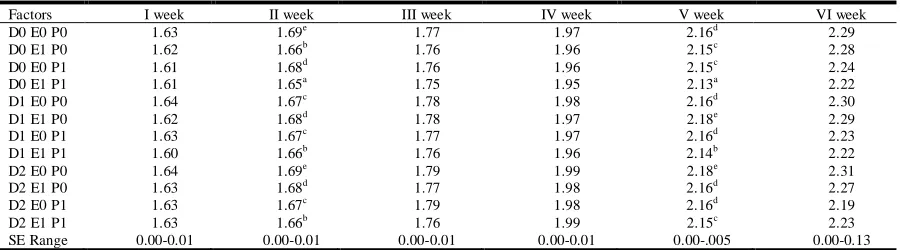
The data obtained on feed efficiency in pooled sex chicks from first week to sixth week of age are given in table 4. The data obtained in the study revealed significant (P<0.05) difference in the results of feed efficiency while feeding of chicks with various combinations of DPE, enzyme and probiotics at second and fifth week of age whereas, non significant difference observed in other age groups. The highest feed efficiency values were observed in the chicks fed on the diet containing 10 percent DPE without addition of enzyme and probiotics in whole of the study period. The lowest feed efficiency value of the pooled sex chicks observed on feeding of diet with enzyme and probiotics at second to fifth week of age while it was lowest at first week on feeding of diet containing 5 percent DPE, enzyme and probiotics and at sixth week on 10 percent DPE and probiotics only. The feed efficiency value is just inversely proportional to the feed required per head and its conversion into body weight. Means if feed efficiency value is higher the feed intake per chick will be higher.
The overall study revealed better feed efficiency of the ration containing 10 percent DPE without enzyme and probiotics and poor feed efficiency in the diet containing enzyme and probiotics without DPE. On overall feed efficiency basis, it indicated that the broilers fed on diet containing 10 per cent DPE required more feed than the control as well as 5 per cent DPE. Results also indicated that addition of enzyme and probiotics into the diet of chicks helped in conversion of diet into the body weight and other body characteristics efficiently.
The similar results have also been published by Jadhav et al.
Table 1: Means of weekly body weights of Male chicks obtained after inclusion of various combinations of DPE, enzyme and probiotic in diet
Factors Dayold I week II week IIIweek IVweek V week VI week
D0 E0 P0 42.78 106.82 265.71 370.21 641.05 932.31 1068.22
D0 E1 P0 38.37 103.64 262.16 386.22 649.01 965.55 1241.77
D0 E0 P1 42.53 104.74 267.05 383.16 674.31 990.01 1049.27
D0 E1 P1 43.02 105.84 273.16 393.92 669.16 988.77 1211.22
D1 E0 P0 43.02 105.11 267.05 377.05 669.16 943.55 1020.55
D1 E1 P0 43.51 104.62 266.44 378.27 699.72 913.24 1214.27
D1 E0 P1 41.92 107.31 279.52 274.38 660.01 971.66 1069.44
D1 E1 P1 43.26 107.06 282.08 389.88 730.27 1078.61 1306.55
D2 E0 P0 41.81 106.33 252.38 359.33 690.55 956.38 1109.16
D2 E1 P0 44.24 107.92 248.72 357.51 711.94 1035.83 1202.05
D2 E0 P1 41.92 105.72 254.83 377.66 684.44 968.61 1126.88
D2 E1 P1 43.75 109.02 267.66 400.27 709.51 1067.01 1220.38
SERange 0.43-0.76 0.54-0.79 5.12-5.80 4.72-4.95 6.09-6.90 5.86-7.60 9.10-10.1
Table 2: Means of weekly body weights of female chicks obtained after inclusion of various combinations of DPE, enzyme and probiotic in diet
Factors Day-old I week II week III week IV week V week VI week
D0 E0 P0 44.85 101.07 194.94 310.44 594.01 845.16 935.61
D0 E1 P0 41.92 100.95 195.18 315.57 588.89 886.11 1072.51
D0 E0 P1 40.82 99.24 212.31 328.77 592.77 901.02 958.84
D0 E1 P1 43.63 99.01 207.16 332.44 620.27 925.83 1097.55
D1 E0 P0 43.26 100.22 198.61 308.61 589.72 897.72 916.66
D1 E1 P0 44.24 100.34 221.34 326.08 632.51 965.55 1114.66
D1 E0 P1 43.02 100.22 227.33 322.05 592.77 881.22 966.77
D1 E1 P1 43.75 101.56 232.11 337.94 675.27 972.27 1171.51
D2 E0 P0 42.77 101.32 199.22 297.01 589.72 858.61 977.77
D2 E1 P0 43.26 101.93 201.69 309.22 650.83 976.55 1124.44
D2 E0 P1 42.53 102.91 198.61 329.38 623.33 864.72 1001.01
D2 E1 P1 43.51 102.05 210.83 334.88 656.94 971.66 1123.22
SE Range 0.42-0.73 0.47-0.70 4.92-5.50 5.0-5.9 4.36-5.15 8.14-8.95 7.50-8.25
Table 3: Means of weekly body weights of combined sex chicks obtained after inclusion of various combinations of DPE, enzyme and probiotic in diet
Factors Day old I week II week III week IV week Vweek VIweek
D0 E0 P0 43.81 103.95 230.32 340.32 617.53 879.38 1001.91
D0 E1 P0 40.15 102.31 223.17 350.91 619.06 925.83 1157.13
D0 E0 P1 41.67 101.99 239.67 355.97 633.61 945.51 1004.05
D0 E1 P1 43.32 102.42 240.16 363.18 644.72 957.30 1154.38
D1 E0 P0 43.14 102.66 232.83 342.83 629.44 920.63 968.61
D1 E1 P0 43.87 102.48 243.89 352.18 687.51 1003.75 1164.47
D1 E0 P1 42.47 103.76 254.52 353.22 626.38 926.44 1018.11
D1 E1 P1 43.51 104.31 255.99 363.91 702.78 1025.44 1237.92
D2 E0 P0 42.28 103.82 225.80 328.16 640.13 907.51 1043.47
D2 E1 P0 43.75 104.92 225.19 333.36 681.38 1006.19 1163.25
D2 E0 P1 42.22 104.31 226.72 353.52 653.88 916.66 1063.94
D2 E1 P1 43.63 105.53 239.25 367.58 683.22 1019.33 1171.80
SE Range 0.45-0.50 0.5-0.6 2.9-3.3 3.0-3.9 4.5-4.6 5.2-5.9 6.6-7.3
Table 4: Means of overall feed efficiency in pooled sex chicks obtained after inclusion of various combinations of DPE, enzyme and probiotic in diet
Factors I week II week III week IV week V week VI week
D0 E0 P0 1.63 1.69e 1.77 1.97 2.16d 2.29
D0 E1 P0 1.62 1.66b 1.76 1.96 2.15c 2.28
D0 E0 P1 1.61 1.68d 1.76 1.96 2.15c 2.24
D0 E1 P1 1.61 1.65a 1.75 1.95 2.13a 2.22
D1 E0 P0 1.64 1.67c
1.78 1.98 2.16d
2.30
D1 E1 P0 1.62 1.68d
1.78 1.97 2.18e
2.29
D1 E0 P1 1.63 1.67c
1.77 1.97 2.16d
2.23
D1 E1 P1 1.60 1.66b
1.76 1.96 2.14b
2.22
D2 E0 P0 1.64 1.69e 1.79 1.99 2.18e 2.31
D2 E1 P0 1.63 1.68d
1.77 1.98 2.16d
2.27
D2 E0 P1 1.63 1.67c
1.79 1.98 2.16d
2.19
D2 E1 P1 1.63 1.66b 1.76 1.99 2.15c 2.23
SE Range 0.00-0.01 0.00-0.01 0.00-0.01 0.00-0.01 0.00-.005 0.00-0.13
Conclusion
In present study, effect of DPE, enzyme and probiotics were assessed on the performance of broilers. The overall effect of these ingredients individually as well in combinations showed no significant effect during whole of the study period on body weight in male, female as well as in combined sexes. The 5 percent level of DPE alongwith enzyme and probiotic supplementation in the diet of chicks provided better body weight during whole of the study period. However, feed efficiency of broilers was significantly (P<0.05) influenced on week second and fifth and non significantly on other week days by the inclusion of enzyme and probiotics in the diet of
broilers.
REFRENCES
AOAC, 1984. Official methods of analysis. 14th Edn.,
Association of Official Analytical Chemists, Washington, D.C.
Chesson, A., 1987. Supplementary Enzymes to Improve the Utilization of Pigs and Poultry Diets. In: Recent Advances in Animal Nutrition,. Haresign, W. and D.J.A.
Cole (Eds.). Butterworths,. London, ISBN:
10-0407011633,. pp: 71-89.
Cunningham, F.E. and G.A. Lillich, 1976. Influence of feeding dehydrated poultry waste on broiler growth, and meat flavour and composition. Poult. Sci. 54 : 860-875. Dhande, V.U., R.J. Kukde, R.M. Lende and D.B. Sarode,
1993. Effect of Giprobiotic on performance of broilers. Poult. Guide 30: 39-41.
El-Deek, A.A., M. Al-Harthi and H.M. Yakout, 2008. Use of enzymes to supplement diets containing date waste meal for lohmann white layers. Int. J. Poult. Sci. 7 (4): 397-407.
Fuller,R., 1989. Probiotics in man and animals. A review. J. Appl. Bacteriol., 66:365-378.
Jadhav, S.B., B.H. Ramteke and R.J. Kukde, 1994. Effect of inclusion of dried poultry dropping in diet on performance of broilers. Poultry Advisor 27 (2): 21-25.
Jain, G.L. 2001. Breeding a broiler for the Indian market. Poultry Voice of India. 7: 9-15.
Khan, A. G., 1993. Value of poultry manure as fertilizer and livestock feed. Poult. Punch, 9: 41-44.
Mishra, S. C., 2000. Brioler breeder management strategies. . Proceedings of 20th Annual Conference and Symposium of Indian Poultry Science Association Congress,. Oct. 12-14,. Tamilnadu Veterinary and Animal Science University, Chennai,. pp. 132.
Nambi, J., P.N. Mbugua and B.N. Mitaru,. 1992. The nutritive evaluation of dried poultry excreta as a feed ingredient for broiler chicken.. Anim. Feed Sci. Technol., 37: 99 -109.
Narahari, D., 1998. Effect of multi-enzyme supplement in broilers performance. Poult. Punch., 14: 28-31.
Netke, S. P., 1990. Enzyme innovations in poultry feed industry. Pashudhan, 8: 12-22.
Ogunmodede, B.K. and A.J. Aninge, 1978. Utilization of dried poultry manure by growing chickens fed on a practical diet. Br. Poult. Sci., 19: 137-141.
Onderci, M., N. Sahin, K. Sahin, G. Cikim, A. Aydin, I. Ozercan and S. Aydin, 2006. Efficacy of Supplementation
of α-Amylase-Producing Bacterial Culture on the
Performance, Nutrient Use and Gut Morphology of Broiler Chickens Fed a Corn-Based Diet. Poult. Sci., 85:505–510.
Sinha, U.K., P.V. Rao, V.R. Sadagopan, and B. Panda, 1977. Utilization and Metabolizable energy content of dried poultry manure in chick starter rations. Indian J. Poult. Sci., 12: 13-17.
Steel, R.G. D. and J.H. Torrie, 1980. Principles and
procedures of statistics: A biometrical approach. 2nd edn.
New York, USA McGraw-Hill Book Co. New York. Pages: 633
Upton, M., 2006. A framework for identifying market and trade impacts of HPAI and its control. Proceedings of the Symposium on The Market and Trade Dimensions of Avian Influenza, November 14, 2006, FAO, Rome, Italy, pp: 1-23.