Mill er, P a ul K., B a r g h , M elis s a , R el p h , N i c ol a a n d G ri m w o o d ,
To m ( 2 0 1 3 ) L e a d e r s hi p d e v el o p m e n t p r o g r a m m e : a m u l
ti-m e t h o d e v al u a tio n . C u ti-m b r i a P a r t n e r s h i p N H S F o u n d a ti o n T r u s t .
Do w n l o a d e d fr o m : h t t p ://i n si g h t . c u m b r i a . a c . u k /i d/ e p ri n t/ 1 5 3 1 /U s a g e o f a n y i t e m s f r o m t h e U n i v e r s i t y o f C u m b r i a’ s i n s t i t u t i o n a l r e p o s i t o r y ‘I n s i g h t ’ m u s t c o n f o r m t o t h e f o l l o w i n g f a i r u s a g e g u i d e l i n e s .
Any it e m a n d it s a s s o ci a t e d m e t a d a t a h el d i n t h e U niv e r si ty of C u m b r i a ’s in s ti t u ti o n al r e p o si t o r y I n si g h t ( u nl e s s s t a t e d o t h e r wi s e o n t h e m e t a d a t a r e c o r d ) m a y b e c o pi e d , di s pl ay e d o r p e rf o r m e d , a n d s t o r e d i n li n e wi t h t h e JIS C f ai r d e a li n g g ui d eli n e s ( av ail a bl e h e r e) fo r e d u c a t i o n al a n d n o t-fo r-p r ofi t a c tiviti e s
p r o v i d e d t h a t
• t h e a u t h o r s , ti tl e a n d full bi blio g r a p h i c d e t ail s of t h e it e m a r e ci t e d cl e a rly w h e n a n y p a r t
of t h e w o r k is r ef e r r e d t o v e r b a lly o r i n t h e w ri t t e n fo r m
• a h y p e rli n k/ U RL t o t h e o ri gi n al I n si g h t r e c o r d of t h a t it e m is i n cl u d e d i n a n y ci t a ti o n s of t h e w o r k
• t h e c o n t e n t is n o t c h a n g e d i n a n y w a y
• all fil e s r e q ui r e d fo r u s a g e of t h e it e m a r e k e p t t o g e t h e r wi t h t h e m a i n it e m fil e. Yo u m a y n o t
• s ell a n y p a r t of a n it e m
• r e f e r t o a n y p a r t of a n it e m wi t h o u t ci t a ti o n
• a m e n d a n y it e m o r c o n t e x t u ali s e it i n a w a y t h a t will i m p u g n t h e c r e a t o r ’s r e p u t a t i o n
• r e m ov e o r a l t e r t h e c o py ri g h t s t a t e m e n t o n a n it e m . T h e full p oli cy c a n b e fo u n d h e r e.
LEADERSHIP
DEVELOPMENT
A MULTI-METHOD EVALUATION
Paul K. Miller
Melissa Bargh
Nicola S. Relph
ii | P a g e
Executive Summary
Background
This report investigates findings arising from a variety of forms of feedback provided by the first cohort of participants (2012-2013) in Cumbria Partnership Foundation Trust’s “Leadership Development” Programme (LDP).
Feedback reflects, throughout, the diversity of the participating cohort in terms of professional roles and levels of seniority.
Methodology
Four different data-forms were collected to provide a multi-dimensional overview of the initiative, which were:
The participants’ evaluations of LDP taught sessions (quantitative and qualitative);
Two tranches of interviews with participants, collected during and after the LDP training (qualitative);
Interviews with the managers of participants after the LDP (qualitative);
An end-point survey of participants in the LDP (quantitative).
Findings I: Session Evaluations
A total of N=112 session evaluation forms were analysed.
The mean satisfaction score allocated by participants in the LDP across all days and all criteria was a very strong 88.76%.
LDP Days 2 (“Leadership and the Organisation”), 4 (“Leadership Analysis Styles”), 5 (“Influence and Power”) and 7 (“Leadership in Practice”) were overwhelmingly well-received in all
iii | P a g e
Participants rated all days of the LDP at above 90% in terms of being informative, except Day 3 (“Service Improvement and Project Management”), which was rated at 83.53%, and Day 6 (“Inspiring and Enabling Others”) which was rated at 66.25%.
Participants rated all days of the LDP at above 90% in terms of being relevant, except Day 3 (77.65%) and Day 6 (71.25%).
Participants rated all days of the LDP at above 89% in terms of facilitation quality, except Day 6 (65%).
Participants rated all days of the LDP at above 90% in terms of being the trainers’ knowledge and skills, except Day 3 (85.88%) and Day 6 (71.25%).
Participants rated all days of the LDP at above 80% in terms of the quality of the learning environment, except Day 1 (Introduction) which scored 63.16%.
Participants identified a range of key success themes relating to the LDP, not least the quality of teaching and facilitation, the senses of community, optimism and confidence that were
generated from involvement, and the support provided for projects.
The modules on all days except Day 6 were seen as very well pitched in terms of level, and very practically relevant.
Day 6 was seen to be either of limited relevance or too familiar, and the materials on mentorship under-pitched in terms of level, and not really “deserving” of a full day.
Some participants found the environment too hot, too dark or too noisy at times.
Action Learning Sets were singled out for consistent praise as a space for sharing experience and moving forward.
MBTI and transactional analysis were recurrently cited as the most valuable taught components.
Interactions with higher Trust management were seen as powerful tools for community and awareness building.
Findings II: Participant Interviews
Two tranches of interviews were conducted, one early in the LDP, the other after the main LDP training had concluded.
iv | P a g e
In terms of early impacts of the LDP training, participants reported outcomes in two areas: (a) project execution (e.g. upskilling in communication, time-management, resource management, confidence and networking) and (b) workplaces (e.g. team harmony, confidence, motivation and self-organisation).
The second tranche of interviews (N=5participants) yielded four global themes: project structures, project impact mechanics, obstacles/solutions and LDP training impacts.
Participants outlined multiple areas in which the change projects had already made definable impacts:
o Stronger communities and better communication, and the corollary benefits for staff wellbeing-at-work;
o Service-delivery, and service-user experience;
o Community engagement, itself influencing styles of patient care and development of team-level initiatives;
o The provision of education and training to staff;
o Formal research being put at the centre of team decision-making and planning procedures;
o Changes in the manner in which the Trust itself looked at staff training within the corporate systems.
The final global theme addressed by participants related to the direct impacts of the LDP training on (a) the workplace, (b) the projects and (c) the participants’ own professional selves.
In the workplace, participants reported a range of important changes arising from the training, underpinning a range of which was bolstered confidence. For example, greater confidence to represent the team externally and stronger team ethos bolstered by more confident leadership.
The direct use of the MBTI within the workplace was reported.
Much stronger internal support mechanisms were reported to be evolving.
Greater sensitivity in management/leadership was reported.
Better understanding of characters - and their place in the broader organisational structure - was reported to have been facilitated by the training, which in turn facilitated much greater capacity to carefully support others in the workplace.
Both the skills and opportunities to network and draw upon the skills of others (including mentors) were deemed to be central to the success of projects.
v | P a g e
As an upshot of reflection skills, or independently, time management and general adaptability were reported to have been essential impacts of the training on the execution of the projects.
The reported impacts on professional selves were either skill-oriented or personal (i.e. disposition-oriented).
Time/resource management, communication, networking and personality management were all seen to have permeated a much broader working self.
Confidence to interact, to diversify, to lead and to step-back and reflect were all identified.
Improvements in assertiveness and interpersonal sensitivity were reported.
Participants discussed the broad-spectrum adoption of a more reflective, self-aware and adaptable approach to all manner of professional tasks and situations.
Findings III: Management interviews
Analysis of N=4 interviews with the managers of participants in the Leadership Development programme yielded four major themes: (a) LDP programme expectations, (b) LDP change project impacts, (c) LDP training impacts, and (d) LDP novelties and functions.
Managers voiced expectations that the LDP would positively impact upon participants in terms of disposition (e.g. making them more businesslike and/or analytic), in terms of workplace skills (e.g. improving abilities to communicate, network and be flexible) and structural knowledge (i.e. improve their understandings of CPFT and the broader NHS).
Managers reported a range of extant impacts made by the change projects, at the levels of (a) the individual participants, (b) workplace teams and (c) service delivery.
As a result of their execution of change projects, participants were viewed as having been generally upskilled, more autonomous, better researchers and more content in their roles.
The teams in which the LDP participants worked were reported to have acquired extra staff, received further education and altered methods of service delivery as outcomes of the change projects.
At the level of delivery itself, better patient care, reduced waiting lists and fewer “did not attends” were reported by managers.
vi | P a g e
Participants were reported to be (a) more confident, calm and open as colleagues, to have (b) improved communication, networking, teamwork, conflict-management, time/resource
management and IT skills, and (c) to have acquired and disseminated stronger information about CPFT itself.
Key aspects of the LDP that managers identified as making the programme different to its forerunners included:
o High support levels for participants, particularly from peer-networks and mentors;
o A strong focus on team leadership within the broader organisation;
o The raw practicality of the programme;
o The range of staff involved, and;
o The Cumbria-specific tailoring of the materials.
Manager expected that LDP participants, given the skills they had acquired through the LDP, would be optimally suited to being “delegation hubs” within teams, and change-leaders.
Findings IV: Participant survey
The end-point survey attracted a response-rate of 53%.
Participants rated the impact of the LDP on their knowledge of CPFT itself very highly, with particularly high ratings for improved understandings of the services with the Trust, and its organisational vision.
Participants also highly rated the impacts of the LDP upon their own confidence, assertiveness and decisiveness at work. Optimism and enthusiasm were also raised during the course of the programme.
Workplace-based interpersonal skills were also shown to have improved considerably across the course of the LDP, with participants rating their communication and listening skills as being the most improved.
Participants further rated their managerial skills as having improved during the LDP, with resource and time management the most improved.
vii | P a g e
Of these impacts, the most common beneficiaries were identified as colleagues (31%) and managers (26%), and the most common forms of impact cited were better use of resources (25%), quality of service improvements (22%) and better workplace harmony (21%).
100% of participants maintained that direct changes had already been made in their workplaces as an output of the LDP change project.
Of these impacts, the most common beneficiaries were identified as colleagues (31%), managers (25%) and service users, and the most common forms of impact cited were better use of
resources (25%), improved channels of communication (22%) and quality of service improvements (29%).
Conclusions
Without doubt, CPFT’s Leadership Development Programme has been a noteworthy success. Not only was there enormous participants satisfaction with the training and change projects themselves, but all core impact expectations have been demonstrably met and a range of additional (and possibly unexpected) benefits arose, which are recorded throughout this document.
The conclusion explores the following core cross-cutting issues: (a) networks, (b) support, mentorship and teamwork, (c) confidence and communication, (d) services, time and resources and (e) research and reflection.
viii | P a g e
Acknowledgement
ix | P a g e
Contents
Executive Summary ... ii
Acknowledgement ... viii
Contents ... ix
List of Figures ...xiv
List of Tables ...xvi
1. Introduction ... 1
1.1. The programme ... 1
1.2. The change projects ... 2
1.3. Report structure ... 3
2. Methodology ... 4
2.1. Session evaluations ... 4
2.1.1. Participants & procedure ... 4
2.1.2. Design ... 5
2.1.3. Data analysis ... 6
2.2. Participant interviews ... 7
2.2.1. Participants ... 7
2.2.2. Design ... 7
x | P a g e
2.3. Management interviews ... 10
2.3.1. Participants ... 10
2.3.2. Design ... 10
2.3.3. Analysis ... 11
2.4. Participant End-Point Survey ... 11
2.3.1. Participants ... 11
2.4.2. Survey Design ... 12
2.4.3. Survey Procedure ... 13
2.4.3. Survey Data Analysis ... 13
3. Findings I: Session Evaluations ... 14
3.1. Quantitative Findings: modular analysis ... 14
3.2. Quantitative findings: cross-modular analysis ... 18
3.3. Qualitative findings: modular analysis ... 21
3.3.1. Introductory Day ... 21
3.3.2. Module 1. ... 23
3.3.3. Module 2 ... 24
3.3.4. Module 3 ... 26
3.4. Qualitative findings: core themes ... 27
3.5. Session Feedback: Overall Summary ... 28
xi | P a g e
4.1. Tranche 1 ... 30
4.1.1. Tranche 1, theme 1: project structures ... 31
4.1.2. Tranche 1, theme 2: project impact mechanics ... 32
4.1.3. Tranche 1, theme 3: training impacts ... 34
4.2. Tranche 2 ... 37
4.2.1. Tranche 2, theme 1: project structures ... 38
4.2.2. Tranche 2, theme 2: change project impacts ... 39
4.2.3. Tranche 2, theme 3: obstacles/solutions ... 41
4.2.3. Tranche 2, theme 4: training impacts ... 43
4.3. Summary ... 48
5. Findings III: Managerial Interviews ... 51
5.1. Theme 1 - LDP expectations ... 51
5.2. Theme 2 - LDP change project impacts ... 53
5.3. Theme 3 - LDP training impacts ... 55
5.4. Theme 4 - LDP novelties and functions ... 57
5.5. Summary of managerial feedback ... 59
6. Findings IV: Participant End-Point Survey ... 61
6.1. Participant Demographics ... 61
6.2. Personal Impacts ... 62
xii | P a g e
6.4. Project Impacts ... 69
6.5. Survey Summary ... 71
7. Impact Analysis ... 73
7.1. Session feedback ... 73
7.2. Participant interviews ... 73
7.3. Managerial feedback ... 75
7.4. Survey findings ... 75
7.5. Impact synthesis ... 76
8. Conclusions ... 78
8.1. Networks ... 78
8.2 Support, mentorship and teamwork ... 79
8.3. Confidence and communication ... 79
8.4. Services, time and resources ... 80
8.5. Research and reflection ... 80
8.6. Final impact statement ... 81
References ... 82
Author Details ... 83
Dr. Paul K. Miller ... 83
Melissa Bargh, MSc. ... 83
xiii | P a g e
Dr. Tom Grimwood ... 84
Appendix 1: LDP Session-by-Session Content Descriptor ... 85
Appendix 2: Daily Evaluation Form ... 104
Appendix 3: Participant Interview Schedule A ... 105
Appendix 4: Participant Interview Schedule B ... 109
Appendix 5: Management Interview Schedule ... 115
xiv | P a g e
List of Figures
Figure 1: Informativeness of LDP materials, by day... 14
Figure 2: Relevance of LDP material, by day ... 15
Figure 3: Clarity of LDP objectives, by day ... 16
Figure 4: Quality of LDP facilitation, by day ... 16
Figure 5: LDP trainers' knowledge and skills ... 17
Figure 6: Quality of LDP learning environment... 18
Figure 7: Overall participant approval for LDP sessions, by day ... 19
Figure 8: Overall LDP approval ratings, by-criterion-by-day ... 20
Figure 9: Introductory day, thematic analysis of qualitative feedback ... 22
Figure 10: Module 1, Thematic Analysis of Qualitative Feedback ... 23
Figure 11: Module 2, thematic analysis of qualitative feedback ... 25
Figure 12: Module 3, thematic analysis of qualitative feedback ... 26
Figure 13: Qualitative Synthesis ... 28
Figure 14: Tranche 1 - project structures... 31
Figure 15: Tranche 1 - project impact mechanics ... 33
Figure 16: Tranche 1 - training Impacts ... 35
Figure 17: Tranche 2 – change project structures ... 38
xv | P a g e
Figure 19: LDP training impacts on workplace and project ... 43
Figure 20: LDP training impacts on professional self ... 46
Figure 21: LDP expectations ... 51
Figure 22: LDP change project impacts ... 53
Figure 23: LDP training impacts ... 55
Figure 24: LDP novelties and functions ... 58
Figure 25: Impacts upon participants’ organisational knowledge ... 63
Figure 26: Impacts upon participants’ working dispositions ... 64
Figure 27: Impacts upon participants' workplace-based interpersonal skills ... 65
Figure 28: Impacts upon participants' management capacities ... 66
Figure 29: General personal impact summary ... 66
Figure 30: LDP training impacts for personnel... 68
Figure 31: Workplace impacts of LDP training ... 69
Figure 32: LDP project impacts for personnel ... 70
Figure 33: Workplace impacts of LDP project ... 71
xvi | P a g e
List of Tables
Table 1: Evaluations collected... 5
Table 2: Analytic Steps in Grounded Theory ... 9
Table 3: Obstacles and solutions ... 41
Table 4: Core population description ... 61
Table 5: Professional role breakdown ... 62
Table 6: Workplace changes made as output of LDP training ... 67
Table 7: Workplace impacts arising from LDP training ... 68
Table 8: Workplace changes made as output of change project ... 69
1 | P a g e
1. Introduction
This report investigates findings arising from a variety of forms of feedback provided by the first cohort of participants (2012-2013) in Cumbria Partnership Foundation Trust’s “Leadership
Development” Programme (LDP). The report summarises both quantitative and qualitative feedback, and synthesises findings to provide a more three-dimensional overview of participant experience and systemic impact. Feedback reflects, throughout, the diversity of the participating cohort in terms of professional roles and levels of seniority.
1.1. The programme
The LDP was developed “…to offer staff theoretical, evidence based insight into leadership
behaviours and practical approaches that will enable [them] to lead change in [their] service area.” (Cumbria PFT, 2012, p.3), with the stated aim of supporting and developing “…personal and professional effectiveness and resilience in managing and leading the challenges faced within a dynamic health care environment.” (Ibid...)
Specifically designed, thus, to provide insight into participants’ leadership styles, and to provide opportunity for participants to develop confidence in management and team-working, the programme comprises three sequentially-ordered two-day modules, plus an introduction day:
Module 1: Understanding Healthcare and Managing the Business for Better Performance
(covering contextual leadership within the CPFT);
Module 2: Knowing and Managing Yourself (providing the opportunity for participant to explore their own leadership styles and stances);
Module 3: Managing People and Resources (exploring how participants might take their team with them, mentorship and coaching and sustainability in practice). (Cumbria PFT, 2012, p.3)
2 | P a g e
Explore the challenges of leading in a complex health care environment;
Understand and share the vision and values of the organisation;
Explore and understand their leadership style and influence on their team and colleagues;
Understand approaches to building commitment and developing collaborative teams;
Identify and develop strategies for improving individual and team performance;
Gain an insight into the human aspects of change and how to get the best from themselves and their teams for effective performance and integration. (Cumbria PFT, 2012, pp.3-4)
And, consequently, the intended outcomes for participants are stated as:
To develop leadership capability and competence within a complex environment;
To develop personal resilience for delivering effective change with positive results;
To identify the most effective strategies to sustain self as a leader;
To develop skills in leading and managing change using evidence based improvement methodologies;
To lead and evaluate a change project linked to the service objectives in their workplace. (Cumbria PFT, 2012, p.4)
1.2. The change projects
The LDP was designed to provide participants with the tools, techniques and strategies to apply learning practically and sustainably in the workplace. This learning was experienced by participants through the undertaking of a series of “change projects.” As part of the programme, each
participant developed and delivered one of these change projects with the support and direction of their Locality General Manager/Service Head. This project could be undertaken as a collective team or individual, and the criteria for the change project included:
It must be completed within the 6 month duration of this programme;
3 | P a g e
It must link with service priorities;
It must demonstrate the benefits for service users. (Cumbria PFT, 2012, p.4)
1.3. Report structure
The remainder of this report is organised around the following structure:
In the Methodology, the sample, data collection and analytic procedures are outlined.
In Findings I, qualitative and quantitative session feedback are analysed.
In Findings II, interview data with LDP participants are explored.
In Findings III, interview data with the managers of LDP participants are explored.
In Findings IV, the findings from an end-point survey of LDP participants are analysed.
In the Impact Analysis, core impact-oriented themes are summarised and synthesised.
In the Conclusions, a discussion of key cross-cutting themes is advanced.
Appendix 1: LDP Session-by-Session Content Descriptor.
Appendix 2: Daily Evaluation Form.
Appendix 3: Participant Interview Schedule A - Early stages.
Appendix 4: Participant Interview Schedule B - Follow-up.
Appendix 5: Management Interview Schedule.
4 | P a g e
2. Methodology
The evaluation incorporated five different modes of data collection. These were:
1. Participant evaluation of LDP taught sessions;
2. Two tranches of semi-structured interviews with participants chiefly addressing the change projects, one early in the programme and a second after its conclusion;
3. One tranche of semi-structured interviews with the managers of participants, post-LDP, to explore the impacts of training and projects from a third-party perspective;
4. Reflective accounts from the staff who delivered the LDP; 5. A final participant survey.
The overall design was organised such that each form of data would complement the final impact assessment. This is to say that early evaluation feedback informed the participant interview design, while evaluation feedback and participant interview data informed the management interview design and so forth. The final participant survey, meanwhile, utilised all prior findings in developing a simple (but telling) impact metric around categories inducted from participant, managerial and LDP staff feedback itself, rather than supposition or abstract expectation.
2.1. Session evaluations
Evaluation of participant response to taught sessions took a mixed-analytic approach to the data collected, utilising a descriptive statistical approach combined with a qualitative-thematic dimension.
2.1.1. Participants & procedure
5 | P a g e
Table 1: Evaluations collected
2.1.2. Design
The evaluation form (included in Appendix 2) was organised to generate two key forms of feedback data. The quantitative aspect utilised six standard Likert scales requesting the following information:
1. Did you find the sessions informative? (Not at all) 1 2 3 4 5 (Definitely)
2. Did you find the course materials relevant? (Not at all) 1 2 3 4 5 (Definitely)
3. Do you feel clear on the programme session objectives? (Poor) 1 2 3 4 5 (Excellent)
4. The quality of facilitation and general manner when dealing with the group was… (Poor) 1 2 3 4 5 (Excellent)
6 | P a g e
6. Did you find the training environment suitable and conducive to learning? (Not at all) 1 2 3 4 5 (Definitely)
The second availed participants of an opportunity to provide more detailed qualitative data in line with the following requests:
7. How relevant do you feel that this training has been in relation to your current job role?
8. Do you feel that the level of the content was appropriate, if not what would you suggest?
9. Can you identify at least one thing that you will take away from this day? (You can include more than one if you wish to)
10. Is there anything else that you would have liked to have seen included in the day?
Finally, space was provided for participants to provide any additional information they saw as relevant.
2.1.3. Data analysis
Likert scale data were analysed descriptively by question, by day-of-collection and by module, and then comparatively to explore differences between feedback on different days and different Modules. A Straussian Grounded Theory approach (Strauss & Corbin, 1998) was used to investigate qualitative contributions, in which responses were initially free-coded, and then grouped into sub-themes and meta-sub-themes. Finally, these meta-sub-themes were collected into common evaluative categories. “Additional information” on evaluations was incorporated into extant categories where appropriate.
7 | P a g e
frequency of occurrence. From a Straussian point of view, every issue has potential ramifications and it would be myopic to dismiss an innovative idea or suggestion because it is less statistically
significant. Indeed, innovation itself is often defined by the fact that it is not widely posited.
2.2. Participant interviews
Semi-structured interviews with a sample of participants in the LDP were conducted in two tranches.
2.2.1. Participants
The first set (N=5 participants) took place at an early stage, around a third of the way into the taught programme. The second (N=5 participants) took place shortly after the end of the programme, enabling these participants time to reflect upon the impacts of the training and their change projects. Participants were purposively sampled (see Silverman, 2010) to provide a strong cross-section of the different roles and grades in the wider base of participants.
2.2.2. Design
Semi-structured (or ‘focused’) interviews are organised around a series of central broad and open questions, with subsidiary topical ‘prompts’, rather than a rigid set of pre-defined inquiries.
‘...the interviewer asks major questions the same way each time, but is free to alter their sequence and probe for more information. The interviewer can thus adapt the research instrument... [to] handle the fact that in responding to a question, people often also provide answers to questions [they] were going to ask later.’ (Fielding & Thomas, 2008, pp.246-247)
The core strengths of this technique in qualitative research are three fold:
8 | P a g e
2. The respondent is also given the discursive space to voice ideas and thoughts that might not have been strictly specified within the exact question; i.e. there is room for new and
potentially novel themes to arise.
3. The respondent can connect topics and concepts in their own way, providing a sense of how they themselves understand the ‘bigger picture’, rather than being beholden to a structure that demands they (a) may have to repeat things they have already said, and/or (b) may have to answer questions in a sequence that does not seem logical to them – both of which can often ‘frustrate and annoy’ respondents (Suchman & Jordan, 1990).
In both tranches of this evaluation, semi-structured questioning thus focused around the following central issues:
1. The reasons for choosing a particular project; 2. The expected/experienced impacts of the projects; 3. The mechanisms through which impacts are made; 4. Obstacles to impact;
5. Means for surmounting obstacles;
6. The relationship between the LDP training and project;
7. The impacts of the LDP training on personal and professional development.
The two full interview schedules can be found in Appendices 3 and 4. Each interview was anticipated to take between 20 and 30 minutes in total, though some were longer and some shorter contingent on the level of detail the respondent provided. Sound files from all interviews were transcribed verbatim, but are presented in this report with necessary deletions for clarity of reading wherever practically possible. These deletions are:
1. ‘Minimal continuers’ (Hutchby & Wooffitt, 1998), such as ‘uhm’, ‘erm’ and ‘err’. 2. Word repetitions and stutters.
3. Aborted or reformulated sentence starts.
9 | P a g e
All data were transcribed and prepared for analysis by mid-August 2013; data analysis then proceeded as outlined in section 2.2.3 (below).
2.2.3. Analysis
Data were explored for patterns and themes using many of the general principles of Grounded Theory (Glaser & Strauss, 1967), and within Scientific Software’s ATLAS.Ti (v. 6.1) qualitative analysis package. Grounded Theory, in its simplest terms, is:
‘...the discovery of theory from data systematically obtained from social research.’ (Glaser & Strauss, 1967, p. 2).
This analytic stance, thus, represents the endeavour to generate robust and defensible, practice-oriented findings from rigorous qualitative analysis of a single data-set. Evaluative strategy herein involves two central analytic steps geared towards ongoing category-refinement, as displayed in Table 2:
10 | P a g e
With respect to step 1, within the data corpus collected the themes identified closely mirror those outlined as priority issues in Section 1, due to the manner in which interview schedules were specified. This phase of analysis is illustrated and evidenced in Section 4.1 and 4.2. Outcomes of the second stages of analysis, aimed at finding core patterns and tendencies in the full corpus of collected data, are detailed in Section 4.3.
It is imperative to note at this point that, since the participants in interview tranches 1 and 2 are not necessarily the same people, no participant “numbers” are allocated in this section. This offers maximum protection to participant anonymity and, moreover, and methodologically-speaking, since this analysis is thematic rather than narrative, longitudinally-consistent individual case studies are not necessary to effectively elucidate the important issues arising (Silverman, 2010).
2.3. Management interviews
Semi-structured interviews with a sample of the managers of participants in the LDP were conducted three months subsequent to the end of the programme itself.
2.3.1. Participants
A total of N=4 managers were purposively sampled to maximise variety, and interviewed about their own experiences regarding the relevant LDP participant.
2.3.2. Design
Semi-structured questioning focused around the following central issues:
1. Their initial hopes and expectations for the personal development of the participant in the LDP as an outcome of their participation;
11 | P a g e
3. The impacts that the project has made to date (if any);
4. The impacts that the LDP has had on the participant’s own personal and professional development (if any);
5. Their own views on the differences between the LDP and prior initiatives of that ilk;
6. How they envisage using the knowledge and skills gained within their team/service/locality (if any)?
The full interview schedule for the management interviews can be found in Appendix 5. Each
interview was anticipated to take between 15 and 20 minutes in total, though some were longer and some shorter contingent on the level of detail the respondent provided. All data were transcribed and prepared for analysis by mid-August 2013.
2.3.3. Analysis
Data were again explored for patterns and themes using many of the general principles of Grounded Theory (Glaser & Strauss, 1967), and within Scientific Software’s ATLAS.Ti qualitative analysis
package.
2.4. Participant End-Point Survey
In order to establish a broad metric for measurement of the personal and institutional impacts of the LDP and the embedded change project, an online end-point survey was generated using the Bristol Online Surveys system (henceforth BOS), grounded in prior findings from the evaluation.
2.3.1. Participants
All participants in the LDP were invited to complete the survey via email link to the site, with relevant assurances of personal anonymity rendered explicit throughout. A response rate of 53%
12 | P a g e
2.4.2. Survey Design
The survey1 was designed to account for three key issues:
1. The specific information required by CPFT itself. 2. The need to measure LDP-related change.
3. The core methodological imperatives outlined in prior survey work on management and leadership, most notably those arising from the established Multifactorial Leadership Questionnaire (see Bass & Riggio, 2006).
As such, an inventory of 33 questions was employed to explore the following major themes:
Participants’ demographic details and role outlines.
Participants’ self-evaluations of the LDP’s impact on their organisational knowledge.
Participants’ self-evaluations of the LDP’s impact on their core workplace skills and aptitudes.
o e.g. confidence, communication, negotiation skills, conflict resolution, resource management etc.
Participants’ self-evaluations of workplace changes that they have brought about as a result of the LDP training.
Participants’ self-evaluations of workplace changes that they have brought about as a result of the LDP change project.
The 19 personally-evaluative questions were measured using five-point Likert scales (De Vaus, 2002) on which to rate the valence and scale of changes. Typically:
13 | P a g e
Please self-rate as a leader/manager in terms of the attributes below, as a result of talking part in the LDP training:
9. Confidence as a leader/manager.
A. Much worse
B. Worse
C. Unchanged
D. Better
E. Much better
2.4.3. Survey Procedure
The survey was designed in draft form, evaluated by an experienced statistician for consistency and also by partners at CPFT for institutional practicality. Adaptations were made and the survey was then inputted to BOS, and rendered live following the end of LDP’s taught period.
2.4.3. Survey Data Analysis
14 | P a g e
3. Findings I: Session Evaluations
As previously noted, evaluation of participant response to taught sessions takes a mixed-analytic approach to the data collected, utilising a descriptive statistical approach combined with a
qualitative-thematic dimension. In this chapter of the evaluation, the quantitative findings are firstly explored, and then the qualitative. Finally, a set of core principles is synthesised from the full corpus of data.
3.1. Quantitative Findings: modular analysis
In this section, participant ratings of content and conditions are explored by day, and are examined in terms of session content.
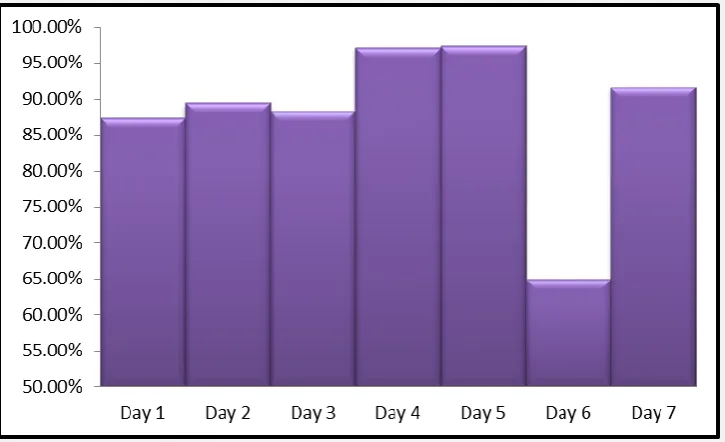
In Figure 1, it is clear that days 1, 2, 4, 5 and 7 were seen by participants as highly
informative, with all achieving an overall approval rating of 90% or above, with days 4 (“Leadership Analysis Styles”) and 5 (“Influence and Power”) both receiving ratings of 97%+.
15 | P a g e
Day 3 (“Service Improvement and Project Management”), and Day 6 (“Inspiring and Enabling
Others”), were ranked less favourably by participants. The former only represented a marginal dip in approval (83.53%), but the latter (with 66.25% approval) was demonstrably less well received.
In terms of the relevance of materials (Figure 2), a similar pattern is visible. Days 1, 2, 4, 5 and 7 were scored at 90% approval or higher by participants – indeed, days 4 and 5 were again scored at over 95% - while days 3 and 6 were scored some way lower, in the 70%-80% range.
Figure 2: Relevance of LDP material, by day
With respect to clarity of objectives, Days 4, 5 and 7 scored well in excess of 90% approval, with days 1, 2 and 3 all in the high 80% range. As such, the previously lower scores for Day 3 were not
replicated in objective clarity. Day 6, however, sustained a (relatively) low approval at 65%, over 20% lower than the lowest of the other six days.
16 | P a g e
Figure 3: Clarity of LDP objectives, by day
In Figure 4, the same broad pattern re-emerges as is evident in Figure 3. Days 4, 5, and 7 are rated exceptionally highly (95%+) for quality of facilitation, and days 1-3 in the region of 90%, while day 6 is rated by participants around 25% lower on approval.
17 | P a g e
The ratings for the trainers’ knowledge and skills (Figure 5) were, again, largely very positive indeed, with Days 1, 2, 4, 5 and 7 all receiving 90%+ approval . Indeed, on Days 2 and 4 highly impressive 100% ratings were achieved in this domain indicating a very strong affinity between trainers and participants during the pertinent sessions. On Day 3, approval dropped slightly to 85.88%, and on Day 6 a substantially lower 71.25% approval was registered.
Figure 5: LDP trainers' knowledge and skills
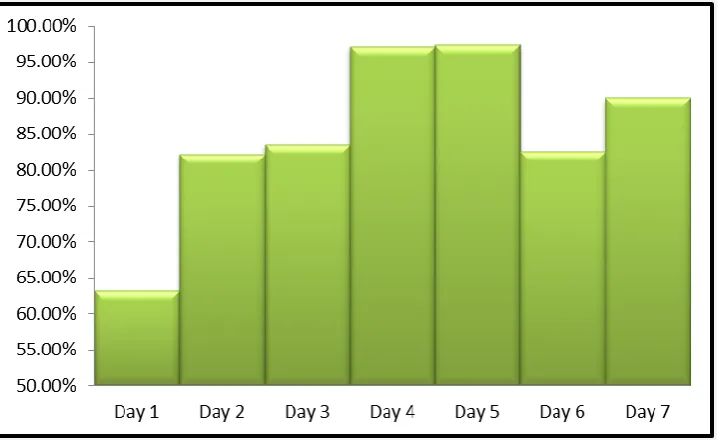
Ratings for the typically eclectic category of “learning environment quality” for each day of the LDP are displayed in Figure 6 (below). As illustrated in more detail in the qualitative session feedback to follow (sections 3.3. and 3.4), participants often show a microscopic sensitivity to apparently mundane aspects of the physical and social environment that are very difficult to anticipate, but which can affect scores quite profoundly. Findings in this domain, thus, show fluctuations that are “out-of-step” with the other evaluative categories used in the feedback collection.
18 | P a g e
80%+. In line with more general patterns in this evaluation feedback, Days 4, 5, and 7 were again most well-received, all scoring at 90% or above.
Figure 6: Quality of LDP learning environment
3.2. Quantitative findings: cross-modular analysis
Taking the daily findings described above, it is possible to make a number of key assertions regarding the body of data collected.
Firstly, the overall mean participant satisfaction rating for the LDP in its entirety (i.e. across all criteria and all days) was a very impressive 88.76%. In Figure 7, the day-by-day mean overall ratings (i.e. the mean of the six evaluative criteria) are displayed. Trends indicate that Day 2, 4, 5 and 7 were the most highly regarded (all receiving mean approval of over 90%). This represents very strong approval for:
The first part of Module 1, addressing leadership and the organisation;
The whole of Module 2, (“Knowing and Managing Yourself”), and;
19 | P a g e
The introductory day was also well-received, scoring over 85% on average, while Day 3 (“Service Improvement and Project Management”) was rated at very marginally less than 85%.
Figure 7: Overall participant approval for LDP sessions, by day
Day 6, “Inspiring and Enabling Others,” is clearly the anomalous statistic here. Although an overall satisfaction rating of 70.21% does not in any way represent a “failure” in absolute terms, it is nonetheless over 18% less than the overall mean for the LDP, when the next lowest-scoring day is only 3% less. As such, in relative terms, the day was substantially less highly-regarded.
20 | P a g e
Day 6, it can be observed, does not have any ‘one’ factor damaging its overall average rating (indeed, a strong showing on learning environment actually raises this score). Rather, the other five criteria are all subject to approval below 75%, which is somewhat out-of-step with all other criteria on all other days (bar the Day 1 environment).
Figure 8: Overall LDP approval ratings, by-criterion-by-day
21 | P a g e
3.3. Qualitative findings: modular analysis
The broad trends described above are illuminated significantly by the findings from the qualitative aspects of the feedback. Herein, four separate thematic analyses of feedback are initially presented:
1. Introductory Day. 2. Module 1 (days 2 and 3). 3. Module 2 (days 4 and 5). 4. Module 3 (days 6 and 7).
A synthesis of all the above feedback is then included in section 3.4. It should be noted that due to the quantity of data involved, the analytic focus herein is chiefly upon emergent themes, and only a limited amount of direct evidence (i.e. quotations) is referenced. It should also be noted that, with respect to all emergent higher-order themes, colour-coding is used within graphical representations to indicate key trends. As such, positive themes are shown in green, negatives in red and neutral descriptive themes in orange.
3.3.1. Introductory Day
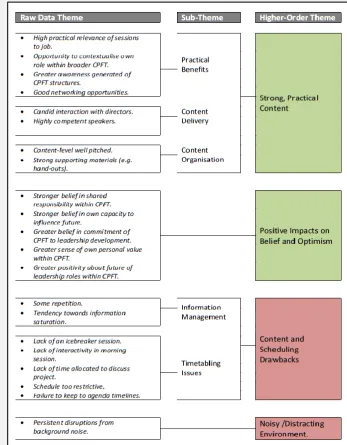
As evidenced in Figure 9, on page 22, a rich range of affirmative themes arose from the qualitative aspect of the evaluation with respect to the Introductory Day.
Unmitigated praise for both content and level of materials was thematically dominant, and the ‘humanising’ of upper management was also identified as a key positive outcome. Perhaps most striking, however, is the group of emergent themes relating to positive impacts on belief and optimism, with participants recurrently identifying how the Introductory Day had reinforced, or reaffirmed, their own belief in themselves and the trust. Also raised were the positive networking impacts of the day and the sense of “linkage” provided between corporate issues and day-to-day leadership roles.
Interestingly, despite the comparatively low quantitative ratings for the learning
22 | P a g e
extraneous and distracting noise at the venue. Aside from this, the only negative theme to arise with any regularity related to a somewhat “crammed” timetable, leaving very little room for ad-hoc
flexibility (such as icebreaking).
Figure 9: Introductory day, thematic analysis of qualitative feedback
23 | P a g e
3.3.2. Module 1.
Thematic analysis of qualitative feedback with respect to Module 1 is displayed in Figure 10 (below). It is of some note that, once again, the core comments provided on content-form and content-level are almost universally positive in character, with only a few mitigated positives (some of which was a direct output of confusion relating to the project, who would be doing it etc.) and some pertaining to the relevance of sessions on team management skills when not all leaders directly manage teams.
24 | P a g e
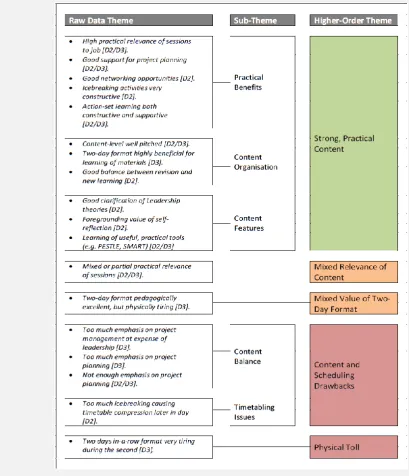
Indeed, the amount of time spent addressing the project itself was one of the more contentious issues all round, with some participants wishing for more time in this domain, and others arguing for less. This, perhaps, gives cause to revisit the issue arising from the Introductory Day, in which participants requested a little more clarity in this domain from the outset. Praise for the action learning approach was constant among all participants, and appreciation of the icebreaking session on the first of the two day was common (though not universal, with one participant maintaining that its duration once again caused timetable “cramming” and inflexibility later in the day). The applied content was very highly praised for its usefulness, with one participant explicitly commenting that they would “…definitely use the PESTLE analysis” in the future.
Possibly the most important set of structural themes to emerge from the feedback relate to the two-day formatting of the module. While the pedagogical value of this format is universally praised in terms of helping participants apply and retain what was being taught, the physical toll exacted by it was a source of concern to many. Moreover, simple fatigue may help account for the noteworthy quantitative feedback-dip for the second day of this module, even though very little substantively poor qualitative feedback appears. This likelihood is underscored by viewing the thematic breakdown for Module 2 feedback (in Figure 11). Herein, with a residential approach, the two-day format is applauded but there are none of the qualitative concerns relating to second-day attrition, nor quantitative declines in feedback quality. In short, a two day module without the benefit of residential trappings can prove exhausting, while an equivalent residential module does not.
3.3.3. Module 2
25 | P a g e
Figure 11: Module 2, thematic analysis of qualitative feedback
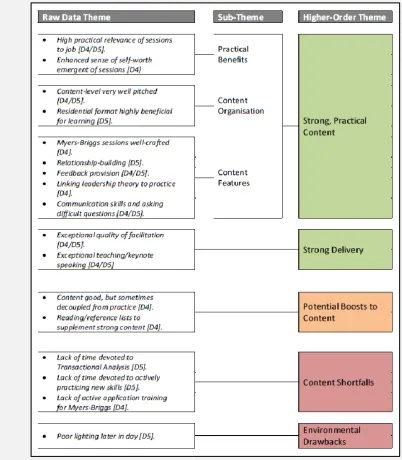
Sessions on relationship-building, communication skills, the provision of feedback and especially on the “asking of difficult questions” were all singled-out for particular praise. Useful support-themes were also raised, with some participants suggesting that reading and reference lists might be a very companion to the strong materials, and others that occasionally the sessions drifted into the abstract when a consistent focus on practice was more to their tastes. Outright negative
26 | P a g e
transactional analysis would have been a valuable addition to the day, and another drawing attention to poor lighting later on the second day of the two.
3.3.4. Module 3
Thematic analysis of qualitative feedback with respect to Module 3 is displayed in Figure 12 (below).
27 | P a g e
These findings help shed particular light on the substantial discrepancy in quantitative approval between Day 6 and Day 7. Of the positive feedback on this module, the overwhelming bulk of the themes raised relate to Day 7. Comments on the weaknesses of the module, on the other hand, relate entirely to Day 6 (with the exception of one complaint that the room was a little hot on Day 7). Firstly, the mentoring-related training in this section were seen as either not relevant, as tangentially relevant or as something the participants already knew extremely well. One piece of feedback noted that the issues on the day basically duplicated materials from clinical and
management supervision. The contents were also seen as over-simplistic (i.e. very basic given the target audience), over-elaborated and over-stretched to fill a full day.
In terms of the strengths of the module, both days were seen by a number of participants as strong networking and experience-sharing opportunities. Some of the mentoring work that formed the backbone of the Day 6 materials was also cited as valuable, though within the frame of a knowledge “refresher” by participants who were already familiar with the materials. Day 7 was, however, praised without caveat for the involvement of the Trust board, which helped improve a range of organisational understandings, and the manner in which the Action Learning Set
functioned. The latter was, in particular, seen as a genuine confidence-booster. The general pitch and organisation of Day 7 were also praised, as (recurrently) were all aspects of the transactional analysis work: structure content and delivery.
3.4. Qualitative findings: core themes
With these findings now described, it is possible to summarise the range (though this does not indicate frequency) of qualitative issues raised.
As evident from the analyses above, and Figure 13 below, the success themes with respect to the LDP were raised in far greater occurrence across the data corpus than any of the emergent development themes and, moreover, the development themes were generally framed as of localised impact, whereas the success themes were discussed in terms of broad-reaching professional and personal impacts. This is to say that development themes were of issue on-the-day, whereas many of the success themes had take-home value and extended across various domains of the
28 | P a g e
Figure 13: Qualitative Synthesis
3.5. Session Feedback: Overall Summary
29 | P a g e
A total of N=112 session evaluation forms were analysed.
The mean satisfaction score allocated by participants in the LDP across all days and all criteria was a very high 88.76%.
LDP Days 2 (“Leadership and the Organisation”), 4 (“Leadership Analysis Styles”), 5 (“Influence and Power”) and 7 (“Leadership in Practice”) were overwhelmingly well-received in all
categories, all averaging over 90% approval.
Participants rated all days of the LDP at above 90% in terms of being informative, except Day 3 (“Service Improvement and Project Management”), which was rated at 83.53%, and Day 6 (“Inspiring and Enabling Others”) which was rated at 66.25%.
Participants rated all days of the LDP at above 90% in terms of being relevant, except Day 3 (77.65%) and Day 6 (71.25%).
Participants rated all days of the LDP at above 89% in terms of facilitation quality, except Day 6 (65%).
Participants rated all days of the LDP at above 90% in terms of being the trainers’ knowledge and skills, except Day 3 (85.88%) and Day 6 (71.25%).
Participants rated all days of the LDP at above 80% in terms of the quality of the learning environment, except Day 1 (Introduction) which scored 63.16%.
Participants identified a range of key success themes relating to the LDP, not least the quality of teaching and facilitation, the senses of community, optimism and confidence that were
generated from involvement, and the support provided for projects.
The modules on all days except Day 6 were seen as very well pitched in terms of level, and very practically relevant.
Day 6 was seen to be either of limited relevance or too familiar, and the materials on mentorship under-pitched in terms of level, and not really “deserving” of a full day.
Some participants found the environment too hot, too dark or too noisy at times.
Action Learning Sets were singled out for consistent praise as a space for sharing experience and moving forward.
MBTI and transactional analysis were recurrently cited as the most valuable taught components.
30 | P a g e
4. Findings II: Participant
Interviews
As discussed in section 2, two tranches of semi-structured interviews with participants were conducted. Recall that the first tranche was
collected around a third of the way into the taught programme, while the second was collected shortly after the taught part of the LDP had drawn to a close. Recall also that the specific character of any individual participant’s project is not detailed, such that participant anonymity can be properly protected.
4.1. Tranche 1
The first tranche of interviews (N=5 participants) yielded three global themes:
1. Project structures;
2. Project impact mechanics, and; 3. Training impacts.
It is of note that, in general, the participants taking part in this tranche voiced a great deal of optimism and enthusiasm for the LDP at that stage. For example:
“I’d just like to say that from the leadership development course, the speakers which
have been invited in have been absolutely excellent; they gave different perspectives on
things and giving you different ideas on different ways of working…”
“[I]t’s really been enjoyable and I think the emphasis on how important it is, is
necessary…”
31 | P a g e
4.1.1. Tranche 1, theme 1: project structures
In terms of the first of the core themes, and as evident in Figure 14 (below), participants outlined a range of issues pertaining to the functions that their projects were anticipated to perform within the Trust, and the contexts of their projects’ conceptualisation (i.e. the problems to be solved and the evidence for intervention).
32 | P a g e
As regards the former, the outward-looking goal of service user satisfaction was high on the agenda for several of the participants, but there were a greater range of what we might term “internal” aspirations, i.e. to improve working practices, knowledge and awareness among colleagues, as well as improving target-monitoring within teams and the Trust on the broader scale.
While service-user feedback and complaints were cited as evidence where service-user satisfaction was a major priority within the project itself, and some formal research was identified, the most commonly utilised evidence for the project’s necessity was negative personal experience. In all cases, participants highlighted that the issue which they were tackling within the project had been a bugbear of theirs for some time, or at the very least had been a regular problem within their working life that was also recognised on the broader scale. For example:
“It’s from personal experience; it was already recognised, but…had become a little bit
lost…so it was an existing concept.”
Indeed, this sense - that the issues being addressed within the projects were much broader
problems with local manifestations – was constant across all interviews. Several participants actually referred specifically to research they had done for the project to evidence this greater distribution.
4.1.2. Tranche 1, theme 2: project impact mechanics
Participants discussed project impact mechanisms at length, both impacts and obstacles, though chiefly as projections and expectations (given the early stage of the interviews). In Figure 15, it is visible how projected impacts manifested in a number of domains, the first of which related to the wellbeing of staff. Herein, the building of knowledge and confidence was a commonly anticipated impact, as evidenced below:
“I think it’ll increase their confidence, they will fully recognise the depth of their role and
I think with that will come a better sense of job satisfaction really. I think it might also,
33 | P a g e
where some members of staff have come fresh into the team, it’ll reassure them more of
the skills and knowledge.”
Figure 15: Tranche 1 - project impact mechanics
34 | P a g e
demonstrable financial resource benefits (for example, through increased uptake in services provided):
“I think there is financial impact to it; I think for patient care it’ll improve our opt-in rate
because people will use the service more…”
The second higher-order theme common to the participants’ accounts was that of “expectable” obstacles to the success/impact of the project. As evident in Figure 15 (below), there were two aspects to the obstacles participants fully expected to encounter; resources and people. Foremost among the former was, perhaps inevitably, time, which was cited by all participants. For example:
“For me personally it’s time, because you’re always juggling a lot of things to try and get
things done but also from an organisational point of view, the getting the training up
and running and out to the right people who need to have it and getting it to them in a
timely manner…”
“For us, it’ll be a timing issue of actually being able to achieve and to actually put a
group together to put these things in place.”
Also cited, and perhaps less expectedly, was the issue of physical premises in which an initiative to enhance service-user satisfaction could be run. The participant expressed anxiety that NHS space might not be available, while rented space was not an option within budgetary restrictions. Human impacts, on the other hand, were a much more singular concern for some participants. While most had no worries on this topic, others felt that lack of engagement from colleagues might prove to be a genuine stumbling-block.
4.1.3. Tranche 1, theme 3: training impacts
35 | P a g e
Figure 16 (below), the LDP sessions to-date were taken to have impacted upon the execution of key tasks within the projects on two levels. The first was an issue of standard skill-acquisition; i.e. the participants had put into effect their training regarding time, people and resource management, and practical communication. The second, however, was a little less easy to categorise. Participants argued that their basic attitudes and knowledge had been changed, which in turn had helped with project execution.
36 | P a g e
On the one hand, a better knowledge and understanding of CPFT’s core structures and organisation allowed participants to better contextualise what they were doing and how to do it.
“[I]t’s really helped me with who I need to inform, is it important
and they need to be on-board and informed or is it not so important?”
On the other, the training had instilled confidence, optimism and motivation for the projects, which were seen as their own rewards, but also catalysts for effective project planning and performance.
Perhaps more striking, however, were the workplace and professional development impacts that participants claimed, particularly given the early stage of the programme. Statement on the topic fell into the two highly interconnected categories of self-organisation (i.e. consolidating and making the best of ones skills in context) and motivation and confidence. For example:
“It has helped my confidence build, and it’s inspired me to think that I do have the right
qualities and has put me in the right direction to achieve and I think that’s the biggest
thing I’ll take away from it.”
Perhaps more strikingly still, one participant highlighted that the work in the LDP to-date had provided the impetus to properly (and finally) engage with a higher degree.
“[I]t’s not just been an exercise that you think you should be doing, but it’s also given me
the motivation to perhaps do my Masters which I’ve played around the idea for a while
so being able to consolidate this module into a module that you can actually carry
forward has been really, really useful.”
Finally, participants noted some small matters they thought could add to the LDP’s delivery. The first of these related to the programme “underselling” itself at the outset, and not providing new (or potential) participants with a clear sense of just how useful it would be and that it would not simply
37 | P a g e
be “additional toil.” In other terms, it could use stronger advance clarity around its purposes and outcomes.
“I think the only thing I would say is that you should make it very clear that you can take
time out from your day job to work on your leadership project and I think that again isn’t
clear and it’s very difficult to juggle that with what you do on a day-to-day basis.”
Another participant, meanwhile, voiced concern that the impetus of the LDP might be lost following the end of the taught programme, and suggested some mode of follow-up enterprise:
“I just think that after the course that maybe it would be useful to do a few workshops a
year for the people who have been on the course just for a bit of further development, it
would be a shame for it just to be the end at the end; some smaller follow-up workshops
would be nice.”
4.2. Tranche 2
The second tranche of interviews (N=5 participants) yielded four global themes:
1. Project structures;
2. Project impact mechanics; 3. Obstacles/solutions; 4. Training impacts.
Recall that, as noted in section 2.2.3, the participants in interview tranches 1 and 2 are not
38 | P a g e
4.2.1. Tranche 2, theme 1: project structures
As clearly evident in Figure 17, the LDP change projects were reported to have been tasked with a wide and differentiated range of functions, with both internal and external trajectories.
Figure 17: Tranche 2 – change project structures
In terms of externally-facing functions, a similar range was reported to that outlined in tranche 1. As evidenced in section 4.2.3, however, this does not necessarily demonstrate simple and
39 | P a g e
a few additions. The most important aspect within this theme is, however, the manner in which the abiding relevance of the work was justified. Nebulous attributions such as ‘personal experience’ are now absent, and instead evidence of efficacy and application is presented from hard research, or in terms of hard results (see section 4.2.2).
4.2.2. Tranche 2, theme 2: change project impacts
Participants outlined eight main areas in which the change projects had already made definable impacts (Figure 18).
40 | P a g e
A core impact domain described by several participants was that relating to stronger communities and better communication, and the corollary benefits for staff wellbeing-at-work. Typically:
“…the team [has] a lot more confidence to be a bit more creative and [they] feel they
can contact other people within the organisation, and they’re not alone if they have
ideas they want to put across.”
Direct and measurable impacts upon service-delivery, and service-user experience, were also noted. One participant described how by enacting a research-driven reduction in time spent with each “mild” case pertinent to their team (to reduce inherent “medicalization”), a greater amount of flexibility appeared in schedules which, in turn, facilitated more time with clients who needed it most. Moreover, it was not just this efficiency marker that improved service at the front line; the move to prevent medicalization itself bore fruit:
“I’ve actually just gone through the audits with the results now, and there has been a
drastic improvement in patients that have only been seen once. They were given an SOS
number if they had any problems, so staff members have actually gained confidence to
know that they only need to, and only should, see [these] patients once, it’s a better
outcome. So it’s a long-term outcome because it’s changing patient care.”
In a similarly outward-facing manner, greater levels of community engagement were also noted, themselves influencing styles of patient care and development of team-level initiatives.
At the individual level, the provision of education and training was reported to have had clear impacts upon staff knowledge. It is, perhaps, the more structural changes to thinking about matters within the Trust that best connect the LDP training to the LDP projects in terms of impacts (see also section 4.2.4). Firstly, it was reported that formal research was increasingly being put at the centre of team decision-making and planning procedures:
“So I’m assessing all the quality of information that people are being given…to try and
41 | P a g e
Secondly, the very manner in which the Trust itself looked at staff training within the corporate systems had been altered, streamlining the processes and ensuring more tailored experiences for clinical and non-clinical staff, rather than adopting a one-size-fits-all mentality.
4.2.3. Tranche 2, theme 3: obstacles/solutions
Participants reported seven main forms of obstacle, in four categories (structural, human, technical and project-specific) that they had encountered in executing their change projects, and enacting the changes they were designed to bring about. These are summarised below in Table 3.
Table 3: Obstacles and solutions
42 | P a g e
and sensitive communication, secondly, taking a clear stance as a leader and thirdly thinking adaptably and flexibly, rather getting bogged down in familiar systems of action. For example:
“I think talking to my colleagues [was key]…I think talking to them about dealing with it
and trying to think out the box.”
The most commonly encountered problems were all fundamentally human. These included (a) a passive resistance to change due to staff being comfortable with the status quo, (b) a more active resistance to change due to explicit protectivity of particular working practices, and (c) simple ‘time lag’ due to involved staff prioritising other things. In all three cases, raw perseverance and a refusal to be discouraged were reported to be the core attributes necessary to solve the problems. On top of this, participants noted that the use of careful enrolment tactics (rather than force), research and evidence and gradual rather than abrupt movements towards change had been effective. For example:
“Mostly through negotiation and discussion and evidence…I am approaching it in a
completely different way [now], through evidence of feedback and information from
[other] organisations.”
Technical problems, such as IT failures hampering communication channels, also required that participants be adaptable and by-pass the problem by opening up new (or old) channels to their targets in parallel.
“We’ve had to be savvy and use different methods of patient communication…as well as
working alongside the GPs and word of mouth too.”
43 | P a g e
tools acquired during the training to pause and redesign, and also involved service-users themselves
in the redesign in order to secure a form of participant design-validation.
4.2.3. Tranche 2, theme 4: training impacts
The final global theme addressed by participants related to the direct impacts of the LDP training on (a) the workplace, (b) the projects and (c) the participants’ own professional selves.
44 | P a g e
In Figure 19, issues (a) and (b) are addressed. In the workplace, participants reported a range of important changes arising from the training. Underpinning a range of these was bolstered confidence. This manifested as greater confidence to represent the team externally:
“I went to the locality business meetings for team leads, and when
I disagreed with a strategy for cost efficiencies within the locality, it
gave me confidence to speak up about…safety and efficiency. I wouldn’t have possibly
spoken up about my concerns unless I had been on this training course, because it gave
me the confidence to do so, and also what I was concerned about it made me able to
vocalise it better as well.”
Internally, meanwhile, stronger team ethos bolstered by more confident leadership was a recurrent theme, as was the related matter of personnel and personality management and understanding. The direct use of the MBTI within the workplace was reported, for example:
“I did a workshop mapping project with some junior staff and I first approached it by
looking at Myers Briggs, and the fact that we can all look at something very differently,
it all means the same thing, and it doesn’t mean that anybody is wrong, we’re just all
different – so that was really useful to start off with and that’s what I learnt on the
cou