The STeP Journal (Student Teacher Perspectives), 4 (4). pp. 19-29.
Downloaded from: http://insight.cumbria.ac.uk/id/eprint/3394/
Usage of any items from the University of Cumbria’s institutional repository ‘Insight’ must conform to the following fair usage guidelines.
Any item and its associated metadata held in the University of Cumbria’s institutional repository Insight (unless stated otherwise on the metadata record) may becopied, displayed or performed, and stored in line with the JISC fair dealing guidelines (available here) for educational and not-for-profit activities
provided that
• the authors, title and full bibliographic details of the item are cited clearly when any part of the work is referred to verbally or in the written form
• a hyperlink/URL to the original Insight record of that item is included in any citations of the work • the content is not changed in any way
• all files required for usage of the item are kept together with the main item file. You may not
• sell any part of an item
• refer to any part of an item without citation
• amend any item or contextualise it in a way that will impugn the creator’s reputation • remove or alter the copyright statement on an item.
The full policy can be found here.
Citation
Deane, J. 7 Can teaching about disruptive technologies such as artificial intelligence change pupils pe eptio s of the alue of desig a d te h olog ?, The STeP Journal, 4(4), pp. 19-29.
19 Can teaching about disruptive technologies
such as artificial intelligence change pupils’ perceptions of the value of design and technology?
The STeP Journal Student Teacher Perspectives
Copyright © 2017 University of Cumbria Vol 4 (4) pages 19-29
Joanne Deane
Nottingham Trent University
Abstract
Design and technology (D&T) is at a point of uncertainty and there are mixed views about what it should consist of and the values that it holds. This research aimed to find out if teaching secondary pupils about disruptive technologies such as artificial intelligence (AI) would alter their perceptions in relation to the value of D&T, as well as improving their learning. Two lessons, focussed on AI, were i teg ated i to a s he e of o k a d pupils pe eptio s of D&T s alue e e easu ed efo e a d afte the lesso s. Pupils espo ses a d o k out o es e e also o side ed. Following the lessons, pupils showed more awareness of D&T being related to problem solving, they displayed critical thinking, and work outcomes showed progress in problem solving skills. The research suggests that tea hi g pupils a out dis upti e te h ologies a ha e a positi e i pa t o pupils lea i g a d to some extent, their perceptions of the value of D&T.
Introduction
Design and technology (D&T) is at a point of uncertainty with a significant decline in uptake at GCSE level (Design and Technology Association, 2016). A likely contributing factor is the implementation of the English Baccalaureate. D&T is not included in the list of subjects that the government expect to be taken by at least 90% of pupils in mainstream schools from the year 2020 (Department for Education, 2015), suggesting that they may see it as being less important than other subjects. On the other hand, Owen-Jackson (20 a, p. a gues that D&T o t i utes to the de elop e t ofthe hole hild a d that it is important that the subject continues to evolve. The Design and Technology Association (2015) believe that a lack of understanding of the value that D&T holds could be to blame for its seemingly overlooked state. It is not only government ministers who appear to underestimate the value of the subject, as tea he s, pupils a d pa e ts also displa i ed opi io s he it o e to the su je t s value (Hardy, 2013). This could also explain why there is an increasing lack of enthusiasm for D&T.
The main purpose of this study was to bring about change and development in my practice as a trainee se o da D&T tea he a d to ha e a positi e i pa t o pupils lea i g. The aim was to change pupils pe eptio s of the alue of D&T, gi i g the a o e a u ate u de sta di g of the i po ta e of the subject. Pedagogical approaches and schemes of work were altered in the hope of improving pupils lea i g a d thei attitudes to ards the subject. Disruptive technologies (artificial intelligence) were used as the focus of new lessons to determine whether teaching pupils about them would help in changing their perceptions.
20 Literature Review
Design and technology, through its lifetime, has been defined in varying ways. Its continuous development and changing nature often results in confusion about its purpose. Owen-Jackson (2015a) demonstrates that there is a lack of clarity and understanding surrounding the subject due to these issues. Teachers, parents and pupils all display mixed opinions of what values are attributed to D&T Ha d , . Fo the su je t to e see as i pe ati e to pupils edu atio hi h I elie e it to be), these misunderstandings need to be addressed. This study will focus o pupils pe eptio s of the value of D&T.
If pupils do not see the value of D&T, they are unlikely to be motivated to do well in the subject and to choose to study it after the compulsory stage. Motivation is described in numerous, similar ways, however I will use Child s , p. defi itio as o sisti g of i te al p o esses a d e te al i e ti es hi h spu us o to satisf so e eed . Ge is a d Capel , p.162)describe factors fou d to e oti ati g su h as pupils i te est i the su je t a d the deg ee to hi h the su je t o spe ifi tasks a e alued. The efo e, ithout a a u ate u de sta di g of the alue of D&T, pupils may fail to see importance in studying the subject, lose interest and become demotivated. This makes it important for values to be communicated effectively.
Hardy, Gyekye and Wainwright (2015) conducted a small research project on the values of D&T held by stakeholders likely to e i ol ed i the p essu e o D&T s u i ulu o te t. Pupils e e o e of the stakeholders involved and when interviewed about what the point of D&T is, there was a significant lack of response relating to the freedom to design, the consideration of wider society issues, and the identification of problems to be solved. The most mentioned values were related to D&T providing practical life skills and the opportunity to make products.
During my time in the D&T department of two different secondary schools, talking to pupils about design and technology brought about similar responses. When pupils in a year seven class were asked h is desig a d te h olog i po ta t? the ost e u i g a s e s e ol ed a ou d the fa t that you learn to make things, followed by learning skills that are important for everyday life. And like the results found by Hardy, Gyekye and Wainwright (2015) there were very few mentions of anything relating to solving problems or learning about the wider world and the impact that technology can have on it. Hardy, Gyekye and Wainwright (2015) mention the possibility of these issues being linked to the atu e of pupils D&T lesso s.
Although developing practical life skills is important for pupils in order to become capable citizens, D&T also has the potential to help pupils develop in a range of other areas. Perhaps many pupils relate the subject to life skills and making because of the way it is taught. Spendlove (2008) demonstrates that the past has seen D&T linked largely to making things which can be taken home and that this, in so e ases, has led to the eal k o ledge ehi d the su je t ei g lost. This is a i te p etatio of D&T that can still be seen in schools today and de Vries (2016)states that when there is too much focus on making and not enough on the design process, pupils are being deprived of the opportunity to e gage i the eati e p o ess of sol i g desig p o le s .
21 De Vries (2016) states in his theory that pupils mostly recognise technology as artefacts and as being high te h a d that they rarely see the subject as something to do with knowledge (including that a out hu a s a d fe see the i po ta e of desig , the efo e o eptualisi g te h olog p i a il as its outcome and not its o igi p. . He suggests a easo fo this ei g the a high te h products are portrayed in the media. However, having a regular focus on making in D&T could also portray technology as being only about artefacts. This could also explain why pupils fail to mention problem solving and wider society issues in relation to the values attributed to D&T.
As well as a lack of design activity, a lack of teaching about values within D&T could have a similar impact. Middleton (2005) explains that teachers should make values an explicit part of design tasks and McLaren (2015) suggests that including in lessons the exploration of technological designs, decisions and developments and their consequences can create a values-based experience in the classroom. Here, pupils can begin to see the wider implications of design and technology and their learning will revolve around more than just designing and making. Involving discussion about values within D&T can encourage pupils to think about their own views and how others may be affected. Consequently, they will gain an awareness of wider society issues and begin to develop their technological perspective.
Ba le , Gi e s a d Steeg , p. elie e that the de elop e t of te h ologi al pe spe ti e is an important and much under-represented aspect of the design and technology curriculum in se o da s hools. The suggest a effe ti e a of de elopi g this is to tea h pupils a out the nature of disruptive technologies.
They explain the features of disruptive technologies as being able to: disrupt the status quo
alter the way people live and work rearrange value pools
lead to entirely new products and services
(Barlex, Givens and Steeg, 2015, p.305).
They explain that encouraging pupils to consider how these technologies might affect their futures and the social impacts they may have, can make for more informed citizens who are able to become involved in debates concerning the deployment of technology in their societies. This, of course, seems appropriate considering the rate at which technology continues to evolve.
Based on the information found in the literature discussed and previous experiences in school, the study will aim to develop teaching practice by integrating values into lessons and allowing for better pupil learning and progress through teaching about disruptive technologies. Although this type of lesson content is recommended, there is a lack of research into whether it is effective.
The intention is to find out whether teaching secondary pupils about disruptive technologies improves their perceptions of the value of D&T, helping them to become aware of the potential to solve real and relevant problems and to consider wider society issues.
Methods
22 permission to carry out the research in the placement school, maintaining confidentiality, and protecting the identity of the school and pupils involved.
Two classes were used for the research, both year seven, mixed ability. Year seven were chosen as de Vries (2016)states that the later the conceptualising of technology is introduced, the harder it will be to change perceptions that may have already become fixed, suggesting that the earlier concepts are introduced, the better. The fi st lass ill e efe ed to as lass A a d the se o d as lass B . Class A was comprised of seventeen pupils, five of which had dyslexia, one of which had autism and two of which were eligible for pupil premium. Class B contained eighteen pupils including three with dyslexia and four eligible for pupil premium.
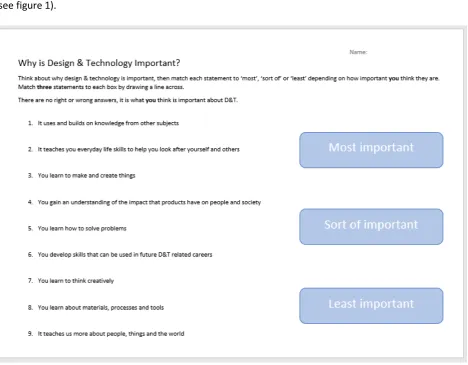
For the collection of data, a survey method was used which Moser and Kalton (1971) describe as being concerned with the opinions and attitudes of a group of people. The opinions and attitudes concerned i this i estigatio e e those of pupils i elatio to the alue of desig a d te h olog . A at h -up sheet as desig ed fo p-upils to o plete, hi h uestio ed the a out the importance of D&T (see figure 1).
Figure 1. The match up sheet given to pupils before and after the intervention lessons.
23 Class A e e asked the uestio h is desig a d te h olog i po ta t? a d thei espo ses e e o pa ed to Ha d s list of alues. The alues to e used o the sheet e e the hose usi g the most and least common values from both sources as well as information found in the literature about pupils pe eptio s.
The sheet stated that pupils must match three values only, up to each of the three options. This meant that each option would have three statements matched to it making analysing the data uncomplicated. It was clearly explained to pupils that there were no right or wrong answers as it was about what they thought was important about D&T. Before using the sheets for the study, they were tested on pupils from class A to identify any flaws and amended appropriately.
St u tu ed o se atio as also used to gai a i sight i to pupils espo ses to lesso o te t involving disruptive technologies. Bell (2010) mentions criticisms of this approach, as the focus is already decided rather than being allowed to emerge, making the approach subjective and biased. However, my objectives were identified through the study of relevant literature which revealed important aspects to be considered through observation.
Throughout the lessons concerned, the reactions of pupils to certain parts of the lessons were noted. Their answers to questions and the questions they asked were recorded for reference and their work outcomes were considered.
The project spanned over two one-hour lessonsand focussed on artificial intelligence (AI), a disruptive technology that Barlex, Givens and Steeg (2015) suggest is appropriate to teach secondary D&T pupils. The lessons involved:
a teacher presentation on what AI is a class discussion on AI around us
a case study on the WAYMO self-driving car using suggestions from Barlex, Givens and Steeg (2015)
a class discussion on the effects of the self-d i i g a a d desig e s espo si ilities
a designing without making task, also using suggestions from Barlex, Givens and Steeg (2015)
A disruptive technology was chosen as the focus of the lessons to try to get pupils to start developing their technological perspectivein the hope that they would begin to see the subject as being less about learning life skills and making things, and more about the wider implications of technology and the ability to solve problems.
The teaching style used was more values-based than usual and the lesson content and activity was planned to involve more opportunity for the development of valuable skills and learning. The context of technology in relation to AI was focussed on in class discussions. The case study was designed to get pupils thi ki g a out the effe ts of the te h olog a d ho it ould ake a diffe e e to people s lives. The design task focussed on designing ithout aki g to a oid est i tio s to pupils desig s (Barlex, Givens and Steeg, 2015) and create more focus on solving relevant problems.
24 of problem solving skills was encouraged through the design task which involved pupils designing a product containing AI for a specific user to solve existing problems. Wider society issues were addressed through the case study and through discussion on the effects the self-driving car may have on people and society.
To ensure the lessons were appropriate and effective, class A were used as a trial for the intervention. This informed the lesson planning, timings and resources. It also gave an idea of how pupils would respond to the lesson content. Following the trial lessons, some minor changes were made to the lesson plans to ensure the optimum outcome before teaching class B and gathering the data used for the study.
To ensure reliability of the data, control methods were used during the study. The lessons followed the end of a resistant materials project before pupils would move on to their next rotation and took pla e he e the ould usuall ha e D&T, e su i g the i te e tio ould t see out of pla e. Pupils were given the same amount of time to complete both the before and after match-up sheets. It was explained explicitly on the sheet and verbally that pupils were to think about their own views of D&T and that there were no right or o g out o es. The pupils p e ious D&T tea he s e e consulted about the lesson content to eliminate the chance of repetition. Pupils had not had any lessons on AI or any other disruptive technology prior to the intervention.
Analysis of Findings
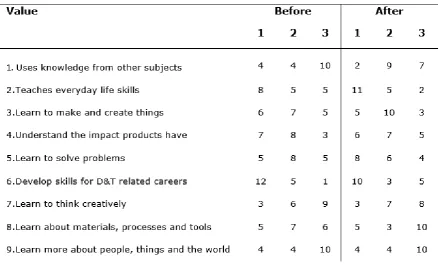
Table 1. Shows pupil responses to the match-up sheet.
Note: 1 = most important, 2 = sort of important, 3 = least important
25 Ta le sho s the u e of pupils, out of a lass of eightee , that at hed ea h alue to ost i po ta t , so t of i po ta t a d least i po ta t efo e a d afte the i te e tio lesso s.
Pupils had previously been shown to attribute certain values to D&T and fail to mention ones that were linked with valuable learning and development. The aim of this study was to see if teaching pupils about artificial intelligence would change their perceptions, making them aware of some of the values previously unthought of by most. Teaching practice was altered to implement the AI lessons in a way which would e efit the pupils lea i g. I the a al sis, fo us ill e o the t o alues that ost pupils attributed to D&T before the intervention (according to literature and my own research) and the two values that were hoped to be attributed to D&T by more pupils following the intervention. These values are 2, 3, 4 and 5.
Value number two: It teaches you everyday life skills to help you look after yourself and others Befo e the i te e tio lesso s, ost pupils at hed this alue to ost i po ta t a d 5 pupils
at hed it to least i po ta t . Follo i g the lesso s, e e o e pupils at hed it to ost i po ta t a d less at hed it to least i po ta t . This ould suggest that the lesso s taught i the intervention project somehow made pupils relate D&T to everyday life skills even more.
The literature suggests that pupils may feel this way because of the nature of the activity involved in their D&T lessons (Hardy, Gyekeye and Wainwright, 2015). Yet taking away the focus on making and placing more emphasis on values did not seem to have the desired impact in this instance. This may have been down to the wording used on the design task given to pupils (see figure 2).
The design brief addressed helping a lady with her day-to-day problems, and the value on the match-up sheet read it tea hes ou e e da life skills to help ou look afte ou self a d othe s . The efo e, pupils may have linked the fact that they were helping another person (the elderly lady) by designing a product for her, with helping to look after others. In further study, different wording may need to be considered to eliminate this problem.
Value number three: You learn to make and create things
Befo e the i te e tio lesso s, pupils at hed this alue to ost i po ta t a d at hed it to least i po ta t . Follo i g the lesso s, less pupils at hed it to ost i po ta t a d less at hed it to least i po ta t . The efo e, ost pupils thought of this alue as ei g so t of i po ta t efo e and after the lessons, suggesting that they see value in learning to make and create things but do not see it as imperative to D&T.
26 This implies that even though lessons in that particular school were regularly focussed on making, they still did not consider making things as one of the most important parts of D&T. Comparing this to class A s espo ses to the uestio h is D&T i po ta t? is i te esti g, as the ost o o the e i their answers was about learning to make things. Perhaps when class B were presented with a range of values related to the importance of D&T, they could see more relevance in other values that they may not have thought about on their own.
Value number four: You gain an understanding of the impact that products have on people and society
Befo e the i te e tio lesso s, pupils at hed this alue to ost i po ta t a d at hed it to least i po ta t . Follo i g the lesso s, less pupils at hed it to ost i po ta t a d o e at hed it to least i po ta t . This ould suggest that the lessons did not have a positive impact on pupils ie s ega di g the ide i pa ts of D&T.
McLaren (2015) suggests that the exploration of technological designs can create a values-based experience and that by involving values in D&T education, pupils can start to think critically about products. For the lessons in question, focussing on the exploration of AI and its effects, according to the data, did not result in pupils seeing more importance of the impact of products in relation to D&T. However, observation suggested otherwise. During the lessons, pupils showed an interest in the effects of AI and made comments showing their thinking about its effects on people and society, saying things such as:
The self-driving car would be good for people ho ha e just had a ope atio a d a t d i e fo a hile e ause it ould ea that the ould t ha e to get so eo e else to d i e the a ou d. What if the AI e t o g a d took ou so e he e ou did t a t to go? It ight get le e e ough to do its o thi g.
Value number five: You learn to solve problems
Befo e the i te e tio lesso s, pupils at hed this alue to ost i po ta t a d at hed it to least i po ta t . Follo i g the lesso s, o e pupils at hed it to ost i po ta t a d less (4) at hed it to least i po ta t. This ould suggest that the lesso s a ha e shifted pupils thi ki g and made them more aware of the opportunity to solve problems through D&T.
By including a design task in the AI project, pupils were given the opportunity to experience wider learning and develop more skills (Robson, 2015). This learning was focussed on the impacts of AI on people a d its a ilit to i p o e people s li es th ough desig i g a p odu t to solve a problem. The data suggest that this helped pupils to realise the link between D&T and problem solving and that this is an important aspect of the subject. Not only did pupils engage in problem solving as part of their design activity but they were also able to think critically about how the technology would have an i pa t. The pupils desig out o es sho ed that the had thought ha d a out ho AI ould help ake the use s life ette a d had o e up ith so e i o ati e ideas to help solve several problems.
Discussion
27 to do well in a subject because of an interest they have for it, they are more likely to see value in that subject. Therefore, by engaging pupils in the lesson content discussed it would seem, from this study, that pupils can become more engaged with problem solving and thinking about the wider impacts of technology. They may then also begin to value the subject more through having more of an interest in it, resulting in more learning taking place and an increase in progression.
To gai a o e a u ate i sight i to hethe pupils pe eptio s ould ha ge th ough tea hi g this type of project with the teaching styles mentioned, a longer running project, considering more time is available, could be implemented. Carpenter and Bryan (2016)explain that there is a limitation on the amount of information pupils can take in at a time and that if information is delivered too quickly, it may not be received in their memory. Therefore, if pupils had more time to absorb the information they may be more likely to see things differently.
Fo lesso s like these to ha e a ha e of i p o i g pupils views of D&T and improve the learning taking place, it is important that teachers have the correct and current subject knowledge on what they will be teaching. Therefore, it is vital that continuous professional development is made use of regularly, as stated in an Ofsted report concerning the provision of D&T (Ofsted, 2011). Providing this is the ase, s hools D&T u i ulu o te t should e ai up-to-date and relevant, another important factor in teaching the subject effectively.
The focus for this study was on the four values discussed and the other five values were put on the match-up sheet to distract pupils and reduce bias towards the original four. However, it is interesting to note that the highest number of pupils matched value 6 (you develop skills that can be used in futu e D&T elated a ee s to ost i po ta t efo e the lesso s a d the se o d highest u e of pupils matched it to ost i po ta t afte . It ould e e efi ial to look further into the reasons why so many pupils relate D&T to future careers and if this is also the case in other schools.
Conclusion
The literature and personal experience suggested that pupils most readily relate learning life skills and making things to the importance of D&T, failing to mention solving problems and the link to wider society issues. It was found that this could be down to how D&T lessons are taught and the activity involved. This not only portrays an incorrect perception of D&T but can also result in opportunities for the development of valuable skills, learning and progress being missed.
This study aimed to determine whether changing pedagogical approaches and adapting lesson content by teaching pupils about disruptive technologies such as artificial intelligence would change pupils peceptions and improve learning. Data from completed match-up sheets concerning the i po ta e of a a ge of alues elated to D&T sho ed a i ease i pupils a a e ess of the importance of problem solving following the lessons. The data did not show an increase in their awareness of wider society issues. However, observation during lessons showed pupils reacting well to tasks focussed around the impacts of AI on people and society. When AI was introduced into their lessons, pupils showed an increase in interest, asking more questions and showing more willingness to be involved in class discussions and becoming more motivated as a result. During discussions and tasks throughout the lessons, most pupils demonstrated critical thinking and produced interesting and appropriate outcomes.
28 For teachers to carry out lessons of this nature, it is crucial that they make use of continuous professional development to keep the lesson content relevant and it is important for teachers to plan lessons carefully to integrate the development of more skills and progress. Perhaps if this type of teaching is carried out over a longer period, pupils will begin to have an even better perspective on D&T.
References
Barlex, D., Givens, N., and Steeg, T., 2015. Developing work with disruptive technologies. In: Owen-Jackson, G., ed. Learning to Teach Design and Technology in the Secondary School. 3rd ed. Oxon:
Routledge, 2015, pp. 303-322.
Bell, J., 2010. Doing Your Research Project. 5th ed. Berkshire: Open University Press.
Bloom, B., Engelhart, M., Furst, E., Hill, W., and Krathwohl, D., 1956. Taxonomy of Educational Objectives. The Classification of Educational Goals, Handbook 1 – Cognitive Domain. New York: Longman.
Carpenter, C., and Bryan, H., 2016. Teaching styles. In: Capel, S., Leask, m., and Younie, S., ed. Learning to Teach in the Secondary School. 7th ed. Oxon: Routledge, 2016, pp. 368-383.
Child, D., 2007. Psychology and the teacher. 8th ed. London; New York: Continuum.
Cohen, L., and Manion, L., 1994. Research Methods in Education. 4th ed. London: Routledge.
Cohen, L., Manion, L., and Morrison, K., 2004. A Guide to Teaching Practice. 5th ed. New York:
RoutledgeFalmer.
de Vries, M J., 2016. Teaching about Technology: an introduction to the philosophy of technology for non-philosophers. 2nd ed. Switzerland: Springer International Publishing.
Denscombe, M., 2014. The good research guide: for small-scale social research projects. 5th ed.
Berkshire: Open University Press.
Department for Education, 2015. Consultation on implementing the English Baccalaureate [online].
London: TSO. Available at:
https://www.gov.uk/government/uploads/system/uploads/attachment_data/file/473455/Co nsultation_on_implementing_the_English_Baccalaureate.pdf [Accessed 23rd March, 2017]
Design and Technology Association., 2015. We Have to Reject EBacc for all. [online]. DATA. Available at: https://www.data.org.uk/news/we-have-to-reject-ebacc-for-all/ [Accessed 24th March
2017]
Design and Technology Association., 2016. 2016 GCSE results day: as we predicted, the trend continues. [online]. DATA. Available at: https://www.data.org.uk/news/2016-gcse-results-day-as-we-predicted-the-trend-continues/ [Accessed 23rd March 2017]
Gervis, M., and Capel, S., 2016. Motivating pupils. In: Capel, S., Leask, m., and Younie, S., ed. Learning to Teach in the Secondary School. 7th ed. Oxon: Routledge, 2016, pp. 160-179.
Hardy, A. Unpublished PhD thesis. The value of a school subject: Investigating the values attributed to design and technology by different stakeholders.
Hardy, A., 2013. Starting the Journey: Discovering the Point of D&T. In: 2013. PATT27 Conference: Technology Education for the Future: A Play on Sustainability, Christchurch, New Zealand, 2-6 December 2013. New Zealand: Technology Environmental Science and Mathematics Education Research Centre, University of Waikato, pp. 222-228.
Hardy, A., Gyekye, K., and Wainwright, C., 2015. What do others think is the point of design and technology education? In: 2015. PATT29 Conference: Plurality and Complementarity of Approaches in Design & Technology Education, Marseille, France, 7-10 April 2015. pp. 217-224. McLaren, S V., 2015. Developing values. In: Owen-Jackson, G., ed. Learning to Teach Design and
Technology in the Secondary School. 3rd ed. Oxon: Routledge, 2015, pp. 287-302.
Middleton, H., 2005. Creative Thinking, Values and Design and Technology Education. International Journal of Technology and Design Education, 15 (1), pp. 61-71.
29 Office for Standards in Education (Ofsted), 2011. Meeting technological challenges: school design and technology provision. [Online]. London: HMSO. Available at: https://www.gov.uk/government/publications/meeting-technological-challenges-school-design-and-technology-provision [Accessed 11th March, 2017]
Owen-Jackson, G., 2015a. Design and Technology in the Secondary School. In: Owen-Jackson, G., ed. Learning to Teach Design and Technology in the Secondary School. 3rd ed. Oxon: Routledge,
2015, pp. 7-17
Owen-Jackson, G., 2015b. Pupil learning in design and technology. In: Owen-Jackson, G., ed. Learning to Teach Design and Technology in the Secondary School. 3rd ed. Oxon: Routledge, 2015, pp.
181-198.
Robson, J., 2015. Preparing to teach design. In: Owen-Jackson, G., ed. Learning to Teach Design and Technology in the Secondary School. 3rd ed. Oxon: Routledge, 2015, pp. 57-76.