Efficient Large Sparse Arrays Synthesis by Means of
Smooth Re-Weighted L1 Minimization
Daniele Pinchera†*ID, Marco Donald Migliore†and Mario Lucido†and Fulvio Schettino†and Gaetano Panariello†
ELEDIA@UniCAS and DIEI - University of Cassino and Southern Lazio, via G. Di Biasio 43, 03043 Cassino, ITALY
* Correspondence: [email protected]; Tel.: +39-0776-299-4348
Abstract:In this paper we present an efficient technique for the synthesis of very large sparse arrays, with arbitrary circularly symmetrical upper bounds for the pattern specifications. The algorithm, that is based on iterative smooth re-weighted L1 minimizations is very flexible, and is capable of achieving very good performances with respect to competitive algorithms. Furthermore, thanks to its efficiency, planar arrays of hundreds of wavelengths can be synthesized with limited computational effort.
Keywords:Antenna Arrays; Sparse arrays; Radar; Pattern Synthesis; Signal Processing
1. Introduction
Antenna arrays are one of the most important technology that allows to respond to the challenges of the close future communication systems, particularly in the 5G and IoT frameworks [1–4]. In this perspective, the use of sparse, non regular, arrays is particularly appealing, since it has been shown that a sparse array is often capable of achieving the same performance of regular lattice ones, with a much lower number of radiating elements, and a strong reduction of the issue of grating lobes.
Unfortunately, the synthesis of a sparse array is a much tougher task with respect to the synthesis of regular lattice ones. This difference is due to the fact that the relationship between the radiated field and the excitation of the radiating elements is linear. This allows the use of efficient linear and convex programming techniques for the determination of the elements excitation once the position of the radiators is fixed. Instead, the relationship between the radiated field and the element’s positions is non linear and non convex, and no optimal algorithms capable to solve this problem are currently known.
In the last decades, researchers have followed different approaches to face the synthesis of sparse arrays. They can be roughly summarized in two main categories. In the first one we have all evolutionary computation based methods [5–20], that exploit the capability of genetic algorithms, particle swarm optimization and similar techniques to face the multiple minima that arise from the aforementioned non-linearity and non-convexity.
A second category is represented by a number of different approaches in which the general synthesis problem is substituted by a simpler one, that can be faced by means of deterministic techniques [21–33].
Both approaches show advantages and disadvantages. The former class is advantaged from the fact that a well-designed evolutionary algorithm is capable of asymptotically find the optimal solution of a given problem. The main issue is represented by the word "asymptotically". The number of iteration needed to get "close" to the global optimum is an exponential function of the number of unknowns, so it is very hard to deal with evolutionary algorithms when the dimension of the desired array is very large: we get a solution, but is often impossible to say how much close to the optimum we are[34].
For the latter category, instead, the execution is - generally speaking - fast, and we are usually allowed to solve, with relative ease, large problems. But, again, since the starting problem solved is a sub-optimal one, so we do not usually obtain the global optimum.
The aforementioned classification is obviously a very simplified one, since in the years hybrid and mixed strategies have been presented [35–41]; furthermore the recent development of compressive sensing [42], ad related algorithms, has provided effective and computationally efficient algorithms [43–53]. In particular, the synthesis of sparse linear arrays of hundreds of wavelengths are shown in [53], a result that to the best knowledge of the authors is currently unmatched.
The synthesis of planar arrays of more than a hundred of wavelengths is instead an open issue. This kind of problems is computationally very difficult to face, because of the huge number of unknowns, with evolutionary algorithms; no results have been shown in the open literature by using other kind of algorithms.
In this contribution we will propose a sub optimal, yet effective, approach to the solution of this kind of problems, to be used for circularly symmetric beam pattern specifications. In particular, the circular symmetry of the specifications will be used to simplify the layout: we will look for antenna arrays with the elements displaced in circular concentric rings, with a reduction of the number of unknowns to optimize for. Furthermore, we will exploit a smooth re-weighted`1norm minimization, a compressive sensing inspired approach, to look for the minimum number of rings; finally, each ring will be populated with a number of elements as small as possible, to achieve an overall minimum number of radiators.
The paper will be organized as follow. First of all we will discuss the synthesis problem formulation (section2), then we will propose the use of a compressive sensing like approach for the determination of the number of rings (section3) and the population of rings with radiating elements (section4). In section5we will provide some numerical results to validate the proposed approach; conclusions follow (section6).
2. Problem formulation
For the sake of simplicity we will consider the case of isotropic radiators; most of the considerations that we will discuss in the remaining of the paper can be extended to cases in which we take into account the element factor with a minimum effort.
Let us now consider the Array Factor of numberNof sources placed on the{x,y}plane:
F(θ,φ) = N
∑
n=1anejβ(xnsinθcosφ+ynsinθsinφ) (1)
whereβ=2π/λis the free space wavenumber,λis the wavelength,{xn,yn}are the coordinates of
then−th radiating element andanis its excitation.
The sparse array synthesis problem consists in finding the position and excitation of the N radiating element in order to satisfy a chosen array factor specification. As an example we could require that
|F(θ,φ)| ≤ MUP(θ,φ) (2)
F(0, 0) = 1 (3)
that represent the typical specifications of a pattern with arbitrary upper bounds.
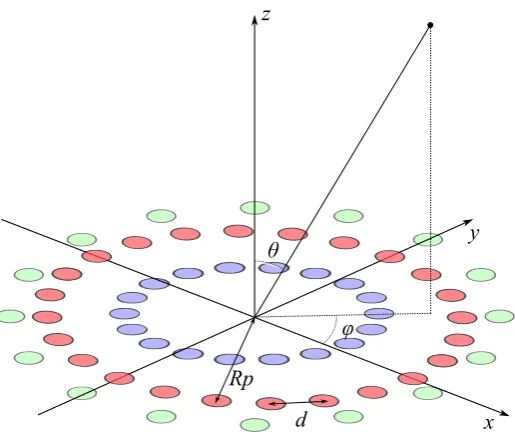
Figure 1.Scheme of a circular concentric ring array.
As stated in the introduction, the general solution of this kind of problem, even in the case of convex constraints for the pattern specifications, leads to a non-linear and non-convex problem, that is usually very hard to solve, and no deterministic techniques for its optimal solution are known.
It is now worth recalling that, when the array elements are arranged into circles, equally spaced along each ring1, the array factor (1) can be recast in a very convenient way:
F(θ,φ) = P
∑
p=1ApNp
+∞
∑
m=−∞JmNp(βRpsinθ)ejmNpΞ(θ,φ) (4)
wherePis the overall number of rings,Npis the number of antennas along thep−th ring,Apis the
common excitation of the elements belonging to thep−th ring of radiusRp,Jh(∗)is then−th order
Bessel function of the first kind andΞ(θ,φ)is a function of the angular variables, inessential for our
purposes [54].
The main advantage of the formulation (4) is due to the fact that the Bessel functions, other than the zero order ones, tend to become very small under very simple conditions; in particular it is well known that|Ja(b)|<<1 whenb<<a, so looking to the worst case ofm=1 if
βRpsinθ<<Np≈2πRp/d (5)
wheredis the distance between two radiating elements on the same ring. Recasting (5) gives:
d<<λ/ sinθ (6)
This means that as long as the elements belonging to the same ring are not too widely spaced, the array factor can be conveniently approximated by:
F(θ,φ)≈F(θ) = P
∑
p=1ApNpJ0(βRpsinθ) (7)
This approximation is particularly useful, since the synthesis can be done analysing theθangular
applicable only to the synthesis of radiation pattern with a circular simmetry (i.e. MUP(θ,φ) =
MUP(θ)).
In the next section we will discuss how we can use a compressive sensing approach to synthesize very large sparse arrays using exploiting (7).
3. Smooth Re-Weighted L1 Minimization
For sake of simplicity, in the next section we will callep= ApNpthe ring excitation. The synthesis
problem will be then recast as finding the number of rings, their radii and excitation in order to satisfy the given pattern specifications; the choice of the balancing betweenApandNpwill depend on the
antenna architecture specifications (i.e. constant excitationApfor isophoric arrays).
Let us now consider a dummy ring array, made of a huge number of closely spaced rings, introducing a dense equispaced positionν−element vector˜rin the range[0,R], with an inter-element
spacingδmuch smaller than the wavelengthλ, and a vector of observation pointsw={w1, ...wζ} ∈ [0,wmax], so that
F=A ˜e (8)
provides the relationship between the array factor sampled inwh = sinθh and the vector of ring
excitations˜e, achieved by the radiation matrixA, whoseh,kelement isah,k =J0(βrkwh).
The radial and angular discretization of the array factor allow us to solve the synthesis problem by solving the following constrained minimization:
minimize k˜ek0 (9)
subject to |A ˜e| ≤MUP (10)
A0˜e=1 (11)
wherekvk0represents the so called`0norm ofvvector,MUPis the sampled version of the upper
mask,A0is the array factor in the direction of the desired maximum of the main beam. Once this minimization is solved, the sparse vector of the solution will give us the radii and excitations of the rings of our sparse array (2)-(3).
Unfortunately, there are no known deterministic optimal techniques to solve the `0 norm minimization, but as shown in [52,55–57] the `0 norm minimization can be conveniently solved in a computationally efficient way by using a sequence of weighted`1minimizations. We could then try to iteratively solve the following convex problem:
minimize kgp◦˜epk1 (12)
subject to |A ˜ep|<MUP (13)
A0˜ep=1 (14)
wheregp◦˜epis the Hadamard entrywise product of the two vectorsgpand˜ep,kvk1is the`1norm of vvector, given by∑k|vk|,pis the iteration index andgp= [g
p
1,· · ·,g
p
ν]is a proper weighting vector.
As shown in [52], by means of a non local, ”smooth” weighting vector it is possible to reduce the step of the radial discretization, preserving the small ”clusters” that arise in the solution of the`1norm minimization. In particular we have used:
gkp= 1 max(zpk−1,η)
(15)
where˜zp−1= [z1p−1,· · ·,zνp−1]and
anddis a smoothing vector of positive numbers, and the convolution “∗” returns only the central part of it, of the same size as|˜ep−1|.
Once the algorithm has reached a satisfactory solution, it is very easy to extract the ring radiiRp
and excitationsepfrom vector˜e, by means of the refined clustering approach described in [52]. 4. Ring population from the calculated excitation
As stated in section2, the ring excitation represents the product of the number of elements and the relative excitation of the radiators belonging to a certain ring. The same ring excitation could be achieved by different combinations of the two factors; the specific choice we need to perform to synthesize the array layout will depend on a particular "ring population strategy".
In this section we will discuss two different ring population strategies: the former, to be used in equal amplitude and isophoric arrays; the latter to be used in arrays with variable excitation of the radiating elements.
The key point in both strategies is reducing as much as possible the number of radiators, trying always to limit the effect of the higher order Bessel terms of (4).
For isophoric arrays we need first to identify the index of the “minimally populated ring” (MPR), the ring that presents the lowest ratio of the excitationepand the ring radiusRp. Once the MPR has
been identified, the number of radiatorsNMPRon such ring can be chosen in order to verify:
JNMPR(βRMPRsinθ)<
T
eMPR (17)
whereTis a threshold that depends on the required side lobe level (usually one hundredth of the SLL is sufficient). The value ofNMPRcan be determined numerically, and then the number of radiators on
all the other rings can be obtained as:
Np=epNMPR
eMPR (18)
The ring population strategy for arrays with variable elements excitation consists, instead, in finding for each ring the minimum number of radiators that allows limiting the effect of higher order Bessel terms:
JNp(βRpsinθ)<
T
ep (19)
once such a number is found the element excitation can be achieved by
Ap=
ep
Np (20)
Obviously, those two strategies aim to the reduction of the number of radiators, and slightly modified versions could be used if other specifications need to be met (for instance, a fixed overall number of radiators). Moreover, the aforementioned strategies can be easily modified to include non-overlapping constraints for the radiators.
The synthesis approach consists in the following steps:
1. Choose the values ofδ,dandηto use.
2. Iteratively solve the problem (12)-(14); usually less than twenty iterations allow the convergence; 3. we extract the ring radii and excitations from the sparse vector ˜e;
4. we populate the ring according to one of the discussed strategies.
5. Numerical Examples
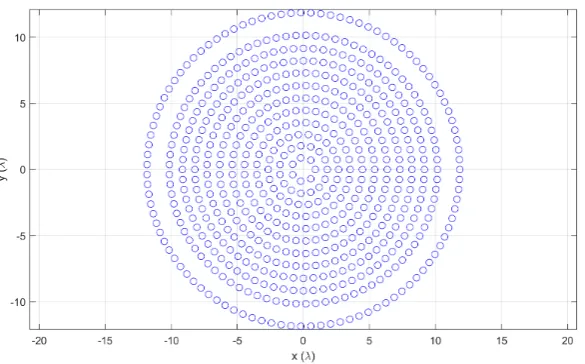
Figure 2. Layout of the 597 element sparse array. Each radiator is represented by a circle of half wavelength diameter.
Figure 3.Plot of theφ−cuts of the array factor for the 597 element array.
d= [0.1, 0.5, 0.99, 1, 0.99, 0.5, 0.1]and the tolerance factor isη=max(|˜xp|/100). All the minimizations
have been solved by means of CVX [58] in Matlab.
5.1. Large array with variable excitation
In the first example we will consider the synthesis of a sparse array with the same specification of the 718 elements array of [39]; this sparse array is able to radiate a pattern with a side lobe level lower than -37.05dB forw≥0.074. By means of the proposed approach we are able to synthesize a sparse array of 597 elements organized in 12 rings (Fig.2), that satisfies the same specifications with a reduction of the radiating elements number of about 17% with respect to the reference layout.
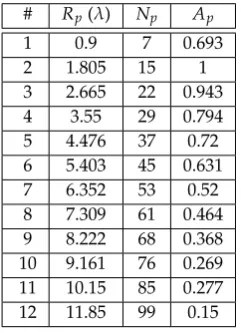
In particular, the parameters of the found array are provided in table1. The minimum, average and maximum spacing between the rings are, respectively, 0.860λ, 0.995λand 1.700λ. The dynamical
ratio of the excitations, the ratio of the maximum and minimum excitation of the elements, is 16.5dB. The array factor of the synthesized array is displayed in figures3and4. It is interesting to observe from Fig.3that theφ−cuts are perfectly superimposed up to about 56◦, confirming the fact that the
Bessel function terms other than the zero order ones are correctly limited by the right choice of the element number per ring.
The calculation of the layout is very quick, ten iterations are needed and each iteration took about 10 seconds on an Intel i7 8700k processor.
5.2. Small Isophoric Sparse Array
Figure 4. Imagemap of the array factor in theu,vplane for the 597 element array. The dual tone (pink/cyan) colormap does not show any violation of the SLL constraint out of the main beam.
Table 1.Parameters of the synthesized 597 element array.
# Rp(λ) Np Ap
1 0.9 7 0.693
2 1.805 15 1
3 2.665 22 0.943 4 3.55 29 0.794 5 4.476 37 0.72 6 5.403 45 0.631 7 6.352 53 0.52 8 7.309 61 0.464 9 8.222 68 0.368 10 9.161 76 0.269 11 10.15 85 0.277 12 11.85 99 0.15
Table 2.Parameters of the synthesized 167 element array.
# Rp(λ) Np
1 1.127 14
2 1.85 22
3 2.7 27
4 3.5 27
5 4.317 29
6 5.45 48
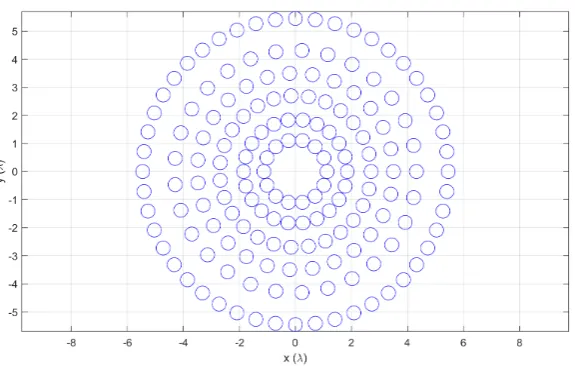
In particular, the parameters of the found array are provided in table2. The minimum, average and maximum spacing between the rings are, respectively, 0.72273λ, 0.86454λand 1.1333λ. The array
factor of the synthesized array is displayed in figures6and7.
It is worth noting that the calculation of the layout is almost instantaneous, only three iterations are needed and each iteration took less than 2 seconds on an Intel i7 8700k processor.
5.3. Very Large Isophoric Sparse Array
In this section we instead will discuss the synthesis of a large sparse array with constant element excitation, with a diameter of about 290λ. To the best knowledge of the authors, there are no results
available in the open literature with sparse arrays of these dimensions, confirming the capability of the proposed approach to handle synthesis problems of very high size.
The particular array sought should be able to radiate a pencil beam with a side lobe level lower than -30dB forw≥0.005, and to scan it on the whole earth surface from GEO orbit, always satisfying the SLL constraint within the Earth’s surface (that is seen a solid angle of about 8.5◦(deg) radius). For this reason the synthesis will be performed in the angular region withwmax = 0.287, following the
guidelines in [31].
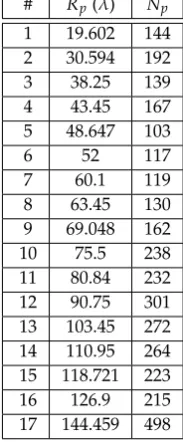
By means of the proposed approach we are able to synthesize a sparse array of 3516 elements organized in 17 rings, see figure8, that perfectly satisfies the same chosen specifications.
In particular, the parameters of the found array are provided in table3. The minimum, average and maximum spacing between the rings are, respectively, 3.350λ, 7.804λand 17.559λ. The array
Figure 6.Plot of theφ−cuts of the array factor for the 167 element array.
Figure 8. Layout of the 3516 element sparse array. Each radiator is represented by a circle of half wavelength diameter.
Table 3.Parameters of the synthesized 3516 element array.
# Rp(λ) Np
1 19.602 144 2 30.594 192 3 38.25 139 4 43.45 167 5 48.647 103
6 52 117
7 60.1 119
8 63.45 130 9 69.048 162
10 75.5 238
11 80.84 232 12 90.75 301 13 103.45 272 14 110.95 264 15 118.721 223 16 126.9 215 17 144.459 498
In this case the calculation of the layout is slower than the previous cases, 41 iterations are needed and each iteration took about 70 seconds on an Intel i7 8700k processor, but considering the dimension of the achieved layout this is indeed an excellent result.
6. Discussion and Conclusions
A very efficient algorithm for the synthesis of sparse array has been presented.
The approach is capable of synthesizing sparse arrays with variable or constant excitation of the element, allowing the satisfaction of circularly symmetrical constraints for the upper bounds of the pattern.
Figure 9.Plot of theφ−cuts of the array factor for the 3516 element array.
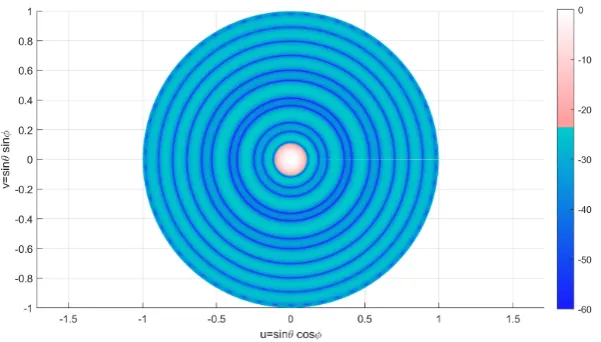
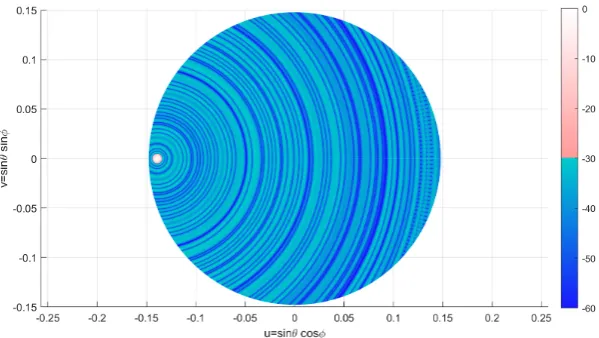
Figure 10.Imagemap of the array factor for the broadside beam in theu,vplane for the 3516 element array. Only the inner part of theu,vplane, relative to Earth’s surface as seen from GEO orbit is displayed.
Furthermore the very high computational efficiency of the approach allows to face also problems of very large size: in one of the examples a sparse planar array of about three hundred wavelengths is demonstrated, and in other numerical tests, not shown here for sake of brevity, we were able to synthesize even larger arrays.
In a future development we plan to extend the proposed synthesis method to the case of shaped beams.
Author Contributions:D.P., M.D.M. and G.P. conceived the method; D.P. wrote the numerical code and performed the array syntheses; M.D.M, M.L. and F.S. helped with the comparison with other approaches-; D.P., G.P., F.S. and M.D.M. wrote the paper.
This paper has been supported by the MIUR program “Dipartimenti di Eccellenza 2018-2022”.
Conflicts of Interest:“The authors declare no conflict of interest.”
1. Weber, R.H.; Weber, R.Internet of things; Vol. 12, Springer, 2010.
2. Pinchera, D.; Migliore, M.D.; Schettino, F.; Panariello, G. Antenna Arrays for Line-of-Sight Massive MIMO: Half Wavelength Is Not Enough. Electronics2017,6.
3. Larsson, E.G.; Edfors, O.; Tufvesson, F.; Marzetta, T.L. Massive MIMO for next generation wireless systems. IEEE Communications Magazine2014,52, 186–195.
4. Zhao, D.; Jin, T.; Dai, Y.; Song, Y.; Su, X. A Three-Dimensional Enhanced Imaging Method on Human Body for Ultra-Wideband Multiple-Input Multiple-Output Radar. Electronics2018,7, 101.
5. Haupt, R.L. Thinned arrays using genetic algorithms. Antennas and Propagation, IEEE Transactions on1994, 42, 993–999.
6. Trucco, A.; Omodei, E.; Repetto, P. Synthesis of sparse planar arrays. Electronics Letters1997,33, 1834–1835. 7. Bray, M.G.; Werner, D.H.; Boeringer, D.W.; Machuga, D.W. Optimization of thinned aperiodic linear phased arrays using genetic algorithms to reduce grating lobes during scanning.Antennas and Propagation, IEEE Transactions on2002,50, 1732–1742.
8. Migliore, M.D.; Pinchera, D.; Schettino, F. A simple and robust adaptive parasitic antenna.IEEE Transactions on Antennas and Propagation2005,53, 3262–3272.
9. Chen, K.; He, Z.; Han, C.C. A modified real GA for the sparse linear array synthesis with multiple constraints. Antennas and Propagation, IEEE Transactions on2006,54, 2169–2173.
10. Quevedo-Teruel, O.; Rajo-Iglesias, E. Ant colony optimization in thinned array synthesis with minimum sidelobe level. Antennas and Wireless Propagation Letters, IEEE2006,5, 349–352.
11. Migliore, M.D.; Pinchera, D.; Schettino, F. Improving Channel Capacity Using Adaptive MIMO Antennas. IEEE Transactions on Antennas and Propagation2006,54, 3481–3489.
12. Haupt, R.L. Optimized element spacing for low sidelobe concentric ring arrays. IEEE Transactions on Antennas and Propagation2008,56, 266–268.
13. Reyna, A.; Panduro, M.A.; Del Rio, C. Design of concentric ring antenna arrays for isoflux radiation in GEO satellites. IEICE Electronics Express2011,8, 484–490.
14. Goudos, S.K.; Siakavara, K.; Samaras, T.; Vafiadis, E.E.; Sahalos, J.N. Sparse linear array synthesis with multiple constraints using differential evolution with strategy adaptation.Antennas and Wireless Propagation Letters, IEEE2011,10, 670–673.
15. Cen, L.; Yu, Z.L.; Ser, W.; Cen, W. Linear aperiodic array synthesis using an improved genetic algorithm. Antennas and Propagation, IEEE Transactions on2012,60, 895–902.
16. Zhang, L.; Jiao, Y.C.; Chen, B. Optimization of concentric ring array geometry for 3D beam scanning. International Journal of Antennas and Propagation2012,2012.
17. Manica, L.; Anselmi, N.; Rocca, P.; Massa, A. Robust mask-constrained linear array synthesis through aninterval-based particle SWARM optimisation.Microwaves, Antennas & Propagation, IET2013,7, 976–984. 18. Chen, K.; Chen, H.; Wang, L.; Wu, H. Modified real ga for the synthesis of sparse planar circular arrays.
IEEE Antennas Wirel. Propag. Lett2016,15, 274–277.
20. Polo-López, L.; Córcoles, J.; Ruiz-Cruz, J.A. Antenna Design by Means of the Fruit Fly Optimization Algorithm.Electronics2018,7, 3.
21. Leahy, R.M.; Jeffs, B.D. On the design of maximally sparse beamforming arrays. Antennas and Propagation, IEEE Transactions on1991,39, 1178–1187.
22. Marchaud, F.B.; De Villiers, G.D.; Pike, E.R. Element positioning for linear arrays using generalized Gaussian quadrature. Antennas and Propagation, IEEE Transactions on2003,51, 1357–1363.
23. Liu, Y.; Nie, Z.; Liu, Q.H. Reducing the number of elements in a linear antenna array by the matrix pencil method. IEEE Transactions on Antennas and Propagation2008,56, 2955–2962.
24. Oliveri, G.; Donelli, M.; Massa, A. Linear array thinning exploiting almost difference sets.Antennas and Propagation, IEEE Transactions on2009,57, 3800–3812.
25. Angeletti, P.; Toso, G. Synthesis of circular and elliptical sparse arrays. Electronics Letters2011,47, 304–305. 26. Yang, K.; Zhao, Z.; Liu, Y. Synthesis of sparse planar arrays with matrix pencil method. Computational
Problem-Solving (ICCP), 2011 International Conference on. IEEE, 2011, pp. 82–85.
27. Bucci, O.M.; Perna, S.; Pinchera, D. Advances in the deterministic synthesis of uniform amplitude pencil beam concentric ring arrays.IEEE Transactions on Antennas and Propagation2012,60, 3504–3509.
28. Guo, H.; Guo, C.J.; Qu, Y.; Ding, J. Pattern synthesis of concentric circular antenna array by nonlinear least-square method. Progress In Electromagnetics Research2013,50, 331–346.
29. Oliveri, G.; Bekele, E.T.; Robol, F.; Massa, A. Sparsening Conformal Arrays Through a Versatile-Based Method. Antennas and Propagation, IEEE Transactions on2014,62, 1681–1689.
30. Angeletti, P.; Toso, G.; Ruggerini, G. Array antennas with jointly optimized elements positions and dimensions part II: Planar circular arrays.IEEE Transactions on Antennas and Propagation2014,62, 1627–1639. 31. Bucci, O.M.; Isernia, T.; Perna, S.; Pinchera, D. Isophoric sparse arrays ensuring global coverage in satellite
communications. Antennas and Propagation, IEEE Transactions on2014,62, 1607–1618.
32. Liu, Y.; You, P.; Zhu, C.; Tan, X.; Liu, Q.H. Synthesis of sparse or thinned linear and planar arrays generating reconfigurable multiple real patterns by iterative linear programming. Progress In Electromagnetics Research 2016,155, 27–38.
33. Bucci, O.; Perna, S.; Pinchera, D. Interleaved Isophoric Sparse Arrays for the Radiation of Steerable and Switchable Beams in Satellite Communications. IEEE Transactions on Antennas and Propagation2017. 34. Pinchera, D.; Migliore, M.D. Comparison Guidelines and Benchmark Procedure for Sparse Array Synthesis.
Progress In Electromagnetics Research M2016,52, 129–139.
35. Caorsi, S.; Lommi, A.; Massa, A.; Pastorino, M. Peak sidelobe level reduction with a hybrid approach based on GAs and difference sets. Antennas and Propagation, IEEE Transactions on2004,52, 1116–1121. 36. Donelli, M.; Caorsi, S.; DeNatale, F.; Pastorino, M.; Massa, A. Linear antenna synthesis with a hybrid
genetic algorithm. Progress In Electromagnetics Research2004,49, 1–22.
37. D’Urso, M.; Isernia, T. Solving some array synthesis problems by means of an effective hybrid approach. Antennas and Propagation, IEEE Transactions on2007,55, 750–759.
38. Bucci, O.M.; Pinchera, D. A generalized hybrid approach for the synthesis of uniform amplitude pencil beam ring-arrays. IEEE Transactions on Antennas and Propagation2012,60, 174–183.
39. Liu, J.; Zhao, Z.; Yang, K.; Liu, Q.H. A hybrid optimization for pattern synthesis of large antenna arrays. Progress In Electromagnetics Research2014,145, 81–91.
40. Bucci, O.M.; Perna, S.; Pinchera, D. Synthesis of isophoric sparse arrays allowing zoomable beams and arbitrary coverage in satellite communications.IEEE Transactions on Antennas and Propagation2015, 63, 1445–1457.
41. Pinchera, D.; Perna, S.; Migliore, M.D. A Lexicographic Approach for Multi-Objective Optimization in Antenna Array Design.Progress In Electromagnetics Research M2017,59, 85–102.
42. Baraniuk, R.G. Compressive sensing. IEEE signal processing magazine2007,24.
43. Zhang, W.; Li, L.; Li, F. Reducing the number of elements in linear and planar antenna arrays with sparseness constrained optimization. Antennas and Propagation, IEEE Transactions on2011,59, 3106–3111. 44. Oliveri, G.; Massa, A. Bayesian compressive sampling for pattern synthesis with maximally sparse
non-uniform linear arrays.IEEE Transactions on Antennas and Propagation2011,59, 467–481.
46. Oliveri, G.; Carlin, M.; Massa, A. Complex-weight sparse linear array synthesis by Bayesian compressive sampling. IEEE Transactions on Antennas and Propagation2012,60, 2309–2326.
47. Carlin, M.; Oliveri, G.; Massa, A. Hybrid BCS-deterministic approach for sparse concentric ring isophoric arrays.IEEE Transactions on Antennas and Propagation2015,63, 378–383.
48. D’Urso, M.; Prisco, G.; Tumolo, R.M. Maximally Sparse, Steerable, and Nonsuperdirective Array Antennas via Convex Optimizations. IEEE Transactions on Antennas and Propagation2016,64, 3840–3849.
49. Bencivenni, C.; Ivashina, M.; Maaskant, R.; Wettergren, J. Synthesis of maximally sparse arrays using compressive sensing and full-wave analysis for global earth coverage applications. IEEE Transactions on Antennas and Propagation2016,64, 4872–4877.
50. Pinchera, D.; Migliore, M.D.; Lucido, M.; Schettino, F.; Panariello, G. A Compressive-Sensing Inspired Alternate Projection Algorithm for Sparse Array Synthesis.Electronics2016,6, 3.
51. Zhao, X.; Yang, Q.; Zhang, Y. A hybrid method for the optimal synthesis of 3-D patterns of sparse concentric ring arrays.IEEE Transactions on Antennas and Propagation2016,64, 515–524.
52. Pinchera, D.; Migliore, M.D.; Schettino, F.; Lucido, M.; Panariello, G. An Effective Compressed-Sensing Inspired Deterministic Algorithm for Sparse Array Synthesis.IEEE Transactions on Antennas and Propagation 2018,66, 149–159.
53. Pinchera, D.; Migliore, M.D.; Panariello, G. Synthesis of Large Sparse Arrays Using IDEA (Inflating-Deflating Exploration Algorithm). IEEE Transactions on Antennas and Propagation 2018, 66, 4658–4668.
54. Balanis, C.Antenna Theory: Analysis and Design; Wiley, 2015.
55. Fuchs, B. Synthesis of sparse arrays with focused or shaped beampattern via sequential convex optimizations. IEEE Transactions on Antennas and Propagation2012,60, 3499–3503.
56. Prisco, G.; D’Urso, M. Maximally sparse arrays via sequential convex optimizations. IEEE Antennas and Wireless Propagation Letters2012,11, 192–195.
57. Migliore, M.D. On the sampling of the electromagnetic field radiated by sparse sources. IEEE Transactions on Antennas and Propagation2015,63, 553–564.