Lyman C. Johnston,
DC, FICC, FCCS(C)
:
Canadian chiropractic’s postural research
pioneer and inventive entrepreneur
Douglas M. Brown,
DC, FICC*
This paper profiles Dr. Lyman Johnston and his contributions in the field of chiropractic research. Postural concepts, diagnostic instruments, therapeutic devices and treatment protocols are reviewed. Set out and briefly discussed are the Posturometer, Pyramidal Man, anterior-posterior gravity line, Postural Spinal Index, tension master, Spine Power Belt and the Mini-Gym.
(JCCA 2001; 45(1):42–52)
K E YW O R D S: chiropractic, posture, Lyman Johnston.
Le présent article trace un portrait du Dr Lyman
Johnston et fait état de son apport à la recherche en chiropratique. On y traite des concepts relatifs à la posture, des instruments diagnostiques, des appareils thérapeutiques et des protocoles de traitement. Il sera question plus particulièrement du posturomètre, du « Pyramidal Man », de la ligne de gravité antéro-postérieure, de l’index postural de la colonne vertébrale, du « Tension Master », du « Spine Power Belt » et du petit gymnase (« Mini-Gym »).
(JACC 2001; 45(1):42–52)
M O T S C L É S : chiropratique, posture, Lyman Johnston.
* 2191 Victoria Park Avenue, Scarborough, Ontario M1R 1V5. Phone: 416-447-9001. Fax: 416-445-4982. E-mail: [email protected]
© JCCA 2001. Introduction
Lyman C. Johnston is a complex star in the chiropractic sky. Although he has been shining for over half a century, many practitioners have not seen his light or understood its significance. This paper looks backward to Dr. Johnston’s origins and forward to his current investigations in order to document his remarkable output of postural concepts, di-agnostic instruments, therapeutic devices and treatment protocols. Hopefully, this article will also help to solidify his historic role in the field of chiropractic research.
Background
Dr. Johnston’s grandfather, W.F. Johnston, had been the general manager of Massey Ferguson in Toronto, the larg-est manufacturer of farm equipment in Canada. His father, Halley, and his uncle Howard, both graduated from the University of Toronto (U of T) School of Practical
Sci-ence. Halley and Howard built the first Canadian diesel engine, the Johnston Diesel, which was displayed at the Canadian National Exhibition in Toronto in 1908 and ran non-stop for two weeks. As a result of their interest in farm machinery, the two brothers traveled West. On October 10, 1915, Lyman Johnston was born on his parent’s two section farm near Stettler, Alberta.
to the Beaches area of Toronto in 1929. Lyman finished his primary education at Balmy Beach Public School and spent the next two years at Danforth Technical School. My father, D.M. Brown, taught Lyman English and history and remembered him as a bright, inquisitive, highly ener-getic student, immersed in extra-curricular activities. An-other English teacher, Roy S. Foley, guided Lyman to first prize in a Toronto Secondary School public speaking con-test. The family moved once more to a large, three storey home at 118 Isabella Street and Lyman obtained his Senior Matriculation diploma at Northern Vocational school.
Lyman had intended to follow his father and uncle into the engineering profession by enrolling at the U of T but the Depression intervened and instead he became a clerk in the brokerage firm of Bigger and Crawford, in the Royal Bank Building, 8 King Street West, Toronto. Incidentally, this is the same building where he and Donovan E. Fitz-Ritson, DC, now conduct their Posture Research Institute. Dissatisfied with the brokerage business, Lyman gained employment in the mail room of Barber Ellis, a prominent manufacturer of paper and envelopes. He gained the atten-tion of Mr. Ellis by creating an unique promoatten-tional item for display in store windows and was soon elevated to salesman. Lyman was so successful at opening new
ac-counts that he was sent to Winnipeg, Manitoba, to publi-cize Barber Ellis products to the major catalogue retailers located there.
By this time World War II was well under way and in 1942 Lyman volunteered for the Radar Division of the Royal Canadian Air Force (RCAF). Lyman had developed an interest in the emerging science of electronics and seized this opportunity to expand his knowledge. In the RCAF he studied electronics at McGill University, Québec, the Radar School in St. Mary’s, Ontario and Cor-pus Christie, Texas. Next, Lyman was assigned to the RCAF 354 Squadron and was posted to a Liberator Bomber, where he served as tail-gunner and radar techni-cian. His plane flew out of Calcutta, India, patrolling the shipping lanes to protect the boats bringing troops and supplies into Burma for the Allied push into Japan.
At the war’s end in 1945, Lyman returned to Toronto. He had developed a low back problem and decided to enrol in the Canadian Memorial Chiropractic College (CMCC). Lyman’s mother, Amy Clark Johnston, had been treated successfully by a chiropractor in Lacombe, Alberta, and he saw this as a way to correct his spinal condition while the Canadian Government paid for his four-year education. [Johnston interview, July 29, 1998] He was too late to enter the first semester in September 18, 1945, so began his chiropractic studies in January 1946, graduating in January 1950. While a student, he was a member of the Research Council, wrote the music for the school song, and won the J.M. Wallace Research Award.1
Immediately after graduation, Dr. Johnston began teaching physiology at CMCC. He went on to tackle most of the courses in the curriculum and spent a lot of time working in the clinic. He became Director of Research in 1958 and held that position until 1975 when he retired from the full-time faculty.2 At convocation that year Dr.
Johnston was named Professor Emeritus and remained on the faculty of Applied Chiropractic Studies until 1986.3
(Figure 1)
Inventions
After three years at CMCC Dr. Johnston’s back problems were worse and he began to search for answers. While still a student he created an electronic palpator, which utilized a galvanometer to measure small quantities of electricity on the skin’s surface. In his third year he began his long study into bipedal posture and the effects of gravity upon it. His
first measuring device was the Kinesiometer. This con-sisted of a tilting platform upon which the subject stood to gauge the pedal centre of gravity. A fulcrum beneath the platform was moved by a handle at the front until the individual was balanced. Deviation from the centre of gravity was shown in linear terms; inches or centimeters. Previously, twin foot scales had been used to measure the disparity of weight bearing from one foot to the other in pounds or kilograms, however, this did not reveal the loca-tion of the centre of gravity.
Realizing the limitations of one and two-dimensional data obtained from plumb lines and x-rays, in the late 1950’s Dr. Johnston started work on his Posturometer and spent the next twenty years improving and simplifying his three-dimensional method of spinal analysis.
His system was based on the work of Moshe Felden-krais, who viewed the human body as “... three pyramids with their bases uppermost, balanced on top of one
an-other.”4 From this Dr. Johnston coined the term,
“Pyrami-dal Man.” (Figure 2) He taught that when these 3 pyramids are properly aligned, the centre of gravity extends from C7 upward through the odontoid process of C2 to the centre of the skull, and downward to the centre of the sacrum, through the acetabulae, knees, mid longitudinal arches of the feet to the proximal ends of the 5th metatarsals. Dr. Johnston called this optimal gravitational adaptation (OGA) and his Posturometer was designed to assess each of the 3 pyramids to measure any tilt, rotation or displace-ment which would disturb their symmetry and reduce OGA. He found that OGA only occurred when there was no scoliosis.
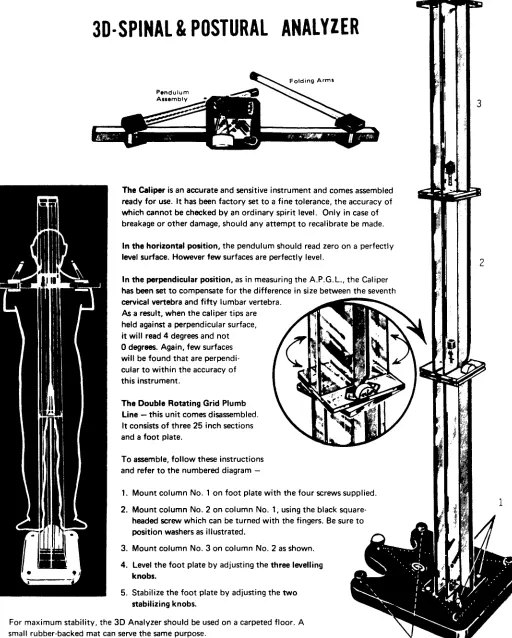
In its final form the Posturometer consisted of two main components. The first part was a caliper bar with movable, folding arms on each end, centered by a pendulum to cal-culate vertical discrepancies in degrees. The second was a double rotating grid plumb line to determine rotations in centimeters. The grid was mounted on an adjustable foot-plate to provide a level base and standardize placement of the subject’s feet. (Figure 3)
The Posturometer recorded ten indices: head level and rotation; shoulder level and rotation; pelvic level and rota-tion; lateral deviation of C7; lateral deviation of L5; antero-posterior (AP) deviation of C 7; and AP deviation of L5. The last two indices (9 and 10) were automated to produce one reading called the antero-posterior gravity line (APGL). The first six indices were recorded in de-grees; the last four in centimeters. The total of the ten indices was termed the Postural Spinal Index (PSI) and ranged from perfect (0) to very poor (over 21). The point of gravitational stress at L5 was found at the junction of the lateral and antero-posterior gravity lines.
To illustrate his concepts Dr. Johnston created drawings of the “Pyramidal Man,” and in 1959 produced, “The Key to 3D Spinal and Postural Nomenclature,” wall chart. This depicted four classes of lateral spinal configurations and four corresponding AP categories. (Figure 4)
The 1950’s were Dr. Johnston’s most prolific period. Besides the Posturometer he created the Posturizer, the Electromyo Percussor (Tension Master), a device for cer-vical traction and a traction chair. Dr. Johnston claimed that his Posturizer exercised 179 muscles and 182 articula-tions. It consisted of a bench with an elevated brace and pulley at its head, through which ran a doubled nylon rope. At the ends of the rope were 2 handles and at the doubled end an ankle strap. The subject lay supine with a rope
handle in each hand, the strap attached to both ankles. The exercises consisted of a variety of ways of repetitively pulling the arms down and up, causing the legs to go up and down. Because the rope was adjusted so that when the arms were fully extended over the head, the feet remained 18" or no less than 30° from the horizontal plane, abdomi-nal muscles were exercised and traction exerted on the spine without straining the low back. Later Dr. Johnston developed a portable version which he called the Mini-Gym. Here the pulley was attached to a door knob, the individual lying supine on the floor with the head toward the door. This became a best-seller through television ad-vertising. (Figure 5)
In the early 1950’s Dr. Johnston created the Electromyo Percussor or Tension Master. He got this idea from a hand-held instrument sold to dentists. This machine had a small hammer which went up and down but the force was inad-equate and the speed too fast to use on the human body. Dr. Johnston designed a much larger, heavier model, with a powerful motor running at 24 cycles a second, producing deep percussion at a slower rate, more in harmony with the body’s rhythms. He also placed the handles at the point of no motion so that energy would not be transmitted into the user’s body. Dr. Johnston used his percussor in conjunc-tion with an electronic skin galvanometer to identify tight muscles and found that releasing tension in the thighs was an important key to reducing spinal imbalance and correcting low back problems. A similar appliance, called the Thumper, is now widely available from an-other manufacturer.
Dr. Johnston’s cervical traction apparatus hung from the top of a door. The subject sat in a chair. A harness was tied around the base of his skull and below the jaw, attached by a rope to a pulley at the top of the door which ran down to a t-bar held under the knees. The individual controlled the amount of traction he received by raising and lowering his knees. Dr. Johnston also created a traction chair for treat-ing discogenic low back problems. This chair was tilted backward and downward. When the patient sat down the seat would fall away causing the patients buttocks to sag through the opening, exerting traction on the lumbo-sacral spine. The traction was controlled by a belt fastened under the person’s rib cage and attached to the chair back.
In 1970 Dr. Johnston began to develop an electronic device to re-educate patients with posterior gravity line deviations. This idea was refined by Dr. Drum, Victor
Celeste, DC, and Brian J. Nelson, DC, and was patented by them in 1975 as a “Slumpmeter.” It was attached to the subject’s low back and adjusted to beep or vibrate when the depth of the individual’s AP spinal curves passed a pre-set limit. This prompted the patient to flatten his spine to correct the posterior gravity line and stop the signal. In 1978 it was purchased by the United States Army as a posture training instrument. [Drum correspondence, Oct. 3, 2000]
Dr. Johnston has been refining his Spine Power Belt since 1979. This is a lumbo-sacral (trochanteric) support designed to control low back problems by stabilizing lax pelvic ligaments. Dr. Johnston now calls it the Spine Power Pelvic Orthotic because he believes it also supports the pelvic bones, thereby realigning and strengthening the low back. He says it can also be used for differential diag-nosis. If you put the Belt on and the symptoms are relieved then the condition is probably mechanical. Dr. Johnston created the prototypes for every part of the 3 inch buckle used to lock his Belt in place and uses material for the belt with a test strength of 4,000 pounds. So far he has sold over ¼ million around the world.
In 1994 Dr. Johnston produced an animated, computer-generated, three-dimensional video depicting motion of the spiral or helical spine to illustrate the theory he first proclaimed in 1966.
Publications
Dr. Johnston has produced numerous documents to ex-plain his concepts. In 1961 he wrote, “The Theory and Practice of Postural Measurement,” Toronto.
His first journal publication, “The Gravity Line in Relation to A.P. Posture,” came out in 1962,5 and
de-clared, “The location of the gravity line ... one of the most important discoveries of our Five Year Postural Research Program ...”
In 1966 “The Paradox of the Functional Spine,” was issued.6 This paper used the drafting technique of plan
shape prompted him to call for a reconsideration of current views about the form and function of the human spine.
In 1967 Dr. Johnston outlined the results of the first statistical research conducted at CMCC to determine the relationship between equilibrium and spinal function.7
Posterior disequilibrium (posterior gravity line) was found in 67% of 1000 low back cases in the College outpatient clinic. 87% of those with a posterior gravity line of 4 centimeters or more, had a specific type of low back pa-thology. He announced, “... the treatment of such cases
was never completely satisfactory unless ... the posterior gravity line was corrected.”
In 1971 Dr. Johnston published the “Spinal Response Factor.”8 After 15 years of developing and testing devices
for measuring the spine and posture he found evidence that the spine reacted to stress by lengthening. Because gravity is the spine’s basic stressor, he decided to investigate how the spine responded to increased gravitational stress when the body was moved from a semi-reclining to a vertical position. To accomplish this he constructed a chair in
which the subject could be placed in a vertical position, tilted backward 22½° and returned to the vertical, thereby varying spinal gravitational stress. Changes in length be-tween the seat of the chair and the top of the subject’s head were detected by an arm resting on top of the head, at-tached to a potentiometer and documented on a graph by a Rustrack recorder. Of 50 adults chosen at random, 42 showed a definite homeostatic response, their spines short-ening in the semi-reclining position and lengthshort-ening when returned to the vertical. From these experiments Dr, Johnston concluded that spinal gravitational homeostasis is a consistently measurable reality in most healthy adults.
Substantiation
In 1962, A. Earl Homewood, DC, published the results of a study he had conducted on 29 Judo club members. This was the first article in which someone other than Dr. Johnston had utilized the Posturometer. Dr. Homewood took nine basic Posturometer measurements of these indi-viduals. About four months later, “The recheck of this group, following instruction and practice of Judo, demon-strated a significant improvement in the Posterior Gravity Line, but little change in the other structural deviations.”9
In 1964 W. Heath Quigley, DC, described a preliminary study conducted by CMCC where the Posturometer was used in conjunction with the Cornel Index N–2 to test a group of 40 chiropractors attending a seminar, in an at-tempt to determine if there was a relationship between posture and mental health. Dr. Quigley found, “... a signifi-cant relationship between posture and mental health, at least as we measured it. Further calculation revealed that such a finding was most unlikely due to chance alone.”10
Later that same year, Gary M. Gleeson, DC, reported on his use of the Posturometer and Posturizer.”11 Dr. Gleeson
chose 10 CMCC students for this project. Among other things, Dr. Gleeson recorded the subjects AP gravity lines as measured by the Posturometer and compared them to the AP gravity lines determined in relation to the centre of the fifth lumbar disc on x-ray, on a weekly basis for seven weeks. During this time the subjects were exercising with the Posturizer (Mini-Gym) from 3 to 5 times a week. Un-der Conclusions, Dr. Gleeson found “... the Posturometer is an accurate instrument to evaluate the changes in struc-tural balance in relation to gravity made by exercise ...” He also stated that, “Use of the posturizing Mini-Gym showed an improvement in the A.P. gravity line position in relation
to the fifth lumbar disc ... The intervertebral discs are pumped during the exercise and show a tendency to ‘plump up’.”
Chiropractic Economics, September–October 1966, contains an article describing the reductions in spinal inju-ries and related costs to the Michigan, USA, firms of Lefere Forge and Machine Company and the Culligan Water Conditioning Company, by instituting pre-employ-ment examinations, conducted by LE Allen, DC, for the previous three years. Dr. Allen states that he is in agree-ment with Dr. Johnston’s spiral spine theories and uses the Posturometer and x-rays in his evaluations.12
In 1968 Oleh H. Jochumsen, DC, verified Dr. Johnston’s categories of “I”, “C”, “S” and “Z” spines, by taking thoraco-lumbar radiographs of a dry spine which had been configured to reproduce these four classifica-tions. Although Dr. Jochumsen was unable to take the above-down x-rays necessary to reveal the spiral spine he declared three dimensional analysis of scoliotic spines necessary to comprehend their true shape.13
In 1968 David C. Drum, DC, published a paper, with the assistance of Dr. Johnston, on the posterior gravity line syndrome. It affirms under Conclusions, “On the basis of this research it may be concluded that the great majority of chiropractic patients and, in fact, the general population, possess posterior gravity lines (approximately 80%). The degree of posterior gravitational deviation shows a general trend to worsen as low back symptoms appear.”
In 1970 Herbert J. Vear, DC, disclosed the results of a survey of 480 students from 4 different high schools. This was the first study of teenagers which utilized Johnston’s Posturometer to determine a modified Postural Stress In-dex (PSI) of each student. Under Conclusion, Dr. Vear notes the percentage of teenagers with a posterior gravity line (PGL) was 67.5%, a figure almost identical to the findings of Gleeson and Johnston for adults.15
In a 1970 article, “Posture and Postural Mechanics,” Adrian S. Grice, DC, questions the accuracy of Dr. Johnston’s statement that the gravity line of the human body in perfectly balanced posture passes through the cen-tre of the fifth lumbar disc.16 Although Dr. Grice argues
In 1982, Howard Vernon, DC, examined the construc-tion and reliability of the Posturometer in the assessment of static posture.18 Dr. Vernon found the Posturometer
carefully constructed to measure inclination of the body in the horizontal and sagittal planes. However, because the instrument is operator-intensive Dr. Vernon considered the problem of temporal reliability or reproducibility, most critical. Eighty CMCC students were selected, divided into symptomatic and asymptomatic groups and shoulder and pelvic levels were recorded using a specific protocol. Complete intra-observer agreement in the whole sample occurred 66% of the time while complete inter-observer agreement in the whole group was 75.5%. Dr. Vernon states under Discussion, that the Posturometer produces a reasonable level of reliability for the qualitative measure-ment of inclination and recommends its use in postural assessment provided care is taken to follow a standardized procedure.
In 1996, Donovon E. Fitz-Ritson, DC, evaluated the effectiveness of trochanteric supports to alleviate pain and increase strength in patients with low back pain.19 Five
patients were selected with musculo-skeletal low back pain. First they rated their current pain intensity by mark-ing the Visual Analog Scale (VAS). Then they were in-structed to do standing near and high lifts which were measured with the Arcon-ST, static strength testing sys-tem. Next the patients were fitted with Spine Power Belts and re-tested on the near and high lifts. Immediately after-ward they again marked the VAS scale. Under Results, Dr. Fitz-Ritson notes the Spine Power Belt produced an aver-age increase in near lifting strength of 35% and 27% for the high lift. VAS scores were improved by 15%.
Treatment protocol
Dr. Johnston is convinced that the body has gross torsions which produce all spinal subluxations and that these can be corrected by reducing the scoliosis. [Interview, July 29, 1998] For 35 years he has continued his search for new ways to identify these distortion patterns and therapeutic procedures to alleviate them. Besides the Posturometer and electronic audio galvanometer, he has developed other means such as the Belt-Chair Test, the Buttock-Wall Test and the Laser Light Test for spinal analysis. His manipula-tion tends to be general, rather than specific and he em-ploys the Spine Power Belt and Mini-Gym, combined with percussion and traction for muscle and ligament
retrain-ing. In addition, Dr. Johnston believes in the value of nutri-tional and emonutri-tional balance and utilizes a system of psy-chological counseling in conjunction with muscle tension release and word association techniques.
Because his treatment approach is so eclectic, it is hard to pin Dr. Johnston’s treatment protocol down to specifics and his written work provides few clues. A 1971 article credited to Carl G. Phillips, DC, asserts, “Well docu-mented clinical studies involving correction of exagger-ated spinal curvatures have been performed by C.G. Phillips ... After recording close to 1000 sequential posturanalyses on the Posturometer, he has evolved an integrated adjustive-exercise postural corrective proce-dure which consistently reduces his patients’ postural stress indices (PSI).”20 Although none of the studies or
corrective procedures are mentioned in the paper, some of his diagnostic, manipulative and exercise methods, along with a sample of his pre and post treatment Posturometer records can be found on a 1971 videotape in the CMCC library.21
Dr. David Drum worked closely with Dr. Johnston for 20 years and his articles are more illuminating. Between 1970 and 1971 he produced 3 papers on the “Conservative Management of Lumbar Disc Degeneration.”22,23,24 These
document the case histories of 10 patients with various forms of lumbar disc disease. He details the symptoms, physical, orthopaedic, neurologic and x-ray findings of each case, followed by the diagnosis, therapeutic tech-niques and outcomes. In the last paper, Dr. Drum summa-rizes the diagnosis and treatment of acute and chronic lumbar disc herniation. Most of his descriptions of spinal manipulations are brief: “spinal rotational manipulation,” “light adjustment,” and ”spinal hook manipulation.” Dr. Drum explains that “succussion” is borrowed from Hippocrates. “Through manual and semi-automated tech-niques we succuss spinal discs in passive, massaging, ver-tically-orientated motion that mimics the pumping action of healthy, young discs.”25 and notes that “The disc
tech-niques and clinical procedures are regularly demonstrated at our 3D seminar series sponsored by the ... Canadian Memorial Chiropractic College.” Detailed demonstrations of specific diagnostic and clinical methods can be seen on two of Dr. Drum’s 1971 CMCC videotapes.26 These
on the intervertebral discs.
Colleagues
Throughout his career Dr. Johnston has collaborated with several prominent CMCC academics. The first of these was Dr. Earl Homewood, who was teaching chiropractic technique and anatomy at the College when Dr. Johnston enrolled in 1946. Later, Dr. Homewood would be named Administrative Dean and Chairman of the Board.27 Dr.
Homewood formally endorsed Dr. Johnston’s work in 1964 when he conducted, “A Posturometer Survey,”and the following year was a major contributor in writing, “The Paradox of the Functional Spine.” [Johnston inter-view, July 29, 1998]
Dr. Herbert J. Vear graduated from CMCC 8 months ahead of Dr. Johnston in May 1945. He returned to the College in 1957 as a part-time pathology instructor and became Dean in 1969.28 In 1970, as the College’s first
CEO, he used Dr. Johnston’s methods to conduct, “A Study of Postural Indices in Adolescents.” He remembers Dr. Johnston’s admonition, “If you can’t measure it, it doesn’t exist,” and wants Dr. Johnston to be remembered as the first Canadian chiropractic biomechanical scientist. [Vear interview, September 15, 1999]
Dr. Donald Fitz-Ritson is a 1979 graduate of CMCC, has been involved with Dr. Johnston since 1977, and is associated with the Posture Research Institute. Besides Dr. Fitz-Ritson’s 1996 pilot study on, “The Effect of Tro-chanteric Support on Low Back Strength,” he has col-lected unpublished data on low back patients who were divided into two groups. Group I was treated using the Belt, specific exercises, “spinal de-torquing” and manipu-lation. Group II received the same treatment without the Belt. 81% of group I were pain free by the end of the 12th week of treatment compared with 67% of group II.
Dr. Fitz-Ritson considers Dr. Johnston one of the most brilliant chiropractors he has met. He taught Dr. Fitz-Ritson to ask questions such as, “What am I doing?” and “What do I want to accomplish?” and showed him how to measure and record his observations and the results of his treatment. Dr. Fitz-Ritson believes the profession has ig-nored Dr. Johnston’s accomplishments and failed to heed his advice. He would like to see a chair named in honour of Dr. Johnston at CMCC. [Fitz-Ritson interview, August 24, 1999]
Dr. David C. Drum is one of Dr. Johnston’s greatest
proponents, quoting his mentor in more publications than any other author. In 1963, when Dr. Drum was a CMCC freshman, Dr. Johnston taught him Biogravitational Adap-tation. Dr. Drum was impressed by his pedagogic skills and the depth and breadth of his hypotheses regarding evolution and the effects of gravity on the human spine. He affirms that Dr. Johnston saw a golden opportunity for chiropractic to play a major role in alleviating those effects.
After graduating in 1967, Dr. Drum worked closely with Dr. Johnston for 20 years, clarifying ideas, writing articles and traveling widely with him conducting post-graduate seminars. He observed that besides being an outstanding educator, Dr. Johnston was an inventor who wore many hats. He conceived theories, conducted research, built pro-totypes of his inventions, then marketed and sold them. Almost everything Dr. Drum uses in his current practice was developed by Dr. Johnston.
It is Dr. Drum’s opinion that Dr. Johnston is disap-pointed with the current educational process because it is too narrow to allow chiropractors to deliver the profound societal change he envisions for the profession. Although he is hopeful that Dr. Johnston’s work will endure, he sees two projects necessary for this to occur: that his many inventions be preserved in a museum; and that Dr. Johnston’s ideas be recorded in book form. [Drum inter-view, January 20, 1999]
Discussion
Dr. Drum’s comments pose a provocative question. Will Dr. Johnston’s devices and concepts survive? Bearing in mind that Dr. Johnston is still refining his theories and developing new diagnostic tests and treatment protocols this query is probably presumptuous but nevertheless in-teresting. Currently, the only device he produced that is still for sale is the Spine Power Belt. The Posturometer was found to be a useful, accurate and portable instrument by practitioners as well as researchers however it is not avail-able although an earlier model was copied by others and sold in the United States when production stopped in Canada. Dr. Johnston has explained he has not brought it back on the market because it is too labour intensive to be financially viable.
antigravitational spinal response as geotaxis which is de-fined as, “oriented movement of a motile organism toward or away from a gravitational force.”29 For some time Dr.
Johnston has been working with Dr. Fitz-Ritson at the Posture Research Institute to develop chiropractic spinal manipulation (CSM) designed to trigger geotaxis, reduce the torsion of the spiral spine and resolve acute low back conditions. Dr. Johnston states that his treatment regime has been tested in private practices for several years with a dramatic improvement in results. [Johnston unpublished notes] Although none of the participants are named, some of the results are recorded in an unpublished article from the Posture Research Institute which mentions screening low back patients using “... a lumbo-pelvic strength/coor-dination test ...” It also mentions, “Treatment involved ‘spinal de-torquing’...” Some of these tests and procedures are outlined and explained by text and diagram, in another unpublished document, “Breakthrough Seminar,” by Drs. Johnston and Fitz-Ritson.
Dr. Johnston has reproduced figures credited to the US Agency for Health Care Policy & Research (AHCPR) and the British National Health Services – The Royal College of General Practitioners. These state, “The 1990 costs as-sociated with LBP (low back pain) were in excess of $60 billion in the United States ...” and, “85% of people will be disabled by back pain at some point in their lives ...” while, “Experts acknowledge that traditional management of pa-tients has been disastrous ...” Dr. Johnston is convinced that he has created prophylactic regimes which will enable the chiropractic profession to have a major impact on this epidemic which is exploding 14 times faster than the popu-lation. Unfortunately, because he has not published an up-date on his views since 1971, he, Dr. Fitz-Ritson and Dr. Drum appear to be the only ones who comprehend his revised and expanded strategies. Someone must docu-ment, explain and videotape these procedures, so that others can replicate his findings and allow the world to benefit from Dr. Johnston’s 50 year struggle to solve the conundrum of low back pain.
References
1 CMCC Cornerstone yearbook, December 1945. 2 Perspectives, Lyman Johnston. JCCA 1985; 29(4):217. 3 CMCC Calendars.
4 Feldenkrais M. Body and mature behaviour. Tel-Aviv: Alef, Ltd., 1949: 69.
5 Johnston LC. The gravity line in relation to A.P. posture. JCCA Feb–Mar 1962: 11.
6 Johnston LC. The paradox of the functional spine. JCCA Jun–Jul 1966: 7–10.
7 Johnston LC. Spinal equilibrium. Digest of Chiropractic Economics Jul–Aug 1967: 14, 25.
8 Johnston LC. Spinal response factor. JCCA 1971; 15(4):34–36.
9 Homewood AE. A Posturometer survey. JCCA Dec 1964–Jan 1965: 9–10.
10 Quigley WH. Posture and mental health. ACA Journal of Chiropractic March 1964: 23,24,40.
11 Gleeson GM. A report of findings and observations regarding the use of the posturometer and posturizer. JCCA Oct–Nov, 1964: 10–13.
12 Dollar saving program for industry. Digest of Chiropractic Economics Sep–Oct 1966: 14–16.
13 Jochumsen OH. Radiographic investigation of functional spinal scolioses. Digest of Chiropractic Economics Jan–Feb 1968: 28–29.
14 Drum DC. The posterior gravity line syndrome. JCCA 1968; 12(4):5–7.
15 Vear HJ. A study of postural indices in adolescents. JCCA 1970; 14(1):16–18.
16 Johnston LC. The gravity line in relation to A.P. posture. JCCA Feb–Mar 962: 11.
17 Grice AS. Posture and postural mechanics. JCCA 1970; 14(3):15.
18 Vernon H. Assessment of the intra- and inter-reliability of the Posturometer. J Manipul Physiol Thera 1983; 6(2):57–60.
19 Cogill L, Fitz-Ritson DE. The effect of trochanteric support on low back strength: a pilot study. JCCA 1996; 40(2):104–107.
20 Phillips CG. Spinal realignment procedure. JCCA Dec’71–Jan’72: 30–33.
21 Phillips CG. Spinal re-alignment. CMCC, 1971:AV WB 905.9 S757 VC 1971.
22 Drum DC. Conservative management of lumbar disc degenerations. JCCA Dec 1970: 8–11.
23 Drum DC. Conservative management of lumbar disc degenerations. JCCA Mar 1971: 18–21.
24 Drum DC. Conservative management of lumbar disc degenerations. JCCA July 1971: 12–15.
25 Drum DC. Conservative management of lumbar disc degenerations. JCCA July 1971: 15.
26 Drum DC. Clinical diagnosis of lumbar disc herniation. CMCC, 1971:AV WB 905.9 C541 VC 1971 Tapes 1 & 2. 27 Brown DM. A. Earl Homewood, DC, chiropractic
educator. JCCA 1989; 33(3):143.
28 Keating JC. Herbert J. Vear, D.C., chiropractic scholar. Chiropractic History 1997; 17(1):10.