Rehabilitation – a valuable consideration
in acute and chronic neck and low back pain
in addition to standard chiropractic management:
a case study
Dennis H Mizel,
BSc,DC, FCCRS(C)*
* Mizel Chiropractic Clinic, 320 Vine Street, St. Catharines, Ontario L2M 4T3. Phone (905) 934-7776. Fax (905) 934-7778.
© JCCA 1999.
A case of chronic neck and low back pain, resistant to standard chiropractic management of manipulation/ adjustment and verbal exercise instruction is presented. Identification of psychosocial factors and deconditioning, with a subsequent three month program of in-office rehabilitation including supervised
progressive/resistance exercises and behavioural therapy was administered in conjunction with spinal manipulation/adjustment and passive modalities. The program proved effective in reducing the patient’s neck and low back pain. The beneficial effect of supervised exercises and behavioural therapy in patient
management is illustrated.
(JCCA 1999; 43(1):22–30)
K E YW O R D S: chronic back pain, chronic neck pain, rehabilitation, chiropractic, manipulation, behavioural therapy.
Introduction
Persistence of neuromusculoskeletal disorders, especially lower back pain, into the subacute and into the chronic stages can become a challenge for the chiropractic practi-tioner using passive modalities and manipulation alone.1
Rehabilitation of a back pain patient should focus on normalization of function, not merely relief of symptoms. Management which can prevent the acute condition from
becoming chronic is a cost effective strategy. This sug-gests a comprehensive spinal rehabilitative approach that consists of the following components:
(A) Education to dispel many of the myths and misceptions that patient’s with chronic pain have con-cerning their condition. These fears and concerns can hamper participation in the exercise portion of treat-ment. The main concerns are the fear of re-injury and
Voici un cas de lombalgie et de cervicalgie chroniques, réfractaire au traitement chiropratique usuel faisant appel aux manipulations et aux directives verbales relatives aux exercices à effectuer. On a d’abord décelé des facteurs psychosociaux et une diminution de la forme physique, puis préparé un programme de réadaptation en clinique, d’une durée de trois mois, qui comportait, entre autres, des exercices dosés progressivement et des exercices contre résistance faits sous supervision; à cela s’ajoutait une thérapie comportementale, complétée par des manipulations vertébrales et des exercices passifs. Le programme a porté fruit et a permis une diminution de la lombalgie et de la cervicalgie. Le présent article démontre les effets favorables des exercices faits sous supervision et de la thérapie comportementale.
(JACC 1999; 43(1):22–30)
the belief that the increased discomfort associated with exercising is causing permanent damage to their back. Therefore the “hurt does not equal harm” con-cept is an important part of back education as well as education to reduce exposure to harmful situations; (B) A functional restoration program aimed at improving
the patients functional abilities. Functional restoration has evolved as the new standard in the conservative treatment of chronic, debilitating back pain. These comprehensive programs can be described as a com-bination of therapy, back school, as mentioned above, conditioning, work hardening and behaviour modifi-cations, and
(C) Psychosocial factors which may be responsible for symptom magnification or inactivity such as fear, an-ger and anxiety. Behaviour modification and stress management become part of the treatment.2,3,4,5 Panel recommendations and findings of the Agency For Health Policy and Research Report on low back pain ad-vises that low-stress aerobic exercise can prevent debilita-tion due to inactivity during the first month of symptoms and therefore may help to return patients to the highest level of functioning appropriate to their circumstances. The Bigos report further states that aerobic (endurance) exercise programs which minimally stress the back (walk-ing, bik(walk-ing, or swimming) can be started during the first two weeks for most patients with acute low back problems.6
The panel recommendations of the Bigos report further states that conditioning exercises for trunk muscles (espe-cially back extensors), gradually increased, are helpful for patients with acute low back problems, especially if symp-toms persist. During the first two weeks, the exercise may aggravate symptoms since they mechanically stress the back more than endurance exercises.6
The British Clinical Guidelines for the management of acute low back pain reports patients who have not returned to ordinary activities and work by six weeks should be referred for re-assessment and subsequent reactivation/ rehabilitation.7 There is some evidence that exercise pro-grams and physical reconditioning can improve pain and functional levels in patients with chronic low back pain.
The Clinical Standards Advisory Group (CSAG) Com-mittee in Back Pain 1994 reports the risk factors for chronicity show that as pain and disability become chronic, biopsychosocial factors become increasingly
im-portant. For this reason, purely physical treatment for chronic pain based on the disease model has a low success rate.8 Clinical management should place an equal em-phasis on both the physical and psychosocial aspects of chronic pain and disability. Components include incre-mental exercise and fitness programs of physical recondi-tioning, behavioural medicine principles with functional objective and close liaison with the work force.8
The following case demonstrates the potential value of rehabilitation in the chiropractic management of chronic neck and low back pain.
Case Report
A 33-year-old female Caucasian presented January 20, 1997, 2 days following a motor vehicle accident.
The patient reported that she was a front seat passenger in a full-sized automobile that was forcefully broadsided by a large truck traveling approximately 50 kilometers per hour. The vehicle sustained major frame damage as a re-sult of the collision. The patient reported that she wore a three-point seat belt and was lifted from the seat by the forceful impact.
The mechanism of injury was lateral flexion of the neck and body caused by the 50 kilometer per hour impact. Of note, the headrest would have been of no value due to the lateral collision.
Immediately on consultation, the patient appeared ill and began to cry. During the interview she began to dis-play a tremor, and she required water a few times. She was displaying signs of acute physical and emotional distress. She displayed guarded movements. During the course of her evaluation, there was evidence of consistent behaviour in relation to her clinical signs.
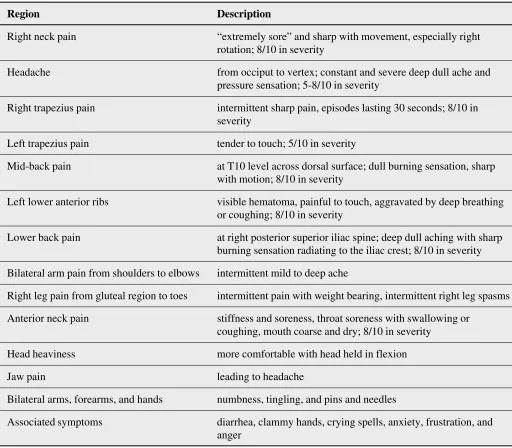
The patient’s complaints were numerous, and have been summarized in Table I.
Table I
Patient Complaints on Intake Post Motor Vehicle Accident
Region Description
Right neck pain “extremely sore” and sharp with movement, especially right
rotation; 8/10 in severity
Headache from occiput to vertex; constant and severe deep dull ache and
pressure sensation; 5-8/10 in severity
Right trapezius pain intermittent sharp pain, episodes lasting 30 seconds; 8/10 in severity
Left trapezius pain tender to touch; 5/10 in severity
Mid-back pain at T10 level across dorsal surface; dull burning sensation, sharp
with motion; 8/10 in severity
Left lower anterior ribs visible hematoma, painful to touch, aggravated by deep breathing or coughing; 8/10 in severity
Lower back pain at right posterior superior iliac spine; deep dull aching with sharp burning sensation radiating to the iliac crest; 8/10 in severity
Bilateral arm pain from shoulders to elbows intermittent mild to deep ache
Right leg pain from gluteal region to toes intermittent pain with weight bearing, intermittent right leg spasms
Anterior neck pain stiffness and soreness, throat soreness with swallowing or
coughing, mouth coarse and dry; 8/10 in severity
Head heaviness more comfortable with head held in flexion
Jaw pain leading to headache
Bilateral arms, forearms, and hands numbness, tingling, and pins and needles
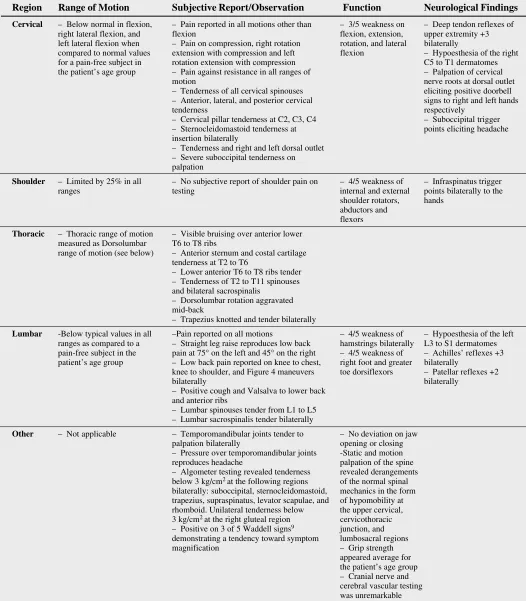
Region Range of Motion Subjective Report/Observation Function Neurological Findings
Cervical – Below normal in flexion, – Pain reported in all motions other than – 3/5 weakness on – Deep tendon reflexes of right lateral flexion, and flexion flexion, extension, upper extremity +3 left lateral flexion when – Pain on compression, right rotation rotation, and lateral bilaterally
compared to normal values extension with compression and left flexion – Hypoesthesia of the right for a pain-free subject in rotation extension with compression C5 to T1 dermatomes the patient’s age group – Pain against resistance in all ranges of – Palpation of cervical
motion nerve roots at dorsal outlet – Tenderness of all cervical spinouses eliciting positive doorbell – Anterior, lateral, and posterior cervical signs to right and left hands tenderness respectively
– Cervical pillar tenderness at C2, C3, C4 – Suboccipital trigger – Sternocleidomastoid tenderness at points eliciting headache insertion bilaterally
– Tenderness and right and left dorsal outlet – Severe suboccipital tenderness on palpation
Shoulder – Limited by 25% in all – No subjective report of shoulder pain on – 4/5 weakness of – Infraspinatus trigger ranges testing internal and external points bilaterally to the
shoulder rotators, hands abductors and
flexors
Thoracic – Thoracic range of motion – Visible bruising over anterior lower measured as Dorsolumbar T6 to T8 ribs
range of motion (see below) – Anterior sternum and costal cartilage tenderness at T2 to T6
– Lower anterior T6 to T8 ribs tender – Tenderness of T2 to T11 spinouses and bilateral sacrospinalis
– Dorsolumbar rotation aggravated mid-back
– Trapezius knotted and tender bilaterally
Lumbar -Below typical values in all –Pain reported on all motions – 4/5 weakness of – Hypoesthesia of the left ranges as compared to a – Straight leg raise reproduces low back hamstrings bilaterally L3 to S1 dermatomes pain-free subject in the pain at 75° on the left and 45° on the right – 4/5 weakness of – Achilles’ reflexes +3 patient’s age group – Low back pain reported on knee to chest, right foot and greater bilaterally
knee to shoulder, and Figure 4 maneuvers toe dorsiflexors – Patellar reflexes +2 bilaterally bilaterally
– Positive cough and Valsalva to lower back and anterior ribs
– Lumbar spinouses tender from L1 to L5 – Lumbar sacrospinalis tender bilaterally
Other – Not applicable – Temporomandibular joints tender to – No deviation on jaw palpation bilaterally opening or closing – Pressure over temporomandibular joints -Static and motion reproduces headache palpation of the spine – Algometer testing revealed tenderness revealed derangements below 3 kg/cm2 at the following regions of the normal spinal
bilaterally: suboccipital, sternocleidomastoid, mechanics in the form trapezius, supraspinatus, levator scapulae, and of hypomobility at rhomboid. Unilateral tenderness below the upper cervical, 3 kg/cm2 at the right gluteal region cervicothoracic
– Positive on 3 of 5 Waddell signs9 junction, and
demonstrating a tendency toward symptom lumbosacral regions magnification – Grip strength
Cervical AP, lateral, open mouth, flexion, extension, right anterior oblique, and left anterior oblique films re-vealed a cervical kypholordotic curve and early degenera-tive changes of the anterior superior and anterior inferior body of C6. The cervical spinouses were left rotated from C2 to C7. Flexion and extension films demonstrated cervi-cal dyskinesia at various levels.
Thoracic AP and lateral films revealed endplate rough-ening at T8 through T12, indicating mild thoracic degen-erative disc disease.
Lumbar AP and lateral films revealed a mild right con-vex lumbar scoliosis from T10 to L4 with apex at L1, and a lumbar posterior gravity line. Mild to moderate disc de-generation was seen at L3–4, as well as a small anterior osteophyte at the superior margin of L4.
The patient denied any previous motor vehicle
acci-dents. She did recall other previous falls and accidents that included a concussion at age 22 from hitting her head. She blacked out, and was diagnosed with a post-concussion headache. In 1987 while working as a waitress she suf-fered from shoulder problems. In 1993 she remembered having a fall in a coffee shop in which she strained her lower back. She reported that she had many falls related to playing sports, and specifically recalled a strain injury to her neck and lower back while playing volleyball in 1992. In 1994 she suffered from bouts of depression. In late 1995 she was seen by an orthopedic consultant regarding knee problems, and subsequently attended physiotherapy, re-ceiving passive care.
Regarding work-related injuries, the patient admits to lifting boxes and injuring her lower back in 1993, and sought chiropractic care for the injuries sustained. Again
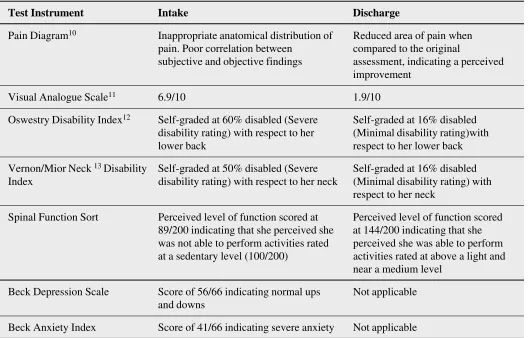
Table III
Test Instrument Scores
Test Instrument Intake Discharge
Pain Diagram10 Inappropriate anatomical distribution of Reduced area of pain when pain. Poor correlation between compared to the original
subjective and objective findings assessment, indicating a perceived improvement
Visual Analogue Scale11 6.9/10 1.9/10
Oswestry Disability Index12 Self-graded at 60% disabled (Severe Self-graded at 16% disabled disability rating) with respect to her (Minimal disability rating)with
lower back respect to her lower back
Vernon/Mior Neck 13Disability Self-graded at 50% disabled (Severe Self-graded at 16% disabled Index disability rating) with respect to her neck (Minimal disability rating) with
respect to her neck
Spinal Function Sort Perceived level of function scored at Perceived level of function scored 89/200 indicating that she perceived she at 144/200 indicating that she was not able to perform activities rated perceived she was able to perform at a sedentary level (100/200) activities rated at above a light and
near a medium level
Beck Depression Scale Score of 56/66 indicating normal ups Not applicable and downs
in November 1996, she injured herself at work while lift-ing a 50 pound box of files from a high shelf. In this acci-dent she sustained injuries to her neck, trapezius, shoulder blade, and right lower back, and again attended for chiro-practic care.
The patient reports that she began receiving chiropractic care in 1983. She had a short course of care, but then injured her back at work and attended for six months re-ceiving manipulation and passive modalities. She reported that she had intermittent chiropractic care between 1983 and 1989. She resumed chiropractic care beginning in 1989 for various musculoskeletal complaints, including neck pain, trapezius pain, midback pain, and low-back pain with sciatic radiation to her knees. Her care consisted of manipulation, manual traction, and other passive modalities such as ice and heat. The patient would receive care at a frequency anywhere from twice per month to once per week. There were occasions when she would receive therapeutic ultrasound to help reduce inflamma-tion. Just two months prior to her motor vehicle accident, the patient sustained injuries to her neck, upper back, and low back in a work-related accident. She attended for chiropractic care at a frequency of three times per week, again receiving manipulation and passive modalities, such as ultrasound, traction, ice, and heat to the targeted soft tissues.
Subsequent to her motor vehicle accident of January 18, 1997 a working diagnosis included: Acute Grade III Whip-lash Associated Disorder of the cervical spine; Cervical sprain/strain with associated myofascial tenderness, de-creased range of motion, headaches, dysphagia, and dizzi-ness, with radiculopathy to the shoulders and arms; Thoracic sprain/strain with associated myofascial tender-ness, decreased range of motion, and multiple level post-traumatic facet joint dysfunction; Post-post-traumatic wrist sprain demonstrating carpal tunnel syndrome; Intercostal sprain/strain, and temporomandibular joint sprain/strain.
Conservative chiropractic management was imple-mented, including manual therapy, mobilization, manipu-lation, trigger point therapy, and physical medicine modalities including ice, heat, traction, and ultrasound, at a frequency of three times per week to once per week. Mas-sage therapy was implemented at a frequency of two times per week to address the significant hypertonicity of her neck and shoulders. It was determined that the patient would begin an active functional restoration program that
would consist of supervised and structured exercises in order to return her to a pre-accident level of function. Our assessment had indicated that behavioural therapy was necessary to deal with issues of frustration and anger about the accident, and it was felt that the patient would also benefit from instruction in deep muscle relaxation, breath-ing exercises, and visualization in order to reduce her anxi-ety level, therefore the program would also consist of a pain and stress management counseling component, con-sidering the moderate to severe levels of perceived pain and disability, combined with her anxiety, frustration, an-ger, and pain magnification. The short term goals of the treatment plan were to address the patient’s presenting complaints, decrease her pain, increase her range of motion, restore proper biomechanics, minimize de-conditioning, and to promote tissue repair and regenera-tion.
Passive care was provided daily to start as she was in the acute phase of tissue healing. After three weeks, the pas-sive care was reduced to three times per week and the active care was introduced which she participated in daily. Total treatment extended for just over ten weeks.
Based on the acute stage of the patient’s injury, and her high levels of perceived pain and disability, an initial two week pre-rehabilitation program was employed, consist-ing of gentle Tai Chi movements as well as progressive aerobic exercise established and maintained at 60–70% of the patient’s estimated maximum heart rate.
to allow two sets of 8–12 repetitions (with a 60 to 90 second rest period between sets) performed to volitional muscle fatigue. Instruction was given so that the patient performed each repetition over approximately seven sec-onds, allowing two to three seconds for the concentric phase, and three to four seconds for the eccentric phase; progressive aerobic exercise on a StarTrac treadmill, with target heart rate established and maintained at 60 to 80% of the patient’s estimated maximum heart rate, as monitored by a Polar chest-band transmitter and a Polar wrist moni-tor. As well, the patient received a home stretching and spinal stabilization program, consisting of the stretching program established in the rehabilitation facility, as well as a floor routine of spinal stabilization exercises utilizing abdominal bracing techniques, as well as single extremity, dual extremity, and quadruped activities.
Upon release from the rehabilitation program, the pa-tient was given a home program of spinal stabilization exercises to enhance the gains she had made within the facility. Since completing this program, the patient has not reported any exacerbations of pain, and the symptomatol-ogy that pre-existed this accident has been totally under the patient’s control. The patient was given the option of pre-ventative/maintenance care, and has chosen to return on an as-needed basis for further care. To note, this patient was discharged in April 1997, ten weeks after her motor vehi-cle accident, and when contacted six months following her discharge, she continued to report that she was asympto-matic and was continuing her exercise program at a local fitness facility.
On discharge, the outcome measures following rehabili-tation were significantly improved and included increased strength and function in her neck, back, and shoulder re-gions. The assessment of function in the major trunk mus-cles upon discharge revealed improvement of abdominal strength, full back flexion, increased lateral muscle strength, and increases in iliopsoas, gluteal, quadriceps, and hamstring flexibility.
The patient attended for 28 passive sessions of chiro-practic treatment, and 8 sessions of massage.
The patient’s outcome measures following the active component of care were also significantly improved, and included a good understanding of body mechanics with respect to sitting, lifting, bending, and static muscle load-ing. Her cervical motion in all ranges, and myofascial hypertonicity associated with her presenting complaints
had also improved. Her pain perception had improved and this was corroborated by the degree of activity and physi-cal improvement level. There was little mention of her low back or other symptoms throughout the later sessions of the exercise program, and she appeared to have a good understanding of the hurt/harm and pain/no pain concepts. Upon her return to work, she did report that she experi-enced some discomfort and fatigue, but she was very will-ing to continue and push herself to reasonable levels of discomfort and fatigue.
At the time of her initial assessment, biomechanical evaluation indicated significant dysfunction which was amenable to a functional restoration process. At the onset, we were concerned about some possible psychosocial bar-riers that might complicate her recovery and require be-havioural therapy, however, this patient was able to manage her situation and progress well throughout the pro-gram. She displayed a typical profile of a patient who would most likely benefit from a functional restoration process.
The patient reported her overall improvement as 95% over the ten weeks since the motor vehicle accident. We felt that the rehabilitation program provided her with am-ple education on her pain, her physical soft tissue injury, and on proper biomechanics so that she was able to return to similar activities to those performed before the accident. At the time of discharge, she had returned to work and was coping well with her regular work demands.
Discussion
It has been shown that spinal manipulation is an effective intervention to effectively reduce pain and perhaps speed recovery in the treatment of acute low back pain.6
This patient demonstrated chronic low back pain that was refractory to resolution using passive modalities and manipulation/adjustment alone.15 She had attended for manipulation/adjustment and passive modalities at a fre-quency from three times per week to once per week for the four years prior to her motor vehicle accident. She reported that she had also attended for chiropractic care between 1984 and 1990 at a frequency of three times per week to twice per month, and subsequently improved for a two year period until having an exacerbation of neck and low back pain in October 1992.
manual techniques, and psychological support yielded greater results for the patient as compared to treatment consisting of physical agents only such as electrical and sonic modalities. In Provinciali et al. the reported benefit was demonstrated to be greater and longer lasting in a multimodal treatment group and quicker return to work. This study showed that patients receiving electro-therapy only received the same benefit in joint mobility as did the patients receiving multimodal treatment.16
Once this patient fully participated in a comprehensive spinal rehabilitative approach consisting of education to understand her condition and to reduce exposure to harm-ful situations, a functional restoration program aimed at improving the patient’s functional abilities, and psychoso-cial behavioural therapy to manage her symptom magnifi-cation and severe anxiety, we achieved greatly improved outcomes with high patient satisfaction. What was achieved was not only resolution of her acute accident related symptoms, but her chronic recurrent musculoskel-etal symptoms that had been present since 1984. This sug-gests that a comprehensive spinal rehabilitative approach would be prudent in many chronic spinal conditions. I have observed that telling patients to participate in a home gym or public fitness facility does not always produce a satisfactory outcome. Giving exercise sheets to patients does not provide any assurance that the exercises will be done. This author’s patients have reported difficulty fol-lowing through with an independent home or fitness facil-ity based program in the past, possibly due to lack of supervision, lack of knowledge of specific beneficial exer-cises, lack of motivation to attend, or lack of knowledge of what goals to set.
A structured spinal rehabilitative exercise program ap-pears to be more effective. Objectives of lumbar rehabili-tation include strength, endurance, range of motion, proprioception/coordination skills, aerobic capacity, and reduction in pain/perceived disability.17 If these objec-tives are met, a satisfactory outcome can possibly be ac-complished.
The addition of chiropractic spinal rehabilitative protocols using progress/resistance exercises effectively addressed this patient’s muscle deconditioning, and be-havioural therapy addressed her pain magnification and anxiety. Chiropractic adjustments alone prior to her acci-dent had never resulted in resolution of her lower back instability. The question goes back to the patient’s working
diagnosis prior to her motor vehicle accident, for which she received chiropractic treatments only: did she also have pain magnification and anxiety, along with physical deconditioning that was never identified and subsequently went unmanaged?
Conclusion
A case was presented in which chronic recurrent neck and low back pain was the prominent complaint where chiro-practic adjustment and verbal exercise instructions were the only treatment. An exacerbation of the patient’s symp-toms subsequent to a motor vehicle accident identified other issues not previously identified, including pain mag-nification, severe anxiety, and physical deconditioning in addition to her aberrant spinal mechanics.
She received chiropractic adjustments as she had re-ceived for years, but in addition a treatment plan was devised to manage all of the identified problems. The pa-tient’s response was encouraging, suggesting that the identification of other factors in addition to vertebral sub-luaxation complex may be useful to the chiropractor in the management of chronic or difficult cases. Addressing the mechanical aspect is obviously of primary importance in the management of all cases, in addition to motor vehicle accident cases. Clinicians must remember other issues can be present concurrently, therefore, this case also suggests respectfully that if all you are looking for is vertebral sub-luxation complex, that may be all that you will find.
References
1 Liebenson C. Rehabilitation and chiropractic practice. JMPT 1996; 19:134–140.
2 Liebenson C, Oslance J. Functional capacity assessment for the small private practitioner. Proceedings of the 7th annual conference on research and education. California Chiropractic Association Belmont, CA 1992;
Pgs. 296–300.
3 Vernon H, Piccinini J, Kopansky-Giles D, Hagino C, Fuligni S. Chiropractic rehabilitation of spinal pain patients: principles, practices and outcome data. JCCA 1995; 39(3):145–153.
4 Burns S H. Exercises in the treatment of chronic low back pain: a community based approach for private
practitioners. Advances in chiropractic 1994; Vol 1:245–265.
6 Bigos S, Bowyer O, Braen G, et al. (1994) Acute Low-Back Problems in Adults. Clinical Practice Guideline No. 14. AHCPR Publication No. 95-0642. Rockville, MD; Agency for Health Care Policy and Research, Public Health Service, U.S. Department of Health and Human Services.
7 Waddell G, National Health Service Executive, Clinical Standards Advisory Group, U. S. Agency for Health Care Policy & Research. (1996) Pamphlet from Royal College of General Practitioners. London, England. Clinical Guidelines for the Management of acute low back pain. 8 Rosen M, Breen A, et al. (1994), Management Guidelines
for Back Pain Appendix B in Report of a Clinical Standards Advisory Group Committee on Back Pain, Her Majesty’s Stationery Office (HMSO), London.
9 Waddell G, McCulloch J A, Kummel E, et al. Nonorganic physical signs in low back pain. Spine 1980; 5:117. 10 Ransford H V, Cairns D, Mooney V. The pain diagram as
an aid to psychological evaluation of patients with low back pain. Spine 1976; 1:27.
11 Melzack P. (ed), (1983) Pain measurement and assessment. Raven Press, New York.
12 Fairbanks J, Davis J, et al. The Oswestry low back disability questionnaire. Physiotherapy 1980; 66:271. 13 Vernon H, Mior S. The neck disability index: A study of
reliability and validity. JMPT 1991; 14(7):409.
14 Liebenson C. Rehabilitation of the spine. A practitioners manual. 1996 Williams and Wilkins 14:297–317. 15 Liebenson C. Rehabilitation and chiropractic practice.
JMPT 1996; 10:134–140.
16 Provinciali L, Baroni M, Illuminati L, Ceravol M. Multimodal treatment to prevent the late whiplash syndrome. Scand J Rehab Med 1996: 28:105–111. 17 Duetsch F. Isolated lumbar strengthening in the
rehabilitation of chronic low back pain. JMPT 1996; 19:124–133.
JCCA
AWARD of EXCELLENCE
The Journal of the Canadian Chiropractic Association (JCCA) has established an Award of Excellence with respect to manuscripts published in the Journal in order to acknowledge and more fully recognize the contributions of authors, clinicians and researchers to advancing the scholarly literature of the profession. The relevant time period for this cycle includes the years 1996, 1997 and 1998. This is the second three-year cycle of awards presented.
Awards to authors may be given in each of the three categories: a. Original designed research (experimental/observational) b. Literature reviews (clinical/historical)
c. Case studies/reports
In each category the award is presented to the authors(s) of the paper “making a significant contribution to the knowledge base on which chiropractic rests”. The editor selected a
subcommittee of editoral board members (Dr. A. Grice, Dr. R. Gitelman and Dr. P. Côté) to serve as an independent panel of raters. The panel was instructed to apply the test of “significant contribution” to the 48 papers and to nominate 2 papers in each category.