Towards Experience Management
for Search Engine Optimisation
Vani Aul and Thomas Roth-Berghofer
School of Computing and Engineering, University of West London, UK {vani.aul,thomas.roth-berghofer}@uwl.ac.uk
Abstract. Websites of Small and Medium-sized Enterprises (SMEs) can gain an added advantage by getting listed in the search engine’s results page during the search sessions of the searchers. The Search Engine Op-timisation (SEO) enables websites to become visible in search engines during search sessions for its featured products or services. It generates additional revenue for the websites. SEO is a complex technique. Its knowledge and experience gained from optimising websites in the past is highly valuable and applicable to optimise websites. This paper dis-cusses the problem of optimisation of websites based on the experience gained by the authors from optimisation of several case study websites. Process models have been generated in order to capture experience of implementing essential elements of SEO and to explain the procedure of implementation of the fundamental on-page SEO techniques that yielded results for the case study websites.
Keywords: SEO, experience management, keyword research
1
Introduction
SEO experience management involves sharing of knowledge and experience of effective techniques by SEO engineers with others tasked with search engine opti-misation of their websites. Experience management [3] mainly involves the trans-fer of knowledge and experience by a more experienced SEO engineer with less experienced SEO engineers. This research has attempted to build SEO recipes, providing experience and knowledge for implementing essential elements of on-page SEO (as described later). The SEO experience module has been created based on the future work recommendation of the INRECA methodology [4], which has been adapted to become suitable for the dynamic characteristics of such a domain as SEO.
In such an unstable and unpredictable scenario there is an unsolved problem for website owners to plan and optimise their websites. Which techniques are more likely to provide long term results [9]? How can SEO process be designed and individual techniques be implemented, monitored and maintained [11]? The answer is, with the help of the past SEO experience.
This research identifies and explains implementation details of individual SEO techniques that are likely to provide long-term results and crafted SEO as a process to be implemented in phases. SEO is the technique to optimise websites for search engines so as to increase their visibility in search engine re-sults. It allows the websites to become indexable and findable by search engine robots [7]. Further it optimises the site to meet the recommended criteria for all search engines and increases the likelihood of individual sites becoming visible and ranking higher in comparison to their competitors. When a search request is made (via search engines) for the product or service offered by the site, all other things being equal, the sites, which feature on the first search results page attract customers and are beneficial to the vendor. Another direct benefit of being listed high up in search engines’ results is the increased brand awareness for the featured companies. Traditionally companies used print, television and other media to increase brand awareness and promote sales. In the present in-formation age, the search engines offer great power to capture clients’ attention and promote sales1.
A series of steps are followed in the implementation of different phases of SEO. In this research we focus on the implementation of basic on-page SEO so as to lay the foundation to make a website visible in the search engine’s results page. We focus on Google as it the most popular and widely used search engine2.
The phases for implementing on-page SEO are explained below.
The process: Phase I Appropriate keywords describing the business’s product or service and are being used by searchers are defined, searched, analysed and selected. Depending on the keyword-concept hierarchy (as applicable to the web-site), an information architecture is planned for the website. It directly influences the navigational structure of the website. The information architecture gener-ally follows a top-down approach, with the main concept at the top navigation followed by sub-concepts. Further, the content is written based on these con-cepts. For instance, if a website is selling books then the main concept can be of books, which in turn can be further divided into sub categories of subjects like languages, technology, law, etc. In order to be recognised as valuable con-tent, it needs topic-modelling and build a theme on the topic or sub-topic it is about. The content should complement to its neighbouring content, i.e. other content pages in the same section. Additionally the synonyms, or complemen-tary words need to be utilised where appropriate. The analysis of competition is very important and can be carried out in the beginning or at any stage of SEO
1
http://www.marketingweekly.com/seo-sem/the-emergence-of-a-new-branding-platform-seo
2
implementation. It provides evidence of the keywords targeted by competing websites, topics or products covered, general layout and functionality of those websites, their establishment in the specified niche, and a rough observation of the SEO strategy adopted.
The process: Phase II Shortlisted keywords are implemented. In this phase the chosen keywords are allocated to the respective pages and implemented on those pages by including them and their variants in URLs, HTML code, alt tags, head-ers, actual content, linking text to internal pages, etc. The information architec-ture is drawn based on the chosen keyword concept hierarchy. Further content is added retrospectively. Moreover competitors’ websites are also studied and a strategy is devised to gradually overcome/overpower/outrun the competition.
The process: Phase III This is the post-implementation stage during which the actual SEO implementation is reviewed to check if it is executed properly and attained desired results. The results expected from the implementation are mon-itored over a regular period of time. This can be done manually or by using automated tools. An effort is made to maintain the achieved results. In case the expected results are not achieved then the implementation details are anal-ysed to identify the gaps. Subsequently the implementation plan is revised and re-implemented. This human intervention is a critical stage in the optimisation process. SEO implementation should follow a sequential order for a new or an existing un-optimised website. In a real time scenario every website has different needs and requirements at different stages of SEO implementation. Therefore these steps can be analysed, implemented randomly, extended or customised to suit the needs of a respective website.
The rest of the paper is organised as follows: Section 2 describes motivation for this research work. Section 3 presents related work. Section 4 identifies case studies, describes the work undertaken and results achieved. Section 5 shows the SEO process models as built to share the SEO experience. Section 6 concludes the paper with our observations about SEO field.
2
Motivation: Knowledge Involved in SEO
The main motivation behind this work is to share the critical SEO experience which is gained from the application of SEO knowledge. On observing SEO, we can see that different kinds of knowledge play an important role, namely:
– Knowledge about on-page SEO elements: an understanding of important el-ements (keywords, content writing, etc.). Further the actual implementation of these elements is a knowledge intensive activity.
– Strategic knowledge: involving the conception and formulation of SEO strat-egy along with its phased implementation and customisation at a later stage to align with the actual results achieved and other requirements (if any).
Typically it is only the experienced SEO engineers who actually possess this knowledge about SEO elements. This knowledge is relevant to the promotion of websites on search engines. Not surprisingly, (given the specialist nature of this knowledge) the owners of SME websites are not even aware of the concept or tech-nique of SEO and its potential in yielding positive results for their business(es). We term website owners’ ignorance of SEO knowledge asSEO knowledge gap. However this gap can be bridged by making SME owners aware of the SEO tech-nique to be implemented on their respective website(s). The SEO knowledge gap exists due to the complex nature of SEO as it is highly dynamic and ever evolving technique. Moreover as the search engines’ ranking algorithms define the rules to implement SEO, this makes its interpretation and implementation even more difficult without a specialised knowledge of this technique.
SEO is a technique that has emerged from the functionality of the search en-gine ranking algorithms (elements rated positively by algorithms are favourable for SEO implementation) but it is not directly or easily inferable. It is obscure in nature and difficult for businesses to implement. The search engines and SEO exist independently of the website, where the SME owners have to make addi-tional efforts to interpret and incorporate SEO elements to become visible on search engines for their targeted keywords. It is not a mandatory step for bring-ing a website into existence like registerbring-ing a domain name to host a website, therefore its implementation can be completely ignored by the website owners.
al-most impossible for the novices that lead to the failure and shut down of many ecommerce websites. Although the SEO guidance material is available on the web, the guidelines to interpret, assess and implement it are lacking. Hence the inexperienced SME website owners get easily lost. This leads to the realisation for a need for straightforward and easy to understand sharing and management of SEO experience.3
3
Related Work
Pellucid is a framework to use past experience for aiding the workers in public organisations in performing their respective jobs [8]. An intelligent assistant was built that is activated within the work environment or workstation of a worker. The basic aim behind building this framework is to support and enhance perfor-mance of employees by providing them the knowledge or active hints in context to the activity they are performing at the time they are actually performing that activity. Pellucid supports context based information retrieval.The triggering of active hints on the basis of users’ workflow influenced the possible future direc-tion of the current research which would result in building a desktop applicadirec-tion and triggering SEO hints based on the users’ activity and workflow.
Literature on SEO just mentions SEO techniques without giving the context and details for its implementation. For non-technical SME website owners it is very difficult to apprehend and implement SEO for their websites. Various researchers have emphasised the important elements of SEO.
On-page and off-page SEO optimisation techniques are addressed in [10] while distinguishing between white hat (recommended by search engines) and black hat (abhorred by search engines) techniques. It specifies the usage of keywords in Title tag, URL, meta tag, anchor text and achieving a keyword density of up to 8 percent, etc. Further it mentions the variants of the technique of link building (link popularity, incoming-outgoing links, etc.).
Similar techniques of SEO i.e. keywords, link building, etc. are emphasised on in [6]. The authors also make a distinction between white hat and black hat practices. Further they notify the evolving SEO practices as a side effect of algorithm updates of major search engine (Google in this case).
A study was undertaken in [5] titled: ’Search engine strategies: A model to improve website visibility for SMME websites’ in which the author studied the use of SEO on-page factors in the top 144 ranking websites. He devised a SEO model consisting of on-page techniques (inclusion of meta tags, prominent link popularity, etc.) to be implemented for optimising a website. Other researchers have also undertaken research in the SEO field with similar results and recom-mendations.
The INRECA methodology supports the development process of Case Based Reasoning (CBR) applications [3]. It consists of a collection of CBR development experience (experience packets), represented as software process models, which
3
are stored in an experience base of an experience factory [1]. An experience packet consists of software process models or parts of it such as processes, prod-ucts, or methods. The experience base is organised at three levels of abstraction namely generic level, cookbook level and specific level [2].
– Experience stored at the Common Generic Level: consists of the processes, products and methods defined at a very high level.
– Experience stored at cookbook level: stores the processes, products and methods covering recipes pertaining to a specific class of CBR application(s) e.g. product catalogue
– Experience stored at specific project level: this level contains experience relevant to a particular project that has already been executed.
Research reported here has composed process models at the cookbook level to record essential elements of on-page SEO namely keyword research, content writing, HTML code and website information architecture.
4
Case Studies
We share our experience on the basis of individual case studies for which SEO was implemented in the past and positive long-term results were achieved:
– Juniors.net4: an online education site for primary school (grades 3-6, keystage
2 students) in UK.
– Bankaholic.com5: a US based financial portal providing information on in-terest rates, credit card reviews, insurance quotes, and personal finance tips.
– Searose Exim6: a bicycle basket manufacturer, selling PVC coated front
bi-cycle baskets in India.
– Changology7: an independent consultant providing IT change management
services for integrating information technology into businesses.
– Sai Digital8: an independent Asian wedding photographer providing
photog-raphy services for Indian Asian weddings held in UK.
For the above-mentioned case studies we mainly implemented the essential elements of on-page SEO. The SEO techniques that were implemented include keywords, information architecture, content writing, and optimisation of HTML code. Keywords refer to the words that searchers use to conduct their search on search engines [12]. Therefore it is very important for webmasters to include those specific keywords in the webpage’s content having high likelihood to be searched by the searchers and are also relevant to their specific product or ser-vice. Site Information Architecture (IA) involves the science and art of organising
4
http://juniors.net[Last access: 03/2006] [Operational 2000 - 2009]
5 http://cdrates.bankaholic.com[Last access: 06/2008] Operational 2006-present] 6
http://www.searoseexim.com[Last accessed 08/2012] [Operational 2011 - 2012]
7 http://www.changology.co.uk[Last accessed 07/2012] [Operational 2011 - 2012] 8
website’s information in a structured format that is easy to understand, navigate and act upon. It must address the user’s or website visitor’s information needs as well as business goals. The IA must follow a logical and intuitive structure so as to address the Why’s and How’s of the presented information9 Content writing refers to the process of creating content for conveying the information on products or services as provided by the website. It should be written by using the terminology or words and phrases as used by the intended audience. Addi-tionally a focus should be laid on using the keywords allocated to the webpage. Optimisation of HTML code refers to externalising the code, which can be re-ferred to via external files e.g. CSS, Javascript, etc. Further it involves inclusion of keywords in file names, alt tags, usage of structured data etc.
We implemented some or all essential SEO elements on case study websites and got promising results in terms of improving their visibility on the main search engine i.e. Google. For two case study websites i.e. Changology and Searoseexim we built their web presence from scratch by creating websites for those SMEs and optimising them to build their visibility on Google. For these two websites all the listed essential SEO Elements were implemented i.e. Keyword research, information architecture, content writing and optimised HTML. As a result we were able to gain visibility to these website in Google for their brand name.
Bankaholic content was created for the blog of this website. Since the main target key phrases for this website revolved around Certificates of Deposit (CD) rates for credit unions in USA, therefore a content outline or blue print was drawn out following which the content was written informing on the CD rates offered by the credit unions in different states of USA. In the content frame: firstly the credit union was introduced, followed by the interest rates offered with special features with some important information (if any) and a summary was written in the concluding paragraph. As a result we were able to gain visibility for every written article in Google for key phrases like: CD rates offered by New Jersey Credit Union. Since other sections of the website were already highly optimised and visible on Google, gaining high ranking for blog articles did not require a lot of effort.
Juniors.net Keyword research was conducted and meta tags were created and implemented for this website. This website was already existing before optimi-sation was undertaken. Additionally, some off page techniques like link building were conducted for this site. As a result high visibility was gained for this website on Google for its related keywords and key phrases.
Sai Digital Similar to Juniors.net, keyword research was conducted and meta tags were created and implemented for this website. This website was already existing but did not rank very well for its related keywords as it was lacking optimisation. As a result of optimising this website, it gained higher rankings
9
for its targeted keywords. Due to these search engine rankings there was a 50 percent increase in the number of leads generated from the website. This SME owner provided Wedding photography services and was able to win more clients from these rankings.
5
Capturing SEO Experience
In order to facilitate reuse of SEO experience on the basis of INRECA-II method-ology, an SEO experience module was created. Common elements were observed from SEO implementation on case study websites. Experience was formalised and represented via process models.
Software process models represent the interaction between processes, prod-ucts and methods required to create the desired output [3]. An input is processed to produce output, supported by methods (simple or complex). In this research, process models have been created for the essential elements of SEO.
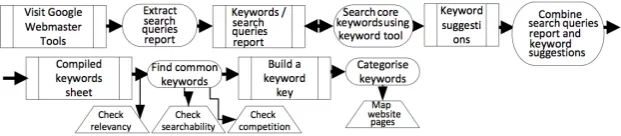
The keyword research model is supported by three different methods namely, Basic search method (Figure 1), Keyword tool method (Figure 2) and Search queries report method (Figure 3).
Fig. 1.Basic search method
Fig. 2.Keyword tool method
The keyword tool method (Figure 2) involves using a keyword suggestion tool i.e. Google keyword planner in this instance. The basic keywords are searched using the keyword planner for getting keyword suggestions. The bi-directional ar-row between Keyword Suggestions and Shortlisted Keywords indicates that the shortlisted keywords would modify the suggested keywords. The shortlisted key-words would be used to generate more keyword suggestions. In order to shortlist the keywords the relevancy of the keywords are checked, as well as the search-ability (to find if the shortlisted keywords are searched by the searchers) and the competition is checked as well to avoid keywords having huge competition. From the shortlisted keywords, a keyword key is created in order to categorise the shortlisted keywords which are further mapped to the website pages.
Fig. 3.Search queries report method
common keywords list, check the relevance of the keywords i.e. keywords are related to the website, searchability of the keywords i.e. keywords are actually being used by the searchers, and the competition i.e. competition is not too high. Further build a keyword key, categorise the common shortlisted keywords according to the key. Finally allocate or map the keywords to the website pages.
Fig. 4.Site information architecture model
The product or service specific information is used to determine the scope of the website (Figure 4). From the scope and information of the website, the main concepts and sub-concepts to be covered by the website are identi-fied. A top-down concept hierarchy is built from the available information. A unique webpage is created for each concept and the sub-concept. The keywords key/categories are referred which were created during the keyword research pro-cess. Each of the concepts and sub-concepts are matched to the keyword cate-gories. Relevant keywords are selected and allocated to the respective webpages.
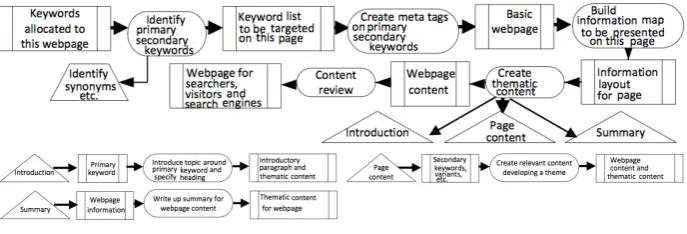
Fig. 5.Content writing model and content writing methods
words, and word variants of the primary and secondary keywords. An infor-mation map is created that has to be present on this page. Depending on the information map, content is created for this webpage. The introduction is created by including the information on the primary keyword and the following content of the page is created by using the secondary keywords, word variants etc. Sub-sequently a summary of the page is presented, in the concluding paragraph. The basic information is created by composing the meta tags for this page.
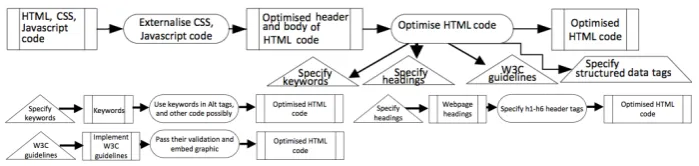
Fig. 6.Optimisation of HTML code model and methods
The webpages consisting of HTML, CSS and Javascript code need to exter-nalise the CSS and Javascript code (Figure 6). Subsequently the HTML code is optimised by specifying keywords in Alt Tags, file names, etc. The headings are created for important sections of the page. Further, the W3C (World Wide Web Consortium) guidelines are implemented and validated. Their validation badge is published on the webpages.
6
Discussion and Outlook
The implementation of essential SEO elements has proven to be very helpful for laying the foundation to obtain higher visibility of websites on search engine’s results pages. It must be noted that SEO needs to be implemented as a process of techniques [11] rather than just implementing individual techniques in isola-tion. Each element feeds information into the other element and is a part of the whole process. For implementing on-page SEO an in-depth keyword research is essential to shortlist the right keywords, followed by laying out the information architecture of the website. Further content is written and HTML code is op-timised. Hence to summarise we can say that SEO is a procedural technique, which needs to be implemented as a recipe, as shown in this paper in the form of process models.
References
1. Basili, V.R., Caldiera, G., Rombach, H.D.: The experience factory. In: Marciniak, J. (ed.) Encyclopedia of Software Engineering, pp. 469–476. Wiley, New York (1994) 2. Bergmann, R., G¨oker, M.: Developing industrial case-based reasoning applications using the INRECA methodology. In: Workshop at the International Joint Confer-ence on Artificial IntelligConfer-ence, IJCAI - Automating the Construction of Case Based Reasoners, Stockholm (1999)
3. Bergmann, R.: Experience Management: Foundations, Development Methodology, and Internet-Based Applications, LNCS, vol. 2432. Springer (2002)
4. Bergmann, R., Breen, S., G¨oker, M., Manago, M., Wess, S.: Developing Industrial Case-Based Resoning Applications: The INRECA Methodology. Lecture Notes in Artificial Intelligence, State-of-the-Art-Survey, LNAI 1612, Springer-Verlag, Berlin (1999)
5. Chambers, R.: Search engine strategies: a model to improve website visibility for SMME websites. Master’s thesis, Cape Peninsula University of Technology (2005) 6. Duk, S., Bjelobrk, D., Carapina, M.: Seo in e-commerce: balancing between white and black hat methods. In: Information & Communication Technology Electronics & Microelectronics (MIPRO), 2013 36th International Convention on. pp. 390–395. IEEE (2013)
7. Go, A.C.: Introducing new search engine optimization techniques for expert tools grinders website. Master’s thesis, Charles Darwin University (2015)
8. Lambert, S., Arenas, A., Delaitre, S., Raposo, J.M., Ferrentino, P., Majewska, M., Krawczyk, K., Fassone, M., Procopio, V., Parcheggi, C.d.G.M.T.: A framework for experience management in e-government: The pellucid project. Electronic Journal of e-Government 2(3), 167–176 (2004)
9. Malaga, R.A.: the value of search engine optimization. Journal of Electronic Com-merce in Organizations 5(3), 6–2 (2007)
10. Patil Swati P., P.B., S., P.A.: Search engine optimization: A study. Research Jour-nal of Computer and Information Technology Sciences 1(1), 10–13 (February 2012) 11. Sagot, S., Foug`eres, A.J., Ostrosi, E., Lacom, P.: Search engine optimization: From analysis based on an engineering meta-model towards integrative approaches. In: Information Society (i-Society), 2014 International Conference on. pp. 274–281. IEEE (2014)