Article
Data-Informed Decomposition for Localized
Uncertainty Quantification of Dynamical Systems
Waad Subber˚, Sayan Ghosh, Piyush Pandita, Yiming Zhang and Liping Wang
1 2 3 4
5 6 7 8
9 10 11
12 13 14 15
16 17 18 19
20
ProbabilisticDesignandOptimizationGroup,GEResearch,1ResearchCircle,Niskayuna,NY12309,USA * Correspondence:[email protected]
Abstract: Industrial dynamical systems often exhibit multi-scale response due to material
heterogeneities, operation conditions and complex environmental loadings. In such problems, it is the
case that the smallest length-scale of the systems dynamics controls the numerical resolution required
to effectively resolve the embedded physics. In practice however, high numerical resolutions is only
required in a confined region of the system where fast dynamics or localized material variability are
exhibited, whereas a coarser discretization can be sufficient in the rest majority of the system. To
this end, a unified computational scheme with uniform spatio-temporal resolutions for uncertainty
quantification can be very computationally demanding. Partitioning the complex dynamical system
into smaller easier-to-solve problems based of the localized dynamics and material variability can
reduce the overall computational cost. However, identifying the region of interest for high-resolution
and intensive uncertainty quantification can be a problem dependent. The region of interest can be
specified based on the localization features of the solution, user interest, and correlation length of
the random material properties. For problems where a region of interest is not evident, Bayesian
inference can provide a feasible solution. In this work, we employ a Bayesian framework to update
our prior knowledge on the localized region of interest using measurements and system response. To
address the computational cost of the Bayesian inference, we construct a Gaussian process surrogate
for the forward model. Once, the localized region of interest is identified, we use polynomial
chaos expansion to propagate the localization uncertainty. We demonstrate our framework through
numerical experiments on a three-dimensional elastodynamic problem.
Keywords: Bayesian inference; Uncertainty Quantification; Dynamical Systems; Inverse Problem;
System Identification ; Gaussian process regression; Polynomial chaos.
21
1. Introduction
22
With the increase in demand for high-performance and highly-efficiency systems, the complexity
23
of industrial design and manufacturing process is increasing proportionally; exposing many
24
opportunities for novel technologies as well as many associated technical challenges. For example,
25
advancements in the design of composite structures allows us to reduce weight, advancements in
26
additive manufacturing enables us to reduce cost, and optimal computational material design pushes
27
the boundary in the discovery of new alloys with desirable electro-mechanical properties. Introducing
28
a new technology typically happens at the lowest level of the systems hierarchy (e.g., at the parts or
29
sub-component levels). Extending the new technologies to the system level requires rigorous testing.
30
For example, in 1980’s composite material was only used for limited components of an aircraft (i.e,.
31
the wing and tail [1]). Recently however, after multiple test flights, about 50% of the materials used in
32
the Boeing 787 Dreamliner are composite materials [2].
33
In the industrial setting, the process of adaptation of a new technology can be accelerated by a
34
proper assessment of uncertainty at various aspects of the product ’s life cycle spanning the design,
35
manufacturing and maintenance stages. For example, at the design stage of an aircraft wing rib, it
36
is crucial to consider the effect of uncertainty in the material and operation conditions on the safety
37
factor and aeroelastic dynamics of the wing [3]. At the manufacturing stage, it is important to consider
38
Preprints (www.preprints.org) | NOT PEER-REVIEWED | Posted: 17 August 2020 doi:10.20944/preprints202008.0358.v1
the impact of manufacturing uncertainties on quality control [4] and non-destructive testing [5]. The
39
maintenance stage requires a holistic assessment of the effect of measurement uncertainty on the static
40
and dynamic responses of the wing during structural health monitoring [6].
41
Quantifying uncertainty at the system level often requires a physics-based computational model
42
for the entire structure. However, in structures such as an aircraft wing, traditional computational
43
models may become too complex and costly for simulating the multi-scale dynamical response
44
especially due to material heterogenity at the sub-component level. The effect of the sub-component
45
on the entire structure depends on the size, location and loading conditions of the part. It is therefore,
46
necessary to consider a different level of fidelity for the analysis of the sub-components in order to
47
reduce the cost and complexity of uncertainty quantification. To this end, the concept of localized
48
uncertainty propagation for dynamical systems having muti spatio-temporal scales can be utilized to
49
address such issues [7–9].
50
In this work, we consider assessing the effect of localized uncertainty in a region of interest
51
within the entire structure. For structures composed of distinct parts that can be clearly identified,
52
the localized region for uncertainty propagation may become obvious. When the distinguished
53
components of a structure are not clear, measurement data can be utilized within Bayesian framework
54
to identify the localized region of interest. The Bayesian paradigm integrates thedomain-knowledge,
55
physics-based computational models and observational data in one framework to update the current
56
state of knowledge [10,11]. The Bayesian methods offer two major advantages namely: a) allow
57
quantification of epistemic uncertainty under limited-data, and b) retain physical sense for the
58
parameters and the quantity-of-interest. Conditioning apriori physics beliefs on the available data,
59
Bayes rule provides aposteriori distribution on the model parameters. A robust method to estimate
60
the posterior distribution in the Bayesian inference (i.e. sampling values of the model parameters from
61
the posterior probability) is Markov Chain Monte Carlo (MCMC) [12,13]. Estimating the posterior
62
probability density function in the Bayesian method requires solving the forward model many times,
63
which may become challenging for limited computing resources. This issue is often addressed by
64
building a data-driven probabilistic surrogate model using Gaussian process (GP) regression [14].
65
Constructing a GP model requires executing the forward model only few number of times. The
66
GP models are non-parametric and Bayesian in nature, and they provide uncertainty bound on
67
their predictions. Nevertheless, for problems with stochastic field representation of the variability
68
in the propagation media, uncertainty quantification using GP models may become challenging for
69
general non-Gaussian description of the underlying random variability. Polynomial Chaos (PC), on
70
the other hand, provides an effective framework to represent and propagate an arbitrary random
71
variable through complex computational models [15,16]. In PC, the response of the physical model is
72
represented as spectral expansion in a polynomial series with basis function being orthogonal with
73
respect to the probability density function of the underlying random variables of the propagation
74
media.
75
The rest of this work is organized as follows: in Section2, we provide the problem statement
76
and the associated mathematical formulations. Our numerical demonstrations for the mathematical
77
framework are provided in Section3. We provide the conclusions of the current work in Section4.
78
2. Methodology
79
In this section, we present the mathematical framework of our approach for data-driven
80
partitioning scheme for localized uncertainty quantification. In particular, in Subsection 2.1, we
81
introduce the problem statement in the Bayesian setting. As mentioned previously, for problems where
82
the localized region of interest is not defined explicitly, we rely on measurement data of a response
83
quantity (aided by a computational model) to infer the localized region of interest. The Bayesian
84
framework requires a computational model (the forward problem) to estimate the response of the
85
system for a given set of the input parameters that to be inferred. Consequently, in Subsection2.2
86
we discuss the stochastic elastodynamic problem and its finite element discretization. Estimating
3 of 16
the localized region of interest in the Bayesian setting necessitates many solutions to the stochastic
88
elastodynamic problem which can become computationally demanding. Furthermore, it is worth
89
noting that for the Bayesian calculation the entire solution field of the stochastic elastodynamic problem
90
is not required, only a realization at the measurement location is needed. Thus, a surrogate model
91
for the realization of the response can be used to reduce the computational cost of the Bayesian
92
framework. In Subsection2.3, we present the Gaussian process surrogate to emulate the solution to
93
the stochastic elastodynamic problem with less cost. Once the localized region of interest is estimated,
94
a confined uncertainty representation of the material properties within the region of interest can be
95
performed. The localized uncertainty is propagated forward through the model in order to estimate
96
its effect on the variability of the response. For this task, we use the polynomial chose expansion for
97
efficient assessment of uncertainty with less cost. The polynomial chose expansion is reviewed in
98
Subsection2.4.
99
2.1. Bayesian Inference
100
In Bayesian inference, the prior knowledge is updated to posterior using noisy measurements and the response of a physical model [10,11]. The update is based on the Bayes’ rule defined as
ppθ|dq “ ppθqppd|θq
ppdq , (1)
whereθis the uncertain parameters to be estimated,dis the measurement of an observable quantity,
ppθ|dqis the posterior probability density function,ppθqis the prior probability density function, and
ppd|θqdenotes the likelihood of the observations given the parameter. We assume that the measured
datadis generated from a statistical model composed of a physical modelMpθqplus an additive
measurements noiseeas
d“Mpθq `e. (2)
Here we represent the measurement noise as a Gaussian random variable with unknown variance
e„Np0,σn2q. For a Gaussian noise, the likelihood function becomes
ppd|θq “ 1
`
2πσ2
n
˘´N{2exp
˜
´ 1
2σ2
n N ÿ
i
rdi´Mpθiqs2
¸
. (3)
The task in hand is to utilize the measurementdand the physical modelMpθqto estimate the system
parametersθthat best satisfy Eq.(1). The process requires many executions to the physical modelMpθq,
which can be computationally expensive. It is often, the expensive computational model is emulated
by a simplereasy-to-evaluatemodel that can estimate the response with a quantified accuracy as:
Mpθq »Mpθq, (4)
whereMpθqdenotes the surrogate model that is constructed using a limited runs of the physical model
101
Mpθq. In our work, we representMpθqas Gaussian process surrogate model [17]. Once we constructed
102
and validate the surrogate model, the parameterization of the localized featuresθis estimated using
103
Bayes’ rule evaluated by Markov Chain Monte Carlo (MCMC) sampling technique. Having the
104
localized region of interest identified, a localized uncertainty quantification of the confined variability
105
of the material properties can be performed efficiently using polynomial chaos expansion [15].
106
2.2. The Forward Problem
107
In this section, we give a brief summary of the mathematical formulation to the linear stochastic
108
dynamical system considered in this work. The framework is presented for localized uncertainty
109
propagation work-flow, whereby the decomposition of the physical domain is based on the variability
110
of the material properties. Consequently, we consider an arbitrary physical domainΩPRdwithBΩ
111
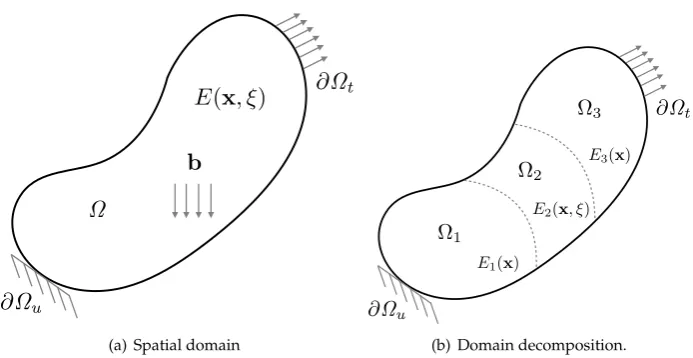
being its boundary as shown in Fig. (1-a), and define the following problem:
112
Find a random functionupx,t,ξq:Ωˆ r0,Tfs ˆΞÑR, such that the following equations hold
ρpξq:upx,t,ξq “ ∇¨σ`b in Ω ˆ r0,Tfs ˆΞ,
upx,t,ξq “ u¯ on BΩu ˆ r0,Tfs ˆΞ,
σ¨n“ ¯t on BΩt ˆ r0,Tfs ˆΞ,
upx, 0,ξq “ u0 in Ω ˆ Ξ,
9
upx, 0,ξq “ u90 in Ω ˆ Ξ,
(5)
whereρpξqis the mass density,σis the stress tensor,uis the displacement field,bis the body force
113
per unit volume, ¯uis the prescribed displacement onBΩu, ¯tis the prescribed traction onBΩt,nis a
114
unit normal to the surface, andu0andu90are the initial displacement and velocity, respectively. Here,
115
we define the stochastic space by (Θ,Σ,Pq, whereΘdenoting the sample space,Σbeing theσ-algebra
116
ofΘ, andPrepresenting an appropriate probability measure. The stochastic space is paramatrized
117
by a finite set of standardized identically distributed random variablesξ“ tξipθquiM“1, whereθPΘ.
118
The support of the random variables is defined asΞ“Ξ1ˆΞ2ˆ ¨ ¨ ¨ΞMPRMwith a joint probability
119
density function given asppξq “p1pξ1q ¨p2pξ2q ¨ ¨ ¨pMpξMq.
120
For linear isotropic elastic martial, the constitutive relation between the stress and strain tensors is given by:
σ “λpξqtrpεqI`2¯pξqε, (6)
whereλpξqandµpξqare the Lemaé’s parameters,Iis an identity tensor andεis the symmetric strain
tensor defined as
ε“ 1
2 ´
∇u`∇uT
¯
. (7)
For a random Young’s modulusEpx,ξqand deterministic Poisson’s ratioν, the Lemaé’s parameters
can be expressed as
λpξq “ Epx,ξqν
p1`νqp1´2νq, µpξq “
Epx,ξq
2p1`νq. (8)
We consider the case that uncertainty steams from a localized variability in a confined region
121
within the physical domain. For example as shown in Fig. (1-b), the variability in the quantity of interest
122
can be attributed to the material random properties within the subdomainΩ2. The artificial martial
123
boundaries shown in Fig.(1-b) for subdomainΩ2is estimated using Bayesian inference. Localizing
124
random variability in the neighborhood of the quantity of interest reduces the computational cost
125
of uncertainty propagation in problems where a region of interest can be specified. Depending
126
on the interest in the region, each subdomain can have its local uncertainty representation and
127
the corresponding mesh and time resolutions. As a results the Asynchronous Space-Time Domain
128
Decomposition Method with Localized Uncertainty Quantification (PASTA-DDM-UQ) [7–9] can be
129
utilized. In PASTA-DDM-UQ, spatial, temporal and material decompositions are considered. In
130
this work however, we only consider material decomposition and apply non-intrusive approach for
131
uncertainty propagation.
132
Consequently, let the physical domainΩbe partitioned based on the martial variability intons
non-overlapping subdomainsΩs, 1ďsďnsas shown in Fig. (1-b) and such that:
Ω“
ns ď
s“1
Ωs, Ωsč
Ωr“ Hfors‰r, Γ“
ns ď
s“1
5 of 16
b
∂Ω
u∂Ω
tΩ
E(
x
, ξ)
(a) Spatial domain
@⌦u
@⌦t
⌦<latexit sha1_base64="2cHE4hOBMX049bWJt+9B26w2a/Y=">AAAB73icbVA9SwNBEJ2LXzF+RS1tFoNgFe5E0DJoY2cEEwPJEfY2c8mS3b1zd08IIX/CxkIRW/+Onf/GTXKFJj4YeLw3w8y8KBXcWN//9gorq2vrG8XN0tb2zu5eef+gaZJMM2ywRCS6FVGDgitsWG4FtlKNVEYCH6Lh9dR/eEJteKLu7SjFUNK+4jFn1Dqp1bmV2KfdoFuu+FV/BrJMgpxUIEe9W/7q9BKWSVSWCWpMO/BTG46ptpwJnJQ6mcGUsiHtY9tRRSWacDy7d0JOnNIjcaJdKUtm6u+JMZXGjGTkOiW1A7PoTcX/vHZm48twzFWaWVRsvijOBLEJmT5Pelwjs2LkCGWau1sJG1BNmXURlVwIweLLy6R5Vg38anB3Xqld5XEU4QiO4RQCuIAa3EAdGsBAwDO8wpv36L14797HvLXg5TOH8Afe5w+IR4+f</latexit><latexit sha1_base64="2cHE4hOBMX049bWJt+9B26w2a/Y=">AAAB73icbVA9SwNBEJ2LXzF+RS1tFoNgFe5E0DJoY2cEEwPJEfY2c8mS3b1zd08IIX/CxkIRW/+Onf/GTXKFJj4YeLw3w8y8KBXcWN//9gorq2vrG8XN0tb2zu5eef+gaZJMM2ywRCS6FVGDgitsWG4FtlKNVEYCH6Lh9dR/eEJteKLu7SjFUNK+4jFn1Dqp1bmV2KfdoFuu+FV/BrJMgpxUIEe9W/7q9BKWSVSWCWpMO/BTG46ptpwJnJQ6mcGUsiHtY9tRRSWacDy7d0JOnNIjcaJdKUtm6u+JMZXGjGTkOiW1A7PoTcX/vHZm48twzFWaWVRsvijOBLEJmT5Pelwjs2LkCGWau1sJG1BNmXURlVwIweLLy6R5Vg38anB3Xqld5XEU4QiO4RQCuIAa3EAdGsBAwDO8wpv36L14797HvLXg5TOH8Afe5w+IR4+f</latexit><latexit sha1_base64="2cHE4hOBMX049bWJt+9B26w2a/Y=">AAAB73icbVA9SwNBEJ2LXzF+RS1tFoNgFe5E0DJoY2cEEwPJEfY2c8mS3b1zd08IIX/CxkIRW/+Onf/GTXKFJj4YeLw3w8y8KBXcWN//9gorq2vrG8XN0tb2zu5eef+gaZJMM2ywRCS6FVGDgitsWG4FtlKNVEYCH6Lh9dR/eEJteKLu7SjFUNK+4jFn1Dqp1bmV2KfdoFuu+FV/BrJMgpxUIEe9W/7q9BKWSVSWCWpMO/BTG46ptpwJnJQ6mcGUsiHtY9tRRSWacDy7d0JOnNIjcaJdKUtm6u+JMZXGjGTkOiW1A7PoTcX/vHZm48twzFWaWVRsvijOBLEJmT5Pelwjs2LkCGWau1sJG1BNmXURlVwIweLLy6R5Vg38anB3Xqld5XEU4QiO4RQCuIAa3EAdGsBAwDO8wpv36L14797HvLXg5TOH8Afe5w+IR4+f</latexit><latexit sha1_base64="2cHE4hOBMX049bWJt+9B26w2a/Y=">AAAB73icbVA9SwNBEJ2LXzF+RS1tFoNgFe5E0DJoY2cEEwPJEfY2c8mS3b1zd08IIX/CxkIRW/+Onf/GTXKFJj4YeLw3w8y8KBXcWN//9gorq2vrG8XN0tb2zu5eef+gaZJMM2ywRCS6FVGDgitsWG4FtlKNVEYCH6Lh9dR/eEJteKLu7SjFUNK+4jFn1Dqp1bmV2KfdoFuu+FV/BrJMgpxUIEe9W/7q9BKWSVSWCWpMO/BTG46ptpwJnJQ6mcGUsiHtY9tRRSWacDy7d0JOnNIjcaJdKUtm6u+JMZXGjGTkOiW1A7PoTcX/vHZm48twzFWaWVRsvijOBLEJmT5Pelwjs2LkCGWau1sJG1BNmXURlVwIweLLy6R5Vg38anB3Xqld5XEU4QiO4RQCuIAa3EAdGsBAwDO8wpv36L14797HvLXg5TOH8Afe5w+IR4+f</latexit> 1
⌦<latexit sha1_base64="AwQbo8yMj1uYX/9t1oWv1WZu44M=">AAAB73icbVBNS8NAEJ3Ur1q/qh69LBbBU0mKoMeiF29WsB/QhrLZTtqlm03c3Qgl9E948aCIV/+ON/+N2zYHbX0w8Hhvhpl5QSK4Nq777RTW1jc2t4rbpZ3dvf2D8uFRS8epYthksYhVJ6AaBZfYNNwI7CQKaRQIbAfjm5nffkKleSwfzCRBP6JDyUPOqLFSp3cX4ZD2a/1yxa26c5BV4uWkAjka/fJXbxCzNEJpmKBadz03MX5GleFM4LTUSzUmlI3pELuWShqh9rP5vVNyZpUBCWNlSxoyV39PZDTSehIFtjOiZqSXvZn4n9dNTXjlZ1wmqUHJFovCVBATk9nzZMAVMiMmllCmuL2VsBFVlBkbUcmG4C2/vEpatarnVr37i0r9Oo+jCCdwCufgwSXU4RYa0AQGAp7hFd6cR+fFeXc+Fq0FJ585hj9wPn8AicuPoA==</latexit><latexit sha1_base64="AwQbo8yMj1uYX/9t1oWv1WZu44M=">AAAB73icbVBNS8NAEJ3Ur1q/qh69LBbBU0mKoMeiF29WsB/QhrLZTtqlm03c3Qgl9E948aCIV/+ON/+N2zYHbX0w8Hhvhpl5QSK4Nq777RTW1jc2t4rbpZ3dvf2D8uFRS8epYthksYhVJ6AaBZfYNNwI7CQKaRQIbAfjm5nffkKleSwfzCRBP6JDyUPOqLFSp3cX4ZD2a/1yxa26c5BV4uWkAjka/fJXbxCzNEJpmKBadz03MX5GleFM4LTUSzUmlI3pELuWShqh9rP5vVNyZpUBCWNlSxoyV39PZDTSehIFtjOiZqSXvZn4n9dNTXjlZ1wmqUHJFovCVBATk9nzZMAVMiMmllCmuL2VsBFVlBkbUcmG4C2/vEpatarnVr37i0r9Oo+jCCdwCufgwSXU4RYa0AQGAp7hFd6cR+fFeXc+Fq0FJ585hj9wPn8AicuPoA==</latexit><latexit sha1_base64="AwQbo8yMj1uYX/9t1oWv1WZu44M=">AAAB73icbVBNS8NAEJ3Ur1q/qh69LBbBU0mKoMeiF29WsB/QhrLZTtqlm03c3Qgl9E948aCIV/+ON/+N2zYHbX0w8Hhvhpl5QSK4Nq777RTW1jc2t4rbpZ3dvf2D8uFRS8epYthksYhVJ6AaBZfYNNwI7CQKaRQIbAfjm5nffkKleSwfzCRBP6JDyUPOqLFSp3cX4ZD2a/1yxa26c5BV4uWkAjka/fJXbxCzNEJpmKBadz03MX5GleFM4LTUSzUmlI3pELuWShqh9rP5vVNyZpUBCWNlSxoyV39PZDTSehIFtjOiZqSXvZn4n9dNTXjlZ1wmqUHJFovCVBATk9nzZMAVMiMmllCmuL2VsBFVlBkbUcmG4C2/vEpatarnVr37i0r9Oo+jCCdwCufgwSXU4RYa0AQGAp7hFd6cR+fFeXc+Fq0FJ585hj9wPn8AicuPoA==</latexit><latexit sha1_base64="AwQbo8yMj1uYX/9t1oWv1WZu44M=">AAAB73icbVBNS8NAEJ3Ur1q/qh69LBbBU0mKoMeiF29WsB/QhrLZTtqlm03c3Qgl9E948aCIV/+ON/+N2zYHbX0w8Hhvhpl5QSK4Nq777RTW1jc2t4rbpZ3dvf2D8uFRS8epYthksYhVJ6AaBZfYNNwI7CQKaRQIbAfjm5nffkKleSwfzCRBP6JDyUPOqLFSp3cX4ZD2a/1yxa26c5BV4uWkAjka/fJXbxCzNEJpmKBadz03MX5GleFM4LTUSzUmlI3pELuWShqh9rP5vVNyZpUBCWNlSxoyV39PZDTSehIFtjOiZqSXvZn4n9dNTXjlZ1wmqUHJFovCVBATk9nzZMAVMiMmllCmuL2VsBFVlBkbUcmG4C2/vEpatarnVr37i0r9Oo+jCCdwCufgwSXU4RYa0AQGAp7hFd6cR+fFeXc+Fq0FJ585hj9wPn8AicuPoA==</latexit> 2 ⌦3
<latexit sha1_base64="J4cuhFiqUQi7Ienv95dNColJIkE=">AAAB73icbVBNS8NAEJ3Ur1q/qh69BIvgqSQq6LHoxZsV7Ae0oWy2k3bp7ibuboQS+ie8eFDEq3/Hm//GbZuDtj4YeLw3w8y8MOFMG8/7dgorq2vrG8XN0tb2zu5eef+gqeNUUWzQmMeqHRKNnElsGGY4thOFRIQcW+HoZuq3nlBpFssHM04wEGQgWcQoMVZqd+8EDkjvvFeueFVvBneZ+DmpQI56r/zV7cc0FSgN5UTrju8lJsiIMoxynJS6qcaE0BEZYMdSSQTqIJvdO3FPrNJ3o1jZksadqb8nMiK0HovQdgpihnrRm4r/eZ3URFdBxmSSGpR0vihKuWtid/q822cKqeFjSwhVzN7q0iFRhBobUcmG4C++vEyaZ1Xfq/r3F5XadR5HEY7gGE7Bh0uowS3UoQEUODzDK7w5j86L8+58zFsLTj5zCH/gfP4Ai0+PoQ==</latexit>
<latexit sha1_base64="J4cuhFiqUQi7Ienv95dNColJIkE=">AAAB73icbVBNS8NAEJ3Ur1q/qh69BIvgqSQq6LHoxZsV7Ae0oWy2k3bp7ibuboQS+ie8eFDEq3/Hm//GbZuDtj4YeLw3w8y8MOFMG8/7dgorq2vrG8XN0tb2zu5eef+gqeNUUWzQmMeqHRKNnElsGGY4thOFRIQcW+HoZuq3nlBpFssHM04wEGQgWcQoMVZqd+8EDkjvvFeueFVvBneZ+DmpQI56r/zV7cc0FSgN5UTrju8lJsiIMoxynJS6qcaE0BEZYMdSSQTqIJvdO3FPrNJ3o1jZksadqb8nMiK0HovQdgpihnrRm4r/eZ3URFdBxmSSGpR0vihKuWtid/q822cKqeFjSwhVzN7q0iFRhBobUcmG4C++vEyaZ1Xfq/r3F5XadR5HEY7gGE7Bh0uowS3UoQEUODzDK7w5j86L8+58zFsLTj5zCH/gfP4Ai0+PoQ==</latexit>
<latexit sha1_base64="J4cuhFiqUQi7Ienv95dNColJIkE=">AAAB73icbVBNS8NAEJ3Ur1q/qh69BIvgqSQq6LHoxZsV7Ae0oWy2k3bp7ibuboQS+ie8eFDEq3/Hm//GbZuDtj4YeLw3w8y8MOFMG8/7dgorq2vrG8XN0tb2zu5eef+gqeNUUWzQmMeqHRKNnElsGGY4thOFRIQcW+HoZuq3nlBpFssHM04wEGQgWcQoMVZqd+8EDkjvvFeueFVvBneZ+DmpQI56r/zV7cc0FSgN5UTrju8lJsiIMoxynJS6qcaE0BEZYMdSSQTqIJvdO3FPrNJ3o1jZksadqb8nMiK0HovQdgpihnrRm4r/eZ3URFdBxmSSGpR0vihKuWtid/q822cKqeFjSwhVzN7q0iFRhBobUcmG4C++vEyaZ1Xfq/r3F5XadR5HEY7gGE7Bh0uowS3UoQEUODzDK7w5j86L8+58zFsLTj5zCH/gfP4Ai0+PoQ==</latexit>
<latexit sha1_base64="J4cuhFiqUQi7Ienv95dNColJIkE=">AAAB73icbVBNS8NAEJ3Ur1q/qh69BIvgqSQq6LHoxZsV7Ae0oWy2k3bp7ibuboQS+ie8eFDEq3/Hm//GbZuDtj4YeLw3w8y8MOFMG8/7dgorq2vrG8XN0tb2zu5eef+gqeNUUWzQmMeqHRKNnElsGGY4thOFRIQcW+HoZuq3nlBpFssHM04wEGQgWcQoMVZqd+8EDkjvvFeueFVvBneZ+DmpQI56r/zV7cc0FSgN5UTrju8lJsiIMoxynJS6qcaE0BEZYMdSSQTqIJvdO3FPrNJ3o1jZksadqb8nMiK0HovQdgpihnrRm4r/eZ3URFdBxmSSGpR0vihKuWtid/q822cKqeFjSwhVzN7q0iFRhBobUcmG4C++vEyaZ1Xfq/r3F5XadR5HEY7gGE7Bh0uowS3UoQEUODzDK7w5j86L8+58zFsLTj5zCH/gfP4Ai0+PoQ==</latexit>
E2(x, ⇠)
E1(x)
E3(x)
(b) Domain decomposition.
Figure 1.An arbitrary computational domainΩwith a random material property (i.e.,Epx,ξq) and its partitioning into non-overlapping subdomains. The partitioning is based on material variability.
According to the decomposition in Eq.(9), the stochastic dynamical problem in Eq.(5) can be
133
transformed into the following minimization problem:
134
Find a random functionupx,t,ξq:Ωˆ r0,Tfs ˆΞÑR, such that
Lpu,u9q “
ns ÿ
s“1
pTspu9q ´Vspuqq Ñmin, s“1,¨ ¨ ¨ ,ns, (10)
whereLpu,u9qis the Lagrangian of the system,Tspu9qdenotes the subdomain kinetic energy andVspuq
135
is the subdomain potential energy defined as:
136
Tspu9q “
ż
Ξ
ż
Ωs 1
2ρspξqu9 ¨u9 dΩdΞ, (11)
Vspuq “
ż
Ξ
ˆż
Ωs 1
2ε:σsdΩ`
ż
Ωs
u¨bsdΩ` ż
BΩt
u¨¯tsdΓ ˙
dΞ, (12)
The Hamilton’s principle with a dissipation term reads
żTf
0 ˆ
δL´BQ
Bε9 :δε
˙
dt“0, (13)
whereδLis the first variation of the augmented Lagrangian defined as
δL“
ns
ÿ
s“1
ż
Ξ
ˆż
Ωs
ρspξqδu9 ¨u9 dΩ´
ż
Ωs
δε:Dspξq:εdΩ`
ż
Ωs
δu¨bsdΩ`
ż
BΩt
δu¨¯tsdΓ
˙
dΞ, (14)
here we defineDspξqas the uncertain linear elasticity tensor. The dissipation functionQpu9qin the
Hamilton is defined as
Qpu9q “
ns ÿ
s“1
1 2 ż
Ξ
ż
Ωs 9
ε:Dps :ε9dΩdΞ, s“1,¨ ¨ ¨,ns, (15)
whereDps is the damping tensor assumed to be deterministic. Substituting Eqs.p15and14qinto the Hamilton’s principle Eq. (13) gives the following stochastic equation of motion for a typical subdomain Ωs
ż
Ξ
ż
Ωs
ρspξq:u¨δudΩdΞ`
ż
Ξ
ż
Ωs 9
ε:Dps :δεdΩdΞ`
ż
Ξ
ż
Ωs
ε:Dspξq:δεdΩdΞ (16)
“ ż
Ξ
ż
Ωs
δu¨bsdΩdΞ`
ż
Ξ
ż
BΩt
δu¨¯tsdΓdΞ.
In the next section, we describe the finite element discretization of the weak form Eq.(16).
137
2.2.1. Spatial and Temporal Discretizations
138
Let the spatial domainΩbe triangulated with finite elements of sizehand let the associated
finite element subspace be defined asXhĂH01pΩq, then an approximate deterministic finite element
solution can be expressed as
uh“
ni
ÿ
i
Nipxqu˜iptq. (17)
Substituting the discrete field, Eq.(17) in the weak form Eq.(16) gives the following semi-discretized
139
stochastic equation of motion :
140
ż
ΞpMu:ptq `Cu9ptq `KuptqqdΞ“
ż
ΞFptqdΞ. (18)
We drop the nodal finite element marks (tilde) for brevity of the representation and define the following matrices:
M“
ns
ÿ
s“1
ż
Ωs
ρsNTNdΩ, C“
ns
ÿ
s“1
ż
Ωs
BTDpsBdΩ,
K“
ns
ÿ
s“1
ż
Ωs
BTDisBdΩ, Fptq “
ns
ÿ
s“1
ˆż
Ωs
bTsNdΩ` ż
BΩs
¯tT
sNdΓ
˙ .
Here,Bis the displacement-strain matrix. For time discretization, we use the Newmark time integration
scheme to advance the stochastic system one time step as
9
uk`1“u9k` p1´γq∆t:uk`γ∆tu:k`1, (19)
uk`1“uk`∆tu9k` ˆ
1
2´β
˙
∆t2u:k`β∆t2u:k`1, (20)
whereγandβare the integration parameters, and∆t“ Tfnt´T0. Substituting he Newmark scheme into
141
the semi-discretized stochastic equation of motion Eq.(18), gives the following fully discretized linear
142
system for a give realization of the random vectorξ:
143
7 of 16
where for compact representation, we define
Apξq “
»
— –
Mpξq C Kpξq
´γ∆TI I 0
´β∆T2I 0 I
fi
ffi
fl, G“
»
— –
0 0 0
´p1´γq∆TI ´I 0
´p12´βq∆T2I ´∆TI ´I
fi
ffi
fl,
Upξq “
$ ’ & ’ % : upξq 9 upξq upξq , / . /
-, F“
$ ’ & ’ % f 0 0 , / . / -.
For the data-driven decomposition approach, many solutions to the forward problem Eq. (21) are
144
required in estimating the appropriate decomposition for localized uncertainty propagation. To
145
mitigate the computational cost involved with identifying the underlying localized region of interest, a
146
Gaussian Process (GP) surrogate model is utilized as explained in the next section.
147
2.3. Surrogate Modeling
148
The Gaussian Process (GP) surrogate model is widely used for engineering problems as a
149
cost-effective alternative to costly computer simulator [18]. In the authors’ previous work [19], a
150
fully-Bayesian industrial-level implementation for GP-based metamodeling and model calibration has
151
been exhaustively covered. This implementation, called GE’s Bayesian hybird modeling (GEBHM),
152
has been rigorously tested and validated on numerous benchmark problems and the impact of using
153
Bayesian surrogate modeling has been demonstrated on several challenging industrial problems. In GP
154
for dynamical systems, we considerD“ tpxi,yiq |i“1, 2,¨ ¨ ¨,Nuto be a set of training data consists
155
ofNsamples, wherexiPRdrepresents the input samplei, andyiis the corresponding output vector
156
of sizenT. For time-series data, the output is observed at a sequence of time stepstjP rt1,t2,¨ ¨ ¨,tnTs.
157
We concatenate all the input and output into the design matrixX and the corresponding observation
158
matrixY, respectively as:
159 X “ » — — — — — — — — — — — — –
t1 x1 ..
. ...
tnT x1 ..
. ...
t1 xN ..
. ...
tnT xN fi ffi ffi ffi ffi ffi ffi ffi ffi ffi ffi ffi ffi fl
, Y “
» — — — — — — — — — — — — –
y11
.. .
y1nT .. .
y1N
.. .
ynNT fi ffi ffi ffi ffi ffi ffi ffi ffi ffi ffi ffi ffi fl , (22)
whereyijis the response at timetjfor the input parametersxi. The sizes of the design matrixX and
the observation matrixYarepNˆnTq ˆ pd`1qandpNˆnTq ˆ1, respectively. In compact form, the
training dataset (X,Y) can be rewritten as:
X “
”
1NbT Xb1nT ı
, Y “vecpYq, (23)
where1Nis an identity vector of sizeN,X“ rx1,¨ ¨ ¨ ,xNsT,T“ rt1,¨ ¨ ¨tnTs
T,1
nT is an identity vector
of sizenT, Y “
”
y1 ¨ ¨ ¨ yN
ı
and yi “ ryi1,¨ ¨ ¨yinTs
T. Here the symbolsband vecp‚qrepresent
Kronecker product and vectorization operators, respectively. Consequently, a general regression model
for time-dependent data can be expressed as a function fpXqthat maps the inputX to time-series
observationY. In GP regression, the goal is to infer the function fpXqfrom noisy observation of the
the outputY. To this end, the function fpXqis viewed as a random realization of Gaussian processes
fpXq „GPpµpXq,KpX,X1qq, whereµpXqandKpX,X1qare the mean and covariance matrix of the
process, respectively. Training the GP model can be performed by finding the optimal values to the covariance parameters. Systematically, this is done by maximizing the evidence or the marginal likelihood with respect to the hyperparameter parameters of the kernel. The prediction of the GP for a
new inputx˚, is a Gaussian process with the following posterior mean and covariance
µpx˚q “kpx˚,XqrKpX,X1
q `σn2Is´1Y, (24)
σ2px˚q “kpx˚,x˚q ´kpx˚,XqrKpX,X1
q `σn2Is´1kpX,x˚q (25)
The covariance function in the GP framework encodes the smoothness and it measures the
160
similarity of the process between two points. The covariance function also encodes the prior belief over
161
the regression function to model the measurements. The prior belief can be on the level of the function
162
smoothness, or behavior and trend such as periodicity, for example. Selecting the right covariance
163
kernel can be challenging for time-dependent data and may require a composition of several covariance
164
functions together to model the right behavior of the data. On the other hand, for problems where the
165
training data is given in the form as in Eq.(22), the size of the data may grow exponentially demanding
166
large computational budged. In this case a scaleable framework for the GP regression of large dataset
167
can be exploited to efficiently address the computational cost [20].
168
In this work, the ultimate goal of the GP model is to serve as a surrogate to the costly simulation
169
code in the Bayesian inference. Thus, we follow a simplified approach to reduce the cost of building
170
the surrogate [21]. For the case when the time index of measurement is set a priori and prediction at
171
intermediate time instant is not required, the inter correlation between the time steps can be relaxed.
172
Specifically, the prediction of the model in this case is always set at the location of the measured
173
data, and the model only considers the correlation among the input variablesxi. Thus the GP can be
174
constructed on on the subset of the data (X,Y) instead of (X,Y) as GPpµpXq,KpX,X1qq, where
175
X“ »
— –
x1 .. .
xN fi
ffi
fl, Y“
»
— –
y11, . . . , y1nT
.. .
y1N, . . . , yNnT
fi
ffi
fl (26)
2.4. Polynomial Chaos
176
The Polynomial Chaos (PC) expansion is based on the spectral decomposition of a stochastic
177
process into deterministic coefficients scaling random functions. In particular, the PC approximates a
178
stochastic process as a linear combination of stochastic orthogonal basis functions as
179
upt,ξq “ N ÿ
j“0
Ψjpξqujptq, (27)
whereΨjpξqare a set of multivariate orthogonal random polynomials andujptq, are the deterministic
180
projection coefficients. The PC coefficients can be estimated non-intrusively as
181
ujptq “ ş
Ξupt,ξqΨjpξqdΞ
ş
ΞΨ2jpξqdΞ
, (28)
whereşΞp‚qdΞdenotes the expectation operator with respect to the probability density function of the
182
underlying random variables. The expectation integral can be estimated using random sampling or
183
deterministic quadrature rule [22]
9 of 16
3. Numerical Example
185
For the numerical demonstration, we consider the problem of detecting the desired geometry
186
(e.g. localized features) for a given specimen from noisy measurements of its dynamical response. We
187
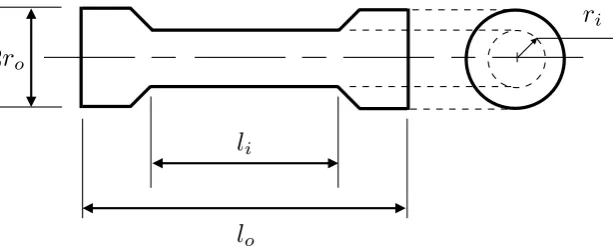
paramatrize the geometry by the dimensions of the inner section (the inner lengthliand radiusri) as
188
shown in Fig. (2). The inner dimensions are inferred from noisy measurement of the beam deflection
189
at the mid-span. Once the dimensions are estimated, we perform a localized uncertainty propagation
190
of the material parameters of the inner core.
191
3.1. The Forward Problem
192
We consider a 3-D Aluminum beam with mean elastic properties ofE “70 GPa,ν “0.3 and
ρ “ 26.25 kN/m3. For the damping representation, we consider Rayleigh damping whereby the
damping is assumed asC“ηmM`ηkK. In the numerical implementation, we consider the proportion
constantsηm“0 andηk “0.001, and we use stiffnessKbased on the mean properties. We utilize
FEniCS for the forward finite element simulations. [23]. Fig. (2) shows a 2D projection of the beam
geometry, whereby we parameterize the inner cylinder by (lengthli and radiusri), and the outer
cylinder by (length lo and radius ro). For the reference case the inner and outer dimensions are
(li“0.45 m,ri “0.025 m) and (ro“0.05 m and,lo“1.0 m), respectively. The beam is subjected to an
impact force defined as:
Fpt,xq “ r0, 0,F0t{tcδpt´tcqsT, (29)
whereF0“ ´5.0 GN and the ramp timetc“0.5 ms. The beam is fixed at both ends and subjected to
193
zero initial displacement and velocity. The dynamics is integrated up to 0.01 s.
194
r
i2
r
ol
il
oFigure 2.Schematic showing a 2D projection of a typical beam. For the reference case the inner and outer dimensions are (li“0.45 m,ri“0.025 m) and (ro“0.05 m and,lo“1.0 m), respectively.
We consider the vertical deflection at the mid-span to be the quantity of interest (QoI) in identifying
195
the underlying beam geometry. Fig. (3) shows he mid-span displacement and velocity for a the
196
reference case.
197
0.000 0.002 0.004 0.006 0.008 0.010 time [s]
−0.02
−0.01 0.00
displacemen
t
[m]
(a) displacement
0.000 0.002 0.004 0.006 0.008 0.010 time [s]
−0.005 0.000 0.005 0.010
velo
cit
y
[m/s]
(b) velocity
Figure 3.The displacement and velocity at the mid-span of the reference casePp0.5, 0.0, 0.0qrmsand using the mean material propertiesE“70 GPa,ν“0.3 andρ“26.25 kN/m3
3.2. The Surrogate Model
198
In order to infer the beam geometry from the QoI, many runs of the forward model (the 3D finite
199
element dynamical code are required. This may cause a computational burden when the computational
200
budget is limited. Thus, a surrogate model can overcome this issue by utilizing a limited number of a
201
prespecified runs. The design of computer experiments concept can be used to optimally select the
202
required runs [24–26]. For multi-fidelity simulations, where a high-cost high-accuracy and a low-cost
203
low-accuracy simulators are available, a balance between the cost and accuracy can be achieved in
204
designing the numerical simulations experiments [27].
205
The surrogate model is constructed based on samples that can represent the variability in the
206
beam geometry due to different values of the inner dimensions. We define the variability of the inner
207
dimensions by assigning a uniform random distribution with a specified bounds asli„Up0.25, 0.75qm
208
andri„Up0.01, 0.05qm. Using Latin hypercube sampling technique [28], we generate 50 independent
209
samples for the inner dimensions. Using these samples, we generate the geometry of the beam followed
210
by constructing the corresponding finite element mesh, and executing the forward model to calculate
211
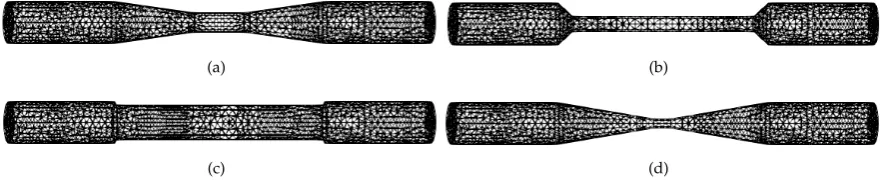
the mid-span deflection (QoI). Samples of the training geometries are shown in Fig. (4). Clearly, the
212
samples span a wide range of the probable geometries of the beam. The corresponding scatter of the
213
mid-span vertical displacement of the 50 samples are shown in Fig. (5). Of course, the variability of the
214
inner dimensions not only affect the geometry, but also the location and magnitude of the bouncing
215
deflection at around timet“0.002sandt“0.005s.
216
(a) (b)
(c) (d)
11 of 16
0.000 0.002 0.004 0.006 0.008 0.010 time [s]
−0.04
−0.02 0.00
displacemen
t
[m]
Figure 5.The mid-span vertical displacement of the 50 samples.
We randomly split the 50 samples into 40 samples for training and 10 for testing. For practical
217
numerical implementation and to reflect the reality of the real world, we add a Gaussian random noise
218
of strength 10´3ˆmaxpuqto the deflection measurementsu. The GP surrogate model is trained on the
219
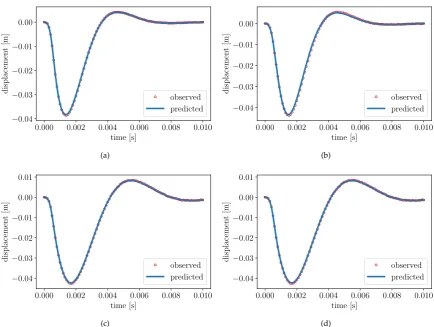
training samples and used to predict the held-out testing samples. Fig.(6) shows samples of observed
220
and predicted responses for different values of the inner dimensions. The maximum and minutemen
221
values of the mean squared error between the prediction and the observed response are 2.10ˆ10´7
222
and 5.35ˆ10´9, respectively. Given the fact that the testing samples are not seen by the model during
223
the training phase, the GP model can predict the unseen data within the given accuracy.
224
0.000 0.002 0.004 0.006 0.008 0.010 time [s]
−0.04
−0.03
−0.02
−0.01 0.00
displacemen
t
[m]
observed predicted
(a)
0.000 0.002 0.004 0.006 0.008 0.010 time [s]
−0.04
−0.03
−0.02
−0.01 0.00
displacemen
t
[m]
observed predicted
(b)
0.000 0.002 0.004 0.006 0.008 0.010 time [s]
−0.04
−0.03
−0.02
−0.01 0.00 0.01
displacemen
t
[m]
observed predicted
(c)
0.000 0.002 0.004 0.006 0.008 0.010 time [s]
−0.04
−0.03
−0.02
−0.01 0.00 0.01
displacemen
t
[m]
observed predicted
(d)
Figure 6.Observed and predicted QoI for different testing samples. The test samples are not part of the training set.
To summarize the quality of the prediction, in Fig. (7), we show theL2-norm of the observed and
225
predicted QoI. The observed/predicted validation plot indicates that the coefficient of determination
226
between the prediction and observation is 0.98, and the corresponding mean squared error is 2.53ˆ
227
10´6. These statistical metrics indicate that the GP model can estimate the unseen geometry from a
228
noisy measurement of the QoI within a given accuracy.
229
0.13 0.14 0.15 0.16 0.17 0.18 observed
0.13 0.14 0.15 0.16 0.17 0.18
observ
ed/predicted
observed predicted
Figure 7.The observed/predicted validation plot showing the norm of the observed (test data) and the corresponding model predictions.
Once the GP model is validated, it can be deployed as a low-cost surrogate for the 3D finite
230
element analysis code. The prediction of GP model takes only a fraction of the time that is needed by
231
the finite element code to estimate the QoI with a fair accuracy.
232
3.3. The Backward Problem
233
In the backward problem, we try to estimate the inner dimensions (li,ri) of the beam from noisy
234
measurements of the QoI. To this end, we utilize the GP surrogate model constructed in the previous
235
subsection as a substitute for the forward model within the Bayesian framework.
236
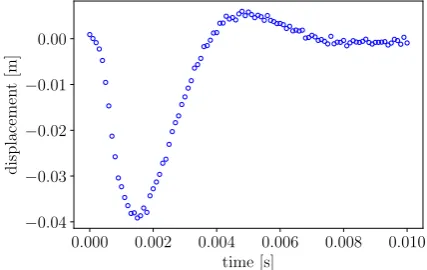
We assume that a noisy measurement for the QoI is available as shown in Fig. (8). The synthetic
237
data is generated using inner dimensionli “ 0.313 m and ri “ 0.055 m plus (σn “0.1ˆmaxpuq)
238
Gaussian noise to mimic a real experiment setting.
239
0.000 0.002 0.004 0.006 0.008 0.010 time [s]
−0.04
−0.03
−0.02
−0.01 0.00
displacemen
t
[m]
Figure 8.Noisy measurement of the QoI
For the Bayesian calculation, we use non-informative prior for both the parametersθ“ rli,risand
240
utilize an adaptive MCMC method (DRAM) [29,30] to estimate the posterior density. In Fig. (9), we
241
show the estimated posterior density of the parametersθ“ rli,ris. We also show the prior density and
242
the true value of the parameters. Note that the true parameters where not part of either the training
243
nor the testing datasets. This highlights the robustness of the framework. The mean of the estimated
13 of 16
values areli “0.310˘0.048 m andri “0.054˘0.004 m (the confidence bounds are based on two
245
standard deviation).
246
0.28 0.30 0.32 0.34 0.36
length [m] 0
10 20 30 40
densit
y
[1/m
]
posterior prior true
(a) the inner lengthli
0.052 0.054 0.056 0.058 hight [m]
0 100 200 300 400
densit
y
[1/m
]
posterior prior true
(b) the inner radiusri
Figure 9.The estimated posterior density function of the inner dimensionsθ“ rli,ris. The sold line is
the posterior PDF, the dotted line is the prior PDF and the bullet dot represents the true valueli“0.313
m andri“0.055 m.
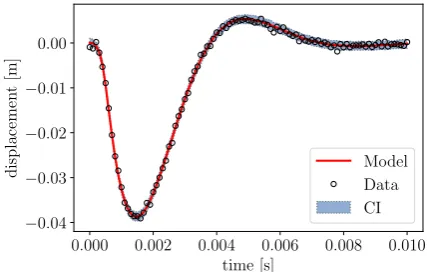
Next, the uncertainty in the parameter estimation represented by the posterior density in Fig. (9) is
247
propagated forward through the surrogate model to estimate a confidence bound on the prediction of
248
the QoI. In Fig. (10), we show the model prediction and the 95% confidence interval as well as the true
249
measured response. TheL2for the discrepancy between the mean model prediction and the measured
250
data is 0.005 m. This conforms that the response due to the estimated parameters uncertainty agrees
251
reasonably well with the true response.
252
0.000 0.002 0.004 0.006 0.008 0.010 time [s]
−0.04
−0.03
−0.02
−0.01 0.00
displacemen
t
[m]
Model Data CI
Figure 10. The prediction of the surrogate model and its confidence interval due to uncertainty propagation of the variability in the estimated inner dimensions.
3.4. Localized Uncertainty Propagation
253
The QoI is confined within the core cylinder defined by inner dimensionsθ“ rli,ris. Once these
dimensions are available, the effect of the random variability in the material properties of the inner subdomain can be estimated using PC expansion. Without loss of generality, here we assume that for the inner cylinder, the Young’s modulus and material density are random quantities, while Poisson’s ratio is deterministic as
Epx,ξ1q “ #
E0p1`σEξ1q, forxPΩ2
E0, otherwise (30)
and
ρpx,ξ2q “
#
ρ0p1`σρξ2q, forxPΩ2
ρ0, otherwise
(31)
where the artificial boundary forΩ2are defined by the Maximum A Posteriori (MAP) estimation
254
of the inner dimensionsθ “ rli,ris,E0 “70 GPa,ρ0 “26.25 kN/m3,σE “0.25 andσρ “0.15 and
255
ξ1,ξ2are standard normal random variables. Note that, not only the solution overΩ2is stochastic,
256
but also over all the whole domain since the spatial finite element and stochastic basis functions
257
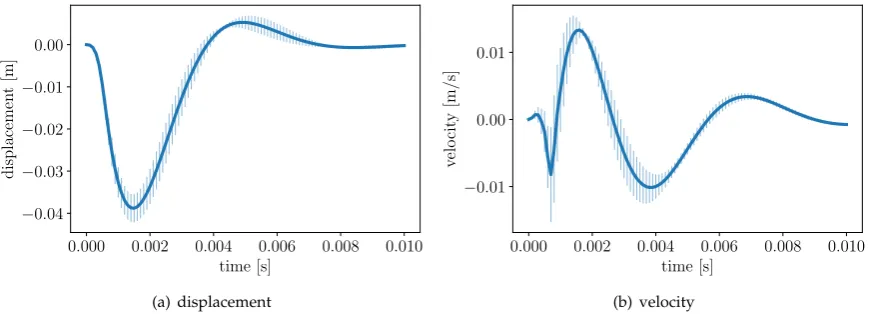
are continuous across the domains interfaces. We use second order PC expansion to propagate the
258
localized uncertainty due to the random Young’s modulus and material density as shown in Fig. (11).
259
The uncertainty bounds follow the trend of the response, with a higher value near the shock location.
260
Although not explored here, high spatio-temporal resolution solver can be directed toward the region
261
of interest, while a less resolution alternative can be assigned to the regions away from the QoI.
262
As demonstrated in [7–9], PASTA-DDM-UQ approach leads to a customized solver for localized
263
uncertainty propagation with less computational cost.
264
0.000 0.002 0.004 0.006 0.008 0.010 time [s]
−0.04
−0.03
−0.02
−0.01 0.00
displacemen
t
[m]
(a) displacement
0.000 0.002 0.004 0.006 0.008 0.010 time [s]
−0.01 0.00 0.01
velo
cit
y
[m/s]
(b) velocity
Figure 11.The PC prediction of the displacement and velocity at the mid-span. The uncertainty bounds represent two standard deviation.
4. Conclusion
265
We present a data-based partitioning scheme for localized uncertainty quantification in
266
elastodynamic system. The localized region of interest is identified using Bayesian inference framework.
267
Measurement of the system response at one location in conjunction with a physics-based computational
268
model is used to infer the localized features of the region of interested. A data-based surrogate
269
model for the physics-based simulator is constructed using Gaussian process regression in order
270
to reduce the computational cost of the Bayesian inversion. Material uncertainty in the region of
271
interest is propagated through the system using polynomial chaos. We exercise our framework on
272
a three-dimensional beam with localized feature and subjected to an impact load. The presented
273
framework can facilitate quantifying the effect of the sub-component uncertainty on the system-level.
274
Proper assessment of uncertainty at various level can accelerate the adaptation process of a new
275
component introduced to an existing system.
276
References
277
1. Dutton, S.; Kelly, D.; Baker, A.Composite materials for aircraft structures; American Institute of Aeronautics
278
and Astronautics, 2004.
279
2. Mrazova, M. Advanced composite materials of the future in aerospace industry.Incas bulletin2013,5, 139.
15 of 16
3. Pettit, C.L. Uncertainty quantification in aeroelasticity: recent results and research challenges. Journal of
281
Aircraft2004,41, 1217–1229.
282
4. Munk, C.L.; Nelson, P.E.; Strand, D.E. Determinant wing assembly, 2004. US Patent 6,808,143.
283
5. Katunin, A.; Dragan, K.; Dziendzikowski, M. Damage identification in aircraft composite structures: A
284
case study using various non-destructive testing techniques. Composite structures2015,127, 1–9.
285
6. Diamanti, K.; Soutis, C. Structural health monitoring techniques for aircraft composite structures.Progress
286
in Aerospace Sciences2010,46, 342–352.
287
7. Subber, W.; Matouš, K. Asynchronous space–time domain decomposition method with localized
288
uncertainty quantification. Computer Methods in Applied Mechanics and Engineering2017,325, 369–394.
289
8. Subber, W.; Salvadori, A.; Lee, S.; Matouš, K. Uncertainty quantification of the reverse Taylor impact test
290
and localized asynchronous space-time algorithm. AIP Conference Proceedings. AIP Publishing LLC,
291
2018, Vol. 1979, p. 140005.
292
9. Subber, W.; Matouš, K. Asynchronous space–time algorithm based on a domain decomposition method
293
for structural dynamics problems on non-matching meshes.Computational Mechanics2016,57, 211–235.
294
10. Smith, R.C.Uncertainty quantification: theory, implementation, and applications; Vol. 12, SIAM, 2013.
295
11. Gelman, A.; Carlin, J.B.; Stern, H.S.; Rubin, D.B.Bayesian data analysis; Vol. 2, Chapman & Hall/CRC Boca
296
Raton, FL, USA, 2014.
297
12. Chen, M.H.; Shao, Q.M.; Ibrahim, J.G. Monte Carlo methods in Bayesian computation; Springer Science &
298
Business Media, 2012.
299
13. Gelman, A.; Carlin, J.B.; Stern, H.S.; Dunson, D.B.; Vehtari, A.; Rubin, D.B. Bayesian data analysis; CRC
300
press, 2013.
301
14. Williams, C.K.; Rasmussen, C.E.Gaussian processes for machine learning; Vol. 2, MIT press Cambridge, MA,
302
2006.
303
15. Ghanem, R.G.; Spanos, P.D.Stochastic finite elements: a spectral approach; Courier Corporation, 2003.
304
16. Le Maître, O.; Knio, O.M.Spectral methods for uncertainty quantification: with applications to computational
305
fluid dynamics; Springer Science & Business Media, 2010.
306
17. Rasmussen, C.E. Gaussian processes in machine learning. Summer School on Machine Learning. Springer,
307
2003, pp. 63–71.
308
18. Ghosh, S.; Pandita, P.; Subber, W.; Zhang, Y.; Wang, L. Efficient bayesian inverse method using robust
309
gaussian processes for design under uncertainty. AIAA Scitech 2020 Forum, 2020, p. 1877.
310
19. Ghosh, S.; Pandita, P.; Atkinson, S.; Subber, W.; Zhang, Y.; Kumar, N.C.; Chakrabarti, S.; Wang, L. Advances
311
in Bayesian Probabilistic Modeling for Industrial Applications.ASCE-ASME J Risk and Uncert in Engrg Sys
312
Part B Mech Engrg2020,6.
313
20. Zhang, Y.; Ghosh, S.; Pandita, P.; Subber, W.; Khan, G.; Wang, L. Remarks for scaling up a general gaussian
314
process to model large dataset with sub-models. AIAA Scitech 2020 Forum, 2020, p. 0678.
315
21. Shabouei, M.; Subber, W.; Williams, C.W.; Matouš, K.; Powers, J.M. Chemo-thermal model and gaussian
316
process emulator for combustion synthesis of ni/al composites. Combustion and Flame2019,207, 153–170.
317
22. Feinberg, J.; Langtangen, H.P. Chaospy: An open source tool for designing methods of uncertainty
318
quantification.Journal of Computational Science2015,11, 46–57.
319
23. Logg, A.; Mardal, K.A.; Wells, G.Automated solution of differential equations by the finite element method: The
320
FEniCS book; Vol. 84, Springer Science & Business Media, 2012.
321
24. Kristensen, J.; Subber, W.; Zhang, Y.; Ghosh, S.; Kumar, N.C.; Khan, G.; Wang, L. Industrial applications
322
of intelligent adaptive sampling methods for multi-objective optimization. InDesign Engineering and
323
Manufacturing; IntechOpen, 2019.
324
25. Kristensen, J.; Bilionis, I.; Zabaras, N. Adaptive simulation selection for the discovery of the ground state
325
line of binary alloys with a limited computational budget. InRecent Progress and Modern Challenges in
326
Applied Mathematics, Modeling and Computational Science; Springer, 2017; pp. 185–211.
327
26. Pronzato, L.; Müller, W.G. Design of computer experiments: space filling and beyond. Statistics and
328
Computing2012,22, 681–701.
329
27. Ghosh, S.; Kristensen, J.; Zhang, Y.; Subber, W.; Wang, L. A Strategy for Adaptive Sampling of Multi-Fidelity
330
Gaussian Processes to Reduce Predictive Uncertainty. International Design Engineering Technical
331
Conferences and Computers and Information in Engineering Conference. American Society of Mechanical
332
Engineers, 2019, Vol. 59193, p. V02BT03A024.
333
28. Lee, A. pyDOE: The experimental design package for python.Python package version 0.32015,8.
334
29. Haario, H.; Laine, M.; Mira, A.; Saksman, E. DRAM: Efficient adaptive MCMC.Statistics and Computing
335
2006,16, 339–354.
336
30. Miles, P.R. pymcmcstat: A Python Package for Bayesian Inference Using Delayed Rejection Adaptive
337
Metropolis. Journal of Open Source Software2019,4, 1417.