peertopeer feedback using adaptive comparative judgement. Practitioner
Research in Higher Education, 12 (1). pp. 5060.
Downloaded from: http://insight.cumbria.ac.uk/id/eprint/4576/
Usage of any items from the University of Cumbria’s institutional repository ‘Insight’ must conform to the following fair usage guidelines.
Any item and its associated metadata held in the University of Cumbria’s institutional repository Insight (unless stated otherwise on the metadata record) may be copied, displayed or performed, and stored in line with the JISC fair dealing guidelines (available here) for educational and notforprofit activities
provided that
• the authors, title and full bibliographic details of the item are cited clearly when any part of the work is referred to verbally or in the written form
• a hyperlink/URL to the original Insight record of that item is included in any citations of the work
• the content is not changed in any way
• all files required for usage of the item are kept together with the main item file.
You may not
• sell any part of an item
• refer to any part of an item without citation
• amend any item or contextualise it in a way that will impugn the creator’s reputation
• remove or alter the copyright statement on an item.
The full policy can be found here.
Citation
Demonacos, C., Ellis, S., Barber, J.(2019) ‘Student peer assessment using adaptive comparative judgment: grading accuracy versus quality of feedback’, Practitioner Research in Higher Education
Journal, 12(1), pp. 50-60.
Student peer assessment using adaptive comparative judgment: Grading accuracy versus quality of feedback
Practitioner Research In Higher Education
Copyright © 2019 University of Cumbria Vol 12(1) pages 50-60
Constantinos Demonacos, Steven Ellis & Jill Barber University of Manchester
Abstract
In this study we explored the potential of adaptive comparative judgement (ACJ) as a medium for peer assessment and for the giving and receiving of peer feedback. ACJ is a marking protocol in which the assessor (or judge) merely compares two answers and chooses a winner. Repeated judgements and a suitable sorting algorithm allow marks to be derived from a rank order of scripts. Feedback can be added to each script. In this case study (a 500 word report in year 3 of a pharmacy programme) each student gave feedback to 10 others and the overall feedback standard was high, but, as judges, students were inconsistent with one another and with staff assessment. This contrasts with a previous exercise, in which a robust assessment was achieved but feedback was less good. A hierarchical marking scheme and explicit feedback guidelines may be key to optimising ACJ-based student peer assessment.
Keywords
Adaptive Comparative Judgement, Peer Assessment, Summative Assessment, Marking Schemes.
Introduction
For academic staff it is often the case that “an hour spent in marking is an hour less of life” (John Sargeant, 2004). Students may, however, gain much from assessing and giving feedback on one another’s work; in particular, they can see what very good work looks like, and reflect on their own practice in the light of their peers’ experience. Barriers to the use of peer assessment include the perception that student marking is unreliable, exacerbated by the fact (in our experience) that students are reluctant to apply mark schemes to other students’ work, tending to award very high marks without discrimination. Software to support the use of adaptive comparative judgement is now available and, by simplifying the marking process to repeatedly answering the single question “Which is better?” has the potential to bring student peer assessment into mainstream practice. The aim of this study was to evaluate the use of adaptive comparative judgement in student peer assessment.
Adaptive Comparative Judgement (ACJ) is an alternative to conventional marking in which the assessor (or judge) merely compares two answers and chooses a winner(Thurstone, 1927; Pollitt, 2012). The use of a suitable sorting algorithm means that repeated comparisons lead to scripts sorted in order of merit. Boundaries are determined by separate review of scripts. In practical terms, the assessor sees two scripts arranged side-by-side; based on the criteria given, (s)he decides which is better and clicks the appropriate “winner” button. The next pair of scripts is then displayed. Scripts of about 500 words appear as a single page, but scrolling is necessary for reading longer pieces of work. The method does much to remove subjective bias and to allow “hawks” and “doves” to mark successfully in a team. (Daly et al., 2017; Barber 2018).
involved, or if the same group judges on a different day?). Politt (2012) and others (Kimble et al., 2007, Kimble et al., 2009) have claimed very high reliability in the final order obtained by ACJ (typically > 0.93)1, compared with 0.6 – 0.7 using conventional marking schemes although this very high level of reliability has been disputed, notably by Bramley (2015). Getting the scripts into the correct rank order is only part of the problem, however. It is equally important that the separation is accurate. In student work, the marks tend to be normally distributed, so that there is very little separation between scripts in the middle of the group, but there might be a large difference in marks between (for example) the top and the second script. Scale separation has been explored in detail by Verhavert et al. (2017).
While a great deal of attention has been paid to the accuracy achievable with adaptive comparative judgement, rather little has been paid to the accuracy required. This will vary considerably from exercise to exercise and setting to setting, but can be quite low. A typical assessment in a UK university (like the one described in this paper) might carry 10% of the marks in a 20 credit third year unit, and no attempt would be made to mark to closer than 0.5 or 0.25 marks out of 10. The most common marks (typically 6/10 or 6.5/10) are likely to be awarded to more than 10% of the cohort, meaning that a precise order is not necessary unless the cohort is very small.
We were especially keen to explore the use of ACJ as a vehicle for peer assessment and feedback. The literature points to the value of peer assessment and feedback. Nicol et al (2014) and Cho and MacArthur (2011) note that students benefit from both giving and receiving feedback. The language used by fellow students tends to be accessible (Topping, 1998; Falchikov, 2005). Bloxham and West (2004) indicate that peer feedback can help students to understand the assessment process. Another potential benefit of peer assessment by ACJ is that students comment on average on 10-15 pieces of work and receive 10-15 pieces of feedback from different people, a variety that staff seldom match. Our preliminary data (Barber, 2018) indicated that students are capable of sufficiently accurate marking by ACJ and the students reported finding the process of judging very helpful to their learning.
The aim of the present study was to assess the value of adaptive comparative judgement in a summative assessment in the third year of a four year undergraduate pharmacy programme, using students as the judges. Both the reliability of student judgements and the quality of student feedback were assessed. The exercise chosen (a case study on the biology and treatment of a patient with complex needs) was one that students historically found difficult and responded to badly.
Methods
The unit of the curriculum chosen for this study was “Integrated Research Skills” which carries 20 credits in the third year. Students carry out a number of exercises designed to prepare them for the final year project module (30 credits). The other exercises are an audit report (40%), a critique (40%) and a laboratory practical (10%).
The present exercise carries 10% of the final mark. As well as appearing on the Virtual Learning Environment, the exercise was presented to students in detail in the course of a lecture, as shown in Figure 1. In addition to preparing students for their final year project, this unit is intended to illustrate the integration of science with pharmacy practice. Thus, the exercise includes explaining the underlying biology of a condition (in this case multiple sclerosis) to a patient. The student requires both an understanding of the disease and its therapy, and an ability to empathise with a patient and to express their knowledge in plain English.
1 The “reliability” measure (the square of standardised residuals) is mathematically complex and beyond the
The exercise consisted of five parts, each with a maximum of 100 words. It was submitted through a Turnitin dropbox so that any plagiarism would be detectable.
ACJ was carried out using the commercially available software CompareAssess (https://compareassess.com). The complete collection of student file submissions was downloaded from Blackboard / Turnitin as a zipped archive. It is possible to assign each file a unique identifier manually, and we have done this in the past. In the present exercise, some automation was achieved as follows. The filenames of those files included system assigned student ID codes set alongside user submitted title text. To standardise file naming and to minimise propagation of identifying information within a 3rd party system like CompareAssess, these filenames were manipulated before each file was submitted for judgement. To do so the listing of filenames was saved to disk and then modified programmatically so that universally unique identifiers (uuid) became associated with each line of that file listing. This produced a tab separated collection of information that was used as the source in a file renaming step and retained for the final collation of feedback. Renamed files were submitted to CompareAssess and used for the comparative analysis judgement sessions. 19 rounds of judging were completed, so that each student made 10 judgements and commented on about 15 scripts.
Once all rounds of judgements had concluded the data available within the CompareAssess system was regularly and tightly associable with the assigned uuids. Complete anonymity was therefore assured and no third party could associate comments or scripts with individual students. Students were further informed of publication and given the opportunity to withdraw the use of their anonymous comments.
Figure 1. Slides introducing the case study to students. A list of references was also given.
The CompareAssess systems presents several useful data fields downloadable as summary reports, however those that contained peer feedback were presented on a document by document basis and might have required laborious manual activity to retrieve. (We understand that this will be improved in a later version of the software.) To avoid this, data scraping routines were implemented using web browser automations which iterated through each of these reports in order to extract peer feedback into structured objects. This information was then readily available to be imported by other systems were it became re-associated with identifying information retained above.
Data Analysis
The software provides information if any of the judges or the scripts were misfits. It also gives an average judgement time for each judge. Data for misfit judges and scripts were analysed visually.
Results
It is a sad fact that among 130 students there will usually be some who do the minimum necessary to pass an assignment, irrespective of any negative effects on their peers. It was therefore necessary to check the parameter “average time per judgement”. Two students spent a little less than one minute on each judgement. The quality of feedback from all students was checked in this exercise, but hindsight and further exercises have taught us that it would be sensible to check these two explicitly.
Student marking
Next, we examined the “Judge misfit” panel (Figure 2A). Six judges appeared above the red line, indicating that their judgements are not consistent with those of the other judges. Previous peer assessment exercises have generally seen only one or two misfit judges. Again, hindsight teaches us to examine those judgements explicitly. The “Script misfit” panel (Figure 2B) allows scripts that are difficult to mark to be identified, and these should be (and were) moderated by staff.
The reliability (Figure 2C) was disappointing at 0.55, and the error bars indicate considerable uncertainty about the final rank order. This level of reliability is similar to that of two other peer-assessed exercises, although one previous exercise, carried out by 64 fourth year students, gave a reliability of 0.92.
In this case scripts 39 – 101 have overlapping error bars, and we cannot rigorously exclude the possibility of their being wrongly ordered. These scripts, however, by either manual or CompareAssess marking span a mark range of only 15% (6.0 – 7.5 /10), corresponding to 1.5% of the unit mark or 0.09% of the final degree mark.
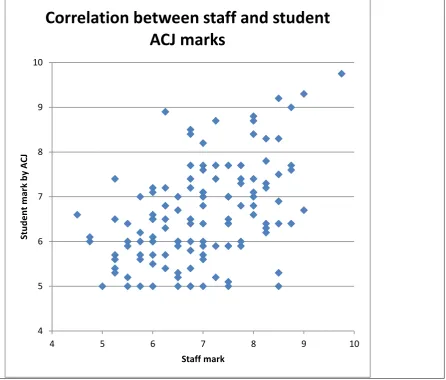
Figure 3 shows the correlation between staff marks and student marks awarded by adaptive comparative judgement. There is no doubt about which script is the best, and the general trend is as expected. Nevertheless, there is considerable scatter, with some disagreements of more than 2 marks between staff marks and student marks by ACJ.
On this occasion, the staff marks were used to contribute to the overall unit mark.
Feedback
Figure 2. A Judge misfit panel showing 6 judges above the critical misfit line. These judges gave judgements somewhat inconsistent with the rest of the cohort, and their judgements merit closer inspection. B Script misfit panel, showing six scripts above the critical misfit line; these scripts proved difficult to judge, and should certainly be considered by the staff moderating the exercise. C Reliability after 19 rounds.
What students think
We have previously determined student views on feedback from adaptive comparative judgement (Barber 2018), and received very positive responses, including requests to use the system with work from previous year groups. We did not formally assess students’ reactions to this exercise, but the unit as a whole is better received by students than in previous years, and, informally, students report the value of seeing their peers’ work. The most positive comments about this exercise were received a semester after its completion. Students beginning their fourth year project work have reported (at a scheduled feedback session) that they now see the value of this exercise.
Table 1. Examples of student feedback. Top: in response to the best script scoring 9.75/10. Bottom: in response to a script scoring 6.25/10.
very detailed answers. good referencing sources
Questions answered very well with all points covered. Good presentation and obvious research has been conducted and used to back statements with evidence from the literature. Case taken into consideration when discussing side effects and lifestyle changes in questions 3, 4 and 5
Clearly differentiates between the type of multiple sclerosis. The counselling point is suitable for Bahar. There is a good connection for pharmacy practice such as smoking cessation. The therapeutic approach is well justified.
Student has given statistics illustrating how prevalent the disease is and which ages are most likely to be affected. A variety of risk factors have been given which gives a better understanding as to how MS could potentially increase its risk. Types of MS were clearly defined and explained showing clearly the differences between all types and what occurs in each. Counselling points were patient specific to Bahar and were well explained, ensuring patient knew how to avoid these symptoms from occurring and what to do if they arose. Contributions the pharmacist can make were well explained and appropriate which showed quality for patient care.
This student has been able to include a vast amount of information regarding the condition despite a very low word count being available. Questions were answered very well however, I believe these questions could have been answered in a more patient friendly manner.
Positives: Good explanation of the different types of MS. Good at relating back to pharmacy practice. Good referencing and use of journals. Improvements: Need to advise Bahar on taking contraception whilst taking fingolimod
Issue has been identified clearly, there is interpretation of the evidence and challenging of the assumptions, the mechanism of action of therapeutic approaches has been described. The similarities, differences, advantages and disadvantages between the therapies have been described. There is clear evidence of the ability to clearly express thoughts. The text is structured well.
Poor range of references
No mention of the dose regimen, sterile injection techniques or rotating injection site for interferon Basic counselling points for fingolimod
Regarding patient centred counselling perhaps discussions regarding pregnancy and contraception could have been included.
Smoking cessation could have been included within the role of the pharmacist section.
Epidemiology is well talked about and risk factors have been mentioned well in the first question. The types of MS are clearly written and distinguished between them. The last question is poorly written with no emphasis on the use of Pharmacy services such as MUR, NMS or smoking cessation. Referencing also needs to be improved as there's very little references and poor execution of referencing style.
Figure 3. Correlation between staff mark and mark obtained by adaptive comparative judgement with student judges.
Discussion
It is essential that healthcare professionals work as teams, and it is counter-intuitive for their undergraduate study to be unduly competitive. Peer assessment and feedback can be used to foster a sense of community among students. The concept of the community of learners is explicit in the advertising of some MOOCs (Massive Open Online Courses) (https://www.futurelearn.com) and has been explored by commentators such as Tinto (2003 & 2008), but the culture of individual learners competing with one another remains strong. The use of student peer assessment and feedback is facilitated by adaptive comparative judgment, and provides opportunities for students to share responsibility for the learning of the group.
The authors have also been seeking methods of helping students to acquire soft skills, such as critical thinking, fair judgement and personal responsibility, in order to advance their professionalism. The high quality of the feedback offered suggests that these objectives were achieved, at least for the majority of students.
Another objective of this study was to enable students to appreciate what the best work looks like. Carless et al. (2018) are among those who have argued for the use of exemplars of best student work to aid the learning of other students. Our study is much less managed than theirs; students are not
4 5 6 7 8 9 10
4 5 6 7 8 9 10
Stu
d
e
n
t
m
ar
k
b
y ACJ
Staff mark
told which is the best work. Nevertheless, students are exposed to 15 or 20 examples of student answers, some good, some much less so.
Adachi et al. (2018), in a comprehensive review of the literature, identify these objectives as the major advantages of peer assessment.
The present exercise was not designed for a study of adaptive comparative judgement; rather it was chosen for the study on the basis that ACJ had the potential to improve the exercise. Adaptive comparative judgement was first used as a method of assessment in this School in 2016 and every assessment allows more lessons to be learned. We have not, however, used ACJ to replace assessments that work well; it has been used either to improve the student or staff experience of summative assessment or to allow formative assessments to take place where pressures on staff time would not permit a conventional assessment. The assessment described here involved a detailed analysis of both marks and feedback generated by peer assessment.
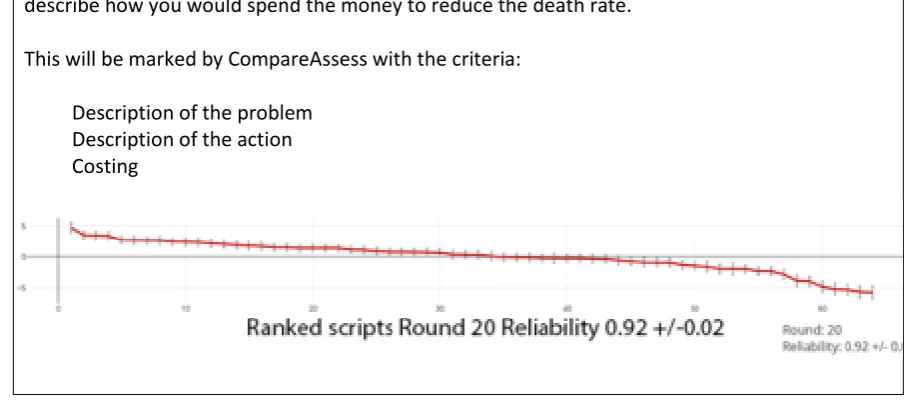
The peer-marking was not wholly successful, students failing wholly to agree with one another or with the academic staff marker. Two other peer assessments in the School saw similar reliability (0.5-0.6). Another (Barber, 2018) has been very successful and is shown in Figure 4.
Imagine that you have been awarded a grant of £1 million to reduce premature deaths anywhere in the world. Choose a specific disease, group of diseases or other major cause of death and describe how you would spend the money to reduce the death rate.
This will be marked by CompareAssess with the criteria:
1. Description of the problem 2. Description of the action 3. Costing
Figure 4. Example of question marked with a hierarchical marking scheme (top) with reliability statistics after round 20 (bottom).
The present exercise, however, gave rise to rich and varied feedback of a quality and quantity we very rarely see in peer feedback. Indeed, the brief feedback notes left the staff member marking the exercise were almost all in complete agreement with the feedback provided by the students. Mortier et al. (2015) have examined students’ perceptions of the comparative judgement process in great detail, finding them positive overall.
intelligent, and quite probably a scientist, so that patient-friendly language is not necessarily simple language. Adaptive comparative judgement requires that judges choose between two scripts; unless they are given very clear guidance, they will choose on the basis of what they consider to be most important.
The key difference between this exercise and the one shown in Figure 4 is therefore probably the latter assessment employed a hierarchical marking scheme. Judges were asked to address the first criterion “Has the problem been clearly described?” and if one script defined the problem and the other did not, the first must win, irrespective of the rest of the answer. If both scripts (or neither script) contained a good description of the problem, the judgement was made on the basis of the action described, and only if this also tied was the costing considered. Students were free to comment on the action or the costing but it was clear that the description of the problem took precedence in the judging process.
The use of comparative judgement in marking large bodies of student work has, until recently, been hindered by the lack of appropriate software. Now that the software is available, teachers are in a position to build expertise in its use. In the Manchester undergraduate pharmacy programme, we have successfully carried out assessments with staff as judges. We have also used the adaptive comparative judgement method to deliver successful peer assessment and successful peer feedback; the next challenge is to deliver both in the same exercise!
Conclusion
Adaptive comparative judgement has enormous potential in peer assessment and in enabling the giving and receiving of peer feedback. The method requires, however, the use of specialised, hierarchical marking schemes and there is, as yet, no body of literature or consensus about how to develop these. We will continue to try to develop protocols that combine good quality peer assessment and feedback, as part of our strategy to create communities of learners.
Acknowledgements
We thank Matt Wingfield and Declan Lynch of Digital Assess for their collaboration in this ongoing project. We also thank many students at the University of Manchester for their participation as judges.
References
Adachi, C., Tai, J. H.-M., Dawson, P. (2018) ‘Academics’ perceptions of the benefits and challenges of self and peer assessment in higher education’, Assessment & Evaluation in Higher Education, 43, PP. 294-306.
Barber, J. (2018) ‘Five go marking an exam question: the use of Adaptive Comparative Judgement to manage subjective bias’, Practitioner Research in Higher Education, 2018, 11, PP.94-100. Bloxham, S., West, A. (2004) ‘Understanding the rules of the game: marking peer assessment as a
medium for developing students' conceptions of assessment’, Assessment & Evaluation in
Higher Education, 29, pp. 721-733.
Bramley, T. (2015) Investigating the reliability of Adaptive Comparative Judgment. Cambridge Assessment Research Report, 23 March 2015. Available at
http://www.cambridgeassessment.org.uk/Images/232694-investigating-the-reliability-of-adaptive-comparative-judgment.pdf (Accessed: 30 March 2018).
Carless, D., Chan, K.K.H., To, J., Lo, M., Barrett, E. (2018) Developing students’ capacities for
evaluative judgement through analysing exemplars, in Boud, D., Ajjawi, R., Dawson, P and Tai, J. (eds.), Developing Evaluative Judgement in Higher Education: Assessment for knowing and
producing quality work. London: Routledge.
Daly, M.; Salmonson, Y.; Glew, P.J. and Everett, B. (2017) ‘Hawks and doves: The influence of nurse assessor stringency and leniency on pass grades in clinical skills assessments’, Collegian, 24, pp. 449-454.
Falchikov N (2005) Improving assessment through student involvement. London: Routledge- Falmer. Kimbell, R., Wheeler, T., Miller, S. and Pollitt, A. (2007) e-scape portfolio assessment: Phase 2 report.
London: Technology Education Research Unit, Goldsmiths, UL. Available at:
http://www.gold.ac.uk/media/e-scape2.pdf. (Accessed: September 2017 and unavailable March 2018).
Kimbell, R., Wheeler, T., Stables, K., Sheppard, T., Martin, F., Davies, D., Pollitt, A. and Whitehouse G. (2009) e-scape portfolio assessment: Phase 3 report. London: Technology Education Research Unit, Goldsmiths, UL.Available at:
https://www.teachertoolkit.co.uk/wp-content/uploads/2014/08/e-scape_phase3_report.pdf (Accessed: 30 March 2018).
Mortier, A., Lesterhuis, M., Vlerick, P. and De Maeyer, S (2015) ‘Comparative judgment within online assessment: exploring students feedback reactions’, Communications in Computer and
Information Science, 571, pp. 69-79.
Nicol, D., Thomson, A., Breslin, C. (2014) ‘Rethinking feedback practices in higher education: a peer review perspective’, Assessment and evaluation in higher education, 39, pp.102-122. Pollitt, A. (2012) ‘The method of Adaptive Comparative Judgement’, Assessment in Education:
Principles, Policy & Practice, 19, pp. 281-300.
Thurstone, L.L. (1927) A law of comparative judgement. Psychological Review, 34, 273-286.
Tinto, V. (2003) Learning better together: The impact of learning communities on student success. Higher Education monograph series, 2003 - nhcuc.org. Available at:
http://www.nhcuc.org/pdfs/Learning_Better_Together.pdf (Accessed 07 January 2019). Tinto, V. (2008) Learning better together: The impact of learning communities on the persistence of
low-income students. Available at:
http://citeseerx.ist.psu.edu/viewdoc/summary?doi=10.1.1.472.8470 (Accessed: 07 January 2019).
Topping, K. (1998) ‘Peer assessment between students in colleges and universities’, Review of
Educational Research, 68, pp.249-276.