Floating Band D2D: Exploring and Exploiting the
Potentials of Adaptive D2D-enabled Networks
Arash Asadi
∗†, Vincenzo Mancuso
∗, and Peter Jacko
‡∗IMDEA Networks Institute, Madrid, Spain †University Carlos III of Madrid, Spain ‡Lancaster University, U.K.
Abstract—In this paper, we propose Floating Band D2D, an adaptive framework to exploit the full potential of Device-to-Device (D2D) transmission modes. We show that inband and
outband D2D modes exhibit different pros and cons in terms of complexity, interference, and spectral efficiency. Moreover, none of these modes is suitable as a one-size-fits-allsolution for today’s cellular networks, due to diverse network requirements and variable users’ behavior. Therefore, we unveil the need for going beyond traditional single-band mode-selection schemes. Specifically, we model and formulate a general and adaptive
multi-band mode selection problem, namely Floating Band D2D. The problem is NP-hard, so we propose simple yet effective heuristics. Our results show the superiority of theFloating Band D2D framework, which dramatically increases network utility and achieves near complete fairness.
I. INTRODUCTION
There have been extensive research efforts in both academia and industry to explore D2D techniques [1]. D2D communi-cations have been considered for a large variety of use-cases such as cellular offloading [2], mobile relaying [3], and video streaming [4]. These studies indicate the potential outstanding gain of D2D communications in cellular networks. Indeed, the high performance gain motivated leading telecommunication companies such as Qualcomm to perform experimental studies on this paradigm using early stage prototypes [5]. Standard-ization bodies such as 3GPP have also joined this front by considering D2D communications as a public safety feature in the next release of LTE-A [6]. These efforts from academia, industry, and standardization bodies confirm that the society regards D2D communications as a crucial feature for next generation networks. Nevertheless, there is still no concrete agreement on D2D operational details such as which medium access control to adopt, or which spectrum allocation schemes, connection setup, and resource management protocols are to be implemented. Initial proposals for D2D communications aimed at re-using the same resources that are used for con-ventional cellular communications (i.e.,inband underlayD2D mode) [7]. The significance of the D2D gain had led to propos-als in which a part of the cellular resources is dedicated only to D2D communications (i.e., inband overlay D2D mode). Finally, the scarcity and the high price of cellular spectrum motivated some researchers to explore D2D communications over the unlicensed band (i.e., outband D2D mode). These D2D modes are schematically illustrated in Fig. 1.
Unlicensed!
band!
Licensed!
band! Underlay Overlay Outband
F
re
que
nc
y
!
Cellular!
D2D! Cellular!
D2D! Cellular!
D2D!
Fig. 1. Schematic representation of overlay inband, underlay inband, and outband D2D for cellular scenarios.
The majority of the existing studies on D2D communica-tions select one of the aforementioned modes, then propose a method for resource allocation/interference management in order to handle the resulting complications, and finally illustrate the achievable performance improvement [2], [3], [7]–[9]. However, single mode D2D significantly limits the system performance to the interference profile of the network. Existing multi-mode D2D systems only focus on inband D2D modes, i.e., fully dependent on cellular spectrum. Other proposals focus on joint scheduling and mode selection [10], [11], although they are extremely complex (more complex than scheduling, which is already proven to be NP-hard for cellular systems such as LTE [12]) and introduce unnecessarily frequent mode selection decisions.
Interestingly, while some researchers limit D2D commu-nications to cellular spectrum, the standards have a more liberal view of D2D. In fact, 3GPP defines D2D as “the communication between two users in proximity using a direct link between the devices without traversing the eNB(s) or the core network” [6]. We also remark that network-assisted outband D2D is accounted for in 3GPP proximity-based ser-vices (ProSe) [13]. Although both inband and outband D2D are considered valid options for ProSe services, there is no indication on how to select between the two. Hence, given the fast-track emergence of D2D communications in cellular networks, the need for an adaptive D2D mode selection scheme is beyond question.
In this paper, we propose a flexible framework to adap-tively select D2D mode or operating band and technology. In particular, we first discuss the practical implications of each D2D mode based on the latest standard releases of LTE-A and WiFi-Direct. This discussion clarifies that there
is no superior D2D mode and the potential of each mode is
both achieved throughput and energy costs. We call such a novel approach Floating Band D2D, because D2D transmis-sions can occur on either inband or outband modes. The problem is formulated as a non-linear integer programming problem. Given the NP-hardness of the problem and time-stringent requirements of future cellular networks, e.g., 5G networks, we propose three practical heuristics with near-optimal performance and low complexity. Finally, we evaluate the performance of the proposed heuristics in a multi-cell scenario using a realistic setup designed based on the ITU-R guidelines for evaluating IMT-Advanced networks [14]. Our results confirm that the coexistence of D2D modes immensely ameliorates the performance of the system in terms of the key performance factors such as throughput and utility (up to one order of magnitude), and near complete fairness.
II. DEVICE-TO-DEVICE IN CELLULAR NETWORKS As mentioned, 3GPP’s definition does not restrain D2D implementations to a specific technology or spectrum. To date, the available commercialized technologies that suit D2D communications are either in the family of 3GPP standards such as LTE-A or in the family of IEEE standards such as WiFi. The former are suitable candidates for inband D2D and the latter match the requirements of outband D2D. Indeed, the feasibility of D2D communications with the aforementioned technologies has recently been theoretically proven [15], [16].
A. Definitions
We refer to users that communicate with the eNB ascellular
users and to those who communicate with other neighboring
users as D2D users. The following describes the list of D2D modes available for D2D users [1], as illustrated in Fig. 1:
• Underlay inband: D2D communications occur over the
same licensed spectrum simultaneously used for legacy cellular communications.
• Overlay inband: A fixed fraction of the licensed spectrum is reserved for D2D users.
• Outband: D2D users exploit unlicensed spectrum to com-municate with each other.
Note that inband D2D users are allowed to share the
same resource (i.e., simultaneously transmit over the same
frequency), while outband D2D users adopt a WiFi MAC and contend for channel access. The differences among available D2D modes pose advantages and disadvantages for each mode, as summarized in Table I. For completeness, we also include legacy cellular communication in the table. Interestingly, none of the available D2D modes can simultaneously guarantee features like controlled interference, spectrum efficiency, and QoS. So, when it comes to electing a specific mode for implementing D2D in a network, there is no clear winner.
B. Which D2D mode is the best?
Looking at the pros and cons of the available D2D modes, one can observe that none of the available D2D modes is ideal. So the question remains: Which D2D mode is the best?
Let us look at a few examples to better address this question. The use of underlay in micro cell scenarios, where users are
TABLE I
PROS AND CONS OF EACHD2DMODE
Underlay Overlay WiFi Cellular
Interference between D2D and cellular users X × × ×
Interference among D2D users X X × ×
Needs dedicated resources for D2D users × X × ×
Controlled interference environment X X × X
Simultaneous D2D and cellular transmission × × X ×
Increased spectral efficiency X X X ×
Requires additional wireless interface × × X ×
QoS guarantee X X × X
Energy cost Eq.(3) Eq.(3) Eq.(5) Eq.(2)
in short range, results in intolerable co-channel interference to cellular users. In such scenarios, overlay and outband modes better facilitate D2D communications. On the other hand, using overlay in a macro cell with many cellular users can result in underutilization of network resources if the number of D2D users is small. Here, underlay and outband potentially perform better because of the sufficient distance among users. Finally, places with high occupancy of unlicensed band are not suitable for outband mode, due to well known congestion problems of contention-based MAC protocols.
One can observe that an eNB may face the above-mentioned scenarios on a daily basis, e.g. as different groups of users (workers/students, residents, shoppers, etc.) become dominant at particular times of the day. Thus, an adaptive scenario-independent D2D-enabled system cannot be tied to a
spe-cific mode or band. Indeed, we propose a multi-band mode
selection scheme in order to facilitate such high level of adaptiveness in real implementations.
III. SYSTEM MODEL
In this section, we describe our reference system, our pro-posed mode selection approach, and its practical implications.
A. System
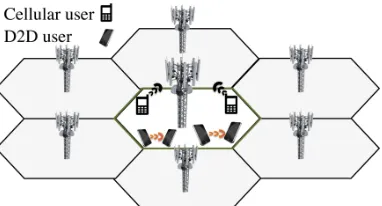
We consider a hexagonal multi-cell LTE-A network with a reference cell in the center and its first-tier neighbors as shown in Fig. 2. The cell consists of N users labelled as n∈ N :={1,2, . . . , N}. Downlink and uplink channels are separated and each one has a fixed bandwidth. Users may communicate with other users in the cell or with those outside the cell. If a user wants to communicate with another user in her proximity, she can use D2D communications. Inband D2D communications use uplink cellular spectrum [6]. It is assumed that each user communicates with (at most) one user at any given time. Each connection between usersnandmis referred to as(n, m),∀n, m∈ N. For notational convenience, the eNB is addressed as user N + 1. In this paper, the outband D2D exploits WiFi Direct technology. With the above, we use four communication modes operating as described in Section II-A:
• Mode0 ↔cellular;
• Mode1 ↔inband underlay D2D;
• Mode2 ↔inband overlay D2D;
• Mode3 ↔outband D2D (WiFi).
Fig. 2. Our system model that consists of a cell with its first-tier neighbors.
consists of 10subframes and the length of a frame is10ms. In each subframe, only one cellular user is scheduled, while the number of concurrent D2D transmissions is not limited a
priori. Therefore, there is no interference among cellular users
(i.e., mode0), but underlay users (i.e., mode1) interfere with the cellular and other underlay users (i.e., modes 0 and 1). Overlay users only interfere with each other, while outband D2D users simply contend for the WiFi channel. A fixed portion of cellular bandwidth is dedicated to overlay D2D users. This portion is released to cellular and underlay users if there is no user in overlay mode.
B. Mode selection and scheduling
As mentioned, mode selection and scheduling decisions by nature require decision making schemes with a different time-scale resolution. Thus, we propose to decouple the mode selection and scheduling problems. The decoupling is mainly inspired by the fact that D2D connections last more than a few frames in a real world scenario and scheduling them on a per-frame basis is unnecessary and possibly inefficient. The inefficiency is due to the high signaling overhead, which is caused by such a high resolution mode selection (see Sub-section III-C). Moreover, the channel quality of D2D links is potentially less time variant in comparison to that of the cellular links due to the short-range nature of D2D communi-cations. The decoupling also simplifies the integration of D2D communications into current cellular systems as it minimizes the changes to the scheduler. Although mode selection and scheduling are decoupled, they are still highly intertwined. On one hand, the scheduling is affected by the interference, which is unknown before mode selection. On the other hand, mode selection depends on the set of cellular users scheduled along with D2D users. Hence, we choose the eNB to perform mode selection, because it is already in charge of scheduling. We propose a mechanism in which the eNB handles these decisions in two steps:(i)mode selection and(ii)scheduling. First, in mode selection, each D2D pair is assigned a mode (modes1to3), and the assignment is repeated at regularmode
intervals of length T seconds. The eNB selects D2D modes
with the assumption of a worst-case interference scenario. This approach helps to reduce the system complexity and to avoid disruptive co-channel interference. Second, in the scheduling phase, the eNB schedules users and assigns them a Modulation and Coding Scheme (MCS). Mode selection and scheduling both rely on the accuracy of Channel State Information (CSI)
data gathered at the eNB, which can be challenging in terms of signaling overhead and scheduling.
C. Practical implications
In a D2D-enabled network, the eNB requires CSI between each pair of users (i.e., user-to-user CSI) in addition to user-to-eNB CSI in order to perform MCS assignment and scheduling. However, the existing cellular technologies do not have the means to obtain user-to-user CSI. Hence, we need a mechanism to obtain and send this information to the eNB efficiently because the addition of user-to-user CSI imposes high signaling overhead to the system.
CSI measurement. In LTE, the eNB-to-user CSI is
es-timated by active measurements from the received signal strength. However, there is no signaling message exchange between the users. Therefore, some researchers propose prob-ing techniques to perform CSI estimation among users [10]. This approach imposes even higher signaling overhead to the system. In contrast, we propose an adaptive passive CSI estimation between users as explained in what follows. In LTE, each user has a unique ID (i.e., C-RNTI [17]) and this ID is included in the frame header. Thus, the users can detect the ID of the source of interference at each frame. Alternatively, the user can read C-RNTIs from the broadcasted scheduling map to identify the interfering user’s ID. The latter does not require users to sniff and decode other users’ frame headers. The CSI is then reported to the eNB. The eNB builds an interference table, whose elements In,m ≥ 0 represent the interference
caused by usernto userm(∀n, m∈ N ∪{N+1}). In case two users do not detect each other for physical/timing reasons, the failure only causes an interruption on a millisecond scale. Once an interruption occurs, the user will report it to the eNB which will update the interference matrix. As for outband D2D, each user reports the last achieved rate over WiFi. In case of an inaccurate report due to long inactivity period, the users can send an updated report before the next mode interval.
Signaling overhead. The maximum number of CSI reports
in LTE-A (with wideband CSI reporting [17]) is equal toN. This number increases to N + 2|Nd||Nc|+|Nd|(|Nd| −1)
in a D2D-enabled network, where Nc and Nd are the sets of cellular and D2D users, respectively. For instance, a D2D-enabled network with4 cellular and6D2D users may require up to88CSI reports, which is almost9 times higher than its equivalent in a legacy system. Fortunately, the CSI feedbacks can be considerably reduced using the state-of-the-art feedback reduction techniques [18]. Moreover, we will see in Section VI that the D2D signaling overhead is negligible as compared to the resulting gain. This overhead is further reduced by our pro-posal because we decouple scheduling from mode selection, hence the D2D related CSIs are obtained less frequently.
IV. FLOATINGBANDD2D FRAMEWORK
model in which specific schedulers can be plugged in. Note that, although the general model can be used with specific schedulers to evaluate the performance of various strategies, the formulation of the problem does not depend on the sched-uler actually implemented, and is not affected by resource allocation strategies for either cellular or D2D connections.
Throughput and energy costs. The transmitted data
θn,mi (j)for a connection(n, m)in modei∈ {0,1,2} during mode intervalj is formulated as follows:
θn,mi (j) =Bn,mi (j)Ri,CSIn,m(j), (1)
where Bi
n,m(j) is the number of Resource Blocks (RBs)
allocated to connection(n, m)in mode intervalj.Ri,CSIn,m(j)is the number of transmitted bits per RB of connection(n, m)in modeiduring mode intervalj, computed based on the channel gain between usersnandm, and the interference matrix I.
The energy consumption of a cellular userE0
n,m(j)and the
energy consumption of a D2D pair Ei
n,m(j)in inband mode
i∈ {1,2} are given by:
En,m0 (j) =βlte+p0,TXn ·tB0
n,m(j) m=N+ 1, (2)
En,mi (j) = 2 βlte+βidleWiFi
+ pi,TXn +pi,RXm tBi
n,m(j), (3)
where βlte and βidleWiFi are the baseline energy consumed in
a mode interval by an active cellular interface and an idle WiFi interface, respectively. The WiFi interface is kept idle in inband modes to speed up WiFi connection setup. Here, pi,TXn and pi,RXm are the energy consumed for transmission
and reception in one subframe, respectively. tBi
n,m(j) is the
duration ofBi
n,m(j). Here, we do not calculate the energy per
RB, because it is shown that the transmission/reception power mainly depends on time rather than bandwidth [19].
The expression of transmitted dataθn,m3 (j)and the energy consumption En,m3 (j) for connection (n, m) under outband
mode (i.e., mode 3) in mode intervalj is as follows:
θ3n,m(j) =T·R3,CSIn,m(j), (4)
E3n,m(j) = 2(βlte+βWiFiactive) + p 3,TX
n +p
3,RX m
θn,m3 (j), (5)
whereR3,CSI
n,m is the WiFi rate andβ WiFi
activeis the baseline WiFi
energy consumed by a user in a mode interval.p3,TX
n andp3,RXm
are the energy consumed by user m per transmitted/received bit. Note that the energy consumption as defined here can in-corporate both the consumption due to transmission/reception and packet processing (see [3]). The βlte is due to the
dependence of outband users to the eNB signaling.
We define a utility function for connection (n, m) under mode iin mode intervalj as follows:
Un,mi (j) =θn,mi (j)−αEn,mi (j), (6)
where α is the relative cost of energy. The utility accounts for both throughput and energy consumption. The value of α determines whether the system is biased towards higher throughput or lower energy consumption. In our model, the impact of schedulers is summarized inBi
n,mandtBi
n,m. Those
parameters have to be computed in each mode interval and for each possible mode selection decision.
Problem formulation. Let L(j) be the set of all existing
connections during mode interval, j,{Yi
n,m(j)}be the set of
binary decision variables, andγn be the tolerable interference
threshold that allows for a non-zero reception rate by usern. We formulate the problem of mode selection for mode interval j as a binary programming problem (the dependency on j is omitted for readability):
max Usum:=P
3 i=0
P
(n,m)∈LUn,mi Yn,mi ∀(n, m)∈ L
s.t. P3
i=0
P
n|(n,m)∈LYn,mi ≤1 ∀m∈ N
P3
i=0
P
m|(n,m)∈LYn,mi ≤1 ∀n∈ N
P
(n,m)∈LY
1
n,mIn,x≤γx ∀x∈ Nc∪ {N+ 1}
P
i∈{0,1}
P
(x,y)∈L\{(n,m)}Y
i
x,yYn,m1 Ix,m≤γm
P
(x,y)∈L\{(n,m)}Y
2 x,yY
2
n,mIx,m≤γm ∀(n, m)∈ L
(7)
Problem (7) maximizes the sum of utilities Usum over all
possible combinations of users and modes. Our assumption on single instantaneous connectivity is enforced with the first and second constraints (the eNB, which is labeled asN+ 1, is an exception). The third constraint ensures that the co-channel interference from underlay users to cellular users and to the eNB is kept below the threshold. The fourth constraint limits the interference from cellular and inband underlay users to other inband underlay users. The interference of overlay transmissions is limited by the fifth constraint.
Complexity. Problem (7) is NP-hard and non-linear since
it can be reduced to the longest path problem (e.g., for a weighted directed and possibly disconnected graph), which is NP-hard [20]. This reduction is obtained when we consider Problem (7) for a single mode i = 3 (outband), in which the objective is to activate D2D pairs so as to achieve the maximum utility possible with the two restrictions on at most one incoming and at most one outgoing transmission for every user. Problem (7) requires the computation of{Un,mi },
which is based on Signal to Noise and Interference Ratios (SINRs) and its optimal solution can be achieved by brute force: exploring the consequences of assigning modes 1, 2, or 3 to any of the |Nd|2 D2D pairs. Hence, the resulting
complexity isO(N·3|N2d|), which grows exponentially with the number of D2D pairs. The optimal solution to the above maximization problem is computationally expensive and prac-tically unfeasible in dense networks. However, the non-linear constraints can be linearized so that the problem can be solved relatively efficiently by standard approaches, such as Branch & Bound [21]. Nevertheless, we deem such an approach impractical as the system requires a solution in milliseconds. Thereby, we propose efficient heuristics in what follows.
V. HEURISTICS
Algorithm 1 Social
Input:
1:Nd,TX: set of D2D transmitters (randomized order).
2:In,x: interference between each pair of users.
Output: Yi
(n,m),∀n∈ Nd,TX
3:initialize:Y=Yold=∅;Y(0c,N+1)= 1,∀c∈ Nc;Y(3n,m)= 1,∀n∈ Nd,TX;
max=Usum
4:whileY6=Yolddo
5: Yold=Y
6: forn∈ Nd,TX do
7: forj∈ {1,2,3} do
8: Calculate:Usum|nis in modej
9: ifUsum>max then
10: max=Usum
11: Y(jn,m)= 1;Y(kn,m)= 0, k∈ {1,2,3} \ {j}
12: end if
13: end for
14: end for
15: end while
Algorithm 2 Greedy
Input:
1:Nd,TX: set of D2D transmitters (randomized order).
2:In,x: interference between each pair of users.
Output: Yi
(n,m),∀n∈ Nd,TX
3:initialize:Y = ∅;Y0
(c,N+1) = 1,∀c∈ Nc;Y 3
(n,m) = 1,∀n∈ Nd,TX;
maxi=U(i,m);exit=F alse,D=∅ 4:whileexit=F alsedo
5: fori∈ Nd,TX do
6: forj∈ {1,2,3} do
7: Calculate:U(ji,m)|iis in modej
8: ifU(ji,m)>maxi then
9: maxi=U(ji,m)
10: Y(ji,m)= 1;Y(ki,m)= 0, k∈ {1,2,3} \ {j}
11: end if
12: end for
13: end for
14: dec= Index of currentY
15: ifdec∈ Dthen
16: exit = True
17: end if
18: AdddectoD
19: end while
(i.e., users’ queues are fully backlogged) so that they do not require the knowledge of the actual user’s offered load.
a) Heuristic 1. Social: The eNB iterates over the set
of D2D transmitters Nd,T X, and it selects the mode that maximizes the aggregate utility (lines 7-13 in Algorithm 1). Note that the mode for user iis selected based on the modes selected for the precedent users. Initially, all D2D pairs are assigned to mode 3 (outband), to minimize the impact on cellular users. For better fairness [5], the order of users
in Nd,T X is randomized at any mode interval. The mode
selection repeats until the algorithm converges to a decision. We name this heuristic as Social because it decides based on social welfare. Since the utility ofSocialcannot decrease with mode selection decisions, the heuristic always converges.
b) Heuristic 2.Greedy: TheGreedyheuristic is
sim-ilar to Social. UnlikeSocial,Greedy selects the mode which maximizes the user’s individual utility (line 10 in Algorithm 2). The drawback of Greedy is that it might not converge. However, we can index each decision since the algorithm is running in the eNB. Once a duplicate index (stored in D) is found, the algorithm stops the iteration.
c) Heuristic 3. Ranked: Both Social and Greedy
operate on a list of D2D transmitters with a randomized
Algorithm 3 Ranked
Input:
1: Nd,TX: set of D2D transmitters (randomized order).
2: In,x: interference between each pair of users.
Output: Yi
(n,m)
3: initialize:Y=∅;Y(0c,N+1)= 1,∀c∈ Nc;Y(3n,m)= 1,∀n∈ Nd,TX
PHASE 1: Sorting D2D pairs based on their utility
4: fori∈ Nd,TX do
5: forj∈ {1,2,3} do
6: CalculateU(ji,m)
7: end for
8: modei= arg max{Uj
(i,m);j∈ {1,2,3}} 9: end for
10: sort theNd,TXbased on utilitiesU modei
(i,m)& store inN (ranked)
d,TX .
PHASE 2: ExecutingGreedyheuristic
11: DoGreedywithNd,TX=Nd,(rankedTX ).
order. In contrast, Ranked heuristic sorts this list based on the achievable utility of each user without considering the impact of other users (PHASE 1). In PHASE 2, the pre-ordered listNd,TX(ranked)is evaluated usingGreedy, which makes the heuristic greedier than Greedy. This helps to evaluate the ability of our approach to withstand unfair conditions. Algorithm 3 illustrates the pseudocode of the heuristic.
d) Complexity Analysis: Our proposed heuristics
com-pute N − |Nd,TX| utilities {Un,mi } for each mode and
for every D2D transmitter in a sequential manner, i.e.,
3 N|Nd,TX| − |Nd,TX|2
utilities per round of evaluation. In each mode interval, the evaluation cycle is repeatedri times,
ri≥1, until the algorithm converges to a decision. Therefore,
the complexity ofSocialandGreedyisO(3riN|Nd,TX|),
i ∈ {1,2}. Ranked has an additional sorting procedure before the mode selection in which the utility of each D2D pair is computed in isolation. Thus, the algorithm only needs to compute 3|Nd,TX| utilities in PHASE 1, which can be neglected with respect to the number of utilities to be com-puted in PHASE 2. Hence, the complexity of Ranked is
O(3r3N|Nd,TX|). Therefore, the three proposed heuristics
have the same complexity, except for a constant factorri that
we will quantify experimentally later.
VI. EVALUATION
In this section, we use numerical simulations to evaluate the performance of our proposed heuristics. The evaluation scenario consists of a hexagonal multi-cell network with a ref-erence cell in the middle and its first-tier neighbors (see Fig. 2). The results reported in this paper pertain to the reference cell, and the neighboring cells model the impact of inter-cell interference. Error bars in the results are the95% confidence intervals. Although our approach can be tested with any sched-uler, here we refer to the Proportional Fair (PF) scheme for scheduling cellular users, since it represents the state of the art for schedulers used in real implementations [12], [22]. In addi-tion to our heuristics, we evaluate three benchmark schemes, namely, Forced-LTE, Forced-WiFi, and Optimal. In
TABLE II
THE PARAMETERS USED IN THE EVALUATION
Parameter Value
Cellular
Cellular uplink bandwidth 20 MHz
Cell radius 250 m
eNB, cellular user TX power 44 dBm, 24 dBm Thermal noise power -174 dBm/Hz Mode interval lengthT 2 s
Fading, shadowing, pathloss Reyleigh, 6 dB, UMa [14] Buffer size 500 packets
βlte 1288.04 mW
WiFi
WiFi bandwidth 22 MHz WiFi effective range 150 m
WiFi TX power 20 dBm
βWiFi
active,β
WiFi
idle 132.86 mW, 77.2 mW
D2D
Underlay max bandwidth 20 MHz Overlay resource portion 30% D2D maximum distance 20 m D2D inband TX power 10 dBm Relative cost of energyα 1 bit/Joule
results are based on the exact solution to Problem (7). The benchmarks allow to compare our proposals with the legacy cellular system, to measure the gain due to extra WiFi band-width, and to see how far the heuristics are from the optimum.
A. Simulation setup
User placement follows the uniform distribution. The num-ber of D2D users is on average30%of the cell population. The simulation parameters are chosen according to the evaluation guidelines of ITU-R [14] which are reported in Table II. In the simulation, we show both the packet simulation results (i.e., performance under finite offered load and in the presence of probabilistic arrival processes) and the achievable performance (i.e., performance at capacity-level utilization, under infinite offered load conditions). Unless otherwise specified, the de-fault values for α and overlay resource portion are those reported in Table II, with an aggregate D2D and cellular load of 30 Mbps and90 Mbps, respectively. Since the D2D capacity is higher than the cellular one, due to proximity of D2D users and availability of outband resources, we deemed fair to impose higher load to D2D users. Note that the default value ofαis selected based on a rough estimate of the current relative price of bit per Joule (b/J) in the market.
Besides the values of Table II, we investigate the impact of user density N, overlay resource portion, relative cost of energy α, and D2D load on the system performance. Moreover, we shed light on the convergence time of our heuristics and their flexibility in different environments.
B. Simulation results
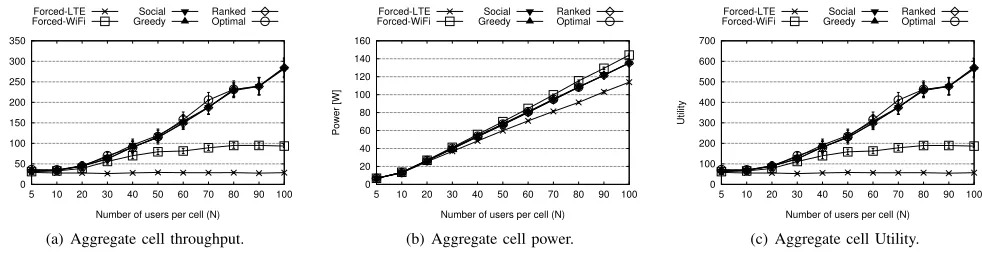
Impact of the number of users N. Fig. 3 illustrates
the impact of N on achievable system performance. We can observe the achievable throughput in Fig. 3(a). The aggregate throughput has a negligible change with N under
Forced-LTEbecause the distribution of channel qualities in the cell remains the same for different density of users, and
therefore the average aggregated throughput. The throughput of the rest of schemes increases with N because there are probabilistically more D2D pairs in a denser cell, hence D2D throughput is higher. InForced-WiFi, the throughput grows slowly due to the contention-based nature of WiFi, in which the MAC overhead increases with the number of contending users. Since some of the outband D2D pairs do not interfere with each other (i.e., they are more distant than 150 m), the aggregate throughput of Forced-WiFi in our experiments reaches up to 98 Mbps. More importantly, not only the simple proposed heuristics greatly outperformForced-LTE
and Forced-WiFi, but they also perform very close to
Optimal (due to the computational complexity of such an ideal scheme, we only have the results up to80users).
In terms of energy cost, the aggregate cell power increases with N, as shown in Fig. 3(b), mainly due to the baseline energy consumption of wireless interfaces. Forced-WiFi
has higher energy consumption because outband users have to maintain two active wireless interfaces instead of one.
Fig. 3(c) shows that the trend for system utility is similar to that of throughput because the throughput is the dominant factor with the current value of α. Our results show that, with a reasonable population, say 100 users per cell, the aggregate throughput gain overForced-LTEis tenfold. This gain comes from both the frequency re-use of inband modes and additional spectrum provided by the outband mode. The significant contribution of both outband and inband modes to this gain highlights the importance of Floating Band D2D. Moreover, this gain can easily compensate for the infrequent D2D CSI feedbacks sent to the eNB (user-to-user CSI). Note that in LTE-A systems with millisecond feedback reporting, the CSI contributes to less than20% of the total bandwidth.
In Fig. 4, we can observe the accuracy of our mode selection and its performance using packet simulation. Fig. 4(a) shows that cellular users have comparable throughput performance under all schemes due to PF scheduling. If the data rate of a cellular user degrades due to co-channel interference, the PF compensates for it by allocating more resources to that user. In Fig. 4(b), it is observed that the fairness among D2D users drops underForced-LTEandForced-WiFi. Under
Forced-LTE, D2D users are scheduled as cellular users, hence they achieve similar fairness performance as cellular users (but not equal because their fairness is computed over a different set and their load is different). The fairness reduction underForced-WiFiis due to topologically uneven distribu-tion of contending outband users. In Fig. 4(c), we can observe that utilities of all D2D-enabled schemes grow untilN reaches
50. The reason for this behavior is that the network operates under saturation up to this point. In fact, one can observe in Fig. 3(a) that the achievable throughput with50 users or less is below 120 Mbps which is equal to the total offered load (i.e.,30 + 90) in the scenario of Fig. 4(c). For N >50, the utility in the packet simulation is limited by the adopted load.
Impact of overlay resource portion.Here, the number of
0 50 100 150 200 250 300 350
5 10 20 30 40 50 60 70 80 90 100
Throughput [Mbps]
Number of users per cell (N) Forced-LTE
Forced-WiFi GreedySocial RankedOptimal
(a) Aggregate cell throughput.
0 20 40 60 80 100 120 140 160
5 10 20 30 40 50 60 70 80 90 100
Power [W]
Number of users per cell (N) Forced-LTE
Forced-WiFi GreedySocial RankedOptimal
(b) Aggregate cell power.
0 100 200 300 400 500 600 700
5 10 20 30 40 50 60 70 80 90 100
Utility
Number of users per cell (N) Forced-LTE
Forced-WiFi GreedySocial RankedOptimal
(c) Aggregate cell Utility.
Fig. 3. The impact of user population on the system performance with fully backlogged queues (achievable performance).
0.5 0.6 0.7 0.8 0.9 1
5 10 20 30 40 50 60 70 80 90 100
Jain’s fairness index (cellular)
Number of users per cell (N) Forced-LTE
Forced-WiFi GreedySocial RankedOptimal
(a) Fairness among cellular users.
0.5 0.6 0.7 0.8 0.9 1
5 10 20 30 40 50 60 70 80 90 100
Jain’s fairness index (D2D)
Number of users per cell (N) Forced-LTE
Forced-WiFi GreedySocial RankedOptimal
(b) Fairness among D2D users.
20 40 60 80 100 120 140 160 180 200 220
5 10 20 30 40 50 60 70 80 90 100
Utility
Number of users per cell (N) Forced-LTE
Forced-WiFi GreedySocial RankedOptimal
(c) Aggregate cell Utility.
Fig. 4. The impact of user population on the system performance evaluated through packet simulation.
50 100 150 200 250 300 350 400 450 500 550
0.1 0.2 0.3 0.4 0.5 0.6 0.7 0.8 0.9
Utility
Overlay portion Forced-LTE
Forced-WiFi
Social Greedy
Ranked Optimal
(a) Aggregate achievable utility.
0 0.1 0.2 0.3 0.4 0.5 0.6 0.7
0.1 0.2 0.3 0.4 0.5 0.6 0.7 0.8 0.9
Cellular delivery ratio
Overlay portion Forced-LTE
Forced-WiFi
Social Greedy
Ranked Optimal
(b) Average delivery ratio of cellular users.
0 0.1 0.2 0.3 0.4 0.5 0.6 0.7 0.8 0.9 1
0.1 0.2 0.3 0.4 0.5 0.6 0.7 0.8 0.9
D2D delivery ratio
Overlay portion Forced-LTE
Forced-WiFi GreedySocial RankedOptimal
(c) Average delivery ratio of D2D users.
Fig. 5. The impact of overlay portion on system performance(N= 50).
increment is due to throughput improvement under mode 2. This implies that D2D users tend to receive more interference from cellular users than from other D2D users, hence, the spectral efficiency is higher in overlay than underlay. As mentioned, the overlay portion is given to modes 0 and 1
if there are no overlay users. As a result, the utilities of
Forced-LTEandForced-WiFiremain unchanged here.
Although the aggregate utilities are improved, we should also investigate the impact of overlay bandwidth on cellular users. Fig. 5(b) illustrates that the delivery ratio of cellular users degrades as the overlay bandwidth grows because there is less bandwidth at their disposal. Fig. 5(b) also sheds light on the differences among multi-band schemes. Cellular users experience higher packet delivery ratio withSocial. Indeed,
Social is the only scheme that aims to maximize the aggregate utility, which includes the utility of cellular users. Finally, Fig. 5(c) shows how the delivery ratio of D2D users approaches 1 with higher overlay bandwidths, as expected.
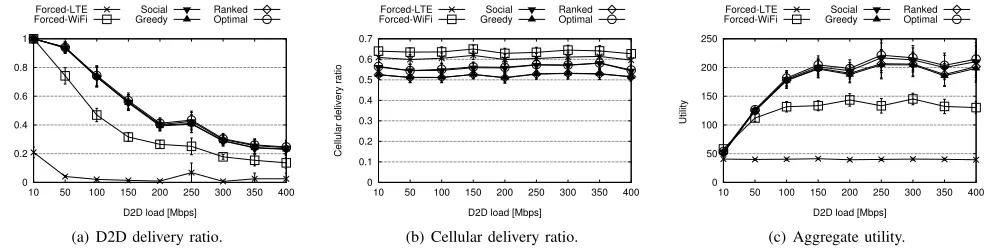
Impact of D2D load. The impact of D2D load is shown
in Fig. 6 for N = 50. The packet delivery ratio for D2D users drops as the load increases, as shown in Fig. 6(a). This is the expected behavior of systems in saturation. However, as we see in Fig. 6(b), our schemes are designed in such a way that saturation of D2D users does not impact the cellular users. This shows that our proposal can be a candidate for distributed D2D mode selection implementations in which
cellular users are protected from mode selection decisions
of D2D users. It is observed in Fig. 6(c) that system utility
approaches its achievable limit (220) when the D2D load is almost 250 Mbps (see Fig 3(c), N = 50). In Fig 3(a), we observe that the achievable capacity for N = 50 is almost
0 0.2 0.4 0.6 0.8 1
10 50 100 150 200 250 300 350 400
D2D delivery ratio
D2D load [Mbps] Forced-LTE
Forced-WiFi GreedySocial RankedOptimal
(a) D2D delivery ratio.
0 0.1 0.2 0.3 0.4 0.5 0.6 0.7
10 50 100 150 200 250 300 350 400
Cellular delivery ratio
D2D load [Mbps] Forced-LTE
Forced-WiFi GreedySocial RankedOptimal
(b) Cellular delivery ratio.
0 50 100 150 200 250
10 50 100 150 200 250 300 350 400
Utility
D2D load [Mbps] Forced-LTE
Forced-WiFi GreedySocial RankedOptimal
(c) Aggregate utility.
Fig. 6. The impact of D2D load on system performance evaluated through packet simulation (N= 50).
0 20 40 60 80 100 120 140 160
0.1 1 100 10000 1000000
Throughput [Mbps]
α [b/J] Forced-LTE
Forced-WiFi GreedySocial RankedOptimal
(a) Aggregate achievable throughput.
-160000 -140000 -120000 -100000 -80000 -60000 -40000 -20000 0 20000
0.1 1 100 10000 1000000
Utility
α [b/J] Forced-LTE
Forced-WiFi GreedySocial RankedOptimal
0 50 100 150 200 250 300
0.1 1 100
(b) Aggregate achievable utility.
Fig. 7. The impact ofαon system throughput and utility(N= 50).
(i.e.,250·0.4 + 30·0.6 = 118). With similar calculations, one finds thatForced-WiFisaturates almost at 100 Mbps.
Impact of energy cost α. Recall that with the current
relative energy costαour system is biased towards throughput. Hence, we investigate the impact of αin Fig. 7, for N = 50. We start with Fig. 7(a), in which a 20%throughput reduction is observed atα= 106b/J. This shows the system’s bias shifts
towards energy minimization asαincreases. In Fig. 7(b), the utility reduces asαgrows, although the behavior of the curves is not linear at all. In particular, for very large values ofα, our system prefers Forced-LTE (i.e., mode 0) because it only powers one interface. Since we disallow multi-band schemes to assign mode0to D2D users,Forced-LTEmight achieve utilities higher than that of Optimal when α is very large (e.g., with α= 106 b/J, which is too unrealistic as of today
and for the near future due to the high cost of electricity).
Convergence. In Table III, we report the convergence of
our proposed heuristics in terms of time and the number of iterations. The heuristics are tested on MathematicaTM on
a machine with a 3.6 GHz processor and 8 GB memory.
GreedyandSocialhave a very similar convergence time.
Greedy is slightly slower than Social due to decision indexing. Interestingly, notwithstanding its ranking operations,
Ranked has a better performance. This happens because
Ranked converges to a decision with less iterations (which is what we have indicated as factor ri in Section V-0d).
TABLE III
CONVERGENCE OF THE HEURISTICS(N= 100)
Social Greedy Ranked
Average convergence time [s] 1.61 1.62 1.43
Average number of iterationsri 2.69 2.80 1.46
Flexibility. As mentioned, Floating Band D2D is key to
flexible D2D architectures. We emphasize this fact by evalu-ating our proposal in various cellular environments, according to ITU-R guidelines [14]. Table IV shows that, moving from micro-cell to rural macro-cell, the system relies more on the cellular spectrum as density reduces. As a consequence, the number of underlay connections increases. For denser environments, we observe that a significant part of connections is served using outband D2D.
TABLE IV
PERCENTAGE OF EACH MODE IN DIFFERENT ENVIRONMENTS(N= 100)
Urban Urban Suburban Rural micro-cell macro-cell macro-cell macro-cell
Inband underlay 4% 8% 29% 31%
Inband overlay 63% 66% 66% 67%
Outband 33% 26% 5% 2 %
VII. RELATEDWORK
This section presents the most relevant mode selection schemes for inband/outband D2D communications and the joint scheduling and mode selection proposals. As of today, there is no proposal on multi-band D2D mode selection.
Asadi and Mancuso in [3] propose an outband D2D scheme in the framework of cellular relaying. In their proposal, cellular users can communicate directly with the eNB or indirectly through another cellular user with whom they have an outband D2D connection. There, users choose the communication mode by means of a coalitional game theory approach. That work does not leverage inband D2D modes.
In [23], Yu et al. formulate the problem of mode selection as a sum-rate maximization problem whose solution can be expressed in closed-form or searched through a finite set. However, the system model used in [23] is limited to a single cell network with one cellular and one D2D user.
Doppler et al. [10] propose a centralized mechanism for scheduling and mode selection that accounts for underlay, overlay, or legacy cellular transmissions. They propose active probing for CSI estimation among users. After probing, the eNB selects a mode for each D2D user, based on the reported SINRs. Unfortunately, active probing imposes high signaling overhead and suffers scalability issues (see Section III).
Phunchongharn et al.[11] propose a joint mode selection, scheduling and power control scheme for D2D communica-tions. Specifically, D2D users are allowed to transmit using underlay, overlay, and cellular mode, or to remain silent. The problem is formulated as mixed integer programming, which is NP-complete, and no efficient heuristics are proposed.
To summarize, the available proposals on D2D mode se-lection: (i) assume D2D users cannot share resources be-tween them, and/or (ii) propose to use a limited set of D2D users and modes, which restrain the adaptiveness of D2D communications, and/or(iii)propose complex solutions, which are either unscalable or too complex for millisecond decision making. In contrast, we formulate a multi-band mode selection problem, which allows to explore the full potential of D2D communications, and we have proposed simple and lightweight heuristics to adaptively exploit the advantages of multiple D2D modes. Specifically, a key practical advantage of our approach is that mode selection and scheduling are handled at substantially different time scales.
VIII. CONCLUSION
We have shown that the performance of D2D modes is highly scenario-dependent. To cope with this issue, we pro-posed theFloating Band D2Dframework along with practical heuristics suitable for quick and adaptive mode selection in such a complex setup. Unlike existing schemes, we allow D2D users to communicate over inband or outband modes, depending on network load and channel conditions. Our results demonstrate the impressive potentials of multi-band mode selection. Remarkably, our simple heuristics result in fair operation and achieve near optimal performance by dramat-ically ameliorating network utility, which accounts for both throughput and energy consumption.
IX. ACKNOWLEDGEMENTS
The research leading to these results was supported by the CROWD project, under the European Union’s Seventh
Framework Programme (grant agreement n◦ 318115). The work has also been partially supported by the Madrid Regional Government through the TIGRE5-CM program (S2013/ICE-2919). The authors would like to thank Christian Vitale for his assistance in the evaluation of WiFi performance.
REFERENCES
[1] A. Asadi, Q. Wang, and V. Mancuso, “A survey on device-to-device communication in cellular networks,” IEEE Comm. Surveys &Tutorials, 2014.
[2] Y. Zhang, E. Pan, L. Song, W. Saad, Z. Dawy, and Z. Han, “Social network aware device-to-device communication in wireless networks,” IEEE Trans. on Wireless Communications, 2014.
[3] A. Asadi and V. Mancuso, “On the compound impact of opportunis-tic scheduling and D2D communications in cellular networks,” in Proceedings of ACM MSWIM’13, pp. 279–288.
[4] J. Kim, F. Meng, P. Chen, H. E. Egilmez, D. Bethanabhotla, A. F. Molisch, M. J. Neely, G. Caire, and A. Ortega, “Adaptive video streaming for device-to-device mobile platforms,” in Proceedings of ACM MobiCom’13, pp. 127–130.
[5] X. Wu, S. Tavildar, S. Shakkottai, T. Richardson, J. Li, R. Laroia, and A. Jovicic, “FlashLinQ: a synchronous distributed scheduler for peer-to-peer ad hoc networks,” IEEE/ACM Trans. on Networking, vol. 21, no. 4, pp. 1215–1228, 2013.
[6] X. Lin, J. Andrews, A. Ghosh, and R. Ratasuk, “An overview of 3GPP device-to-device proximity services,” IEEE Comm. Magazine, 2014. [7] K. Doppler, M. Rinne, C. Wijting, C. B. Ribeiro, and K. Hugl,
“Device-to-device communication as an underlay to LTE-Advanced networks,” IEEE Communications Magazine, 2009.
[8] M. Zulhasnine, C. Huang, and A. Srinivasan, “Efficient resource allo-cation for device-to-device communiallo-cation underlaying LTE network,” in IEEE WiMob’10, pp. 368–375.
[9] B. Zhou, H. Hu, S.-Q. Huang, and H.-H. Chen, “Intracluster device-to-device relay algorithm with optimal resource utilization,” IEEE Trans. on Vehicular Technology, 2013.
[10] K. Doppler, C.-H. Yu, C. Ribeiro, and P. Janis, “Mode selection for device-to-device communication underlaying an LTE-Advanced net-work,” in Proceedings of IEEE WCNC’10, pp. 1–6.
[11] P. Phunchongharn, E. Hossain, and D. Kim, “Resource allocation for device-to-device communications underlaying LTE-Advanced net-works,” IEEE Wireless Communications, vol. 20, pp. 91–100, 2013. [12] S.-B. Lee, I. Pefkianakis, A. Meyerson, S. Xu, and S. Lu, “Proportional
fair frequency-domain packet scheduling for 3GPP LTE uplink,” in Proceedings of IEEE INFOCOM’09, pp. 2611–2615.
[13] 3GPP TR 23.303, “Proximity-based services (ProSe);Stage 2 (Release 12),” v. 12.2.0, September, 2014.
[14] ITU, “Guidelines for evaluation of radio interface technologies for IMT-Advanced,” 2009.
[15] A. Asadi and V. Mancuso, “WiFi Direct and LTE D2D in action,” in Proceedings of IFIP WD’13, pp. 1–8.
[16] B. Raghothaman, E. Deng, R. Pragada, G. Sternberg, T. Deng, and K. Vanganuru, “Architecture and protocols for LTE-based device to device communication,” in Proceedings of IEEE ICNC’13, pp. 895–899. [17] C. Johnson, LTE in Bullets. Createspace Independent Pub, 2012. [18] J.-H. Li and H.-J. Su, “Opportunistic feedback reduction for multiuser
MIMO broadcast channel with orthogonal beamforming,” IEEE Trans. on Wireless Communications, vol. 13, no. 3, pp. 1321–1333, 2014. [19] B. Dusza, C. Ide, L. Cheng, and C. Wietfeld, “An accurate
measurement-based power consumption model for LTE uplink transmissions,” Proceedings of IEEE INFOCOM’13.
[20] D. Karger, R. Motwani, and G. Ramkumar, “On approximating the longest path in a graph,” Algorithmica, vol. 18, no. 1, pp. 82–98, 1997. [Online]. Available: http://dx.doi.org/10.1007/BF02523689
[21] E. L. Lawler and D. E. Wood, “Branch-and-bound methods: A survey,” Operations research, vol. 14, no. 4, pp. 699–719, 1966.
[22] R. Margolies, A. Sridharan, V. Aggarwal, R. Jana, N. Shankara-narayanan, V. A. Vaishampayan, and G. Zussman, “Exploiting mobility in proportional fair cellular scheduling: Measurements and algorithms,” in Proceedings of IEEE INFOCOM’14, pp. 1339–1347.