a n d S z pli t, Ag ni e s z k a, ( e d s .) S t u d e n t t e a c h e r s l e a r n i n g t h r o u g h
in q ui r y: in t e r n a ti o n al p e r s p e c tiv e s . Wy d a w n i c t w o Atty k a,
Kr a k ów, Pol a n d , p p . 5-1 0 .
Do w n l o a d e d fr o m : h t t p ://i n si g h t . c u m b r i a . a c . u k /i d/ e p ri n t/ 2 5 7 8 /
U s a g e o f a n y i t e m s f r o m t h e U n i v e r s i t y o f C u m b r i a’ s i n s t i t u t i o n a l r e p o s i t o r y ‘I n s i g h t ’ m u s t c o n f o r m t o t h e f o l l o w i n g f a i r u s a g e g u i d e l i n e s .
Any it e m a n d it s a s s o ci a t e d m e t a d a t a h el d i n t h e U niv e r si ty of C u m b r i a ’s in s ti t u ti o n al r e p o si t o r y I n si g h t ( u nl e s s s t a t e d o t h e r wi s e o n t h e m e t a d a t a r e c o r d ) m a y b e c o pi e d , di s pl ay e d o r p e rf o r m e d , a n d s t o r e d i n li n e wi t h t h e JIS C f ai r d e a li n g g ui d eli n e s ( av ail a bl e
h e r e) fo r e d u c a t i o n al a n d n o t-fo r-p r ofi t a c tiviti e s
p r o v i d e d t h a t
• t h e a u t h o r s , ti tl e a n d full bi blio g r a p h i c d e t ail s of t h e it e m a r e ci t e d cl e a rly w h e n a n y p a r t
of t h e w o r k is r ef e r r e d t o v e r b a lly o r i n t h e w ri t t e n fo r m
• a h y p e rli n k/ U RL t o t h e o ri gi n al I n si g h t r e c o r d of t h a t it e m is i n cl u d e d i n a n y ci t a ti o n s of t h e w o r k
• t h e c o n t e n t is n o t c h a n g e d i n a n y w a y
• all fil e s r e q ui r e d fo r u s a g e of t h e it e m a r e k e p t t o g e t h e r wi t h t h e m a i n it e m fil e.
Yo u m a y n o t
• s ell a n y p a r t of a n it e m
• r e f e r t o a n y p a r t of a n it e m wi t h o u t ci t a ti o n
• a m e n d a n y it e m o r c o n t e x t u ali s e it i n a w a y t h a t will i m p u g n t h e c r e a t o r ’s r e p u t a t i o n
• r e m ov e o r a l t e r t h e c o py ri g h t s t a t e m e n t o n a n it e m .
T h e full p oli cy c a n b e fo u n d h e r e.
Alt e r n a t iv ely c o n t a c t t h e U niv e r si t y of C u m b ri a R e p o si t o ry E di t o r b y e m a ili n g
Pete Boyd and Agnieszka Szplit
There is currently a tension around the professional status of teachers that centres on the place of knowledge within their expertise. This tension is most apparent in nations, including the USA and England, where Neoliberalism has strongly influenced educational systems so that they are driven by parent choice, measurement of success by test and examination results, school league tables, high stakes inspection systems and performativity of individual teachers. This tension around professional knowledge and the status of professionals is found across a wide range of professionals and is a feature of social and historical change related perhaps as much to technology and the knowledge-based economy as it is to the rise of Neoliberalism. In this period of challenge professionalism is positioned by Freidson (2004) as an ideal type that is involved in a power struggle with the other two logics of rational-legal bureaucracy, and a free market model.
Across most nations of the world there is strong political desire to improve education systems and an acknowledgement that high quality teachers are central to that project. There is also a broad assumption that, despite the vagaries of individual ministers for education, the development of the education system should be based on research evidence. The tension around research evidence arises as to the role of individual teachers and teaching teams within this grand project of improving educational systems. It may be expressed by considering a choice between ‘teachers as technicians who must deliver evidence-based practice’ and ‘teachers as professionals who must lead the development of research-informed practice through practitioner inquiry’.
and analysis of data, engagement with a theoretical framework, and some kind of peer reviewed dissemination (Baumfield, Hall & Wall, 2013). There are some threats to teacher inquiry within the Neoliberal context including that teacher inquiry might become ‘domesticated’ within managerialist institutional contexts, communities and discourses of the ‘learning organisation’ (Kemmis, 2006; Watson, 2014; Fenwick, 2001). Such domestication might mean that teacher inquiry was merely evaluating the techniques of schooling rather than asking tough critical questions that might arrive at uncomfortable truths (Kemmis, 2006; Cochran-Smith & Lytle, 2009). In the chapters that follow authors from a wide range of national contexts reveal their own interpretations of ‘teacher inquiry’ and of ‘inquiry-based learning’. This variety goes beyond issues of language and reveals aspects of agency by individuals and teams of teacher educators but it also provides some insight into social and cultural historical influences on the development of teacher education systems and pedagogies in different national contexts.
In chapter 1 Pete Boyd makes a provocative proposal, that teacher education should adopt an explicit pedagogy entitled ‘realistic clinical practice’. Such a move would represent strategic compliance in the sense that the clinical practice model has been put forward by Neoliberal leaning governments as a suitable way by which education might move towards ‘evidence-based’ practice. Adding ‘realistic’ to the proposed pedagogy acknowledges that education as a field is closer to the complexities of ‘healthcare’ or of ‘mental health’ than it is of medicine and it is argued that this allows acknowledgement of the practical wisdom of teachers and the ambition to co-create mode 2 knowledge (Nowotny, Scott & Gibbons, 2001) through collaboration between researchers and teachers. The subsequent 12 chapters illustrate the range of strategies by which inquiry is embedded in teacher education programmes in a wide range of European nations as well as examples from the Caribbean, the Middle East and Australia.
At an early stage of an initial teacher education programme student teachers do not have much school-based experience and may not have key educational research skills, so it may not be wise to let them loose collecting data in classrooms. In chapter 2 Zoe Martínez-de-la-Hidalga and Lourdes Villardón-Gallego, based in Spain, evaluate such an early stage inquiry which focused on teacher identity and used data collected from a previous cohort of student teachers. This structured inquiry enables the new student teachers to critically engage with useful theory and research evidence around teacher identity whilst developing research skills that will be useful at a later stage of their programme when they will be completing classroom and school based research.
education in Finland, explains how an approach entitled ‘participatory pedagogy’ involves student teachers in designing and managing their own programme of learning. This flexible approach is designed to expand the possibilities of knowing, acting and being and contribute powerfully to teacher identity construction.
In the right context short video clips can be a powerful media to support learning, for example classroom video helps to capture the complexity of teaching and provides a useful stimulus for evaluation and debate with student teachers. In chapter 4 Rita Szaszkó from Hungary proposes that online video clips provide an opportunity for inquiry-based learning by student teachers. In their case study student teachers engaged with online video clips in blended learning courses with viewing often completed individually online discussion mainly in face to face sessions.
A blended learning teacher education programme requires careful design of the online learning activities. In chapter 5 Rebecca Miles, Scott Alterator and Sarah Lord use a social practice theoretical framework to analyse their practice on a teacher education programme in Australia. They use two concrete examples, a reading group and a collaborative authentic teacher planning task, to illustrate some of the design features of effective inquiry-based online learning activities. In this teacher education programme the online learning activities allow best use of the limited time for face to face sessions on campus.
Oral story-telling is a long-standing form of cultural education and chapter 6 by Annamaria Sinka based in Hungary considers digital story-telling as an innovative development of the tradition. This is a teacher educator inquiry that fully involves students in the tutor’s inquiry and evaluates the impact of digital story-telling on student teacher learning. Digital stories as teacher strategy are considered as exemplars of key concepts, as problem cases for students to solve, or as advice for students. The authors argue that digital stories provide an effective strategy for teacher education.
Contemporary teacher education programmes include a strong focus on student learning through enactment in practice. Chapter 7 by Serafina Pastore and Monica Pentassuglia from Italy focuses on the role of ‘body’ within that. The authors argue that developing body awareness or body literacy should be an explicit element of teacher education. The use of sketches, photos, and video together with portraits and interviews are considered as tools for student teacher inquiry that engages with the corporeal dimension of becoming a teacher.
adult learning. Through this approach the student teachers may develop Shulman’s idea of a signature pedagogy for the curriculum subject discipline.
Developing critical thinking of student teachers seems important, especially as they may be focused on classroom survival and tend towards a pragmatic acceptance of ways of working within their placement school. There is a determination to develop critical thinking of student teachers in the Netherlands and this is reflected in the inclusion of inquiry-based learning in their initial teacher education programmes. However, chapter 9 by Femke Timmermans and Gerda Geerdink working in the Netherlands uses pre and post-test of critical attitude around one of these inquiry-based activities inquiry-based on ‘observation’ and finds only limited impact on the thinking of student teachers. From their review of the literature the authors point out that developing research inquiry skills does not always mean that student teachers will develop inquiry as stance and they raise the importance of modelling by teacher educators of an inquiry-based stance.
Metaphors are useful linguistic devices that are able to capture conceptions of a teacher and of learning. In Chapter 10 Renáta Kisné Bernhardt, Marietta Molnár and Laura Furcsa based in Hungary focus on student conceptions of learning and use a metaphor method to investigate this. The authors helpfully review the literature on the use of metaphors and show how these may be used to reveal the learning theories held by student teachers and how these may, or may not change, during the process of becoming a teacher. In addition to demonstrating the potential of metaphors for insightful research this chapter also stakes a claim for use of metaphors as a teaching strategy within teacher education programmes.
In chapter 11 Béatrice Boufoy-Bastick from Trinidad and Tobago proposes that teacher education is provided in the form of ‘teachers’ professional identity development programmes’. She argues that such programmes would have ‘identity inquiry-based learning’ at their core and explains that this includes three dimensions of evidence-based reflection, collaboration and management. Beatrice positions her proposal within a Culturometric perspective in which the teacher commits to affirm their own identity but also that of their learners. The proposed approach highlights the significance of teacher identity, values and relationships in the process of becoming a teacher.
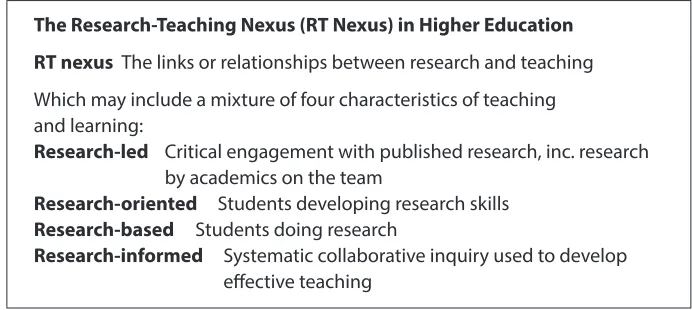
The wide range of inquiry-based strategies considered in the chapters of this text reveals the creativity and commitment of teacher educators and their belief in the centrality of inquiry. The ‘research-teaching nexus’ is an idea developed within the higher education sector about how to link research to teaching so that students more clearly benefit from the research activities of academic tutors (Griffiths, 2004). Griffiths identified four characteristics that may describe the links between research and teaching in higher education. Very concise definitions of the RT nexus and of the terminology associated with it are presented in Table 1.
The Research-Teaching Nexus (RT Nexus) in Higher Education RT nexus The links or relationships between research and teaching Which may include a mixture of four characteristics of teaching and learning:
Research-led Critical engagement with published research, inc. research by academics on the team
Research-oriented Students developing research skills Research-based Students doing research
Research-informed Systematic collaborative inquiry used to develop effective teaching
Table 1. Terminology for the Research Teaching nexus, based on Griffiths (2004).
References
Baumfield, V., Hall, E. & Wall, K. (2013) Action Research in Education. London: Sage.
Boyd, P., Hymer, P. & Lockney, K. (2015) Learning Teaching: becoming an inspirational teacher. Critical Publishing.
Boyd, P. & Bloxham, S. (2014) A situative metaphor for teacher learning, British Educational Research Journal, 40 (2), 337-352.
Cochran-Smith, M., & Lytle, S. L. (2009). Inquiry as stance: Practitioner research for the next generation. New York: Teachers College Press.
Fenwick, T. (2001) Questioning the Concept of the Learning Organisation in Paechter, C. , Preedy, M., Scott, D. & Soler, J. (eds.) Knowledge, Power and Learning. London: Paul Chapman.
Freidson, E. (2004) Professionalism: The Third logic. 4th edn. Oxford: Polity.
Griffiths, R. (2004) ‘Knowledge production and the research-teaching nexus: the case of the built environment disciplines’, Studies in Higher Education, 29(6), 709–726.
Kemmis, S. (2006) Participatory action research and the public sphere, Educational Action Research, 14(94), 459-476.
Nowotny, H., Scott, P. & Gibbons, M. (2001) Rethinking Science: knowledge and the public in an age of uncertainty. Available at: http://www.uni-klu.ac.at/wiho/downloads/nowotny.pdf
Teacher Development Trust, http://tdtrust.org/about/dgt