Article
A Novel Methodology for Securing IoT Objects Based
on their Security Level Certificates
Hezam Akram Abdulghani , Dimitri Konstantas, Niels Alexander Nijdam
Geneva School of Economics and Management, Geneva University, Switzerland; {mohammed.akram| dimitri.konstantas| niels.nijdam}@unige.ch
* Correspondence: mohammed.akram
Abstract: Internet of Things (IoT)provides a huge business value for customers, organizations, and governments due to the developments of so many applications in different sectors like energy and healthcare. Nevertheless, as a new emerging technology,IoTfaces several security concerns that are more challenging than conventional Internet because of its limited resources as well as its complex ecosystem. Toward this end, we first highlightIoTsecurity challenges and briefly discuss its security goals like confidentiality and integrity. Second, we discuss the most common attacks againstIoT, along with their violated security goals. We also review the existing frameworks of security and privacy guidelines forIoTand illustrate their shortcomings. Third, we propose a novel framework for securing IoTobjects, the key objective of which is to assign differentSecurity Level Certificates (SLCs)forIoT objects based on their hardware capabilities and protection measures. Objects withSLCs, therefore, will be able to communicate with each other or with the Internet in a secure manner. The proposed framework is composed of five main phases. In phase 1, we classifyIoTassets into four components: (i) physical objects, (ii) protocols, (iii) data at rest, and (iv) software, which includesOperating Systems (OSs), middlewares, and applications. We also classifyIoTobjects into five categories based on their hardware capabilities. In phase 2, we propose security and privacy guidelines for previously mentioned IoTassets, along with their protection measures. In phase 3, we classify protection measures into five SLCs, and then we assign differentSLCsforIoTobjects. In phase 4: we develop a communication plan between objects based on theirSLCs. In phase 5, we propose a four-step method to seamlessly integrate our objects with legacy objects ( objects are not developed according to our framework). Fourth, the feasibility and application of this framework are illustrated using smart homes as a case study. Finally, we investigate how our framework would lessen several attacks and threats againstIoTlike routing attacks and physical damage. We also provide qualitative arguments to show that this framework could be utilized to solve some ofIoTsecurity challenges such as tight resource constrains. Moreover, we discuss the shortcomings of our suggested framework
Keywords: Internet of Things (IoT); security goals; security guidelines; IoT assets; IoT security level certificates; countermeasures; IoT attacks; secure IoT frameworks
1. Introduction
energy and healthcare) to offer a huge business value for customers, organizations and governments [1]. For instance, smart watches, smart homes, and smart phones are examples ofIoTapplications designed specifically to make customers’ life much easier and more productive [2]. However, previously mentioned applications andIoTin general have faced many security and privacy issues, the common example of which are side-channel attacks, unauthorized conversation, routing attacks and unexpected use ofIoTdata. Such attacks and threats may jeopardize the existence ofIoT, if they are left untouched. That said, securing IoTseems to be very complex and confusing compared to traditional Internet because of two primary factors [3,4]. One isIoTobjects vary from tiny and lightweight objects (e.g., light bulbs) to powerful objects (e.g., smart phones), the majority of which is being connected to the Internet or each other to achieve specific tasks. It is, therefore, possible to apply traditional security mechanisms (e.g.,Advanced Encryption Standard (AES)) directly to powerful objects like smart phones. In contrast, tiny objects, for instance light bulbs, may not be able to apply such techniques directly without some modifications due to their limited resources in terms of battery life, memory storage, and computational power [3,5]. To this end, several research proposals have been proposed in this regard, and they can be classified broadly into three categories: (i) gateway-based solutions [6–8], (ii)IoTstack-based solutions [9–13], and (iii) middleware-based solutions[14–18]. Despite the benefits of using such solutions for addressing someIoT security concerns (e.g., secure communication), they suffer from some shortcomings. For instance, using a gateway for securingIoTobjects is a matter of compromise. On one hand, it can be used to address some of security issues like updating objects’ firmware and providing a secure key management method betweenIoTobjects and the gateway[19]. On the other hand, it introduces a single point of failure in both security and operation. Furthermore, flexibility and scalability will be decreased and hampered , as the development of a newIoTapplication orIoTobject requires some changes to be implemented into the gateway [20].
The other factor is the lack of frameworks that provide widely agreed upon security and privacy guidelines forIoTassets ( physical objects, protocols, data at rest, and software proposed in our earlier work [21]), along with their protection measures[3]. Such guidelines and their suitable implementation techniques would pave the road forIoTstakeholders like developers and manufacturers to build secure IoTsystems by integrating such guidelines into their systems from the start [4]. In spite of the importance of such frameworks of security and privacy guidelines forIoTto enhance its security and privacy by design according to [4], a few research studies have been proposed in this regard [3,4,22–24].
Nevertheless, framework-based solutions require more efforts not only to address their limitations ( e,g., poor implementation see Section3), but also to go beyond such limitations and contribute to make them more secure and reliable. To this end, we develop a novel framework by which differentSLCswill be assigned toIoTobjects based on their hardware capabilities and protection measures. Objects in our framework, hence, will be able to protect themselves autonomously (except object withSLC1 andSLC2). In other words, this framework will allowIoTobjects to protect themselves either independently for object equipped with higherSLCslikeSLC3,SLC4, andSLC5 or dependently for objects armed with lower SLCssuch asSLC1 andSLC2. A detailed explanation of our methodology is presented in Section4
The main contributions of this work are the following:
1. To highlightIoTsecurity challenges as well asIoTsecurity goals.
2. To investigate the most common popular attacks againstIoT, along with their violated security goals such as confidentiality, integrity, and availability.
3. To review the current frameworks of security and privacy guidelines for IoT, and present their limitations.
2. IOT SECURITY CHALLENGES AND GOALS
5. To utilize a smart home as a case study to illustrate the feasibility of our proposed framework. 6. To discuss how our framework can be used to address some ofIoTsecurity challenges as well asIoT
attacks, and to present its limitations and future work.
The remainder of this paper is structured as follows. In Section2, we illustrateIoTsecurity challenges and briefly discussIoTsecurity goals. In Section3, we review the existing frameworks of security and privacy guidelines forIoTand discuss their limitations. In Section4, the proposed methodology for securingIoTobjects is presented. In section5, a case study is introduced to illustrate the benefits of our proposed framework. In Section6, we describe how our framework can mitigate some attacks and threats againstIoTand solve someIoTsecurity challenges. We also present limitations as well as future works of our framework.
2. IoT Security Challenges and Goals
In this section, we first discussIoTsecurity challenges, and then we briefly highlightIoTsecurity goals.
2.1. IoT Security Challenges
In this part, different security challenges which may hinder and threatenIoTto reach its full potential and growth have been investigated. Such challenges include, but not limited to, the lack of a secureIoT development, tight resource constraints, and uncontrolled environments. A summary of the most popular IoTsecurity challenges is presented in Table1.
Table 1.IoTSecurity challenges
ID Name A brief description SC1 Lack of a secure
development
Both traditional software and IoT systems engineering processes focus primarily on functional requirements. Security, however, was never a primary consideration of the software development process in both traditional and IoT systems, since they concentrate mainly on achieving their functional requirements, leaving security requirements as an after-though to be addressed at the end of software development [25]. This kind of practice therefore is insufficient, and IoT systems need to integrate security requirements or guidelines from ground up. To this end, the authors in [3] proposed a comprehensive set of security and privacy guidelines forIoTassets, particularly for physical objects and protocols.
SC2 Tight resource
constraints
IoTobjects may have different hardware constraints in terms of computational power, storage and battery life. Therefore, traditional security mechanisms like AEScan be applied directly to someIoTobjects like cell phones and tablets due to their hardware capabilities. For example, the authors in [26] stated that window 10 mobile uses the same protection measures (e.g., Windows Hello mechanism) that have been utilized by the Windows 10OSpersonal computer to offer protection against new security threats. while for other simpler objects(e.g., presence sensors and smoke detectors) these mechanisms are not applicable[5]. SC3 Designed for specific
Tasks
SC4 Changes in security requirements
The security requirements for anIoTobject can be changed, depending on the status of the overall system to which it participates. For example, let assume that a smart car has several embedded objects. So, deciding which one of these embedded objects is the most essential to secure depends heavily on the status of the car, in our opinion. If the car is moving, the most crucial one is the an anti-lock braking object. In contrast, if the car is not moving, the most important one is a glass break detector object.
SC5 Update mechanisms Security ofIoTobjects depends heavily on their update mechanisms. In other words, anIoTobject designed to get its updates remotely (e.g., through a server) requires more security mechanisms than the object designed to get its updates locally (e.g, using a USB cable), according to [3]. This is because any object willing to remotely update its firmware in a secure manner must be able first to establish a secure channel with the server, and also be able to check the integrity of a new firmware image. On the other hand, only the authenticity of a person, who will install newly released firmware into the object, must always be checked in the local firmware updates [27].
SC6 Objects’ mobility One of the main attributes ofIoTobjects is its mobility. Security of anIoTobject, in our perspective, depends heavily on its location either static or dynamic. To this point, we do believe that a dynamic object requires more security mechanisms than static one for many reasons. One is that the dynamic object may be connected to unknown objects appearing in different environments. Therefore, according to [28], such object must be armed with different protection measures like an end-to-end security to secure its communications with other objects, tamper-proofing techniques to prevent physical attacks, side-channel analysis to prevent data leakage, and a secure firmware update method. While the static one may always be connected to trusted objects, and its security might be provided by the trusted objects.
SC7 The Importance of IoT objects
Security of anIoTobject depends on its importance. For instance, in aWSN, a sink node requires more defensive techniques when compared to sensor nodes, since the sink node is responsible for collecting, aggregating and processing data coming from sensor nodes as well as managing the whole network [28]. To this point, the authors in [29] have stated that the malicious nodes inWSN that persistently emit unwanted signals towards the sink node or a base station could stop or paralyze the whole network.
SC8 Uncontrolled environment
As some ofIoTobjects may be deployed on remote environments and left unattended, such objects therefore are vulnerable to physical attacks (e.g., malicious modification ofIntegrated Circuits (ICs)[30]. For example, having placedIoTobjects in uncontrolled areas without proper protection measures, an attacker could take such objects to a lab or a home for further analysis in order to discover their security parameters (e.g., private keys).
2.2. IoT Security Goals
3. RELATED WORK
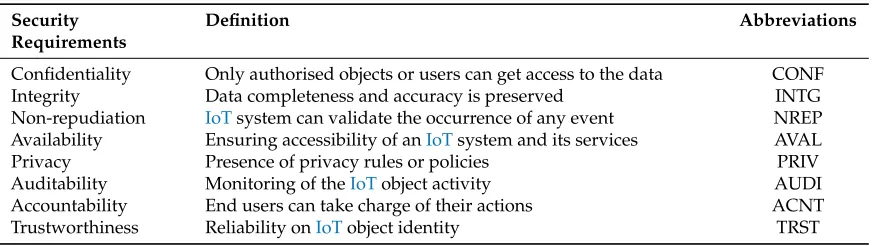
Table 2.IoT Security goals[4]
Security Requirements
Definition Abbreviations
Confidentiality Only authorised objects or users can get access to the data CONF
Integrity Data completeness and accuracy is preserved INTG
Non-repudiation IoTsystem can validate the occurrence of any event NREP Availability Ensuring accessibility of anIoTsystem and its services AVAL
Privacy Presence of privacy rules or policies PRIV
Auditability Monitoring of theIoTobject activity AUDI
Accountability End users can take charge of their actions ACNT
Trustworthiness Reliability onIoTobject identity TRST
Table 3.The violated security goals by AT1
CONF INTG NREP AVAL PRIV AUDI ACNT TRST
o o o
CIA-triad, it fails to deal with novel threats appearing in a collaborative environment [31]. Toward this end, the authors in [31] suggest a thorough set of security goals calledInformation, Assurance, and Security octave (IAS)octave, known as theIASoctave, by investigating a huge number of information in the literature in terms of security. An overview of the security goals proposed by theIASoctave, along with their definitions and abbreviations in link withIoTenvironment is presented in Table2.
3. Related Work
In this section, we first describe the most popular attacks againstIoTand investigate their violated security goals. Then, we review the existing frameworks of security and privacy guidelines, along with their shortcomings.
3.1. Attacks against IoT
In this part, we discuss attacks and threats applicable forIoTsystems and correlate them withIoT security goals, identified in Table2. More specifically, we annotate with ‘o’ when security goal in question is violated by the described attack.
(AT1) Eavesdropping: Intentionally listening to packets over communication links is called eavesdropping, and it is a powerful attack against communication channels if packets are not encrypted during transmission, according to [3]. The main goal of such attack is to intercept, read, and alter the communication packets. Three security goals, namely CONF, NREP, and PRIV, are affected by this type of attacks (see Table3). The CONF and PRIV security goals are violated, since the attacker is indirectly revealing some private information by listening to communication channels that are not encrypted nor well protected. The NREP is compromised, as the attacker could recognize a private key of an object or a sender in case of a weak cryptographic algorithm and thus use such key to sign some packets and send them to other objects or recipients without revealing his/her true identity.
Table 4.The violated security goals by AT2
CONF INTG NREP AVAL PRIV AUDI ACNT TRST
o o o o o o o o
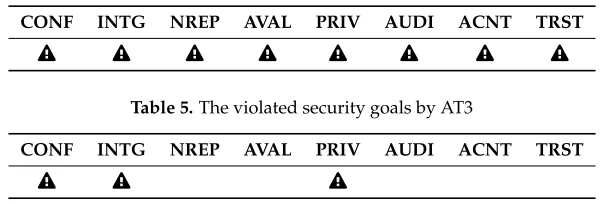
Table 5.The violated security goals by AT3
CONF INTG NREP AVAL PRIV AUDI ACNT TRST
o o o
(AT3)Side-channel attacks: AsIoTobjects execute their normal functions, there is a huge risk that such objects may reveal critical information (e.g., the secret keys). This type of attacks may happen because of the lack of secure techniques of processing and storingIoTdata (e.g., storing unencrypted data onIoT objects). It is also worth mentioning thatIoTobjects may be vulnerable to such attack even when such objects are not equipped with wireless protocols to transmit their data. For example, an electromagnetic wave omitted by an object may reveal sensitive data about both the object and its users, according to [27]. Three security goals(CONF, INTG, and PRIV) are affected by this attack (see Table5). The CONF and PRIV are violated as the attacker could reveal sensitive data about the object and its users by analyzing its side exposed features such as algorithms and power consumption. Having discovered some security parameters (e.g., encryption keys), the attacker could modify, for instance, the transmitted data. Thus, the INTG is also compromised by this attack.
(AT4)Malicious object insertion: Maliciously adding an object to the existing set of objects by duplicating another object’s identification number to either corrupt the packets or misdirect them is the main goal of this attack. Therefore, this type of attack may cause a huge drop in the network performance. Moreover, upon arrival of messages at a replica, an attacker could not only gain access to different security parameters (e.g., encryption keys) but also revoke authorized objects, since the attacker could execute an object-revocation protocol, according to [27]. This attack violates all security goals (see Table6) as the attacker has capability to misdirect, drop, decrypt, and corrupt the messages.
(AT5)Routing attacks: In [3], the authors illustrate several attacks like Gray hole, sybil, and worm hole designed specifically to target howIoTpackets are directed. The consequences of such attacks include, but not limited to, dropping, spoofing , and misdirecting packets. The simplest form of such attacks is known as modifying attack in which routing information is illegally manipulated by an attacker. A part from modifying attack, several attacks have been identified in the state of the art like sybil, selective forwarding, wormhole gray hole [3], and hello flood. Several security goals (see Table7) such as CONF, INTG, NREP, PRIV, and ACNT are compromised by this attack. The CONF, INTG and PRIV security goals are violated as the attacker is indirectly capable of disturbing routing path and spoofing packets. ACNT is also affected as the attacker could drop or misdirect some messages.
Table 6.The violated security goals by AT4
CONF INTG NREP AVAL PRIV AUDI ACNT TRST
3. RELATED WORK
Table 7.The violated security goals by AT5
CONF INTG NREP AVAL PRIV AUDI ACNT TRST
o o o o o
Table 8.The violated security goals by AT6
CONF INTG NREP AVAL PRIV AUDI ACNT TRST
o o o o o o o o
(AT6) Malicious firmware: Several manufacturers such as Apple and Sony have been using Over-the-air (OTA)methods to update their objects which were already being deployed in power grids, smart homes, smart cars, and more. Due to the large number ofIoTobjects that require updates, a trusted server has been used by manufacturers to publish or push newly released updates of their objects. This method, however, is vulnerable to a single point of failure because ofDenial of Service (DoS)attacks and a huge number of valid update requests sent simultaneously to the server. This attack violates all security goals such as CONF, INTG, and PRIV (see Table8) as the attacker has full control overIoTobjects.
3.2. Framework-based solutions
Although the development of a comprehensive set of security and privacy guidelines, covering all IoTassets, is nowadays an indispensable requirement for building secureIoTsystems, a few frameworks equipped with such guidelines have been proposed, which briefly present in the next paragraphs.
In [32], the authors suggest a list of privacy guidelines forIoTmoddlewares and applications and their data at rest. Such guidelines include, but not limited to, reducing data granularity, blocking repeated queries, and distributing data storage. However, they do not propose guidelines for differentIoTassets like physical objects (computing nodes andRFID), protocols, andOSs. Moreover, they do not address attacks and threats againstIoT, nor do they identify suitable protection measures to implement their guidelines.
In [22], the Broadband Internet Technical Advisory Group (BITAG) suggests an abstract list of security and privacy guidelines (e.g., encrypting communications) for some ofIoTassets ( computing nodes, applications, and protocols). That said,BITAGneither provides a thorough set of guidelines, nor recognizes proper security mechanisms to carry out its guidelines. Moreover, attacks and threats against IoTare left untouched.
In [23], theOpen Web Application Security Project (OWASP)proposes a list of security and privacy for someIoTassets ( computing nodes, applications). Nevertheless, the OWASP does not identify attacks and threats againstIoT, nor does it discuss the required security techniques to apply its guidelines.
In [4], the authors propose a comprehensive list of security and privacy guidelines only forIoTdata at rest, such as searching on encrypted data, ensuring authorized access, encrypting data storage, and minimizing duplicated copies. Moreover, the authors investigate all possible attacks and threats against data at rest and identify a set of protection measures which can be used to implement their guidelines. Moreover, they show the link between their guidelines, attacks, and mitigation techniques.
In [24], theIoT Security Foundation (IoTSF)proposes a complete list of security and privacy guidelines for allIoTassets, exceptRFIDtags. Nevertheless,IoTSFdoes not address attacks and threats againstIoT, nor does it distinguish suitable implementation techniques to accomplish its guidelines.
them. Furthermore, they identify proper protection measures to implement their guidelines. Not only that, they also show the link between their proposed guidelines, attacks, and protection measures.
In [5], the authors first state the importance of defining security requirements forIoTobjects based on three factors: (i) functionality, (ii) capabilities, and (iii) characteristics. Then, they investigate security threats as well as vulnerabilities ofIoTobjects, and more importantly they utilize the classification ofIoT objects capabilities int different classes to suggest a list of security requirements suitable for each class
Table19summarizes the recently-published frameworks that suggest several security and privacy guidelines for severalIoTassets along with their appropriate implementation techniques.
Shortcomings:It can be noticed that the suggested research proposals presented in Table19suffered from one common limitation which is the lack of a list of security and privacy guidelines that cover all IoTassets. Moreover, the authors in [4] have stated that the success of such frameworks of security and privacy guidelines depends heavily on the their implementation techniques. Poor implementation of such frameworks, therefore, may lead to develop insecureIoTsystems despite of having security and privacy guidelines.
We do believe that framework-based solution is the answer to many security challenges now facing IoTto reach its full potential. This is because such frameworks have suggested a set of security and privacy guidelines along with their protection measures which can be utilized by differentIoTstakeholders (e.g, developers and manufacturers) to build secure systems from ground. This kind of practice, for sure, will enhance security and privacy by design forIoT.
4. Methodology
In this section, we will discuss the proposed methodology through which differentSLCswill be assigned toIoTobjects based on their hardware capabilities as well as their implemented protection measures likeIntrusion Detection System (IDS), side channel protection, and secure storage schemes. In our framework,IoTobjects equipped withSLC1 orSLC2 indicate that they will have weak protection measures (e.g.,Data Link Layer Security (DLLS)) and limited hardware resources. Hence, these objects will neither be deployed in unattended areas, nor will be connected directly to the Internet. Such objects will depend heavily on objects withSLC3 (acting as gateways) to protect them and manage their communication to the Internet. In contrary,IoTobjects armed withSLC3 orSLC4 orSLC5 indicate that they will have strong protection mechanisms (e.g., blockchain-based solutions) and powerful hardware resources. These objects, thus, can be deployed in uncontrolled environments and more importantly can be connected directly to the Interment and protect themselves autonomously. Moreover, our framework states the communication plan in which differentIoTobjects can communicate securely with each other or with the Internet based on theirSLCs. The proposed framework consists of five main phases. The main phases are briefly described below, and an overview of the overall methodology is shown in Figure1.
4.1. Phase 1: classify IoT assets, attacks, countermeasures, and objects
In this phase, we first recognizeIoTassets along with their associated attacks and countermeasures, and then we classifyIoTobjects into different categories based on their hardware resources.
4.1.1.IoT Assets classification
4. METHODOLOGY
Table 9.Classification ofIoTobjects based on their hardware capabilities
Object Categories
CPU/ Microcontroller Memory (M) On-board storage
Power consumption (P)
Example
Category 1 Low CPU like 8- bit Microcontroller 16 MHz
M <= 32 KB None P<=1W Arduino Mego
Category 2 Moderate CPU such as 32- bit Microcontroller 80 MHz
32 KB< M <= 80 KB None P<=1W NodeMCU ESP-12
Category 3 Single core CPU (e.g., ARM1176 single-core 1 GHz )
80 KB< M <= 512 MB <=4GB 1W<P<=2W Raspberry Pi Zero
Category 4 Quad core CPU (e.g.,
ARM Cortex-A53
quad-core 1.2 GH)
512 MB< M<=2GB <=8GB 2W<P<=4W Raspberry Pi 3
Category 5 High(e.g., ARM
Cortex-A57 quad-core 2 GHz )
M >=8GB) High
(>=32 GB)
High NVIDIA Jetson
TX2
different layers, they do not address the required building blocks for their layers or levels, which can be used byIoTdevelopers to easily construct their systems. Toward this end, a novel building-blockedRMfor IoTwas introduced in earlier work in [21], andIoTassets were divided into four main layers (components): (a) physical object layer, (b) communication layer, (c) data at rest layer, and (d) software layer. Physical layer consists of computing nodes (RFIDreaders and sensor nodes) andRFIDtags. Communication layer includes allIoTprotocols covering allIoTstack and the existing network infrastructures (e.g., routers and switches). Data at rest layer involves data stored either inIoTobjects or on theCloud Storage Service (CSS). Software layer is composed ofIoTmiddleware,IoTapplications, andIoT OSs.
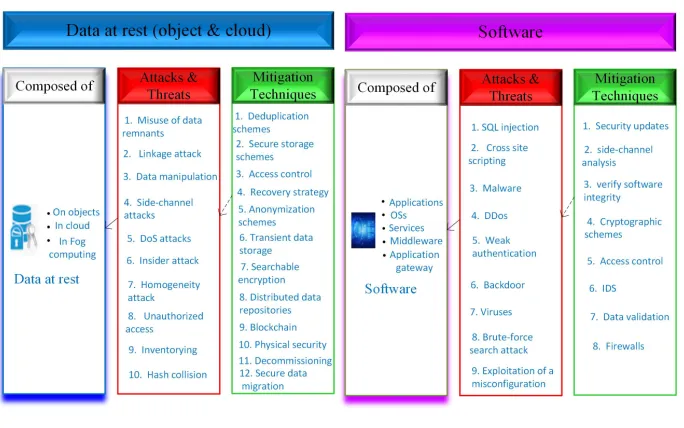
It is worth mentioning that the process of identifying all possible attacks and threats against eachIoT asset and also recognizing their suitable protection mechanisms has been investigated in our earlier work in [21]. The whole process can be summarized in Figure2a, and2b.
4.1.2.IoT objects classification
InIoTenvironment, different types ofIoTobjects that vary from tiny and lightweight objects (e.g, light bulbs) to powerful objects (e.g, smart phones) are being connected to the Internet or each other to achieve specific tasks. It is therefore unwise to suggest common implementation techniques for all of them, since some objects, for instance light bulbs, would not be able to run them due to their limited resources. Therefore, there is a need to classifyIoTobjects into different categories based on their hardware capabilities. To this point, we classifyIoTobjects, in our framework, into five categories based on four primary factors: (a)Central Processing Unit (CPU), (b) memory, (c) power consumption, and (d) on-board storage.
In our framework, if anIoTobject is in category 1, it indicates that it has minimal hardware capabilities. While if anIoTobject is in category 5, it indicates that it has very powerful hardware capabilities. An overview of objects classification in our framework, along with a real example for each category is presented in Table9.
4.2. Phase 2: Proposing security and privacy guidelines for each IoT asset
4. METHODOLOGY
(a) Physical and communication layers
(b) Data at rest and software layers
Figure 3.IoT assets along with their suggested security guidelines
4.2.1.Physical layer:
As shown in Figure2a, this layer is susceptible to several attacks and threats, the most popular of which are physical attacks, object replication attacks, side-channel attacks, and Hardware Trojan attacks. To contribute to alleviate such attacks, we suggest a list of security and privacy guidelines for the physical layer. These guidelines can be utilized at the early stages of systems development life cycles byIoT stakeholders like developers so that such systems will be resistant to such attacks. For example, one guideline recommends that a hardware secure boot process should be integrated into eachIoTobject. If such guideline is implemented by developers or manufacturers, it will prevent such object from running malicious code. Table10highlights the suggested security and privacy guidelines at this layer, their purposes, and their implementation techniques.
4.2.2.Communication layer
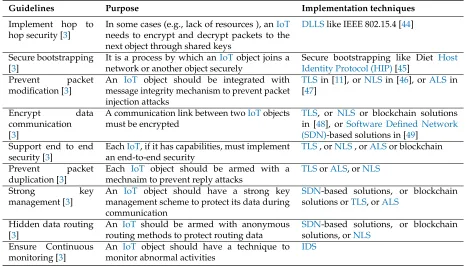
Similarly, this layer is vulnerable to several attacks shown in Figure2a. These attacks include, but not limited to, side channel attacks, malicious packet modification, routing attacks, malicious node injection, and eavesdropping. To mitigate these attacks, we propose a set of security and privacy guidelines for this layer which can be utilized byIoTstakeholders to build secure system from start. For instance, we suggest that eachIoTobject should be equipped with techniques, such asNetwork Layer Security (NLS),Application Layer Security (ALS), andTransport Layer Security (TLS), to prevent malicious packets modification. An overview of our proposed guidelines for communication layer, along with their purposes and their protection measures is presented in Table11.
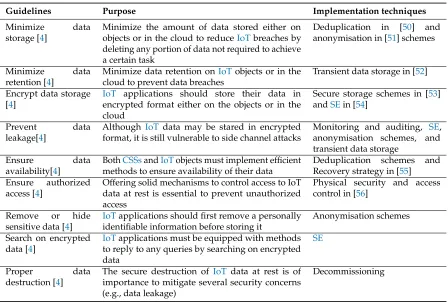
4.2.3.Data at rest layer
4. METHODOLOGY
Table 10.A summary of the suggested guidelines for physical layer along with their countermeasures
Guidelines Purpose Implementation techniques
Secure boot process [3]
AnIoTobject should have a fixed hardware secure boot process to prevent it from running a malicious code
Cryptographic schemes [36], hardware-based solutions [37,38]
Update firmware securely [3]
AnIoTobject should have a mechanism to update its firmware securely to detect malicious firmware
Firmware update methods [39]
Use hardware
identifier [3]
AnIoTobject should be equipped with a unique identity associated with its hardware
Hardware-based solutions
Prevent physical tampering [3]
A proper tamper- resistant measure should be integrated into eachIoTobject to prevent physical attacks
Hardware-based solutions( e.g., tamper-proofing techniques )
Safe disposal [3] AnIoTobject should have a method to destruct its data properly when reaching its end-of-life stage
Decommissioning methods [40]
Implement hardware trust [3]
AnIoTobject should have a hardware trust method to prevent malicious modification of data
Hardware-based solutions(e.g., aPhysical Unclonable Function (PUF)-based authentication [41] )
Detect abnormal nodes [3]
AnIoTobject should have a technique to detect abnormal nodes and activities
IDStechniques (e.g., a method based on Markov model [42])
Prevent node
replication [3]
AnIoT should have a method to safeguard its identification number
Cryptographic schemes
Prevent unwantedIC modifications [3]
AnIoTobject should be armed with a mechanism to detect malicious modifications on itsIC
Side channel analysis (e.g., dynamic permutation [43])and hardware-based solutions
Table 11. A summary of the suggested guidelines for communication layer along with their countermeasures
Guidelines Purpose Implementation techniques
Implement hop to hop security [3]
In some cases (e.g., lack of resources ), anIoT needs to encrypt and decrypt packets to the next object through shared keys
DLLSlike IEEE 802.15.4 [44]
Secure bootstrapping [3]
It is a process by which anIoTobject joins a network or another object securely
Secure bootstrapping like Diet Host Identity Protocol (HIP)[45]
Prevent packet modification [3]
An IoT object should be integrated with message integrity mechanism to prevent packet injection attacks
TLSin [11], orNLSin [46], orALSin [47]
Encrypt data
communication [3]
A communication link between twoIoTobjects must be encrypted
TLS, or NLS or blockchain solutions in [48], orSoftware Defined Network (SDN)-based solutions in [49]
Support end to end security [3]
EachIoT, if it has capabilities, must implement an end-to-end security
TLS, orNLS, orALSor blockchain
Prevent packet duplication [3]
Each IoT object should be armed with a mechnaim to prevent reply attacks
TLSorALS, orNLS
Strong key
management [3]
An IoT object should have a strong key management scheme to protect its data during communication
SDN-based solutions, or blockchain solutions orTLS, orALS
Hidden data routing [3]
An IoT should be armed with anonymous routing methods to protect routing data
SDN-based solutions, or blockchain solutions, orNLS
Ensure Continuous monitoring [3]
An IoT object should have a technique to monitor abnormal activities
Table 12.A summary of the suggested guidelines for data at rest layer along with their countermeasures
Guidelines Purpose Implementation techniques
Minimize data
storage [4]
Minimize the amount of data stored either on objects or in the cloud to reduceIoTbreaches by deleting any portion of data not required to achieve a certain task
Deduplication in [50] and anonymisation in [51] schemes
Minimize data
retention [4]
Minimize data retention onIoTobjects or in the cloud to prevent data breaches
Transient data storage in [52]
Encrypt data storage [4]
IoT applications should store their data in encrypted format either on the objects or in the cloud
Secure storage schemes in [53] andSEin [54]
Prevent data
leakage[4]
Although IoT data may be stared in encrypted format, it is still vulnerable to side channel attacks
Monitoring and auditing, SE, anonymisation schemes, and transient data storage
Ensure data
availability[4]
BothCSSsandIoTobjects must implement efficient methods to ensure availability of their data
Deduplication schemes and Recovery strategy in [55] Ensure authorized
access [4]
Offering solid mechanisms to control access to IoT data at rest is essential to prevent unauthorized access
Physical security and access control in [56]
Remove or hide sensitive data [4]
IoTapplications should first remove a personally identifiable information before storing it
Anonymisation schemes
Search on encrypted data [4]
IoTapplications must be equipped with methods to reply to any queries by searching on encrypted data
SE
Proper data
destruction [4]
The secure destruction of IoTdata at rest is of importance to mitigate several security concerns (e.g., data leakage)
Decommissioning
data storage. Table12outlines our suggested guidelines at this layer, along with their purposes, and their implementation techniques.
4.2.4.Software layer
As depicted in Figure2b, this layer, composed ofIoTapplication,OSs, and middleware, is also vulnerable to many attacks and threats likeDoSsattacks,Structured Query Language (SQL)injection attacks, weak authentications, malicious requests, and viruses. We suggest a set of security and privacy at this layer to alleviate its associated attacks and threats. For example, having integrated access control mechanisms intoIoTapplications,OSs, and middleware, such software will be able to prevent malicious requests coming from either adversaries or malicious objects. A summary of our proposed guidelines for this layer, along with their purposes and their protection measures is presented in Table13.
4.3. Phase 3: Assigning different SLC for IoT objects
In this phase, we briefly classifySLCsused in our framework and then discuss how to assignSLCsto IoTobjects.
4.3.1. SLCs classification
4. METHODOLOGY
Table 13.A summary of the suggested guidelines for software layer along with their countermeasures
Guidelines Purpose Implementation
techniques
Prevent malicious requests
IoTapplications should be armed with a technique to prevent and block malicious requests
Access control methods
Integrate OS with TLS To offer data integrity and privacy two or more communicating objects,TLSshould be integrated into an object’sOS.
SecureIoT OSs
Provide memory protection
An object’sOS should have a strong process management to manage an object’s resources
SecureIoT OSs
Validate and encrypt update
To prevent the injection of malware in objects’ OSs or IoT applications during their update processes, each update patch must be encrypted and validated
Secure IoT OSs and secure update methods
Provide events trace IoTobjects should be armed with a technique to continuously monitor their logs, processes, and software
Provide memory protection
An object’sOSshould be integrated with a memory management technique to properly allocate/deallocate its parts for different threads and processes
SecureIoT OSs
other reason depends on the environment at whichIoTobjects are being deployed and operated. Objects operating in a controlled area will require less protection measures as they will always be connected to trusted objects and will always be monitored by human beings or security cameras. On the other hand, objects operating in an uncontrolled environment will need more protection measures, since they will neither be connected to trusted objects, nor will be monitored by human beings or security cameras. To this end, we classify all the protection measures suggested to implement our proposed guidelines for previously mentionedIoTassets into five groups known asSLCs, starting fromSLC1 toSLC5. The number attached to eachSLCindicates its security level, which is very weak inSLC1 and very powerful inSLC5. This is becauseSLC1 includes only two protection measures (DLLSand secure bootstrapping), whereasSLC5 includes almost all mitigation techniques. It is worth noting that the process of assigning and issuingSLCsdepends heavily on entities (e.g.,IoTmanufacturers orIoTdevelopers) that implement our framework. More importantly, we assume that such entities are trusted and authenticated so that they will neither issue nor assign fakeSLCs. In the next paragraphs, we briefly discuss each one of them.
SLC1: This type ofSLC will implement two mitigation techniques, namely DLLS and secure bootstrapping. Thus,IoTobjects withSLC1 will be able to encrypt and decrypt packets only at data link layer because ofDLLS. In other words, they will be able to provide hop-to-hop security. Moreover, they will be able to join or rejoin gateways securely (objects withSLC2) because of their secure bootstrapping techniques. Due to the lack of hardware-based solutions to prevent physical attacks and end-to-end security techniques (e.g.,TLS) to provide secure communication channels, objects withSLC1 will neither be deployed in an uncontrolled environment, nor will be connected to the Internet directly. Furthermore, objects withSLC1 will not be able to store data locally as they will lack secure methods of storingIoTdata, nor will be able to update their firmware autonomously since they will not have secure firmware update methods, and they will depend on objects withSLC2 to do so. Moreover, objects withSLC1 will depend on objects withSLC2 to register theirSLCsin objects withSLC5 (responsible for tracking ofSLCsfor all objects).
Internet through objects withSLC3, as objects withSLC2 will not have side channel protection measures to prevent data leakage andIDSsto detect malicious packets. In other words, such objects will not be able to connect directly to the Internet. Since such objects will have firmware update methods, they will be able to update their firmware by connecting objects withSLC4, which are responsible for managing firmware updates in our framework. Like objects withSLC1, objects withSLC2 will not be deployed in an uncontrolled area because they lack required security techniques (e.g., tamper-proofing method ) to prevent physical attacks. Furthermore, objects withSLC2 will not be able to store data locally due to the absence of secure techniques to do so. Unlike objects withSLC1, objects withSLC2 will be able to register theirSLCsin objects withSLC5 and also communicate with other objects securely, as they will have end-to-end security techniques (e.g.,NLSandTLS).
SLC3: This type ofSLCwill be integrated with 12 mitigation techniques (see Table14) likeDLLS, TLS,NLS, firmware update methods,IDS, secureOS, and access control methods.IoTobjects withSLC 3 will be able to connect directly to the Internet and also manage communication between objects with SLC1 andSLC2 and the Internet. This is because objects withSLC3 will be armed with the required protection measures like end-to-end security techniques, side channel protection methods, secureOSs, and more importantlyIDSsto detect malicious packets. Unlike objects withSLC1 andSLC2,IoTobjects with SLC3 will be able not only to deploy and operate in unattended areas, but also to update their firmware by connecting objects withSLC4. Furthermore,IoTobjects withSLC3 will be able to store their data or data coming from objects withSLC2 temporally on their data storage after simple data processing to offer quick response to objects withSLC2, as they will be equipped with transient data storage techniques. Nevertheless,IoTobjects withSLC3 will lack secure data destruction as well as recovery mechanisms. To this end, such objects will be able only to store data just for a short period of time (e.g., per an hour). However, such objects will able to communicate with objects withSLC5 in order to store their data for a long time, as they will have suitable protection measures (e.g., secure storage sachems, recovery strategy, and deduplication schemes) to prevent data at rest breaches.
SLC4: This type ofSLCwill be equipped with 14 protection measures (see Table14), such asDLLS, TLS,NLS, hardware-based solutions, and blockchain-based solutions. IoTobjects withSLC4, in our framework, will be responsible for managing firmware updates of the allIoTobjects equipped with differentSLCs. More importantly, objects withSLC4 will utilize blockchain-based solutions like smart contacts proposed in [57] to manage secureIoTfirmware updates for allIoTobjects participating in our framework. As a consequence, manufacturers, implemented our framework, will be able to create smart contracts for the newly-developed firmware versions and push them to all objects withSLC4. Having pushed the smart contracts to the blockchain network formed, in our framework, by different objects equipped withSLC4, objects withSLC2,SLC3, andSLC5 will be able autonomously to query objects withSLC4 and therefore download the latest versions of firmware available for them. That said, time latency to register each smart contact to the blockchain network may take a long time (e.g., 10 minutes per transaction), but this is not an issue since objects’ firmware updates may be released once per month or week. As objects withSLC4 will be used to store the latest versions of objects’ firmware, they will be also equipped with secure decommissioning methods to securely destruct their data when reaching their end-of-life stages to prevent data breaches (e.g., misuse of data remnants).
4. METHODOLOGY
Table 14.SLCsclassification according to their mitigation techniques
ID Mitigation Techniques SLC1 SLC2 SLC3 SLC4 SLC5
MT1 Link layer security X X X X X
MT2 Transport layer security 7 X X X X
MT3 Network layer security 7 X X X X
MT4 Firmware update methods 7 X X X X
MT5 Intrusion detection system 7 7 X 7 7
MT6 Side channel protection 7 7 X X X
MT7 Decommissioning methods 7 7 7 7 X
MT8 Secure bootstrapping X X X X X
MT9 Blockchain solutions 7 7 7 X X
MT10 Hardware-based solutions 7 7 X X X
MT11 Deduplication schemes 7 7 7 7 X
MT12 Anonymisation schemes 7 7 7 7 X
MT13 Transient data storage 7 7 X X 7
MT14 Secure storage schemes 7 7 7 X X
MT15 Searchable encryption 7 7 X X X
MT16 Monitoring and auditing 7 7 7 7 X
MT17 Recovery strategy 7 7 7 7 X
MT18 Access control methods 7 7 X X X
MT19 SecureIoT OSs 7 7 X X X
validatingSLCs, since this process will be archived by entities implemented our framework from the early stages of their systems development processes. Each object in our framework (except object with SLC1) will have to register itsSLCin object withSLC5. This step, in our suggested framework, is an indispensable requirement for many reasons. One is that objects will not be able to change theirSLCs, sine they will be allowed to register theirSLCsonce in objects withSLC5. Another reason is that it will ease the communication process among objects with differentSLCs, as their public keys will be accessible by all the objects (except objects withSLC1). The other reason is that it will detect malicious objects with fakeSLCs, as each object will be able to verify theSLCof another object by checking itsSLCin the chain in objects withSLC5. More importantly, fake objects will be placed in a revocation list by objects with SLCs5, and all objects (except object withSLC1) will be notified by this list so that they will no longer communicate with them. Like objects withSLC4, objects withSLC5 will be able to deploy and operate in uncontrolled environments, and will be able to destroy their data in a proper way. Unlike objects withSLC 4, these objects will provide a recovery strategy of their data, and most importantly will responsible for integrating legacy objects with our objects.
By observing Table14, it is clear that our framework will provide a common method by which all objects (except objects withSLC1) will be able to communicate with each other securely. This is because objects withSLC3,SLC4, andSLC5 will implement the same protection measures inTLSandNLS. An overview ofSLCsclassification used in our suggested framework along their mitigation techniques is presented in Table14.
4.3.2. Assigning SLC to IoT objects :
Table 15.AssigningSLCstoIoTobjects
Object categories/SLCs SLC1 SLC2 SLC3 SLC4 SLC5
Category 1 X X 7 7 7
Category 2 X X 7 7 7
Category 3 X X X 7 7
Category 4 X X X X 7
Category 5 X X X X X
Table 16.The suggested communication plan
Types ofSLCs SLC1 SLC2 SLC3 SLC4 SLC5 Internet
SLC1 7 X 7 7 7 7
SLC2 X X X X X 7
SLC3 7 X X X X X
SLC4 7 X X X X X
SLC5 7 X X X X X
to implementSLC3, orSLC4, orSLC5 due their limited resources. Similarly,IoTobjects in category 2 will be able to implement eitherSLC1 andSLC2, as they have required hardware capabilities to do so. Unlike objects in category 1 and category 2, objects in category 5 will have powerful hardware resources to implement any one ofSLCs.
It is worth stressing that the process of assigningSLCstoIoTobjects must be done with caution. This is because the improper assignment ofSLCstoIoTobjects may lead to have insecure objects despite having strong hardware capabilities, for instance assigningSLC1 orSLC2 to objects in category 5. Table15 states theSLCsthat are suitable for each category.
4.4. Phase 4: Developing communication plan based on SLC
Defining a communication plan between objects, in our framework, depends heavily on theirSLCsin order to minimize the risks associated with weak links and also reduce unexpected used ofIoTdata. To this end, object withSLC1 will only communicate with objects withSLC2 due to their weak protection measures (see Table14). Not only that, such objects will not be able to communicate with objects having the sameSLCsas these objects may have different link layer protocols (e.g, IEEE 802.15.4 and Bluetooth ). To do so, they will depend on objects withSLC2 to perform a required translation between these protocols. Unlike objects withSLC1, objects withSLC2 will be able to communicate with all objects in our framework as long as objects withSLC3,SLC4, andSLC5 will implement the same algorithms or mechanisms ,implemented by objects withSLC2, in theirTLSandNLS. Nevertheless, such objects will not be able to communicate with the internet without using object withSLC3. Unlike objects withSLC1 andSLC2, object withSLC3,SLC4, andSLC5 will be able to communicate with the Internet and more importantly communicate with all objects easily (except objects withSLC1). Table16summarizes the proposed communication plan amongIoTobjects equipped withSLCs.
4.5. Phase 5: Integrating our objects with Legacy objects
5. CASE STUDY: SMART HOME
this end, we propose a simple method composed of 4 steps, depicted in Figure4, that will allow legacy objects to communicate with our objects in a secure manner.
Figure 4.Integration the legacy objects with our framework
First, a legacy object, if it in the range of our network, will try to communicate with our objects except for objects withSLC1 andSLC2 due to their restricted communication plan (see Table16). Second, upon receiving the request from the legacy object, our object first checks if that object has aSLC. If not, it will send the request to any objects withSLC5, as they are responsible for integrating legacy objects with our objects. Third, an object withSLC5 will suggest a set of algorithms that should be implemented in a transport layer of the legacy object to be able to communicate with other objects and will be able to provide an end-to-end security. If the legacy object lacks such algorithms or will not be able to implement them, this legacy object will not be able to integrate with our framework. Fourth, the legacy object will be able to communicate with objects withSLC3,SLC4, andSLC5 as long as it will use the same protection measures in its transport layer implemented by those objects.
Figure4summarizes the above mentioned steps required to integrate the legacy objects with objects developed according to our suggested framework. Step 1 (Figure4) shows that the legacy object (lo4), depicted in Figure4b, will attempt to communicate with an object withSLC3, depicted in Figure4a. In step 2, the object withSLC3 (see Figure4a) will direct the request coming from the legacy object (lo4) to any object withSLC5. In step 3, the object withSLC5 (in Figure4a) will recommend a set of protection measures that should be implemented in transport layer of the legacy object(lo4), and we assume the legacy object depicted in Figure4b will have such mechanisms. In step 4, the legacy object(in Figure4a) will be able to communicate with objects withSLC3,SLC4 andSLC5.
Figure5highlights the capabilities (shown in green arrows ) and the shortcomings (shown in red arrows) ofIoTobjects equipped with our suggestedSLCs.
5. Case study: smart home
This section illustrates how our proposed methodology can be utilized to develop a secure smart home system as a simplified case study in order to present clearly the benefits of our suggested framework. Even though the feasibility of our framework is presented in the context of a smart home, our methodology is domain agnostic, and thus it can be applied in other IoT domains. To this point, a set of steps is required byIoTdevelopers or software engineers to apply our framework to smart homes. These steps are briefly presented in the next paragraphs.
Figure 5.An overview of objects equipped withSLCs
objects include, but not limited to, light-bulbs, smart switches, microwaves, dishwashers, TVs, projectors, and smart phones. To this end, we classify smart home objects into eight groups such as smart detectors, household objects, and consumer objects, depicted in Figure6. Our classification depends heavily on hardware capabilities of smart home objects as well as their functionalities. For instance, consumer objects have very powerful resources and can be used in multiple purposes (e.g., control other objects), while smart detectors have very limited resources, and their main objectives are to detect changes inside the smart home (e.g., detect motion).
5. CASE STUDY: SMART HOME
Figure 6.Smart home object classification, along with theirSLCs
It is worth mentioning that smart home objects in our methodology will not only be used to achieve their specific tasks, but also to carry out other responsibilities due to theirSLCs, depicted in Figure5. For example, the main purpose for a smart TV is to allow its users, without the need to connect the TV antenna, to access to several channels which provide movies, music, and programs. Apart from providing such specific task, the smart TV in our framework will have other responsibilities (See Figure5) such as managing communication between objects withSLC2 (e.g., smart heath objects) and the Internet, since the TV will have required techniques to carry out such responsibilities.
Table17summarizes the process of classifying smart home objects into different categories, along their mitigation techniques required for eachSLC. It is worth noting that we assume that the hardware capabilities of each smart home classification in this case study such as smart detectors, smart health, and customer objects match our suggestedIoTobjects classification, presented in Table9. By observing Table 13, it is not hard to see that all smart home objects will have a set of mitigation techniques through which previously mentioned attacks against IoT such as AT1, AT2, AT3, and AT5 will be mitigated. A detailed explanation of how our suggested framework will lesson such attacks is presented in Section6.2.
Table 17.A summary of smart home object classification, along withSLCs
Object category Example Object class SLC Type Mitigation Techniques
Smart detectors Water, gas. motion Category 1 SLC1 MT1 and MT8
Security Cameras
Indoor Category 2 SLC2 MT1, MT2, MT3, MT4, MT8
Outdoor Category 3 SLC3 MT1, MT2, MT3, MT4, MT5,
MT6, MT8, MT10, MT13, MT15, MT18, MT19
Energy and lighting Light bulbs Category 2 SLC2 MT1, MT2, MT3, MT4, MT8
Home entertainment Amazon Echo Category 3 SLC3 MT1, MT2, MT3, MT4, MT5, MT6, MT8, MT10, MT13, MT15, MT18, MT19
Smart health Blood pressure monitor Category 2 SLC2 MT1, MT2, MT3, MT4, MT8
Household appliances
Dishwasher, refrigerator, dryer
Category 2 SLC2 MT1, MT2, MT3, MT4, MT8
Consumer objects
Smart phones, tablets Category 4 SLC4 MT1, MT2, MT3, MT4, MT6, MT8, MT9, MT10, MT13, MT14, MT15, MT18, MT19
Laptops Category 5 SLC5 MT1, MT2, MT3, MT4, MT6,
MT7, MT8, MT9, MT10, MT11, MT12, MT14, MT15, MT16, MT17, MT18, MT19
6. DISCUSSION AND FUTURE WORK
Table 18.The suggested communication plan for smart home objects
Smart home objects Smart detectors Indoor Security Cameras outdoor Security Cameras Energy and lighting Smart health Household appliance Smart phones, tablets
Laptops Gateways Internet legacy objects
Smart detectors 7 X 7 X X X 7 7 7 7 7
Indoor Security Cameras
X X X X X X X X X 7 7
Outdoor Security Cameras
7 X X X X X X X X X X
Energy and lighting
X X X X X X X X X 7 7
Smart health X X X X X X X X X 7 7
Household appliance
X X X X X X X X X 7 7
Smart phones, tablets
7 X X X X X X X X X X
Laptops 7 X X X X X X X X X X
Gateways 7 X X X X X X X X X X
lighting, smart health, and household appliance, as long as such objects are located within the coverage area of smart detectors signals. Nevertheless, smart detectors will not be able to communicate with smart phones and tablets, laptops, gateways, and the Internet.
An overview of the communication plan in which smart home objects presented above (see Figure6) will be able to communicate securely with each other, the Internet, and legacy objects is presented in Table 18.
Step 4: Finally, we illustrate how the smart home that will implement our framework will be able to seamlessly and securely integrate legacy objects. A legacy object inside the smart home will attempt to interact with any objects such as gateways and consumer objects in smart home except objects withSLC1 andSLC2 (e.g., smart detectors and smart health) due to their limited communication plan (See Table18). However, the legacy objects will not be able to communicate with smart home objects withSLC3 (home entertainment),SLC4 (phones and Tablets), andSLC(laptops), unless they first communicate with objects withSLC5 (laptops) and then get theirSLCsfrom them. The procedure in which the legacy objects will get theirSLCsfrom objects withSLC5 is presented in Section4.5.
6. Discussion and Future Work
A summary of the previously mentioned research proposals is presented in Table19, along with our intended objectives. It is not so difficult to recognize their limitations while going through them. This article, therefore, is directed to overcome those shortcomings that can be categorised as follows: (i) The lack of a thorough set of security and privacy guidelines forIoTassets. (ii) The absence of proper mitigation techniques to carry out such guidelines. (iii) The need of attack investigations related toIoTsystems. (iv) The necessity of mitigation techniques classification as well asIoTobjects classification. (v) The need of a communication plan so thatIoTobjects will be able to communicate securely with each other or with the Internet.
Table 19.Comparison of research efforts presented in the literature.
Addressed Features State-of-the Art Work
[32] [22] [23] [4] [24] [3] [5] This work
IoT asset guidelines
Computing nodes 7 X X X X X X X
RFID tags 7 7 7 7 7 7 7 X
Protocols 7 X 7 7 X X 7 X
Data at rest X 7 7 7 X 7 7 X
Applications X X X 7 X 7 X X
OSs 7 7 7 7 X 7 7 X
Addressed IoT SCs
SC1 X X X X X X X X
SC2 7 7 7 7 X X X X
SC3 X 7 7 7 7 7 7 X
SC4 7 7 7 7 7 7 7 7
SC 5 X X X 7 X X X X
SC6 7 7 7 7 7 X 7 X
SC7 7 7 7 7 7 7 7 7
SC8 7 7 7 7 7 X 7 X
Addressed IoT attacks
AT1 - - - X X X
AT2 - - - X X X
AT3 - - - X 7 X
AT4 - - - X 7 X
AT5 - - - X 7 X
AT6 - - - X X X
Types of guidelines
Privacy X X X 7 X X 7 X
Security 7 X X X X X X X
Communication Plan 7 7 7 7 7 7 7 X
Objects classification 7 7 7 7 7 7 X X
Protection measures classification 7 7 7 7 7 7 X X
6. DISCUSSION AND FUTURE WORK
6.1. Analysis on IoT security challenges
In this part, we offer qualitative arguments to illustrate that our proposed methodology, if it is followed precisely, can be used to address severalIoTsecurity challenges (see Table1), which are briefly discussed below:
(SC1)Lack of a secure development: As our proposed methodology is composed of five phases, one of its phases which is phase 2 is designed specifically to address such challenge. In phase 2, we propose a set of security and privacy guidelines covering allIoTassets (physical objects, protocols, data at rest, and software), along with their appropriate implementation techniques. Integrating such guidelines and techniques by developers or manufacturers into theirIoTsystems or products from the early stages of development (life cycles) will lead to develop secure system, which in turn improves security and privacy by design forIoT.
(SC2)Tight resource constraints: It is unrealistic to assign common protection measures forIoT objects, since such objects may come in different sizes, varying from resource-limited objects like motion detectors to resource-rich ones such as smart phones. Smart phones, for example, can implement traditional security mechanisms, while it seems to be very difficult to apply such techniques in motion detectors without some modifications. To this point, we first classifyIoTobjects into five categories (see Table9) based on their hardware capabilities. Furthermore, we assign different mitigation techniques (SLCs) which are more suitable for each category. For instance, objects in category 1 will implement a few protection measures (see Table14) suitable to their limited resources, whereas objects in category 5 will almost implement all our suggested protection measures due to their powerful hardware capabilities such as power consumption.
(SC3)Designed for specific Tasks: Being designed to carry out specific tasks and deployed in different environments,IoTobjects require different mitigation techniques. In other words, it is wise to assign different protection measures toIoTobjects based on their main functions or tasks. To this end, the proposed framework assigns different protection measures toIoTobjects based on their tasks and hardware resources. For example, as the main goal of objects withSLC5 in our method is to register and keep track of allSLCs, such objects thus will be equipped with blockchain solutions to do so. In contrary, objects withSLC1, 2, and 3 will not be armed with such solutions,as they are not designed to accomplish such goal.
(SC5)Update mechanisms: As the security ofIoTobjects relies on a method in which such objects receive their newly released updates either locally or remotely, our proposed framework thus assigns different mitigation techniques forIoTobjects. For example, objects withSLC1 will not have firmware update methods, as they depend entirely on objects withSLC2 to update their firmware, while other objects withSLC2, 3, 4, and 4 will be equipped with such techniques to independently update their firmware.
(SC8)Uncontrolled environment: The environment at whichIoTobjects will be deployed and operated plays a key role in determining their proper mitigation techniques. To this point,IoTobjects, in our framework, can be classified broadly into two groups: (i) objects operating in controlled environments and (ii) objects operating in uncontrolled areas. Thus, objects operating in controlled areas like objects withSLC1 andSLC2 will have a few mitigation techniques, as such objects will always be deployed in attended areas and will always be monitored by human beings or security cameras to prevent physical attacks. In contraty, objects withSLC3,SLC4, andSLC5 will have more protection measures to prevent physical attacks, as such objects may will be deployed in unattended environments.
Although most ofIoTsecurity challenges presented in Table1have been addressed in our suggested framework, two security challenges, namely(SC4)"changes in security requirements" and(SC7)"the importance of IoT objects", are left untouched. We do believe that such challenges can be addressed by developers or software engineers during the analysis phase of anIoTsystem’s requirements.
6.2. The mitigated attacks and threats in our methodology
We anticipate that our framework can be used to address several attacks and threats againstIoTas long as our methodology is precisely followed. We briefly discuss the mitigated attacks and threats in the next paragraphs.
(AT1)Eavesdropping: To mitigate such attacks, our framework prevents any object from sending and receiving its data or packets over unencrypted channels. This can be observed through mitigation techniques included in all our suggestedSLCs. For instance, objects withSLC1 will implementDLLSto send/receive their data in encrypted format to/from objects withSLC2. Similarly, objects withSLC2, SLC3,SLC4, andSLC5 will implement eitherTLSorNLSto provide end-to-end secure communication channels between them (see Table14).
(AT2)Physical attacks: To lessen this type of attacks, our framework divides its objects based on their environments into two categories: (a) Controlled environments and (b)Uncontrolled environments. Objects withSLC1 andSLCwill always be deployed in controlled areas to prevent physical attacks despite not having mitigation techniques to do so (see Table14). This is because such objects will always be monitored by either people or security cameras. On the other hand, objects withSLC3,SLC4, andSLC5 will be deployed in uncontrolled environments, as they will be equipped with hardware-based solutions like tamper-proofing techniques to mitigate physical attacks (see Table14).
(AT3)Side-channel attacks: To alleviate such attacks, our framework will integrate side-channel protection techniques into objects withSLC3,SLC4, andSLC5 so that such objects will be able to alleviate such attacks. Whereas objects withSLC1 andSLC2 will be vulnerable to side-channel attacks, since such objects will not have side-channel protection techniques (see Table14). However, this will not be an issue in our suggested framework, as these objects will not be connected directly to the Internet (always interact with our objects, see Table16), nor they will be deployed in uncontrolled environments, according to our methodology.
6. DISCUSSION AND FUTURE WORK
try to communicate with an object withSLC2. First, the object withSLC2 will check if the object trying to communicate with has a genuineSLC3 by contacting any object withSLC5. If not, which is the case in this example, the object withSLC2 will not communicate with it and will notify any object withSLC5 about this incident.
(AT5)Routing attacks : To lessen such attacks, our framework will compel the majority of its objects to applyNLSto prevent such attacks (see Table14). For instance, objects withSLC2,SLC3,SLC4, and SLC5 will have such mitigation techniques against routing attacks. In contrary, objects withSLC1 will be vulnerable to such attacks, as they will only implement two mitigation techniques (DLLSand secure bootstrapping). However, our suggested communication plan (see Table16) will play a key role to mitigate such threat, as it will restrict the communication of objects withSLC1 to only objects withSLC2. More importantly, communication links or channels between objects withSLC1 and object withSLC2 are encrypted using link layer security (DLLS).
(AT6) Malicious firmware To mitigate this types of attacks, our framework will utilize blockchain-based solutions (e.g., A pushed-based firmware update proposed in [58] )to update their objects securely. Manufacturers, implemented our framework, will be able to build smart contacts for newly developed firmware versions and will push them to all objects withSLC4. During the update process, some objects withSLC4 called miners will verify the integrity of pushed firmware, as they will equip with consensus protocol. Once the smart contacts are verified by miners, objects withSLC2,SLC3, andSLC5 will be able to send requests to objects withSLC4 and therefore download the latest versions of firmware available for them.
6.3. Limitations of the Study and Threats to Validity
Vulnerable to Insider Threats: The risks associated with the insider threats in our framework can be recognized in two processes: (i) issuing and assigningSLCsand (ii) firmware updates. As the process of assigning and issuingSLCs, in our methodology, will depend heavily on entities (e.g, developers or manufacturers) that will implement it, it is therefore vulnerable to malicious insider threats. It is possible that a developer who is responsible for issuingSLCscould accidentally or intentionally either alter the setting ofSLCsor assignSLCsto wrongIoTobjects. For instance, a malicious developer could assignSLC 3 to an object whose realSLCis one, which may put the entire system at risk. This is because security of our methodology relies heavily on its communication plan, which in turn depends onSLCs; the object withSLC1 will always be connected to objects withSLC2, and it will be deployed in controlled areas, whereas the object withSLC3 will communicate with all objects (except object withSLC1) and it will be deployed in uncontrolled environments (see Table16and Figure5).
6.4. Conclusion
The main goal of this paper is to develop a secure framework forIoTthat allows differentIoTobjects to communicate securely with each other or with the internet based on theirSLCs. To this end, we first classifyIoTobjects into five categories based on their hardware capabilities; objects in category 1 indicate that they will have very limited resources, whereas objects in category 5 indicate that they will have very powerful hardware capabilities. Second, we classify mitigation techniques, suggested to implement our security guidelines, into fiveSLCs;SLC1 indicates that it will have weak protection measures, whileSLC 5 will have very strong protection measures. Third, we assignSLCstoIoTobjects based on their hardware capabilities. Fourth, we propose a communication plan that allows our objects not only to communicate securely with each other but also with the Internet. Moreover, such plan will prevent unexpected use of IoTdata. Finally, we propose a four-step method in which the legacy objects can integrate securely with our objects. Our framework also can be used to address several attacks againstIoTand also solve some of IoTsecurity challenges, as long as our methodology is precisely followed. To demonstrate the feasibility and application of our suggested framework, we have utilized a smart home system as a case study.
In the future, we will propose a method that provides protection against an insider attacker, since it is the main threat to our methodology. Moreover, we will perform penetration tests on the actualIoT objects equipped with our proposedSLCsto evaluate the performance penalty as well as security benefits of using such framework.
References
[1] Kouicem, D.E.; Bouabdallah, A.; Lakhlef, H.; Kouicem, D.E.; Bouabdallah, A.; Lakhlef, H. Internet of things security : A top-down survey2018.
[2] Riahi Sfar, A.; Natalizio, E.; Challal, Y.; Chtourou, Z. A roadmap for security challenges in the Internet of Things. Digital Communications and Networks 2018, 4, 118–137. doi:10.1016/j.dcan.2017.04.003.
[3] Abdul-Ghani, H.A.; Konstantas, D. A Comprehensive Study of Security and Privacy Guidelines, Threats, and Countermeasures: An IoT Perspective.Journal of Sensor and Actuator Networks2019, 8, 38. doi:10.3390/jsan8020022.
[4] Abdulghani, H.A.; Nijdam, N.A.; Collen, A. A Study on Security and Privacy Guidelines , Countermeasures , Threats : IoT Data at Rest Perspective2019.11, 1–36. doi:10.3390/sym11060774. [5] Seungyong, Yoon; Jeongnyeo, K.Y.J. Security Considerations Based on Classification of IoT Device
Capabilities. SERVICE COMPUTATION 2017 : The Ninth International Conferences on Advanced Service Computing2017, pp. 1–63.
[6] Chang, C.t.; Chang, C.y.; Dario, R.; Martinez, B.; Chen, P.t.; Chen, Y.d. An IoT Multi-Interface Gateway for Building a Smart Space2015. pp. 56–60.
[7] Rodriguez, J.D.; Schreckling, D.; Posegga, J. Addressing data-centric security requirements for IOT-based systems. Proceedings - 2016 International Workshop on Secure Internet of Things, SIoT 2016 2017, pp. 1–10. doi:10.1109/SIoT.2016.007.
[8] John Treadway. Using an IoT gateway to connect the Things to the cloud.
[9] Raza, S.; Trabalza, D.; Voigt, T. 6LoWPAN compressed DTLS for CoAP. Proceedings - IEEE International Conference on Distributed Computing in Sensor Systems, DCOSS 20122012, pp. 287–289. [10] Kumar, S.S. draft-keoh-dice-dtls-profile-iot-00 - Profiling of DTLS for CoAP-based IoT Applications
2013.
[11] Hartke, K. draft-hartke-dice-practical-issues-01 - Practical Issues with Datagram Transport Layer Security in Constrained Environments2014.
[12] Sethi, M.; Arkko, J.; Keranen, A. End-to-end security for sleepy smart object networks.Proceedings - Conference on Local Computer Networks, LCN2012, pp. 964–972.