EARTH SCIENCE JOURNALS IN ERIC: A SCIENTOMETRIC PERSPECTIVE
A.Anitha*, N.Murugesapandian** and K. Kathiravan***
*Librarian, Dharmapuram Gnanmbigai Government Arts College for Women, Mayiladuthurai-609001. Tamilnadu.
** Head, Dept. of Library and Information Science, Ganesar college of Arts and Science, Pudukkottai. Tamilnadu.
***Research Scholar, Centre for Water Resources, Anna University, Chennai. Tamilnadu.
ABSTRACT
The Educational Resources Information Center (ERIC) is the largest education database in the world containing millions of bibliographic records of journal articles, research reports, curriculum and teaching guides, conference papers and books. This study presents the information on earth science peer reviewed journal articles available in ERIC. The articles in earth science are covered in 25 peer reviewed journals available in ERIC. The present study reveals that ERIC facilitates access to 25 journals in the field of earth science. Journal of Geological Education has the highest number of articles with 253 articles in earth science. Chang, Chun-Yen author has contributed the maximum number of articles i.e. 11.6 % in Earth science. Journal articles in earth science are more than other publication types available in Earth Science. Most of the journals in earth science are under the major subject heading Science Education. The multi dimensional findings of this study may be referred by librarians, authors, publisher and users.
1. INTRODUCTION:
Scientometrics is the study of measuring and analysing science, technology and innovation. “Scientometric is the quantitative study of physical published units or of bibliographic units or of surrogates of either.” Scientometrics is concerned with the quantitative features and characteristics of science and scientific research. The study of publication output in a field is a good indicator of status of research work in that field. This paper studies the publication productivity of Earth Science in ERIC.
Earth Science is the study of the Earth and its neighbors in space. Many different sciences are used to learn about the earth and the basic areas of Earth science studies are geology, meteorology, oceanography and astronomy. Today we live in a time in which the Earth and its inhabitants face many challenges. Earth scientists recognized this problem and its solution depends upon a deep understanding of Earth science. The output of the study or research work in earth science available in ERIC database is studied in this paper.
2. EDUCATION RESOURCES INFORMATION CENTRE (ERIC)
The Education Resources Information Centre (ERIC) database is an online digital library of education research and information which begun in 1966. ERIC is sponsored by the Institute of Education Sciences of the United States Department of Education. The ERIC Collection provides access to 1.5 million bibliographic records and contains variety of publication types like journal articles, books, research syntheses, conference papers, technical reports, dissertations, policy papers and other education-related materials.
The mission of ERIC is to provide a comprehensive, easy-to-use, searchable, Internet-based bibliographic and full-text database of education research and information for educators, researchers, and the general public in Adobe PDF format or can often be accessed using links to publisher websites and/or library holdings. ERIC is working on the online submission system of the articles and its updated monthly. This paper studies the earth science journals in ERIC.
3. REVIEW OF LITERATURE:
Stonehill2 studied the features and activities of ERIC and recommended that ERIC products and services should be made widely available to diverse audiences by expanding the database and journal coverage. Kapoor3 studied the Citation Analysis of Earth Science in the Annual Review of Earth and Planetary Sciences from 1973 to 1981 and found 82 journals in earth science representing 76% of the total citations out of the 833 titles cited. Anitha4 studied the Open Access literature productivity of Earth Science in DOAJ and found that 68 journals of Earth science are available in DOAJ. Brown5 has Compared 48 features of four versions of the ERIC and discussed the relative merits of some of the more important features. Robbins6 Studied an overview of the mission, structure, and resource base of the ERIC and highlighted the problems in meeting the variety of information needs and resources that are limited by underfunding. Kulczak7 studied citations with abstracts from the ERIC database focusing on the subject Public History and provided background information and teaching materials on topics such as museum resources, western women's history and Oregon Trail. Cesarone8 studied ERIC documents and journal articles covering the teaching method in the subject early Childhood Education and provided paragraph-length abstracts of nine ERIC documents and seven journal articles, as well as information about ERIC and ordering ERIC documents. And this study concentrates on Earth Science journal in ERIC.
4. AIMS AND OBJECTIVES:
0 100 200 300
N
u
m
b
er
of
A
rt
ic
le
s
Journal Tiltles
5. METHODOLOGY:
The factual data has been collected from ERIC website under the subject category Earth Science. The relevant details regarding the name of journal, author, publisher, country, language, year in which journal was added to ERIC, Publication type and form of publication, etc have been collected and tabulated using MS Excel. The individual journal’s publisher website was also consulted through the direct link available in ERIC. Only the peer reviewed journal articles were taken into account excluding the ERIC documents like reports, guide, etc.
6. RESULTS AND DISCUSSION:
The number of journals containing earth science articles covered in ERIC is 25 journals as listed in Figure 6.1. The total number of article in the twenty five journals is 1664 articles. Journal of Geological Education ranks the first with 253 articles followed by Science Teacher journal with 207 articles in Earth science. Science and Children journal is in the third position with 183 articles.
Figure 6.1 Number of articles published in journals of Earth Science
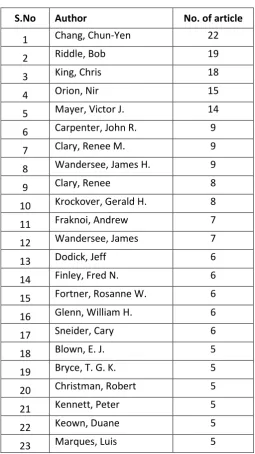
Table 6.1 Author wise distribution –
S.No Author No. of article
1 Chang, Chun-Yen 22
2 Riddle, Bob 19
3 King, Chris 18
4 Orion, Nir 15
5 Mayer, Victor J. 14
6 Carpenter, John R. 9
7 Clary, Renee M. 9
8 Wandersee, James H. 9
9 Clary, Renee 8
10 Krockover, Gerald H. 8
11 Fraknoi, Andrew 7
12 Wandersee, James 7
13 Dodick, Jeff 6
14 Finley, Fred N. 6
15 Fortner, Rosanne W. 6
16 Glenn, William H. 6
17 Sneider, Cary 6
18 Blown, E. J. 5
19 Bryce, T. G. K. 5
20 Christman, Robert 5
21 Kennett, Peter 5
22 Keown, Duane 5
23 Marques, Luis 5
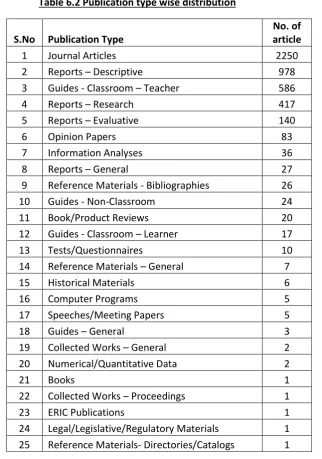
Table 6.2 Publication type wise distribution
S.No Publication Type
No. of article
1 Journal Articles 2250
2 Reports – Descriptive 978
3 Guides - Classroom – Teacher 586
4 Reports – Research 417
5 Reports – Evaluative 140
6 Opinion Papers 83
7 Information Analyses 36
8 Reports – General 27
9 Reference Materials - Bibliographies 26
10 Guides - Non-Classroom 24
11 Book/Product Reviews 20
12 Guides - Classroom – Learner 17
13 Tests/Questionnaires 10
14 Reference Materials – General 7
15 Historical Materials 6
16 Computer Programs 5
17 Speeches/Meeting Papers 5
18 Guides – General 3
19 Collected Works – General 2
20 Numerical/Quantitative Data 2
21 Books 1
22 Collected Works – Proceedings 1
23 ERIC Publications 1
24 Legal/Legislative/Regulatory Materials 1
25 Reference Materials- Directories/Catalogs 1
R² = 0.946
Pra ctitioners Tea chers Resea rchers Policyma kers Students Administra tors Community Pa rents Media Sta ff
0 50 100 150 200 250 300 350 400 450 500
A
u
d
ie
n
ce
Article Number
Table 6.3 Country wise distribution
S.No Country
No. of Journals
1 Virginia, United States 7 (28%)
2 District of Columbia, USA 4 (16%)
3 Philadelphia, PA, USA 4 (12%)
4 Newyork, United States 3 (12%)
5 New Jersey, United States. 3 (28%)
6 United Kingdom, Europe 2 (8%)
7 California, USA 1 (4%)
8 Netherland 1 (4%)
Total 25
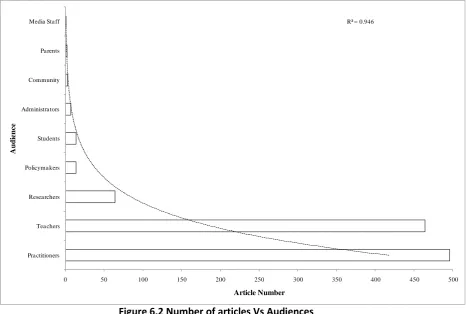
The articles are classified based on the content and its user. The user of the articles is termed as audience. Based on the level of education and requirement of the audiences, the journal articles are classified under nine major headings as shown in Figure 6.2. It is revealed from the above table that the number of articles for Practitioners is on the top with 47 % followed by teachers with 464 articles i.e., 44 % and next the researchers with 6 % of the total documents available in ERIC.
0 2 4 6 8 10
1978 1979 1980 1982 1983 1986 1992 1993 1997 1999 2004 2005 2007
N u m b er of Jou rn al s Year
Na tiona l Science Tea chers Associa tion
16%
Heldref Publica tions 12%
Institute of Physics Publishing 12%
Associa tion for Science Educa tion.
8% John Wiley & Sons, Inc.
8% Na tiona l Associa tion of
Geoscience Tea chers 8% Ta ylor & Fra ncis
8% America n Astronomica l Society.
4%
Astronomica l Society of the Pa cific
4%
Division of Chemica l Educa tion of the America n Chemica l Society
4%
Na tiona l Associa tion of Biology Tea chers.
4%
Na tiona l Ma rine Educa tion Associa tion
4%
Springer 4%
Wiley-Bla ckwell 4%
The Journals on Earth science were added to ERIC from 1978 to 2007. The maximum number of Journals added to ERIC was in the year 1979 (i,e) Nine Journals. In the Second position as shown in the Figure 6.3 the number of journals added to ERIC was in the year 1978. Two Journals were added in the year 1980 and 1999.
Figure 6.3 Year wise number of Journals published
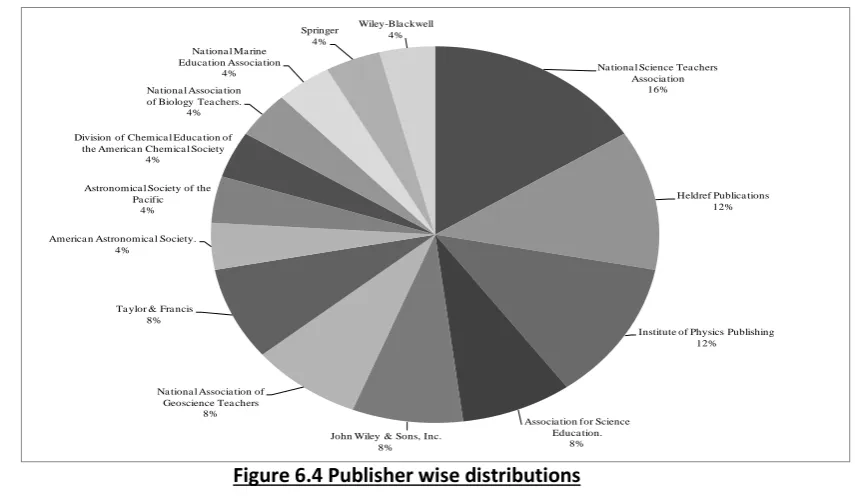
Earth science journals available in ERIC are published by fourteen publishers. National Science Teachers Association holds the first position by publishing 4 Journals in Earth Science. Institute of Physics Publishing is in the second position with three journals. And the third place is shared by six publishers as shown in Figure 6.4 and remaining publisher has published one journal each.
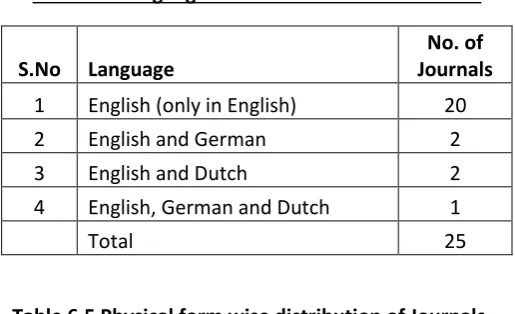
All the journals published in Earth science in ERIC are in English. Among the 25 journals, 20 Journals are published only in English Language. Journal published in other language are German and Dutch with three each. Journal of Geography published by Taylor & Francis, Ltd is the only Journal published in all the three language as shown in Table 6.4.
Table 6.4 Language wise distribution of Journals -
S.No Language
No. of Journals
1 English (only in English) 20
2 English and German 2
3 English and Dutch 2
4 English, German and Dutch 1
Total 25
Table 6.5 Physical form wise distribution of Journals –
S.No Journal type
No. of Journals
1 Only Print 16
2 Online and Print 9
Total 25
In the digital era the access of e-journals is comparatively equal to that of the printed journal. From table 6.5 it’s clear that out of the 25 journals on Earth science in ERIC, 9 journals are available in both printed and electronic form. The number of journals available only in printed form is 16 journals. In the near future all the journals may have electronic version to serve the need of the user.
FINDINGS:
REFERENCE:
1. http://www.eric.ed.gov. Accessed on 20.1.15.
2. Stonehill, Robert M (1990). The educational resources information center (ERIC): A system faces its future. Knowledge in society. 3 (2), 69-80.
3. Kapoor, S.K (1984). Citation Analysis of Earth Science Literature. Annals of Library Science and Documentation. 31(1-2), 56-62.
4. Anitha, A; Murugesapandian,N; Mala, A.(2014) Open Access literature productivity of Earth Science in DOAJ. Journal of Library and Information Services. 2 (1), 94-103.
5. Brown, Janet Dagenais (2003) The ERIC Database: A Comparison of Four Versions. Reference Services Review. 31(2) 154-74.
6. Robbins, Jane B. (2001) ERIC: Mission, Structure, and Resources. Government Information Quarterly. 18(1)5-17.
7. Kulczak, Carrie. (2002) Public History: An ERIC/ChESS Sample. OAH Magazine of History. 16 (2). 57-59.