R E S E A R C H
Open Access
Using Semantic Web technologies for the
generation of domain-specific templates to
support clinical study metadata standards
Guoqian Jiang
1*, Julie Evans
2, Cory M. Endle
1, Harold R. Solbrig
1and Christopher G. Chute
3Abstract
Background:The Biomedical Research Integrated Domain Group (BRIDG) model is a formal domain analysis model for protocol-driven biomedical research, and serves as a semantic foundation for application and message development in the standards developing organizations (SDOs). The increasing sophistication and complexity of the BRIDG model requires new approaches to the management and utilization of the underlying semantics to harmonize domain-specific standards. The objective of this study is to develop and evaluate a Semantic Web-based approach that integrates the BRIDG model with ISO 21090 data types to generate domain-specific templates to support clinical study metadata standards development.
Methods:We developed a template generation and visualization system based on an open source Resource Description Framework (RDF) store backend, a SmartGWT-based web user interface, and a“mind map”based tool for the visualization of generated domain-specific templates. We also developed a RESTful Web Service informed by the Clinical Information Modeling Initiative (CIMI) reference model for access to the generated domain-specific templates.
Results:A preliminary usability study is performed and all reviewers (n= 3) had very positive responses for the evaluation questions in terms of the usability and the capability of meeting the system requirements (with the average score of 4.6).
Conclusions:Semantic Web technologies provide a scalable infrastructure and have great potential to enable computable semantic interoperability of models in the intersection of health care and clinical research.
Keywords:BRIDG, RDF, CIMI, Doman analysis model, Clinical study meta-data standards, Detailed clinical model, Semantic Web technologies
Introduction
The Biomedical Research Integrated Domain Group (BRIDG) model is a formal domain analysis model for protocol-driven biomedical research, and serves as the semantic foundation for application and message devel-opment in the standards developing organizations (SDOs) [1, 2]. The increasing sophistication and com-plexity of the BRIDG model requires new approaches to the management and utilization of the underlying se-mantics to harmonize domain-specific standards.
A typical use case for the BRIDG model comes from the Clinical Data Interchange Standards Consortium (CDISC) [3]. CDISC initiated the Shared Health And ClinicalResearchElectronic Library (SHARE) project to build “a global, accessible electronic library, which en-ables standardized data element definitions and richer metadata to improve biomedical research and its link with healthcare” [4]. In it, CDISC envisioned integrated domain-specific templates built from the classes and at-tributes from the BRIDG model and ISO 21090 data types as a foundation for the definition of research con-cepts in the therapeutic target areas.
The CDISC SHARE approach to domain-specific tem-plates has much in common with an international col-laboration effort initiated by the Clinical Information * Correspondence:[email protected]
1Department of Health Sciences Research, Mayo Clinic, 200 First St SW,
Rochester, MN 55905, USA
Full list of author information is available at the end of the article
clinical research. We also believe that the emerging Semantic Web technologies based on World Wide Web Consortium (W3C) standards can provide much of the in-frastructure and tools needed to accomplish this goal.
The W3C standards include the Resource Description Framework (RDF) and the Web Ontology Language (OWL) [7, 8], which provide a scalable framework for semantic data integration, harmonization and sharing. These technologies are beginning to appear in both clin-ical research and health care workspaces and have been leveraged in several notable projects, including the UK CancerGrid [9], the US caBIG [10] and the National Center of Biomedical Ontologies (NCBO) [11]. The Se-mantic Web Health Care and Life Sciences (HCLS) Inter-est Group has been formed under the auspices of the W3C to develop, advocate for and support the use of the Semantic Web technologies across the domains of health care, life sciences, clinical research and translational medi-cine [12]. In some of our previous studies, we explored the use of OWL to represent clinical study metadata models such as HL7 Detailed Clinical Models (DCMs) [13] and the ISO/IEC 11179 model [14], and investigated a Semantic Web representation of the Clinical Element Model (CEM) for secondary use of the EHR data [15, 16].
The objective of this study is to develop and evaluate a Semantic Web-based approach that integrates the BRIDG model with ISO 21090 data types to generate domain-specific templates to support clinical study metadata standards development. The main purpose of the tools developed in this study is to support SDOs such as CDISC to create information models that can enable data exchange between clinical care systems (e.g., in a CIMI model) and clinical trial systems (e.g., in a BRIDG model). In it we developed a template gen-eration and visualization system based on an open source Resource Description Framework (RDF) store backend, a SmartGWT-based web user interface, and a
“mind map” based tool for the visualization of gener-ated domain-specific templates. We also cregener-ated a RESTful Web Service informed by the Clinical Informa-tion Modeling Initiative (CIMI) reference model for ac-cess to the generated domain-specific templates. A
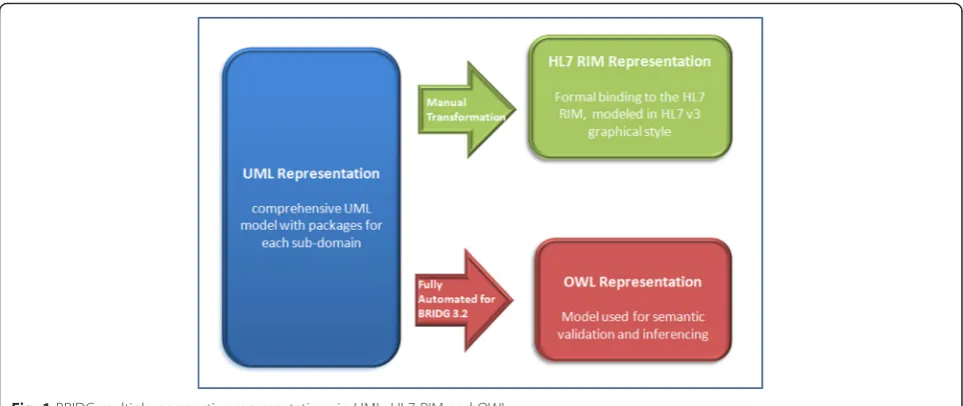
regulatory artifacts [1]. The BRIDG model was based on the HL7 Development Framework. Multiple repre-sentations of the model were introduced in the BRIDG 3.0 release, including the canonical Unified Modeling Language (UML)–based representation, a HL7 Refer-ence Information Model (RIM)-based representation and a ontological representation in a single OWL file. Figure 1 shows BRIDG multiple-perspective representa-tions in UML, HL7 RIM and OWL.
CDISC standards development
The mission of CDISC is“to develop and support global, platform-independent data standards that enable infor-mation system interoperability to improve medical re-search and related areas of healthcare” [17]. Over the past decade, CDISC has fulfilled its mission by publish-ing and supportpublish-ing a suite of standards that enable the electronic interchange of data throughout the lifecycle of a clinical research study [18].
Specifically, CDISC has developed standards for use across the various points in the research study lifecycle:
Planning: Protocol Representation Model Version 1, which includes Study Design, Eligibility Criteria and Clinical Trial Registration
Data Collection:
o Clinical Data Acquisition Standards Harmonization (CDASH) for the collection of data through case report forms
o Operational Data Model (ODM) for the collection of operational data through electronic data exchange
o Laboratory Model (LAB) for the collection of clinical laboratory data through electronic data exchange
Data Tabulations
o Study Data Tabulation Model (SDTM) for submission of human subject data to regulatory agencies
Statistical Analysis: Analysis Data Model (ADaM) for submission of statistical analysis data to regulatory agencies.
Clinical information modeling initiative
The Clinical Information Modeling Initiatives (CIMI) was officially launched in July, 2011 with more than 23 participating organizations. The initiative was established to “improve the interoperability of healthcare informa-tion systems through shared implementable clinical in-formation models” [5]. The principles of the CIMI include“1) CIMI specifications will be freely available to all. 2) CIMI is committed to making these specifications available in a number of formats. 3) CIMI is committed to transparency in its work and product.” The goals of the CIMI include: 1) shared repository of detailed clin-ical information models; 2) a single formalism; 3) a com-mon set of base data types; 4) formal bindings of the models to standard coded terminologies; and 5) reposi-tory is open and models are free for use at no cost. As of May 7, 2013, CIMI is finalizing its reference model spe-cification that consists of a core reference model, a data value type model and a party model.
Semantic Web technologies
The World Wide Web Consortium (W3C) is the main international standards organization for the World Wide Web [7]. Its goal is to develop interoperable technolo-gies and tools as well as specifications and guidelines to realize the full potential of the Web. The W3C tools and specifications that we used in this study include the Resource Description Framework (RDF) [8], RDF Schema (RDFS) [19], the Web Ontology Language (OWL), OWL 2 [20], the Simple Knowledge Organization System (SKOS) [17], the SPARQL Protocol and RDF
Query Language (SPARQL) [21], and the SPARQL Infer-ence Notation (SPIN) [22], which is a W3C Member Submission that can be used to represent SPARQL rules and constraints on Semantic Web models.
Methods
System requirements
The system requirements for this study were based on a CDISC SHARE project, in which building domain-specific templates based on BRIDG model is an essential process for clinical study metadata standards develop-ment. These requirements include:
Selection from multiple BRIDG classes. For example, describing a measurement on a subject (such as vital signs like body temperatures) may include the BRIDG classes Defined Observation, Defined Observation Result, Performed Observation, Performed Observation Result and Reference Result. Selection of specific attributes from each selected
BRIDG class. The attributes include the inherited attributes from its parent classes. For example when selecting attributes based on a BRIDG class Person, the inherited attributes (e.g.,name,birthDate, etc.) from its parent class Biologic Entity shall be available for the selection.
Specification of the subcomponents of the data type for a specific attribute of a BRIDG class. BRIDG attributes are associated with ISO 21090 data types, each of which has multiple components with its own data type, which may also be a complex. Using the BRIDG class Person as an example, the attribute
educationLevelCodehas the data typeCD. CD, in turn has a set of components includingcode,
downstream development and harmonization of clinical study metadata standards.
System architecture
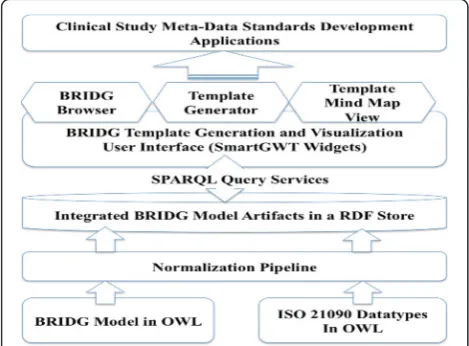
Figure 2 shows the system architecture. The system comprises the following modules: 1) a normalization pipeline module; 2) a backend module that uses a RDF store; 3) a frontend module that includes a BRIDG model browser, a template generation mechanism and a mind map viewer for generated templates.
Implementation
Materials
BRIDG model in OWL In the release of the BRIDG version 3.2, an ontological perspective, i.e., OWL repre-sentation of BRIDG semantics is developed for the BRIDG model. For this release, the scope of the OWL contents is limited to the information found in the BRIDG UML model. In this study, we used the OWL rendering of the BRIDG model that is publicly available from the release package of the BRIDG 3.2 [1].
HL7 V3 data types in OWLThe HL7 OWL project has published an initial draft of the Core HL7 V3 in OWL.
RDF store backend.
To make all of the inherited attributes and associations explicit for each BRIDG class, we used Jena ARQ API-based script [25] that recursively retrieved the attributes and associations from parent classes of each BRIDG class and materialized them explicitly using two BRIDG predicates: bridg:attributePropertyand bridg:association-Property. We also used a template, spl:Attribute, from the SPARQL Inference Notation (SPIN) to model the metadata of each attribute and association, including the cardinality and a predicate bridg:isInherited indicating whether the target attribute or association is inherited or not. Figure 3 shows an example of the flattened repre-sentation for an association and an attribute of the BRIDG class Person. Following this, we combined the namespaces used for the HL7 V3 data types and the OWL renderings of the BRIDG models.
Frontend implementation
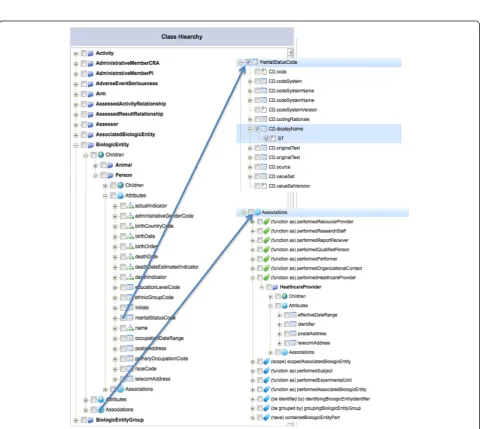
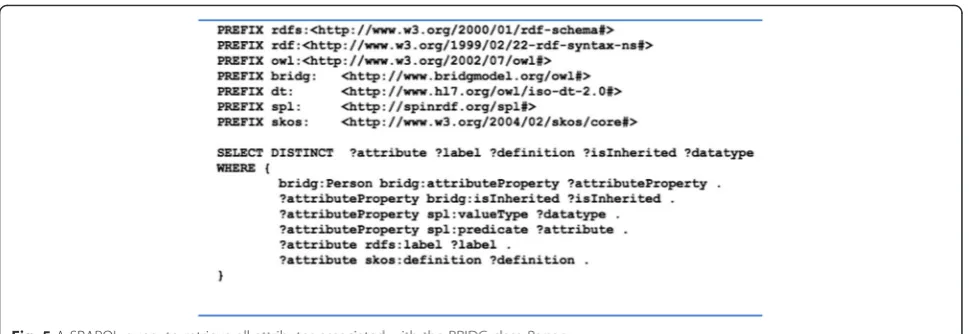
Building a BRIDG model browser and a template generation mechanism We developed a BRIDG model browser as a web application based on the SmartGWT API [26]. SmartGWT is a Google Web Toolkit (GWT)-based framework that allows users to utilize its compre-hensive widget library for user interface development. The browser displays a hierarchical tree of BRIDG classes (see Fig. 4). For each class, the browser displays a metadata structure comprising Children, Attributes and Associations, which streamlined those metadata associ-ated with each class. We defined a set of SPARQL queries to retrieve the children, attributes and associations for each class. Figure 5 shows a SPARQL query to retrieve all attributes associated with the BRIDG classPerson.
If a BRIDG class has children, they will be displayed under the folder Children. The Attributes folder displays all inherited and non-inherited attributes and their data types. Separate icons are used to differentiate which at-tributes are local vs. inherited. The sub-components are displayed for complex data types. As an example, the upper right corner of Fig. 4 shows the sub-components of the data typeCDfor the attributemaritalStatusCode.
Fig. 3An example of flattened representation for an association and an attribute of the BRIDG class Person using a SPIN template
Data type sub-components can be expanded to display interior data types.
The Associations folder shows inherited and non-inherited associations with icons representing their in-heritance status. The associated class will be displayed and it can be expanded to show its corresponding struc-ture. The lower right hand of Fig. 4 shows the expansion of the Associations folder for the class Person.
We also developed a template generation mechanism by allowing selection of specific elements in the BRIDG model browser. A target template can be constructed from the attributes (including data type components) from one or more BRIDG classes. Based on the system requirements, a set of rules is applied when users make their selections. The upper right hand part of Fig. 4 shows the user selecting the data type ST data type of the CD.displayName component with the full path of the selected attribute used as the attribute name: Person.maritalStatusCode.CD.displayName.ST.
A generated template with a set of selected attributes (including data type components) can be rendered as a
“mind map”. We use the Freemind browser [27] to dis-play a target mind map.
A CIMI reference model-based Semantic Web repre-sentation of generated domain templates We created a mapping between CDISC standard objects and CIMI reference model elements. In it a domain-specific tem-plate corresponds to the CIMI element ENTRY(the lo-gical root of a single clinical statement within a clinical session) and the component BRIDG classes and BRIDG attributes correspond to the CIMI elementCLUSTER(a set of ELEMENTs) andELEMENT(a type of data ITEM, which does not itself contain ITEMs) respectively. Using this mapping, we were able to create a CIMI-complaint Semantic Web representation for generated BRIDG domain-specific templates. Figure 6 shows an example of a CIMI-compliant Semantic Web representation for a
domain-specific template generated from the BRIDG class AdverseEventSeriousness. As illustrated, we used the elements from the CIMI reference model, such as cimi:ENTRY, cimi:CLUSTER, cimi:ELEMENT, and cimi:-CLUSTER.item. We also used the SPIN template spl:at-tribute to attach the metadata of each selected attribute including the cardinality.
We then developed the RESTful Web Service that provides programmatic and browser access to the CIMI reference model-based representations of the domain-specific templates. As an example, the CIMI reference model-based representation for the AdverseEventSer-iousnessdomain in Turtle format is shown in Fig. 6.
Results and discussion
System evaluation
We performed a preliminary evaluation on the system in terms of the usability and the capability of meeting the system requirements as described in the Section 3. For the evaluation design, we created a use case test script that describes the use case of generating a template
“Measurement on a Subject”. The target of the use case is to develop a template that covers 5 BRIDG classes, 20 BRIDG attributes and 5 BRIDG associations. We re-cruited three reviewers: one reviewer (JE, a co-author) from CDISC SHARE team who has extensive expertise on BRIDG model and clinical study metadata standard development, and two other reviewers who are biomed-ical informatics researchers. We arranged a teleconfer-ence meeting and introduced the background of the project and demonstrated the basic features and usages of our frontend widgets to them. We made the web ap-plication accessible to the three reviewers who followed the test script to build a template for the target use case. Each reviewer worked individually to complete the test case. After they completed, the three reviewers are asked to answer the evaluation questions in a 1-5 scale, in which 1 stands for“Strongly disagree”, 2 for“disagree”, 3
for “neutral”, 4 for “agree” and 5 for “Strongly agree”. The preliminary results indicated that all three reviewers successfully created the template as described in the test script. All reviewers had very positive responses for the evaluation questions in terms of the usability and the capability of meeting the system requirements (with the average score of 4.6). The reviewers also provided free-text feedback on the system. Some of comments include 1) the suggestion to add a search button for users who look for a particular class and attribute; 2) the suggestion that the icon used for the folder Children could be mis-leading and confusing; 3) the issues for displaying
Freemind map in different browsers; 4) the suggestion of allowing multiple ways to de-select an attribute; 5) the suggestion of allowing to reload the generated template for modification; 6) the suggestion of allowing to con-strain the data type of ANY in a specific data type.
Discussion
In this study, we designed, developed and evaluated a BRIDG-based domain-specific template generation and visualization system for supporting clinical study meta-data standards development. We consider that the sys-tem and approach developed in this study are significant
views, Adverse Event, Common, Protocol Representa-tion, Regulatory, Statistical Analysis, and Study Conduct, which help domain experts to navigate subsets of the domain semantics. In addition, multiple representations as described in the Background section are used to meet the requirements from different use cases. In this study, we focused on the domain-specific template generation use case and developed a customized BRIDG browser that enables the standards developer to interact with the BRIDG model elements. Specifically, we streamlined the metadata for each BRIDG class using a metadata struc-ture of Children, Attributes and Associations. The pre-liminary evaluation demonstrated the positive results in terms of the ease of use and the capability to meet the system requirements. In addition, the generated domain-specific templates can be rendered in a Mind Map view, which has been widely used in the standards develop-ment community. Furthermore, we developed a Seman-tic Web representation informed by CIMI reference model for the generated domain-specific templates, pro-viding a modular representation for a specific domain exposed as a standard RESTful service. This will enable semantic harmonization with other CIMI-compliant models, potentially developed from different contexts.
Technical significance
Semantic Web technologies played a critical role in the system design and development. First, the RDF data model and the triple store technology enabled data inte-gration of the BRIDG model and ISO 21090 data type model. All BRIDG attributes have defined data types based on ISO 21090. For those complex data types, they have multiple components. Some of the components of a complex data type are required for a domain-specific template. For example, theCDdata type has the compo-nents valueSetand valueSetVersionthat can be used for the valueset binding. Utilizing the Semantic Web OWL/ RDF version of the two models, we were able to seam-lessly link the data type defined for each BRIDG attri-bute with their components defined in the ISO 21090 data type model. Note that we unified the namespaces
eration. As part of the normalization pipeline, we re-trieved and materialized all inherited attributes/ associations for each BRIDG class, which streamlined the metadata of each BRIDG class and made the attri-bute selection straightforward to users.
Third, a SPARQL endpoint was established to provide standard SPARQL query services for accessing the con-tent of the BRIDG model elements. We defined a set of SPARQL queries to extract the metadata for each BRIDG class. We found that the normalization pipeline as we implemented it was very helpful to simplify the query building. For example, as we materialized the inherited attributes and associations for each BRIDG class, building the SPARQL queries for retrieving this kind of metadata was simplified. In addition, the SPARQL endpoint based on 4store implementation sup-ports SPARQL 1.1 update features, which enables the storage and update of generated domain-specific tem-plates with their provenance information and provides potential for future authoring application development.
enable an automatic mechanism for model validation and consistency checking.
Limitations and future study
There are several limitations in the study. First, a more rigorous evaluation from a panel of domain experts from broader communities would be helpful in the future. The system will be iteratively enhanced based on the feedback from the evaluators. For example, the search functionality would be helpful to allow users to find a target class/attribute more quickly. Second, the system evaluation was limited to the ease of use and the fulfill-ment of those basic requirefulfill-ments. We have not evalu-ated the system in terms of the CIMI conformance for generated domain-specific templates. We are actively working with the CDISC SHARE and CIMI communi-ties to review the current prototype representation. One of main tasks is to develop the mappings between the ISO 21090 data types used in the BRIDG model and the data type defined in the CIMI reference model.
Conclusions
In summary, we developed and evaluated a Semantic Web –based approach that integrates the model ele-ments from both BRIDG model and ISO 21090 model and enables a domain-specific template generation mech-anism for supporting clinical study metadata standards de-velopment. The source code of the application are available from the project GitHub website at https:// github.com/caCDE-QA/bridgmodel. We demonstrated that Semantic Web technologies provide a scalable infra-structure and have great potential to enable computable semantic interoperability of models in the intersection of health care and clinical research.
Availability of supporting data
The data set(s) supporting the results of this article is(are) included within the article (and its additional file(s)).
Abbreviations
BRIDG:The Biomedical Research Integrated Domain Group; SDO: Standards developing organizations; RDF: Resource Description Framework; CIMI: The Clinical Information Modeling Initiative; CDISC: The Clinical Data Interchange Standards Consortium; SHARE: The Shared Health And Clinical Research Electronic Library; EHR: Electronic health records; W3C: World Wide Web Consortium; OWL: The Web Ontology Language; NCBO: National Center for Biomedical Ontology; HCLS: The Semantic Web Health Care and Life Sciences; DCMs: Detailed Clinical Models; CEM: Clinical Element Model; NCI: National Cancer Institute; UML: Unified Modeling Language; RIM: Reference Information Model; CDASH: Clinical Data Acquisition Standards Harmonization; ODM: Operational Data Model; LAB: Laboratory Model; SDTM: Study Data Tabulation Model; SEND: Standard for the Exchange of Nonclinical Data; ADaM: Analysis Data Model; SKOS: The Simple Knowledge Organization System; SPIN: The SPARQL Inference Notation; GWT: Google Web Toolkit.
Competing interests
The authors declare that they have no competing interests.
Authors’contributions
Conceived and designed the study: GJ, HRS. Developed the system: CME, GJ. Designed and conducted the system evaluation: JE, GJ. Wrote the paper: GJ, HRS, JE, CGC. All authors read and approved the final manuscript.
Acknowledgments
The authors thank Dr. Chunhua Weng from Columbia University and Dr. Cui Tao from Mayo Clinic who participated in the evaluation. The authors also thank the technical support from Mr. Craig Stancl from Mayo Clinic. The study is supported in part by the SHARP Area 4: Secondary Use of EHR Data (90TR000201).
Author details
1Department of Health Sciences Research, Mayo Clinic, 200 First St SW,
Rochester, MN 55905, USA.2Clinical Data Interchange Standards Consortium (CDISC), Austin, TX, USA.3Johns Hopkins University, Baltimore, MD, USA.
Received: 30 May 2014 Accepted: 2 December 2015
References
1. The Biomedical Research Integrated Domain Group (BRIDG) Model [cited 2012 November 19, 2013]. Available from: http://www.bridgmodel.org/. 2. Fridsma DB, Evans J, Hastak S, Mead CN. The BRIDG project: a technical
report. J Am Med Inform Assoc. 2008;15(2):130–7. doi:10.1197/jamia.M2556. PubMed PMID: 18096907, PubMed Central PMCID: PMC2274793, Epub 2007/12/22M2556 [pii].
3. The CDISC [November 6, 2012]. Available from: http://www.cdisc.org/. 4. The CDISC CSHARE [May 15, 2013]. Available from: http://www.cdisc.org/
cdisc-share.
5. The Clinical Information Modeling Initiative (CIMI) [cited 2012 November 6, 2012]. Available from: http://www.opencimi.org/.
6. CIMI–initial public statement [cited 2012 November 6, 2012]. Available from: http://omowizard.wordpress.com/2011/12/14/cimi-initial-public-statement/.
7. Huff SM, Rocha RA, McDonald CJ, De Moor GJ, Fiers T, Bidgood Jr WD, et al. Development of the logical observation identifier names and codes (LOINC) vocabulary. J Am Med Inform Assoc. 1998;5(3):276–92. PubMed PMID: 9609498, PubMed Central PMCID: PMC61302, Epub 1998/06/03. 8. Dolin RH, Huff SM, Rocha RA, Spackman KA, Campbell KE. Evaluation of a
“lexically assign, logically refine”strategy for semi-automated integration of overlapping terminologies. J Am Med Inform Assoc. 1998;5(2):203–13. PubMed PMID: 9524353, PubMed Central PMCID: PMC61291, Epub 1998/04/03. 9. Davies J, CGibbons J, Harris S, Crichton C. The CancerGrid Experience:
Metadata-Based Model-Driven Engineering for Clinical Trials. Sci Compt Programming. 2014;89:126–143.
10. Komatsoulis GA, Warzel DB, Hartel FW, Shanbhag K, Chilukuri R, Fragoso G, et al. caCORE version 3: Implementation of a model driven, service-oriented architecture for semantic interoperability. J Biomed Inform. 2008;41(1):106– 23. doi:10.1016/j.jbi.2007.03.009. PubMed PMID: 17512259, PubMed Central PMCID: PMC2254758, Epub 2007/05/22S1532-0464(07)00029-9 [pii]. 11. Noy NF, Shah NH, Whetzel PL, Dai B, Dorf M, Griffith N, et al. BioPortal:
ontologies and integrated data resources at the click of a mouse. Nucleic Acids Res. 2009;37(Web Server issue):W170-3. Epub 2009/06/02. doi: gkp440 [pii] 10.1093/nar/gkp440. PubMed PMID: 19483092; PubMed Central PMCID: PMC2703982.
12. Nadkarni PM, Brandt CA. The common data elements for cancer research: remarks on functions and structure. Methods Inf Med. 2006;45(6):594–601. PubMed PMID: 17149500, PubMed Central PMCID: PMC2980785, Epub 2006/12/07doi: 06060594 [pii].
13. HL7 Detailed Clinical Models [cited 2012 November 6, 2012]. Available from: http://wiki.hl7.org/index.php?title=Detailed_Clinical_Models.
14. ISO/IEC 11179, Information Technology–Metadata registries (MDR) [cited 2012 November 6, 2012]. Available from: http://metadata-standards.org/11179/. 15. Tao C, Jiang G, Oniki TA, Freimuth RR, Pathak J, Zhu Q, et al. A
Semantic-Web Oriented Representation of the Clinical Element Model for Secondary Use of Electronic Health Records Data. J Am Med Inform Assoc 2012;(doi:10.1136/amiajnl-2012-001326).
project/hl7owl/.
24. 4Store Website [May 8, 2013]. Available from: https://github.com/garlik/ 4store.
25. Jena ARQ API [May 15, 2013]. Available from: http://jena.apache.org/ documentation/query/.
26. SmartGWT API [May 15, 2013]. Available from: https://github.com/ isomorphic-software/smartgwt.
27. Freemind [May 15, 2013]. Available from: http://freemind.sourceforge.net/ wiki/index.php/Main_Page.
• We accept pre-submission inquiries
• Our selector tool helps you to find the most relevant journal • We provide round the clock customer support
• Convenient online submission • Thorough peer review
• Inclusion in PubMed and all major indexing services • Maximum visibility for your research
Submit your manuscript at www.biomedcentral.com/submit